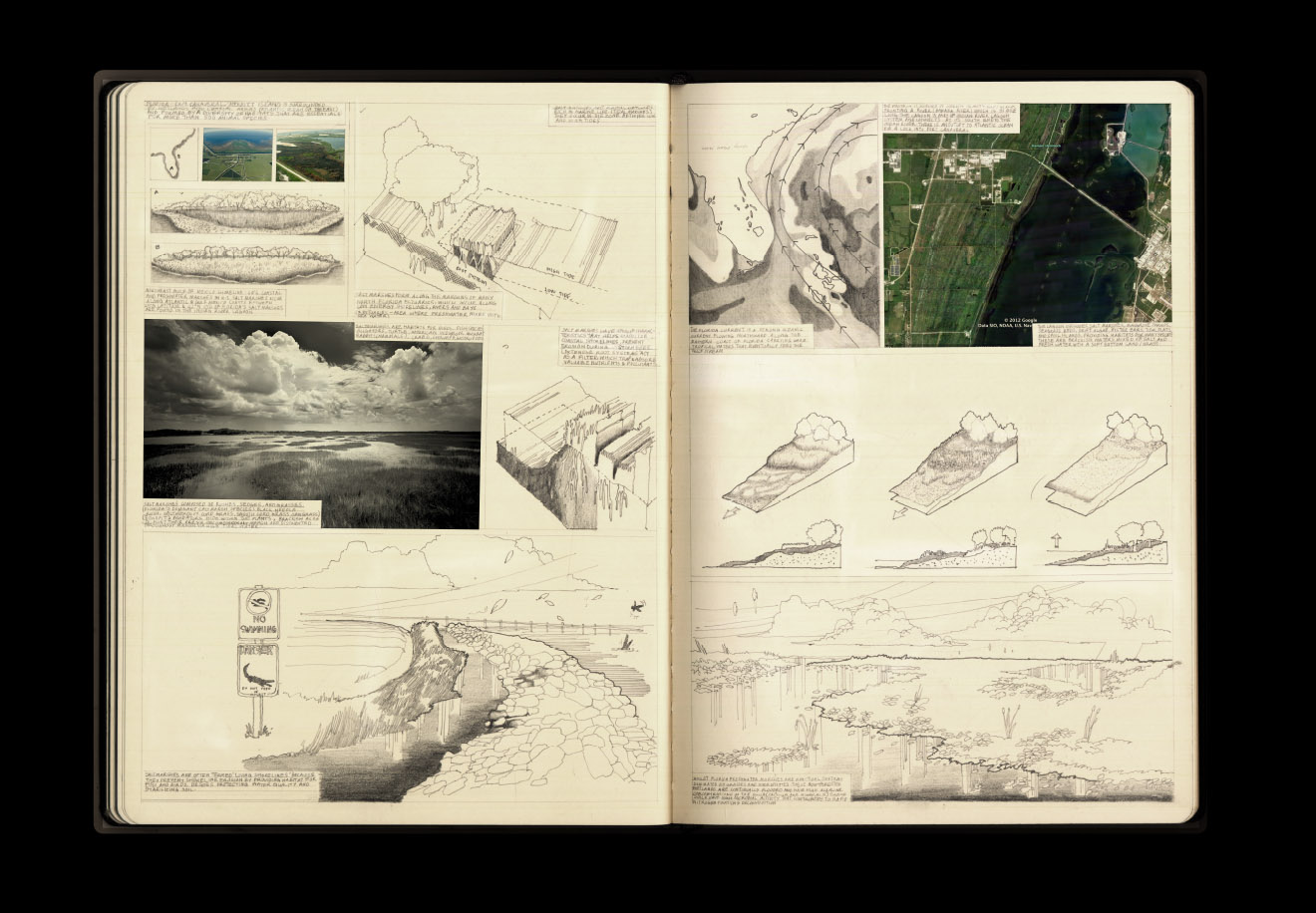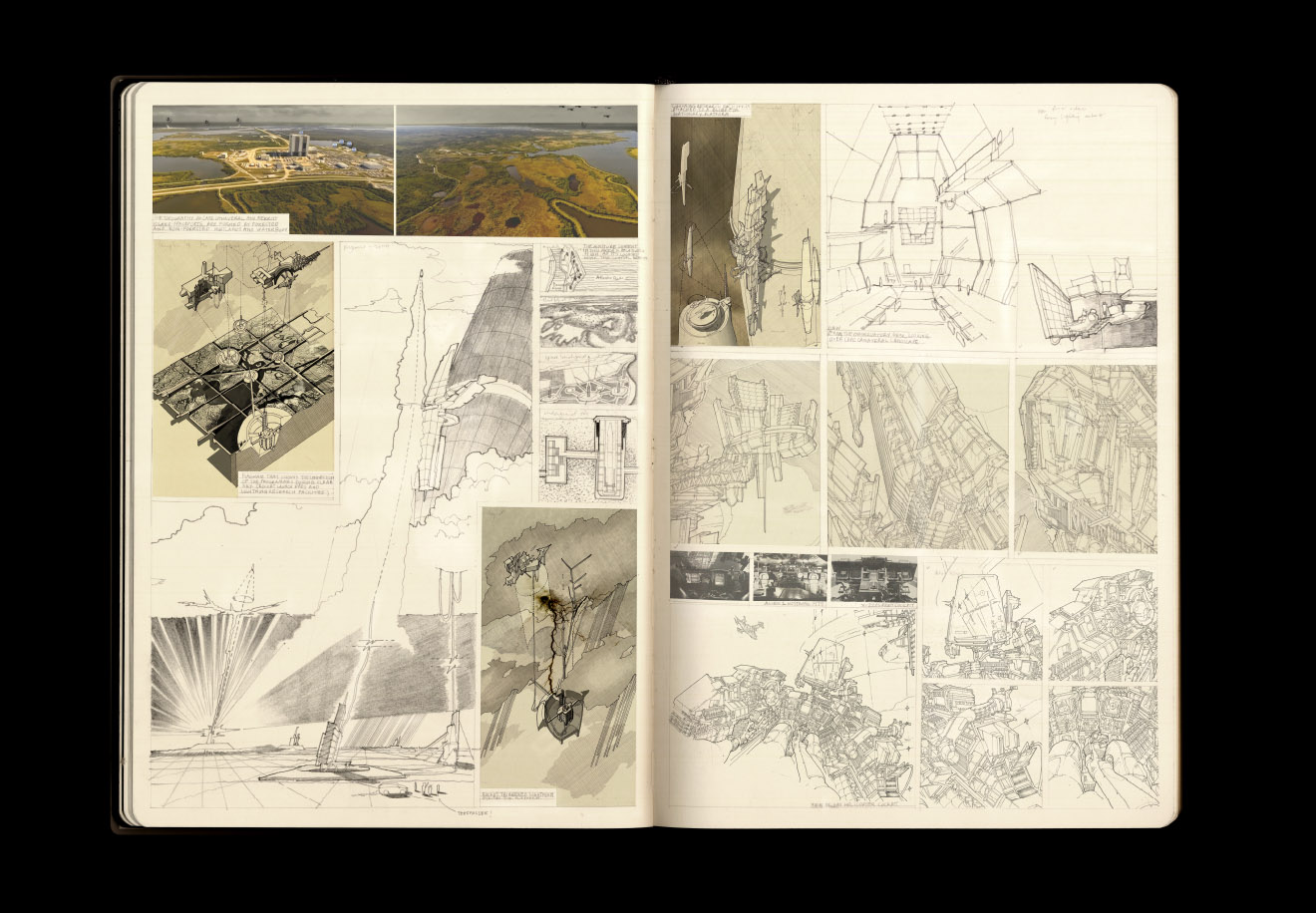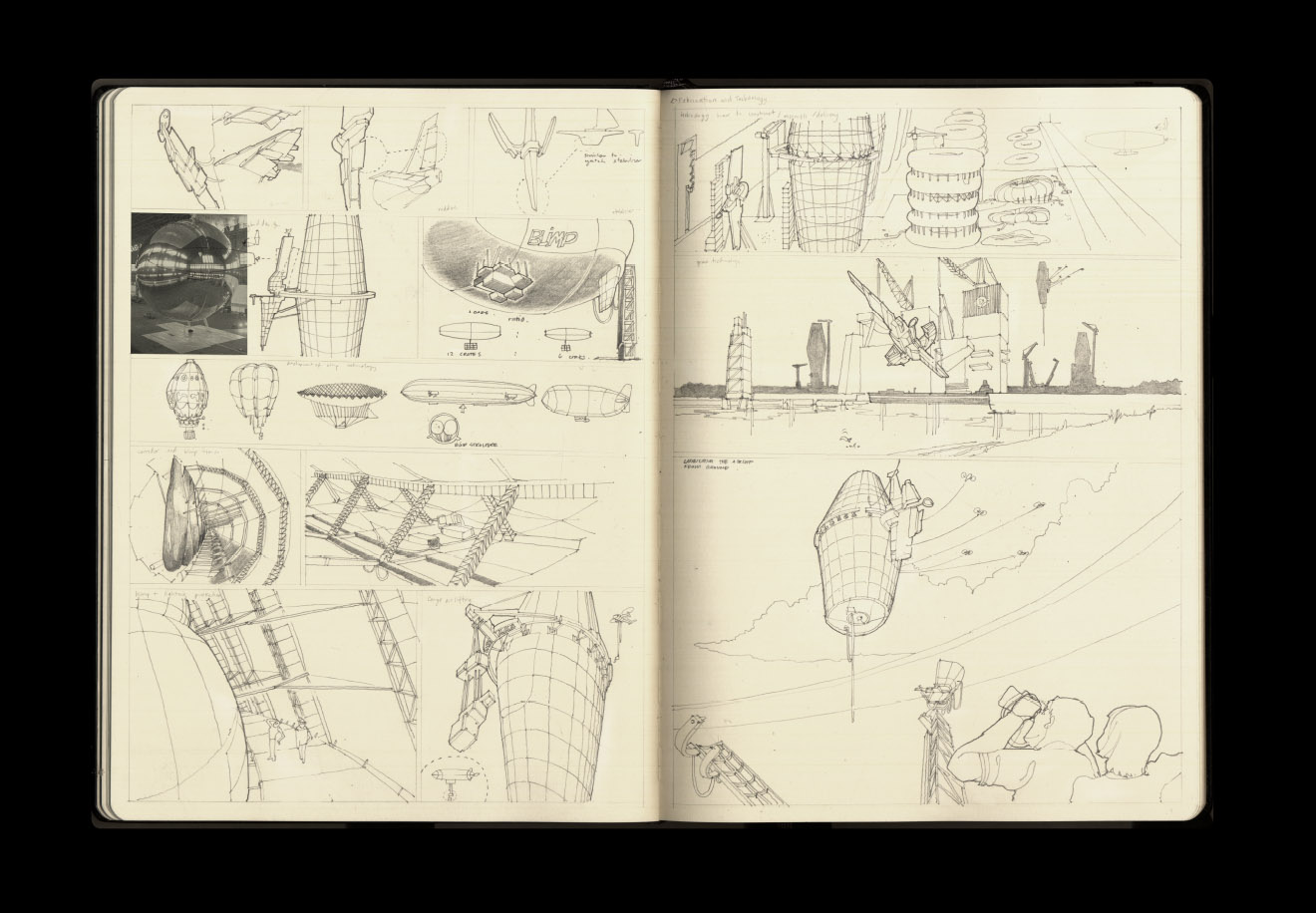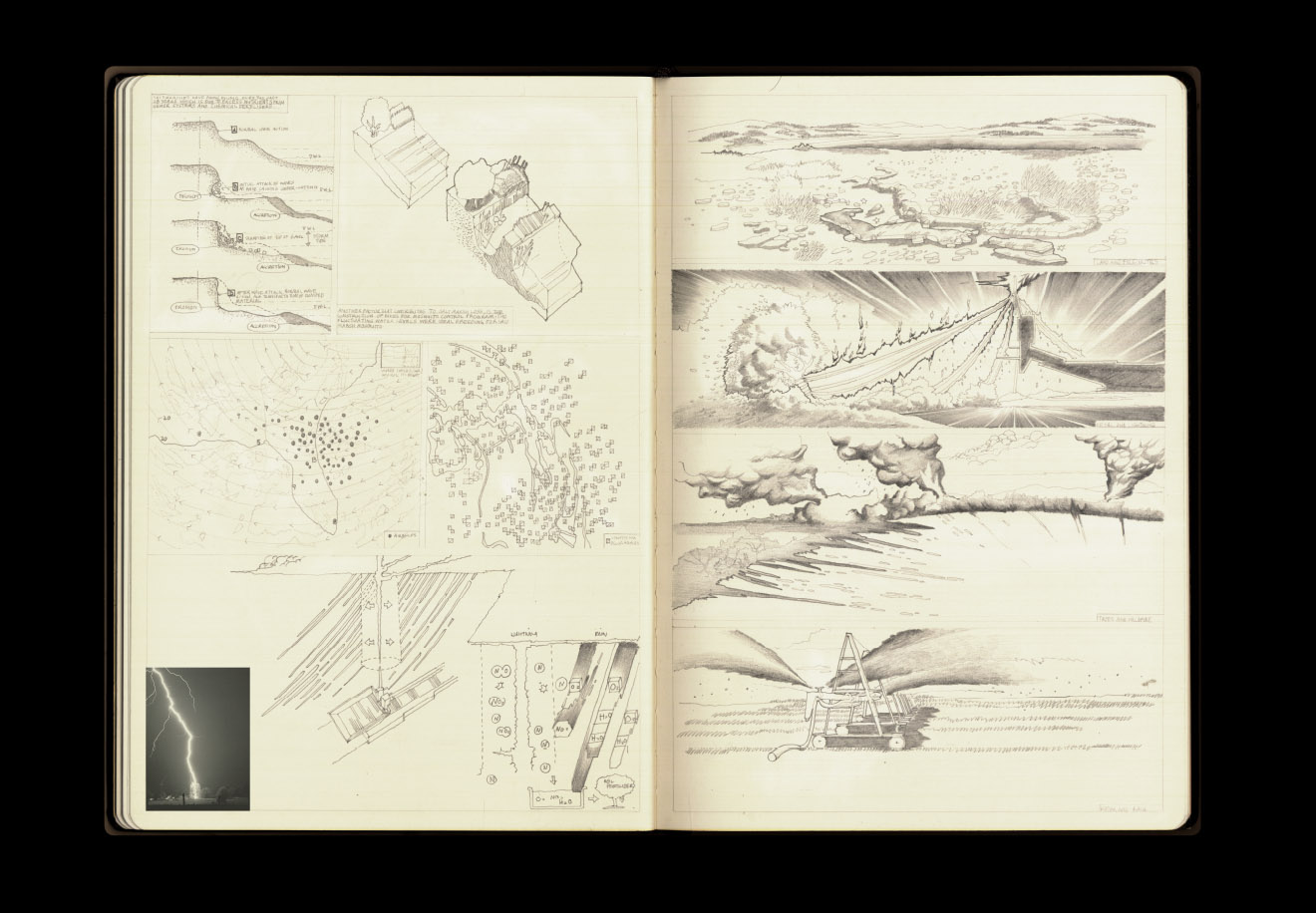
(waves, says hello, disappears again)

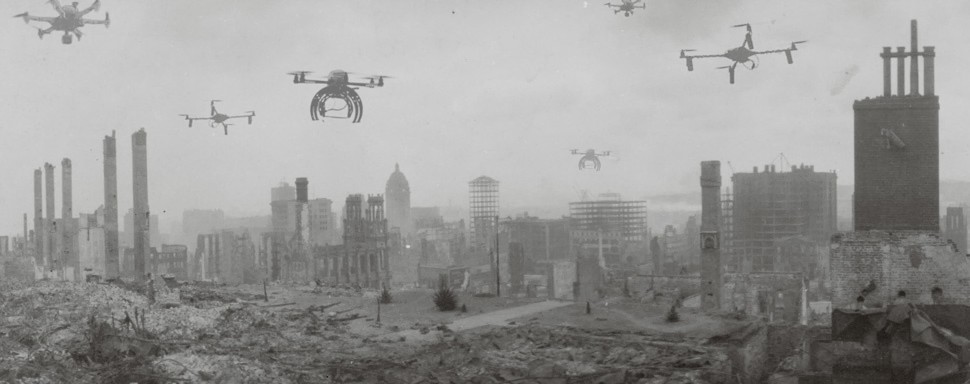
[Image: Collage by Michael Hession, based on this image from the Library of Congress].

The last few weeks have been extremely busy, and there’s been no real time to post here on BLDGBLOG; so many interesting stories have come and gone, so many ideas to discuss and write about here, but I’ve primarily been working full-throttle in my new role as Editor-in-Chief of Gizmodo, where I’ve joined a team tasked with continuing the site’s transition away from pure tech news and gadget reviews to include the worlds of architecture, urbanism, and design. Any sufficiently large technology is indistinguishable from a landscape, we might say; any sufficiently ubiquitous machine indistinguishable from a city.

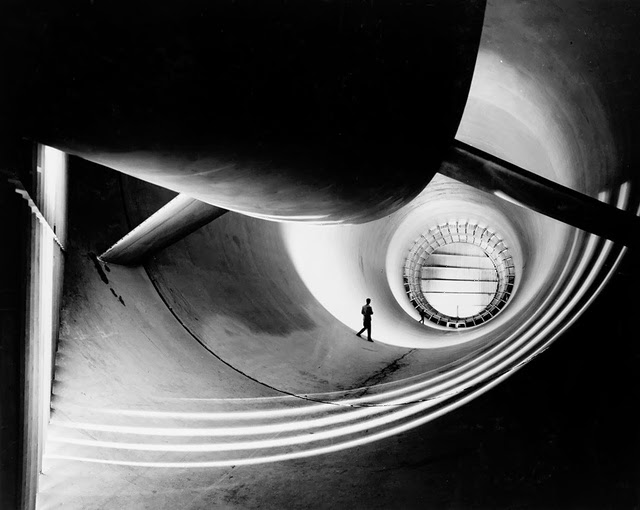
[Image: Inside a wind tunnel, courtesy of NASA, via Gizmodo].

In any case, I will be very busy for the foreseeable future in my new role—but we’ve published some really fantastic features there over the past few weeks alone, and I thought I’d throw up a quick post to give BLDGBLOG readers a taste of what’s to come. Here’s a solid list for a long day’s perusal:

Gizmodo was part of the first media tour since the 1980s of Hart Island, the largest mass grave site in the United States, run by the Department of Corrections on the outer maritime edge of New York City.

—”Capture houses” are entire decoy apartments and homes—furnished, lit, and run like actual residences—that, in reality, are elaborate traps for capturing burglars.

—The lost cow tunnels of New York City are no longer an urban myth: Nicola Twilley dug up blueprints for Gizmodo.

—The Los Angeles Aqueduct’s 100-year anniversary just rolled by and, with it, an historic reenactment of the moment the city’s floodgates were opened.

—New Yorkers receive junk mail from the future, thanks to designers Chris Woebken and Elliott P. Montgomery.

—”3D painting” creates working machine parts from directed aerosol layering—in effect, spray-painting objects into existence.

—A South Carolina archaeologist, citing Star Trek: The Next Generation as an influence, has scanned Linear B so that machines can help catalog the ancient past.

—The future of disaster recovery is a constellation of semi-autonomous robots swarming over avalanches and ruined cities to find survivors.

—An incredible “tangible interface” roils like the surface of a mechanical sea, reproducing any object you place within view of its sensors.

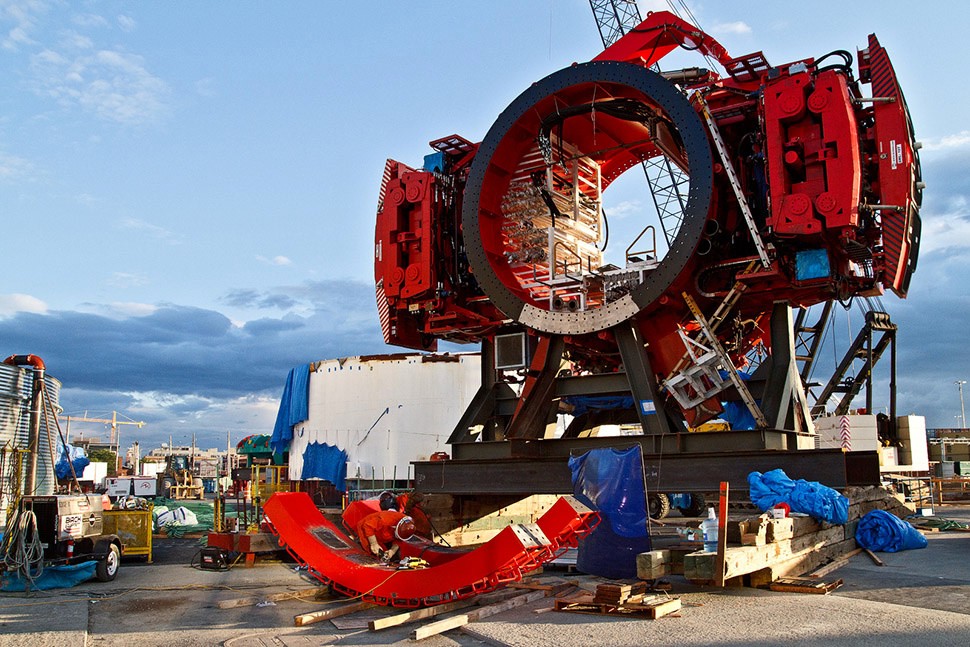
—We were on hand to see “Bertha,” the largest-diameter tunneling machine in the world, start spinning its way into the underworld of Seattle.

[Image: Bertha, a tunneling jaeger, undergoes assembly, courtesy of WSDOT, via Gizmodo].

—We learned what life is like on the job of a New York City archaeologist, digging up water mains, old bottles, and the foundation walls of lost prisons.

—Take a look at these chains 3D-printed from ice and igloos algorithmically constructed by architectural robots.

—This herky-jerky rock-climbing robot from NASA could someday conquer the glaciers, cliffs, caves, and mountains of alien worlds.

—Cheese made from human bacteria, cultivated into tomorrow’s sci-fi brie.

—Cold War weapons that terrified U.S. military intelligence.

—New techniques for turning nuclear waste into glass.

—And another tour of the Brooklyn super-factory producing modules for what will be the tallest prefab tower in the United States, right here in New York City.

Enjoy! Meanwhile, I’ll see you on the internet, here, there, and elsewhere, though the frequency of posting here will now be closer to just 2 or 3 times a month.

Books Received

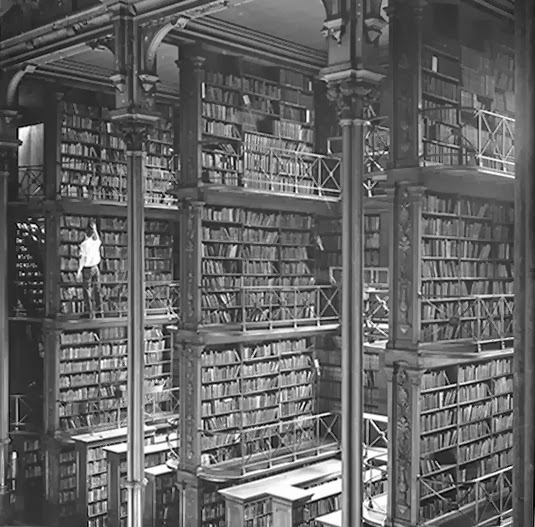
[Image: Cincinnati Public Library, 1870s; photo via Steve Silberman].

It’s that time of the year again, to take a look at the many, many books that have passed through the halls of BLDGBLOG the past season or two, ranging, as usual, from popular science to fiction, landscape history to the urban future of the refugee camp.

There are some great books included in this round-up, ones I’d love to help find a wider audience—however, as will be clear from a handful of descriptions below, and as is always the case with book round-ups here on BLDGBLOG, I have not read every book included in the following list and not all of them are necessarily new.

However, in all cases, these books are included for the interest of their approach or for their general subject matter, and the wide range of themes present should give anyone at least a few interesting titles to seek out for autumn reading.


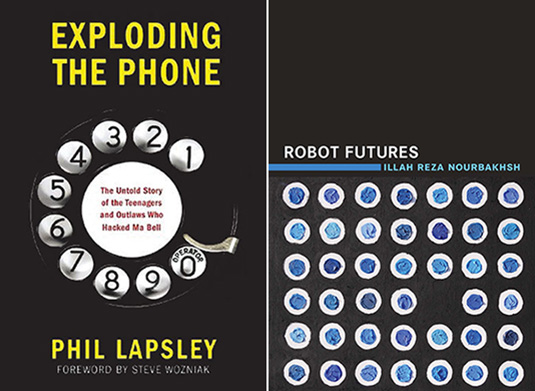
1) Exploding the Phone: The Untold Story of the Teenagers and Outlaws Who Hacked Ma Bell by Phil Lapsley (Grove Press)

One of the most enjoyable books of my summer was Exploding the Phone by Phil Lapsley. Lapsley’s history of “phone phreaks,” or people who successfully hacked the early phone networks into giving them free calls to one another and around the world, would read, in a different context, like some strange occult thriller featuring disaffected teenagers tapping into a supernatural world. Weird boxes, unexplained dial tones, and disembodied voices at the end of the line pop up throughout the book, as do surprise cameos from a pre-Apple Steve Wozniak and Steve Jobs.

Teenagers throwing frequencies and sounds at vast machines through telephone handsets managed to unlock another dimension of the phone network, Lapsley explains, a byzantine geography of remote switching centers and international operators. In the process, they helped pave the way for the hackers we know today. I have heard, anecdotally, from a few people who were around and part of these groups at the time, that Lapsley got some of his details wrong, but that didn’t take away from my enjoyment of—or inability to put down—his book. Recommended, and very fun.

2) Robot Futures by Illah Reza Nourbakhsh (MIT Press)

This pamphlet-length book by Carnegie Mellon University’s Illah Reza Nourbakhsh on the future of robotics pays admirable attention to the fundamental problem of even defining what “robotics” is. Better yet, Nourbakhsh prefaces each of his short chapters with fictional interludes exploring speculative scenarios of future robotics gone awry. There is a disturbing vignette in which flying robot toys programmed to recognize human eye contact swarm around and terrify anyone not hiding their gaze behind wearing sunglasses—something the toys’ manufacturer never predicted—as well as a memorable scenario in which new forms of robot-readable graffiti throw entire self-driving traffic systems into a tizzy, making car after car wrongly report that an impenetrable roadblock lies ahead. Call it traffic-hacking.

In the end, Nourbakhsh suggests, robots will prove to be fundamentally different from human beings, and we should be prepared for his. “A robot moving down the street will see in all directions, not simply in front of it like humans,” he writes. “If that robot is connected to a network of video cameras along the street, it will see everywhere on the street, from all angles, the entire time it walks. Imagine this scenario. A not-very-clever robot walking down the street will have access to entire synthesized views of the street—up and down, behind you, down the alley, around the corner—and be able to scroll back through time with perfect fidelity. As you approach this robot, it might be cognitively much dumber than you, but it knows far more about its surroundings than you do. It stops suddenly. What do you do? There is no common ground established between you and this robot, just the fact that you occupy the same sidewalk.”


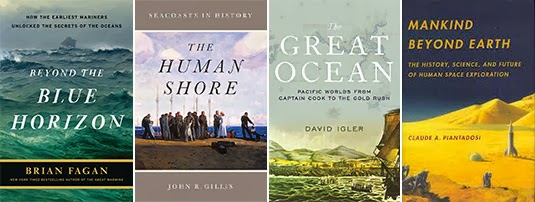
3) Beyond The Blue Horizon: How The Earliest Mariners Unlocked The Secrets Of The Oceans by Brian Fagan (Bloomsbury Press)

Brian Fagan, an environmental historian known for his books on climate change and civilization, has written a great example of what might be called adventure-history. Beyond the Blue Horizon takes us through roughly twenty thousand—even potentially, depending on how you interpret the archaeological evidence, more than one hundred thousand—years of human seafaring. Every few pages, amidst tales of people sailing in small groups, even drifting, seemingly lost, for days at a time across vast expanses of open water, Fagan makes arresting observations, such as the fact that early Pacific navigators, laden down with seeds and plants, “literally carried their own landscape with them,” he writes.

The importance of the coast in supporting human settlement, and the absolute centrality of the sea—rather than continental interiors—in shaping human history, gives Fagan multiple opportunities to refocus our sense of our own remote past. We are not landed creatures of roads and automobiles, Fagan argues, but a maritime species whose entire childhood and adolescence was spent paddling past unknown coastlines, searching for freshwater rivers and streams—a “world of ceaseless movement,” as he calls it, including now lost islands, deltas, and coasts. Fagan’s brilliance at describing landscapes as they undergo both seasonal changes and variations in climate also applies to his depictions of Earthly geography when sea levels were, for most of the eras described in his book, more than 300 feet lower than it is today. It was another planet—a maritime world—one that humans seem to have lost sight of and forgotten.

4) The Human Shore: Seacoasts in History by John R. Gillis (University of Chicago Press)

John R. Gillis’s look at “seacoasts in history” proves to be compulsively readable, sustaining many long subway rides for me here in New York, although the final few chapters fall off into unnecessarily long quotations from what seems like any random academic source he could find that mentioned the sea. This is too bad, because a shorter, more tightly edited version of this book would be a dream. Gillis is not shy about making outsized claims for revising the history of human civilization. The shore is “the true home of humankind,” he writes, “the original Eden.” He wants Westerners to forget the “terracentric history” they’ve been taught, which is, he points out, simply a historical misunderstanding of where humans actually spent 95%—the number Gillis uses—of their development: on shorelines and coastal islands.

“The book of Genesis would have us believe that our beginnings were wholly landlocked,” he writes, “but it was written at the time that the Hebrews were settling down to an agrarian existence.” Gillis quotes the words of writer Steve Mentz here, who argued that we need “fewer gardens, and more shipwrecks” in our narrative understanding of human prehistory.

Gillis allows his book some intriguing political subthemes. He writes, for example, that “it would be a very long time, almost three hundred years, before Europeans realized the full extent of the Americas’ continental character and grasped the fact that they might have to abandon the ways of seaborne empires for those of territorial states.” He adds, “for the first century or more [of their habitation in the Americas], northern Europeans showed more interest in navigational rights to certain waterways and sea tenures than in territorial possession as such.” Rivers and lakes were the key to ruling North America, for a time; and, seemingly since the interior land rush of U.S. history, the “seaborne” ways of humans, with or without a state to back them, have been forgotten.

As a brief side note, it’s interesting here to look at the Somali pirates so often mythologized in Western media, including the forthcoming Paul Greengrass film Captain Phillips—that stateless, seaborne groups of humans still exist and are the rogue scourge of landed empires (see also The Enemy of All by Daniel Heller-Roazan, etc.).

5) The Great Ocean: Pacific Worlds from Captain Cook to the Gold Rush by Davig Igler (Oxford University Press)

David Igler’s own book on all things anthropologically oceanic focuses solely on the Pacific Ocean, from the first wave of European exploration to early-modern sea trade. Igler, too, finds the land-locked nature of traditional history both claustrophobic and incorrect. “The ‘places’ usually subjected to historical analysis—nations, regions, and localities—have fixed borders enclosing land and thus constitute terrestrial history,” he writes in the book’s introduction. “Historians have far less experience imagining the ways that oceanic space connects people and polities, rather than separating them.” Igler’s larger point—that tides, currents, and winds, even specific ships, are also, in a sense, “places” deserving of historical recognition—animates the rest of the book.

Mankind Beyond Earth: The History, Science, And Future Of Human Space Exploration by Claude A. Piantadosi (Columbia University Press)

6) This book is admittedly quite hampered by its extraordinary practicality: there is very little poetry here, mostly straight talk of musculoskeletal disorders in low gravity and heat-loss from warm bodies in space. We begin on the ground floor, not only with a short and perhaps unnecessary history of the U.S. space program, but with the very basics of human physiology and the mechanics of flight. I suspect, however, that most readers are perfectly willing to jump into the deep end and read what’s on offer in the book’s later chapters: human visits to Mars, to asteroids, to “big planets, dwarf planets, and small bodies,” in Piantadosi’s words, to the “moons of the ice giants” and beyond. Ultimately, though, the book is simply too dry to feel like these later glimpses of “mankind beyond Earth,” as the title teasingly—and, for the most part, misleadingly—promises, are a worthy reward. If you must, one to look for in the local library.


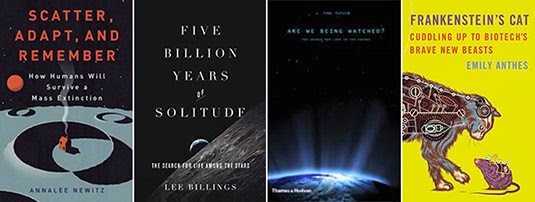
7) Scatter, Adapt, and Remember: How Humans Will Survive a Mass Extinction by Annalee Newitz (Doubleday)

Annalee Newitz, editor-in-chief of io9 and thus, now, a colleague of mine, has exceeded all expectations with the research, depth, and range of this quirkily enthusiastic look at planetary mass extinction. Her early chapters on dinosaurs, plagues, extremophiles, world-altering volcanic eruptions, long geological eras when the Earth was locked in ice, possible human/Neanderthal guerrilla warfare (not to mention inter-breeding), and much more, are like a New Scientist article you hope never ends. It’s an exciting read.

Oddly, though, the central premise of the book—that, through urbanization, human beings will find ways to avoid their own extinction—feels tacked on and unconvincingly developed. If I’m being honest, it feels like Newitz is trying to make more of an ideological point about the political value and cultural centrality of cities today, rather than actually arguing rationally for the possibility that cities will save the human species. This is especially the case if we’re talking about—as, in this book, we are—catastrophic asteroid impacts or the outbreak of a super-virus. This otherwise gripping book thus has a bit of an are-you-serious? feel as it wraps up its final fifty pages or so. While advancing a theory of safety achieved through collective living, urban farming, and social cooperation, Newitz also inadvertently seems to contradict the first command of her book’s title: to scatter. That is, to fling ourselves to the far edges of the universe—to explore, survive, and mutate with the cosmos—not to band together, urbanize, and cooperate.

As such, it seems possible to imagine an identical version of this book—identical, that is, for 200 pages or so—but with a radically differnet ending: one in which truly scattering, adapting ourselves, isolating ourselves, and differentiating our civilizational pursuits—even differentiating our very DNA through evolution in separation—would be the most effective way to avoid human extinction. But that argument, it seems, is ideologically impermissible; it makes you an anti-state survivalist, a cosmic redneck, building bunkers in the Utah desert or on the moons of another world, more Ted Nugent than Stewart Brand.

In any case, putting political arguments like these aside, the book ends with a mind-popper of a quotation. In a conversation with Randii Wessen at the Jet Propulsion Lab in Pasadena, California, Wessen tells Newitz: “Our kids are the last generation who will see no city lights on the Moon.” This is both wonderful and terrible, and as concise a statement as I’ve read anywhere to show the human future rolling on.

8) Five Billion Years of Solitude: The Search for Life Among the Stars by Lee Billings (Current)

Gifted science writer Lee Billings takes us on a search for other Earths—or, more accurately, for habitable “exoplanets” where life like us may or may not have a chance of existing. The book starts off with quite a coup. Billings treats us to a long, at-home visit with astronomer Frank Drake of Drake’s Equation fame: the abstract but reasonable calculation used for decades now to determine whether or not intelligent civilizations might exist elsewhere (and, by extension, how likely it is that humans will find them).

The book is not hard science, it is easy to follow, and Billings is a great writer; his tendency, however, veers toward the humanistic, following the life stories of individual astronomers or physicists here on Earth as they search the outer reaches of the detectable universe for signs of exoplanets.

A sizable diversion late in the book, for example, takes us on a canoe trip far into the Canadian north, past lakes and rivers, with a wary eye on approaching storms, to tell the story of how physicist Sara Seager met and fell in love with one of her colleagues. It is not a short diversion, and you’d be forgiven for thinking that Seager’s canoe trip has little to do with the search for “life among the stars,” as the book’s subtitle suggests. It is at moments like this, as Seager and her partner paddle from one portage to another, that I found myself wondering if the only stories to tell are of other human beings—whether scientists or NASA administrators—then why, in a sense, are we looking for exoplanets at all?

Of course, the book jacket never promised us surreal descriptions of other worlds. But it’s hard not to hope for exactly that: that Billings would focus his considerable rhetorical powers away from our world for a few more chapters and offer those evocative glimpses of Earth-like planets I suspect so many readers will come to his book to find—visions of worlds like ours but magically, cosmically different—and thus communicate the beautiful, poetically irresistible urge to discover them. His introductory descriptions of the formation of our solar system, for instance, are breathtaking, clear, and poetic, and similar passages elsewhere show the pull of the exoplanetary; the narrative structure of the scientist profile seems inadvertently to have focused the bulk of the book’s attention here on Earth, where we are already bound, rather than to let the strange light of the universe shine through more frequently.

But this is like complaining about dessert after a delicious meal. I’ll simply hope that Billings’s next book concentrates more on the inhuman allure so peculiar to astronomy, a field astonishingly rich with worlds mortal humans long to see.

9) Are We Being Watched?: The Search for Life in the Cosmos by Paul Murdin (Thames & Hudson)

The off-putting and sensationalistic title of Paul Murdin’s new book is, thankfully, not a sign of things to come in the text itself. Murdin’s sober yet thrilling look at the history and future of astrobiology is a bright spot in a recent spate of books about the possibility of extraterrestrial life. “The twenty-first century is the century of astrobiology,” he writes in the first sentence of chapter one; indeed, he adds with extraordinary confidence, “this is the era in which we will discover life on other worlds, and learn from it.”

Amidst many interesting tidbits, one worth repeating here actually comes from Murdin’s quotation of paleontologist Simon Conway-Morris. Conway-Morris, referring to the possibility of discovering truly alien life, rightly suggests that we could very well have no idea what we’re looking at. Indeed, he memorably says, these other life forms could be “constructions so unfamiliar that they are only brought home by accident and then inadvertently handed over for curation in a department of mineralogy.” The idea that rocks sitting quietly in a Natural History museum somewhere are actually alien life forms is mind-blowing and but one take-away from this thought-provoking book.

Over the course of Are We Being Watched?, Murdin enjoyably goes all over the place, from amino acids to plate tectonics, to radio-stimulated organic molecules in the atmosphere of Titan. As if channeling H.P. Lovecraft, Murdin at one point writes that, on Jupiter’s ice-covered moon Europa, scientists have seen the same churning processes as witnessed in Antarctica, but, on Europa, “we see the results of this churning as colored stains on ridges of ice at the boundaries of ice floes. Perhaps in these colored stains lie dead creatures, brought up from the depths of the ocean and exposed to view by orbiting spacecraft or landers that can rove over the surface.”

10) Frankenstein’s Cat: Cuddling Up to Biotech’s Brave New Beasts by Emily Anthes (FSG)

Frankenstein’s Cat follows the 21st-century quest to re-engineer biology, to design “the fauna of the future,” as the book promises, or “biotech’s brave new beasts,” where resurrected species, pets with prostheses, and militarized insects crawl through forests of genetically modified trees. At once terrifying and thrilling, and animated in all cases by the gonzo enthusiasm of any science operating at seemingly unstoppable speed, Emily Anthes’s book shows the weird biological breakthroughs that will ultimately create the landscapes of tomorrow: the cities, gardens, parks, oceans, and backyards our descendants will inevitably mistake for nature (and then, eventually, dismiss as mundane).


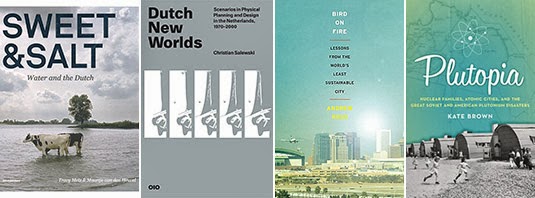
11) Sweet & Salt: Water And The Dutch by Tracy Metz and Maartje van den Heuvel (NAi Publishers)

Journalist Tracy Metz and art historian Maartje van den Heuvel have teamed up for this collaborative look at “environmental planning” in the Netherlands, with a focus on all things aquatic. While Metz visits the country’s numerous megaprojects and anti-flooding infrastructure to speak with water engineers, “dike wardens,” and other stewards of Holland’s relationship with rain and the sea, van den Heuvel assembles a spectacular catalog featuring visual depictions of waterworks throughout Dutch art history. This is “the visualization of water in art,” as she calls it, revealing “anxieties about flooding” and a deep-rooted infrastructural patriotism inspired by the technical means for controlling that flooding.

Ultimately, the book’s goal is to show how Dutch water management is changing in the face of rising sea levels and climate change, and how “water is coming back into the city,” as Metz writes, changing the nature of contemporary urban design.

12) Dutch New Worlds: Scenarios in Physical Planning and Design in the Netherlands, 1970-2000 by Christian Salewski (010 Publishers)

This well-illustrated history and catalog of large-scale hydrological projects in the Netherlands—and the “Dutch new worlds” those projects helped generate—offers a provocative look at the very idea of infrastructure. Salewski suggests that a nation’s infrastructure is like literature or mythology, a built narrative in which a much larger constellation of dreams and aspirations can be read. “There is no Dutch Hollywood,” Salewski writes, “no cinematic dream machine that constantly processes the current view of the future into easily digestible, mass-consumed science fiction movies. Dutch views into the future are probably best found not in cultural works of literature and art, but in physical planning designs.” That is, in the dams, dikes, levees, and polders the rest of the book goes on to so interestingly describe. Infrastructure, Salewski offers, is one of many ways in which a nation dreams.

13) Bird On Fire: Lessons From The World’s Least Sustainable City by Andrew Ross (Oxford University Press)

Andrew Ross takes a critical look at Phoenix, Arizona, a desert city “sprawling over a thousand square miles, with a population of four and a half million, minimal rainfall, scorching heat, and an insatiable appetite for unrestrained growth and unrestricted property rights.” As the city tries to “green” itself through boosts in public transportation and a more sensible water management strategy—among other things—Ross asks if an urban transformation, something that might save Phoenix from its current parched fate, is even possible.

14) Plutopia: Nuclear Families, Atomic Cities, and the Great Soviet and American Plutonium Disasters by Kate Brown (Oxford University Press)

Kate Brown’s Plutopia creates a horrifying set of conjoined urban twins, so to speak, by both comparing and contrasting the purpose-built plutonium production towns of Richland, Washington, and Ozersk, Russia. These were fully planned and state-supported facilities, yet both were also highly delicate, secret cities—in Ozersk’s case, literally off the map—constantly at risk of nuclear disaster. And disaster, of course, eventually comes.

Brown points out how, between the two of them, Richland and Ozersk released four times the amount of radiation into the environment as the meltdown at Chernobyl, and she tracks the disturbing long-term health and environmental effects in the surrounding regions. In both cases, perhaps cynically, perhaps inspiringly, these polluted regions have become nature reserves.

In a particularly troubling anecdote from the final chapter, referring to the experience of Richland, Brown points out that “periodically deer and rabbits wander from the preserve and leave radioactive droppings on Richland’s lawns,” but also, more seriously, that multiple wineries have sprung up perilously close to the hazard zone, “near the mothballed plutonium plant.” While sipping wine at one of those very vineyards, Brown tries to talk to the locals about the potential for radiation in the soil—and, thus, in the wine—but, unsurprisingly, they react to her questions “testily.”

These carefully manicured utopian towns, like scenes from The Truman Show crossed with Silkwood, with their dark role in the state production of plutonium, give us the “Plutopia” of the book’s title. Ozersk and Richland are “citadels of plutonium,” she writes, instant cities of the atomic age.


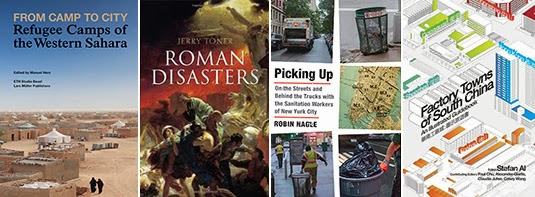
15) From Camp To City: Refugee Camps of the Western Sahara by Manuel Herz (Lars Müller Publishers)

Based on original research from a studio taught at the ETH in Zurich, architect Manuel Herz has assembled this fascinating and important guide to the urban and quasi-urban structures of refugee camps. Focusing specifically on camps in extreme southwest Algeria, populated by people fleeing from conflict in the Western Sahara, these camps are, Herz suggests, Western instant urbanism stripped bare, the city shown at its factory presets, revealing the infrastructural defaults and basic political conditions of the modern metropolis. They are “the spatial manifestation of the state of exception,” he writes, citing Giorgio Agamben, mere “holding areas” in which urban forms slowly take shape and crystallize. The camps are where, Herz writes, “Architecture and planning becomes [sic] a replacement for a political solution.”

From the architecture of the tents themselves to the delivery infrastructures that bring water, food, and other vital goods to their inhabitants, to culturally specific spatial accouterments, like carpets and curtains, Herz shows how the camps manage to become cities almost in spite of themselves, and how these cities then offer something like training grounds for future nations to come. In Herz’s own words, “the camps act also as a training phase, during which the Sahrawi society [of the Western Sahara] can develop ideas and concepts of what system of education they want to establish, and learn about public health and medical service provision. The camps become a space where nation-building can be learned and performed, to be later transferred to their original homeland, if it becomes available in the future.”

This idea of the state-in-waiting—and its ongoing spatial rehearsal in the form of emergency camps—runs throughout the book, which is also a detailed, full-color catalog of almost every conceivable spatial detail of life in these refugee camps. In the process, Herz and his team have assembled a highly readable and deeply fascinating look at urbanism in its most exposed or raw condition. “In the blazing sun of the Sahara Desert,” he concludes, “we can observe the birth of the urban condition with a clarity and crispness almost unlike anywhere else in the world.”

16) Roman Disasters by Jerry Toner (Polity)

Cambridge Classicist Jerry Toner had described his wide range of interests as being centered on the notion of “history from below.” He has written prolifically about ancient Rome, in particular, from several unexpected points of view, including popular culture in antiquity, the smellscape of early Christianity, and an currently in-progress work on crime in the ancient metropolis.

Roman Disasters looks specifically at imperial disaster-response, including earthquakes, volcanic eruptions, catastrophic fires, warfare, and disease. Toner describes how the abstract notion of risk was first formulated and understood; the role of religious prophecy in “imagining future disaster”; and halting, ultimately unsuccessful attempts to construct a fireproof metropolis, such as the widening of city streets and the creation of a semi-permanent Roman fire brigade.

Very much a history, rather than a page-turner directed at a popular audience, Roman Disasters nonetheless offers a compelling and unexpected look at the ancient world, one peppered with refugee camps, tent cities, and displaced populations all looking for—and not necessarily finding—imperial beneficence.

17) Picking Up: On the Streets and Behind the Trucks with the Sanitation Workers of New York City by Robin Nagle (FSG)

Robin Nagle is an “anthropologist-in-residence” at the NYC Department Sanitation. Picking Up is her document of that incredible—and strange—backstage pass to the afterlife of the city, where all that we discard or undervalue simply gets tossed to the curb. Nagle tags along with, interviews, and reveals the “garbage faeries” who rid our streets of the unwanted detritus of everyday life, whether trash or snow. In the process, she’s written a kind of narrative map or oral history of another New York, one with its own flows and infrastructure, and one that exists all but invisibly alongside the one we inhabit everyday.

18) Factory Towns of South China: An Illustrated Guidebook edited by Stefan Al (Hong Kong University Press)

Architect Stefan Al, currently teaching at the University of Pennsylvania, leads a team of researchers to the Pearl River Delta, the “factory of the world,” to explore how people live and—even more—how they work in the region. A fascinating glimpse at the “self-contained world” of what amounts to corporate-industrial urbanism, the book nonetheless feels very much like a book assembled by architects who had a grant for producing a publication: it is heavy on comparative infographics, layered images, pie charts, and small-print introductory essays, all on coated paper resistant to underlining. The subject matter is fascinating, but the book is ultimately of less use than, say, sending Robin Nagle to visit these “factory towns of south China,” reporting back about the complicated lives and material cultures found there.


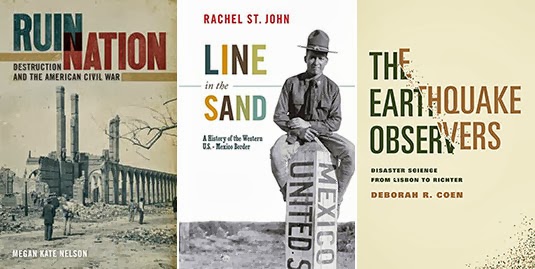
19) Ruin Nation: Destruction And The American Civil War by Megan Kate Nelson (University of Georgia Press)

Megan Kate Nelson’s Ruin Nation is a kind of Piranesian guide to the Civil War ruins of American cities of the 19th century. The book is a bit slow and overly cautious in its descriptions, but it is remarkable for a specific focus on architectural ruins following the Civil War. “Architectural ruins—cities and houses—dominated the stories that soldiers and civilians told about the Civil War,” she writes in the book’s introduction, a time when whole cities were reduced to “lone chimneys” amidst the smoke and obliteration of urban warfare. We often hear—especially post-9/11—that Americans have never really experienced war and destruction on their own soil, but Nelson’s book convincingly and devastatingly shows how inaccurate a statement that is.

20) Line In The Sand: A History Of The U.S.-Mexico Border by Rachel St. John (Princeton University Press)

Heading west from the Gulf Coast, the U.S.-Mexico border takes an unexpected turn when you get past El Paso, Texas—that is, by not really turning at all. The border instead becomes a series of abnormally, mathematically straight lines, cutting, with only a few diversions north and south, all the way to the Pacific Ocean. It thus no longer follows any natural feature, such as the Rio Grande River.

But why is the border exactly here, and why the rigid, linear path that it takes? Rachel St. John’s “history of the western U.S.-Mexico border” looks at sovereignty, surveying, geography, diplomacy, war, conquest, and private property to piece together the tangled story of this “line in the sand” and the people (and economies) it has divided. Line in the Sand—which often has the ungainly feel of a Ph.D. thesis later edited into a book—ends with a critical look at the “operational security” falsely promised by a border fence, and a more hopeful look at mutations of the border region yet to come.

21) The Earthquake Observers: Disaster Science From Lisbon To Richter by Deborah R. Coen (University of Chicago Press)

Deborah Coen’s Earthquake Observers looks at the history of seismology—or the study of earthquakes—but, more specifically, seismology’s transition from something like a folk art of human observation to an instrumented science. It is a consistently interesting book, so much so that I invited Coen to speak to my class at Columbia last semester.

The book includes a great deal worth mentioning here, from the gender of early earthquake observers—writing, for example, specifically in reference to early-modern domesticity, that “a quiet, housebound lifestyle and close attention to the arrangement of domestic objects put many bourgeois women in an excellent position to detect tremors”—to the literally geopolitical effects of earthquakes. In the latter case, a state of emergency following catastrophic seismic events helped to influence 20th-century legal theory as well as to challenge accepted hierarchies of what it means for a state to respond. “Particularly in the Balkans,” she writes, “earthquakes called into question the political framework that tied the monarchy’s fringes to its two capitals: which level of the state’s intricate web of governance would respond?”

John Muir, the San Francisco earthquake of 1906, and the study of earthquake-related traumas, or “seismopathology,” all make their appearance in Coen’s study of how seismology became both modern and scientific.


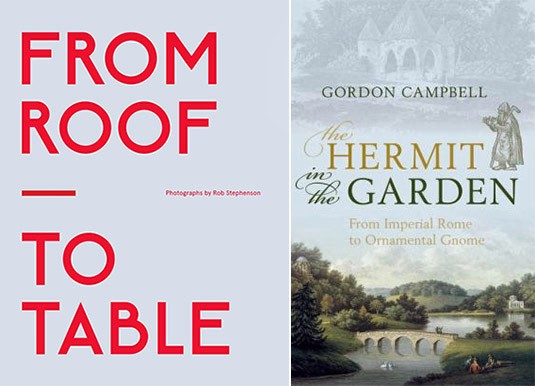
22) From Roof To Table: Photographs By Rob Stephenson by Rob Stephenson (Design Trust for Public Space)

This magazine-style pamphlet of images by photographer Rob Stephenson documents urban farming efforts—not necessarily limited to roofs—across New York City. Plots of land beside empty brick warehouses, backyards, and even university labs bloom with fruits and vegetables in Stephenson’s full-color shots. “With the influx of people to cities and a continuing rise in the financial and environmental costs of shipping food, the widespread and large-scale adoption of urban agriculture seems inevitable,” Stephenson writes in an accompanying project description. “New York City, with its network of backyard vegetable plots, community gardens and rooftop farms, is at the forefront of this transformation.”

23) The Hermit in the Garden: From Imperial Rome to Ornamental Gnome by Gordon Campbell (Oxford University Press)

Gordon Campbell’s history of the garden hermit attempts to discover why the phenomenon of the live-in hermit—an actual human being, installed in a landscaped garden, acting as a form of living ornament—arose at all. Along the way, he explores what architectural structures these hermits required and the cultural motifs their strange roles kicked off. “Who were these people?” Campbell asks. “Why did landowners think it appropriate to have them in their gardens? What function did they serve?”


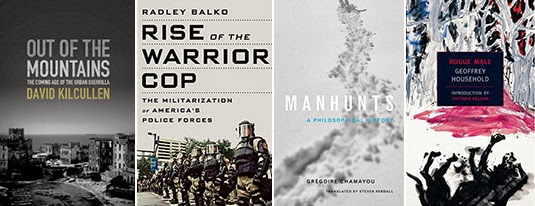
24) Out of the Mountains: The Coming Age of the Urban Guerrilla by David Killcullen (Oxford University Press)

Military strategist David Kilcullen takes on the urban future of war, arguing that armed conflict will occur more often, and with increasingly devastating effects, in cities. If the future is such that, in his words, “all aspects of human life—including, but not only, conflict, crime and violence—will be crowded, urban, networked and coastal,” then it only makes sense to attempt to make sense of this, both sociologically and from the perspective of the military.

Citing everything from Richard Norton’s revolutionary notion of the “feral city” to Mike Davis’s Planet of Slums—Davis, in fact, blurbs the book—Kilcullen has written a must-read for anyone unconvinced by the rosy take on cities and their triumphant future currently dominating the best-seller list.

25) Rise of the Warrior Cop: The Militarization of America’s Police Forces by Radley Balko (PublicAffairs)

Radley Blako’s libertarian take on the “militarization of America’s police forces” is more Rand Paul than ACLU, if you will, but it’s a worthy read for all sides of the political debate. It opens with the jarring rhetorical question, “Are cops constitutional?” And it goes on from there to discuss legal debates on federal power and the 3rd and 4th Amendments, a short history of military tactics creeping into the U.S. police arsenal following urban riots in Watts, the rise of reality TV shows seemingly encouraging police belligerence, the War on Drugs, the Occupy Movement, today’s all but ubiquitous Taser (and its abuse), no-knock raids, and more.

If you’re interested in cities, you should also be interested in how those cities are policed, and this is as interesting a place as any to start digging.

26) Manhunts: A Philosophical History by Grégoire Chamayou (Princeton University Press)

I picked up a copy of this book after an interesting, albeit brief, email exchange with L.A. Times architecture critic Christopher Hawthorne, who described a shift from the high-speed chase (that is, a large amount of space covered at high speed) to the manhunt (or a limited space studied with incredible intensity).

I’ve written about Hawthorne’s observation at greater length in my own forthcoming book about crime and architecture, and, while researching that book, I thought Grégoire Chamayou’s Manhunts would be a helpful reference. It was not, if I’m being honest, but it is, nonetheless, a striking work on its own terms: a history of what it means to hunt human beings, from runaway slaves and “illegal aliens” to Jews in World War II. He calls this an “anthropology of the predator”—“a history and a philosophy of hunting powers and their technologies of capture”—wherein the prey subject to destruction is a banished or shunned human being, terrifyingly relegated to the status of animal.

27) Rogue Male by Geoffrey Household (New York Review of Books Classics)

This strange, quite short, and very readable novel, recently brought back into print by the New York Review of Books, tells the story of a British political agent who fails in his attempt to assassinate an unnamed German political leader (who is, clearly, Adolf Hitler). The man flees Germany for the comparative safety of England, only to be relentlessly—and, as it happens, successfully—hunted by German agents intent on revenge.

It both does and does not spoil the rest of the book to reveal that the hunted man literally goes to ground, terrestrializing himself by digging a burrow in the Earth and hiding out there amidst the mud, the exposed tree roots, the darkness, and his own waste, sleeping unwashed in a humiliating cave of his own making, his clothes rotten, his feet swollen by rain, living underground at the side of a small lane in Britain’s agrarian hinterland. When he is found—and he is found—what could descend into a Rambo-like scene of violence and retaliation instead offers something that is still violent but far stranger, as this nearly worldchanging political actor, a failed assassin who could have changed the 20th century, finds a way to escape his grotesque and feral state.

Have a good autumn, and enjoy the books.

* * *

All Books Received: August 2015, September 2013, December 2012, June 2012, December 2010 (“Climate Futures List”), May 2010, May 2009, and March 2009.

(Thanks to Dan Bergevin for my copy of Out of the Mountains).

Sukkah City

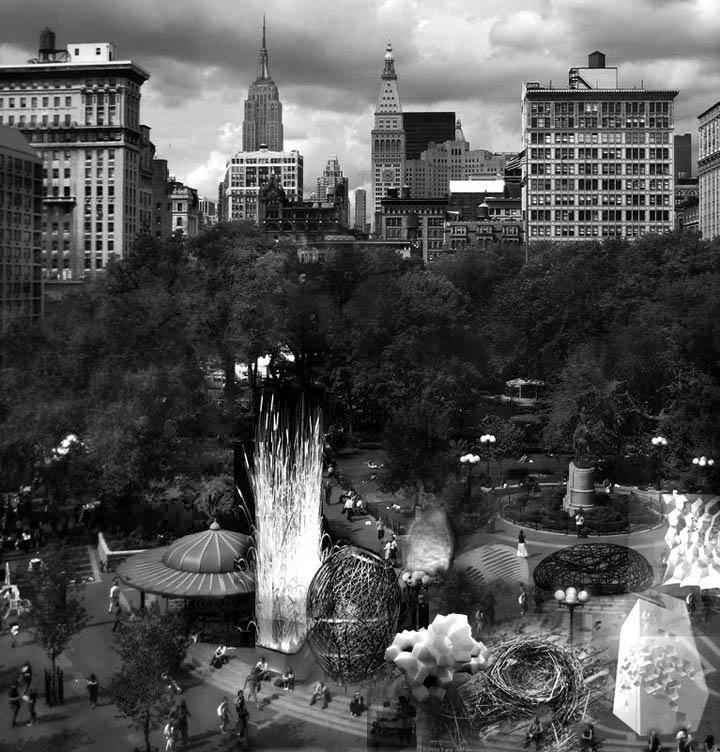
[Image: Sukkah City as it could be].

Joshua Foer, co-founder of Atlas Obscura and author of the forthcoming book Moonwalking with Einstein, has put together an awesome design competition called “Sukkah City.”

A sukkah is a temporary architectural structure with Biblical origins; it is “an ephemeral, elemental shelter, erected for one week each fall,” Foer writes, “in which it is customary to share meals, entertain, sleep, and rejoice. Ostensibly the sukkah’s religious function is to commemorate the temporary structures that the Israelites dwelled in during their exodus from Egypt, but it is also about universal ideas of transience and permanence as expressed in architecture.” The modern-day sukkah is thus both nostalgia and reenactment, substitution and performance (to put it in terms explored by the recent book Anachronic Renaissance).

With this historical background, you can imagine that the brief includes some very particular constraints, design limits that should prove oddly exhilarating to anyone willing to take them on:

The basic constraints seem simple: the structure must be temporary, have at least two and a half walls, be big enough to contain a table, and have a roof made of shade-providing organic materials through which one can see the stars. Yet a deep dialogue of historical texts intricately refines and interprets these constraints—arguing, for example, for a 27 x 27 x 38-inch minimum volume; for a maximum height of 30 feet; for walls that cannot sway more than one handbreadth; for a mineral and botanical menagerie of construction materials; and even, in one famous instance, whether it is kosher to adaptively reuse a recently deceased elephant as a wall. (It is.) The paradoxical effect of these constraints is to produce a building that is at once new and old, timely and timeless, mobile and stable, open and enclosed, homey and uncanny, comfortable and critical.

The idea of there being a long-running interpretive tradition associated with this specific but highly abstract architectural structure is amazing to me: an oral tradition, or architectural midrash, spanning centuries, through which even the most basic parameters—and thus the building’s most wild, soaring, and structurally unexpected instantiations, its walls made from dead elephants, its roof a meshed hole through which to spy on stars—can be determined.

More from the brief:

Sukkah City: New York City” will re-imagine this ancient phenomenon, develop new methods of material practice and parametric design, and propose radical possibilities for traditional design constraints in a contemporary urban site. Twelve finalists will be selected by a panel of celebrated architects, designers, and critics to be constructed in a visionary village in Union Square Park from September 19-21, 2010.
One structure will be chosen by New Yorkers to stand and delight throughout the week-long festival of Sukkot as the Official Sukkah of New York City. The process and results of the competition, along with construction documentation and critical essays, will be published in the forthcoming book Sukkah City: Radically Temporary Architecture for the Next Three Thousand Years.

You must register by July 1, and your design proposal will be due by August 1. I’m a bit biased here, but the jury includes some heavyweights, including Paul Goldberger, Ron Arad, Natalie Jeremijenko, Steven Heller, Maira Kalman, Thom Mayne, Ada Tolle, Thomas de Monchaux (co-coordinator of Sukkah City), and many others. I can’t wait to see what comes in, and I’d strongly encourage all sorts of approaches to this, from sprawling plastic plant forms to blocks of plug-in modularity, from a showerhead that 3D-prints the building below it to DIY assemblages of found materials. The collaged image, above, shows how formally interesting some of this could get.

And anyone is able to join in—as Foer writes, “If you’re an architect, designer, artist, engineer, backyard builder, or just someone with a clever idea, I hope you’ll consider entering.”

Lightning Farm

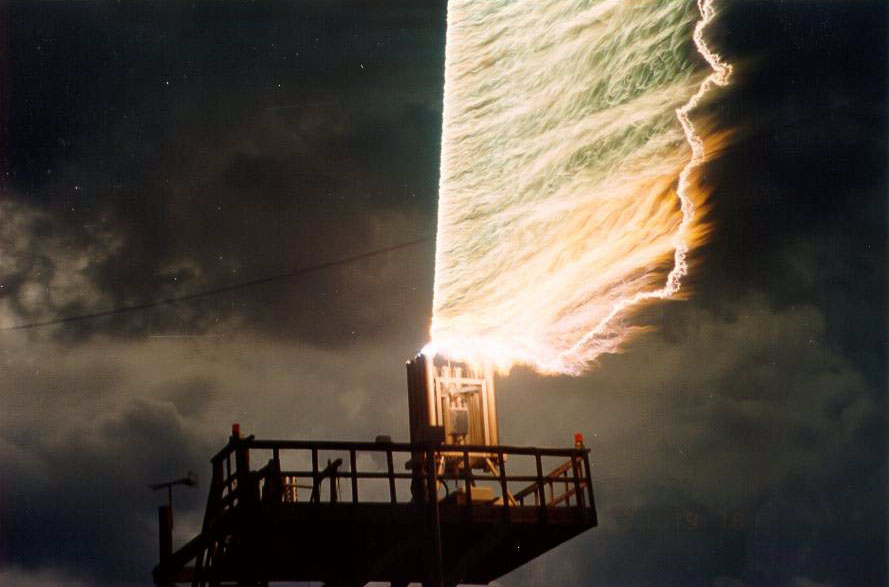
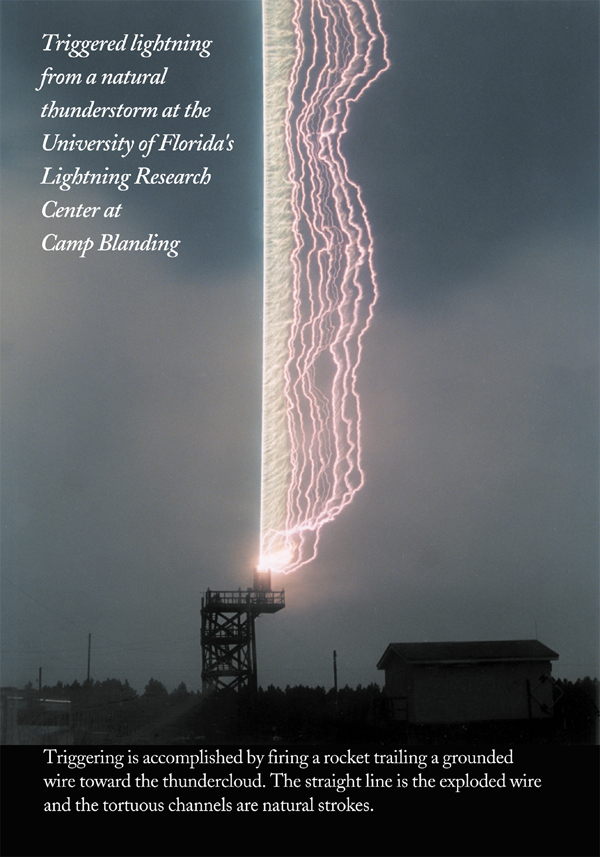
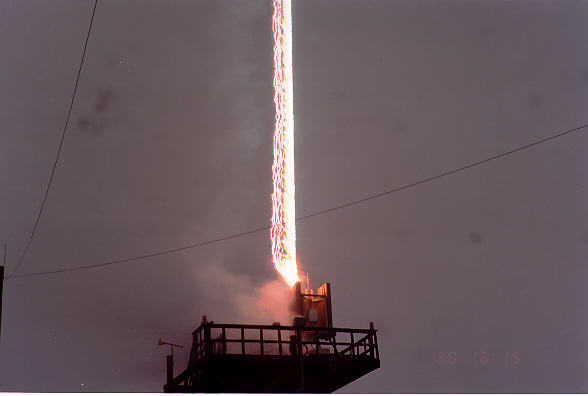
[Image: Triggered lightning technology at the University of Florida’s Lightning Research Group].

This past winter, I had the pleasure of traveling around south Florida with Smout Allen, Kyle Buchanan, and nearly two dozen students from Unit 11 at the Bartlett School of Architecture.

Florida’s variable terrains—of sink holes, swamps, and eroding beaches—and its Herculean infrastructure, from canals and freeways to theme parks and rocket facilities, served as the narrative backdrop for the many architectural projects ultimately produced by the class (in addition, of course, to the 2012 U.S. Presidential election, the results of which we watched live from the bar of a tropical-themed hotel near Cape Canaveral, next door to Ron Jon).

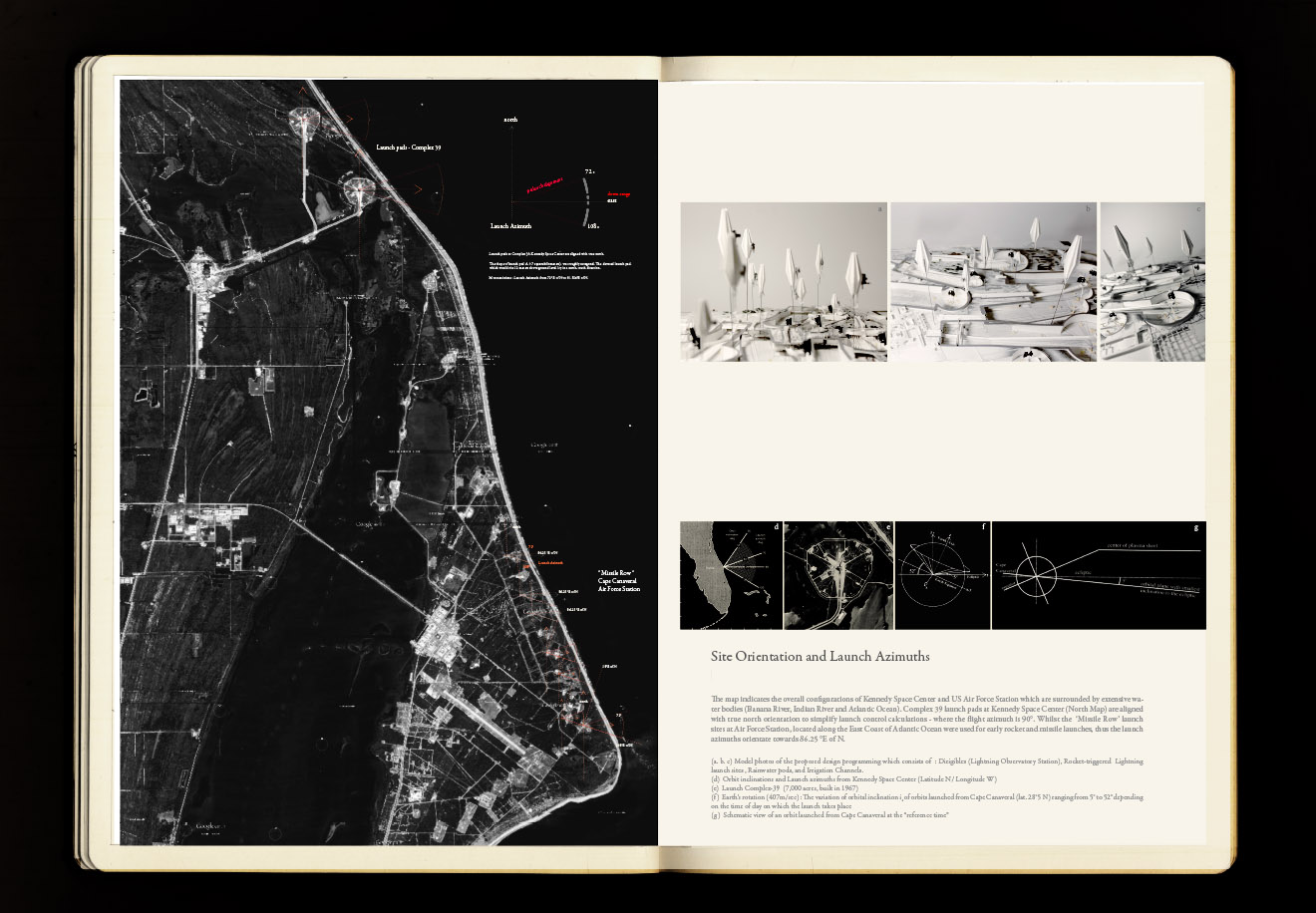
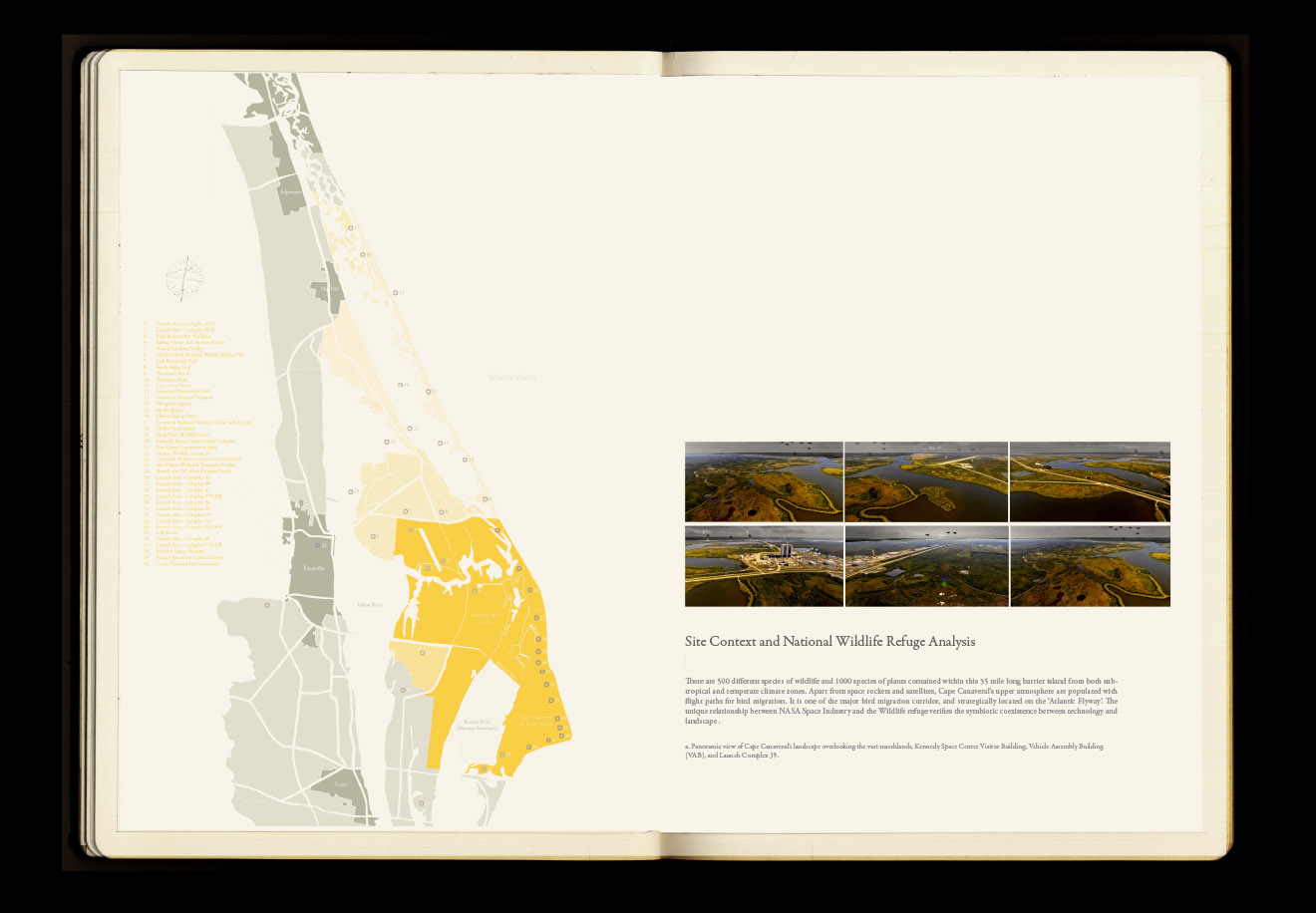
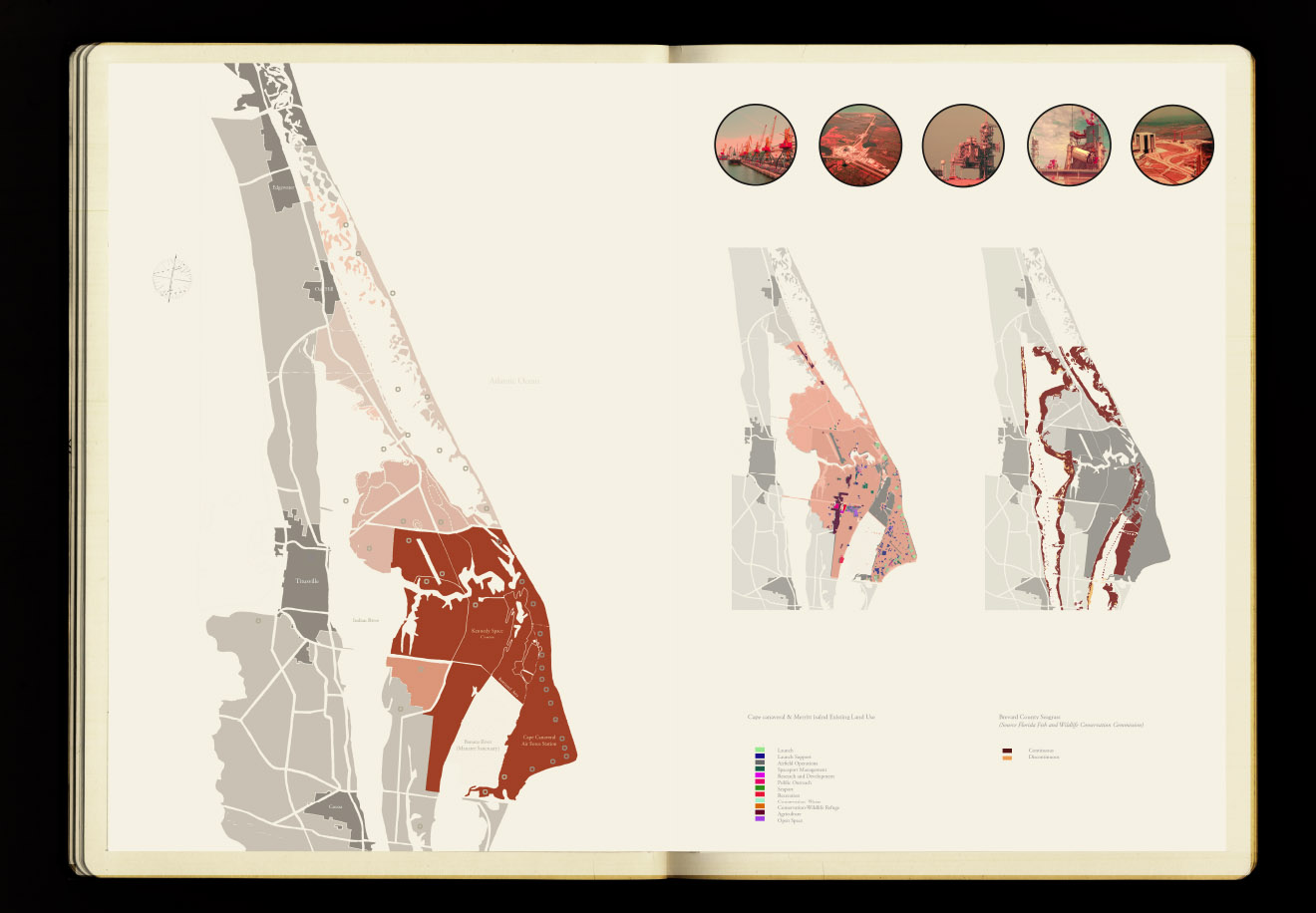
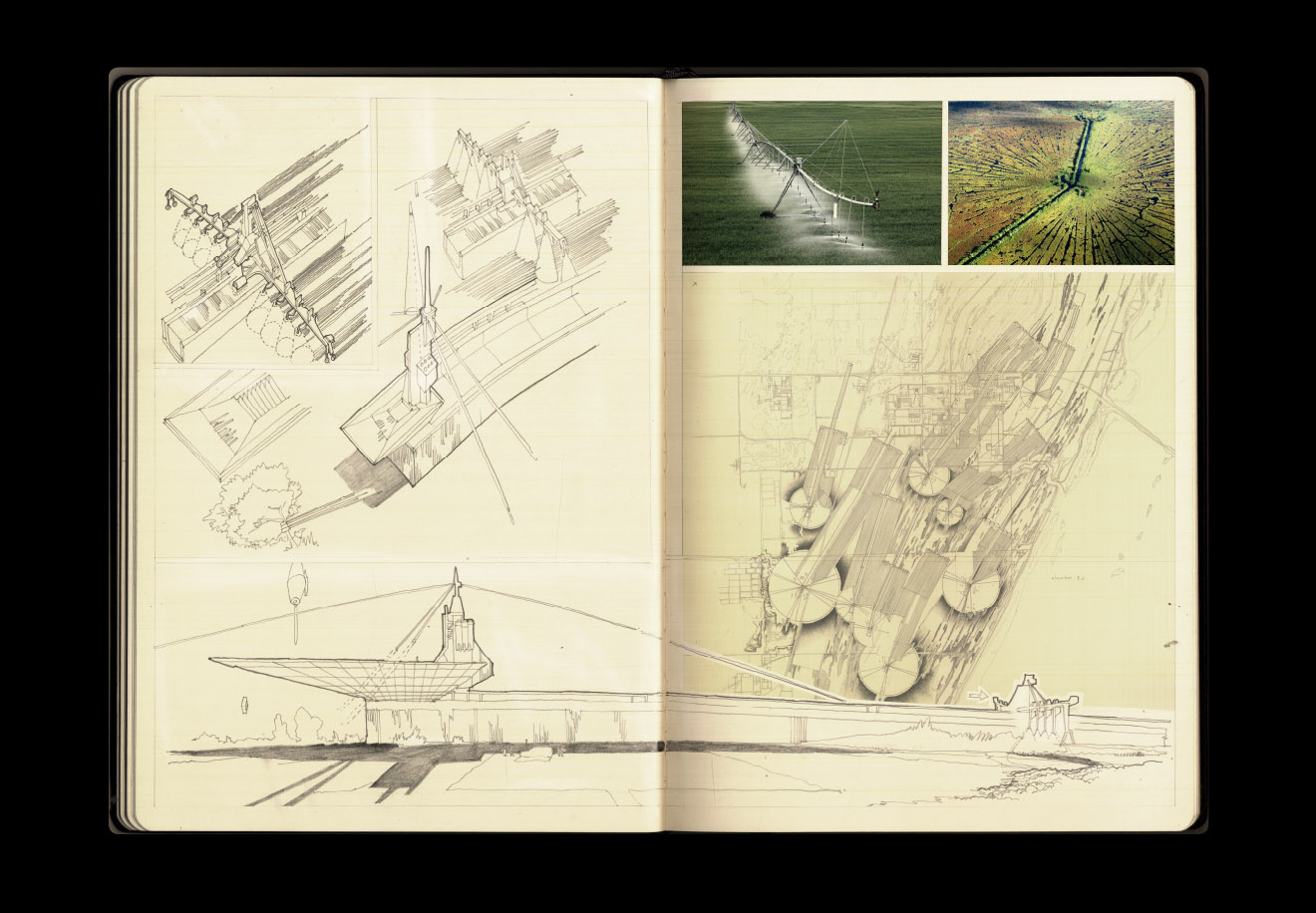
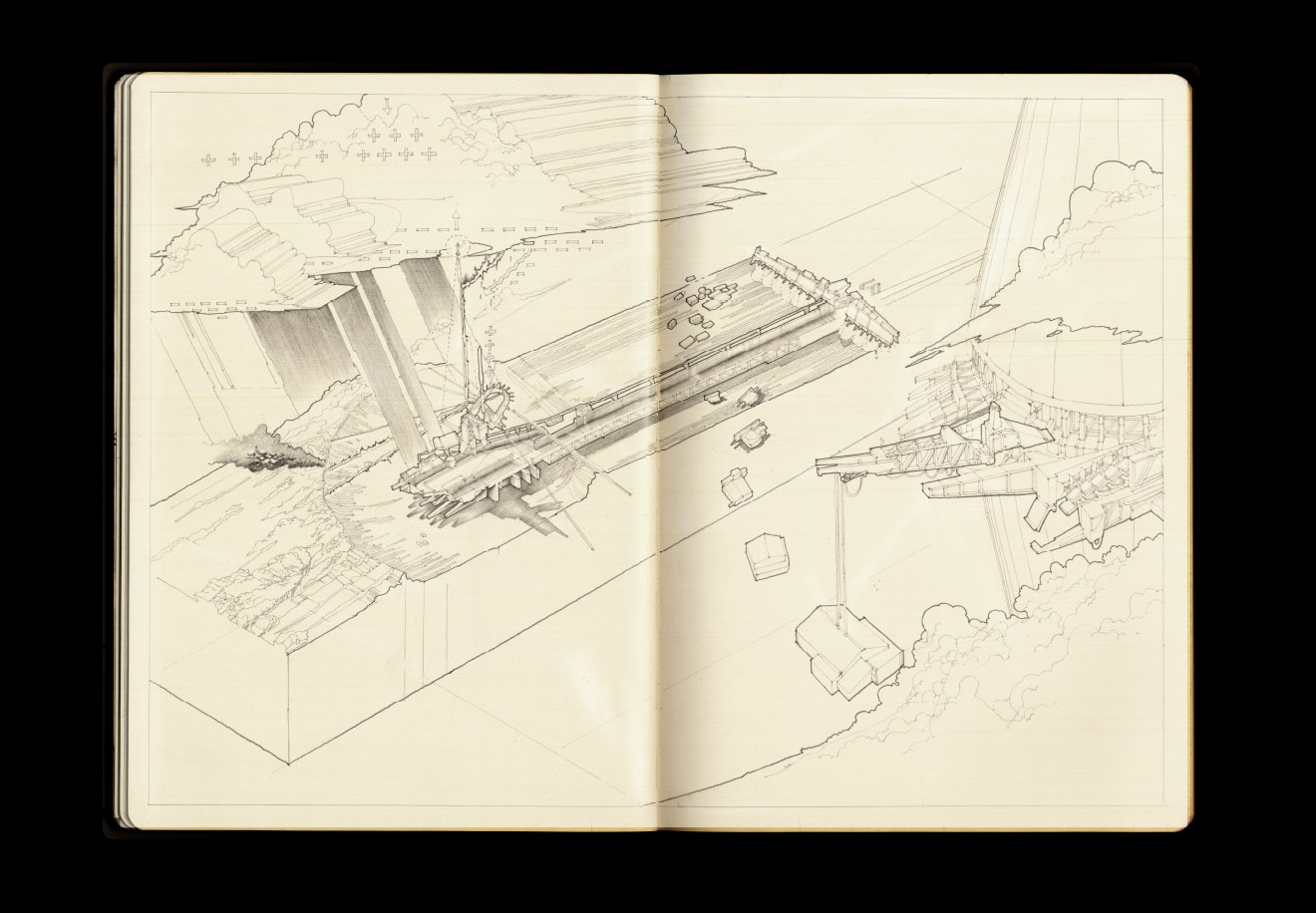
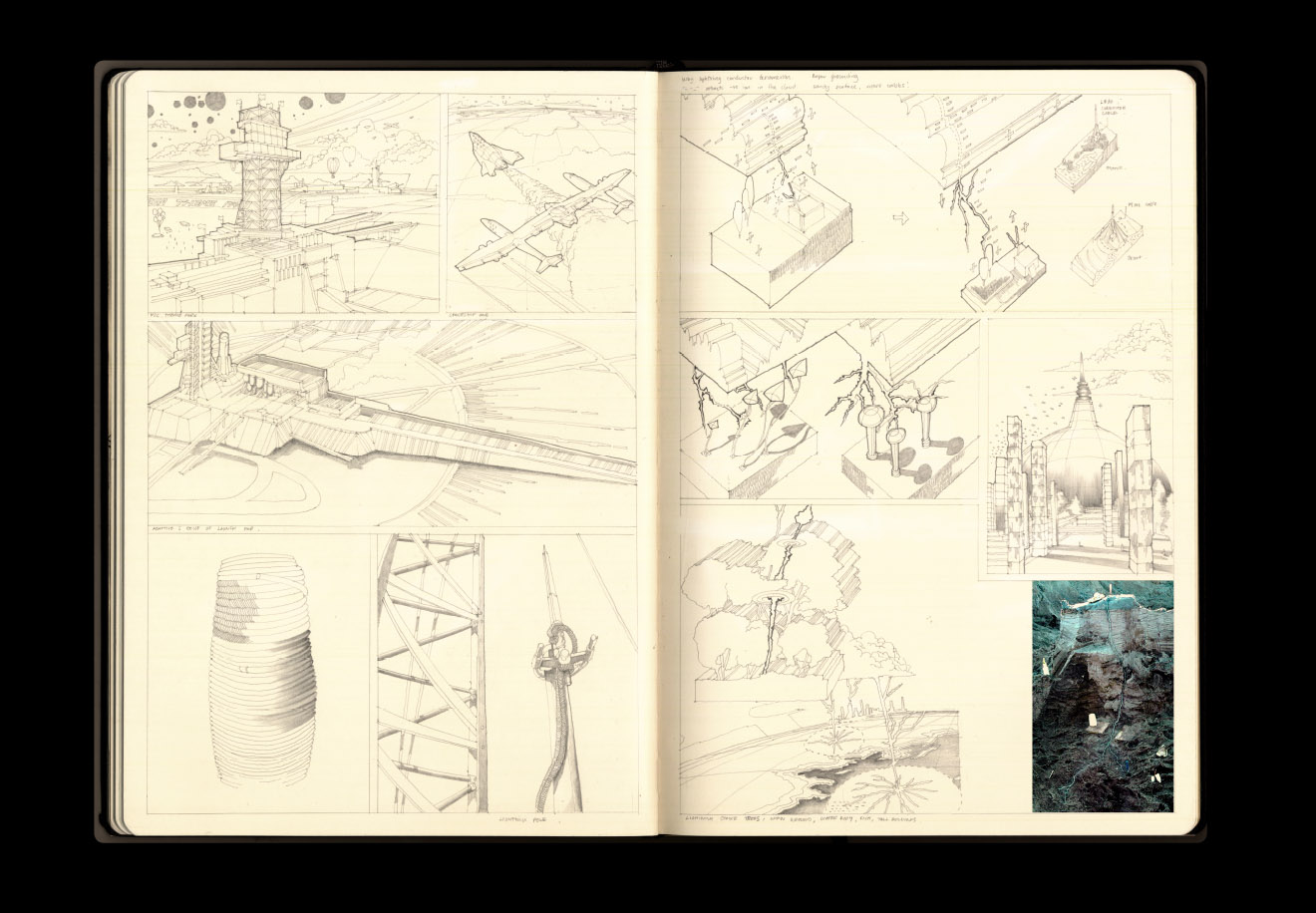
While there were many, many interesting projects resulting from the trip, and from the Unit in general, there is one that I thought I’d post here, by student Farah Aliza Badaruddin, particularly for the quality of its drawings.

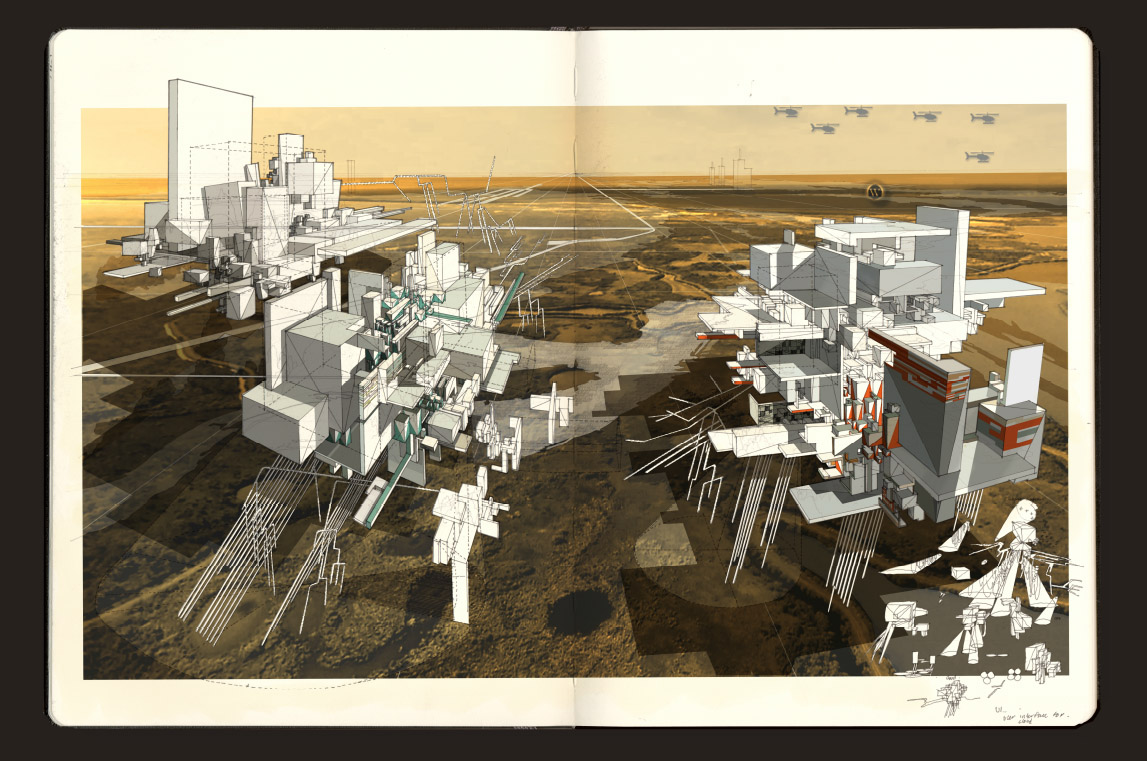
[Images: From a project by Farah Aliza Badaruddin at the Bartlett School of Architecture].

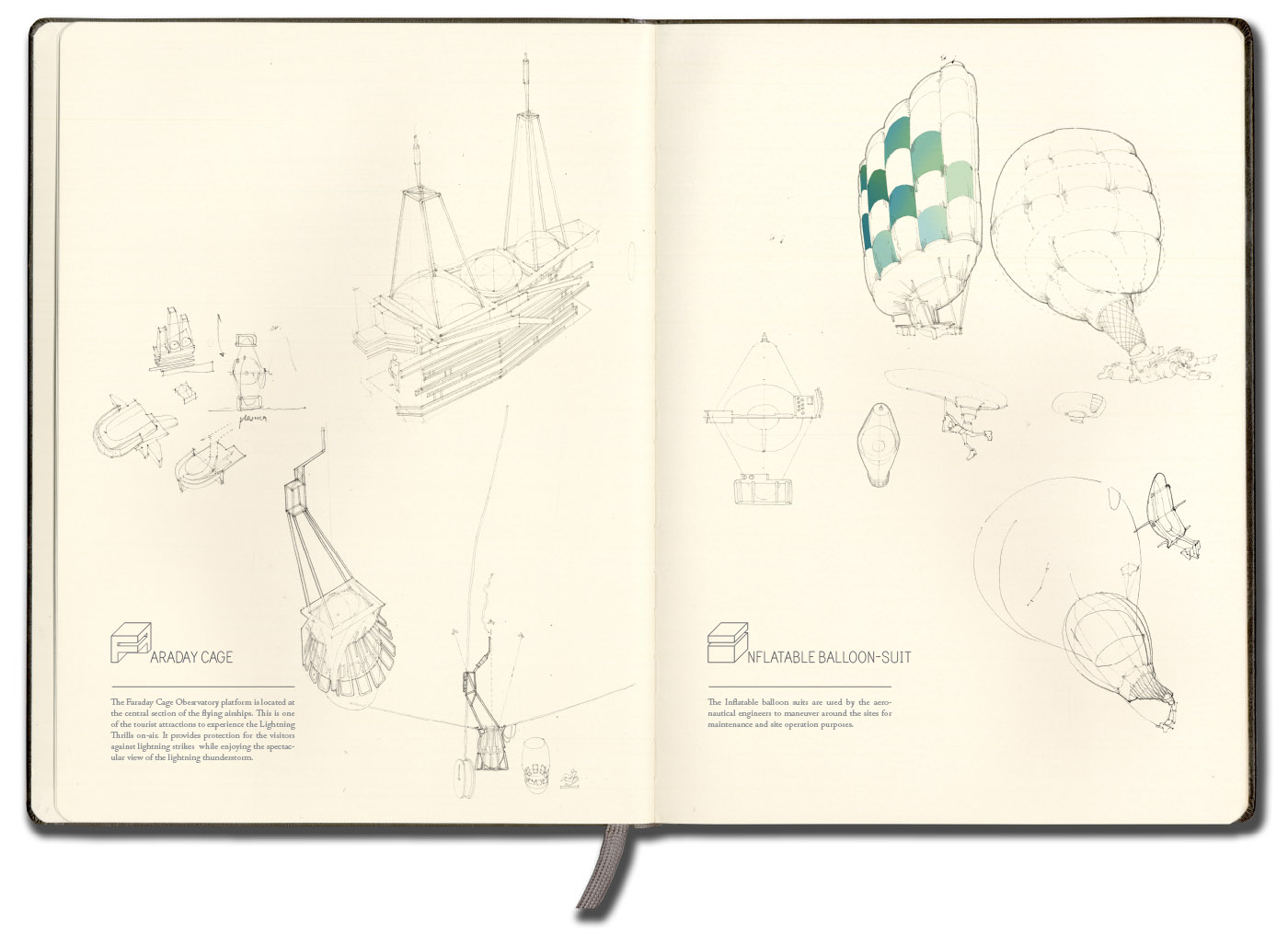
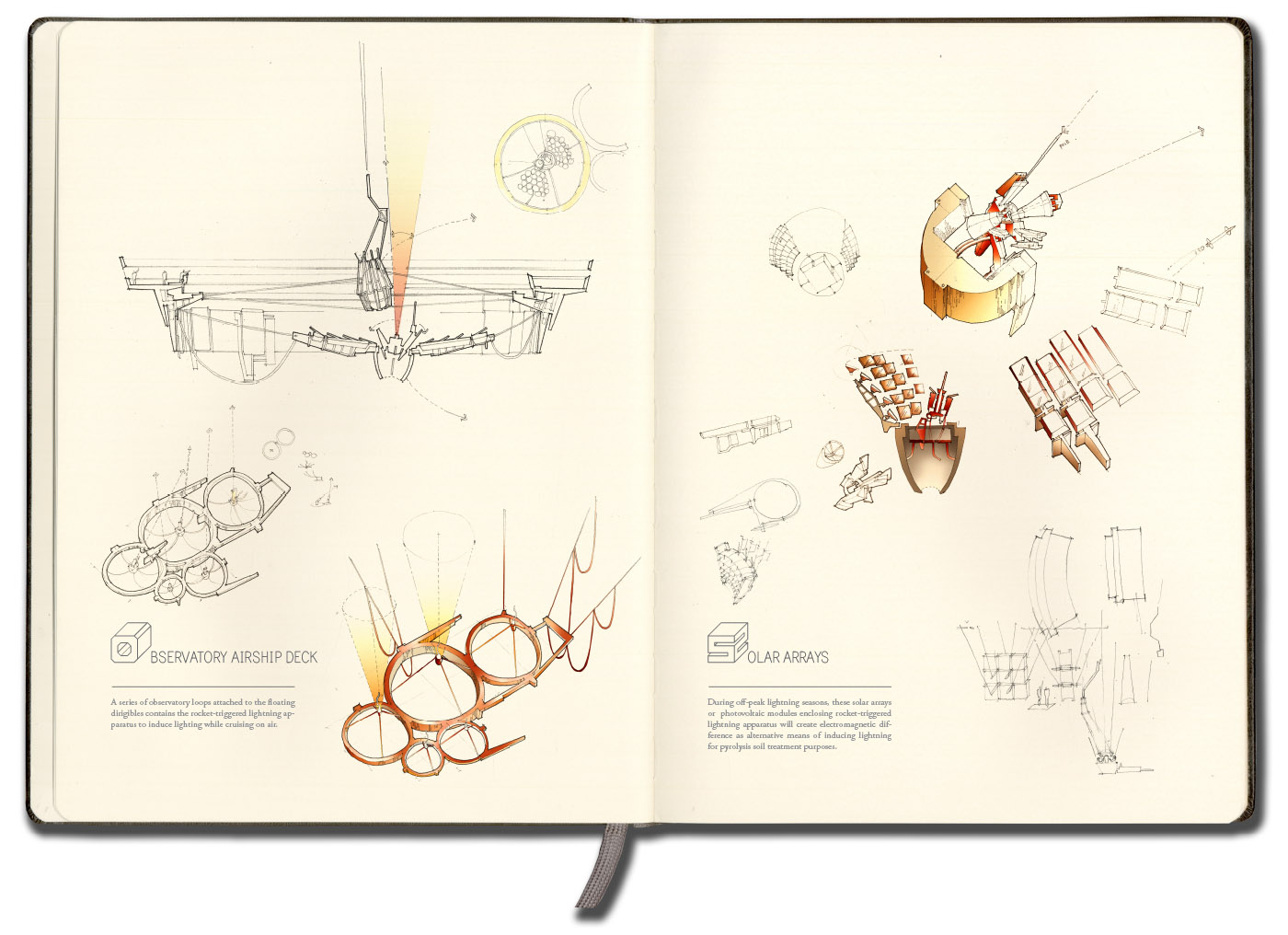
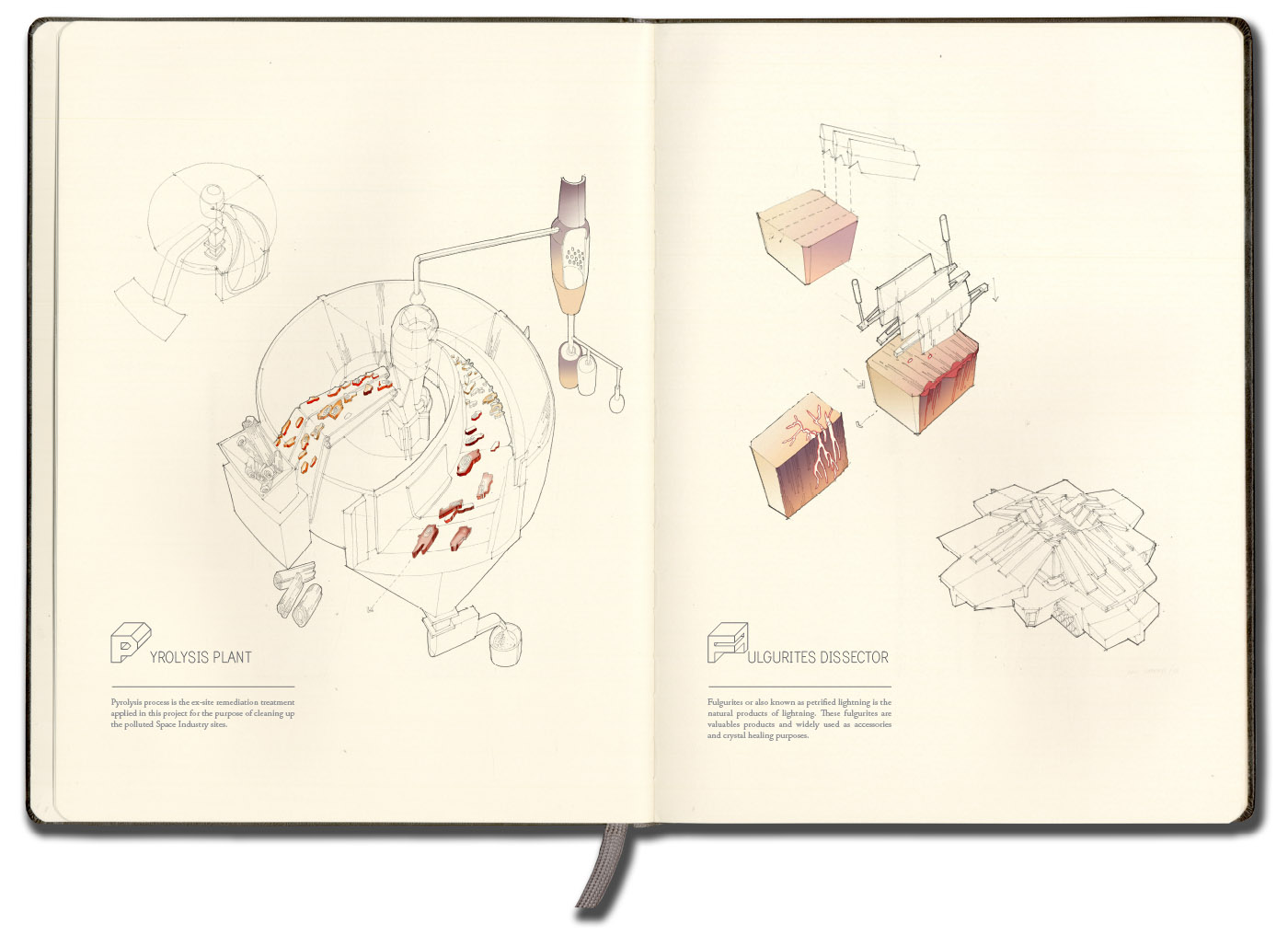
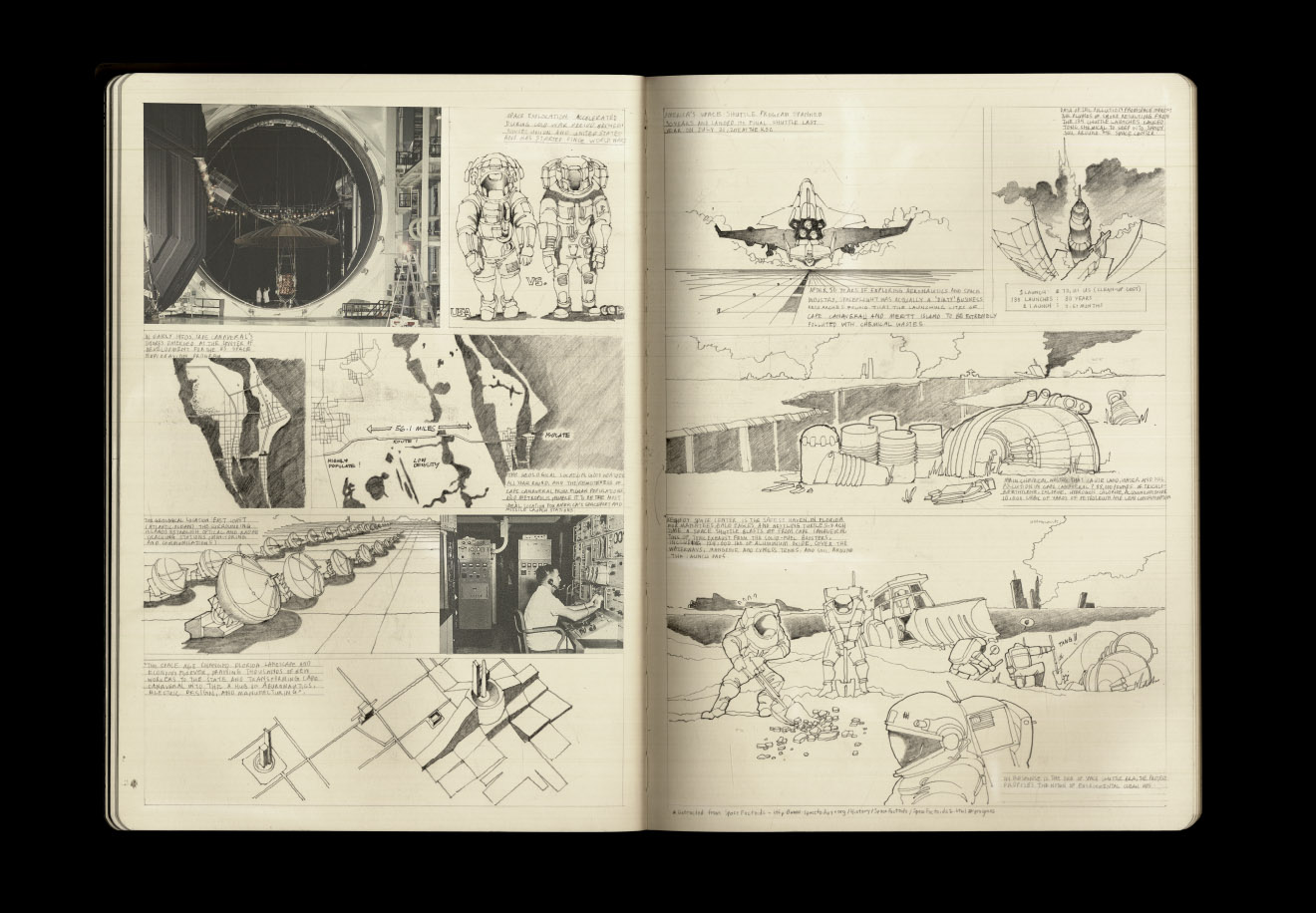
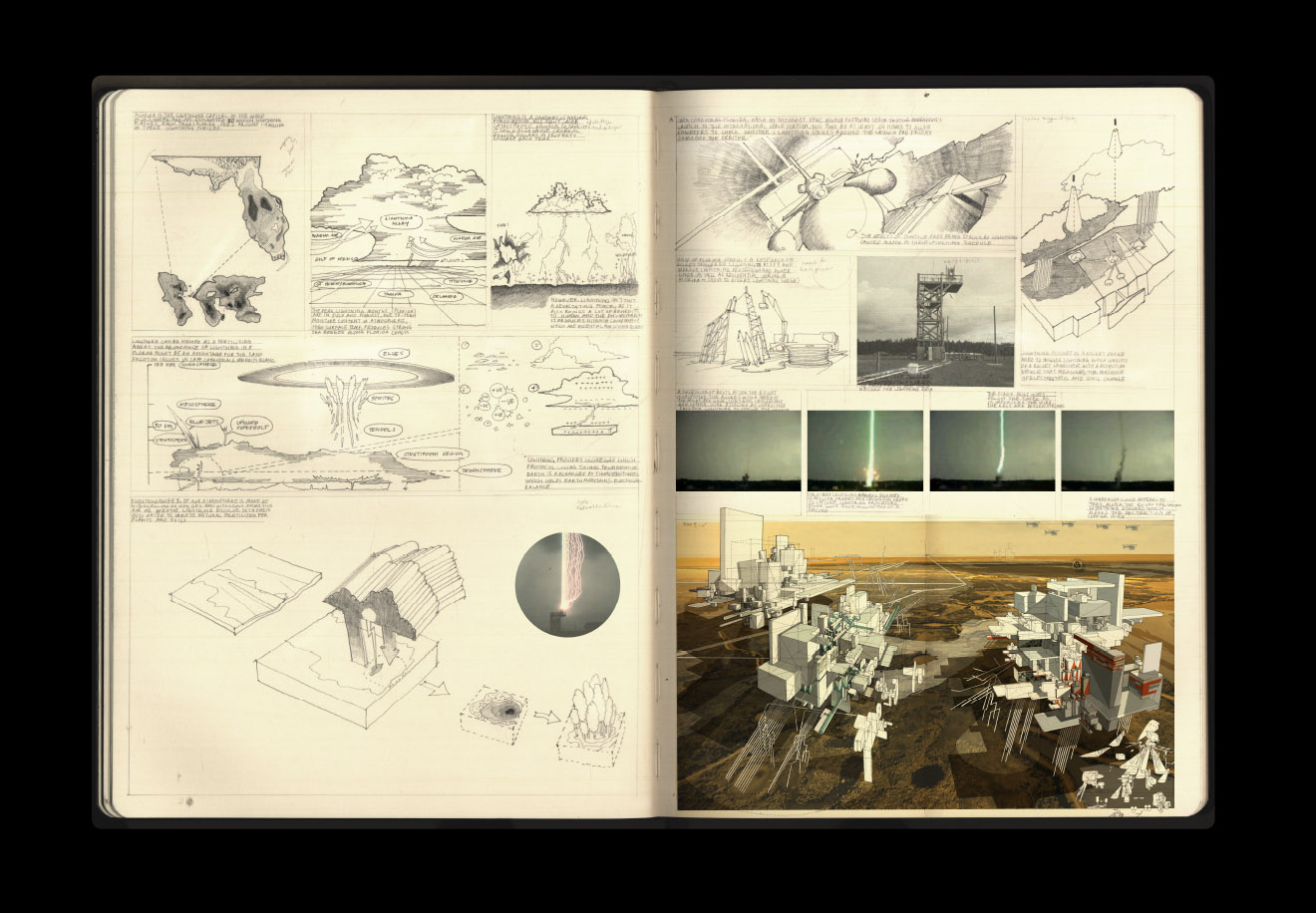
Badaruddin’s project explored the large-scale architectural implications of applying radical weather technologies to the task of landscape remediation, asking specifically if Cape Canaveral’s highly contaminated ground water—polluted by a “viscous toxic goo” made from tens of thousands of pounds of rocket fuels, chemical plumes, solvents, and other industrial waste products over the decades—could be decontaminated through pyrolysis, using guided and controlled bursts of lightning.

In her own words, Badaruddin explains that the would test “the idea that lightning can be harnessed on-site to pyrolyse highly contaminated groundwater as an approach to remediate the polluted site.”

These controlled and repetitive lightning strikes would also, in turn, help fertilize the soil, producing a kind of bio-electro-agricultural event of truly cosmic (or at least Miller-Ureyan) proportions.

[Image: Triggered lightning technology at the University of Florida Lightning Research Group].

Her maps of the area—which she presents as if drawn in a Moleskine notebook—show the terrestrial borders of the proposal (although volumetric maps of the sky, showing the project’s fully three-dimensional engagement with regional weather systems, would have been an equally, if not more, effective way of showing the project’s spatial boundaries).

This raises the awesome question of how you should most accurately represent an architectural project whose central goal is to wield electrical influence on the atmosphere around it.

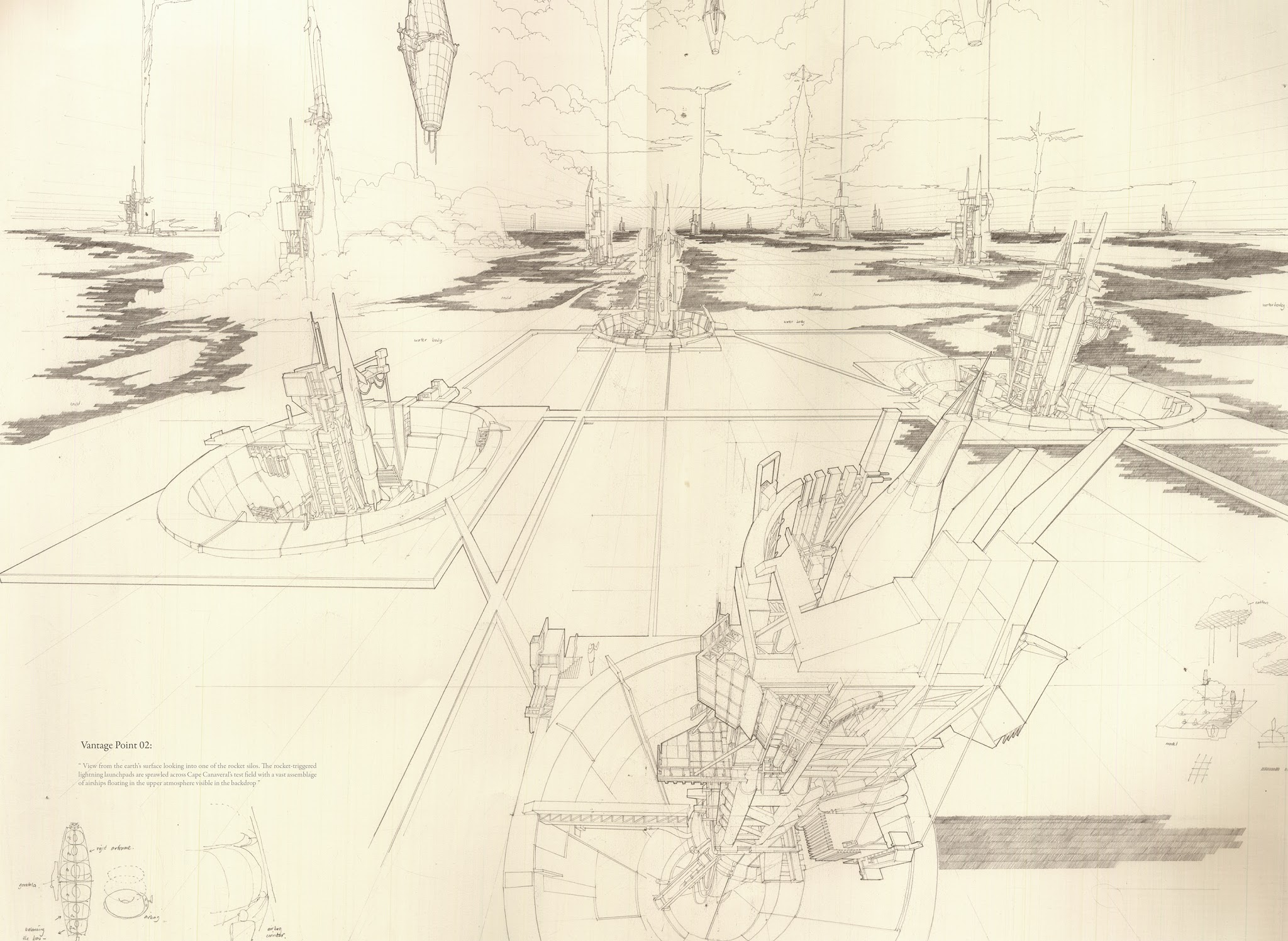
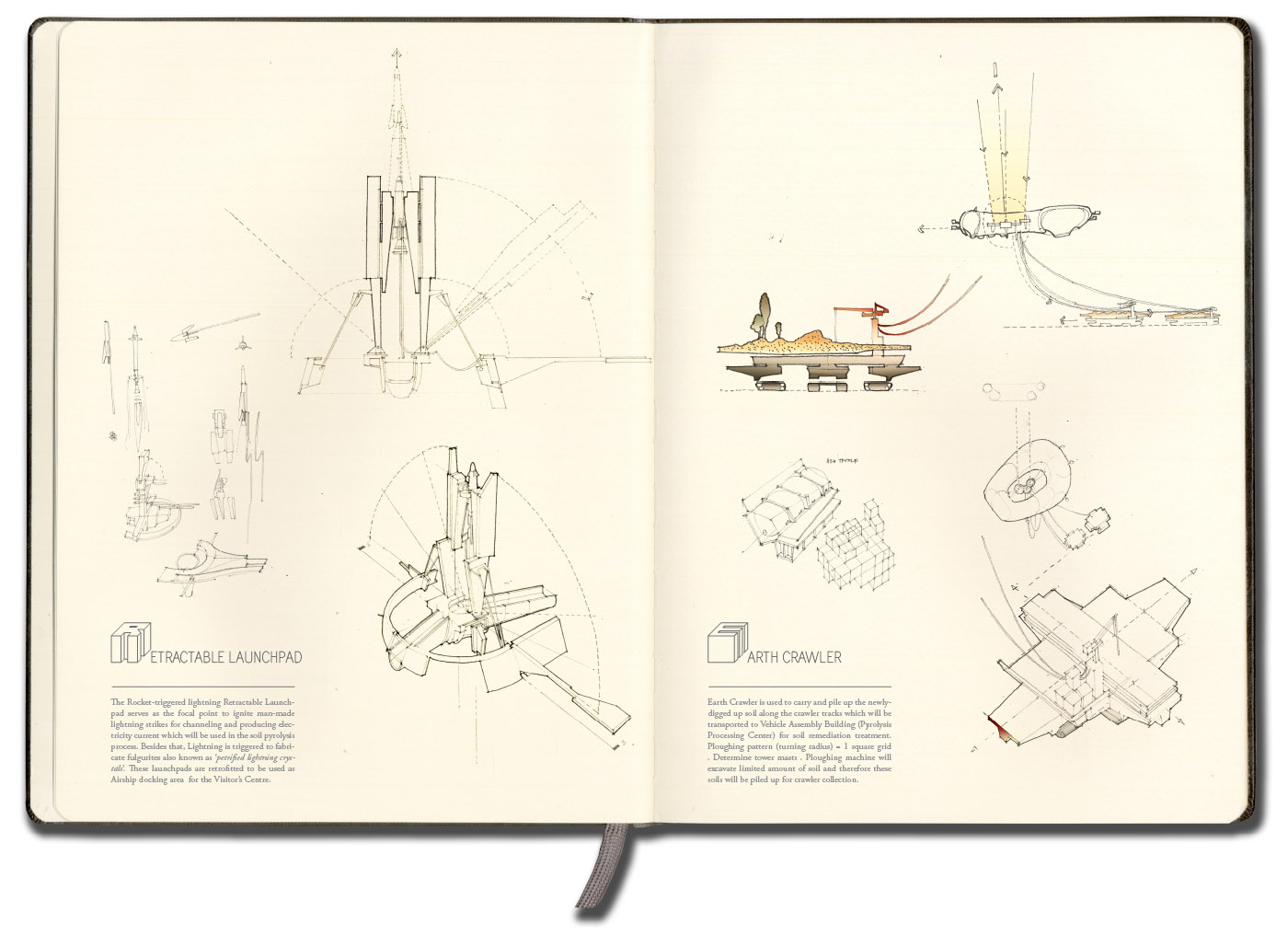
[Images: From a project by Farah Aliza Badaruddin at the Bartlett School of Architecture].

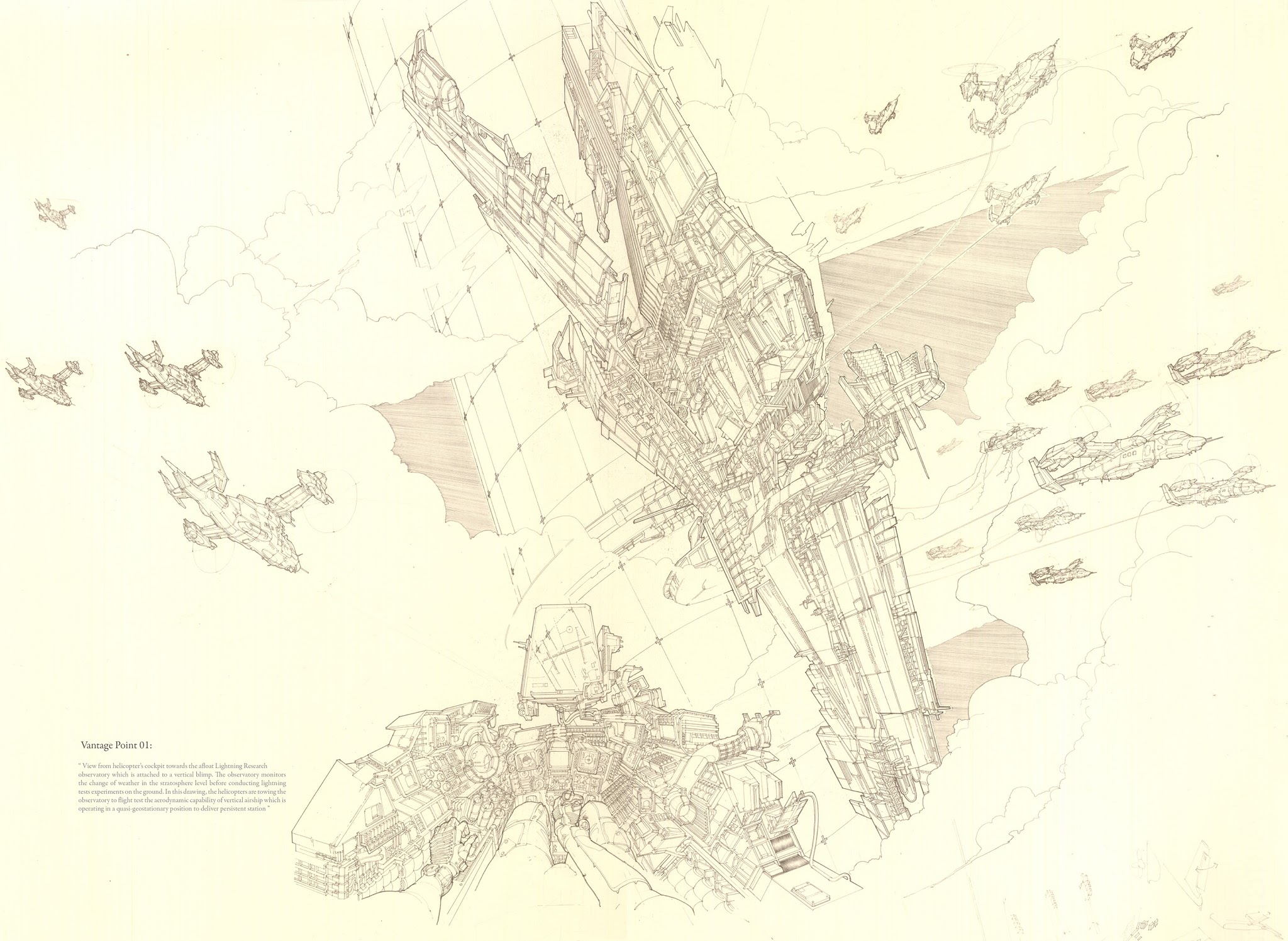
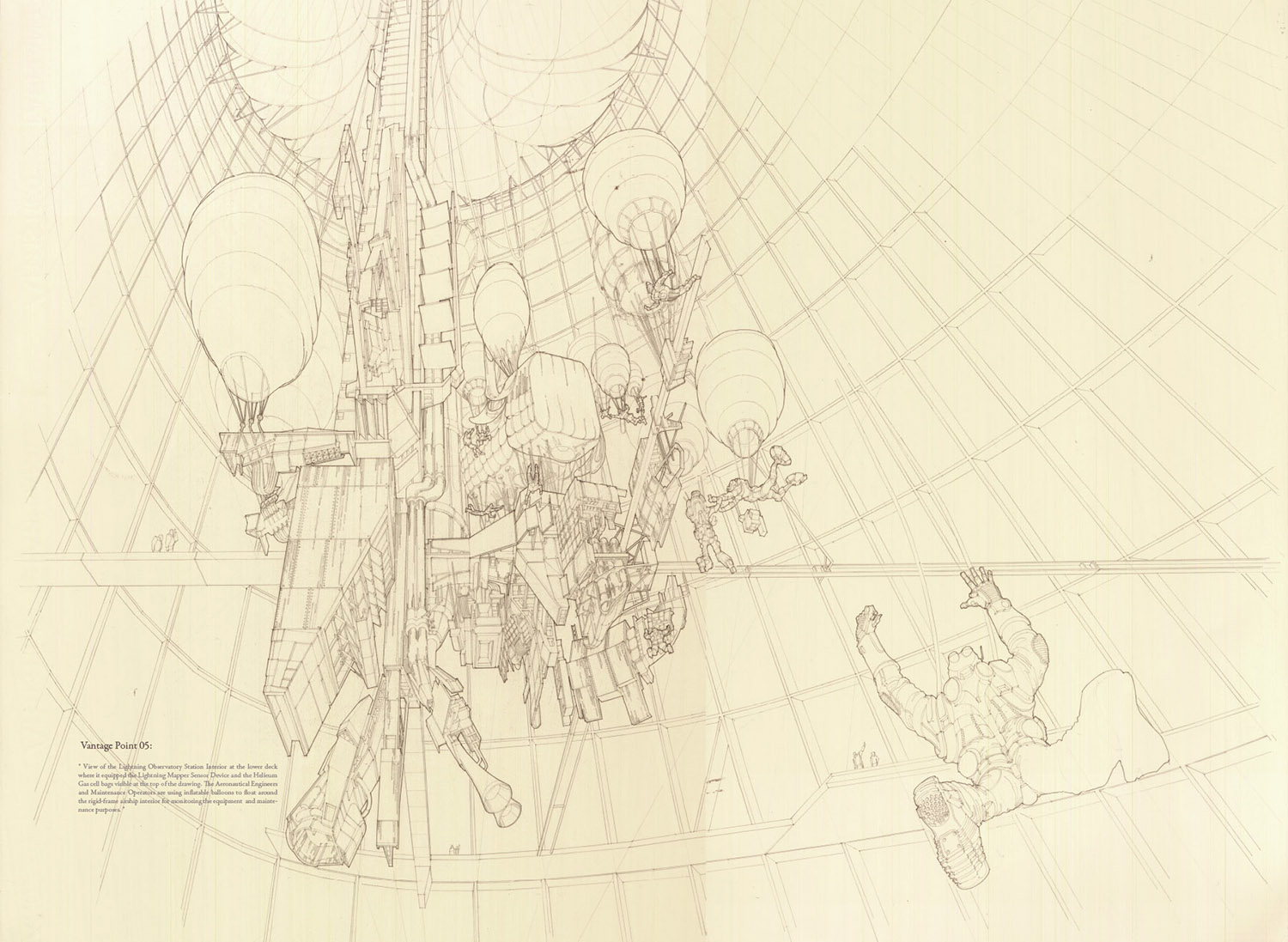
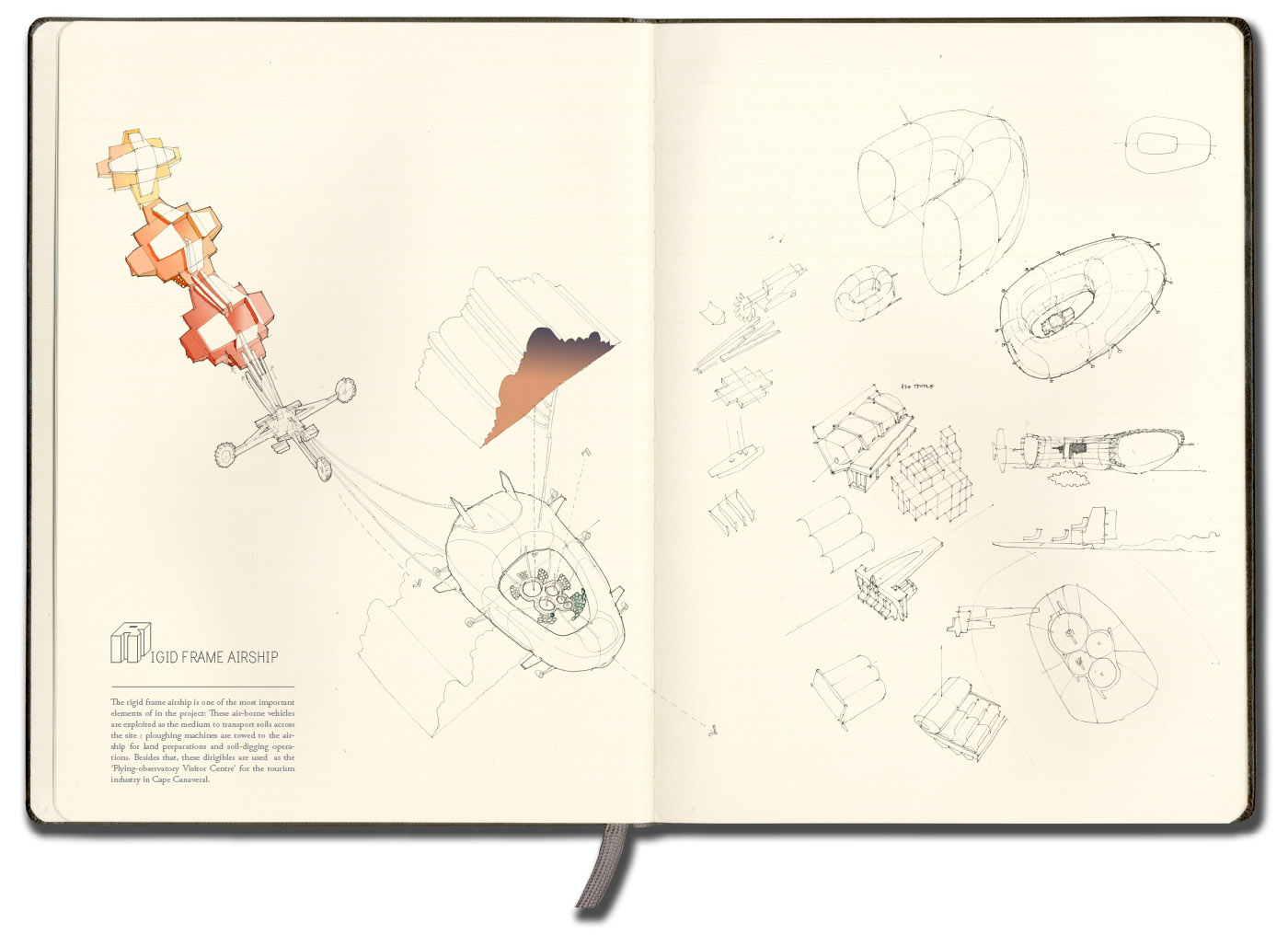
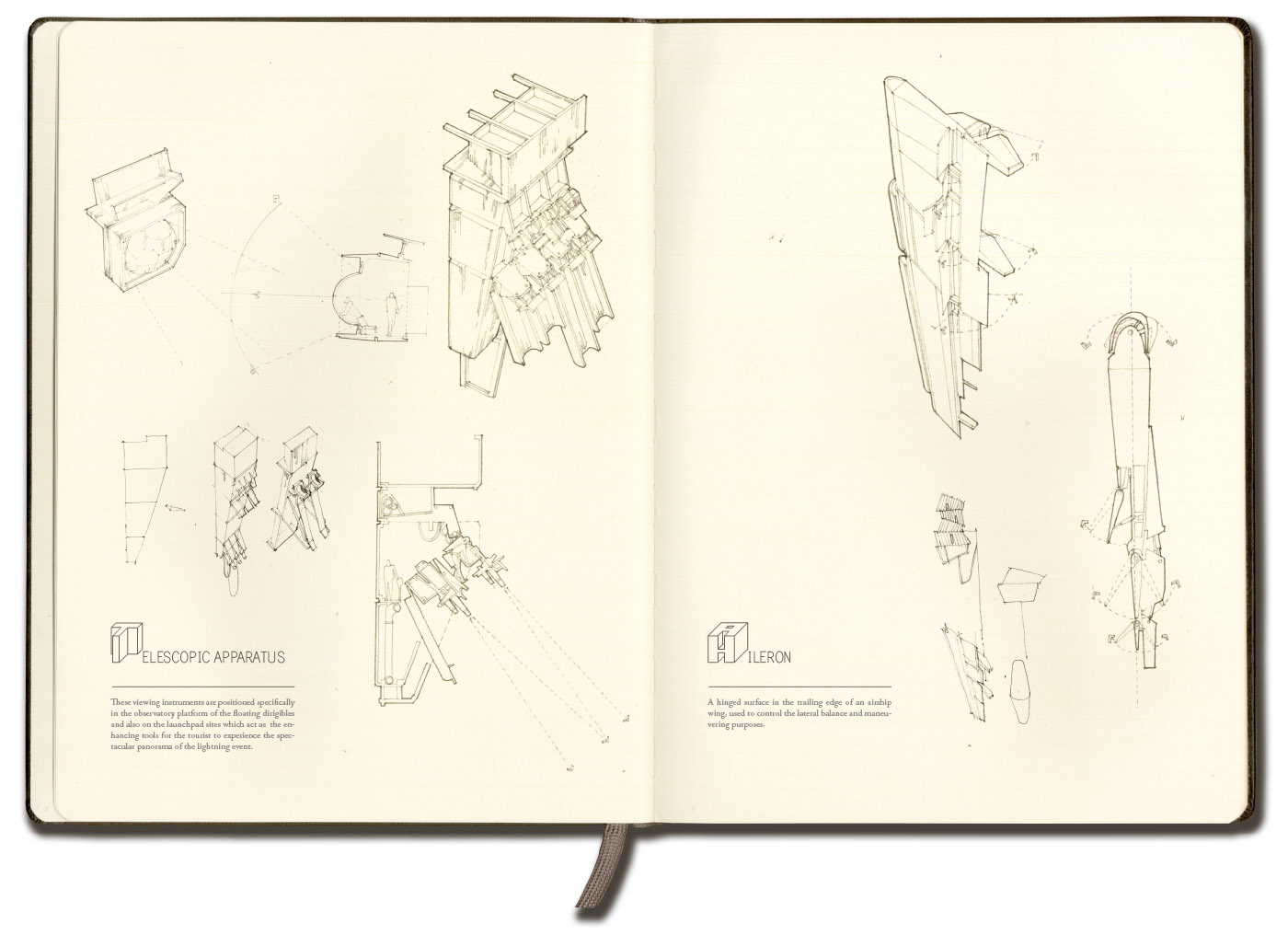
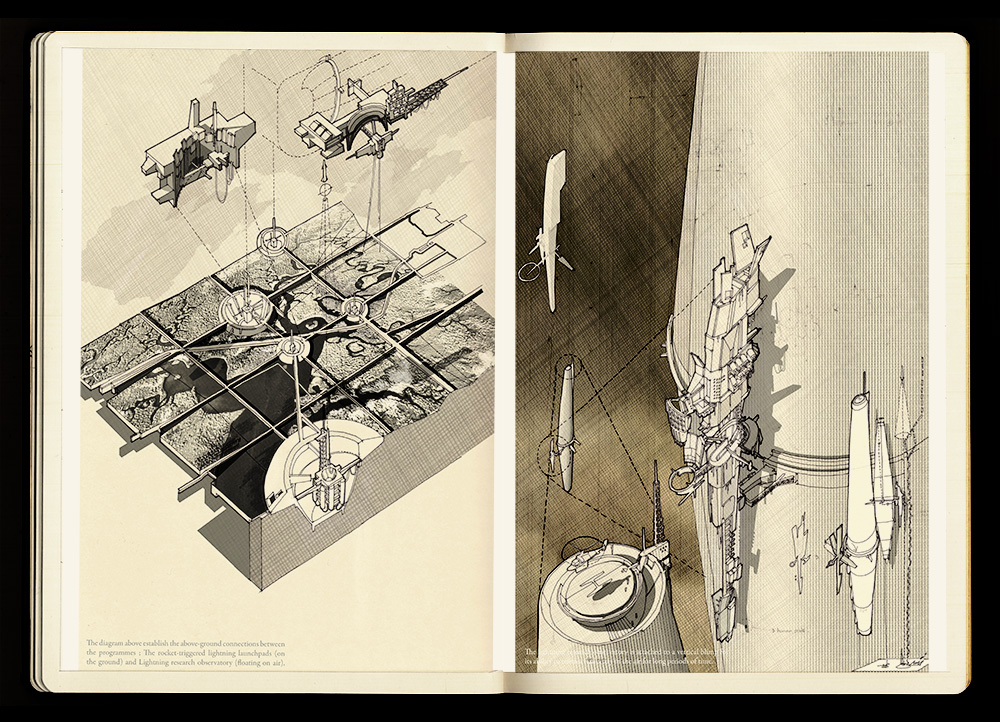
In short, her design proposes a new infrastructure of “rocket-triggered lightning technology,” assisted and supervised by a peripheral network of dirigibles—floating airships that “surround the site and serve as the observatory platform for a proposed lightning visitor centre and the weather research center.”

The former was directly inspired by real-world lightning research equipment found at the University of Florida’s Lightning Research Group.

[Image: Triggered lightning technology at the University of Florida’s Lightning Research Group].

Badaruddin’s own rocket triggers would be used both to attract and “to provide direct lightning strikes to the proposed sites,” thus pyrolizing the landscape and purifying both ground water and soil.

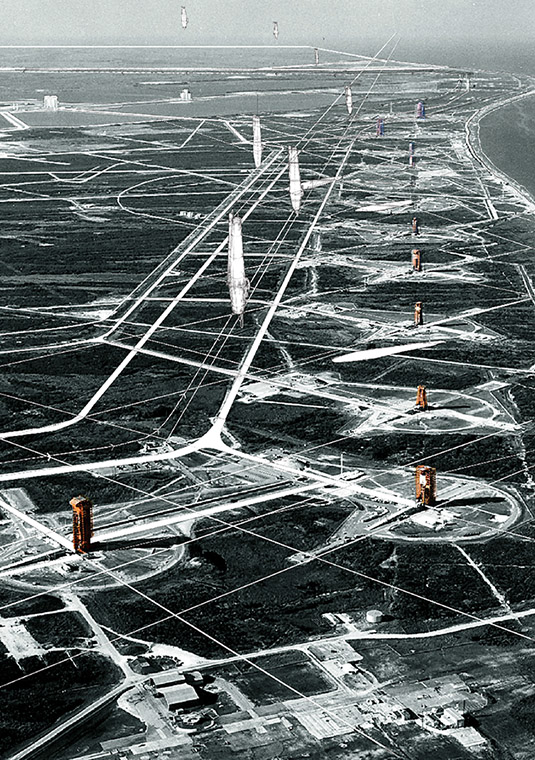
[Image: Aerial collage view of the lightning farm, by Farah Aliza Badaruddin at the Bartlett School of Architecture].

The result would be a lightning farm, a titanic landscape tuned to the sky, flashing with controlled lightning strikes as the ground conditions are gradually remediated—an unmoving, nearly permanent, artificial electrical storm like something out of Norse mythology, cleansing the earth of toxic chemicals and preparing the site for future reuse.

[Image: Collage of the lightning farm, by Farah Aliza Badaruddin at the Bartlett School of Architecture].

I should say that my own interest in these kinds of proposals is less in their future workability and more in what it means to see a technology taken out of context, picked apart for its spatial implications, and then re-scaled and transformed into a speculative work of landscape architecture. The value, in other words, is in re-thinking existing technologies by placing them at unexpected scales in unexpected conditions, simultaneously extracting an architectural proposal from that and perhaps catalyzing innovative new ways for the original technology itself to be redeveloped or used.

[Image: Farah Aliza Badaruddin].

It’s not a question of whether or not something can be immediately realized or built; it’s a question of how open-ended, fictional design proposals can change the way someone thinks about an entire field or class of technologies.

[Images: From a project by Farah Aliza Badaruddin at the Bartlett School of Architecture].

But I’ll let Badaruddin’s own extraordinary visual skills tell the story. Most if not all of these images can be seen in a much larger size if you open the images in their own windows; they’re well worth a closer look—

[Images: From a project by Farah Aliza Badaruddin at the Bartlett School of Architecture].

—including what amount to a short graphic novel telling the story of her proposed controlled-lightning landscape-decontamination facility.

[Images: From a project by Farah Aliza Badaruddin at the Bartlett School of Architecture].

All in all, whether or not architecturally-controlled lightning storms will ever purify the land and water of south Florida, it’s a wonderfully realized and highly imaginative project, and I hope Badaruddin finds more opportunities, post-Bartlett, to showcase and develop her skills.

Documentary Holography

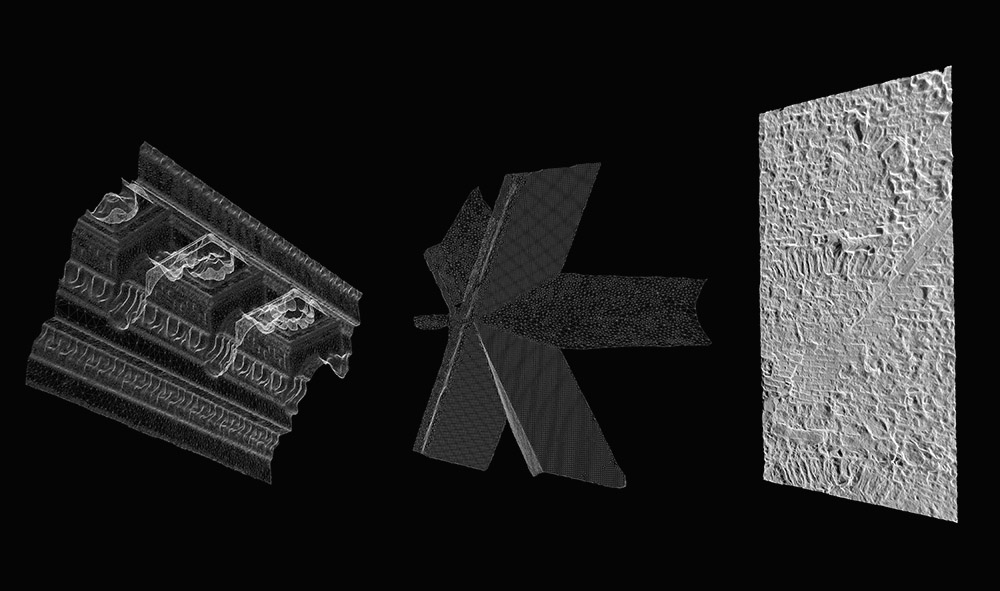
[Image: A “detail theft” by ScanLAB Projects].

ScanLAB Projects, a reliably interesting and enthusiastic design-research duo formed by Bartlett graduates Matthew Shaw and William Trossell, explores, in their words, “the potential of large scale terrestrial laser scanning as a tool for design, visualization and fabrication. We use a range of state-of-the-art 3D scanning technologies to capture buildings, objects and spaces.”

As it happens, they mean this quite literally, as they aim to “capture” and then illicitly reproduce, using multi-axis milling machines, architectural details scanned around London. These are what they call “detail thefts… arguably cloning the original architect’s intellectual property.”

[Image: A “detail theft” by ScanLAB Projects].

You can read an earlier write-up of their many projects—from “stealth objects” to scanner-jamming architectural ornament installed on an urban scale—here on BLDGBLOG (as well as in the forthcoming Landscape Futures book).

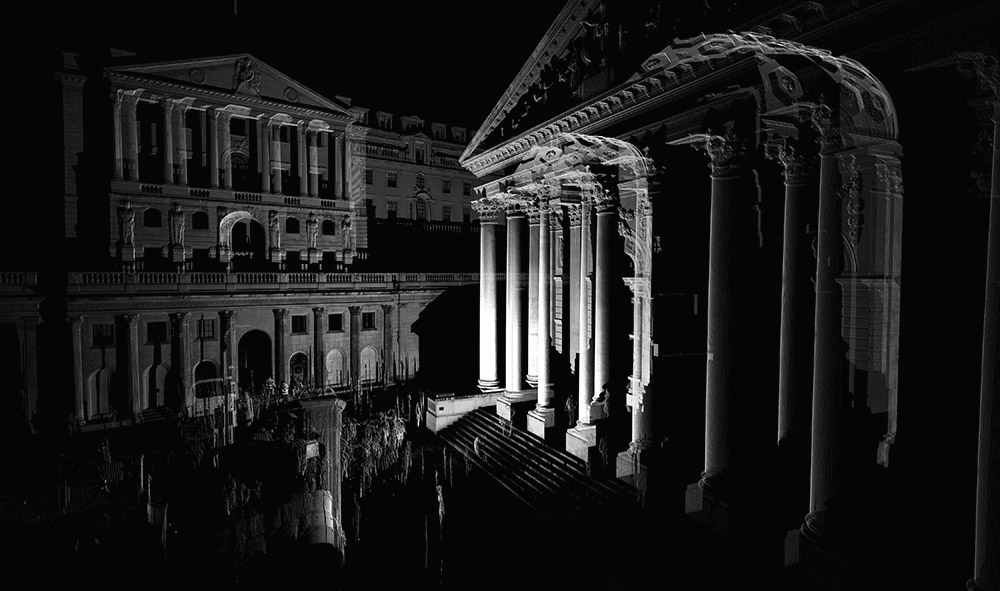
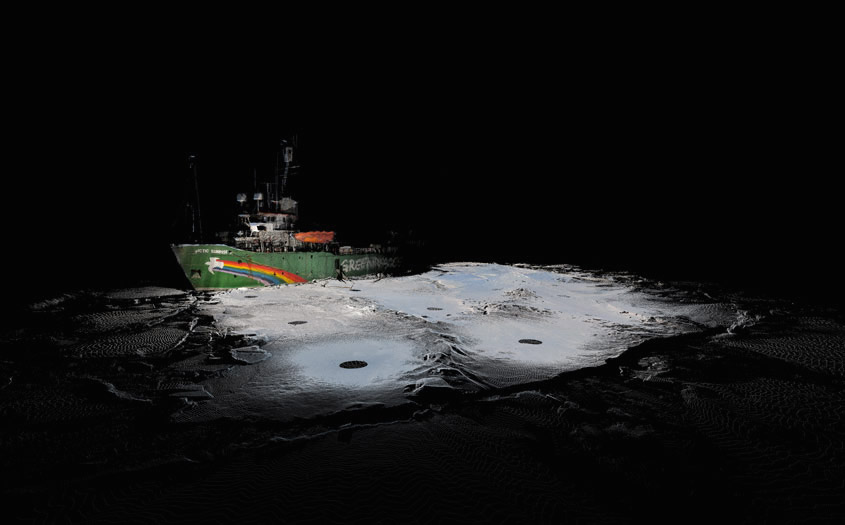
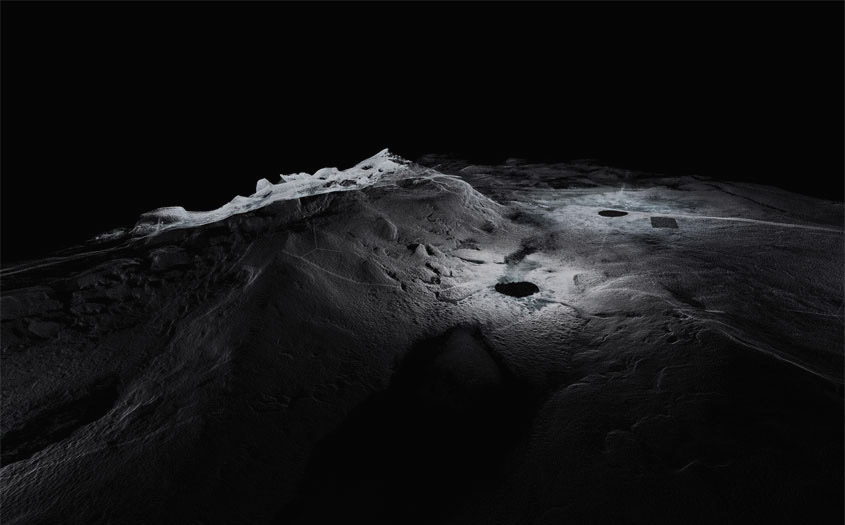
What I find so consistently interesting in their work, though, is that, over the past few years, they’ve been expanding the representational range of the laser scanner, using it to document highly ephemeral, even ethereal, spatial events.

Whether scanning mist and humidity or traveling north to the Arctic to shoot lasers at pressure ridges and melting ice floes, their work is almost a kind of documentary holography: not a film, not a photograph, not a 3D model, but also not simply a point-cloud, their work operates almost narratively as they capture objects or places in the process of becoming something else, blurred by passing fog or pulled apart by unseen ocean currents. You could write a screenplay for scanners.

[Images: From the “Arctic Climatic Tour 2011” of ScanLAB Projects].

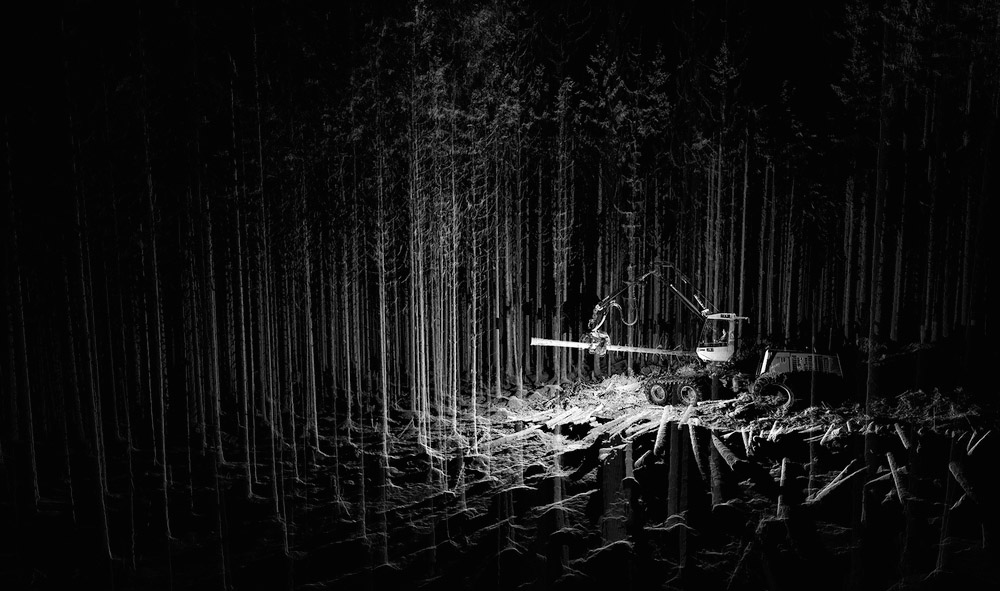
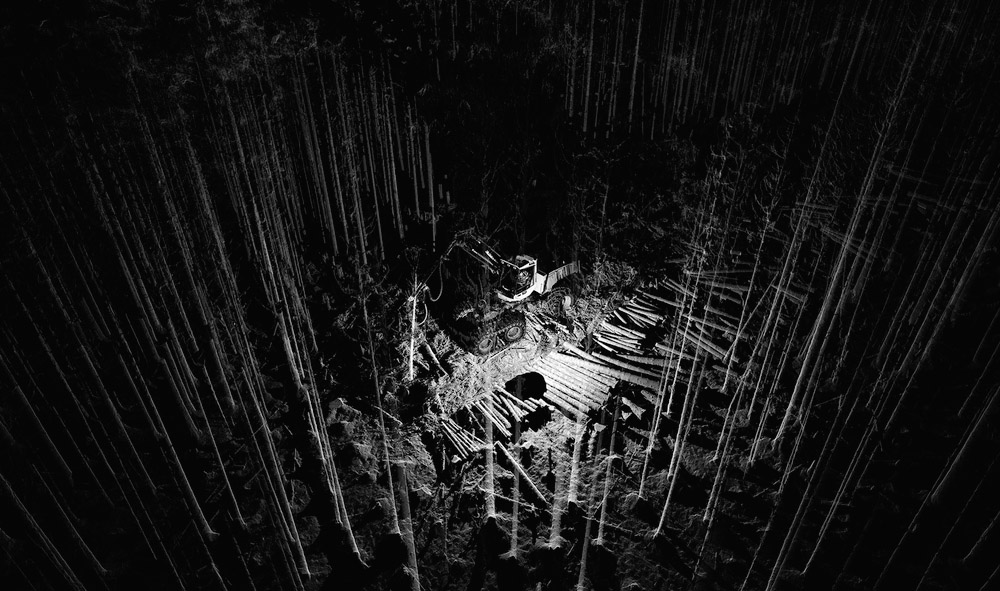
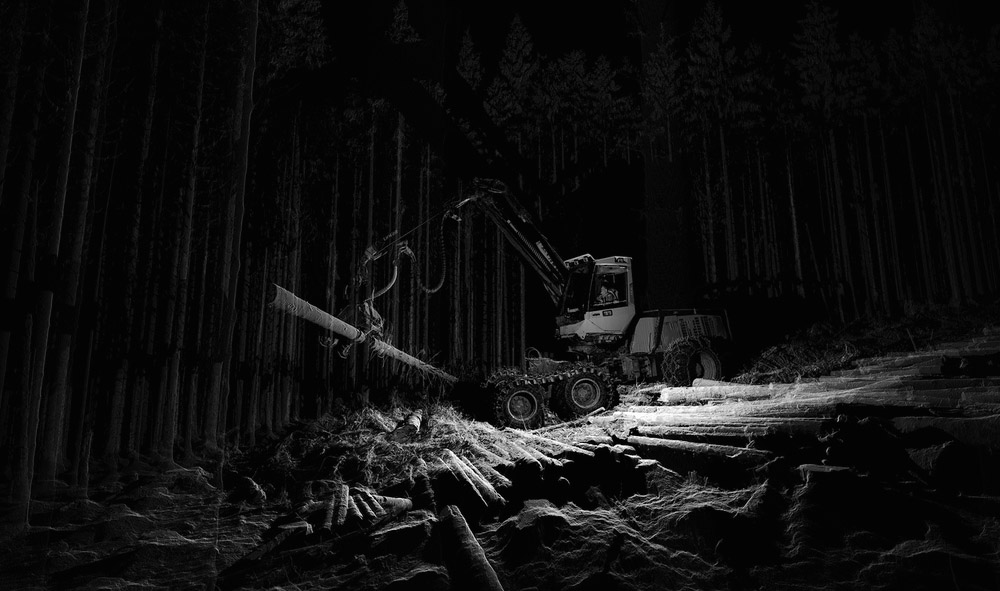
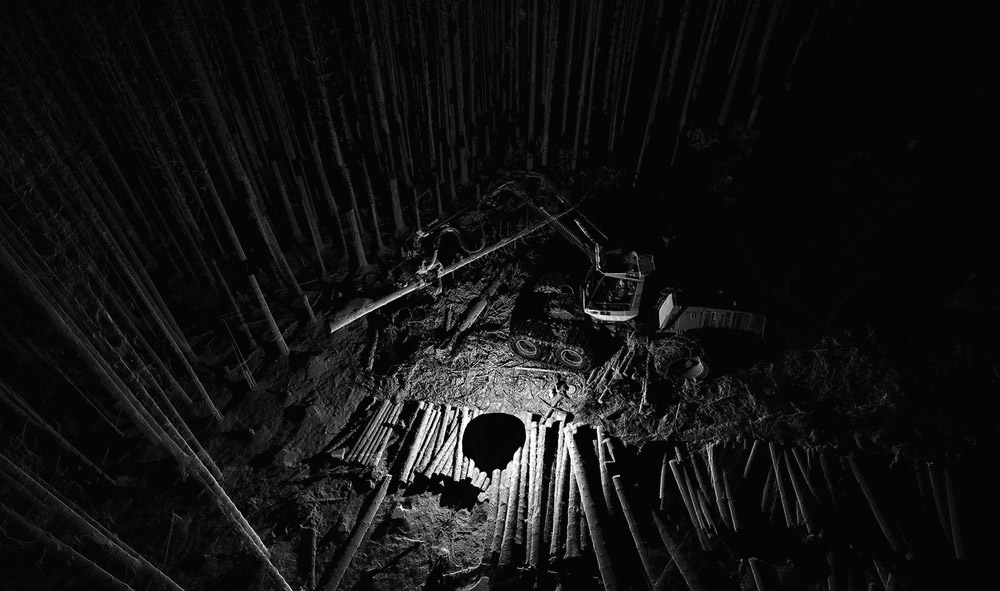
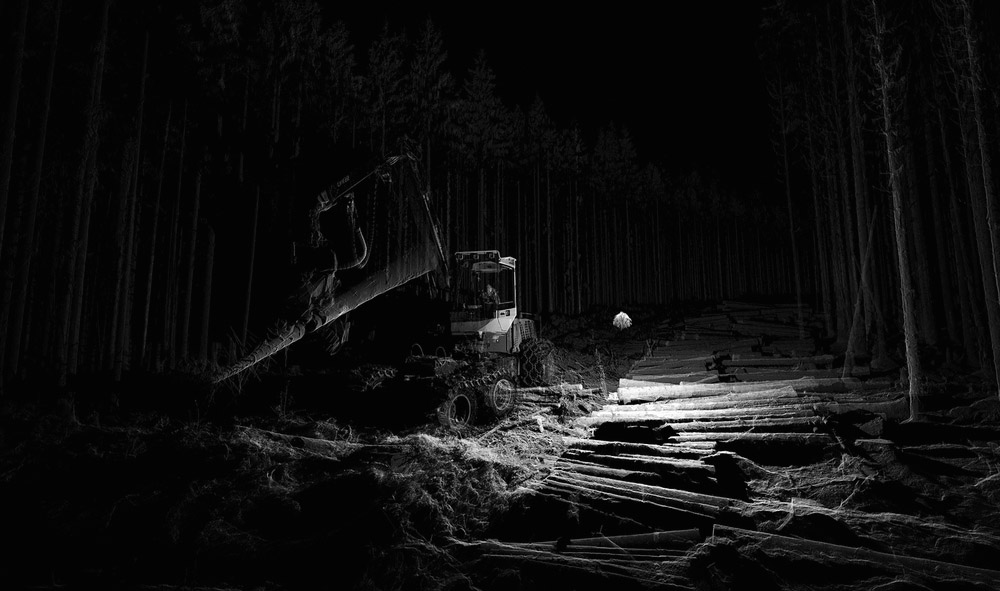
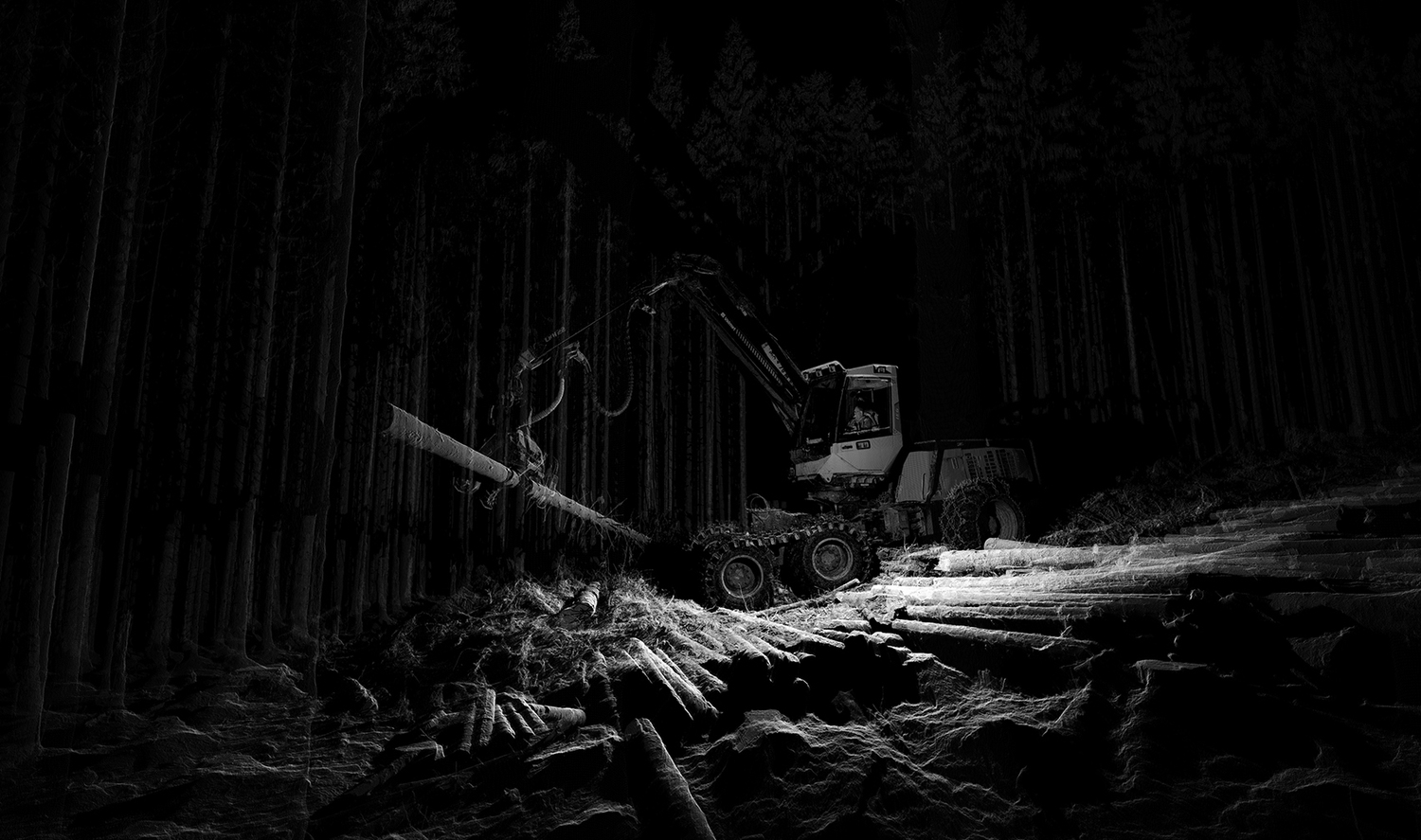
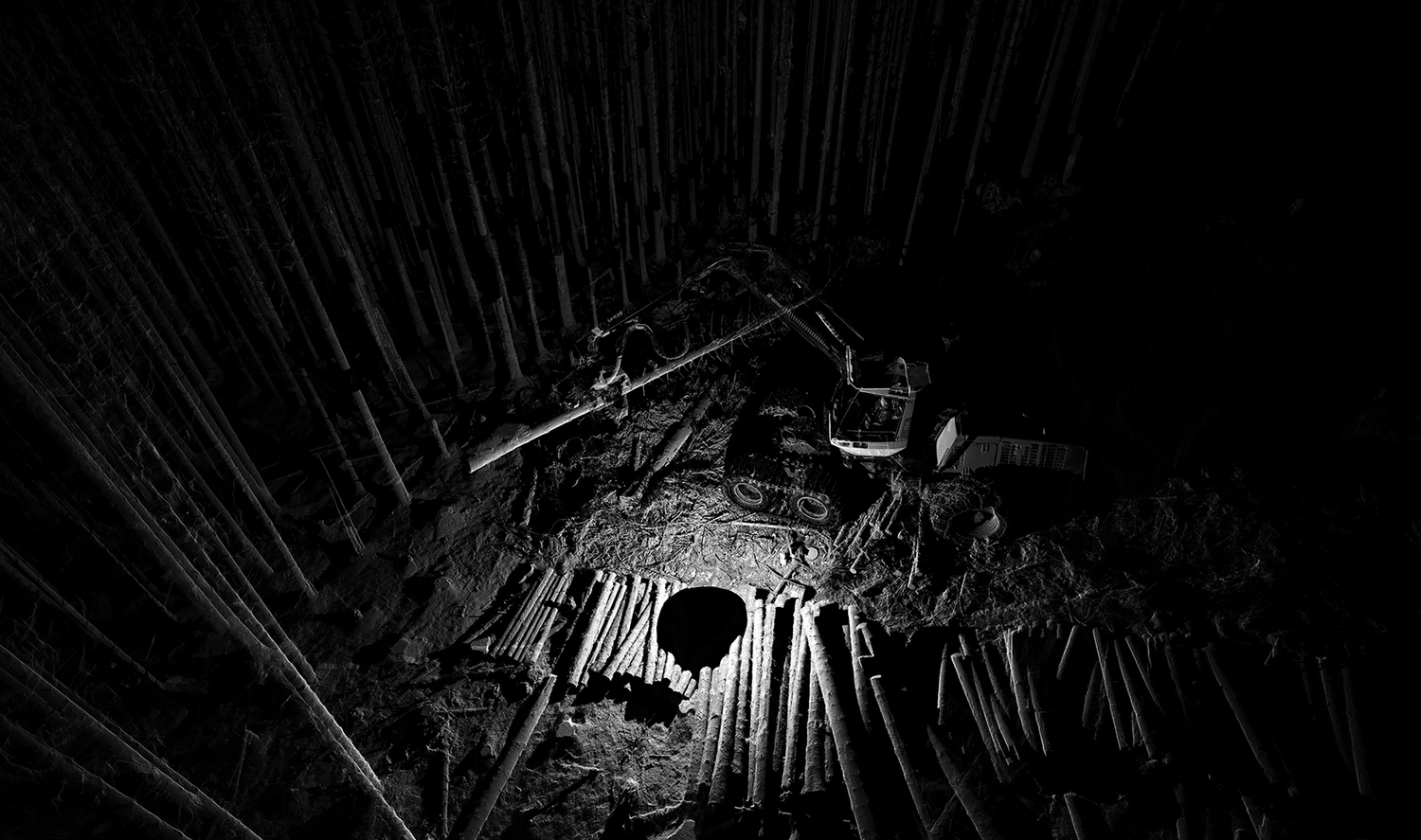
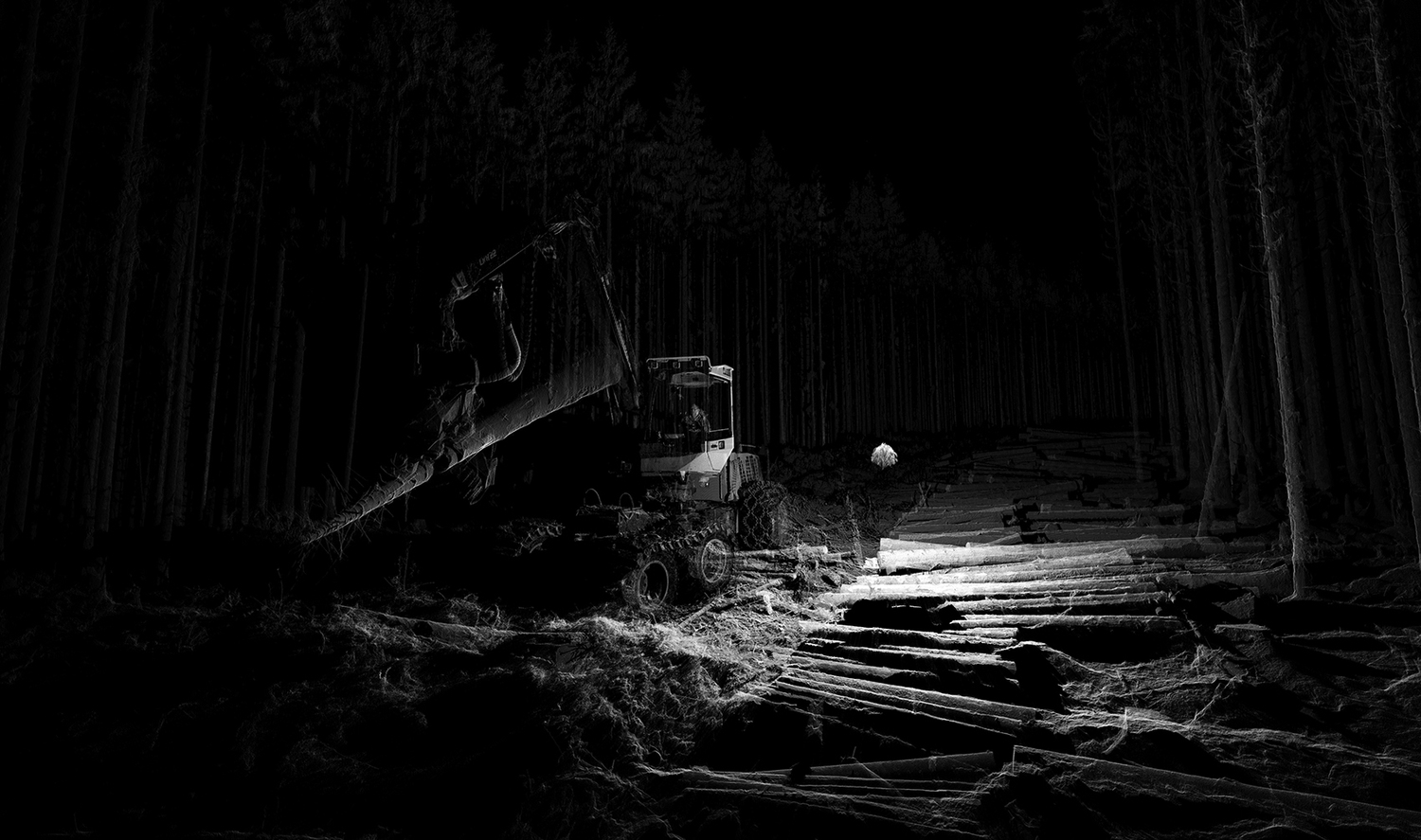
For a more recent project, one that indicates a growing environmental or ecological emphasis in their work, the duo found themselves in the presence of heavy forestry equipment, a haunting and behemoth machine busy uprooting, de-branching, and stacking trees, converting a living forest to mere timber. The satiny black background makes it all that much more dreamlike, as if occurring in secret at 2am.

[Image: Forestry Commission Tree Harvester by ScanLAB Projects; view larger].

Cast in black and white and seeming to gleam in the laser light, the machine is both dinosaur-like and ghostly, implying the total gutting of the forest around it as the orderly bar code of the trees is disrupted by this artificial clearing.

[Image: Scans of a Forestry Commission tree harvester in action, by ScanLAB Projects; view image one, two, three, and four larger!].

In all cases, the images are much more evocative when viewed at a larger size (see captions for direct links), which you can also find on the ScanLAB Projects website.

Finally, if all this interests you, consider signing up for a 10-day workshop with ScanLAB Projects up in Ottawa, Canada, from 5-13 July 2013, focusing on “post-industrial landscapes.” Here’s the course description:

Set within the context of a post-industrial era, we find ourselves venturing through the Canadian wilderness of Gatineau Park, walking in the footsteps of industrial alchemist Thomas “Carbide” Willson. Within this natural blossom lie the ruins of his former empire, the decaying heart of industrialization and manufacturing in a factory that never fully materialized.
The course will explore 3D devices that can scan the unnatural post-industrial landscape in an attempt to fuse the accidental qualities of discovery—such as Willson’s trial and error of calcium carbide—with the mathematical precision of laser-scanned environments. Students will form their own architectural “carbide,” a fusion of scans and digital modeling to generate a landscape that materialies from Willson’s place of decay into a new architectural ground.

More information, including registration, is available here.

The Planetary Super-Surface of San Bernardino County

A surprisingly interesting business article in the Los Angeles Times this past weekend pointed out that an “industrial real estate boom” is underway east of the city: “Nestled on the windy plains at the foot of the San Bernardino Mountains,” we read, “once austere stretches of agricultural land have morphed into the country’s most desirable industrial real estate market, and it is growing faster than any other industrial region in the U.S.”

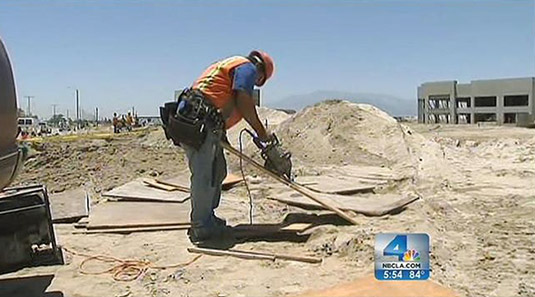
[Image: Construction work at a future Amazon.com warehouse in San Bernardino, courtesy of NBC Southern California].

What’s at stake? Eager buyers are snapping up “vast warehouses—some are bigger than 30 football fields under one roof—where they can store, process and ship merchandise such as clothes, books and toys to ever more online shoppers and handle the rising flood of goods passing through the ports of Los Angeles and Long Beach.”

It’s a logistics rush “so intense” that “developers are erecting more than 16 million square feet of warehouses on speculation, meaning they are gambling that buyers or renters will rush forward to claim the buildings by the time they are complete.”

As it happens, though, huge volumes of empty space framed by walls and ceilings are something of the ultimate testing ground for robot intelligence: “Once upon a time, a warehouse was where you stored things for weeks or months, such as toys and canned food that retailers would grab to restock their shelves. Sorting, organizing and moving the inventory was a constant challenge.”

However, now, in this age of empty architectural airspace, “Tracking goods in the modern age of bar codes, scanners and computers is a comparative breeze. The location of every widget can be identified with pinpoint accuracy and fetched by robots that can lift and carry 3,000-pound loads with ease.”

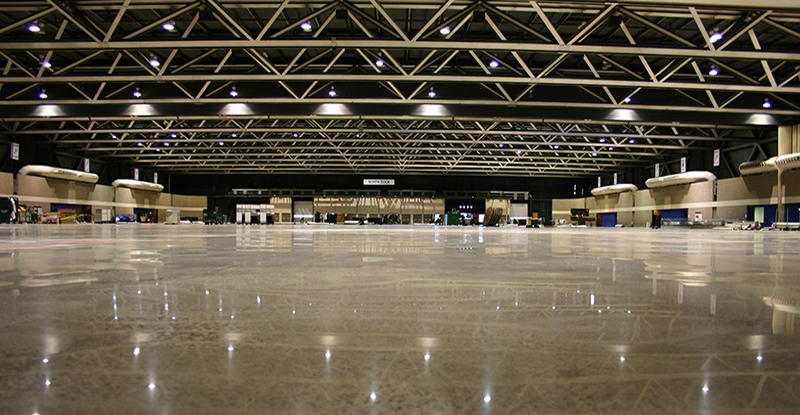
[Image: An unrelated warehouse photo from CCI Flooring].

I’m reminded of something novelist Zachary Mason said in an interview with BLDGBLOG three years ago. Mason, who has also worked in the field of artificial intelligence, pointed out the spatial problems faced by any truly emergent A.I.:

One of the problems with A.I. is that interacting with the world is really tough. Both sensing the world and manipulating it via robotics are very hard problems, and solved only for highly stripped-down special cases. Unmanned aerial vehicles, for instance, work well, because maneuvering in a big, empty, three-dimensional void is easy—your GPS tells you exactly where you are, and there’s nothing to bump into except the odd migratory bird. Walking across across a desert, though, or, heaven help us, negotiating one’s way through a room full of furniture in changing lighting conditions, is vastly more difficult.

The prospect of Artificial Intelligence finding its way into the world not by way of unmanned aerial vehicles flying in Mason’s “big, empty, three-dimensional void” but, instead, in the vast and echoing elsewhere of speculative warehouse space built in the desert outside Los Angeles is an incredible, and even somewhat frightening, thing to contemplate.

However, I started this post actually hoping to point out one small thing mentioned merely in passing at the end of the L.A. Times article.

One of these warehouses, it turns out, is actually so huge it must be laser-leveled against the curvature of the earth.

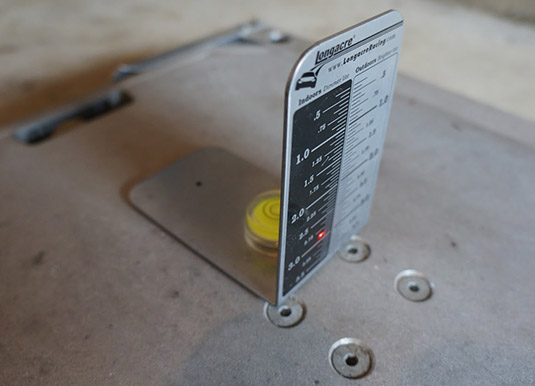
[Image: A laser-leveling target used for calibrating car scales, taken by someone named “Butt Dyno,” via an evolutionm.net forum].

The building in question “has 32-foot ceilings and enough doors to load or unload 124 trucks at the same time,” presenting insane combinatorial possibilities that would make the bridges of Königsberg blush; but, even more unbelievably, this “480,000-square-foot facility recently built for Quaker Oats Co. on land that used to be part of Norton Air Force Base in San Bernardino… is so long at 1,000 feet that contractors laying the concrete floor used lasers to gently follow the curve of the Earth and keep the floor level.”

Of course, this means that you could also work in reverse, and thus deduce, from the precise leveling of the warehouse floor, the curvature of the planet it rests on, which, bizarrely enough, makes studying this building—an empty warehouse in the California desert—an unexpected subset of astronomical calculation.

Last week, for instance, we looked at various “benchmarks” that have been used for measuring the circumference of the Earth, but perhaps future generations will simply drive out to a cluster of warehouses somewhere on the fringes of Los Angeles—next century’s Stonehenge, a new Solomon’s Temple, or Superstudio meets Eratosthenes—ritually laser-level the floor on a hot summer afternoon, and thus deduce the limits of our world itself, all by way of the most “fundamental” of architectural interventions: the floor.


The logistical super-surface as planetary analogue.

Floating Cities and Site Surveys

[Image: Photo by Mark Smout of a photo by Mark Smout, for the British Exploratory Land Archive].

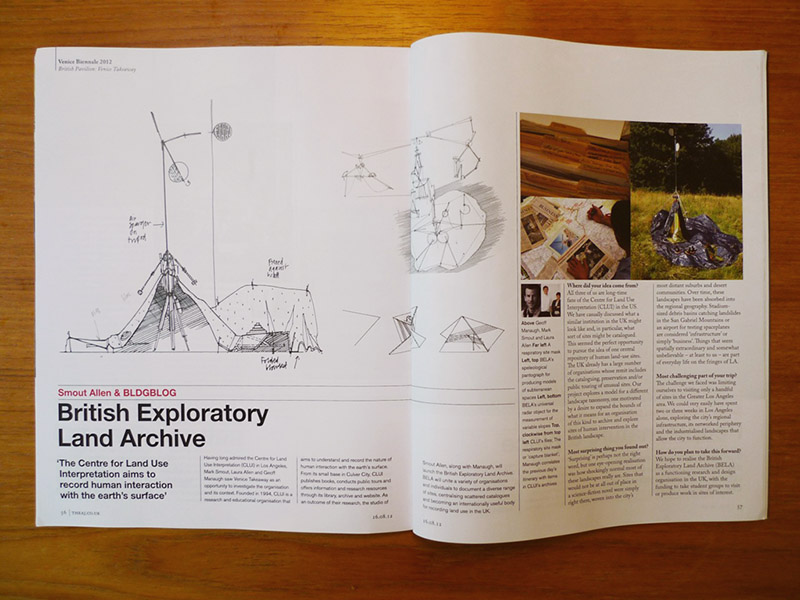
I’m delighted to say that work originally produced for the British Pavilion at last summer’s Venice Biennale will go on display this week at the Royal Institute of British Architects in London, beginning tomorrow, 26 February.

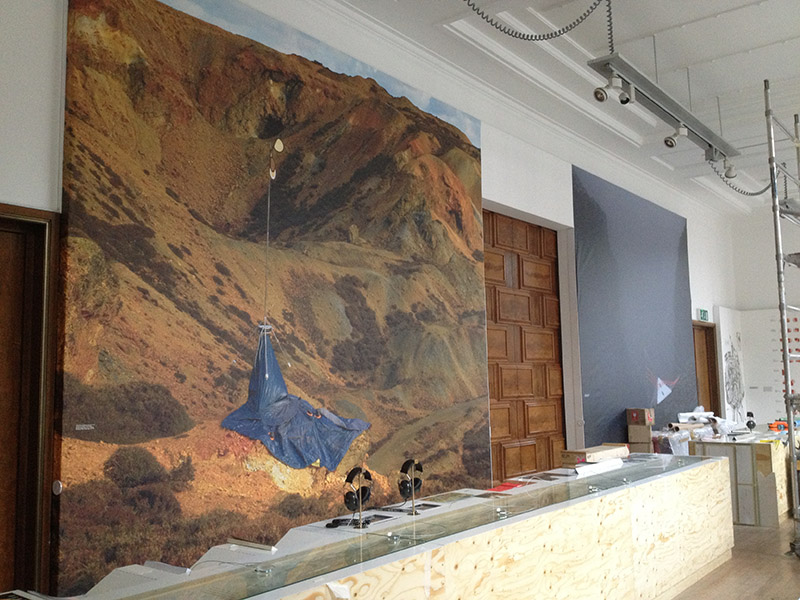
This will include, among many other projects, from studies of so-called “new socialist villages” in China to floating buildings in Amsterdam, to name but a few, the British Exploratory Land Archive (BELA) for which BLDGBLOG collaborated with architects Smout Allen in proposing a British version of the Center for Land Use Interpretation in Los Angeles. BELA would thus survey, catalog, explore, tour, document, and archive in one location the huge variety of sites in Britain altered by and used by human beings, from industrial sites to deserted medieval villages, slag heaps to submarine bases, smuggler’s hideouts to traffic-simulation grounds. A few of these sites have already been documented in massive photographs now mounted at the RIBA, also featuring architectural instruments designed specifically for the BELA project and assembled over the summer in Hackney.

[Image: From the British Exploratory Land Archive].

However, if you’re curious to know more and you happen to be in London on Thursday, 28 February, consider stopping by the Architectural Association to hear Smout Allen and I speak in more detail about the project. That talk is free and open the public, and it kicks off at 6pm; I believe architect Liam Young will be introducing things. Meanwhile, the aforementioned study of floating architecture in Amsterdam will be presented by its collaborative team—dRMM—at the RIBA on Tuesday night, 26 February, so make your calendars for that, as well (and check out the full calendar of related talks here).

The RIBA is at 66 Portland Place and the AA is in Bedford Square.

Detecting lost rooms with architectural antennae

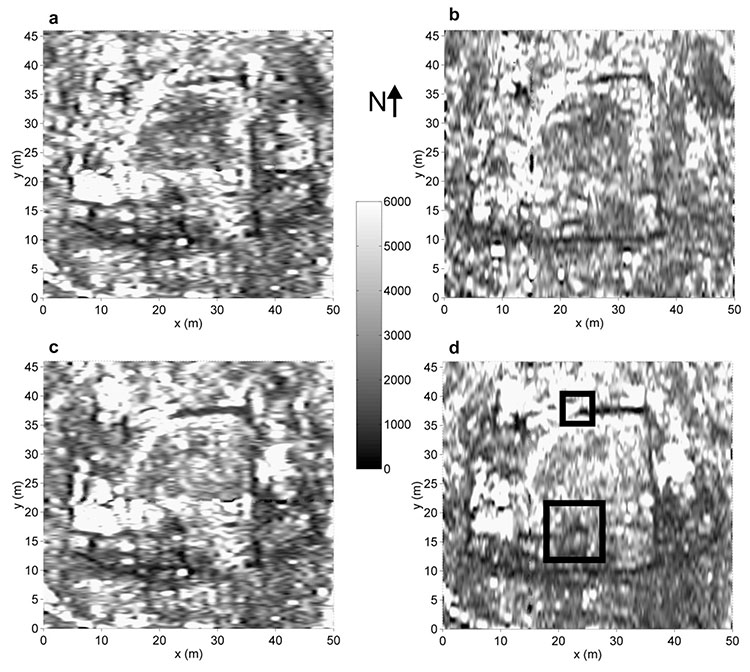
[Image: “Constant time slices” reveal buildings buried in northwestern Argentina; image from, and courtesy of, the Journal of Archaeological Science, “Detecting and mapping buried buildings with Ground-Penetrating Radar at an ancient village in northwestern Argentina,” by Néstor Bonomo, Ana Osella, and Norma Ratto].

While reading The Losers last night for the first time—a graphic novel about a team of ex-CIA members now executing a series of elaborate heists against their former employer—I was pleasantly surprised to see that one of the final scenarios involves a small volcanic island featuring an abandoned village that had very recently been buried by ash and pumice.

In a nutshell, the buildings beneath all that rock and ash are still intact—and one of them contains a locked safe that our eponymous group of “losers” is searching for. So begins an unfortunately quite short scene of vertical archaeology: locating the proper building amidst the featureless landscape of ash, blasting a hole down through the building’s roof, stabilizing the ceiling from within so that heavy-lifting equipment can be installed on the rooftop, and then descending into the hallways and staircases below by way of mountaineering ropes to find the safe.

For whatever reason, there are few things I find more exciting to read about than high-risk descents into buried cities, especially one that, as in the case of The Losers, remains otherwise indistinguishable from the surface of the earth, only gradually revealing itself to be an extraordinary honeycomb of connected rooms and passages—and this brief moment in the book was made even more interesting when I remembered a handful of articles I’d saved last year, one of which also involves a lost village, buried by volcanic ash.

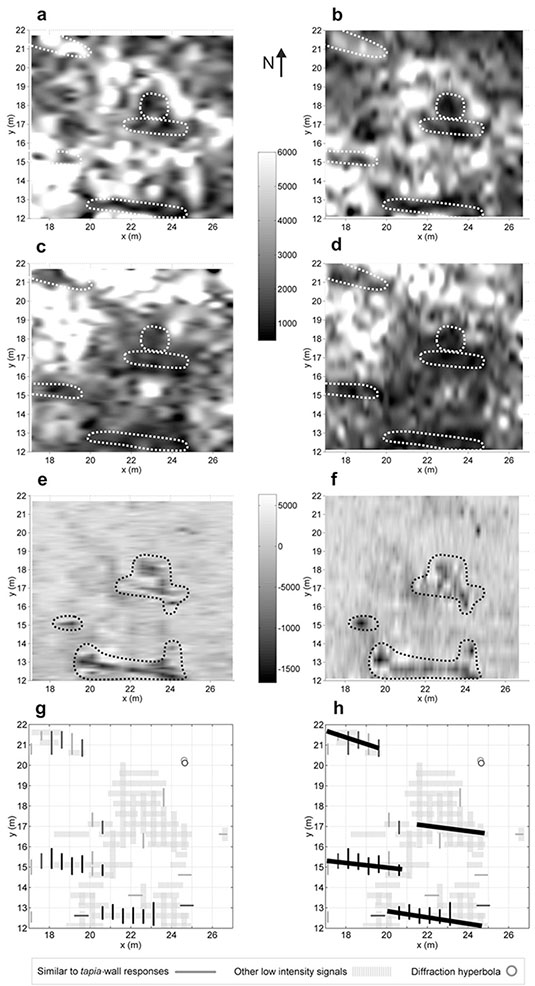
[Image: A selection of “time slices” from the buried buildings of northwestern Argentina; image from, and courtesy of, the Journal of Archaeological Science, “Detecting and mapping buried buildings with Ground-Penetrating Radar at an ancient village in northwestern Argentina,” by Néstor Bonomo, Ana Osella, and Norma Ratto].

In a 1998 paper from the Journal of Applied Geophysics, called “The use of ground penetrating radar to map an ancient village buried by volcanic eruptions,” we read about a village in Japan called Komochi-mura, in Gunma prefecture: “The entire area surrounding the village is covered by a thick deposit of pumice derived from the eruption of Futatsudake volcano of Mt. Haruna, approximately 10km to the southwest of the village.”

Beneath the modern village, its predecessor from the middle of the 6th century is buried by the pumice deposits. Since these were laid down over a very short period, the ancient village should survive in a high state of preservation and will therefore contain much significant archaeological information. Ground penetrating radar (GPR) has been used to investigate this site over a period of 10 years. As a result, the plan of the ancient village can be accurately mapped… In this paper, the authors demonstrate how GPR was able to map the structural remains of the ancient village under a deposit of pumice.

In addition to various buildings, “pit-dwellings,” and other destroyed structures preserved but invisibly buried beneath today’s village, “traces of brushwood hedges, paths and other slight features have also been identified by the survey.”

These types of articles—on the remote-sensing of buried architectural remains, using technologies that “can detect and map buried structures without disturbing them,” in the words of the paper I am about to cite—are increasingly easy to find, but no less interesting because of their ubiquity.

Another paper, then, called “Detecting and mapping buried buildings with Ground-Penetrating Radar at an ancient village in northwestern Argentina,” published in 2010 in the Journal of Archaeological Science, describes an archaeological survey in which ground-penetrating radar was used “in order to detect new buildings,” including a system of “complex wall distribution and a number of unknown enclosures.” These “new buildings,” however, were just signals from the earth awaiting spatial interpretation:

The exploration showed signals of mud-walls in a sector that was located relatively far from the previously known buildings. A detailed survey was performed in this sector, and the results showed that the walls belonged to a large dwelling with several rooms. The discovery of this dwelling has considerably extended the size of the site, showing that the dwellings occupied at least twice the originally assumed area. High-density GPR surveys were acquired at different parts of the discovered building in order to resolve complex structures. Interpreted maps of the building were obtained.

“From the joint analysis of the transverse sections, time slices and volume slices of the data and their time averaged intensity,” the authors explain, “we have obtained a final map for the new building”—where the “new” building, of course, is a much older, forgotten one, a structure interpretively remade and refreshed through this newfound legibility.

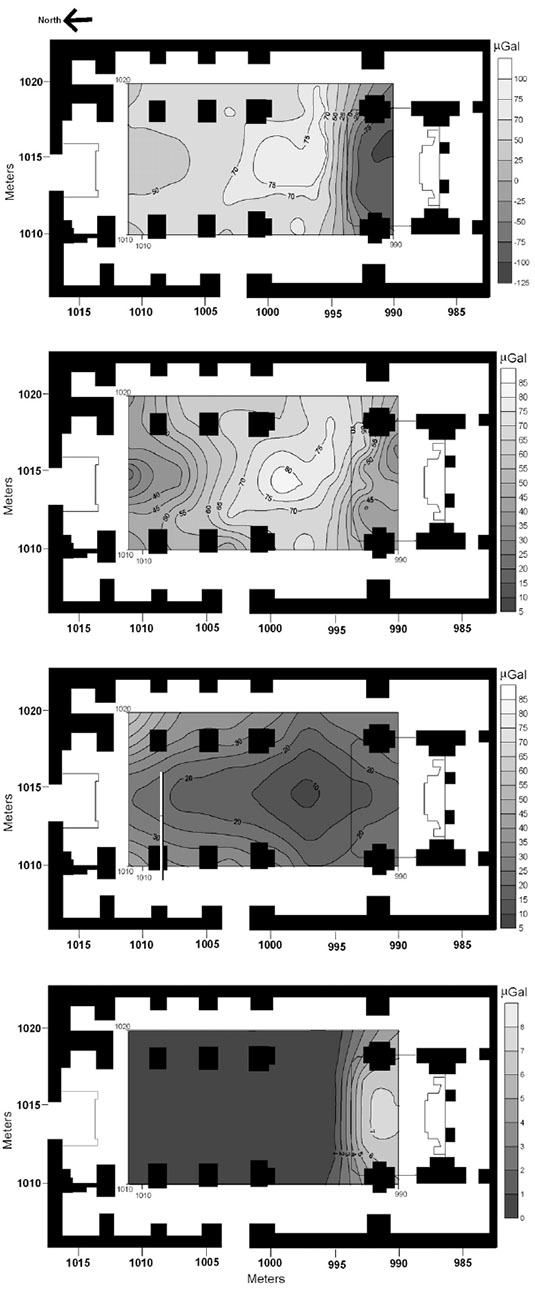
[Image: From “Archaeological microgravimetric prospection inside don church (Valencia, Spain),” by Jorge Padín, Angel Martín, Ana Belén Anquela, in a 2012 issue of the Journal of Archaeological Science].

Architecture, in this context, comes to our attention first as a series of “intensity blots continued through consecutive slices,” an almost impossibly abstract geometry of signals and reflections, of patterned “electromagnetic responses” hidden in the landscape.

In all of these cases, it’d be interesting to propose a kind of archaeological discovery park the size of a football stadium, whose interior is simply a massive, open-span paved landscape on which small devices like floor-waxing machines or lawnmowers have been parked. Paying visitors can walk out onto this vast, continuous monument of bare concrete where they will begin moving the machines around, cautiously at first but then much more ambitiously, revealing as they do so the underground perimeters and outlines of entire villages buried deep in the mud and gravel beneath the building. The “park” is thus really a kind of terrestrial TV show of invisible architecture previously lost to history but beautifully preserved—that is, entombed—in the geology below.

In any case, in writing this post I’ve realized that I’ve accumulated over the past two years or so several gigabytes’ worth of PDFs about these and other archaeological technologies—from mapping ancient ships buried in the Egyptian pyramids and micro-gravity detection of “shallow subsurface structures” in a church in Italy (“indicating,” in the authors’ words, “that the actual church was constructed above another one”) to “archaeomagnetic data” taken from Roman sites in Tunisia—but here’s at least one more reference for good measure.

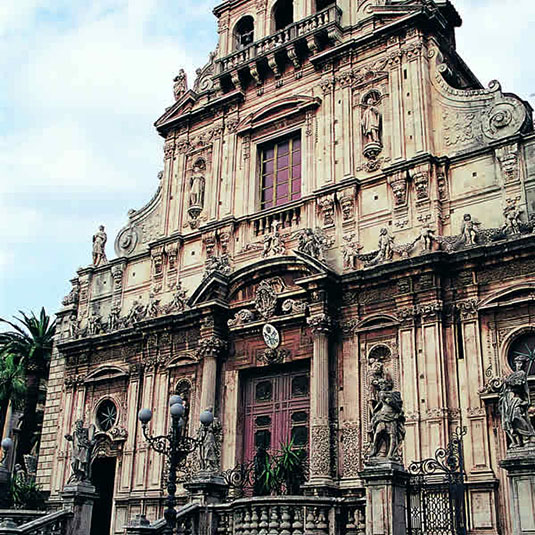
In a paper called “Ground penetrating radar (G.P.R.) surveys applied to the research of crypts in San Sebastiano’s church in Catania (Sicily),” from a 2007 issue of the Journal of Cultural Heritage, a team of Italian geophysicists explored “natural or anthropic buried cavities” under a church in Sicily—that is, both architectural chambers and caves physically inaccessible in the foundations of the building. Soon enough, the authors write, “the existence of hidden structures was revealed.”

“In fact,” they add, “a crypt with a barrel vault, under the central aisle of the church, and a room of small dimensions next to this crypt were identified. Moreover, near the altar, the presence of a quadrangular crypt with a cross-vault was revealed. The presence of such buried masonries confirms that the church, rebuilt on previous building rests, has been subjected along the centuries to repeated repairs.”

[Image: The church of San Sebastiano in Catania, Sicily, courtesy of the regional tourism council].

There is something particularly awesome—that is, it is a story that lends itself particularly to metaphor—about envisioning a squad of well-equipped scientists setting up shop in a church in Sicily, using radar and rigs of strange antennae to scan the structure around them for secret rooms, heavenly nooks and crannies out of human reach. A kind of electromagnetic baroque.

The paper cited in a caption above—”Archaeological microgravimetric prospection inside don church (Valencia, Spain),” by Jorge Padín, Angel Martín, Ana Belén Anquela, from a 2012 issue of the Journal of Archaeological Science—even includes such strangely resonant lines as calculating against “residual gravity anomalies” in a “microgravimetric correction for the altar,” as if the high science of geophysical investigation has been rhetorically wed with theological speculation.

In the words of a paper by N. Farnoosh et al., published in a 2008 issue of NDT & E International, analyzing a given architectural space becomes a question of “buried target detection” using high-tech means—that is, establishing a sustained and coordinated “electromagnetic interaction among the radar antennas, ground, and buried objects.”

Here, the study of architectural history can very, very loosely be compared to astronomy: using tools of remote-sensing, including antennae, but targeted downward, into the earth, to reveal the flickering, gossamer traces of something that, for a variety of reasons, humans can’t yet physically reach. Like astronomy, then, archaeology and architectural history become a case of interpreting signals from afar, not of stars and supernovae but of lost rooms and buildings beneath our feet.

San Andreas: Architecture for the Fault

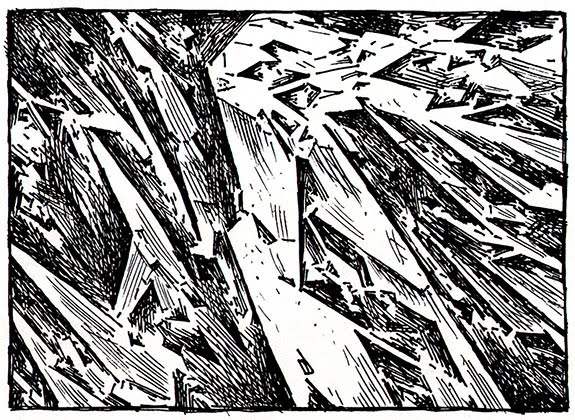
[Image: Lebbeus Woods, from San Francisco Project: Inhabiting the Quake, Quake City (1995)].

I thought I’d upload the course description for a studio I’ll be teaching this spring—starting next week, in fact—at Columbia University’s GSAPP on the architectural implications of seismic energy and the possibility of a San Andreas Fault National Park in California. The images in this post are just pages from the syllabus.

The overall idea is to look at architecture’s capacity for giving form to—or, in terms of the course description, its capacity to “make legible”—seismic energy as experienced along the San Andreas Fault. As the syllabus explains, we’ll achieve this, first, through the design and modeling of a series of architectural “devices”—not scientific instruments, but interpretive tools—that can interact with, spatially mediate, and/or augment the fault line, making the tectonic forces of the earth visible, audible, or otherwise sensible for a visiting public. From pendulums to prepared pianos, seismographs to shake tables, this invention and exploration of new mechanisms for the fault will fill the course’s opening three weeks.

The larger and more important impetus of the studio, however, is to look at the San Andreas Fault as a possible site for a future National Park, including all that this might entail, from questions of seismic risk and what it means to invite visitors into a place of terrestrial instability to the impossibility of preserving a landscape on the move. What might a San Andreas Fault National Park look like, we will ask, how could such a park best be managed, what architecture and infrastructure—from a visitors’ center to hiking way stations—would be appropriate for such a dynamic site, and, in the end, what does it mean to enshrine seismic movement as part of the historical narrative of the United States, suggesting that a fault line can be worthy of National Park status?

I’m also excited to say that we’ll be working in collaboration with Marc Weidenbaum’s Disquiet Junto, an online music collective who will be developing projects over the course of the spring that explore the sonic properties of the San Andreas Fault—a kind of soundtrack for the San Andreas. The results of these experiments will be uploaded to Soundcloud.
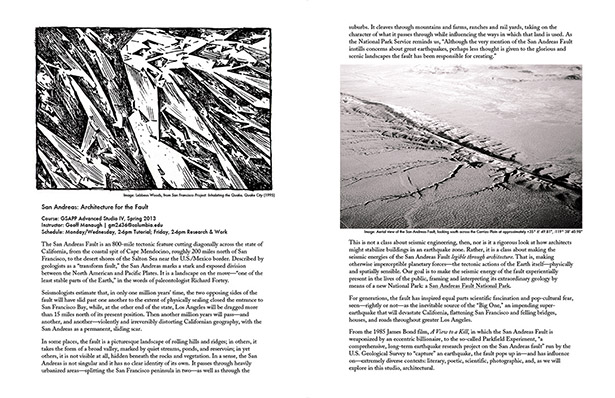
[Images: Lebbeus Woods, from San Francisco Project: Inhabiting the Quake, Quake City (1995) and an aerial view of the San Andreas Fault, looking south across the Carrizo Plain at approximately +35° 6′ 49.81″, -119° 38′ 40.98″].

Course: Columbia University GSAPP Advanced Studio IV, Spring 2013
Title: San Andreas: Architecture for the Fault
Instructor: Geoff Manaugh

The San Andreas Fault is a roughly 800-mile tectonic feature cutting diagonally across the state of California, from the coastal spit of Cape Mendocino, 200 miles north of San Francisco, to the desert shores of the Salton Sea near the U.S./Mexico border. Described by geologists as a “transform fault,” the San Andreas marks a stark and exposed division between the North American and Pacific Plates. It is a landscape on the move—“one of the least stable parts of the Earth,” in the words of paleontologist Richard Fortey, writing in his excellent book Earth: An Intimate History, and “one of several faults that make up a complex of potential catastrophes.”

Seismologists estimate that, in just one million years’ time, the two opposing sides of the fault will have slid past one another to the extent of physically sealing closed the entrance to San Francisco Bay; at the other end of the state, Los Angeles will have been dragged more than 15 miles north of its present position. But then another million years will pass—and another, and another—violently and unrecognizably distorting Californian geography, with the San Andreas as a permanent, sliding scar.

In some places today, the fault is a picturesque landscape of rolling hills and ridges; in others, it is a broad valley, marked by quiet streams, ponds, and reservoirs; in yet others, it is not visible at all, hidden beneath the rocks and vegetation. In a sense, the San Andreas is not singular and it has no clear identity of its own, taking on the character of what it passes through whilst influencing the ways in which that land is used. The fault cuts through heavily urbanized areas—splitting the San Francisco peninsula in two—as well as through the suburbs. It cleaves through mountains and farms, ranches and rail yards. As the National Park Service reminds us, “Although the very mention of the San Andreas Fault instills concerns about great earthquakes, perhaps less thought is given to the glorious and scenic landscapes the fault has been responsible for creating.”
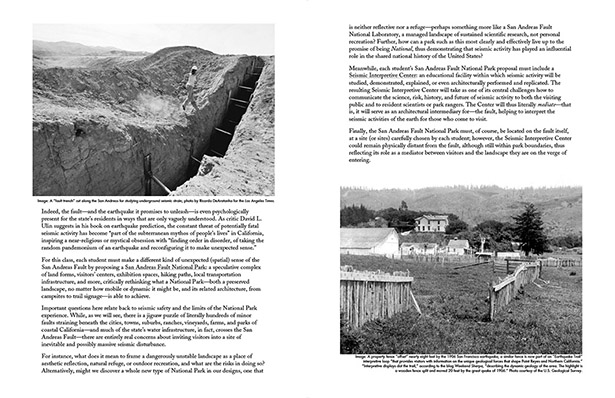
[Images: (left) A “fault trench” cut along the San Andreas for studying underground seismic strain; photo by Ricardo DeAratanha for the Los Angeles Times. (right) A property fence “offset” nearly eight feet by the 1906 San Francisco earthquake; a similar fence is now part of an “Earthquake Trail” interpretive loop “that provides visitors with information on the unique geological forces that shape Point Reyes and Northern California.” “Interpretive displays dot the trail,” according to the blog Weekend Sherpa, “describing the dynamic geology of the area. The highlight is a wooden fence split and moved 20 feet by the great quake of 1906.” Photo courtesy of the U.S. Geological Survey].

This is not a class about seismic engineering, however, nor is it a rigorous look at how architects might stabilize buildings in an earthquake zone. Rather, it is a class about making the seismic energies of the San Andreas Fault legible through architecture. That is, making otherwise imperceptible planetary forces—the tectonic actions of the Earth itself—physically and spatially sensible. Our goal is to make the seismic energy of the fault experientially present in the lives of the public, framing and interpreting its extraordinary geology by means of a new National Park: a San Andreas Fault National Park.

For generations, the fault has inspired equal parts scientific fascination and pop-cultural fear, seen—rightly or not—as the inevitable source of the “Big One,” an impending super-earthquake that will devastate California, flattening San Francisco and felling bridges, houses, and roads throughout greater Los Angeles.

From the 1985 James Bond film, A View to a Kill, in which the San Andreas Fault is weaponized by an eccentric billionaire, to the so-called Parkfield Experiment, “a comprehensive, long-term earthquake research project on the San Andreas fault” run by the U.S. Geological Survey to “capture” an earthquake, the fault pops up in—and has influence on—extremely diverse contexts: literary, poetic, scientific, photographic, and, as we will explore in this studio, architectural.

Indeed, the fault—and the earthquake it promises to unleash—is even psychologically present for the state’s residents in ways that are only vaguely understood. As critic David L. Ulin suggests in his book The Myth of Solid Ground, on the promises and impossibilities of earthquake prediction, the constant threat of potentially fatal seismic activity has become “part of the subterranean mythos of people’s lives” in California, inspiring a near-religious or mystical obsession with “finding order in disorder, of taking the random pandemonium of an earthquake and reconfiguring it to make unexpected sense.”

For this class, each student must make a different kind of unexpected (spatial) sense of the San Andreas Fault by proposing a San Andreas Fault National Park: a speculative complex of land forms, visitors’ centers, exhibition spaces, hiking paths, local transportation infrastructure, and more, critically rethinking what a National Park—both a preserved landscape, no matter how mobile or dynamic it might be, and its related architecture, from campsites to trail signage—is able to achieve.

Important questions here relate back to seismic safety and the limits of the National Park experience. While, as we will see, there is a jigsaw puzzle of literally hundreds of minor faults straining beneath the cities, towns, suburbs, ranches, vineyards, farms, and parks of coastal California—and much of the state’s water infrastructure, in fact, crosses the San Andreas Fault—there are entirely real concerns about inviting visitors into a site of inevitable and possibly massive seismic disturbance.

For instance, what does it mean to frame a dangerously unstable landscape as a place of aesthetic reflection, natural refuge, or outdoor recreation, and what are the risks in doing so? Alternatively, might we discover a whole new type of National Park in our designs, one that is neither reflective nor a refuge—perhaps something more like a San Andreas Fault National Laboratory, a managed landscape of sustained scientific research, not personal recreation? Further, how can a park such as this most clearly and effectively live up to the promise of being National, thus demonstrating that seismic activity has played an influential role in the shared national history of the United States?

Meanwhile, each student’s San Andreas Fault National Park proposal must include a Seismic Interpretive Center: an educational facility within which seismic activity will be studied, demonstrated, explained, or even architecturally performed and replicated. The resulting Seismic Interpretive Center will take as one of its central challenges how to communicate the science, risk, history, and future of seismic activity to both the visiting public and to resident scientists or park rangers.

Finally, the San Andreas Fault National Park must, of course, be located on the fault itself, at a site (or sites) carefully chosen by each student; however, the Seismic Interpretive Center could remain physically distant from the fault, although still within park boundaries, thus reflecting its role as a mediator between visitors and the landscape they are on the verge of entering.
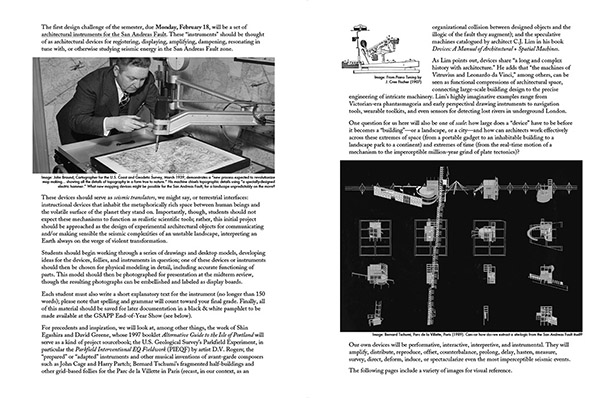
[Images: (left) John Braund, Cartographer for the U.S. Coast and Geodetic Survey, March 1939, demonstrates a “new process expected to revolutionize map making… showing all the details of topography in a form true to nature.” His machine chisels topographic details using “a specially-designed electric hammer.” What new mapping devices might be possible for the San Andreas Fault, for a landscape unpredictably on the move? (right top) From Piano Tuning by J. Cree Fischer (1907). (right bottom) Bernard Tschumi, Parc de la Villette, Paris (1989). Can—or how do—we extract a site-logic from the San Andreas Fault itself?].

The first design challenge of the semester, due Monday, February 18, will be a set of architectural instruments for the San Andreas Fault. These “instruments” should be thought of as architectural devices for registering, displaying, amplifying, dampening, resonating in tune with, or otherwise studying seismic energy in the San Andreas Fault zone.

These devices should serve as seismic translators, we might say, or terrestrial interfaces: instructional devices that inhabit the metaphorically rich space between human beings and the volatile surface of the planet they stand on. Importantly, though, students should not expect these mechanisms to function as realistic scientific tools; rather, this initial project should be approached as the design of experimental architectural objects for communicating and/or making sensible the seismic complexities of an unstable landscape, interpreting an Earth always on the verge of violent transformation.

Students should begin working through a series of drawings and desktop models, developing ideas for the devices, follies, and instruments in question; one of these devices or instruments should then be chosen for physical modeling in detail, including accurate functioning of parts. This model should then be photographed for presentation at the midterm review, though the resulting photographs can be embellished and labeled as display boards. Each student must also write a short explanatory text for the instrument (no longer than 150 words).

Finally, all of this material should be saved for later documentation in a black & white pamphlet to be made available at the GSAPP End-of-Year Show.

For precedents and inspiration, we will look at, among other things, the work of Shin Egashira and David Greene, whose 1997 booklet Alternative Guide to the Isle of Portland will serve as a kind of project sourcebook; the U.S. Geological Survey’s Parkfield Experiment, in particular the Parkfield Interventional EQ Fieldwork (PIEQF) by artist D.V. Rogers; the “prepared” or “adapted” instruments and other musical inventions of avant-garde composers such as John Cage and Harry Partch; Bernard Tschumi’s fragmented half-buildings and other grid-based follies for the Parc de la Villette in Paris (recast, in our context, as an organizational collision between designed objects and the illogic of the fault they augment); and the speculative machines catalogued by architect C.J. Lim in his book Devices: A Manual of Architectural + Spatial Machines.
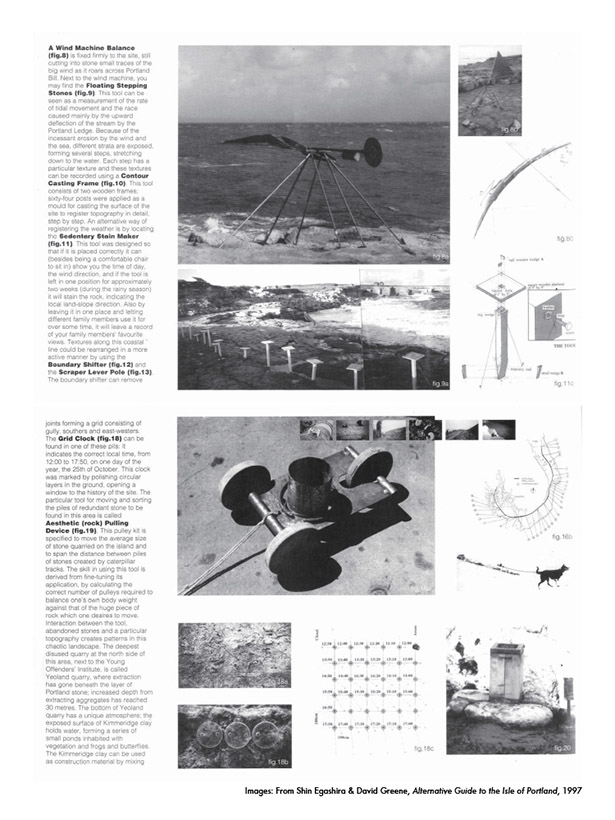
[Images: From Shin Egashira & David Greene, Alternative Guide to the Isle of Portland (1997)].

As Lim points out, devices share “a long and complex history with architecture.” He adds that “the machines of Vitruvius and Leonardo da Vinci,” among others, can be seen as functional compressions of architectural space, connecting large-scale building design to the precise engineering of intricate machinery. Lim’s highly imaginative examples range from Victorian-era phantasmagoria and early perspectival drawing instruments to navigation tools, wearable toolkits, and even sensors for detecting lost rivers in underground London.
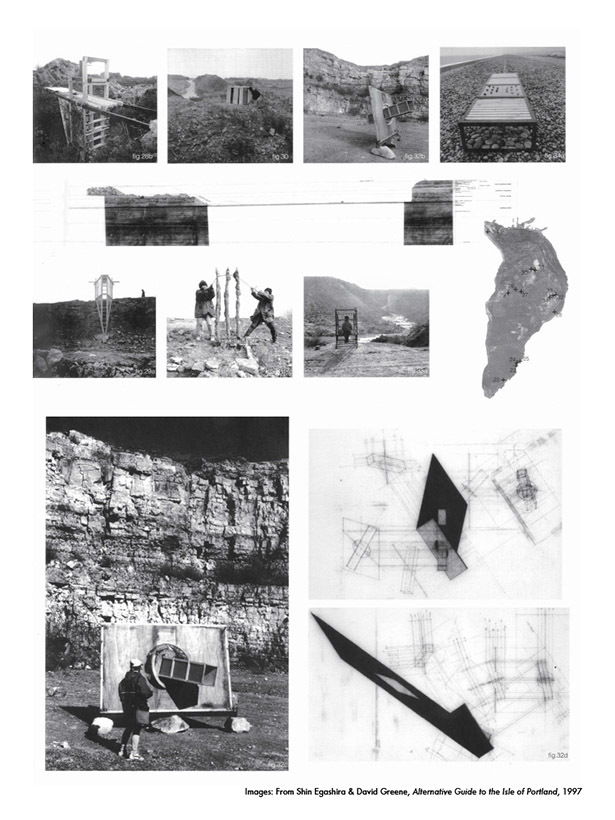
[Images: From Shin Egashira & David Greene, Alternative Guide to the Isle of Portland (1997)].

One question for us here will also be in reference to scale: how large does a “device” have to be before it becomes a “building”—or a landscape, or a city—and how can architects work effectively across these extremes of space (from a portable gadget to an inhabitable building to a landscape park to a continent) and extremes of time (from the real-time motion of a mechanism to the imperceptible million-year grind of plate tectonics)?
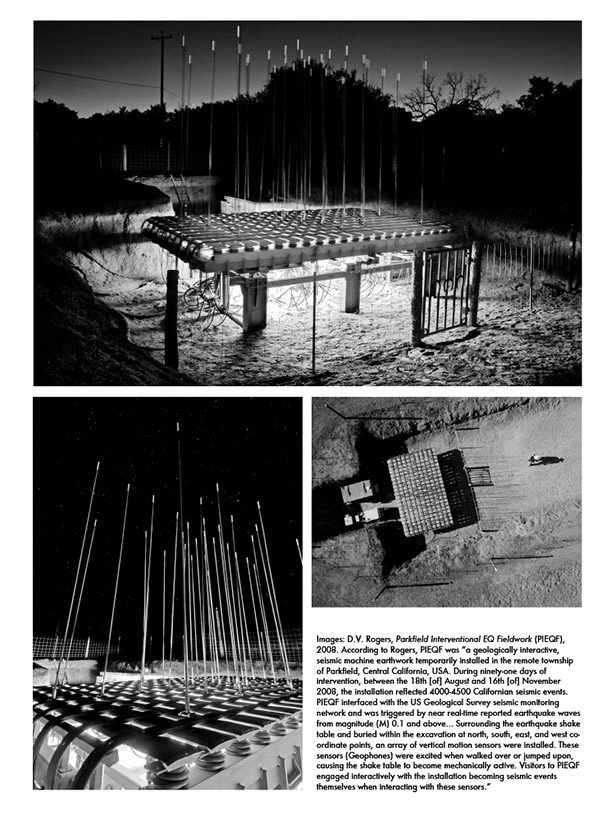
[Images: D.V. Rogers, Parkfield Interventional EQ Fieldwork (PIEQF), 2008. According to Rogers, PIEQF was “a geologically interactive, seismic machine earthwork temporarily installed in the remote township of Parkfield, Central California, USA. During ninety-one days of intervention, between the 18th [of] August and 16th [of] November 2008, the installation reflected 4000-4500 Californian seismic events. PIEQF interfaced with the US Geological Survey seismic monitoring network and was triggered by near real-time reported earthquake waves from magnitude (M) 0.1 and above… Surrounding the earthquake shake table and buried within the excavation at north, south, east, and west co-ordinate points, an array of vertical motion sensors were installed. These sensors (Geophones) were excited when walked over or jumped upon, causing the shake table to become mechanically active. Visitors to PIEQF engaged interactively with the installation becoming seismic events themselves when interacting with these sensors.”].

Our own devices will be performative, interactive, interpretive, and instrumental. They will amplify, distribute, reproduce, offset, counterbalance, prolong, delay, hasten, measure, survey, direct, deform, induce, or spectacularize even the most imperceptible seismic events.
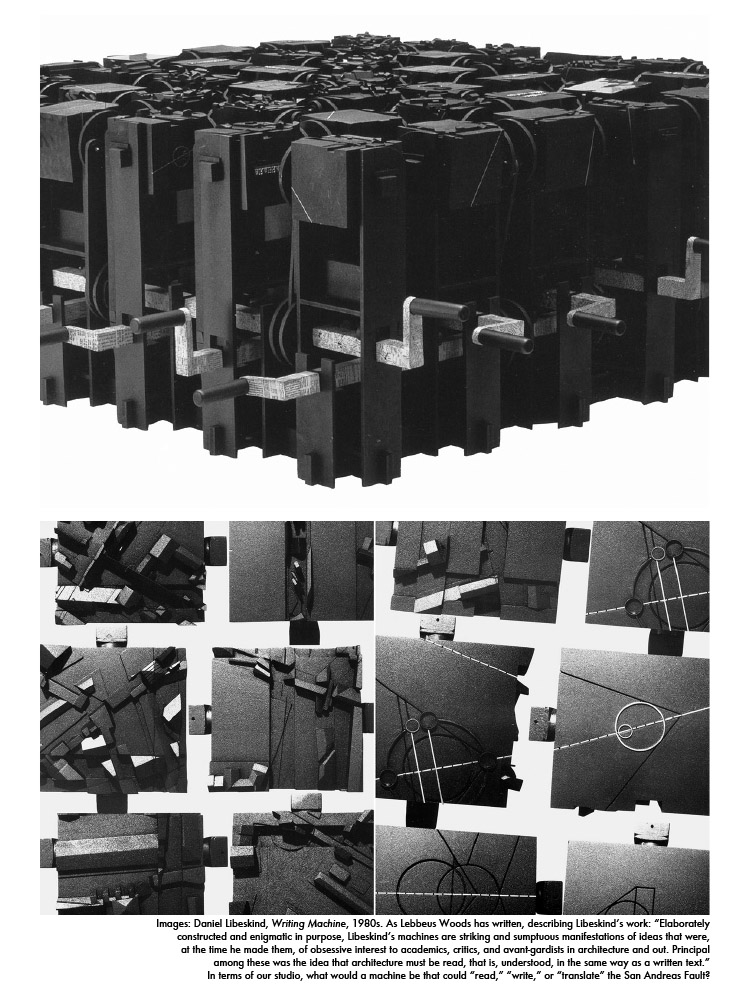
[Images: Daniel Libeskind, Writing Machine (1980s). As Lebbeus Woods has written, describing Libeskind’s work: “Elaborately constructed and enigmatic in purpose, Libeskind’s machines are striking and sumptuous manifestations of ideas that were, at the time he made them, of obsessive interest to academics, critics, and avant-gardists in architecture and out. Principal among these was the idea that architecture must be read, that is, understood, in the same way as a written text.” In terms of our studio, what would a machine be that could “read,” “write,” or “translate” the San Andreas Fault?].

Again, these “instruments” should not be approached as realistic scientific tools, but rather as poetic, spatial augmentations of the San Andreas Fault. Students are being asked to use the problem-solving techniques of architectural design to imagine hypothetical devices at a variety of scales that will translate this unique site—a fault line between tectonic plates and an elastic zone of origin for millions of years of future terrain deformation—into a new kind of spatial and intellectual experience for those who encounter it.
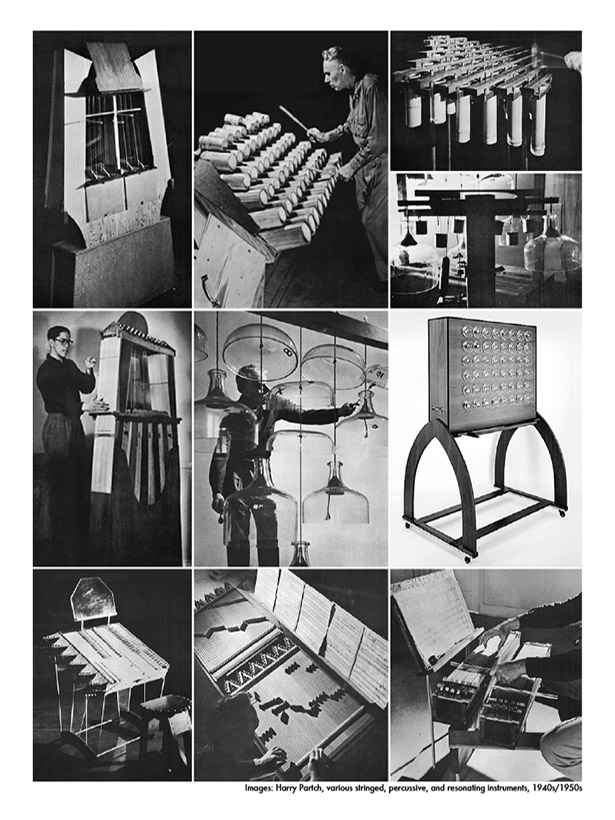
[Images: Harry Partch, various stringed, percussive, and resonating instruments (1940s/1950s)].

Upon completing these devices, the second, most important, and largest project of the semester, due Wednesday, April 17, will be the San Andreas Fault National Park proposal and its associated Seismic Interpretive Center.

The Seismic Interpretive Center should be an educational facility, equivalent to 30,000 square feet. Here, seismic activity will be studied, demonstrated, interpreted, and otherwise explained to the visiting public and to a seasonal crew of scientist-researchers who use the facility in their work. It might be useful to think of the Seismic Interpretive Center as a direct outgrowth of the instruments developed in the previous project, either by housing or emulating those devices. In other words, the Center could passively display seismic instruments for public use but simultaneously operate as an active, building-scale mechanism for engaging with or tectonically explaining the San Andreas Fault.

In practical terms, the proposed Center should be a fully developed three-dimensional building or landscape project, no matter how speculative or straight-forward its underlying premise might be, whether it is simply a museum of the fault or something more provocative, such as a partially underground public test-facility for generating artificial earthquakes. In all cases—circulation, materials, program, site—students must demonstrate thorough knowledge of their own project in the form of, but not limited to, the appropriate use of plans, sections, elevations, axonometrics, physical models, and 3D diagrams.
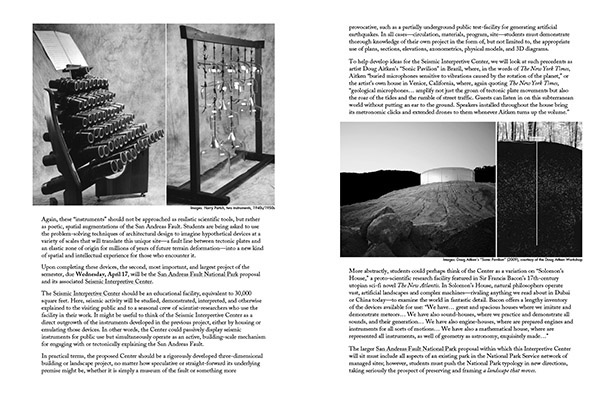
[Images: (left) Harry Partch, two instruments, 1940s/1950s. (right) Doug Aitken’s “Sonic Pavilion” (2009), courtesy of the Doug Aitken Workshop].

To help develop ideas for the Seismic Interpretive Center, we will look at such precedents as artist Doug Aitken’s “Sonic Pavilion” in Brazil, where, in the words of The New York Times, Aitken “buried microphones sensitive to vibrations caused by the rotation of the planet,” or the artist’s own house in Venice, California, where, again quoting The New York Times, “geological microphones… amplify not just the groan of tectonic plate movements but also the roar of the tides and the rumble of street traffic. Guests can listen in on this subterranean world without putting an ear to the ground. Speakers installed throughout the house bring its metronomic clicks and extended drones to them whenever Aitken turns up the volume.”

More abstractly, students could perhaps think of the Center as a variation on “Solomon’s House,” a proto-scientific research facility featured in Sir Francis Bacon’s 17th-century utopian sci-fi novel The New Atlantis. In Solomon’s House, natural philosophers operate vast, artificial landscapes and complex machines—rivaling anything we read about in Dubai or China today—to examine the world in fantastic detail. Bacon offers a lengthy inventory of the devices available for use: “We have… great and spacious houses where we imitate and demonstrate meteors… We have also sound-houses, where we practice and demonstrate all sounds, and their generation… We have also engine-houses, where are prepared engines and instruments for all sorts of motions… We have also a mathematical house, where are represented all instruments, as well of geometry as astronomy, exquisitely made…”

The larger San Andreas Fault National Park proposal within which this Interpretive Center will sit must include all aspects of an existing park in the National Park Service network of managed sites; however, students must push the National Park typology in new directions, taking seriously the prospect of preserving and framing a landscape that moves.
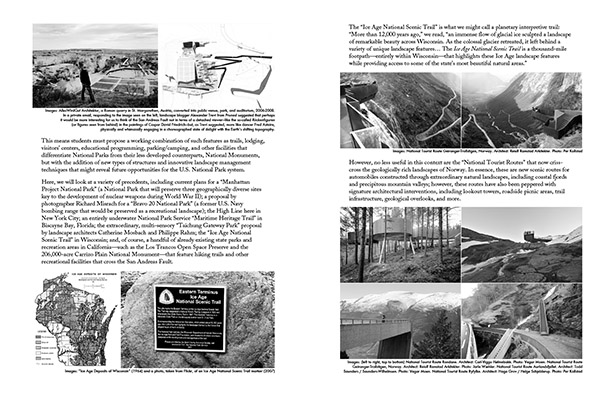
[Images: (left top) AllesWirdGut Architektur, a Roman quarry in St. Margarethen, Austria, converted into public venue, park, and auditorium, 2006-2008. In a private email, responding to the image seen on the left, landscape blogger Alexander Trevi from Pruned suggested that perhaps it would be more interesting for us to think of the San Andreas Fault not in terms of a detached viewer—like the so-called Rückenfiguren (or figures seen from behind) in the paintings of Caspar David Friedrich—but, as Trevi suggested, more like dancer Fred Astaire, physically and whimsically engaging in a choreographed state of delight with the Earth’s shifting topography. (left bottom) “Ice Age Deposits of Wisconsin” (1964) and a photo, taken from Flickr, of an Ice Age National Scenic Trail marker (2007). (right top) National Tourist Route Geiranger-Trollstigen, Norway. Architect: Reiulf Ramstad Arkitekter. Photo: Per Kollstad. (right bottom, left to right, top to bottom, within grid) National Tourist Route Rondane. Architect: Carl-Viggo Hølmebakk. Photo: Vegar Moen. National Tourist Route Geiranger-Trollstigen, Norway. Architect: Reiulf Ramstad Arkitekter. Photo: Jarle Wæhler. National Tourist Route Aurlandsfjellet. Architect: Todd Saunders / Saunders-Wilhelmsen. Photo: Vegar Moen. National Tourist Route Ryfylke. Architect: Haga Grov / Helge Schjelderup. Photo: Per Kollstad. Courtesy of National Tourist Routes in Norway].

This means students must propose a working combination of such features as trails, lodging, visitors’ centers, educational programming, parking/camping, and other facilities that differentiate National Parks from their less developed counterparts, National Monuments, but with the addition of new types of structures and innovative landscape management techniques that might reveal future opportunities for the U.S. National Park system.

Here, we will look at a variety of precedents, including current plans for a “Manhattan Project National Park” (a National Park that will preserve three geographically diverse sites key to the development of nuclear weapons during World War II); a proposal by photographer Richard Misrach for a “Bravo 20 National Park” (a former U.S. Navy bombing range that would be preserved as a recreational landscape); the High Line here in New York City; an entirely underwater National Park Service “Maritime Heritage Trail” in Biscayne Bay, Florida; the extraordinary, multi-sensory “Taichung Gateway Park” proposal by landscape architects Catherine Mosbach and Philippe Rahm; the “Ice Age National Scenic Trail” in Wisconsin; and, of course, a handful of already existing state parks and recreation areas in California—such as the Los Trancos Open Space Preserve and the 206,000-acre Carrizo Plain National Monument—that feature hiking trails and other recreational facilities that cross the San Andreas Fault.

The “Ice Age National Scenic Trail” is what we might call a planetary interpretive trail: “More than 12,000 years ago,” we read, “an immense flow of glacial ice sculpted a landscape of remarkable beauty across Wisconsin. As the colossal glacier retreated, it left behind a variety of unique landscape features… The Ice Age National Scenic Trail is a thousand-mile footpath—entirely within Wisconsin—that highlights these Ice Age landscape features while providing access to some of the state’s most beautiful natural areas.”

However, no less useful in this context are the “National Tourist Routes” that now criss-cross the geologically rich landscapes of Norway. In essence, these are new scenic routes for automobiles constructed through extraordinary natural landscapes, including coastal fjords and precipitous mountain valleys; however, these routes have also been peppered with signature architectural interventions, including lookout towers, roadside picnic areas, trail infrastructure, geological overlooks, and more.

But how do we define—let alone locate—a park on the scale of a fault line? Landscape architect James Corner suggests that the virtue of a “large park”—which he defines as a park “greater than 500 acres”—is that it “allows for dramatic exposure to the elements, to weather, geology, open horizons, and thick vegetation, all revealed to the ambulant body in alternating sequences of prospect and refuge—distinctive places for overview and survey woven with more intimate spots of retreat and isolation.” He calls such parks “huge experiential reserves”—in terms of the San Andreas, we might say a kind of seismic commons.

Further, thinking about—let alone designing—architecture on this scale requires close attention to what landscape theorist Julia Czerniak calls legibility. “The concept of legibility,” she writes in her edited collection Large Parks, “extends from park design to the design process. In other words, to be realized, parks have to be legible to the people who pay for and use them.” After all, she adds, “in addition to questions of a park’s legibility that stem from recognizing its limits—‘where is the park?’—large park schemes with unconventional configurations provoke other uncertainties—‘how does it look?’ and ‘what can it do?’”
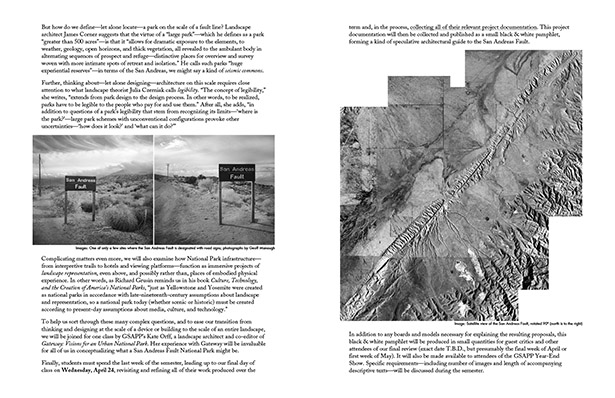
[Images: (left) One of only a few sites where the San Andreas Fault is designated with road signs; photographs by Geoff Manaugh. (right) Satellite view of the San Andreas Fault, rotated 90º (north is to the right)].

Complicating matters even more, we will also examine how National Park infrastructure—from interpretive trails to hotels and viewing platforms—function as immersive projects of landscape representation, even above, and possibly rather than, places of embodied physical experience. In other words, as Richard Grusin reminds us in his book Culture, Technology, and the Creation of America’s National Parks, “just as Yellowstone and Yosemite were created as national parks in accordance with late-nineteenth-century assumptions about landscape and representation, so a national park today (whether scenic or historic) must be created according to present-day assumptions about media, culture, and technology.” Indeed, he adds, “national parks have functioned from their inception as technologies for reproducing nature according to the scientific, cultural, and aesthetic practices of a particular historical moment—the period roughly between the Civil War and the end of the First World War.” How, then, would a 21st-century San Andreas Fault National park both represent and preserve the landscape in question?

To help us sort through these many complex questions, and to ease our transition from thinking and designing at the scale of a device or building to the scale of an entire landscape, we will be joined for one class by GSAPP’s Kate Orff, a landscape architect and co-editor of Gateway: Visions for an Urban National Park. Her experience with Gateway will be invaluable for all of us in conceptualizing what a San Andreas Fault National Park might be.

Finally, students must spend the last week of the semester, leading up to our final day of class on Wednesday, April 24, revisiting and refining all of their work produced over the term and, in the process, collecting all of their relevant project documentation. This project documentation will then be collected and published as a small black & white pamphlet, forming a kind of speculative architectural guide to the San Andreas Fault.

In addition to any boards and models necessary for explaining the resulting proposals, this black & white pamphlet will be produced in small quantities for guest critics and other attendees of our final review. It will also be made available to attendees of the GSAPP Year-End Show. Specific requirements—including number of images and length of accompanying descriptive texts—will be discussed during the semester. 

One of the main inspirations for this course is architect Lebbeus Woods, who passed away during Hurricane Sandy in October 2012. In order both to honor Woods’s extraordinary influence but also to demonstrate the breadth of ideas and themes available to us as we explore the architectural implications of seismic energy, this syllabus will end with a few examples of Woods’s work that will serve as points of reference throughout the term.
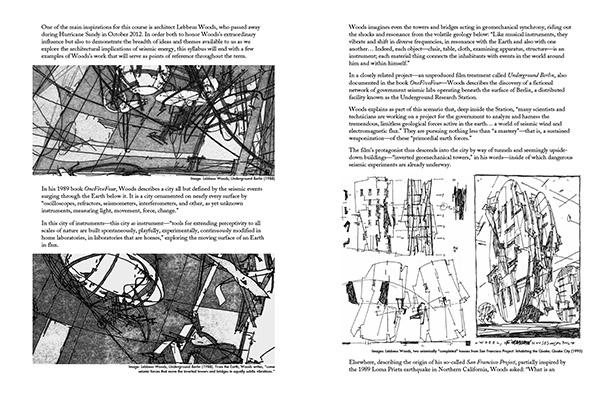
[Images: (left top and bottom) Lebbeus Woods, from Underground Berlin (1988). From deep inside the Earth, Woods writes, “come seismic forces that move the inverted towers and bridges in equally subtle vibrations.” (right) Lebbeus Woods, two seismically “completed” houses from his San Francisco Project: Inhabiting the Quake, Quake City (1995)].

In his 1989 book OneFiveFour, Woods describes a city all but defined by the seismic events surging through the Earth below it. It is a city ornamented on nearly every surface by “oscilloscopes, refractors, seismometers, interferometers, and other, as yet unknown instruments, measuring light, movement, force, change.”

In this city of instruments—this city as instrument—“tools for extending perceptivity to all scales of nature are built spontaneously, playfully, experimentally, continuously modified in home laboratories, in laboratories that are homes,” exploring the moving surface of an Earth in flux.

Woods imagines even the towers and bridges acting in geomechanical synchrony, riding out the shocks and resonance from the volatile geology below: “Like musical instruments, they vibrate and shift in diverse frequencies, in resonance with the Earth and also with one another… Indeed, each object—chair, table, cloth, examining apparatus, structure—is an instrument; each material thing connects the inhabitants with events in the world around him and within himself.”

In a closely related project—an unproduced film treatment called Underground Berlin, also documented in the book OneFiveFour—Woods describes the discovery of a fictional network of government seismic labs operating beneath the surface of Berlin, a distributed facility known as the Underground Research Station.

Woods explains as part of this scenario that, deep inside the Station, “many scientists and technicians are working on a project for the government to analyze and harness the tremendous, limitless geological forces active in the earth… a world of seismic wind and electromagnetic flux.” They are pursuing nothing less than “a mastery”—that is, a sustained weaponization—of these “primordial earth forces.”

The film’s protagonist thus descends into the city by way of tunnels and seemingly upside-down buildings—“inverted geomechanical towers,” in his words—inside of which dangerous seismic experiments are already underway.

Elsewhere, describing the origin of his so-called San Francisco Project, partially inspired by the 1989 Loma Prieta earthquake in Northern California, Woods asked: “What is an architecture that accepts earthquakes, resonating with their matrix of seismic waves—an architecture that needs earthquakes, and is constructed, transformed, or completed by their effects—an architecture that uses earthquakes, converting to a human purpose the energies they release, or the topographical transformations they bring about—an architecture that causes earthquakes, triggering microquakes in order that ‘the big one’ is defused—an architecture that inhabits earthquakes, existing in their space and time?”
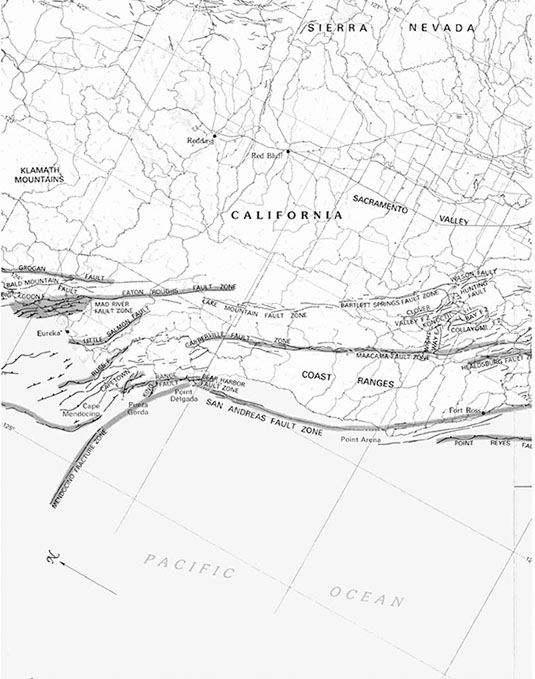
[Image: A map in four sections (see below three images) shows the San Andreas Fault stretching from northern to southern California. The San Andreas “is just one of several faults that make up a complex of potential catastrophes,” paleontologist Richard Fortey writes in Earth: An Intimate History. It is “the flagship of a fleet of faults that run close to the western edge of North America… In places, maps of the interweaving faults look more like a braided mesh than the single, deep cut of our imagination.” Here, we see the San Andreas come to an end in Northern California at the so-called Mendocino Triple Junction. Maps courtesy of the U.S. Geological Survey, from The San Andreas Fault System, U.S.G.S. Professional Paper 1515 (PDF); see original paper for higher resolution].

Readings & References

Online (Required Reading)

USGS Earthquake Hazards Program:
earthquake.usgs.gov

The San Andreas Fault System, U.S. Geological Survey Professional Paper 1515:
pubs.usgs.gov/pp/1990/1515/pp1515.pdf

The San Andreas Fault:
pubs.usgs.gov/gip/earthq3/contents.html

“San Andreas System and Basin and Range,” from Active Faults of the World by Robert Yeats (Cambridge University Press):
dx.doi.org/10.1017/CBO9781139035644.004

Where’s the San Andreas Fault? A Guidebook to Tracing the Fault on Public Lands in the San Francisco Bay Region:
pubs.usgs.gov/gip/2006/16/gip-16.pdf

Of Mud Pots and the End of the San Andreas Fault:
seismo.berkeley.edu/blog/seismoblog.php/2008/11/04/of-mud-pots-and-the-end-of-the-san-andre

U.S. Geological Survey Fault and Volcano Monitoring Instruments:
earthquake.usgs.gov/monitoring/deformation/data/instruments.php
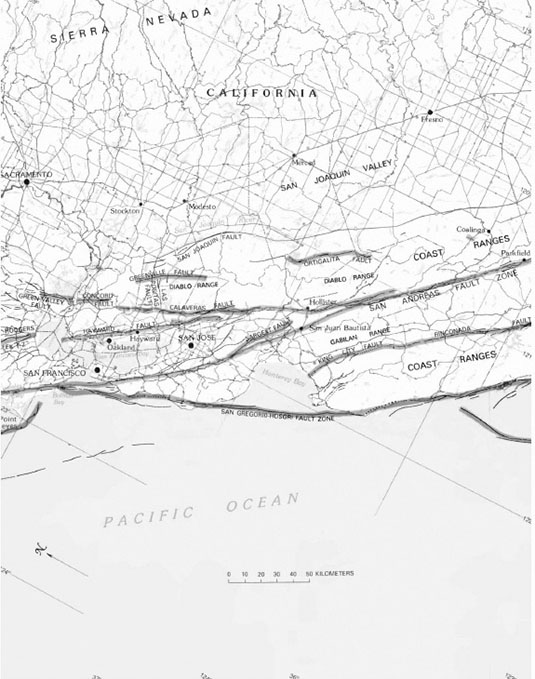
[Image: Map courtesy of the U.S. Geological Survey, from The San Andreas Fault System, U.S.G.S. Professional Paper 1515 (PDF)].

Online (Reference Only)

California Integrated Seismic Network and Southern California Seismic Network:
cisn.org | www.scsn.org

California Strong Motion Instrumentation Program:
conservation.ca.gov/cgs/smip/Pages/about.aspx

California Geotour Online Geologic Field Trip:
conservation.ca.gov/cgs/geotour/Pages/Index.aspx

Carrizo Plain National Monument maps and brochures:
blm.gov/ca/st/en/fo/bakersfield/Programs/carrizo/brochures_and_maps.html

Ken Goldberg, Mori and Ballet Mori:
memento.ieor.berkeley.edu | goldberg.berkeley.edu/art/Ballet-Mori

Doug Aitken, Sonic Pavilion:
dougaitkenworkshop.com/work/sonic-pavilion
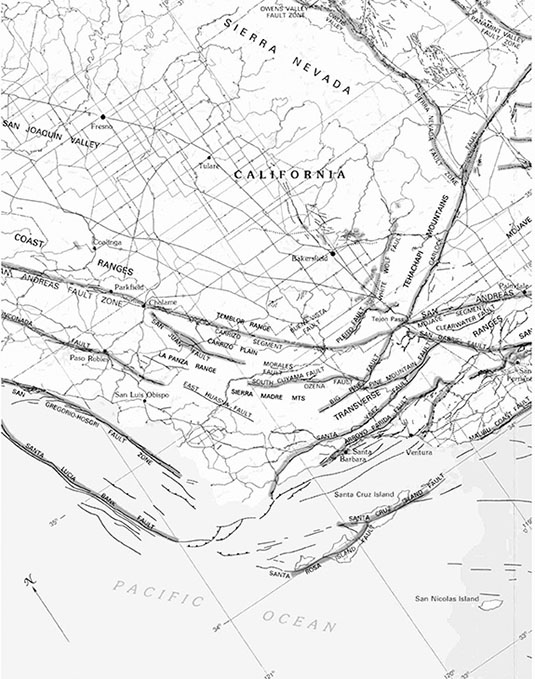
[Image: Map courtesy of the U.S. Geological Survey, from The San Andreas Fault System, U.S.G.S. Professional Paper 1515 (PDF)].

Offline (Required Reading)

Smout Allen, Pamphlet Architecture 28: Augmented Landscapes (Princeton Architectural Press, 2007)

Ethan Carr, Wilderness by Design: Landscape Architecture and the National Park Service (University of Nebraska Press, 1999) — Introduction, Chapter 1, and Chapter 4

Julia Czerniak and George Hargreaves, eds., Large Parks (Princeton Architectural Press, 2007) — Foreword, Introduction, and Chapter Seven

Shin Egashira & David Greene, Alternative Guide to the Isle of Portland (Architectural Association, 1997)

Richard Fortey, Earth: An Intimate History (Vintage, 2004) — Chapter 9: “Fault Lines”

John McPhee, Assembling California (Farrar, Straus & Giroux, 1993)

David L. Ulin, The Myth of Solid Ground: Earthquakes, Prediction, and the Fault Line Between Reason and Faith (Penguin, 2004) — “The X-Files,” “A Brief History of Seismology,” and “Earthquake Country” (though entire book is recommended)

Lebbeus Woods, OneFiveFour (Princeton Architectural Press, 1989)

Offline (Reference Only)

Alexander Brash, Jamie Hand, and Kate Orff, eds., Gateway: Visions for an Urban National Park (Princeton Architectural Press, 2011)

C. J. Lim, Devices: A Manual of Architectural + Spatial Machines (Elsevier/Architectural Press, 2006)

Lebbeus Woods, Radical Reconstruction (Princeton Architectural Press, 2001) — “Radical Reconstruction” (pp. 13-31) and “San Francisco” (p. 133-155)
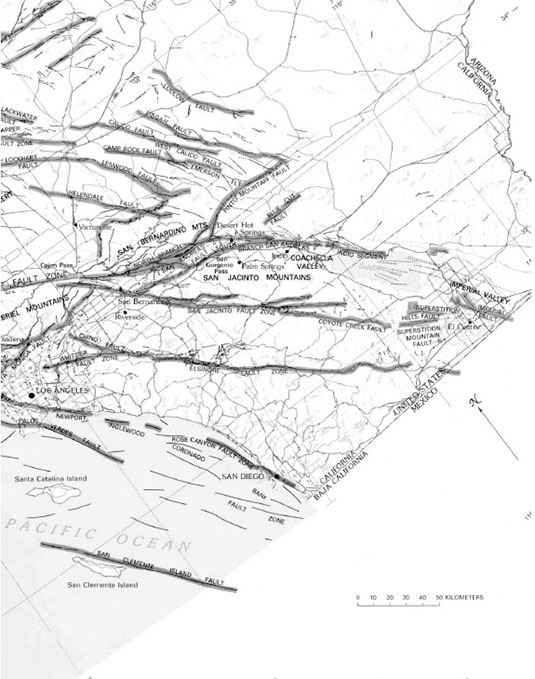
[Image: Map courtesy of the U.S. Geological Survey, from The San Andreas Fault System, U.S.G.S. Professional Paper 1515 (PDF)].

Film and Games (Entertainment Value Only!)

A View To A Kill, dir. John Glen (1985)

Fracture, LucasArts (2008)

Music (Required Listening)

Our work this Spring will be paralleled by a series of musical experiments led by Bay Area sound artist Marc Weidenbaum’s Disquiet Junto, an online music collective. The Disquiet Junto will be developing projects that explore the sonic properties of the San Andreas Fault and uploading the results of these seismic-acoustic experiments to Soundcloud. Students will be required to leave comments on these audio tracks as part of regular homework over the course of the Spring term.

The Disquiet Junto, a satellite operation of disquiet.com, “uses formal restraint as a springboard for creativity. In 2012, the year it launched, the Disquiet Junto produced over 1,600 tracks by over 270 musicians from around the world. Disquiet.com has operated at the intersection of sound, art, and technology since 1996.”
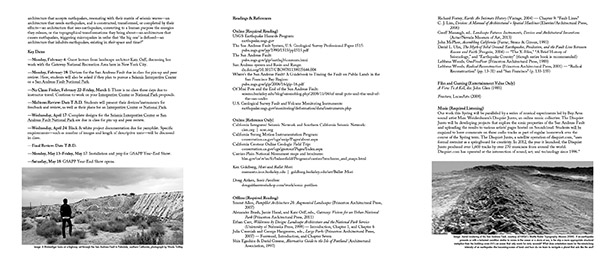
[Image: (left) A Rückenfigur looks at a highway cut through the San Andreas Fault in Palmdale, southern California; photograph by Nicola Twilley. (right) Aerial rendering of the San Andreas Fault, courtesy of NASA’s Shuttle Radar Topography Mission (2000). If an earthquake presents us with a turbulent condition similar to waves in the ocean or a storm at sea, is the ship a more appropriate structural metaphor than the building—even if it’s an ocean that only exists for sixty seconds? What does orientation mean for the minute-long intensity of an earthquake—the becoming-ocean of land—and how do we learn to navigate a planet that acts like the sea?].

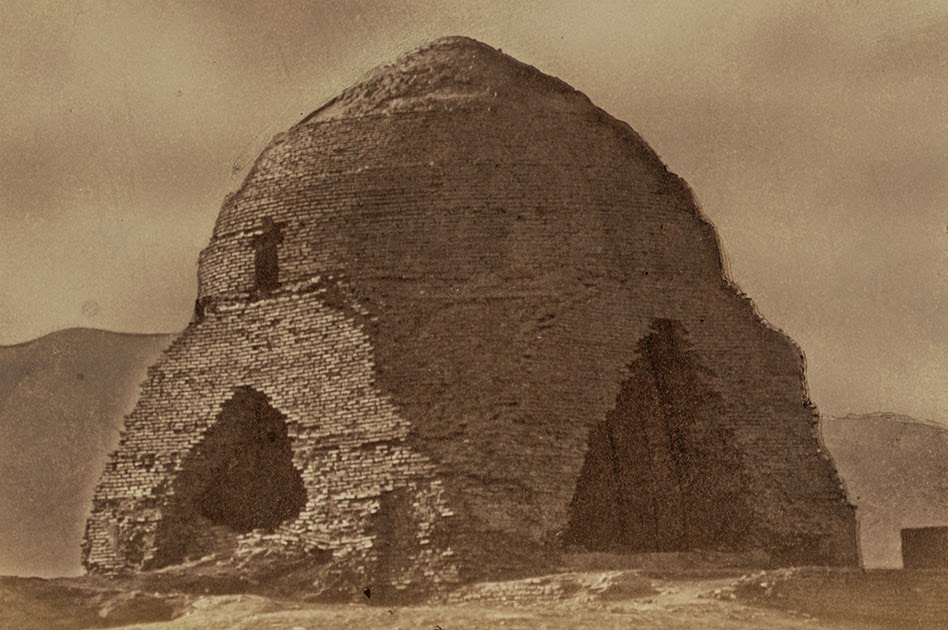
Test Room

[Image: The World Trade Center towers, photographer unknown].
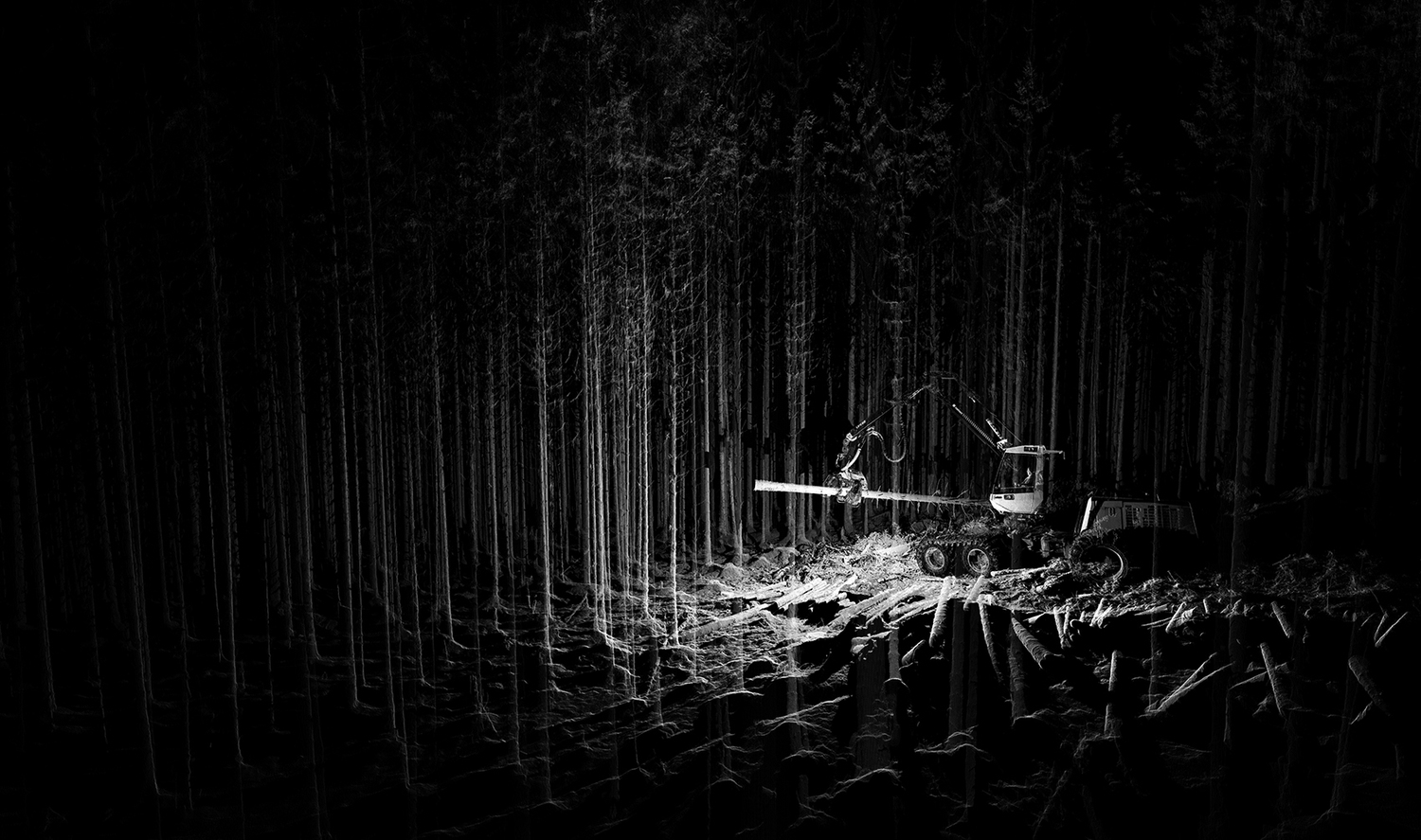
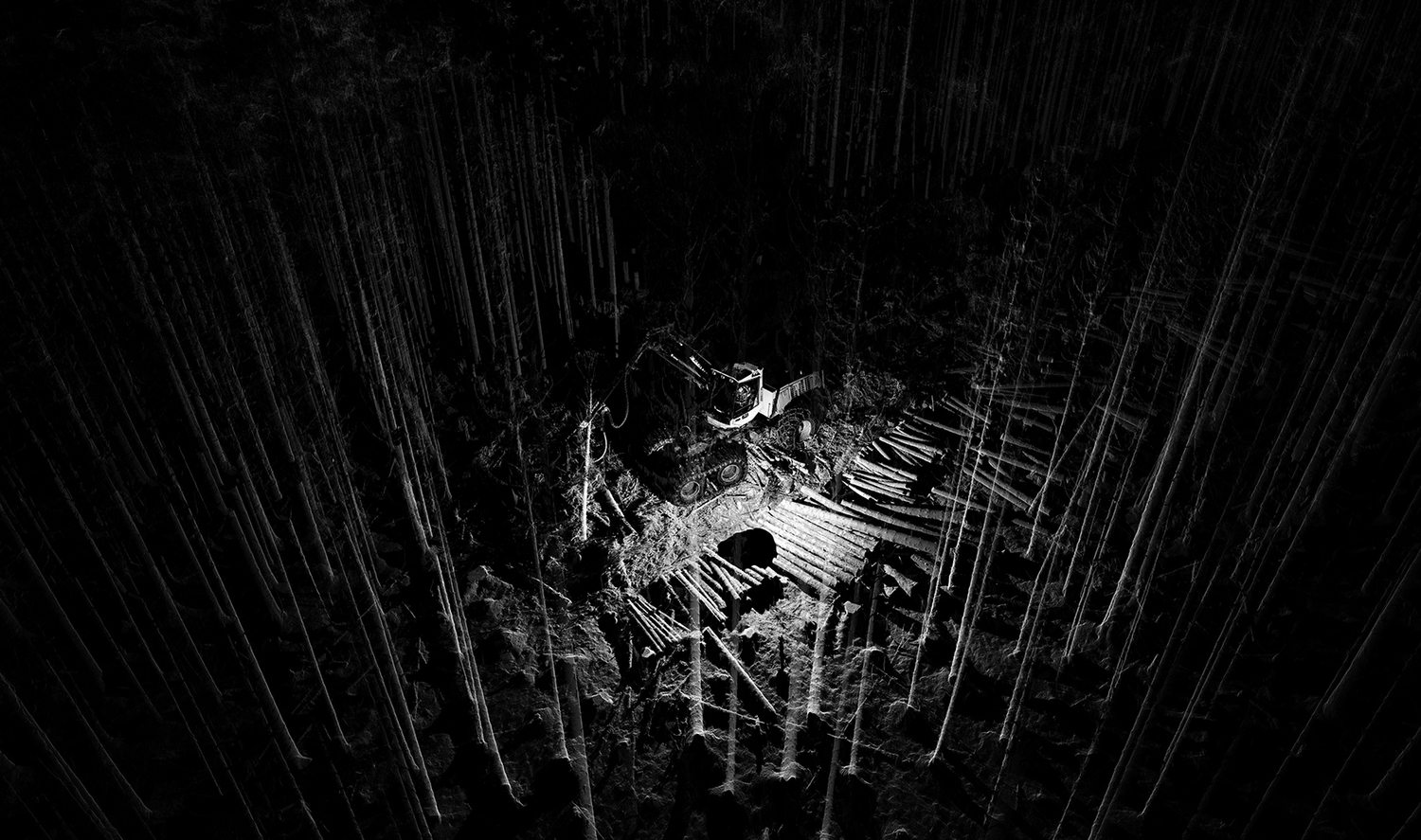
Amongst many other interesting moments in Siobhan Roberts’s new biography of Alan Davenport, the “father of modern wind engineering,” is the incredible story of a room in Eugene, Oregon.

In August 1965, Roberts explains, “ads in the local newspaper… promised complimentary checkups at the new Oregon Research Institute Vision Research Center.” But these promised eye exams were not all that they seemed.

The office was, in fact, a model—a disguised simulation—including a “stereotypical waiting room” where respondents to the ad would be “greeted by a receptionist” who could escort them into a fake “examination room” that turned out to be examining something else entirely.

While members of the public were led through a series of eye tests, looking at “some triangles,” in Roberts words, that had been projected onto the wall, they were, in fact, being jostled back and forth, silently and unannounced, by motors installed on tracks below the floor. The room swayed, rocking side to side, shifting imperceptibly—or so the experiment was testing—beneath the feet of the volunteers and the actor-nurses who, without breaking character, took care of them.

It turns out that the whole thing was actually a wind-condition simulator for a pair of buildings that had not yet been publicly announced, let alone constructed: the future twin towers of New York City’s World Trade Center. This quiet office in Oregon, paid for by the Port Authority, was an unpublicized test-run for the high winds and other complicated atmospheric effects that would soon rock the two towers back and forth at their unprecedented height in southern Manhattan.

The room, “mounted on a wheeled platform driven by hydraulic actuators,” thus tested unsuspecting members of the public for their physiological reaction to the swaying of the floor—testing whether “conflicting brain inputs” from the moving architecture “would cause synaptic confusion, or motion sickness—nausea, dizziness, fatigue,” as Roberts writes.

Unbeknownst to them, then, people in Eugene, Oregon, in 1965, were helping to test the aerodynamic flexibility of two buildings that had not yet been announced and that would soon come to dominate the skyline of New York City—leaving at least me to wonder if some room today somewhere, some doctor’s office or other nondescript chamber, whether a classroom or a restaurant, is actually a testing ground for as-yet unrealized architectures to come, be it in New York City, Dubai, Mexico City, or, who knows, even for future travelers to the moon.

(Thanks to Nicola Twilley for giving me a copy of Roberts’s book).

Books Received

[Image: The Wiederin bookshop in Innsbruck, Austria; photo by Lukas Schaller, courtesy of A10].

Barely in time for the holidays, here is a quick look at some of the many new or recent books that have passed through the home office here at BLDGBLOG.

As usual, I have not read all of the books listed here, but this will be pretty clear from the ensuing descriptions; those that I have read, and enjoyed, I will not hesitate to recommend.

And, as always, all of these books are included for the interest of their approach or subject matter as it relates to landscape, spatial sciences, and the built environment more generally.

1) Map of a Nation: A Biography Of The Ordnance Survey by Rachel Hewitt (Granta).

2) The Measure of Manhattan: The Tumultuous Career and Surprising Legacy of John Randel, Jr., Cartographer, Surveyor, Inventor by Marguerite Holloway (W.W. Norton).

These two fantastic books form a nice, if coincidental, duo, looking at the early days of scientific cartography and the innovative devices and mathematical techniques that made modern mapping possible. In Rachel Hewitt’s case—a book I found very hard to put down, up reading it till nearly 2am several nights in a row—we trace the origins of the UK’s Ordnance Survey by way of the devices, tools, precision instruments, and imperialist geopolitical initiatives of the time.

Similarly, Marguerite Holloway introduces us to, among many other things, the first measured imposition of the Manhattan grid. I mentioned Holloway’s book the other day here on BLDGBLOG, and am also very happy to have been asked to blurb it. Here’s my description: “This outstanding history of the Manhattan grid offers us a strange archaeology: part spatial adventure, part technical expedition into the heart of measurement itself, starring teams of 19th-century gentlemen striding across the island’s eroded mountains and wild streams, implementing a grid that would soon enough sprout skyscrapers and flatirons, Central Park and 5th Avenue. Marguerite Holloway’s engaging survey takes us step by step through the challenges of obsolete land laws and outdated maps of an earlier metropolis, looking for—and finding—the future shape of this immeasurable city.”

For anyone at all interested in cartography, these make an excellent and intellectually stimulating pair.

3) The Old Ways: A Journey on Foot by Robert Macfarlane (Viking).

4) Weeds: In Defense of Nature’s Most Unloved Plants by Richard Mabey (Ecco).

I’ve spoken highly of Robert Macfarlane’s writing before, and will continue to do so. His Wild Places remains one of my favorite books of the last few years, and I was thus thrilled to hear of his newest: a series of long walks (and a boat ride) through the British landscape, from coastal mudflats to chalk hills and peat bogs, following various kinds of well-worn routes and paths, the “old ways” of his book’s title. Macfarlane’s writing can occasionally strain for rapture when, in fact, it is precisely the mundane—nondescript earthen paths and overlooked back woods—that makes his “journeys on foot” so compelling; but this is an otherwise minor flaw in a highly readable and worthwhile new book.

Meanwhile, Richard Mabey has written an almost impossibly captivating history of weeds, “nature’s most unloved plants.” Covering invasive species, overgrown bomb sites in WWII London, and abandoned buildings, and relating stories from medieval poetry and 21st-century agribusiness to botanical science fiction, Mabey’s book is an awesome sweep through the world of out-of-place plant life.

5) The Maximum of Wilderness: The Jungle in the American Imagination by Kelly Enright (University of Virginia Press).

6) In Search of First Contact: The Vikings of Vinland, the Peoples of the Dawnland, and the Anglo-American Anxiety of Discovery by Annette Kolodny (Duke University Press).

7) The Swamp: The Everglades, Florida, and the Politics of Paradise by Michael Grunwald (Simon & Schuster).

These three books variously describe encounters with the alien wilderness of a new world. Kelly Enright’s look at “the jungle in American imagination” reads a bit too much like a revised Ph.D. thesis, but its central premise is fascinating, looking not only at the complex differences between the meaning of a jungle and that of a rain forest, but exploring, as she phrases it, “some of the consequences of expanding an American image and ideology of wilderness beyond American shores,” from Theodore Roosevelt to the early days of tropical anthropology.

Annette Kolodny’s review of what can more or less be summarized as the Viking discovery of North America is incredibly rich. Quoting from the cover, Kolodny “offers a radically new interpretation of two medieval Icelandic tales, known as the Vinland Sagas. She contends that they are the first known European narratives about contact with North America.” However, in addition to these tales of “first contact,” Kolodny examines rock carvings in Maine and Canada, as well as Native American folktales, to try to geographically and historically locate the moment when Europeans first arrived in North America, sailing up the small coastal rivers and setting foot on foreign land. Kolodny convincingly demonstrates, in the process, that the Viking discovery of North America was more or less widely accepted by 19th-century historians, but that, she argues, following a large influx of Italian immigrants toward the end of that century and into the 20th, the national importance of Christopher Columbus—an Italian—began to grow. From this emerged, she shows, a kind of narrative contest in which rugged northerners from a stoic, military culture (the Norse) were pitted against royalist Catholic Mediterranean family men as the true cultural progenitors of the United States. It is also interesting here to note that Kolodny assigned these early Icelandic contact narratives to her English literature class, asking students “to consider the possibility that American literature really began in these early ‘contact’ narratives that constructed a so-called New World and its peoples through and for the contemporary cultural understandings of the European imagination.”

I read Michael Grunwald’s The Swamp under particular circumstances—traveling around Florida as part of Venue, along with Smout Allen and a group of students from the Bartlett School of Architecture (photos of that trip can be seen here and here)—which might have added to its appeal. But, either way, I was riveted. Grunwald’s book presents, in effect, all of Florida south of Orlando as a massive series of ecologically misguided—but, from an economic perspective, often highly successful—terraforming projects. Speaking only for myself, the book made it impossible not to notice waterworks everywhere, on all sides and at every scale: every canal, storm sewer, water retention basin, highway overpass, levee, reservoir, drainage ditch, coastal inlet, and flood gate, all parts of an artificially engineered peninsula that wants to—and should—be swamp. Environmentally sensitive without being a screed, and written at the pace of a good New Yorker article, The Swamp was easily one of my favorite discoveries this year, a book I’d place up there with Marc Reisner’s classic Cadillac Desert; it deserves the comparison for, if nothing else, its clear-eyed refocusing of attention onto a region’s hydrology and onto civilization’s larger attempts to manage wild lands (and waters), from the Seminole Wars to George W. Bush. Grunwald also makes clear something that I had barely even considered before, which is that south Florida is actually one of the most recently settled regions of the United States, far younger than the new states of the American West. South Florida, in many senses, is an event that only just recently happened—and Grunwald shows both how and why.

8) Petrochemical America by Richard Misrach and Kate Orff (Aperture Foundation).

9) Gateway: Visions for an Urban National Park edited by Alexander Brash, Jamie Hand, and Kate Orff (Princeton Architectural Press/Van Alen Institute).

Here are two new books, each connected to the work of landscape architect and Columbia GSAPP urban planner, Kate Orff.

The first is a split project with photographer Richard Misrach, looking both directly and indirectly at petrochemical infrastructure and the landscapes it passes through in the state of Louisiana. Misrach’s photos open the book with nearly 100 pages’ worth of views into the rapidly transforming nature of Louisiana’s so-called Cancer Alley, “showcasing the immediate plight of embattled local communities and surrounding industries.” Orff’s work follows in the second half of the book with what she calls an “Ecological Atlas” of the same region, mapping what currently exists, more thoroughly annotating Misrach’s photos, and proposing new interventions for ecologically remediating the spoiled landscapes of the region.

The second book is an edited collection of essays and proposals for New York’s Gateway National Recreational Area. Gateway is a strange combination of protected lands and artificial dredgescapes, at the border between ocean and land at the very edge of New York City. Photographs by Laura McPhee join essays by Ethan Carr, Christopher Hawthorne, and others to suggest a new role for parks in American urban life, and a new type of park in general, one that is distributed over discontinuous parcels of marginal land and includes large expanses of active waters.

10) Cities Without Ground: A Hong Kong Guidebook by Adam Frampton, Jonathan D. Solomon, and Clara Wong (ORO Editions).

11) Oblique Drawing: A History of Anti-Perspective by Massimo Scolari (MIT Press).

12) Bulwark & Bastion: A Look at Musket Era Fortifications with a Glance at Period Siegecraft by James R. Hinds and Edmund Fitzgerald (Pioneer Press).

13) On the Making of Islands by Nick Sowers (self-published).

Cities Without Ground: A Hong Kong Guidebook was inspired by the revelation that a person can navigate the city of Hong Kong over great distances without ever leaving architecture behind, meandering through complex networks of internal space, from walkways and shopping malls to escalators and covered footbridges. Indeed, one can explore Hong Kong without really setting foot on the surface of the earth at all, making it a “city without ground.” The resulting labyrinthine spatial condition—consisting of “seemingly inescapable and thoroughly disorienting sequences” that cut through, around, between, and under nominally separate megastructures—has led the book’s authors to produce a series of visually dense maps dissecting the various routes a pedestrian can take through the city. A particular highlight comes toward the end, where they focus solely on the city’s air-conditioning, suggesting a kind of thermal cartography of indoor space and implying that temperature control and even humidity are better metrics for evaluating the success of a given project than mere visual or aesthetic concerns.

Massimo Scolari’s Oblique Drawing also pursues the idea that there are other, less well-explored methods for representing the built environment. Although I was disappointed to find that the chapters are, in effect, separate, not always related papers that happen to share a common interest in architectural representation, the book manages to tie together everything from ancient Egyptian hieroglyphs to the military drawings of Leonardo da Vinci, from medieval Christian landscapes to Chinese painting techniques and the Tower of Babel. Scolari’s book was also mentioned here on the blog last week in the context of architectural espionage.

I was actually given a copy of Bulwark & Bastion while out at the surreal and extremely remote site of Fort Jefferson, in the Dry Tortugas of Florida, and I read it on the 2-hour boat ride back to Key West. No more than a stapled pamphlet, like something you’d make at Kinko’s, it is, nonetheless, an extremely interesting look at built landscapes of warfare and defense. Unsurprisingly, it includes a history of walled cities and forts from Europe; but—and this topic alone deserves a full-length book from a publisher like Princeton Architectural Press—it discusses in detail the landscape defenses of the American Civil War, including massive brick citadels in Alabama, Maryland, South Carolina, and New York City. Star forts, bastions, casements, field works, and other geometries of assault and counter-attack are all illustrated and diagrammed, and they’re followed by a glossary of architectural defensive terms. Thoroughly enjoyable, in particular for anyone interested in military history.

Many of you will know Nick Sowers from his blogging at Archinect, where he explored the niche field of military landscapes and sound recordings. Nick was a deserving recipient of UC-Berkeley’s generous Branner Fellowship, which gave him the resources to travel the world for nearly a year, visiting overseas military bases, old battlefields, and urban fortresses from Japan and the South Pacific to Western Europe, including even the legendary Maunsell Towers in London’s Thames Estuary. At all of these sites, he made field recordings. Nick and I first met, in fact, down in Sydney, Australia, as part of Urban Islands back in 2009. This self-published book tells the story of those travels, including sketches and models from Nick’s own final thesis project at Berkeley, black & white photos from his long circumambulations of closed U.S. bases overseas, and a consistently interesting series of observations on the spatial implications of sound in landscape design. Weird visions of limestone caves being vibrated into existence by the tropical sonic booms of military aircraft give the book a dream-like feel as it comes to a close. Congrats to Nick not only for putting this book together, but for organizing such an interesting, planet-spanning trip in the first place.

14) Architecture for Astronauts: An Activity-based Approach by Sandra Häuplik-Meusburger (Springer Praxis).

15) The Textual Life of Airports: Reading the Culture of Flight by Christopher Schaberg (Continuum).

16) Urban Maps: Instruments of Narrative and Interpretation in the City by Richard Brook and Nick Dunn (Ashgate).

Sandra Häuplik-Meusburger’s Architecture for Astronauts has an accompanying website where we read that a “number of extra-terrestrial habitats have been occupied over the last 40 years of space exploration by varied users over long periods of time. This experience offers a fascinating field to investigate the relationship between the built environment and its users.” Häuplik-Meusburger goes on to definite extra-terrestrial habitat as “the ‘houses and vehicles’ where people live and work beyond Earth: non-planetary habitats such as a spacecraft or space station; and planetary habitats such as a base or vehicle on the Moon or Mars. These building types are set up in environments different from the one on Earth and can be characterized as ‘extreme environments.’ Multiple requirements arise for the architecture and design of such a habitat.” These requirements include different lines of sight, a shifted posture for humans in low-gravity, and different needs for visual clarity and even thermal insulation—a very different architecture, indeed. Her book is thus organized as an activity guide for thinking through things like sleep, food, and hygiene, and how architects can reimagine the spatial requirements of each for the “extreme environments” into which these houses and vehicles might go.

Christopher Schaberg’s Textual Life of Airports looks at the airport as a new kind of cultural space, one with its own emerging literature and its own untold stories, including what he calls “the secret stories of airports—the disturbing, uncomfortable, or smoothed over tales that lie just beneath the surface of these sites.” Citing Marc Augé and ambient music, the “airport screening complex” and Steven Spielberg, his book tries to clarify some of the “spatial ambivalence” travelers feel in an airport’s interconnected spaces. In the context of Häuplik-Meusburger’s book, one wonders what future literatures will emerge for the transitional sites of offworld infrastructure, the spaceports and gravity-free hotels that may or may not be forthcoming for the human future.

For Urban Maps, Richard Brook and Nick Dunn “use the term ‘map’ loosely to describe any form of representation that reveals unseen space, latent conditions or narratives in and of the city.” Their examples come from Google Street View, the photographs of urban explorers, advertisements, contemporary film, surveillance, and the art world, to name but a few.

17) Belgrade, Formal/Informal: A Research on Urban Transformation by ETH Studio Basel Contemporary City Institute (Scheidegger & Spiess).

18) The Waters of Rome: Aqueducts, Fountains, and the Birth of the Baroque City by Katherine Wentworth Rinne (Yale University Press).

Using an awesome font called Warsaw Book/Poster, Belgrade, Formal/Informal zeroes in on “a city that was isolated on the European periphery, a city a long history that was as significant as it was turbulent,” to find what parts of a metropolis with such locally specific circumstances have managed to stay more or less the same, through both war and economic estrangement, and what parts were fundamentally transformed by larger, pan-European events and processes. Further, within this, and as the book’s title suggests, they break the city into formal and informal sectors, the generic and the specific. The book is extensively illustrated, and attractively designed by Ludovic Balland.

Katherine Rinne teaches architecture at the CCA in Oakland, though her online project on the waters of Rome is hosted by the University of Virginia. Her book, The Waters of Rome, coalesces much of that work into a detailed study of the city’s hydrological infrastructures, from the ancient to the nearly modern, with a particular emphasis on the city in its Baroque age. Her approach is “largely topographic,” she explains in the book’s introduction, tying even the innermost fountains and waterworks to the landscapes of hills and rivers outside the city. As she writes, “Rome’s fountains are so dazzling that it is easy for even dedicated to overlook the profound changes that their construction initiated in the social, cultural, and physical life of the city. The transformation was systematic and structural, reaching from ancient springs outside the city walls to include aqueducts, fountains, conduits, drains, sewers, streets, and the Tiber. Because of gravity, which dictated distribution, the water’s flow was constrained or encouraged by the existing topography, which influenced in part how the water was displayed or made available for use, who controlled it and who was served by it, what it cost, and obligations that attached to the people who were allowed to access it.” The book is a vital addition to any syllabus or library on hydraulic urbanism.

19) Foodprint Papers, Volume 1 by Nicola Twilley & Sarah Rich (Foodprint Project).

Last not but least, the Foodprint Papers, Volume 1 have been released, edited by Nicola Twilley (my wife) and Sarah Rich, documenting Foodprint NYC from back in 2010, “the first in [a] series of international conversations about food and the city.”

From a cluster analysis of bodega inventories to the cultural impact of the ice-box, and from food deserts to peak phosphorus, panelists examined the hidden corsetry that gives shape to urban foodscapes, and collaboratively speculated on how to feed New York in the future. The free afternoon program included designers, policy-makers, flavor scientists, culinary historians, food retailers, and others, for a wide-ranging discussion of New York’s food systems, past and present, as well as opportunities to transform our edible landscape through technology, architecture, legislation, and education.

The pamphlet is self-published through Lulu, and all purchases help Nicola & Sarah throw more such events in the future. And, while we’re on the subject of food, don’t miss Sarah’s own recent book, Urban Farms.

Happy reading!

* * *

All Books Received: August 2015, September 2013, December 2012, June 2012, December 2010 (“Climate Futures List”), May 2010, May 2009, and March 2009.