Spatial Delirium: An Interview with Michael Light

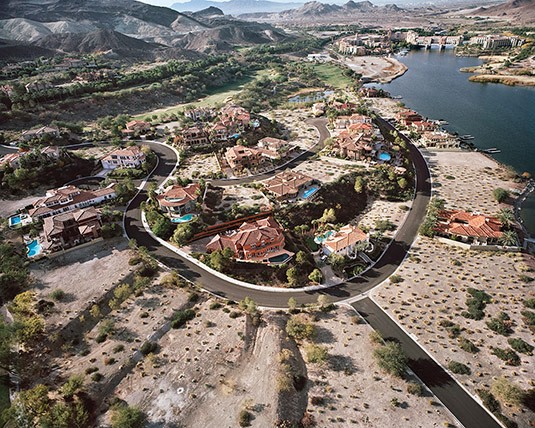
Michael Light, Gated “Monaco” Lake Las Vegas Homesites Looking West on Grand Corniche Drive, Bankrupt MonteLago Village and Ponte Vecchio Bridge Beyond, Henderson, Nevada (2010)

Photographer Michael Light divides his time between San Francisco and a remote house near Mono Lake, in the Sierra Nevada. An artist widely known for his aerial work, Light flies the trip himself in a small airplane, usually departing very early in the morning, near dawn, before the turbulence builds up.

Michael Light preps his airplane for flight; photo by Venue.

Venue, BLDGBLOG’s collaborative project with Nicola Twilley of Edible Geography and the Nevada Museum of Art’s Center for Art + Environment, not only had the pleasure of flying with Light around Mono Lake, but of staying in his home for a few nights and learning more, over the course of many long conversations, about his work.
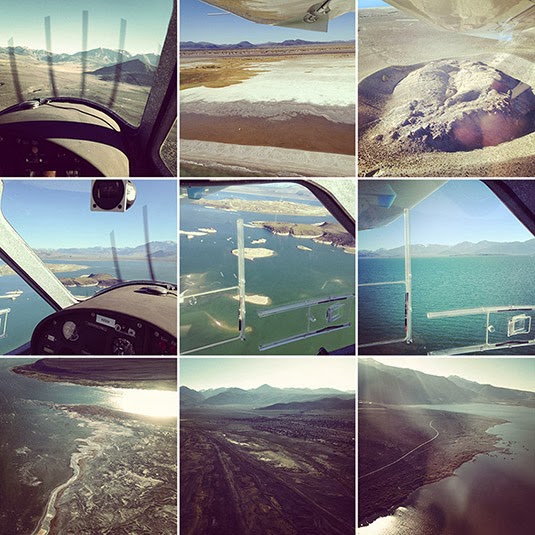
Flying with Michael Light over Mono Lake; photos by Venue.

We took a nighttime hike and hunted for scorpions in the underbrush; we looked at aerial maps of the surrounding area—in fact, most of the U.S. Southwest—to discuss the invisible marbling of military & civilian airspace in the region; and we asked Light about his many projects, their different landscape emphases, the future of photography as a pursuit and profession, and what he might work on next.

From SCUBA diving amidst the nuked ruins of WWII battleships in the most remote waters of the Pacific Ocean to spending years touching up and republishing photos of U.S. nuclear weapons tests for a spectacular and deeply unsettling book called 100 Suns, to his look at the Apollo program of the 1960s as an endeavor very much focused around the spatial experience of another landscape—the lunar surface—to his ongoing visual investigation of housing, urbanization, and rabid over-development in regions like Phoenix and Las Vegas, Light was never less than compelling.

With several great phrases—that “the mine is a city reversed,” or that the sunken ruins of WWII battleships “are dissolving like Alka-Seltzer” in the depths of the Pacific—and with an always caustic sense of humor, Light patiently answered our questions about his work both above the ground and below sea level, discussing what nuclear weapons have done the Western notion of the landscape sublime, what cameraphones have done to the professional photographer, and what it means to transgress today into the corporate-controlled air spaces of vast mining and extraction sites out west.
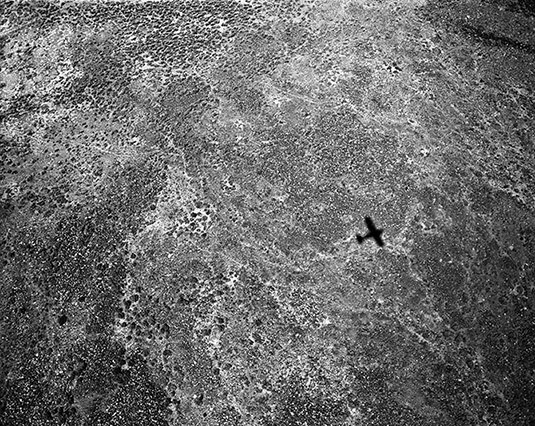
Michael Light, Shadow at 300’, 1300 hours, Deep Springs Valley, CA (2001)

• • •
Geoff Manaugh: I’d like to start by asking how the aerial view ties into the nature of your work in general. You’ve spoken to William L. Fox in an interview for the Some Dry Space exhibition about a feeling of spatial “delirium,” suggesting that the experience of moving through the sky is something viscerally attractive to you. I’m curious if you could talk about that, as a physical sensation, but also about the representational effects of the bird’s eye—or pilot’s eye—view and how it so thoroughly changes the appearance of a landscape.
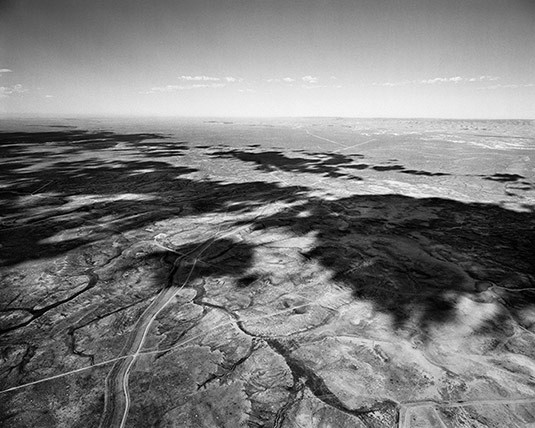
Michael Light, Clouds Over the Jonah Natural Gas Field, Pinedale, WY (2007)

Michael Light: The short answer is that the aerial view affords a breadth of scale that offers direct access to many of the bigger, more “meta” themes that have always been of interest to me.

But let me take a few steps back and try to explain where all this came from. I got a B.A. in American Studies from Amherst many years ago, and I have since been an Americanist—not in the sense of being an apologist for America, but in the sense of someone trying to figure out what makes this country tick. It is a very, very vast country.
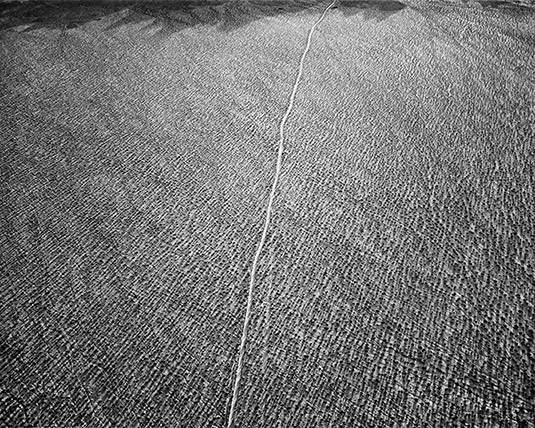
Michael Light, Sheep Hole Mountains at 400’, 0700 hours, Twentynine Palms, CA (2000)

I grew up on the end of Long Island, and I was always getting onto Highway 80 or onto more southerly interstates and heading west. The metaphor that always accompanied me, oddly enough, was one of falling into America rather than crossing it. I was falling into the vastness of America and the sheer scale of it.

Of course, after I moved to California in 1986, I caught myself coming back east quite a bit, for family or for work, and those commercial air flights across the nation, flying coast to coast, were formative and endlessly interesting to me. I don’t ever lower the window shade as requested. If the weather is clear, the odds are that what’s unfolding below, geologically, is the main attraction for me. I just found myself looking down—or looking into—America a lot, and that sense of falling into the country just grew and evolved.

I did a big piece back in the 1990s, when I was still in graduate school. It took a couple of years, but I figured out how to make pretty decent images from 30,000 feet, from the seat of a commercial airliner. For instance, you have to sit in front of the engine so that the heat doesn’t blow the picture; and it’s a contrast game, trying to get enough clarity through all the atmospheric haze and through two layers of plexiglass, and so on and so forth. That piece was based specifically on commercial flights and it was liberating for me in lots of ways.

While working on one of those images, in particular, I had something of an epiphany—I think it was somewhere over Arizona. It’s very spare, arid country, and the incursions of human settlement into it that you see from above look very much like a colony on Mars might look, or the proverbial lunar colony, and I thought “Ah ha! Look at that!” And I realized, at that moment, that maybe I could try to find or document something like a planetary landscape: the way humans live at a planetary scale and through planetary settlements.
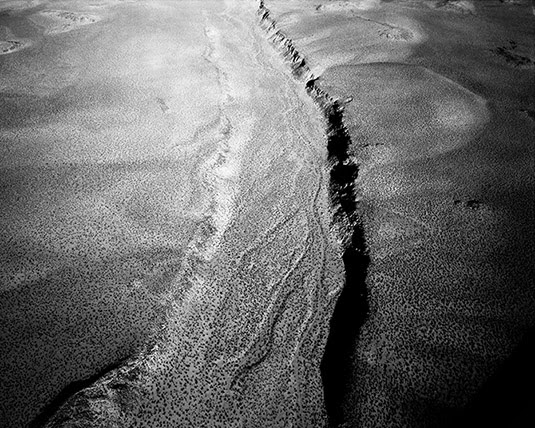
Michael Light, Chidago Canyon at 500’, 1800 hours, Chalfant, CA (2001)

This was what got me, pretty soon thereafter, thinking above and beyond the earth: looking toward NASA, and their various programs over the past few decades, and that eventually became Full Moon.
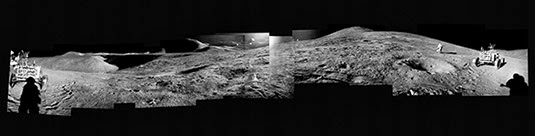
FULL MOON: Composite of David Scott Seen Twice on Hadley Delta Mountain; Photographed by James Irwin, Apollo 15, 1971 (1999)

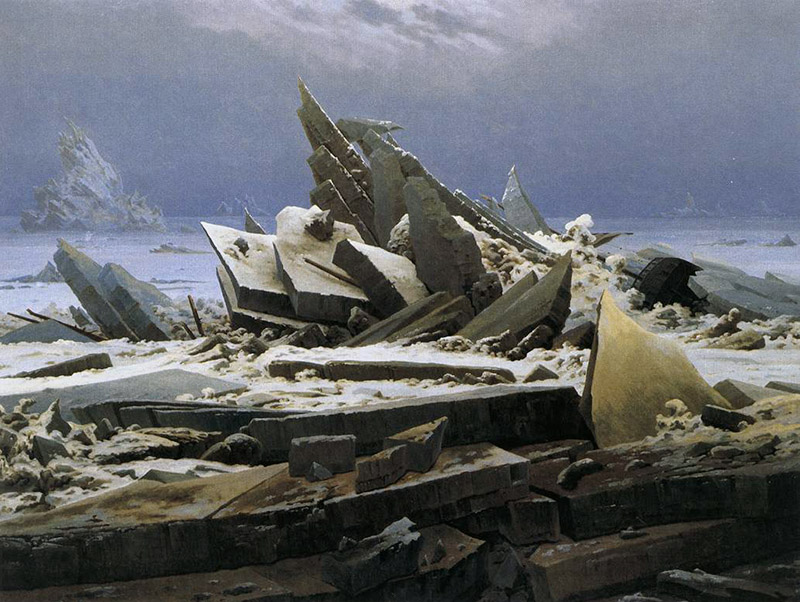
Manaugh: There’s an interesting book called Moondust by Andrew Smith, which began with Smith’s realization that we are soon approaching an historical moment when every human being who has walked on the moon will be dead. He set about trying to interview every living person—every American astronaut—who has set foot there. What makes it especially fascinating is that Smith portrays the entire Apollo program as a kind of vast landscape project, or act of landscape exploration, as if the whole thing had really just been at attempt at staging a real-life Caspar David Friedrich painting with seemingly endless Cold War funds to back it up. The place of Full Moon in your own work seems to echo that idea, of NASA lunar photography as something like the apotheosis of American natural landscape photography.

Light: The Apollo program was absolutely a landscape project—but also an extreme aerial project. And Full Moon, of course, was also driven by my own interest in the aerial view, or the aerial exterior. That project is nothing if not a really serious exploration of the aerial: that is, if you keep going up and up, the world becomes quite circular and alien. You see the world quite literally as a planet.
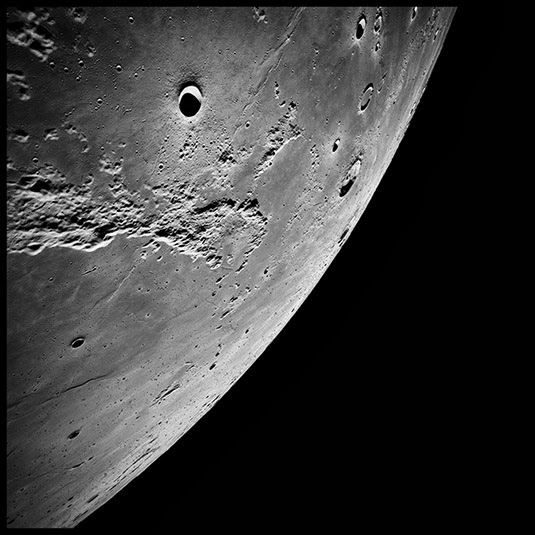
FULL MOON: The Ocean of Storms and the Known Sea; Photographed by Kenneth Mattingly, Apollo 16, April 16-27, 1972 (1999)

Anyway, for me, yes, the aerial view has an intense physicality. I’ve been flying planes since before I was driving. I soloed in gliders—engineless aircraft—by 14, and, by 16, I had a private pilot’s license. A glider offers a particularly intimate and very physical way of flying, because you have to work with thermals and updrafts. You don’t have an engine. You actually want it to be turbulent and bumpy up there, because that means that the air is unstable—that parts of the atmosphere are going up and other parts are going down—and, if you can stay in those up parts and find the updrafts, then you can ride it out for hours.

Also, I was lucky enough to start SCUBA diving at the age of 9.
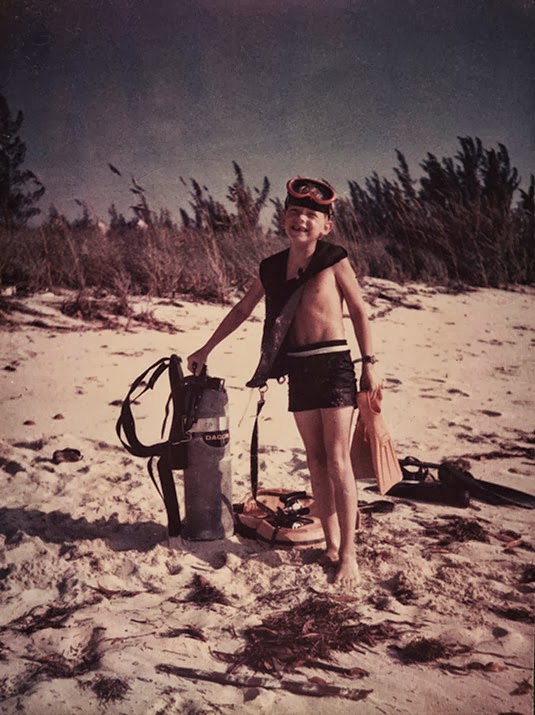
Michael Light at 9 years old, Bimini, Bahamas (1972)

Flying and going underwater are completely connected, at least in my mind. The three-dimensionality of each of them is something I’ve experienced from a very early age, and it is one of my greatest ongoing pleasures. I would say that there’s a tremendous amount of physical pleasure in both—and that, occasionally, it would even be accurate to call it ecstasy.

It’s like skiing or long-distance running: everything’s in the groove, everything sort of falls into place, you’re flying really beautifully, or, oftentimes in my work, you’re transgressing over something, or you’ve got a very intense subject, and you are trying to figure something out as an artist or as a citizen.
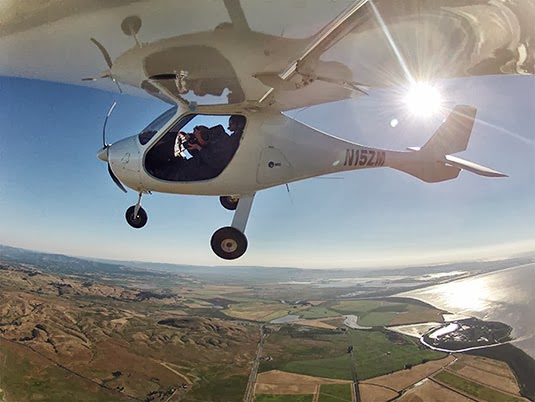
Michael Light at 49 years old, Petaluma, CA (2012)

You mentioned delirium. There’s also a certain kind of delirium—a spatial delirium, sure—simply in the pleasure of learning something new and, for me, hopefully putting that 3-dimensional experience into 2-dimensional photographic form. And if it’s good—if the image is good—then hopefully other people can get some of what I got.

Manaugh: This reminds me of a conversation I had with a writer named Kitty Hauser about the history of aerial archaeology. To make a long story short, aerial archaeology, using photographs, was born from military reconnaissance flights over the European front in World War I. The pilots there began noticing that they could see features in the landscape—such as buried or ruined buildings—that were invisible from the ground. When that technique of viewing from above was later exported to England, particularly as the leisure classes and retired military types found the free time and the personal wealth to purchase private airplanes, aerial archaeology as a pursuit really took off, if you’ll excuse the pun. And these early pioneers began to realize that, for example, there are certain times of day when things are more clearly revealed by the angle of the sun, including shadows appearing in wheat and barley fields that, when seen from above, are revealed to be an archaeological site otherwise hidden beneath the plant life. I’m curious how coming back to the same locations at certain times of day, or in certain kinds of light, can make sites or landscapes into radically different photographic experiences—with different depths or different reliefs—and how you plan for that in your shots.

Light: If I go out on an expedition for weeks shooting with an assistant, I don’t immediately fall into that groove. A few days in, everything will align. It certainly is a kind of discipline. You’re flying and imaging and circling—again and again and again, around and around and around—because you can’t just move the camera two inches to the left, or wait 15 minutes. You’re moving along at 60 miles an hour through space. So you have to shoot it again and again and again, until, finally, you get to a point where your physical senses are moving faster than your mind, and you’ve made all the shots that you think you should make—which are generally the worst ones—and it’s at that point that you come up with something genuinely new.

Specifically, I tend to shoot early in the morning and then again in the evening, which is pretty much standard practice because, of course, the lower axial light gives that 3-dimensionality and creates a feeling of revelation. Every once in a while, though, I will shoot in the desert at midday, but it’s usually only when I’m specifically seeking a flat, blown out, almost stunning or hallucinatory light.
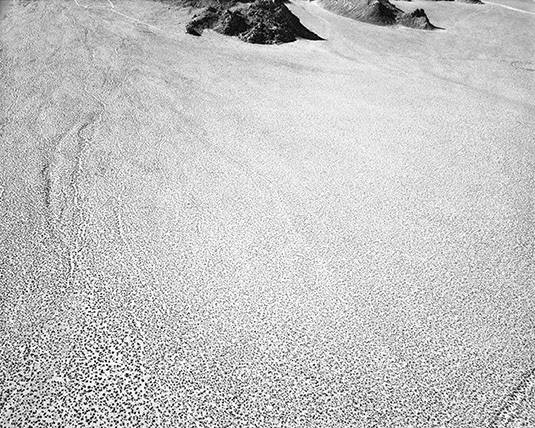
Michael Light, Deep Springs Valley at 500’, 1600 hours, Big Pine, CA (2001)

But, early in the morning, the sun seems to go off in the desert like a gun—and, of course, the sun is much softer in the evening, because there’s so much more dust in the air. You really have to get up early. I’ll shoot for an hour and a half, which is all I can really take with the doors off of the aircraft. It’s very windy. It’s very intense. The camera I use is about 20 pounds. So we’ll come back and we’ll have some breakfast—and I’m exhausted. I’ll probably nap around noon for an hour or two then, come 4:00pm or so, we gather our forces and go back up.

It’s always much more turbulent in the afternoon in summer. Summer is when I tend to fly, though, because, of course, in the colder months it’s just too cold. It’s also just a lot more dangerous to cross the mountains when there’s snow on them.

But, on summer afternoons, it can be a wild ride. You strap in there tight. My glider background is helpful here; I know the plane will continue to fly, for instance, and that there’s nothing to be super-scared of. I know I’m at the edges of my equipment’s performance. The specifications on the plane degrade measurably when you take the doors off, because you generate a tremendous amount of drag. In hot temperatures, the engine also tends to run hot and, the hotter the summer air is, the fewer molecules there are under the wings of the aircraft, the fewer molecules there are to combust with the engine fuel, the fewer molecules there are for the propeller to bite into, and you get much more turbulent air. Your aircraft performance falls off measurably.
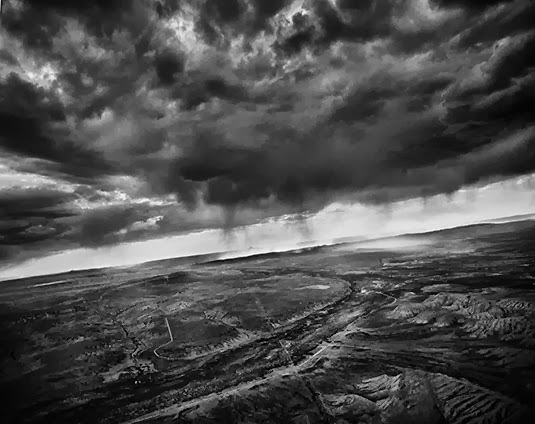
Michael Light, Afternoon Thunderstorm Looking West, Near Rock Springs, WY (2007)

For example, I often fly from San Francisco over the Sierras to Mono Lake in the summer. The Sierras, on the west side, have a very gradual slope. But on the east side it’s a very dramatic, very steep escarpment. It’s a drop of 7,000 feet almost in a straight line. You have a very smooth, very fast trip up the western slope, but, when you get to the escarpment, you hit what’s called a “rotor.” That’s a very turbulent place where the usual land-to-airflow relationship completely falls apart, because the support has been taken away. For those five miles or so, going east, you’re in a tumbly, sometimes chaotic atmosphere and it can be extremely dangerous, depending on the speed of the wind.

When I hit the rotor, I just think of it in terms of river rafting: looking for eddies, back-flow currents, whirlpools, and so forth. Even though it’s invisible, I know where I’m going to hit turbulence. Even though I can’t see the air, I know, extrapolating from the way that water behaves, where the turbulence will be—like, beyond that rock mountain spire over there, it’s going to be gnarly.
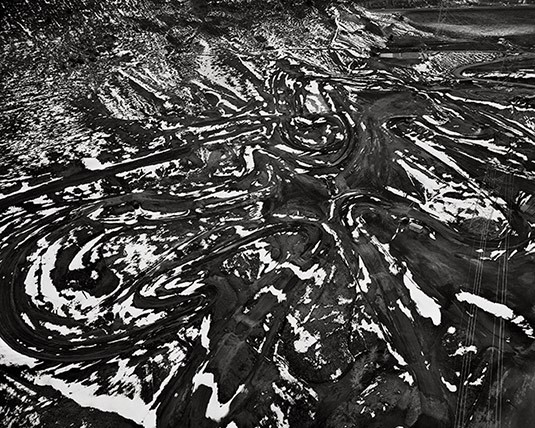
Michael Light, City-Owned Motocross Park Looking North, I-70 Beyond, Lakewood, CO (2009)

To go back to your question: in the six, almost seven years I’ve been flying with engines, the landscape is so perceptually dependent on the type of light that’s illuminating it. You really do get radically different spaces in different kinds of light. A different kind of vibe. Seasons will also change the way a landscape looks—or, I should say, the light itself seasonally changes.

On an artistic level, the ever-changing nature of what I do and how I do it, and even the instability of my position in the sky over the landscape—it’s all part of my process and it’s something I enjoy.

Manaugh: Let’s go back to SCUBA diving. When we talked four or five years ago in Nevada, you were heading off to the Bikini Atoll, to dive amidst the ruins of U.S. warships, and I’d love to learn more about that project. How did it come about, what were you seeking to document, and what were the results? I’m also fascinated by analogy of being in the empty volume of the sky versus being buried in the very full volume of the ocean and how that affects the sense of space in your photography.

Light: The Bikini work grew out of my earlier involvement with imagery of nuclear detonations, which, as you know, was a project called 100 Suns. That was an archival endeavor that came out in 2003.
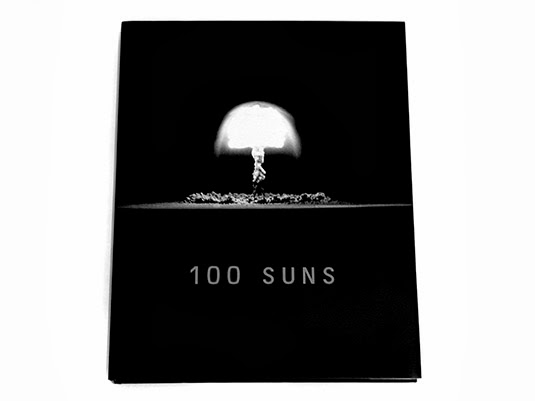
100 Suns (2003)

As a photographer or maker of images, I’m always as interested in trying to figure out the meaning of the trillions of photographs that have already been made as I am in making new ones of my own. And, culturally, I find it interesting to think about the meaning of photography, in the very large American contexts of Full Moon and 100 Suns. I think of both projects as landscape projects and, certainly, they are also investigations into American power and the peculiarities of American scale.

Nicola Twilley: As a side note, how does an archival project like 100 Suns work, technically, as far as reproducing the images goes?

Light: You scan them. You go in and you clean them up. You do whatever the approach of the hour is. You wind up almost lovingly inside each of the historical photographs. And you get very fond of them; you think of them almost as your own. Of course, they’re not—primarily because you haven’t had the experience of actually going to that space at that particular time and choosing how to make that image.

But I had a very strong desire to go—to make a pilgrimage—to, if not the Nevada Test Site, which I never could get into, then at least to the Pacific Proving Grounds, which I could get to. I tried to get into the Nevada Test Site. You can visit it, physically, but to get over it—in the air—and to make images is basically impossible. The last person to get permission to do that was Emmet Gowin, with his remarkable images. He got in in the 1990s. It took him a decade, and that was before 9/11. I tried again, and I was negotiating directly with the head of the site, but I just could never do it.

However, one can get out to Bikini, and the way one gets to Bikini hasn’t changed. At the time I went, there was a dive operation there run by the people of Bikini—who actually live 500 miles away, on a rather awful rock without a lagoon, in a place that they were moved to in 1945. They were basically booted off their atoll by the U.S. government. The people run this dive operation really for propaganda reasons, using it as a method to tell their story.
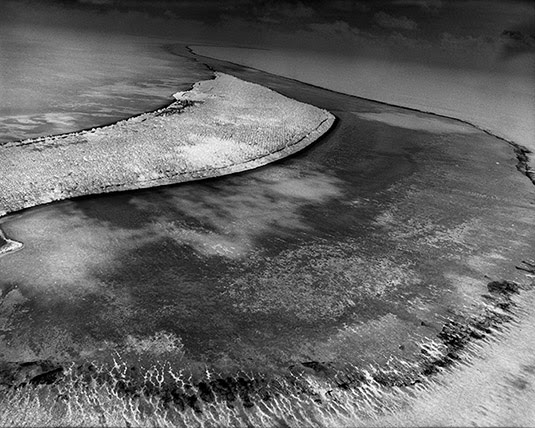
Michael Light, Bikini Island, Radioactively Uninhabitable Since 1954, Bikini Atoll (2003)

What one goes to dive for there are ships that were sunk in the Operation Crossroads tests of 1946.

At that point, the U.S. Navy—this was, of course, right after Hiroshima and Nagasaki—wanted to know if naval warfare was now utterly obsolete. Could a single bomb destroy an entire navy or a flotilla of ships?
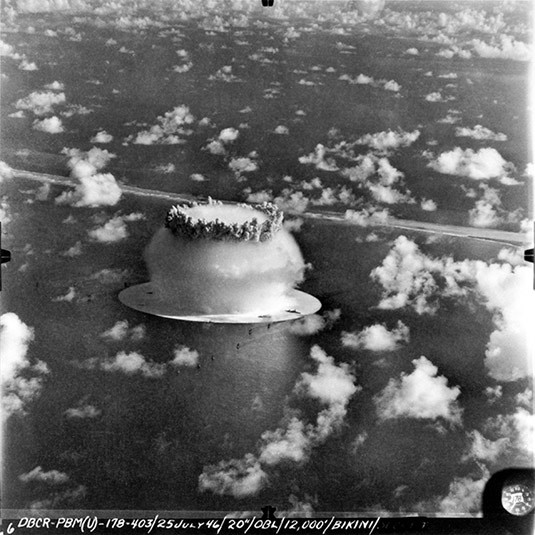
100 SUNS: 058 BAKER/21 kilotons/Bikini Atoll/1946 (2003)

So they gathered almost 100 vessels for the tests, making all sorts of strange, mythic gestures. For instance, they brought the Nagato, which Admiral Yamamoto was on when he orchestrated the attack on Pearl Harbor. They brought that all the way from Tokyo. They brought out the Prinz Eugen from Germany, which was Germany’s most modern battleship. They brought the first American aircraft carrier, the U.S.S. Saratoga, out.

The ships they chose were these giant wartime icons, and they were bombed both from the air, with the Able test, and from 90 feet underwater, by the Baker test. The Baker test gave us the most spectacularly iconic images of Bikini: a water column being blasted up into the sky with the Wilson bell cloud around it that we all know so well.
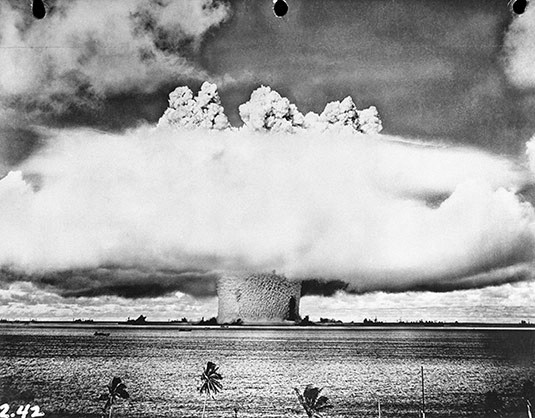
100 SUNS: 059 BAKER/21 kilotons/Bikini Atoll/1946 (2003)

Those ships are 180 feet down at the bottom of Bikini Lagoon, to this day. They were functional at the time, and they were fully loaded with weaponry and fuel. They were unpopulated, although there were farm animals chained to the decks of the ships. So it’s creepy.

Diving there is pretty hairy. It’s way beyond recreational safety diving limits. 180 feet is dark. 180 feet is cold. You take on a tremendous amount of nitrogen down there. It’s pretty technical. You have to do decompression diving, which is inherently dangerous—you have to breathe helium trimix at about thirty feet below the boat for nearly an hour after twenty minutes at depth, hoping that no tiger shark comes along to eat you, as you adjust.
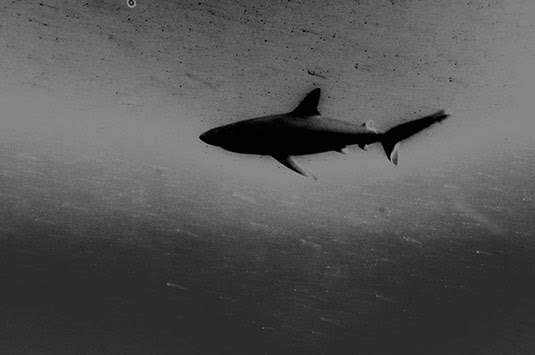
Michael Light, Shark, Bikini Lagoon (2007)

Once you’re down there, you can penetrate the ships, which are dissolving like Alka-Seltzer. It’s very entropic. You’re suffering, at that depth, from nitrogen narcosis. It’s like having three martinis. You’re pretty zonked out.

I went twice: in 2003 and, again, in 2007. During those trips, I made images from the air, on the surface, and underwater. I dove Bikini Lagoon, down to those ships on the bottom, twice.
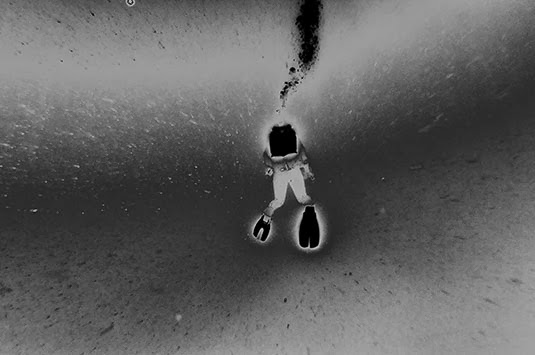
Michael Light, Diver descending to 180 feet, Bikini Lagoon (2007)

It was one of the most challenging landscapes I have ever worked in, because almost inconceivable violence occurred to these places—both to Bikini Atoll and to Enewetak Atoll. I only physically went to Bikini Atoll, although I did fly over Enewetak. But both atolls were subjected to human gestures that are, as I said, almost inconceivably violent. To try to represent that photographically is very, very difficult.

In fact, the radiological disaster that occurred in 1954 happened simply because the winds changed direction at the wrong time, blowing back over the atoll at Bikini. During the largest nuclear detonation the United States ever did out there, which was 15 megatons, the winds shifted and everything blew back over the islands. It’s the worst radiological disaster in U.S. history.

Manaugh: I don’t want to sound naïve, but is it safe even to be there? Can you walk around and swim in the water and not get radiation poisoning?

Light: Bikini Atoll is still radioactive and still uninhabited to this day, but, yes, you can go there. As long as you don’t drink the water or eat the coconuts—anything that actually comes in contact with the soil, which has a layer of Cesium-137 in it—then you’re fine. The islands have healed. You know, it’s tropical. They’ve healed. There aren’t five-headed crabs walking around. The fish are fine; you can eat the fish. But it’s still pretty radioactive. I’m walking around in a Speedo bathing suit, thinking, “Wow, I’m glad I’m never having kids, ever!” You can’t feel radiation, but it’s there.

So there you are, having a tropical paradise moment, surrounded by tropical paradise visuals, yet you know, in your head, that this is one of the most violent landscapes on earth.
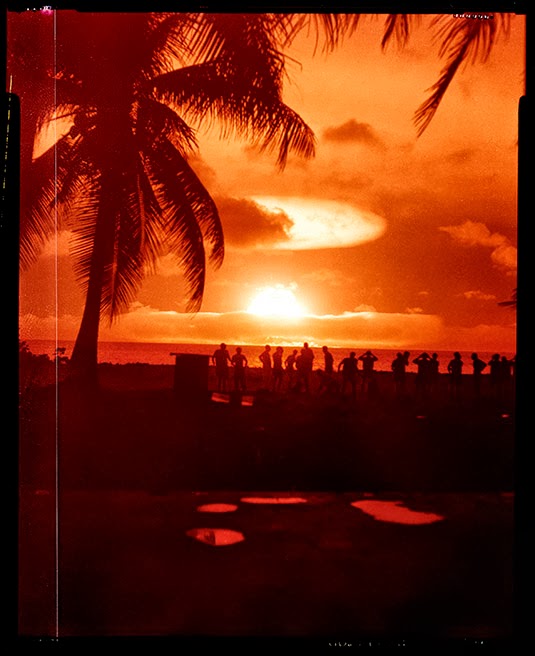
100 SUNS: 086 MOHAWK/360 kilotons/Enewetak Atoll/1956 (2003)

Two commercial aircraft fly the Marshall Islands. There is no access to private aircraft. The distances are too great. Bikini and Enewetak are in the middle of nowhere—that’s why they were used as test sites in the first place. To get aerial access to them was extremely difficult. I had to shoot from those two commercial air shuttles.

Over Enewetak I was able to get some pretty great images of the Mike crater. Mike was the first H-bomb test or, I should say, the first test of a “thermonuclear device.” It was not a bomb.
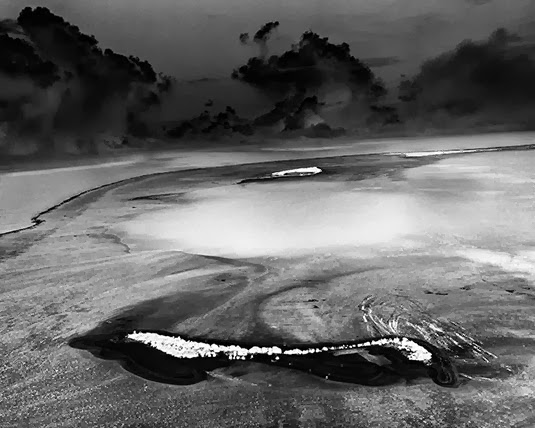
Michael Light, Mile-Wide, 200’ Deep 1952 MIKE Crater, 10.4 Megatons, Enewetak Atoll (2003)

That was Edward Teller’s baby, and one big-ass crater. That was 10.4 megatons. The scale of that kind of explosion dwarfs all of the ordinance detonated in both world wars combined. Five seconds after that detonation, the fireball alone was five miles wide. These were really, really big explosions. It’s hard to get your head around how big they were.
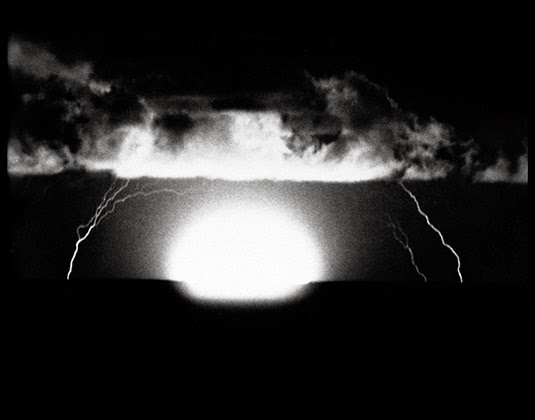
100 SUNS: 065 MIKE/10.4 megatons/Enewetak Atoll/1952 (2003)

Getting above and working with the Mike crater was terrific. I was able to get above Bikini, but not above the Bravo crater or out to the farthest edge of the atoll. Bravo was the 15-megaton test that left Bikini radioactive.
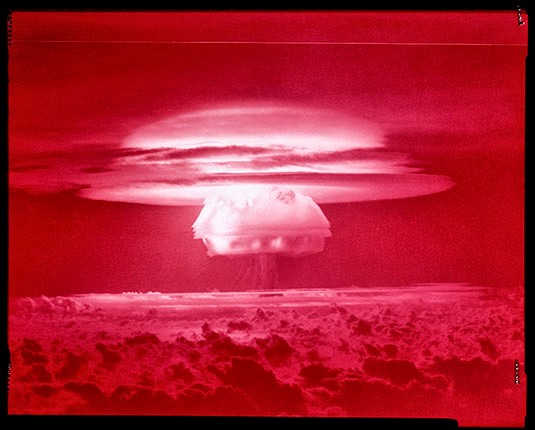
100 SUNS: 099 BRAVO/15 megatons/Bikini Atoll/1954 (2003)

However, I was able to dive in the Bravo crater while I was there, which was one of the creepiest experiences of my life. It’s still quite radioactive out on the edge of the crater. There’s a bunker right on the edge of Bravo Crater that’s sheared off at the top.
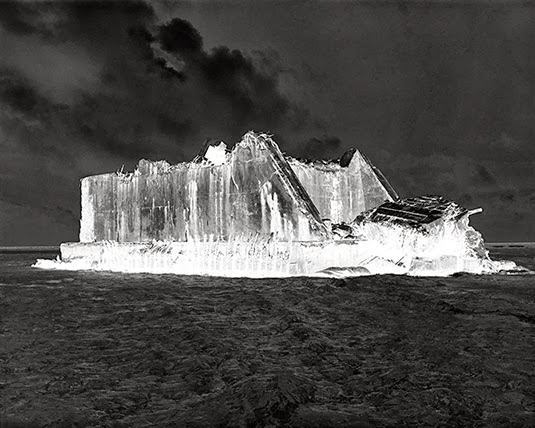
Michael Light, Radioactive Bunker Facing Mile-Wide, 200’ Deep 1954 BRAVO Crater, Bikini Atoll (2003)

Anyway, it’s obviously very deep and very rich territory. It was pretty amazing to be able to make the pilgrimage after having spent so much time with the archival material as I worked on 100 Suns. I have always felt ambivalent about the Bikini work. I’ve never known quite what to do with it. It is hard to work out there. I think that, ultimately, I will do a small book that will move between historical imagery of the ships and of the servicemen. There were 40,000 servicemen stationed there for several years while the Crossroads tests were happening.

I went back in 2007—I think that was right after you and I first talked about this. I got to do some aerial work and some more work on the ground, but, primarily, that trip was about bringing out a digital camera, which I did not have in 2003, and using it underwater. I had a housing and some lights, but I was not very successful in imaging those ships recognizably at those depths. It’s hard.
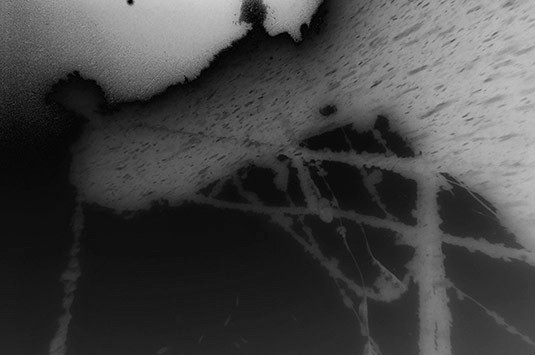
Michael Light, Ship Sunk by 1946 Crossroads Tests, Bikini Lagoon (2007)

There’s a lot of organic matter in the water. It’s incredibly dark. It’s very difficult to figure out, conceptually, a way to image the country’s first aircraft carrier. For example, I can’t back away from it enough, underwater, to get the whole thing. In theory, one could put together composite images, shot at a fairly close level, and then sort of stitch together what should look like a ship. But it’s a challenge.
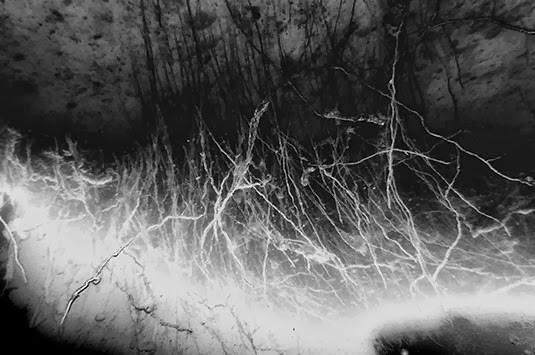
Michael Light, Growth on Ship Sunk By 1946 Crossroads Tests, Bikini Lagoon (2007)

For me, throughout the Bikini work, both in 2003 and in 2007, I have taken the approach of reversing the positive as a conceit toward a sense of visually representing radiation and visually suggesting multiple energy sources other than the sun—multiple sources of light. There are also questions about narrative: about entropy, light, Hades, narcosis, dissolution.

You’ve got this kind of X-ray death trip, if you will.
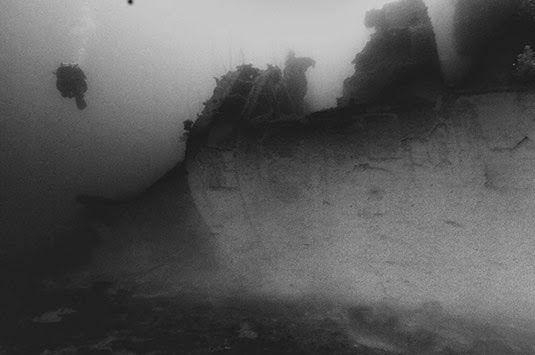
Michael Light, Tower of the IJN Nagato Battleship, Sunk By 1946 Crossroads Tests, Bikini Lagoon (2007)

It’s a very, very strong feeling, diving amongst those ships, and the ghosts of all the people who died on those ships, and knowing what they were used for and how they were sunk. It almost feels like the last gasp of an industrial era that’s now long over and gone. It was really an age of iron. It’s as far from the digital world that we live in now that you can imagine. It’s a dead era, and the work is tough. It’s not warm and fuzzy, or nostalgic. None of that is what Bikini is about. It’s about as dark as you can get.
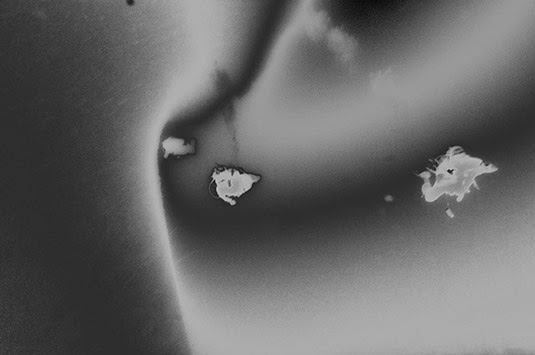
Michael Light, Along the USS Saratoga, Sunk By 1946 Crossroads Tests, Bikini Lagoon (2007)

Manaugh: In the context of 100 Suns and even hearing you say things like, “as dark as you can get,” it almost seems as though sites like the Mike crater and even these tropical ruins are like spatial byproducts of very large-scale light events. It’s as if the light of a counter-sun—the nuclear explosion—has created its own landscapes of extreme over-exposure and violence. The scenes you’re documenting, in a sense, are byproducts of light.

Light: Yes, some of this is important to me, and I do tend to think oppositionally, in rather binary terms.
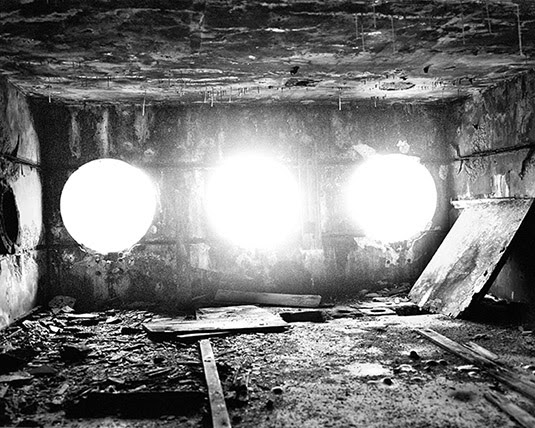
Michael Light, Inside Radioactive Photographic Bunker Built In 1956, Aomon Island, Bikini Atoll (2003)

There are so many levels of meaning to the bomb. There are landscape meanings. There are political meanings. There are industrial meanings. There are scientific meanings. To me, as I mentioned, this is a landscape book at bottom.

I personally see the moment that the Mike device detonated in 1952 as the moment when the classical landscape sublime—which, of course, up to that point was the domain of either the divine or of massively powerful natural forces beyond human control—switched. In 1952, the landscape sublime shifted wholly over to humans as the architect.

I was interested in looking closer at that moment when humans became “the divine”—as powerful as, if not more powerful than, the natural forces that they’re subject to on the planet. What was the effect of that—what did that do to landscape representation—when the sublime became an architecture of ourselves?
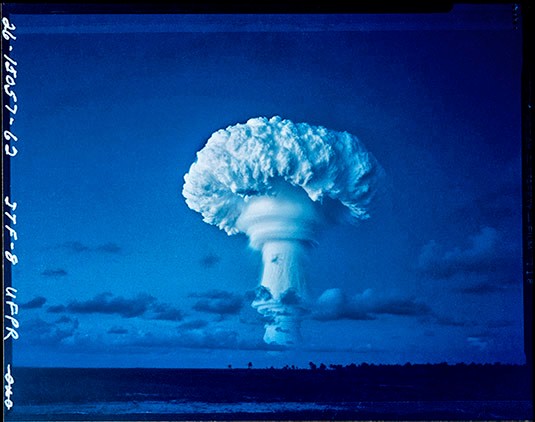
100 SUNS: 081 TRUCKEE/210 kilotons/Christmas Island/1962 (2003)

With the attainment of a thermonuclear fusion device, humans are igniting their own stars. What does that mean in landscape terms? What does that mean in architectural terms? When you talk about light itself creating a landscape and leaving behind these giant craters, it’s very resonant territory.

Arguably, humans firing up their own stars could be seen as the absolute pinnacle of a tool-bearing civilization—although it’s equally fair to say that it could be seen as humanity’s greatest tragedy, because it came out of a cauldron of violence and was immediately put back into a cauldron of violence.
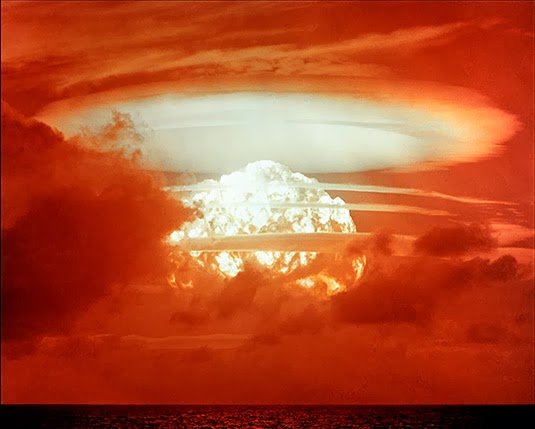
100 SUNS: 093 BRAVO/15 megatons/Bikini Atoll/1954 (2003)

To bring us back to ground a little bit here, I did 100 Suns, and I did Full Moon, and I continue to do my aerial forays into the American West, because these are things that I want to learn about and try to understand. I just truly didn’t understand fusion and fission; I really didn’t understand space. I think that, while I have a taste—and the human mind has a taste—for scale, there’s only so much scale that we can take. Even then, we need to have it served to us in smaller chunks.

I found that other books and investigations pertaining to outer space were just way too broad and, in the end, didn’t tell me anything. I don’t get much out of the Hubble images, for example. They’re too big. I have no entranceway into those to conceptualize or think about the subject, so I wind up with cotton candy or some nebula image that’s pretty, sure, but I can’t get any substance out of it.

100 Suns never would have happened without having spent five years on the surface of the moon, metaphorically. Studying the nature of light in a vacuum—that was really the primary interest of mine, artistically, in taking on that project.
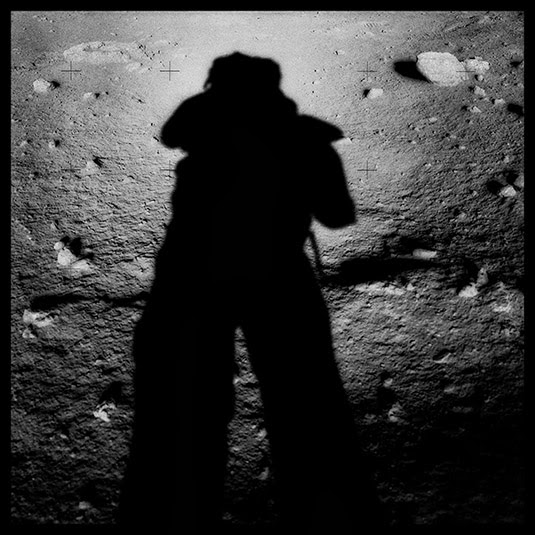
FULL MOON: Astronaut’s Shadow; Photographed by Harrison Schmitt, Apollo 17, 1972 (1999)

How does light work without atmosphere to break it up? It’s sharper than anything our eyes have evolved to see, and it behaves very differently than it does when diffused by an atmosphere. What does that do to the physical act—the actual technology—of photography as it tries to capture that light? What does that light do to a landscape?

What does that landscape do to all the other landscapes we’ve already seen in the history of landscape photography?
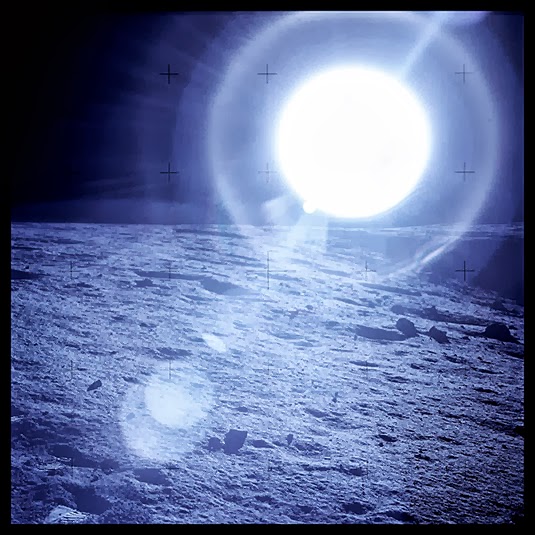
FULL MOON: Morning Sun Near Surveyor Crater, With Blue Lens Flare; Photographed by Charles Conrad, Apollo 12, 1969 (1999)

I spent a lot of time looking at the sun’s effects on the surface of the moon, in near-vacuum conditions, and I thought, “Well, what’s the next logical step for this?”
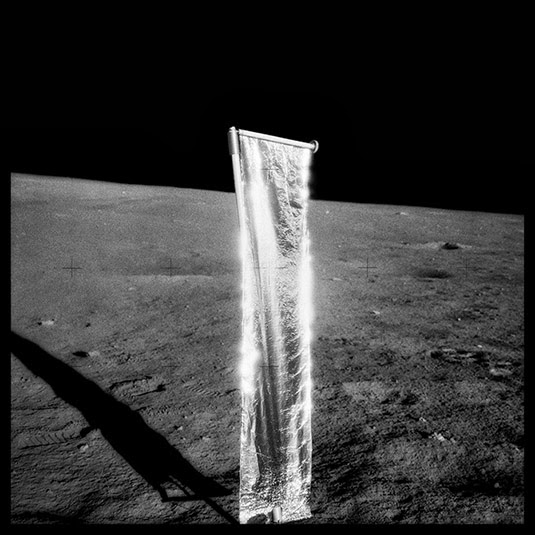
FULL MOON: Solar Wind Collector; Photographed by Alan Bean, Apollo 12, 1969 (1999)

Certainly, it’s not Mars, as so many publishers would suggest. It seemed more logical to go look directly into that sun and, at least in terms of the 20th century, very clear that I should step back just two or three decades, and deal with the bomb. Of course, the Apollo program never would have happened without ICBMs.

On that level, it’s logical—but it also acts as a kind of psychological journey. In 100 Suns, there’s no handholding that occurs for the viewer to guide them between attraction and repulsion. You’re just thrown into it. There’s science afterward; there’s text afterward; there are explanations afterward; there are politics afterward. But that kind of frontal experience was what I wanted you to feel, as a viewer.

It was a very daunting subject. The scale of America, and the scale of its power, offers an infinite mountain of mystery.

Twilley: In terms of both the moon and some of these military ruins, like the Nevada Test Site, physical access for the photographer is all but impossible. Has this made you interested in remote-viewing, remotely controlled cameras, or even drone photography? What might those technologies do, not necessarily to the future of photography, but to the future of the photographer?

Light: Absolutely. I think it’s important to remember that the vast majority of the Apollo photographs were made without anyone looking through a viewfinder.

Those cameras were mounted on the surface of the moon or on the chest area of the spacesuit. With a proper wide-angle lens and an electric advance, the astronauts basically just pointed their bodies in 360-degree circles, at whatever area they were collecting the samples from, and that was the photograph. They were trained very carefully to make sure they could operate the cameras, and there are certainly examples of handheld camera images on the surface of the moon, but a lot of the images were these sort of automatic images you’re talking about—photography without a photographer.
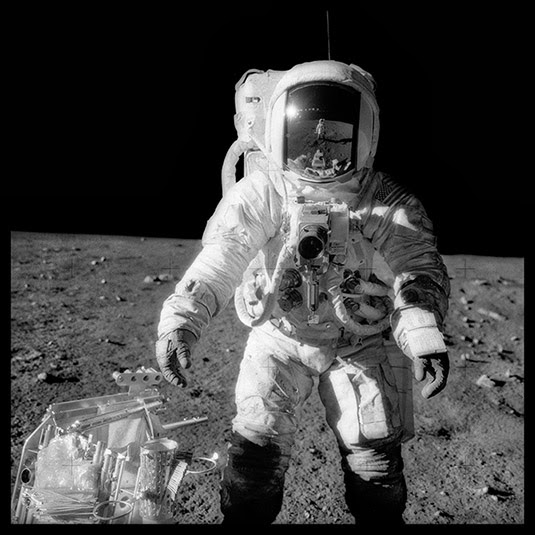
FULL MOON: Alan Bean at Sharp Crater With the Handtool Carrier; Photographed by Charles Conrad, Apollo 12, 1969 (1999)

It’s one of those things that I find interesting about Full Moon, that what we consider to be interesting, photographically, can happen absent of a human set of eyes making the image. Today, as you mention, it’s only getting more extreme.

I should say, at this particular photographic moment, as a photographer myself, I feel overwhelmed. I have not figured out where photography is going. I don’t think anyone has. I certainly know that it’s changing, radically, and sometimes in ways that make me want to run back to the 19th century.

For one thing, everyone’s a photographer now, because everyone has a phone, and those cameras are getting very good. The cameras themselves are doing more and more of the work, as well, work that, traditionally, was the field of the photographer, so the quality of photographs—in the classic sense of things like quality of exposure, density, resolution, contrast, and so forth—is going up and up and up. And, of course, as you well know, there are now systems in place for total and instantaneous publishing of one’s work via the Internet. I think we are entering a world of total documentation.

Obviously, all of this visual information is going to continue to proliferate. I don’t know how to navigate my way through that. I tell myself—because I have my own methods, my own cameras, and my own crazy aerial platform—that my pictures have a view that you are not going to get from a drone.

Personal drones are going to proliferate, and our eyes, soon enough, are going to be able to go anywhere and everywhere without our bodies. Humans have a tremendous interest—they always have had—in extending themselves where they physically cannot go. That’s just picking up more speed now—it’s going faster and faster—and the density of the data is thickening, becoming smog.

I think that photography, or what we currently consider photography, will become more about the concept or the idea driving the picture than the actual picture itself. Maybe that has always been the case. Metaphors are obviously applicable to everything, and you can find them in everything, if you want to. It’s not so much the picture—or, it’s not so much the information in the picture—it’s the spin on it. Information does not equal meaning. Meaning is bigger than information.

I used to fly model aircraft as a kid. It’s a powerful fantasy: mounting a camera on a little electric helicopter and running it around the corner, lifting off over the fence, the hedgerow, the border, and seeing what you can see. I actually do it physically now, in airplanes, and I’m very invested in the physical experience of that. It’s a big part of my aerial work: the politics of transgressing private property in a capitalist society.

I may not be able to get into that gated community on the outskirts of Las Vegas—which is what I’m photographing now, a place called Lake Las Vegas—but, legally, I can get above it and I can make the stories and the images I want to make.
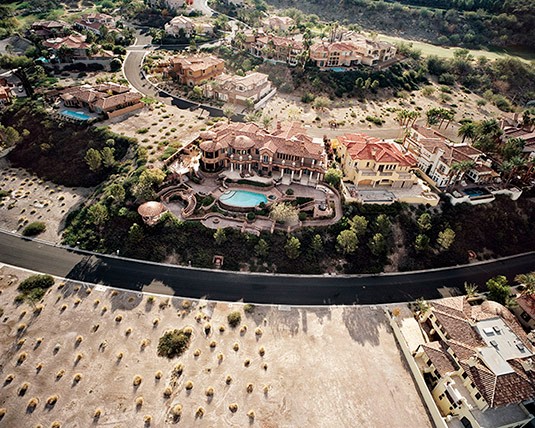
Michael Light, “Monaco” Lake Las Vegas Homes on Gated Grand Corniche Drive, Henderson, NV (2010)

That homeowners’ association, or that world created by developers, wants total control over its narrative, and, in general, they have it. They exclude anyone who wants to tell a different story. So far, with the exception of military air space and occasional prohibited air space around nuclear power plants and that sort of thing, I can still tell my own stories, and I do.

A couple of years ago I went out to Salt Lake City. I sold one of my big handmade books to the art museum there, and I also made an effort to see Kennecott Copper, which is owned by Rio Tinto. I thought they might be interested in buying some of the work—but, as it turned out, they were not at all interested, and, in fact, seemed to wish I didn’t exist.

I met with their PR person—a very nice, chatty PR kind of lady. I showed her this spectacular, 36-inch high and 44-inch wide book of photographs featuring this incredible, almost Wagnerian hole in the ground. And the only thing that she could say, upon seeing the book, was: “How on earth did you get permission?” Not: Wow, these are interesting pictures, or whatever. She instantly zoomed into the question of the legal permission to represent or tell the story of this site. I said: “Well, I didn’t get permission, actually, because I didn’t need permission.” And that was anathema to her; it was anathema to the whole corporate structure that wants to control the story of the Bingham Mine.
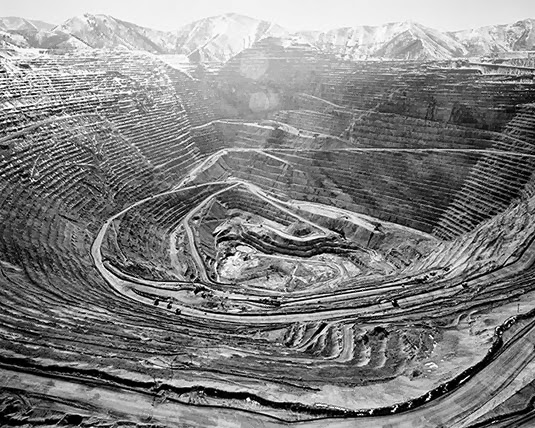
Michael Light, Earth’s Largest Excavation, 2.5 Miles Wide and .5 Miles Deep, Bingham Copper Mine, UT (2006)

Anyway, I think it’s through my own selfishness that I would not want to send a drone up to transgress over a site when I could do it, instead. I could just sit at my computer screen and kick back in my chair—but we spend enough time in chairs as it is. It’s more that I am putting my butt on the line; I’m breaking no laws, but there is the experience of physical exploration that I would be denied by using drones. Obviously, in areas where I truly cannot go—like the moon—or where I wouldn’t want to go—like on the edge of one of those nuclear detonations—then I’d be thrilled to have a remote.

Manaugh: You mentioned control over the narrative of the copper mine. It’s as if Kennecott has two-dimensional control over their narrative, through image rights, but they don’t have volumetric, or three-dimensional, control over the narrative, which you can enter into with an airplane and then relate to others in a totally different way.

Light: Of course.

My particular approach, aerially, is very different. The obvious answer is: why not just Google Map it, and zoom in, and then throw a little three-dimensionality on it by moving a little Google Earth lever? But the actual act of going in at the low altitudes that I do lets me make these particular images. I don’t do verticals; I do obliques, because they allow for a relational tableau to happen. To go in low—to make that physical transgression over Bingham or over Lake Las Vegas or over this or that development—is great, and I think it’s a viewpoint that is unique.
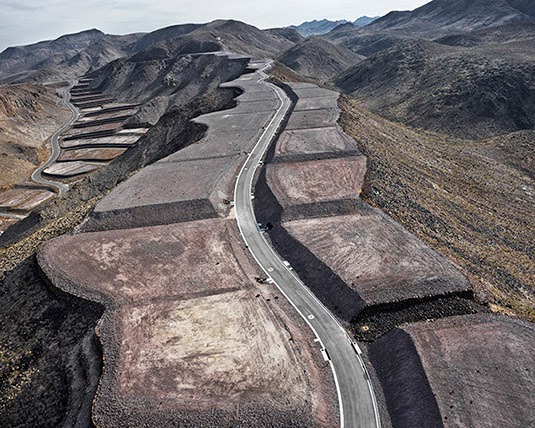
Michael Light, Looking East Over Unbuilt “Ascaya” Lots, Black Mountain Beyond, Henderson, NV (2010)

Manaugh: You’ve mentioned Las Vegas, but I’d also like to talk about your Los Angeles work. You basically have two oppositional series—L.A. Day and L.A. Night—which really makes explicit the role light plays in changing how we see a landscape. For instance, in L.A. Night, the city is represented as this William Blake-like microcosm of the universe, with the lights of the houses in the Hollywood hills, and the cars on the freeways, mimicking the stars above them. The city becomes a copy of the sky.
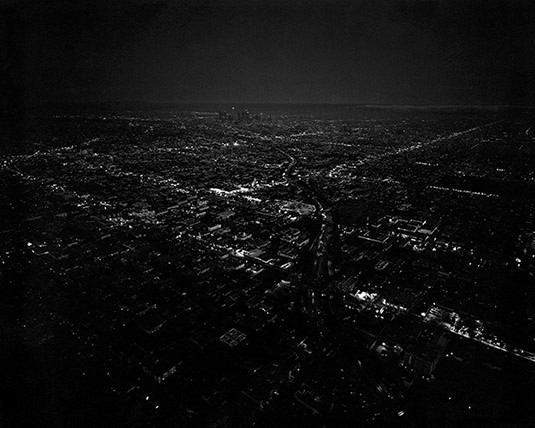
Michael Light, Untitled/Downtown Dusk, Los Angeles (2005)

Then there’s L.A. Day, which confronts the massive Ballardian geometry of the freeways themselves, baking under the sun.
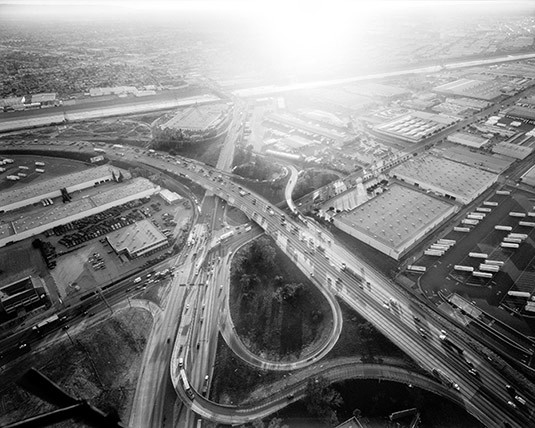
Michael Light, Long Beach Freeway and Atlantic Boulevard Looking Southeast, L.A. River Beyond (2004)

I’m interested in what the city is doing for you in these photographs. Is it a representation of the end of civilization, or is it a strange depiction of new, golden dawn for urban form? What is your attraction to and metaphoric use of the city—of Los Angeles, in particular?

Light: Well, these are very interesting questions. One thing to bear in mind, first of all, is that the day work and the night work is now quite old work to me. The day work was shot in 2004 and the night work was shot in 2005 and it’s just a Los Angeles; it’s not the Los Angeles. It’s very much a particular spot in time that I found myself at that moment. I’ll get into that in a little more detail in a minute.

Back in 1986, when I moved to San Francisco, I wanted to come west for a lot of reasons, one of which was to work for the environment. I had worked for the Sierra Club doing political lobbying with their D.C. office for a couple of years right out of school in the late 1980s. I’ve remained a pretty strong environmentalist, although I try not to make my work tendentious or overtly activist in that sense. I want to be more complicated than that.
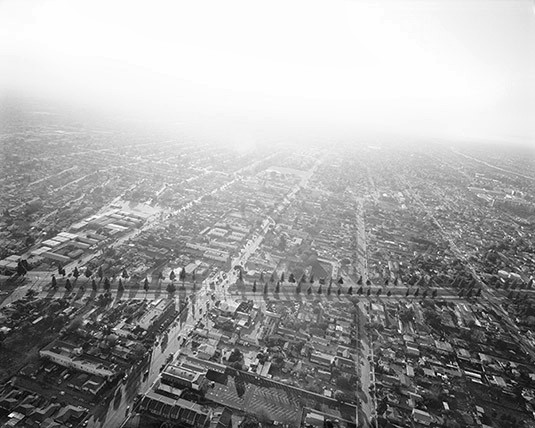
Michael Light, Looking Northwest, Somewhere Near Torrance (2004)

Anyway, in San Francisco, the default attitude is to look down your nose at the Southland—like, “Oh, yeah, Los Angeles. It’s everything that’s wrong with America.” The more I’ve lived in California, though, which is 26 years now, the more I have come to realize that this is an extraordinarily common, but very facile, view of Los Angeles. I hope I have grown in the depth of my views about L.A., I’d say, because, if there’s any one thing I’ve learned about photographing Los Angeles—like anywhere else, but particularly L.A.—it’s that, every time you shoot, it’s a different city. L.A. in the spring is one thing. L.A. in the dry summer is another. L.A. day. L.A. night. L.A. color. L.A. black and white. I have been humbled, I think, in a positive way in my views of Los Angeles. Of course, maybe I’ve just gotten more cynical or maybe I’ve gotten a little more complicatedly environmental. But I’m not condemnatory about that city the way I used to be.

L.A. is a massive thing. This is one of the reasons why I was drawn to it in the first place. It’s so big. It’s so complex. Is it apocalyptic? Well, yes; it has a certain apocalyptic quality to it. But, if I’m trying to understand America, or trying to understand the bomb, how could I not try to understand L.A.?

So L.A. Day came directly out of doing 100 Suns. 100 Suns came out in 2003 and I had been spending a tremendous amount of time metaphorically looking at “suns.” Obviously, in L.A. Day, one of the major tropes is that I am shooting directly into the sun, and I’m dealing with air, light, and atmosphere. In that regard, I’m also exploring many of the same things as Full Moon.

I was also just beginning to work with 4×5 negatives, and wanted to go as high-key as possible, to go back into that annihilating desert light. A lot of it was shot either early in the morning or very late in the day, but the whiteness of the light at midday is a very dry, Western, annihilating light that I was also interested in investigating. There’s an image that I’m particularly fond of: it’s downtown L.A. with the river in front, and the city is almost vaporizing. It’s almost just lifting up into the ether. I guess I wasn’t overtly looking for a nuclear moment, something coming so literally from 100 Suns, but, in my mind, that image really—at least, metaphorically—bridges those two projects.
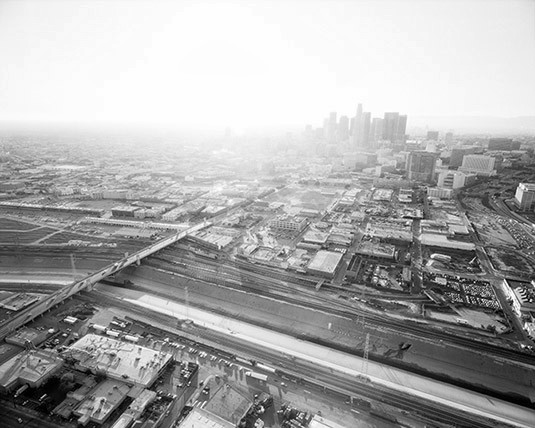
Michael Light, Downtown Los Angeles Looking West, 1st Street Bridge and L.A. River in Foreground (2004)

The night work was kind of a binary reflex. I had been thinking about the old 19th-century blue-sensitive films, where the skies would go pure white, for a while. Full Moon, obviously, is the reversal of that, where the ground—the surface of the moon—is white with undiluted sunlight and the sky is endlessly black.

In the day in L.A. you get the obverse: a terrestrial sky, if you will. L.A. Night is another reversal and a kind of the binary analogue to the moon and its vacuum sky.

Michael Light, Untitled/River Stars, Los Angeles (2005)

Those things were operating in my mind, although the night work also came out of a technical challenge I wanted to face. I wanted to get this 4×5 camera to work from a helicopter. I can only go one-sixtieth of a second. Slower than that and I get a blur. The challenge was: can I actually get enough light on the film at one-sixtieth of a second, either at dusk or in pure dark? Can I even make this work?

I discovered very cheap—relatively speaking—Robinson R22 helicopters, operating out of Van Nuys, that I could get for something like $230 an hour with a pilot. The physical thrill of having your own private dragonfly, really, which is what these helicopters are, also drove my interest. I was doing all this day work and I thought, well: let’s try a night flight. Let’s actually drift over the vastness and the endlessness of the city, and all the light washing around in that basin. It is exquisitely sparkly. It’s delightful. It has some enchantment in a way that Los Angeles, in daylight, does not. It’s rife with metaphor with all the little lights standing in for all the little people.
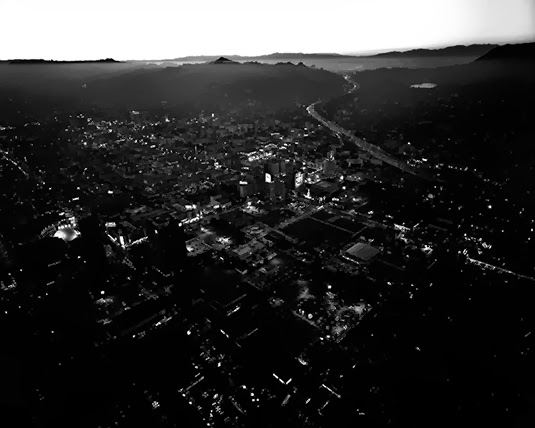
Michael Light, Untitled/Hollywood, Los Angeles (2005)

I think that, in all of my work since the late 1980s, there has been a transposition between up and down, or a loss of gravitational pull, and that’s very important to me.
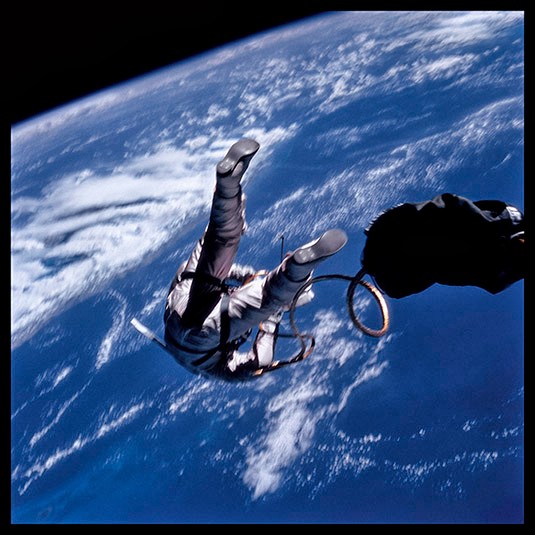
FULL MOON: Edward White at 17,500 mph Over the Gulf of Mexico; Photographed by James McDivitt, Gemini 4, 1965 (1999)

A sense of vertigo or spinning in space, the full 3-dimensionality of space—the spatial delirium we were talking about earlier. I’ve always been interested in imagery that gives me a sense of looking up when I am actually looking down. That reversal is something I try to look for.
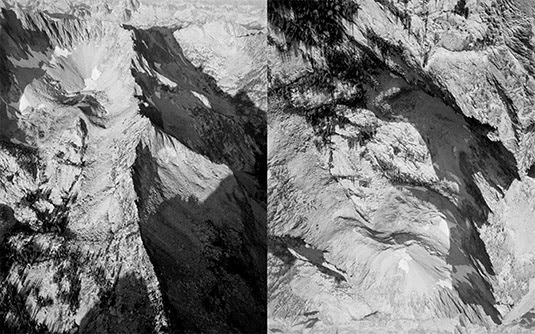
Michael Light, Sawtooth Mountains Diptych, ID (2012)

But that night work was very much of a moment in time in my own production—meaning that I would not go back to L.A. and make pictures like that again.

The work I’m doing over Vegas couldn’t be more different. It’s color. It’s very much lower to the ground. It’s much more specific to its content. In aerial work for me, not only is there tremendous pleasure in moving through space, 3-dimensionally, there is also tremendous pleasure in moving over and around and amongst geology and amongst actual formations of the land. Much of the content of the western work is about that dialogue between geology and the built world.
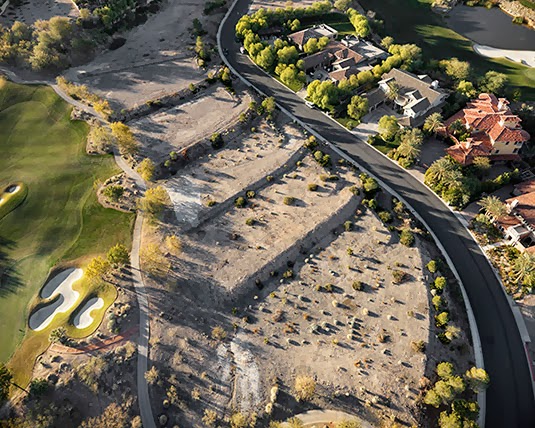
Michael Light, Empty Lots in the “Marseilles” Lake Las Vegas Community, Henderson, NV (2011)

The subtitle of my larger project, Some Dry Space, is An Inhabited West. My point is that there is no place that’s untouched anymore. The west is a giant human park.

But, that said, there is still lot of space left and it’s really fun to move through that space. It’s fun to say, well, okay, here’s Phoenix or here’s Los Angeles, but how can I make images that actually show the power of the geology of a place? How do I represent two different time scales? How do I photograph the human one and the tectonic one? I find that dialogue, between a human time frame and the time frame of the land, to be an interesting one. I try to capture both when I can, preferably adjacent to each other in the same picture.
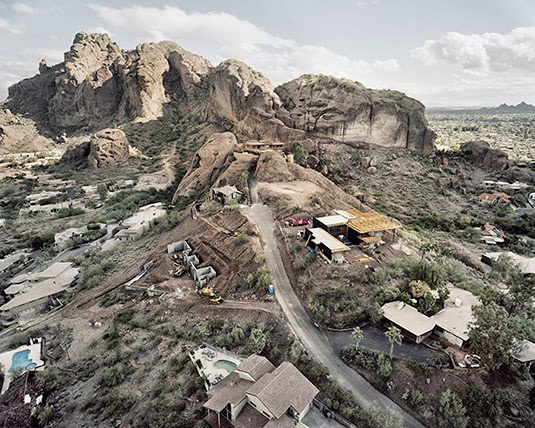
Michael Light, New Construction On East Porter Drive, Camelback Mountain Beyond, Scottsdale, AZ (2007)

Twilley: What have you been trying to capture or represent in your most recent trips out there?

Light: Every flight is different. Every mindset is different. I find that I take radically different pictures each time I go up. It’s an interesting thing. I’ve contained myself to two areas—Lake Las Vegas and the MacDonald Ranch, which is this whole side of a mountain that’s been completely sculpted into house pads. It is the most spectacular, simple engineering project I think I’ve ever seen. It’s very dramatic. Parts of it are built out; parts of it aren’t. I don’t know what the final awful sales name of the development will be, but these will be very high-end homes.

I’ve really taken on the domestic side of Las Vegas, where “California dreams” are to be had on the cheap—and then on the extraordinarily inflated side of things, the delusional, opulent side of things.

Vegas is a very easy target for the sophisticated East Coast cultural critic to come out and judge. But that line of critique is a dead end. It’s not new territory, and it also dismisses the people—the end-users—without asking any questions about how they got there. I’ll nail the developers any day of the week: this is a calculated, rationalized capitalist agenda for them. But the people at the end, on the receiving side of it, the people who are trying to build their lives and their dreams, on whatever unstable sands that they can or can’t afford out there—I would like to present them critically but without condemnation.
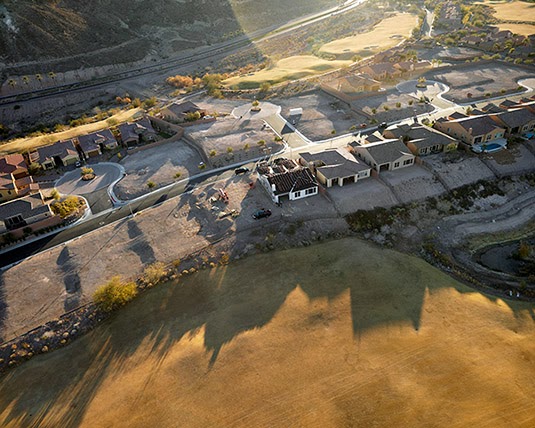
Michael Light, Halted “Bella Fiore” Houses and Bankrupt “Falls” Golf Course, Lake Las Vegas, Henderson, NV (2011)

The L.A. work was too high and atmospheric to get political. Now that I’m down, flying much lower and getting closer and closer to the material, I think the work can carry more of an agenda. It is a presentation with sophisticated layering, I hope, rather than a blanket condemnation. Otherwise, I’m looking down my nose, saying, “Oh, look at these poor fools living in Las Vegas, while I’m up in San Francisco living the way people should live.”

The more work I do in Las Vegas, the more I see parallels between the mining industry—and the extraction history of the west—and the inhabitation industry. They do the same sort of things to the land; they grade, flatten, and format the land in similar ways. It can be hard to tell the difference sometimes between a large-scale housing development being prepped for construction and a new strip mine where some multinational firm is prospecting for metals.
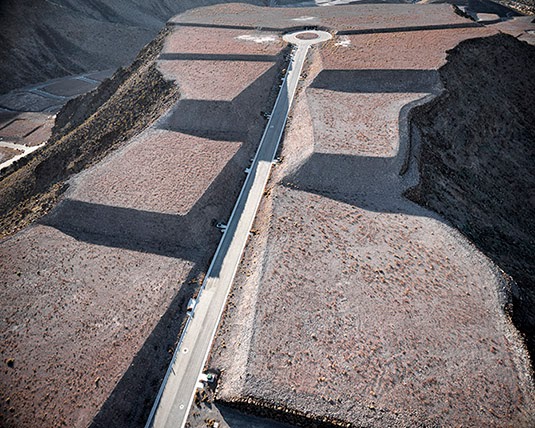
Michael Light, Unbuilt “Ascaya” Lots and Cul De Sac Looking West, Henderson, NV (2011)

In other words, the extraction industry and the inhabitation industry are two sides of the same coin. The terraforming that takes place to make a massive development on the outskirts of a city has the same order, and follows the same structure, as much of the terraforming done in the process of mining.

That was a revelation for me. The mine is a city reversed. It is its own architecture.
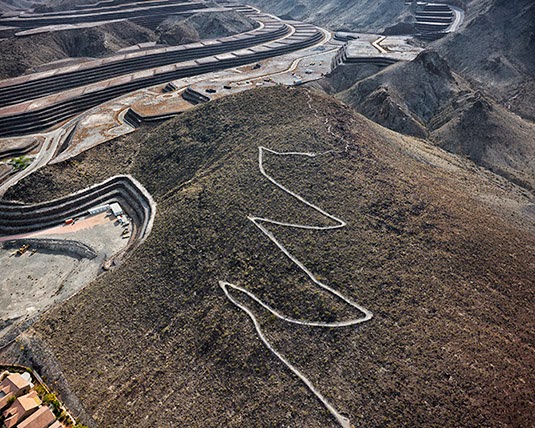
Michael Light, Hiking Trail and Unbuilt “Ascaya” Lots, Black Mountain Beyond, Henderson, NV (2010)

This latest shoot also resulted in some structural advances in the photographs, in the way that they are composed and the way that they are offset and fragmenting. I was pleased with it. I was also testing out a new camera I had rented.

Twilley: Are you shooting digital?

Light: I am beginning to. I’m trying. I’m renting all the Hasselblads—60 megapixels—that I can get my hands on.
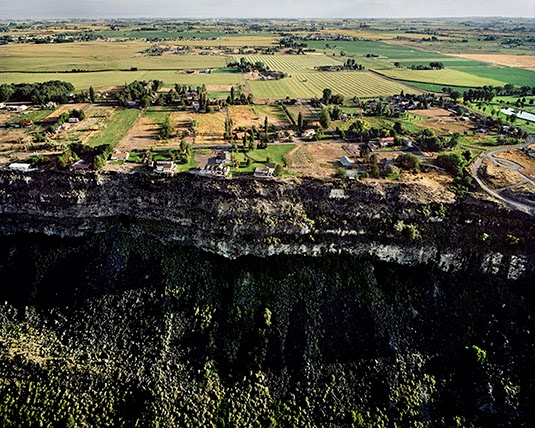
Michael Light, Houses on the Edge of the Snake River Lava Plain, Jerome, ID (2009)

Anyway, the more I photograph, the more I have become attracted to architecture and the meanings of architecture. As it appears here and there out west in the landscape, architecture stands out so much. It’s just plunked down, naked and exposed. Whatever intentions it has, if there are any, are so apparent.

As I have come to photograph these inhabited landmarks, it’s more and more obvious how the affluent choose to manifest their affluence through architecture. They manifest it by getting or obtaining a certain piece of land—a spectacular piece of land in the spectacular west—and then by building some sort of structure there. They want to insert themselves into the most sublime location possible.

They take in the sublime, as we all would, and as I do, but then they try to project it back out again through a generally dirty and dark architectural mirror. You see it on the Snake River, with the potato barons. You see it in Colorado. You see it in ski towns. In my view, it’s just a re-projection of the American business ego—let’s just call it the American ego—back out into the landscape, via this or that villa. It’s an architectural version of wanting now to be the true authors of the landscape sublime, and part of this abrupt shift from classical, uninhabited landscapes to built landscapes of our own monumental and violent design. That’s all part of what I mean by “the inhabited west.”

Books Received

[Image: Cincinnati Public Library, 1870s; photo via Steve Silberman].
It’s that time of the year again, to take a look at the many, many books that have passed through the halls of BLDGBLOG the past season or two, ranging, as usual, from popular science to fiction, landscape history to the urban future of the refugee camp.

There are some great books included in this round-up, ones I’d love to help find a wider audience—however, as will be clear from a handful of descriptions below, and as is always the case with book round-ups here on BLDGBLOG, I have not read every book included in the following list and not all of them are necessarily new.

However, in all cases, these books are included for the interest of their approach or for their general subject matter, and the wide range of themes present should give anyone at least a few interesting titles to seek out for autumn reading.


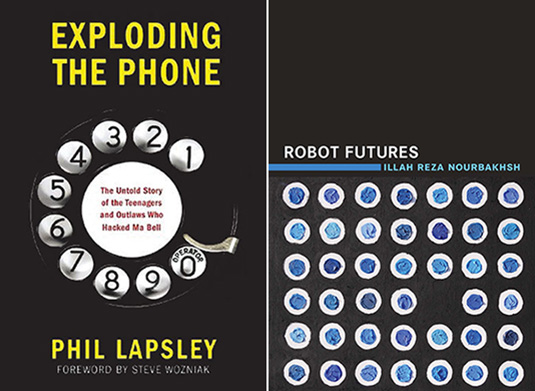
1) Exploding the Phone: The Untold Story of the Teenagers and Outlaws Who Hacked Ma Bell by Phil Lapsley (Grove Press)

One of the most enjoyable books of my summer was Exploding the Phone by Phil Lapsley. Lapsley’s history of “phone phreaks,” or people who successfully hacked the early phone networks into giving them free calls to one another and around the world, would read, in a different context, like some strange occult thriller featuring disaffected teenagers tapping into a supernatural world. Weird boxes, unexplained dial tones, and disembodied voices at the end of the line pop up throughout the book, as do surprise cameos from a pre-Apple Steve Wozniak and Steve Jobs.

Teenagers throwing frequencies and sounds at vast machines through telephone handsets managed to unlock another dimension of the phone network, Lapsley explains, a byzantine geography of remote switching centers and international operators. In the process, they helped pave the way for the hackers we know today. I have heard, anecdotally, from a few people who were around and part of these groups at the time, that Lapsley got some of his details wrong, but that didn’t take away from my enjoyment of—or inability to put down—his book. Recommended, and very fun.

2) Robot Futures by Illah Reza Nourbakhsh (MIT Press)

This pamphlet-length book by Carnegie Mellon University’s Illah Reza Nourbakhsh on the future of robotics pays admirable attention to the fundamental problem of even defining what “robotics” is. Better yet, Nourbakhsh prefaces each of his short chapters with fictional interludes exploring speculative scenarios of future robotics gone awry. There is a disturbing vignette in which flying robot toys programmed to recognize human eye contact swarm around and terrify anyone not hiding their gaze behind wearing sunglasses—something the toys’ manufacturer never predicted—as well as a memorable scenario in which new forms of robot-readable graffiti throw entire self-driving traffic systems into a tizzy, making car after car wrongly report that an impenetrable roadblock lies ahead. Call it traffic-hacking.

In the end, Nourbakhsh suggests, robots will prove to be fundamentally different from human beings, and we should be prepared for his. “A robot moving down the street will see in all directions, not simply in front of it like humans,” he writes. “If that robot is connected to a network of video cameras along the street, it will see everywhere on the street, from all angles, the entire time it walks. Imagine this scenario. A not-very-clever robot walking down the street will have access to entire synthesized views of the street—up and down, behind you, down the alley, around the corner—and be able to scroll back through time with perfect fidelity. As you approach this robot, it might be cognitively much dumber than you, but it knows far more about its surroundings than you do. It stops suddenly. What do you do? There is no common ground established between you and this robot, just the fact that you occupy the same sidewalk.”


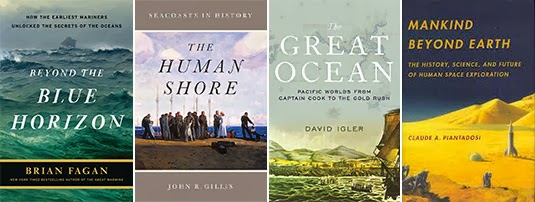
3) Beyond The Blue Horizon: How The Earliest Mariners Unlocked The Secrets Of The Oceans by Brian Fagan (Bloomsbury Press)

Brian Fagan, an environmental historian known for his books on climate change and civilization, has written a great example of what might be called adventure-history. Beyond the Blue Horizon takes us through roughly twenty thousand—even potentially, depending on how you interpret the archaeological evidence, more than one hundred thousand—years of human seafaring. Every few pages, amidst tales of people sailing in small groups, even drifting, seemingly lost, for days at a time across vast expanses of open water, Fagan makes arresting observations, such as the fact that early Pacific navigators, laden down with seeds and plants, “literally carried their own landscape with them,” he writes.

The importance of the coast in supporting human settlement, and the absolute centrality of the sea—rather than continental interiors—in shaping human history, gives Fagan multiple opportunities to refocus our sense of our own remote past. We are not landed creatures of roads and automobiles, Fagan argues, but a maritime species whose entire childhood and adolescence was spent paddling past unknown coastlines, searching for freshwater rivers and streams—a “world of ceaseless movement,” as he calls it, including now lost islands, deltas, and coasts. Fagan’s brilliance at describing landscapes as they undergo both seasonal changes and variations in climate also applies to his depictions of Earthly geography when sea levels were, for most of the eras described in his book, more than 300 feet lower than it is today. It was another planet—a maritime world—one that humans seem to have lost sight of and forgotten.

4) The Human Shore: Seacoasts in History by John R. Gillis (University of Chicago Press)

John R. Gillis’s look at “seacoasts in history” proves to be compulsively readable, sustaining many long subway rides for me here in New York, although the final few chapters fall off into unnecessarily long quotations from what seems like any random academic source he could find that mentioned the sea. This is too bad, because a shorter, more tightly edited version of this book would be a dream. Gillis is not shy about making outsized claims for revising the history of human civilization. The shore is “the true home of humankind,” he writes, “the original Eden.” He wants Westerners to forget the “terracentric history” they’ve been taught, which is, he points out, simply a historical misunderstanding of where humans actually spent 95%—the number Gillis uses—of their development: on shorelines and coastal islands.

“The book of Genesis would have us believe that our beginnings were wholly landlocked,” he writes, “but it was written at the time that the Hebrews were settling down to an agrarian existence.” Gillis quotes the words of writer Steve Mentz here, who argued that we need “fewer gardens, and more shipwrecks” in our narrative understanding of human prehistory.

Gillis allows his book some intriguing political subthemes. He writes, for example, that “it would be a very long time, almost three hundred years, before Europeans realized the full extent of the Americas’ continental character and grasped the fact that they might have to abandon the ways of seaborne empires for those of territorial states.” He adds, “for the first century or more [of their habitation in the Americas], northern Europeans showed more interest in navigational rights to certain waterways and sea tenures than in territorial possession as such.” Rivers and lakes were the key to ruling North America, for a time; and, seemingly since the interior land rush of U.S. history, the “seaborne” ways of humans, with or without a state to back them, have been forgotten.

As a brief side note, it’s interesting here to look at the Somali pirates so often mythologized in Western media, including the forthcoming Paul Greengrass film Captain Phillips—that stateless, seaborne groups of humans still exist and are the rogue scourge of landed empires (see also The Enemy of All by Daniel Heller-Roazan, etc.).

5) The Great Ocean: Pacific Worlds from Captain Cook to the Gold Rush by Davig Igler (Oxford University Press)

David Igler’s own book on all things anthropologically oceanic focuses solely on the Pacific Ocean, from the first wave of European exploration to early-modern sea trade. Igler, too, finds the land-locked nature of traditional history both claustrophobic and incorrect. “The ‘places’ usually subjected to historical analysis—nations, regions, and localities—have fixed borders enclosing land and thus constitute terrestrial history,” he writes in the book’s introduction. “Historians have far less experience imagining the ways that oceanic space connects people and polities, rather than separating them.” Igler’s larger point—that tides, currents, and winds, even specific ships, are also, in a sense, “places” deserving of historical recognition—animates the rest of the book.

Mankind Beyond Earth: The History, Science, And Future Of Human Space Exploration by Claude A. Piantadosi (Columbia University Press)

6) This book is admittedly quite hampered by its extraordinary practicality: there is very little poetry here, mostly straight talk of musculoskeletal disorders in low gravity and heat-loss from warm bodies in space. We begin on the ground floor, not only with a short and perhaps unnecessary history of the U.S. space program, but with the very basics of human physiology and the mechanics of flight. I suspect, however, that most readers are perfectly willing to jump into the deep end and read what’s on offer in the book’s later chapters: human visits to Mars, to asteroids, to “big planets, dwarf planets, and small bodies,” in Piantadosi’s words, to the “moons of the ice giants” and beyond. Ultimately, though, the book is simply too dry to feel like these later glimpses of “mankind beyond Earth,” as the title teasingly—and, for the most part, misleadingly—promises, are a worthy reward. If you must, one to look for in the local library.


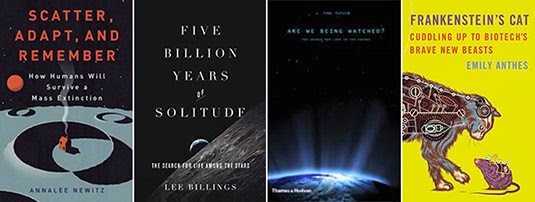
7) Scatter, Adapt, and Remember: How Humans Will Survive a Mass Extinction by Annalee Newitz (Doubleday)

Annalee Newitz, editor-in-chief of io9 and thus, now, a colleague of mine, has exceeded all expectations with the research, depth, and range of this quirkily enthusiastic look at planetary mass extinction. Her early chapters on dinosaurs, plagues, extremophiles, world-altering volcanic eruptions, long geological eras when the Earth was locked in ice, possible human/Neanderthal guerrilla warfare (not to mention inter-breeding), and much more, are like a New Scientist article you hope never ends. It’s an exciting read.

Oddly, though, the central premise of the book—that, through urbanization, human beings will find ways to avoid their own extinction—feels tacked on and unconvincingly developed. If I’m being honest, it feels like Newitz is trying to make more of an ideological point about the political value and cultural centrality of cities today, rather than actually arguing rationally for the possibility that cities will save the human species. This is especially the case if we’re talking about—as, in this book, we are—catastrophic asteroid impacts or the outbreak of a super-virus. This otherwise gripping book thus has a bit of an are-you-serious? feel as it wraps up its final fifty pages or so. While advancing a theory of safety achieved through collective living, urban farming, and social cooperation, Newitz also inadvertently seems to contradict the first command of her book’s title: to scatter. That is, to fling ourselves to the far edges of the universe—to explore, survive, and mutate with the cosmos—not to band together, urbanize, and cooperate.

As such, it seems possible to imagine an identical version of this book—identical, that is, for 200 pages or so—but with a radically differnet ending: one in which truly scattering, adapting ourselves, isolating ourselves, and differentiating our civilizational pursuits—even differentiating our very DNA through evolution in separation—would be the most effective way to avoid human extinction. But that argument, it seems, is ideologically impermissible; it makes you an anti-state survivalist, a cosmic redneck, building bunkers in the Utah desert or on the moons of another world, more Ted Nugent than Stewart Brand.

In any case, putting political arguments like these aside, the book ends with a mind-popper of a quotation. In a conversation with Randii Wessen at the Jet Propulsion Lab in Pasadena, California, Wessen tells Newitz: “Our kids are the last generation who will see no city lights on the Moon.” This is both wonderful and terrible, and as concise a statement as I’ve read anywhere to show the human future rolling on.

8) Five Billion Years of Solitude: The Search for Life Among the Stars by Lee Billings (Current)

Gifted science writer Lee Billings takes us on a search for other Earths—or, more accurately, for habitable “exoplanets” where life like us may or may not have a chance of existing. The book starts off with quite a coup. Billings treats us to a long, at-home visit with astronomer Frank Drake of Drake’s Equation fame: the abstract but reasonable calculation used for decades now to determine whether or not intelligent civilizations might exist elsewhere (and, by extension, how likely it is that humans will find them).

The book is not hard science, it is easy to follow, and Billings is a great writer; his tendency, however, veers toward the humanistic, following the life stories of individual astronomers or physicists here on Earth as they search the outer reaches of the detectable universe for signs of exoplanets.

A sizable diversion late in the book, for example, takes us on a canoe trip far into the Canadian north, past lakes and rivers, with a wary eye on approaching storms, to tell the story of how physicist Sara Seager met and fell in love with one of her colleagues. It is not a short diversion, and you’d be forgiven for thinking that Seager’s canoe trip has little to do with the search for “life among the stars,” as the book’s subtitle suggests. It is at moments like this, as Seager and her partner paddle from one portage to another, that I found myself wondering if the only stories to tell are of other human beings—whether scientists or NASA administrators—then why, in a sense, are we looking for exoplanets at all?

Of course, the book jacket never promised us surreal descriptions of other worlds. But it’s hard not to hope for exactly that: that Billings would focus his considerable rhetorical powers away from our world for a few more chapters and offer those evocative glimpses of Earth-like planets I suspect so many readers will come to his book to find—visions of worlds like ours but magically, cosmically different—and thus communicate the beautiful, poetically irresistible urge to discover them. His introductory descriptions of the formation of our solar system, for instance, are breathtaking, clear, and poetic, and similar passages elsewhere show the pull of the exoplanetary; the narrative structure of the scientist profile seems inadvertently to have focused the bulk of the book’s attention here on Earth, where we are already bound, rather than to let the strange light of the universe shine through more frequently.

But this is like complaining about dessert after a delicious meal. I’ll simply hope that Billings’s next book concentrates more on the inhuman allure so peculiar to astronomy, a field astonishingly rich with worlds mortal humans long to see.

9) Are We Being Watched?: The Search for Life in the Cosmos by Paul Murdin (Thames & Hudson)

The off-putting and sensationalistic title of Paul Murdin’s new book is, thankfully, not a sign of things to come in the text itself. Murdin’s sober yet thrilling look at the history and future of astrobiology is a bright spot in a recent spate of books about the possibility of extraterrestrial life. “The twenty-first century is the century of astrobiology,” he writes in the first sentence of chapter one; indeed, he adds with extraordinary confidence, “this is the era in which we will discover life on other worlds, and learn from it.”

Amidst many interesting tidbits, one worth repeating here actually comes from Murdin’s quotation of paleontologist Simon Conway-Morris. Conway-Morris, referring to the possibility of discovering truly alien life, rightly suggests that we could very well have no idea what we’re looking at. Indeed, he memorably says, these other life forms could be “constructions so unfamiliar that they are only brought home by accident and then inadvertently handed over for curation in a department of mineralogy.” The idea that rocks sitting quietly in a Natural History museum somewhere are actually alien life forms is mind-blowing and but one take-away from this thought-provoking book.

Over the course of Are We Being Watched?, Murdin enjoyably goes all over the place, from amino acids to plate tectonics, to radio-stimulated organic molecules in the atmosphere of Titan. As if channeling H.P. Lovecraft, Murdin at one point writes that, on Jupiter’s ice-covered moon Europa, scientists have seen the same churning processes as witnessed in Antarctica, but, on Europa, “we see the results of this churning as colored stains on ridges of ice at the boundaries of ice floes. Perhaps in these colored stains lie dead creatures, brought up from the depths of the ocean and exposed to view by orbiting spacecraft or landers that can rove over the surface.”

10) Frankenstein’s Cat: Cuddling Up to Biotech’s Brave New Beasts by Emily Anthes (FSG)

Frankenstein’s Cat follows the 21st-century quest to re-engineer biology, to design “the fauna of the future,” as the book promises, or “biotech’s brave new beasts,” where resurrected species, pets with prostheses, and militarized insects crawl through forests of genetically modified trees. At once terrifying and thrilling, and animated in all cases by the gonzo enthusiasm of any science operating at seemingly unstoppable speed, Emily Anthes’s book shows the weird biological breakthroughs that will ultimately create the landscapes of tomorrow: the cities, gardens, parks, oceans, and backyards our descendants will inevitably mistake for nature (and then, eventually, dismiss as mundane).


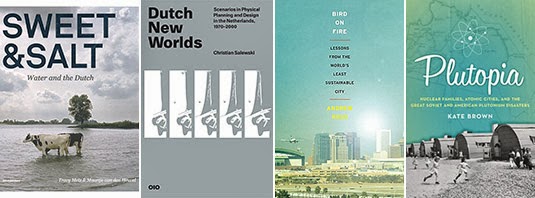
11) Sweet & Salt: Water And The Dutch by Tracy Metz and Maartje van den Heuvel (NAi Publishers)

Journalist Tracy Metz and art historian Maartje van den Heuvel have teamed up for this collaborative look at “environmental planning” in the Netherlands, with a focus on all things aquatic. While Metz visits the country’s numerous megaprojects and anti-flooding infrastructure to speak with water engineers, “dike wardens,” and other stewards of Holland’s relationship with rain and the sea, van den Heuvel assembles a spectacular catalog featuring visual depictions of waterworks throughout Dutch art history. This is “the visualization of water in art,” as she calls it, revealing “anxieties about flooding” and a deep-rooted infrastructural patriotism inspired by the technical means for controlling that flooding.

Ultimately, the book’s goal is to show how Dutch water management is changing in the face of rising sea levels and climate change, and how “water is coming back into the city,” as Metz writes, changing the nature of contemporary urban design.

12) Dutch New Worlds: Scenarios in Physical Planning and Design in the Netherlands, 1970-2000 by Christian Salewski (010 Publishers)

This well-illustrated history and catalog of large-scale hydrological projects in the Netherlands—and the “Dutch new worlds” those projects helped generate—offers a provocative look at the very idea of infrastructure. Salewski suggests that a nation’s infrastructure is like literature or mythology, a built narrative in which a much larger constellation of dreams and aspirations can be read. “There is no Dutch Hollywood,” Salewski writes, “no cinematic dream machine that constantly processes the current view of the future into easily digestible, mass-consumed science fiction movies. Dutch views into the future are probably best found not in cultural works of literature and art, but in physical planning designs.” That is, in the dams, dikes, levees, and polders the rest of the book goes on to so interestingly describe. Infrastructure, Salewski offers, is one of many ways in which a nation dreams.

13) Bird On Fire: Lessons From The World’s Least Sustainable City by Andrew Ross (Oxford University Press)

Andrew Ross takes a critical look at Phoenix, Arizona, a desert city “sprawling over a thousand square miles, with a population of four and a half million, minimal rainfall, scorching heat, and an insatiable appetite for unrestrained growth and unrestricted property rights.” As the city tries to “green” itself through boosts in public transportation and a more sensible water management strategy—among other things—Ross asks if an urban transformation, something that might save Phoenix from its current parched fate, is even possible.

14) Plutopia: Nuclear Families, Atomic Cities, and the Great Soviet and American Plutonium Disasters by Kate Brown (Oxford University Press)

Kate Brown’s Plutopia creates a horrifying set of conjoined urban twins, so to speak, by both comparing and contrasting the purpose-built plutonium production towns of Richland, Washington, and Ozersk, Russia. These were fully planned and state-supported facilities, yet both were also highly delicate, secret cities—in Ozersk’s case, literally off the map—constantly at risk of nuclear disaster. And disaster, of course, eventually comes.

Brown points out how, between the two of them, Richland and Ozersk released four times the amount of radiation into the environment as the meltdown at Chernobyl, and she tracks the disturbing long-term health and environmental effects in the surrounding regions. In both cases, perhaps cynically, perhaps inspiringly, these polluted regions have become nature reserves.

In a particularly troubling anecdote from the final chapter, referring to the experience of Richland, Brown points out that “periodically deer and rabbits wander from the preserve and leave radioactive droppings on Richland’s lawns,” but also, more seriously, that multiple wineries have sprung up perilously close to the hazard zone, “near the mothballed plutonium plant.” While sipping wine at one of those very vineyards, Brown tries to talk to the locals about the potential for radiation in the soil—and, thus, in the wine—but, unsurprisingly, they react to her questions “testily.”

These carefully manicured utopian towns, like scenes from The Truman Show crossed with Silkwood, with their dark role in the state production of plutonium, give us the “Plutopia” of the book’s title. Ozersk and Richland are “citadels of plutonium,” she writes, instant cities of the atomic age.


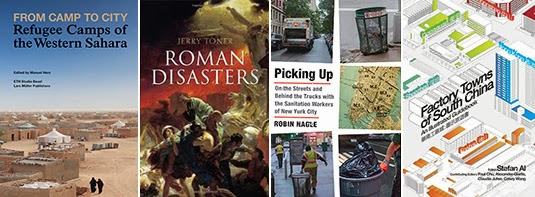
15) From Camp To City: Refugee Camps of the Western Sahara by Manuel Herz (Lars Müller Publishers)

Based on original research from a studio taught at the ETH in Zurich, architect Manuel Herz has assembled this fascinating and important guide to the urban and quasi-urban structures of refugee camps. Focusing specifically on camps in extreme southwest Algeria, populated by people fleeing from conflict in the Western Sahara, these camps are, Herz suggests, Western instant urbanism stripped bare, the city shown at its factory presets, revealing the infrastructural defaults and basic political conditions of the modern metropolis. They are “the spatial manifestation of the state of exception,” he writes, citing Giorgio Agamben, mere “holding areas” in which urban forms slowly take shape and crystallize. The camps are where, Herz writes, “Architecture and planning becomes [sic] a replacement for a political solution.”

From the architecture of the tents themselves to the delivery infrastructures that bring water, food, and other vital goods to their inhabitants, to culturally specific spatial accouterments, like carpets and curtains, Herz shows how the camps manage to become cities almost in spite of themselves, and how these cities then offer something like training grounds for future nations to come. In Herz’s own words, “the camps act also as a training phase, during which the Sahrawi society [of the Western Sahara] can develop ideas and concepts of what system of education they want to establish, and learn about public health and medical service provision. The camps become a space where nation-building can be learned and performed, to be later transferred to their original homeland, if it becomes available in the future.”

This idea of the state-in-waiting—and its ongoing spatial rehearsal in the form of emergency camps—runs throughout the book, which is also a detailed, full-color catalog of almost every conceivable spatial detail of life in these refugee camps. In the process, Herz and his team have assembled a highly readable and deeply fascinating look at urbanism in its most exposed or raw condition. “In the blazing sun of the Sahara Desert,” he concludes, “we can observe the birth of the urban condition with a clarity and crispness almost unlike anywhere else in the world.”

16) Roman Disasters by Jerry Toner (Polity)

Cambridge Classicist Jerry Toner had described his wide range of interests as being centered on the notion of “history from below.” He has written prolifically about ancient Rome, in particular, from several unexpected points of view, including popular culture in antiquity, the smellscape of early Christianity, and an currently in-progress work on crime in the ancient metropolis.

Roman Disasters looks specifically at imperial disaster-response, including earthquakes, volcanic eruptions, catastrophic fires, warfare, and disease. Toner describes how the abstract notion of risk was first formulated and understood; the role of religious prophecy in “imagining future disaster”; and halting, ultimately unsuccessful attempts to construct a fireproof metropolis, such as the widening of city streets and the creation of a semi-permanent Roman fire brigade.

Very much a history, rather than a page-turner directed at a popular audience, Roman Disasters nonetheless offers a compelling and unexpected look at the ancient world, one peppered with refugee camps, tent cities, and displaced populations all looking for—and not necessarily finding—imperial beneficence.

17) Picking Up: On the Streets and Behind the Trucks with the Sanitation Workers of New York City by Robin Nagle (FSG)

Robin Nagle is an “anthropologist-in-residence” at the NYC Department Sanitation. Picking Up is her document of that incredible—and strange—backstage pass to the afterlife of the city, where all that we discard or undervalue simply gets tossed to the curb. Nagle tags along with, interviews, and reveals the “garbage faeries” who rid our streets of the unwanted detritus of everyday life, whether trash or snow. In the process, she’s written a kind of narrative map or oral history of another New York, one with its own flows and infrastructure, and one that exists all but invisibly alongside the one we inhabit everyday.

18) Factory Towns of South China: An Illustrated Guidebook edited by Stefan Al (Hong Kong University Press)

Architect Stefan Al, currently teaching at the University of Pennsylvania, leads a team of researchers to the Pearl River Delta, the “factory of the world,” to explore how people live and—even more—how they work in the region. A fascinating glimpse at the “self-contained world” of what amounts to corporate-industrial urbanism, the book nonetheless feels very much like a book assembled by architects who had a grant for producing a publication: it is heavy on comparative infographics, layered images, pie charts, and small-print introductory essays, all on coated paper resistant to underlining. The subject matter is fascinating, but the book is ultimately of less use than, say, sending Robin Nagle to visit these “factory towns of south China,” reporting back about the complicated lives and material cultures found there.


19) Ruin Nation: Destruction And The American Civil War by Megan Kate Nelson (University of Georgia Press)

Megan Kate Nelson’s Ruin Nation is a kind of Piranesian guide to the Civil War ruins of American cities of the 19th century. The book is a bit slow and overly cautious in its descriptions, but it is remarkable for a specific focus on architectural ruins following the Civil War. “Architectural ruins—cities and houses—dominated the stories that soldiers and civilians told about the Civil War,” she writes in the book’s introduction, a time when whole cities were reduced to “lone chimneys” amidst the smoke and obliteration of urban warfare. We often hear—especially post-9/11—that Americans have never really experienced war and destruction on their own soil, but Nelson’s book convincingly and devastatingly shows how inaccurate a statement that is.

20) Line In The Sand: A History Of The U.S.-Mexico Border by Rachel St. John (Princeton University Press)

Heading west from the Gulf Coast, the U.S.-Mexico border takes an unexpected turn when you get past El Paso, Texas—that is, by not really turning at all. The border instead becomes a series of abnormally, mathematically straight lines, cutting, with only a few diversions north and south, all the way to the Pacific Ocean. It thus no longer follows any natural feature, such as the Rio Grande River.

But why is the border exactly here, and why the rigid, linear path that it takes? Rachel St. John’s “history of the western U.S.-Mexico border” looks at sovereignty, surveying, geography, diplomacy, war, conquest, and private property to piece together the tangled story of this “line in the sand” and the people (and economies) it has divided. Line in the Sand—which often has the ungainly feel of a Ph.D. thesis later edited into a book—ends with a critical look at the “operational security” falsely promised by a border fence, and a more hopeful look at mutations of the border region yet to come.

21) The Earthquake Observers: Disaster Science From Lisbon To Richter by Deborah R. Coen (University of Chicago Press)

Deborah Coen’s Earthquake Observers looks at the history of seismology—or the study of earthquakes—but, more specifically, seismology’s transition from something like a folk art of human observation to an instrumented science. It is a consistently interesting book, so much so that I invited Coen to speak to my class at Columbia last semester.

The book includes a great deal worth mentioning here, from the gender of early earthquake observers—writing, for example, specifically in reference to early-modern domesticity, that “a quiet, housebound lifestyle and close attention to the arrangement of domestic objects put many bourgeois women in an excellent position to detect tremors”—to the literally geopolitical effects of earthquakes. In the latter case, a state of emergency following catastrophic seismic events helped to influence 20th-century legal theory as well as to challenge accepted hierarchies of what it means for a state to respond. “Particularly in the Balkans,” she writes, “earthquakes called into question the political framework that tied the monarchy’s fringes to its two capitals: which level of the state’s intricate web of governance would respond?”

John Muir, the San Francisco earthquake of 1906, and the study of earthquake-related traumas, or “seismopathology,” all make their appearance in Coen’s study of how seismology became both modern and scientific.


22) From Roof To Table: Photographs By Rob Stephenson by Rob Stephenson (Design Trust for Public Space)

This magazine-style pamphlet of images by photographer Rob Stephenson documents urban farming efforts—not necessarily limited to roofs—across New York City. Plots of land beside empty brick warehouses, backyards, and even university labs bloom with fruits and vegetables in Stephenson’s full-color shots. “With the influx of people to cities and a continuing rise in the financial and environmental costs of shipping food, the widespread and large-scale adoption of urban agriculture seems inevitable,” Stephenson writes in an accompanying project description. “New York City, with its network of backyard vegetable plots, community gardens and rooftop farms, is at the forefront of this transformation.”

23) The Hermit in the Garden: From Imperial Rome to Ornamental Gnome by Gordon Campbell (Oxford University Press)

Gordon Campbell’s history of the garden hermit attempts to discover why the phenomenon of the live-in hermit—an actual human being, installed in a landscaped garden, acting as a form of living ornament—arose at all. Along the way, he explores what architectural structures these hermits required and the cultural motifs their strange roles kicked off. “Who were these people?” Campbell asks. “Why did landowners think it appropriate to have them in their gardens? What function did they serve?”


24) Out of the Mountains: The Coming Age of the Urban Guerrilla by David Killcullen (Oxford University Press)

Military strategist David Kilcullen takes on the urban future of war, arguing that armed conflict will occur more often, and with increasingly devastating effects, in cities. If the future is such that, in his words, “all aspects of human life—including, but not only, conflict, crime and violence—will be crowded, urban, networked and coastal,” then it only makes sense to attempt to make sense of this, both sociologically and from the perspective of the military.

Citing everything from Richard Norton’s revolutionary notion of the “feral city” to Mike Davis’s Planet of Slums—Davis, in fact, blurbs the book—Kilcullen has written a must-read for anyone unconvinced by the rosy take on cities and their triumphant future currently dominating the best-seller list.

25) Rise of the Warrior Cop: The Militarization of America’s Police Forces by Radley Balko (PublicAffairs)

Radley Blako’s libertarian take on the “militarization of America’s police forces” is more Rand Paul than ACLU, if you will, but it’s a worthy read for all sides of the political debate. It opens with the jarring rhetorical question, “Are cops constitutional?” And it goes on from there to discuss legal debates on federal power and the 3rd and 4th Amendments, a short history of military tactics creeping into the U.S. police arsenal following urban riots in Watts, the rise of reality TV shows seemingly encouraging police belligerence, the War on Drugs, the Occupy Movement, today’s all but ubiquitous Taser (and its abuse), no-knock raids, and more.

If you’re interested in cities, you should also be interested in how those cities are policed, and this is as interesting a place as any to start digging.

26) Manhunts: A Philosophical History by Grégoire Chamayou (Princeton University Press)

I picked up a copy of this book after an interesting, albeit brief, email exchange with L.A. Times architecture critic Christopher Hawthorne, who described a shift from the high-speed chase (that is, a large amount of space covered at high speed) to the manhunt (or a limited space studied with incredible intensity).

I’ve written about Hawthorne’s observation at greater length in my own forthcoming book about crime and architecture, and, while researching that book, I thought Grégoire Chamayou’s Manhunts would be a helpful reference. It was not, if I’m being honest, but it is, nonetheless, a striking work on its own terms: a history of what it means to hunt human beings, from runaway slaves and “illegal aliens” to Jews in World War II. He calls this an “anthropology of the predator”—“a history and a philosophy of hunting powers and their technologies of capture”—wherein the prey subject to destruction is a banished or shunned human being, terrifyingly relegated to the status of animal.

27) Rogue Male by Geoffrey Household (New York Review of Books Classics)

This strange, quite short, and very readable novel, recently brought back into print by the New York Review of Books, tells the story of a British political agent who fails in his attempt to assassinate an unnamed German political leader (who is, clearly, Adolf Hitler). The man flees Germany for the comparative safety of England, only to be relentlessly—and, as it happens, successfully—hunted by German agents intent on revenge.

It both does and does not spoil the rest of the book to reveal that the hunted man literally goes to ground, terrestrializing himself by digging a burrow in the Earth and hiding out there amidst the mud, the exposed tree roots, the darkness, and his own waste, sleeping unwashed in a humiliating cave of his own making, his clothes rotten, his feet swollen by rain, living underground at the side of a small lane in Britain’s agrarian hinterland. When he is found—and he is found—what could descend into a Rambo-like scene of violence and retaliation instead offers something that is still violent but far stranger, as this nearly worldchanging political actor, a failed assassin who could have changed the 20th century, finds a way to escape his grotesque and feral state.

Have a good autumn, and enjoy the books.

* * *

All Books Received: August 2015, September 2013, December 2012, June 2012, December 2010 (“Climate Futures List”), May 2010, May 2009, and March 2009.

(Thanks to Dan Bergevin for my copy of Out of the Mountains).

Ghosts of Planets Past: An Interview with Ron Blakey

[Image: The west coast of North America as it appeared roughly 215 million years ago; map by Ron Blakey].
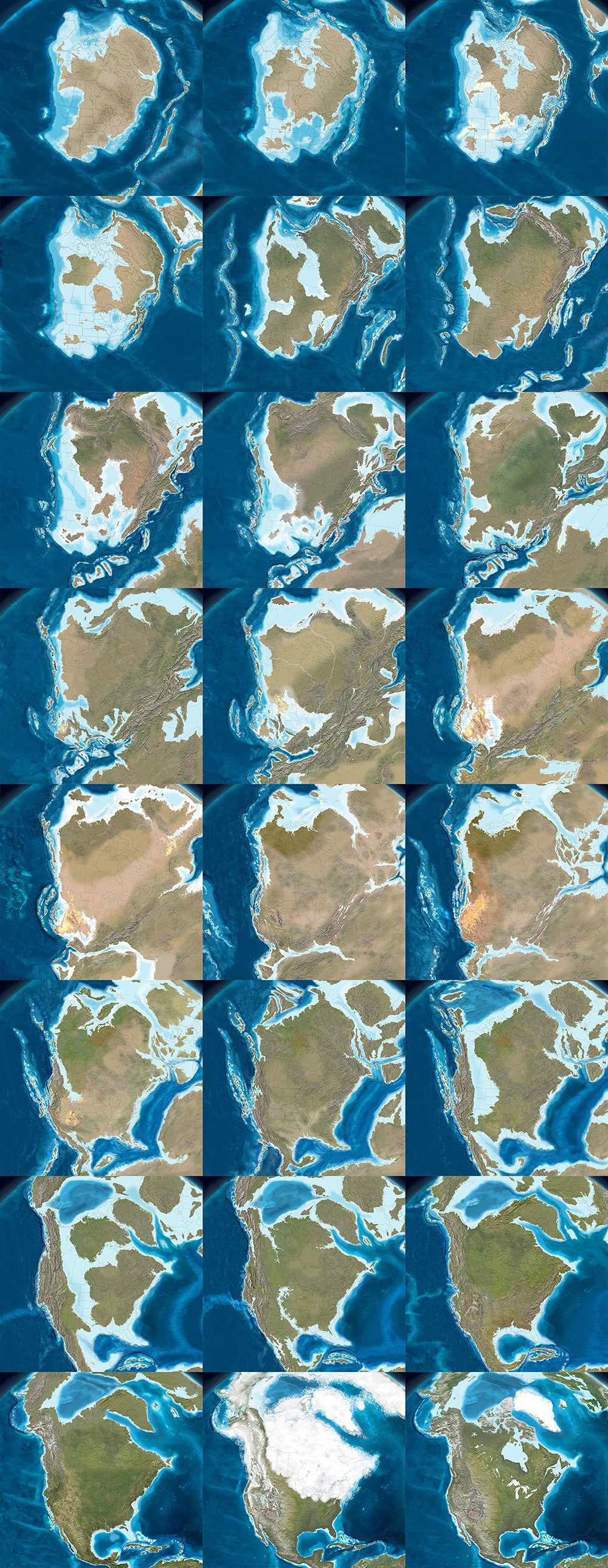
The paleo-tectonic maps of retired geologist Ronald Blakey are mesmerizing and impossible to forget once you’ve seen them. Catalogued on his website Colorado Plateau Geosystems, these maps show the world adrift, its landscapes breaking apart and reconnecting again in entirely new forms, where continents are as temporary as the island chains that regularly smash together to create them, on a timescale where even oceans that exist for tens of millions of years can disappear leaving only the subtlest of geological traces.

With a particular emphasis on North America and the U.S. Southwest—where Blakey still lives, in Flagstaff, Arizona—these visually engaging reconstructions of the Earth’s distant past show how dynamic a planet we live on, and imply yet more, unrecognizable changes ahead.

The following images come from Ron Blakey‘s maps of the paleotectonic evolution of North America. The first map shows the land 510 million years ago, progressing from there—reading left to right, top to bottom—through the accretion and dissolution of Pangaea into the most recent Ice Age and, in the final image, North America in its present-day configuration.


As part of BLDGBLOG’s collaborative side-project, Venue, Nicola Twilley and I met with Blakey in his Flagstaff home to talk about the tectonic processes that make and remake the surface of the Earth, the difficulty in representing these changes with both scientific accuracy and visual panache, and the specific satellite images and software tools he uses to create his unique brand of deep-time cartography.

Like film stills from a 600-million year-old blockbuster, Blakey’s maps take us back to the Precambrian—but there are much older eras still, stretching unmapped into far earlier continents and seas, and there are many more billions of years of continental evolution to come. Blakey talked us through some of the most complex changes in recent geological history, including the opening of the North Atlantic Ocean, and he allowed himself to speculate, albeit briefly, about where Earth’s continental crust might yet be headed (including a possible supercontinent in the Antarctic).

Many of Blakey’s maps are collected in the book Ancient Landscapes of the Colorado Plateau, written with Wayne Ranney, where Blakey also describes some of the research and methods that went into producing them. Blakey also contributed to the recent, new edition of a textbook by Wolfgang Frisch and Martin Meschede, Plate Tectonics: Continental Drift and Mountain Building, a thorough exploration of landscapes disassembling and colliding over vast spans of time.

• • •

[Image: The west coast of North America, depicted as it would have been 130 million years ago; the coast is a labyrinth of islands, lagoons, and peninsulas slowly colliding with the mainland to form the mountains and valleys we know today. Map by Ron Blakey].
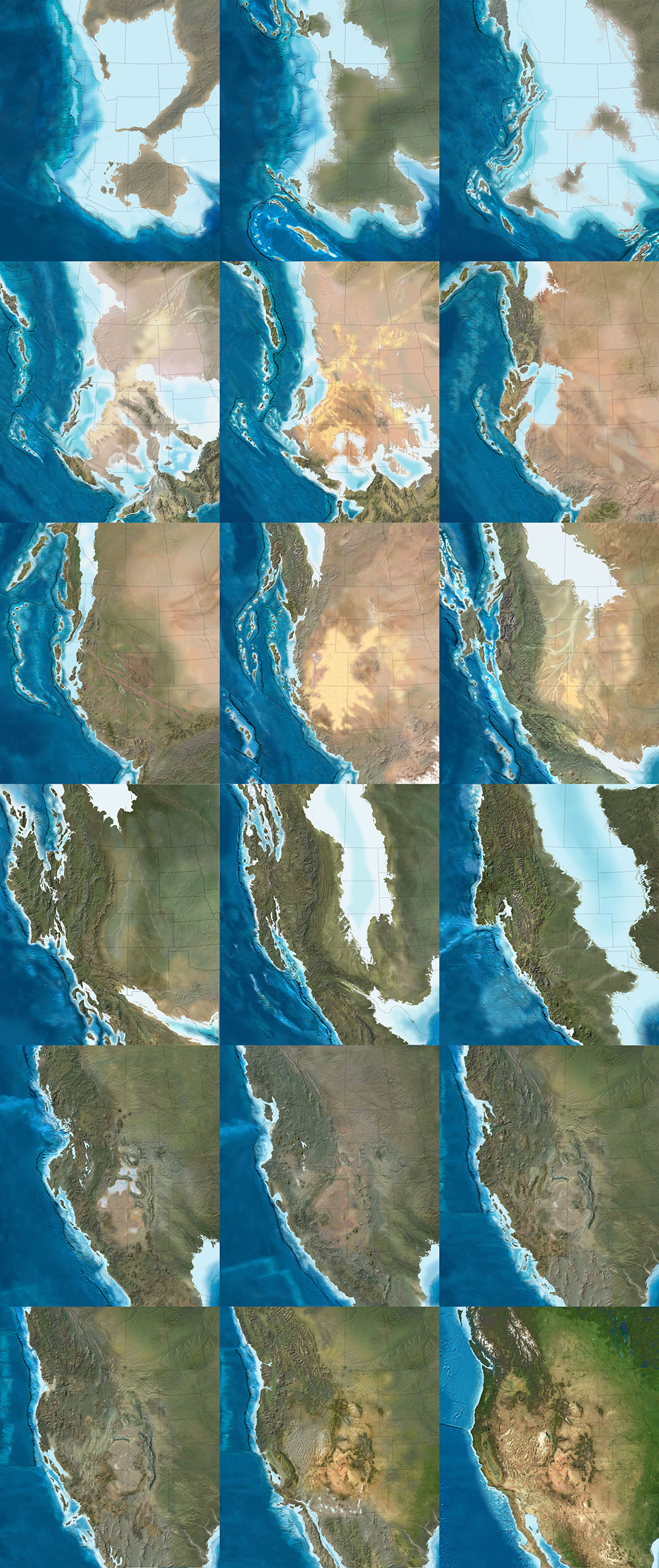
Geoff Manaugh: When I first discovered your maps showing the gradual tectonic re-location of the continents over hundreds of millions of years, I thought this was exactly what geologists should be doing: offering clear, step-by-step visual narratives of the evolution of the earth’s surface so that people can better understand the planet we live on. What inspired you to make the maps, and how did you first got started with them?

Ronald Blakey: Well, the very first maps I made were in conjunction with my doctoral thesis, back in the early 1970s. Those were made with pen and ink. I made sketches to show what the paleogeography would have looked like for the specific formation I was studying with my doctorate. Three or four of those maps went into the thesis, which was then published by the Utah Geologic Survey. I’ve also done a number of papers over the years where I’ve made sketches.

But I was late getting into the computer. Basically, during my graduate work I never used a computer for anything. I kind of resisted it, because, for the kind of work I was doing, I just didn’t see a need for it—I didn’t do quantifiable kinds of things. Then, of course, along comes email and the Internet. I actually forget when I first started with Photoshop—probably in the mid-1990s. When I found that, I just thought, wow: the power of this is incredible. I quickly learned how to use the cloning tool, so that I could clone modern topography onto ancient maps, and that made things even simpler yet.

Another thing I started doing was putting these maps into presentations. There were something like five different programs back there, in the late 90s, but the only one that survived was PowerPoint—which is too bad, because it was far from the best of the programs. I was using a program called Astound, which was far superior, particularly in the transitions between screens. I could do simple animations. I could make the tectonic plates move, create mountain belts, and so forth.

I retired in May of 2009, but all of my early maps are now online. With each generation of maps that I’ve done, there has been a noted improvement over earlier maps. I find new techniques and, when you work with Photoshop as much as I do, you learn new ideas and you find ways to make things that were a little clumsy look more smooth.

Manaugh: Where does the data come from?

Blakey: It comes from various publications. You can get a publication and have that PDF open, showing what something looked like in the past, and work from that. Usually, what I’m working from are fairly simple sketches published in the literature. They’ll show a subduction zone and a series of violent arcs, or a collision zone. What I do is take this information and make it more pictorial.

If you create a series of maps in sequence, you can create them in such a way that certain geologic events, from one time slice to the next, to the next, to the next, will blend. It depends a lot on the scale of what you’re trying to show—the whole world versus just four or five states in the West.

Now, throughout the years from, let’s say, 2004 until I retired in 2009, I kept improving the website. I envisioned most of this as educational material, and I didn’t pay much attention to who used it, how they used it, and so forth. But, then, shortly before I retired, various book companies and museums—and, most recently, oil companies—have approached me. So I started selling these and I tried very diligently not to allow this to overlap with what I was doing for my teaching and my research at the University.

In the following long sequence of images, we see the evolution of the west coast of North America, its state boundaries ghosted in for reference. Sea levels rise and fall; island chains emerge and collide; mountains form; inland seas proliferate and drain; and, eventually, modern day California, Vancouver Island, and the Baja peninsula take shape, among other recognizable features. The time frame represented by these images is approximately 500 million years. All maps by Ron Blakey.


Nicola Twilley: What do the oil companies want them for?

Blakey: They’re my biggest customers now. Usually, the geologists at oil companies are working with people who know either much less geology than they do or, in some cases, almost no geology at all, yet they’re trying to convince these people that this is where they need to explore, or this is what they need to do next.

They find these maps very useful to show what the Devonian of North Dakota looked like, for example, which is a hot spot right now with all the shales that they’re developing in the Williston Basin. What they like is that I show what the area might have really looked like. This helps, particularly with people who have only a modest understanding of geology, particularly the geologic past.

Manaugh: What have been some of the most difficult regions or geological eras to map?

Blakey: The most difficult thing to depict is back in the Paleozoic and the Mesozoic. Large areas of the continent were flooded, deep into the interior.

During certain periods, like the Ordovician, the Devonian, and parts of the Jurassic—especially the Cretaceous—as much as two-thirds of the continents were underwater. But they’re still continents; they’re still continental crusts. They’re not oceans. The sea level was just high enough, with respect to where the landscape was at the time, that the area was flooded. Of course, this is a concept that non-geologists really have problems with, because they don’t understand the processes of how continents get uplifted and subside and erode and so forth, but this is one of the concepts that my maps show quite nicely: the seas coming in and retreating.

But it’s very difficult—I mean, there is no modern analog for a seaway that stretched from the Mackenzie River Delta in Canada to the Gulf of Mexico and that was 400 miles wide. There’s nothing like that on Earth today. But the styles of mountains have not dramatically changed over the last probably two billion years—maybe even longer than that. I don’t go back that far—I tend to stick with the last 600 million years or so—but the styles of mountains haven’t changed. The nature of island arcs hasn’t changed, as far as we know.

What has changed is the amount of vegetation on the landscape. My maps that are in the early part of the Paleozoic—the Cambrian and the Ordovician early part of the Silurian—tend to be drab-colored. Then, in the late Silurian and in the Devonian, when the land plants developed, I start bringing vegetation colors in. I try to show the broad patterns of climate. Not in detail, of course—there’s a lot of controversy about certain paleoclimates. But, basically, paleoclimates follow the same kinds of regimens that the modern climates are following: where the oceans are, where the equator is, where the mountain ranges are, and so forth.

That means you can make broad predictions about what a paleoclimate would have been based on its relationship to the equator or based on the presence or absence of nearby mountains. I use these kinds of principles to show more arid areas versus more humid areas.

The next three sequences show the evolution of the Earth’s surface in reverse, from the present day to, at the very bottom, 600 million years ago, when nearly all of the planet’s landmasses were joined together in the Antarctic. The first sequence shows roughly 90 million years of backward evolution, the continents pulling apart from one another and beginning a slow drift south. They were mapped using the Mollweide projection, and, in all cases, are by Ron Blakey.


Twilley: And you paint the arid area based on a contemporary analog?

Blakey: Right. I know the modern world reasonably well and I’ll choose something today that might have matched the texture and aridity of that older landscape.

I use a program called GeoMapApp that gives me digital elevation maps for anywhere in the world. Most recently, they have coupled it with what they call the “Blue Marble.” NASA has stitched together a bunch of satellite photos of the world in such a way that you can’t tell where one series of photos come in or another. It’s a fairly true-color representation of what Earth would look like from space. So this Blue Marble is coupled with the GeoMapApp’s digital elevation topography; you put the Blue Marble over it, and you use a little slider to let the topography show through, and it gives you a fairly realistic looking picture of what you’re looking for.

For example, if I’m working with a mountain range in the southern Appalachians for a Devonian map—well, the southern Appalachians, during the Devonian, were probably far enough away from the equator that it was in the arid belt. There are some indications of that, as well—salt deposits in the Michigan Basin and in parts of New York and so forth. Plus, there are red-colored sediments, which don’t prove but tend to indicate arid environments. This combination tells me that this part of the world was fairly arid. So I’m going to places like modern Afghanistan, extreme western China, northern Turkey, or other places where there are somewhat arid climates with mountain belts today. Then I clone the mountains from there and put them in the map.

But you have to know the geologic background. You have to know how the mountains were formed, what the grain of the mountains was. That’s not always easy, although there are ways of doing it. To know the grain of the mountains, you need to know where the hinterland and the center of the mountains were. You need to know where the foreland area is, so that you can show the different styles of mountains. You have to move from foreland areas—which tends to be a series of parallel ridges, usually much lower than the hinterlands—to the center and beyond.

I use this kind of information to pick the right kind of modern mountain to put back in the Devonian, based on what that Devonian landscape probably had a good chance of looking like. Do we know for certain? Of course not. We weren’t around in the Devonian. But we have a good rock record and we have a lot of information; so we use that information and, then, voilà.

To give another example, let’s look at the Devonian period of the east coast. The big European continent that we call Baltica collided with Greenland and a series of micro-continents collided further south, all the way down at least as far as New Jersey, if not down as far the Carolinas. We know that there are places on Earth today where these same kinds of collisions are taking place—in the Alps and Mediterranean region, and the Caucasus region, and so forth.

We can use the concept that, if two plates are colliding today to produce the Caucasus mountains, and if we look at the style of mountains that the Caucasus are, then it’s reasonable to think that, where Greenland and Baltica collided in the Silurian and the Devonian, the mountains would have had a similar style. So we can map that.

This second sequence shows the continents drifting apart, in reverse, from 105 million years ago to 240 million years ago. They were mapped using the Mollweide projection, and, in all cases, are by Ron Blakey.


Manaugh: That collision alone—Baltica and Greenland—sounds like something that would be extremely difficult to map.

Blakey: Absolutely. And it’s not a one-to-one relationship. You have to look at the whole pattern of how the plates collided, how big the plates were, and so forth.

Then there’s the question of the different histories of particular plates. So, for example, most of Scotland started out as North America. Then, when all the continents collided to form Pangaea, the first collisions took place in the Silurian-Devonian and the final collisions took place in the Pennsylvanian-Permian. By, say, 250 million years ago, most of the continents were together. Then, when they started to split apart in the Triassic and Jurassic—especially in the Triassic and Cretaceous—the split occurred in such a way that what had been part of North America was actually captured, if you will, by Europe and taken over to become the British Isles.

Scotland and at least the northern half of Ireland were captured and began to drift with Europe. On the other hand, North America picked up Florida—which used to be part of Gondwana—and so forth.

One of the things that is interesting is the way that, when mountains come together and then finally break up, they usually don’t break up the same way that they came together. Sometimes they do, but it has to do with weaknesses, stress patterns, and things like this. Obviously, all time is extremely relative, but mountains don’t last that long. A given mountain range that’s been formed by a simple collision—not that there’s any such thing as a simple collision—once that collision is over with, 40 or 50 million years after that event, there is only low-lying landscape. It may have even have split apart already into a new ocean basin.

But here’s the important part: the structure that was created by that collision is still there, even though the mountains have been worn down. It’s like when you cut a piece of wood: the grain is still inherited from when that tree grew. The pattern of the grain still shows where the branches were, and the direction of the tree’s growth in response to wind and sun and its neighbors. You can’t reconstruct the tree exactly from its grain, but, if you’re an expert with wood, you should be able to look and say: here are the tree rings, and here’s a year where the tree grew fast, here’s a year where the tree grew slow, here’s where the tree grew branches, etc.

In a sense, as geologists, we’re doing the same things with rock structure. We can tell by the pattern of how the rocks are deformed which direction the forces came from. With mountains, you can tell the angle at which the plates collided. It’s usually very oblique. What that tends to do is complicate the geologic structure, because you not only get things moving one way, but you get things dragging the other way, as well. But we can usually tell the angle at which the plates hit.

Then, in many cases, based upon the nature of how the crust has been deformed and stacked up, we can tell the severity of the mountain range. It doesn’t necessarily mean that we can say: oh, this structure would have been a twenty-thousand-foot high mountain range. It’s not that simple at all, not least of which because rocks can deform pretty severely without making towering mountains.

This final of the three global sequences shows the continents drifting apart, in reverse, from 260 million years ago to 600 million years ago. There was still nearly 4 billion years of tectonic evolution prior to where these maps begin. They were mapped using the Mollweide projection, and, in all cases, are by Ron Blakey.


Manaugh: Are you able to project these same tectonic movements and geological processes into the future and show what the earth might look like in, say, 250 million years?

Blakey: I’ve had a number of people ask me about that, so I did make some global maps. I think I made six of them at about 50-million-year intervals. For the fifteen to 100-million-year range, I think you can say they are fairly realistic. But, once you get much past 75 to 100 million years, it starts to get really, really speculative. The plates do strange things. I’ll give you just a couple of quick examples.

The Atlantic Ocean opened in the beginning of the Jurassic. The actual opening probably started off the coasts of roughly what is now Connecticut down to the Carolinas. That’s where the first opening started. So the central part of the Atlantic was the first part to open up. It opened up reasonably simply—but, again, I’m using the word simple with caution here.

The north Atlantic, meanwhile, didn’t open up until about 60 to 50 million years ago. When it opened up, it did a bunch of strange things. The first opening took place between Britain and an offshore bank that’s mostly submerged, called Rockall. Rockall is out in the Atlantic Ocean, northwest of Ireland—near Iceland—but it’s continental crust. That splitting process went on for, let’s say, ten million years or so—I’m just going to talk in broad terms—as the ocean started opening up.

Then the whole thing jumped. A second opening began over between Greenland and North America, as Greenland and North America began to separate off. That lasted for a good 40 or 50 million years. That’s where you now get the Labrador Sea; that is actual ocean crust. So that was the Atlantic Ocean for thirty or forty million years—but then it jumped again, this time over between Greenland and what is now the west coast of Europe. It started opening up over there, before it jumped yet again. There’s an island in the middle of the North Atlantic, way the heck up there, called Jan Mayen. At one time, it was actually part of Greenland. The Atlantic opened between it and Greenland and then shifted to the other side and made its final opening.

The following two sequences show the evolution of Europe from an Antarctic archipelago to a tropical island chain to the present day Europe we know and recognize. The first sequence starts roughly 450 million years ago and continues to the Jurassic, 200 million years ago. All maps by Ron Blakey.


So it’s very complicated. And that’s just the Atlantic Ocean.

The Northern Atlantic took at least five different paths before the final path was established, and it’s all still changing. In fact, the south Atlantic is actually even worse; it’s an even bigger mess. You’ve got multiple openings between southwest Africa and Argentina, plus Antarctica was up in there before it pulled away to the south.

These complications are what makes this stuff so interesting. If we look at events that we can understand pretty well over the last, let’s say, 150 or 200 million years of time—where we have a good indication of where the oceans were because we still have ocean crusts of that age—then we can extrapolate from that back to past times when oceans were created and destroyed. We can follow the rules that are going on today to see all of the oddities and the exceptions and so forth.

These are the kinds of things I try to keep track of when I’m making these maps. I’m always asking: what do we know? Was it a simple pull-apart process? There are examples where continents started to split across from one another, then came back together, then re-split in a different spot later on. That’s not just speculation—there is geologic evidence for this in the rock record.

So, when it comes to extrapolating future geologies, things become very complicated very quickly. If you start thinking about the behavior of the north Atlantic, creating a projection based on what’s going on today seems, at first, like a fairly simple chore. North America is going on a northwesterly path at only one or two centimeters a year. Europe is moving away, at almost a right angle, at about another centimeter a year. So the Atlantic is only opening at three centimeters a year; it’s one of the slowest-opening oceans right now.

OK, fine—but what else is happening? The Caribbean is pushing up into the Atlantic and, off South America, there is the Scotia Arc. Both of those are growing. They’ve also identified what looks like a new island arc off the western Mediterranean region; that eventually would start to close the Atlantic in that area. Now you start to speculate: well, these arcs will start to grow, and they’ll start to eat into the oceans, and subduct the crusts, and so forth.

Again, for the first 50, 75, or even 100 million years, you can say that these particular movements are fairly likely. But, once you get past that, you can still use geologic principles, but you’re just speculating as to which way the continents are going to go.

For instance, the one continent that does not seem to be moving at all right now, relative to anything else, is Antarctica. It seems to be really fixed on the South Pole. That’s why some people think that everything will actually coagulate back towards the South Pole. However, there are also a bunch of subduction zones today along southern Asia, and those are pretty strong subduction zones. Those are the ones that created the big tsunami, and all the earthquakes off of Indonesia and so forth. Eventually, those could pull either parts of Antarctica or all of Antarctica up toward them.

But I’m more interested in reconstructing the past than I am the future, so I’ve only played around with those five or six maps.

This second sequence, showing the next phase in the evolution of Europe, begins approximately 150 million years ago and extends to the present day. All maps by Ron Blakey.


Manaugh: To ground things a bit, we’re having this conversation in Flagstaff, on the Colorado Plateau, which seems like a great place to teach geology. I wonder whether there might be another Colorado Plateau, so to speak, elsewhere in the world—something geologically similar to the extraordinary landscapes we see here that just hasn’t had the chance to emerge. Maybe the tectonics aren’t right, and it’s still just a crack, rather than a canyon, or maybe it’s covered in vegetation or ice so we can’t see it yet. Conversely, I’m curious if you might have found evidence of other great geological districts in the earth’s past—lost Grand Canyons, other Arches National Parks—that have been lost to time. How could we detect those, and where are they?

Blakey: This is indeed a great place to teach geology. It’s a great place to live.

As for Colorado Plateau analogs—it’s an interesting question. There’s an area in South America that I’d say is fairly similar. It’s got a couple of famous national parks that I can’t remember the name of. It’s a smaller version, but it’s very similar to the Colorado Plateau. It’s between the Andes and the Amazon basin, part of the general pampas region there of South America. It even has similarly aged rocks. Parts of northern Africa would also be similar.

But you have to look at all the characteristics of the Plateau. Number one: the rocks are flat. Number two: the rocks have been uplifted. Number three: the rocks are dissected by a major river system. Number four: it’s a semi-arid climate. There are probably five or six defining characteristics in total, and I’ve heard many people say that there is no other place else on Earth that has all those characteristics in exactly the same way. But I went to an area in eastern Mauritania many years ago, where, for all the world, it looked like the Grand Canyon. It wasn’t as colorful, but it was a big, deep canyon.

In fact, the Appalachian Plateau would be somewhat similar, except it’s in a humid climate, which means the land has been shaped and formed differently. But the Appalachian plateau has flat-lying rocks; it’s dissected by some major rivers; it’s experienced uplift; and so forth.

The next two sequences of images, followed from left to right, top to bottom, illustrate the gradual evolution of the Colorado Plateau, where, in its modern day incarnation, this interview with Ron Blakey took place (specifically, in Flagstaff, Arizona. The earliest map included here depicts the Proterozoic; the first sequence ends in the Triassic. All maps by Ron Blakey.


Twilley: I’m interested in the representational challenges you face when you decide to make a map, and, specifically, when you’re in Photoshop, what your most-used tools might be. I thought it was fascinating when you said that the cloning tool really changed how you make geological maps. What other techniques are important to you, in order to represent geological histories?

Blakey: Oh, the cloning tool is the most important, by far—at least when I’m actually painting. Of course, I use the outline tool to select areas, but, when I’m actually painting, it would be impossible to paint these different maps pixel by pixel. I couldn’t do it. Occasionally, I will actually hand-draw some things in the flatlands, where I want to put a river system, for example, but, at least for mountains and rugged terrain, I clone everything.

Some times, I’ll cut and paste. I’ll select an area in the GeoMapApp, I save it as a JPEG, and then I can select it and copy it and paste it in, and I can rotate and deform it a little bit. Are you familiar with the warp tool in Photoshop? I use that a lot, because you can change the shape of mountains a little. If you do it too dramatically, it really looks flaky. But, if you do it right, it still looks pretty realistic.

This second sequence, also showing the evolution of the Colorado Plateau, begins with the Triassic and ends roughly 5 million years ago—basically the present day, in geological terms. All maps by Ron Blakey.


Twilley: And do you have certain filters you rely on for particular geological effects?

Blakey: A little bit. I like to use the craquelure filter. It actually gives you little bumps and valleys and so forth. I use that especially for continental margins. Continental margins are anything but regular slopes, going down to the abyssal depths. They’re very irregular. There are landslides and all kinds of things going on there at the margins, so I add a little texture with craquelure.

It can be difficult to use, though, and it doesn’t work at really high resolutions—so, what I actually have to do some times, is that I will actually copy a part of my map, take it out, make it smaller, do the craquelure on it, and then blow it back up and paste it in again.

[Image: A painting by Ron Blakey depicts a geological landscape near Sedona, Arizona].

Dee Blakey, Ron’s Wife: I think the other reason that he can do what he does is that he paints. That’s one of his paintings over there. [gestures above fireplace]

Blakey: Well, I guess I should have said that right away, when you asked me why I got interested in this, because I am interested in the artistic aspect of geology. The artistic aspect of science, in general, but especially geology. Astronomy, for example, would be another field where artistic visualizations are useful—any time you’re trying to show things that can’t easily be visualized with something comparable here on present-day planet Earth, you have to use an artistic interpretation.

Anyway, I can’t explain it, but I understand color pretty well. I use the hue saturation tool a lot. I’ll select an area and then I’ll feather it, let’s say, because you don’t want the edges to be sharp. I’ll feather it by thirty, forty, fifty pixels. Then I’ll take the slider for hue saturation, where, if you go to the left, you make things redder and, if you go to the right, you make things greener. If I’ve got a landscape that looks a little too humid, I’ll just slide it slightly to the left to make it a bit redder. You can also change the lightness and darkness when you do that. There’s also regular saturation. By killing the saturation, you can really kill the nature of a landscape quite a bit.

And I use hue saturation a lot. That took me a long time to master, because it’s really easy to screw things up with that tool. You start sliding things a little too far and, whoa—wait a minute! All of a sudden, you’ve got purple mountains.

• • •

For more Venue interviews, be sure to stop by the Venue website.

Offworld Glaciology

[Image: Photo by Gerco de Ruijter, via but does it float].

A short article by Sam Kean for the Chemical Heritage Foundation in Philadelphia explores the world of “bizarro ice—ice that burns, ice that sinks instead of floating, ice literally out of this world.” For the most part, these are ices that have formed under extraordinary pressure, whether naturally or artificially applied, which “forc[es] H2O molecules into rhombuses, tetragons, and other alternative geometries.”

In some cases, the pressure is so great that the resulting ice “can stay solid at temperatures of thousands of degrees—a true freezer burn. If you could somehow plop chunks of these ices into a glass of liquid water, they’d vaporize it.” Incredibly, we read that, “at super-high pressures, some chemists predict that ice transforms into a metal.”

There is an ice “that’s structurally similar to diamonds,” Kean explains, that “probably exists in the upper atmosphere.” And there are exotic ices on other planets: “The dense, hot interiors of Neptune and Uranus probably contain chunks of nonhexagonal ices, as do exoplanets around distant stars, a potentially important consideration as we search for life beyond our solar system.”

[Image: The Sea of Ice by Caspar David Friedrich].

This latter remark brings to mind a book I downloaded in my recent PDF binge called The Science of Solar System Ices, edited by Murthy S. Gudipati and Julie Castillo-Rogez. It’s a mammoth book—more than 650 pages—that explores exotic ices found in comets, on exoplanets, on moons, and elsewhere in our solar system.

“The largest deposits of carbon dioxide ice,” we learn, “is on Mars. Sulfur dioxide ice is found in the Jupiter system. Nitrogen and methane ices are common beyond the Uranian system. Saturn’s moon Titan probably has the most complex active chemistry involving ices, with benzene and many tentative or inferred compounds,” including a long list of chemicals I can’t even pronounce let alone recognize or describe, forming ices with “unusual colors and spectral shapes.” There are even “organic” ices made of hydrocarbons.

[Image: The Monk by the Sea by Caspar David Friedrich].

How these ices produce landscapes is by far the most interesting aspect here, at least from the point of view of BLDGBLOG: how they glaciate, experience gravitational tides and weathering, melt from below due to volcanoes, reflect the alien skies shining down on them in distorted shapes and angled echoes, and even how they tectonically fracture into karst-like networks of sinkholes and caves.

Imagining snow storms of frozen methane on other planets while thinking about, for example, human artistic traditions of landscape representation, from the Hudson Valley School to Caspar David Friedrich—picturing massive and extraordinary widescreen scenes of glacial hills and valleys steaming in the outer darkness of the solar system and the paintings or photographs or even animated GIFs that might result—would extend the idea of the sublime to non-terrestrial landscapes and the sights they might someday reveal to human explorers.

[Image: Walking into a glacier: “Grindelwald Grotto, Bernese Oberland, Switzerland,” courtesy of the Library of Congress Prints & Photographs Division].

Art historians would gaze in awe at offworld glaciers of carbon dioxide ice and howling massifs of frozen nitrogen, where volcanoes erupt not with liquid rock but with “ice slurries” and groundwater exploding onto the landscape with the force of a Kilauea.

Perhaps someday you’ll be able to get a degree in the field of exploratory xenoglaciology, the study of rare and incredible landforms made of frozen chemicals in space.

(“Wild Ice” story spotted via @nicolatwilley).

Landscape Futures Arrives

[Image: Internal title page from Landscape Futures; book design by Everything-Type-Company].

At long last, after a delay from the printer, Landscape Futures: Instruments, Devices and Architectural Inventions is finally out and shipping internationally.

I am incredibly excited about the book, to be honest, and about the huge variety of content it features, including an original essay by Elizabeth Ellsworth & Jamie Kruse of Smudge Studio, a short piece of landscape fiction by Pushcart Prize-winning author Scott Geiger, and a readymade course outline—open for anyone looking to teach a course on oceanographic instrumentation—by Mammoth’s Rob Holmes.

These join reprints of classic texts by geologist Jan Zalasiewicz, on the incipient fossilization of our cities 100 million years from now; a look at the perverse history of weather warfare and the possibility of planetary-scale climate manipulation by James Fleming; and a brilliant analysis of the Temple of Dendur, currently held deep in the controlled atmosphere of New York’s Metropolitan Museum of Art, and its implications for architectural preservation elsewhere.

And even these are complemented by an urban hiking tour by the Center for Land Use Interpretation that takes you up into the hills of Los Angeles to visit check dams, debris basins, radio antennas, and cell phone towers, and a series of ultra-short stories set in a Chicago yet to come by Pruned‘s Alexander Trevi.

[Images: A few spreads from the “Landscape Futures Sourcebook” featured in Landscape Futures; book design by Everything-Type-Company].
Of course, everything just listed supplements and expands on the heart of the book, which documents the eponymous exhibition hosted at the Nevada Museum of Art, featuring specially commissioned work by Smout Allen, David Gissen, and The Living, and pre-existing work by Liam Young, Chris Woebken & Kenichi Okada, and Lateral Office.

Extensive original interviews with the exhibiting architects and designers, and a long curator’s essay—describing the exhibition’s focus on the intermediary devices, instruments, and spatial machines that can fundamentally transform how human beings perceive and understand the landscapes around them—complete the book, in addition to hundreds of images, many maps, and an extensive use of metallic and fluorescent inks.

The book is currently only $17.97 on Amazon.com, as well, which seems like an almost unbelievable deal; now is an awesome time to buy a copy.

[Images: Interview spreads from Landscape Futures; book design by Everything-Type-Company].

In any case, I’ve written about Landscape Futures here before, and an exhaustive preview of it can be seen in this earlier post.

I just wanted to put up a notice that the book is finally shipping worldwide, with a new publication date of August 2013, and I look forward to hearing what people think. Enjoy!

Teenage Mutant Ninja District

Abandoned terrapin turtles purchased 25 years ago at the height of popularity for Teenage Mutant Ninja Turtles have been harming wildlife and changing the ecological character of England’s famed Lake District. Once an orbital center for the lives of poets William Wordsworth and Samuel Taylor Coleridge, the landscape is now infested with discarded pets purchased for their imaginative resemblance to kids’ toys and comic book characters.

Terry Bowes, a regional zoo director interviewed by the Guardian, has become “exasperated at the routine abandonment of creatures,” he explained, “that suffered the misfortune of becoming fashionable at the time of the Teenage Mutant Ninja Turtle craze.”

“I was thinking what we could do about them all,” Bowes told the paper, “and then I heard about another Teenage Mutant Ninja Turtle film coming out soon and steam came out of my ears. I was thinking, ‘Oh no, this is only going to get worse.'”

Human ownership of changing animal species responds to the quirks of popular appeal, we read, including hit films and toy lines: “Pets are just as vulnerable to fashion as anything else, said Bowes, as we passed three enormous European eagle owls he said were abandoned by their owners after they outgrew Harry Potter, and a trio of perky meerkats he said were probably originally bought after seeing the star of the Compare the Market insurance ads.” The region is an open-air zoo of animals that have escaped from popular media.

Surely, though, in a sense, this is just the latest, albeit inadvertent iteration of the infamous American Acclimatization Society, a group of literary-minded naturalists in 19th-century New York City who made it their bizarre goal to “introduce to the U.S. every bird mentioned in Shakespeare’s scripts.” As Scientific American writes, “The Acclimatization Society released some hundred starlings in New York City’s Central Park in 1890 and 1891. By 1950 starlings could be found coast to coast, north past Hudson Bay and south into Mexico. Their North American numbers today top 200 million.” Shakespeare, the Bible, Teenage Mutant Ninja Turtles—all cultural artifacts and unintended animal blueprints for infested landscapes yet to come.

(The recent documentary The Elephant in the Living Room is worth a view here, for anyone interested in the unforeseen—or, far more often, willfully overlooked—negative side-effects of exotic pets).

Captive America: An Interview with Alyse Emdur

[Image: Prison Visiting Room Backdrop, Woodbourne Correctional Facility, New York; photograph by Alyse Emdur].
Earlier this year, Venue published an interview with Los Angeles-based photographer Alyse Emdur discussing her project Prison Landscapes. I thought Emdur’s work—a look at the unexpected landscape paintings used as photographic backdrops in prison waiting rooms throughout the United States—deserved a second look, so I am re-posting the interview here.

Venue, of course, is a joint project between BLDGBLOG and Nicola Twilley of Edible Geography, and it is supported by the Nevada Museum of Art‘s Center for Art + Environment.

The full interview, along with its original introduction, appears below.

[Image: Prison Landscapes, published January 2013 by Four Corners Books].

Some of the most unsettling examples of contemporary landscape painting in the United States are to be found in its prison visiting rooms, where they function as visual backdrops for family photographs.

[Image: James Bowlin, United States Penitentiary, Marion, Illinois; photograph courtesy Alyse Emdur. Note the fake trout].
Ranging in subject matter from picturesque waterfalls to urban streetscapes, and from ski resorts to medieval castles, these large-format paintings serve a dual purpose: for the authorities, they help to restrict photography of sensitive prison facilities; for the prisoners and their families, they are an escapist fiction, constructing an alternate reality for later display on fridge doors and mantlepieces.

With nearly 2.3 million Americans in prison today—an astonishing one out of every hundred adults in the United States, according to a 2008 Pew study (PDF)—this school of landscape art is critically overlooked but has a mass-market penetration comparable to the work of Thomas Kinkade. And, like Kinkade’s work, these backdrops—which are usually painted by talented, self-taught inmates—are simultaneously photo-realistic and highly idealized. Cumulatively, they represent a catalog of imagined utopias: scenes from an abstracted and perfect elsewhere, painted from behind bars.

[Image: Prison Visiting Room Backdrop, Shawangunk Correctional Facility, New York; photograph by Alyse Emdur. Unlike the family portraits, Emdur’s own large-format photographs deliberately show the prison context that surrounds the backdrop landscape, for an unsettling contrast].

Several years ago, artist Alyse Emdur was looking through a family album when she came across a photo of herself as a little girl, posing in front of a tropical beach scene while visiting her elder brother in prison. She spent the next few years exploring this surprising body of vernacular landscape imagery, tracking down examples across the United States.

[Image: Emdur family photo in front of prison visiting room backdrop; photograph courtesy Alyse Emdur].
At first, she wrote to prison administrators to ask permission to photograph the backdrops herself—a request that was inevitably firmly denied. Instead, she joined prisoner pen-pal sites, asking inmates to send her pictures of themselves posed in front of their prison’s backdrops; through this method, Emdur eventually assembling several hundred photos and more than sixteen binders full of correspondence. Finally, in summer 2011, she gained permission to visit and photograph several prison visiting room backdrops herself.

[Image: Michael Parker and Geoff Manaugh looking at Alyse Emdur‘s correspondence and work in Emdur’s studio space; photograph by Venue].

Venue visited Emdur’s studio in downtown Los Angeles in the summer of 2012, as she was collecting all this material for a book, Prison Landscapes, published in January 2013 by Four Corners Books. After a studio tour conducted by her partner, artist Michael Parker, we followed up with Emdur by phone: the edited transcript of our conversation follows.

• • •

[Image: Alyse Emdur‘s large-format photographs of prison visiting room backdrops on her studio walls; photograph by Venue].

Nicola Twilley: From the hundreds of photographs that prisoners sent you, as well as the ten or so backdrops that you were able to photograph yourself, it seems as though there is almost a set list of subject matter: glittering cityscapes, scenes of natural landscapes, like beaches and sunsets, and then historical or fantasy architecture, such as medieval castles. Did you notice any patterns or geographic specificity to these variations in subject matter?

Alyse Emdur: You do see some regional realism—so, prisons in Washington State will have evergreen trees in their backdrops, prisons in Florida will have white sand beaches, and prisons in Louisiana will have New Orleans French Quarter-style features. There’s also the question of where the prisoners are from: one thing that I’ve observed is that in upstate New York, for example, many of the prisoners are actually from New York City, so many of the backdrops in upstate New York prisons show New York City skylines.

Fantastical scenes are actually much less common—from what I gather from my correspondence, realism is like gold in prison. That’s the form of artistic expression that’s most appreciated and most respected, so that’s often the goal for the backdrop painter.

[Image: Brandon Jones, United States Penitentiary, Marion, Illinois; photograph courtesy Alyse Emdur].

Twilley: Do you have a sense of how you get to be a backdrop painter—do inmates chose amongst themselves or do the prison authorities just make a selection? And, on a similar note, how much artistic freedom does the backdrop painter actually have, in terms of needing approval of his or her subject matter from fellow inmates or the authorities?

Emdur: That’s one of the questions that I’ve asked of all the backdrop painters who I’ve been in touch with over the years. The answer is always that if you are a “good artist” in prison, then you’re very well-respected within the prison—people in the prison all know you. You’ll be making greeting cards for people or you’ll be doing hand calligraphy for love letters for friends in prison—you’ll be known for your skills. The prison administration is already aware of the respected artists, because they shine within the culture, and so they are usually the ones that are chosen. And when you’re chosen, it’s a huge honor.

[Image: Genesis Asiatic, Powhatan Correctional Center, Statefarm, Virginia; photograph courtesy Alyse Emdur].
Something to keep in mind, though, is that backdrops do get painted over. In some prisons, the backdrop can change a few times a year.

One of the artists I’ve kept in touch with is Darrell Van Mastrigt—I interviewed him for the book, and he painted a backdrop for me that was in my thesis show. In the prison that he’s in, the portrait studios are organized by the NAACP. He said that the NAACP had seen his paintings in the past, and when they selected him, they gave him creative control over what sort of landscape he chose to paint.

Obviously, there are some rules. The main restriction is that you can’t use certain colors that are affiliated with gangs. So, for instance, Darrell painted a mural with two cars and they had to be green and purple—they couldn’t be red or blue. But, from what Darrell has told me and from what I understand from other painters, they don’t get much input from other prisoners. At the same time, they’re very conscious of wanting to please people and maintain their status within the prison, of course, and they get a lot of pleasure out of doing something positive for families in the visiting room.

One of sixteen binders full of letters and prisoner portraits mailed to Emdur; photograph by Venue].

Another interesting thing a painter told me was that she was very conscious of not wanting to do a specific, recognizable cityscape, because she knew that not everyone in the prison was from the city. So she deliberately tried to paint a more abstract landscape that she thought anyone could relate to. And a lot of imagery they work from is from books in the prison library, rather than just their memories.

Twilley: In some of the photographs you were sent, the prisoners are in front of off-the-shelf printed backdrops—some offering multiple pull-down choices—rather than hand-painted ones. Are these standardized commercial backdrops gradually replacing the inmate-produced landscapes?

Emdur: The backdrop-painting tradition is definitely still vibrant and strong, but my sense is that these store-bought backdrops are becoming more and more common.

For one thing, the hand-painted backdrops are not always as realistic as a photograph, and, often, the prisoners and their families are looking to create the illusion that they really are somewhere else. So, the more realistic, the better. When I went to photograph a backdrop in one New York State prison, I found an amazing hand-painted mural of a New York City skyscraper with a cartoon-like Statue of Liberty in front—she almost looked alive. But it had been completely covered up by a pull-down, store-bought, photographic backdrop of the New York City skyline. I tried to photograph the backdrop in Fort Dix Federal Prison in New Jersey and they told me that they had just painted over the hand-painted backdrop and replaced it with a commercial photography backdrop.

[Image: Small prints of Emdur‘s backdrop photographs on her studio wall, alongside a few examples of her extensive collection of self-help books; photograph by Venue. Note the hand-painted cityscape featuring the Statue of Liberty on the left].

Of course, another thing is that it’s easier to buy a backdrop than it is to engage with a prisoner, you know? And attitudes vary from prison to prison. In some prisons, you’ll find murals throughout the facility, not just in the visiting rooms. I went on a tour of a privately-operated women’s prison in Florida, for instance, that lasted four hours because there were paintings everywhere—in all the hallways, dorm rooms, and offices. The PR person who assisted me on that tour explained that having prisoners paint murals is really a way to keep them busy and out of trouble, so they saw it as a really positive activity.

Of course, I see these paintings as a way for people in prison to temporarily escape the architecture and culture of confinement, and that’s what makes them so important for me.

[Image: Antoine Ealy, Federal Correctional Complex, Coleman, Florida; photograph courtesy Alyse Emdur].
Twilley: There’s an uncomfortable overlap between the escapism of the landscapes and then the other purpose of the backdrops, which is to not allow photographs of the prison interior to get out.

Emdur: Yes—I found that really concerning. The prison administration either thinks that photographs of the interior of the prison could help inmates escape or, at the very least, the administrators are trying to control the imagery of the prison that reaches the outside world.

During my research, I’ve been trying to figure out how long these kinds of backdrops have been used. From prison administrators to PR people to wardens and prisoners, everyone told me they don’t even remember—these kinds of painted backdrops have been used in visiting rooms for as long as they can remember. I’ve spoken to a sixty-five-year-old warden who just said, “You know, they’ve been here longer than I have.”

[Image: Robert RuffBey, United States Penitentiary, Atlanta, Georgia; photograph courtesy Alyse Emdur].
I do know that at some point in the last twenty years, companies came along that would charge inmates to substitute in a different backdrop. If you’re a prisoner and you have a photograph of yourself or yourself and your kids in front of the painted backdrop in the visiting room, then you could send your photograph to one of these companies and they would take out the painting and then put in a Photoshop background. That’s not very common at all, but it’s pretty bizarre—one fake landscape being replaced by another.

Going along with that is the replacement of Polaroid with digital photography. All these portraits were Polaroid up until the last five to ten years, I would say. Some prisons still use Polaroids, but from what I gather, it’s basically all digital now.

[Image: One of sixteen binders full of letters and prisoner portraits mailed to Emdur; photograph by Venue].

One thing to remember is that all the prisons have slightly different rules and they all organize their prison portrait programs differently. In most state and federal prisons in America, the only place where a prisoner can be photographed is in front of these backdrops, and the only time they can be photographed in front of the backdrops is when they have a visitor—but, then, there are all these exceptions.

At some prisons, for instance, you can get your picture taken at special events, like graduations or holiday parties. Then, some prisons have murals elsewhere in the prison, not in the visiting room, that you can sign up once a month or something to have your picture taken in front of.

[Image: Kimberly Buntyn, Valley State Prison for Women, Chowchilla, California; photograph courtesy Alyse Emdur].
This question of the kinds of images of prisons that are allowed out is quite interesting. In fact, I’m working with a photographer who’s been in prison for almost 30 years in Michigan, on what I think will be my next book. In the 1970s and 80s, he ran the photo lab in Jackson Prison, and he was in charge of developing and printing all the inmates’ photographs. At that time, the rules of photography were very different in prison—there just weren’t as many rules, basically. This guy has hundreds of photographs from all over Jackson State Prison.

It’s just fascinating to see the differences between these very staged and framed visiting room portraits and the reality of the prison as seen through this guy’s eyes—through an insider’s eyes. I think his situation was extremely rare when it happened, but today it’s totally unheard of. The majority of photographs that come out of prisons today are these visiting room portraits. I suppose some prisoners are smuggling cell phones with cameras into prison, but those images aren’t easy to find!

[Images: Sixteen binders’ worth of letters and prisoner portraits have been mailed to Emdur over the course of her project; photographs by Venue. Several of Emdur‘s pen-pals adopted the so-called “prison pose“—a low crouch—while others incorporated props or flexed their muscles].
Geoff Manaugh: Both Nicky and I were amazed by the amount of correspondence you’ve gathered in the process of researching these backdrops—binder after binder organized and shelved in your studio—but I can’t imagine that it’s been easy to edit it all down into a book, or to get releases from all the prisoners, for example. How has that process worked?

Emdur: It’s been really tough. With 2.3 million Americans in prison today, just think how many of these portrait studio photographs there are circulating in family albums and frames all across the country. A big part of me wants to document more and more and more. But, for a book, I figured it was really important to step back a little bit and not go crazy, and instead try to focus and pull out the different genres of backdrops and the different poses and the stories.

In terms of the process of getting releases, that was a huge effort. As you know, I collected the images through contacting prisoners on pen-pal websites. I sent out something like 300 letters and about 150 inmates responded really quickly with photographs of themselves in front of these backdrops.

A lot of prisoners are looking for engagement with the outside world, so it was very easy to collect the images. The challenging thing was getting releases for publication. Tracking down people who’d been released was one thing. For minors, we wanted to get our release approvals from both the incarcerated parents and also from the non-incarcerated parents, and that really was challenging.

[Image: A binder of letters and prisoner portraits mailed to Emdur; photograph by Venue].

But, really, the most difficult thing for me about this project is just how emotionally challenging it is—how draining it is—to correspond with hundreds of people who have a very different reality than I have and live a very different life than I do and who don’t have the privileges that I would normally take for granted.

The relationship between the incarcerated and the free is a very complex relationship, and that’s something that I’m interested in showing in the book, and that I hope comes out in the correspondence.

• • •

For more Venue interviews, focusing on human interactions with the built, natural, and virtual environments, check out the Venue website in full.

Meanwhile, Michael Parker—the artist who showed us around the studio space he shares with Alyse Emdur—has some projects of his own worth checking out, in particular, his work Lineman, which documents, in film, photographs, and interviews, “an electrical lineman class at Los Angeles Trade-Technical College” where adult students learn “how to become power-pole technicians.”

Sim City: An Interview with Stone Librande

[Image: Screenshot of our own SimCity—called, for reasons that made sense at the time, We Are The Champignons—after three hours of game play].
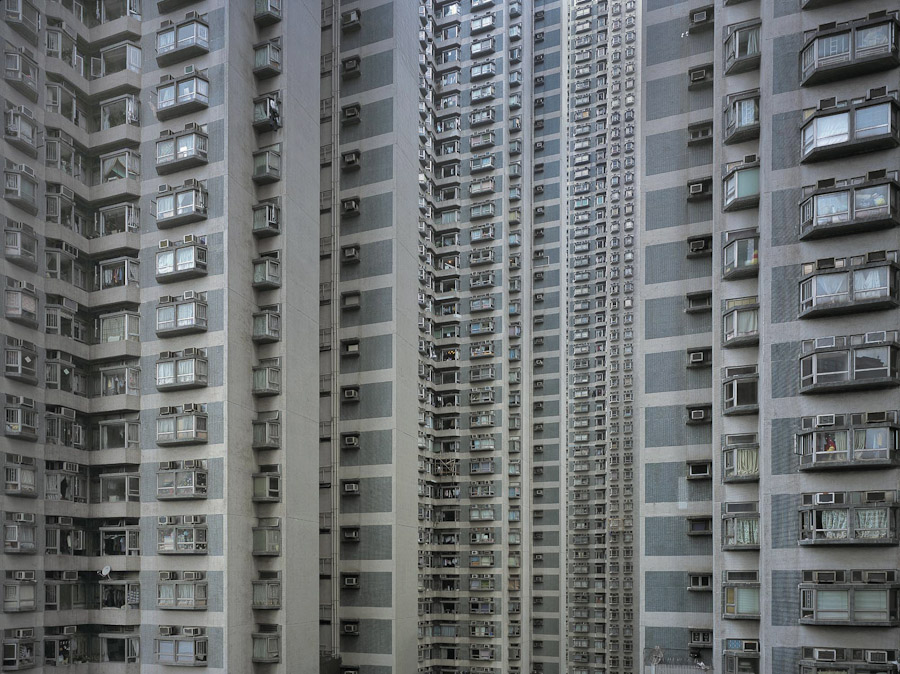
(This interview was originally published on Venue).

In the nearly quarter-century since designer Will Wright launched the iconic urban planning computer game, SimCity, not only has the world’s population become majoritatively urban for the first time in human history, but interest in cities and their design has gone mainstream.

Once a byword for boring, city planning is now a hot topic, claimed by technology companies, economists, so-called “Supermayors,” and cultural institutions alike as the key to humanity’s future. Indeed, if we are to believe the hype, the city has become our species’ greatest triumph.

[Image: A shot from photographer Michael Wolf‘s extraordinary Architecture of Density series, newly available in hardcover].

In March 2013, the first new iteration of SimCity in a decade was launched, amidst a flurry of critical praise mingled with fan disappointment at Electronic Arts’ “always-online” digital rights management policy and repeated server failures.

A few weeks before the launch, Venue—BLDGBLOG’s ongoing collaboration with Edible Geography‘s Nicola Twilley, supported by the Nevada Museum of Art‘s Center for Art + Environment—had the opportunity to play the new SimCity at its Manhattan premiere, during which time we feverishly laid out curving roads and parks, drilled for oil while installing a token wind turbine, and tried to ignore our city’s residents’—known as Sims—complaints as their homes burned before we could afford to build a fire station.


We emerged three hours later, blinking and dazed, into the gleaming white and purple lights of Times Square, and were immediately struck by the intensity of abstraction required to translate such a complex, dynamic environment into a coherent game structure, and the assumptions and values embedded in that translation.

Fortunately, the game’s lead designer, Stone Librande, was happy to talk with us further about his research and decision-making process, as well as some of the ways in which real-world players have already surprised him. We spoke to him both in person and by telephone, and our conversation appears below.

• • •


Nicola Twilley: I thought I’d start by asking what sorts of sources you used to get ideas for SimCity, whether it be reading books, interviewing urban experts, or visiting different cities?

Stone Librande: From working on SimCity games in the past, we already have a library here with a lot of city planning books. Those were really good as a reference, but I found, personally, that the thing I was most attracted to was using Google Earth and Google Street View to go anywhere in the world and look down on real cities. I found it to be an extremely powerful way to understand the differences between cities and small towns in different regions.

Google has a tool in there that you can use to measure out how big things are. When I first started out, I used that a lot to investigate different cities. I’d bring up San Francisco and measure the parks and the streets, and then I’d go to my home town and measure it, to figure out how it differed and so on. My inspiration wasn’t really drawn from urban planning books; it was more from deconstructing the existing world.

Then I also really got into Netflix streaming documentaries. There is just so much good stuff there, and Netflix is good at suggesting things. That opened up a whole series of documentaries that I would watch almost every night after dinner. There were videos on water problems, oil problems, the food industry, manufacturing, sewage systems, and on and on—all sorts of things. Those covered a lot of different territory and were really enlightening to me.


Geoff Manaugh: While you were making those measurements of different real-world cities, did you discover any surprising patterns or spatial relationships?

Librande: Yes, definitely. I think the biggest one was the parking lots. When I started measuring out our local grocery store, which I don’t think of as being that big, I was blown away by how much more space was parking lot rather than actual store. That was kind of a problem, because we were originally just going to model real cities, but we quickly realized there were way too many parking lots in the real world and that our game was going to be really boring if it was proportional in terms of parking lots.

Manaugh: You would be making SimParkingLot, rather than SimCity.

Librande: [laughs] Exactly. So what we do in the game is that we just imagine they are underground. We do have parking lots in the game, and we do try to scale them—so, if you have a little grocery store, we’ll put six or seven parking spots on the side, and, if you have a big convention center or a big pro stadium, they’ll have what seem like really big lots—but they’re nowhere near what a real grocery store or pro stadium would have. We had to do the best we could do and still make the game look attractive.

[Image: Using the zoning tool for the city designed by We Are the Champignons].
Twilley: I’d love to hear more about the design process and how you went about testing different iterations. Did you storyboard narratives for possible cities and urban forms that you might want to include in the game?

Librande: The way the game is set up, it’s kind of infinite. What I mean by that is that you could play it so many different ways that it’s basically impossible to storyboard or have a defined set of narratives for how the player will play it.

[Images: Stone Librande’s storyboards for “Green City” and “Mining City” at the start of play].
Instead, what I did was that I came up with two extreme cases—around the office we call them “Berkeley” and “Pittsburgh,” or “Green City” and “Dirty City.” We said, if you are the kind of player who wants to make utopia—a city with wind power, solar power, lots of education and culture, and everything’s beautiful and green and low density—then this would be the path you would take in our game.

But then we made a parallel path for a really greedy player who just wants to make as much money as possible, and is just exploiting or even torturing their Sims. In that scenario, you’re not educating them; you’re just using them as slave labor to make money for your city. You put coal power plants in, you put dumps everywhere, and you don’t care about their health.

[Image: Stone Librande’s storyboard for “Green City” at mid-game].
I made a series of panels, showing those two cities from beginning to late stage, where everything falls apart. Then, later on, when we got to multiplayer, I joined those two diagrams together and said, “If both of these cities start working together, then they can actually solve each other’s problems.”

The idea was to set them up like bookends—these are the extremes of our game. A real player will do a thousand things that fall somewhere in between those extremes and create all sorts of weird combinations. We can’t predict all of that.

Basically, we figured that if we set the bookends, then we would at least understand the boundaries of what kind of art we need to build, and what kind of game play experiences we need to design for.

[Image: Stone Librande’s storyboard for “Mining City” at mid-game].
Twilley: In going through that process, did you discover things that you needed to change to make game play more gripping for either the dirty city or the clean city?

Librande: It was pretty straightforward to look at Pittsburgh, the dirty city, and understand why it was going to fail, but you have to try to understand why the clean one might fail, as well. If you have one city—one path—that always fails, and one that always succeeds, in a video game, that’s really bad design. Each path has to have its own unique problems.

What happened was that we just started to look at the two diagrams side-by-side, and we knew all the systems we wanted to support in our game—things like power, utilities, wealth levels, population numbers, and all that kind of stuff—and we basically divided them up.

We literally said: “Let’s put all of this on this side over in Pittsburgh and the rest of it over onto Berkeley.” That’s why, at the very end, when they join together, they are able to solve each other’s problems because, between the two of them, they have all the problems but they also have all the answers.

[Image: Stone Librande’s storyboard for the “Green City” and “Mining City” end-game symbiosis].

Twilley: One thing that struck me, after playing, was that you do incorporate a lot of different and complex systems in the game, both physical ones like water, and more abstract ones, like the economy. But—and this seems particularly surprising, given that one of your bookend cities was nicknamed Berkeley—the food system doesn’t come into the game at all. Why not?

Librande: Food isn’t in the game, but it’s not that we didn’t think about it—it just became a scoping issue. The early design actually did call for agriculture and food systems, but, as part of the natural process of creating a video game, or any situation where you have deadlines and budgets that you have to meet, we had to make the decision that it was going to be one of the things that the Sims take care of on their own, and that the Mayor—that is, the player—has nothing to do with it.

I watched some amazing food system documentaries, though, so it was really kind of sad to not include any of that in the game.

[Image: Data layer showing ore deposits].
[Image: Data layer showing happiness levels. In SimCity, happiness is increased by wealth, good road connections, and public safety, and decreased by traffic jams and pollution].
Manaugh: Now that the game is out in the world, and because of the central, online hosting of all the games being played right now, I have to imagine that you are building up an incredible archive of all the decisions that different players have made and all the different kind of cities that people have built. I’m curious as to what you might be able to make or do with that kind of information. Are you mining it to see what kinds of mistakes people routinely make, or what sorts of urban forms are most popular? If so, is the audience for that information only in-house, for developing future versions of SimCity, or could you imagine sharing it with urban planners or real-life Mayors to offer an insight into popular urbanism?

Librande: It’s an interesting question. It’s hard to answer easily, though, because there are so many different ways players can play the game. The game was designed to cover as many different play patterns as we could think of, because our goal was to try to entertain as many of the different player demographics as we could.

So, there are what we call “hardcore players.” Primarily, they want to compete, so we give them leader boards and we give them incentives to show they are “better” than somebody else. We might say: “There’s a competition to have the most people in your city.” And they are just going to do whatever it takes to cram as many people into a city as possible, to show that they can win. Or there might be a competition to get the most rich people in your city, which requires a different strategy than just having the most people. It’s hard to keep rich people in a city.

Each of those leader boards, and each of those challenges, will start to skew those hardcore people to play in different ways. We are putting the carrot out there and saying: “Hey, play this way and see how well you can do.” So, in that case, we are kind of tainting the data, because we are giving them a particular direction to go in and a particular goal.

On the other end of the spectrum, there are the “creative players” who are not trying to win—they are trying to tell a story. They are just trying to create something beautiful. For instance, when my wife plays, she wants lots of schools and parks and she’s not at all concerned with trying to make the most money or have the most people. She just wants to build that idealized little town that she thinks would be the perfect place to live.

[Image: A regional view of a SimCity game, showing different cities and their painfully small footprints].
So, getting back to your question, because player types cover such a big spectrum, it’s really hard for us to look at the raw data and pull out things like: “This is the kind of place that people want to live in.” That said, we do have a lot of data and we can look at it and see things, like how many people put down a park and how many people put in a tram system. We can measure those things in the aggregate, but I don’t think they would say much about real city planning.

Twilley: Building on that idea of different sorts of players and ways of playing, are there a variety of ways of “winning” at SimCity? Have you personally built cities that you would define as particularly successful within the game, and, if so, what made them “winners”?

Librande: For sure, there is no way to win at SimCity other then what you decide to put into the game. If you come in with a certain goal in mind—perhaps, say, that you want a high approval rating and everyone should be happy all the time— then you would play very differently than if you went in wanting to make a million dollars or have a city with a million people in it.

As far as my personal city planning goes, it has varied. I’ve played the game so much, because early on I just had to play every system at least once to understand it. I tried to build a power city, a casino city, a mining city—I tried to build one of everything.

Now that I’m done with that phase, and I’m just playing for fun at home, I’ve learned that I enjoy mid-density cities much more then high-density cities. To me, high-density cities are just a nightmare to run and operate. I don’t want to be the mayor of New York; I want to be the mayor of a small town. The job is a lot easier!

Basically, I build in such a way as to not make skyscrapers. At the most, I might have just one or two because they look cool—but that’s it.

[Image: Screenshot from SimCity 4].

Manaugh: I’m curious how you dealt with previous versions of SimCity, and whether there was any anxiety about following that legacy or changing things. What are the major innovations or changes in this version of the game, and what kinds of things did you think were too iconic to get rid of?

Librande: First of all, when we started the project, and there were just a few people on the team, we all agreed that we didn’t want this game to be called SimCity 5. We just wanted to call it SimCity, because if we had a 5 on the box, everybody would think it had to be SimCity 4 with more stuff thrown in. That had the potential to be quite alienating, because SimCity 4 was already too complicated for a lot of people. That was the feedback we had gotten.

Once we made that title decision, it was very liberating—we felt like, “OK, now we can reimagine what the brand might be and how cities are built, almost from scratch.”

Technically, the big difference is the “GlassBox” engine that we have, in which all the agents promote a bottom-up simulation. All the previous SimCity games were literally built on spreadsheets where you would type a number into a grid cell, and then it propagated out into adjacent grid cells, and the whole city was a formula.

SimCity 4 was literally prototyped in Excel. There were no graphics—it was just a bunch of numbers—but you could type a code that represented a particular type of building and the formulae built into the spreadsheet would then decide how much power it had and how many people would work there. It just statically calculated the city as if it were a bunch of snapshots.

[Image: A fire breaks out in the city designed by We Are The Champignons].
Because our SimCity—the new SimCity—is really about getting these agents to move around, it’s much more about flows. Things have to be in motion. I can’t look at anybody’s city as a screenshot and tell you what’s going on; I have to see it live and moving before I can fully understand if your roads are OK, if your power is flowing, if your water is flowing, if your sewage is getting dumped out, if your garbage is getting picked up, and so on. All that stuff depends on trucks actually getting to the garbage cans, for example, and there’s no way to tell that through a snapshot.

[Image: Sims queue for the bus at dawn].
Once we made that decision—to go with an agent-driven simulation and make it work from the bottom up—then all the design has to work around that. The largest part of the design work was to say: “Now that we know agents are going to run this, how do schools work with those agents? How do fire and police systems work with these agents? How do time systems work?” All the previous editions of SimCity never had to deal with that question—they could just make a little table of crimes per capita and run those equations.

Manaugh: When you turned things over to the agents, did that have any kind of spatial effect on game play that you weren’t expecting?

Librande: It had an effect, but it was one that we were expecting. Because everything has to be in motion, we had to have good calculations about how distance and time are tied together. We had to do a lot of measurements about how long it would really take for one guy to walk from one side of the city to the other, in real time, and then what that should be in game time—including how fast the cars needed to move in relationship to the people walking in order to make it look right, compared to how fast would they really be moving, both in game time and real time. We had all these issues where the cars would be moving at eighty miles an hour in real time, but they looked really slow in the game, or where the people were walking way, way too fast, but actually they were only walking at two miles an hour.

We knew this would happen, but we just had to tweak the real-life metrics so that the motion and flow look real in the game. We worked with the animators, and followed our intuition, and tried to mimic the motion and flow of crowds.

[Image: We Are The Champignons’ industrial zone, carefully positioned downwind of the residential areas].
In the end, it’s not one hundred percent based on real-life metrics; it just has to look like real life, and that’s true throughout the game. For example, if we made the airport runways actual size, they would cover up the entire city. Those are the kinds of things where we just had to make a compromise and hope that it looked good.

Twilley: Actually, one of the questions we wanted to ask was about time in the game. I found it quite intriguing that there are different speeds that you can choose to play at, but then there’s also a distinct sense of the phases of building a city and how many days and nights have to pass for certain changes to occur. Did you do any research into how fast cities change and even how the pace of city life is different in different places?

Librande: We found an amazing article about walking speeds in different cities. That was something I found really interesting. In cities like New York, people walk faster, and in medium-sized or small towns, they walk a lot slower. At one point, we had Sims walking faster as the city gets bigger, but we didn’t take it that far in the final version.


I know what you are talking about, though: in the game, bigger cities feel a lot busier and faster moving. But there’s nothing really built into the game to do that; it’s just the cumulative effect of more moving parts, I guess. In kind of a counter-intuitive way, when you start getting big traffic jams, it feels like a bigger, busier city even though nothing is moving—it’s just to do with the way we imagine rush-hour gridlock as being a characteristic of a really big city.

The fact that there’s even a real rush hour shows how important timing is for an agent-based game. We spent a lot of time trying to make the game clock tick, to pull you forward into the experience. In previous SimCities, the day/night cycle was just a graphical effect—you could actually turn it off if you didn’t like it, and it had no effect on the simulation. In our game, there is a rush hour in the morning and one at night, there are school hours, and there are shopping hours. Factories are open twenty-four hours a day, but stores close down at night, so different agents are all working on different schedules.


The result is that you end up getting really interesting cycles—these flows of Sims build up at certain times and then the buses and streets are empty and then they build back up again. There’s something really hypnotic about that when you play the game. I find myself not doing anything but just watching in this mesmerized state—almost hypnotized—where I just want to watch people drive and move around in these flows. At that point, you’re not looking at any one person; you’re looking at the aggregate of them all. It’s like watching waves flow back and forth like on a beach.

For me, that’s one of the most compelling aspects of our game. The timing just pulls you forward. We hear this all the time—people will say, “I sat down to play, and three hours had passed, and I thought, wait, how did that happen?” Part of that is the flow that comes from focusing, but another part of it is the success of our game in pulling you into its time frame and away from the real-world time frame of your desk.


Twilley: Has anything about the way people play or respond to the game surprised you? Is there anything that you already want to change?

Librande: One thing that amazed me is that, even with the issues at the launch, we had the equivalent of nine hundred man-years put into SimCity in less than a week.

Most of the stuff that people are doing, we had hoped or predicted would happen. For example, I anticipated a lot of the story-telling and a lot of the creativity—people making movies in the cities, and so on—and we’re already seeing that. YouTube is already filled with how-to videos and people putting up all these filters, like film noir cities, and it’s just really beautiful.

[Video: SimCity player Calvin Chan’s film noir montage of his city at night].

The thing I didn’t predict was that, in the first week, two StarCraft players—that’s a very fast-paced space action game, in case you’re not familiar with it, and it’s fairly common for hardcore players to stream their StarCraft battles out to a big audience—decided to have a live-streamed SimCity battle against each other. They were in a race to be the first to a population of 100,000; they live-streamed their game; and there were twenty thousand people in the chat room, cheering them on and typing in advice—things like “No, don’t build there!” and “ What are you doing—why are you putting down street cars?” and “Come on, dude, turn your oil up!” It was like that, nonstop, for three hours. It was like a spectator sport, with twenty thousand people cheering their favorite on, and, basically, backseat city planning. That really took me by surprise.

I’m not sure where we are going to go with that, though, because we’re not really an eSport, but it seems like the game has the ability to pull that out of people. I started to try to analyze what’s going on there, and it seems that if you watch people play StarCraft and you don’t know a lot about it, your response is going to be something like, “I don’t know what I’m looking at; I don’t know if I should be cheering now; and I don’t know if what I just saw was exciting or not.”

But, if you watch someone build a city, you just know. I mean, I don’t have to teach you that putting a garbage dump next to people’s houses is going to piss them off or that you need to dump sewage somewhere. I think the reason that the audience got so into it is that everyone intuitively knows the rules of the game when it comes to cities.

• • •

For more Venue interviews, on human interactions with the built, natural, and virtual environments, check out the Venue website in full.

British Countryside Generator

[Image: From Sir, You Are Being Hunted by Big Robot].

For the last ten months or so, I’ve been watching from afar the development of ground forms and landscapes for a game called Sir, You Are Being Hunted, from Big Robot.

Big Robot, of course, is a small game design firm founded by Jim Rossignol, who has guest-posted here on BLDGBLOG a few times over the years and who I interviewed back in 2009 about his book This Gaming Life.

[Image: From Sir, You Are Being Hunted by Big Robot].

What I’ve been captivated by is the so-called British Countryside Generator, a “procedural world engine” using “spatial division maths” that allowed Big Robot to generate aesthetically recognizable rural British landscapes.

[Image: From Sir, You Are Being Hunted by Big Robot].

“I’ve worked on a number of procedural world generation tools before,” coder Tom Betts explains on the Big Robot blog, “but this particular engine is unique in that the intention was to generate a vision of ‘British countryside,’ or an approximation thereof.”

To approach this we identified a number of features in the countryside that typify the aesthetic we wanted, and seem to be quintessential in British rural environments. Possibly the most important element is the ‘patchwork quilt’ arrangement of agricultural land, where polygonal fields are divided by drystone walls and hedgerows. These form recognizable patterns that gently rise and fall across the rolling open countryside, enclosing crops, meadows, livestock and woodlands. This patchwork of different environmental textures is something that is very stereotypically part of the British landscape. I looked for a mathematical equivalent we could use to simulate this effect and quite quickly decided upon using Voronoi diagrams.

The basic topology is thus established, one that, despite its mathematical abstraction, “looks remarkably like… the British countryside.”

[Image: From Sir, You Are Being Hunted by Big Robot].

“Once this is done,” Tom continues, “the engine then uses the height information to produce a terrain splatmap where different textures are assigned to areas according to altitude, slope and region type. This results in sandy beaches, rocky highlands and meadows in between.”

[Image: From Sir, You Are Being Hunted by Big Robot].

These subtle glimpses of game geology disguise Jim Rossignol’s own mock enthusiasm for all things virtually terrestrial. “Terrain!” he exclaimed over at Rock, Paper, Shotgun last summer in a Walt Whitmanic moment of expansiveness. “It’s the undulating table on which the pieces of our play are set. It’s the sandbox in which we dig, and the garden in which we grow. Terrain: for exploring, for absorbing, for smoothing, for deforming. It is the unsung underfoot heroic substrate of all that is gaming, and much else besides.”

[Images: From Sir, You Are Being Hunted by Big Robot].

Speaking of “smoothing,” these automatically generated lines and divisions are not always ideal, and can often use some smudging. “There are also a number of ‘noisy’ functions,” Tom adds, “that make the textures intersect more organically by adding goat type trails, blurring and dithering. There are also additional alterations made to this splatmap later as the engine deploys the actual models too—walls, buildings and so on.”

[Image: From Sir, You Are Being Hunted by Big Robot].

Personally—perhaps it’s schadenfreude—I love to see all of architecture reduced to “walls, buildings and so on,” just tossed across the landscape like salt; to think of all the time spent on student architecture projects that could simply have been achieved using a countryside generator…

[Images: From Sir, You Are Being Hunted by Big Robot].

Roads and towns at the push of a button.

[Image: From Sir, You Are Being Hunted by Big Robot].

But then, of course, you add the “sir” being hunted, and you throw in the jangly figures carrying rifles and smoking pipes in the foggy landscape, and mere terrain becomes gamespace, a place of strategy and places to hide.

[Image: From Sir, You Are Being Hunted by Big Robot].

Landscape then becomes something you explore while looking down the barrel of a gun, wandering through “walls, buildings and so on” as a new and renewable world tiles into being all around you.

[Images: From Sir, You Are Being Hunted by Big Robot].

In his long blog post at Big Robot, for instance, Tom writes that “one of the most exciting parts of procedural content generation is the fact that it can produce unexpected results, [and] players can stumble across regions that due to a particular combination of features appear really unusual. In testing I’ve found villages collapsing over cliff edges, trees submerged in lakes and roads from nowhere to nowhere. There is actually something nice about finding these anomalies because it really feels like a unique discovery, proving that you are wandering your own, individual version of the game world.”

Jim Rossignol has discussed the game in more detail in several interesting interviews—such as with WhatCulture and Rock, Paper, Shotgun—where you’ll find more background and info, and a convincing glimpse of the game designer as landscape theorist.

For now, here are some further shots of the British Countryside Generator at work.

[Images: From Sir, You Are Being Hunted by Big Robot].

Briefly, I can’t let this post end without mentioning another, admittedly entirely unrelated project, something that itself could easily be described as a “British countryside generator.” I’m referring to the massive wetland redevelopment on Wallasea Island, using “approximately 6.5m tons of spoil,” in the words of London Reconnections, that have been sucked, scraped, and excavated from deep beneath London as part of the Herculean Crossrail tunneling project.

In other words, the island is literally being expanded through an open-air terrestrial 3D-printing exercise, using dirt from the foundations of London as its ink.

[Image: Wallasea Island Map from Google Maps, via London Reconnections].

As the BBC explains, the Wallasea wetland project is “making good use of the excess earth being generated from the separate £14.8bn Crossrail project. The twin-bore tunnels being dug out to link east and west London would have seen six million tons of earth in need of a new home—but three-quarters of this will head to Wallasea Island via freight trains and ships to create the new reserve.”

There is something absolutely mind-boggling in the idea of huge, artificial hollows under London being sprayed out over a coastal site—no doubt according to Big Robot-like formal rules, where “different textures are assigned to areas according to altitude, slope and region type,” as the game designer explains, above—to form, nearly from whole cloth, a new ecosystem.

A British Countryside Generator, indeed.

(An earlier version of this post mistakenly attributed many quotations to Jim Rossignol, rather than to Tom Betts—my apologies to Tom for the oversight!)

Mountain View

[Image: Courtesy of the U.S. Library of Congress Prints & Photographs Division].

After posting several of these images in our recent Venue interview with outdoor equipment strategist Scott McGuire—easily one of my favorite interviews of late, touching on everything from civilianized military gear used in everyday hiking to REI-augmented wilderness camp sites as the true heirs of Archigram—I was so taken by their weirdly haunting views of humans wandering through extreme landscapes, dressed in 19th-century suits and top hats, carrying canes, that I thought I’d post a larger selection.

[Images: Courtesy of the U.S. Library of Congress Prints & Photographs Division].

Middle class gentlemen and ladies in hooped skirts walk into ice caves and step gingerly across the cracked, abyssal surfaces of old mountain glaciers, pointing up at things they don’t understand.

[Image: Courtesy of the U.S. Library of Congress Prints & Photographs Division].

At times, these feel almost like photos from some as-yet-unwritten Gothic horror story, perhaps a 19th-century Swiss prequel to John Carpenter’s The Thing, in which purely accidental sequences of photos—

[Images: Courtesy of the U.S. Library of Congress Prints & Photographs Division].

—imply a narrative of genial discovery, focused exploration, and eventual solo flight down the mountainside in terror.

In fact, I could easily imagine an Alpine variation on Michelle Paver’s memorably unsettling Arctic ghost novel Dark Matter set in such geologically extravagant landscapes, as humans struggle to survive, both physically and psychologically, in this encounter with an incomprehensibly over-sized landscape millions of years older than they might ever be, naively setting up camp amidst a wilderness that does not want them there.

[Images: Courtesy of the U.S. Library of Congress Prints & Photographs Division].

But then, at other times, these photos are almost like exaggerated set pieces by artists Kahn & Selesnick, whose work proposes fictional expeditions to otherworldly landscapes, missions to the moon, ancient salt cities, and more, all told through an almost unbelievably elaborate series of props, fake postcards, paintings, photographs, and more.

Like some unrealized backstory for their “Eisbergfreistadt” project, for example, or their “Circular River” expedition, men in wool vests pull one another up abstract glacial forms, as an incredible wooden staircase—if you look closely at the next image—races up the mountainside in the middle of nowhere.

[Image: Courtesy of the U.S. Library of Congress Prints & Photographs Division].

After a point, these scenes are Chaplinesque and ridiculous, like turn-of-the-century bankers who got lost on a glacier in a Modernist play.

[Image: Courtesy of the U.S. Library of Congress Prints & Photographs Division].

In any case, these all come courtesy of the U.S. Library of Congress Prints & Photographs Division, where substantially higher-res versions of each photo are available; but don’t miss the additional photos in the interview with Scott McGuire over at Venue.

[Images: Courtesy of the U.S. Library of Congress Prints & Photographs Division].

Mountain Lab: An Interview with Scott McGuire

Photo courtesy Scott McGuire.

(This interview originally published on Venue).

Several years ago, while I was still on the editorial staff at Dwell magazine, I took a daytrip down to the head office of The North Face to visit their equipment design team and learn more about the architecture of tents.

“As a form of minor architecture,” the resulting short article explained, “tents are strangely overlooked. They are portable, temporary, and designed to withstand even the most extreme conditions, but they are usually viewed as simple sporting goods. They are something between a large backpack and outdoor lifestyle gear—certainly not small buildings. But what might an architect learn from the structure and design of a well-made tent?”

Amongst the group of people I spoke with that day was outdoor equipment strategist Scott McGuire, an intense, articulate, and highly focused advocate for all things outdoors. As seen through Scott’s eyes, the flexibility, portability, ease of use, and multi-contextual possibilities of outdoor equipment design began to suggest a more effective realization, I thought, of the avant-garde legacy of 1960s architects like Archigram, who dreamed of impossible instant cities and high-tech nomadic settlements in the middle of nowhere.

Scott McGuire talks to Venue in Lee Vining, California; Mono Lake can be seen in the background.

Intrigued by his perspective on the ways in which outdoor gear can both constrain and expand the ways in which human beings move around in and inhabit wild landscapes, and traveling with Nicola Twilley as part of our collaborative Venue project, I was thrilled to catch up with Scott at a deli in Lee Vining, California, near his home in the Eastern Sierra.

McGuire, who recently left The North Face to set up his own business, called The Mountain Lab, was beyond generous with his time and expertise, happily answering Nicola’s and my questions as the sun set over Mono Lake in the distance. His answers combined a lifelong outdoor enthusiast’s understanding of the natural environment with a granular, almost anthropological analysis of the activities that humans like to perform in those contexts, as well as a designer’s eye for form, function, and material choices.

Indeed, as Scott’s description of the design process makes clear in the following interview, a 40-liter mountaineering pack is revealed literally as a sculpture produced by the interaction between the human body and a particular landscape: the twist to squeeze through a crevasse, or the backward tilt of the head during a belay.

Our conversation ranged from geographic and generational differences in outdoor experiences to the emerging spatial technologies of the U.S. military, and from the rise of BMX and the X Games to the city itself as the new “outdoors,” offering a fascinating perspective on the unexpected ways in which technical equipment can both enable and redefine our relationship with extreme environments.

• • •

Geoff Manaugh: I’d like to start by asking you about the constraints you face in the design of outdoor athletic equipment, and how that affects the resulting product. For instance, in designing architecture, you might think about factors such as a building’s visual impact, its environmental performance, or the historic context of where your future structure is meant to be. But if you’re designing something like a tent—a kind of athletic architecture, if you will—then you’re talking about factors like portability, aerodynamism, cost, weather-proofing, etc.. What design constraints do you face, and how do you prioritize them?

Scott McGuire: The first thing is always the user. Everything has to be very user-centric, in a way that’s perhaps unlike conventional architecture. You might say, “I’m building a house; it’s about this site; it’s about this view; people are going to live in it in a certain way,” but you would rarely design a house based on whether or not someone has a propensity, for example, to use their kitchen utensils with their left hand or their right hand. But when you’re creating a technical product, you become really myopically focused on how that product interacts with an individual. It’s about establishing who that person is.

Of course, if I’m talking about doing a small technical pack that will hold 40 liters for someone who’s going mountaineering—well, I know that same pack may very well be used by someone riding on a bike as a commuter in New York City. Still, when we’re talking about that product, it’s very much about things like: what’s the person who’s going mountaineering wearing? What are they carrying? Where are they going? What environment are they going to be in? How much wear and tear is their pack going to get? As you study the user, you usually end up discovering a lot of nuances about the way they’ll use the product, and they’re often things you wouldn’t normally think about.

Mt. Blanc from Le Jardin“; “The Finsteraarhorn“; another view of the Finsteraarhorn; and “Glacier of the Rhone.” All photos taken between 1860 and 1890. Courtesy of the U.S. Library of Congress Prints and Photographs Division.

I’ll give you some examples of how that would work. I’ll stick with the 40-liter technical pack, which is the one you usually find in an area that’s high alpine, above 8000 feet, with year-round glaciers, where there’s lots of climbing and mountaineering. What you’re going to find, obviously, is that people are carrying it. They’re moving at a relatively athletic pace. They want to have the ability to fit the pack.

When we think about fit, it’s not as simple as saying: “This person’s got a 34″ waist, a 19″ back, a 42″ chest, and that’s what we need to focus on.” It’s also the fit based off the way someone moves—what I would call the interaction between the user and the device. The way a 65-liter pack fits someone who’s walking down a manicured trail, doing eight miles a day—the height that their knee climbs and the amount that their body twists—is different than the fit of a 40-liter pack for somebody who’s going up a mountain, where they might be climbing a 45-degree slope. Or they might have somebody on belay and they need to be able to look up, so they need to have a tiny pocket of space so that, with a helmet, they can crane their head back and look up at their partner. The pack can’t get in the way of that.

Three 65-liter packs by The North Face, High Sierra, and Kelty, respectively.

Then you add to all that not just an ability to carry weight, but questions like: what does it feel like when an arm comes up to reach for a hold? Or: what happens when you’re trying to twist through a crevasse? There’s a fair amount of time spent really thinking about all of those elements on the body.

And then you run into some really interesting places when you start thinking about how the pack comes off the body. What does everybody do when they come to a stop? They take their packs off, throw them on the ground, and sit on them. So you have to think about how your frame system can carry the load one way, while being carried on someone’s back, but also what happens to that frame system when someone sits on it when it’s on the ground. That really nice zipper pocket on the face, the one that’s so great for getting access at the front of the pack—well, what happens when that thing spends a year lying zipper-down, crammed full of mud, with 150 to 200 pounds of person sitting on top of it? A lot of these observations need to take place in the very beginning, to think through these things.

Mountain climbers, Zermatt, Switzerland (1954); photograph by Toni Frissell, courtesy of the U.S. Library of Congress Prints & Photographs Division.

That’s basically the fit component of the interaction to the person. The second element is really going to be: what goes into the product? What is the user carrying, and how do they access it? Those two questions live in a symbiotic relationship with each other. It’s also not just about what goes in the pack, but when it goes in, when it comes out, and how it goes back in again.

Taking a conventional top design, you have an open bucket; you open the lid; and you put stuff inside. There are shapes that inherently lend themselves to technical packs: they’re slightly tapered at the bottom, so they stay within the lumbar area, keeping the weight centered over the sacrum. That makes it a little easier when those narrow slots are on your waist, and the V-shape of the pack mimics the shape of your shoulders and chest. What it also does is it creates a bucket that can feed stuff down into the bottom. You want to keep your heavier stuff near your center of gravity—you want to keep it low and tight—preferably right underneath the shoulder blades.

But you also need to think about what’s going in there, in what order. Things like an extra shell, or your spare jacket, or the rope you may or may not need—those can all go in the bottom. But what are the things that are coming on and off, all the time? On a technical climb, if you’re wearing a puffy jacket, well, every time you’re hot, that jacket’s going to come off—maybe ten or fifteen times a day. So how does that go in and how do you maintain access to it in the easiest possible way? How do you make sure you’ve got easy access to things like a first aid kit, in case you’ve got to get to it quick? Where does your headlamp sit so that, when it’s late and you’re finally getting the headlamp out, and it’s probably already dark, you know, intuitively, that it’s in this pocket right here and you don’t have to fumble around and find the headlamp and risk having everything else dump out?

The view from Scott McGuire’s back porch; photo courtesy Scott McGuire.

And then there are even simpler things, like small pockets for access to things like a point-and-shoot camera that can go in and out quickly, or your lip balm, or that nutritional bar that allows you to get a shot of quick energy. A lot of thought needs to go into where those things go—where pocketing and storage should be, both from an organizational standpoint but also from a load-dispersion standpoint. These are all maybe a little comparable to how an architect might think: it’s about organizing the space, but down to a level of detail that takes into consideration very different people doing very different things with their gear.

Once you’re talking about the load—about what you’re carrying and how that gets managed—the next thing is going to be materials. The materials are so important. Like in conventional architecture and design, materials obviously have an aesthetic appeal. On the business side of it, the value equation is always about cost versus value. For example, there are things that can cost very little but have a very high value based off their perceived benefit: they’re lightweight, durable, attractive. Things can also have a very high cost but not necessarily have a value that the customer perceives, such as highly technical specialized fabrics that may not really contribute a benefit to your average end user. The benefit’s lost. It’s as if you build a house and you install gold pipes—no one sees it. Do they really make the water taste better?

You need to be really careful about those decisions. When you’re talking about the material selection and if somebody has to carry it, then there’s a balance not only in terms of cost versus value, but also around weight versus durability. In a general analysis, you’ve got price, weight, and durability—and, usually, you only get to pick two. You want something that’s really cheap and super lightweight? You give up durability. You want something that’s super durable and incredibly lightweight? It’s going to cost you a lot of money—you give up price.

Ascension of Mt. Blanc” and Glacier of the Rhone.” Photos taken between 1860 and 1890. Courtesy of the U.S. Library of Congress Prints and Photographs Division.

To get back to the example of a 40-liter mountaineering pack, that customer typically is investing in a product that is high-quality, with high-durability, designed to take a lot of abuse. And there’s an expectation there that a slightly more expensive product, with greater durability and less failure potential, has higher value. It’s worth the extra money. There’s a huge difference between someone who’s going for their very first backpacking trip versus the person who’s been training for an objective for the last year. That person doesn’t want, after all the hours spent planning, looking at topo maps, and waiting for the weather window, to be hampered by gear. That person’s going to choose quality and durability over price.

Photo courtesy Scott McGuire.

Manaugh: When it comes to materials, I’m curious if there are things that you or the designers you work with are aware of, that are perfect for certain functions, but they’re so expensive or simply so foreign to the average consumer that the market can’t bear them. In other words, how do you navigate the market with new materials and new designs?

McGuire: One of the Holy Grails here, from a design standpoint, is the side-release buckle. From a functional standpoint, the ability to have a buckle, pop it, have it separate, put it back together, click it, including that audible signal that it’s now secure—that has a simplicity and intuitiveness to it. I think a lot of people in design still look at that and say, gosh, that’s one of the things that’s been around for a long time. But is it the best solution?


It’s always a question of whether you’re building a better mouse trap, or if you’re just trying to do something that’s different—something that’s gimmicky. You’re always balancing what’s unique for the sake of being unique—not necessarily because it’s providing a better solution—versus what’s unique because it’s actually offers a functional improvement.

There are a couple of examples like that. Nobody’s really figured out a better solution than a zipper. But zippers fail; they wear out over a certain period of time. The side-release buckle is a design that is ubiquitous across all packs, and there are different aesthetic treatments to it, but, functionally, they all do the same thing: a two-part click. But there are always people exploring what could be better in that space.

Manaugh: One of the things we talked about a few years ago when I first met you at The North Face was that there are differences in tent design between the North American and the European markets. You mentioned then that, in Europe, campgrounds are so crowded that a different level of privacy is expected from a tent, whereas, in the U.S., you can get away with using much more transparent materials, because you might be the only people at a certain campsite for two or three nights in a row and you don’t need as much privacy.

The REI Half Dome 2 Plus Tent, with and without cover; via REI.

I’m curious, now that you’re doing consulting with different companies, different regions, and different markets, how these sorts of cultural differences play out in the design of outdoor equipment in general.

McGuire: The commercial world has gotten a lot smaller, and the ability now to connect with people in those very different cultures has become much more commonplace. That’s true everywhere, I think. I mean, sitting where we are today, we have a lot of people coming through the Eastern Sierra who have traveled all the way from Europe.

I actually just talked to a guy over there in the parking lot on a motorcycle who’s over here from Germany, on his way to Jackson Hole. He said he happened to be swinging by here on his way from Atlanta. I still haven’t figured out the geographical connection to Atlanta, if you’re on your way to Wyoming, but…

Manaugh: [laughs] He was too embarrassed to ask for directions.

McGuire: But it is interesting to see a foreign product in a local environment—you can see where it seems a little odd, and you can try to find out why those little moments are there in the design. There’s also a need to expose yourself to those other places. That means being in Europe and seeing that user; it means being in Japan and seeing that user.

The Big Agnes Copper Spur UL1 Tent with and without cover; via REI.

Oftentimes, there are unique, local solutions to global problems, and these can influence global gear designs and become ubiquitous. Just as often, there are very specific needs to solve a local issue that are non-transferable. I’ll give you a classic case in point. We just talked about mountaineering in the Eastern Sierras. Well, all of our access is car-based. Everybody drives to a trail head, gets out of their car, and walks up a trail that is highly likely to have no one else on it, and, from there, they end up at the place they’re climbing, and so on. It’s not uncommon for people here to go out and, from the time they leave their car until they bag their peak and come back, they never see anybody—not even a trace of another person.

But in Chamonix, over in France, there’s a parade from 7:00 am every morning. If you sit at the base, where the trail goes up Mont Blanc, you can watch people coming down with their coffee and their croissant, and they’ve got their crampons in the back of their pack. They’ve got all of their gear. They’re going to climb into a tightly packed gondola with 50 or even 100 other people, and that’s all before they even start their climb.

Two photos of architecture on the Aiguille du Midi in Chamonix, France; uncredited; found via Google Image Search.

So, here, in the Eastern Sierra, you can just say, Jed Clampett-style, eh, my crampons are over here, my ice axe is here, and, as long as my hiking partner isn’t within five feet of me, well—hook, swing—who cares? But when people start getting into a packed tram system in Chamonix, and they’ve all got to scoot together, you really need to start thinking about how you protect all those sharp points. How do you make sure no one’s exposed to those? You’ve got to know where those are.

Those differences are where I think a lot of the challenges are. It’s not necessarily intuitive that something that’s highly successful in one region will automatically have traction in another. Creating a globalized product in a highly specialized market can be very challenging and, oftentimes, there has to be a tolerance. You either have to have tolerance for a broader product assortment to meet regional needs, or you have to accept the fact that you may have a product that’s not specialized enough to hit the local super-user, because you’ve traded off specificity for an ambiguity that will reach more people.

Nicola Twilley: It seems to me that, although in your work you’re responding to the user, the user is also responding to the landscape—so, in effect, you’re responding to the landscape, too. When you look at a landscape, do you more typically see it in terms of what sort of activities you might do there, or are you looking at the landscape from the perspective of the gear you might need?

McGuire: In terms of gear, you do see the differences. I mean, take the west coast of the United States. The climbing conditions for a 40-liter pack in the North Cascades involve a much wetter environment, with much wetter snow and a more volatile climate all around, as far as sudden changes in weather go. But, here in the Eastern Sierra, you can probably plan on the fact that it’s not going to get any precipitation for the next 90 days. You don’t really have to think about bringing a ton of rain gear with you, because we just don’t get storms that show up out of nowhere or weather patterns that suddenly convert. That nuance in meteorological conditions will change what the customer’s wearing, which will change how their pack fits, which will change what they’re carrying, which will change how they store things inside the pack, because of what comes on and off and what they need access to. All those things come into effect.

Then you have geographic nuances—the way the different physical characteristics of the environment that you’re in are going to damage the pack. For example, if you are in a volcanic area, where you’re doing a lot of chimneying, you’re going to end up with a high abrasion area. The impacts of a granite environment and a lot of scree will have a different impact on gear than someone in a classic glacier environment.

So there are geologic elements and there are meteorological elements—and both have an impact on the product itself and an impact on what the user does there. The gear you need in a landscape and the activities you are going to do in that landscape are always going to feed into one another.

Twilley: So you can’t optimize a technical pack for the Eastern Sierra and for climbing in Washington State simultaneously, right? That wouldn’t be the same pack?

McGuire: True. All design at some point is a compromise. If you use vehicles as an analogy, the SUV is the ultimate compromise. It doesn’t really carry everything and it doesn’t drive like a sports car, but it’s still managed to fulfill this niche for people. It does enough things pretty well that it allows them to find their solution in one product. That’s an elusive role for packs. It’s why people who end up being pretty active rarely own one pack—they own two, three, or four of different literages, different weights, different carrying capacities, and different materials.

An early U.S. Geological Survey field camp; photo courtesy of the USGS/U.S. Department of the Interior.

Manaugh: This is a fairly silly question, but I’m curious if, on a day where you have a lot of free time—you’re lying in a hammock in the mountains somewhere—you ever find yourself thinking that you could design a pack that would be absolutely perfect, but only for a very, very specific place. It would be the ultimate pack for a particular trail in Arizona—but for that trail only. It would be useless in Utah or on a trail in the Alps. And maybe it would cost $5,000—but it’s the perfect pack. Do you have dream gear like that?

McGuire: [laughs, pauses] At the end of the day, that’s what every gear head does. Not just the pack—they’re on the quest for the perfect kit. Unfortunately, what happens is that a large factor in enjoying the outdoor environment is wanderlust. As soon as your kit is perfect in one place, not only does the gear itself change over time or through use, but, usually, your reaction is, “Great! Now that I’ve experienced this, let me go to this other place…” And all of your metrics have been thrown off. You start building the perfect kit all over again. So, as soon as that’s obtainable, your own interest level changes, and it goes away.

Of course, I’m not actually a designer, in that I don’t really put pen to paper. I work on strategy and process, with people who do the pen-to-paper side of things—people who are highly creative and sometimes even have an arts background.

Courtesy Osprey Packs.

One of the best examples of that kind of designer, and one of the people I admire the most in this space, is Mike Pfotenhauer, who’s the owner and designer of Osprey Packs. Mike is classically trained as a sculptor so, when you look at Mike’s pack design, there’s an aesthetic to his product that speaks to his ability as a sculptor. It’s very rare that you see straight lines. I’m convinced that if Mike could get someone to weave for him a curved webbing, his packs would all have curved webbing on them. He wants things to have this organic flow, which means there’s a signature to his packs, because he’s only worked on one brand as an owner and designer for his entire career.

Courtesy Osprey Packs.

But, when you look at the actual function of his designs, he’s a real user. He’s a backpacker. He doesn’t let his aesthetic override the fact that, as a user, he knows his end product has to work. Case in point: take the webbing. At the end of the day, something needs to be able to pull and compress. If the pieces of webbing that are the most effective at doing that require straight lines to pull, then he knows the pack’s aesthetic needs to give way to the fact that there’s a functional need calling for something different.

Courtesy Osprey Packs.

Twilley: Given the importance of the user and the landscape, can you talk a little about how this gear is tested? Are there labs filled with simulated environments where packs are repeatedly rubbed against things, or sprayed with water and then flash-frozen to see what happens?

McGuire: There are three legitimate forms of testing. There’s the ASTM/EN, with the ASTM being the American Standard Testing Method and EN being the European Norm. These are scientific methodologies around proving whether something’s working in the right way. Those are usually at an item level. Then, there are ASTM things around complete packages like insulation warmth ratings for sleeping bags. There are rules around how to properly gauge the square footage and volume of a tent or the volume of the inside of a pack. So these are metrics that can be tested.

On the testing from a durability standpoint, oftentimes it’s specific devices that measure individual materials.

Twilley: Oh, so it’s not the complete pack. You just test a particular buckle, for example.

McGuire: Yeah. You might pull-test the buckle to make sure it can survive a 300-pound pull test. You might take a piece of material and put it on a Taber machine and see how many cycles it takes until the machine rubs a hole through it to see what the material’s abrasion durability is. Or you might do a tensile tear strength test to see how a tear would propagate in a rip-stop and how functional the rip-stop is.

These are functional tests that are relatively close to reality, but then there are also reality tests. The classic example of that is a lot of factories and companies will have access to things like very, very large commercial dryers; somebody has taken the time to open them up and bolt 2x4s and climbing holds and all kinds of stuff to the inside of the dryer. Then you throw a pack or a piece of luggage onto it, turn the dryer on, and let it just beat the daylights out of something till you see where your failures are.

Or you’ll have jerk tests on handles, where you’ll have a weight that—over and over again—will simulate the grabbing of a shoulder strap with a 60-pound pack and throwing it over your shoulder. What does that do to that seam? You’ll simulate it over and over again, and you’ll see, as you grab the shoulder strap and yank on it, if you yank a little this way or you yank a little that way, you end up putting different seam stresses on each place.

These sorts of reality-based testing devices are, oftentimes, custom manufactured. They’re not necessarily scientific. They’ll run through the cycles so that you see where there need to be improvements, but there’s not really a standardized test to measure it against.

But, still, today, in this industry, nothing beats human use.

Twilley: You mean field-testing?

McGuire: Product failures in this space are rarely attributable only to one thing. It’s almost always systematic. For instance, the shoulder strap didn’t fail because it was getting pulled up and down; the shoulder strap failed because of the way it was stitched, and then the way it was worn by the user, which created a spot where it sat on the shoulder blade, and that wore the stitching down over the course of a 600-mile trip, which then exposed the motion to a failure. An abrasion test on its own or a jerk test on its own wouldn’t expose that, but, in real world use, those two things combined expose a weakness. This is where human testing really is the quintessential component to make sure things work right.

This is also why so many people in design—in fact, every single person I know who was an inventor of an outdoor product in the 50s and 60s, during the real heyday of our industry—came into prominence not because they were designers. They were users who, by necessity, turned to design to solve a problem.

Image courtesy of Skipedia.

This is how Scot Schmidt created the original Steep Tech gear for North Face. Scot didn’t want to be a clothing designer—at least, from everything I heard from him. Scot just wanted to be a skier who didn’t have to deal with duct taping his knees and shoulders because he was skiing in such horrendous conditions and he kept tearing the fabric.

The original North Face Mountain Light jacket with its “iconic black shoulder”; photo courtesy ZONE7STYLE.

The iconic black shoulder of the original North Face Mountain Light jacket came about not because someone thought, “Wow, straight lines and bold blocking is going to look awesome.” It came about because someone said, “I need a super-durable material because, when I throw my skis over my shoulder to hike up this ridge, the straight skis of the 1970s and 80s rub a hole through my jacket”—and the only thing available at the time was a 1680 ballistic nylon that only came in black because it was for the military.

You end up with an iconic design that was never intended to be an iconic design. It just happened that way because of a specific need, and it evolved to become an icon.

Photo courtesy The North Face.

Twilley: Are there landscapes that gear innovation has opened up, in a way? Obviously, there are extreme landscapes, like Mt. Everest or Antarctica, where the right gear can be the difference between making it or not, but are other types of landscapes now opening up through innovations in outdoors gear?

McGuire: For sure. I think ever since people started pushing the limits of where they could survive, the types of landscapes available to people have changed. There are the extremes, like you mention, of being up in the Himalayas—up at high altitude—where gear has had an absolutely huge impact. But I would say that one of the challenges in our industry has actually been that, for the most part, for better or worse, most of the impacts on design from extreme environments happened more than a decade ago.

What’s happening today, I think, that’s now driving some of the greatest innovation aren’t the extremes of the environment, but what people are trying to do in that environment on either end. It’s the book-ends of either extreme. In other words, design is being driven now by people who are going much farther, much faster, and much harder than they ever did before.

Take the idea of building a product for hiking the Pacific Crest Trail—which is 2,400 miles. Typically, that would take four to six months—and, in 1970 or 1980, that was a pretty extreme environment. Now, that environment hasn’t really changed—there’s global warming, of course, so there have been changes in the glaciers and so on—but, effectively, that trail is the same as it was for the past forty or fifty years. What has changed now is that people are coming in and saying: “I want to do the entire Pacific Crest Trail, and I want to do it in ninety days. Instead of doing eight to ten miles a day, I want to do twenty-five or thirty miles a day.” In order to do that, people who were comfortable with carrying a 60-pound pack on the trip are now saying that there’s no way they’d go out there with more than 30 pounds. In fact, on the far end of that, people are saying they should be perfectly comfortable, and fully safe and functional, with only a 15-pound pack. Put all that together, and that necessitates a new kind of design.

Aletsch Glacier“; “Lac des Morts, Grimsell“; and”Aletsch Glacier, Eggischorn.” All photos taken between 1860 and 1890. Courtesy of the U.S. Library of Congress Prints and Photographs Division.

But there’s also the other extreme. We have a society that is spending less and less time in the outdoors. What we’re finding, on the other end, is that the goal is to just make sure the approachability of the outdoors is simple enough, and convenient enough, and affordable enough, that, when people are trading a weekend in front of their Wii for a weekend taking their family camping on the side of a river, that it’s not intimidating. It’s not scary. For instance, how do you design a tent for someone who’s never set up a tent before, or who thinks a tent is so expensive that it’s a barrier to entry? A tent that’s not so complex that I can’t even imagine using it? Or a tent that’s not so small that I can’t stand up and change my clothes? What does that look like?

So you have these very divergent activities, these very different spaces, but, in each one, you have people who basically need something—they need a piece of gear or equipment—that can allow them to have this experience. That’s where I think most of the innovations have come from in the last decade. It’s not the middle ground. It’s these extreme fringes on either side.

Manaugh: Do you find, ironically, that the guy who wants to be home playing Wii all day in the suburbs is actually the more challenging design client?

McGuire: Well, let me back up a bit. If you go to a company like Procter & Gamble, for example, you find people there who are working as industrial designers, and they’re trying to think like a customer who they just might not be. But, in this industry, you have people who are really just trying to solve their own problems, in their own tinkering way.

Photos courtesy of the Outdoor Retailer show.

The Outdoor Retailer trade show is a very unique environment, in that regard. It’s like a tribe. You walk into that outdoor retailer environment and, if you’re in the outdoor industry, you can see straightaway who’s there and who’s not there—meaning, who’s part of the tribe and who’s a visitor. It’s a group of a lot of the same people, over decades now, doing a lot of the same things. You might see different companies and different brands over time, but what you don’t see is a lot of people from outside of that space showing up there. If you’re an outsider and you show up—if you’re trying to pose like you’re there, and trying to sell into that space—that group smells your inauthenticity right away. But, now, this tribe mentality is starting to recognize that the future of the industry is outside of our own doors. In fact, not enough people are finding their way into the tribe on their own and we have to bring in more people.

Photos courtesy of the Outdoor Retailer show.

So the industry itself has been wrestling with this. How do we go out and approach someone? I’ll use an analogy. In the industry, there have been three rings of people: there’s your hardcore ring of people who are absolute purists: “I make it all myself. And I’m so badass, no one even knows where I go.”

They’re almost elitist in their pursuit of their sport. But then you have another side, which is a group of people who like the outdoors, but they’ve recognized that there’s commercial value there. They are mostly driven by the business side of it. They’re people who want to work in the outdoor company sector because they like the idea of going to work in a T-shirt and jeans, versus wearing a suit, and their skills lend themselves to this space, but you also kind of know that a person like that isn’t really from here because their core motivation is: “Wow, we can make money off of this!”

So the ex-suits don’t get the hardcores, and the hardcores resent the fact that all these ex-suits are showing up. Then there’s this tiny group in the middle who are interested in the business side, but they also come from the hardcore side at one point—and, what’s interesting is that all of these people in this group of three circles in the industry right now are wondering: “Who’s going to come in from outside our three circles? Who’s going to drive the business going forward? Who are those people?”

Photos courtesy of the Outdoor Retailer show.

There were some good industry numbers that came out recently where, for the first time, we’re seeing the number of young people getting exposed to the outdoors is on a slight uptick. I would say it’s encouraging news. It’s not good news, because we still have a long way to go. But, from a design standpoint in the industry, that’s something that appeals both to the suits—“Wow, new customers! More money!”—and also that center group, along with the old hardcores, who love seeing the interest and the energy grow. They all see that, from a culture standpoint, we need this: the stronger our tribe is—the more people who come into it—the better it’s all going to be.

But I have a love/hate relationship with some of the solutions that have come up in the past few years. Here, in the Eastern Sierras, we have a pretty robust program where you can get on the phone in Los Angeles and call a company that will deliver a camping trailer to a campground here for you. You drive up in your little economy car from the city, and you pull into a campground, and the there’s this 26-foot trailer sitting there waiting for you, with all the comforts of home. It’s got a mattress; it’s got running water; it’s got a toilet; the refrigerator is eve pre-stocked. The stoves are there. There’s propane in the tanks. It’s like a pop-up hotel.

The “love” part of me is that more people are now actually making the trip. It’s like a gateway drug. Somebody who might not have got in their car is at least opening their door at 6:00 in the morning and smelling trees and not being in a parking lot at a hotel somewhere. So it’s a start.

The difference, though—the “hate” part of me—is that there’s nothing like being out there in the dark, putting a tent up, finding a site. You know, maybe I’m a little bit of a sadomasochist in this regard. But, for me, when you’re in the outdoors, tripping over the picnic table and trying to figure out where the guylines go, and dropping stakes and wondering if you remembered to put them all in… Not that I want to see people suffer! But part of it is actually about the dirt under the fingernails—it’s that sharp rock under the tent that keeps you awake at night.

But, as long as people are making the trip, and, from a design standpoint, as long as we’re making a product that eases that transition for people as much as possible…

The LogPlug and RokPlug projects by Archigram, courtesy of the Archigram Archival Project at the University of Westminster.

Manaugh: It’s funny, your trailer example actually reminded me of this group of architectural designers in England in the 1960s/early 70s called Archigram. They were somewhere between science fiction and Woodstock. They had this one series of designs—and it was all totally speculative—for fake logs with electrical outlets that could be put out in the woods somewhere, and even fake rocks that could act as speakers, and so on.

The LogPlug and RokPlug projects by Archigram, courtesy of the Archigram Archival Project at the University of Westminster.

But the funny thing is that the intention of the project was to get more people in 1960s England out of their middle-class houses and into the wilderness, to experience a non-urban environment. Of course, though, the perhaps unanticipated side effect of a proposal like that is that they were actually just extending the city out into the woods, letting you take all these ridiculous things, like TVs and toasters, in the great outdoors with you, things that you don’t ever really need in that environment in the first place.

The LogPlug and RokPlug projects by Archigram, courtesy of the Archigram Archival Project at the University of Westminster.

In other words, it seems like an almost impossibly thin line between enticing people to go out into a new environment versus simply taking their ubiquitous home environment and infecting someplace new with it. The next thing you know, the woods are just like London and the Eastern Sierra are just like Los Angeles.

REI’s portable, pop-up, outdoor Camp Kitchen. Are outdoor equipment manufacturers the true inheritors of Archigram‘s speculative design mantle?

In any case, I wanted to return to something you said earlier about ballistic nylon materials that had originally been developed by the military. Are you still finding materials and technical innovations coming out of the military that can be “civilianized,” so to speak, for use by outdoors enthusiasts? For instance, I recently read that the military has developed silent Velcro, which seems like it could be useful for backpackers.

McGuire: Definitely, yes. On the military side of things, what’s different now, is that, except on very rare occasions, people today are not humping huge loads over long distances to fight wars. Soldiers are now incredibly mobile. They’re vehicle-based; they move in; they move out; they carry just what they need; they get the job done; and they’re gone. We have a lot of people coming back from wars today—and I’m not at all taking away from what they’re doing—but their war experience is unlike even just a few generations ago, where you put your pack on and everything you needed was in your pack and you were gone out in the wilderness somewhere for a year. We increasingly have soldiers who get in a Humvee, go out for a day, maybe two days, and then they’re back at base.

“New York Central Issue Facility Strives to Get National Guard Troops Latest Gear.” Image and caption courtesy of the U.S. Army.

What I think we’re seeing, culturally, is a lot like this. The patience for long-term adventures is waning. People want to go out and have an experience. They want it to be quick. They want it to be impactful. They want it to be memorable. And, to be honest, they want it to be easy. It’s the “I want to see Europe in five days and here are all my pictures” thing. It’s speed and efficiency. Well, one area where the military is lending some benefit is that they’re developing a lot of specialized gear for these in quick/out quick, intense experiences. You’re seeing things like the MOLLE system—what is it, Modular, Lightweight, Load-carrying Equipment?—and that modularity is seeping out of the military to influence outdoor gear design, where you’re able to have a base system that can increase or decrease in size, depending on the specifics of your day and what you’re going to go out and do. These are influences that that are now starting to show up.

“The Army is able to swiftly deploy soldiers where they’re needed and part of that is ensuring soldiers are properly equipped. The materials they need-they need fast, and that’s where a rapid fielding initiative team comes in.” Image and caption courtesy of the U.S. Army.

And there are some strong crossovers, in things like hydration, that are now becoming much more ubiquitous. We aren’t seeing that crossover quite as influentially as the original A-frame tents, or the development of sleeping bags coming out of World War I and World War II, but we’re certainly still seeing it. But I would say that the most significant recent impact are things like GPS—highly specialized technical solutions that make things work much better and much easier, and that don’t take up a lot of space.

GPS is military-based, and the ability to know where you are, where you’re going, and how to get back, without having to rely on map knowledge, has opened up all kinds of confidence for people to get into new places. Personally, I love using a GPS, but I still think you ought to know which way north is and how to read a map—because batteries die.

We’re also still seeing new materials come out of the military, like super-lightweight parachute fabrics that are allowing people to have highly tear-resistant, lighter-weight equipment. And, even with helmets, the foams used in lighter-weight, highly protective helmets are changing, mostly as a result of IEDs.

Combat helmets with sensors attached are part of “the next generation of protective equipment” for the U.S. Army. Image courtesy of the U.S. Army.

So, yes, we are seeing elements of the military trickle into outdoor gear. I just think that, with the needs of the military being what they are today, and the way that wars are being fought now, it just happens to serendipitously fall in line with a cultural desire for short, fast, light outdoors experiences—you’re done and you’re back. It is a bizarre overlap, but you’d be hard-pressed to say it’s attributable to one or the other.

Manaugh: To build on that question of cultural shifts, when you said that more kids are starting to go outdoors, I immediately wondered if at least part of that is due to a pretty huge rise in popularity of things like alternative sports: X Games, BMX, skateboarding, and so on, all those urban subcultures that I grew up with, but that had no real media attention at the time. They’re now becoming more and more mainstream. I suppose my question is: is the city its own form of “outdoors” now, and are alternative urban sports a kind of indirect way of getting kids interested in forests, or rock-climbing, or going bouldering?

Twilley: I might even add to that, to speculate that kids exploring sewers or breaking into abandoned steel mills are perhaps experiencing the same kind of thrills that the first generation of outdoors enthusiasts did in the West. Is urban exploration the next big opportunity for gear in the future, given our increasingly urbanized world?

McGuire: I think I’d say yes to both. Something that’s endemic to the outdoor industry is, first and foremost, the idea of having an experience. It’s about stretching where your comfort level is. So I would say pick whichever sport you want—skate, snowboard, mountain bike—those sports have allowed people to stretch what they believe they’re capable of. Whether you think that what people are doing on the west shore of Vancouver with mountain biking, and pushing the mountain biking free-ride space, is good or not, at the end of the day what we have is a generation of people who are having an experience that’s not inside of four walls. They’re pushing their comfort levels, and they’re having an experience and a memory that involves fresh air.

Martin Söderström in a timelapse jump, courtesy of Red Bull.

What we’re seeing among the youngest generation today is there is much less identity around sport specificity. I’m almost 40. When I grew up, you were a surfer or you were a skater or you were a climber or you were a road biker. But kids today don’t think anything like that—they think, “I do all of those things!” Why would I not be someone who is a skier who’s also into bouldering who’s taking up trail running and who competes in Wii dance competitions? Why can’t I be that person? There’s a sense that I will be whoever I want to be, whenever, and of course I will be multifaceted.

When we start talking about trying to build gear for those kids, you want to make sure that the gear allows them to do the current activity—and that might be more urban-influenced, like skating and biking—but, as they grow and stretch, it isn’t a hindrance to their next thing. Does your free-ride hydration pack let you try trail running? I think people are discovering on their own where their next challenge is, but the way they’re discovering it, and the tools they’re using to discover it, aren’t yet in the view of the popular side of the industry.

Spanish freerider Andreu Lacondeguy from Where The Trail Ends; photo by Blake Jorgenson for the Red Bull Content Pool, courtesy of Red Bull.

I’ll give you an example. I live in a place just down the road from here called McGee Canyon. It’s a beautiful canyon. I was going for a trail run the other morning; it was relatively early, about 7:30 in the morning, and I see these kids walking toward me. The guy is in jeans, Vans, his hat’s cocked off to the side; he’s got a hoodie, a t-shirt. It’s got some outdoor qualities to it, but it’s got some hip graphics. Kind of unshaven. He could just as easily have been walking down the street in the Mission District. His girlfriend’s in Toms shoes with knee-high, super bright-colored stockings, board shorts, a hoodie, big sunglasses, a hat. A very, very unlikely couple to see walking down this trail at sunrise. It was kind of surprising.

Photos courtesy of Poler.

I actually stopped running and I said, “Hey, where are you guys from?” They’re from Los Angeles. What they’d done is they’d taken their iPhones and they’d decided to go for a hike up to a place and take some Instagrams of waterfalls and flowers with their phones to share with their friends.

Photo courtesy of Poler.

So, are they hikers? I mean, she’s hiking in a pair of Toms and knee-highs, which are not really hiking products. But this is a generation who don’t see why they can’t leave the trail, go to town, have lunch, and go to the skate park and skate all afternoon, and not change gear. But the outdoor industry is having a hard time reconciling that.

Photos courtesy of Poler.

How do you talk to a customer who is that different from us? There is, right now, in the industry, a huge generational gap where most of the people in the industry, culturally, simply don’t understand their audience. What we’re seeing out of that is that new brands are starting to emerge that are able to translate the surf-skater or the city-hipster culture into this interest in outdoor experience in unique ways. Brands like Poler out of Portland, or Alite in San Francisco, with Tae Kim: these guys are actually starting to create brand identities that appeal to a customer that the outdoor industry still doesn’t get… You know, the outdoor industry has always tried to say, “Come to us!” And Poler and these other guys are saying: “We make a product that’s coming to you and to your aesthetic.”

Photos courtesy of Poler.

Twilley: Is figuring out how to serve that new kind of customer part of the work you do with Mountain Lab?

McGuire: What I’ve been doing is working with companies that know they need something, but they aren’t quite sure what it is yet. Of course, I don’t necessarily have all the answers for them, but my job is to help assemble the right teams of people—to find the people who can work on and solve that problem. I rely very heavily on a vast network of people: people who are professors of ethnography and cultural anthropology, people who are designers in Sweden and have a background in a very clean aesthetic, and people who are, you know, hipster skaters into trail running who live in New York City.

How do you take those people and put them together on a team with a common problem? Here’s the designer who has the right aesthetic, something that matches the brand value, and here’s the ethnographer who can say that this is who the customer is today, and this is what the design experience will need to look like, from a marketing standpoint, to communicate something to that customer.

The “lab” part of Mountain Lab is really the assembly. What are all the things that go in the pot to make the special sauce? It’s putting those things together.

Twilley: And what’s the product at the end? A recommendation? A prototype?

McGuire: It’s a mix of things. We’ve done things as simple as assembling business plans for startup companies, so they can go out and receive their second or third level of funding, to actually creating design briefs and pricing metrics, all the way through to completed design packages presented back for line review. Our main focus is not just what the solution is now, but what the solution will be—how things are changing, and how you know what customers need—that incremental step of asking “What does this look like in phases A, B, C and D?”

Manaugh: Finally, how does the internal structure of Mountain Lab work?

McGuire: It’s a revolving door. I’m the only constant within the Mountain Lab today. I would say that there are eight to ten people who, on any given week, are part of my regular repertoire of who I go to. Some I go to more than others, but, at this point, everyone is independent.

In Steven Johnson’s book, Where Good Ideas Come From, he talks about the coffee shops of the Renaissance period. For me, a lot of what Mountain Lab is about is having that kind of network of people—I know that I want to have these eight people around the coffee table to share ideas. And, on the next project, or even the next phase of the same project, it might be that these four need to stay, but then we need fresh insight from these other four. And we keep changing it up. There are times where I’m not part of the conversation at all. I may be introducing two or three people, setting the stage for their dialogue, but then just taking what they’ve reported back out and adding it into another dialogue next year.


That’s part of what allows me to live in the Eastern Sierra. I live in the middle of nowhere, where nobody I work with lives, but I also live in a place that, in my industry, is deeply rooted with all the customers I work with. So technology allows me to move well beyond the Eastern Sierra, but my proximity to the end-user here allows me to stay really focused on being close to what they do and what they need.

I didn’t think, though, when I started the Mountain Lab, that it was going to be quite the way it’s been. I thought there would be a lot more design work being done in-house with people. The virtual nature of the teams, and the success we’ve found in that virtual collaboration, has surprised me. I’ve also been really surprised—pleasantly surprised—by the people I’ve been able to connect with. I didn’t, in my wildest dreams, ever think I was going to have some of these opportunities twenty years ago, when I first got into the outdoor industry.

I remember going to the very first Outdoor Retailer show with a close friend of mine, walking through the doors, and looking around, and feeling like a kid in a candy store. Now I have friends in those companies, and I can call up these industry legends and say, “Hey, I’m working on this new idea. What do you think?” Or, “Do you know the right person? Where would you go?” I’m so grateful for that opportunity, and for being able to keep that creative stoke alive.

• • •

For more Venue interviews, on human interactions with the built, natural, and virtual environments, check out the Venue website in full.