The Landscape Architecture of Crisis

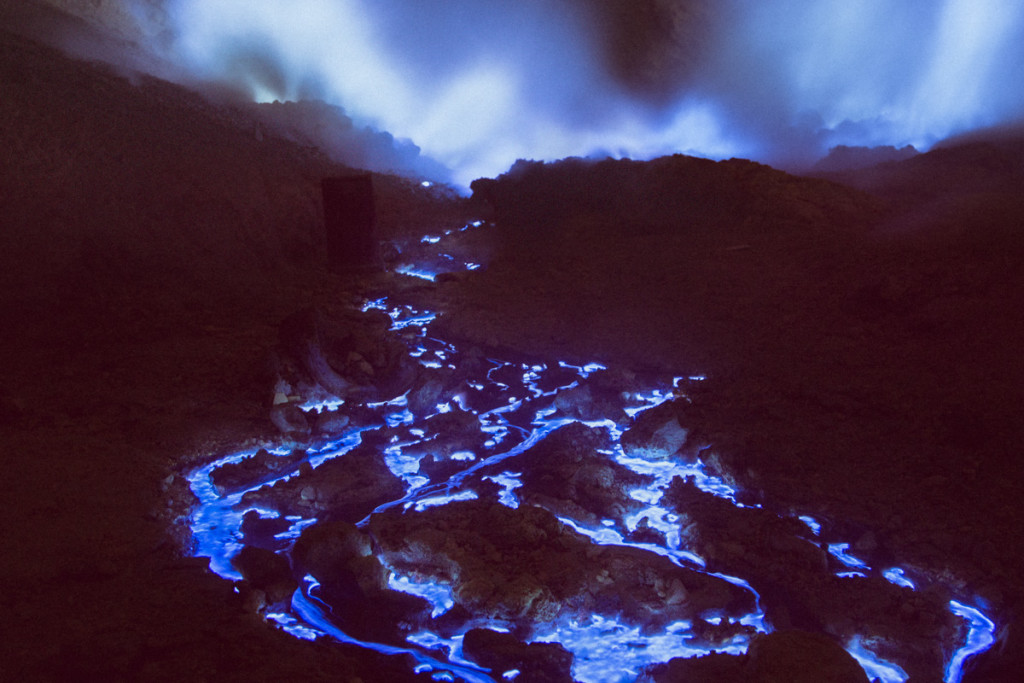
[Image: An only conceptually related photo from a volcano in Java, taken by Reuben Wu].

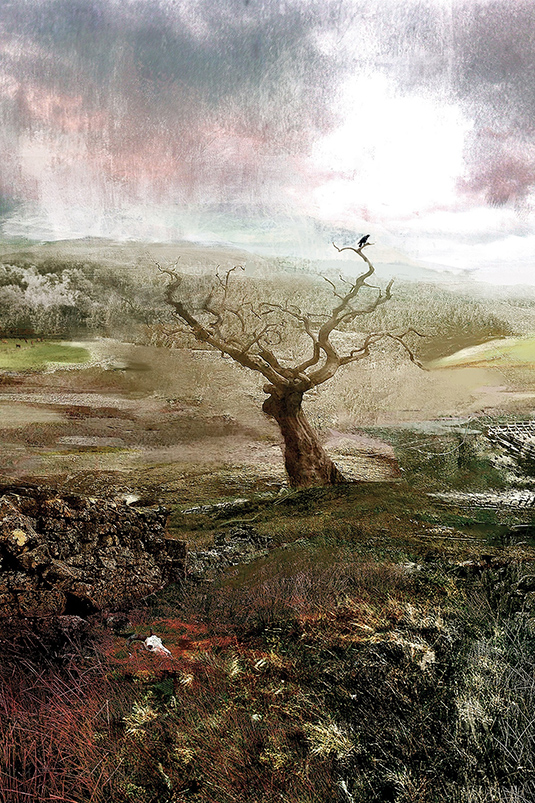
The invisibility of underground fires makes them particularly surreal and difficult to imagine: flames with no real room to flicker, moving slowly forward through the planet, relentlessly burning their way ever deeper into the landscape from below.

Whether that fire was caused by the ignition of a coal seam—as in Centralia or, my favorite example, in Australia’s Burning Mountain—or because subterranean strata of human-generated trash have caught fire, these events make for an especially spectral presence in the landscape. They remain entirely out of view except for the haze of their atmospheric effects, as they fill the air above with toxic gases.

This already strange phenomenon is hitting a whole new level of apocalyptic artificiality in a landfill outside St. Louis, Missouri. There, an underground fire is at risk of igniting old nuclear waste from U.S. weapons programs.

As the AP reports, “Beneath the surface of a St. Louis-area landfill lurk two things that should never meet: a slow-burning fire and a cache of Cold War-era nuclear waste, separated by no more than 1,200 feet.”

It’s worth pointing out that “the waste was illegally dumped in 1973 and includes material that dates back to the Manhattan Project, which created the first atomic bomb in the 1940s.” In many ways, then, this was an obvious problem just waiting to reassert itself.

An “emergency plan” has now kicked into gear to help fend off the potentially “catastrophic event” that would occur if these two things meet—the dormant deposit of nuclear waste and the respiring event of the underground fire.

In effect, this plan is a massive undertaking of design: it is landscape architecture as a tool against crisis.

New structures called “interceptor wells” are being constructed, for example, to maintain a kind of thermal quarantine line between the fire and the nuclear waste—however, the fire already appears to have circumvented these buffers, at least according to the AP. For example, some safety reports from the site have allegedly “found radiological contamination in trees outside the landfill’s perimeter,” implying that the nuclear waste has already, in at least some capacity, entered the biosphere, and “another showed evidence that the fire has moved past two rows of interceptor wells and closer to the nuclear waste.”

Yet another report ominously claims that the management company in charge of the landfill simply “does not have this site under control.”

This slow-burning apocalypse brings to mind our earlier look at writer Robert Macfarlane’s recent work on the vocabulary we use for certain landscapes, how words come and go over time and how spatial atmospheres can be verbally communicated.

Is there a proper landscape term for a subterranean catastrophe ready to burst through the surface of the world and forever change things for the worse in its immediate vicinity?

(Thanks to Ben Brockert and Kevin Iris for the tip!)

The Drowned World

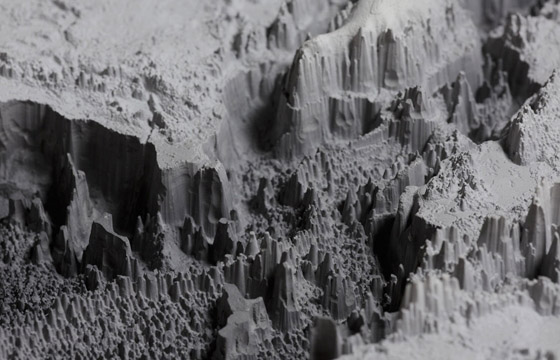
[Image: From Terra Forming: Engineering the Sublime by Adam Lowe and Jerry Brotton].

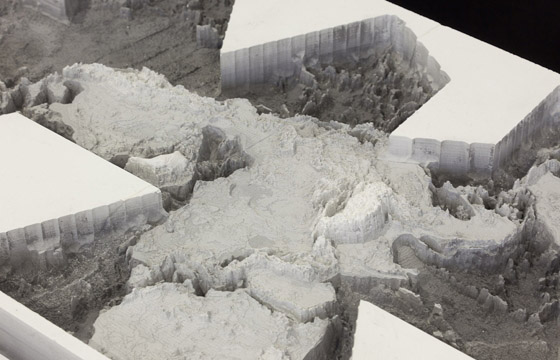
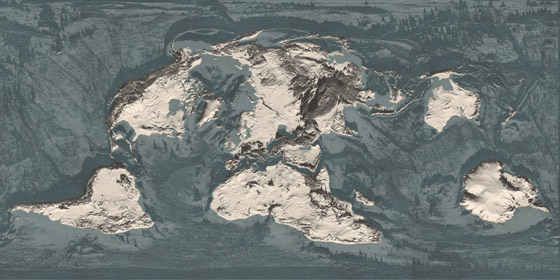
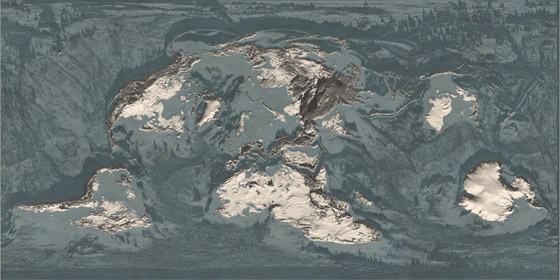
Artists Adam Lowe and Jerry Brotton’s project Terra Forming: Engineering the Sublime simultaneously explores the history of different geographic projections—including how these have been used to misrepresent and distort the earth’s surface—and at the future of that earth in an era of rising sea levels.

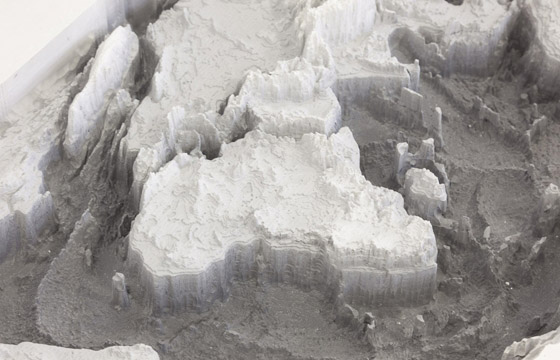
[Image: From Terra Forming: Engineering the Sublime by Adam Lowe and Jerry Brotton].

As Factum Arte explain, their chosen geographic projections offer “a way of engaging with the Earth from different points of view, and reflect historical ways of mapping the world from the Greeks to Google Earth.”

[Image: From Terra Forming: Engineering the Sublime by Adam Lowe and Jerry Brotton].

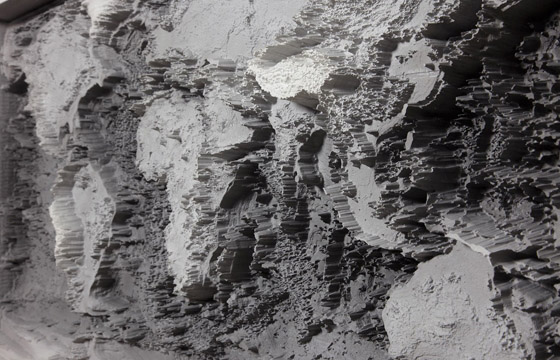
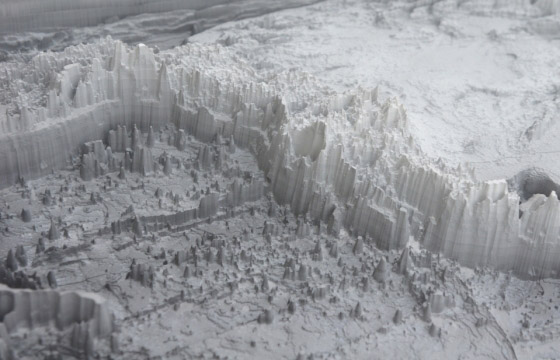
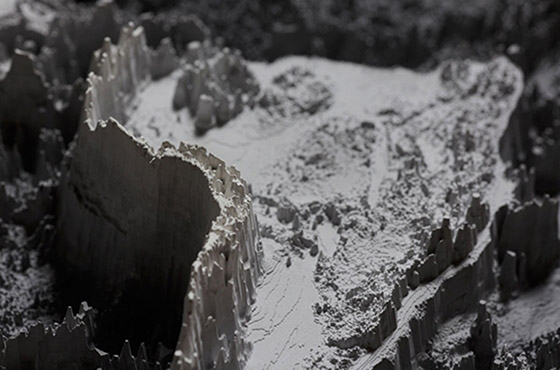
The projections are milled into beautiful 3D topographic models, with the vertical axis exaggerated to allow for changes in altitude to become visible.

The Andes, for example, become an abrupt spine of skyscraping pinnacles on the edge of an otherwise dead-flat continent, and deep-sea plains become spiky fields of underwater needles and pins.

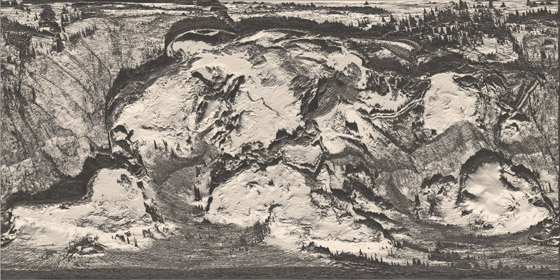
[Images: From Terra Forming: Engineering the Sublime by Adam Lowe and Jerry Brotton].

As the artists write, “distortion was used because without it the globe’s surface would appear almost totally flat”—which interestingly suggests that representational distortion, with a great deal of irony, is actually central to giving our planet geographic legibility.

To map it or to know it, the implication seems to be, you must first alter it.

[Image: From Terra Forming: Engineering the Sublime by Adam Lowe and Jerry Brotton].

This is only half the project, however.

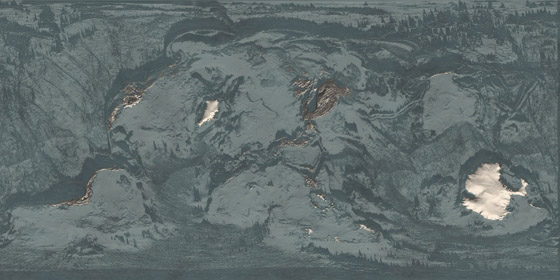
The artists refer to Terra Forming as “a cartographic response to the advent of the Anthropocene“—which is why the resulting topographic models are then flooded.

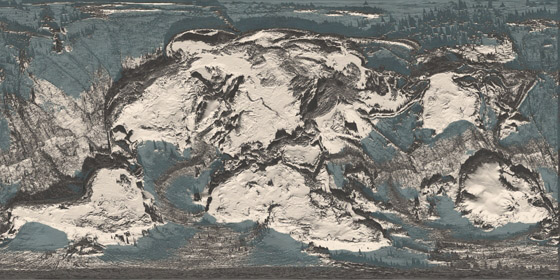
[Images: From Terra Forming: Engineering the Sublime by Adam Lowe and Jerry Brotton].

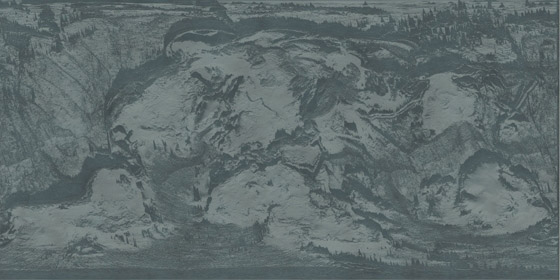
“The installation will mimic the passage of time as well as space,” Factum Arte write, “by flooding the world with water over several days, until we reach current sea levels; the world will then be flooded completely, leaving us with a drowned world, a prescient image for those parts of the world facing rising sea levels, as well as those such as parts of the Arabian Peninsula which is trying to reclaim land from the sea.”

You can watch a short video of the project’s gradual submergence on Vimeo—or embedded below.


And you can read much more about the project over at Factum Arte.

Liquid Quarries and Reefs On Demand

[Image: Micromotors at work, via UCSD/ScienceDaily].

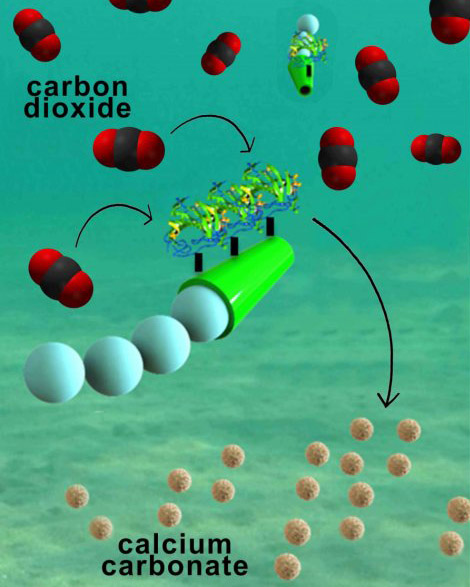
Tiny machines that can extract carbon dioxide from water might someday help deacidify the oceans, according to a press release put out last week by UCSD.

Described as “micromotors,” the devices “are essentially six-micrometer-long tubes that help rapidly convert carbon dioxide into calcium carbonate, a solid mineral found in eggshells, the shells of various marine organisms, calcium supplements and cement.”

While these are still just prototypes, and are far from ready actually to use anywhere in the wild, they appear to have proven remarkably effective in the lab:

In their experiments, nanoengineers demonstrated that the micromotors rapidly decarbonated water solutions that were saturated with carbon dioxide. Within five minutes, the micromotors removed 90 percent of the carbon dioxide from a solution of deionized water. The micromotors were just as effective in a sea water solution and removed 88 percent of the carbon dioxide in the same timeframe.

The implications of this for marine life are obviously pretty huge—after all, overly acidic waters mean that shells are difficult, if not impossible, to form, so these devices could have an enormously positive effect on sea life—but these devices could also be hugely useful in the creation of marine limestone.

As UCSD scientists explain, the micromotors would “rapidly zoom around in water, remove carbon dioxide and convert it into a usable solid form.” A cloud of these machines could thus essentially precipitate the basic ingredients of future rocks from open water.

[Image: A Maltese limestone quarry, via Wikipedia].

At least two possibilities seem worth mentioning.

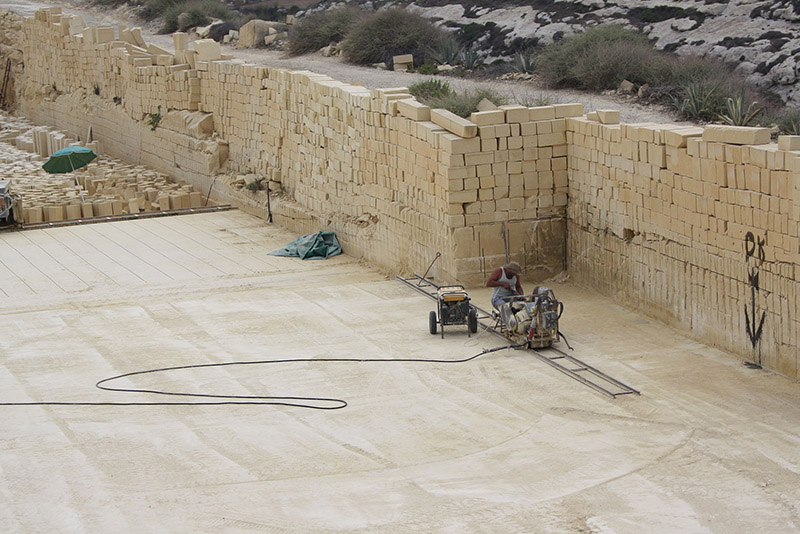
One is the creation of a kind of liquid quarry out of which solid rock could be extracted—a square mile or two of seawater where a slurry of calcium carbonate would snow down continuously, 24 hours a day, from the endless churning of invisible machines. Screen off a region of the coast somewhere, so that no fish can be harmed, then trawl those hazy waters for the raw materials of future rock, later to be cut, stacked, and sold for dry-land construction.

The other would be the possibility of, in effect, the large-scale depositional printing of new artificial reefs. Set loose these micromotors in what would appear to be a large, building-sized teabag that you slowly drag through the ocean waters, and new underwater landforms slowly accrete in its week. Given weeks, months, years, and you’ve effectively 3D-printed a series of new reefs, perfect for coastal protection, a new marine sanctuary, or even just a tourist site.

In any case, read more about the actual process over at UCSD or ScienceDaily.

Forest Megaphone

[Image: Photo by Tõnu Tunnel].

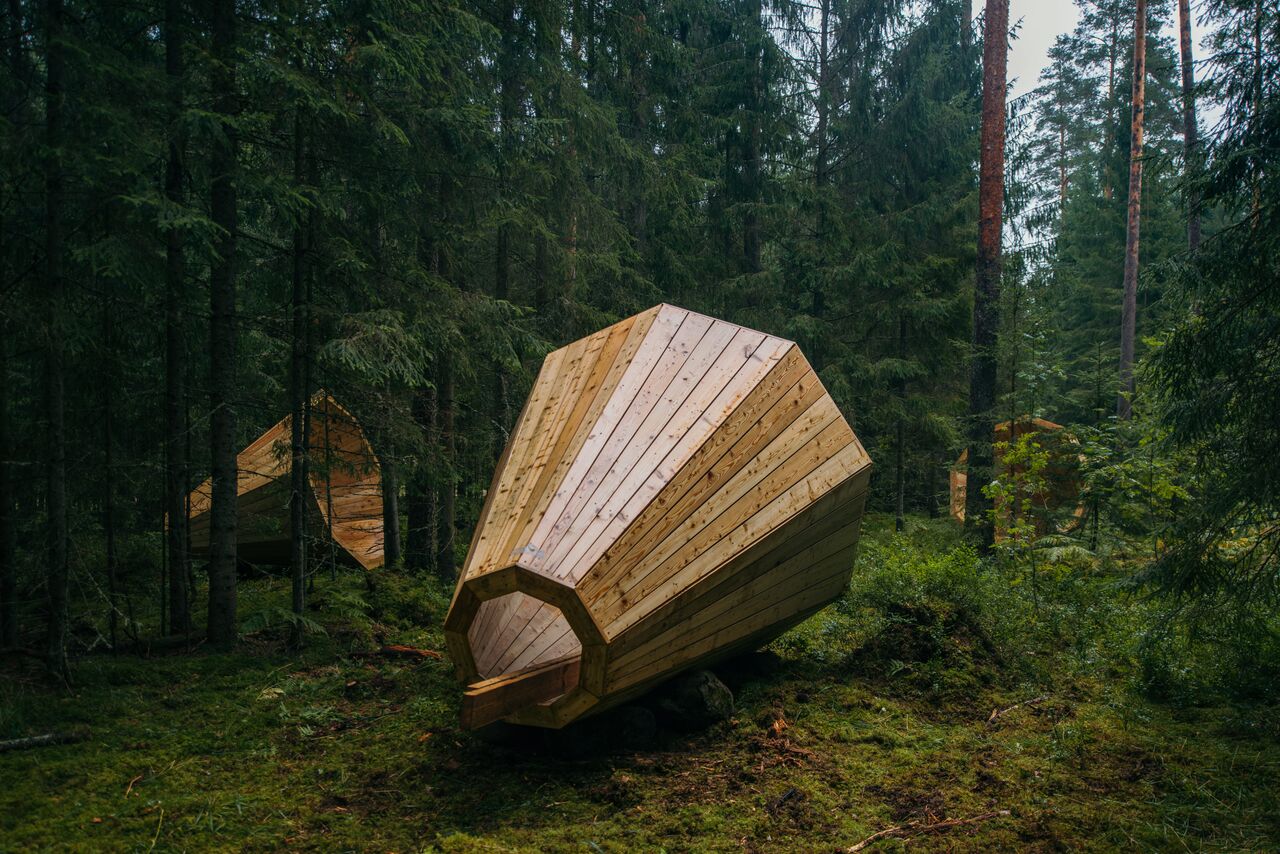
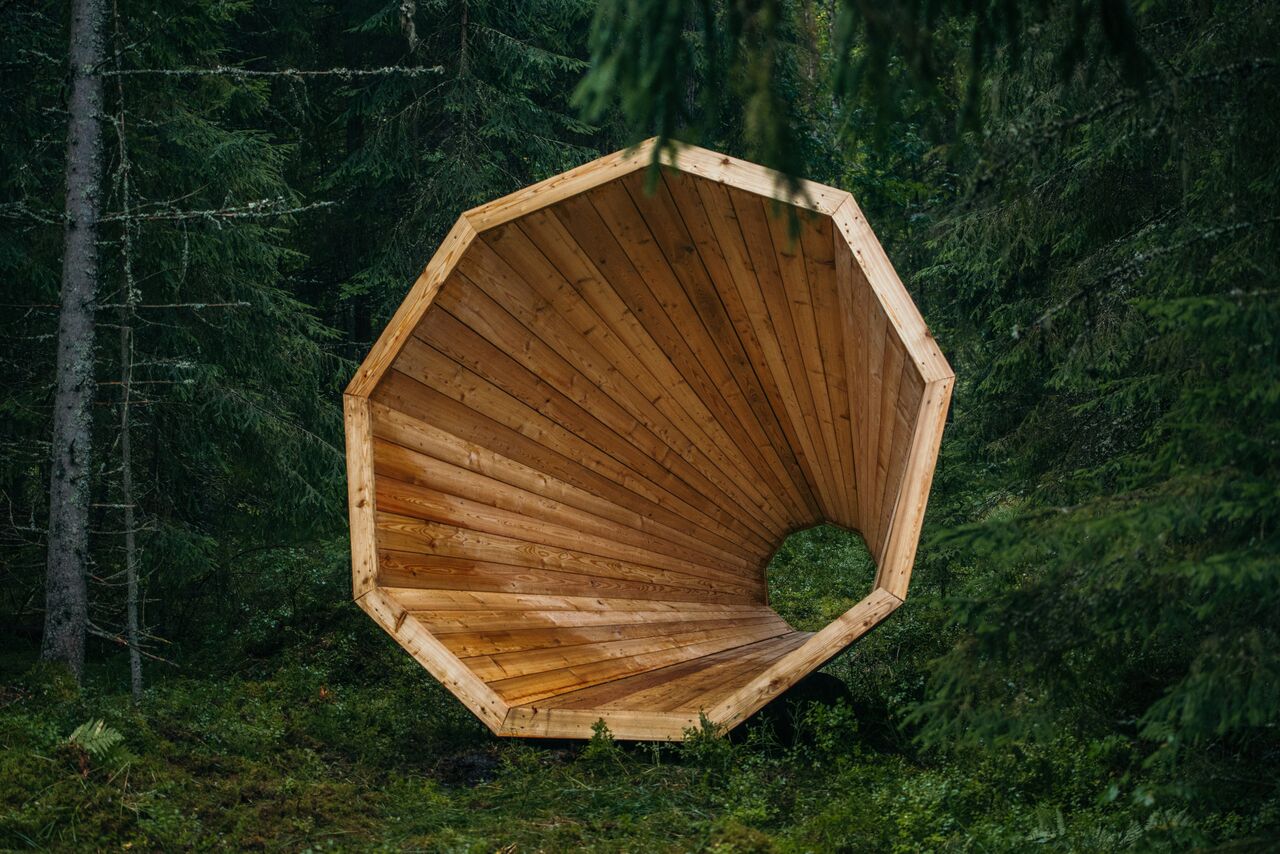
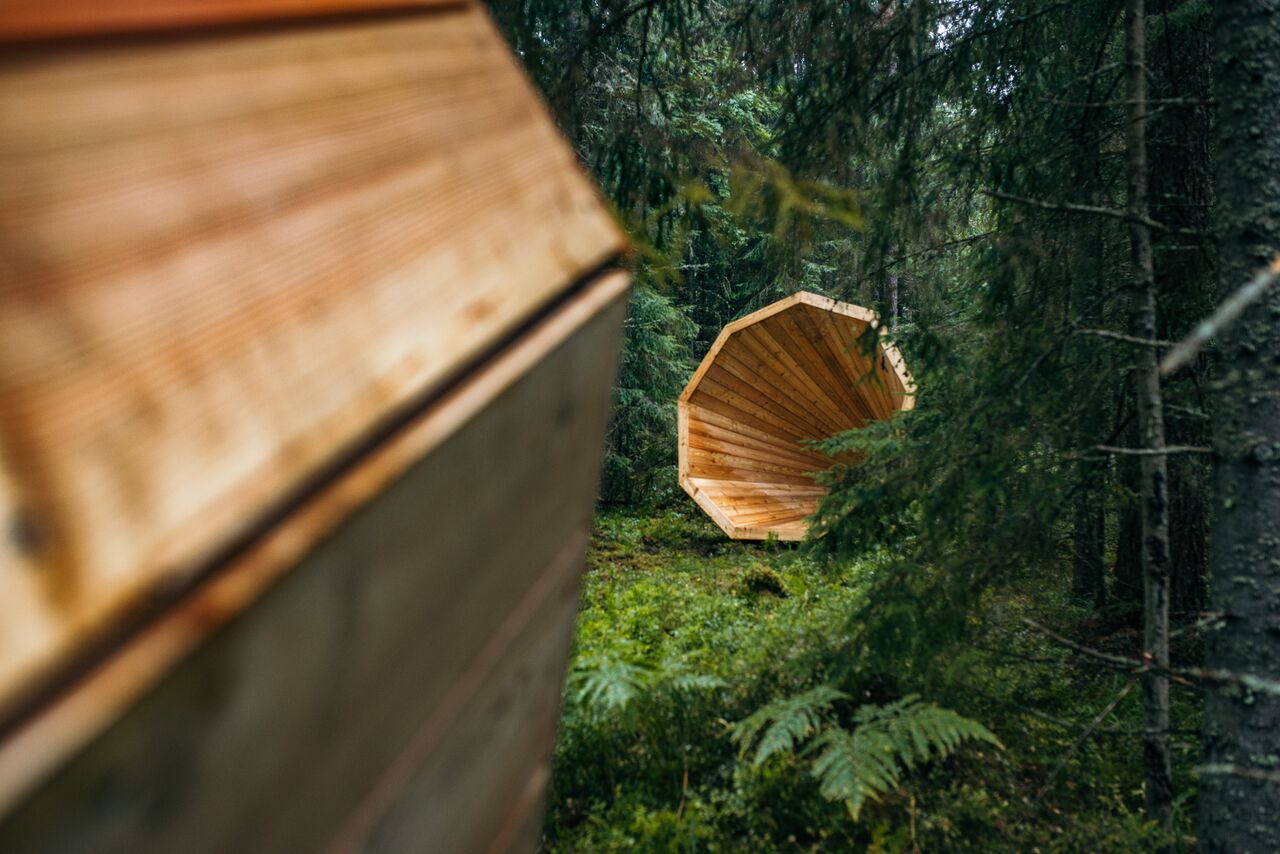
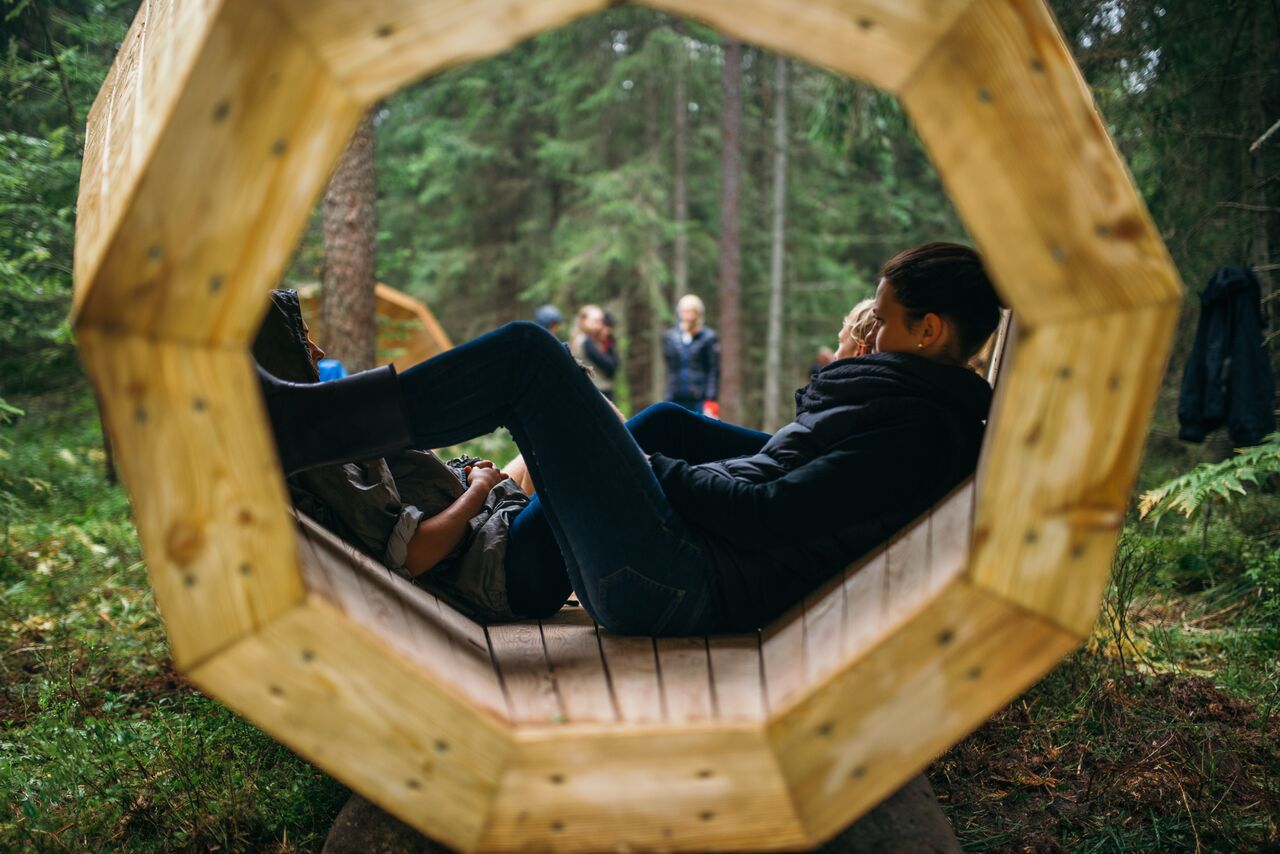
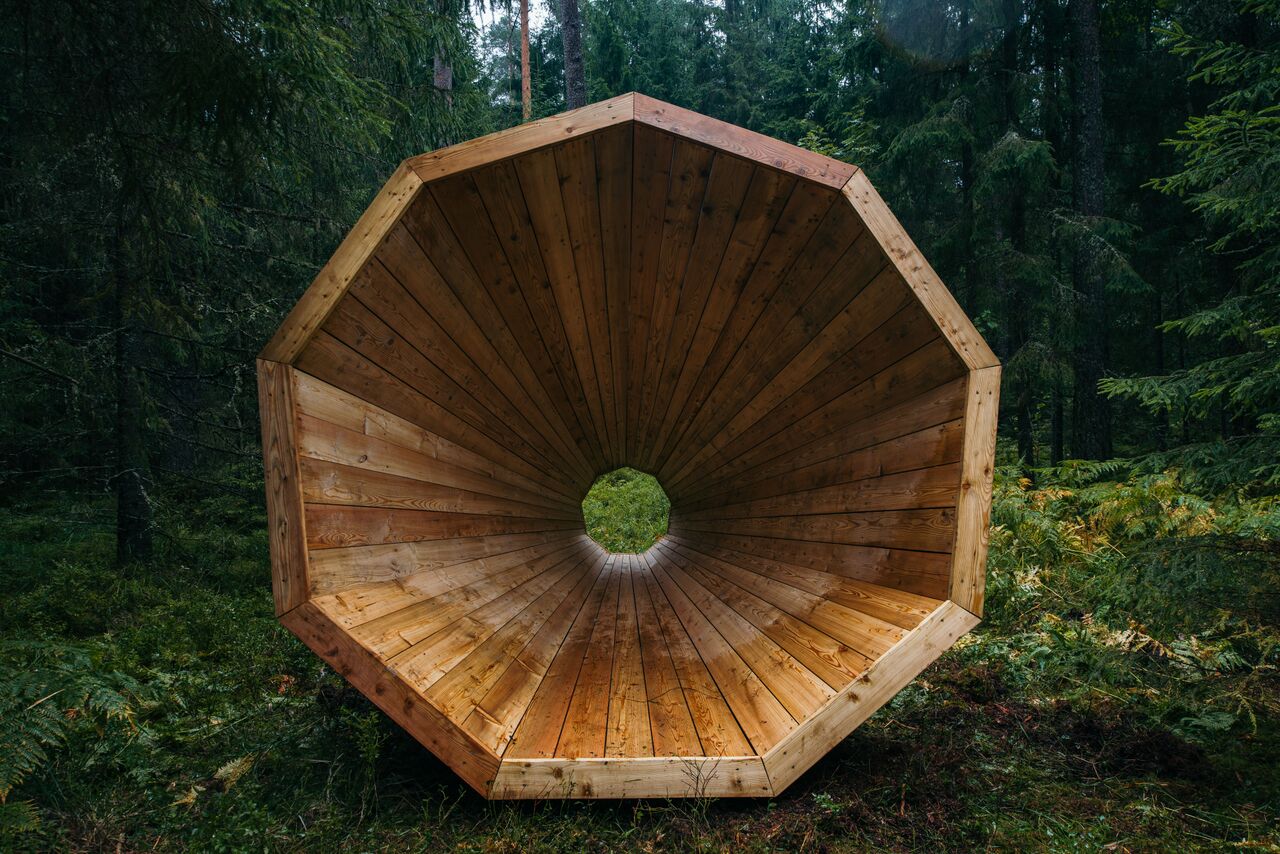
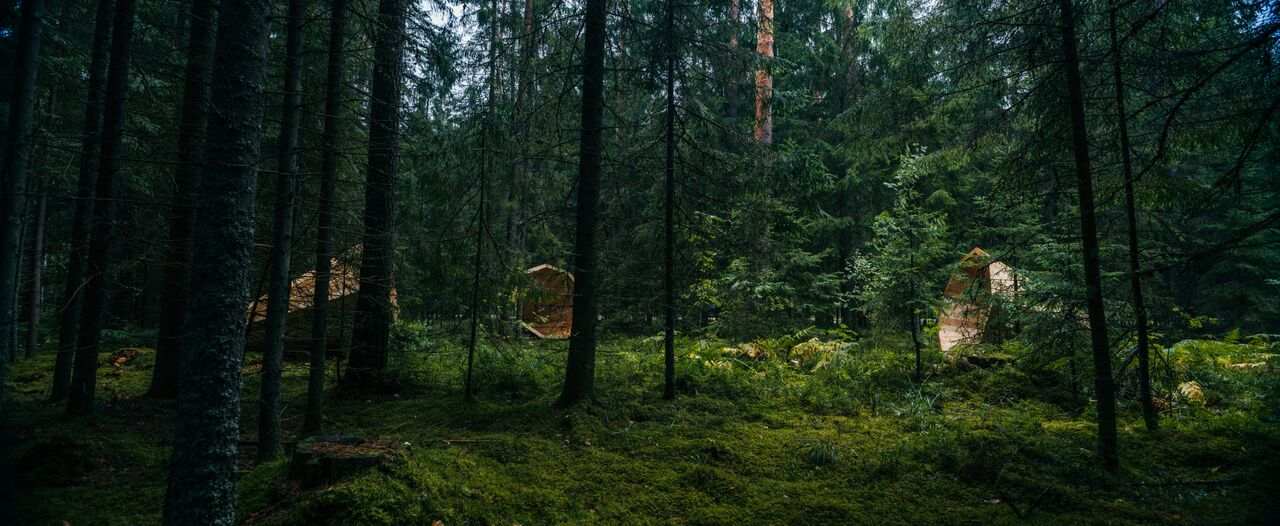
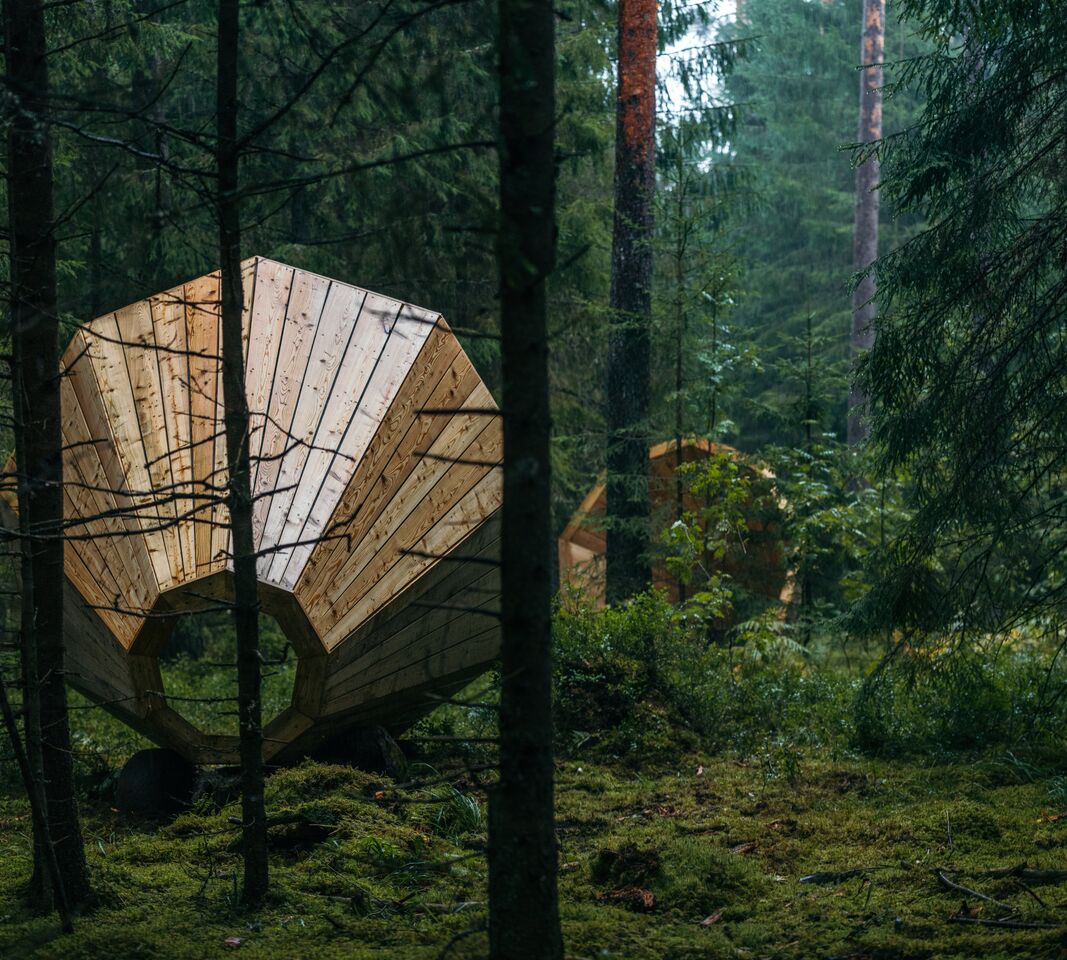
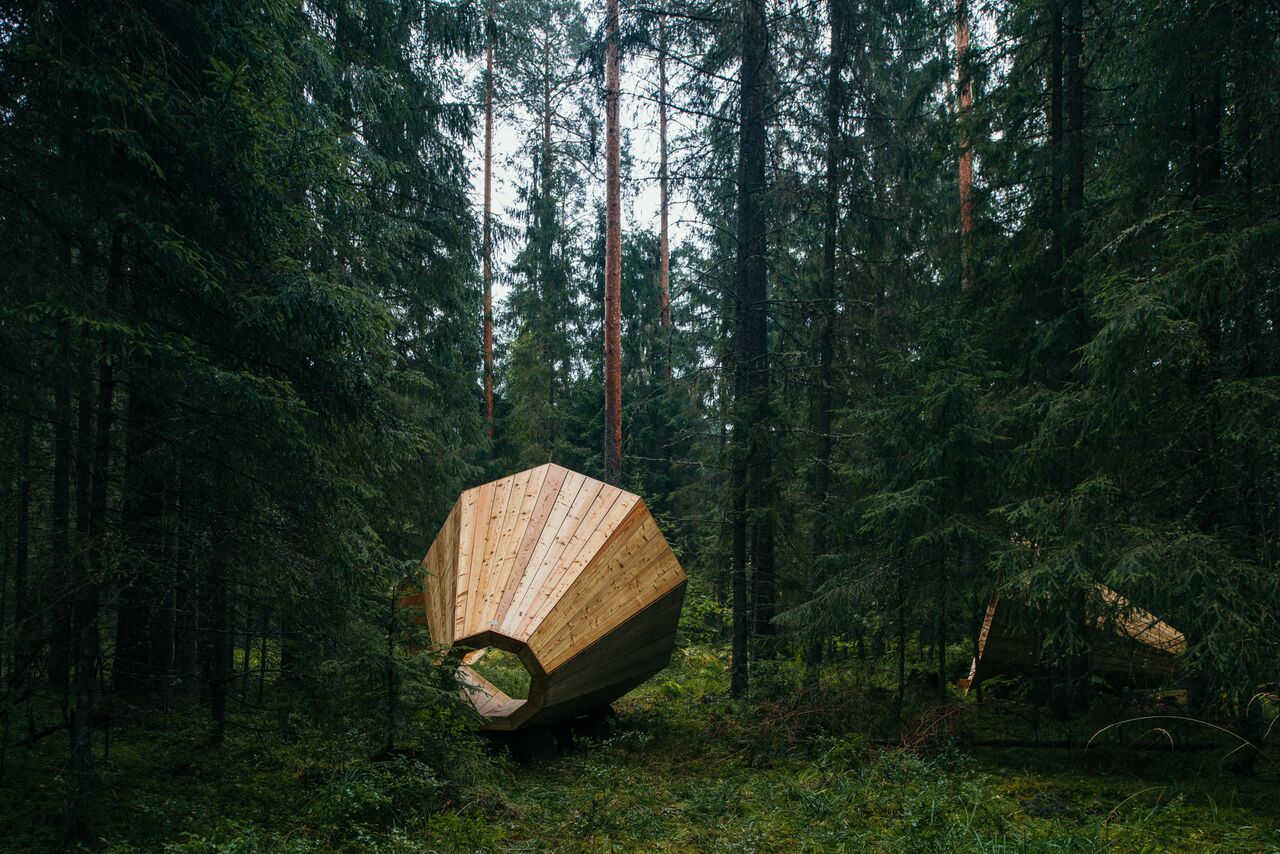
These architectural objects are “gigantic wooden megaphones” for the forest, part of an acoustic installation in Estonia’s gorgeous Pähni Nature Centre for amplifying the sounds of the landscape.

[Image: Photo by Tõnu Tunnel].

“According to interior architect Hannes Praks,” we read in a newly published press release, “who leads the Interior Architecture Department of the [Estonian Academy of Arts] that initiated the installation project, the three-metre diameter megaphones will operate as a ‘bandstand’ for the forest around the installation, amplifying the sounds of nature.”

The actual design is by a student named Birgit Õigus.

[Image: Photo by Tõnu Tunnel].

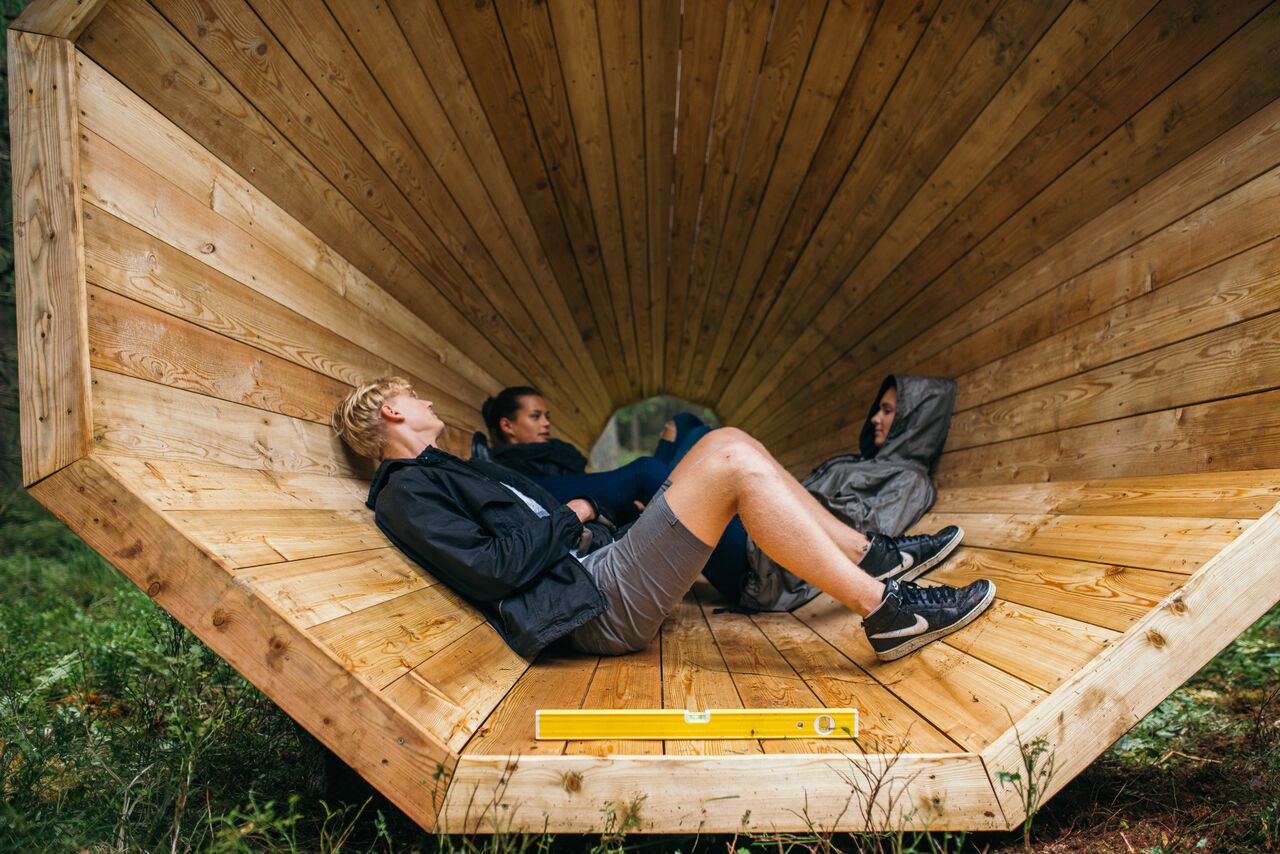
Part building, part furniture, part recreational folly, they’re meant to focus visitor attention on the smallest acoustic details of the site—rainfall, branches brushing against one another in the breeze, distant footsteps, thunder.

[Image: Photos by Tõnu Tunnel].

Sit in them, read books, whisper to friends, listen to birds.

[Image: Photo by Tõnu Tunnel].

Not having visited these in person, I can’t speak to their performance—i.e. whether they function as planned—and the relatively orderly placement of each structure in the woods might very well lead to some unfortunately conservative acoustic effects.

[Image: Photo by Tõnu Tunnel].

Nonetheless, it’s a great idea for a project, and the geometric simplicity of the stained timber frame is compelling.

[Image: Photo by Tõnu Tunnel].

Of course, these bring to mind the so-called “acoustic mirrors” of coastal Britain that we looked at here more than a decade ago.

[Image: Photo by Tõnu Tunnel].

In turn, makes me wonder how these forest megaphones might appear six or seven decades from now, when small groups of hikers stumble upon the moss-covered forms of this old acoustic infrastructure, trying to determine amongst themselves if the strange audio effects and interrupted echoes they notice still filtering through the wooden forms are a curious accident or an engineered goal.

[Image: Photo by Tõnu Tunnel].

Typographic Forestry and Other Landscapes of Translation

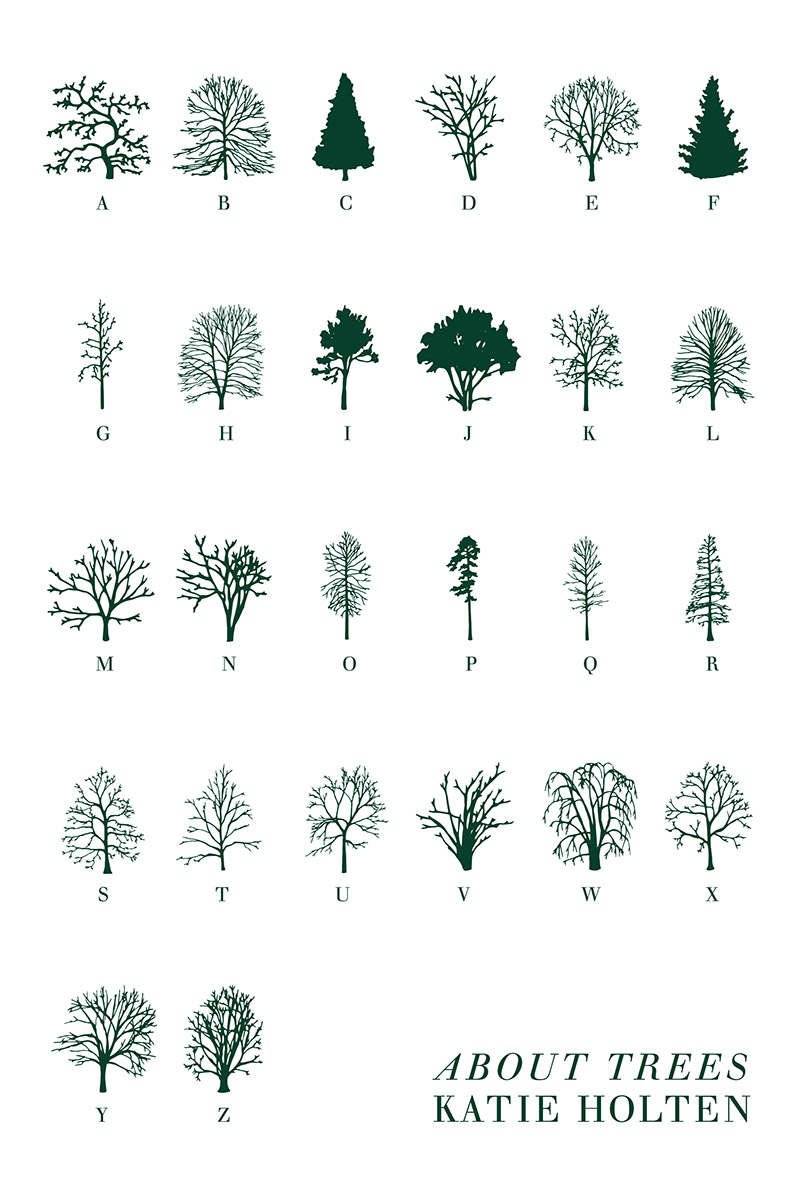
[Image: The cover for About Trees, edited by Katie Holten].

Artist Katie Holten—who participated in “Landscapes of Quarantine” a few years back—has just published an interesting book called About Trees.

It is essentially an edited compilation of texts about, yes, trees, but also about forests, landscapes of the anthropocene, unkempt wildness, altered ecosystems, and, more broadly speaking, the idea of nature itself.

It ranges from short texts by Robert Macfarlane—recently discussed here—to James Gleick, and from Amy Franceschini to Natalie Jeremijenko. These join a swath of older work by Jorge Luis Borges, with even Radiohead (“Fake Plastic Trees”) thrown in for good measure.

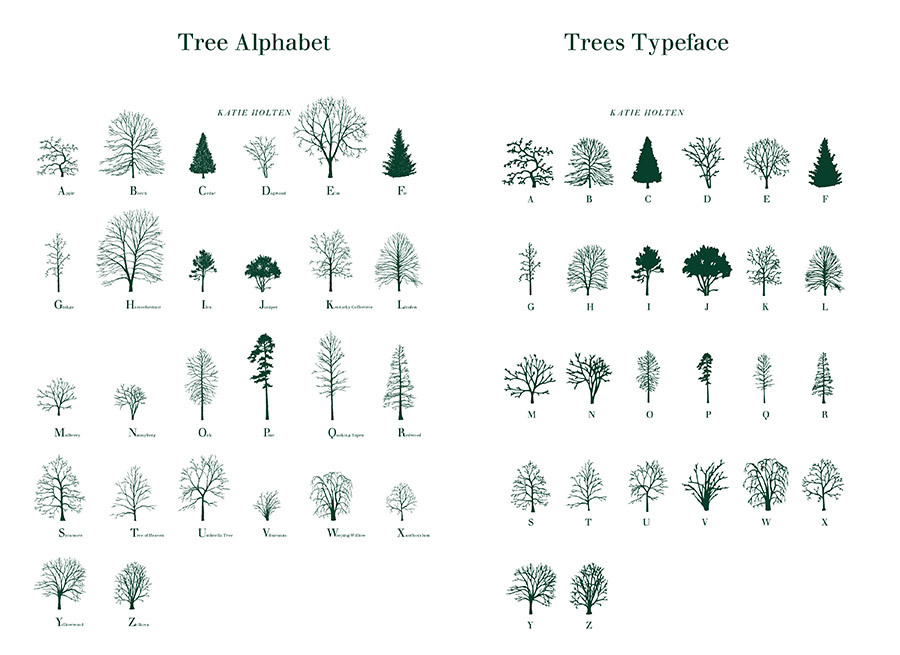
It’s an impressively nuanced selection, one that veers between the encyclopedic and the folkloric, and it has been given a great and memorable graphic twist by the fact that Holten, working with designer Katie Brown, generated a new font using nothing less than the silhouettes of trees.

Every letter of the alphabet corresponds to a specific species of tree.

[Image: The tree typeface from About Trees, edited by Katie Holten].

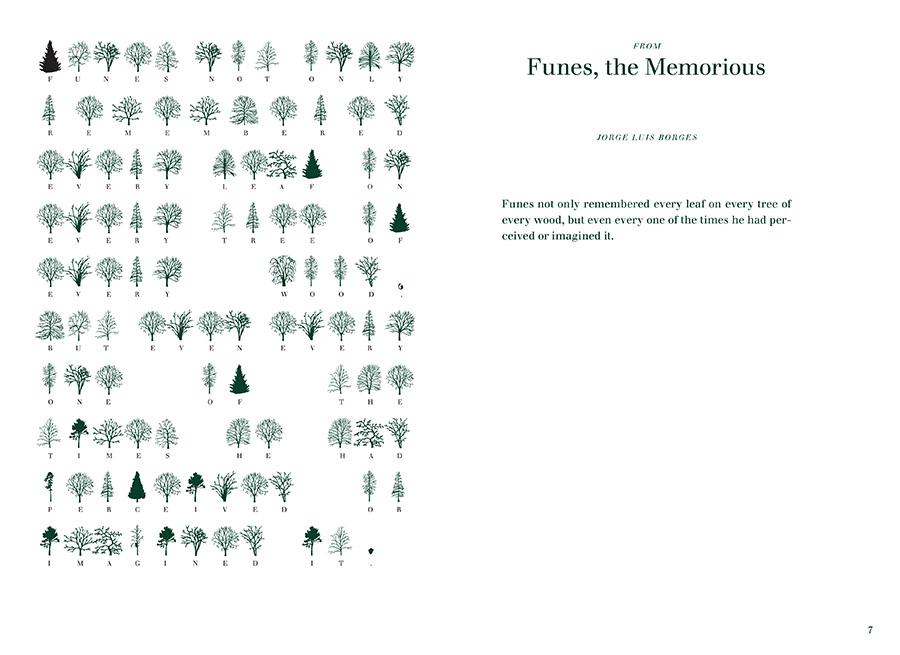
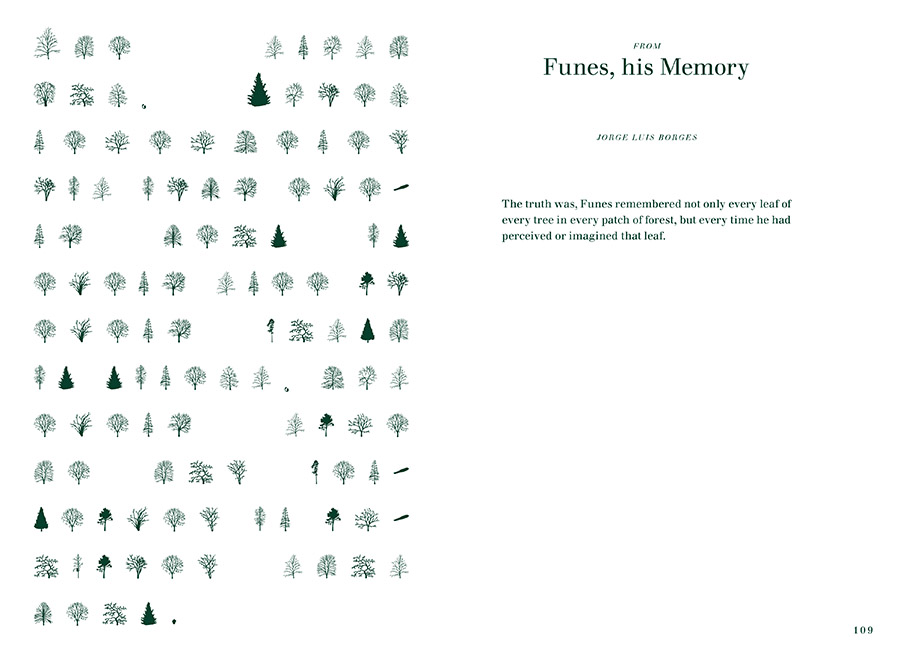
This has been put to good use, re-setting the existing texts using this new font—with the delightful effect of seeing the work of Jorge Luis Borges transcribed, in effect, into trees.

This has the awesome implication that someone could actually plant this: a typographic forestry of Borges translations.

[Image: Borges, translated into trees, from About Trees].
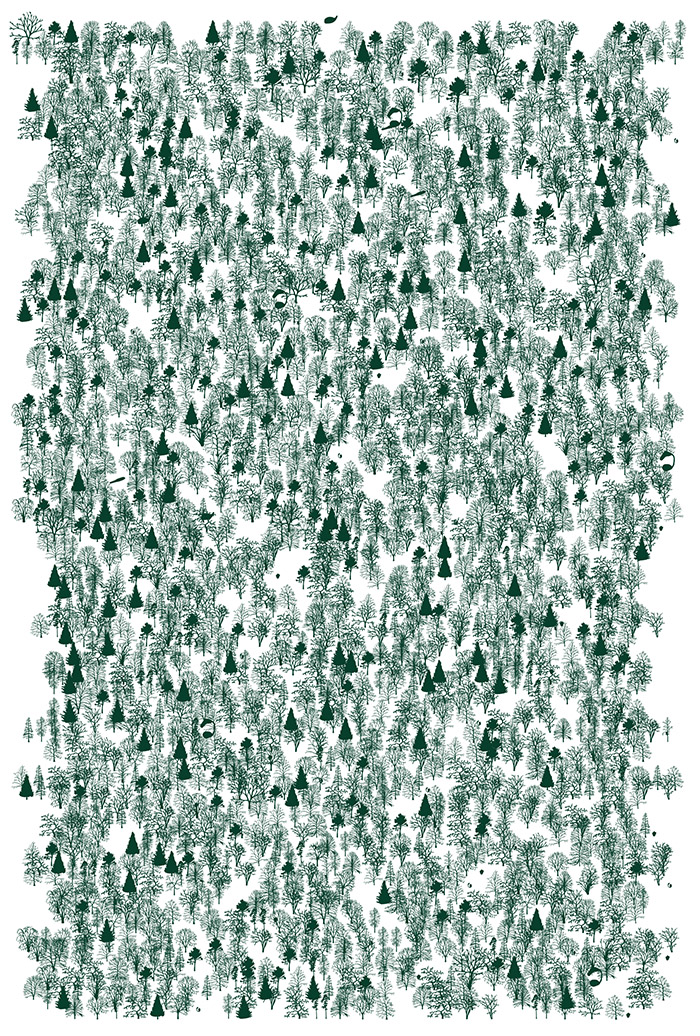
Speculative short stories realized as ornamental thickets in the backyards of arboreally inclined landowners.

Given all the urban parks, hedge mazes, and scientifically accurate themed gardens of the world—two of my favorites being the exquisite Silver Garden at Longwood Gardens and the scifi otherworldliness of the Desert Garden at the Huntington—surely there is room for a kind of translation landscape?

Stories and fables—koans, slogans, poems, wisecracks—planted as cryptoforests, literary labyrinths you could somehow, impossibly, read provided you know what each species is meant to signify.

Just take Holten’s typeface as a new kind of planting guide, and see what landscapes might result.

[Image: From About Trees].

Holten’s About Trees is available for purchase, of course, if you want to check it out; in the meantime, I’ll keep my fingers crossed that someone actually implements a typographic grove somewhere, a planted language of texts flipped into readable tree-signs, sequenced using the font from About Trees.

In fact, recall the myth of Odin discovering the Nordic runes: hanging upside-down from a tree and mistaking, in the especially complicated carpet of roots sprawled out beneath him, the beginnings of a new typeface, an arboreal symbol system that could be written down and shared with others. Runes came from roots—and, as Holten implies, every tree contains a library.

“It’s almost like he wanted to collect every map ever made”

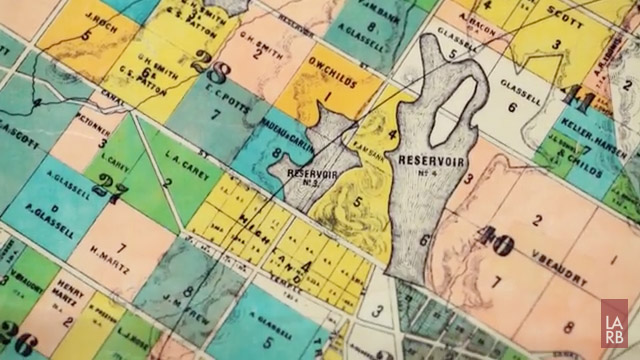
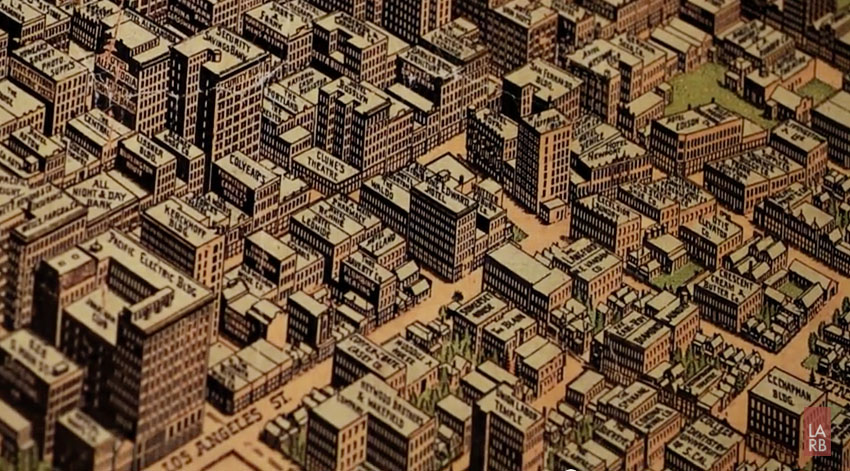
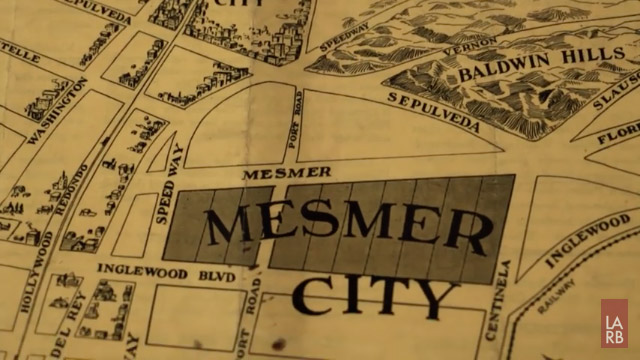
Alec Earnest recently made an interesting documentary about a house in Los Angeles whose owner died, leaving behind a personal map collection so massive that, upon being acquired by the city’s public library, “it doubled the LAPL’s collection in a single day.”

When LAPL map librarian Glen Creason, interviewed for the film, first entered the house, his jaw dropped; “everywhere I looked in the house, there’s maps,” he explains in the film, including an entire floor that was “absolutely wall to wall with street guides.”

[Image: From Living History: The John Feathers Map Collection by Alec Earnest].

As the Los Angeles Times described Feathers’s house upon its discovery back in 2012, it held “tens of thousands of maps. Fold-out street maps were stuffed in file cabinets, crammed into cardboard boxes, lined up on closet shelves and jammed into old dairy crates. Wall-size roll-up maps once familiar to schoolchildren were stacked in corners. Old globes were lined in rows atop bookshelves also filled with maps and atlases.”

It went on and on and on: “A giant plastic topographical map of the United States covered a bathroom wall and bookcases displaying Thomas Bros. map books and other street guides lined a small den.”

Urban atlases, motoring charts, pre-Thomas Guide local street maps—Feathers collected seemingly any cartographic ephemera he could get his hands on.

[Image: From Living History: The John Feathers Map Collection by Alec Earnest].

Earnest’s short film has more information about Feathers himself, and can seen in full either above or over on YouTube.

Although the story of the collection would lend itself well to longer journalistic exploration—and map librarian Glen Creason has actually written up some thoughts for Los Angeles Magazine—it feels like an amazing jumping off point for a piece of fiction, either cinematic or literary.

Perhaps some sort of Chinatown or True Detective-like property speculation noir, where parcels of land and off-books deals are being tracked by a lone collector through generations of local maps, marking boundaries, street names, omissions; or perhaps something more like “X Marks the Spot,” where an old Spanish-affiliated property from the pre-Los Angeles era is rumored to have once had vast brick vaults stocked high with gold, buried beneath the main ranch house, a property long since absorbed into the supergrid of Greater Los Angeles… but the vaults are still down there—along with the gold—if only you can dig up the right map to go find it.

[Image: From Living History: The John Feathers Map Collection by Alec Earnest].

In fact, there could be a whole genre based purely on the unexpected narrative side-effects of people attempting—and failing—to map Los Angeles.

Abandoned Basements as Stormwater Basins

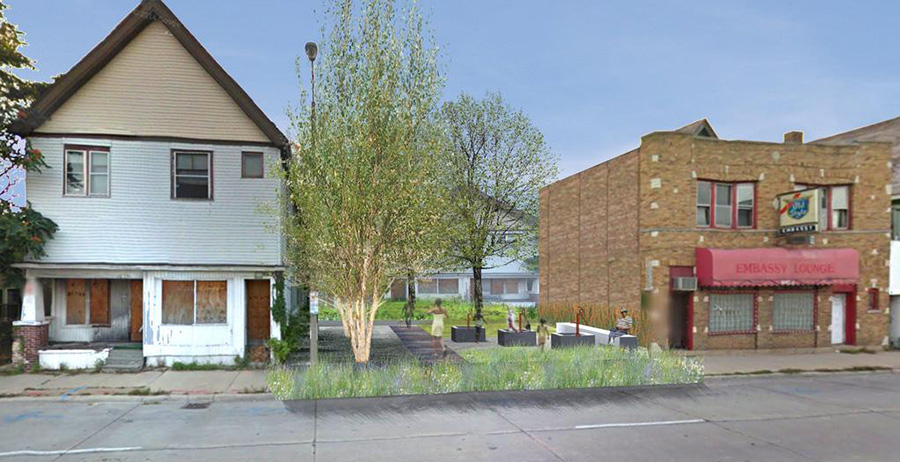
[Image: Rendering of a possible “BaseTern” landscape by students Brett Harris, Andrew D’Arcy, and Heidi Petersen, via Landscape Architecture Magazine].
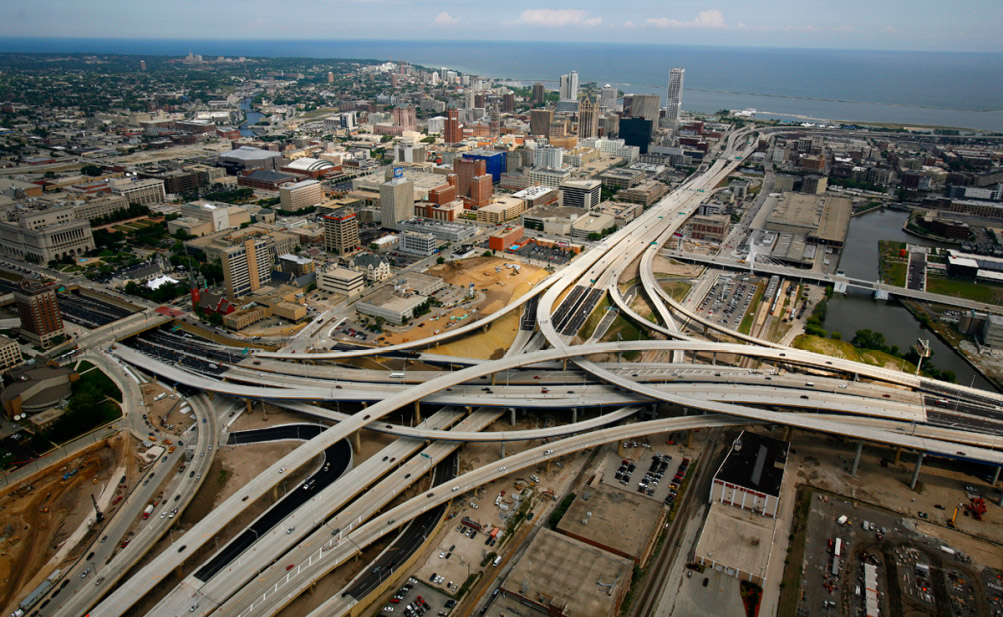
Not all the news coming out of Milwaukee involves misguided highway megaprojects or tax-funded crony capitalism—though there is that.

For example, Wisconsin governor Scott Walker—confusing an earlier generation’s urban mistakes with how a city is meant to function—has been plowing billions of dollars’ worth of taxpayer money into “freeway megaprojects” for which “the pricetag got so big that leaders from his own party rejected his plan as fiscally irresponsible, leaving the state budget in limbo,” Politico reports:

As the state has shifted resources into freeway megaprojects, 71 percent of [Wisconsin’s] roads are in mediocre or poor condition, according to federal data. Fourteen percent of its bridges are structurally deficient or functionally obsolete, which is actually better than the national average. Walker and his fellow Republicans have killed plans for light rail, commuter rail, high-speed rail, and dedicated bus lanes on major highways, so there is almost no public transportation connecting Milwaukee to its suburbs, intensifying divisions in one of the nation’s most racially, economically and politically segregated metropolitan areas. Yet Walker, who is running for president as a staunch fiscal conservative, has pushed a $250 million-per-mile plan to widen Interstate 94 between the Marquette and the Zoo despite fierce local opposition.

If that sounds both avoidable and unfortunate, consider the fact that “Walker also killed a ‘Complete Streets’ program that pushed road builders to accommodate bicyclists and pedestrians.”

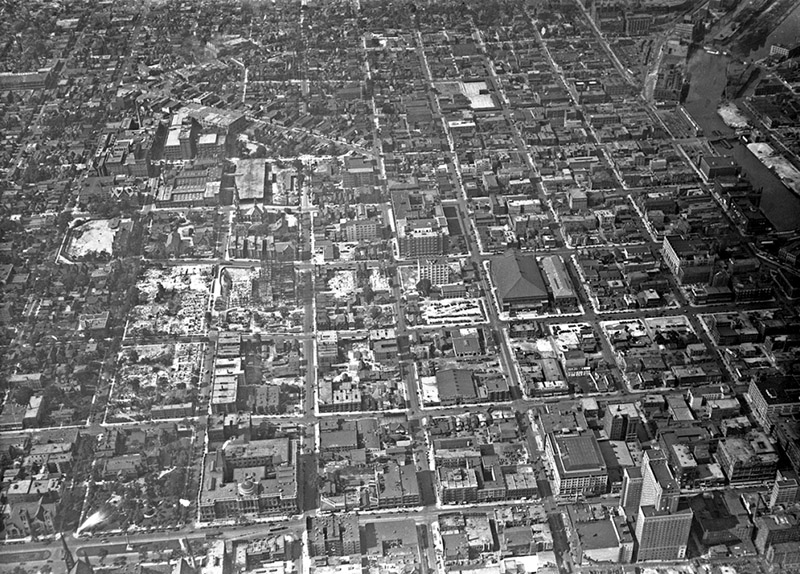
[Images: (top) Milwaukee’s Marquette interchange, nearly the same size as the city it cuts through; (bottom) Milwaukee before the interchange. Images via Politico].

At the same time, Walker has also “championed a high-profile proposal to spend a quarter of a billion dollars of taxpayer money to help finance a new Milwaukee Bucks arena—all while pushing to slash roughly the same amount from state funding for higher education,” the International Business Times reports.

But, hey, why does Wisconsin need universities when everyone can just go to an NBA game? Not that benefitting the public is even Walker’s goal: “One of those who stands to benefit from the controversial initiative is a longtime Walker donor and Republican financier who has just been appointed by the governor to head his presidential fundraising operation.”

In any case, an interesting landscape test-project is currently underway in Milwaukee, called the “BaseTern” program.

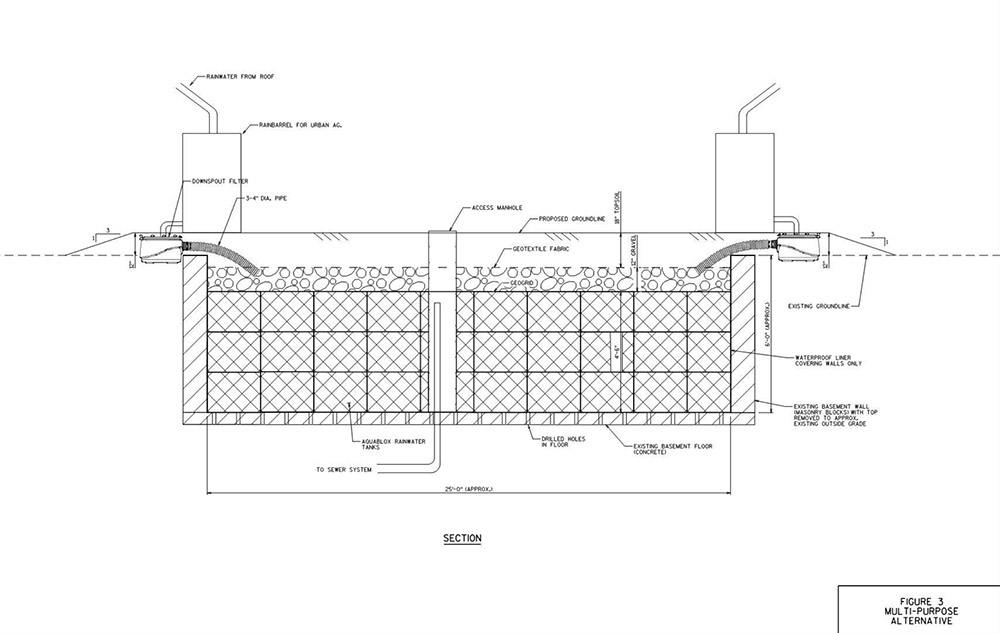
As the city explains it, a “BaseTern” is “an underground stormwater management or rainwater harvesting structure created from the former basement of an abandoned home that has been slated for demolition.” Why is the city doing this?

By using abandoned basements, the City saves the cost of demolition on these structures (filing the basement and grading the surface) and on excavation for the new structure. In addition, BaseTerns provide significant stormwater storage capacity on a single site, the equivalent of up to 600 rain barrels.

The result, the city is keen to add, is “not an open pit. Rather a BaseTern is a covered structure, which is covered with topsoil and grass, and will appear the same as conventional vacant lot.”

In their July 2015 issue, Landscape Architecture Magazine explained that this is, in fact, “the world’s first such system.” Conceived—and actually trademarked—by a city official named Erick Shambarger, the idea was inspired by a GIS-fueled discovery that the worst flooding in the city always “occurred in neighborhoods with high rates of foreclosures. The city controls roughly 900 foreclosed properties, many of which it plans to demolish. Shambarger figured the city could preserve the basement structure and put it to use.”

[Images: Two BaseTern design diagrams, taken from Milwaukee’s “Vacant Basements for Stormwater Management Feasibility Study“].

While there is something metaphorically unsettling in the idea that parts of a blighted, financially underwater neighborhood might soon literally be underwater—transformed into a kind of urban sponge for the rest of Milwaukee—the notion that the city can discover in its own economic misfortune a possible new engineering approach for dealing with seasonal flooding and super-storms is an inspiring thing to see.

The BaseTern program also potentially suggests a stopgap measure for coastal cities set to face rising sea levels well within the lifetimes of the coming generation.

In the all but inevitable managed retreat from the coast that seems set to kick off both en masse and in earnest by midcentury—something that is already happening in New York City, post-Sandy—perhaps the subterranean ruins of old neighborhoods left behind can be temporarily repurposed as minor additions to a broader coastal program intent on reducing flooding for residents further inland.

Before, of course, those underground voids—former guest bedrooms, dens, man caves, she sheds, and basements—are inundated for good.

Read more about BaseTerns over at Landscape Architecture Magazine.

Joyful Rendezvous Upon Pure Ice and Snow

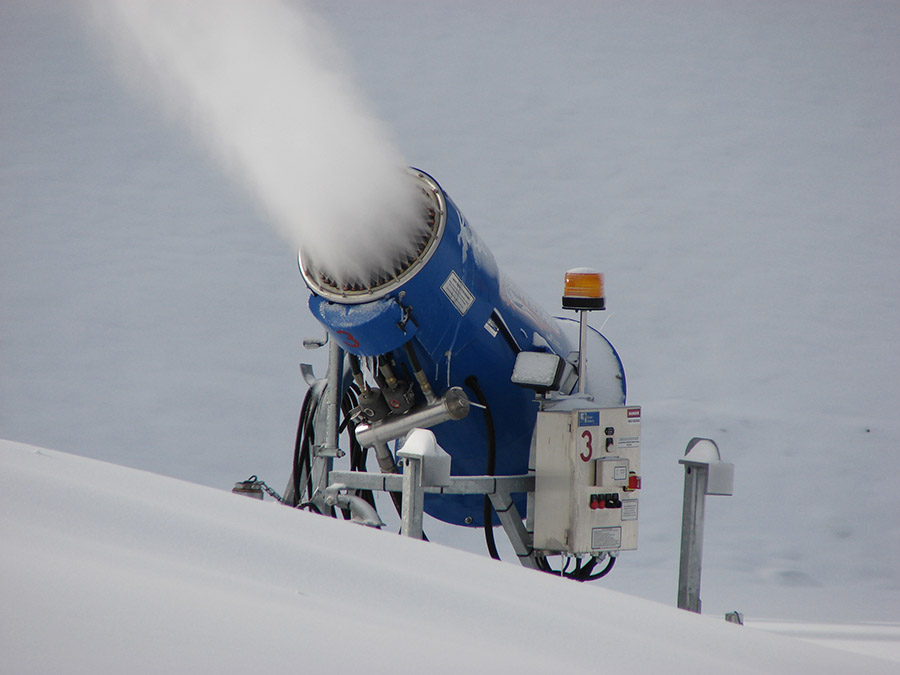
[Image: Snow-making equipment via Wikipedia].

The 2022 Winter Olympics in Beijing are something of a moonshot moment for artificial snow-making technology: the winter games will be held “in a place with no snow.” That’s right: “the 2022 Olympics will rely entirely on artificial snow.”

As a report released by the International Olympic Committee admits, “The Zhangjiakou and Yanqing Zones have minimal annual snowfall and for the Games would rely completely on artificial snow. There would be no opportunity to haul snow from higher elevations for contingency maintenance to the racecourses so a contingency plan would rely on stockpiled man-made snow.”

This gives new meaning to the word snowbank: a stock-piled reserve of artificial landscape effects, an archive of on-demand, readymade topography.

Beijing’s slogan for their Olympic bid? “Joyful Rendezvous upon Pure Ice and Snow.”

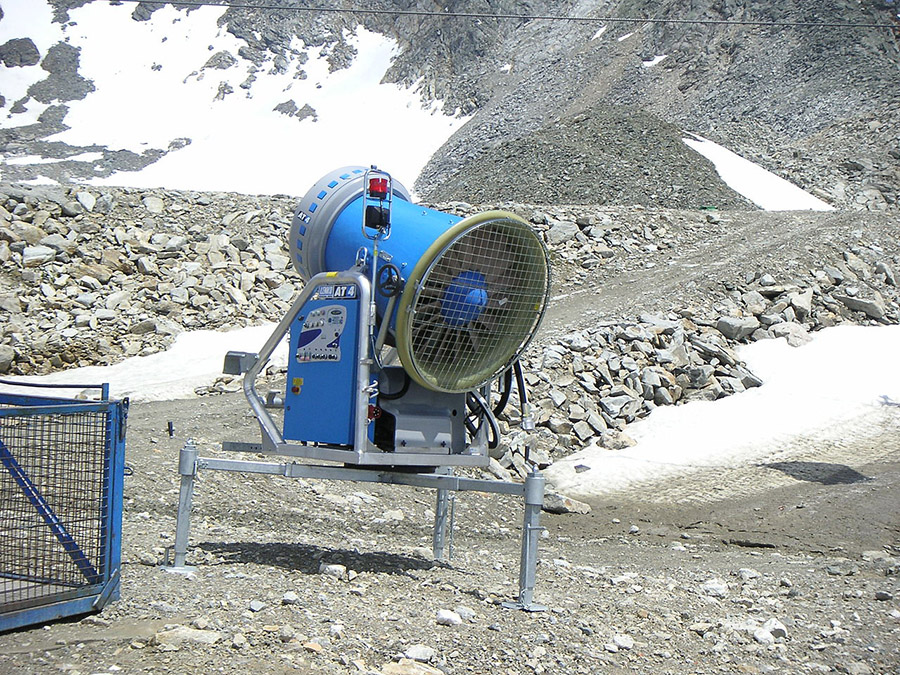
[Image: Snow-making equipment via Wikipedia].

Purely in terms of energy infrastructure and freshwater demand—most of the water will be pumped in from existing reservoirs—the 2022 winter games will seemingly be unparalleled in terms of their sheer unsustainability. Even the IOC sees this; from their report:

The Commission considers Beijing 2022 has underestimated the amount of water that would be needed for snowmaking for the Games but believes adequate water for Games needs could be supplied.

In addition, the Commission is of the opinion that Beijing 2022 has overestimated the ability to recapture water used for snowmaking. These factors should be carefully considered in determining the legacy plans for snow venues.

Knowing all this, then, why not be truly radical—why not host the winter games in Florida’s forthcoming “snowball fight arena,” part of “a $309 million resort near Kissimmee that would include 14-story ski and snowboard mountain, an indoor/outdoor skateboard park and a snowball fight arena”?

Why not host them in Manaus?

Interestingly, the IOC also raises the question of the Games’ aesthetics, warning that the venues might not really look like winter.

“Due to the lack of natural snow,” we read, “the ‘look’ of the venue may not be aesthetically pleasing either side of the ski run. However, assuming sufficient snow has been made or stockpiled and that the temperature remains cold, this should not impact the sport during the Games.”

Elsewhere: “There could be no snow outside of the racecourse, especially in Yanqing, impacting the visual perception of the snow sports setting.” This basically means that there will be lots of bare ground, rocks, and gravel lining the virginal white strips of these future ski runs.

[Image: Ski jumping in summer at Chicago’s Soldier Field (1954); via Pruned].
Several years ago, Pruned satirically offered Chicago as a venue for the world’s “first wholly urban Winter Olympics.” With admirable detail, he went into many of the specifics for how Chicago might pull it off, but he also points out the potential aesthetic disorientation presented by seeing winter sports in a non-idyllic landscape setting.

“Chicago’s gritty landscape shouldn’t be much of a handicap,” he suggests. Chicago might not “embody a certain sort of nature—rustic mountains, pastoral evergreen forests, a lonely goatherd, etc.,” but the embedded landscape technology of the Winter Games should have left behind that antiquated Romanticism long ago.

As Pruned asks, “have the more traditional Winter Olympic sites not been over the years transformed into high-tech event landscapes, carefully managed and augmented with artificial snow and heavy plows that sculpt the slopes to a pre-programmed set of topographical parameters?”

Seen this way, Beijing’s snowless winter games are just an unsustainable historical trajectory taken to its most obvious next step.

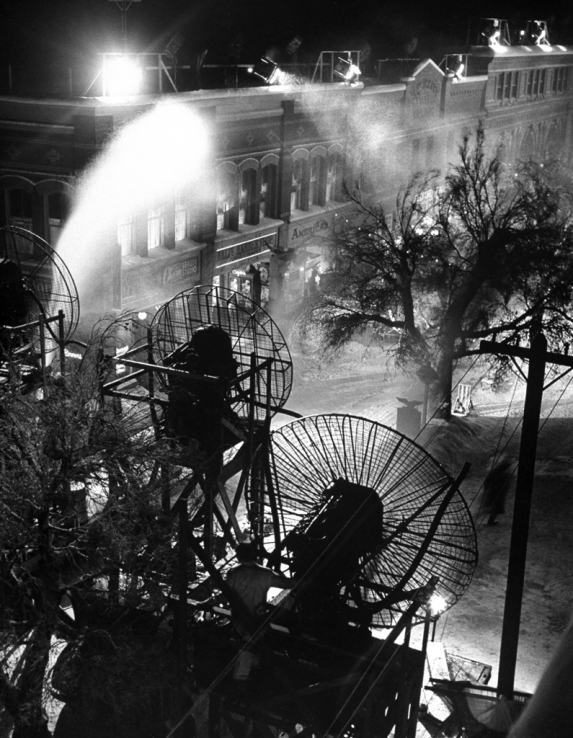
[Image: Making snow for It’s A Wonderful Life, via vintage everyday].

In any case, the 2022 Winter Olympics are shaping up to be something like an Apollo Program for fake snow, an industry that, over the next seven years, seems poised to experience a surge of innovation as the unveiling of this most artificial of Olympic landscapes approaches.

Landscapes of Inevitable Catastrophe

[Image: Illustration by David McConochie, courtesy of The Art Market, via The Guardian].

Last month, The Economist reported on the widespread presence of radioactive tailings piles—waste rock left over from Soviet mining operations—in southern Kyrgyzstan. Many of the country’s huge, unmonitored mountains of hazardous materials are currently leaching into the local water supply.

In a particularly alarming detail, even if you wanted to avoid the danger, you might not necessarily know where to find it: “Fences and warning signs have been looted for scrap metal,” we read.

Frequent landslides and seasonal floods also mean that the tailings are at risk of washing downriver into neighboring countries, including into “Central Asia’s breadbasket, the Fergana Valley, which is home to over 10m people… A European aid official warns of a ‘creeping environmental disaster.'”

Attempts at moving the piles have potentially made things worse, releasing “radioactive dust” that might be behind a spike in local cancers.

In addition to the sheer aesthetic horror of the landscape—a partially radioactive series of river valleys, lacking in warning signs, that writer Robert Macfarlane would perhaps call “eerie,” a place where “suppressed forces pulse and flicker beneath the ground and within the air… waiting to erupt or to condense”—it’s worth noting at least two things:

One, there appears to be no end in sight; as The Economist points out, the neighboring countries “are hardly on speaking terms, so cross-border co-operation is non-existent,” and the costs of moving highly contaminated mine waste are well out of reach for the respective governments.

This means we can more or less confidently predict that, over the coming decades, many of these tailings piles will wash away, slowly but relentlessly, fanning out into the region’s agricultural landscape.

Once these heavy metals and flecks of uranium have dispersed into the soil, silt, and even plantlife, they will be nearly impossible to re-contain; this will have effects not just over the span of human lifetimes but on a geological timescale.

Second, most of these piles are unguarded: unwatched, unmonitored, unsecured. They contain radioactive materials. They are in a region known for rising religious extremism.

Given all this, surely finding a solution here is rather urgent, before these loose mountains of geological toxins assume an altogether more terrifying new role in some future news cycle—at which point, in retrospect, articles like The Economist‘s will seem oddly understated.

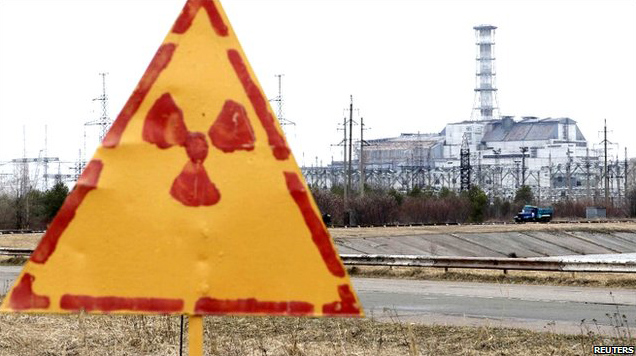
[Image: Hand-painted radiation sign at Chernobyl, via the BBC].

Indeed, our ability even to comprehend threats posed on a geologic timescale—let alone to act on those threats politically—is clearly not up to the task of grappling with events or landscapes such as these.

To go back to Robert Macfarlane, he wrote another article earlier this year about the specialized vocabulary that has evolved for naming, describing, or cataloging terrestrial phenomena. By contrast, he suggests, we now speak with “an impoverished language for landscape” in an era during when “a place literacy is leaving us.”

As Macfarlane writes, “we lack a Terra Britannica, as it were: a gathering of terms for the land and its weathers—terms used by crofters, fishermen, farmers, sailors, scientists, miners, climbers, soldiers, shepherds, poets, walkers and unrecorded others for whom particularised ways of describing place have been vital to everyday practice and perception.”

Channeling Macfarlane, where is the vocabulary—where are our cognitive templates—for describing and understanding these landscapes of long-term danger and slow catastrophe?

It often seems that we can stare directly into the wasteland without fear, not because there is nothing of risk there, but because our own words simply cannot communicate the inevitability of doom.

Full-Spectrum Mandala

[Image: Via the Pacific Cold War Patrol Museum].

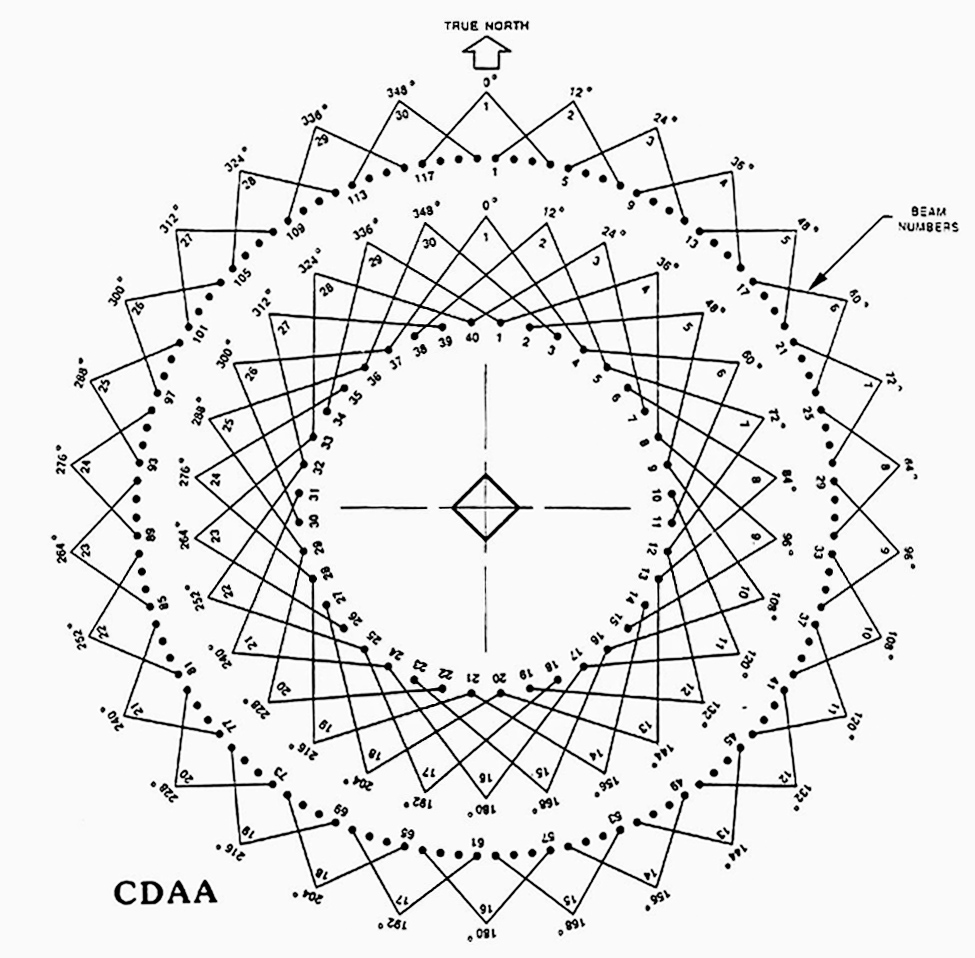
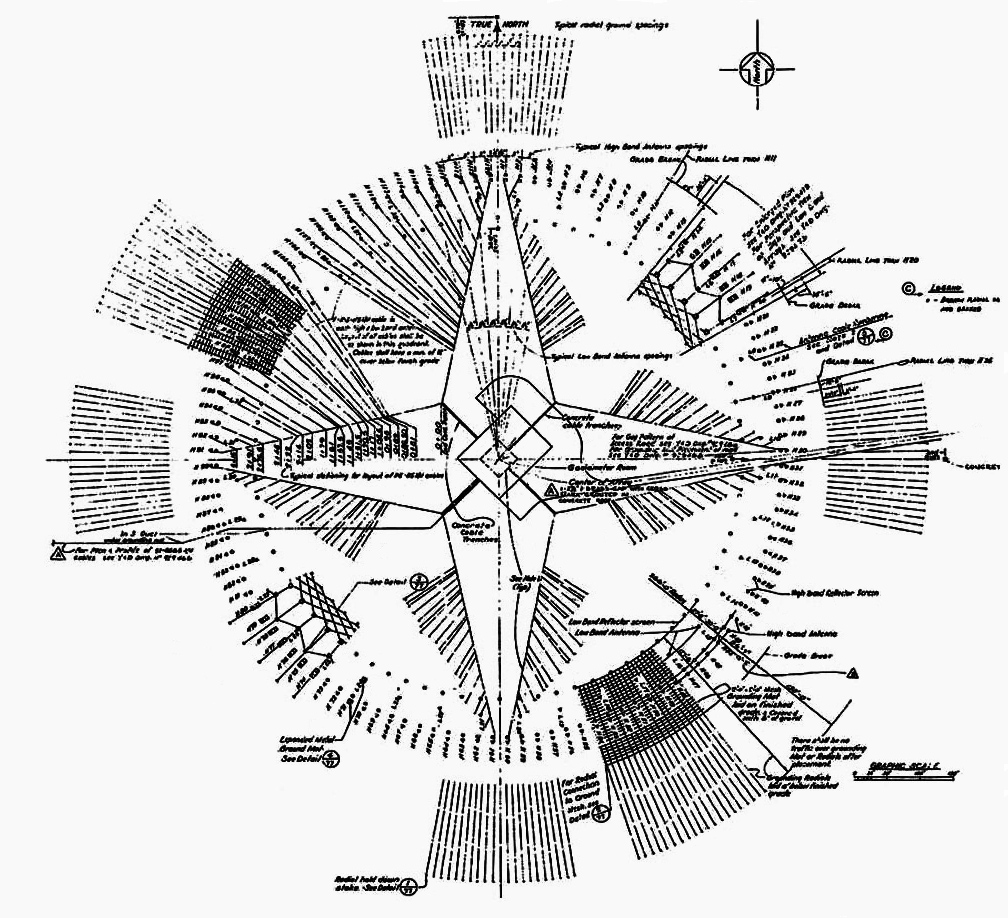
Somewhat randomly—though I suppose I have a thing for antennas—I came across a blog post looking at the layout of Circularly Disposed Antenna Arrays.

A Circularly Disposed Antenna Array, he explains, was “sometimes referred to as a Circularly Disposed Dipole Array (CDDA)” and was “used for radio direction finding. The military used these to triangulate radio signals for radio navigation, intelligence gathering and search and rescue.”

[Image: Via the Pacific Cold War Patrol Museum].

While discussing the now-overgrown landscapes found on old military sites in Hawaii, the post’s author points out the remains of old antenna set-ups still visible in the terrain.

A series of photos, that you can find over at the original post, show how these abandoned circular land forms—like electromagnetic stone circles—exist just below the surface of the Hawaiian landscape, thanks to the archipelago’s intense militarization over the course of the 20th century.

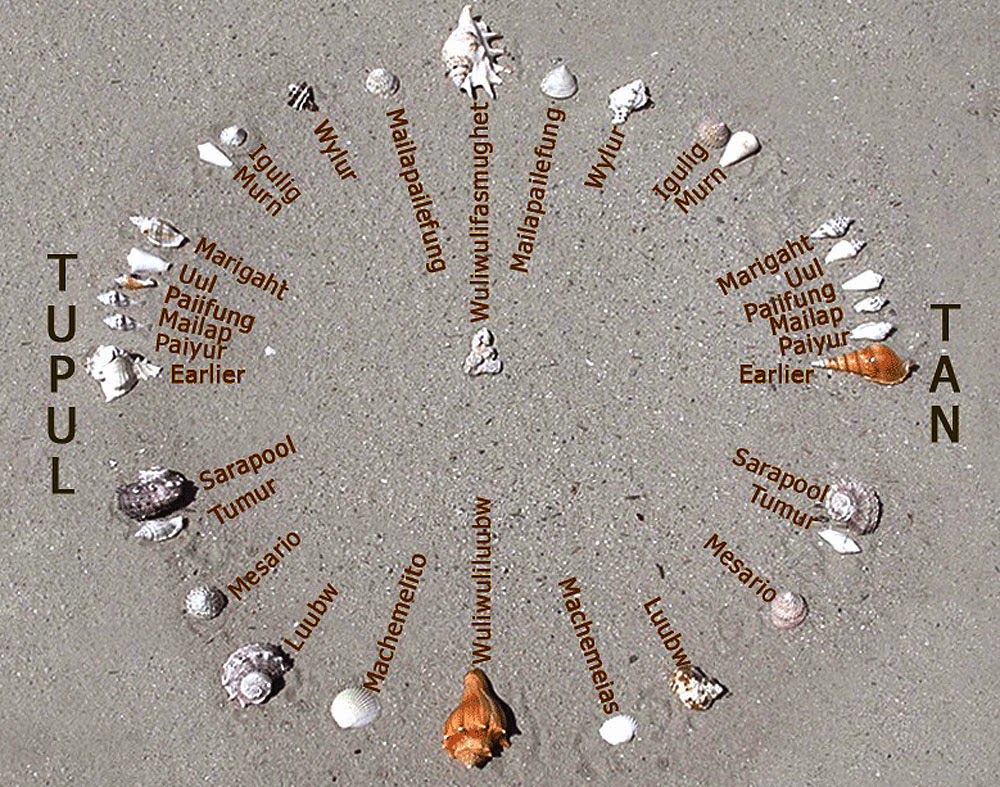
He then cleverly juxtaposes these madala-like technical diagrams with what he calls a “Polynesian guidance system for navigating the Pacific” (bringing to mind our earlier look at large-scale weather systems in the South Pacific and how they might have guided human settlement there).

[Image: Via the Pacific Cold War Patrol Museum].

The idea that Polynesian shell map geometries and the antenna designs of Cold War-era military radio sites might inadvertently echo one another is hugely evocative, albeit purely a poetic analogy.

Finally, I couldn’t resist this brief passage, describing many of these ruined antenna sites: “Their exact Cold War era use, frequencies and purpose isn’t yet known but were most likely for aircraft radio navigation, direction finding, intelligence gathering and for search and rescue.”

You can all but picture the opening shots of a film here, as concerned military radio operators, surrounded by the arcane, talismanic geometries of antenna structures in the fading light of a Pacific summer evening, pick up the sounds of something vast and strange moving at the bottom of the sea.