Architectural Dressage

You’ve likely already seen the large complex of buildings in Shanghai that was picked up as a single block and walked to an adjacent site by a phalanx of miniature robots. Then walked back into place again.

The 432 individual machines used for the move were “actually omnidirectional modular hydraulic jacks that are capable of lifting around 10 tons each,” New Atlas explains. “Sensors monitor pressure, vibration, and alignment while a centralized AI control unit coordinates the balance and movements into a synchronized crawl.”

It’s easy enough to imagine these technologies being permanently built into the urban fabric someday, allowing buildings to relocate for large construction projects or even to dodge flash floods; or demented emperors requiring all their court’s buildings to be mobile, with urban-scale choreographers designing elaborate birthday fetes of architectural dressage; or even that—given how these robots were allegedly installed, involving an earlier sequence of “remote-controlled robots that can move through narrow corridors and doorways,” all guided by a virtual 3D model of the entire complex—some wild new form of whole-building heist becomes possible. Send in the robots; jack the building up; steal it.

[Animation via Core77.]

Building Digital with Timber, Mud, and Ice

[Image: From a project called “Slice” by HANNAH, as featured in FABRICATE 2020.]

The Bartlett School of Architecture recently put out two new books, freely available for download, FABRICATE 2020 and Design Transactions. Check them both out, as each is filled with incredibly interesting and innovative work.

Purely in the interests of time—by all means, download the books and dive in—I’ll focus on three projects rethinking the use of wood, clay, and ice, respectively, alongside new kinds of concrete formwork and 3D printing.

[Image: From “Slice” by HANNAH, as featured in FABRICATE 2020.]

For a project called “Slice,” Sasa Zivkovic and Leslie Lok of design firm HANNAH and Cornell University explore the use of “waste wood” killed by Emerald Ash Borer infestation.

[Image: From “Slice” by HANNAH, as featured in FABRICATE 2020.]

“Mature ash trees with irregular geometries present an enormous untapped material resource. Through high-precision 3D scanning and robotic fabrication on a custom platform, this project aims to demonstrate that such trees constitute a valuable resource and present architectural opportunities,” they explain.

[Images: From “Slice” by HANNAH, as featured in FABRICATE 2020.]

They continue on their website: “No longer bound to the paradigm of industrial standardization, this project revisits bygone wood craft and design based on organic, found and living materials. Robotic bandsaw cutting is paired with high-precision 3D scanning to slice bent logs from ash trees that are infested by the Emerald Ash Borer.”

I’m reminded of a point made by my wife, Nicola Twilley, in an article for The New Yorker last year about fighting wildfires in California. At one point, she describes attempts “to imagine the outlines of a timber industry built around small trees, rather than the big trees that lumber companies love but the forest can’t spare. In Europe, small-diameter wood is commonly compressed into an engineered product called cross-laminated timber, which is strong enough to be used in multistory structures.”

Seeing HANNAH’s work, it seems that perhaps another way to unlock the potential of small-diameter wood is through robotic bandsaw slicing.

[Image: From “Mud Frontiers” by Emerging Objects, as featured in FABRICATE 2020.]

For their project “Mud Frontiers,” Ronald Rael and Virginia San Fratello use 3D printing and “traditional materials (clay, water, and wheat straw), to push the boundaries of sustainable and ecological construction in a two phase project that explores traditional clay craft at the scale of architecture and pottery.”

[Image: From “Mud Frontiers” by Emerging Objects.]

“To do this,” they explain on their website, “we stepped out of the gallery and into the natural environment by constructing a low-cost, and portable robot, designed to be carried into a site where local soils could be harvested and used immediately to 3D print large scale structures.”

[Image: From “Mud Frontiers” by Emerging Objects.]

Finally—and, again, I would recommend just downloading the books and spending time with each, as I am barely scratching the surface here—we have a very cool project looking at “ice formwork” for concrete, developed by Vasily Sitnikov at the KTH Royal Institute of Technology in Stockholm.

[Image: Ice formwork for casting concrete, developed by Vasily Sitnikov, as featured in Design Transactions.]

Sitnikov’s method was initially devised as a way to save energy during the concrete-casting and construction process, but quickly revealed its own aesthetic and structural implications: “The variety of programmable functions for ice formwork is vast,” he writes, “across environmental design, programmable lighting conditions, acoustics, ventilation, insulation and structural-design weight-saving applications.”

[Image: Ice formwork for casting concrete, developed by Vasily Sitnikov.]

He has found, for example, that “spatial patterns… can be imposed on concrete, abandoning any use of petrochemicals in the fabrication process. Breaking away from the ‘solid’ image of conventional concrete, the technique of using ice as the formwork material enables the production of mesoscale spatial structures in concrete which would be impossible to manufacture with existing formwork materials.”

[Image: Ice formwork for casting concrete, developed by Vasily Sitnikov.]

Weaving, carving, cutting, molding: the two new Bartlett books have much, much more, including voluminous detail about each of the projects mentioned briefly above, so click on through and go wild: Design Transactions and FABRICATE 2020.

Folktales for the Offworld

The vocabulary in this new book on Extraterrestrial Construction Techniques is amazing, from the design of “Earth-independent habitats” to the use of “space-native metals” and other “non-terrestrial construction materials in the alien environment of space.”

The full manuscript also contains a section on “high-fidelity simulants”—another great phrase—as well as one on artificial crystal-growth techniques in space. Here, the ideas themselves are architecturally evocative: “It is envisioned that fragments of bio-like materials could be launched in an inactive state during space flight, and once landed at the Moon or Mars, would start to grow into construction materials or even pre-engineered habitats.” Controlled crystal architecture!

You can easily imagine some new version of Jack and the Beanstalk, about a relentlessly growing crystal building, a future folktale for life in space.

Waller

[Image: Otherwise unrelated photo of a wall in Malta; photo by the author].

It’s a slow morning, so perhaps the laziness of linking to Wikipedia can be excused… Immurement is “a form of imprisonment, usually for life, in which a person is placed within an enclosed space with no exits.”

In folklore and myth, “immurement is prominent as a form of capital punishment, but its use as a type of human sacrifice to make buildings sturdy has many tales attached to it as well. Skeletal remains have been, from time to time, found behind walls and in hidden rooms and on several occasions have been asserted to be evidence of such sacrificial practices or of such a form of punishment.”

In terms of literature and film, an obvious example would be Edgar Allan Poe’s short story, “The Cask of Amontillado,” but there was also an absolutely God-awful horror movie a few years ago called, yes, Walled In.

The examples given by Wikipedia include a Moroccan serial killer sentenced to death in 1906 by being walled alive—or immured—and whose screams, inside the walls, were audible for two days; immurement as a tactic for military revenge; and a horrific photo of a woman “immured” inside a wooden crate with only her arm and head visible, left to die outside in Mongolia.

Vaguely related to this, anchorites are self-isolated religious hermits, but ones who “take a vow of stability of place, opting instead for permanent enclosure in cells often attached to churches.” While not immurement in a technical sense, becoming an anchorite was nonetheless also a radical act of bodily enclosure, using architecture as an extreme kind of “stability of place,” a permanent habitation.

I suppose exile would be the opposite spatial condition, a state in which one is permanently disallowed from ever entering architecture, always locked outside. Walled out, as it were.

Wood from the Witch House

[Image: Via LASSCO].

This is amazing: shortly after writing an earlier post, I found this anecdote from an architectural salvage company in England called LASSCO. It’s like the beginning of a blockbuster film. A customer came in one weekend looking for “an oak beam for his fireplace lintel.” As LASSCO explains, the company tries to keep “a selection of them in stock—salvaged, prepped up and ready to sell. It was only when placing one of the beams aside we happened to put it down with daylight glancing along its length and we spotted that it held a secret. It was covered in apotropaic markings.”

Apotropaic markings, or protection marks, are basically magic symbols thought to ward off evil influences and keep malevolent fates at bay—and they are more common in traditional architectural practice than you might think. LASSCO even recommends checking your own house for them.

“If you live in a timber-framed house dating back earlier than the eighteenth century,” they advise, “look out for scratchings on the bressumer beam, sometimes only very lightly inscribed at the top corners of the fireplace, like the scratching of a cat. Look for a repeated ‘W’—thought to be a double ‘V’ for ‘Virgo Virginum’. Look for daisy wheels—a circular device with petals, or runic symbols—a ‘P’ incorporating a cross, or a ‘W’ incorporating a ‘P’. Look for two verticals with a ‘Saltire’ cross between them—a motif also much used on iron door latches and bolts and wrought iron firedogs.”

What an incredible setup for a horror film or novella: an architectural salvage firm uncovers strange ritual markings on pieces of timber in their inventory, and the macabre knock-on effects this might have as these bits of weird wood are incorporated into someone else’s home.

Alas, LASSCO’s tale is from 2013 and the oak beam has since been sold.

Fab

[Image: “The Sphere” by Oliver Tessman, Mark Fahlbusch, Klaus Bollinger, and Manfred Grohmann].

The Bartlett School of Architecture has made all three volumes of Fabricate, their excellent series of books and conference proceedings dating back to 2011, free to download.

[Image: Matter Design’s La Voûte de LeFevre, Banvard Gallery (2012)].

More than 700 pages’ worth of technical experiments, speculative construction processes, new industrial tools, and one-off prototypes, the books are a gold mine for research and development.

[Image: Greg Lynn’s “Embryological House,” Venice Biennale (2002)].

3D printers, buoyant robots, multi-axis milling machines, directed insect-secretion, cellular automata, semi-autonomous bricklaying, self-assembling endoskeletons, drone weaving—it’s hard to go wrong with even the most cursory skimming of each volume, and that doesn’t even mention the essays and interviews.

[Image: “Custom forming tool mounted on the six-axis robotic arm,” via Fabricate 2014]

Download each book—from 2017, 2014, and 2011—and be prepared to lose a few days reading through them.

Arcs, Sets, Circles


[Images: Via the Getty Research Institute].

Thanks to some “newly digitized” versions of the classic Encyclopédie edited by Denis Diderot, Jean le Rond d’Alembert, and Robert Bénard—among others—I stumbled on these beautiful carpentry diagrams, presented here simply for your Monday morning viewing pleasure.

Archiving “Geomagnetic Spikes” in Everyday Objects

[Image: One of the pots; photo by Oded Lipschits, courtesy NPR].

Ancient clay pottery in the Middle East has inadvertently recorded the Earth’s magnetic field, including evidence of an “astonishing geomagnetic spike.”

“All those years ago,” NPR reported earlier this week, “as potters continued to throw clay, the molten iron that was rotating deep below them tugged at tiny bits of magnetic minerals embedded in the potters’ clay. As the jars were heated in the kiln and then subsequently cooled, those minerals swiveled and froze into place like tiny compasses, responding to the direction and strength of the Earth’s magnetic field at that very moment.”

Archaeologist Erez Ben-Yosef, one of the researchers on the project, has compared the process to a terrestrial “tape recorder,” and a particularly sensitive one at that: the resulting jars “provide an unprecedented look at the planet’s magnetic field over those six centuries, one that’s much harder to get from rocks.”

These accidental indices also indicate that the Earth’s magnetic field at the time was much stronger than expected; ominously, this “astonishing geomagnetic spike,” as mentioned above, could happen again. Indeed, the jars have “given scientists a glimpse of how intense the magnetic field can get—and the news isn’t good for a world that depends on electrical grids and high-tech devices,” Annalee Newitz writes for Ars Technica.

“The researchers note that this geomagnetic spike is similar to another that occurred in the 10th century BCE,” Newitz adds. “Data from the 10th century spike and this 8th century one indicate that such events were probably localized, not global. That said, they write that ‘the exact geographic expanse of this phenomenon has yet to be investigated, and the fact that these are very short-lived features that can be easily missed suggests that there is much more to discover.’”

This vision—of highly localized, mysterious geomagnetic storms frying electronics from below—is not only a great plot device for some burgeoning scifi novelist, it could also almost undoubtedly be weaponized: subterranean geomagnetic warfare against an entire region of the planet, short-circuiting every electrical device in sight.

[Image: One of the pots; photo by Oded Lipschits, courtesy NPR].

Of course, it’s also worth noting that this would still be happening: that is, today’s ceramics should still be “recording” the Earth’s magnetic field, even without any corresponding spike in that field’s strength. An invisible terrestrial forcefield is thus still inscribing itself inside objects in your kitchen cabinet or standing on your breakfast table. Everyday knick-knacks in retail stores around the world are still archives of planetary magnetism.

This also makes me wonder what other types of artifacts—clay figurines from nomadic Arctic tribes, mud bricks from central Africa—might also house geomagnetic records yet to be analyzed by modern technology. So what else might be discovered someday?

I’m reminded of the possibility that space weather—or “fossils of spacetime”—might be frozen into the built environment in the form of GPS glitches: hidden inside minute structural errors in large building projects, such as freeways, dams, and bridges, there might be evidence that our solar system is passing through “cosmic kinks” of dark matter.

In any case, read the original paper in PNAS; see also The New Yorker.

Cloud Constructor

[Image: An airplane hangar in Utah, via the U.S. Library of Congress].

Another book I read while jet-lagged in London last week was Skyfaring: A Journey with a Pilot by Mark Vanhoenacker; its chapter “Wayfinding” is particularly fascinating and worth seeking out.

[Image: Interior view of same hangar, via U.S. Library of Congress].

The previous post here mentioned 19th-century cloud chambers, and I was accordingly struck by a quick line in Vanhoenacker’s book. At one point, he describes the construction of airplane bodies inside sprawling factory buildings, whose contained volumes of air are so enormous they can generate their own weather. They are internal skies.

“Some airplane factories are so large,” he writes, “that clouds once formed inside them, a foreshadowing of the sky to come for each newborn jet.”

375829pu[Image: Utah airplane hangar, via U.S. Library of Congress].

Of course, other megastructures are also known to produce internal precipitation. NASA’s Vehicle Assembly Building at Cape Canaveral “is the second largest building (by volume) in the world, and it even has its own weather inside—NASA employees report that rain clouds form below the ceiling on very humid days.”

As architecture writers like David Gissen and Sean Lally have shown, architecture—in and of itself—has always been a kind of applied atmospheric design, with buildings defined as much by temperature, barometry, and humidity as they are by walls and ceilings.

But I love the idea of aircraft assembly and repair occurring amidst inadvertent simulations of the sky to come, as dew points are crossed, condensation begins, and internal weather fronts blurrily amass above the wings of dormant airplanes, as if conjured there in a dream.

Sulphur Bricks and Super-Arches

mars[Image: Mars architecture concept by ZA Architects, via The Verge].

Without water or traditional building materials, what will hypothetical Martian settlers use to build their future homes? Worry no more: materials scientists at Northwestern University have developed “Martian concrete” using sulphur, which is abundant on our neighboring planet.

The key material in a Martian construction boom will be sulphur, says the Northwestern team. The basic idea is to heat sulphur to about 240°C [464°F] so that it becomes liquid, mix it with Martian soil, which acts as an aggregate, and then let it cool. The sulphur solidifies, binding the aggregate and creating concrete. Voila—Martian concrete.

The resulting bricks are apparently quite strong and readily recyclable. As the MIT Technology Review points out, “Martian concrete can be recycled by heating it, so that the sulphur melts. So it can be re-used repeatedly. It is also fast-setting, relatively easy to handle and extremely cheap compared to materials brought from Earth.”

Briefly, it’s worth noting that sulphur-based brick mixes were previously explored at McGill University in Montréal by a team of environmentally minded designers, including architect Vikram Bhatt. As I got to learn from Bhatt himself during a summer at the Canadian Centre for Architecture back in 2010, that group sought to reuse waste sulfur as a building material.

One of the more interesting and, if I remember correctly, totally unexpected side-effects was the discovery that full-color images could be transferred to the bricks with a startling degree of verisimilitude, as the following two photos make clear.

IMG_0430IMG_0433[Images: Photos by Geoff Manaugh, originally published here].

Of course, this feature is presumably rather low on the list of details future astronaut-architects will be hoping for as they build their first encampments on Mars.

More practically, one thing I’d love to learn more about would be the possibility of novel architectural structures constructed using sulfurous concrete in the lower-gravity environment of Mars. Would the planet’s weaker gravity augment an architect’s ability to construct ambitious spans and arches, for example, because the materials themselves would be substantially lighter? Or, conversely, would the planet’s gravitational strength already be accounted for by a reduced density of the material, negating gravity’s diminished pull?

Put another way, the idea of ultra-light sulphur-concrete vaults and arches covering distances and spans that would be terrestrially impossible is quite a beautiful thing to imagine—and, coupled with those image-transfer techniques seen by Bhatt and his team at McGill, could result in vast new galleries and chapels illustrated with Martian frescoes, a high-tech return to older representational techniques from art history.

Then we descend

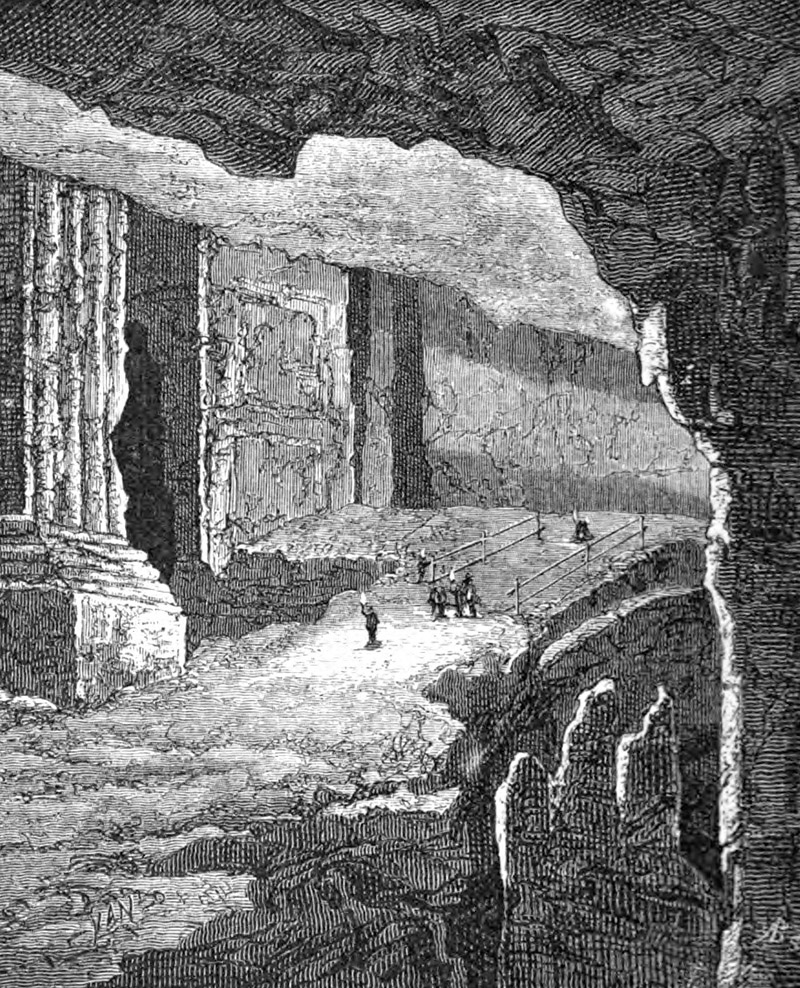
[Image: Descending into Mammoth Cave, from Beneath the surface; or, the wonders of the underground world by W.H. Davenport Adams].
By way of JF Ptak Science Books, I found myself reading through an old book called Beneath the surface; or, the wonders of the underground world by W.H. Davenport Adams this weekend, a travelogue from 1876 exploring subterranean landscapes around the world, including what is now Mammoth Cave National Park.

“Then we descend,” Adams writes upon his arrival at the cave, “by a small pathway excavated among the rocks, until we discover, in the sides of the mountain, and at the bottom of a funnel-shaped cavity, overgrown with verdure, an opening so low and narrow that two people can with difficulty enter at once.”

Slipping through, they pass into “a labyrinth of caves” consisting of seemingly endless sloping rooms, shafts, and corridors.

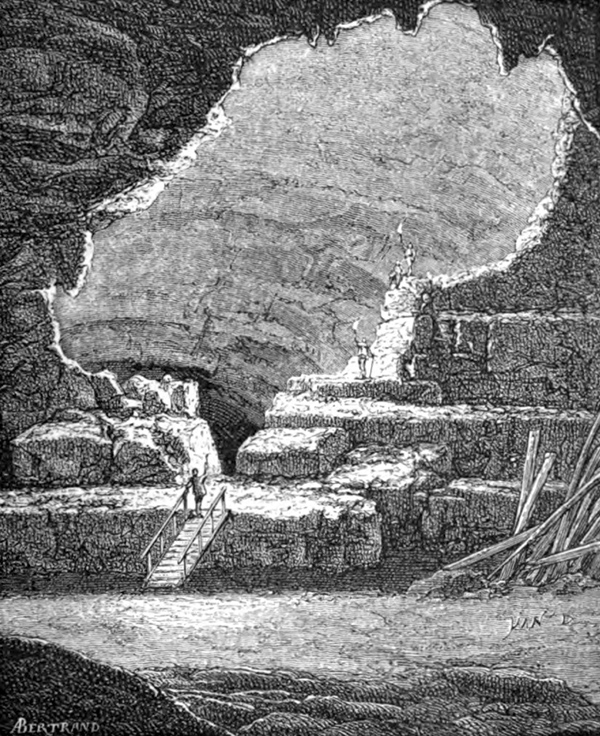
As my own phrasing there indicates, these spaces are described by way of architectural analogy: as naves and vestibules, chambers and rotundas. In fact, their perceived architectural characteristics are highlighted even on the acoustic level. One cave, for example, is a place “where the voice resounds and, lingering, reverberates, like the strain of an organ through dim cathedral aisles.”

[Image: A room in Mammoth Cave known as “The Maelstrom,” from Beneath the surface; or, the wonders of the underground world by W.H. Davenport Adams].
Continuing on their downward trek, Adams & Co. soon wander into “a chamber nearly 320 feet in circuit, whose roof rises like the stand of an immense nave. Its form, its grandeur, its magnitude (it could accommodate five thousand persons), and the strange architectural-like stalactites which embellish it, have procured it the name of the Gothic Church.”

Indeed, standing amidst this ersatz cathedral, and “thanks to the power of imagination, and the varying influence of the light, we here distinguish all the details of a medieval nave, pillars, and columns, and corbels and ogives.”

Among many things, what interests me here is how the interior of the earth is seen as if through the haze of a projection, with architectural forms emerging where, in fact, only inhuman geological processes at work—but also, in the opposite direction, the implied observation here that, in an age of masonry construction, architecture and geology were, in effect, natural cousins, lending themselves to mutual comparison far more easily than in today’s time of glass and steel construction.

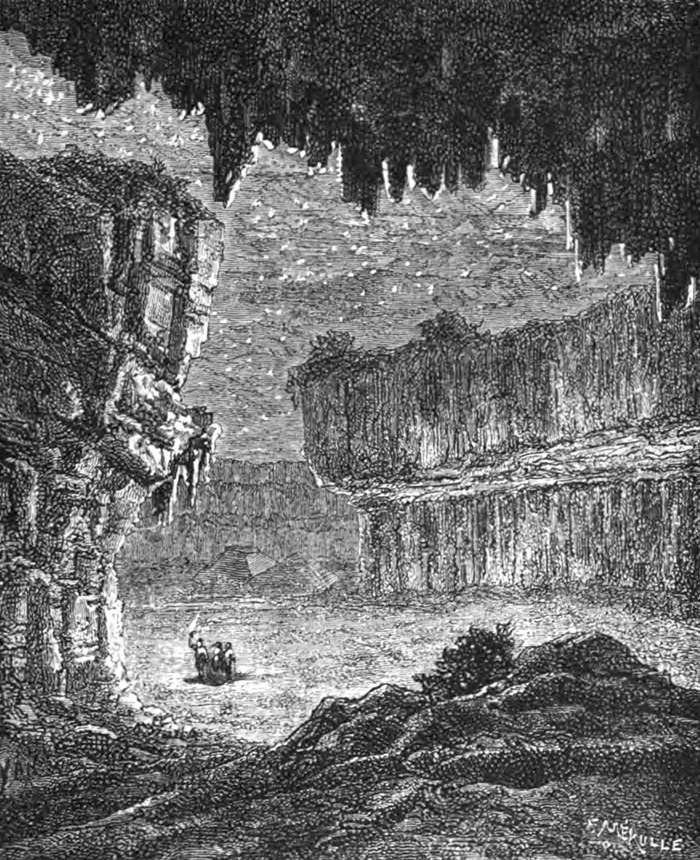
[Image: A vast underground room filled with “a silent, terrible solitude,” from Beneath the surface; or, the wonders of the underground world by W.H. Davenport Adams].
To put this another way, many streets in Manhattan are often quite appropriately described as “canyons,” not only due to their perceived depth—that is, given the towering buildings on either side, as if pedestrians merely wander at the bottom of artificial slot canyons—but also due to the geological materials those buildings were made from.

However, following widespread transformations in global building construction, our buildings today are now more likely to be reflective—even dangerously so—or partially transparent, whether this is due to the use of glass curtain walls or shadow-annihilating polished titanium, with the effect that our urban environment is no longer particularly well-served by geological analogy.

In any case, the book’s flirtation with an architectural vocabulary is gradually abandoned as Adams and his colleagues venture deeper into the planet. They eventually find themselves standing somewhat uncomfortably surrounded by a “phantasmagoria” of black gypsum walls, all “covered with sparkling crystallizations,” in a vast room whose belittling proportions inspire feelings not of grandeur and religiosity but a kind of exhausted desolation.

Here, Adams writes, “you think yourself on one of those dead and naked planets, where mineral nature reigns in the bosom of a silent, terrible solitude; on some earth never warmed by the sun, and which is animated by no kind of life.”

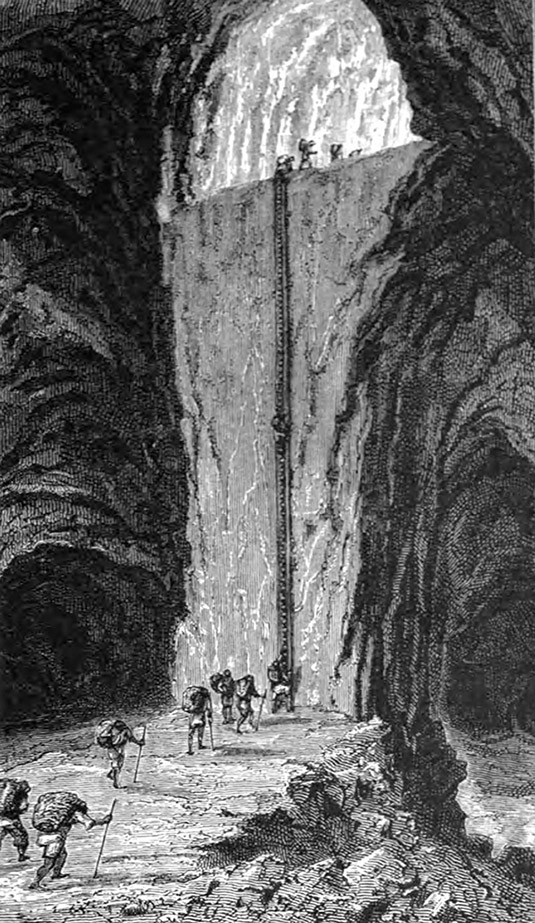
[Image: An unfortunately rather low-res image from Beneath the surface; or, the wonders of the underground world by W.H. Davenport Adams].

The rest of the book—including the image seen immediately above this sentence—ventures elsewhere, into silver mines and glacial caves, even briefly passing by way of underground “artificial ice caves” for the premodern production and storage of ice.

I’m just a sucker for subterranea. Check it out if any of this sounds up your alley, and click through the archives of JF Ptak Science Books while you’re at it.