London Laocoön

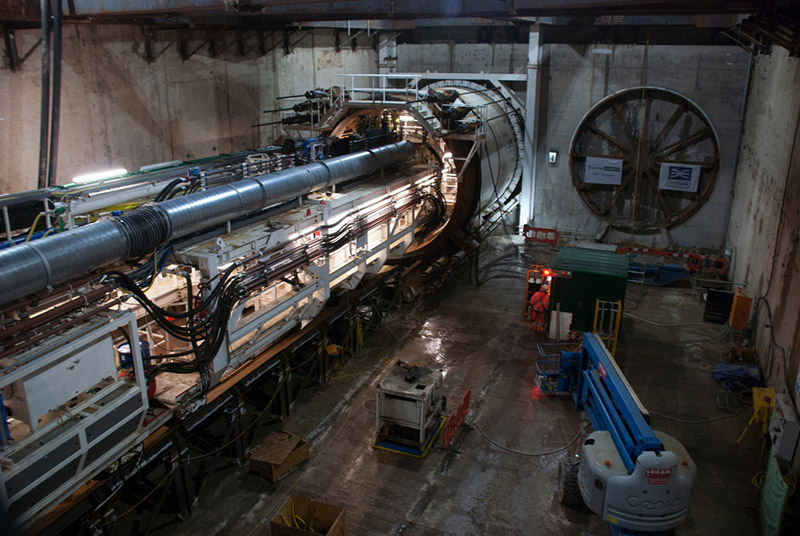
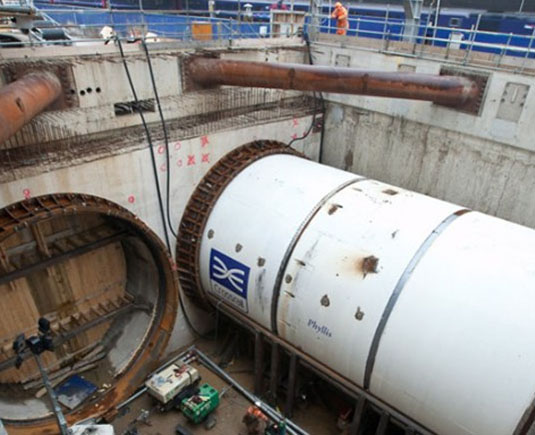
[Image: Machines slide beneath the streets, via Crossrail].

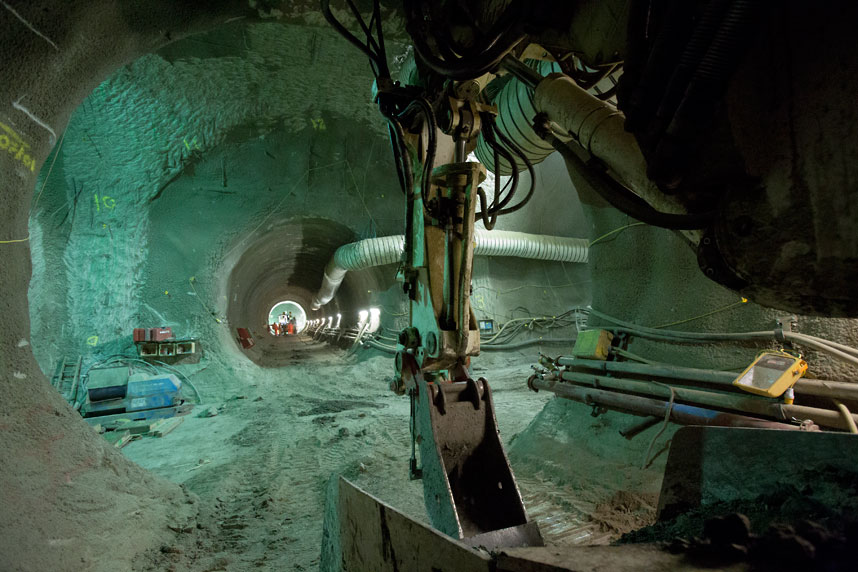
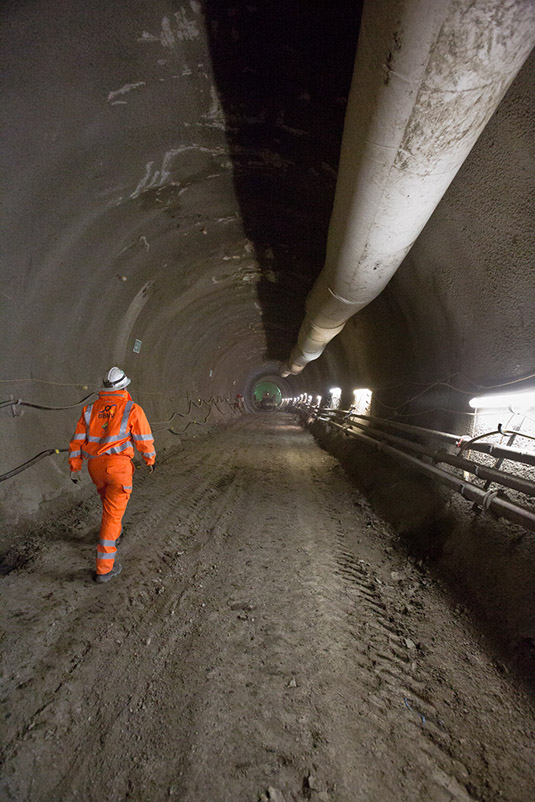
The Crossrail tunnels in London—for now, Europe’s largest construction project, scheduled to finish in 2018—continue to take shape, created in a “tunneling marathon under the streets of London” that aims to add 26 new miles of underground track for commuter rail traffic.

It’s London as Laocoön, wrapped in tunnel-boring machines, mechanical snakes that coil through their own hollow nests beneath the city.

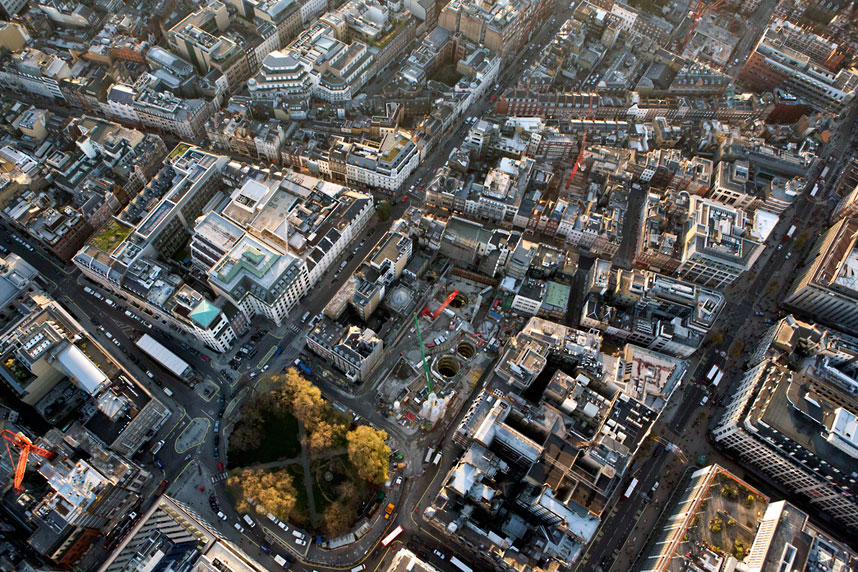
[Image: Looking down through shafts into the subcity, via Crossrail].

What interested me the most in all this, however, was simply that fact that the first tunneling machine put to work in this round of excavation is called Phyllis—

[Image: Phyllis, via Crossrail].

—named after Phyllis Pearsall, widely (but incorrectly?) mythologized as the founder of the legendary A-Z book of London street maps.

There’s something very Psychogeography Lite™ in this, weaving your city together from below with a giant machine-needle named after the woman who (supposedly) first walked the streets of the capital, assembling her book of maps, as if the only logical direction to go, once you’ve mapped the surface of your city, is down, passing through those surfaces to explore larger and darker volumes of urban space.

Space in the Adaptive Plastic

[Image: An otherwise irrelevant photo of early night-vision technology used during the Vietnam War; courtesy of the U.S. Army].

So where were we?

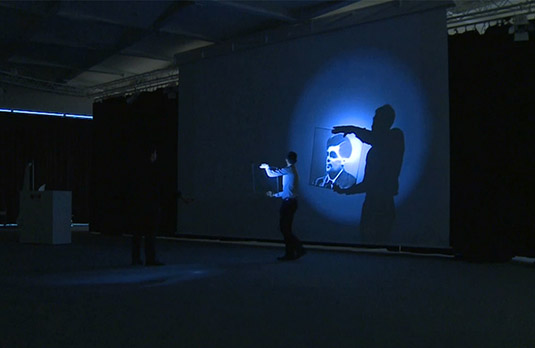
Just clearing out a few old links for a fresh start. Last spring, Danger Room reported that DARPA had been hoping to step into the world of “battlefield illusions,” developing “technologies that will ‘manage the adversary’s sensory perception’ in order to ‘confuse, delay, inhibit, or misdirect [his or her] actions.'” This includes “frontline illusions intended to disrupt enemy warfighters’ thought patterns.”

The program—a kind of military-sensory complex—is based on the belief that “if researchers can better understand ‘how humans use their brains to process sensory inputs,’ the military should be able to develop ‘auditory and visual’ hallucinations that will ‘provide tactical advantage for our forces.'”

But what might the architectural—or the more generally urban, the very broadly spatial—implications of such a technology be? Can managing or choreographing perception through shared hallucinations and techniques of sensory misdirection in the built environment be a tool increasingly useful for designers today? Even DARPA refers to this sub-class of programs as “Shaping the Environment“—so is there a civilian, or, more accurately, a deweaponized, version of these deployable “illusions” that could be used by architects or even by set & interior designers for real-time augmentations of everyday space? For “engineering ghosts” in the rooms around us, where the rooms themselves are sometimes ghosts?

After all, urban design as a hand-me-down technology from the military is nothing new, so adapting battlefield misperceptions to architectural use on the homefront would hardly be surprising.

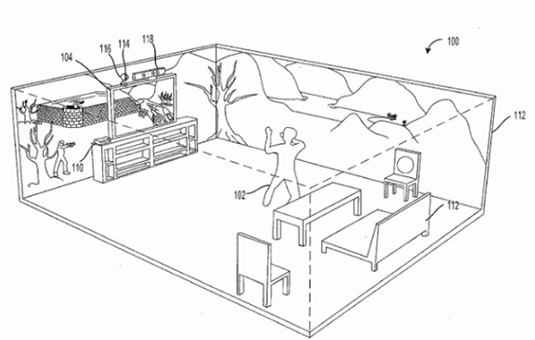
Perhaps it’d be like Microsoft’s patented Immersive Display Experience, an architecture of overlapping stitched projections such that “the peripheral image appears as an extension of the primary image,” and, in the process, the room you’re standing in becomes a game display.

[Image: Microsoft’s Immersive Display Experience].

How could this be used by architects?

While we’re on the subject of DARPA, meanwhile, another even older piece of news from their designers’ desks was this 2011 announcement that they’d begun constructing “an entirely new class of electronic systems that can meet the demands of dynamic environments.” These would be called Systems of Neuromorphic Adaptive Plastic Scalable Electronics (or SyNAPSE), a “program [that] aims to fundamentally alter conventional designs by developing biological-scale neuromorphic electronic systems that mimic important functions of a human brain.” A strange future of neuromorphic plastic brains illusioneering streets into existence—invisible cities, flickering and disruptive—we humans will try and, haplessly, fail to navigate.

Starfish City

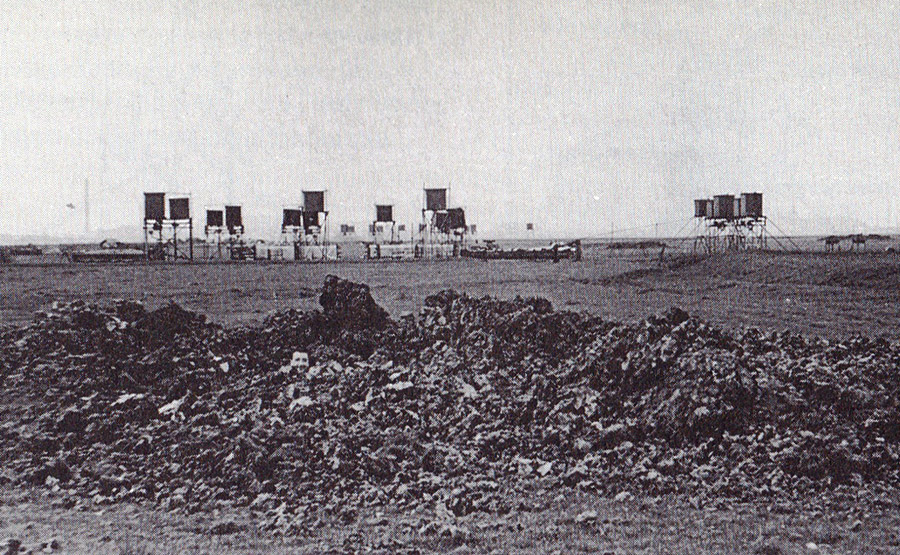
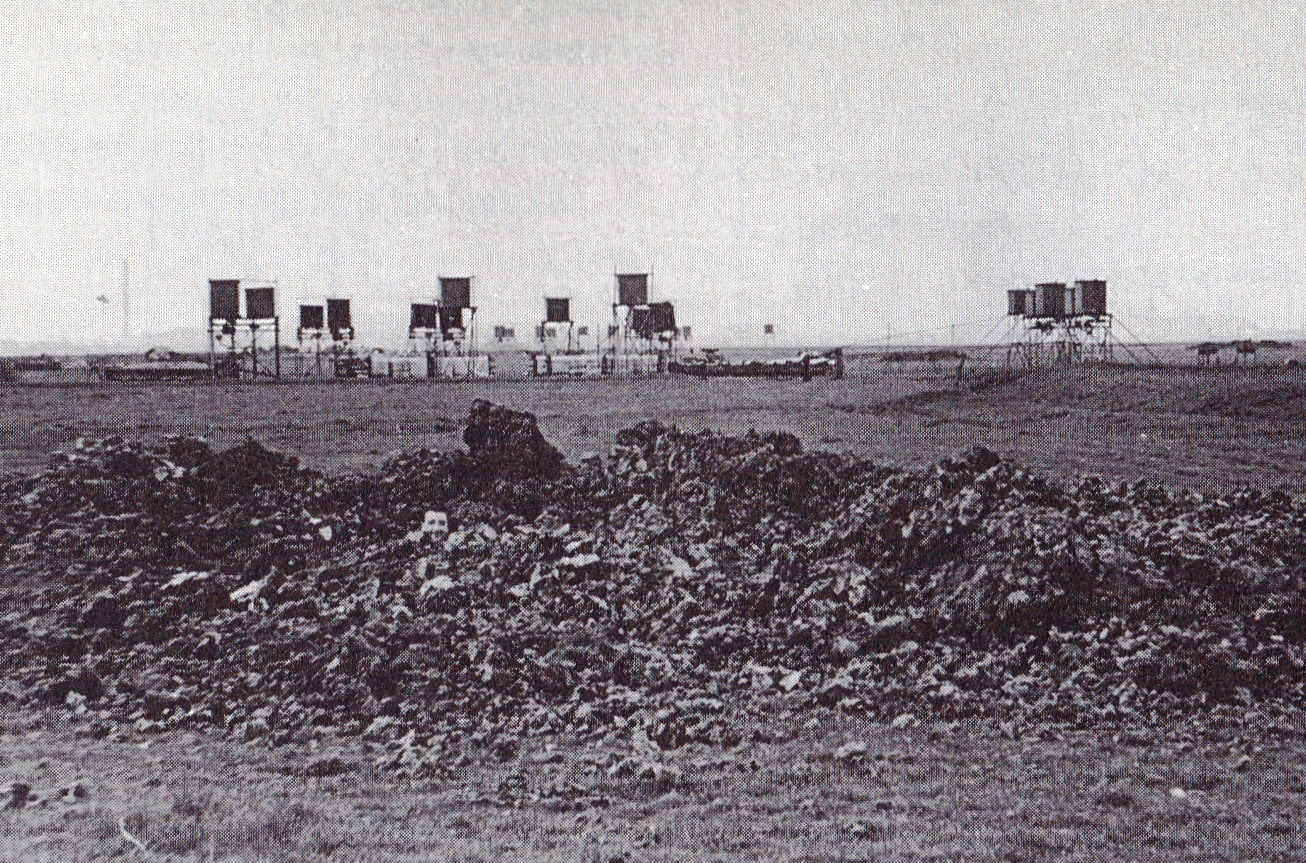
[Image: A Starfish site, like a pyromaniac’s version of Archigram, via the St. Margaret’s Community Website; view larger].

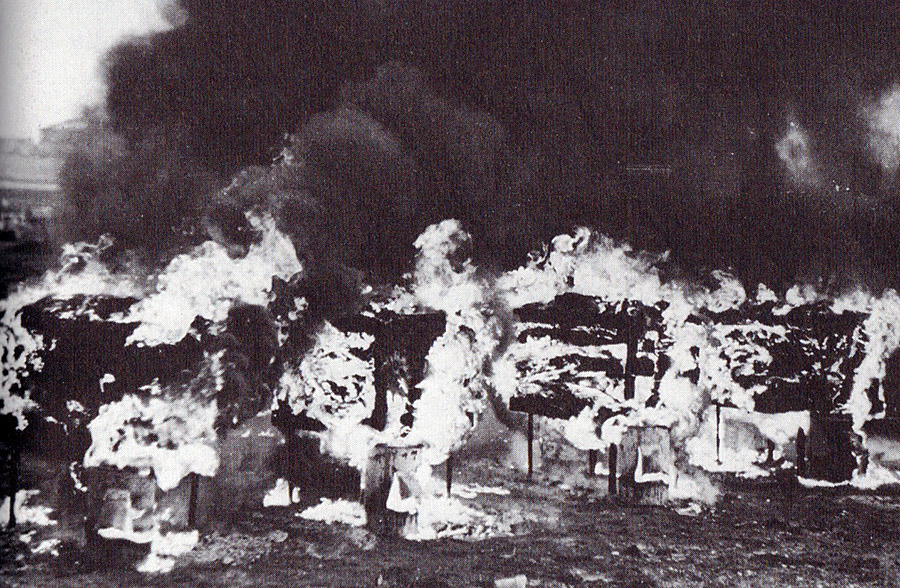
A few other things that will probably come up this evening at the Architectural Association, in the context of the British Exploratory Land Archive project, are the so-called “Starfish sites” of World War II Britain. Starfish sites “were large-scale night-time decoys created during The Blitz to simulate burning British cities.”

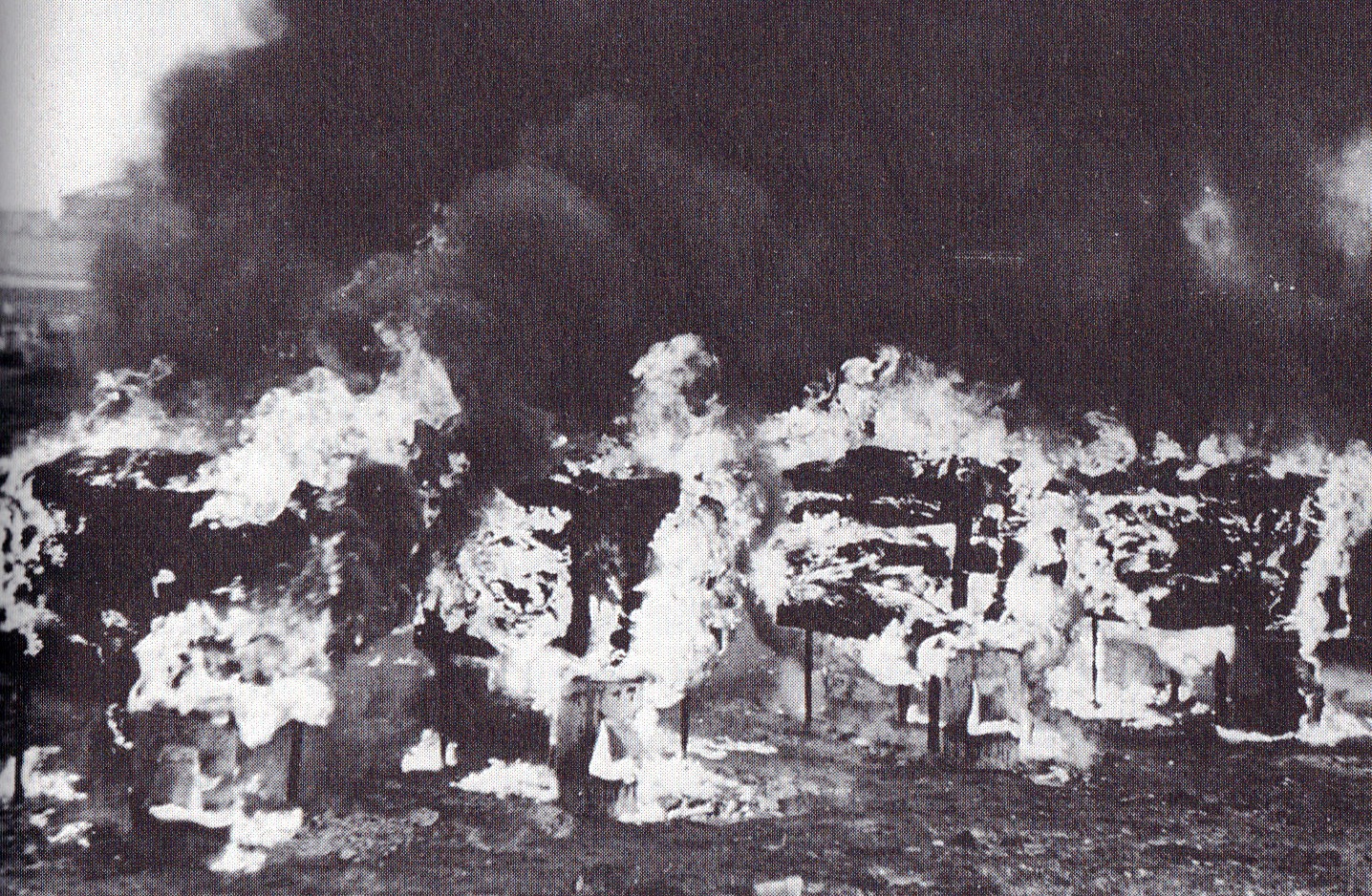
[Image: A Starfish site burning, via the St. Margaret’s Community Website; view larger].

Their nickname, “Starfish,” comes from the initials they were given by their designer, Colonel John Turner, for “Special Fire” sites or “SF.”

As English Heritage explains, in their list of “airfield bombing decoys,” these misleading proto-cities were “operated by lighting a series of controlled fires during an air raid to replicate an urban area targeted by bombs.” They would thus be set ablaze to lead German pilots further astray, as the bombers would, at least in theory, fly several miles off-course to obliterate nothing but empty fields camouflaged as urban cores.

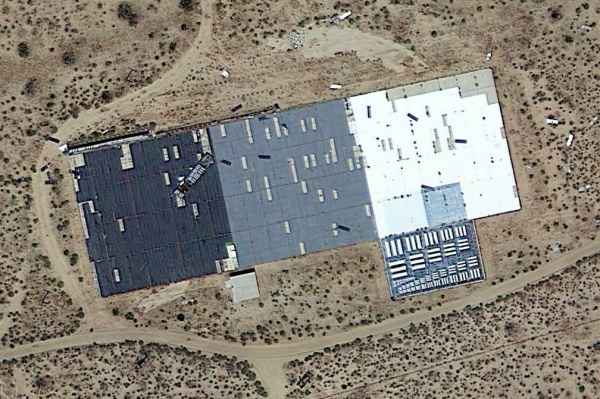
They were like optical distant cousins of the camouflaged factories of Southern California during World War II.

Being in a hotel without my books, and thus relying entirely on the infallible historical resource of Wikipedia for the following quotation, the Starfish sites “consisted of elaborate light arrays and fires, controlled from a nearby bunker, laid out to simulate a fire-bombed town. By the end of the war there were 237 decoys protecting 81 towns and cities around the country.”

[Image: Zooming-in on the Starfish site, seen above; image via the St. Margaret’s Community Website].

The specific system of visual camouflage used at the sites consisted of various special effects, including “fire baskets,” “glow boxes,” reflecting pools, and long trenches that could be set alight in a controlled sequence so as to replicate the streets and buildings of particular towns—1:1 urban models built almost entirely with light.

In fact, in some cases, these dissimulating light shows for visiting Germans were subtractively augmented, we might say, with entire lakes being “drained during the war to prevent them being used as navigational aids by enemy aircraft.”

Operational “instructions” for turning on—that is, setting ablaze—”Minor Starfish sites” can be read, courtesy of the Arborfield Local History Society, where we also learn how such sites were meant to be decommissioned after the war. Disconcertingly, despite the presence of literally tons of “explosive boiling oil” and other highly flammable liquid fuel, often simply lying about in open trenches, we read that “sites should be de-requisitioned and cleared of obstructions quickly in order to hand the land back to agriculture etc., as soon as possible.”

The remarkable photos posted here—depicting a kind of pyromaniac’s version of Archigram, a temporary circus of flame bolted together from scaffolding—come from the St. Margaret’s Community Website, where a bit more information is available.

In any case, if you’re around London this evening, Starfish sites, aerial archaeology, and many other noteworthy features of the British landscape will be mentioned—albeit in passing—during our lecture at the Architectural Association. Stop by if you’re in the neighborhood…

(Thanks to Laura Allen for first pointing me to Starfish sites).

Ice Age Aerial

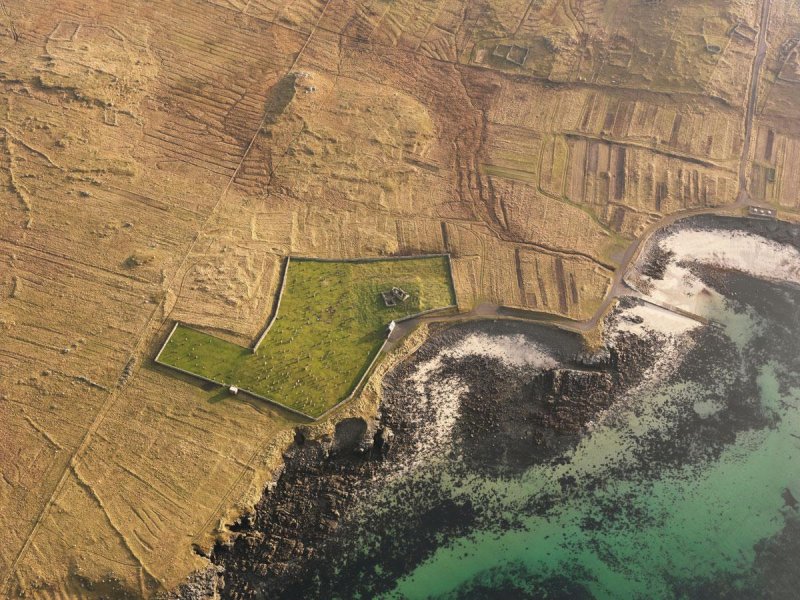
[Image: Photo: The “cemetery and church at Teampull Eion, Isle of Lewis,” courtesy of the Royal Commission on the Ancient and Historical Monuments of Scotland].

One of many things I was excited to discover while working on the British Exploratory Land Archive project, and while getting ready for tonight’s lecture at the Architectural Association, is the “Scotland’s Landscapes” collection of aerial archaeology photographs from the Royal Commission on the Ancient and Historical Monuments of Scotland.

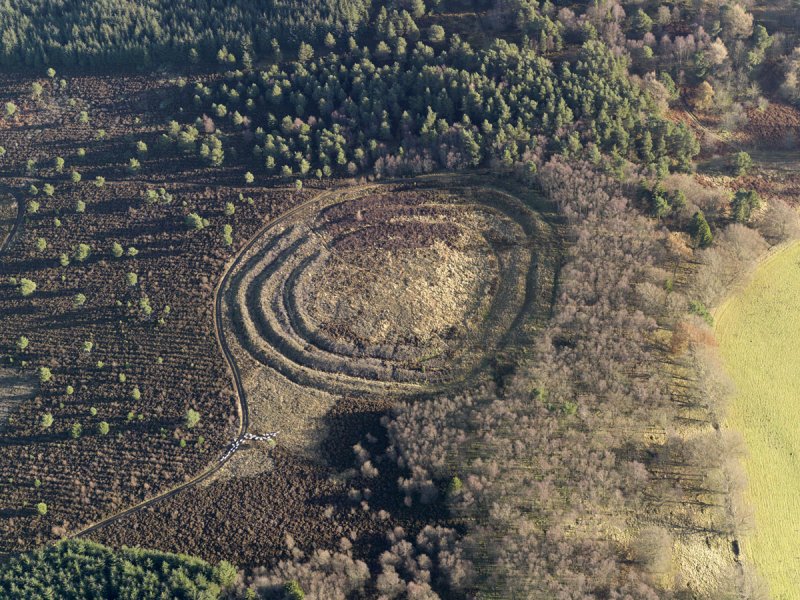
[Image: (top) The “remains of White Castle Fort“; (bottom) the “remains of the Northshield Rings.” Photos courtesy of the Royal Commission on the Ancient and Historical Monuments of Scotland].

“As the glaciers of the last Ice Age receded,” we read, “Scotland’s earliest ancestors ventured northwards, exploring a wild, fertile territory. Nomadic hunter-gatherers at first, they made the decision to stay for good—to farm and to build. From that moment on, people began to write their story firmly into the fabric of the landscape.” Indeed, today, “every inch of Scotland—whether remote hilltop, fertile floodplain, or storm-lashed coastline—has been shaped, changed and moulded by its people.”

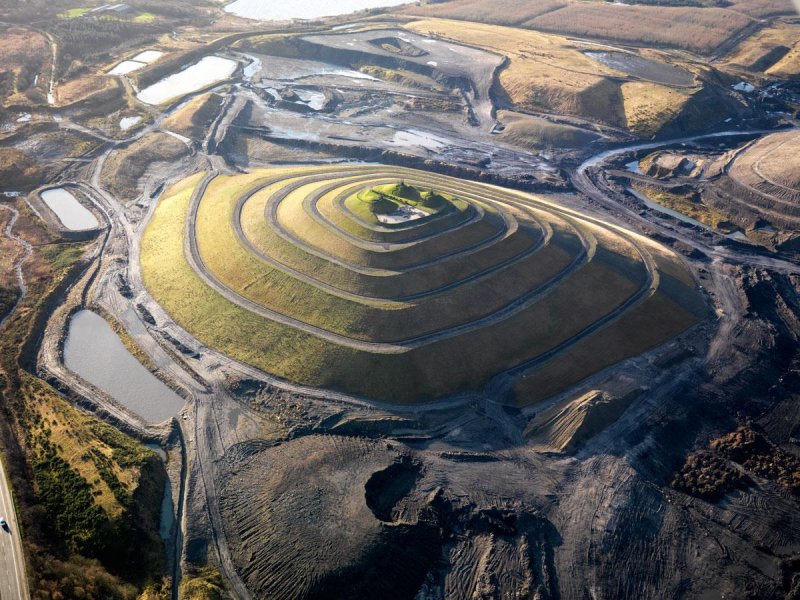
[Image: Photo: The (modernday) “Fife Earth Project at St. Ninian’s Open Cast Site,” courtesy of the Royal Commission on the Ancient and Historical Monuments of Scotland].

Quoting at length:

The landscapes they lived on were remarkable in their diversity. Vast forests of pine and birch ran through one of the world’s oldest mountain ranges—once as high as the Himalayas but over millennia scoured and compressed by sheets of ice a mile thick. On hundreds of islands around a saw-edged coastline, communities flourished, linked to each other and the wider world by the sea, the transport superhighway of ancient times.

Many of the resulting settlements have the appearance of inland islands, isolated shapes and ringed perimeters still visible from the air.

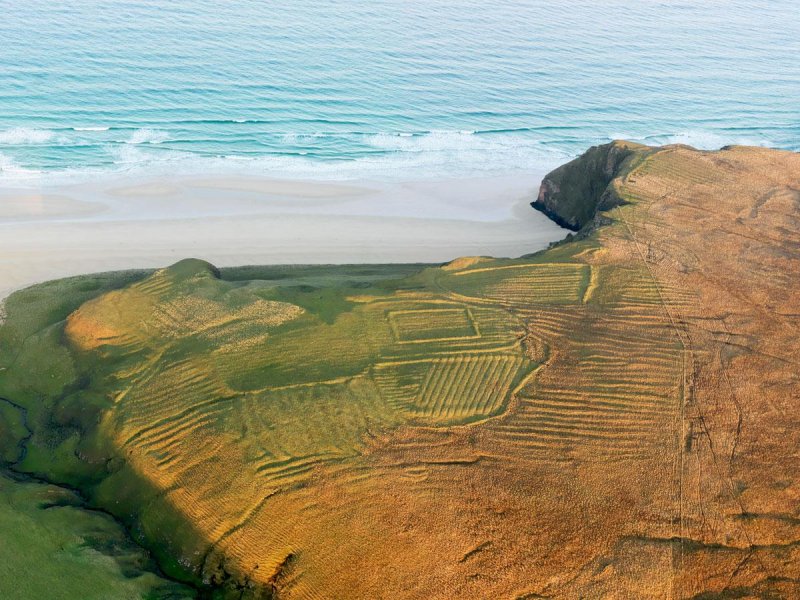
[Image: Photo: The “remains of the lazy beds and enclosures at Muidhe on the Isle of Skye,” courtesy of the Royal Commission on the Ancient and Historical Monuments of Scotland].

In any case, here are some of the photos—just a random selection of eye-candy for a Thursday afternoon.

[Images: Aerial view of Lochindorb Castle, courtesy of the Royal Commission on the Ancient and Historical Monuments of Scotland].

Meanwhile, these and many other photos are available in a new book by James Crawford, called Scotland’s Landscapes: The National Collection of Aerial Photography, and you can see more online here.

Floating Cities and Site Surveys

[Image: Photo by Mark Smout of a photo by Mark Smout, for the British Exploratory Land Archive].

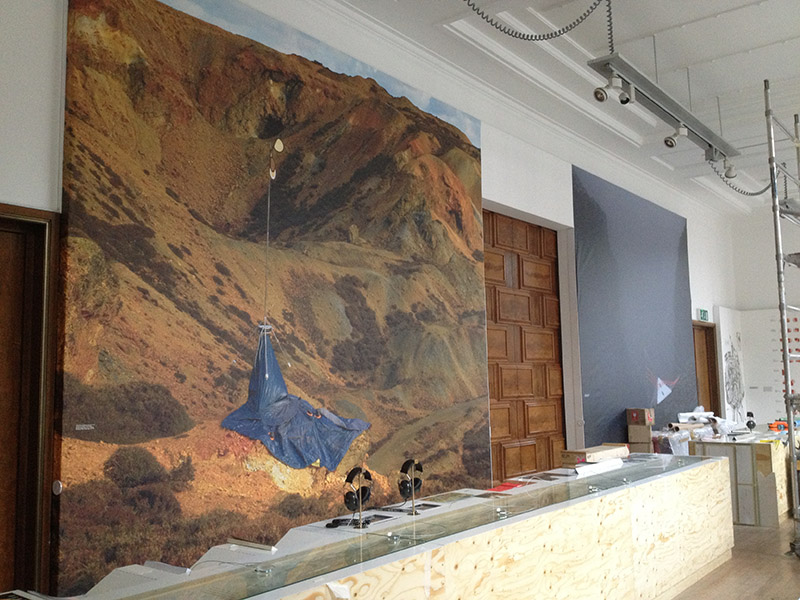
I’m delighted to say that work originally produced for the British Pavilion at last summer’s Venice Biennale will go on display this week at the Royal Institute of British Architects in London, beginning tomorrow, 26 February.

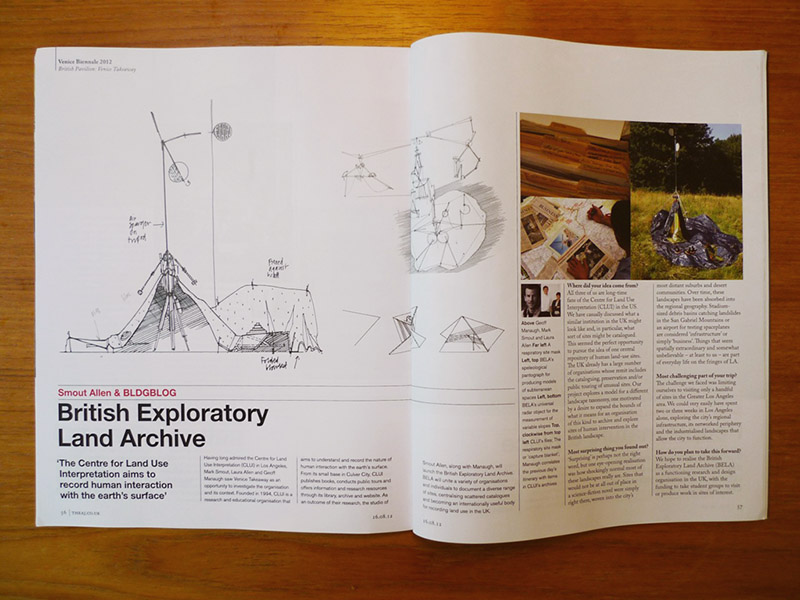
This will include, among many other projects, from studies of so-called “new socialist villages” in China to floating buildings in Amsterdam, to name but a few, the British Exploratory Land Archive (BELA) for which BLDGBLOG collaborated with architects Smout Allen in proposing a British version of the Center for Land Use Interpretation in Los Angeles. BELA would thus survey, catalog, explore, tour, document, and archive in one location the huge variety of sites in Britain altered by and used by human beings, from industrial sites to deserted medieval villages, slag heaps to submarine bases, smuggler’s hideouts to traffic-simulation grounds. A few of these sites have already been documented in massive photographs now mounted at the RIBA, also featuring architectural instruments designed specifically for the BELA project and assembled over the summer in Hackney.

[Image: From the British Exploratory Land Archive].

However, if you’re curious to know more and you happen to be in London on Thursday, 28 February, consider stopping by the Architectural Association to hear Smout Allen and I speak in more detail about the project. That talk is free and open the public, and it kicks off at 6pm; I believe architect Liam Young will be introducing things. Meanwhile, the aforementioned study of floating architecture in Amsterdam will be presented by its collaborative team—dRMM—at the RIBA on Tuesday night, 26 February, so make your calendars for that, as well (and check out the full calendar of related talks here).

The RIBA is at 66 Portland Place and the AA is in Bedford Square.

The Fifth Wall

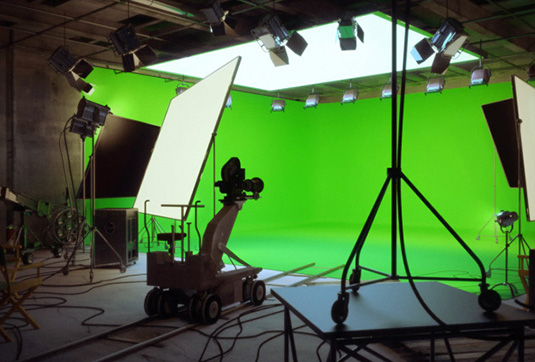
[Image: Green screen; image via Geek Magazine].

Earlier this week, Petro Vlahos, described by the BBC as “the pioneer of blue- and green-screen systems” in cinema, passed away. Vlahos’s highly specific recoloring of certain surfaces in the everyday built environment allowed “filmmakers to superimpose actors and other objects against separately filmed backgrounds”; they are walls that aren’t really there:

He called his invention the colour-difference travelling matte scheme. Like pre-existing blue-screen techniques it involves filming a scene against an aquamarine blue-coloured background. This is used to generate a matte—which is transparent wherever the blue-colour features on the original film, and opaque elsewhere. This can then be used to superimpose a separately filmed scene or visual effects to create a composite.

Special effects, animated actors, entire sets and spaces that weren’t physically present during filming: these aquamarine-colored surfaces are almost conjuring windows through which other environments can be optically inserted into filmed representations of the present moment.

These sorts of walls and surfaces are not architecture, we might say, but pure spatial effects, a kind of representational sleight of hand through which the boundaries and contents of a location can be infinitely expanded. There is no “building,” then, to put this in Matrix-speak; there are only spatial implications. Green screen architecture, here, would simply be a visual space-holder through which to substitute other environments entirely: a kind of permanent, physically real special effect that, in the end, is just a coat of paint.

It’s interesting, in this interpretation, that “green screens” or a rough optical equivalent are not more commonly utilized in architectural or interior design—even if only as an ironic gesture toward the possibility that, say, a group of friends taking photographs in your living room, with its weird green wall on one side, or in the lobby of that hotel, with its green screen backdrop, might somehow be able to insert into the resulting photographs otherwise non-present spatial realities, as if they had been photographed in front of a Stargate or a Holodeck, a window creaking open between worlds.

In fact, this was exactly the strange feeling I had when living just two buildings away from a green screen lot in Los Angeles, as if the painted green surface there, looming over the empty lot on our street corner, was standing sentinel, patiently awaiting new worlds to appear, all the while being nothing more than a wall of green plywood.

Optical Calibration Targets

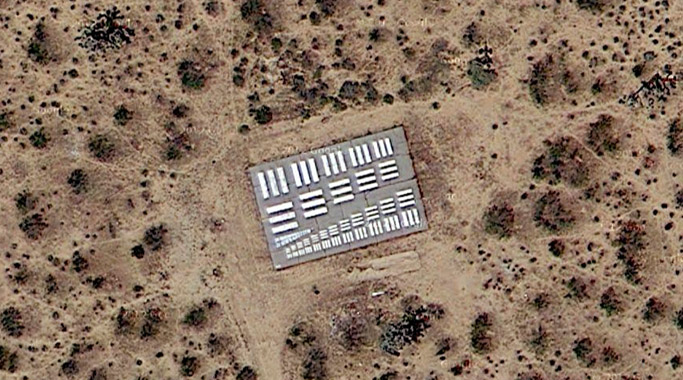
[Image: “Three tri-bar targets remaining at Cuddeback Lake… the flat surfaces are peeling, crumbling and sprouting, producing dimensionality, and relief.” Photo by and courtesy of the Center for Land Use Interpretation].

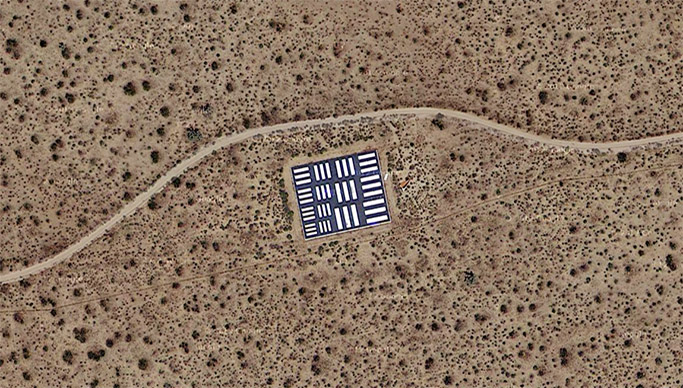
“There are dozens of aerial photo calibration targets across the USA,” the Center for Land Use Interpretation reports, “curious land-based two-dimensional optical artifacts used for the development of aerial photography and aircraft. They were made mostly in the 1950s and 1960s, though some apparently later than that, and many are still in use, though their history is obscure.”

These symbols—like I-Ching trigrams for machines—are used as “a platform to test, calibrate, and focus aerial cameras traveling at different speeds and altitudes,” CLUI explains, similar to “an eye chart at the optometrist, where the smallest group of bars that can be resolved marks the limit of the resolution for the optical instrument that is being used.”

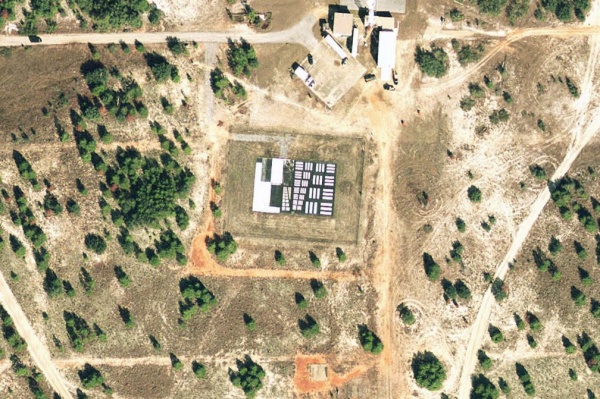
[Image: A tri-bar array at Eglin Air Force Base, Florida; via CLUI].

Formally speaking, the targets could be compared to mis-painted concrete parking lots in the middle of the nowhere, using “sets of parallel and perpendicular bars duplicated at 15 or so different sizes.” This “configuration is sometimes referred to as a 5:1 aspect Tri-bar Array, and follows a similar relative scale as a common resolution test chart known as the 1951 USAF Resolving Power Test Target, conforming to milspec MIL-STD-150A. This test pattern is still widely used to determine the resolving power of microscopes, telescopes, cameras, and scanners.”

[Image: A “standard tri-bar test pattern on the Photo Resolution Range at Edwards that has been greatly expanded,” CLUI writes; via CLUI].

CLUI points out that the history and location of the tri-bar patterns corresponds to the rise of high-altitude “flying cameras” developed during the Cold War—i.e. spy planes whose purpose was not to deliver ordnance to the far side of the world but simply to take detailed photographs.

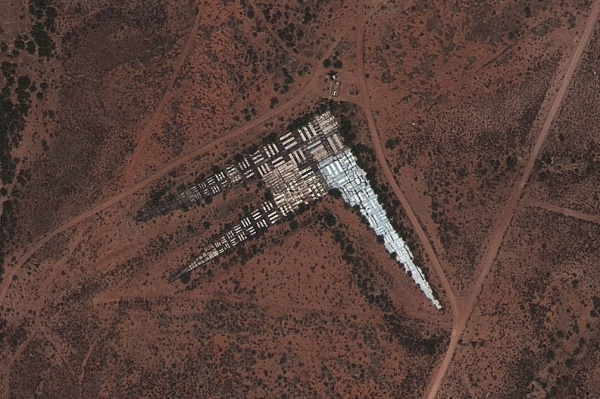
[Image: An “especially exotic” expanded tri-bar array at Fort Huachuca, Arizona; via CLUI].

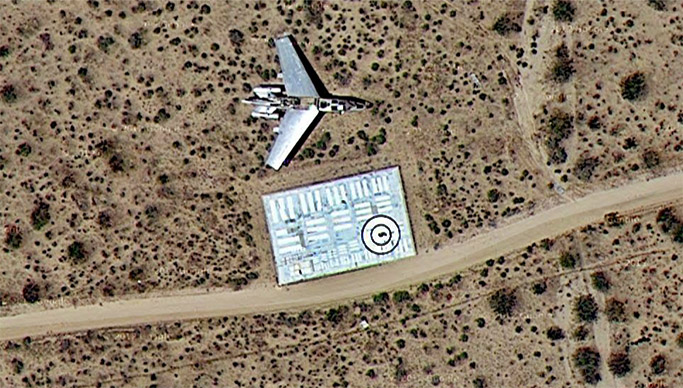
Further, “the largest concentration of calibration targets in one place is on the grounds of Edwards Air Force Base” in California, “in an area referred to as the photo resolution range, where 15 calibration targets run for 20 miles across the southeast side of the base in a line, so multiple targets can be photographed in one pass. There is some variation in the size and shape of the targets at Edwards, suggesting updates and modifications for specific programs. A number of the targets there also have aircraft hulks next to them, added to provide additional, realistic subjects for testing cameras.”

A quick scan of Google Maps locates the photo resolution range relatively easily; broadly speaking, just go up to the right and down to the left from, say, this point and you’ll find the targets.

[Image: Calibration targets from the photo resolution range, Edwards Air Force Base; from Google Maps].

Although I am truly fascinated by what sorts of optical landmarks might yet be developed for field-testing the optical capabilities of drones, as if the world might soon be peppered with opthalmic infrastructure for self-training autonomous machines, it is also quite intriguing to realize that these calibration targets are, in effect, ruins, obsolete sensory hold-overs from an earlier age of film-based cameras and less-powerful lenses. Calibrating nothing, they are now just curious emblems of a previous generation of surveillance technology, robot-readable hieroglyphs whose machines have all moved on.

Fault Wall

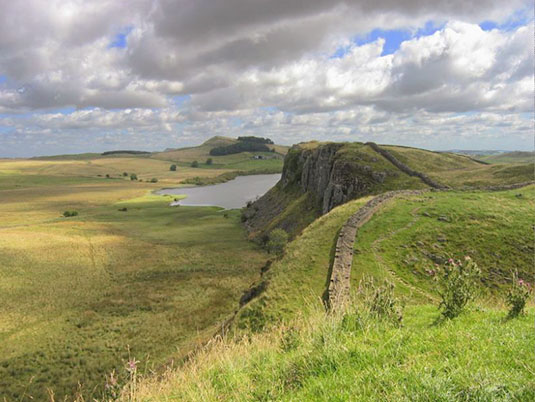
With my eyes on all things fault-related these days, as we’re now in the third week of the San Andreas Fault National Park studio up at Columbia, I was interested in a brief moment from poet Simon Armitage’s new memoir, Walking Home.

[Image: Hadrian’s Wall (not the wall described below) on the Whin Sill, via Wikipedia].

While hiking with a friend across a geological formation called the Whin Sill, in the northern Pennines, Armitage learns something extraordinary:

Stopping to appreciate a high and long dry-stone wall that bisects two valleys, [his fellow hiker] Chris explains how the shape, size, colour and consistency of the stones begins to change along its course, a consequence of wall-builders using the nearest available material while quarrying across a fault-line, so the wall becomes a kind of cross-section of the bedrock below us, and a timeline also, and after a few minutes of looking I almost convince myself that I can see the difference.

Whether or not this is even geologically true—and Armitage himself seems hesitant to accept the insight—the idea that fissures in the earth can be made visible in architecture is an implication worth contemplating, as if human spatial constructions, or, more importantly, the materials from which they’re made, can act as signs or perhaps symptoms for long-dead titanic events of incredible force and violence otherwise invisible inside the planet.

(Thanks to Nicola Twilley for the tip!)

Rock Type

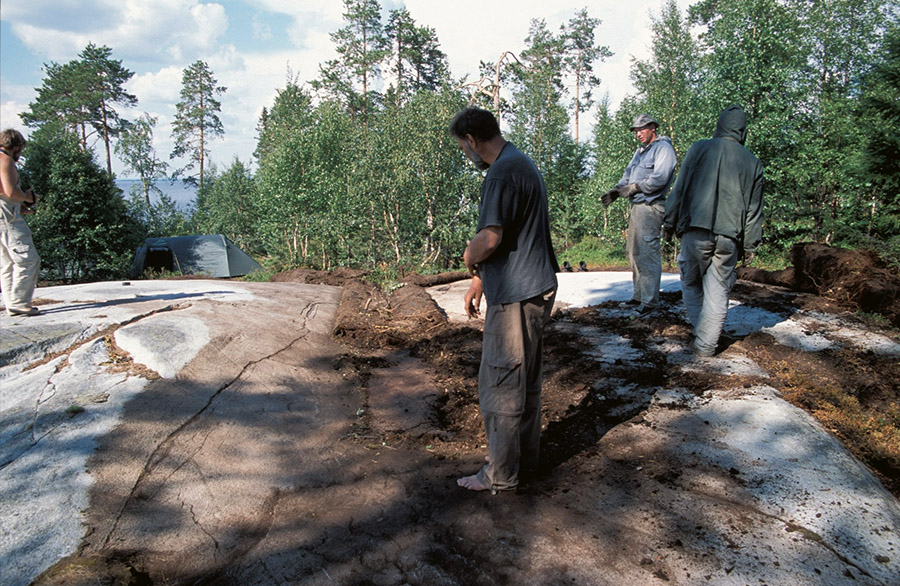
[Image: Recording a landscape; photo courtesy of Jan Magne Gjerde, via Past Horizons Archaeology].

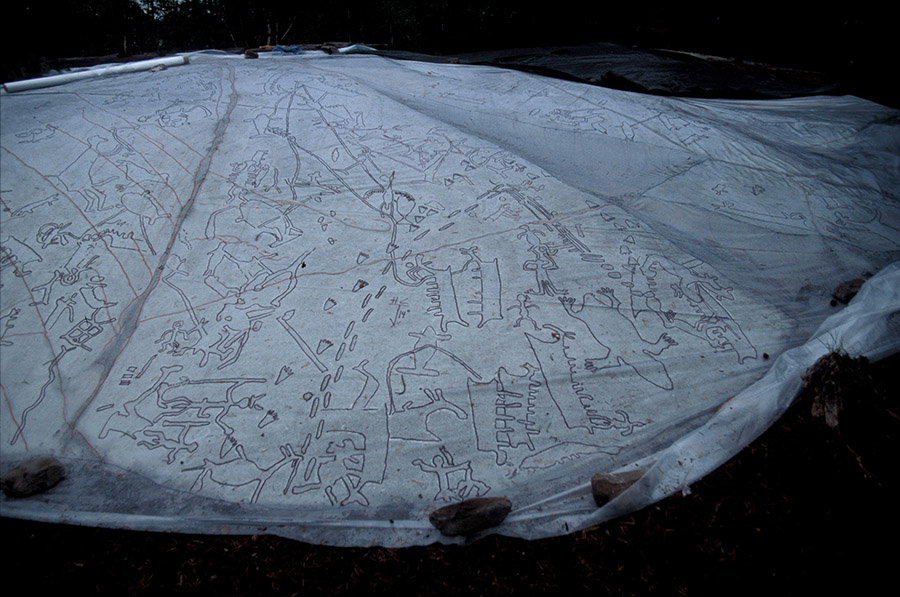
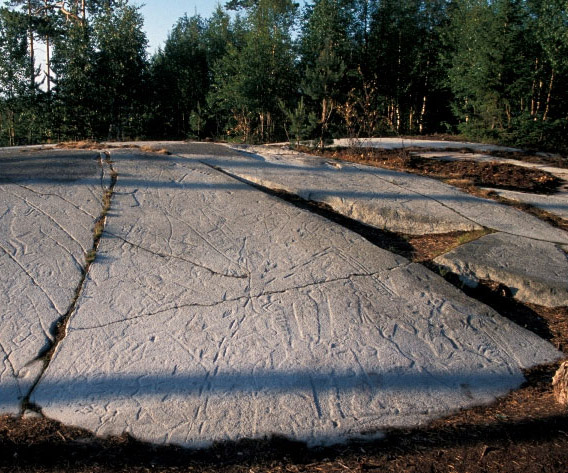
Last winter, Past Horizons Archaeology ran some remarkable photos from a site in NW Russia, close to the border with Norway, where more than a thousands petroglyphs have been discovered carved into the horizontal surface of the local bedrock.

Most of the site had been buried under 5,000 years’ worth of mud, soil, and plant roots, and was only recently cleared by Jan Magne Gjerde, who otherwise works as a project manager at Norway’s Tromsø University Museum.

[Image: The team looks down at the earth they will soon record; photo courtesy of Jan Magne Gjerde, via Past Horizons Archaeology].

“In the summer of 2005,” we read, “Gjerde drove more than 1000 kilometres east to Lake Kanozero,” where the glyphs are located.

“Together with Russian colleagues he discovered what he calls some of the world’s oldest animated cartoons.” The glyphs, in other words, constituted a narrative—in this case, of a bear hunt. The sprawling series of images depict “a hunter who is heading uphill on skis and tracking a bear. The ski tracks are just as one would expect for someone going up a slope with a good distance between the strides. The hunter then gets his feet together, skis down a slope, stops, removes his skis, takes four steps—and plunges his spear into the bear.”

Indeed, “The figures depicted in the Lake Kanozero rock carvings include moose, boats, whales, humans, harpoon lines, beavers and all kinds of other ordinary and extraordinary images and scenes from the distant past.”

[Image: The petroglyphs; photo courtesy of Jan Magne Gjerde, via Past Horizons Archaeology].

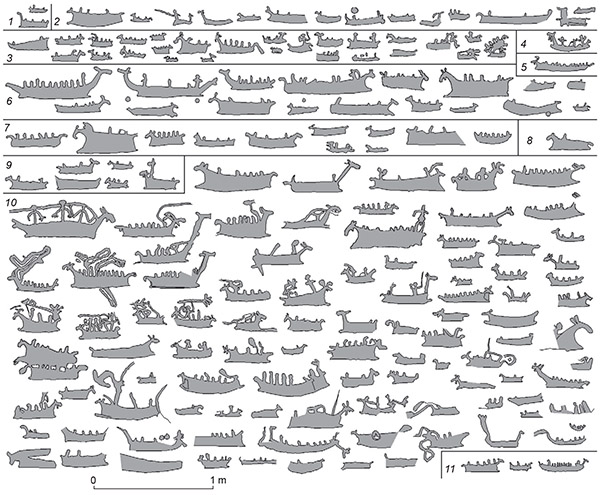
Interestingly, though, “Boats represent one of the most popular motifs in the rock art of Kanozero; they form 16% of all figures,” historians E.M. Kolpakov and V.Y. Shumkin explain in a paper published in Archaeology, Ethnology and Anthropology of Eurasia.

[Image: Boat glyphs from Lake Kanozero, courtesy of Archaeology, Ethnology and Anthropology of Eurasia].

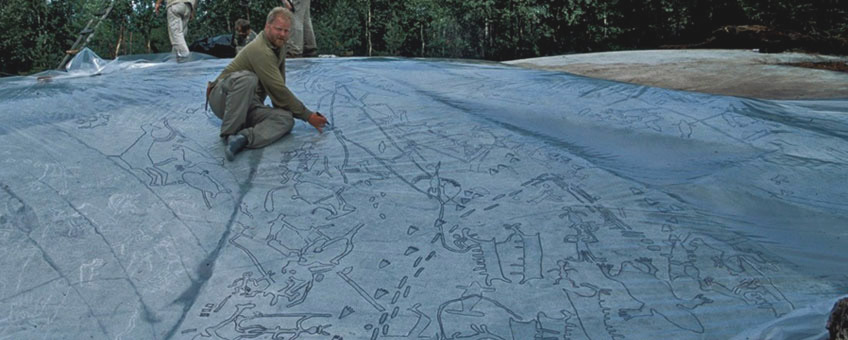
In addition to the obvious interest of the site itself, though, the ensuing method of documentation is pretty awesome: Jan Magne Gjerde and his team camped out for ten days and traced all of the petroglyphs with chalk, covered the whole thing with huge plastic sheets, and then traced onto the sheets with felt-tip pen the graphic storyboards seen on the rocks below. This could then “be brought back home and properly photographed and documented.” [Image: The petroglyphs and their tracing paper; photo courtesy of Jan Magne Gjerde, via Past Horizons Archaeology].

It should be published as a graphic novel! The world’s oldest comic book.

Meanwhile, as part of the ongoing Venue project—which has slowly been accumulating posts, for those of you who haven’t checked in for a while—we have been visiting a number of petroglyph sites out west in the United States, including images of animal hunts and atlatl-throwing etched into the rocks outside Las Vegas, of all places, and Utah’s famous “Newspaper Rock,” a kind of literary pilgrimage site, or monument to narrative media.

But these sorts of sites also always make me think that we cannot be far away from having easily deployable, personally affordable, field-rugged 3D milling machines capable of carving petroglyphs of our own into hard rocks anywhere in the world. Set up a Petroglyph National Sacrifice Zone or a Petroglyph Park on private rocky land somewhere in the Peak District or the mountains northeast of Yuma and build up the scaffolding for your inscription robot -slash- writing machine, and a future mythology of rock glyphs might emerge, carved two inches deep in solid granite.

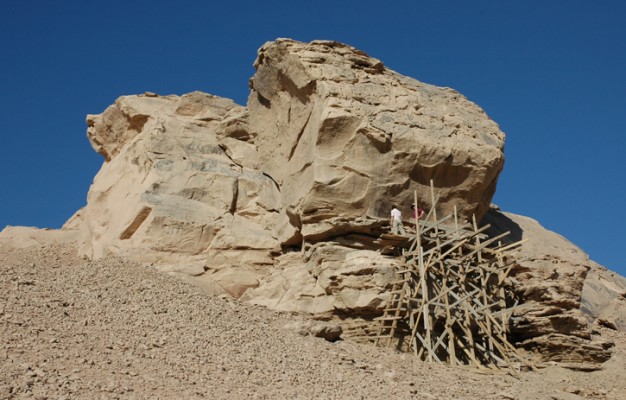
[Image: Field scaffolding set up to study rock art in Egypt; photo ©RMAH, Brussels, courtesy of YaleNews].

Literature becomes a place you visit, a rock-carving district of canyons and massifs tattooed with bands and sprays of plots and character arcs. Shelled, self-repairing robots chisel all day and night, GPS-stabilized and surrounded by clouds of rock dust. Goggled supervisors—librarians of geology partially deafened by chisels—wander the site, preparing themselves to someday lead tours through this labyrinth of glyphs and words.

Caustic Engineering

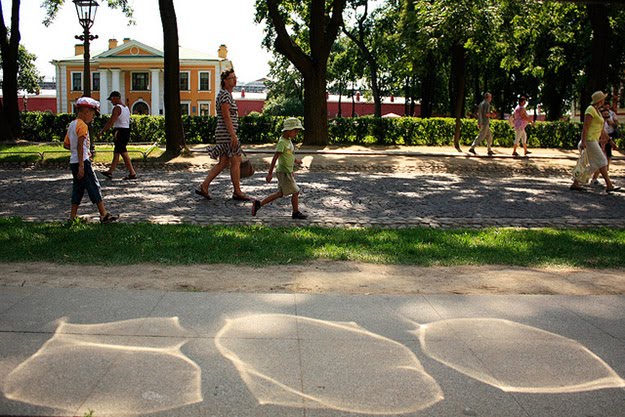
New milling techniques applied to glass and plexiglass panels could be used to “create windows that are also cryptic projectors, summoning ghostly images from sunlight.”

[Image: A piece of milled plexiglass acting as a projecting lens; via the Computer Graphics and Geometry Lab at the École Polytechnique Fédérale de Lausanne].

They do so by “taking control of a seemingly chaotic optical phenomena known as caustics,” in the words of New Scientist. Mark Pauly and Philippe Bompas have been experimenting with so-called “caustic engineering,” combining Pauly’s background in computational geometry and Bompas’s interest in manipulating otherwise “unintentional light shows produced by the reflection and refraction of light from curved mirrors or glass structures.” Indeed, Bompas’s work has a somewhat Neoplatonic overtone, as it involves “working backwards from a pattern of light to deduce the structure needed to create it.”

Working together, Pauly and Bompas—not Bompas and Parr—set out to fabricate “a large, transparent plate capable of generating a high-resolution image when a light was shone through it,” and they “chose to make the plate in perspex, which is easier to shape than glass.” You can see it in the image included in this post.

The architectural implications are obvious, and are brought to the fore by the New Scientist article from which I’m quoting. For instance: “Now [Pauly and Bompas] hope that the technique will be used in architectural design, to create windows that mould sunlight and throw images or patterns onto walls or floors,” which, if timed, milled, and manipulated just right, could produce a slowly animated sequence of images being projected by an otherwise empty window during different times of day. After all, “it should be possible to create a transparent plate containing several overlayed caustics that become visible as an animation as the light source moves.”

One piece of glass, infinitely dense with visual imagery, a kind of dream-prism casting slow two-hour films across the floor as the day goes by.

[Image: Reflections off glass or other polished surfaces could be controlled—that is, manipulated into producing recognizable images or specific shapes—by way of “caustic engineering”; Creative Commons photo by Flickr user passer-by].

This can work not only with light passing through milled transparent surfaces but with light bouncing off complexly shaped reflective surfaces—something the article describes as pieces of metal that look like “the mildly dented bodywork of a car” (i.e. parametric formalism in architecture today) creating recognizable images in the weird sprays of light they produce.

Curve a building just right with the daily passage of the sun, placing caustic windows at key moments so that their reflections or projections overlap like edits, and your building is now a cinema: an optical landmark with content, in the narrative life of the city. Buskers offer optional soundtracks. Reflection festivals arise on sidewalks. Milled glass objects play filmloops in the sun.

Detecting lost rooms with architectural antennae

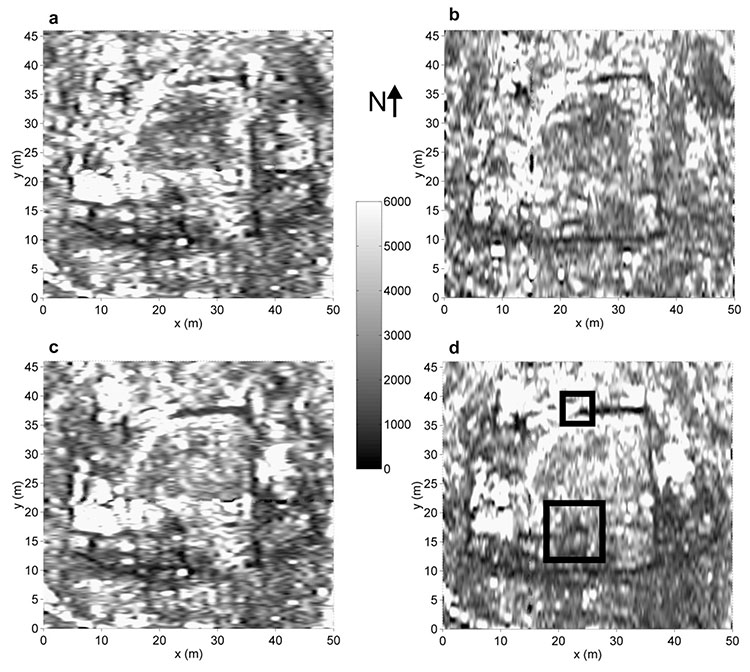
[Image: “Constant time slices” reveal buildings buried in northwestern Argentina; image from, and courtesy of, the Journal of Archaeological Science, “Detecting and mapping buried buildings with Ground-Penetrating Radar at an ancient village in northwestern Argentina,” by Néstor Bonomo, Ana Osella, and Norma Ratto].

While reading The Losers last night for the first time—a graphic novel about a team of ex-CIA members now executing a series of elaborate heists against their former employer—I was pleasantly surprised to see that one of the final scenarios involves a small volcanic island featuring an abandoned village that had very recently been buried by ash and pumice.

In a nutshell, the buildings beneath all that rock and ash are still intact—and one of them contains a locked safe that our eponymous group of “losers” is searching for. So begins an unfortunately quite short scene of vertical archaeology: locating the proper building amidst the featureless landscape of ash, blasting a hole down through the building’s roof, stabilizing the ceiling from within so that heavy-lifting equipment can be installed on the rooftop, and then descending into the hallways and staircases below by way of mountaineering ropes to find the safe.

For whatever reason, there are few things I find more exciting to read about than high-risk descents into buried cities, especially one that, as in the case of The Losers, remains otherwise indistinguishable from the surface of the earth, only gradually revealing itself to be an extraordinary honeycomb of connected rooms and passages—and this brief moment in the book was made even more interesting when I remembered a handful of articles I’d saved last year, one of which also involves a lost village, buried by volcanic ash.
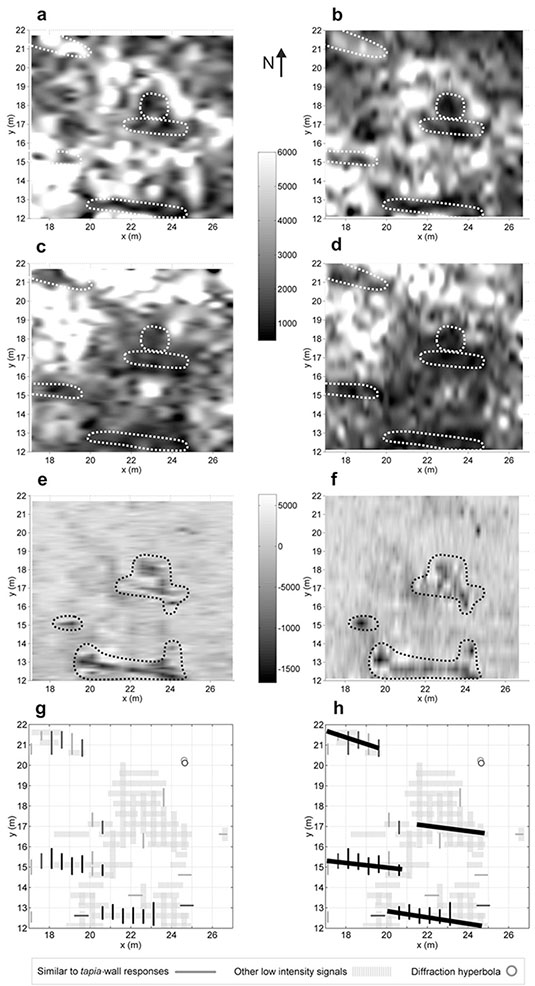
[Image: A selection of “time slices” from the buried buildings of northwestern Argentina; image from, and courtesy of, the Journal of Archaeological Science, “Detecting and mapping buried buildings with Ground-Penetrating Radar at an ancient village in northwestern Argentina,” by Néstor Bonomo, Ana Osella, and Norma Ratto].

In a 1998 paper from the Journal of Applied Geophysics, called “The use of ground penetrating radar to map an ancient village buried by volcanic eruptions,” we read about a village in Japan called Komochi-mura, in Gunma prefecture: “The entire area surrounding the village is covered by a thick deposit of pumice derived from the eruption of Futatsudake volcano of Mt. Haruna, approximately 10km to the southwest of the village.”

Beneath the modern village, its predecessor from the middle of the 6th century is buried by the pumice deposits. Since these were laid down over a very short period, the ancient village should survive in a high state of preservation and will therefore contain much significant archaeological information. Ground penetrating radar (GPR) has been used to investigate this site over a period of 10 years. As a result, the plan of the ancient village can be accurately mapped… In this paper, the authors demonstrate how GPR was able to map the structural remains of the ancient village under a deposit of pumice.

In addition to various buildings, “pit-dwellings,” and other destroyed structures preserved but invisibly buried beneath today’s village, “traces of brushwood hedges, paths and other slight features have also been identified by the survey.”

These types of articles—on the remote-sensing of buried architectural remains, using technologies that “can detect and map buried structures without disturbing them,” in the words of the paper I am about to cite—are increasingly easy to find, but no less interesting because of their ubiquity.

Another paper, then, called “Detecting and mapping buried buildings with Ground-Penetrating Radar at an ancient village in northwestern Argentina,” published in 2010 in the Journal of Archaeological Science, describes an archaeological survey in which ground-penetrating radar was used “in order to detect new buildings,” including a system of “complex wall distribution and a number of unknown enclosures.” These “new buildings,” however, were just signals from the earth awaiting spatial interpretation:

The exploration showed signals of mud-walls in a sector that was located relatively far from the previously known buildings. A detailed survey was performed in this sector, and the results showed that the walls belonged to a large dwelling with several rooms. The discovery of this dwelling has considerably extended the size of the site, showing that the dwellings occupied at least twice the originally assumed area. High-density GPR surveys were acquired at different parts of the discovered building in order to resolve complex structures. Interpreted maps of the building were obtained.

“From the joint analysis of the transverse sections, time slices and volume slices of the data and their time averaged intensity,” the authors explain, “we have obtained a final map for the new building”—where the “new” building, of course, is a much older, forgotten one, a structure interpretively remade and refreshed through this newfound legibility.
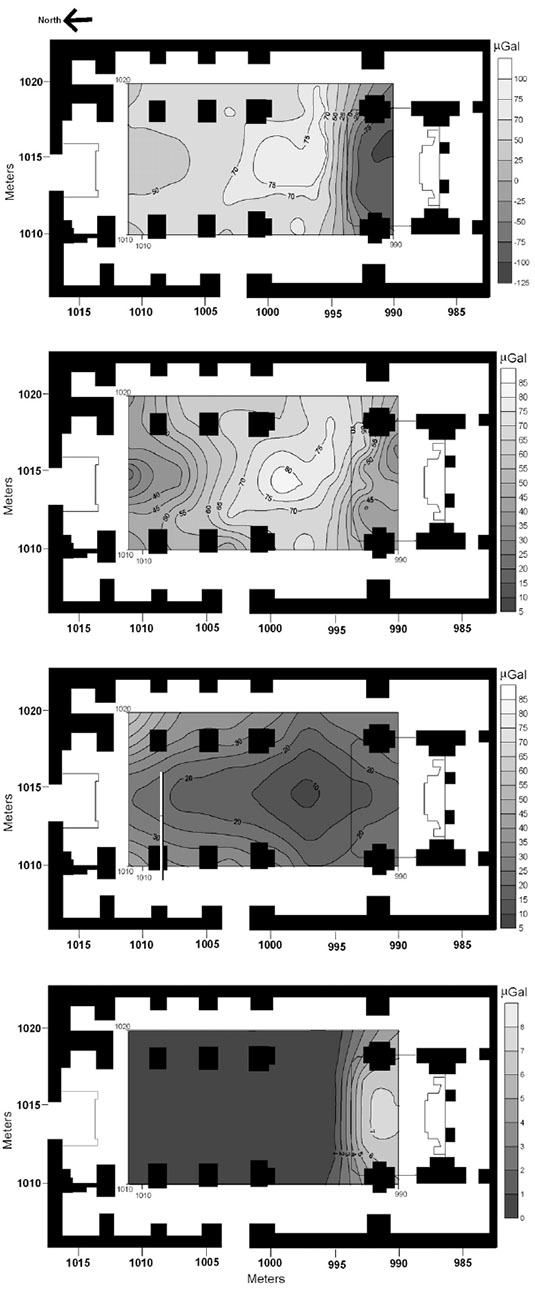
[Image: From “Archaeological microgravimetric prospection inside don church (Valencia, Spain),” by Jorge Padín, Angel Martín, Ana Belén Anquela, in a 2012 issue of the Journal of Archaeological Science].

Architecture, in this context, comes to our attention first as a series of “intensity blots continued through consecutive slices,” an almost impossibly abstract geometry of signals and reflections, of patterned “electromagnetic responses” hidden in the landscape.

In all of these cases, it’d be interesting to propose a kind of archaeological discovery park the size of a football stadium, whose interior is simply a massive, open-span paved landscape on which small devices like floor-waxing machines or lawnmowers have been parked. Paying visitors can walk out onto this vast, continuous monument of bare concrete where they will begin moving the machines around, cautiously at first but then much more ambitiously, revealing as they do so the underground perimeters and outlines of entire villages buried deep in the mud and gravel beneath the building. The “park” is thus really a kind of terrestrial TV show of invisible architecture previously lost to history but beautifully preserved—that is, entombed—in the geology below.

In any case, in writing this post I’ve realized that I’ve accumulated over the past two years or so several gigabytes’ worth of PDFs about these and other archaeological technologies—from mapping ancient ships buried in the Egyptian pyramids and micro-gravity detection of “shallow subsurface structures” in a church in Italy (“indicating,” in the authors’ words, “that the actual church was constructed above another one”) to “archaeomagnetic data” taken from Roman sites in Tunisia—but here’s at least one more reference for good measure.

In a paper called “Ground penetrating radar (G.P.R.) surveys applied to the research of crypts in San Sebastiano’s church in Catania (Sicily),” from a 2007 issue of the Journal of Cultural Heritage, a team of Italian geophysicists explored “natural or anthropic buried cavities” under a church in Sicily—that is, both architectural chambers and caves physically inaccessible in the foundations of the building. Soon enough, the authors write, “the existence of hidden structures was revealed.”

“In fact,” they add, “a crypt with a barrel vault, under the central aisle of the church, and a room of small dimensions next to this crypt were identified. Moreover, near the altar, the presence of a quadrangular crypt with a cross-vault was revealed. The presence of such buried masonries confirms that the church, rebuilt on previous building rests, has been subjected along the centuries to repeated repairs.”
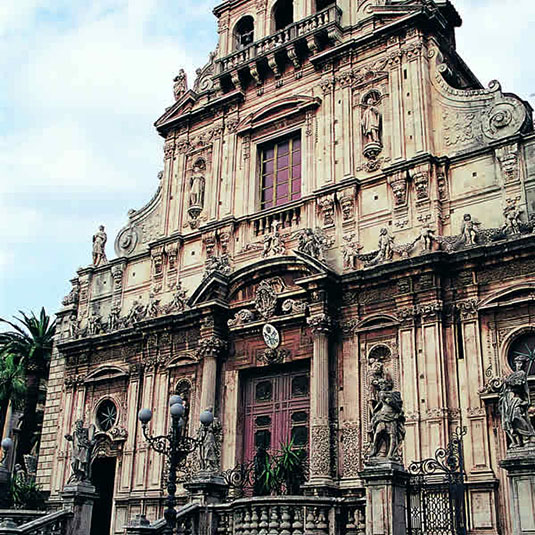
[Image: The church of San Sebastiano in Catania, Sicily, courtesy of the regional tourism council].

There is something particularly awesome—that is, it is a story that lends itself particularly to metaphor—about envisioning a squad of well-equipped scientists setting up shop in a church in Sicily, using radar and rigs of strange antennae to scan the structure around them for secret rooms, heavenly nooks and crannies out of human reach. A kind of electromagnetic baroque.

The paper cited in a caption above—”Archaeological microgravimetric prospection inside don church (Valencia, Spain),” by Jorge Padín, Angel Martín, Ana Belén Anquela, from a 2012 issue of the Journal of Archaeological Science—even includes such strangely resonant lines as calculating against “residual gravity anomalies” in a “microgravimetric correction for the altar,” as if the high science of geophysical investigation has been rhetorically wed with theological speculation.

In the words of a paper by N. Farnoosh et al., published in a 2008 issue of NDT & E International, analyzing a given architectural space becomes a question of “buried target detection” using high-tech means—that is, establishing a sustained and coordinated “electromagnetic interaction among the radar antennas, ground, and buried objects.”

Here, the study of architectural history can very, very loosely be compared to astronomy: using tools of remote-sensing, including antennae, but targeted downward, into the earth, to reveal the flickering, gossamer traces of something that, for a variety of reasons, humans can’t yet physically reach. Like astronomy, then, archaeology and architectural history become a case of interpreting signals from afar, not of stars and supernovae but of lost rooms and buildings beneath our feet.