An Occult History of the Television Set


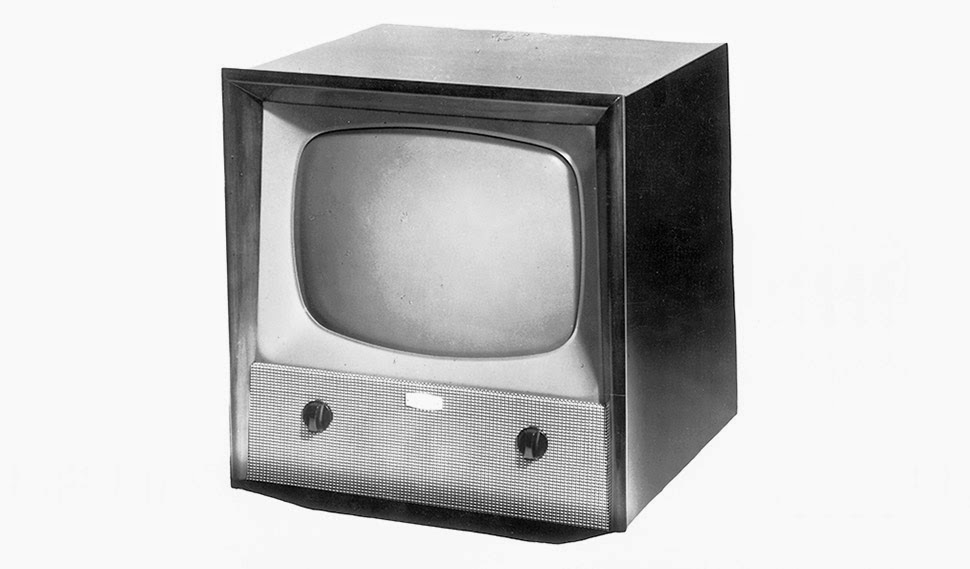
The origin of the television set was heavily shrouded in both spiritualism and the occult, Stefan Andriopoulos writes in his new book Ghostly Apparitions. In fact, as its very name implies, the television was first conceived as a technical device for seeing at a distance: like the telephone (speaking at a distance) and telescope (viewing at a distance), the television was intended as an almost magical box through which we could watch distant events unfold, a kind of technological crystal ball.

Andriopoulos’s book puts the TV into a long line of other “optical media” that go back at least as far as popular Renaissance experiments involving technologically-induced illusions, such as concave mirrors, magic lanterns, disorienting walls of smoke, and other “ghostly apparitions” and “phantasmagoric projections” created by specialty devices. These were conjuring tricks, sure—mere public spectacles, so to speak—but successfully achieving them required sophisticated understandings of basic physical factors such as light, shadow, and acoustics, making an audience see—and, most importantly, believe in—the illusion.

A Magic Lantern for Watching Events at a Distance

What’s central to Andriopoulos’s argument is that these devices incorporated earlier experimental instruments devised specifically for pursuing supernatural research—for visualizing the invisible and showing the subtle forces at work in everyday life. In his words, these were “devices developed in occult research”—including explicitly “televisionlike devices”—that had been invented in the name of spiritualism toward the end of the 19th century and that, only a decade or two later, “played a constitutive role in the emergence of radio and television.”
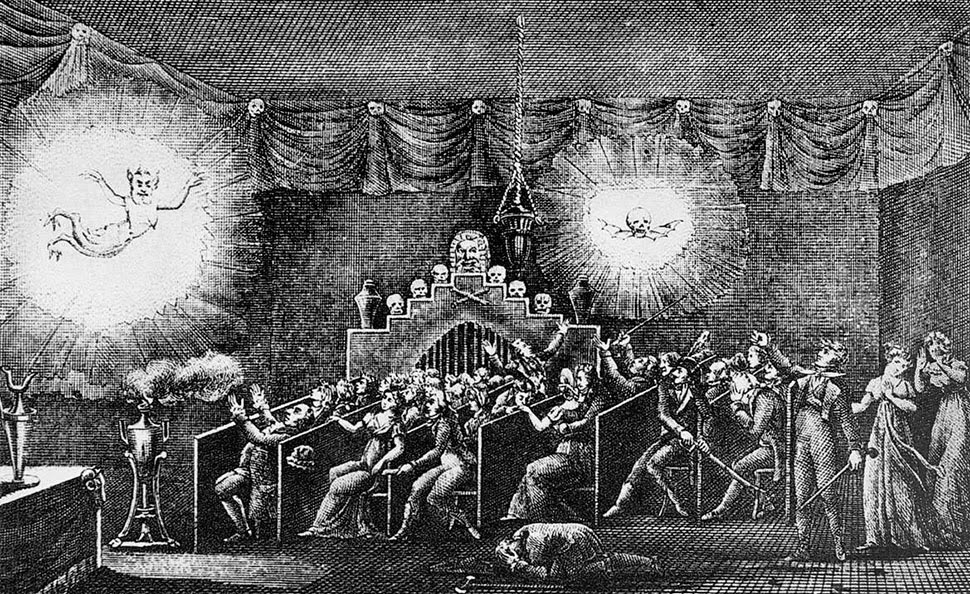
[Image: From Etienne-Gaspard Robertson’s 1834 study of technical phantasmagoria, via Ghostly Apparitions].

In Andriopoulos’s words, this was simply part of “the reciprocal interaction between occultism and the natural sciences that characterized the cultural construction of new technological media in the late nineteenth century,” a “two-directional exchange between occultism and technology.” New forms of broadcast technology and belief in the occult? No big deal.

So, while the television itself—the object you and I most likely know as the utterly mundane fixture of family distraction sitting centrally ensconced in a nearby living room—might not be a supernatural mechanism, it nonetheless descends from a strange and convoluted line of esoteric experimentation, including early attempts at controlling electromagnetic transmissions, directing radio waves, and even experiencing various forms of so-called “remote viewing.”

The idea of a medium takes on a double meaning here, Andriopoulos explains, as the word refers both to the media—in the sense of a professional world of publishing and transmission—and to the medium, in the sense of a specific, vaguely shamanic person who acts as a psychic or seer. The medium thus acts as an intermediary between humans and the supernatural world in a very literal sense.

Indeed, in Andriopoulos’s version of television’s origin story, the notion of spiritual clairvoyance was very much part of the overall intention of the device.

Clairvoyance—a word that literally means clear vision, yet that has now come to refer almost exclusively to a supernatural ability to see things at a distance or before events even happen—offered an easy metaphor for this new mechanism.

Television promised clairvoyance in the sense that a TV could allow seeing without interference or noise. It would give viewers a way to tune into and clearly see a broadcast’s invisible signals—with the implication that an esoteric remote-viewing apparatus with forgotten supernatural intentions is now mounted and enshrined in nearly everyone’s home.

[Image: A “moving face” transmitted by John Logie Baird at a public demonstration of TV in 1926 (photo via the BBC)].

I’ll leave it to curious readers to look for Andriopoulos’s book itself—with the caveat that it is quite heavy on German idealism and rather light on real tech history—but it is worth mentioning the fact that at least one other technical aspect of the 20th-century television also followed a very bizarre historical trajectory.

Part Tomb, Part Church, Part Planetarium

The cathode ray—a vacuum tube technology found in early television sets—took on an unexpected and extraordinary use in the work of gonzo Norwegian inventor Kristian Birkeland. Birkeland used cathode rays in his attempt to build a doomed scale model of the solar system.

I genuinely love this story and I have written about it elsewhere, including both here on BLDGBLOG and in The BLDGBLOG Book, but it’s well worth retelling.

In a nutshell, Birkeland was the first scientist to correctly hypothesize the origins of the Northern Lights, rightly deducing from his own research into electromagnetic phenomena that the aurora borealis was actually caused by interactions between charged particles constantly streaming toward earth from the sun and the earth’s own protective magnetic field. This produced the extraordinary displays of light Birkeland had seen in the planet’s far north.

However, as Birkeland fell deeper into an eventually fatal addiction to extreme levels of caffeine and a slow-acting hypnotic drug called Veronal, he also—awesomely—became fixated on the weirdly impossible goal of precisely modeling the Northern Lights in miniature. He sought to build a kind of Bay Model of the Northern Lights.
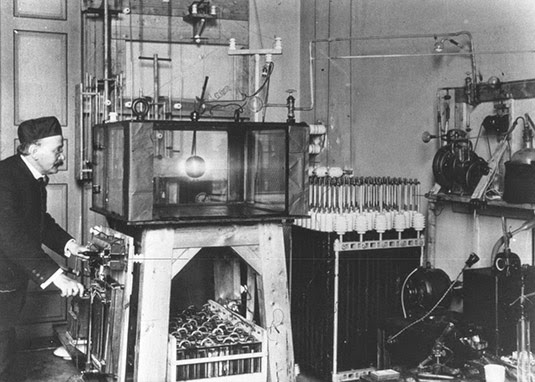
[Image: Kristian Birkeland stares deeply into his universal simulator (via)].

As author Lucy Jago tells Birkeland’s amazing story in her book The Northern Lights, he was intent on producing a kind of astronomical television set: a “televisionlike device,” in Andriopoulos’s words, whose inner technical workings would not just broadcast actions and characters seen elsewhere, but would actually model the electromagnetic secrets of the universe.

As Jago describes his project, Birkeland “drew up plans for a new machine unlike anything that had been made before.” It resembled “a spacious aquarium,” she writes, a shining box that would act as “a window into space.”

The box would be pumped out to create a vacuum and he would use larger globes and a more powerful cathode to produce charged particles. With so much more room he would be able to see effects, obscured in the smaller tubes, that could take his Northern Lights theory one step further–into a complete cosmogony, a theory of the origins of the universe.

It was a multifaceted and extraordinary undertaking. With it, Jago points out, “Birkeland was able to simulate Saturn’s rings, comet tails, and the Zodiacal Light. He even experimented with space propulsion using cathode rays. Sophisticated photographs were taken of each simulation, to be included in the next volume of Birkeland’s great work, which would discern the electromagnetic nature of the universe and his theories about the formation of the solar system.”

However, this “spacious aquarium” was by no means the end of Birkeland’s manic (tele)vision.
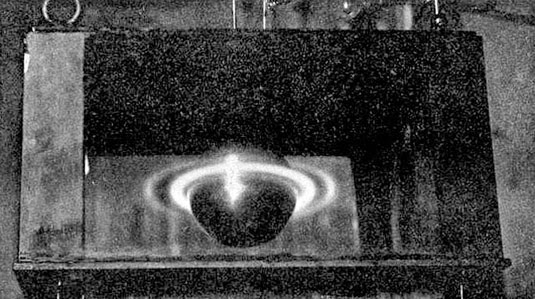
[Image: From Birkeland’s The Norwegian Aurora Polaris Expedition 1902-1903, Vol. 1: On the Cause of Magnetic Storms and The Origin of Terrestrial Magnetism (via)].

His ultimate goal—devised while near-death in a hotel room in Egypt—was to construct a vacuum chamber partially excavated into the solid rock of a mountain peak, an insane mixture of tomb, church, and planetarium.

The resulting cathedral-like space—think of it as a three-dimensionally immersive, landscape-scale television set carved directly into bedrock—would thus be an artificial cavern inside of which flickering electric mirages of stars, planets, comets, and aurorae would spiral and glow for a hypnotized audience.

Birkeland wrote about this astonishing plan in a letter to a friend. He was clearly excited about what he called a “great idea I have had.” It would be—and the emphasis is all Birkeland’s—”a museum for the discovery of the Earth’s magnetism, magnetic storms, the nature of sunspots, of planets—their nature and creation.”

His excitement was justified, and the ensuing description is worth quoting at length; you can almost feel the caffeine. “On a little hill,” he scribbled, presumably on his Egyptian hotel’s own stationery, perhaps even featuring a little image of the pyramids embossed in its letterhead, reminding him of the ambitions of long-dead pharaohs, “I will build a dome of granite, the walls will be a meter thick, the floor will be formed of the mountain itself and the top of the dome, fourteen meters in diameter, will be a gilded copper sphere. Can you guess what the dome will cover? When I’m boasting I say to my friends here ‘next to God, I have the greatest vacuum chamber in the world.’ I will make a vacuum chamber of 1,000 cubic metres and, every Sunday, people will have the opportunity to see a ring of Saturn ten metres in diameter, sunspots like no one else can do better, Zodiacal Light as evocative as the natural one and, finally, auroras… four meters in diametre. The same sphere will serve as Saturn, the sun, and Earth, and will be driven round by a motor.”

Every Sunday, as if attending Mass, congregants of this artificial solar system would thus hike up some remote mountain trail, heading deep into the cavernous and immersive television of Birkeland’s own astronomy, hypnotized by the explosive whirls of its peculiar, peacock-like displays of electromagnetism, shimmering cathedrals of artificially controlled planetary light.
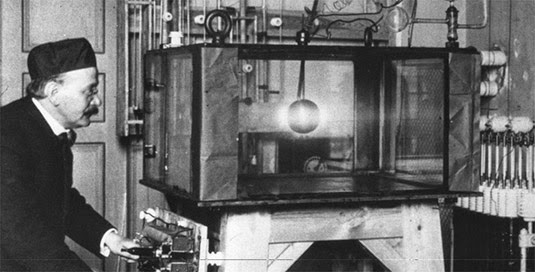
[Image: Cropping in on the pic seen above (via)].

Seen in the context of the occult mechanisms, psychic TVs, and clairvoyant media technologies of Stefan Andriopoulos’s book, Birkeland’s story reveals just one particularly monumental take on the other-worldly possibilities implied by televisual media, bypassing the supernatural altogether to focus on something altogether more extreme: a direct visual engagement with nature itself, in all its blazing detail.

Of course, Birkeland’s cathode ray model of the solar system might not have conjured ghosts or visualized the spiritual energies that Andriopoulous explores in his book, but it did try to bring the heavens down to earth in the form of a 1,000 cubic meter television set partially hewn from mountain granite.

It was the most awesome TV ever attempted, a doomed and never-realized invention that nonetheless puts all of today’s visual media to shame.

(An earlier version of this post previously appeared on Gizmodo).

Guided By Voices

At last week’s inaugural Infrastructure Observatory conference, MacroCity, archivist Rick Prelinger delivered a fantastic opening lecture looking back at the history of telephony in the Bay Area.

From the earliest exposed copper wires vulnerable to shorting out in San Francisco’s morning fog to 1970s phone phreaks and the future of NSA surveillance, it was a great talk; you can view the slides here (and follow Rick on Twitter for yet more).

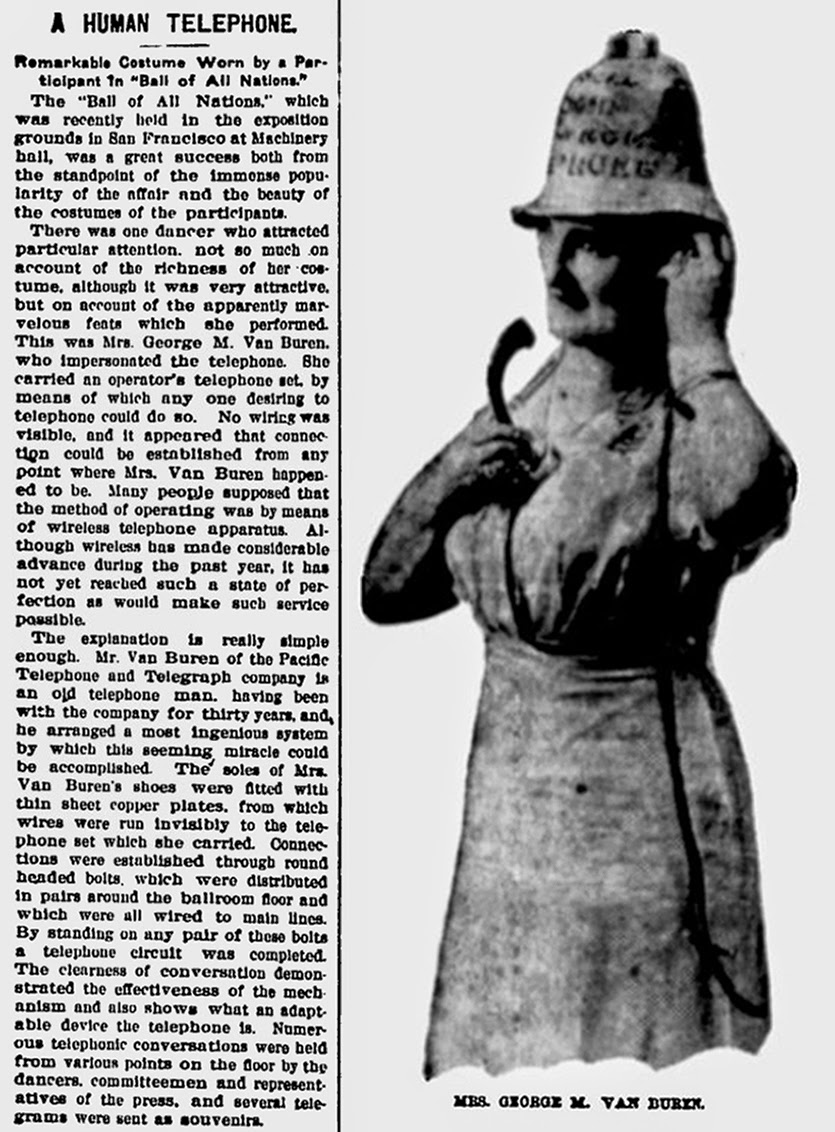
[Image: From the Ellensburg Daily Record, June 16, 1914].

Amidst dozens of examples and images in his talk, the one that really stood out for architectural purposes was his citation of something called the “human telephone,” as originally reported in the Ellensburg Daily Record on June 16, 1914. A reorganized and cleaned-up version of that article appears above.

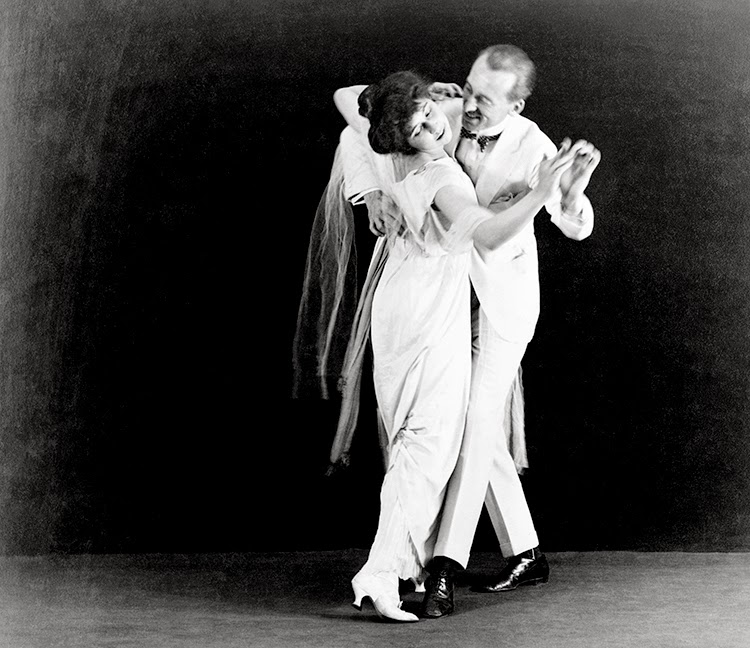
As Prelinger described it, the human telephone was like an electromagnetic update to the oracle at Delphi: a lone female figure with access to distant voices, dancing slowly across a dance floor secretly wired from below, an interactive surface whose hidden technology extended up into her very clothing.

There were copper wires woven through her dress, copper-soled shoes on her feet, even copper nails hammered in the floor below, and this all effectively turned her into a living telephone network—the “human telephone” of the article’s title—receiving voices from some continent-scale network invisible to spectators’ eyes. Oracular and alluring, she would then invite members of the audience to join her in this choreography, where ghostly conversations-at-a-distance would ensue.

[Image: An otherwise irrelevant photo of people ballroom dancing, via Wikipedia].

In Prelinger’s own words:

Prior to the opening of PPIE [the Panama Pacific International Exhibition], Pacific Telephone was asked to furnish service to the Ball of All Nations in May 1914. They built a hidden network of wires under the floor, connected with copper nails set close apart in the floor. The spouse of a telco employee wore copper-soled shoes from which wires ran up through her clothing to a telephone set. She asked her dancing partners whom they’d like to talk with, and suddenly they were on the phone. A switchboard operator listened in on all conversations and whenever she heard a name rushed through a call on special lines.

This wired ballroom—like some telephonic update of the khôra, that Platonic dance floor and moving surface so mythologically important to the first days of Western architecture—presents us with an absolutely incredible image of people waltzing amidst voices, metallurgically connected to a matrix of wires and lines extending far beyond the room they first met within.

The copper woman in the center of it all becomes more like an antenna, stepping and turning inside a glossolalia of distant personalities all vying for time on the invisible network she controls with every move of her feet. Sheathed in metal, she is part golem, part conjurer, part modern oracle, kicking off the weird seance that was the early telephone system, guiding us through a switchboard of words from nowhere all woven together in this awesome dance.

Wire-Tapping the Ruins of Pompeii

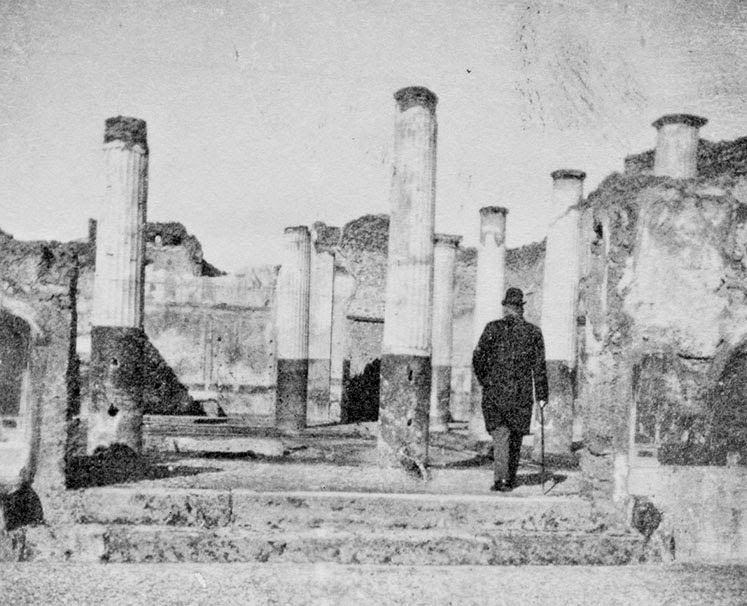
[Image: Alexander Graham Bell, inventor of the telephone, steps forth into the ruins of the “extinct city” of Pompeii; courtesy U.S. Library of Congress].

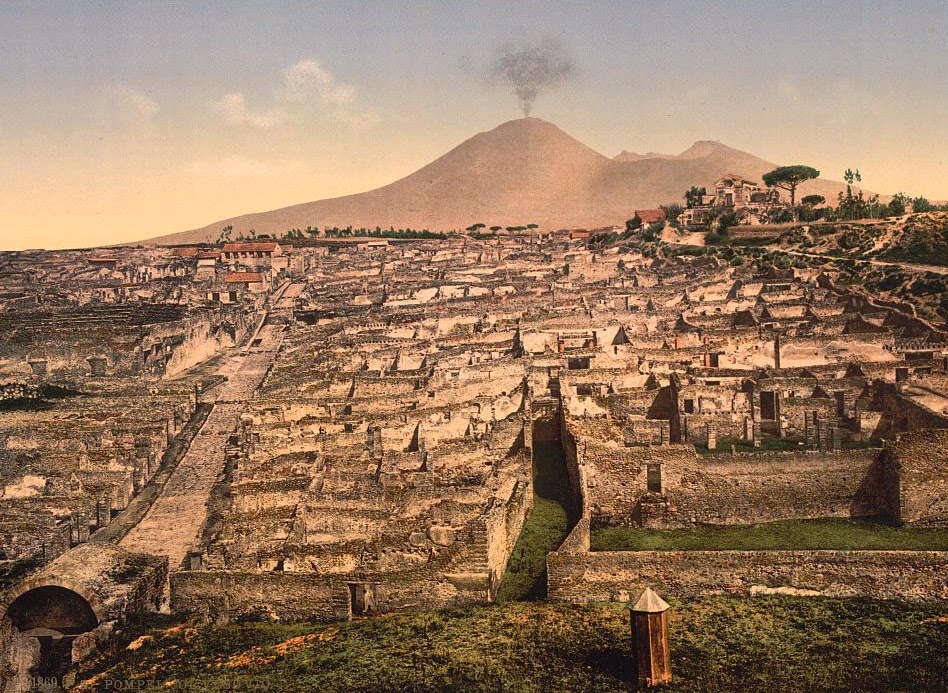
The ruins of Pompeii are being wired-up by a company otherwise known for its work as a manufacturer of military drones and “electronic warfare equipment,” Phys.org reports. Finmeccanica, the “Italian aerospace and defense giant,” has been contracted to install a high-tech sensor network amongst the barely stabilized walls and streets of this city once buried by a volcanic eruption nearly 2,000 years ago, in the hopes of monitoring unstable ground conditions on the sites.

Slippage and instability threaten to bring some of the buildings down, not just putting the site’s UNESCO-designated mansions at risk but potentially injuring (or worse) its annual hordes of international visitors.

[Image: General view of Pompeii and Mt. Vesuvius; courtesy U.S. Library of Congress].

In Phys.org’s words, the sensors are being installed “to assess ‘risks of hydrogeological instability’ at the sprawling site, boost security and test the solidity of structures, as well as set up an early warning system to flag up possible collapses.”

The results are a bit like electronic eavesdropping—a kind of NSA of the ruins—only, instead of wire-tapping a single phone line, the entire city of Pompeii will be listened to from within, hooked up from one side to the other with equipment so sensitive it is normally used in waging “electronic warfare.”

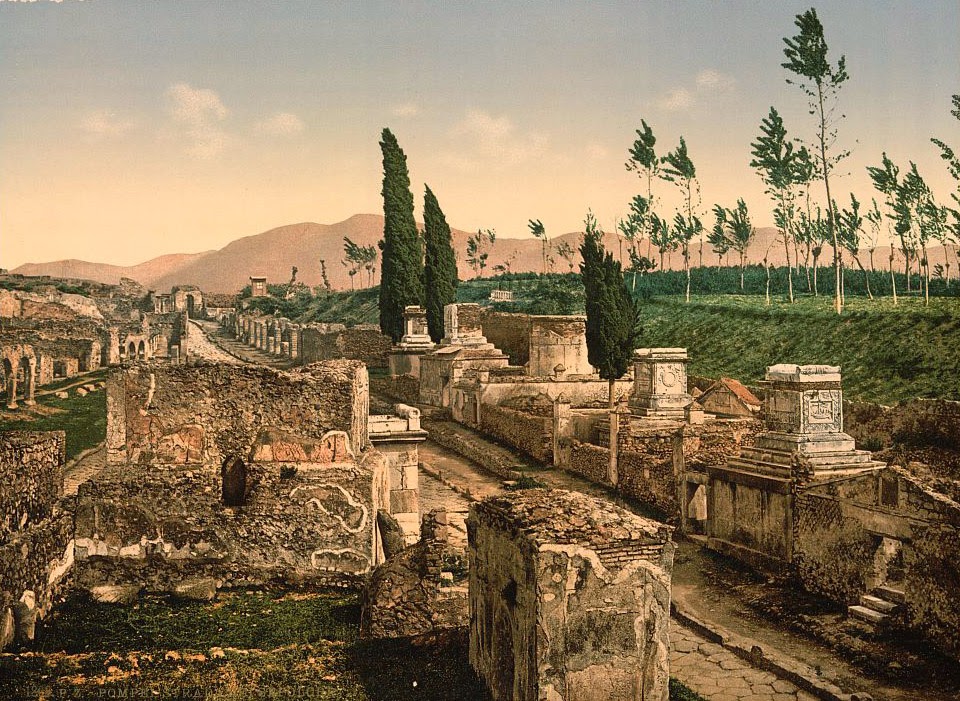
[Image: The Street of Tombs, Pompeii; courtesy U.S. Library of Congress].

The data will eventually be made available online for all to analyze, but it is interesting to read of a more immediate use of the sensors’ findings: Pompeii’s “security guards will be supplied with special radio equipment as well as smartphone apps to improve communication that can pinpoint their position and the type of intervention required.”

In other words, guards will receive electronic updates from the city itself while out on their daily rounds, including automated pings and alerts of impending structural failure or deformations of the ground, like some weird, semi-militarized version of ambient music, as if listening to the real-time groans of a settling city by radio.

Wire-tapping the ruins of a dead city, this mesh of electronic equipment—normally used in military surveillance operations—will thus help to preserve the archaeological site for future generations.

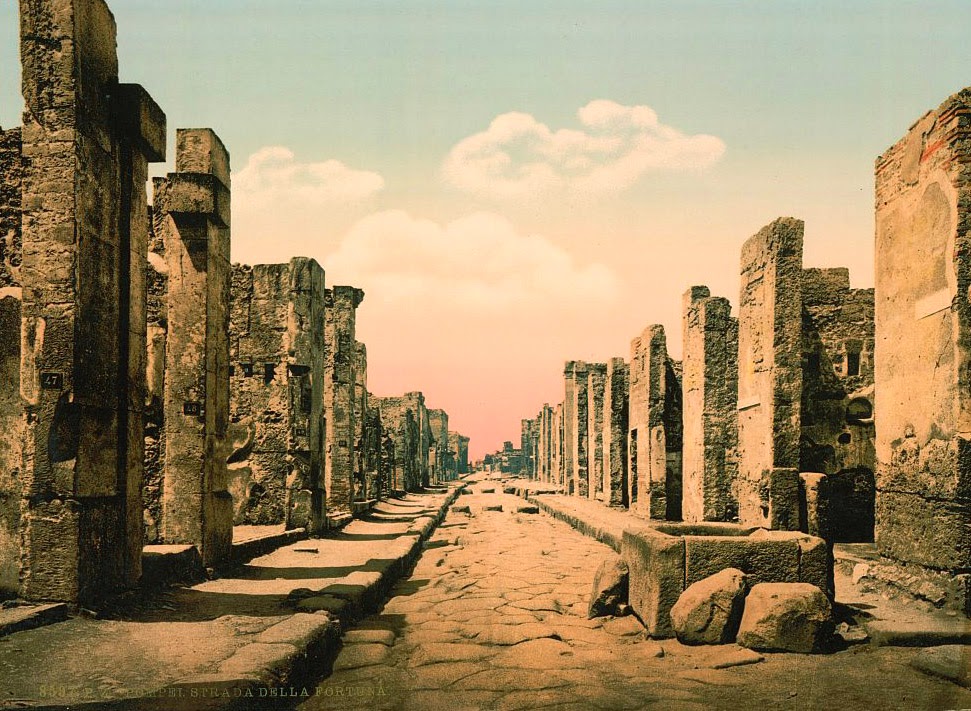
[Image: Fortuna Street, Pompeii; courtesy U.S. Library of Congress].

Like something out of Douglas Kahn’s recent book about the history of terrestrial electromagnetism and audio art, the old crumbling columns and shattered walls of Pompeii will soon find a new voice through repurposed military equipment, a weaponized seance performed on the empty streets of a place that’s more tomb than city.

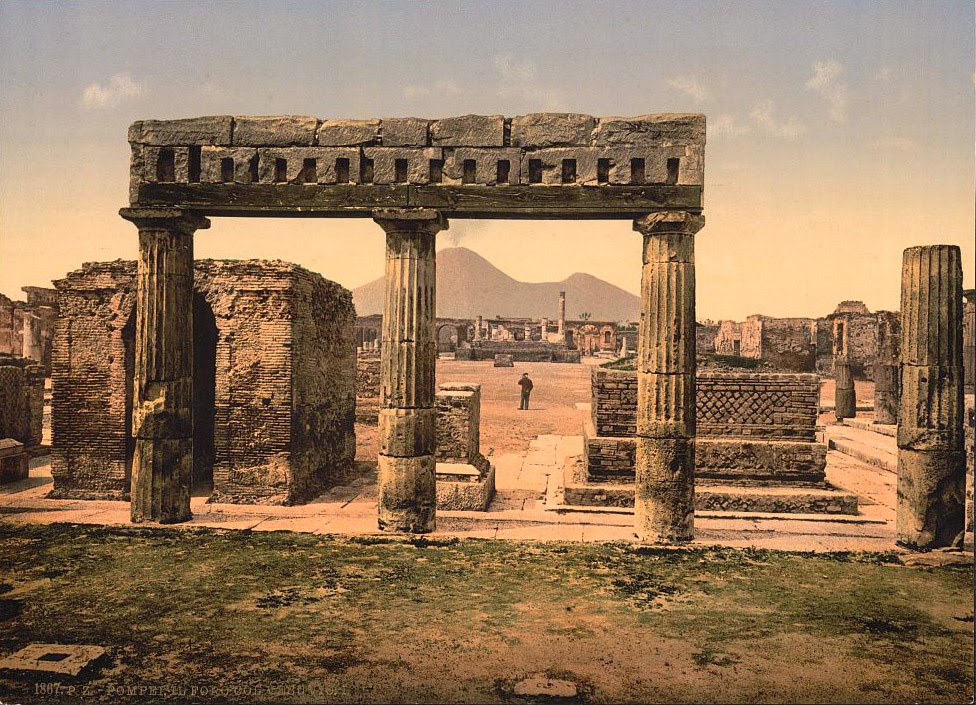
[Image: The Forum, Pompeii; courtesy U.S. Library of Congress].

The possibilities for interactive apps and other touristic experiences are also mind-boggling here: imagine, at the very least, being able to walk into the center of Pompeii totally alone, with nothing but your phone and some earbuds, tuning into real-time broadcasts of the shuddering masonry all around you, a wireless archaeological orchestra of bleached monuments in the sun, listening from within to the sounds of the ancient city.

Distant HAM radio enthusiasts, tuning in from attics in Indiana, spin the dial every Saturday night hoping to find Pompeii, a destroyed city on the other side of the world with its own location in the ether, whistling and purring as its architecture falls apart, room by room, a catacomb of sound and destruction.

(An earlier, different version of this post first appeared on Gizmodo).

Romanticism of the Scanning Error

[Image: ScanLAB Projects].

(A different version of this post previously appeared on Gizmodo).
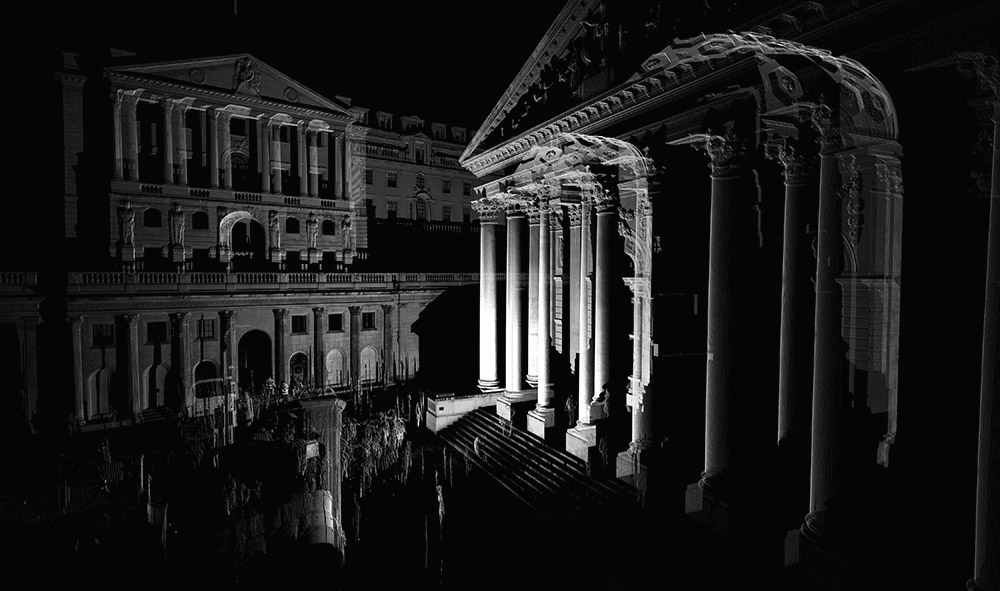
Matthew Shaw and William Trossell, the London-based duo known as ScanLAB Projects, continue to push the envelope of laser-scanning technology, producing visually stunning and conceptually intricate work that falls somewhere between art and practical surveying.

Their work also bears an unexpected yet increasingly pronounced political dimension, as they have scanned concentration camp sites, designed insurgent objects for thwarting police laser scanners, and even point-mapped melting ice floes in the Arctic as part of a larger study of climate change. The results are astonishingly, almost hypnotically detailed, as in this cinematic fly-through of an outdoor festival, where we pass through tent walls and very nearly see recognizable expressions on participants’ faces. It’s as if the future of the motion picture might really be narrative holograms.

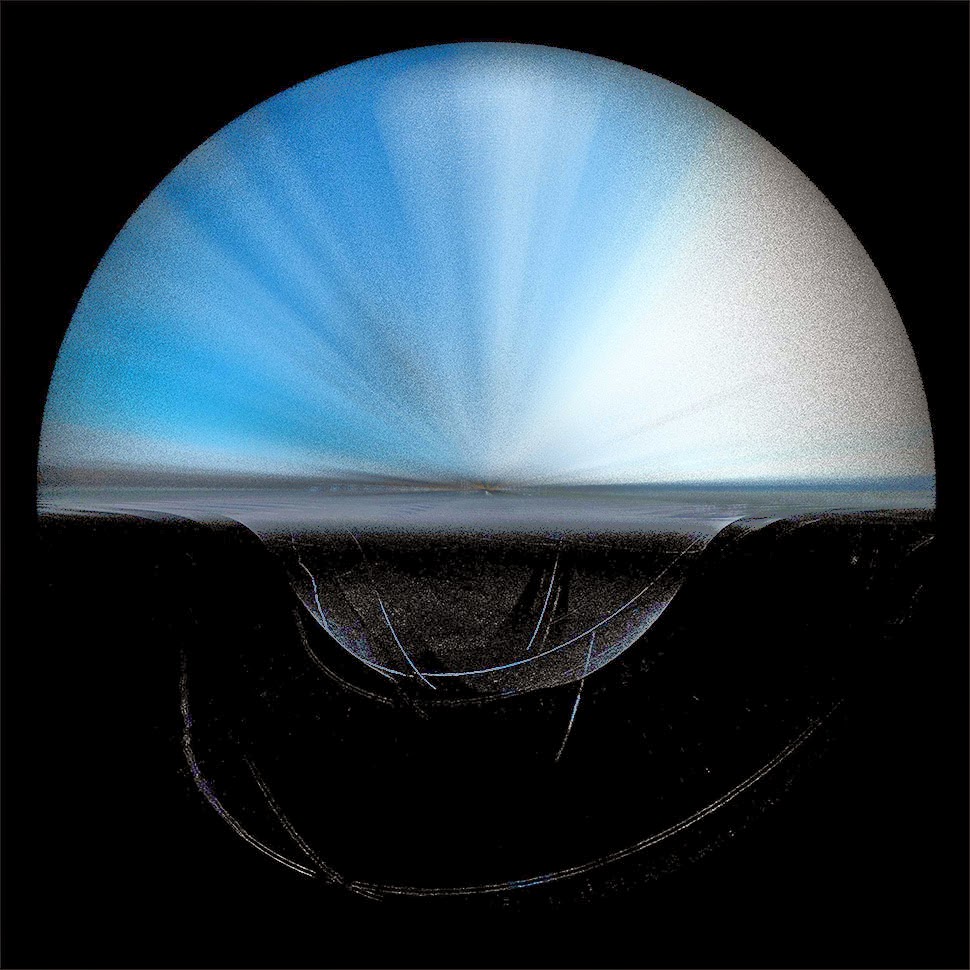
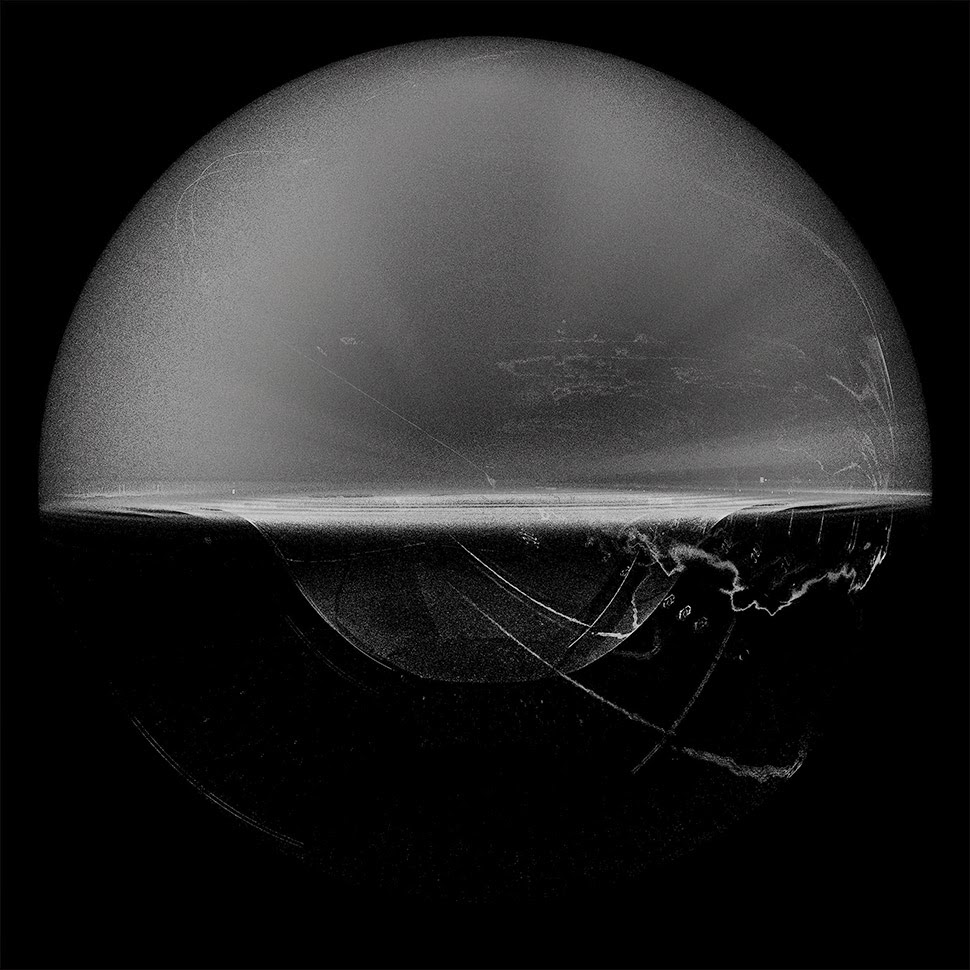
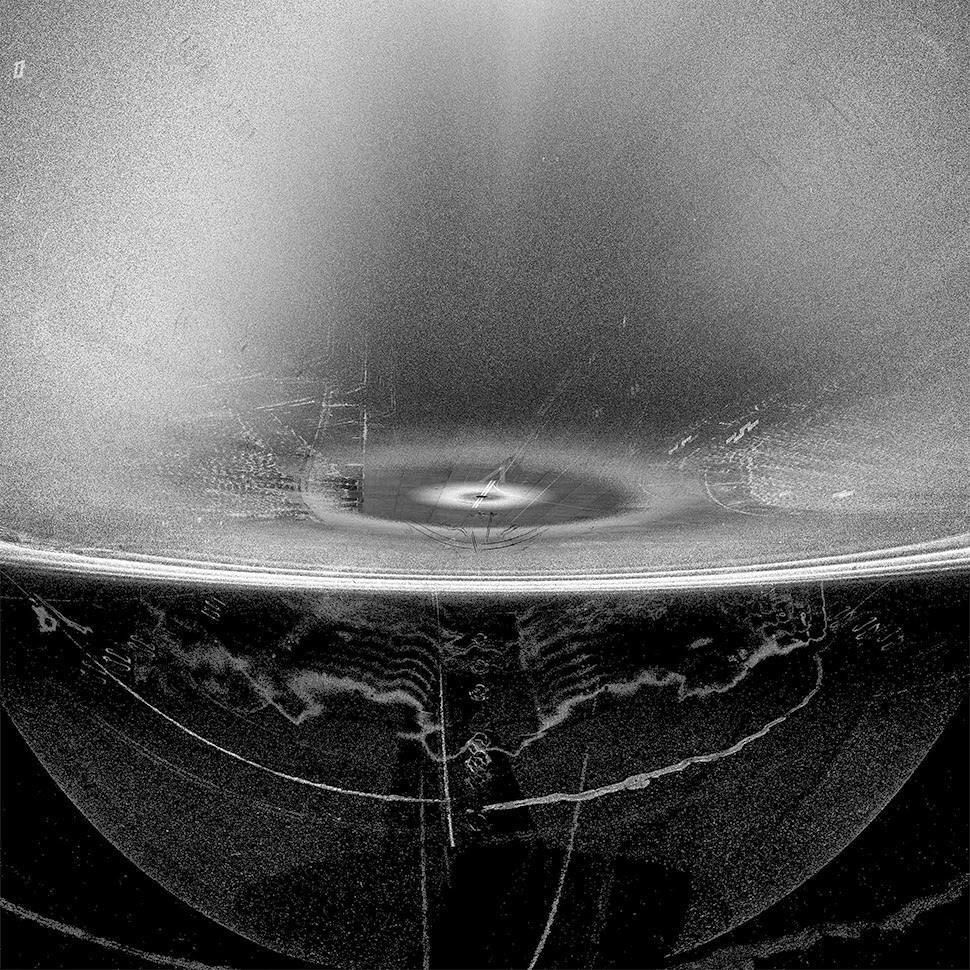
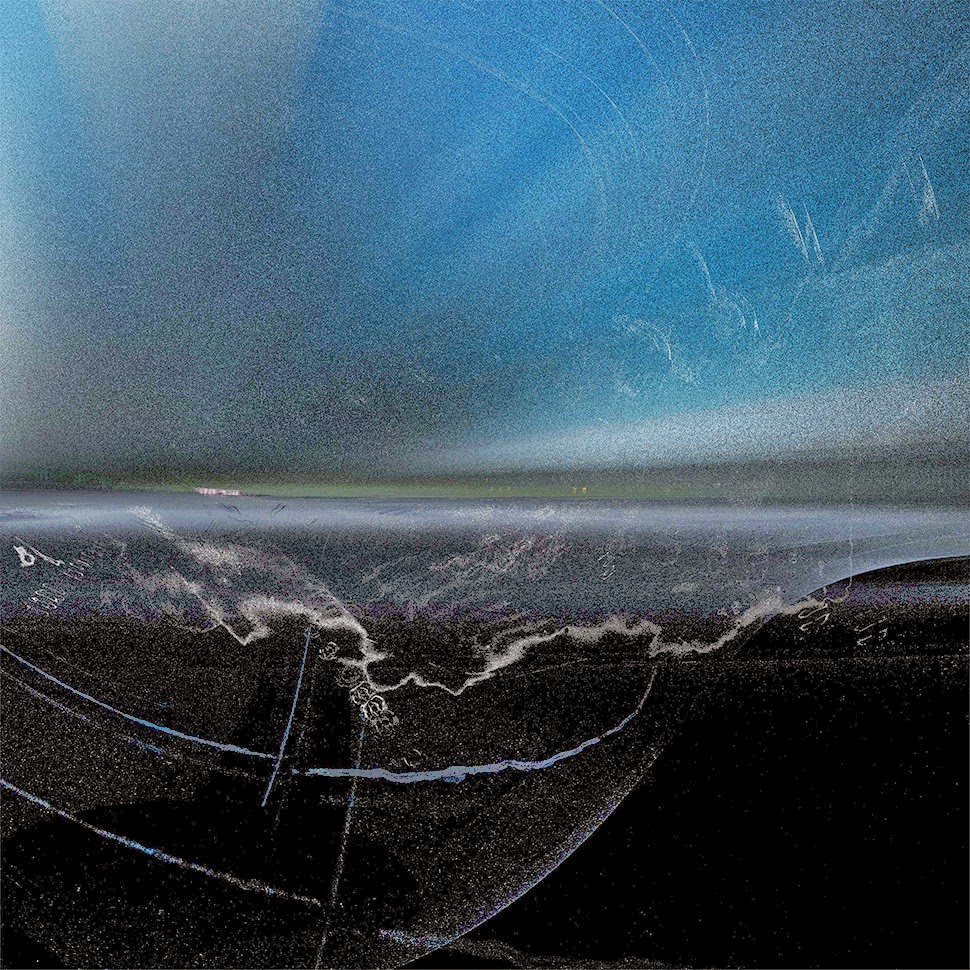
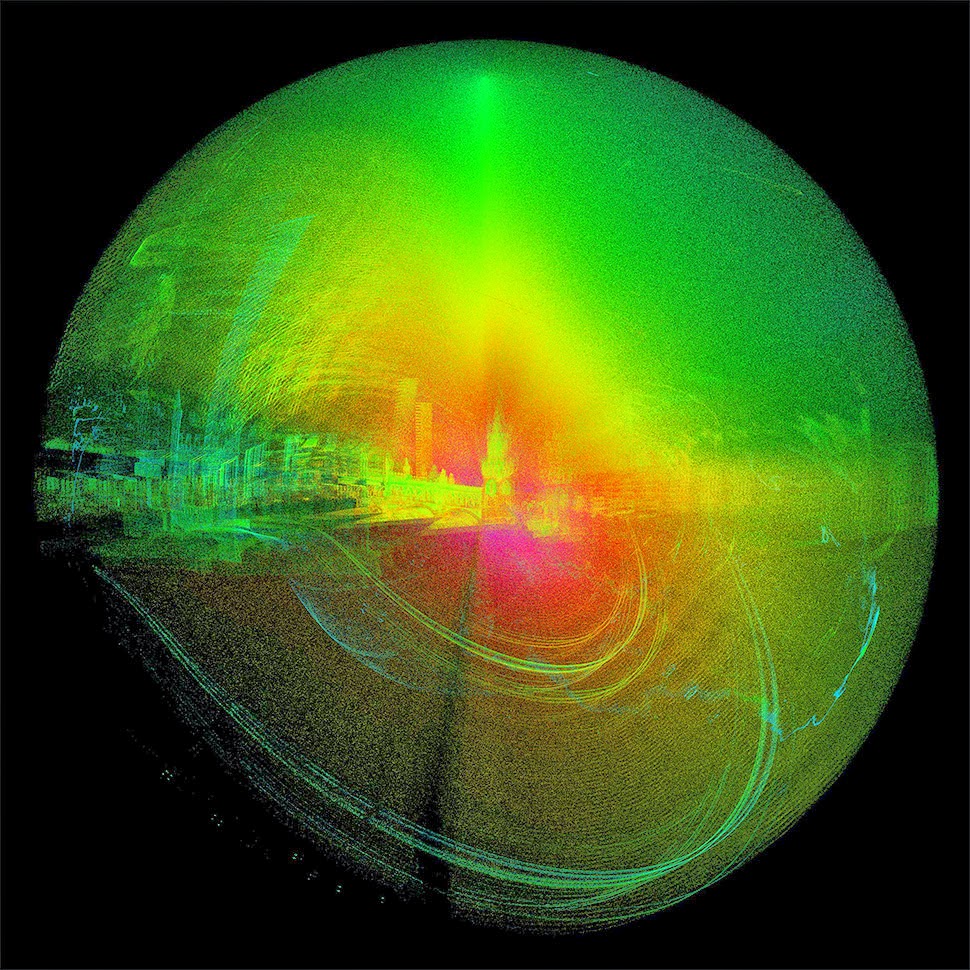
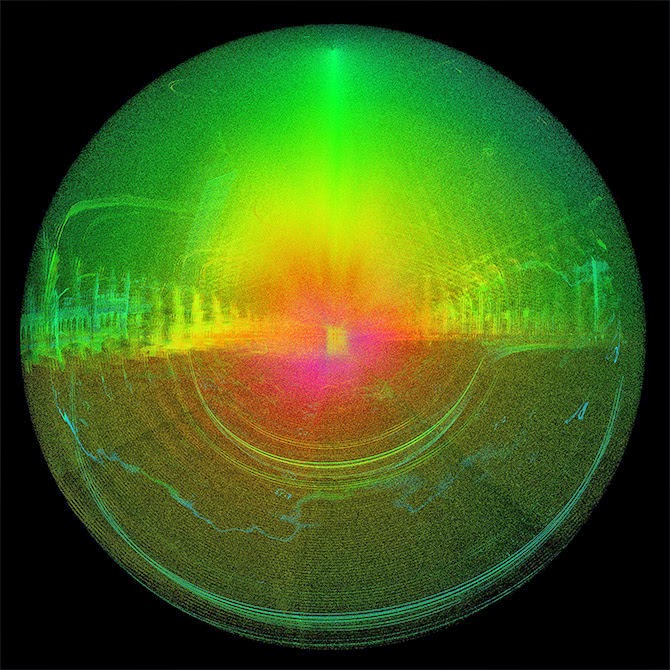
Last week, Shaw and Trossell premiered a new project at London’s Surface Gallery, exploring where laser scanners glitch, skip, artifact, and scatter. Called Noise: Error in the Void, the show utilizes scanning data taken from two locations in Berlin, but—as the show’s title implies—it actually foregrounds all the errors, where the equipment went wrong: a world of “mistaken measurements, confused surfaces and misplaced three-dimensional reflections.”

The tics and hiccups of a scanner gone off the mark thus result in these oddly beautiful, almost Romantic depictions of the world, like some lunatic, lo-fi cosmology filtered through machines.

Frozen datascapes appear like digital mist settling down over empty fields—or perhaps they’re parking lots—a virtual Antarctica appearing in the middle of the city.

[Image: ScanLAB Projects].

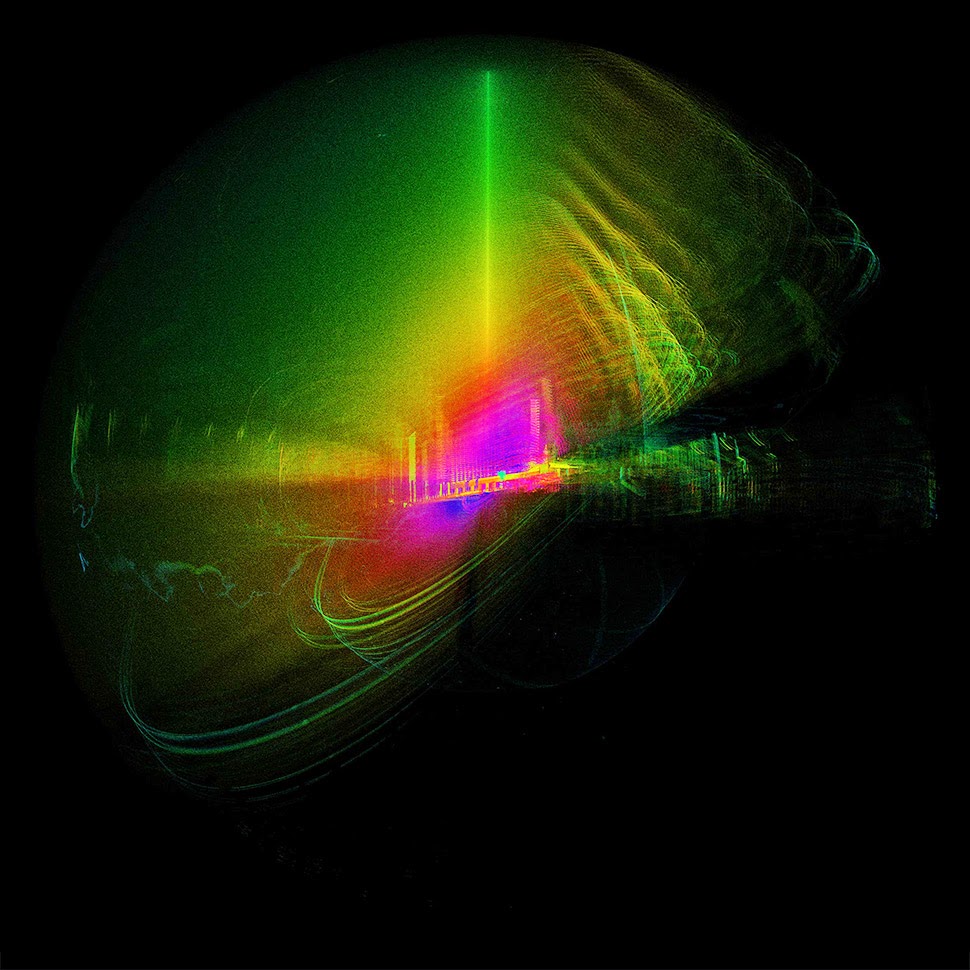
Huge domes of white light burn like spherical flames above a central point that remains both mysterious and unidentified, resembling the halos of nuclear explosions or the birth of stars.

[Image: ScanLAB Projects].

Spectacular bursts of color then suggest the presence of some new stratosphere, where black airplanes roam the edge of space and clouds are nothing but processing errors in a blurred celestial rendering. Perhaps we could call it expressionist scanning.

[Image: ScanLAB Projects].

In Shaw’s and Trossell’s own words, “Using terrestrial LIDAR technology it is now possible to capture the world in three dimensions. This technology can create near perfect digital 3D replicas of buildings, landscapes, objects and events. But these digital replicas are always an illusion of perfection. Noise: Error in the Void explores the inherent mistakes made by modern technologies of vision. Here we see the unedited view of the world as seen through the eyes of the LIDAR machine. Reality is shrouded in a cloud of mistaken measurements, confused surfaces and misplaced three-dimensional reflections.”

A short film—more like a dark ambient music video—shows some of the images in action.

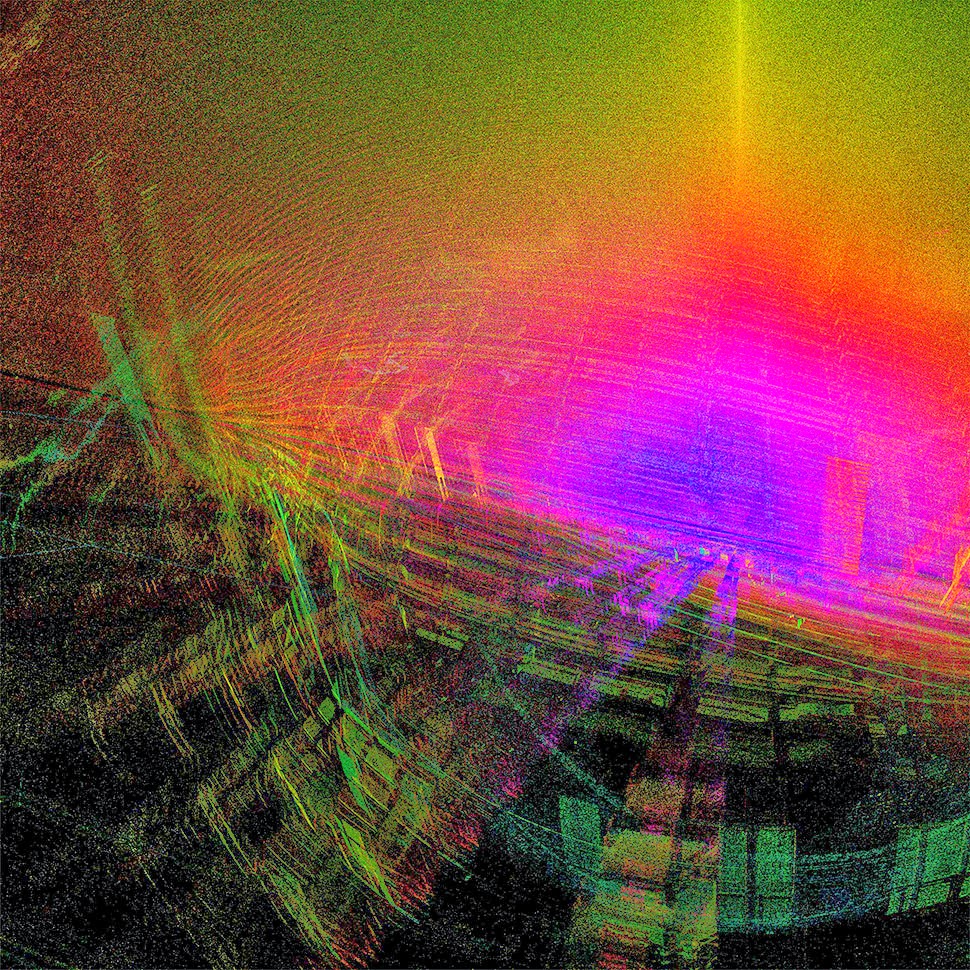
In all honesty, many of the images are colored in a way that looks a bit more like a Pink Floyd laser show than the almost melancholy landscapes I like so much above, and I even made a few of these greyscale to see if, stripped of color, they could still repeat the lonely, wanderer-above-a-sea-of-fog feeling that the other images have, the benthic void of miscalculated data that nonetheless results in new worlds. But then I figured I shouldn’t mess with ScanLAB’s work and I left them as is.

[Images: ScanLAB Projects].

But, even here, blinded by the colors of a rave, throbbing architectural shapes rotate and spin, as if parts of London are stuttering in and out of sync with themselves, a whole city rumbling through a shockwave of digital reverb, blinking gyroscopically out of control.

[Images: ScanLAB Projects].

If you’re lucky enough to be in London in the next few weeks, check out their exhibition at Surface Gallery—and, even better, if you’re an architecture student, you can actually take a class with these guys. Check out their teaching work here.

(Read an earlier version of this post at Gizmodo).

Roentgen Objects, or: Devices Larger than the Rooms that Contain Them

[Image: Photo courtesy of the Rijksmuseum Amsterdam and the Metropolitan Museum of Art].

A gorgeous exhibition last year at the Metropolitan Museum of Art featured mechanical furniture designed by the father and son team, Abraham and David Roentgen: elaborate 18th-century technical devices disguised as desks and tables.

First, a quick bit of historical framing, courtesy of the Museum itself: “The meteoric rise of the workshop of Abraham Roentgen (1711–1793) and his son David (1743–1807) blazed across eighteenth-century continental Europe. From about 1742 to its closing in the early 1800s, the Roentgens’ innovative designs were combined with intriguing mechanical devices to revolutionize traditional French and English furniture types.”

Each piece, the Museum adds, was as much “an ingenious technical invention” as it was “a magnificent work of art,” an “elaborate mechanism” or series of “complicated mechanical devices” that sat waiting inside palaces and parlors for someone to come along and activate them.

If you can get past the visual styling of the furniture—after all, the dainty little details and inlays perhaps might not appeal to many BLDGBLOG readers—and concentrate instead only on the mechanical aspect of these designs, then there is something really incredible to be seen here.

[Image: Photo courtesy of the Rijksmuseum Amsterdam and the Metropolitan Museum of Art].

Hidden amidst drawers and sliding panels are keyholes, the proper turning of which results in other unseen drawers and deeper cabinets popping open, swinging out to reveal previously undetectable interiors.

But it doesn’t stop there. Further surfaces split in half to reveal yet more trays, files, and shelves that unlatch, swivel, and slide aside to expose entire other cantilevered parts of the furniture, materializing as if from nowhere on little rails and hinges.

Whole cubic feet of interior space are revealed in a flash of clacking wood flung forth on tracks and pulleys.

As the Museum phrases it, Abraham Roentgen’s “mechanical ingenuity” was “exemplified by the workings of the lower section” of one of the desks on display in the show: “when the key of the lower drawer is turned to the right, the side drawers spring open; if a button is pressed on the underside of these drawers, each swings aside to reveal three other drawers.”

And thus the sequence continues in bursts of self-expansion more reminiscent of a garden than a work of carpentry, a room full of wooden roses blooming in slow motion.

[Images: Photos courtesy of the Rijksmuseum Amsterdam and the Metropolitan Museum of Art].

The furniture is a process—an event—a seemingly endless sequence of new spatial conditions and states expanding outward into the room around it.

Each piece is a controlled explosion of carpentry with no real purpose other than to test the limits of volumetric self-demonstration, offering little in the way of useful storage space and simply showing off, performing, a spatial Olympics of shelves within shelves and spaces hiding spaces.

Sufficiently voluminous furniture becomes indistinguishable from a dream.

[Image: Photo courtesy of the Rijksmuseum Amsterdam and the Metropolitan Museum of Art].

What was so fascinating about the exhibition—and this can be seen, for example, in some of the short accompanying videos (a few of which are archived on the Metropolitan Museum of Art’s website)—is that you always seemed to have reached the final state, the fullest possible unfolding of the furniture, only for some other little keyhole to appear or some latch to be depressed in just the right way, and the thing just keeps on going, promising infinite possible expansions, as if a single piece of furniture could pop open into endless sub-spaces that are eventually larger than the room it is stored within.

The idea of furniture larger than the space that houses it is an extraordinary topological paradox, a spatial limit-case like black holes or event horizons, a state to which all furniture makers could—and should—aspire, devising a Roentgen object of infinite volumetric density.

A single desk that, when unfolded, is larger than the building around it, hiding its own internal rooms and corridors.

Suggesting that they, too, were thrilled by the other-worldly possibilities of their furniture, the Roentgens—and I love this so much!—also decorated their pieces with perspectival illusions.

[Image: Photo courtesy of the Rijksmuseum Amsterdam and the Metropolitan Museum of Art].

The top of a table might include, for example, the accurately rendered, gridded space of a drawing room, as if you were peering cinematically into a building located elsewhere; meanwhile, pop-up panels might include a checkerboard reference to other possible spaces that thus seemed to exist somewhere within or behind the furniture, lending each piece the feel of a portal or visual gateway into vast and multidimensional mansions tucked away inside.

The giddiness of it all—at least for me—was the implication that you could decorate a house with pieces of furniture; however, when unfolded to their maximum possible extent, these same objects might volumetrically increase the internal surface area of that house several times over, doubling, tripling, quadrupling its available volume. But it’s not magic or the supernatural—it’s not quadraturin—it’s just advanced carpentry, using millimeter-precise joinery and a constellation of unseen hinges.

[Images: Photos courtesy of the Rijksmuseum Amsterdam and the Metropolitan Museum of Art].

You could imagine, for example, a new type of house; it’s got a central service core lined with small elevators. Wooden boxes, perhaps four feet cubed, pass up and down inside the walls of the house, riding this network of dumbwaiters from floor to floor, where they occasionally stop, when a resident demands it. That resident then pops open the elevator door and begins to unfold the box inside, unlatching and expanding it outward into the room, this Roentgen object full of doors, drawers, and shelves, cantilevered panels, tabletops, and dividers.

And thus the elevators grow, simultaneously inside and outside, a liminal cabinetry both tumescent and architectural that fills up the space with spaces of its own, fractal super-furniture stretching through more than one room at a time and containing its own further rooms deep within it.

But then you reverse the process and go back through in the other direction, painstakingly shutting panels, locking drawers, pushing small boxes inside of larger boxes, and tucking it all up again, compressing it like a JPG back into the original, ultra-dense cube it all came from. You’re like some homebound god of superstrings tying up and hiding part of the universe so that others might someday rediscover it.

To have been around to drink coffee with the Roentgens and to discuss the delirious outer limits of furniture design would have been like talking to a family of cosmologists, diving deep into the quantum joinery of spatially impossible objects, something so far outside of mere cabinetry and woodwork that it almost forms a new class of industrial design. Alas, their workshop closed, their surviving objects today are limited in number, and the exhibition at the Metropolitan Museum of Art is now closed.

(waves, says hello, disappears again)

[Image: Collage by Michael Hession, based on this image from the Library of Congress].

The last few weeks have been extremely busy, and there’s been no real time to post here on BLDGBLOG; so many interesting stories have come and gone, so many ideas to discuss and write about here, but I’ve primarily been working full-throttle in my new role as Editor-in-Chief of Gizmodo, where I’ve joined a team tasked with continuing the site’s transition away from pure tech news and gadget reviews to include the worlds of architecture, urbanism, and design. Any sufficiently large technology is indistinguishable from a landscape, we might say; any sufficiently ubiquitous machine indistinguishable from a city.

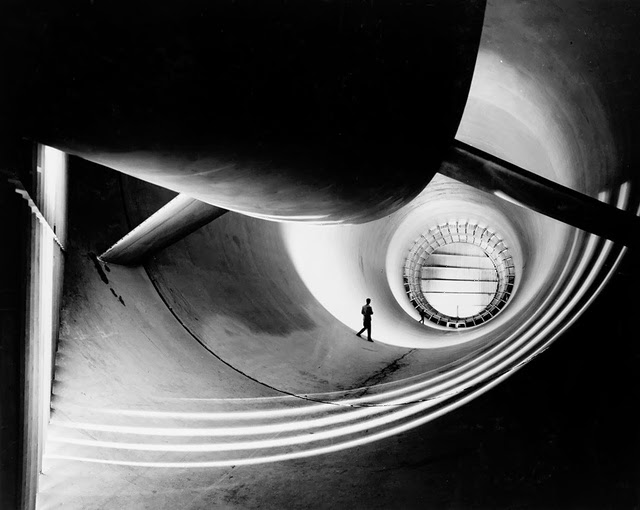
[Image: Inside a wind tunnel, courtesy of NASA, via Gizmodo].

In any case, I will be very busy for the foreseeable future in my new role—but we’ve published some really fantastic features there over the past few weeks alone, and I thought I’d throw up a quick post to give BLDGBLOG readers a taste of what’s to come. Here’s a solid list for a long day’s perusal:

Gizmodo was part of the first media tour since the 1980s of Hart Island, the largest mass grave site in the United States, run by the Department of Corrections on the outer maritime edge of New York City.

—”Capture houses” are entire decoy apartments and homes—furnished, lit, and run like actual residences—that, in reality, are elaborate traps for capturing burglars.

—The lost cow tunnels of New York City are no longer an urban myth: Nicola Twilley dug up blueprints for Gizmodo.

—The Los Angeles Aqueduct’s 100-year anniversary just rolled by and, with it, an historic reenactment of the moment the city’s floodgates were opened.

—New Yorkers receive junk mail from the future, thanks to designers Chris Woebken and Elliott P. Montgomery.

—”3D painting” creates working machine parts from directed aerosol layering—in effect, spray-painting objects into existence.

—A South Carolina archaeologist, citing Star Trek: The Next Generation as an influence, has scanned Linear B so that machines can help catalog the ancient past.

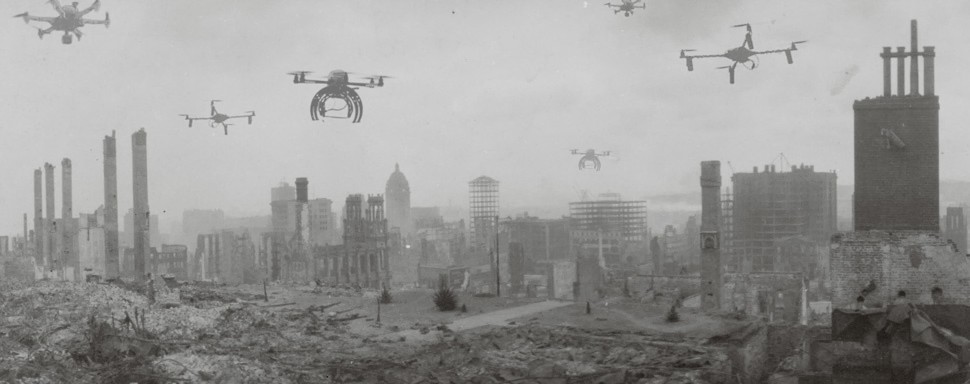
—The future of disaster recovery is a constellation of semi-autonomous robots swarming over avalanches and ruined cities to find survivors.

—An incredible “tangible interface” roils like the surface of a mechanical sea, reproducing any object you place within view of its sensors.

—We were on hand to see “Bertha,” the largest-diameter tunneling machine in the world, start spinning its way into the underworld of Seattle.

[Image: Bertha, a tunneling jaeger, undergoes assembly, courtesy of WSDOT, via Gizmodo].

—We learned what life is like on the job of a New York City archaeologist, digging up water mains, old bottles, and the foundation walls of lost prisons.

—Take a look at these chains 3D-printed from ice and igloos algorithmically constructed by architectural robots.

—This herky-jerky rock-climbing robot from NASA could someday conquer the glaciers, cliffs, caves, and mountains of alien worlds.

—Cheese made from human bacteria, cultivated into tomorrow’s sci-fi brie.

—Cold War weapons that terrified U.S. military intelligence.

—New techniques for turning nuclear waste into glass.

—And another tour of the Brooklyn super-factory producing modules for what will be the tallest prefab tower in the United States, right here in New York City.

Enjoy! Meanwhile, I’ll see you on the internet, here, there, and elsewhere, though the frequency of posting here will now be closer to just 2 or 3 times a month.

Landscape Futures Arrives

[Image: Internal title page from Landscape Futures; book design by Everything-Type-Company].

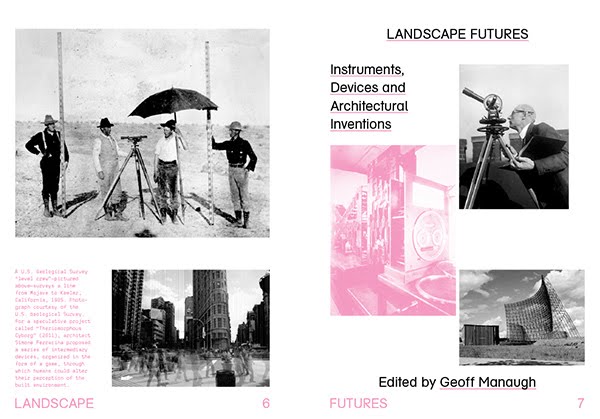
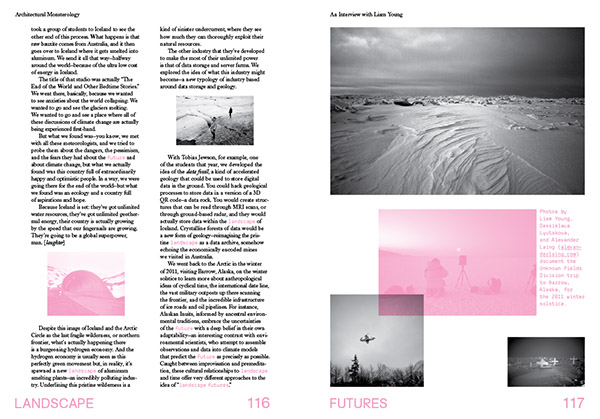
At long last, after a delay from the printer, Landscape Futures: Instruments, Devices and Architectural Inventions is finally out and shipping internationally.

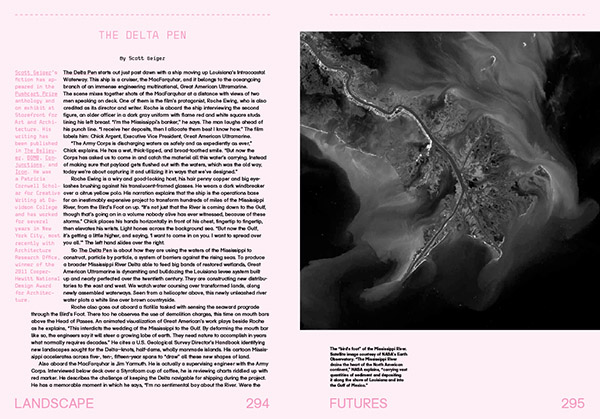
I am incredibly excited about the book, to be honest, and about the huge variety of content it features, including an original essay by Elizabeth Ellsworth & Jamie Kruse of Smudge Studio, a short piece of landscape fiction by Pushcart Prize-winning author Scott Geiger, and a readymade course outline—open for anyone looking to teach a course on oceanographic instrumentation—by Mammoth’s Rob Holmes.

These join reprints of classic texts by geologist Jan Zalasiewicz, on the incipient fossilization of our cities 100 million years from now; a look at the perverse history of weather warfare and the possibility of planetary-scale climate manipulation by James Fleming; and a brilliant analysis of the Temple of Dendur, currently held deep in the controlled atmosphere of New York’s Metropolitan Museum of Art, and its implications for architectural preservation elsewhere.

And even these are complemented by an urban hiking tour by the Center for Land Use Interpretation that takes you up into the hills of Los Angeles to visit check dams, debris basins, radio antennas, and cell phone towers, and a series of ultra-short stories set in a Chicago yet to come by Pruned‘s Alexander Trevi.

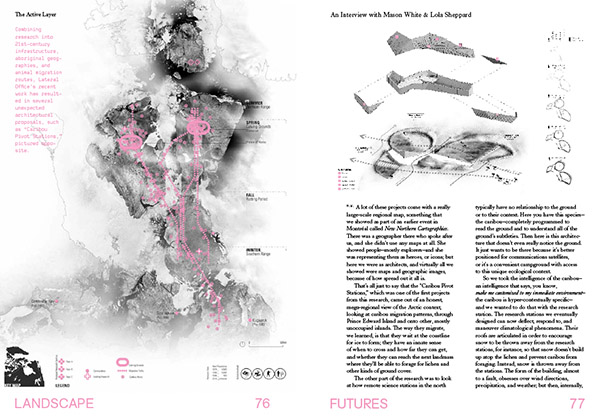
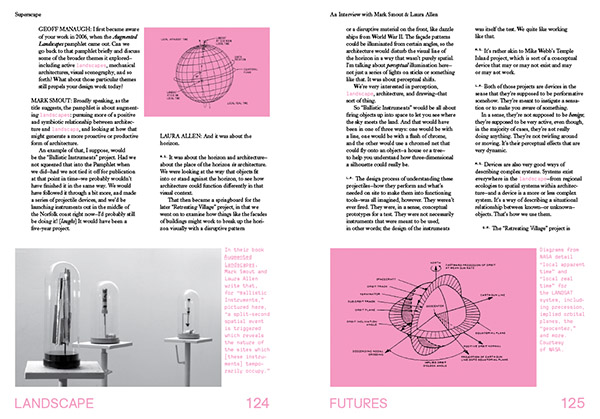
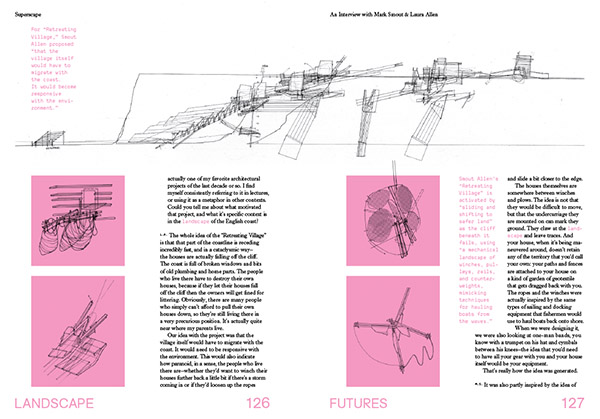
[Images: A few spreads from the “Landscape Futures Sourcebook” featured in Landscape Futures; book design by Everything-Type-Company].
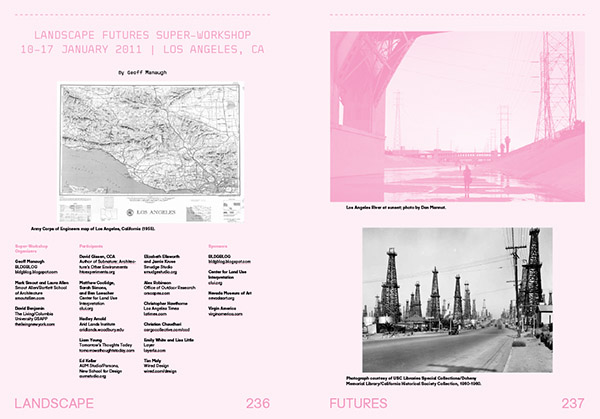
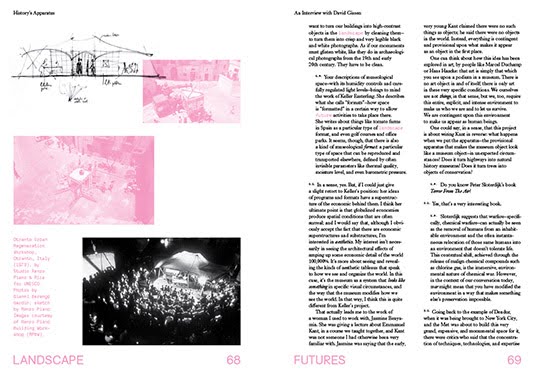
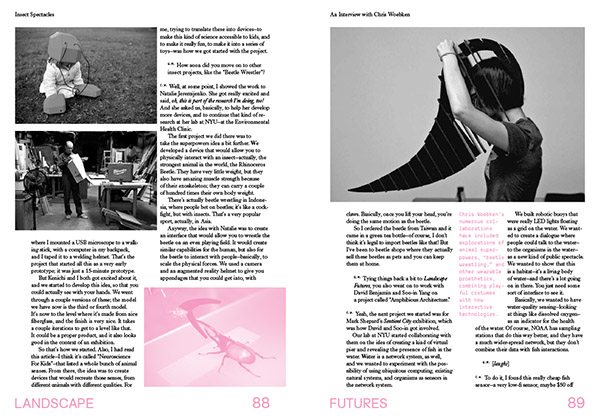
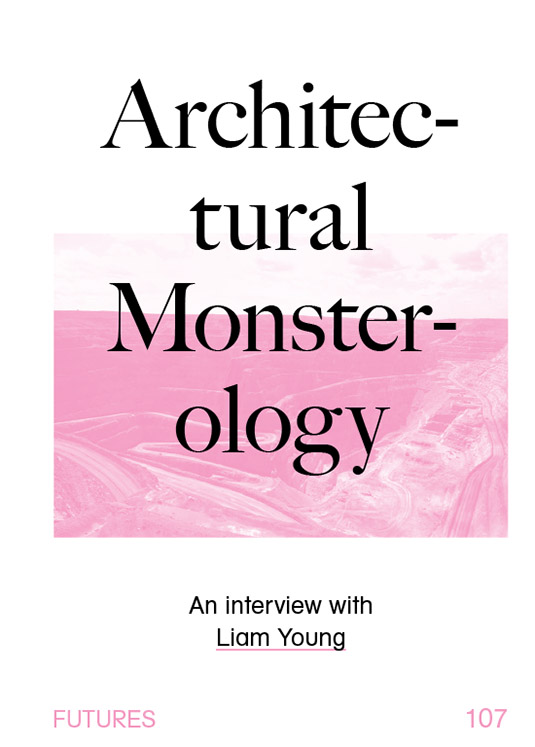
Of course, everything just listed supplements and expands on the heart of the book, which documents the eponymous exhibition hosted at the Nevada Museum of Art, featuring specially commissioned work by Smout Allen, David Gissen, and The Living, and pre-existing work by Liam Young, Chris Woebken & Kenichi Okada, and Lateral Office.

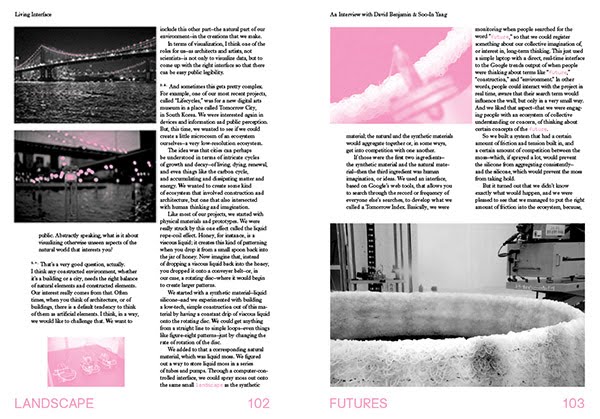
Extensive original interviews with the exhibiting architects and designers, and a long curator’s essay—describing the exhibition’s focus on the intermediary devices, instruments, and spatial machines that can fundamentally transform how human beings perceive and understand the landscapes around them—complete the book, in addition to hundreds of images, many maps, and an extensive use of metallic and fluorescent inks.

The book is currently only $17.97 on Amazon.com, as well, which seems like an almost unbelievable deal; now is an awesome time to buy a copy.

[Images: Interview spreads from Landscape Futures; book design by Everything-Type-Company].

In any case, I’ve written about Landscape Futures here before, and an exhaustive preview of it can be seen in this earlier post.

I just wanted to put up a notice that the book is finally shipping worldwide, with a new publication date of August 2013, and I look forward to hearing what people think. Enjoy!

Documentary Holography

[Image: A “detail theft” by ScanLAB Projects].

ScanLAB Projects, a reliably interesting and enthusiastic design-research duo formed by Bartlett graduates Matthew Shaw and William Trossell, explores, in their words, “the potential of large scale terrestrial laser scanning as a tool for design, visualization and fabrication. We use a range of state-of-the-art 3D scanning technologies to capture buildings, objects and spaces.”

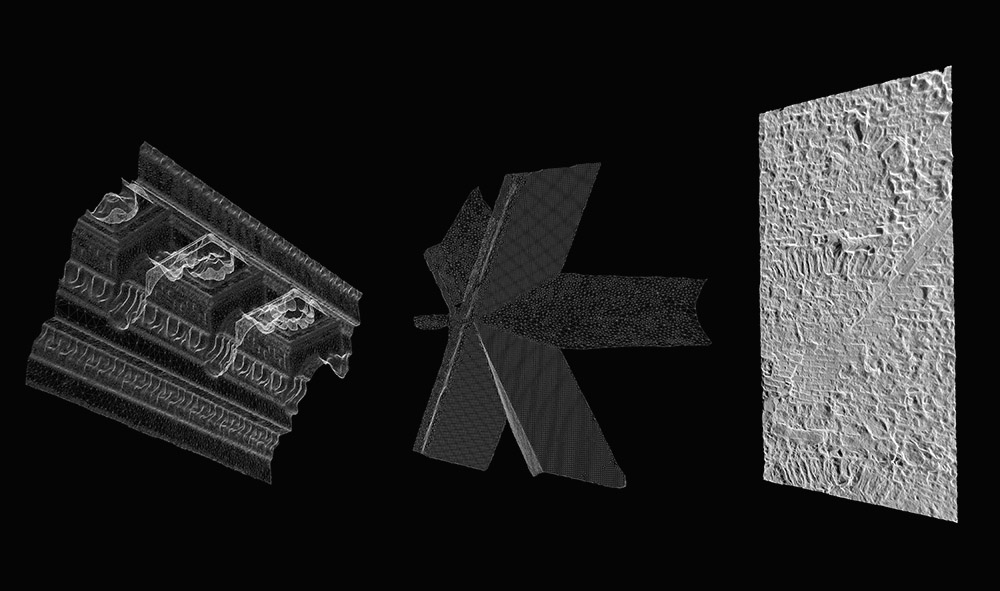
As it happens, they mean this quite literally, as they aim to “capture” and then illicitly reproduce, using multi-axis milling machines, architectural details scanned around London. These are what they call “detail thefts… arguably cloning the original architect’s intellectual property.”

[Image: A “detail theft” by ScanLAB Projects].

You can read an earlier write-up of their many projects—from “stealth objects” to scanner-jamming architectural ornament installed on an urban scale—here on BLDGBLOG (as well as in the forthcoming Landscape Futures book).

What I find so consistently interesting in their work, though, is that, over the past few years, they’ve been expanding the representational range of the laser scanner, using it to document highly ephemeral, even ethereal, spatial events.

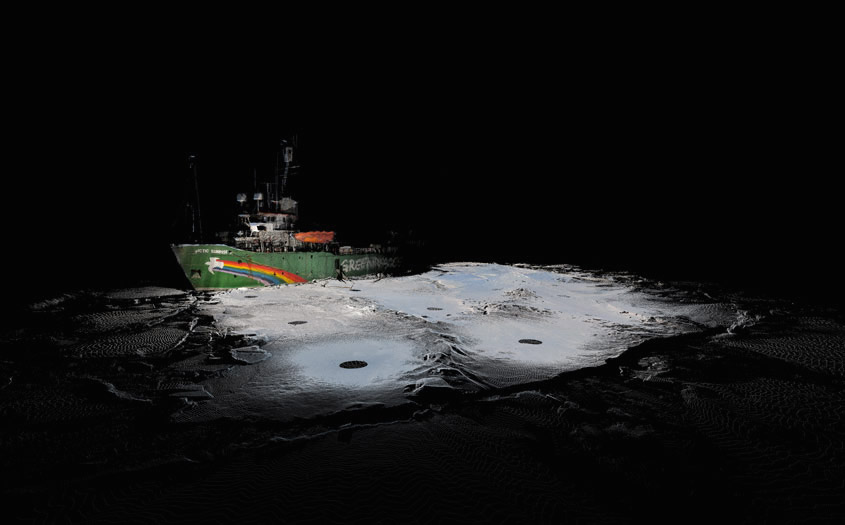
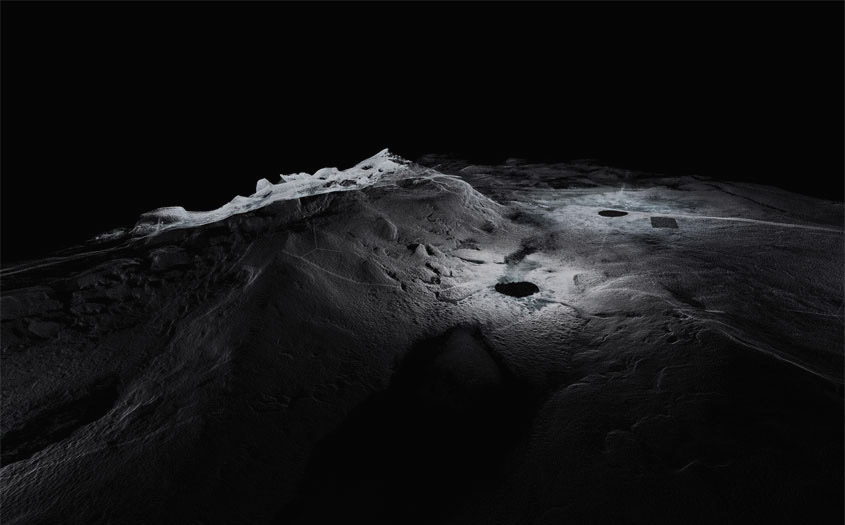
Whether scanning mist and humidity or traveling north to the Arctic to shoot lasers at pressure ridges and melting ice floes, their work is almost a kind of documentary holography: not a film, not a photograph, not a 3D model, but also not simply a point-cloud, their work operates almost narratively as they capture objects or places in the process of becoming something else, blurred by passing fog or pulled apart by unseen ocean currents. You could write a screenplay for scanners.

[Images: From the “Arctic Climatic Tour 2011” of ScanLAB Projects].

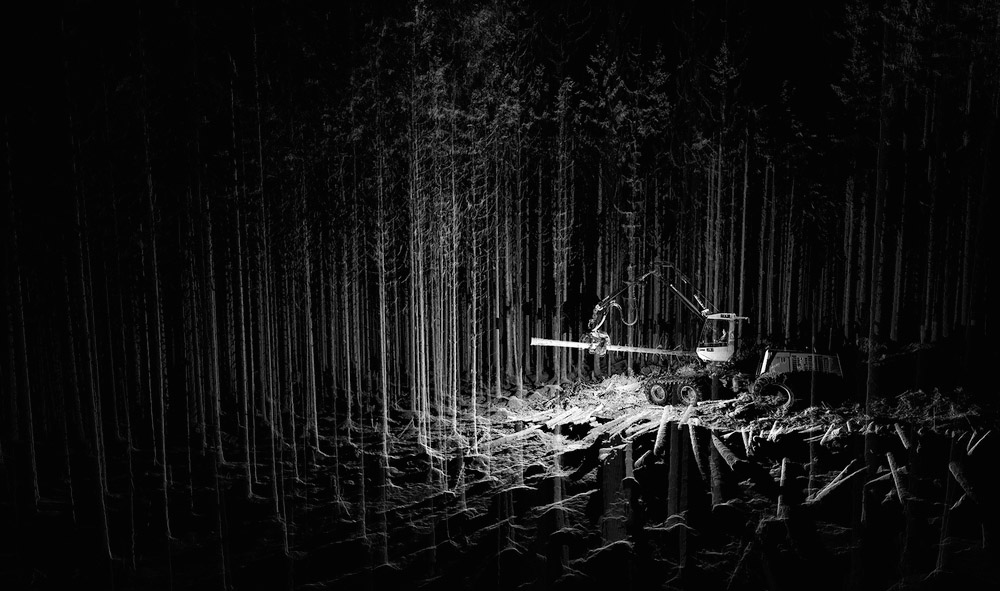
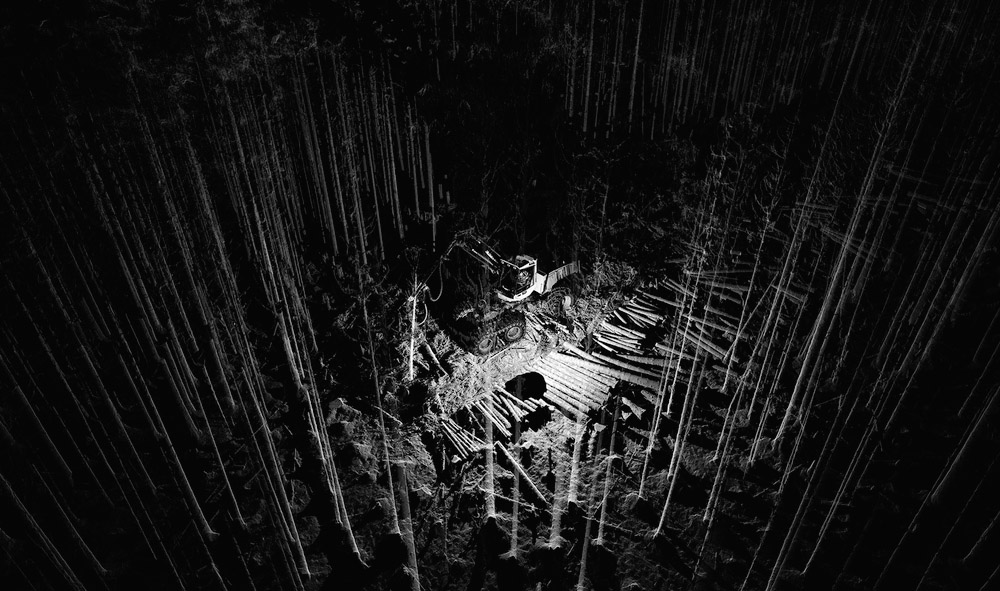
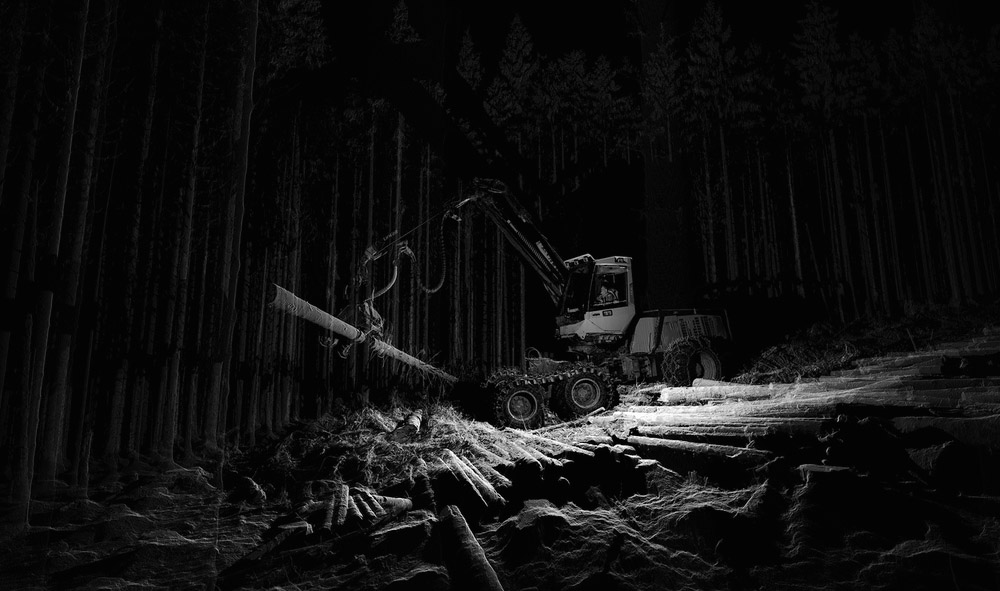
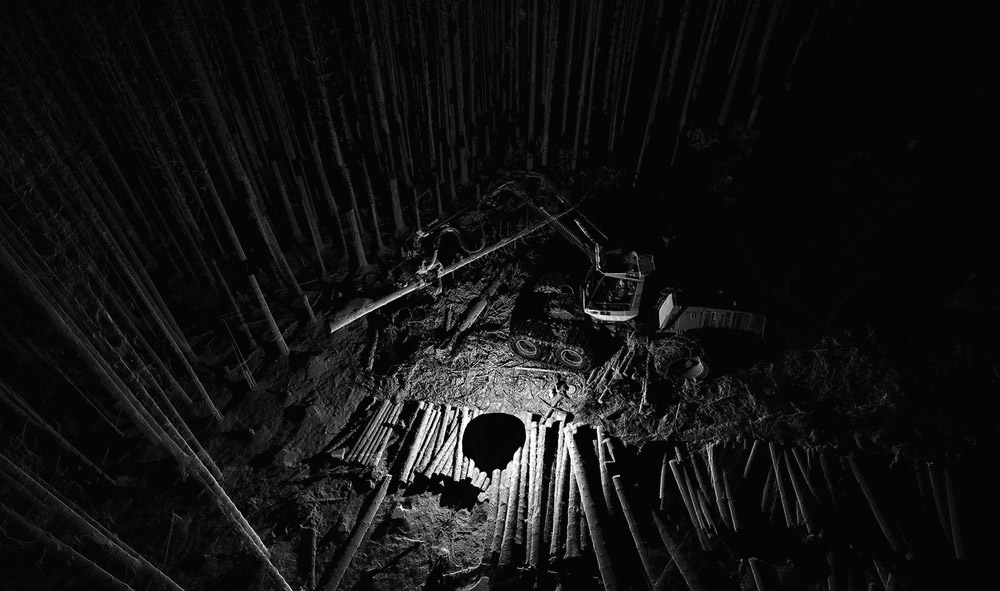
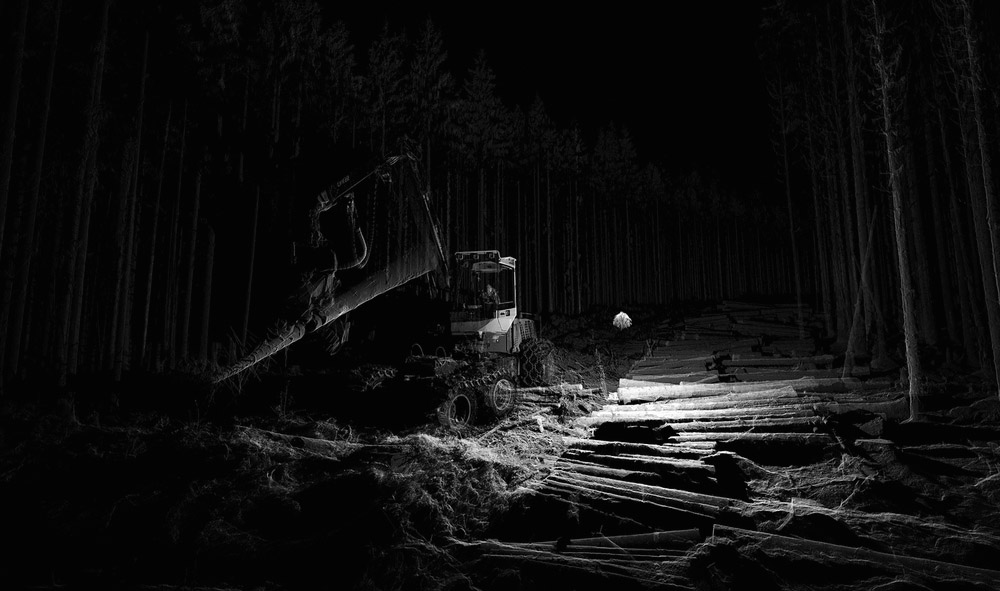
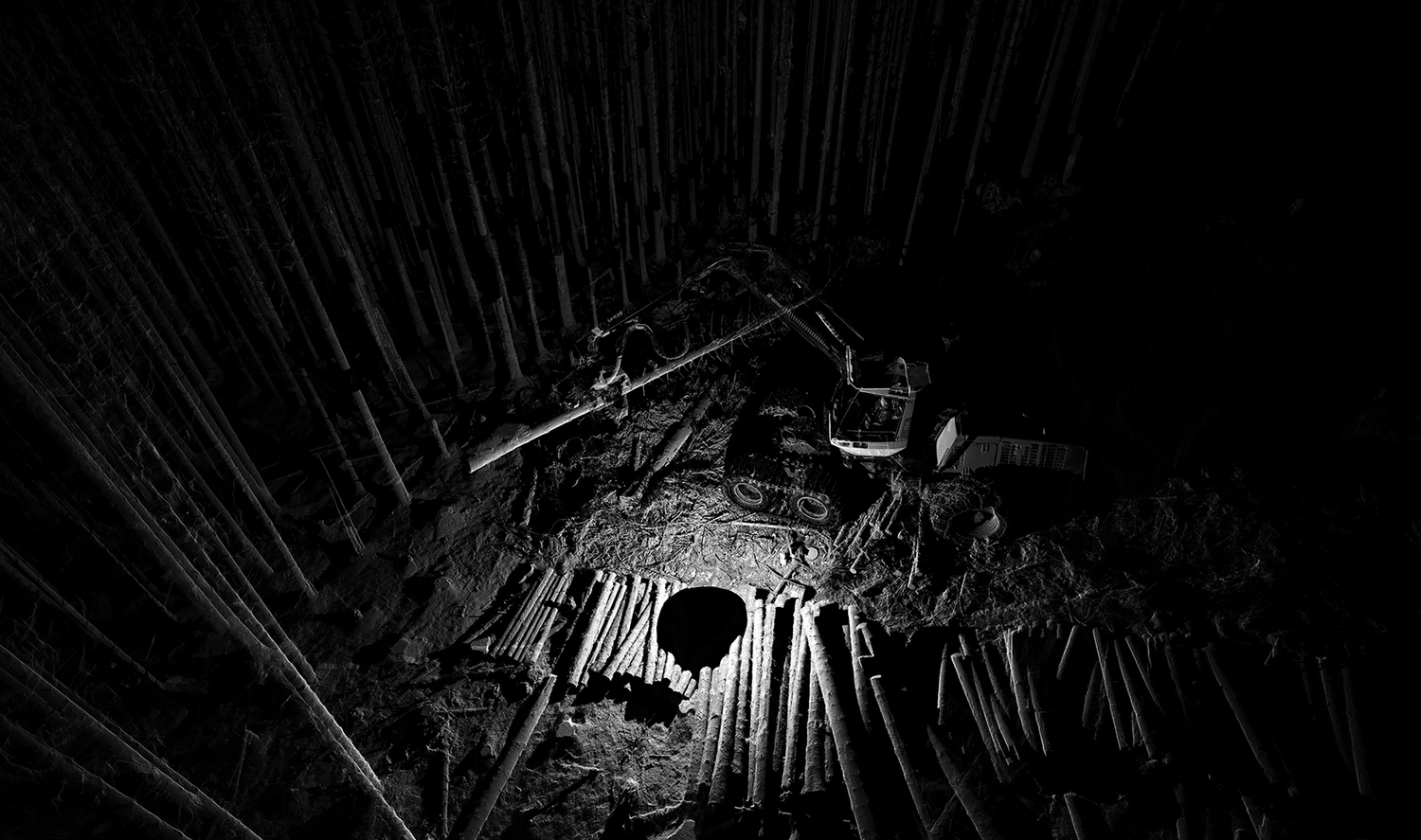
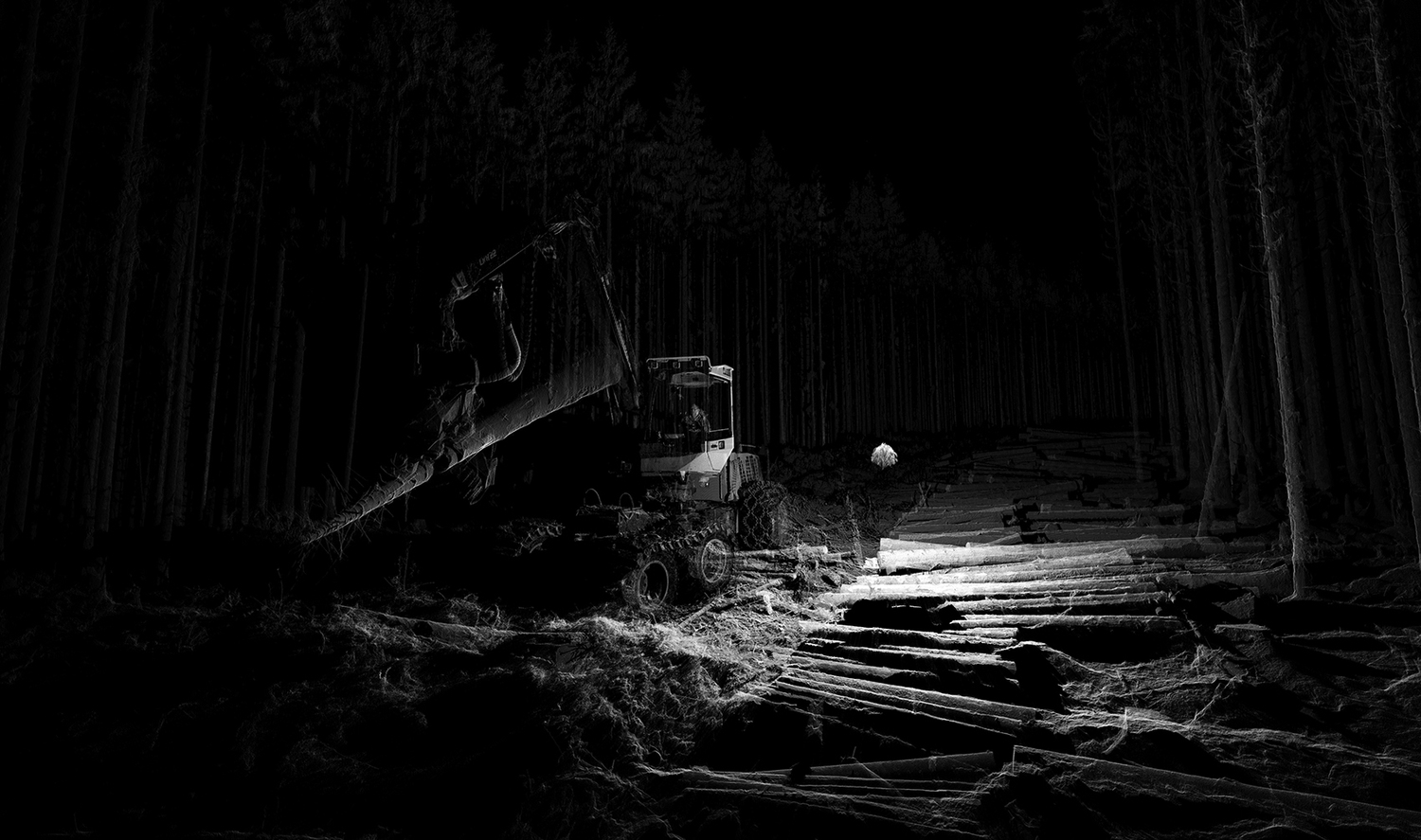
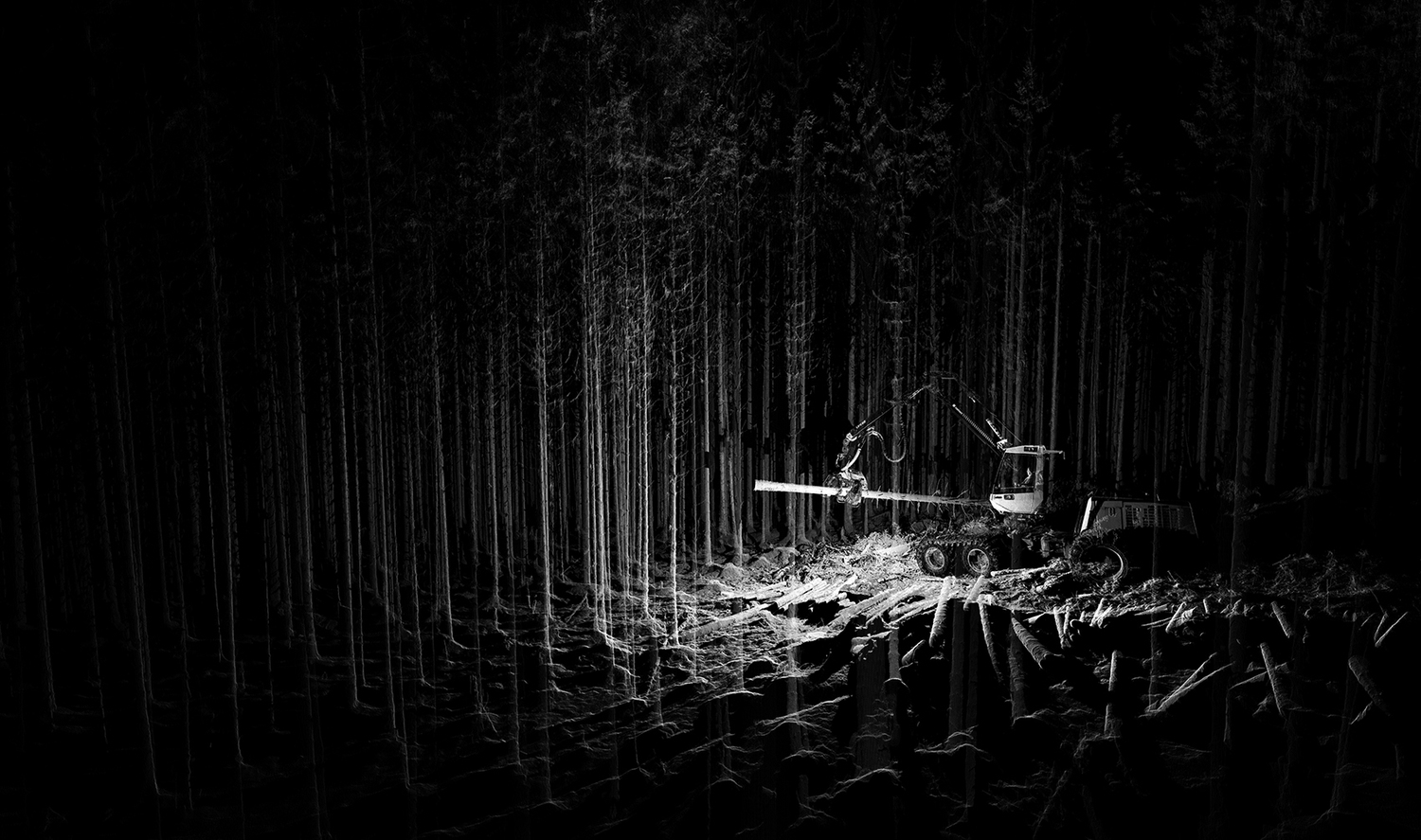
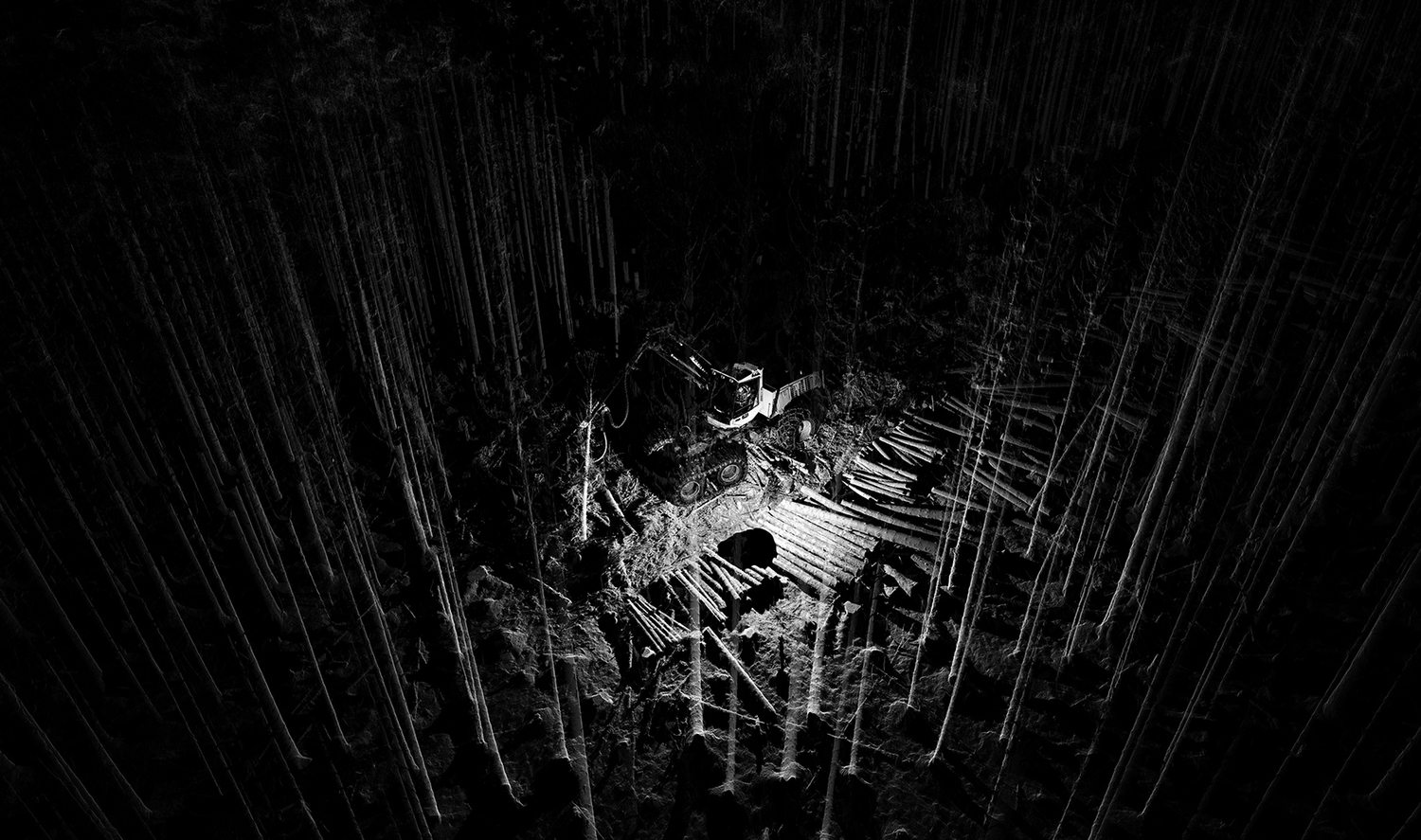
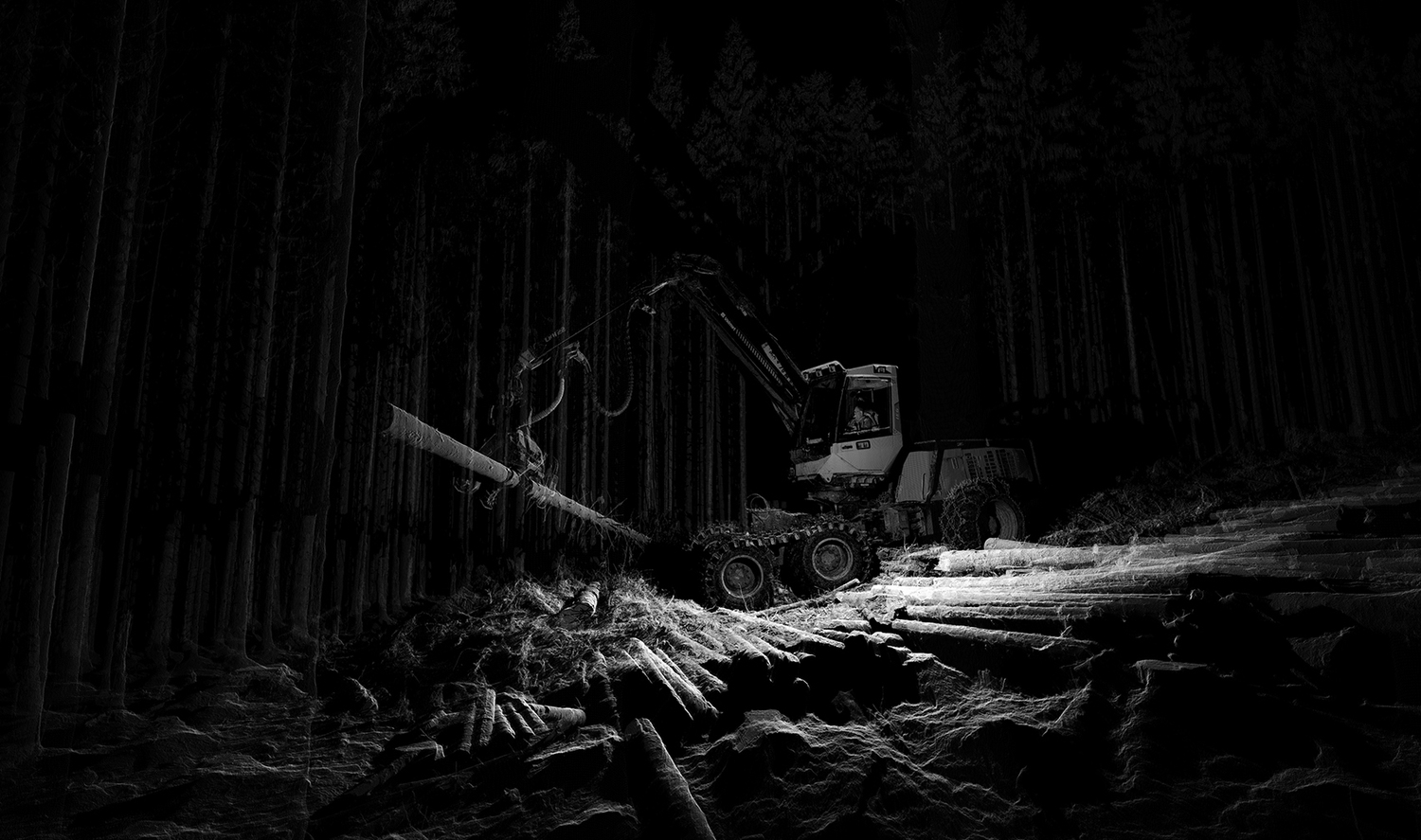
For a more recent project, one that indicates a growing environmental or ecological emphasis in their work, the duo found themselves in the presence of heavy forestry equipment, a haunting and behemoth machine busy uprooting, de-branching, and stacking trees, converting a living forest to mere timber. The satiny black background makes it all that much more dreamlike, as if occurring in secret at 2am.

[Image: Forestry Commission Tree Harvester by ScanLAB Projects; view larger].

Cast in black and white and seeming to gleam in the laser light, the machine is both dinosaur-like and ghostly, implying the total gutting of the forest around it as the orderly bar code of the trees is disrupted by this artificial clearing.

[Image: Scans of a Forestry Commission tree harvester in action, by ScanLAB Projects; view image one, two, three, and four larger!].

In all cases, the images are much more evocative when viewed at a larger size (see captions for direct links), which you can also find on the ScanLAB Projects website.

Finally, if all this interests you, consider signing up for a 10-day workshop with ScanLAB Projects up in Ottawa, Canada, from 5-13 July 2013, focusing on “post-industrial landscapes.” Here’s the course description:

Set within the context of a post-industrial era, we find ourselves venturing through the Canadian wilderness of Gatineau Park, walking in the footsteps of industrial alchemist Thomas “Carbide” Willson. Within this natural blossom lie the ruins of his former empire, the decaying heart of industrialization and manufacturing in a factory that never fully materialized.
The course will explore 3D devices that can scan the unnatural post-industrial landscape in an attempt to fuse the accidental qualities of discovery—such as Willson’s trial and error of calcium carbide—with the mathematical precision of laser-scanned environments. Students will form their own architectural “carbide,” a fusion of scans and digital modeling to generate a landscape that materialies from Willson’s place of decay into a new architectural ground.

More information, including registration, is available here.

Fence Phone

[Image: Barbed wire, via Wikipedia].

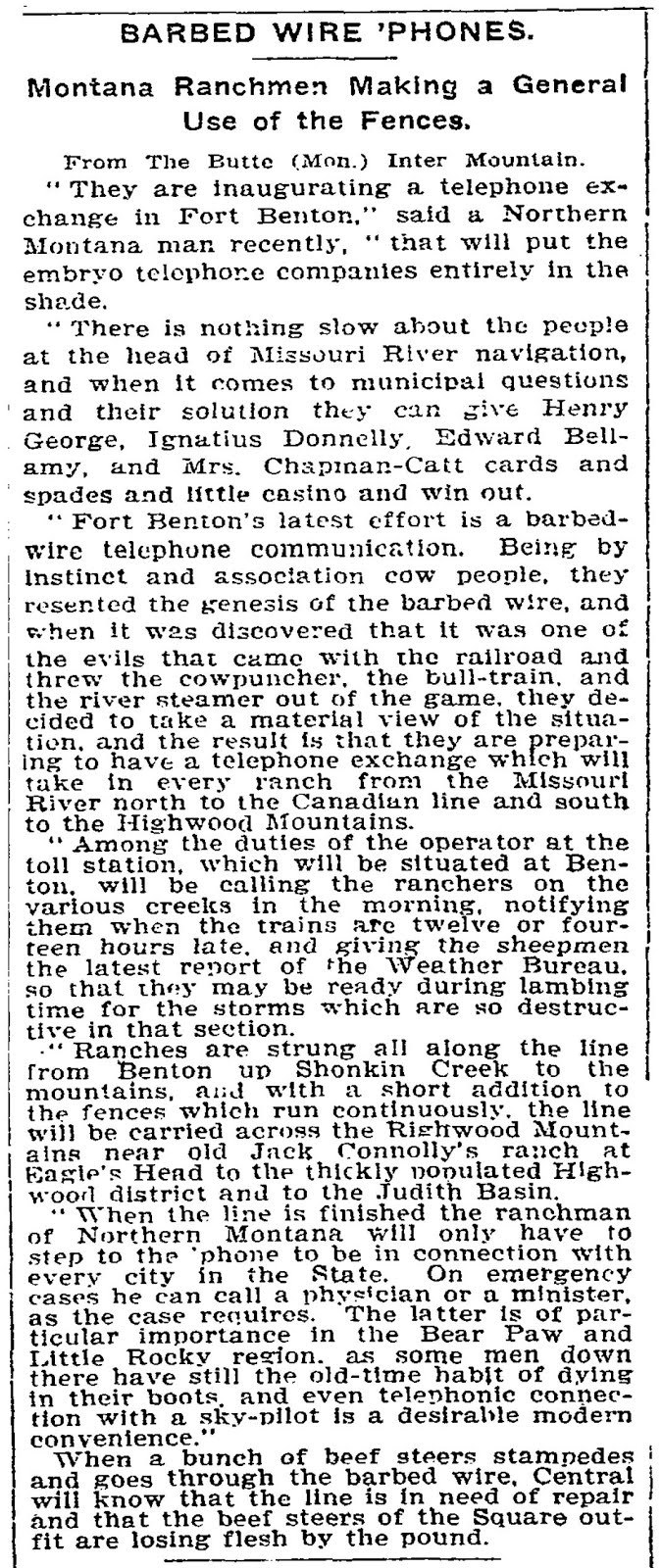
One more radio-related link comes via @doingitwrong, who mentions the use of barbed-wire fences as a kind of primitive telephone network.

“Across much of the west,” C.F. Eckhardt explains, “…there was already a network of wire covering most of the country, in the form of barbed-wire fences. Some unknown genius discovered that if you hooked two Sears or Monkey Ward telephone sets to the top wire on a barbed-wire fence, you could talk between the telephones as easily as between two ‘town’ telephones connected by slick wire through an operator’s switchboard. A rural telephone system that had no operators, no bills—and no long-distance charges—was born.”

The system relied upon the creative use of everyday materials as insulators; in fact, according to Delbert Trew, “the most clever, most innovative cowboys used every conceivable type of device as insulators to suspend the wire. I have found leather straps folded around wire and nailed to the posts, whiskey bottle necks installed over big nails, snuff bottles, corn cobs, pieces of inner-tube wrapped around the wire and short straps of tire holding telephone wires to the post.”

[Image: From a June 1902 issue of The New York Times].

This ranchpunk system of interlinked fences led to the “big ranches” being “among the first to install barbed wire telephones in an effort to be alerted when prairie fires started”—an early-warning device for previously disconnected ranch owners, not a divisive symbol of modern property but a network, a transmitter, an oral internet of fences.

Electromagnetic Escher Mazes

The previous two posts have led to a number of interesting links, including several comments over at Reddit that seem worth reproducing here.

There, a commenter named clicksnd “used to be in a special forces Signal Detachment (as a server guy) and got awesome cross training from our radio section. One cool thing they taught us is that if we ever needed to boost range, we could wire up to a fence or, in a pinch, knife a tree and wire to it!” When you need a radio, in other words, considering just sticking some metal in a tree.

To that, someone named pavel_lishin responds: “I remember hearing a story, possibly apocryphal, about a college radio station that used some nearby railroad tracks as their broadcasting antenna, and it worked well enough for the entire town to receive the signal clearly. In fact, it worked a little too well. Someone drove up from a town a couple of hundred miles away, and asked them to knock it off, since the signal was being broadcast all the way down there and interfering with a different radio station.” Perhaps you could broadcast a radio station via all the nails in the walls of an abandoned suburb.

Finally, replying to someone mocking the idea that antennas have ever been more complex than “just a piece of metal connected to a receiver,” someone named cuddlebadger says that, on the contrary, “the field has progressed a bit since 1919,” when those tree-antennas were first being proposed. Today, cuddlebadger writes, “we have fractal antennas that look like [an] MC Escher drawing and work incredibly well. Genetic algorithms that design alien-looking antennas that are barely visible yet outperform many all-human designs. Someone even draws nanometer-scale antennas out of gold on tiny glass hemispheres for that extra efficiency. Antennas exist that can literally capture the electromagnetic radiation of sunlight!”

Electromagnetic Escher mazes made of gold, picking up emanations from stars: technology as myth achieved by other means.

Tree Receivers

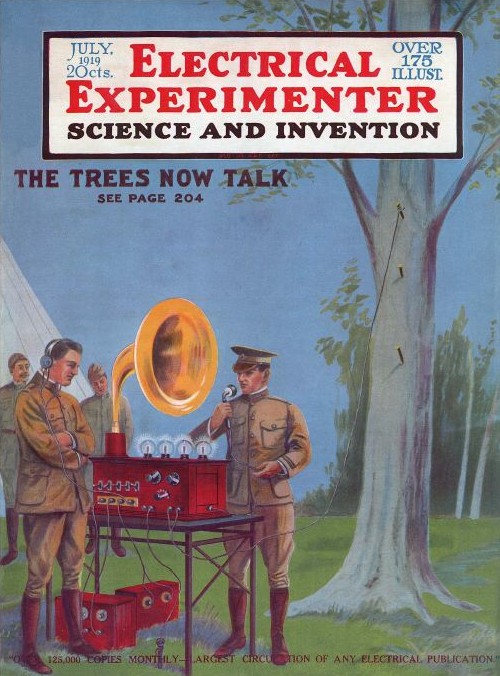
[Image: “The Trees Now Talk” cover story in The Electrical Experimenter (July 1919); image via rexresearch].

Way back in 1919, in their July 14th issue, Scientific American published an article on the discovery that trees can act “as nature’s own wireless towers and antenna combined.”

General George Owen Squire, the U.S. Army’s Chief Signal Officer, made his “strange discovery,” as SciAm phrases it, while sitting in “a little portable house erected in thick woods near the edge of the District of Columbia,” listening to signals “received through an oak tree for an antenna.” This realization, that “trees—all trees, of all kinds and all heights, growing anywhere—are nature’s own wireless towers and antenna combined.”

He called this “talking through the trees.” Indeed, subsequent tests proved that, “[w]ith the remarkably sensitive amplifiers now available, it was not only possible to receive signals from all the principle [sic] European stations through a tree, but it has developed beyond a theory and to a fact that a tree is as good as any man-made aerial, regardless of the size or extent of the latter, and better in the respect that it brings to the operator’s ears far less static interference.”

Why build a radio station, in a sense, when you could simply plant a forest and wire up its trees?

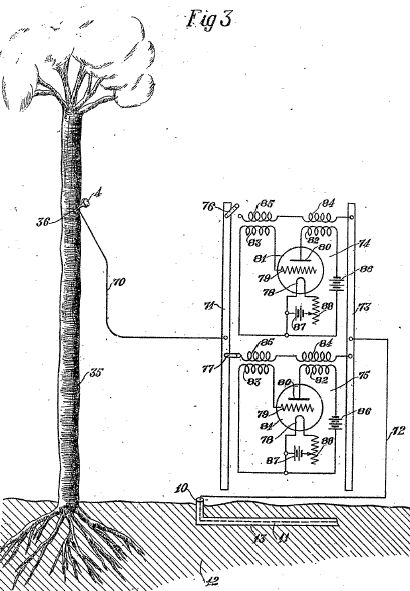
[Images: From George Owen Squire’s British Patent Specification #149,917, via rexresearch].
So how does it work? Alas, you can’t just plug your headphones into a tree trunk—but it’s close. From Scientific American:

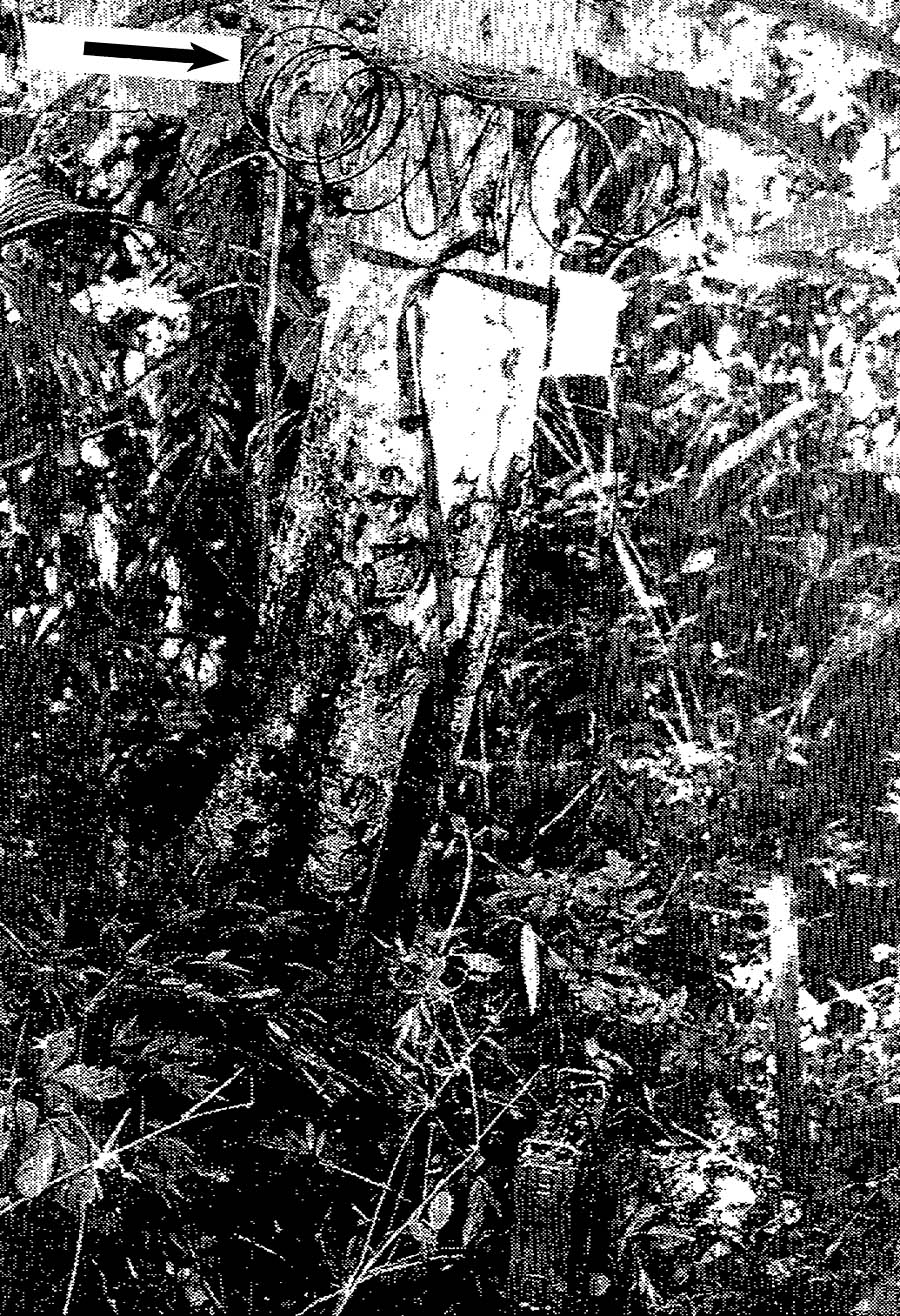
The method of getting the disturbances in potential from treetop to instrument is so simple as to be almost laughable. One climbs a tree to two-thirds of its height, drives a nail a couple of inches into the tree, hangs a wire therefrom, and attaches the wire to the receiving apparatus as if it were a regular lead-in from a lofty copper or aluminum aerial. Apparently some of the etheric disturbances passing from treetop to ground through the tree are diverted through the wire—and the thermionic tube most efficiently does the rest.

Although “40 nails apparently produce no clearer signals than half a dozen,” one tree can nonetheless “serve as a receiving station for several sets, either connected in series with the same material or from separate terminals.”

[Image: Researching the possibility that whole forests could be used as radio stations—broadcasting weather reports, news from the front lines of war, and much else besides—is described by Scientific American as performing “tree radio work.” Image via IEEE Transactions on Antennas and Propagation (January 1975)].
In a patent filing called “British Patent Specification #149,917,” Squire goes on to explore the somewhat mind-bending possibilities offered by “radio transmission and reception through the use of living vegetable organisms such as trees, plants, and the like.” He writes:

I have recently discovered that living vegetable organisms generally are adapted for transmission and reception of radio or high frequency oscillations, whether damped or undamped, with the use of a suitable counterpoise. I have further discovered that such living organisms are adapted for respectively transmitting or receiving a plurality of separate trains of radio or high frequency oscillations simultaneously, in the communication of either or both telephonic or telegraphic messages.

This research—the field of “tree radio work”—has not disappeared or been forgotten.

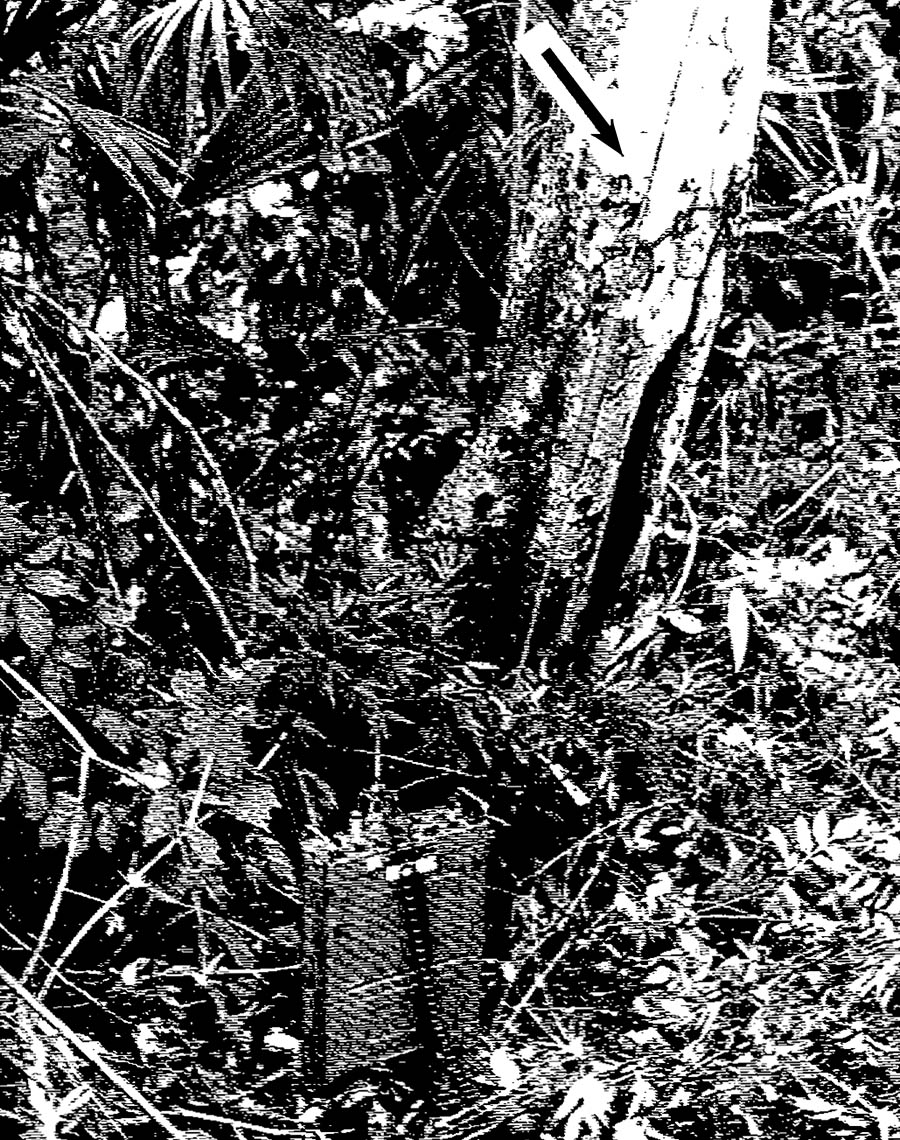
[Image: A tree in the Panamanian rain forest wired up as a sending-receiving antenna; from IEEE Transactions on Antennas and Propagation (January 1975)].
In the January 1975 issue of IEEE Transactions on Antennas and Propagation, we read the test results of several gentleman who went down to the rain forests of the Panama Canal Zone to test “the performance of conventional whip antennas… compared with the performance of trees utilized as antennas in conjunction with hybrid electromagnetic antenna couplers.”

The authors specifically cite Squire’s work and quote him directly: “‘It would seem that living vegetation may play a more important part in electrical phenomena than has been generally supposed… If, as indicated above in these experiments, the earth’s surface is already generously provided with efficient antennae, which we have but to utilize for communications…’ These words were written in 1904 by Major George 0. Squire, U.S. Army Signal Corps, in a report to the Department of War in connection with military maneuvers in the Pacific Division.”

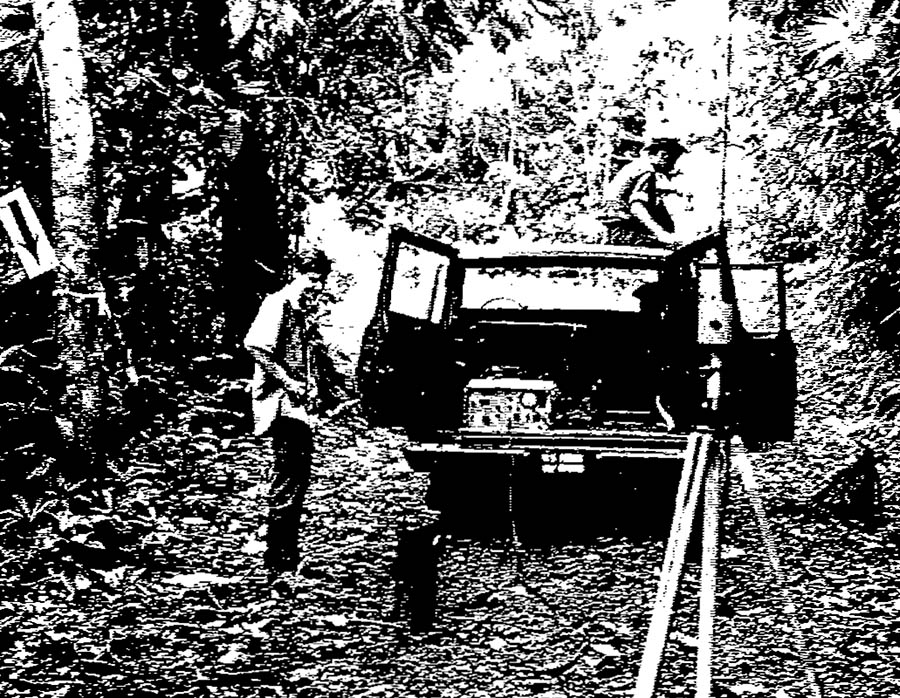
The authors of the IEEE Transactions report thus establish up a jungle-radio “Test Area” in a remote corner of Panama, complete with trees wired-up as dual senders & receivers. There, they think they’ve figured out what’s occurring on a large scale, as signals propagate through the forest canopy, writing that we should consider “the jungle as a maze of aperture-coupled screen rooms. In the jungle case, the screens, in the form of vertical tree and fern trunks, and the horizontal forest canopy are of variable thickness, have variable shaped apertures, and are composed of diverse substances that contain mostly water.”

[Image: Inside the Panamanian jungle-radio Test Zone; image via IEEE Transactions on Antennas and Propagation (January 1975)].
The design implication of all this is that an ideal radio-receiving forest could be planted and maintained, complete with spatially tuned “aperture-coupled screen rooms” (trees of specific branch-density planted at specific distances from one another) to allow for the successful broadcast of messages (and/or music) through the “living vegetable organisms” that Squire wrote about in his patent application.

What other creatures—such as birds, bats, wandering children, foxes, or owls—might make of such a landscape, planted not for aesthetic or ecological reasons, but for the purpose of smoothly relaying foreign radio transmissions and encrypted spy communications, is bewildering to contemplate.

In any case, this truly alien vision of forests silently crackling inside with unexploited radio noise is incredible, implying the existence of undiscovered “broadcasts” of biological noise, humming trunk to trunk amongst groves of remote forests like arboreal whale song, inaudible to human ears, as well as suggesting a near-miraculous venue for future concerts, where music would be played not through wireless headsets or hidden speakers lodged in the woods but through the actual trees, music shimmering from root to canopy, filling trees branch and grain with symphonies, drones, rhythms, songs, sounds occasionally breaking through car radios as they speed past on roads nearby.

[All links found via an old message from Shawn Korgan posted to the Natural Radio VLF Discussion Group of which I am a non-participating member. Vaguely related: The Duplicative Forest and Pruned’s Graffiti as Tactical Urban Wireless Network. See also a follow-up post: Antarctic Island Radio].