A Cordon of Hives

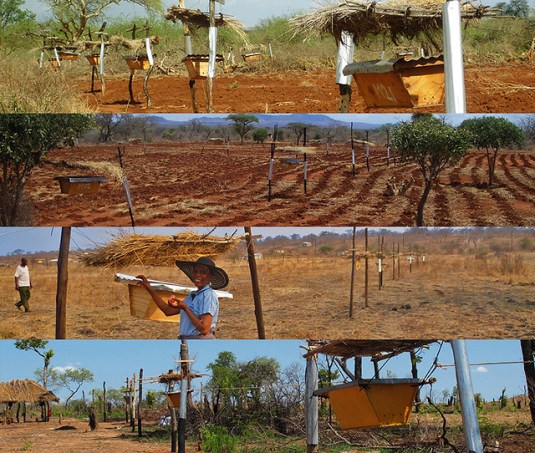
[Images: From The Elephants & Bees Project “Beehive Fence Construction Manual” (PDF)].

Designing for humans, insects, and elephants at the same time, University of Oxford zoologist Lucy King has developed “the honey fence system,” Edible Geography explains.

[Images: Via The Elephants & Bees Project].

A honey fence is “a series of hives, suspended at ten-metre intervals from a single wire threaded around wooden fence posts. If an elephant touches either a hive or the wire, all the bees along the fence line feel the disturbance and swarm out of their hives in an angry, buzzing cloud.”

“By encircling a village with a cordon of hives,” we read, “the village’s crops are protected.”

Read more at Edible Geography.

Comparative Astral Isochrones

[Image: Isochronic map of travel distances from London, from An Atlas of Economic Geography (1914) by John G. Bartholomew (via)].

“This is an isochronic map—isochrones being lines joining points accessible in the same amount of time—and it tells a story about how travel was changing,” Simon Willis explains over at Intelligent Life. The map shows you how long it would take to get somewhere, embarking from London:

You can get anywhere in the dark-pink section in the middle within five days–to the Azores in the west and the Russian city of Perm in the east. No surprises there: you’re just not going very far. Beyond that, things get a little more interesting. Within five to ten days, you can get as far as Winnipeg or the Blue Pearl of Siberia, Lake Baikal. It takes as much as 20 days to get to Tashkent, which is closer than either, or Honolulu, which is much farther away. In some places, a colour sweeps across a landmass, as pink sweeps across the eastern United States or orange across India. In others, you reach a barrier of blue not far inland, as in Africa and South America. What explains the difference? Railways.

Earlier this year, when a private spacecraft made it from the surface of the Earth to the International Space Station in less than six hours, the New York Times pointed out that “it is now quicker to go from Earth to the space station than it is to fly from New York to London.”

[Image: From Twitter].

In the context of Bartholomew’s map, it would be interesting to re-explore isochronal cartography in our own time, to visualize the strange spacetime we live within today, where the moon is closer than parts of Antarctica and the International Space Station is a shorter trip than flying to Heathrow.

(Map originally spotted via Francesco Sebregondi).

Ghost Streets of Los Angeles

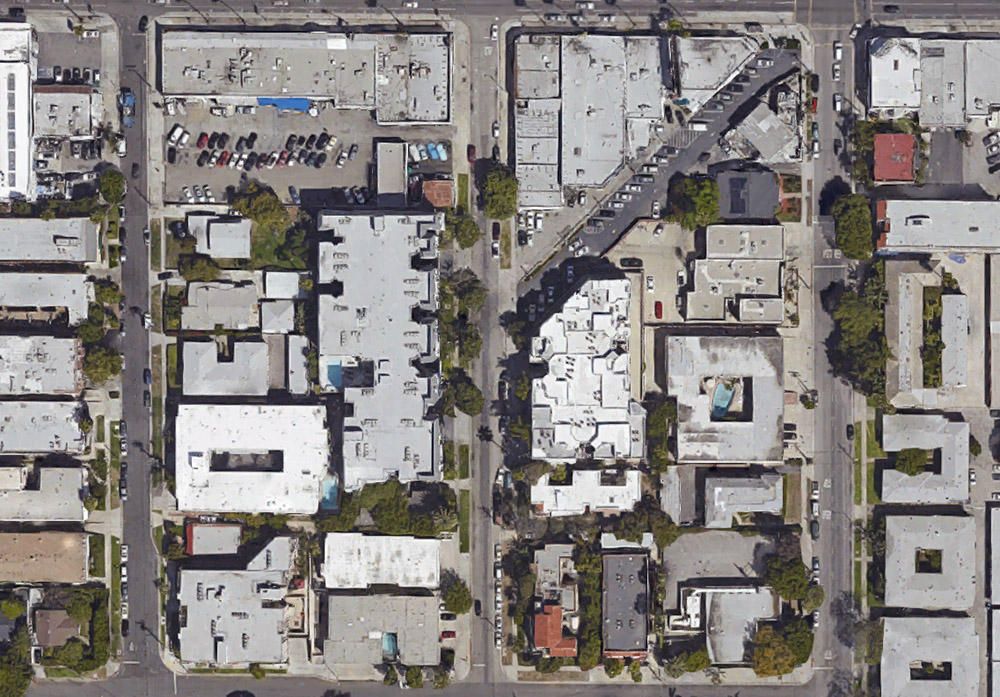
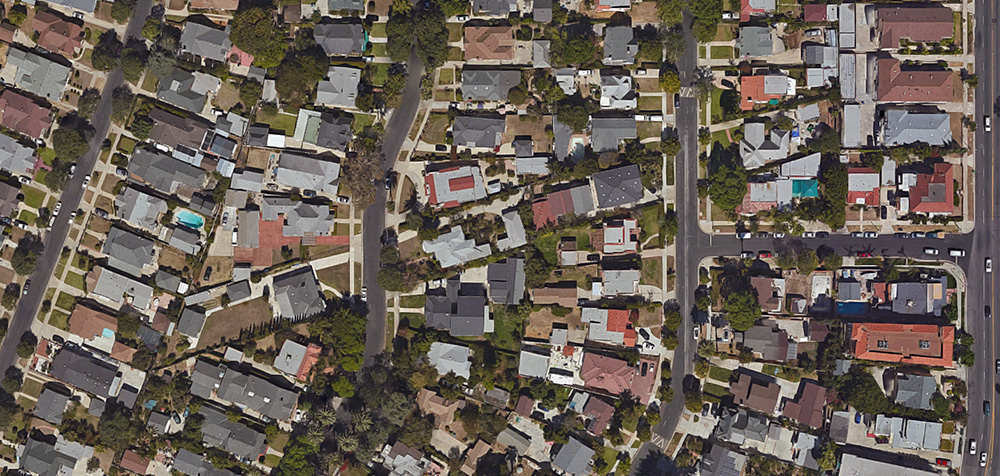
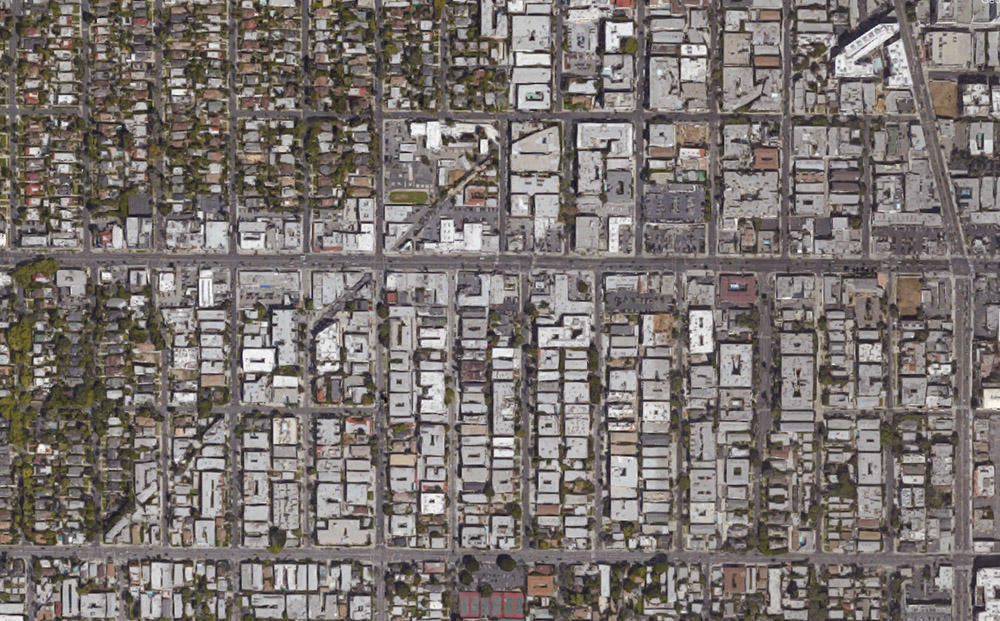
[Image: Via Google Maps; view larger].

In a short story called “Reports of Certain Events in London” by China Miéville—a text often cited here on BLDGBLOG—we read about a spectral network of streets that appear and disappear around London like the static of a radio tuned between stations, old roadways that are neither here nor there, flickering on and off in the dead hours of the night.

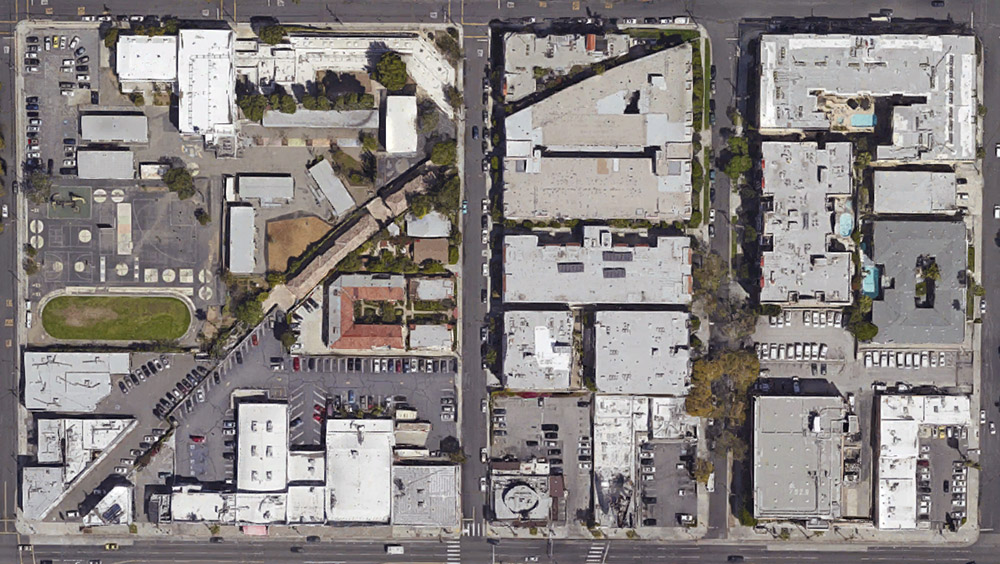
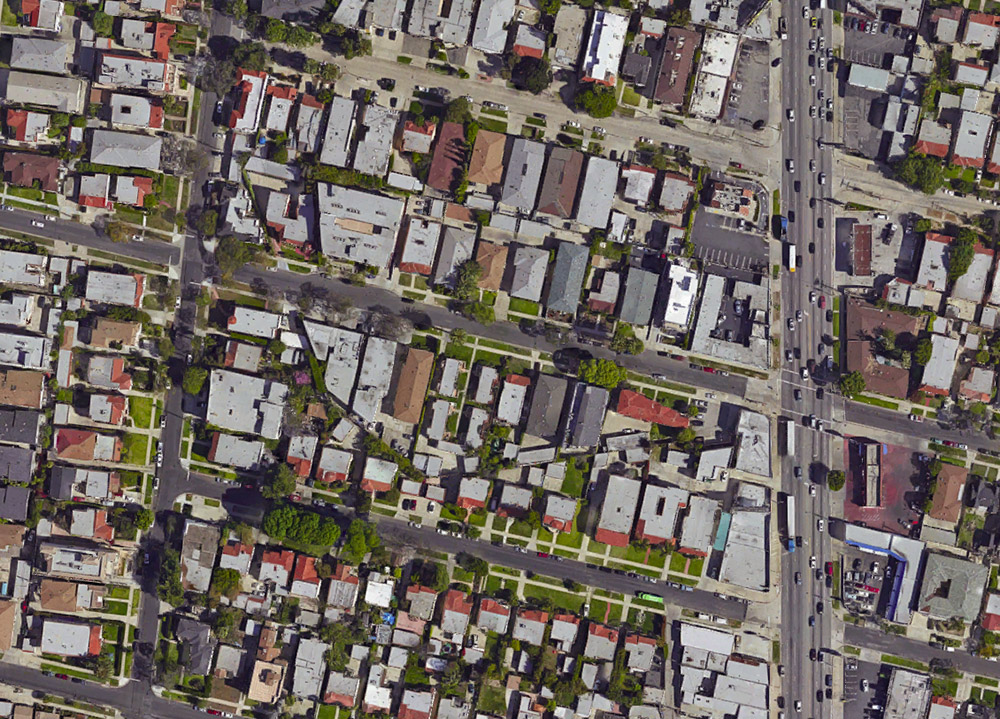
For reasons mostly related to a bank heist described in my book, A Burglar’s Guide to the City, I found myself looking at a lot of aerial shots of Los Angeles—specifically the area between West Hollywood and Sunset Boulevard—when I noticed this weird diagonal line cutting through the neighborhood.

[Image: Via Google Maps; view larger].

It is not a street—although it obviously started off as a street. In fact, parts of it today are still called Marshfield Way.

At times, however, it’s just an alleyway behind other buildings, or even just a narrow parking lot tucked in at the edge of someone else’s property line.

[Image: Via Google Maps; view larger].

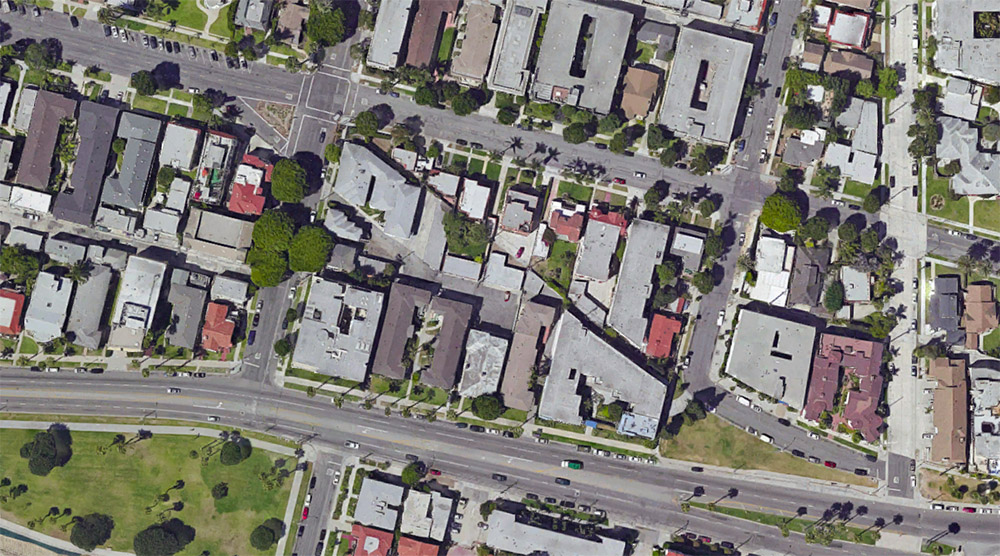
Other times, it actually takes on solidity and mass in the form of oddly skewed, diagonal slashes of houses.

The buildings that fill it look more like scar tissue, bubbling up to cover a void left behind by something else’s absence.

[Image: Via Google Maps; view larger].

First of all, I love the idea that the buildings seen here take their form from a lost street—that an old throughway since scrubbed from the surface of Los Angeles has reappeared in the form of contemporary architectural space.

That is, someone’s living room is actually shaped the way it is not because of something peculiar to architectural history, but because of a ghost street, or the wall of perhaps your very own bedroom takes its angle from a right of way that, for whatever reason, long ago disappeared.

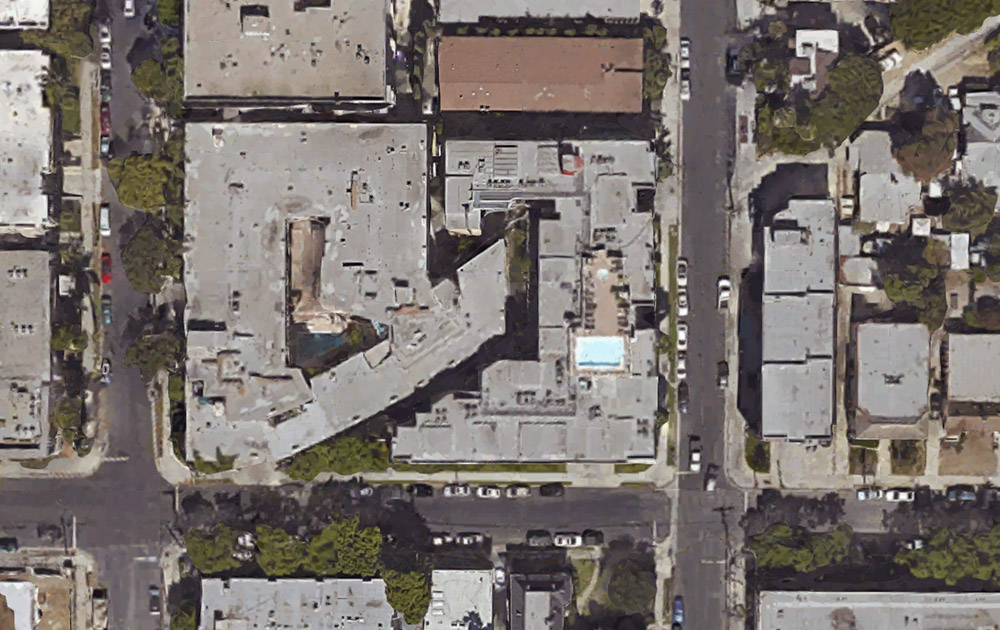
[Image: Via Google Maps; view larger].

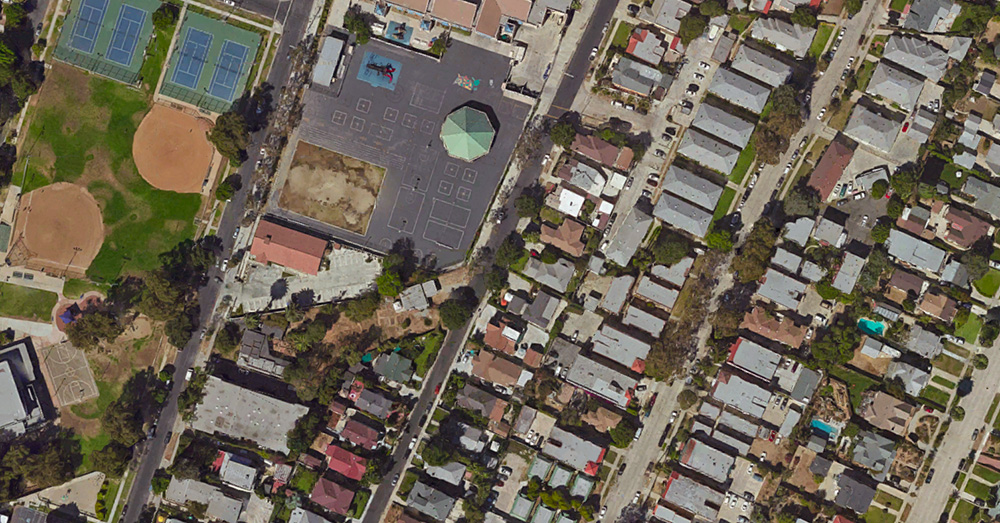
If you follow this thing from roughly the intersection of Hollywood & La Brea to the strangely cleaved back of an apartment building on Ogden Drive—the void left by this lost street, incredibly, now takes the form of a private swimming pool—these buildings seem to plow through the neighborhood like train cars.

Which could also be quite appropriate, as this superficial wound on the skin of the city is most likely a former streetcar route.

But who knows: my own research went no deeper than an abandoned Google search, and I was actually more curious what other people thought this might be or what they’ve experienced here, assuming at least someone in the world reading this post someday might live or work in one of these buildings.

[Image: Via Google Maps; view larger].

And perhaps this is just the exact same point, repeated, but the notion that every city has these deeper wounds and removals that nonetheless never disappear is just incredible to me. You cut something out—and it becomes a building a generation later. You remove an entire street—and it becomes someone’s living room.

I remember first learning that one of the auditoriums at the Barbican Art Centre in London is shaped the way it is because it was built inside a former WWII bomb crater, and simply reeling at the notion that all of these negative spaces left scattered and invisible around the city could take on architectural form.

Like ghosts appearing out of nowhere—or like China Miéville’s fluttering half-streets, conjured out of the urban injuries we all live within and too easily mistake for property lines and real estate, amidst architectural incisions that someday become swimming pools and parking lots.

*Update* Some further “ghost streets” have popped up in the comments here, and the images are worth posting.

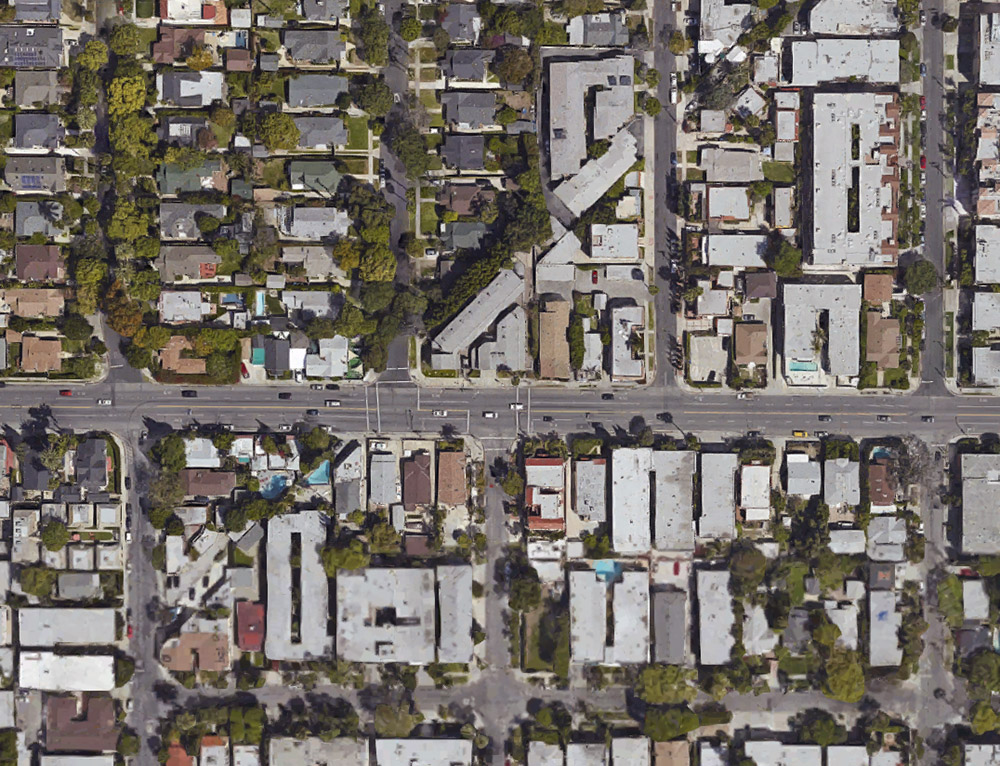
[Image: Via Google Maps; view larger].

The one seen above, for example, is “another ghost diagonal that begins on 8th St. at Hobart, and ends at Pico and Rimpau,” an anonymous commenter explains.

Another example, seen below—

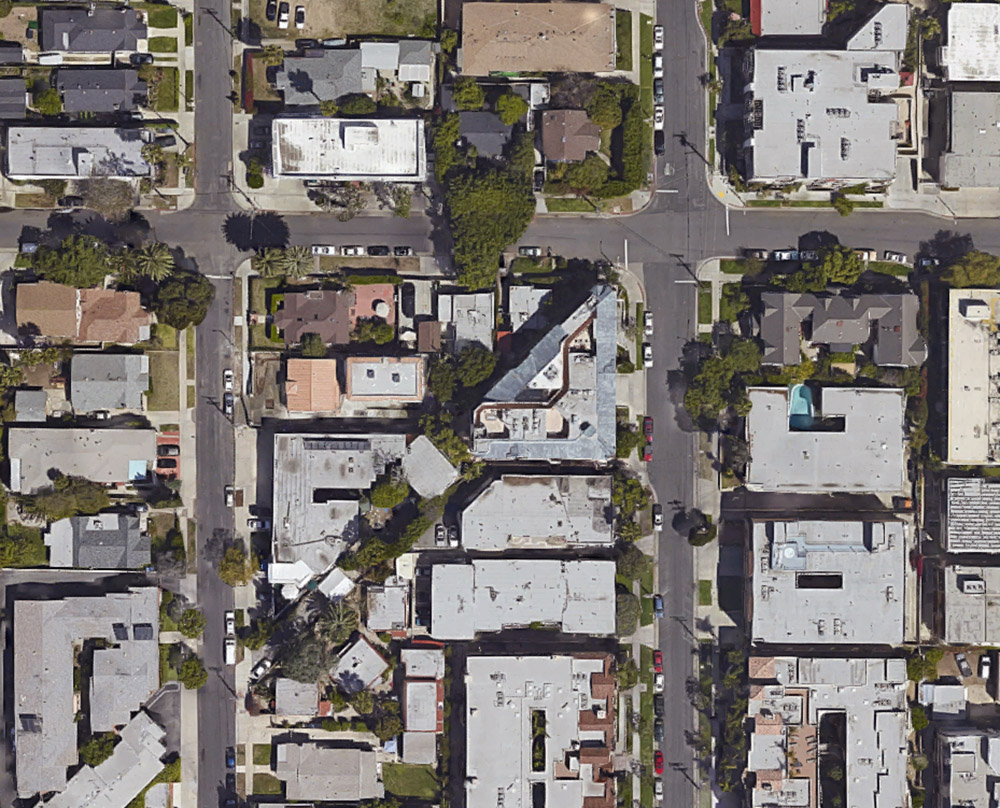
[Image: Via Google Maps; view larger].

—is “a block in the Pico-Robertson area,” a commenter writes:

I lived there as a teenager, but never noticed the two diagonals until I looked at it with google maps. There are some lots on the west side of the next two blocks north which also have diagonals. And if you continue north across Pico Blvd, you can see diagonal property lines around St. Mary Magdalene Catholic School and the church.

Thanks for all the tips, and by all means keep them coming, if you are aware of other sites like this, whether in Los Angeles or further afield; and be sure to read through the comments for more.

*Second Update* The examples keep coming. A commenter named Lance Morris explains that he did an MFA project “about this very thing, but in Long Beach. There’s a long diagonal scar running from Long Beach Blvd and Willow all the way down to Belmont Shore. I tried walking as closely to the line as I could and GPS tracked the results. There are even 2 areas where you can still see tracks!”

This inspired me to look around the area a little bit on Google Maps, which led to another place nearby, as seen below.

[Image: Via Google Maps; view larger].

Again, seeing how these local building forms have been generated by the outlines of a missing street or streetcar line is pretty astonishing.

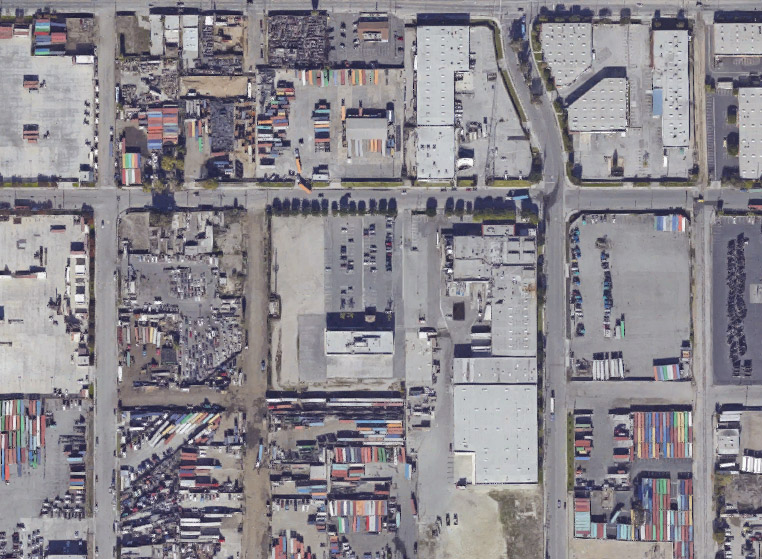
Further, the tiniest indicators of these lost throughways remain visible from above, usually in the form of triangular building cuts or geometrically odd storage yards and parking lots. Because they all align—like some strange industrial ley line—you can deduce that an older piece of transportation infrastructure is now missing.

[Image: Via Google Maps; view a bit larger].

Indeed, if you zoom out from there in the map, you’ll see that the subtle diagonal line cutting across the above image (from the lower left to the upper right) is, in fact, an old rail right of way that leads from the shore further inland.

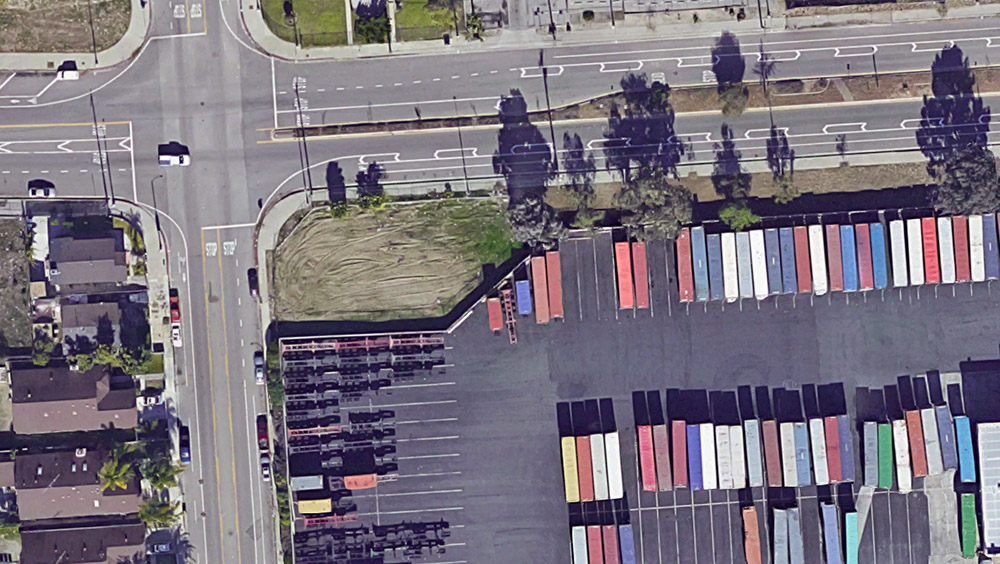
To give a sense of how incredibly subtle some of these signs can be, the diagonal fence seen in the below screen grab—

[Image: Via Google Maps; view larger].

—is actually shaped that way not because of some quirk of the local storage lot manager, but because it follows this lost right of way.

*Third Update* There are yet more interesting examples popping up now over in a thread on Metafilter.

There, among other notable comments, someone called univac points out that the streetcar scar that “begins on 8th St. at Hobart, and ends at Pico and Rimpau”—quoting an earlier commenter here on BLDGBLOG—”actually has one echo in the diagonally-stepped building here, and picks up again in the block bounded by Wilton, Westchester, 9th and San Marino, and ends at a crooked building just north of 4th and Olympic.”

[Image: Via Google Maps; view larger].

You can see the middle stretch of that route in the image, above. For more, check out the thread on Metafilter.

Not only this, however, but the old right of way followed by that commenter actually extends much further than that, all the way southwest to a small park at approximately Pico and Queen Anne Place.

[Image: Via Google Maps; view larger].

In the above image, you can see a small structure—a garage or a house—turned slightly off-axis in the northeast corner, indicating the line of the old streetcar line, with some open lawns and small paved areas revealing its obscured geometry as you look down to the southwest.

In the Garden of 3D Printers

[Image: Unrelated image of incredible floral shapes 3D-printed by Jessica Rosenkrantz and Jesse Louis-Rosenberg (via)].

A story published earlier this year explained how pollinating insects could be studied by way of 3D-printed flowers.

The actual target of the study was the hawkmoth, and four types of flowers were designed and produced to help understand the geometry of moth/flower interactions, including how “the hawkmoth responded to each of the flower shapes” and “how the flower shape affected the ability of the moth to use its proboscis (the long tube it uses as a mouth).”

Of course, a very similar experiment could have been done using handmade model flowers—not 3D printers—and thus could also have been performed with little fanfare generations ago.

But the idea that a surrogate landscape can now be so accurately designed and manufactured by printheads that it can be put into service specifically for the purpose of cross-species dissimulation—that it, tricking species other than humans into thinking that these flowers are part of a natural ecosystem—is extraordinary.

[Image: An also unrelated project called “Blossom,” by Richard Clarkson].

Many, many years ago, I was sitting in a park in Providence, Rhode Island, one afternoon reading a copy of Germinal Life by Keith Ansell Pearson. The book had a large printed flower on its front cover, wrapping over onto the book’s spine.

Incredibly, at one point in the afternoon a small bee seemed to become confused by the image, as the bee kept returning over and over again to land on the spine and crawl around there—which, of course, might have had absolutely nothing to do with the image of a printed flower, but, considering the subject matter of Ansell Pearson’s book, this was not without significant irony.

It was as if the book itself had become a participant in, or even the mediator of, a temporary human/bee ecosystem, an indirect assemblage created by this image, this surrogate flower.

In any case, the image of little gardens or entire, wild landscapes of 3D-printed flowers so detailed they appear to be organic brought me to look a little further into the work of Jessica Rosenkrantz and Jesse Louis-Rosenberg, a few pieces of whose you can see in the opening image at the top of this post.

Their 3D-printed floral and coral forms are astonishing.

[Image: “hyphae 3D 1” by Jessica Rosenkrantz and Jesse Louis-Rosenberg].

Rosenkrantz’s Flickr page gives as clear an indication as anything of what their formal interests and influences are: photos of coral, lichen, moss, mushrooms, and wildflowers pop up around shots of 3D-printed models.

They sometimes blend in so well, they appear to be living specimens.

[Image: Spot the model; from Jessica Rosenkrantz’s Flickr page].

There is an attention to accuracy and detail in each piece that is obvious at first glance, but that is also made even more clear when you see the sorts of growth-studies they perform to understand how these sorts of systems branch and expand through space.

[Image: “Floraform—Splitting Point Growth” by Jessica Rosenkrantz and Jesse Louis-Rosenberg].

The organism as space-filling device.

And the detail itself is jaw-dropping. The following shot shows how crazy-ornate these things can get.

[Image: “Hyphae spiral” by Jessica Rosenkrantz and Jesse Louis-Rosenberg].

Anyway, while this work is not, of course, related to the hawkmoth study with which this post began, it’s nonetheless pretty easy to get excited about the scientific and aesthetic possibilities opened up by some entirely speculative future collaboration between these sorts of 3D-printed models and laboratory-based ecological research.

One day, you receive a mysterious invitation to visit a small glass atrium constructed atop an old warehouse somewhere on the outskirts of New York City. You arrive, baffled as to what it is you’re meant to see, when you notice, even from a great distance, that the room is alive with small colorful shapes, flickering around what appears to be a field of delicate flowers. As you approach the atrium, someone opens a door for you and you step inside, silent, slightly stunned, noticing that there is life everywhere: there are lichens, orchids, creeping vines, and wildflowers, even cacti and what appears to be a coral reef somehow inexplicably growing on dry land.

But the room does not smell like a garden; the air instead is charged with a light perfume of adhesives.

[Image: “Hyphae crispata #1 (detail)” by Jessica Rosenkrantz and Jesse Louis-Rosenberg].

Everything you see has been 3D-printed, which comes as a shock as you begin to see tiny insects flittering from flowerhead to flowerhead, buzzing through laceworks of creeping vines and moss—until you look even more carefully and realize that they, too, have been 3D-printed, that everything in this beautiful, technicolor room is artificial, and that the person standing quietly at the other end amidst a tangle of replicant vegetation is not a gardener at all but a geometrician, watching for your reaction to this most recent work.

Five Parises of Emptiness

[Image: Via Curbed LA].

Citing a new report in the Journal of the American Planning Association, Curbed LA points out that “parking infrastructure takes up about 200 square miles of land in LA county.”

That’s more than four San Franciscos’ worth of space (46.87 square miles) and nearly five times the size of Paris (40.7 square miles). Or, as Janette Sadik-Khan wrote on Twitter, “LA County has 85% more parking spots than people, occupying more space than the entire city of Philly.”

Los Angeles, where it’s you and a bunch of parking lots.

Electronic Plantlife

[Image: A rose-circuit, courtesy Linköping University].

In a newly published paper called “Electronic plants,” researchers from Linköping University in Sweden describe the process by which they were able to “manufacture” what they call “analog and digital organic electronic circuits and devices” inside living plants.

The plants not only conducted electrical signals, but, as Science News points, the team also “induced roses leaves to light up and change color.”

Indeed, in their way of thinking, plants have been electronic gadgets all along: “The roots, stems, leaves, and vascular circuitry of higher plants are responsible for conveying the chemical signals that regulate growth and functions. From a certain perspective, these features are analogous to the contacts, interconnections, devices, and wires of discrete and integrated electronic circuits.”

[Image: Bioluminescent foxfire mushrooms (used purely for illustrative effect), via Wikipedia].

Here’s the process in a nutshell:

The idea of putting electronics directly into trees for the paper industry originated in the 1990s while the LOE team at Linköping University was researching printed electronics on paper. Early efforts to introduce electronics in plants were attempted by Assistant Professor Daniel Simon, leader of the LOE’s bioelectronics team, and Professor Xavier Crispin, leader of the LOE’s solid-state device team, but a lack of funding from skeptical investors halted these projects.
Thanks to independent research money from the Knut and Alice Wallenberg Foundation in 2012, Professor Berggren was able to assemble a team of researchers to reboot the project. The team tried many attempts of introducing conductive polymers through rose stems. Only one polymer, called PEDOT-S, synthesized by Dr. Roger Gabrielsson, successfully assembled itself inside the xylem channels as conducting wires, while still allowing the transport of water and nutrients. Dr. Eleni Stavrinidou used the material to create long (10 cm) wires in the xylem channels of the rose. By combining the wires with the electrolyte that surrounds these channels she was able to create an electrochemical transistor, a transistor that converts ionic signals to electronic output. Using the xylem transistors she also demonstrated digital logic gate function.

Headily enough, using plantlife as a logic gate also implies a future computational use of vegetation: living supercomputers producing their own circuits inside dual-use stems.

Previously, we have looked at the use of electricity to stimulate plants into producing certain chemicals, how the action of plant roots growing through soil could be tapped as a future source of power, and how soil bacteria could be wired up into huge, living battery fields—in fact, we also looked at a tongue-in-cheek design project for “growing electrical circuitry inside the trunks of living trees“—but this actually turns vegetation into a form of living circuitry.

While Archigram’s “Logplug” project is an obvious reference point here within the world of architectural design, it seems more interesting to consider instead the future landscape design implications of technological advances such as this—how “electronic plants” might affect everything from forestry to home gardening, energy production and distribution infrastructure to a city’s lighting grid.

[Image: The “Logplug” by Archigram, from Archigram].

We looked at this latter possibility several few years ago, in fact, in a post from 2009 called “The Bioluminescent Metropolis,” where the first comment now seems both prescient and somewhat sad given later developments.

But the possibilities here go beyond mere bioluminescence, into someday fully functioning electronic vegetation.

Plants could be used as interactive displays—recall the roses “induced… to light up and change color”—as well as given larger conductive roles in a region’s electrical grid. Imagine storing excess electricity from a solar power plant inside shining rose gardens, or the ability to bypass fallen power lines after a thunderstorm by re-routing a town’s electrical supply through the landscape itself, living corridors wired from within by self-assembling circuits and transistors.

And, of course, that’s all in addition to the possibility of cultivating plants specifically for their use as manufacturing systems for organic electronics—for example, cracking them open not to reveal nuts, seeds, or other consumable protein, but the flexible circuits of living computer networks. BioRAM.

There are obvious reasons to hesitate before realizing such a vision—that is, before charging headlong into a future world where forests are treated merely as back-up lighting plans for overcrowded cities and plants of every kind are seen as nothing but wildlife-disrupting sources of light cultivated for the throwaway value of human aesthetic pleasure.

Nonetheless, thinking through the design possibilities in addition to the ethical risks not only now seems very necessary, but might also lead someplace truly extraordinary—or someplace otherworldly, we might say with no need for justification.

For now, check out the original research paper over at Science Advances.

A Model Descent

[Image: Model by SITU Studio with C&G Partners; Instagram by BLDGBLOG].

The Homestake Mine in Lead, South Dakota, was once “the largest, deepest and most productive gold mine in North America,” featuring nearly 370 miles’ worth of tunnels.

Although active mining operations ceased there more than a decade ago, the vast subterranean labyrinth not only remains intact, it has also found a second life as host for a number of underground physics experiments.
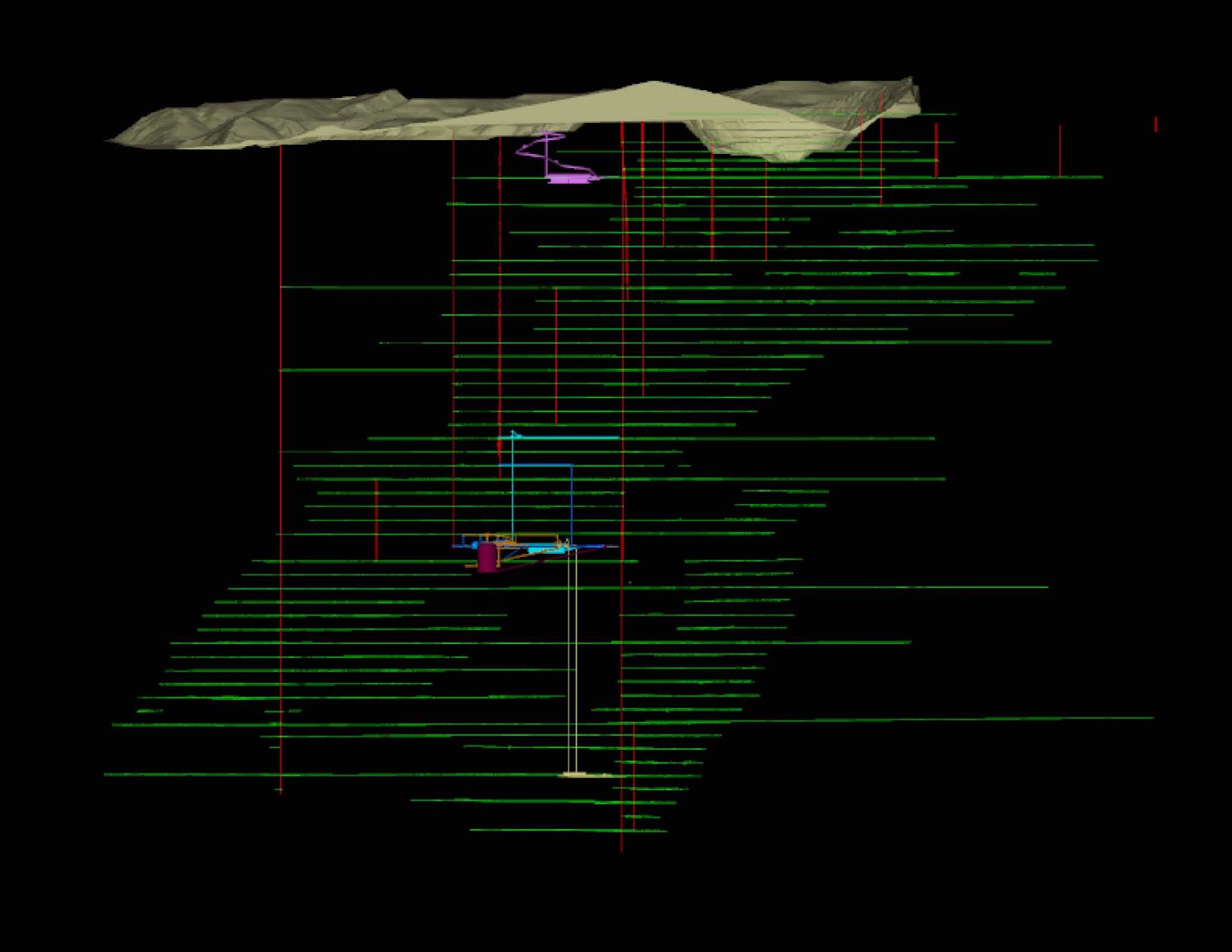
[Image: Digital model of the old mine tunnels beneath Lead, South Dakota; via SITU Fabrication].

These include a lab known as the Sanford Underground Research Facility, as well as a related project, the Deep Underground Science and Engineering Laboratory (or DUSEL).

Had DUSEL not recently run into some potentially fatal funding problems, it “would have been the deepest underground science facility in the world.” For now, it is on hold.
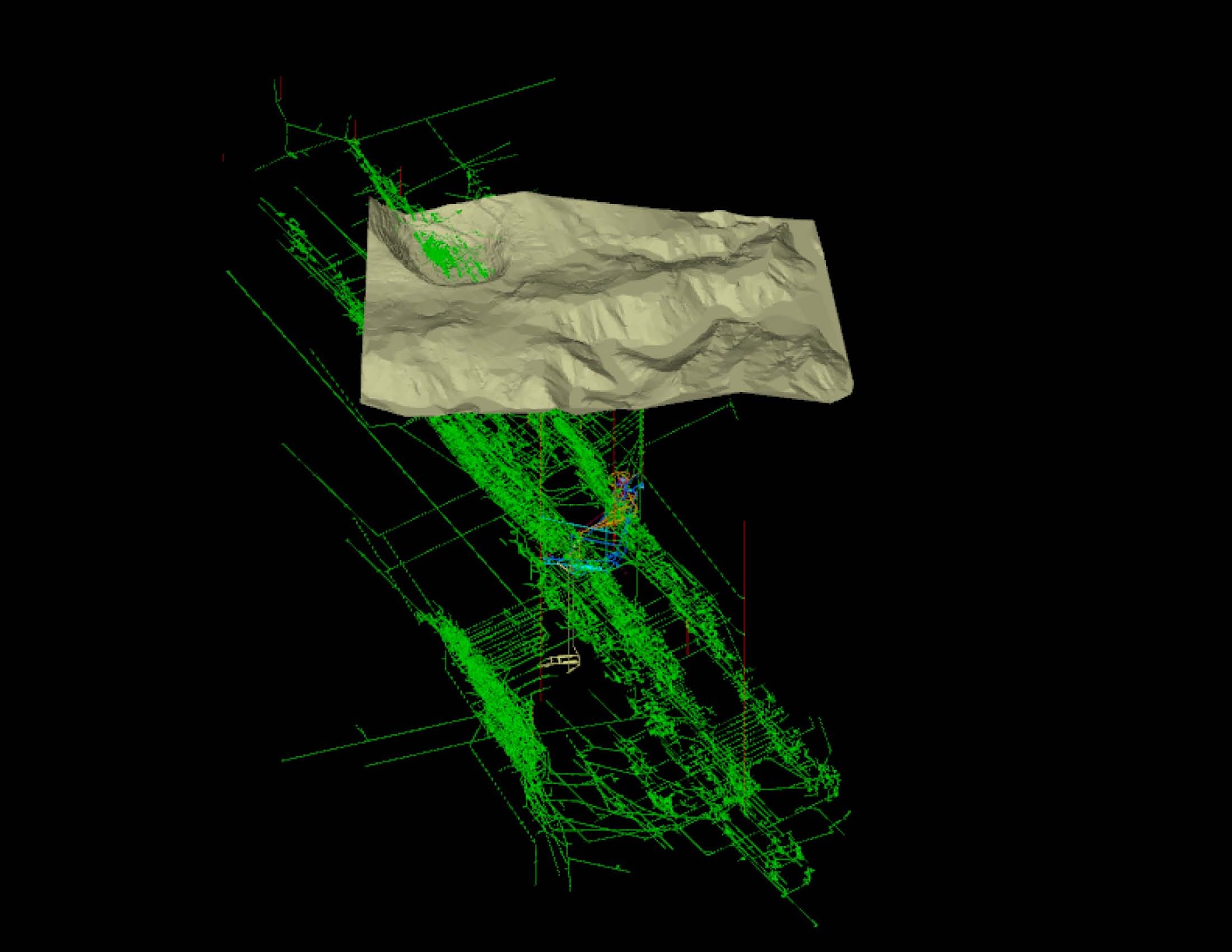
[Image: Digital model of the old mine tunnels beneath Lead, South Dakota; via SITU Fabrication].

There is already much to read about the experiments going on there, but one of the key projects underway is a search for dark matter. As Popular Science explained back in 2010:

Now a team of physicists and former miners has converted Homestake’s shipping warehouse into a new surface-level laboratory at the Sanford Underground Laboratory. They’ve painted the walls and baseboards white and added yellow floor lines to steer visitors around giant nitrogen tanks, locker-size computers and plastic-shrouded machine parts. Soon they will gather many of these components into the lab’s clean room and combine them into LUX, the Large Underground Xenon dark-matter detector, which they will then lower halfway down the mine, where—if all goes well—it will eventually detect the presence of a few particles of dark matter, the as-yet-undetected invisible substance that may well be what holds the universe together.

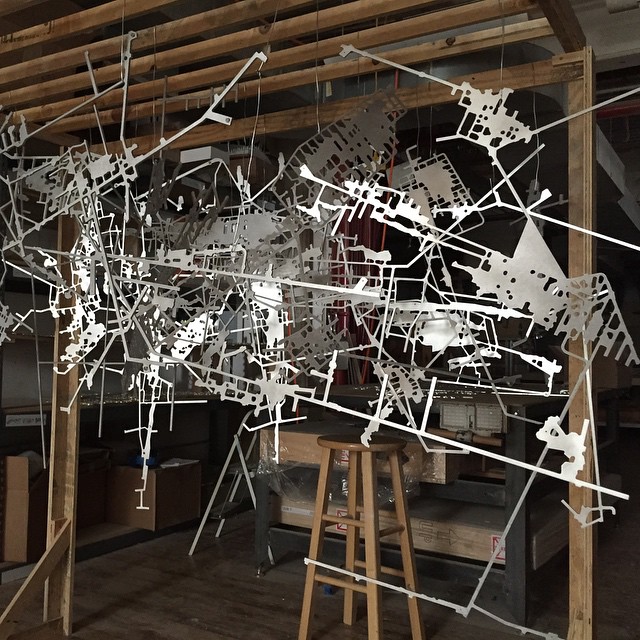
Earlier this year, I was scrolling through my Instagram feed when I noticed some cool photos popping up from a Brooklyn-based firm called SITU Fabrication. The images showed what appeared to be a maze of strangely angled metal parts and wires, hanging from one another in space.
[Image: Model by SITU Studio with C&G Partners; Instagram by SITU Fabrication].

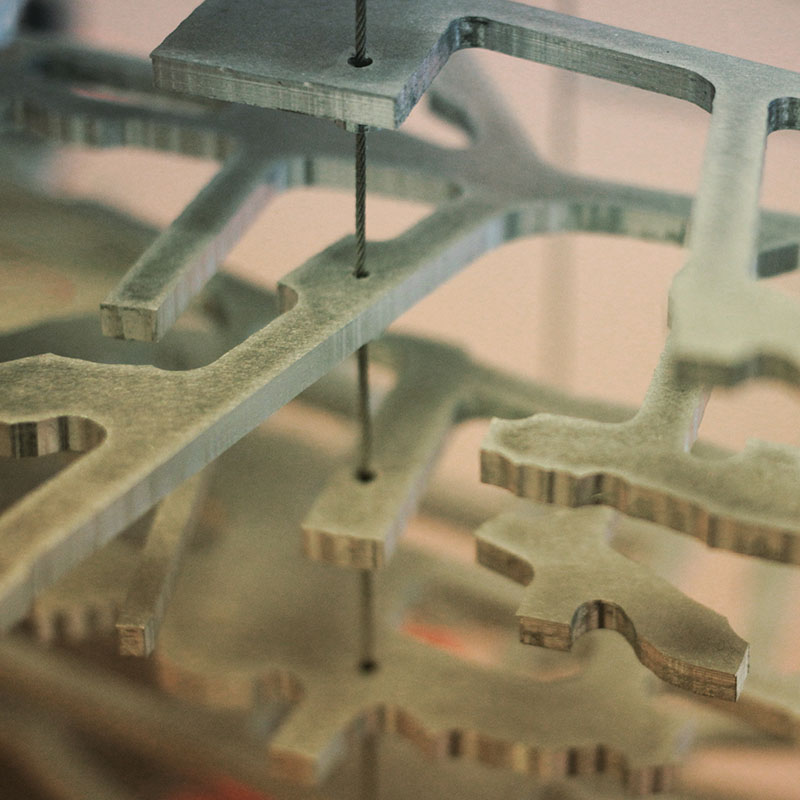
One of them—seen above, and resembling some sort of exploded psychogeographic map of Dante’s Inferno—was simply captioned, “#CNC milled aluminum plates for model of underground tunnel network in #SouthDakota.”

Living within walking distance of the company’s DUMBO fabrication facility, I quickly got in touch and, a few days later, stopped by to learn more.

[Image: Model by SITU Studio with C&G Partners; Instagram by BLDGBLOG].

SITU’s Wes Rozen met me for a tour of the workshop and a firsthand introduction to the Homestake project.

The firm, he explained, already widely known for its work on complex fabrication jobs for architects and artists alike, had recently been hired to produce a 3D model of the complete Homestake tunnel network, a model that would later be installed in a visitors’ center for the mine itself.

Visitors would thus encounter this microcosm of the old mine, in lieu of physically entering the deep tunnels beneath their feet.
[Image: Model by SITU Studio with C&G Partners; Instagram by BLDGBLOG].

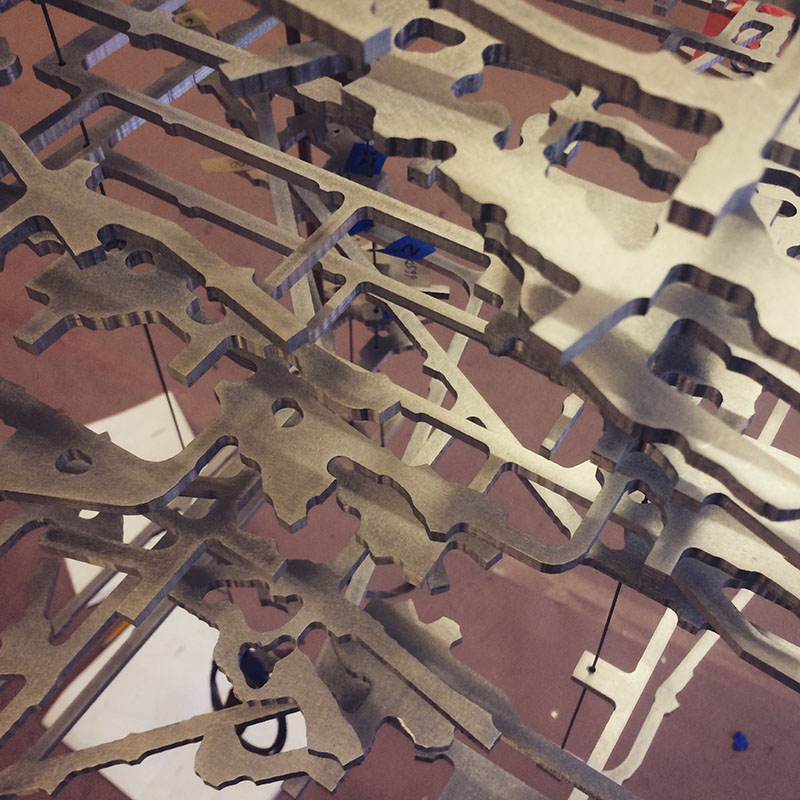
Individual levels of the mine, Rozen pointed out, had been milled from aluminum sheets to a high degree of accuracy; even small side-bays and dead ends were included in the metalwork.

Negative space became positive, and the effect was like looking through lace.

[Image: Model by SITU Studio with C&G Partners; photo by BLDGBLOG].

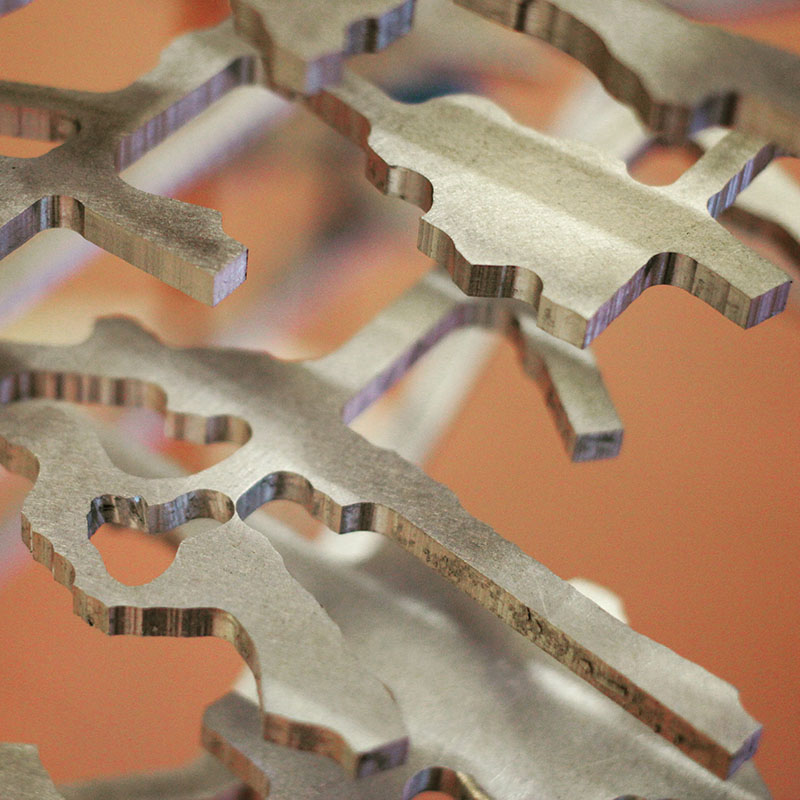
Further, tiny 3D-printed parts—visible in some photographs, further below—had also been made to connect each level to the next, forming arabesques and curlicues that spiraled out and back again, representing truck ramps.
[Image: Model by SITU Studio with C&G Partners; Instagram by BLDGBLOG].

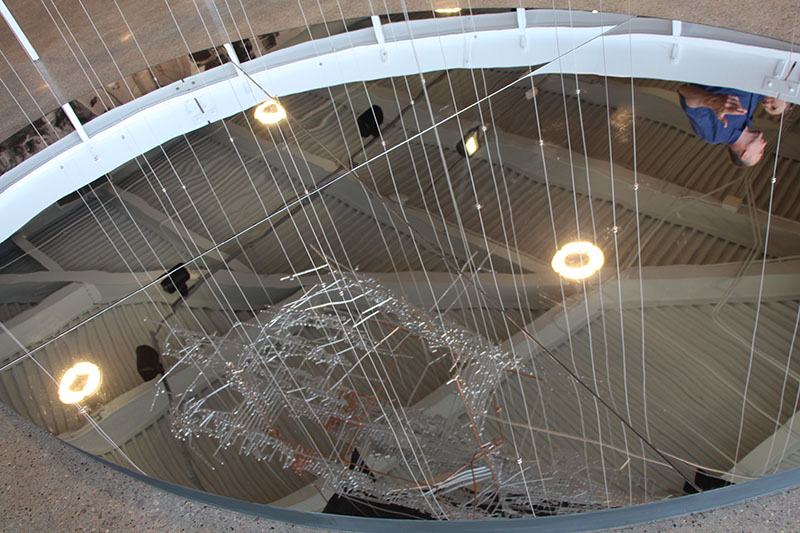
The whole thing was then suspended on wires, hanging like a chandelier from the underworld, to form a cloud or curtain of subtly reflective metal.
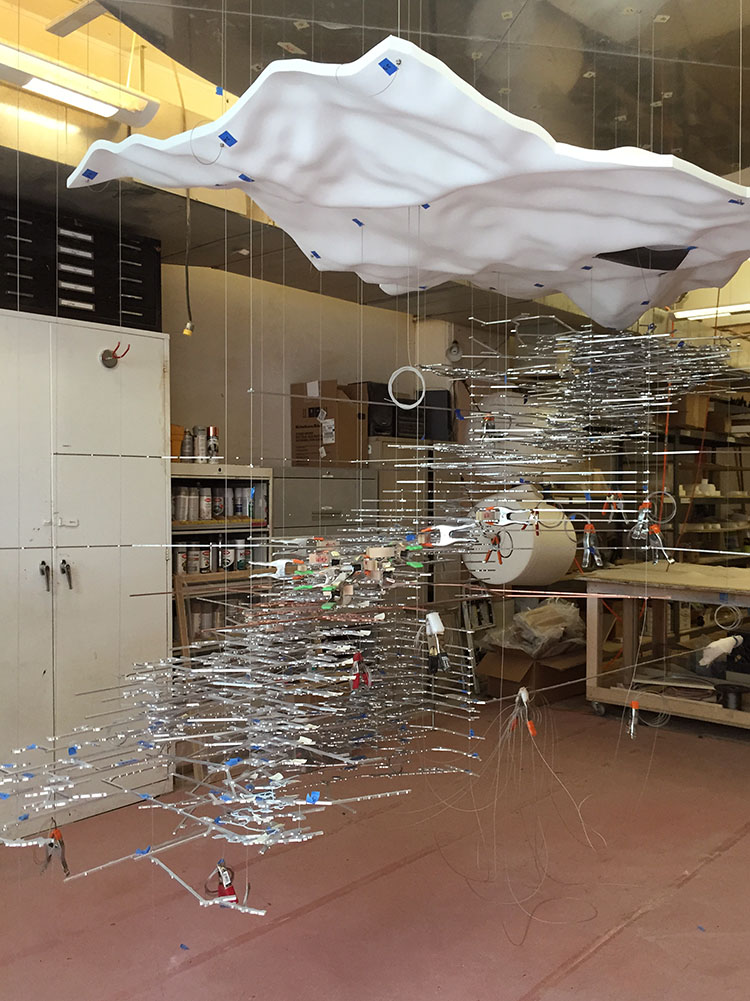
[Image: Assembly of the model by SITU Studio with C&G Partners; photo courtesy of SITU Fabrication].

When I showed up that day, the pieces were still being assembled; small knots of orange ribbon and pieces of blue painter’s tape marked spots that required further polish or balancing, and metal clamps held many of the wires in place.

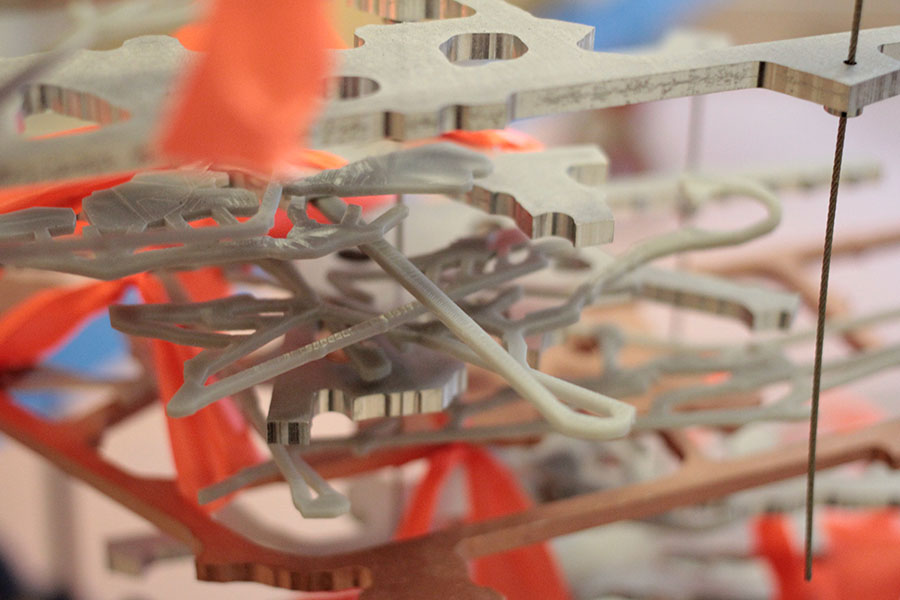
[Images: Model by SITU Studio with C&G Partners; photos by BLDGBLOG].

Seen in person, the piece is astonishingly complex, as well as physically imposing—in photographs, unfortunately, this can be difficult to capture.
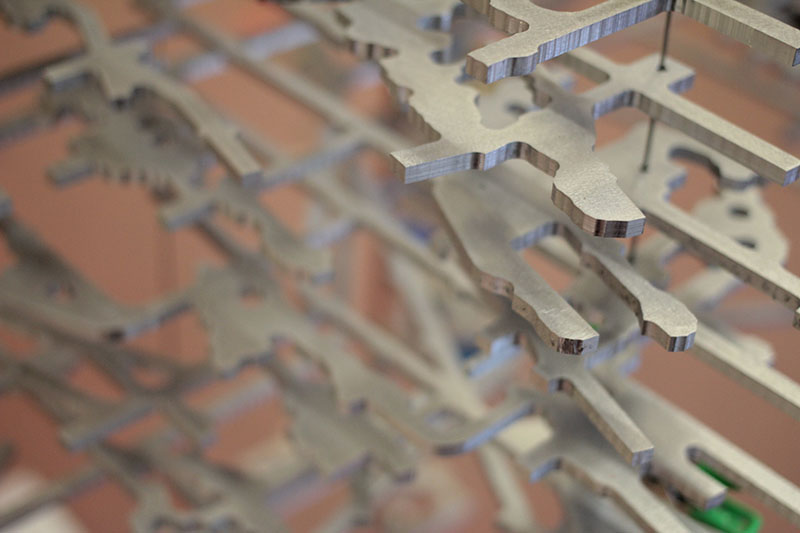
[Image: Model by SITU Studio with C&G Partners; photo by BLDGBLOG].

However, the sheer density of the metalwork and the often impossibly minute differences from one level of the mine to the next—not to mention, at the other extreme, the sudden outward spikes of one-off, exploratory mine shafts, shooting away from the model like blades—can still be seen here, especially in photos supplied by SITU themselves.
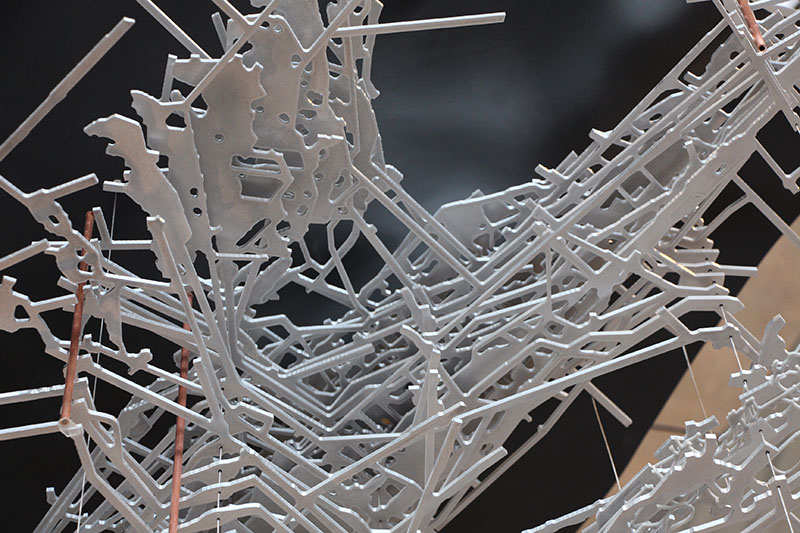
[Image: Assembly of the model by SITU Studio with C&G Partners; photo courtesy of SITU Fabrication].

A few of the photos look more like humans tinkering in the undercarriage of some insectile aluminum engine, a machine from a David Cronenberg movie.
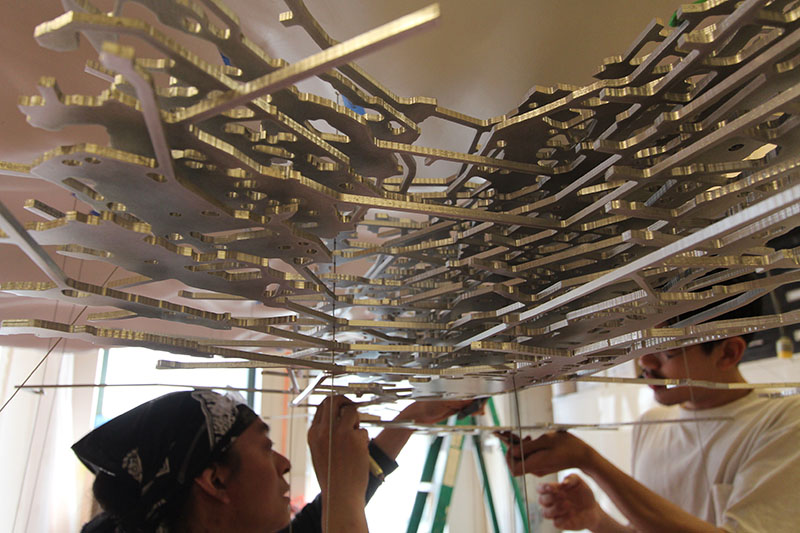
[Image: Assembling the model by SITU Studio with C&G Partners; photo courtesy of SITU Fabrication].

Which seems fitting, I suppose, as the other appropriate analogy to make here would be to the metal skeleton of a previously unknown creature, pinned up and put together again by the staff of an unnatural history museum.
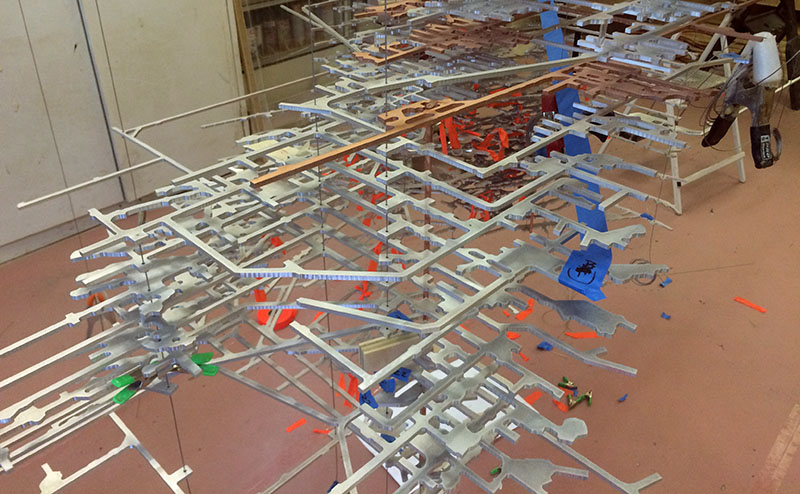
[Image: Model by SITU Studio with C&G Partners; photo by BLDGBLOG].

The model is now complete and no longer in Brooklyn: it is instead on display at the Homestake visitors’ center in South Dakota, where it greets the general public from its perch above a mirror. As above, so below.
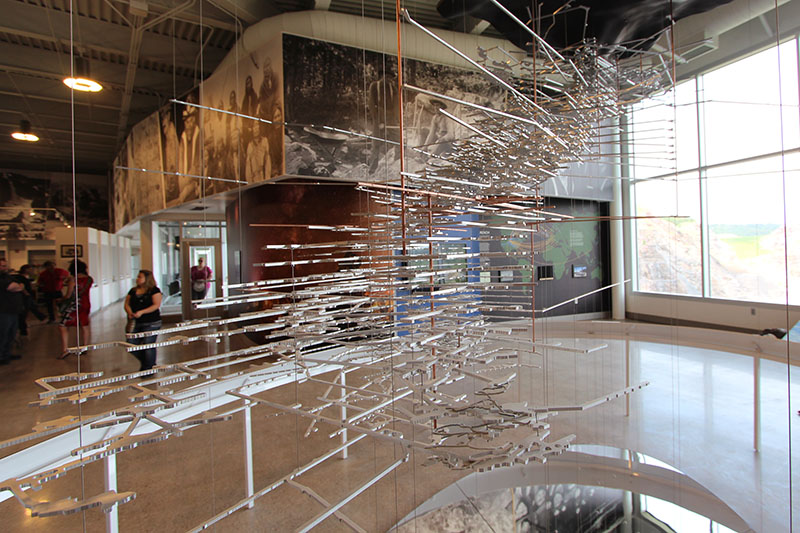
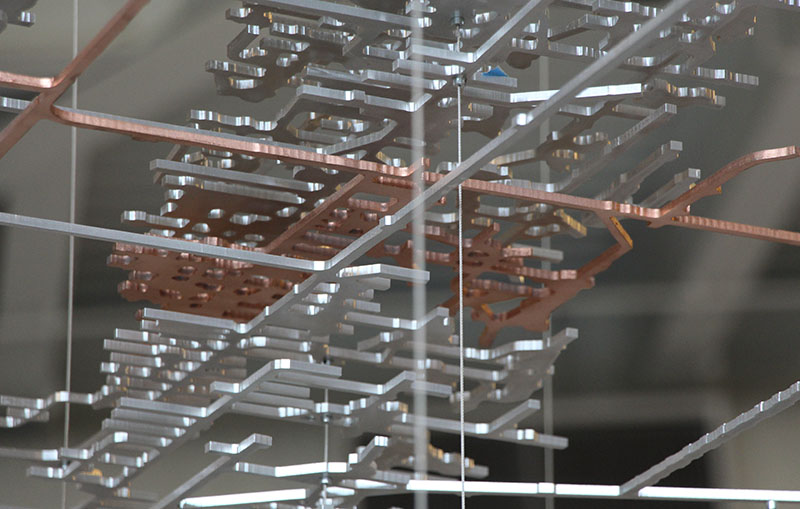
[Images: The model seen in situ, by SITU Studio with C&G Partners; photos courtesy of SITU Fabrication].

Again, it’s funny how hard the piece can be to photograph in full, and how quick it is to blend into its background.

This is a shame, as the intricacies of the model are both stunning and worth one’s patient attention; perhaps it would be better served hanging against a solid white background, or even just more strategically lit.
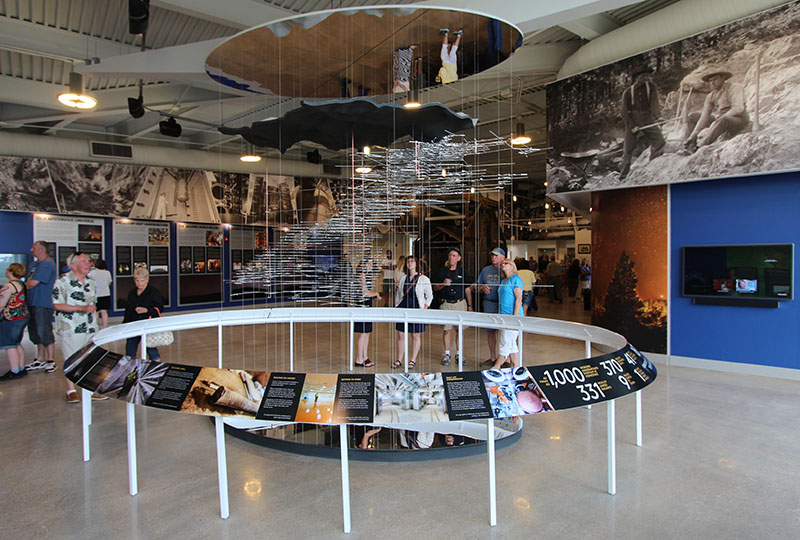
[Image: The model by SITU Studio with C&G Partners; photo courtesy of SITU Fabrication].

Or, as the case may be, perhaps it’s just worth going out of your way to see the model in person.

Indeed, following the milled aluminum of one level, then down the ramps to the next, heading further out along the honeycomb of secondary shafts and galleries, and down again to the next level, and so on, ad infinitum, was an awesome and semi-hypnotic way to engage with the piece when I was able to see it up close in SITU’s Brooklyn facility.

I imagine that seeing it in its complete state in South Dakota would be no less stimulating.

(Vaguely related: Mine Machine).

Dead Ringer

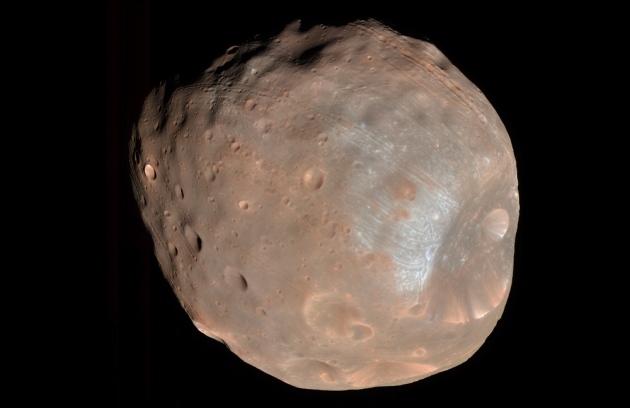
[Image: Mars’s moon, Phobos; courtesy NASA /JPL/University of Arizona].
Oh, to live another 40 million years… “One day,” Nature reports, “Mars may have rings like Saturn does”:

The martian moon Phobos, which is spiralling inexorably closer towards the red planet, will disintegrate to form a ring system some 20 million to 40 million years from now, according to calculations published on 23 November. Other research suggests that long grooves on Phobos’s surface may represent the first stages of that inevitable crack-up.

After that point, a red mineral ring will gradually coalesce from the dust storm, circling the planet in a desert halo.

In terms of human experience, 20-40 million years obviously dwarfs our anatomical and genetic history as modern Homo sapiens, and I am excessively confident that no humans will be around to witness this event. Nonetheless, it’s not actually that far off. The Earth itself is 4.5 billion years old; 20-40 million years is the geological blink of an eye. In a sense, we will just miss it.

For what it’s worth, Neal Stephenson’s most recent novel, Seveneves, is about a similar event—but set on Earth, not Mars.

“What if Earth’s moon suddenly and spontaneously broke apart into seven large pieces?” a review in the New York Times asked. “What would happen to life on Earth? It’s an intriguing premise, one that could conceivably go in any number of interesting directions. What would be the ramifications for every aspect of society, including economics, governance, the rule of law, privacy and security, not to mention even more fundamental matters like reproductive rights, religion and belief?”

In any case, read more over at Nature.

Shell

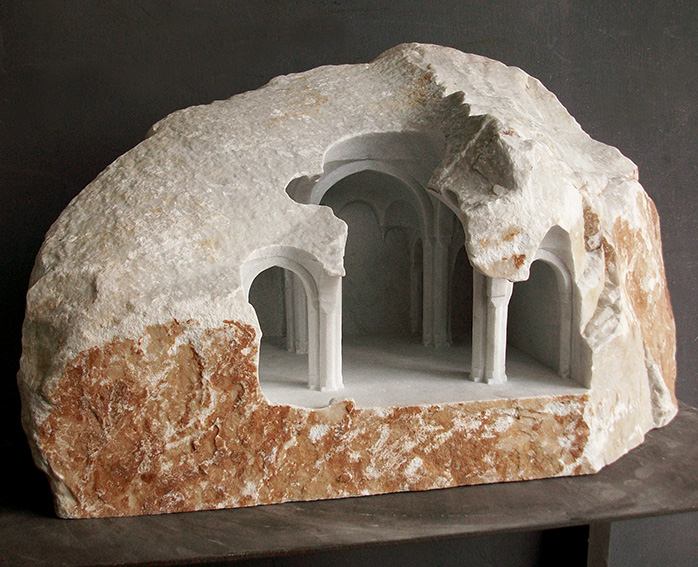
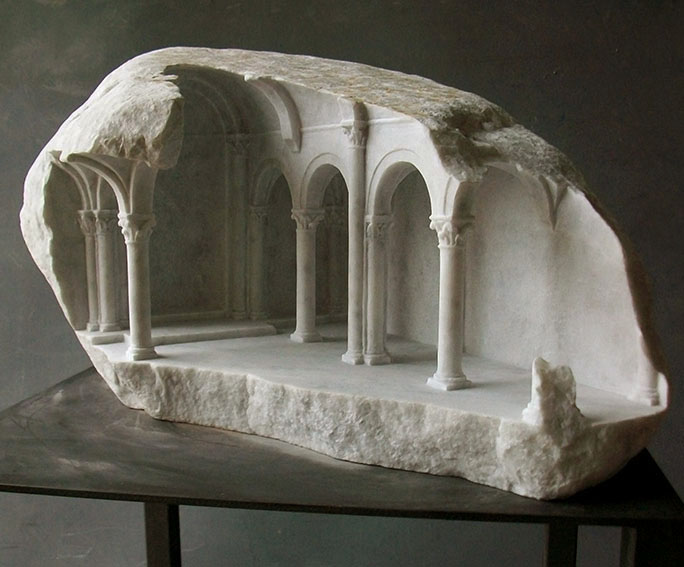
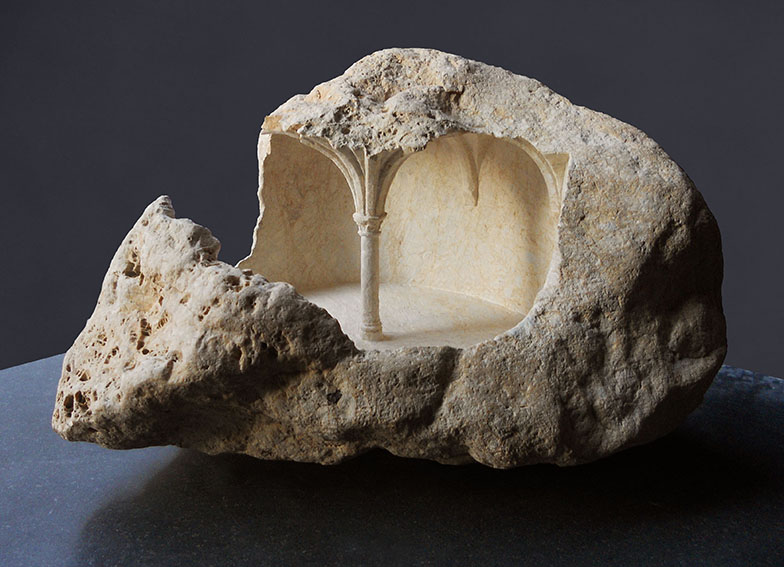
[Image: “Vaulted Chamber” by Matthew Simmonds].

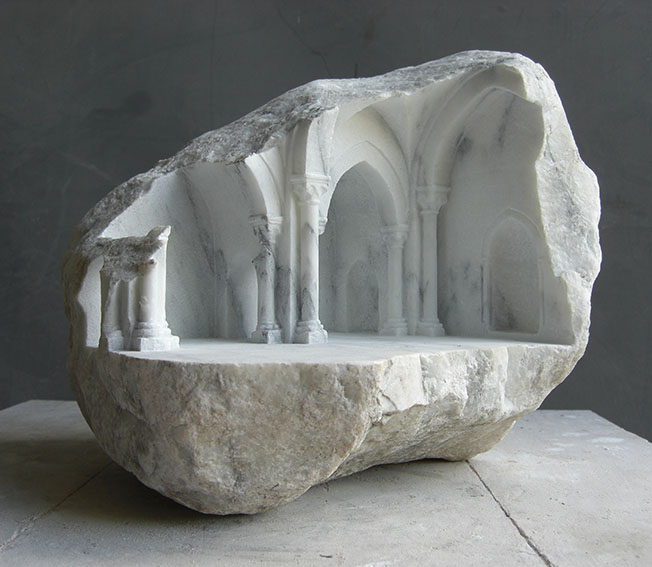
While writing the previous post, I remembered the work of Matthew Simmonds, a British stonemason turned sculptor who carves beautifully finished, miniature architectural scenes into otherwise rough chunks of rock.

[Image: “Sinan: Study” by Matthew Simmonds].

Simmonds seems primarily to use sandstone, marble, and limestone in his work, and focuses on producing architectural forms either reminiscent of the ancient world or of a broadly “sacred” character, including temples, church naves, and basilicas.

[Image: “Basilica III” by Matthew Simmonds].

You can see many more photos on his own website or over at Yatzer, where you, too, might very well have seen these last year.

[Image: “Fragment IV” by Matthew Simmonds].

Someone should commission Simmonds someday soon to carve, in effect, a reverse architectural Mt. Rushmore: an entire hard rock mountain somewhere sculpted over decades into a warren of semi-exposed rooms, cracked open like a skylight looking down into a deeper world, where Simmonds’s skills can be revealed at a truly inhabitable spatial scale.

(Previously: Emerge).

Then we descend

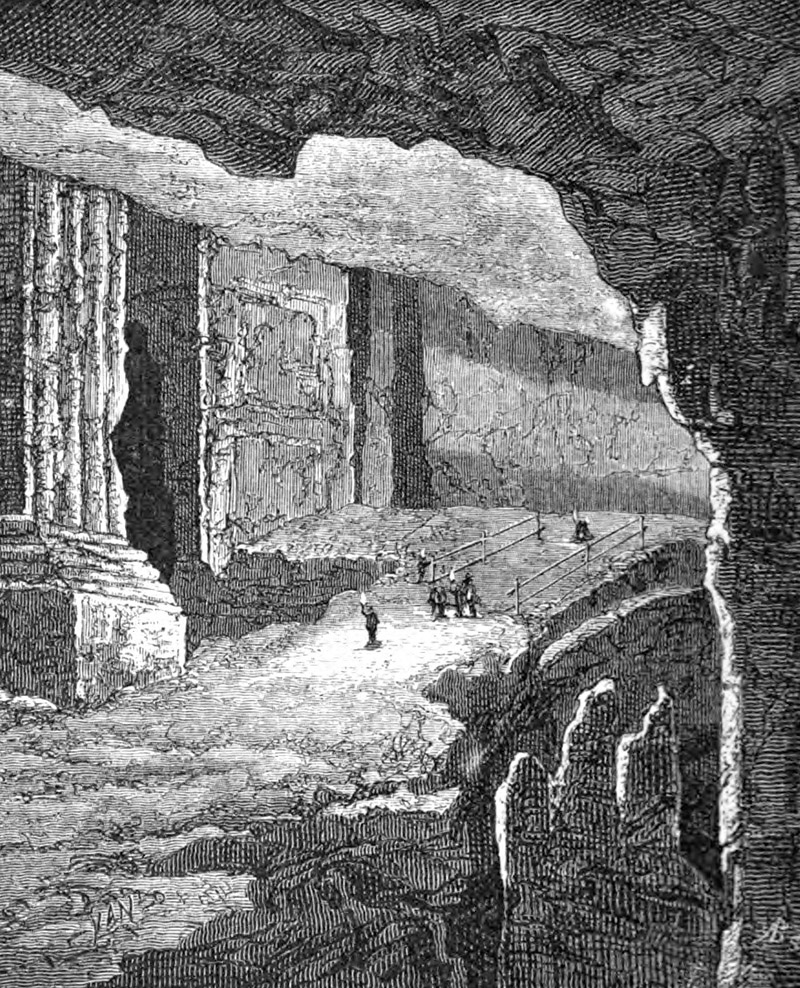
[Image: Descending into Mammoth Cave, from Beneath the surface; or, the wonders of the underground world by W.H. Davenport Adams].
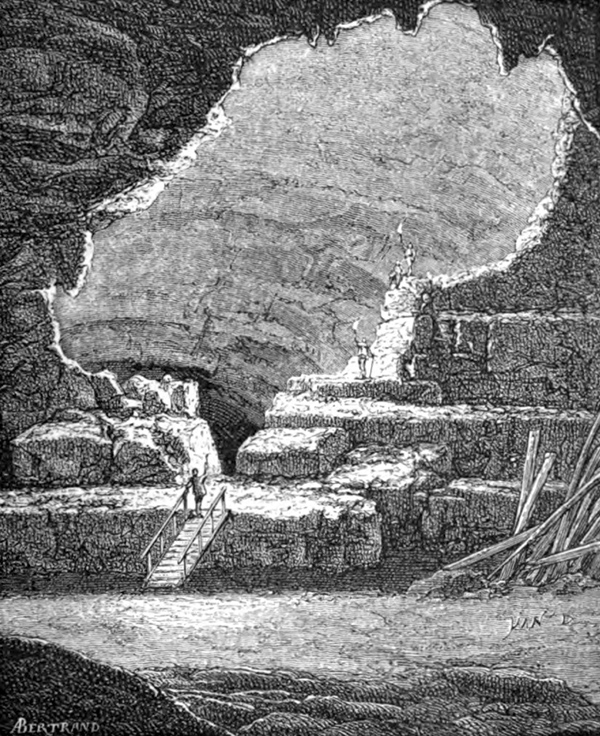
By way of JF Ptak Science Books, I found myself reading through an old book called Beneath the surface; or, the wonders of the underground world by W.H. Davenport Adams this weekend, a travelogue from 1876 exploring subterranean landscapes around the world, including what is now Mammoth Cave National Park.

“Then we descend,” Adams writes upon his arrival at the cave, “by a small pathway excavated among the rocks, until we discover, in the sides of the mountain, and at the bottom of a funnel-shaped cavity, overgrown with verdure, an opening so low and narrow that two people can with difficulty enter at once.”

Slipping through, they pass into “a labyrinth of caves” consisting of seemingly endless sloping rooms, shafts, and corridors.

As my own phrasing there indicates, these spaces are described by way of architectural analogy: as naves and vestibules, chambers and rotundas. In fact, their perceived architectural characteristics are highlighted even on the acoustic level. One cave, for example, is a place “where the voice resounds and, lingering, reverberates, like the strain of an organ through dim cathedral aisles.”

[Image: A room in Mammoth Cave known as “The Maelstrom,” from Beneath the surface; or, the wonders of the underground world by W.H. Davenport Adams].
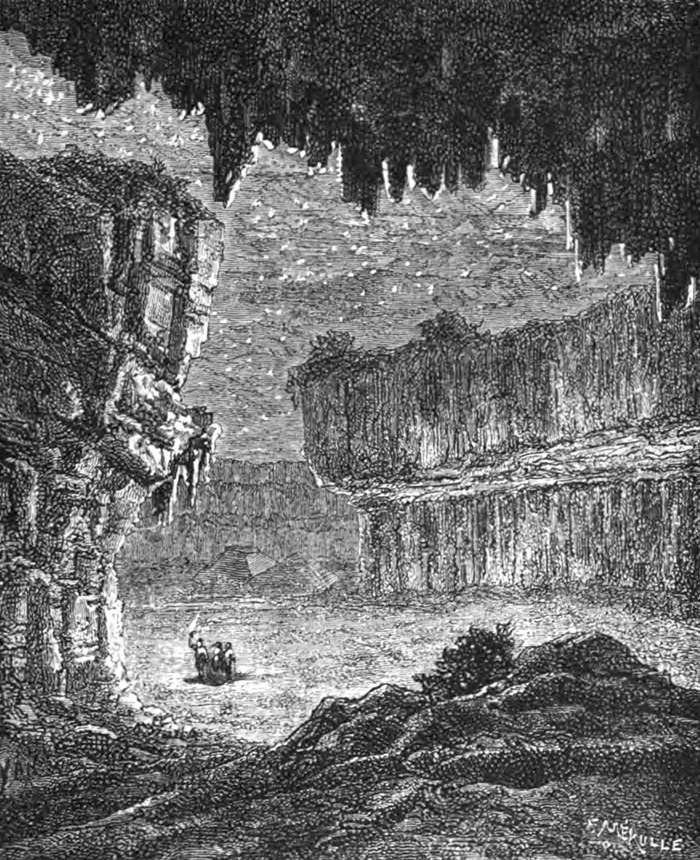
Continuing on their downward trek, Adams & Co. soon wander into “a chamber nearly 320 feet in circuit, whose roof rises like the stand of an immense nave. Its form, its grandeur, its magnitude (it could accommodate five thousand persons), and the strange architectural-like stalactites which embellish it, have procured it the name of the Gothic Church.”

Indeed, standing amidst this ersatz cathedral, and “thanks to the power of imagination, and the varying influence of the light, we here distinguish all the details of a medieval nave, pillars, and columns, and corbels and ogives.”

Among many things, what interests me here is how the interior of the earth is seen as if through the haze of a projection, with architectural forms emerging where, in fact, only inhuman geological processes at work—but also, in the opposite direction, the implied observation here that, in an age of masonry construction, architecture and geology were, in effect, natural cousins, lending themselves to mutual comparison far more easily than in today’s time of glass and steel construction.

[Image: A vast underground room filled with “a silent, terrible solitude,” from Beneath the surface; or, the wonders of the underground world by W.H. Davenport Adams].
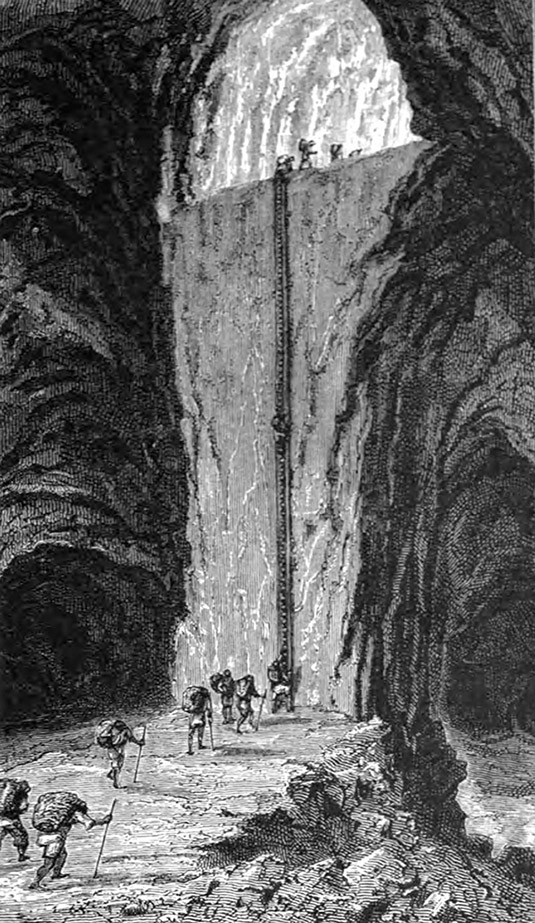
To put this another way, many streets in Manhattan are often quite appropriately described as “canyons,” not only due to their perceived depth—that is, given the towering buildings on either side, as if pedestrians merely wander at the bottom of artificial slot canyons—but also due to the geological materials those buildings were made from.

However, following widespread transformations in global building construction, our buildings today are now more likely to be reflective—even dangerously so—or partially transparent, whether this is due to the use of glass curtain walls or shadow-annihilating polished titanium, with the effect that our urban environment is no longer particularly well-served by geological analogy.

In any case, the book’s flirtation with an architectural vocabulary is gradually abandoned as Adams and his colleagues venture deeper into the planet. They eventually find themselves standing somewhat uncomfortably surrounded by a “phantasmagoria” of black gypsum walls, all “covered with sparkling crystallizations,” in a vast room whose belittling proportions inspire feelings not of grandeur and religiosity but a kind of exhausted desolation.

Here, Adams writes, “you think yourself on one of those dead and naked planets, where mineral nature reigns in the bosom of a silent, terrible solitude; on some earth never warmed by the sun, and which is animated by no kind of life.”

[Image: An unfortunately rather low-res image from Beneath the surface; or, the wonders of the underground world by W.H. Davenport Adams].
The rest of the book—including the image seen immediately above this sentence—ventures elsewhere, into silver mines and glacial caves, even briefly passing by way of underground “artificial ice caves” for the premodern production and storage of ice.

I’m just a sucker for subterranea. Check it out if any of this sounds up your alley, and click through the archives of JF Ptak Science Books while you’re at it.

Landscapes of Drone Control

[Image: Photo courtesy Mountain Drones].

A Colorado-based company called Mountain Drones is developing a line of octocopters armed with small explosive charges as a possible tool for setting off artificial avalanches. It’s landscape design by drone.

“Here’s how it would work,” Outside explains:

Instead of spending hours bootpacking to a ridgeline to drop a hand charge, ski patrollers would select a preprogrammed route for the drone to fly and manually drop the charges to clear the slope from a safe distance. Onboard sensors will calculate the snow-water equivalent—a measure of the snowpack’s water content—and depth, allowing patrollers to identify persistent weak layers and breaking points and helping them determine where to make drops.

For now, of course, this is all still stuck at the proposal stage, although the company estimates—somewhat over-optimistically, it seems—that it will be “at least one or two years” before the proper regulations are passed.

Until then, the drones will instead be flying test routes with mock explosives, running various patterns across the mountains in anticipation of the future landscape events they will trigger.