Spreading Ground

In Richard Mabey’s excellent history—and “defense”—of weeds, previously mentioned on BLDGBLOG back in December, he tells the story of Oxford ragwort, a species native to the volcanic slopes of Sicily’s Mount Etna. Exactly how it arrived in Oxford is unknown, Mabey explains, but it was as likely as not brought back deliberately as part of an 18th-century scientific expedition.
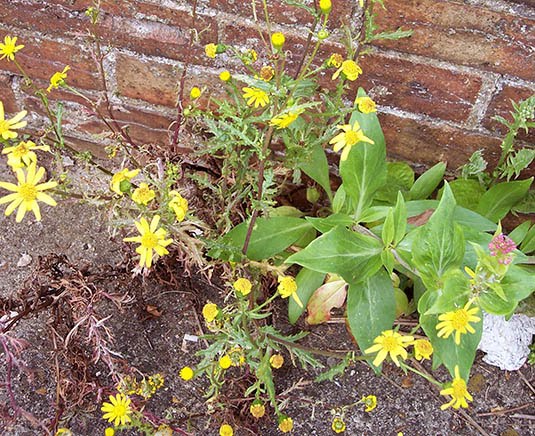
[Image: Cropped photo of Oxford ragwort from the UK National Education Network].

But once it took root in Oxford, it began to spread—and Mabey tells the tale of its territorial expansion in forensic close-up. You can literally track this on Google Maps. Quoting him at length:

Within a few years the ragwort had escaped from the garden (which is sited opposite Magdalen College) and begun its westward progress along Oxford’s ancient walls. Its downy seeds seemed to find an analogue of the volcanic rocks of its original home in the cracked stonework. It leap-frogged from Merton College to Corpus Christi and the august parapets of Christ Church, then wound its way through the narrow alleys of St. Aldate’s. It got to Folly Bridge over the Isis, and then to the site of the old workhouse in Jericho, where, as if recognizing that this was a place of poverty, threw up a strange diminutive variant, a type with flower heads half the normal size (var. parviflorus). Sometime in the 1830s it arrived at Oxford Railway Station, the portal to a nationwide, interlinked network of Etna-like stone chips and clinker. Once it was on the railway companies’ permanent ways there was no holding it. The seeds were wafted on by the slipstream of the trains, and occasionally traveled in the carriages. The botanist George Claridge Druce described a trip he took with some on a summer’s afternoon in the 1920s. [Ragwort seeds] floated in through his carriage window at Oxford and “remained suspended in the air till they found an exit at Tilehurst,” twenty miles down the line.

So ragwort came to be everywhere, spreading across “analogous” landscapes that chemically and texturally mimicked the plant’s home ground, establishing itself as an all but ubiquitous plant—an itinerant super-weed riding the nation’s trains and piggybacking stone wall to stone wall—across the United Kingdom.

This step-by-step expansion of a life form’s zone of habitation came to mind when reading the bizarre story of a runaway fungus in Kentucky. “The sooty-looking black gunk has been here for as long as anyone can remember,” the New York Times reported back in August 2012, “creeping on the outside of homes, spreading over porch furniture, blanketing car roofs, mysterious and ever-present.” People in town thought it must be the result of pollution, or perhaps just the town being reclaimed by whatever original moldy life had once inhabited those valleys.

But no: “[I]t turns out the most likely culprit is Kentucky’s signature product, its liquid pride: whiskey, as in bourbon whiskey, distilled and bottled across the city and nearby countryside.” The mold—called Baudoinia—”belongs to a class of fungi that is almost prehistorically tenacious” (and, for good measure, Wired adds that it is “a fungus that’s millions of years old, older than Homo sapiens“).

And it is a dark and spreading presence on the buildings, streets, cars, and even road signs near distilleries, “indiscriminately colonizing exposed surfaces ranging from vegetation to built structures, sign posts and fences (including those made from glass and stainless steel),” the U.S. Department of Energy warns, describing this ancient and sooty form of life.

[Image: Baudoinia growing on a fire hydrant; photo by Ben Sklar, courtesy of the New York Times].

Indeed, it’s gotten so bad that towns along the historic Kentucky Bourbon Trail are bringing suit against the distilleries, the New York Times continues: “The dark residue is visible throughout neighborhoods on days when the air carries a slight yeasty smell from nearby whiskey warehouses and on days when it does not, in heat and in damp. It is difficult to get rid of, the lawsuit alleges, returning after repeated commercial cleanings.”

A similar suit in Scotland is now in the works, where “the fungus is so rampant that it almost seems like part of the architecture.” Here, I’m reminded of novelist Jeff VanderMeer‘s idea of domesticated species of lichen being used as living architectural ornament—that, in his words, “much of the ‘gold’ covering the buildings was actually a living organism similar to lichen that [had been] trained to create decorative patterns.”
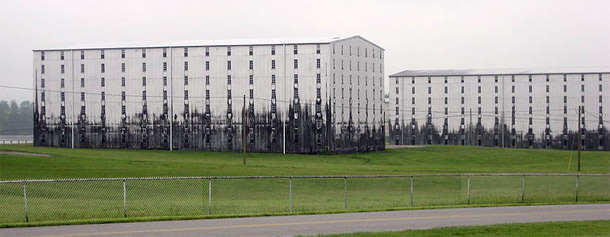
[Image: Buildings covered in black, growing spotches of Baudoinia; photographer unknown, via Discover].

In any case, this prehistoric “weed,” if you will—a mold not from the slopes of Mount Etna but escaped from barrels of whiskey—offers us an interesting variation on Richard Mabey’s forensic tale of rooted but footloose infestation.

At the center of each story, we find an organism spatially and chemically dependent on the built environment of humans for its success, a species ready and perfectly able to “invade niches which resemble its original habitat,” in Mabey’s words. Living stowaways, they make themselves at home on walls, porches, car hoods, trees, even, in the case of Baudoinia, stainless steel, quietly thriving on whatever systems of objects they might find, eventually merging with and becoming part of the everyday landscape.

Crashing Through Dark Matter Walls

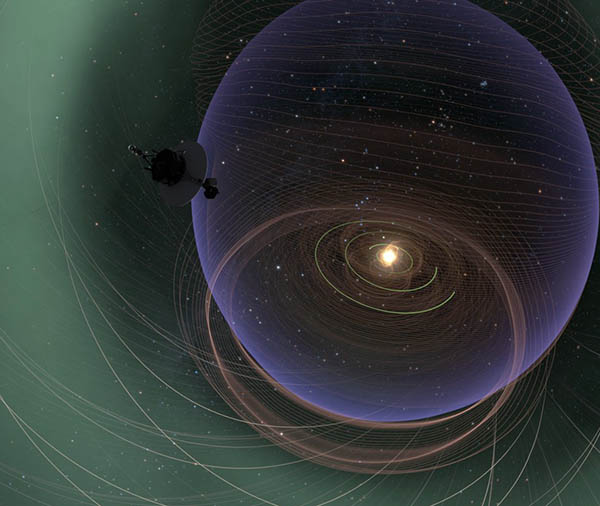
[Image: An otherwise unrelated image from NASA, an artist’s rendition of the heliosphere and magnetic fields].

The Earth is “constantly crashing through huge walls of dark matter,” New Scientist explains, “and we already have the tools to detect them.”

This dark architecture in space consists of so-called “domain walls” that are like the boundaries between soap bubbles in foam. “The idea is that the hot early universe was full of an exotic force field that varied randomly. As the universe expanded and cooled, the field froze, leaving a patchwork of domains, each with its own distinct value for the field.”

The Earth now randomly “crashes” through this “grid of domain walls”—a remnant “patchwork” of frozen, remnant force fields and now something perhaps less like soap bubbles and metaphorically closer to cosmic-scale magnetic ice, a structured frost we move through without seeing—on a scale of once every several years. So, not quite “constantly,” as the lead sentence implies, but, given the age of the universe, I suppose that’s constant enough.

But how do we find them, this grid of domain walls we apparently live within? We simply need to install dedicated magnetometers at stations around the world, and look for evidence of this colossal architecture wrapped all around us in the dark.

Operation Deep Sleep: or, dormant robots at the bottom of the sea

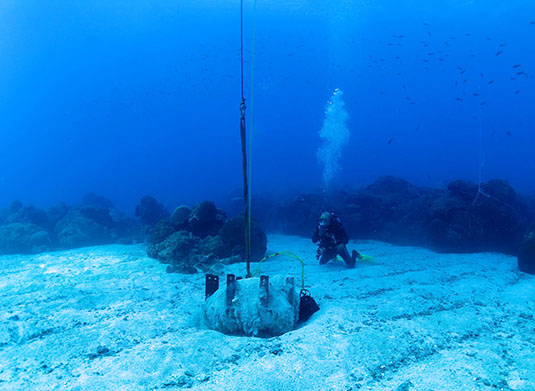
[Image: An otherwise unrelated photo of lift bags being used in underwater archaeology; via NOAA].

The Defense Advanced Research Projects Agency, or DARPA, is hoping to implement a global infrastructure for storing mission-critical objects and payloads at the “bottom of the sea”—a kind of stationary, underwater FedEx that will release mission-critical packages for rendezvous with passing U.S. warships and UAVs.

It’s called the Upward Falling Payloads program.

The “concept,” according to DARPA, “centers on developing deployable, unmanned, distributed systems that lie on the deep-ocean floor in special containers for years at a time. These deep-sea nodes would then be woken up remotely when needed and recalled to the surface. In other words, they ‘fall upward.'” This requires innovative new technologies for “extended survival of nodes under extreme ocean pressure, communications to wake-up the nodes after years of sleep, and efficient launch of payloads to the surface.”

As Popular Science describes it, it’s a sleeping archive of “‘upward falling’ robots that can hide on the seafloor for years [and] launch on demand.”

And you can even get involved: DARPA is currently seeking proposals for how to realize its vision for Upward Falling Payloads.

DARPA seeks proposals in three key areas for developing the program: Communications, deep ocean ‘risers’ to contain the payloads, and the actual payloads. DARPA hopes to reach technical communities that conduct deep-ocean engineering from the telecom and oil-exploration industry to the scientific community with insights into signal propagation in the water and on the seafloor.

An informative “proposer’s day” will be held on January 25, 2013, where you can learn more about the program. It seems that, just a few years from now, storing objects for at-sea retrieval will be as ordinary as receiving an email.

Briefly, it seems worth mentioning that this vision of waking things up from slumber at the bottom of the sea reads like a subplot from Pacific Rim, or like some militarized remake of the works of H.P. Lovecraft—wherein Lovecraft’s fictional Cthulhu, a monstrous and alien god, is described (by Wikipedia) as “a huge aquatic creature sleeping for eternity at the bottom of the ocean and destined to emerge from his slumber in an apocalyptic age.”

Only, here, it is a gigantic system of military jewelry laced across the seafloor, locked in robotic sleep until the day of its electromagnetic reawakening.

(Thanks to Brian Romans for the link!)

Desert Traverse

This autumn—October 12-19, 2013—High Desert Tests Sites aims “to take in everything from Joshua Tree, California, to Albuquerque, New Mexico,” through a weeklong open event in which “artists and audience alike [will] traverse the desolate desert roads and explore the hidden gems, both old and new,” between these two locations.

A call for participation is up if you’d like more information or hope to join in; you have roughly two weeks to propose something. Earthworks, field recordings, sensory maps, experimental antenna fields conjuring new mountain aurorae, mineral gardens, a photonovella of speculative eclipse camps and desert satellite trackers, illustrated myths of the flash flood—who knows.

(Thanks to Greg Hohman for the tip).

Test Room

[Image: The World Trade Center towers, photographer unknown].

Amongst many other interesting moments in Siobhan Roberts’s new biography of Alan Davenport, the “father of modern wind engineering,” is the incredible story of a room in Eugene, Oregon.

In August 1965, Roberts explains, “ads in the local newspaper… promised complimentary checkups at the new Oregon Research Institute Vision Research Center.” But these promised eye exams were not all that they seemed.

The office was, in fact, a model—a disguised simulation—including a “stereotypical waiting room” where respondents to the ad would be “greeted by a receptionist” who could escort them into a fake “examination room” that turned out to be examining something else entirely.

While members of the public were led through a series of eye tests, looking at “some triangles,” in Roberts words, that had been projected onto the wall, they were, in fact, being jostled back and forth, silently and unannounced, by motors installed on tracks below the floor. The room swayed, rocking side to side, shifting imperceptibly—or so the experiment was testing—beneath the feet of the volunteers and the actor-nurses who, without breaking character, took care of them.

It turns out that the whole thing was actually a wind-condition simulator for a pair of buildings that had not yet been publicly announced, let alone constructed: the future twin towers of New York City’s World Trade Center. This quiet office in Oregon, paid for by the Port Authority, was an unpublicized test-run for the high winds and other complicated atmospheric effects that would soon rock the two towers back and forth at their unprecedented height in southern Manhattan.

The room, “mounted on a wheeled platform driven by hydraulic actuators,” thus tested unsuspecting members of the public for their physiological reaction to the swaying of the floor—testing whether “conflicting brain inputs” from the moving architecture “would cause synaptic confusion, or motion sickness—nausea, dizziness, fatigue,” as Roberts writes.

Unbeknownst to them, then, people in Eugene, Oregon, in 1965, were helping to test the aerodynamic flexibility of two buildings that had not yet been announced and that would soon come to dominate the skyline of New York City—leaving at least me to wonder if some room today somewhere, some doctor’s office or other nondescript chamber, whether a classroom or a restaurant, is actually a testing ground for as-yet unrealized architectures to come, be it in New York City, Dubai, Mexico City, or, who knows, even for future travelers to the moon.

(Thanks to Nicola Twilley for giving me a copy of Roberts’s book).

Fence Phone

[Image: Barbed wire, via Wikipedia].

One more radio-related link comes via @doingitwrong, who mentions the use of barbed-wire fences as a kind of primitive telephone network.

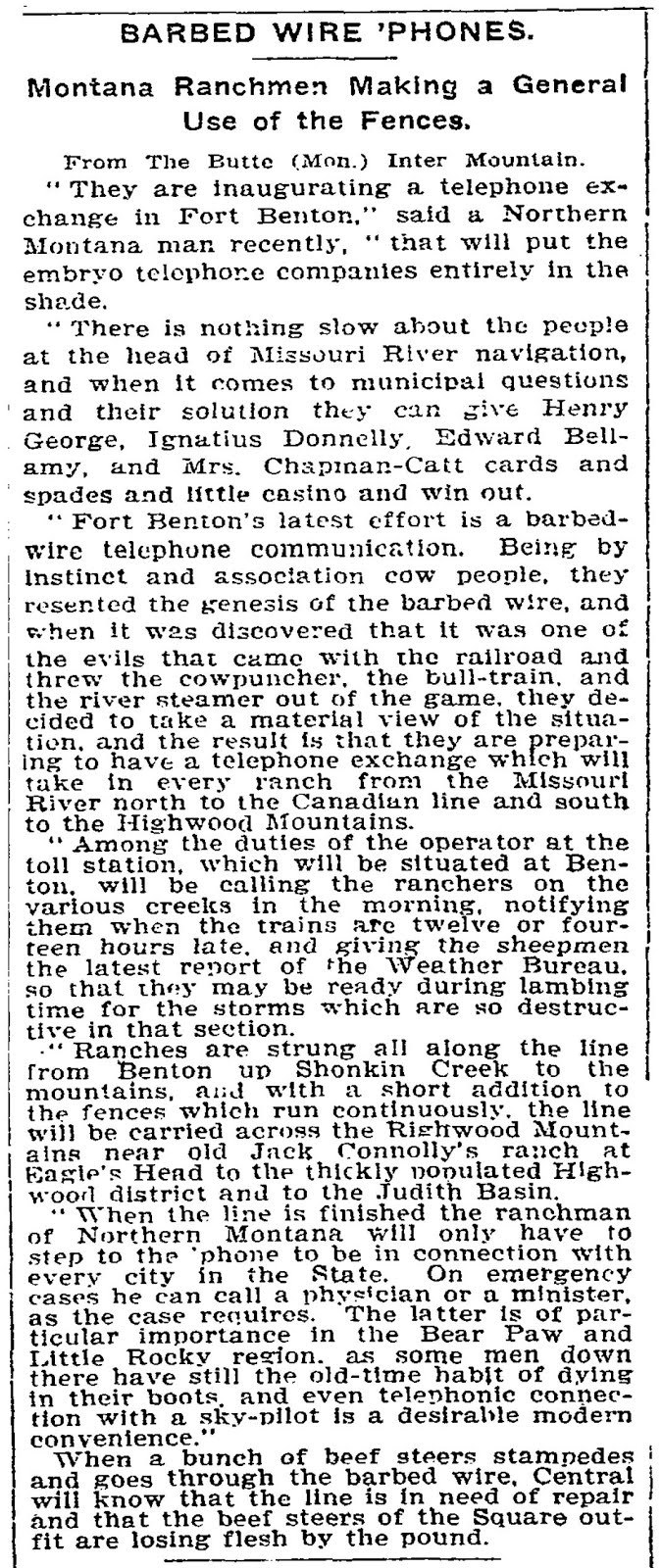
“Across much of the west,” C.F. Eckhardt explains, “…there was already a network of wire covering most of the country, in the form of barbed-wire fences. Some unknown genius discovered that if you hooked two Sears or Monkey Ward telephone sets to the top wire on a barbed-wire fence, you could talk between the telephones as easily as between two ‘town’ telephones connected by slick wire through an operator’s switchboard. A rural telephone system that had no operators, no bills—and no long-distance charges—was born.”

The system relied upon the creative use of everyday materials as insulators; in fact, according to Delbert Trew, “the most clever, most innovative cowboys used every conceivable type of device as insulators to suspend the wire. I have found leather straps folded around wire and nailed to the posts, whiskey bottle necks installed over big nails, snuff bottles, corn cobs, pieces of inner-tube wrapped around the wire and short straps of tire holding telephone wires to the post.”

[Image: From a June 1902 issue of The New York Times].

This ranchpunk system of interlinked fences led to the “big ranches” being “among the first to install barbed wire telephones in an effort to be alerted when prairie fires started”—an early-warning device for previously disconnected ranch owners, not a divisive symbol of modern property but a network, a transmitter, an oral internet of fences.

Project Sanguine and the Dead Hand

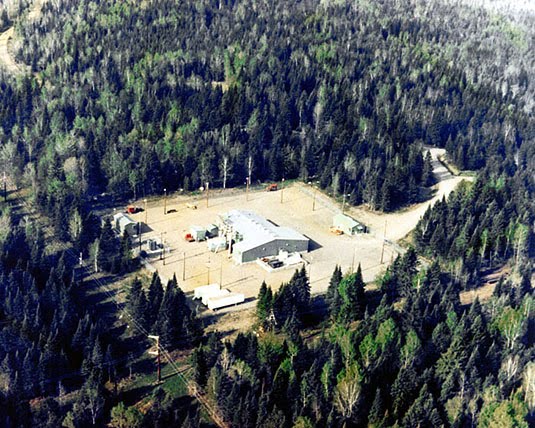
[Image: One of the stations of Project ELF, via Wikipedia].
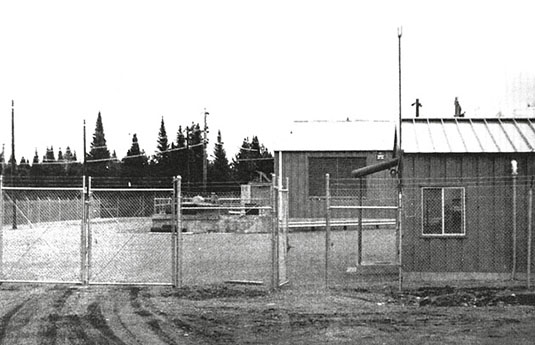
Further exploring the radio-related theme of the last few posts, Rob Holmes—author and co-founder of mammoth—has pointed our attention to something called Project Sanguine, a U.S. Navy program from the 1980s that “would have involved 41 percent of Wisconsin,” turning that state into a giant “antenna farm” capable of communicating with what Wikipedia calls “deeply-submerged submarines.”

Each individual antenna would have been “buried five feet deep” in the fertile soil of the Cheese State, the New York Times explains, creating a networked system with nearly 6,000 miles’ worth of cables and receiving stations.

The Navy was hoping, we read, for a system “that could transmit tactical orders one-way to U.S. nuclear submarines anywhere in the world, and survive a direct nuclear attack.” This would “normally… require an antenna many hundreds of miles in length,” according to the NYT, but Naval strategists soon “realized that a comparable effect could be achieved by using a large volume of the earth’s interior”—that is, “looping currents deep in the Earth”—”as part of the antenna.” The hard and ancient rock of the Laurentian Shield was apparently perfect for this.

[Image: From Roy Johnson, “Project Sanguine,” originally published in The Wisconsin Engineer (November 1969)].
In other words, the bedrock of the Earth itself—not a mere island in the Antarctic—could be turned into a colossal radio station.

A similar system, installed for preliminary tests in North Carolina and Virginia, “apparently flickered lightbulbs in the area and caused spurious ringing of telephones,” like some regional poltergeist or a technical outtake from Cabin in the Woods.

At least two things worth pointing out here are that a “scaled-down version” of Project Sanguine was, in fact, actually constructed, becoming operational in the northern forests of Michigan and Wisconsin from 1989-2004; called Project ELF (for Extremely Low Frequency), it arrived just in time for the Soviet Union to collapse…

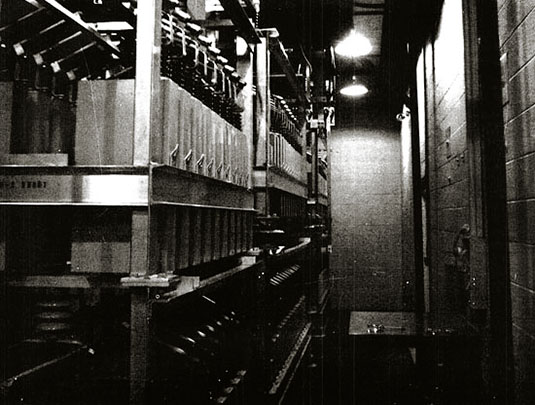
[Image: Inside Project Sanguine; photo from Roy Johnson, The Wisconsin Engineer (November 1969)].
…which brings us to the second point worth mentioning: a strangely haunting program known as “The Dead Hand,” a doomsday device constructed by the Soviet Union.

In his Pulitzer Prize-winning book of that title, historian David Hoffman writes about a (still active) weapon of retaliation. The “Dead Hand” was built such that, if nuclear field commanders ever lost touch with military leaders back in Moscow during a time of war, a constellation of cruise missiles would automatically launch. This would happen not in spite of a lack of living military leaders, but precisely because everyone had been killed. That is, a machine would take over—thus the name “dead hand.”

Each cruise missile, however, flying over the lands of the USSR, would emit launch commands to all of the missile silos it passed over. Missile after missile would soon soar—thousands of them—arcing toward the United States, which would soon be obliterated, along with the rest of the world, in a nuclear holocaust controlled and commanded by nothing but preprogrammed machines.

In any case, Project Sanguine was its own version of an end-times radio, an “immense subterranean grid” transmitting to distant submarines by way of the Earth itself, humans using an entire planet as an apocalyptic radio device.

Electromagnetic Escher Mazes

The previous two posts have led to a number of interesting links, including several comments over at Reddit that seem worth reproducing here.

There, a commenter named clicksnd “used to be in a special forces Signal Detachment (as a server guy) and got awesome cross training from our radio section. One cool thing they taught us is that if we ever needed to boost range, we could wire up to a fence or, in a pinch, knife a tree and wire to it!” When you need a radio, in other words, considering just sticking some metal in a tree.

To that, someone named pavel_lishin responds: “I remember hearing a story, possibly apocryphal, about a college radio station that used some nearby railroad tracks as their broadcasting antenna, and it worked well enough for the entire town to receive the signal clearly. In fact, it worked a little too well. Someone drove up from a town a couple of hundred miles away, and asked them to knock it off, since the signal was being broadcast all the way down there and interfering with a different radio station.” Perhaps you could broadcast a radio station via all the nails in the walls of an abandoned suburb.

Finally, replying to someone mocking the idea that antennas have ever been more complex than “just a piece of metal connected to a receiver,” someone named cuddlebadger says that, on the contrary, “the field has progressed a bit since 1919,” when those tree-antennas were first being proposed. Today, cuddlebadger writes, “we have fractal antennas that look like [an] MC Escher drawing and work incredibly well. Genetic algorithms that design alien-looking antennas that are barely visible yet outperform many all-human designs. Someone even draws nanometer-scale antennas out of gold on tiny glass hemispheres for that extra efficiency. Antennas exist that can literally capture the electromagnetic radiation of sunlight!”

Electromagnetic Escher mazes made of gold, picking up emanations from stars: technology as myth achieved by other means.

Antarctic Island Radio

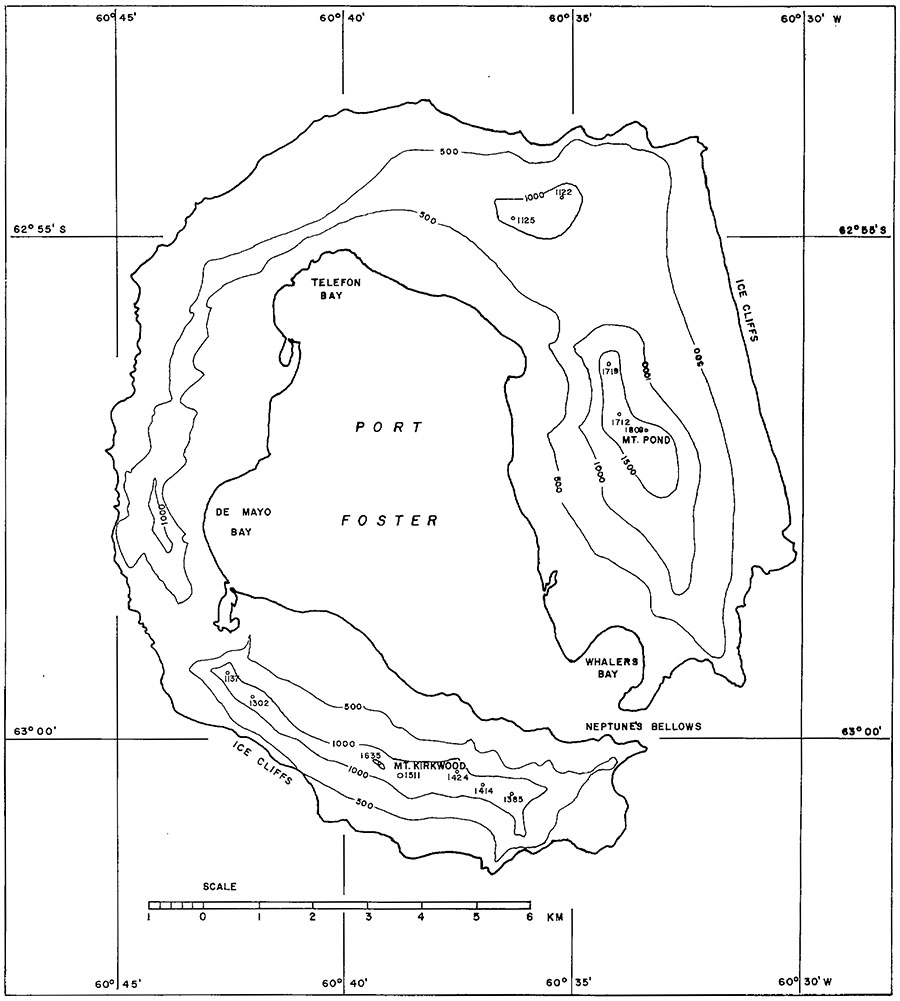
[Image: Deception Island, from Millett G. Morgan’s September 1960 paper An Island as a Natural Very-Low-Frequency Transmitting Antenna].

Yesterday’s post reminded me of an interesting proposal from the 1960s, in which an entire Antarctic island would be transformed into a radio-conducting antenna. Signals of international (or military submarine) origin could thus be bounced, relayed, captured, and re-transmitted using the topographical features of the island itself, and naturally occurring ionospheric radio noise could be studied.

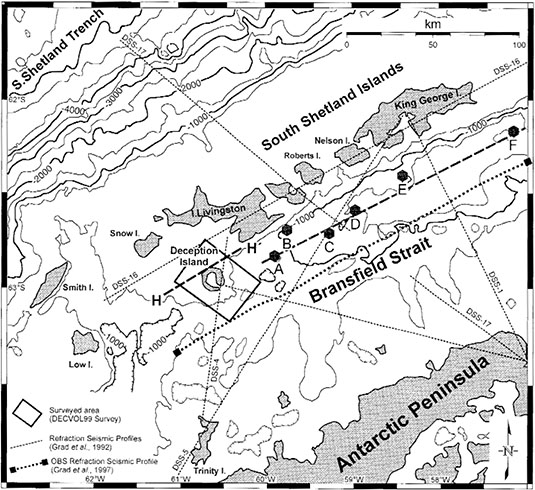
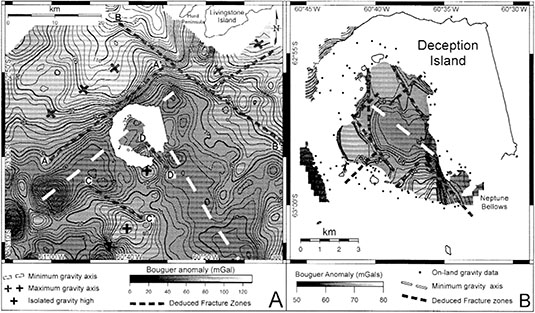
[Image: A map of Deception Island, taken from an otherwise unrelated paper called “Upper crustal structure of Deception Island area (Bransfield Strait, Antarctica) from gravity and magnetic modelling,” published in Antarctic Science (2005)].
In the September 1960 issue of IEEE Transactions on Antennas and Propagation, radio theorist Millett G. Morgan, a “leading researcher in the field of ionospheric physics” based at Dartmouth, speculated that he could generate artificial “whistlers”—that is, audial electromagnetic effects that are usually caused by lightning—if only he could find the right island.

“In thinking about how to generate whistlers artificially,” Morgan’s proposal leisurely begins, “it has occurred to me that an island of suitable size and shape, extending through the conducting sea, may constitute a naturally resonant, VLF slot antenna of high quality.”

[Image: Deception Island, from “Upper crustal structure of Deception Island area (Bransfield Strait, Antarctica) from gravity and magnetic modelling,” Antarctic Science (2005)].
He looked far and wide for this “naturally resonant, VLF slot antenna,” eventually settling on a remote island in the Antarctic. “Following this line of reasoning,” he explains, “I thought first of the annular Pacific atolls, but knowing of the fresh-water lenses in them”—that is, aquatic features that would destructively interfere with radio transmissions—”[I] rejected them as being too pervious to water to be satisfactory insulators. Also, of course, they are not found in suitable latitudes for generating whistlers.”

Morgan’s reasoning continued: “The Pacific atolls are built upon submerged volcanic cones and this led me to think of Deception Island in the SubAntarctic, a remarkable, similarly shaped, volcanic island in which the volcanic rock extends above the surface; and which is located in the South Shetland Islands where the rate of occurrence of natural whistlers has been found to be very great.”

Perhaps the island could be the geologic radio antenna he was looking for.

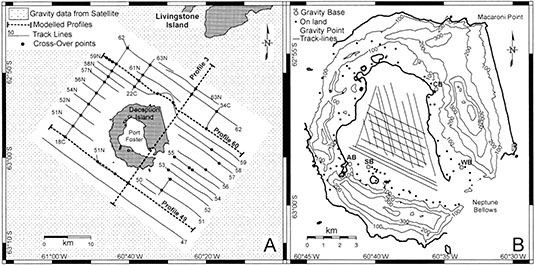
[Image: Deception Island, from “Upper crustal structure of Deception Island area (Bransfield Strait, Antarctica) from gravity and magnetic modelling,” Antarctic Science (2005)].
Morgan points out in detail that mathematical ratios amongst the island’s naturally occurring landscape features, including its ring-shaped lagoon, are perfect for supporting radio transmissions (even the relationship between the length of the island and the radio wavelengths Morgan would be using seems to work out). And that’s before he looks at the material construction of the island itself, consisting of volcanic tuff, which would help the terrain act as an “insulator.”

There is even the fact that the island’s small lagoon is coincidentally but unrelatedly named “Telefon Bay” (alas, named after a ship called the Telefon, not for the island’s natural ability to make telephone calls).

[Image: Deception Island, from “Upper crustal structure of Deception Island area (Bransfield Strait, Antarctica) from gravity and magnetic modelling,” Antarctic Science (2005)].

Morgan’s “proposed island antenna” would thus be a wired-up matrix of transmission lines and natural landscape features, bouncing radio wavelengths at the perfect angle from one side to the other and concentrating broadcasts for human use and listening.

You could tune into the sky, huddling in the Antarctic cold and listening to the curling electromagnetic crackle of the ionosphere, or you could use your new radio-architectural set-up, all wires and insulators like some strange astronomical harp, “to generate whistlers artificially,” as Morgan’s initial speculation stated, bursting forth with planetary-scale arcs of noise over a frozen sea, a wizard of sound alone and self-deafened at the bottom of the world.

(Deception Island proposal discovered via Douglas Kahn, whose forthcoming book Arts of the Spectrum: In the nature of electromagnetism looks fantastic, and who also gave an interesting talk on “natural radio” a few years ago at UCLA).

Tree Receivers

[Image: “The Trees Now Talk” cover story in The Electrical Experimenter (July 1919); image via rexresearch].

Way back in 1919, in their July 14th issue, Scientific American published an article on the discovery that trees can act “as nature’s own wireless towers and antenna combined.”

General George Owen Squire, the U.S. Army’s Chief Signal Officer, made his “strange discovery,” as SciAm phrases it, while sitting in “a little portable house erected in thick woods near the edge of the District of Columbia,” listening to signals “received through an oak tree for an antenna.” This realization, that “trees—all trees, of all kinds and all heights, growing anywhere—are nature’s own wireless towers and antenna combined.”

He called this “talking through the trees.” Indeed, subsequent tests proved that, “[w]ith the remarkably sensitive amplifiers now available, it was not only possible to receive signals from all the principle [sic] European stations through a tree, but it has developed beyond a theory and to a fact that a tree is as good as any man-made aerial, regardless of the size or extent of the latter, and better in the respect that it brings to the operator’s ears far less static interference.”

Why build a radio station, in a sense, when you could simply plant a forest and wire up its trees?

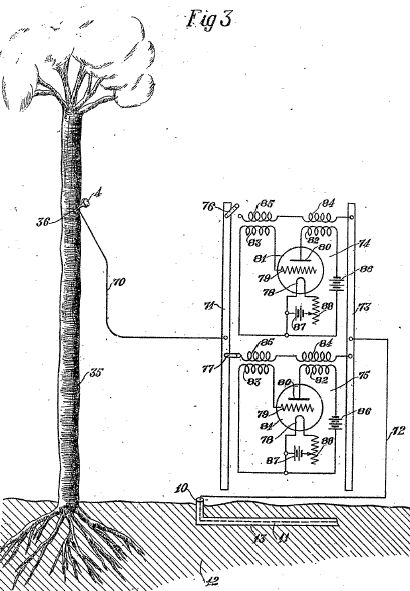
[Images: From George Owen Squire’s British Patent Specification #149,917, via rexresearch].
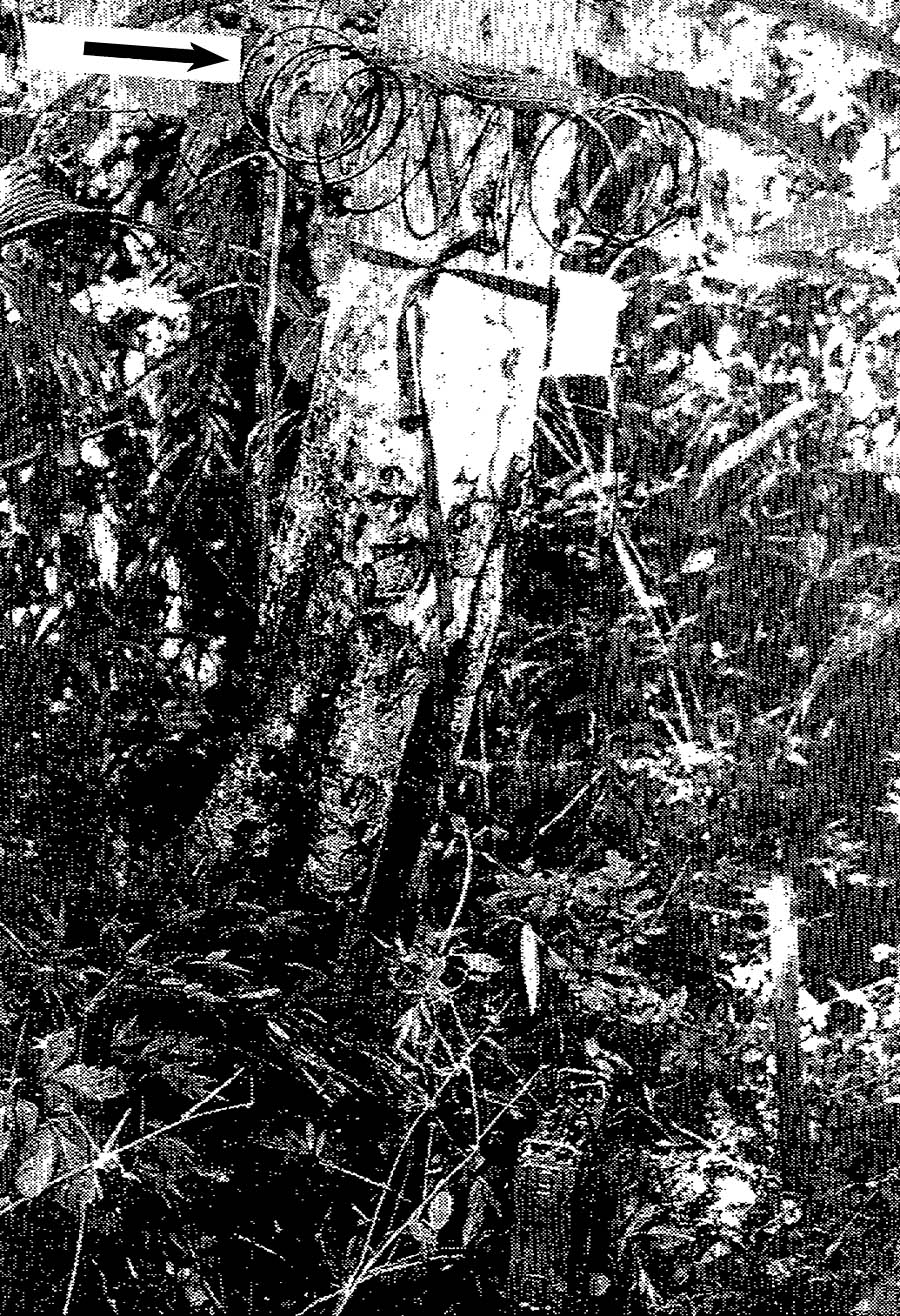
So how does it work? Alas, you can’t just plug your headphones into a tree trunk—but it’s close. From Scientific American:

The method of getting the disturbances in potential from treetop to instrument is so simple as to be almost laughable. One climbs a tree to two-thirds of its height, drives a nail a couple of inches into the tree, hangs a wire therefrom, and attaches the wire to the receiving apparatus as if it were a regular lead-in from a lofty copper or aluminum aerial. Apparently some of the etheric disturbances passing from treetop to ground through the tree are diverted through the wire—and the thermionic tube most efficiently does the rest.

Although “40 nails apparently produce no clearer signals than half a dozen,” one tree can nonetheless “serve as a receiving station for several sets, either connected in series with the same material or from separate terminals.”

[Image: Researching the possibility that whole forests could be used as radio stations—broadcasting weather reports, news from the front lines of war, and much else besides—is described by Scientific American as performing “tree radio work.” Image via IEEE Transactions on Antennas and Propagation (January 1975)].
In a patent filing called “British Patent Specification #149,917,” Squire goes on to explore the somewhat mind-bending possibilities offered by “radio transmission and reception through the use of living vegetable organisms such as trees, plants, and the like.” He writes:

I have recently discovered that living vegetable organisms generally are adapted for transmission and reception of radio or high frequency oscillations, whether damped or undamped, with the use of a suitable counterpoise. I have further discovered that such living organisms are adapted for respectively transmitting or receiving a plurality of separate trains of radio or high frequency oscillations simultaneously, in the communication of either or both telephonic or telegraphic messages.

This research—the field of “tree radio work”—has not disappeared or been forgotten.

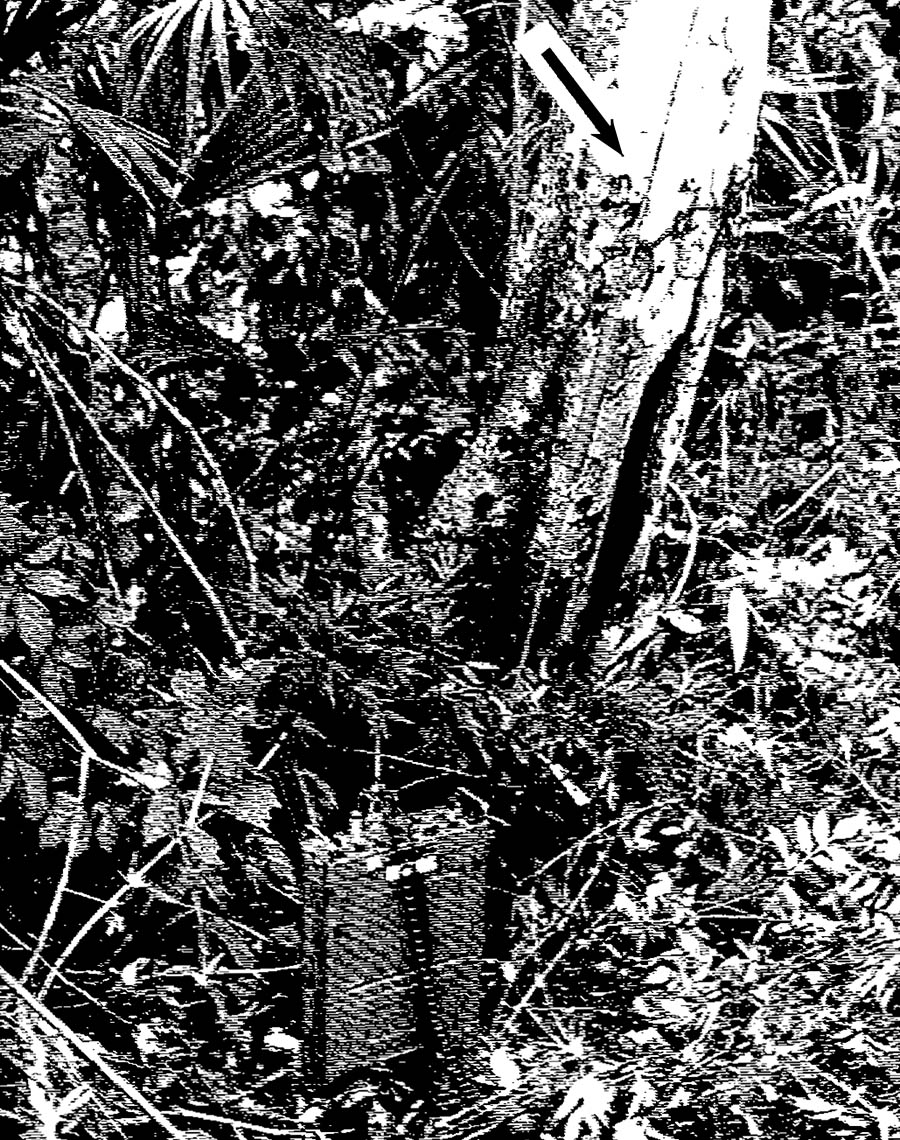
[Image: A tree in the Panamanian rain forest wired up as a sending-receiving antenna; from IEEE Transactions on Antennas and Propagation (January 1975)].
In the January 1975 issue of IEEE Transactions on Antennas and Propagation, we read the test results of several gentleman who went down to the rain forests of the Panama Canal Zone to test “the performance of conventional whip antennas… compared with the performance of trees utilized as antennas in conjunction with hybrid electromagnetic antenna couplers.”

The authors specifically cite Squire’s work and quote him directly: “‘It would seem that living vegetation may play a more important part in electrical phenomena than has been generally supposed… If, as indicated above in these experiments, the earth’s surface is already generously provided with efficient antennae, which we have but to utilize for communications…’ These words were written in 1904 by Major George 0. Squire, U.S. Army Signal Corps, in a report to the Department of War in connection with military maneuvers in the Pacific Division.”

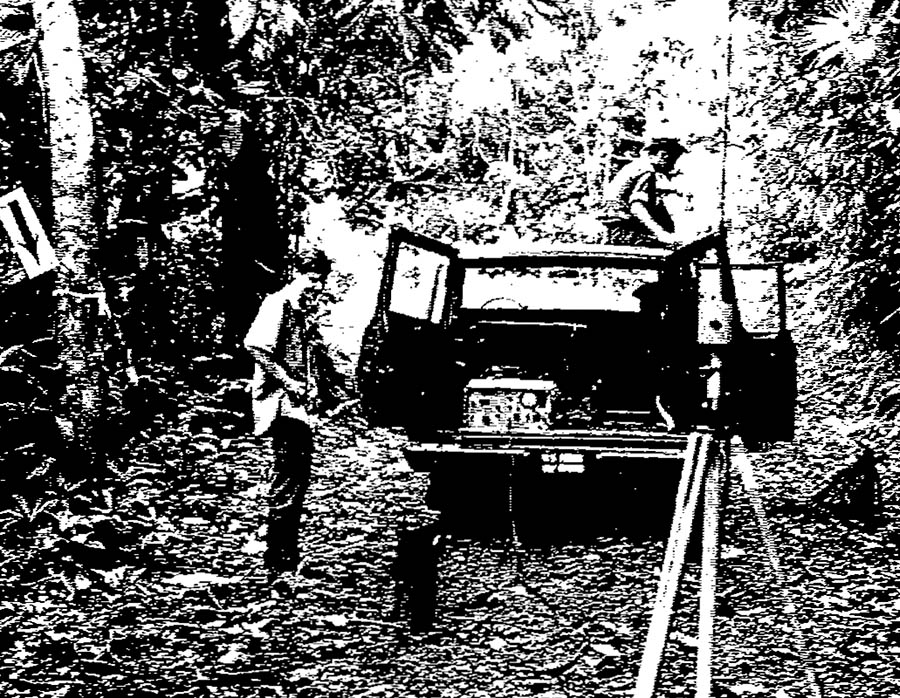
The authors of the IEEE Transactions report thus establish up a jungle-radio “Test Area” in a remote corner of Panama, complete with trees wired-up as dual senders & receivers. There, they think they’ve figured out what’s occurring on a large scale, as signals propagate through the forest canopy, writing that we should consider “the jungle as a maze of aperture-coupled screen rooms. In the jungle case, the screens, in the form of vertical tree and fern trunks, and the horizontal forest canopy are of variable thickness, have variable shaped apertures, and are composed of diverse substances that contain mostly water.”

[Image: Inside the Panamanian jungle-radio Test Zone; image via IEEE Transactions on Antennas and Propagation (January 1975)].
The design implication of all this is that an ideal radio-receiving forest could be planted and maintained, complete with spatially tuned “aperture-coupled screen rooms” (trees of specific branch-density planted at specific distances from one another) to allow for the successful broadcast of messages (and/or music) through the “living vegetable organisms” that Squire wrote about in his patent application.

What other creatures—such as birds, bats, wandering children, foxes, or owls—might make of such a landscape, planted not for aesthetic or ecological reasons, but for the purpose of smoothly relaying foreign radio transmissions and encrypted spy communications, is bewildering to contemplate.

In any case, this truly alien vision of forests silently crackling inside with unexploited radio noise is incredible, implying the existence of undiscovered “broadcasts” of biological noise, humming trunk to trunk amongst groves of remote forests like arboreal whale song, inaudible to human ears, as well as suggesting a near-miraculous venue for future concerts, where music would be played not through wireless headsets or hidden speakers lodged in the woods but through the actual trees, music shimmering from root to canopy, filling trees branch and grain with symphonies, drones, rhythms, songs, sounds occasionally breaking through car radios as they speed past on roads nearby.

[All links found via an old message from Shawn Korgan posted to the Natural Radio VLF Discussion Group of which I am a non-participating member. Vaguely related: The Duplicative Forest and Pruned’s Graffiti as Tactical Urban Wireless Network. See also a follow-up post: Antarctic Island Radio].

Sound Signature

Electrical networks emit such a constant, locally recognizable hum that their sound can be used to help solve crimes.

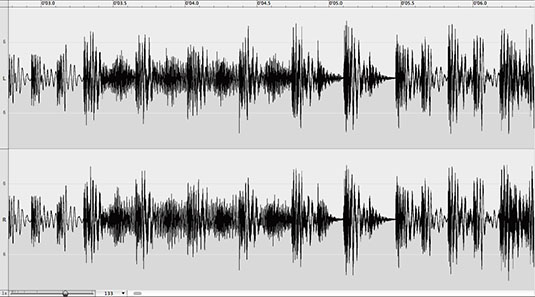
[Image: Random sound file using Sound Studio].

A forensic database of electrical sounds is thus being developed by UK police, according to the BBC. “For the last seven years, at the Metropolitan Police forensic lab in south London,” we read, “audio specialists have been continuously recording the sound of mains electricity. It is an all pervasive hum that we normally cannot hear. But boost it a little, and a metallic and not very pleasant buzz fills the air.”

Any digital recording made anywhere near an electrical power source, be it plug socket, light or pylon, will pick up this noise and it will be embedded throughout the audio.

This buzz is an annoyance for sound engineers trying to make the highest quality recordings. But for forensic experts, it has turned out to be an invaluable tool in the fight against crime.

Even with—or, in fact, because of—slight fluctuations in the level of local electric power, such recordings can reveal sonic traces of where and when they were recorded; these barely audible details act as “a digital watermark,” the BBC explains, secret audio artifacts that put “a date and time stamp on the recording.”

You can thus acoustically prove that someone was in a certain part of, say, London at a certain time of day, and that a given audio recording is thus genuine (or faked), due to the exact signature of what electrical networks in that part of the city had been doing at the time.

It’s like cosmic microwave background radiation, an immersive soundtrack—a sea of acoustic metadata—hidden in the built environment, detectable electronically, droning all around us at a volume usually below human hearing.