Forest Tone

[Image: The “Lady Blunt” Stradivarius violin recently sold for £15.9 million].

I have to admit to a certain amount of obsession with the various quasi-scientific hypotheses for why Stradivarius violins have their so-called “perfect” sound, ranging from sunspots and European cold spells to tales of “secret ingredients” and “special varnishes” applied to the wood, to stories of Antonio Stradivari himself harvesting “the wood of ancient castles and cathedrals” in order to build the bodies of his famous instruments.

“A sharp dip in temperatures between 1645 and 1715,” we read in but one example of these sorts of speculations, this time from National Geographic, “coincided with a reduction in sunspots and the sun’s overall activity known as the Maunder Minimum. Researchers say those factors may have slowed tree growth, thereby creating the ideal building material for violins later manufactured.” Indeed, the BBC adds, “It seems that the trees growing during the lifetime of Stradivari experienced a unique set of environmental conditions that has not occurred since.”
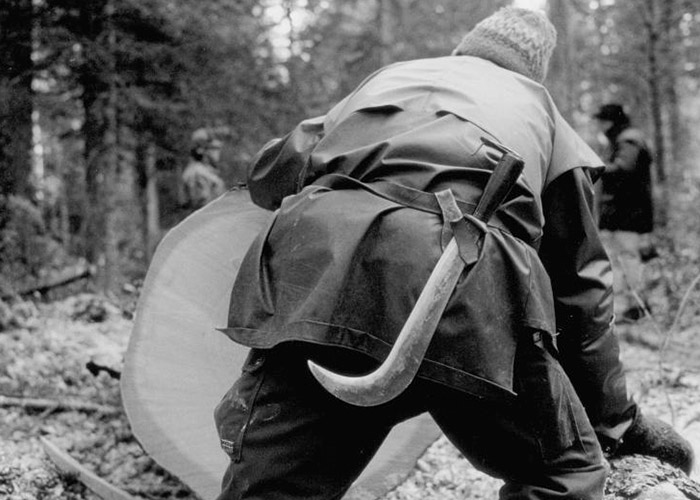
[Image: Lorenzo Pellegrini gardens the forest for resonant wood; photo via JMC].

On the other hand, the resonant fullness of a Stradivarius could also come down simply to good pruning.

A fascinating and odd story in the BBC last week described the life’s work of a man named Lorenzo Pellegrini, who “gardens” the Risoud Forest in Switzerland to assist the future resonant acoustics of the wood currently growing there. It’s a violin garden for the 24th century. “Now 83, he still climbs trees like a squirrel,” the BBC writes, “and tends the forest as if it were his garden—weeding out the beech trees that would smother his precious spruces” (note that this description suspiciously echoes the website of Swiss instrument maker JMC Lutherie, where we read that “Lorenzo is 80 years old, and he still climbs trees like a squirrel”).
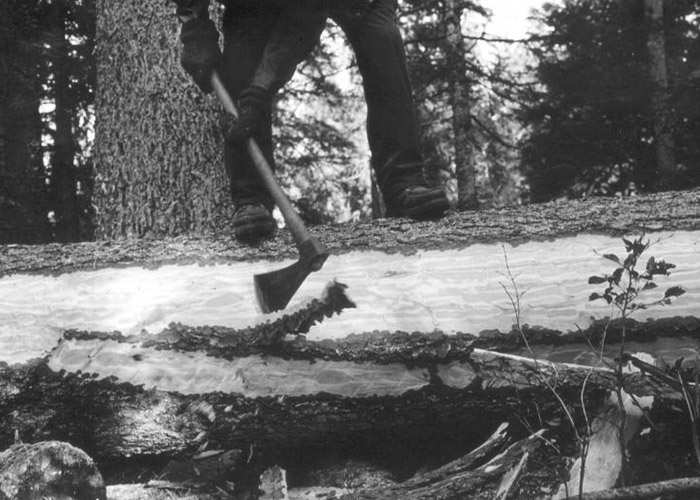
[Image: Lorenzo Pellegrini shapes planks for violins in Switzerland’s Risoud Forest; photo via JMC].

In any case, felling the trees is like ceremonial druidry:

Once you have found the perfect tree, he says, you have to wait for the perfect day to cut it down. That day comes at the end of autumn when the sap has sunk back into the ground. When the moon is lowest on the horizon, and furthest from the Earth. Because, apparently, the gravitational pull of the moon does not only tug the waters of the sea and make the tides, it tugs up the sap.

It is, we might say, lunar wood. You can watch a film about Pellegrini—in French, without English subtitles—here.

There is a very long list of interesting things to point out here, not the least of which is the conceptual overlap between resonant forests, grown for the musical properties of their wood, and the long history of the sacred grove in European folklore and mythology. But I am also reminded of the Jaguar Lount Wood, a small forest in the UK planted specifically to help off-set all the walnut grown for paneling the insides of Jaguar cars; and of the many forests planted over the centuries specifically for growing wood for shipbuilding (more of which at the earlier link).
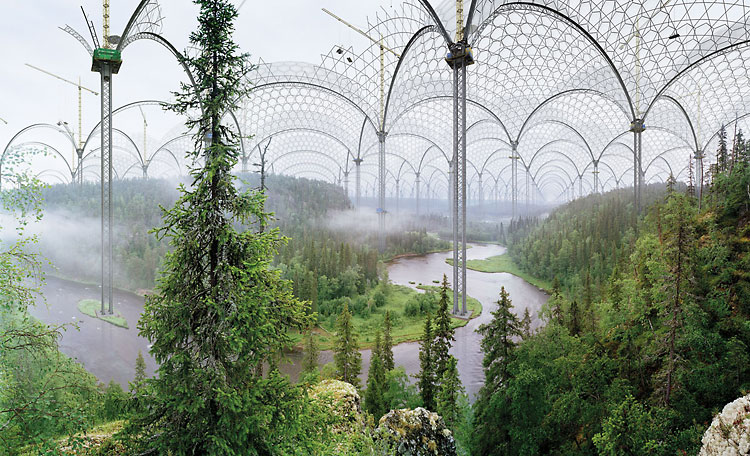
[Image: “Kitka River” from the Museum of Nature by Ilkka Halso].

But surely this also sets the stage for the design of some incredible future greenhouse somewhere, chilled from within and spanning whole hills, streams, and meadows at a time, where perfectly refrigerated forests grow slowly under controlled conditions to form violins in three centuries: lined with weights and counter-weights, they are pruned, cut, sliced, and pulleyed to stretch the grain toward specific densities, to hit frequencies hundreds of years from now in an echoing concert hall built for music from modified trees.

Families tend the chambered forest, introducing a new carbon dioxide mix every third Sunday of the month according to some arcane unwritten formula, and these perfectly strange trees, ideally shaped for music, roll deliriously inside with their own tuned tides of sap and water. Instrument makers step gingerly over the roots and soils of the controlled forest floor where, barely whispering out of respect for their surroundings, they remove calipers from leather bags, they prism their laser-levelers through passing banks of mist, and they pay on credit three hundred years in advance to reserve well-measured sections of trees for future violins and cellos, imagining whole new forms of music that might emerge someday, given the right, surgically placed sequences of cuts, as if all trees are secretly hiding musical instruments and only the smallest percentage of them have so far been revealed.

(Spotted via @nicolatwilley).

British Countryside Generator

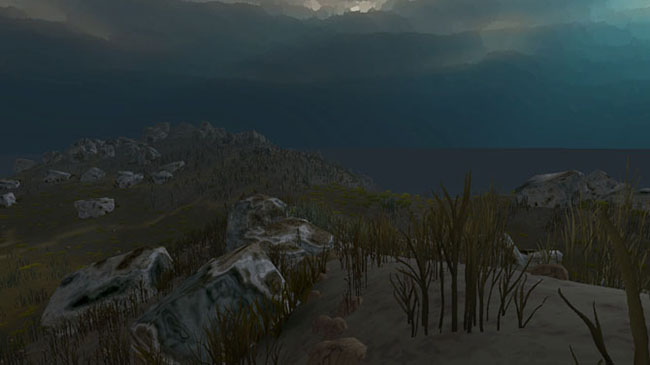
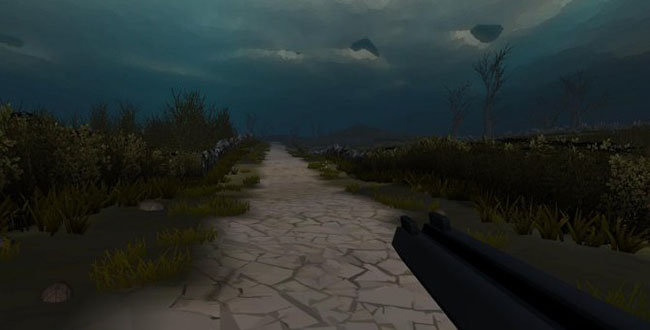
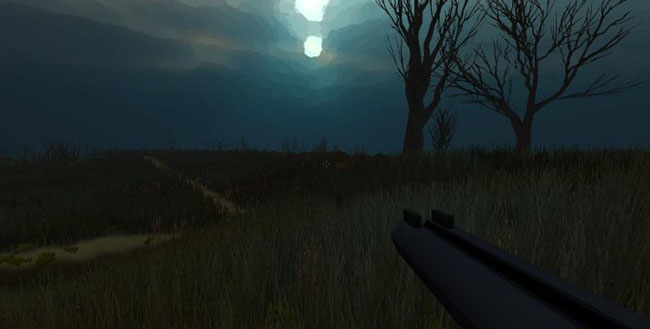
[Image: From Sir, You Are Being Hunted by Big Robot].

For the last ten months or so, I’ve been watching from afar the development of ground forms and landscapes for a game called Sir, You Are Being Hunted, from Big Robot.

Big Robot, of course, is a small game design firm founded by Jim Rossignol, who has guest-posted here on BLDGBLOG a few times over the years and who I interviewed back in 2009 about his book This Gaming Life.

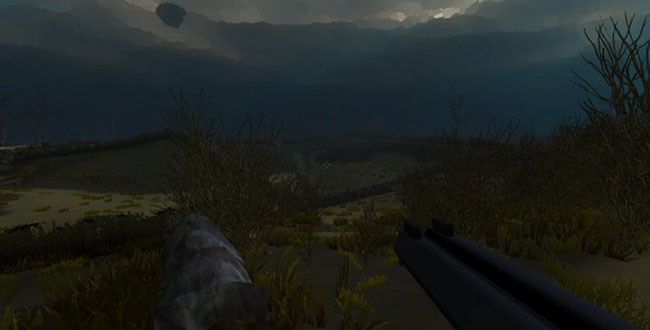
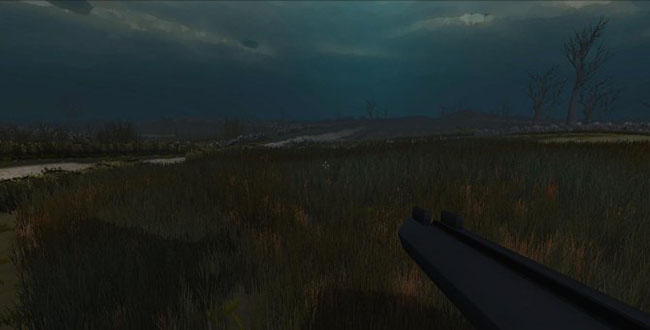
[Image: From Sir, You Are Being Hunted by Big Robot].

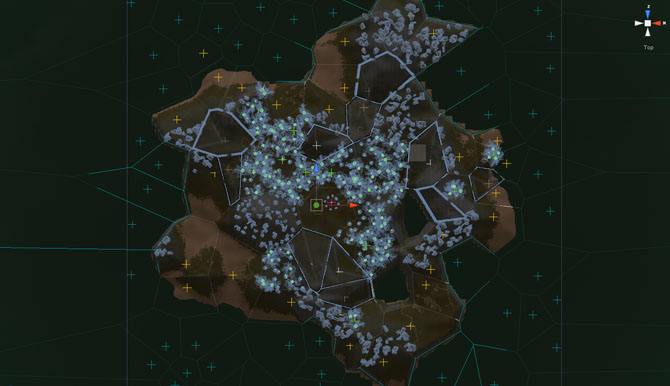
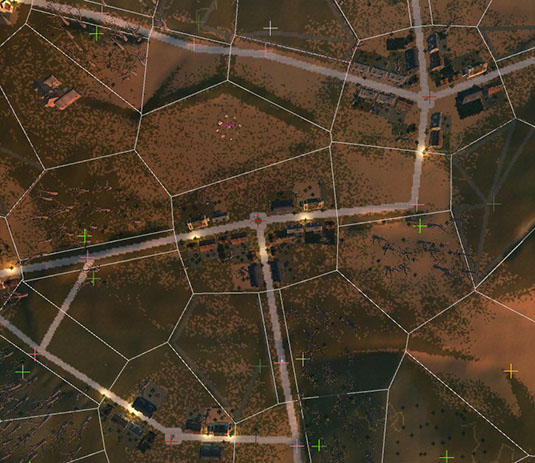
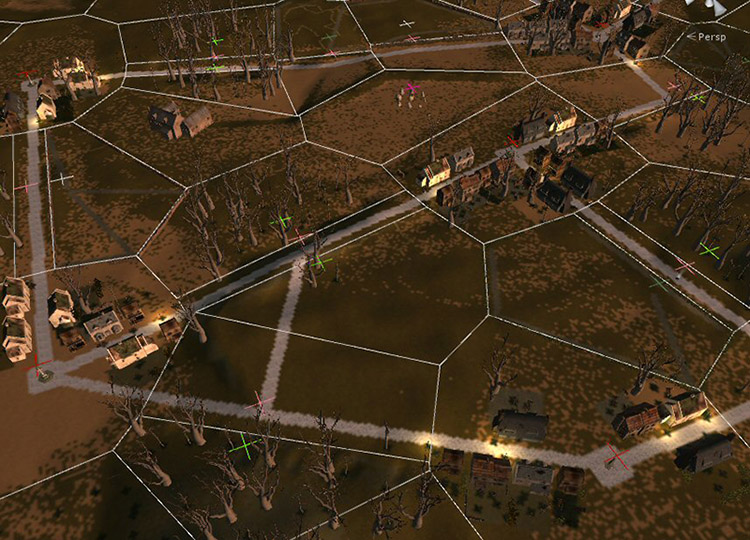
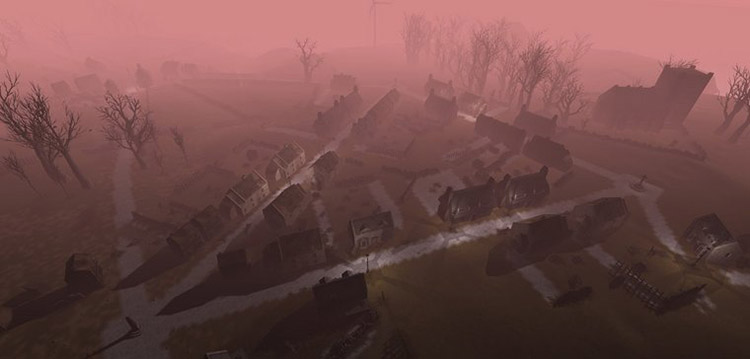
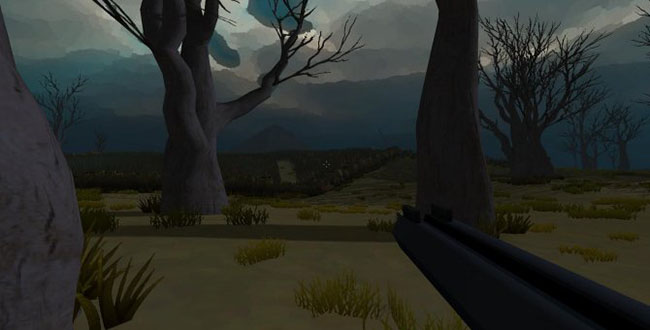
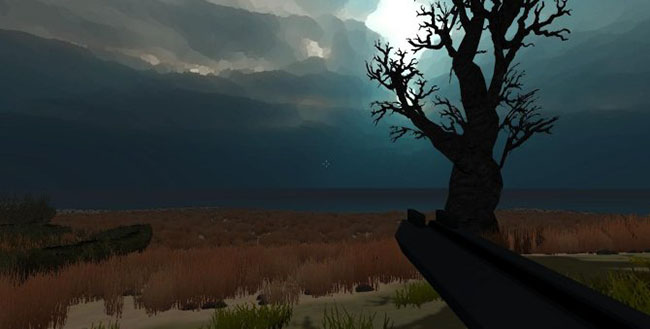
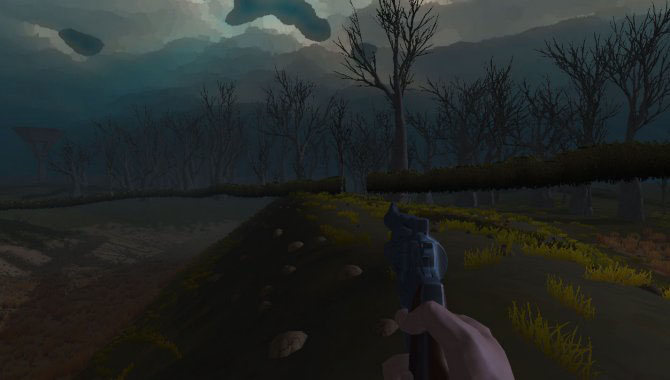
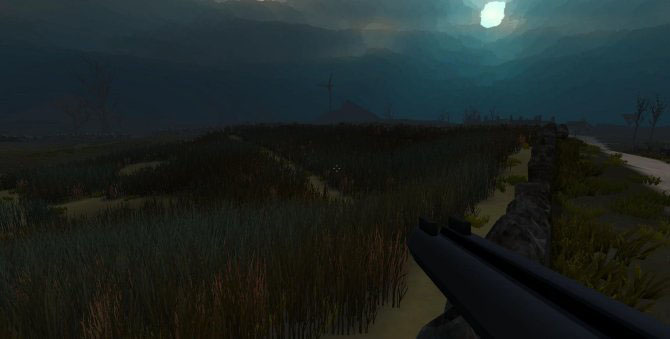
What I’ve been captivated by is the so-called British Countryside Generator, a “procedural world engine” using “spatial division maths” that allowed Big Robot to generate aesthetically recognizable rural British landscapes.

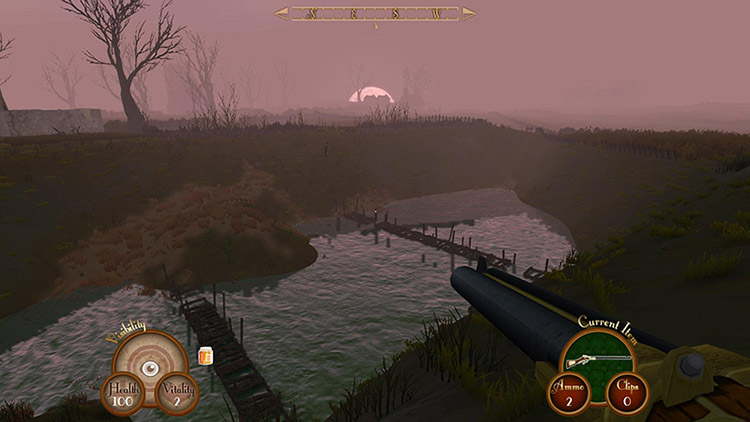
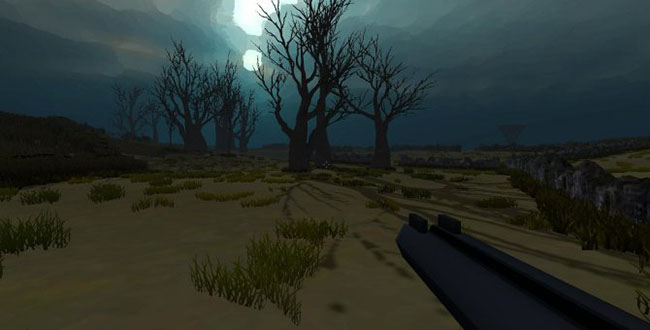
[Image: From Sir, You Are Being Hunted by Big Robot].

“I’ve worked on a number of procedural world generation tools before,” coder Tom Betts explains on the Big Robot blog, “but this particular engine is unique in that the intention was to generate a vision of ‘British countryside,’ or an approximation thereof.”

To approach this we identified a number of features in the countryside that typify the aesthetic we wanted, and seem to be quintessential in British rural environments. Possibly the most important element is the ‘patchwork quilt’ arrangement of agricultural land, where polygonal fields are divided by drystone walls and hedgerows. These form recognizable patterns that gently rise and fall across the rolling open countryside, enclosing crops, meadows, livestock and woodlands. This patchwork of different environmental textures is something that is very stereotypically part of the British landscape. I looked for a mathematical equivalent we could use to simulate this effect and quite quickly decided upon using Voronoi diagrams.

The basic topology is thus established, one that, despite its mathematical abstraction, “looks remarkably like… the British countryside.”

[Image: From Sir, You Are Being Hunted by Big Robot].

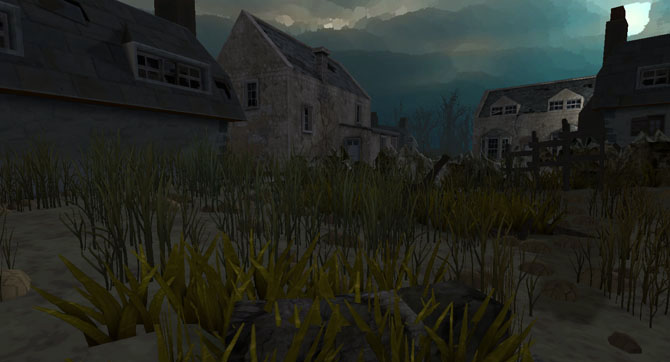
“Once this is done,” Tom continues, “the engine then uses the height information to produce a terrain splatmap where different textures are assigned to areas according to altitude, slope and region type. This results in sandy beaches, rocky highlands and meadows in between.”

[Image: From Sir, You Are Being Hunted by Big Robot].

These subtle glimpses of game geology disguise Jim Rossignol’s own mock enthusiasm for all things virtually terrestrial. “Terrain!” he exclaimed over at Rock, Paper, Shotgun last summer in a Walt Whitmanic moment of expansiveness. “It’s the undulating table on which the pieces of our play are set. It’s the sandbox in which we dig, and the garden in which we grow. Terrain: for exploring, for absorbing, for smoothing, for deforming. It is the unsung underfoot heroic substrate of all that is gaming, and much else besides.”

[Images: From Sir, You Are Being Hunted by Big Robot].

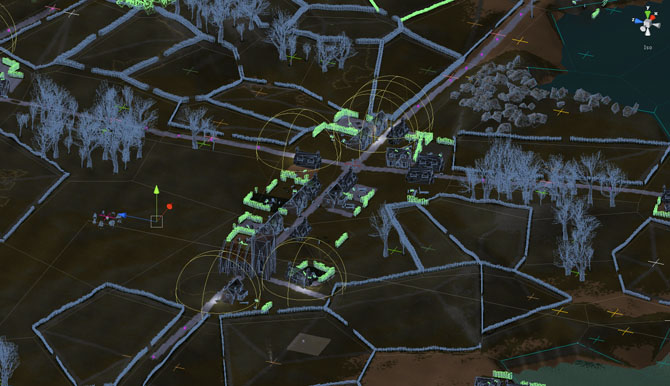
Speaking of “smoothing,” these automatically generated lines and divisions are not always ideal, and can often use some smudging. “There are also a number of ‘noisy’ functions,” Tom adds, “that make the textures intersect more organically by adding goat type trails, blurring and dithering. There are also additional alterations made to this splatmap later as the engine deploys the actual models too—walls, buildings and so on.”

[Image: From Sir, You Are Being Hunted by Big Robot].

Personally—perhaps it’s schadenfreude—I love to see all of architecture reduced to “walls, buildings and so on,” just tossed across the landscape like salt; to think of all the time spent on student architecture projects that could simply have been achieved using a countryside generator…

[Images: From Sir, You Are Being Hunted by Big Robot].

Roads and towns at the push of a button.

[Image: From Sir, You Are Being Hunted by Big Robot].

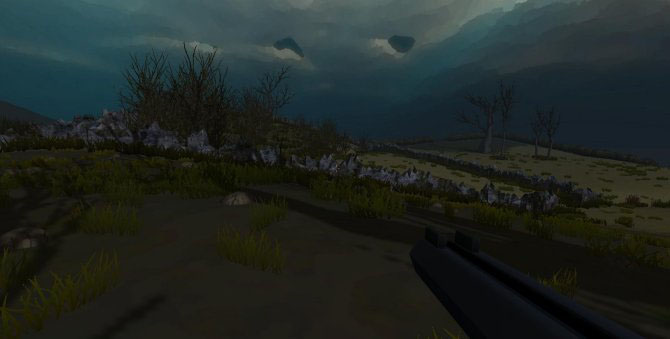
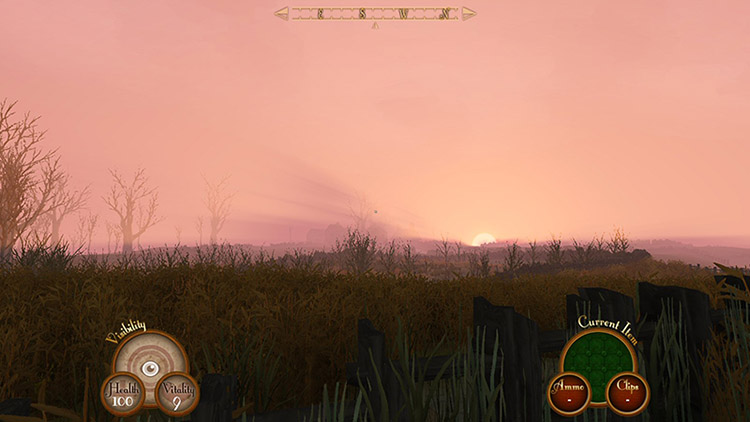
But then, of course, you add the “sir” being hunted, and you throw in the jangly figures carrying rifles and smoking pipes in the foggy landscape, and mere terrain becomes gamespace, a place of strategy and places to hide.

[Image: From Sir, You Are Being Hunted by Big Robot].

Landscape then becomes something you explore while looking down the barrel of a gun, wandering through “walls, buildings and so on” as a new and renewable world tiles into being all around you.

[Images: From Sir, You Are Being Hunted by Big Robot].

In his long blog post at Big Robot, for instance, Tom writes that “one of the most exciting parts of procedural content generation is the fact that it can produce unexpected results, [and] players can stumble across regions that due to a particular combination of features appear really unusual. In testing I’ve found villages collapsing over cliff edges, trees submerged in lakes and roads from nowhere to nowhere. There is actually something nice about finding these anomalies because it really feels like a unique discovery, proving that you are wandering your own, individual version of the game world.”

Jim Rossignol has discussed the game in more detail in several interesting interviews—such as with WhatCulture and Rock, Paper, Shotgun—where you’ll find more background and info, and a convincing glimpse of the game designer as landscape theorist.

For now, here are some further shots of the British Countryside Generator at work.

[Images: From Sir, You Are Being Hunted by Big Robot].

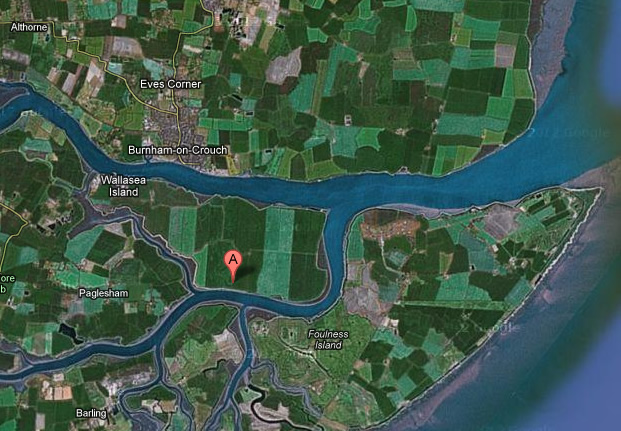
Briefly, I can’t let this post end without mentioning another, admittedly entirely unrelated project, something that itself could easily be described as a “British countryside generator.” I’m referring to the massive wetland redevelopment on Wallasea Island, using “approximately 6.5m tons of spoil,” in the words of London Reconnections, that have been sucked, scraped, and excavated from deep beneath London as part of the Herculean Crossrail tunneling project.

In other words, the island is literally being expanded through an open-air terrestrial 3D-printing exercise, using dirt from the foundations of London as its ink.

[Image: Wallasea Island Map from Google Maps, via London Reconnections].

As the BBC explains, the Wallasea wetland project is “making good use of the excess earth being generated from the separate £14.8bn Crossrail project. The twin-bore tunnels being dug out to link east and west London would have seen six million tons of earth in need of a new home—but three-quarters of this will head to Wallasea Island via freight trains and ships to create the new reserve.”

There is something absolutely mind-boggling in the idea of huge, artificial hollows under London being sprayed out over a coastal site—no doubt according to Big Robot-like formal rules, where “different textures are assigned to areas according to altitude, slope and region type,” as the game designer explains, above—to form, nearly from whole cloth, a new ecosystem.

A British Countryside Generator, indeed.

(An earlier version of this post mistakenly attributed many quotations to Jim Rossignol, rather than to Tom Betts—my apologies to Tom for the oversight!)

Mountain View

[Image: Courtesy of the U.S. Library of Congress Prints & Photographs Division].

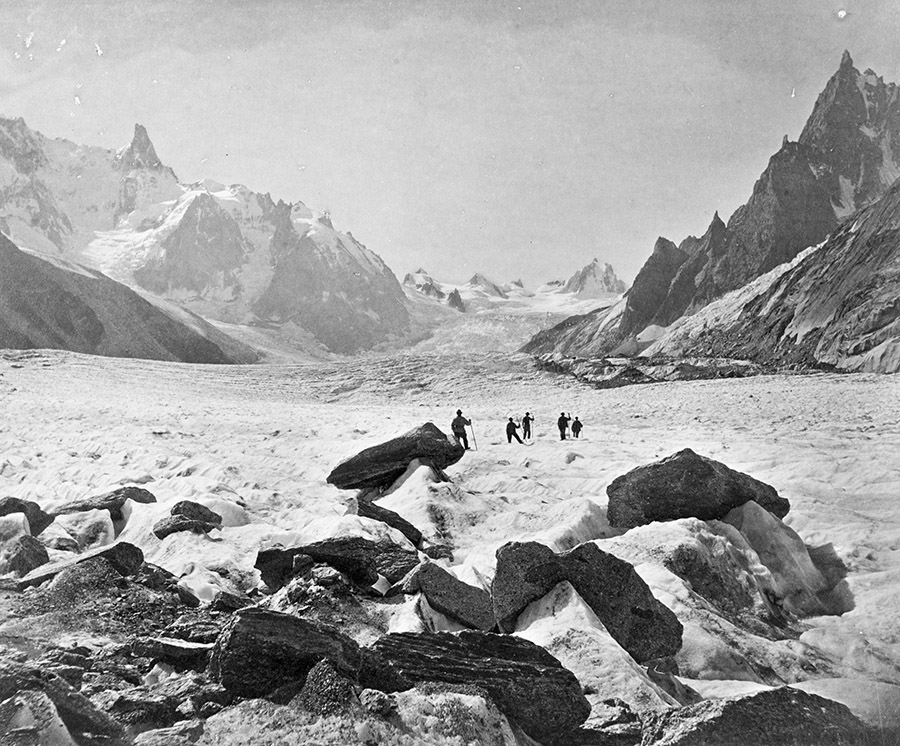
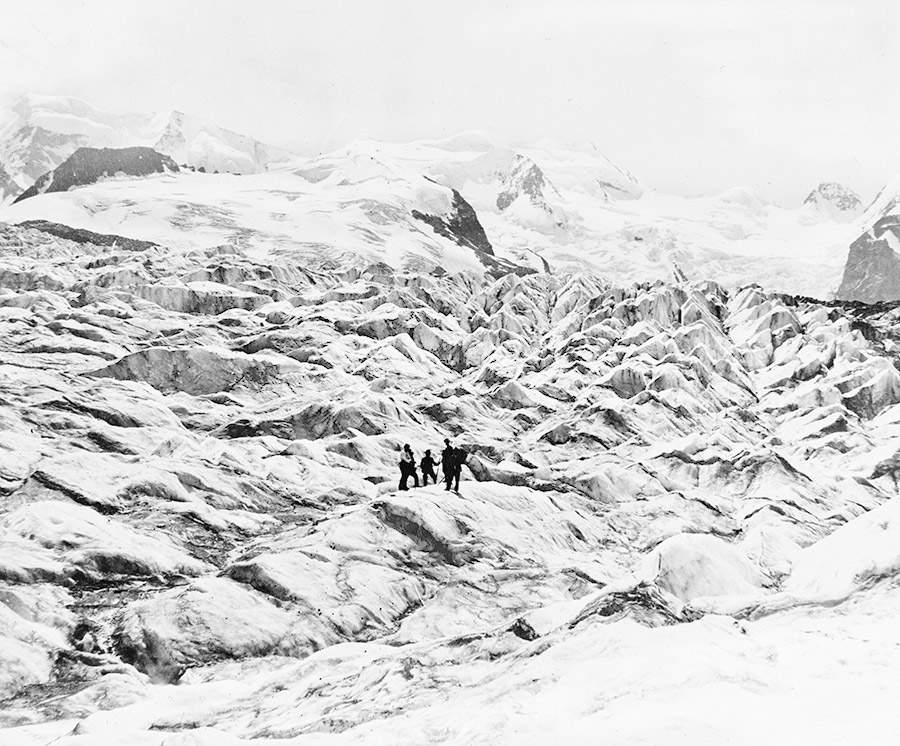
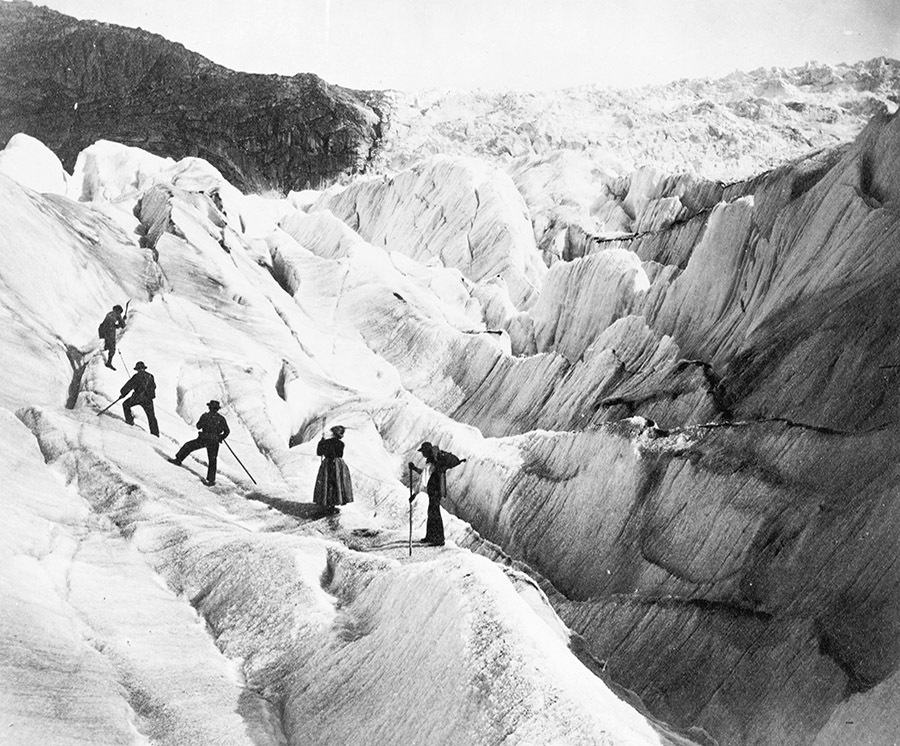
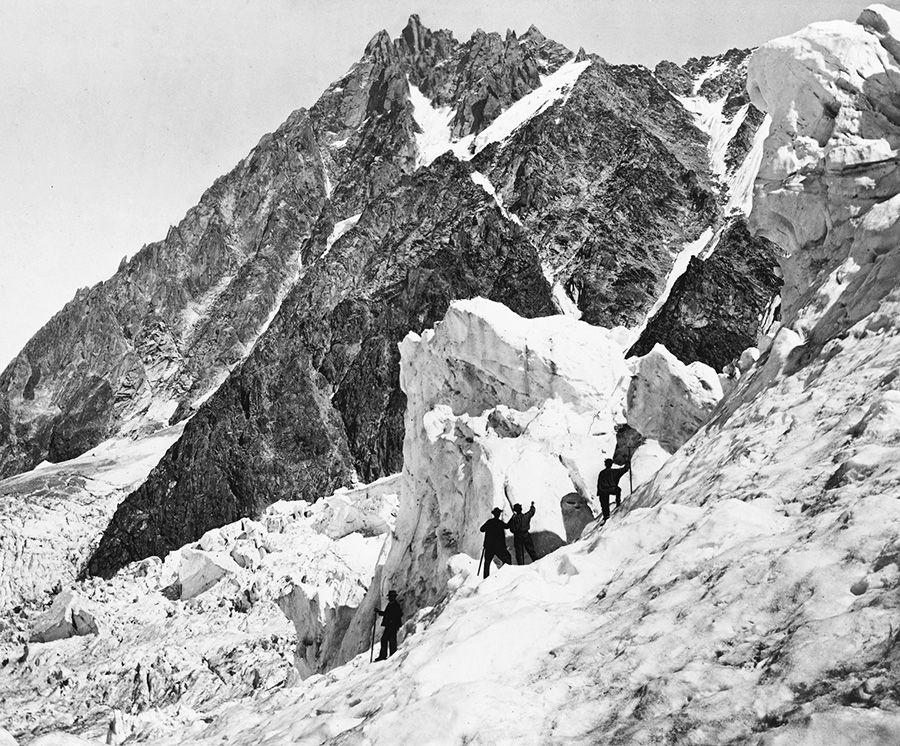
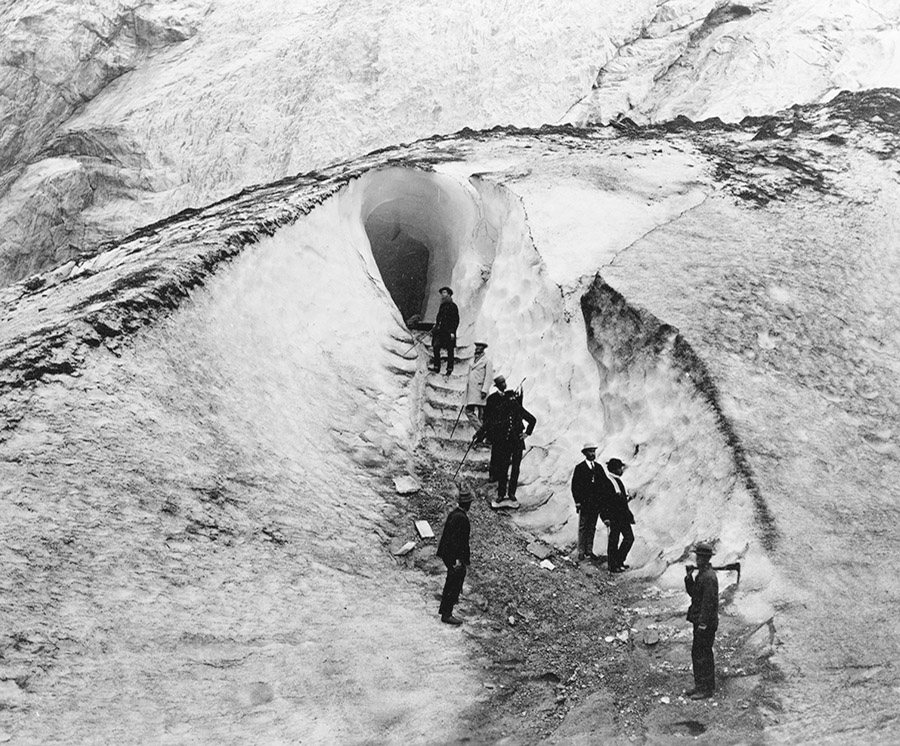
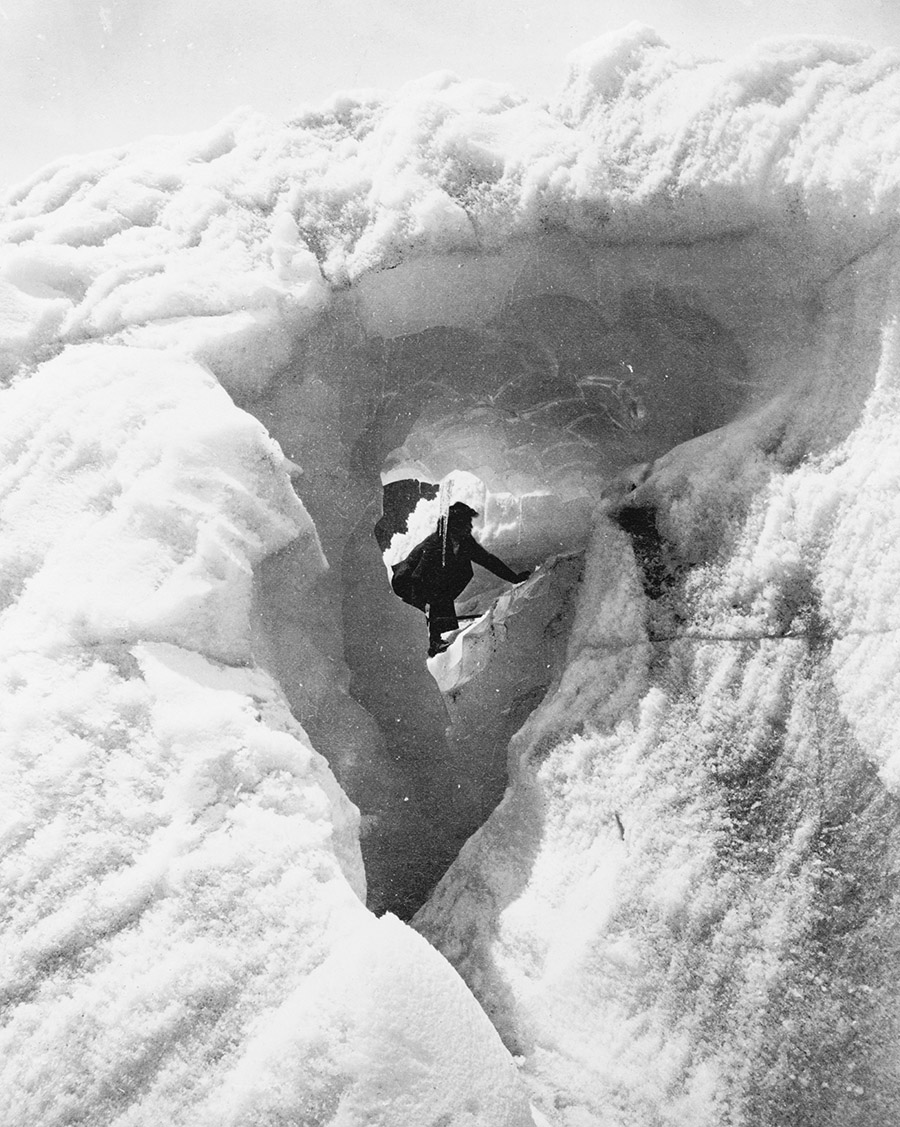
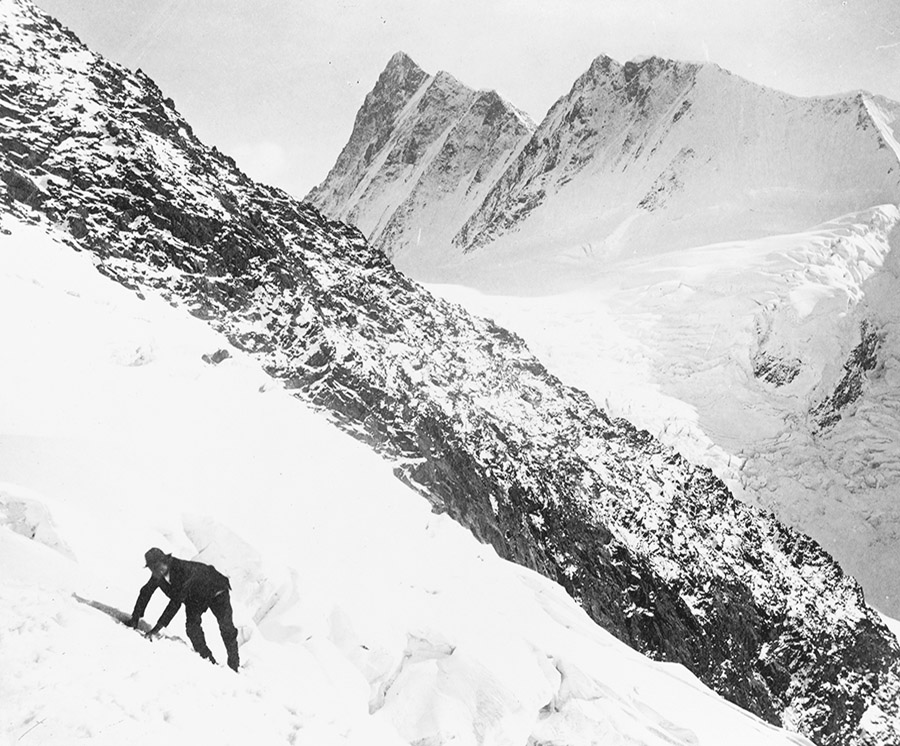
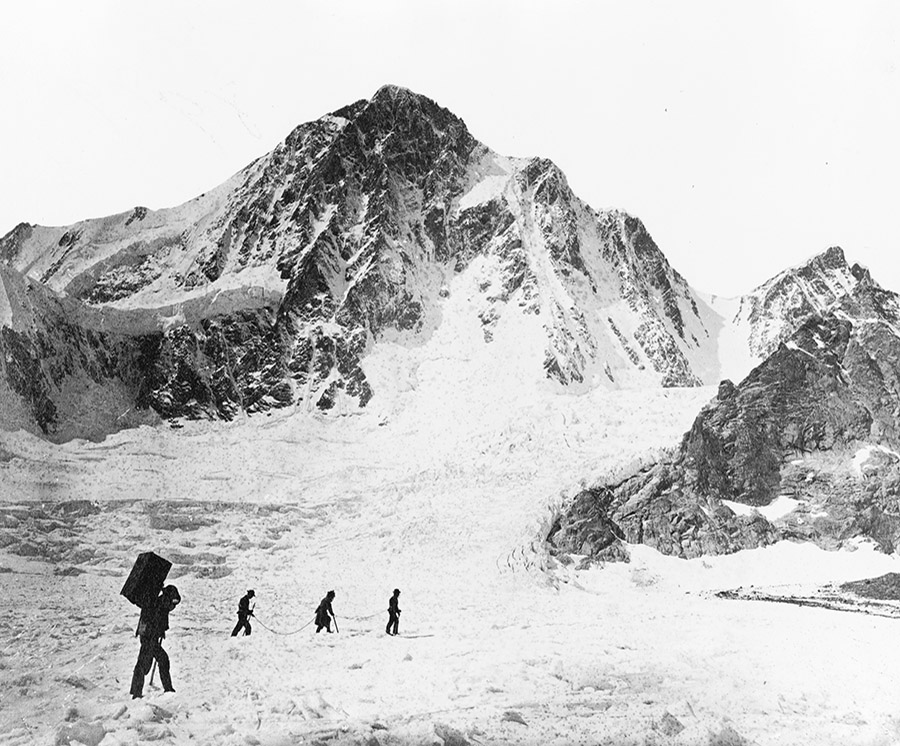
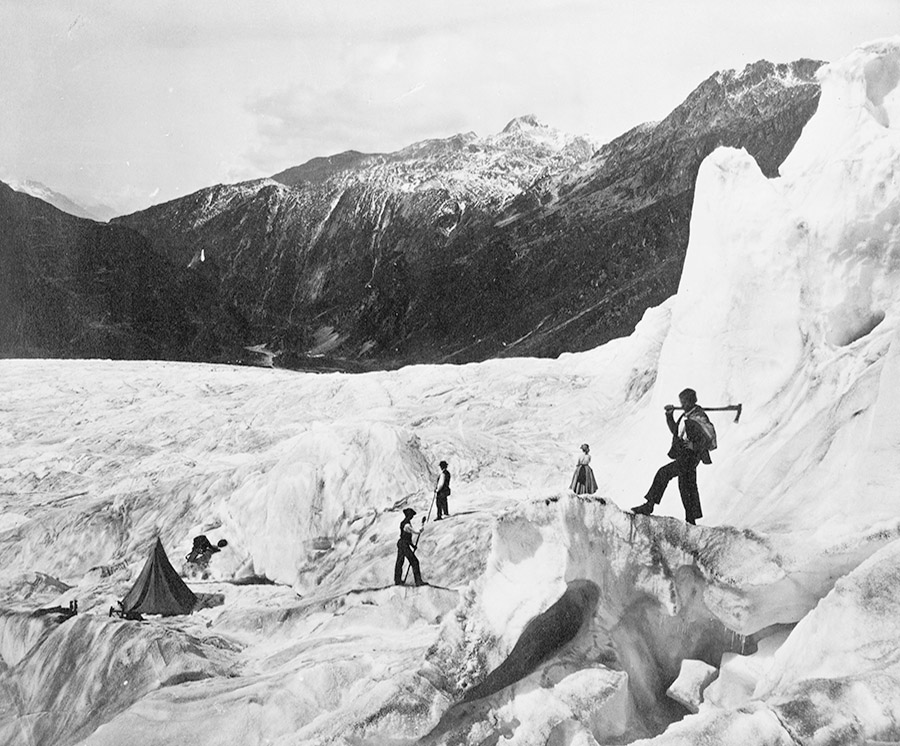
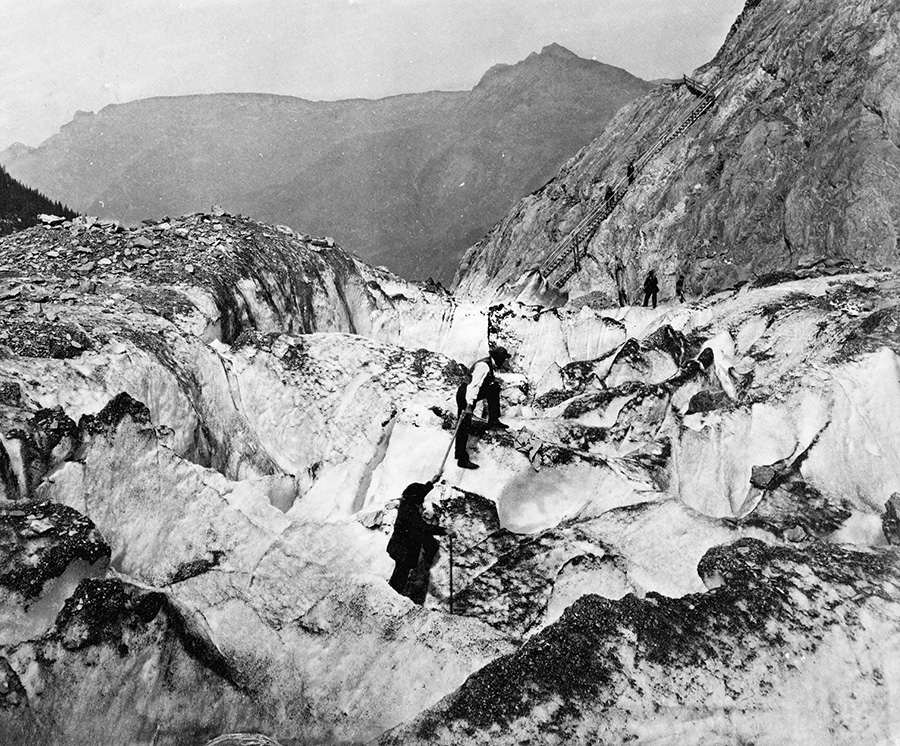
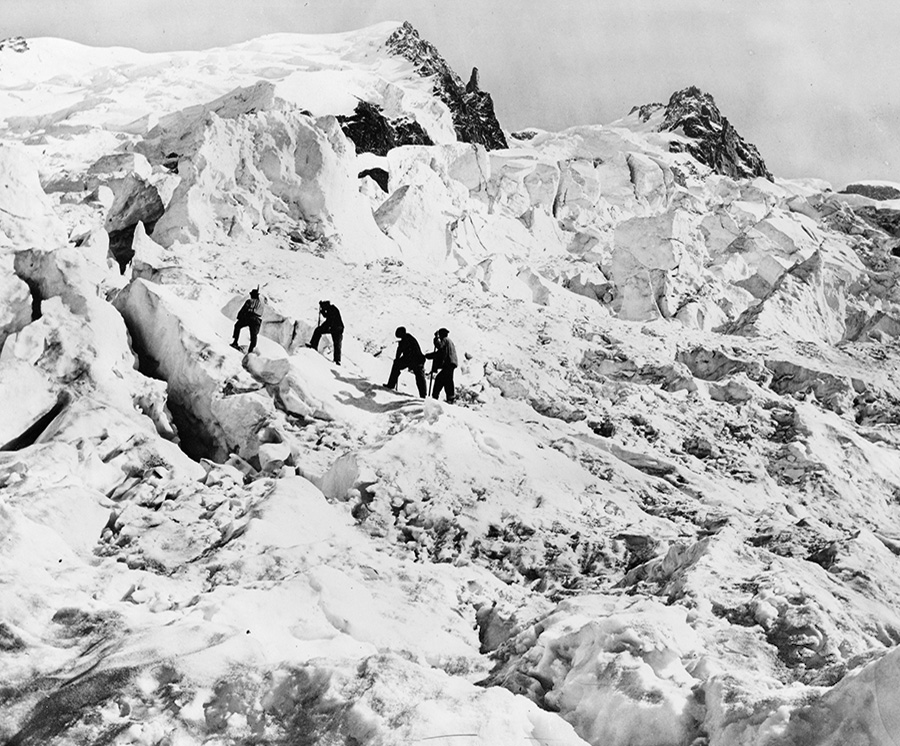
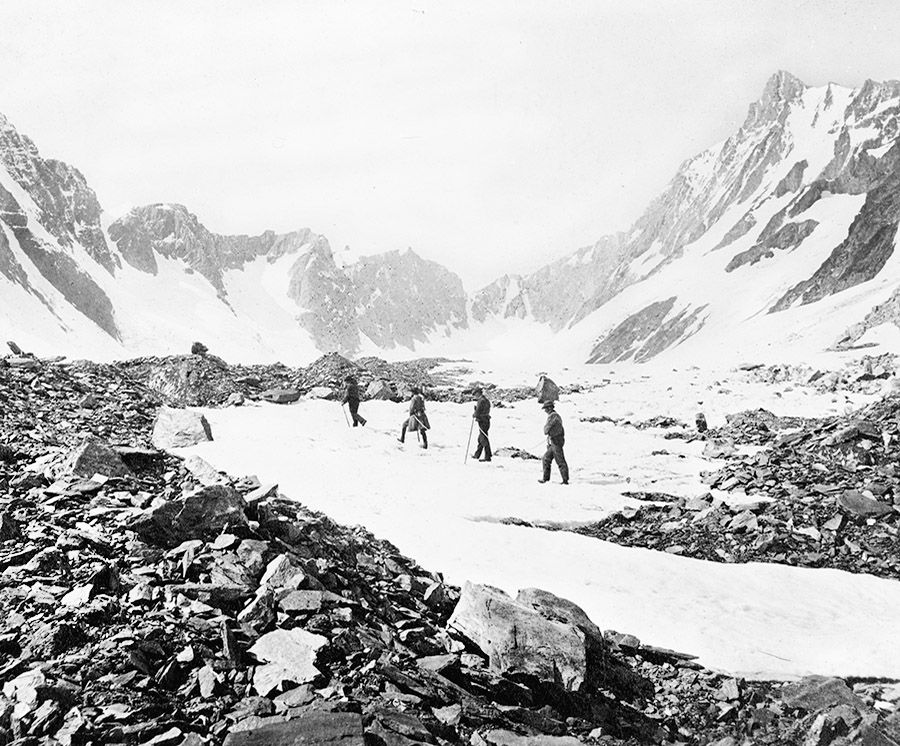
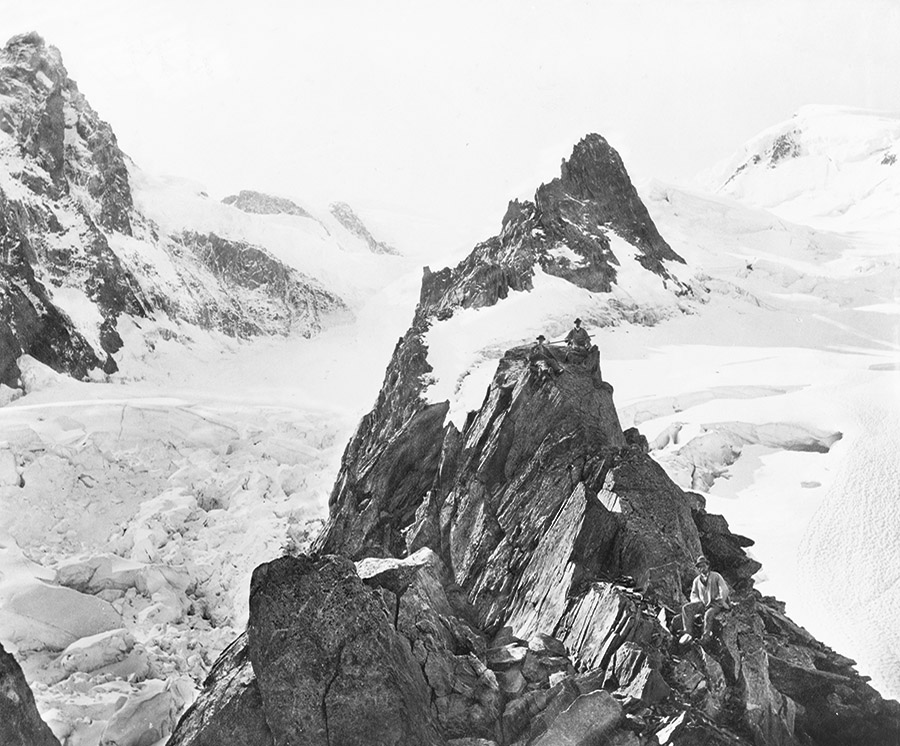
After posting several of these images in our recent Venue interview with outdoor equipment strategist Scott McGuire—easily one of my favorite interviews of late, touching on everything from civilianized military gear used in everyday hiking to REI-augmented wilderness camp sites as the true heirs of Archigram—I was so taken by their weirdly haunting views of humans wandering through extreme landscapes, dressed in 19th-century suits and top hats, carrying canes, that I thought I’d post a larger selection.

[Images: Courtesy of the U.S. Library of Congress Prints & Photographs Division].

Middle class gentlemen and ladies in hooped skirts walk into ice caves and step gingerly across the cracked, abyssal surfaces of old mountain glaciers, pointing up at things they don’t understand.

[Image: Courtesy of the U.S. Library of Congress Prints & Photographs Division].

At times, these feel almost like photos from some as-yet-unwritten Gothic horror story, perhaps a 19th-century Swiss prequel to John Carpenter’s The Thing, in which purely accidental sequences of photos—

[Images: Courtesy of the U.S. Library of Congress Prints & Photographs Division].

—imply a narrative of genial discovery, focused exploration, and eventual solo flight down the mountainside in terror.

In fact, I could easily imagine an Alpine variation on Michelle Paver’s memorably unsettling Arctic ghost novel Dark Matter set in such geologically extravagant landscapes, as humans struggle to survive, both physically and psychologically, in this encounter with an incomprehensibly over-sized landscape millions of years older than they might ever be, naively setting up camp amidst a wilderness that does not want them there.

[Images: Courtesy of the U.S. Library of Congress Prints & Photographs Division].

But then, at other times, these photos are almost like exaggerated set pieces by artists Kahn & Selesnick, whose work proposes fictional expeditions to otherworldly landscapes, missions to the moon, ancient salt cities, and more, all told through an almost unbelievably elaborate series of props, fake postcards, paintings, photographs, and more.

Like some unrealized backstory for their “Eisbergfreistadt” project, for example, or their “Circular River” expedition, men in wool vests pull one another up abstract glacial forms, as an incredible wooden staircase—if you look closely at the next image—races up the mountainside in the middle of nowhere.

[Image: Courtesy of the U.S. Library of Congress Prints & Photographs Division].

After a point, these scenes are Chaplinesque and ridiculous, like turn-of-the-century bankers who got lost on a glacier in a Modernist play.

[Image: Courtesy of the U.S. Library of Congress Prints & Photographs Division].

In any case, these all come courtesy of the U.S. Library of Congress Prints & Photographs Division, where substantially higher-res versions of each photo are available; but don’t miss the additional photos in the interview with Scott McGuire over at Venue.

[Images: Courtesy of the U.S. Library of Congress Prints & Photographs Division].

Two-Track Mind

[Image: NYC’s “track geometry car,” via Wikipedia].

The MTA‘s “track geometry car” slides around through the New York City subway, employing “a variety of sensors, measuring systems, and data management [software] to create a profile of the track being inspected.”

It’s a large-scale, precision optical mechanism, measuring such things as track curvature, alignment, “crosslevel,” rail gauge, warp, and more, using GPS, gyroscopes, proximity sensors, now-obsolete analogue measuring wheels, strain gauges, accelerometers, and even a “paint spray system” for marking “the location of a defect on the track once a defect is found.” These devices can be used in tandem with “ultrasonic rail-flaw detection vehicles” that use ultrasound “to ‘look’ inside rail to detect flaws unseen by the human eye. An internal flaw may be caused by a poor casting or metal mixture.”

But it’s hard not to be captivated by the idea of some blindingly well-lit behemoth vehicle maneuvering around beneath the city at night, all lasers, mirrors, lenses, and prisms—a surreal, moving garden of repurposed photographic equipment and motion-capture technologies from different historical eras—scanning the geometry of the metropolis from below, down to thermal flaws in the very metal it passes over. Surrounded by overlapping holographs of infinite lines and tunnels, like the subway dreaming of itself, this collage of physical instruments circles around and around through the foundation of the world, a two-track mind, a mobile neurology thinking in well-measured bursts of strobe light.

(Thanks to Nicola Twilley for the tip!)

Intentional Landscapes

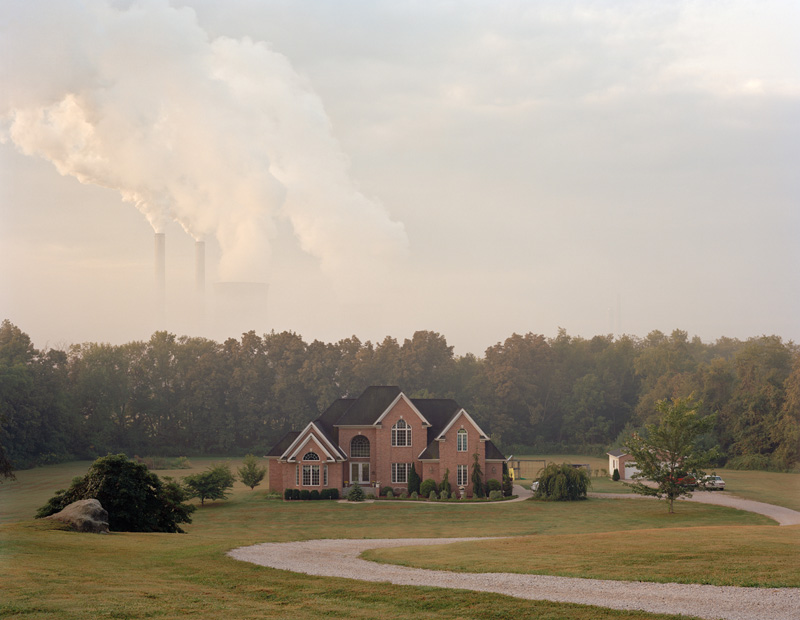
[Image: This humid and apocalyptic image—one of my favorite of the last few years—by photographer Daniel Shea depicts a house in Cheshire, Ohio, seemingly stranded amidst its own, artificially maintained lawn, as a coal-fired power plant belches out new climates in the distance].
Over the last few months, several photos from Andy Adams‘s project Looking at the Land have stuck with me, peppering my desktop here at home and re-appearing every few days as I search for other files; and I thus thought I should post a few of them here to share with a wider audience.

Looking at the Land, in a nutshell, developed from an admittedly broad call looking for “photographs depicting landscape in the United States since 2000.”

In the process, Adams hoped to pose several subsidiary questions: “Why do people photograph places? What compels artists to make images of the land? Are their intentions similar or different than previous generations?” The answers to these questions form what Adams calls “landscape stories.”

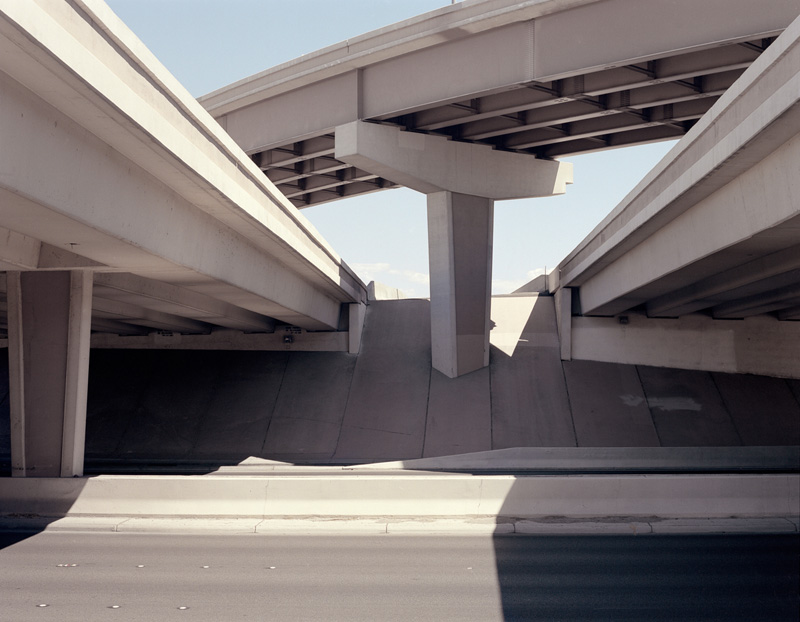
[Image: The “strong, elegant structure” of a highway overpass in Las Vegas, Nevada, photographed by Caitlin Teal Price].

The resulting online-only exhibition is suitably mixed—in theme, subject, and, in some cases, quality—but the overall collection well deserves longer attention, precisely for its diversity of focus.

In addition to the images reproduced here, for example, there are scenes of empty parking lots overlooking distant geological formations in Arizona, empty cul-de-sacs still awaiting their future buildings in the wilds of Texas, and an unfinished big box store, like some white alien monolith, in the western desert.

[Image: A future suburb in Monroe, New Jersey, takes shape as huge, sculpted chocolate formations of red dirt are mechanically rearranged across the landscape in this photograph by Justin James Reed].

But those are just the images I’m drawn to, myself. Click through to see the nearly one hundred photographs on display, and be sure to read the short interviews with each photographer that accompany the images.

Temple of the Autonomous Machine

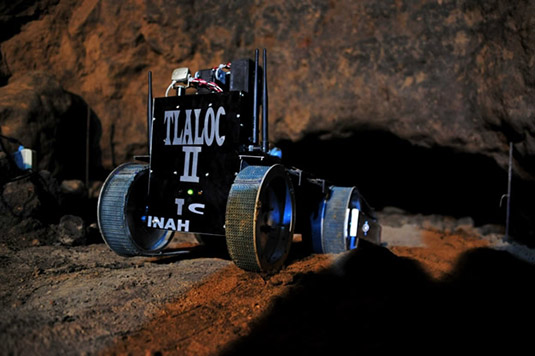
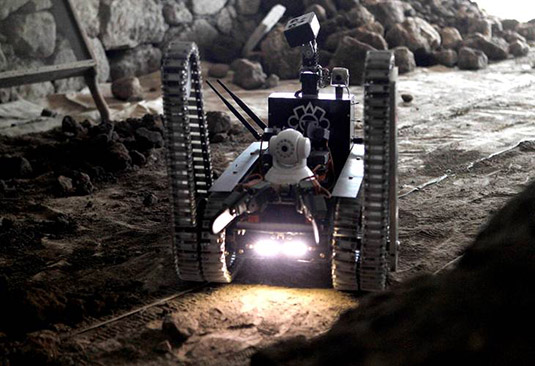
[Image: The archaeological robot Tlaloc II-TC, a design descendent of Tlaloque I, courtesy of INAH/Cortesía].
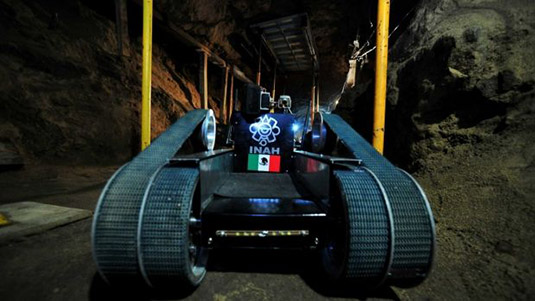
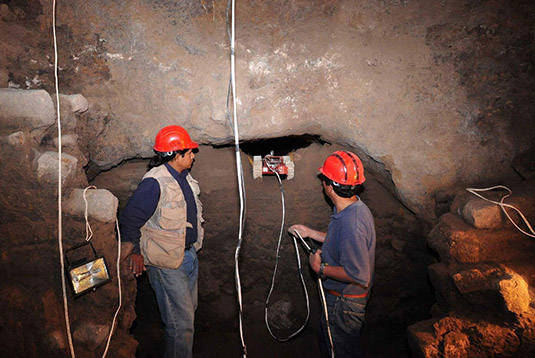
A news item over at Archaeology reports that a little wireless robot called Tlaloc II-TC will soon “investigate the far reaches of a tunnel found beneath the Temple of the Plumed Serpent at Teotihuacan,” entering a chamber “estimated to be 2,000 years old, and [that] may have been used as a place for royal ceremonies or burials.”

[Image: The archaeological robot Tlaloc II-TC, courtesy of INAH/Cortesía].
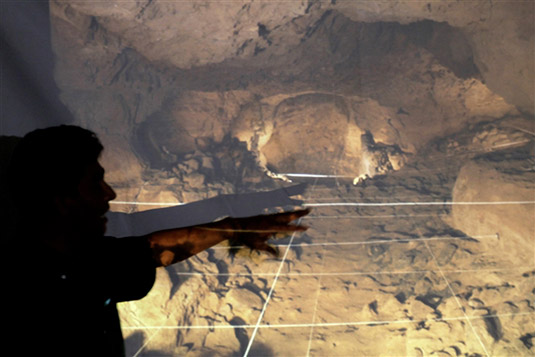
The robot will then make laser scans of the interior.

[Image: Sergio Gomez from the INAH shows some preliminary findings; photo by Henry Romero, courtesy of Reuters, via NBC].

This is only the “third time anywhere in the world that such an automaton [has been] used to design excavation strategies,” adds HispanicallySpeakingNews.com.

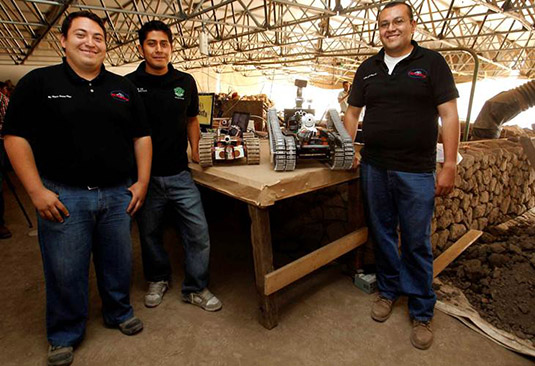
[Image: The robot design team and different models of the surveyors; photos by Alma Rodríguez for El Universal].
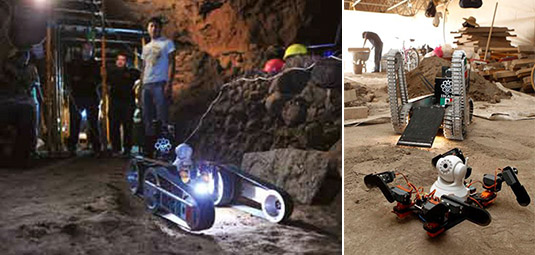
Incredibly, though, the mission—called “Project Tlalocan, Underground Road”—will also involve a smaller robot, described as a “bug,” that will be deployed by Tlaloc II.

According to my own bad, Google-assisted translation of an article published in Provincia, “The team also has a robot ‘bug’ that is carried by the lead vehicle, which descends based on instructions from a computer. It measures 40 cm with outstretched arms and carries an infrared camera, and it conducts exploration of ground-level terrain, avoiding obstacles.”

[Image: The robot design team and different models of the surveyors; photos by Alma Rodríguez for El Universal].
It gets even more interesting when we then read that there is yet another, “third part” of the ensemble, a “robot made with four propellers” that can “remain suspended in the air and take pictures with video cameras.”

It’s a drone, in other words—part of a whole family of proliferating machines—but, for now, it will only be “used outdoors due to currents of air in the tunnel.”

[Image: The earlier generation Tlaloque 1 robot prepares to roll into the Temple of the Plumed Serpent; image courtesy of Past Horizons].

But how extraordinary it is to read about these and other collaborations between teams of roboticists and archaeologists, and to realize that excavating the past will soon mean deploying teams of remote-sensing robotic machines semi-autonomously flying, crawling, gridding, scanning, squeezing, and non-destructively burrowing their way into lost rooms and buried cities, perhaps even translating ancient languages along the way.

Earth Prism

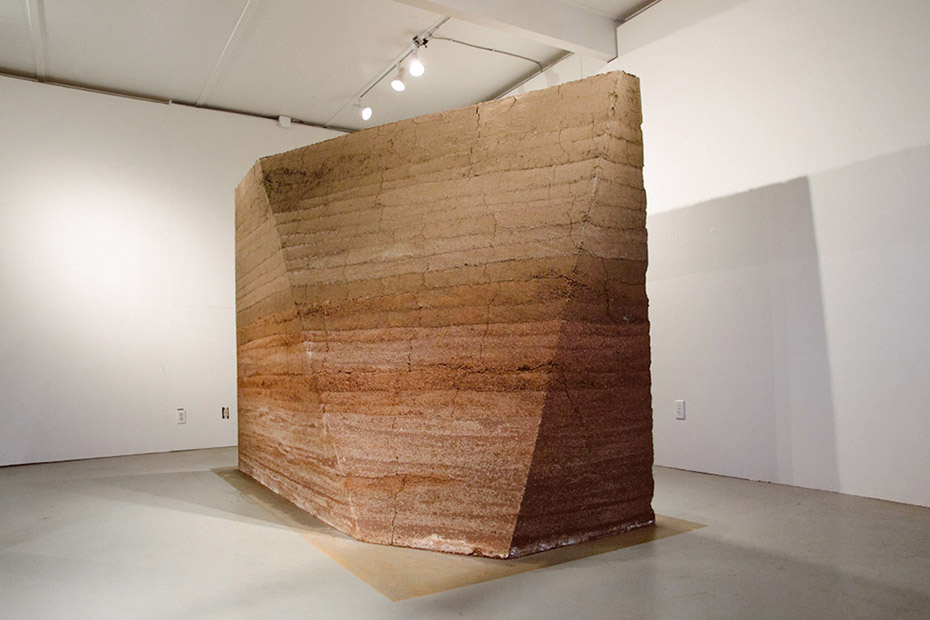
[Image: A Small Area of Land (Kaka‘ako Earth Room) by Sean Connelly at Honolulu’s ii gallery; courtesy of the artist].
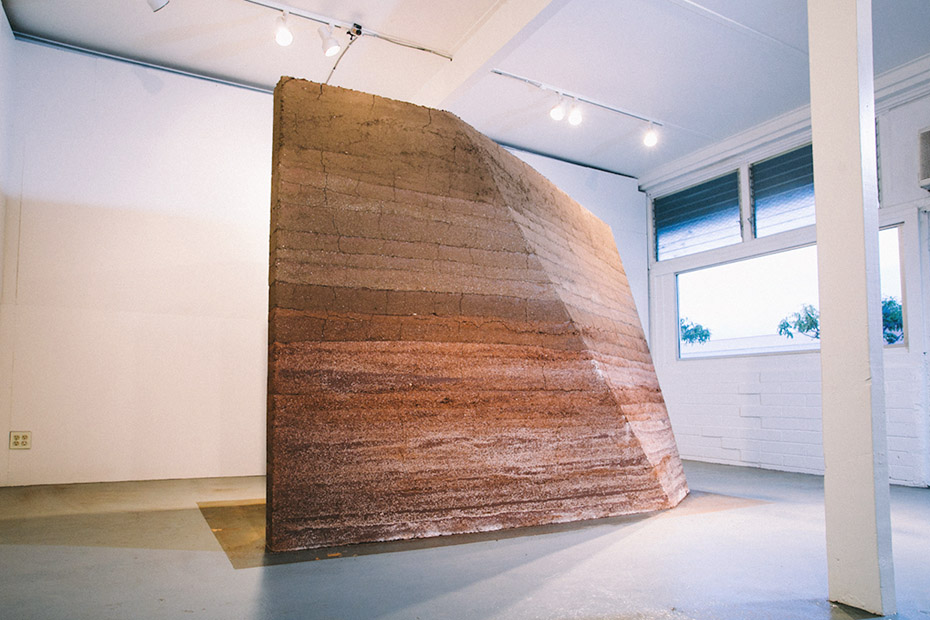
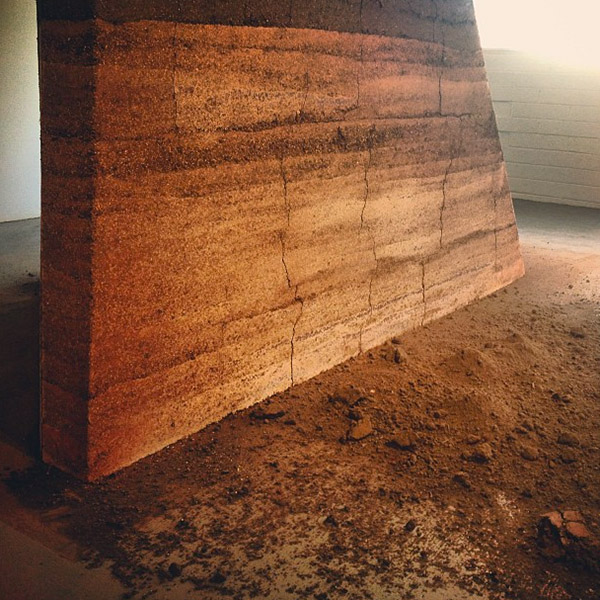
The ii gallery in Honolulu, Hawai‘i, is currently showing architect Sean Connelly’s installation A Small Area of Land (Kaka‘ako Earth Room), a “temporary earth sculpture” made from “32,000 pounds of volcanic soil and coral sand.”

[Images: A Small Area of Land (Kaka‘ako Earth Room) by Sean Connelly at Honolulu’s ii gallery; images courtesy of the artist].
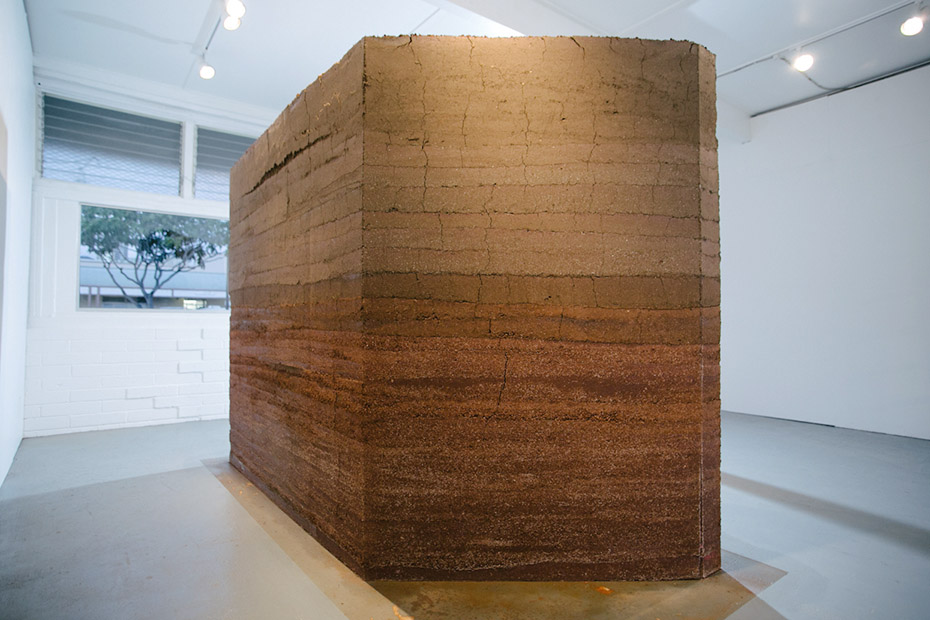
The resulting prismatic monolith is 7′ tall, 9′ long, and 4′ wide, and it “takes geometry to a new level,” we read: “starting with a basic rectangular block, the sculpture will feature a single sloping surface that aligns with the position of the sun and moon on a key date in the history of land in Hawai‘i.”

The exhibition title is the definition of the term kuleana, as translated in the Dictionary of Hawaiian Legal Land Terms. Coupled with increasingly contentious perspectives on the future use, development, and management of Hawai‘i’s land and natural resources, A Small Area of Land (Kaka‘ako Earth Room) uses two of Hawai‘i’s most politically charged materials and highly valued commodities (dirt and sand) to comment on the state of its environmental decline.

It’s what the Honolulu Weekly calls “a site-specific, conceptual indoor megalithic sculpture erupting with a breadth of natural materials, Hawaiian history and galactic alignment.”

[Image: A Small Area of Land (Kaka‘ako Earth Room) by Sean Connelly, seen from above; photo by Vincent Ricafort, courtesy of the ii gallery].

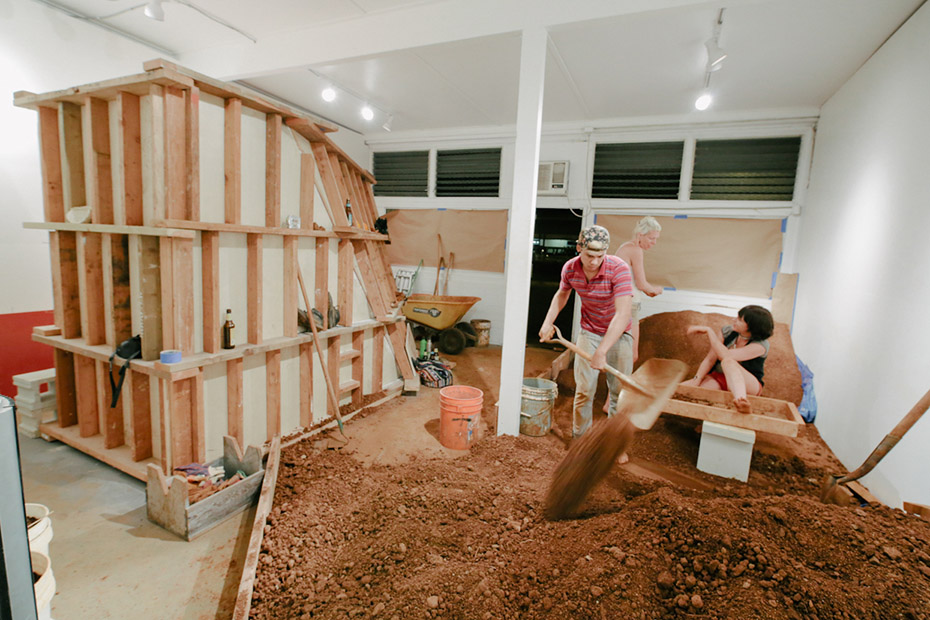
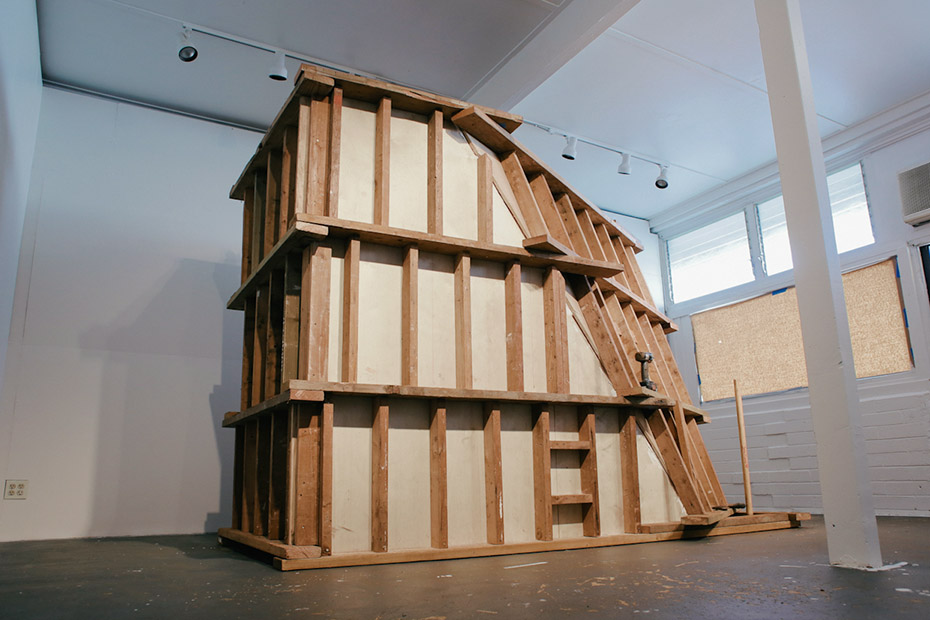
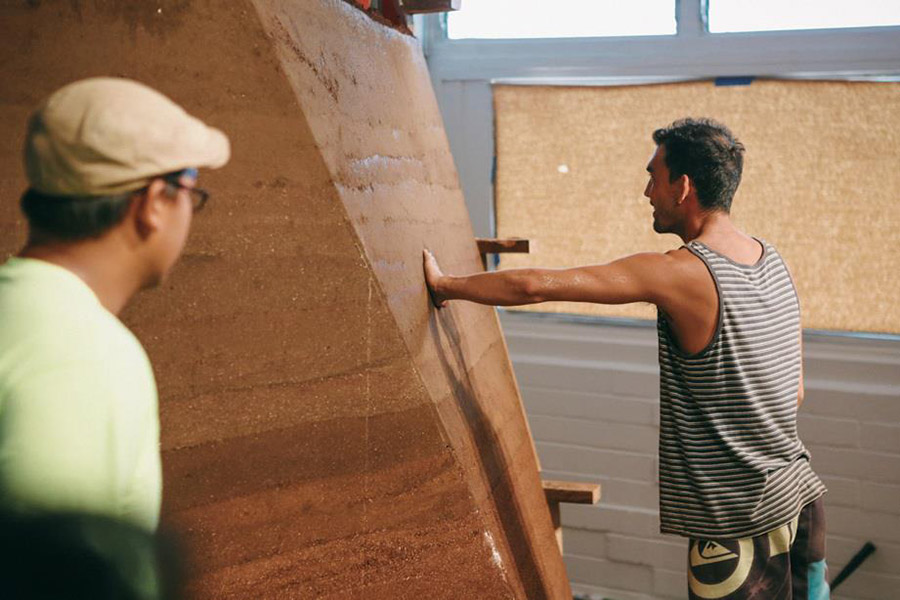
The form itself was molded using timber framework to shape, pack, and stabilize the soil and coral sand—

[Images: A Small Area of Land (Kaka‘ako Earth Room) by Sean Connelly at Honolulu’s ii gallery; images courtesy of the artist].
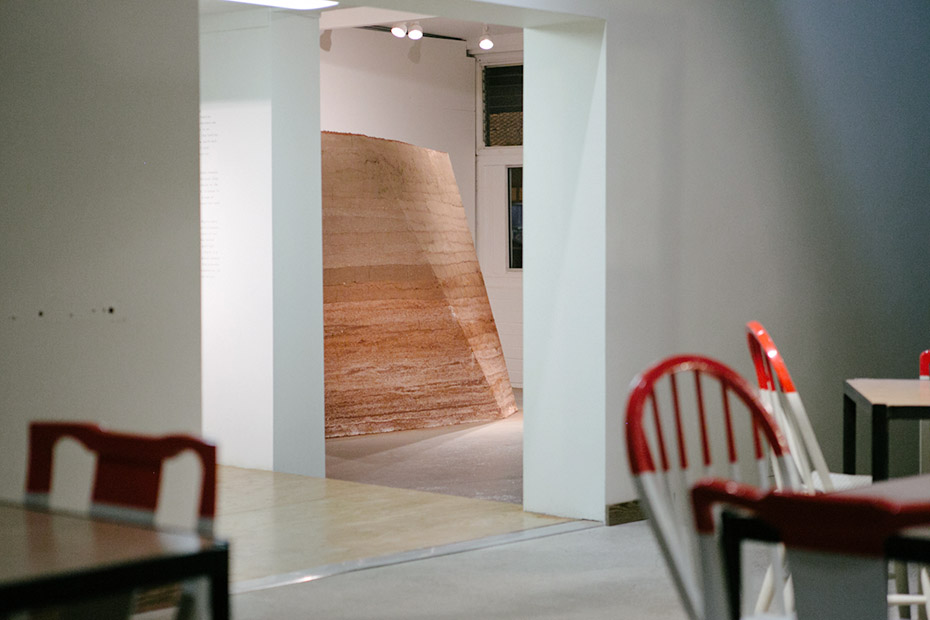
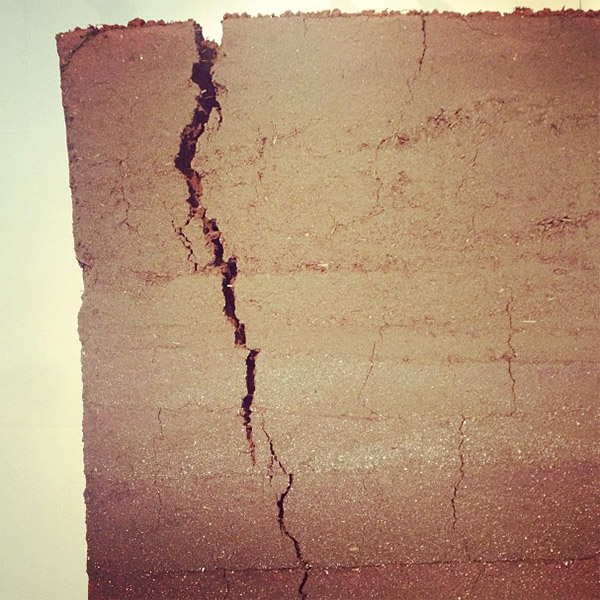
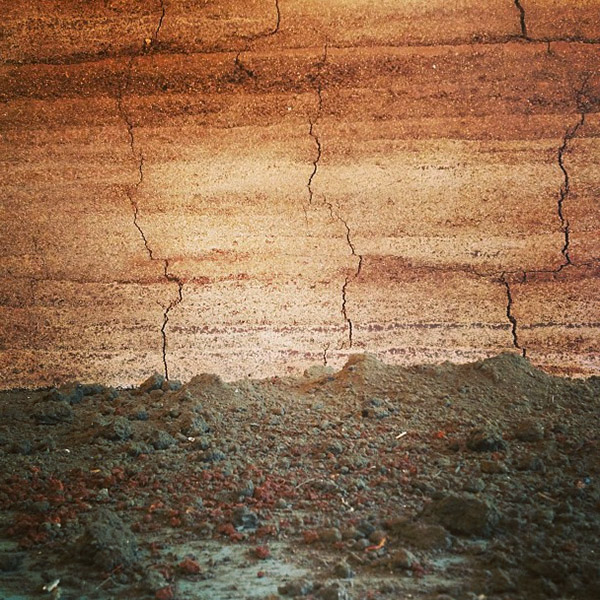
—but this, nonetheless, doesn’t prevent the granular materials from seeking out their own, more natural shape, released from geometric imposition: sagging, cracking, creeping, buckling, and shedding matter over the course of the show.

[Images: A Small Area of Land (Kaka‘ako Earth Room) by Sean Connelly at Honolulu’s ii gallery; images courtesy of the artist].
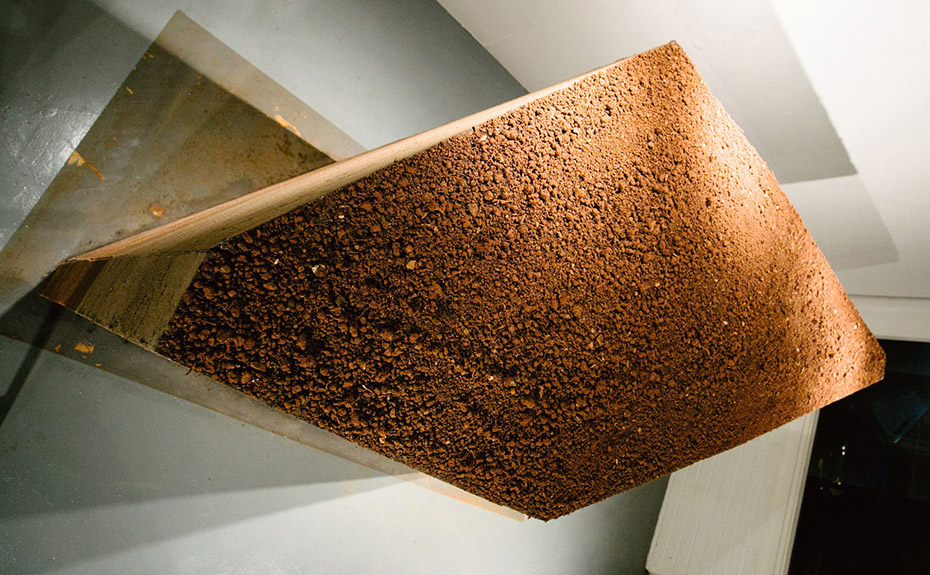
It is a sculpture that slowly falls apart—the earth exhausted from holding itself in place for so long—crumbling back to a less formal and organized condition, leaving chalky, smudged traces like a beach on the gallery floor.

[Images: Four Instagrams by Sean Connelly of his Small Area of Land (Kaka‘ako Earth Room) installation at Honolulu’s ii gallery].

Apparently inspired by Walter de Maria’s New York Earth Room, Connelly wanted to see “what a version of this might look like in Hawai‘i, on Hawai‘i’s terms.”

[Images: A Small Area of Land (Kaka‘ako Earth Room) by Sean Connelly at Honolulu’s ii gallery; images courtesy of the artist].

To find out required his own massive earth-moving operation, bringing the 32,000 pounds of soil and sand to the gallery in a truck and carting it in with wheelbarrows; then compressing, framing, and forming the soil into the imposing trapezoid, a rammed earth Euclid.

[Images: A Small Area of Land (Kaka‘ako Earth Room) by Sean Connelly at Honolulu’s ii gallery; images courtesy of the artist].
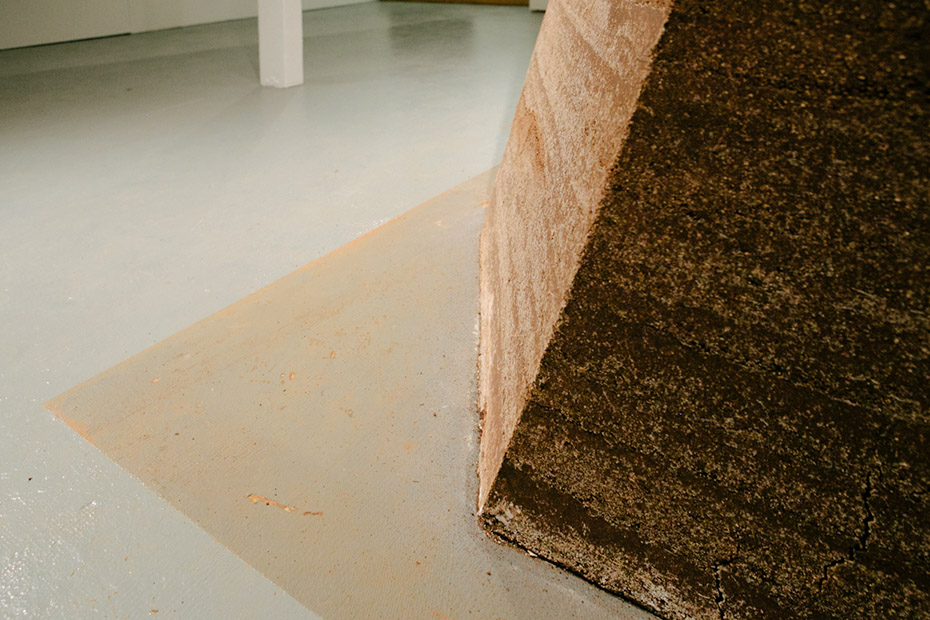
The results are these gorgeous but temporary slopes, planes, and strata, soon to crumble.

[Image: A Small Area of Land (Kaka‘ako Earth Room) by Sean Connelly at Honolulu’s ii gallery; courtesy of the artist].

You can also listen to the artist discuss the piece on Hawaii Public Radio. A Small Area of Land is on display until April 27th at the ii gallery, at which point it will be “demolished.” I’m not sure if this is a public event or not, but the process of dismantling the sculpture would be an interesting thing to see.

The Planetary Super-Surface of San Bernardino County

A surprisingly interesting business article in the Los Angeles Times this past weekend pointed out that an “industrial real estate boom” is underway east of the city: “Nestled on the windy plains at the foot of the San Bernardino Mountains,” we read, “once austere stretches of agricultural land have morphed into the country’s most desirable industrial real estate market, and it is growing faster than any other industrial region in the U.S.”

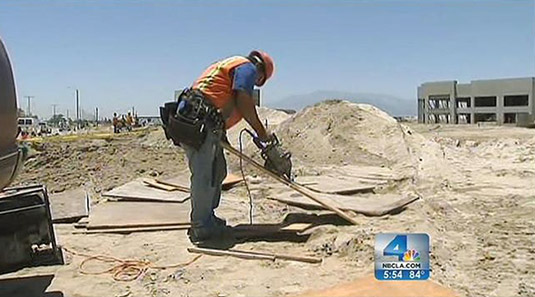
[Image: Construction work at a future Amazon.com warehouse in San Bernardino, courtesy of NBC Southern California].
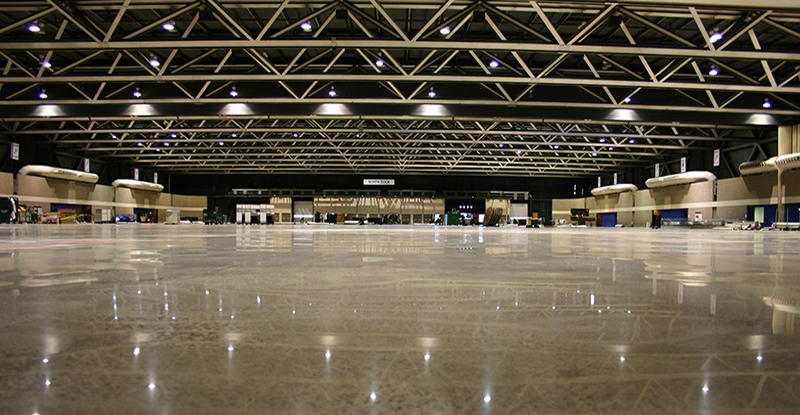
What’s at stake? Eager buyers are snapping up “vast warehouses—some are bigger than 30 football fields under one roof—where they can store, process and ship merchandise such as clothes, books and toys to ever more online shoppers and handle the rising flood of goods passing through the ports of Los Angeles and Long Beach.”

It’s a logistics rush “so intense” that “developers are erecting more than 16 million square feet of warehouses on speculation, meaning they are gambling that buyers or renters will rush forward to claim the buildings by the time they are complete.”

As it happens, though, huge volumes of empty space framed by walls and ceilings are something of the ultimate testing ground for robot intelligence: “Once upon a time, a warehouse was where you stored things for weeks or months, such as toys and canned food that retailers would grab to restock their shelves. Sorting, organizing and moving the inventory was a constant challenge.”

However, now, in this age of empty architectural airspace, “Tracking goods in the modern age of bar codes, scanners and computers is a comparative breeze. The location of every widget can be identified with pinpoint accuracy and fetched by robots that can lift and carry 3,000-pound loads with ease.”

[Image: An unrelated warehouse photo from CCI Flooring].
I’m reminded of something novelist Zachary Mason said in an interview with BLDGBLOG three years ago. Mason, who has also worked in the field of artificial intelligence, pointed out the spatial problems faced by any truly emergent A.I.:

One of the problems with A.I. is that interacting with the world is really tough. Both sensing the world and manipulating it via robotics are very hard problems, and solved only for highly stripped-down special cases. Unmanned aerial vehicles, for instance, work well, because maneuvering in a big, empty, three-dimensional void is easy—your GPS tells you exactly where you are, and there’s nothing to bump into except the odd migratory bird. Walking across across a desert, though, or, heaven help us, negotiating one’s way through a room full of furniture in changing lighting conditions, is vastly more difficult.

The prospect of Artificial Intelligence finding its way into the world not by way of unmanned aerial vehicles flying in Mason’s “big, empty, three-dimensional void” but, instead, in the vast and echoing elsewhere of speculative warehouse space built in the desert outside Los Angeles is an incredible, and even somewhat frightening, thing to contemplate.

However, I started this post actually hoping to point out one small thing mentioned merely in passing at the end of the L.A. Times article.

One of these warehouses, it turns out, is actually so huge it must be laser-leveled against the curvature of the earth.

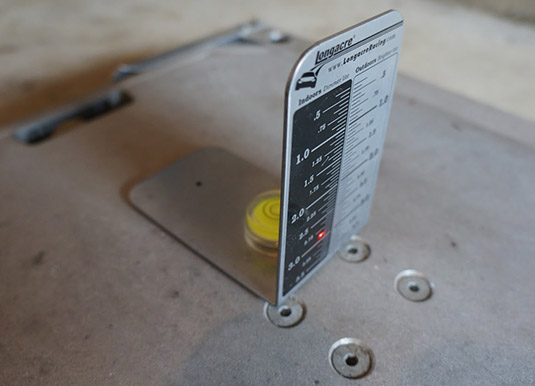
[Image: A laser-leveling target used for calibrating car scales, taken by someone named “Butt Dyno,” via an evolutionm.net forum].
The building in question “has 32-foot ceilings and enough doors to load or unload 124 trucks at the same time,” presenting insane combinatorial possibilities that would make the bridges of Königsberg blush; but, even more unbelievably, this “480,000-square-foot facility recently built for Quaker Oats Co. on land that used to be part of Norton Air Force Base in San Bernardino… is so long at 1,000 feet that contractors laying the concrete floor used lasers to gently follow the curve of the Earth and keep the floor level.”

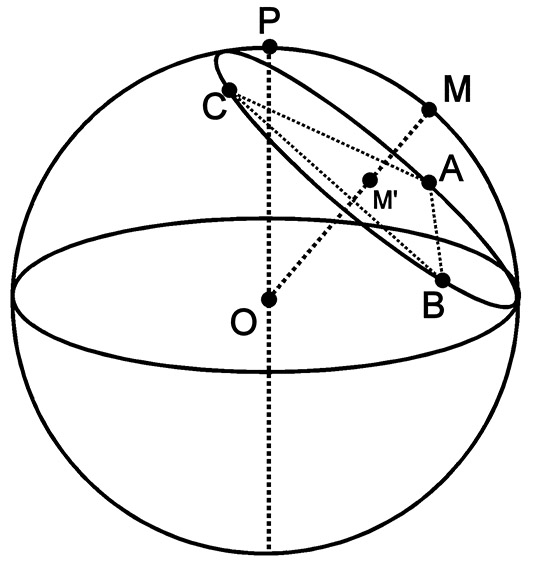
Of course, this means that you could also work in reverse, and thus deduce, from the precise leveling of the warehouse floor, the curvature of the planet it rests on, which, bizarrely enough, makes studying this building—an empty warehouse in the California desert—an unexpected subset of astronomical calculation.

Last week, for instance, we looked at various “benchmarks” that have been used for measuring the circumference of the Earth, but perhaps future generations will simply drive out to a cluster of warehouses somewhere on the fringes of Los Angeles—next century’s Stonehenge, a new Solomon’s Temple, or Superstudio meets Eratosthenes—ritually laser-level the floor on a hot summer afternoon, and thus deduce the limits of our world itself, all by way of the most “fundamental” of architectural interventions: the floor.


The logistical super-surface as planetary analogue.

Bingham Landslide

[Image: Photo by Ravell Call, Deseret News, courtesy of KSL].
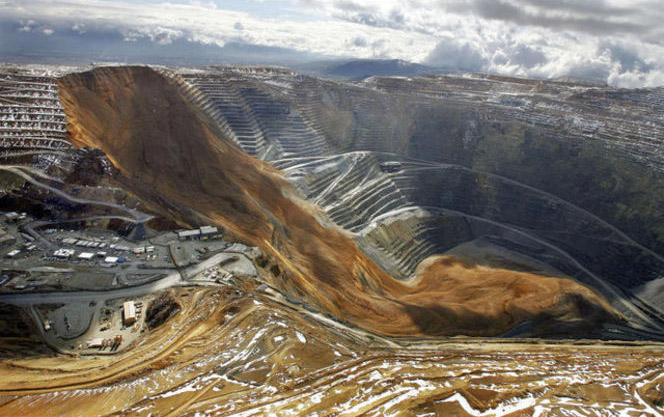
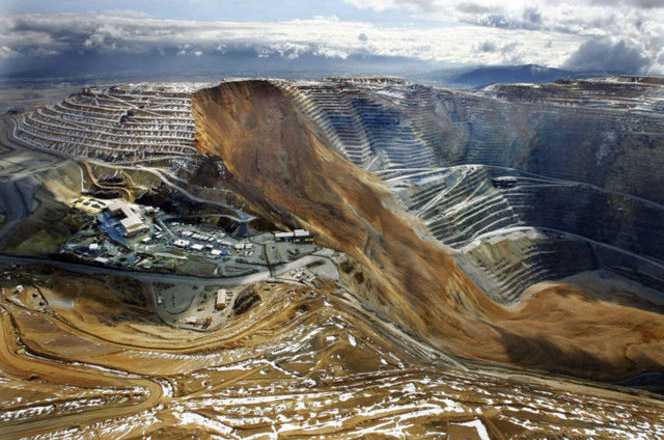
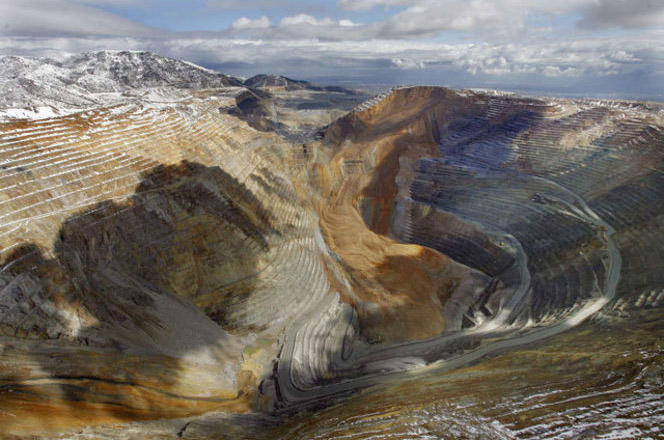
Utah’s Bingham Canyon Mine, one of the largest active copper mines in the world, had a massive landslide last night, which makes for quite an extraordinary coppery blur against the orderly terraced geometry of the hole itself.

[Images: Photos by Ravell Call, Deseret News, courtesy of KSL].
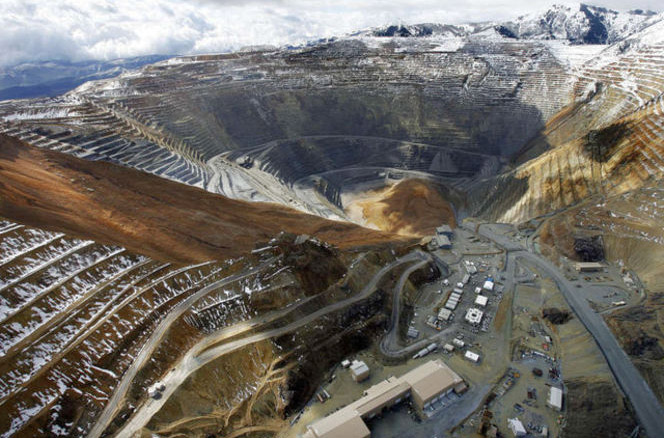
“The copper-mining company [Kennecott] was aware of the impending slide ,” local news station KSL reports, “and had warned residents near the mine Wednesday that a slide was possible any day.”

Kennecott engineers had been detecting ground movement as far back as February. At the time, the movement amounted to just fractions of an inch, but it was enough for the company to close and relocate the mine’s visitors center. “This is something that we had anticipated,” [a company spokesperson] said of the slide. “We knew the slide was imminent. We had relocated machinery, we had rerouted roads, we had rerouted utilities, we had rerouted buildings.”

But the ground had faster plans, and it rerouted the roads itself.

[Image: Photo by Ravell Call, Deseret News, courtesy of KSL].
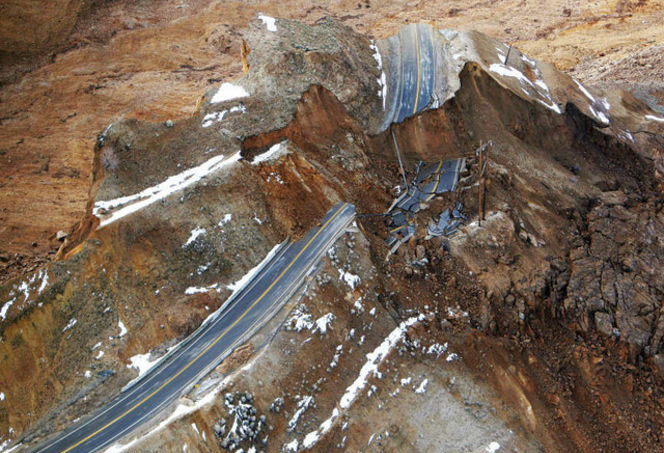
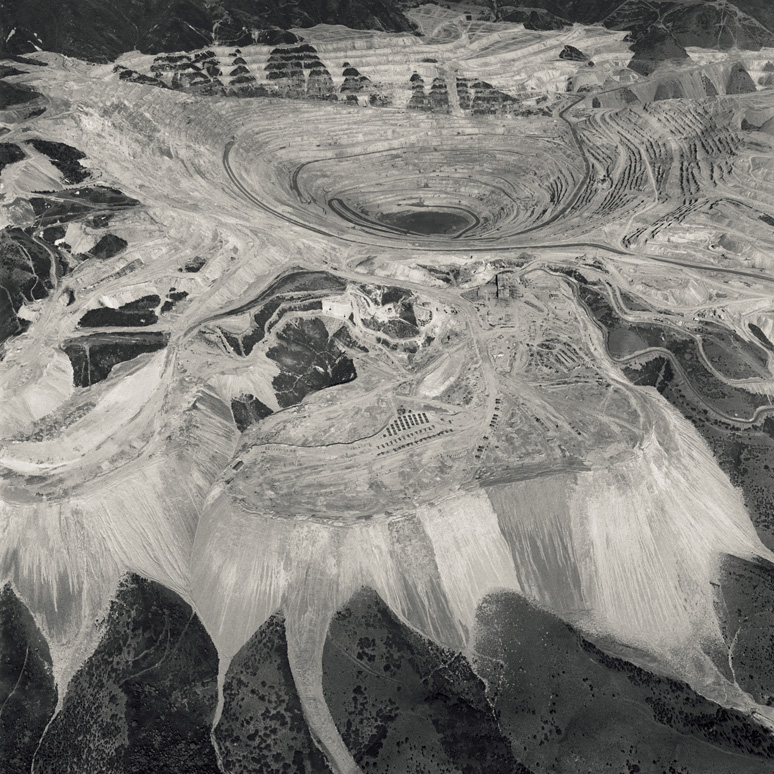
Oddly enough, the Bingham Pit, as it’s colloquially known, was the subject of one of the earliest posts on BLDGBLOG, as well as a recurring site of visual investigation in the work of photographer David Maisel. “These sites are the contemplative gardens of our time,” Maisel writes, “places that offer the opportunity to reflect on who and what we are collectively, as a society.”

It is an absolutely amazing landform perhaps made all the more otherworldly by the Herculean levels of terrestrial obliteration its creation required: planetary resurfacing performed on a jaw-dropping scale.

[Image: An aerial photo of the Bingham Canyon Mine, Utah, by David Maisel].

Last night’s landslide only adds to its terrestrial interest, giving us hints of what fate might ultimately befall all the many mines, flattened mountains, hydroelectric dams, and other gigantic acts of human industry—open wounds, lasting far longer than cities—that currently surround us.

[Image: Photo by Ravell Call, Deseret News, courtesy of KSL].
After all, even our deepest mines will erase themselves, buried in flash floods of rock, carrying nearby architecture, roads, and all memories of themselves along with them.

(Bingham landslide photos originally spotted via Chris Rowan).

Foundation

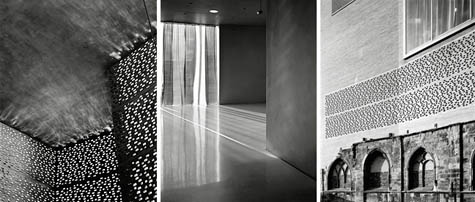
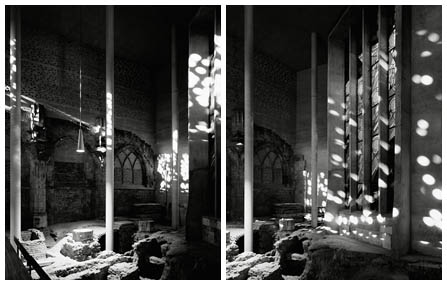
[Images: The Kolumba art gallery, by Peter Zumthor].

Steve Rose of the Guardian this morning greets us with a “magnificent art gallery with a ruined gothic church in the basement.”
The gallery is in Cologne, Germany, it’s called Kolumba, and it was recently designed by architect Peter Zumthor.
The building’s “cavernous ground-floor room,” Rose writes, “is dimly lit, but fresh air and dappled sunlight spill in from honeycomb-like perforations high above.”
Even better: “Embedded in the light brick walls are the blackened windows and arches of a ruined gothic church, onto which this new building has been grafted.” And, “disappearing into the depths and the darkness, are the excavated ruins of crypts, vaults and foundations.”

[Images: The Kolumba art gallery, by Peter Zumthor].

The backstory, briefly, is that the church – called St. Kolumba – was “reduced to rubble during the second world war,” but, we read, “[a] wooden Madonna survived the bombing so, after the war, local architect Gottfried Böhm built the small octagonal chapel on the site, dedicated to the ‘Madonna of the Ruins’. In the 1970s, excavations revealed evidence of previous churches, not to mention vaults filled with human bones.”
Evidence of previous churches! Such a beautiful phrase. Finding evidence of other buildings – older buildings – inside the building you’re now standing in.
Or perhaps you find evidence of a newer building, inside the building you’re standing in – and you realize, stunned, that someone is replacing the building, slowly and in secret over the course of several years, in bits and pieces, here and there, leaving traces, evidence, clues.
In any case, Kolumba, with its swirling foundations on top of foundations on top of crypts, now houses religious art.
In 650 years, someone will build another museum atop its wreckage.

(Thanks, Nicky!)

Electromagnetic Chiaroscuro

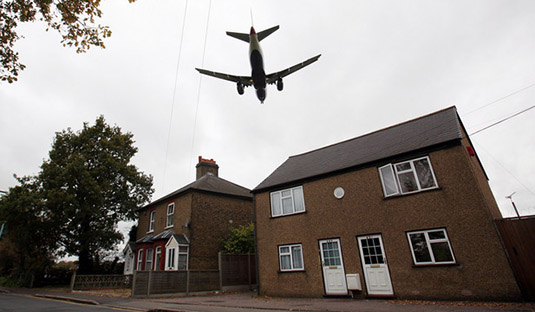
[Image: A plane lands at Heathrow, London; photo by Simon Dawson, courtesy of Bloomberg].

A short article in The Economist raises the possibility that television signals in London, England, could be turned into a passive, aircraft-detecting radar system.

A system such as this “relies on existing signals, such as television and radio broadcasts, to illuminate aircraft.”

This involves using multiple antennas to listen out for signals from broadcast towers, and for reflections of those signals that have bounced off aircraft, and comparing the two. With enough number-crunching, the position, speed and direction of nearby aircraft can then be determined. Passive radar requires a lot of processing power, but because there is no need for a transmitter, it ends up being cheaper than conventional radar. It also has military benefits, because it enables a radar station to detect objects covertly, without emitting any signals of its own.

“Will soap operas and news bulletins end up helping to direct aircraft in London’s busy skies?” The Economist asks. The idea of the entirety of London becoming a passive aeronautic device, pinging both commercial aircraft and military planes, and tracking the encroachment of unmanned aerial vehicles on urban airspace, all simply by piggybacking on the everyday technology of the television set, is pretty eerie, as if living in a giant radar dish powered by late-night entertainment.

London becomes a weird new kind of camera pointed upward at secretly passing aircraft, your living room taking pictures of the sky.

It also brings to mind the so-called “wifi camera” developed way back in 2008 by Bengt Sjölén and Adam Somlai Fischer with Usman Haque. The wifi camera “takes ‘pictures’ of spaces illuminated by wifi in much the same way that a traditional camera takes pictures of spaces illuminated by visible light.”

[Image: The “wifi camera” by Bengt Sjölén and Adam Somlai Fischer with Usman Haque].

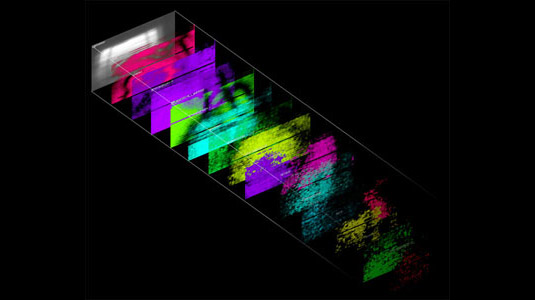
You can thus create images of architectural spaces, almost like a CAT scan, based on wifi signal strength, deducing from the data things like building layout, room density, material thickness, the locations of walls, doors, windows, and more, albeit to quite a low degree of resolution.

[Image: Signal data and its spatial implications from the “wifi camera” by Bengt Sjölén and Adam Somlai Fischer with Usman Haque].
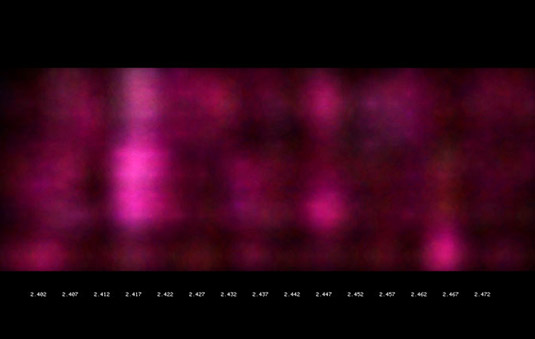
“With the camera we can take real time ‘photos’ of wifi,” its developers write. “These show how our physical structures are illuminated by this particular electromagnetic phenomenon and we are even able to see the shadows that our bodies cast within such ‘hertzian’ spaces.”

It’s a kind of electromagnetic chiaroscuro that selectively and invisibly “illuminates” the built environment—until the right device or camera comes along, and all that spatial data becomes available to human view. It’s like a sixth sense of wifi, or something out of Simone Ferracina‘s project Theriomorphous Cyborg.

Here, the comparison to the London TV radar system is simply that, in both cases, already existing networks of electromagnetic signals are operationalized, so to speak, becoming inputs for a new form of visualization. You can thus take pictures of the sky, so to speak, using passive, city-wide, televisual radar, and you can scan the interiors of unknown buildings using wifi cameras tuned to routers’ electromagnetic glow.

[Image: From the “wifi camera” by Bengt Sjölén and Adam Somlai Fischer with Usman Haque].

Apropos of very little, meanwhile, and more or less dispensing with plausibility, it would be interesting to see if the same sort of thing—that is, passive radar, using pre-existing signals—could somehow be used to turn the human nervous system itself into a kind of distributed, passively electric object-detection device on an urban scale. Nervous systems of the city as sensor network: a neuro-operative technology always scanning, sometimes dreaming, interacting with itself on all scales.