Flying Robotic Construction Cloud

Quentin Lindsey, Daniel Mellinger, and Vijay Kumar from the University of Pennsylvania’s GRASP Lab—General Robotics, Automation, Sensing and Perception—have devised a system whereby autonomous flying helicopters can assemble a rudimentary architectural grid using small magnetic beams.

This technology begs a series of questions, of course, including who might first pick up on and directly invest in this construction process (the field exploration wings of transnational oil-services firms? forward-operating base commanders of the 22nd-century U.S. military? rogue GSD students self-supported by a family trust fund?), what sorts of architectural styles might result given the technical and material limitations associated with magnetic cloud-construction (a return to the minimalist grid? Sol Lewitt as architectural progenitor?), and how successfully this could be scaled up to the dimensions of whole towns and cities.

It might not be altogether unfeasible, in other words, given enough time and investment, that we’ll someday see flocks of autonomous helicopters roaring off into western Australia, or into the Canadian Arctic, autonomously assembling supply-chain-governed grid-cities where every magnet, bolt, beam, and screw is dutifully accounted for and guided into place by intelligent airborne mechanisms. Then the humans move in.

Or, extending this into the clichéd territory where BLDGBLOG and the Terminator begin to overlap, perhaps the machines will construct factories for the production of more machines, which will then fly onward and further to build yet more factories, constructing a sovereign halo of autonomous machine-urbanism in the earth’s north polar latitudes.

(Via @WillWiles).

Landscape Futures Super-Dialogue

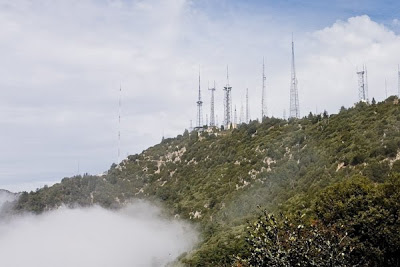
[Image: The electromagnetic infrastructure of Los Angeles; photo by the Center for Land Use Interpretation].

I’ve deliberately waited to the last minute to mention this event, simply because there will only be room for five or six people to join us, but the Landscape Futures Super-Workshop pops out in public today for a live event beginning at 1pm at the Center for Land Use Interpretation in Culver City.

It features, in order of appearance:

Matthew Coolidge, Center for Land Use Interpretation
David Gissen, Subnature / HTC Experiments / California College of the Arts
David Benjamin, The Living
Liam Young, Tomorrow’s Thoughts Today / Architectural Association
Mark Smout and Laura Allen, Smout Allen / Barlett School of Architecture
Elizabeth Ellsworth and Jamie Kruse, Smudge Studio / Friends of the Pleistocene

Students from the Arid Lands Institute will also have a casebook of research drawings on display, and the day will conclude with a panel discussion, kicking off at 4pm, featuring all of the above speakers in addition to Arid Lands Institute faculty and Los Angeles Times architecture critic Christopher Hawthorne.

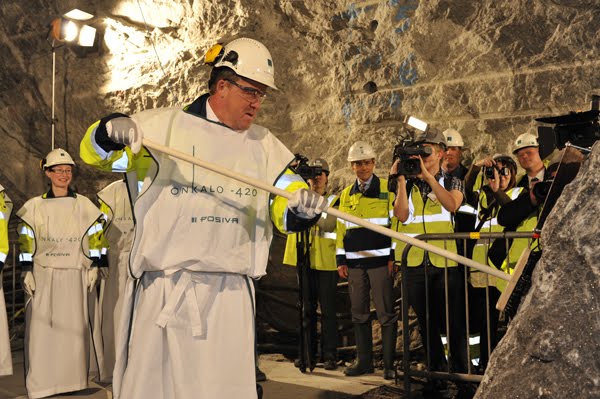
[Image: “Topping-out ceremony” at the Onkalo nuclear-waste sequestration site, Finland; photo by Posiva/Jari Hakala, via Friends of the Pleistocene].

In addition to the work of each practitioner listed above, we’ll be discussing everything from the coastal-expansion infrastructures of Los Angeles, urban aridity, future climates and their spatial implications, and the architecture of dynamic landscapes to the cognitive difficulties associated with geologic time, the Super-Workshop‘s own recent experience of L.A., L.A. itself as a site for interventions both speculative and real, and the layered ecologies of the city.

Things kick off at 1pm at the Center for Land Use Interpretation. Due to the size of our own group, however, I should point out again that there will be limited space, and I’d thus suggest arriving early.

Ground TV

[Image: An otherwise unrelated temple complex in Indonesia].

“Hardened lava from Indonesia’s Mount Merapi covers ancient temples in the historic city of Yogyakarta,” Archaeology News reports. As if fishing in the ground for lost architecture, “Scientists are using remote sensing equipment to locate them.”

The Jakarta Post elaborates, pointing out that “objects recently found underneath cold lava,” thus “requiring archeologists to use remote sensing equipment to find them,” remain physically ambiguous when they cannot be directly excavated. Indeed, “the equipment cannot determine precisely whether rock is part of a temple construction or not.” In some cases, then, it’s a question of forensic interpretation.

Nonetheless, five entire temples have been discovered so far, locked down there in old lava: the Morangan, Gampingan, Kadisoko, Sambisari and Kimpulan temples, “buried between 2 and 9 meters deep.” That’s nearly thirty feet of rock—a once-liquid landscape covering blurred remnants of an otherwise overwritten past, architectural history by way of subterranean remote-sensing.

I should point out, meanwhile, that Archaeology News also links to a quick story taking place out here in greater Los Angeles: a parking lot in Ventura, at the intersection of Palm and Main streets, is under archaeological investigation. “Researchers this week are crisscrossing the parking lot using ground-penetrating radar,” the Ventura County Star explains, “in search of anomalies below the asphalt that could be artifacts or building foundations from years past. Archaeologists will return to excavate by hand those areas believed to contain artifacts.”

I love the idea that the surface of a parking lot could become something like a new screen technology—a depth-cinema of lost evidence from earlier phases of human history, shining from within with archaeological remains as researchers walk back and forth above.

Imagine the archaeological cinema of the future—some massive open parking lot in Istanbul, say, where crowds arrive, milling about, tickets in hand, and then, like the giant LED screen from the Beijing Olympics, the city’s archaeological past is revealed in 3D: hologram-like structures shivering there inside the surface of the earth, below everyone’s feet in real-time, the planet become an immersive TV screen on which we can view the debris of history.

Books Received: Climate Futures List

A rash of recent books about the geographic implications of climate change have crossed my desk. In this themed supplement to BLDGBLOG’s ongoing Books Received series, I thought I’d group them together into one related list.
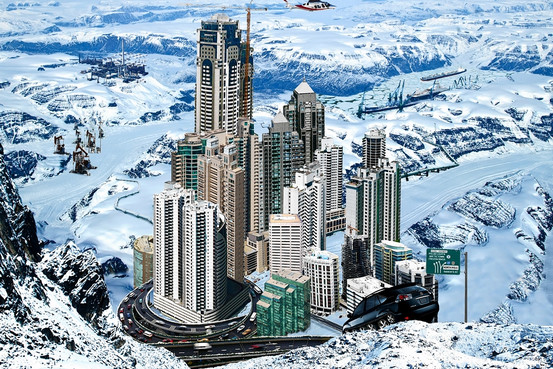
[Image: Courtesy of the Wall Street Journal].

What many of the books described in this post have in common—aside from their shared interest in what a climatically different earth will mean for the future of human civilization—is their use of short, fictionalized narratives set in specific future years or geographic regions as a way of illustrating larger points.

These narrative scenarios—diagnostic estimates of where we will be at some projected later date—come with chapter titles such as “Russia, 2019,” “China, 2042,” “Miami Beached,” and “Holland 2.0 Depolderized.” Among the various spatial and geopolitical side-effects of climate change outlined by these authors are a coming depopulation of the American Southwest; a massive demographic move north toward newly temperate Arctic settlements, economically spearheaded by the extraction industry and an invigorated global sea trade; border wars between an authoritarian Russia and a civil war-wracked China; and entire floating cities colonizing the waters of the north Atlantic as Holland aims to give up its terrestrial anchorage altogether, becoming truly a nation at sea.

“Will Manhattan Flood?” asks Matthew E. Kahn in his Climatopolis: How Our Cities Will Thrive in the Hotter Future. What will Greenland look like in the year 2215, with atmospheric carbon dioxide levels at 1300 parts per million, according to Peter Ward’s The Flooded Earth: Our Future In a World Without Ice Caps? Will a “New North” rise as the Arctic de-ices and today’s economic powerhouses, from Los Angeles to Shanghai, stagnate under killer droughts, coastal floods, and heat waves, as Laurence C. Smith suggests in The World in 2050: Four Forces Shaping Civilization’s Northern Future?

[Image: Modeling sea-level rise in Florida, courtesy of Penn State].

However, climate change is only one of the world-altering forces under discussion in each of these six books. Demography, oil scarcity, natural resources, public hygiene, and accelerating globalization all play roles, to different extents, in these authors’ thinking. In one case, in particular—Float!: Building on Water to Combat Urban Congestion and Climate Change, the most practical book described here—new construction technologies, with immediate implications for architectural design, also take center stage.

In all cases, though, these books offer further evidence of an irresistible popular urge to discuss the future, and to do so through what can very broadly described as fiction. The recent speculative tone taken by much of today’s architecture writing is only part of this trend; from “design fiction” to speculative foreign policy blogs, and from “the world without us” to future food, a compulsion to understand what might happen to human civilization, in both the near and distant future, using fictional scenarios and speculative hypotheses seems to be at a high point of trans-disciplinary appeal.

As Heidi Cullen writes in The Weather of the Future: Heat Waves, Extreme Storms, and Other Scenes from a Climate-Changed Planet, there is something inherently difficult in comprehending the scale of climate change—what effects it might have, what systems it might interrupt or ruin. She thus imports lessons from cognitive psychology to understand what it is about climate change that keeps it so widely misinterpreted (though a hefty dose of media criticism, I’d argue, is far more apropos). It is interesting, then, in light of the apparent incomprehensibility of climate change, that fictional scenarios have become so popular a means of explaining and illustrating what Cullen calls our “climate-changed planet.”

This emerging narrative portraiture of climate change—exemplified by most of the books under discussion here, whether they present us with Atlanta running out of freshwater, frantic Chinese troops diverting rivers on the border with India, or a governmentally-abandoned Miami given over to anarchism and mass flooding—offers an imperfect but highly effective way of making a multi-dimensional problem understandable.

After all, if stories are an effective means of communicating culturally valuable information—if stories are pedagogically useful—then why not tell more stories about future climate change—indeed, why not tell more stories about architecture and buildings and emerging technologies and the spaces of tomorrow’s geopolitics?

Perhaps this is why so much of architecture writing today, both on blogs and elsewhere, so willfully crosses over into science fiction: if architecture literally is the design and proposal of a different world—one that might exist tomorrow, next year, next decade—then it is conceptually coextensive with the genre of scifi.

The current speculative turn in architecture writing is thus both unsurprising and highly appropriate to its subject matter—something worth bearing in mind by anyone hoping to find a larger audience for architectural critique.
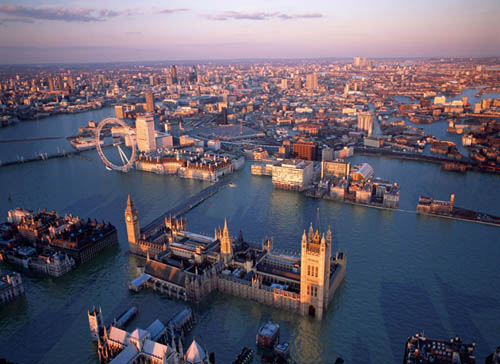
[Image: “London as Venice” by Robert Graves and Didier Madoc-Jones, based on a photo by Jason Hawkes (part of an image series well-critiqued by the Guardian)].

An obvious problem with these preceding statements, however, is that we might quickly find ourselves relying on fiction to present scientific ideas to a popular audience; in turn, this risks producing a public educated not by scientists themselves but by misleading plotlines and useless blockbusters, such as The Day After Tomorrow and State of Fear, where incorrect popular representations of scientific data become mistaken for reports of verified fact.

In a way, one of the books cited in the following short list unwittingly demonstrates this very risk; Climate Wars: The Fight for Survival as the World Overheats would certainly work to stimulate a morally animated conversation with your friends over coffee or drinks, but there is something about its militarized fantasies of Arctic tent cities and Asian governments collapsing in civil free-fall that can’t help but come across as over-excitable, opening the door to disbelief for cynics and providing ammunition for extreme political views.

Indeed, I’d argue, the extent to which contemporary political fantasies are being narratively projected onto the looming world of runaway climate change has yet to be fully analyzed. For instance, climate change will cause the European Union to disband, we read in one book cited here, leaving Britain an agriculturally self-sufficient (though under-employed) island-state of dense, pedestrian-friendly urban cores; the U.S. will close its foreign military bases en masse, bringing its troops home to concentrate on large-scale infrastructural improvements, such as urban seawalls, as the middle class moves to high-altitude safety in the Rocky Mountains where it will live much closer to nature; Africa, already suffering from political corruption and epidemic disease, will fail entirely, undergoing a horrific population crash; and China will implode, leaving the global north in control of world resources once again.

It is important to note that all of these scenarios represent explicit political goals for different groups located at different points on the political spectrum. Perversely, disastrous climate change scenarios actually offer certain societal forces a sense of future relief—however misguided or short-term that relief may be.

Elsewhere, I’ve written about what I call climate change escapism—or liberation hydrology—which is the idea that climate change, and its attendant rewriting of the world’s geography through floods, is being turned into a kind of one-stop shop, like the 2012 Mayan apocalypse, for people who long for radical escape from today’s terrestrial status quo but who can find no effective political means for rallying those they see as forming a united constituency. Climate change thus becomes a kind of a deus ex machina—a light at the end of the tunnel for those who hope to see the world stood abruptly on its head.

Indeed, we might ask here: what do we want from climate change? What world do we secretly hope climate change will create—and what details of this world can we glimpse in today’s speculative descriptions of the future? What explicit moral lessons do we hope climate change will teach our fellow human beings?
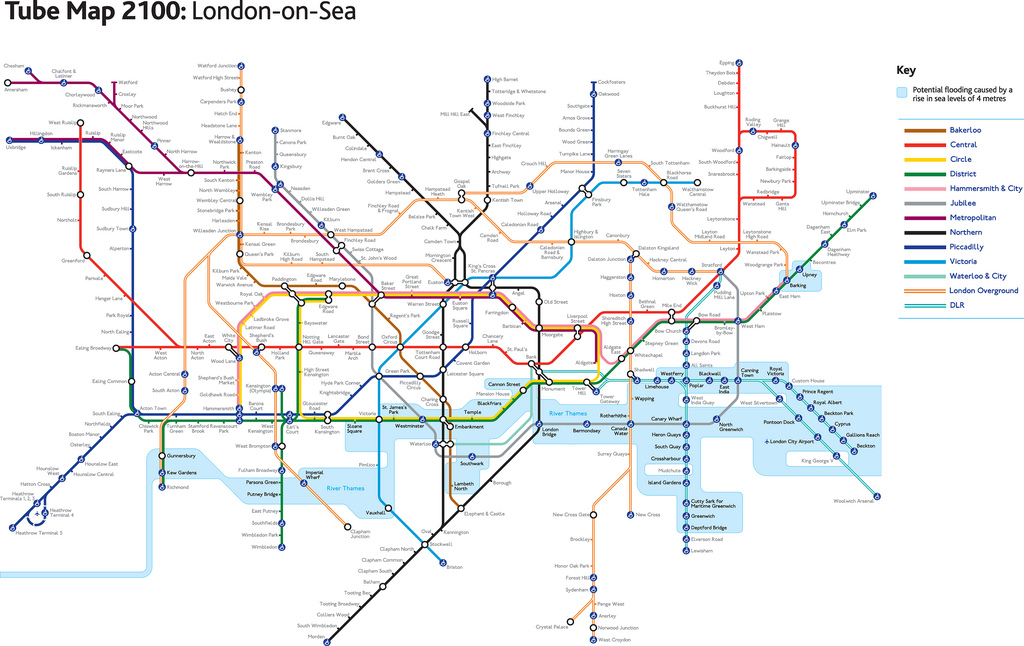
[Image: “London-on-Sea” by Practical Action].

Of course, the six books listed below are by no means the only ones worth reading on these topics; in fact, the emerging genre of what I’ll call climate futures is an absolutely fascinating one, and these books should be seen as a useful starting place. I would add, for instance, that Charles Emmerson’s recent Future History of the Arctic clearly belongs on this list—however, I covered it in an earlier installment of Books Received. Further, Forecast: The Consequences of Climate Change, from the Amazon to the Arctic, from Darfur to Napa Valley by Stephan Faris is a commendably concise and highly readable introduction to what global climate change might bring, and Elizabeth Kolbert’s Field Notes from a Catastrophe: Man, Nature, and Climate Change has become something of a minor classic in this emerging field.

So, without further ado, here are six new books about climate futures.
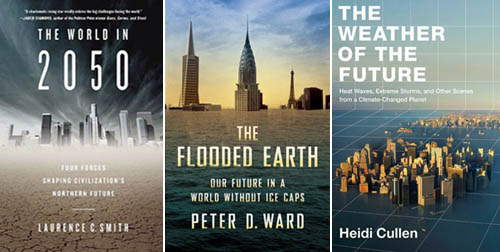
The World in 2050: Four Forces Shaping Civilization’s Northern Future by Laurence C. Smith (Dutton). Smith’s book is a virtuoso example of what I would call political science fiction, extrapolating from existing trends in demography, natural-resource depletion, globalization, and climate change to see what will happen to the eight nations of the Arctic Rim—what Smith alternately calls the New North and the Northern Rim. “I loosely define this ‘New North,'” Smith writes, “as all land and oceans lying 45º N latitude or higher currently held by the United States, Canada, Iceland, Greenland (Denmark), Norway, Sweden, Finland, and Russia.”

I should point out that the book’s cover art depicts downtown Los Angeles being over-run by the cracked earth of a featureless desert, as clear an indication as any that Smith’s New North will benefit from negative—indeed, sometimes catastrophic—effects elsewhere.

In an article-slash-book-excerpt published last month in the Wall Street Journal, Smith wrote: “Imagine the Arctic in 2050 as a frigid version of Nevada—an empty landscape dotted with gleaming boom towns. Gas pipelines fan across the tundra, fueling fast-growing cities to the south like Calgary and Moscow, the coveted destinations for millions of global immigrants. It’s a busy web for global commerce, as the world’s ships advance each summer as the seasonal sea ice retreats, or even briefly disappears.” Further:

If Florida coasts become uninsurable and California enters a long-term drought, might people consider moving to Minnesota or Alberta? Will Spaniards eye Sweden? Might Russia one day, its population falling and needful of immigrants, decide a smarter alternative to resurrecting old Soviet plans for a 1,600-mile Siberia-Aral canal is to simply invite former Kazakh and Uzbek cotton farmers to abandon their dusty fields and resettle Siberia, to work in the gas fields?

Being an unapologetic fan of rhetorical questions—will speculative Arctic infrastructure projects be, in the early 2010s, what floating architecture was to the mid-2000s?—the overall approach of Smith’s book maintains a strong appeal for me throughout. The final chapter, in which, as Smith writes, we “step out of the comfort zone” into more open speculation, caps the book off nicely.

The Flooded Earth: Our Future In a World Without Ice Caps by Peter D. Ward (Basic Books). Ward, a paleontologist, has produced a disturbing overview of how terrestrial ecosystems might be fundamentally changed as sea levels rise—and rise, and rise. Ward has the benefit of calling upon data taken from extremely distant phases of the earth’s history, almost all of which becomes highly alarming when transposed to the present and near-future earth. “This book is based on the fact that the earth has flooded before,” he writes, including phases in which seas rose globally at rates of up to 15 feet per century.

Ward successfully communicates the fact that the stakes of climate change are urgent and huge. Indeed, he writes, “The most extreme estimate suggests that within the next century we will reach the level [of carbon dioxide in the atmosphere] that existed in the Eocene Epoch of about 55 million to 34 million years ago, when carbon dioxide was about 800 to 1,000 ppm. This might be the last stop before a chain of mechanisms leads to wholesale oceanic changes that are not good for oxygen-loving life.” That is, a cascade of terrestrial side-effects and uncontrollable feedback loops could very well begin, ultimately extinguishing all oxygen-breathing organisms and kickstarting a new phase of life on earth. Whatever those future creatures might be, they will live, as Ward has written in another book, under the specter of a “green sky.” Brief fictional scenarios—including future bands of human “breeding pairs” wandering through flooded landscapes—pepper Ward’s book.

The Weather of the Future: Heat Waves, Extreme Storms, and Other Scenes from a Climate-Changed Planet by Heidi Cullen (Harper). Cullen’s book is the one title listed here with which I am least familiar, having read only the opening chapter. But it, too, is organized by region and time frame: the Great Barrier Reef, California’s Central Valley, the Sahel in Africa, Bangladesh, New York City, and so on. The shared references to these and other locations in almost all contemporary books on climate change suggests an emerging geography of hotspots—a kind of climate change tourism in which authors visit locations of projected extreme weather events before those storms arrive. Cullen’s book “re-frightened” Stephen Colbert, for whatever that’s worth; I only wish I had had more time to read it before assembling this list.
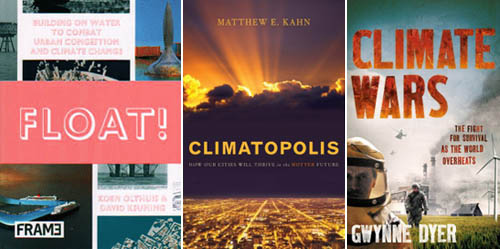
Float!: Building on Water to Combat Urban Congestion and Climate Change by Koen Olthuis and David Keuning (Frame). When David Keuning sent me a review copy of this book he joked that “offshore architecture has been relatively depleted of its novelty over the last few years”—an accurate statement, as images of floating buildings bring back strong memories of the architectural blogosphere circa 2005.

However, Keuning and Olthuis needn’t be worried about depleting the reader’s interest. A remarkably stimulating read, Float! falls somewhere between design textbook, aquatic manifesto, and environmental exhortation to explore architecture’s offshore future. Water-based urban redesign; public transportation over aquatic roadways; floating barge-farms (as well as floating prisons); maneuverable bridges; entire artificial archipelagoes: none of these are new ideas, but seeing them all in one place, in a crisply designed hardback, is an undeniable pleasure.

The book is occasionally hamstrung by its own optimism, claiming, for instance, that “Once a floating building has left its location, there will be nothing left to remind people of its former presence,” an environmentally ambitious goal, to be sure, but, without a clear focus on maritime waste management (from sewage to rubbish to excess fuel) such statements simply seem self-congratulatory. Having said that, Float! is an excellent resource for any design studio or seminar looking at the future of floating structures in an age of flooding cities.

Climatopolis: How Our Cities Will Thrive in the Hotter Future by Matthew E. Kahn (Basic Books). Kahn’s book is at once hopeful—that cities will energetically reconfigure themselves to function smoothly in a decarbonized global economy—and cautionary, warning that whole regions of the world might soon become uninhabitable.

Kahn’s early distinction between New York City and Salt Lake City—the former considered high-risk, due to coastal flooding and extreme weather events, the latter an example of what Kahn calls “safe cities”—is useful for understanding the overall, somewhat armchair tone of the book. Climatopolis is not hugely rigorous in its exploration of what makes a city “climate-safe,” and it overestimates the descriptive value of using “Al Gore” as a personality type, seeming to cite the politician at least once every few pages, but if your interests are more Planetizen than Popular Science, this is a useful overview of the urban effects of climate change over disparate cities and regions.

Climate Wars: The Fight for Survival as the World Overheats by Gwynne Dyer (Oneworld Publications). Dyer writes that his awareness of climate change was kicked off by two things: “One was the realization that the first and most important impact of climate change on human civilization will be an acute and permanent crisis of food supply.” The other “was a dawning awareness that, in a number of the great powers, climate-change scenarios are already playing a large and increasing role in the military planning process.” Putting two and two together, Dyer has hypothesized, based on a close reading of military documents outlining climate-change contingency plans, what he calls climate wars: wars over food, water, territory, and unrealistic lifestyle guarantees.

Dyer’s book utilizes the most explicitly fictionalized approach of all the books under discussion here—to the extent that I would perhaps have urged him literally to write a novel—and he is very quick to admit that the outcome of his various, geographically widespread scenarios often contradict one another. For those of you with a taste for the apocalypse, or at least a voyeuristic interest in extreme survivalism, this is a good one. For those of you not looking for what is effectively a military-themed science fiction novel in journalistic form, you would do better with one of the titles listed above.

* * *

All Books Received: August 2015, September 2013, December 2012, June 2012, December 2010 (“Climate Futures List”), May 2010, May 2009, and March 2009.

Probe Field

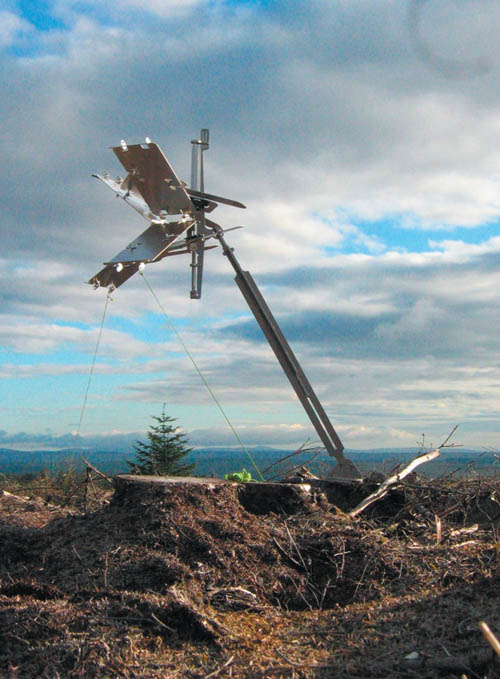
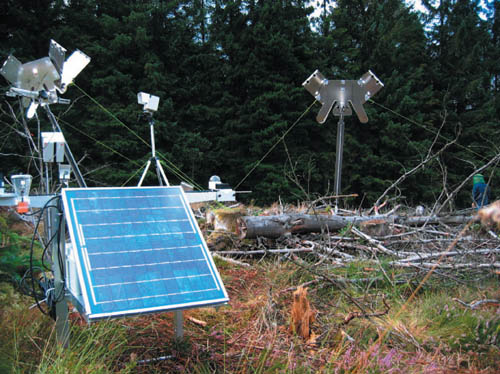
[Image: From “Kielder Probes” by Phil Ayres, Chris Leung, and Bob Sheil, courtesy of sixteen*(makers)].

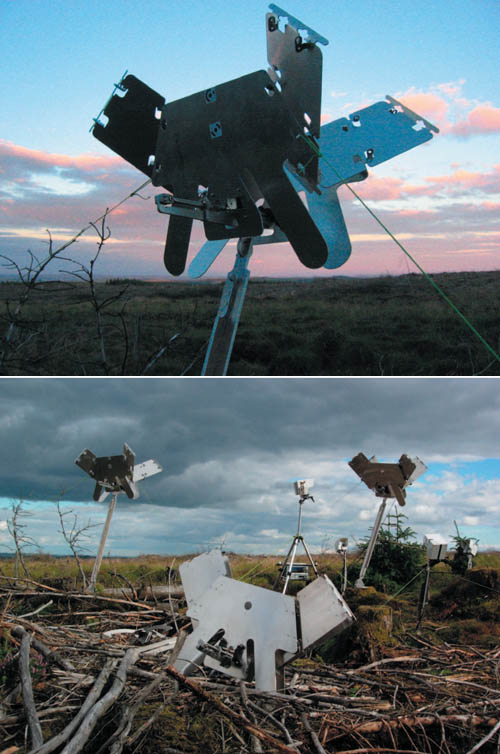
Beginning in 2003, architects Phil Ayres, Chris Leung, and Bob Sheil of sixteen*(makers) began experimenting with a group of “micro-environmental surveying probes” that he was later to install in Kielder Park, Northumbria, UK.

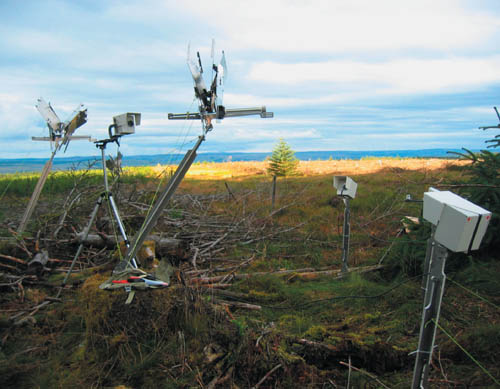
[Image: From “Kielder Probes” by Phil Ayres, Chris Leung, and Bob Sheil, courtesy of sixteen*(makers)].

The probes were “designed to act as dual monitors and responsive artefacts.” Which means what, exactly?

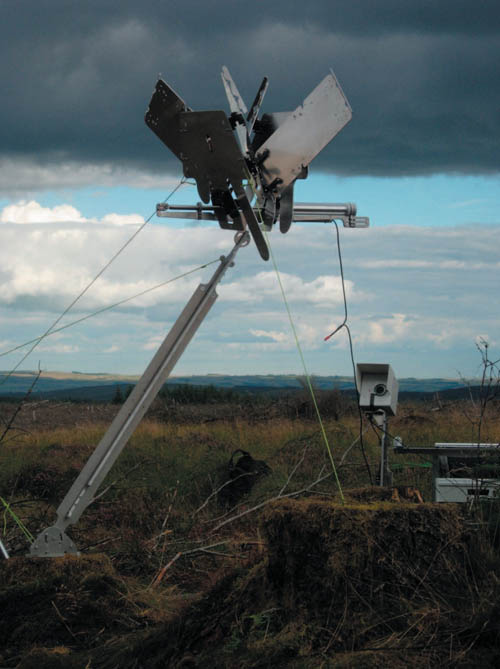
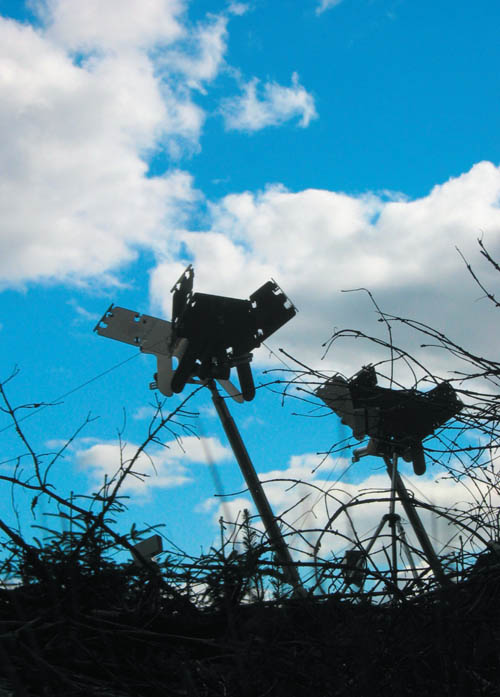
The probes were designed to measure difference over time rather than the static characteristics of any given instance. Powered by solar energy, the probes gathered and recorded ‘micro environmental data’ over time. The probes were simultaneously and physically responsive to these changes, opening out when warm and sunny, closing down when cold and dark. Thus not only did the probes record environmental change, but they demonstrated how these changes might induce a responsive behaviour specific to a single location.

After the probes were installed, they were filmed by “an array of high-resolution digital cameras programmed to record at regular intervals.”

[Images: From “Kielder Probes” by Phil Ayres, Chris Leung, and Bob Sheil, courtesy of sixteen*(makers)].

The resulting data—which took note of the climatic and solar situations in which the objects began to change—offers insights, Sheil suggests, into how “passively activated responsive architecture” might operate in other sites, under other environmental conditions.

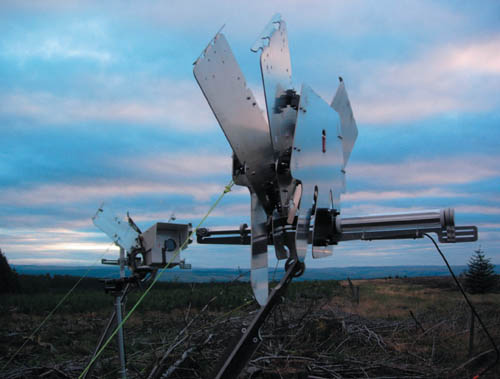
[Images: From “Kielder Probes” by Phil Ayres, Chris Leung, and Bob Sheil, courtesy of sixteen*(makers)].

As DIY landscape-registration devices constructed from what appear to be off-the-shelf aluminum plates, they also cut an interesting formal profile above the horizon line, like rare birds or machine-flowers perched amidst the tree stumps.

[Image: From “Kielder Probes” by Phil Ayres, Chris Leung, and Bob Sheil, courtesy of sixteen*(makers)].

Architecturally Armed

[Image: Photo by Vincent Fournier, courtesy of Wired UK].

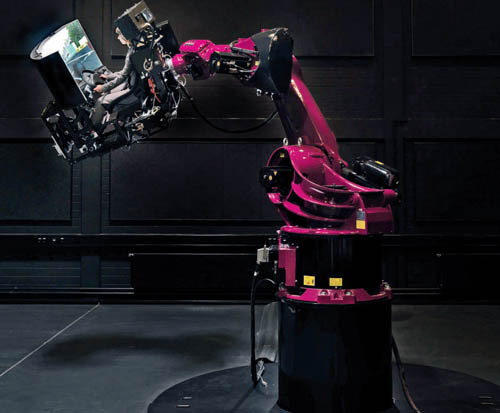
This morning’s post about a robot-city on the slopes of Mount Fuji reminded me of this thing called the CyberMotion Simulator, operated by the Max Planck Institute for Biological Cybernetics in Germany (and featured in this month’s issue of Wired UK).

The Simulator, Wired writes, is “a RoboCoaster industrial robotic arm adapted and programmed to simulate an F1 Ferrari F2007.”

Testers are strapped into a cabin two metres above ground, and use a steering wheel, accelerator and brake to control CyberMotion. The simulator can provide accelerations of 2G and its display shows a 3D view of the circuit at Monza. The arm’s six axes allow for the replication of twists and turns on the track and can even turn the subjects upside down.

But I’m curious what everyday architectural uses such a robo-arm might have. An office full of moving cubicles held aloft by black robotic arms that lift, turn, and rotate each desk based on who the worker wants to talk to; mobile bedroom furniture for a depressed ex-astronaut; avant-garde set design for a new play in East London; a vertigo-treatment facility designed by Aristide Antonas; surveillance towers for traffic police in outer Tokyo; a hawk-watching platform in Fort Washington State Park.

You show up for your first day of high school somewhere in a Chinese colonial city in central Africa and find that everyone—in room after room, holding hundreds of people—is sitting ten feet off the ground in these weird and wormy chairs, dipping and weaving and reading Shakespeare.

The Robot A-Z

[Image: The yellow chipboards of the Fanuc global headquarters; courtesy of Fanuc].

On the flight back to Los Angeles yesterday I read about the corporate campus of Fanuc, “a secretive maker of robots and industrial automation gear,” according to Bloomberg Businessweek.

“Some 60 percent of the world’s precision machine tools use Fanuc’s controls,” the article explains, “which give lathes, grinders, and milling machines the agility to turn metal into just about any manufactured product.” As if suggesting a future art installation by Jeff Koons—sponsored by Boeing—we read about a man who uses “a milling machine with Fanuc controls to sculpt 747 parts.” (The company’s robot A-Z shows off their other goods).

[Image: Assembly robots by Fanuc].

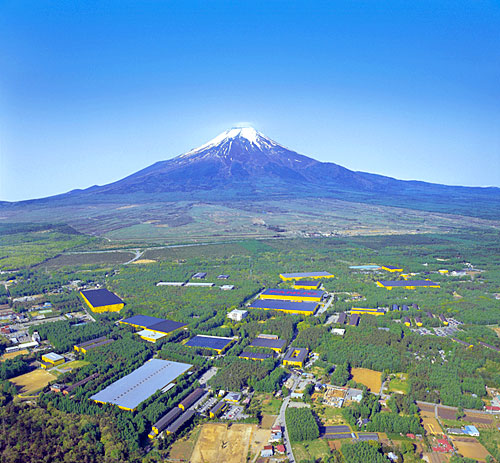
But it’s the description of the firm’s actual facilities that caught my eye. “Fanuc‘s headquarters, a sprawling complex in a forest on the slopes of Mount Fuji, looks like something out of a sci-fi flick”:

Workers in yellow jumpsuits with badges on their shoulders trot among yellow buildings as yellow cars hum along pine-lined roads. Fanuc lore holds that the founder, Seiuemon Inaba, believed yellow “promotes clear thinking.”Inside the compound’s windowless factories, an army of (yes, yellow) robots works 24/7. “On a factory floor as big as a football field you might see four people. It’s basically just robots reproducing themselves.”

Thing is, if you want to see more—to see this strange origin-site for contemporary intelligent machines—you can’t. “Outsiders are rarely allowed inside the facility, and workers not engaged in research are barred from labs,” Businessweek adds. “‘I can’t even get in,’ quips a board member who asks that his name not be used.”

In a way, I’m reminded of South Korea’s plans for its own “Robot Land,” an “industrial city built specifically for the robotics industry,” that will have “all sorts of facilities for the research, development, and production of robots, as well as things like exhibition halls and even a stadium for robot-on-robot competitions.”

Here, though, alone amidst other versions of themselves in the pines of Mt. Fuji, “the world’s most reliable robots” take shape in secret, shelled in yellow, reproducing themselves, forming a robot city of their own.

The Inevitability Of Prophecy Among Models Of New York

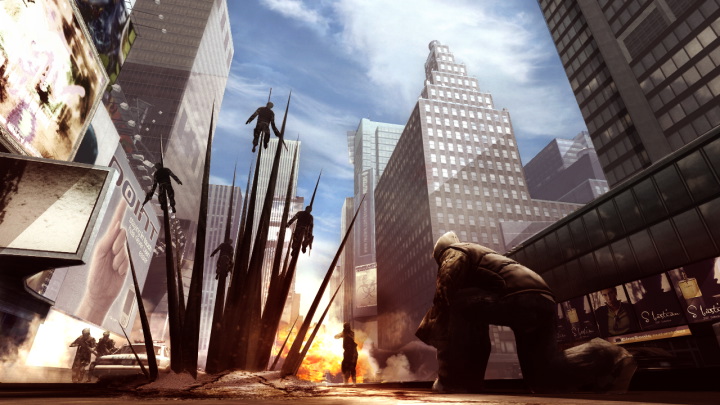
[Image: From Prototype, courtesy of Activision].

[Note: This is a guest post by Jim Rossignol].

The parallels and disparities between videogames and movies are endlessly debated, but there’s one certainty: they both return, routinely, to the architecture of New York City. The most frequently filmed city in the world is also the most frequently modeled.

The canyons of New York are as useful for game designers as they are for film directors. If the decision is arbitrary, then New York represents a kind of go-to alpha city: the logical choice if you need a city at all. For film directors it’s a grand and familiar backdrop, and the same bold geometry is relatively straightforward for game technologies to render. The grid-like topology, an added bonus, is easy for gamers to understand and navigate, too.

Models of the city exist, at many different levels of fidelity, for many different gaming scenarios. From the crude polygonal outlines of early iterations of Microsoft Flight Sim, to the normal-mapped biomorphic horrors of last year’s ultraviolent brawler, Prototype, Manhattan’s skyline and the districts beyond are etched into virtuality, over and over. These models exist on countless DVDs and hard-discs across the world, in ten of thousands of memory-states within the architecture of game consoles and PCs that are modeling the city right now, in real time. It might be impossible to say how many different (or identical) instances of New York are stored, digitally, within the city itself. It seems likely that a model of New York sits just an arm-length away from every Xbox-inhabited TV stand in the greater metropolitan area.

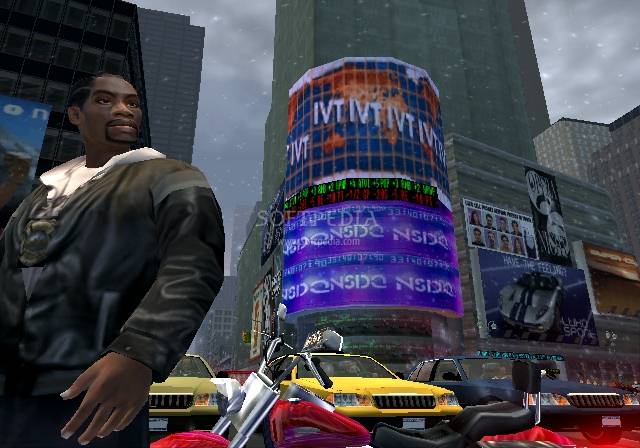
[Image: From True Crime: New York City, courtesy of Activision].

There have been dozens of instances of New York remade for the escape-hatch sub-realities of gaming in studios around the world. In just the past decade we could name Alone In The Dark, True Crime, The Hulk, World In Conflict, Forza 2, Project Gotham, 50 Cent, Max Payne 1 & 2, Gran Turismo 3, and Def Jam Vendetta. This number spills into scores more across the previous decades, and it’s a figure which becomes hazier still when mods, expansions, analogues, and cancelled or lost projects are counted in the mix.

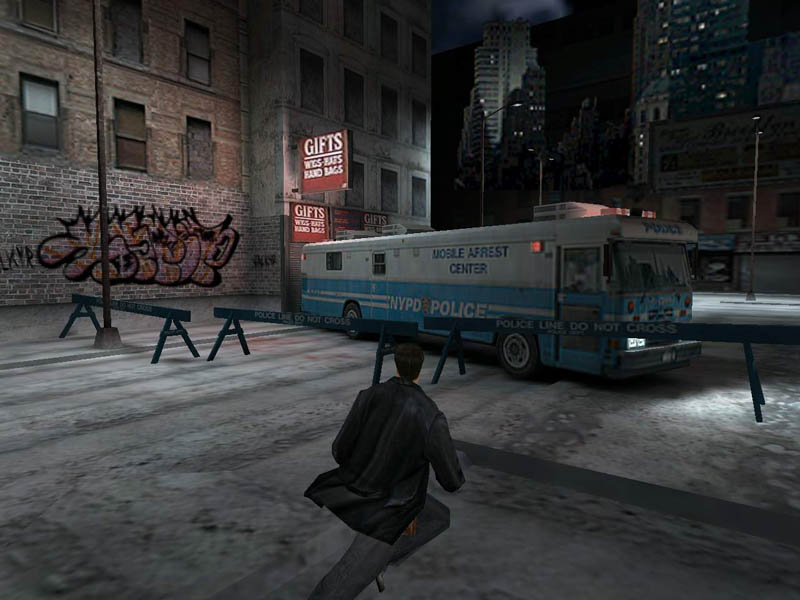
[Image: From Max Payne, courtesy of Rockstar Games].

This reliance on New York isn’t simply about providing a visually interesting backdrop, of course, because it has also provided some of the strongest connections to character. When the noir ultraviolence of Max Payne was moved to Sao Paulo for Max Payne 3, there was uproar. If you took Max out of the tenements of New York, was he really Max at all? What was the New York cop without his delirious nightmare of New York’s criminal innards? Similarly, when it was announced that Crysis 2 would be moving from its technologically impressive jungle-island home to the exploding streets of Manhattan, no one really thought to comment. Of course it would be set in New York. Indeed, if they really wanted to see/destroy it all, where else would the aliens want to go next?

[Image: From Crysis 2, courtesy of Electronic Arts].

Crysis 2‘s ash-hazed avenues are impeccably damaged, while surly pedestrians in any sandbox city are happy to pick a fight if you don’t look where you’re going. These models new look increasingly like New York City, and more often behave like it, too. As the complexity of games increases, it seems that we are speeding towards a completionist model of the city—one that whirs and hums and yells like the real thing. As the models made by game studios march toward reality, they march towards Manhattan.

Yet realism is not a goal that games should really be striving for. Leave that to the CAD programs and the satellite maps. Instead games should explore the aspects of Manhattan that make less sense, like its dreams, or the models of the city that represent it not as it is, but as we are able to explore it, thanks to the mutational potentials of digital simulation. Examine those aspects of the city and perhaps the issue becomes less about New York as a fabulous piece of set design, and more about New York as a vital raw material for the business of fantasy.

This is a relationship that has moved on from simply being a straightforward practical connection to something that is embroiled in deeper meaning. New York city has become gaming’s ideal and idealized urban environment, and it has done so by becoming refictionalized and reimagined. The finest example of a city yet given to gaming, that of Grand Theft Auto IV, isn’t really New York at all, and yet it is more like New York than ever before. It’s the essence of New York—a distillation that is only possible thanks to the unique way in which games are able to make the figurative and the abstract resonate with us even more profoundly than the infinite detail of the everyday.

[Image: From Grand Theft Auto IV, courtesy of Rockstar Games].

It’s worth noting that the superficial New Yorkness of other, real cities often counts in their favor when it comes to making movies. At the end of American Psycho, for instance, Toronto’s TD Centre convincingly stands in for the fictional Patrick Bateman’s office in the real-world Seagram Building—both buildings by Mies van der Rohe, but the latter is in Manhattan. The TD Centre thus becomes an architectural stunt double—or perhaps a sinewy body double helping the real New York look good. Not only that, but Pinewood Toronto Studios recently announced that they will be investing further in their home city to create lived-in, urban areas that look like residences in New York, Chicago and London—real districts of a city that are permanently and deliberately cast as a “living movie set.”

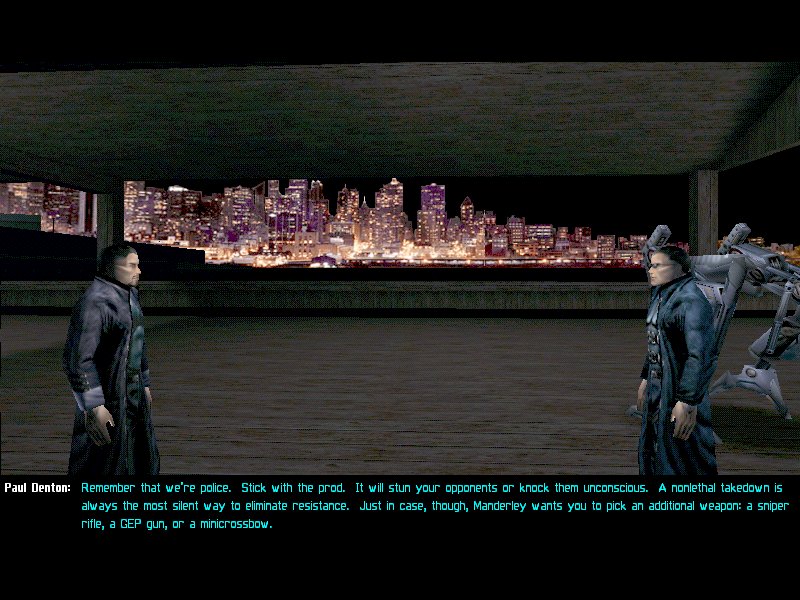
[Image: From Deus Ex, courtesy of Eidos Interactive].

Where games are concerned, New York, and the modeling thereof, is a primary conduit for things that cannot happen, or things that need to happen over and over in a slightly different way each time. Not just a conveniently located backdrop, but a thing that can be toyed with digitally, again and again, first by the game developers and then by the gamers themselves. Occasionally, even, the simulations might accidentally model things that have yet to happen. Conspiratorial cyber-fantasy Deus Ex was awash with its own ideas about the sinister possibilities of our politico-military techno-future, but what was the meaning behind the twin towers missing from its future skyline? A year before the towers were destroyed? The silent bells of paranoia began to ring.

In truth the skyline had been cheaply mirrored to reduce the game’s memory footprint, and the Twin Towers portion had simply been left out to make the game run more smoothly. It was nothing more than a technical conceit of the kind games are riddled with, one of the limiting factors of memory or processing that makes the computerized cities so much less than their real counterparts. But it was also a manifestation of something that became inevitable as New York was modeled over and over—as speculation mingled with outright fantasy—the inevitability that games could become a form of architectural prophecy.

• • •

Jim Rossignol is a games critic, blogger, occasional guest writer on BLDGBLOG, and author of the excellent This Gaming Life: Travels in Three Cities, published by the University of Michigan Press. He is @jimrossignol on Twitter.

Stratigraphies of Infestation

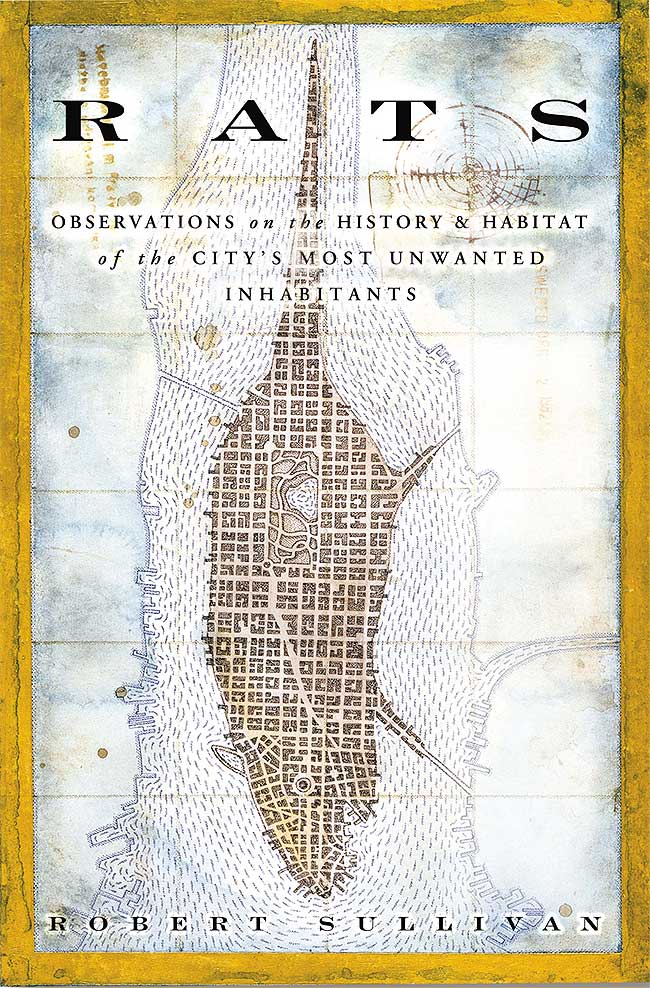
In his book Rats, Robert Sullivan—an author whose work we previously reviewed here—offers a glimpse of how the city is seen through the eyes of the pest-control industry.

[Image: Rats by Robert Sullivan].

Effective rodent control requires a very specific kind of spatial knowledge, Sullivan suggests, one that often eludes architects and city planners.

Sullivan quotes one rat-control professional, for instance, who “foresees a day when he will be hired to analyze a building’s weaknesses, vis-à-vis pests and rodents… ‘They design buildings to support pigeons and for infiltration by rodents because they don’t think about it. Grand Central Station, right? They just renovated it, right? Who knows what they spend on that, right? You know how much they spend on pest control? You know how much they budgeted? Nothing. I did all the extra work there, but they had to pay us out of the emergency budget.'”

Pest control here becomes an explicitly architectural problem, something you can design both for and against. Imagine an entire degree program in infestation-resistant urban design.

Sullivan points out that a massive, urban-scale architectural intervention, in the form of a quarantine wall fortifying all of New York City against rats, was once tentatively planned: “There was a time in New York, in the 1920s,” he writes, “when scientists proposed a great wall along the waterfront to shut out rats completely, to seal out rats and, thus, forever end rat fear. Eventually, though, the idea was deemed implausible and abandoned: rats will always get through.”

But it’s the particular subset of urban knowledge that has been actively cultivated within the pest control industry that fascinates me here. Sullivan spends a bit of time with a man named Larry Adams, a municipal rodent control expert. “If you hang around Larry long enough,” Sullivan says, “you realize that he sees the city in a way that most people don’t—in layers.” And what follows is well worth quoting in full:

He sees the parks and the streets and then he sees the subways and the sewers and even the old tunnels underneath the sewers. He sees the city that is on the maps and the city that was on the maps—the city’s past, the city of hidden speakeasies and ancient tunnels, the inklings of old streams and hills.
“People don’t realize the subterranean conditions out there,” he likes to say. “People don’t realize the levels. People don’t realize that we got things down there from the Revolution. A lot of people don’t realize that there’s just layers of settlers here, that things just get bricked off, covered up and all. They’re not accessible to people, but they are to rats. And they have rats down there that have maybe never seen the surface. If they did, then they’d run people out. Like in the movies. You see, we only see the tail end of it. And we only see the weak rats, the ones that get forced out to look for food.”

The book’s wealth of rat-catching anecdotes are often unbelievable. “More than anything,” Sullivan reflects, “I have learned from exterminators that history is crucial in effective rat analysis.”

In fact, history is everything when it comes to looking at rats—though it is not the history that you generally read; it is the unwritten history. Rats wind up in the disused vaults, in long underground tunnels that aren’t necessarily going anywhere; they wind up in places that are neglected and overlooked, places with a story that has been forgotten for one reason or another. And to find a rat, a lot of times you have to look at what a place was. One exterminator I know tells the story of a job on the Lower East Side in an old building where rats kept appearing, nesting, multiplying, no matter how many were killed. The exterminator searched and searched. At last, he found an old tunnel covered by floorboards, a passageway that headed toward the East River. The tunnel was full of rats. Later, he discovered that the building had housed a speakeasy during Prohibition.

Or this disconcerting image of an infested basement that was never fully demolished—it was simply forgotten, walled off beneath the surface of the city. Here, Sullivan visits an abandoned lot with a rat-catching expert named Isaac, writing that, “just before we drove off, two men walked by and stopped at the fence; they looked into the abandoned lot and spoke with Isaac in Spanish.”

They told Isaac that they remembered when the lot was the site of an old wooden house that had become abandoned and filled with rats. They remembered the house being demolished and partially buried—the basement was still there, they said. They pointed to the ground, saying that the old home was still beneath it, still rat-infested.

What a perfectly haunting line: They pointed to the ground, saying that the old home was still beneath it, still rat-infested. (And if anyone out there has read The Rats by James Herbert, you might remember that the novel begins with a vaguely similar urban image).

[Image: A “rat king,” via Wikimedia].

Speaking later with Mike, another rat-control expert, Sullivan learns how the stratigraphy of the city takes shape in the mind of the exterminator: “I was getting ready to leave—Mike was just too busy. But then Mike was reminded of an aspect of the nature of rats in the city, and as he put down the phone, he said, ‘You know, I heard there are three layers of sewer lines.’ He counted them off on his fingers. ‘There are the ones from the 1800s, the ones from the 1700s, and the ones they don’t have maps for anymore. Once in a while, they use that old line, when they’re doing construction or something, and you read in the papers that there are hundreds of rats coming up. Well, those rats that are in the third line, they haven’t even seen man before.’”

These stratigraphies of infestation are wonderfully horrifying—but also perfectly and immediately available to the architect and urban planner as practical design challenges. How does one deal with “what was on the maps,” as Sullivan phrases it, while at the same time designing a pest-unfriendly metropolis?

Taking as their design target rats and other “unwanted inhabitants” of the city, as Sullivan phrases it, what inspired collaborations could we develop amongst public health inspectors, urban ecologists, pesticide manufacturers, historical cartographers, city archivists, materials scientists (Sullivan writes, for instance, that Larry Adams, mentioned earlier, has actually developed his own special mix of rat-resistant concrete: “With his expertise, Larry has developed his own rat-eradication techniques, such as concrete mixed with broken glass to keep the rats from gnawing through the concrete. ‘Sometimes, they’ll still cut through before the concrete hardens. So sometimes, I use glass and industrial-strength steel wool and put it in with the concrete and make one big goop with it’”), and, of course, architects and planners? How realistic—let alone ethical—a design challenge is the rodent-free metropolis?

A Visitors Center for the Center of the Earth

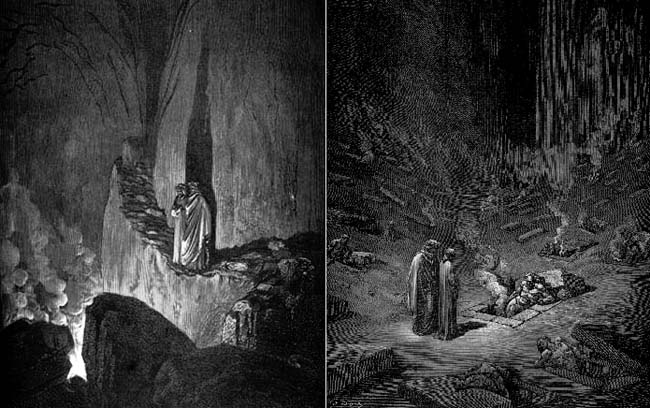
I received a strange packet in the mail last week, full of maps and images hand-annotated with ball-point pen and partly held together with red duct tape. It implies—more than it describes—a subterranean expedition in a boat led by an unnamed explorer (“note,” it says, “expedition almost goes down the drain,” with an arrow pointing into the abyss).

[Images: Two illustrations for Dante’s Inferno, both by Gustav Doré].

The actual purpose of the elaborate packaging, however, was to announce that there is a party and “underground fundraiser” in Austin, Texas, from 6-8pm on Thursday night of this week, celebrating the opening of a (fictitious) “center of the earth visitors center” and benefiting an organization called the Austin Bat Cave, “a nonprofit writing and tutoring center for kids.” If you’re in the area and interested in attending, contact underground(at)austinbatcave(dot)org, and tell them that you read about it on BLDGBLOG.

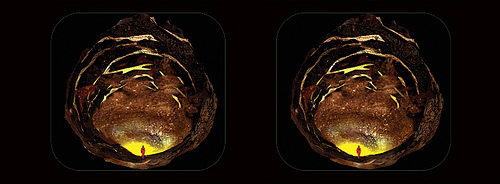
[Image: Viewmaster images of the Center of the Earth Visitors Center by Legge Lewis Legge architects].

As architects Legge Lewis Legge describe their plans for this fictitious complex in Austin, it will be “a visitors’ center for a cave system recently rediscovered underneath the City of Austin, Texas.”

The labyrinthine system of caves and tunnels is only partially explored. The cave system’s first explorers noted many years ago that “some cave passageways have been observed to lead toward the very center of the earth.” Along with Austin Bat Cave, Legge Lewis Legge are concepting and designing the Center, as well as assisting with mapping and rendering cave and tunnel interiors from descriptions recorded long ago when the caves were first discovered.

The idea of a visitors center for the center of the earth is pretty fantastic design brief; I would love to see this taken up as the broader premise of an architectural challenge or summer workshop. In other words, what facility for preparing surface visitors for their forthcoming visit to the center of the earth would be most appropriate (and fun) to design? A museum of the earth’s core; a series of hands-on, experiential pressure chambers; a make-your-own-stalactites class; a mind-bogglingly elaborate series of wormhole-like passages that you crawl and squeeze your way through, for hours at a time, in preparation for the abyss that awaits you.

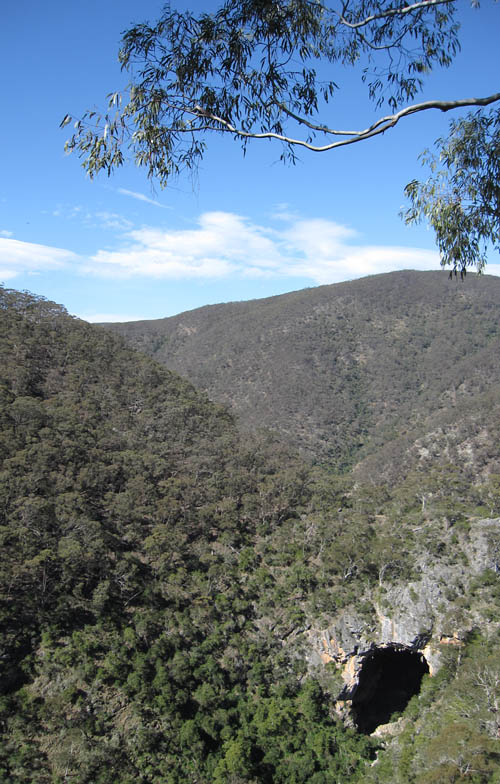
[Image: The Jenolan Caves in Australia; photo by BLDGBLOG].

Perhaps a worthwhile reference for any such class would be Jeff Long’s over-the-top but undeniably enjoyable, religiously-inflected science-horror novel The Descent, published back in 2001, for its proposed architectural exploration of the planet’s interior—suggesting that liberal applications of hydroponic agriculture, UV lights, and seemingly endless quantities of instant concrete could allow for an organized human “descent” into the planet.

Long writes that his underworld explorers “approached the subplanet the way America [sic] approached manned landings on the moon forty years ago, as a mission requiring life support systems, modes of transportation and access, and logistics.” Accordingly, the Army Corps of Engineers gets involved, “tasked to reinforce tunnels, devise new transport systems, drill shafts, build elevators, bore channels, and erect whole camps underground. They even paved parking lots—three thousand feet beneath the surface. Roadways were constructed through the mouths of caves.”

Apply the personal infrastructure of caving on an industrial scale; devise a visitors center for people about to embark upon an exploration of that underground world; produce a Center of the Earth reading & viewing list for the interested public; and use the whole thing as an excuse to talk about the uniquely challenging design constraints of architecture in extreme environments. The best project wins a lifetime membership at Mammoth Cave.

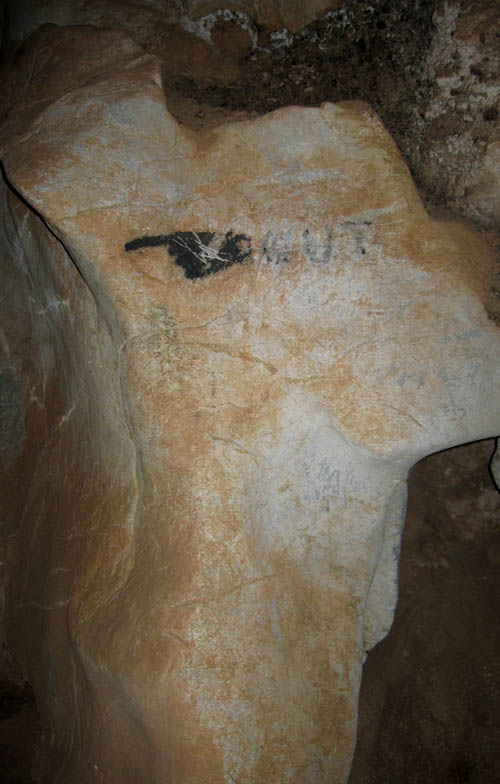
[Image: The way out. Jenolan Caves, Australia; photo by BLDGBLOG].

In any case, if you’re in the vicinity of Austin, Texas, consider contacting the email address, above, to find out more about the fundraiser.

Drylands Design

If I could go back in time, there are two things I would have prioritized this autumn, had I known about them earlier: 1) I would have stopped by the Out of Water: Innovative Technologies in Arid Climates exhibition, curated by Liat Margolis and Aziza Chouani, at the Arid Lands Institute of Woodbury University, and 2) I would have attended more of the accompanying lecture series. The whole thing sounds amazing.
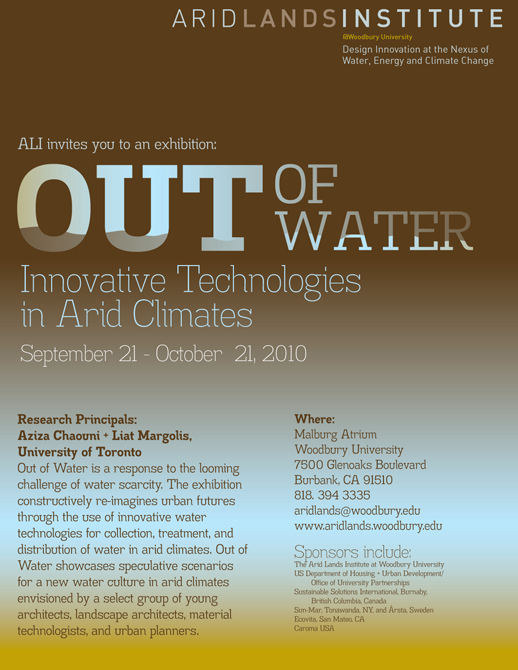
Here’s a description of the lecture series:
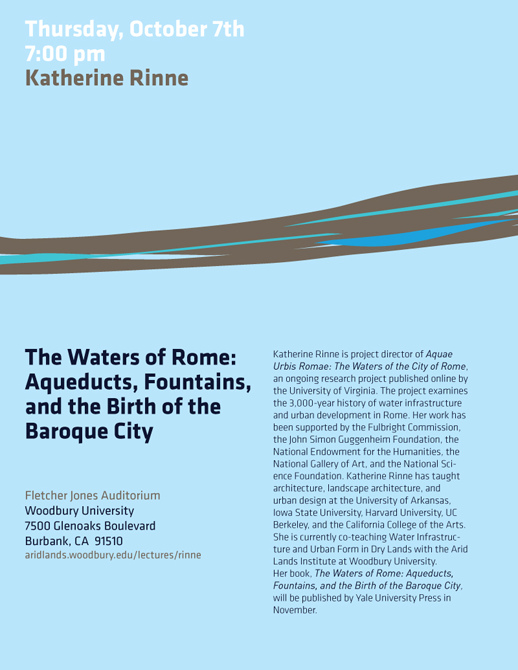
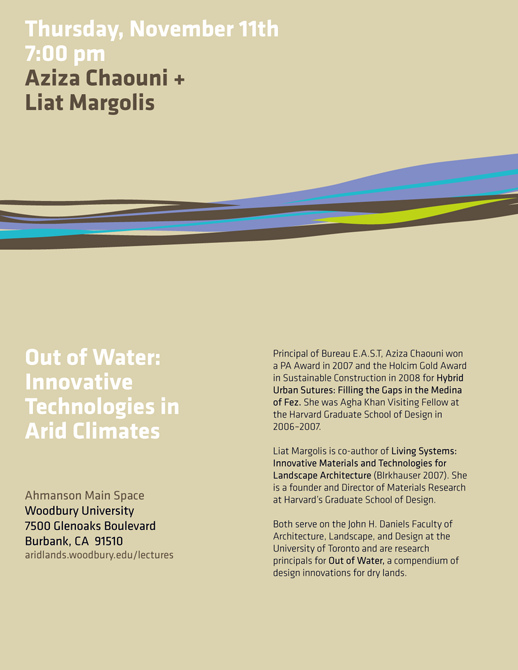
Excavating Innovation: The History and Future of Drylands Design examines the role of water engineering in shaping public space and city form, by using arid and semi-arid sites in India, the Middle East, the Mediterranean, and the New World to explore how dryland water systems throughout history have formed and been formed by ritual, hygiene, gender, technology, governance, markets, and, perhaps above all, power.

The series “brings together historians, urbanists, and contemporary designers to selectively excavate global historical case studies and reveal relevance to contemporary design practice.”

The specific lectures sound almost too good to be true, including a forthcoming talk this Thursday, November 18, about the stepwells of India—fantastically gorgeous native hydrological structures I’ve returned to again and again in my own off-blog reading and research.
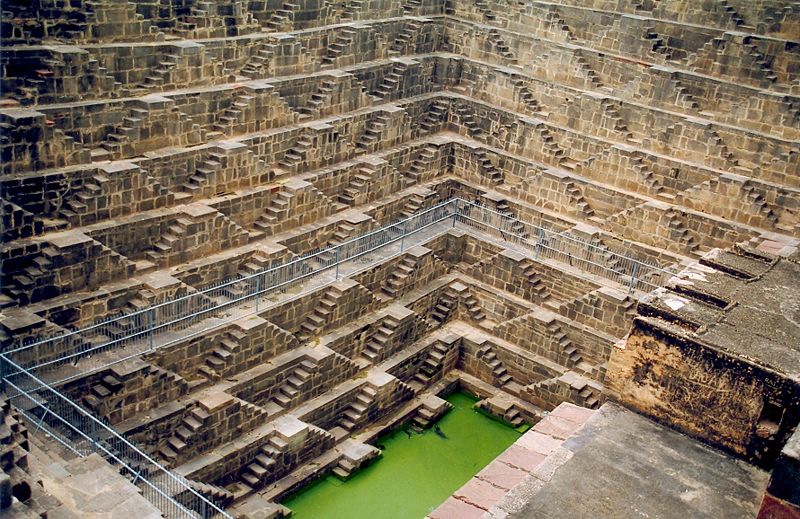
[Image: Stepwell at Chand Baori, courtesy of Wikipedia].

The series continues into 2011 with a lecture by Nan Ellin called “Canalscape: Ancient and Contemporary Infrastructures of Phoenix” (January 27) and one by Vinayak Bharne called “Indigenous Infrastructure and the Urban Water Crisis: Perspectives from Asia” (February 10).

Anyone interested in the idea of “drylands design” or arid-climate technologies should strongly consider picking up a copy of Fred Pearce’s excellent book When the Rivers Run Dry: Water, The Defining Crisis of the Twenty-first Century. In it, Pearce presents a huge variety of vernacular water-harvesting and storage architectures, from Chinese domestic cisterns and dew ponds in the English South Downs to fog-catching nets in Pacific South America. Two other quick suggestions, if you want to extend your reading, include Marc Reisner’s classic Cadillac Desert: The American West and Its Disappearing Water—an immensely interesting but often historically over-detailed book—and James Powell’s Dead Pool: Lake Powell, Global Warming, and the Future of Water in the West. The latter title I favorably reviewed a while back for the The Wilson Quarterly.

In fact, if you’re really into this stuff, another article I frequently recommend here is something published in the Chicago Reader back in 2006: “They need it, we waste it,” a provocative look at the future interstate politics of freshwater, projecting a time when cities like Phoenix, Las Vegas, and even L.A. might come, buckets in hand, begging for clean water from the Great Lakes. What impending hydro-political rearrangement of North America might we then see take shape?

(Follow the Arid Land Institute on Twitter. Earlier on BLDGBLOG: N.A.W.A.P.A.).