100 Views of a Drowning World

[Image: Kahn & Selesnick, courtesy Yancey Richardson].

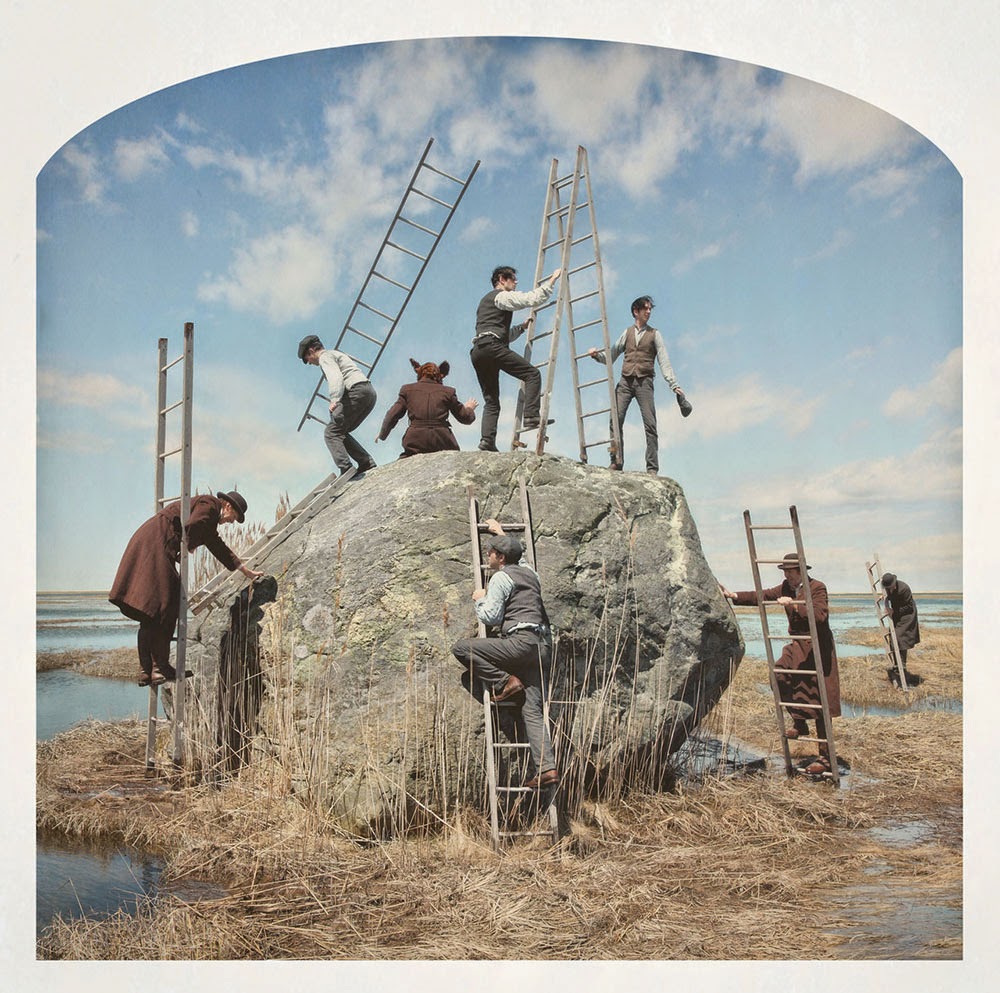
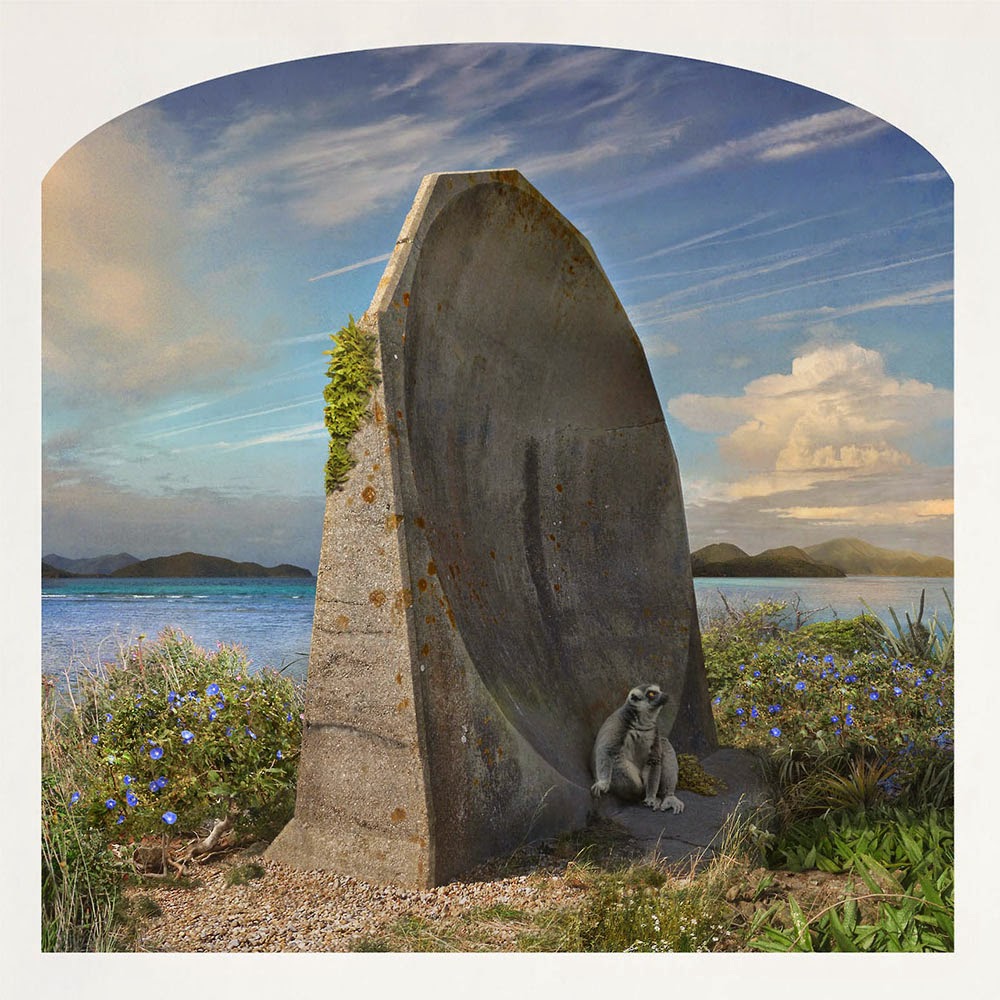
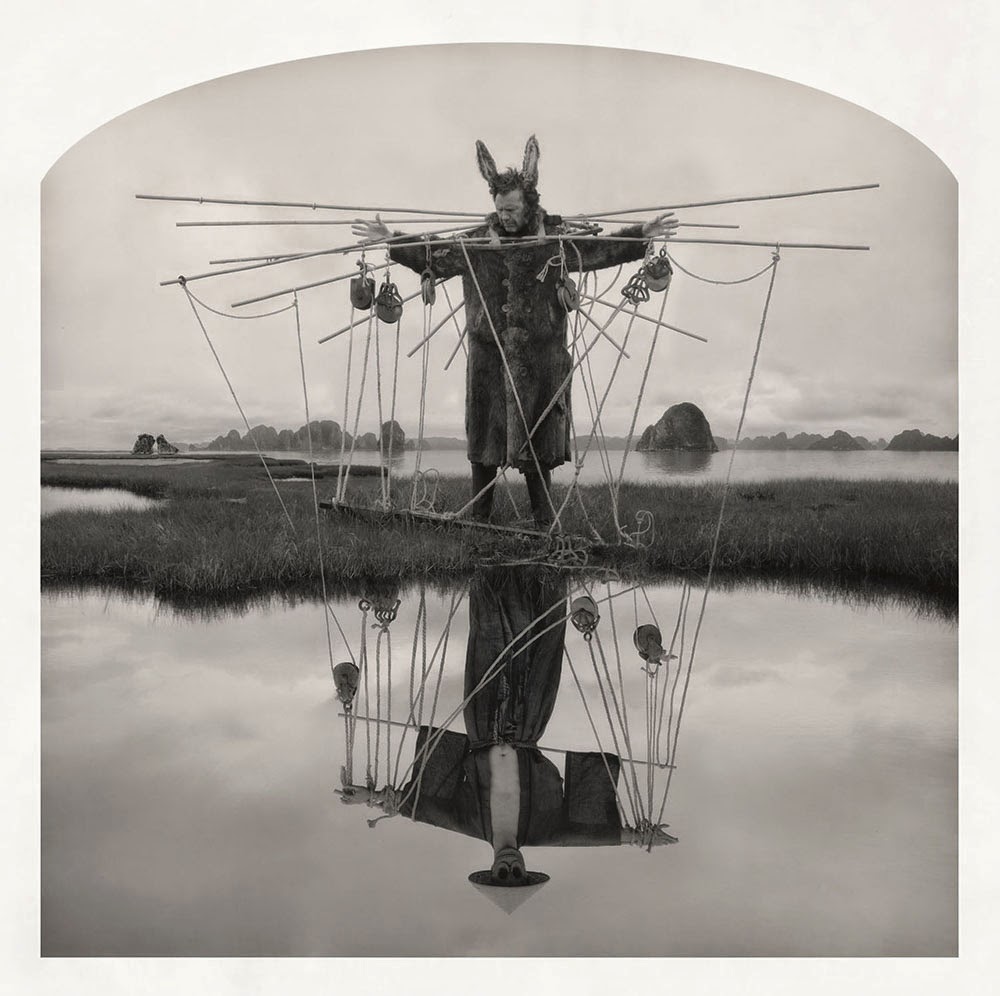
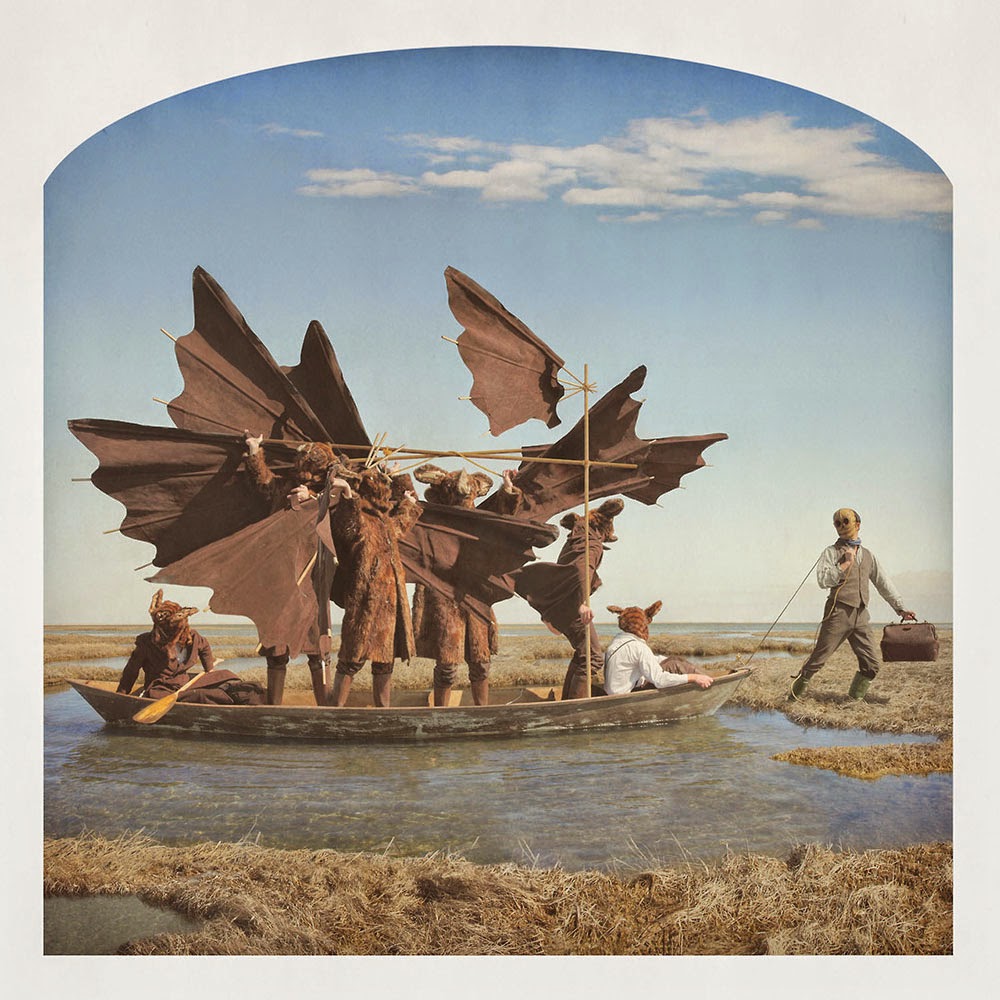
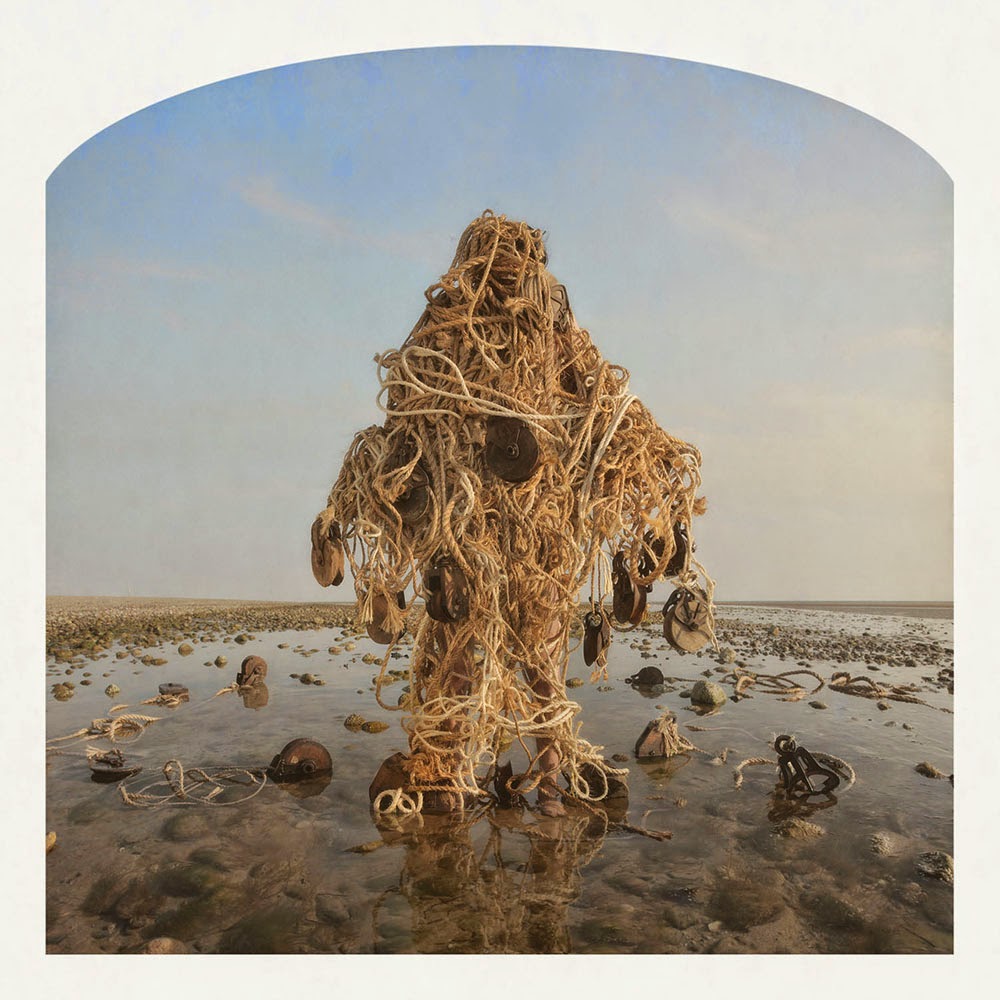
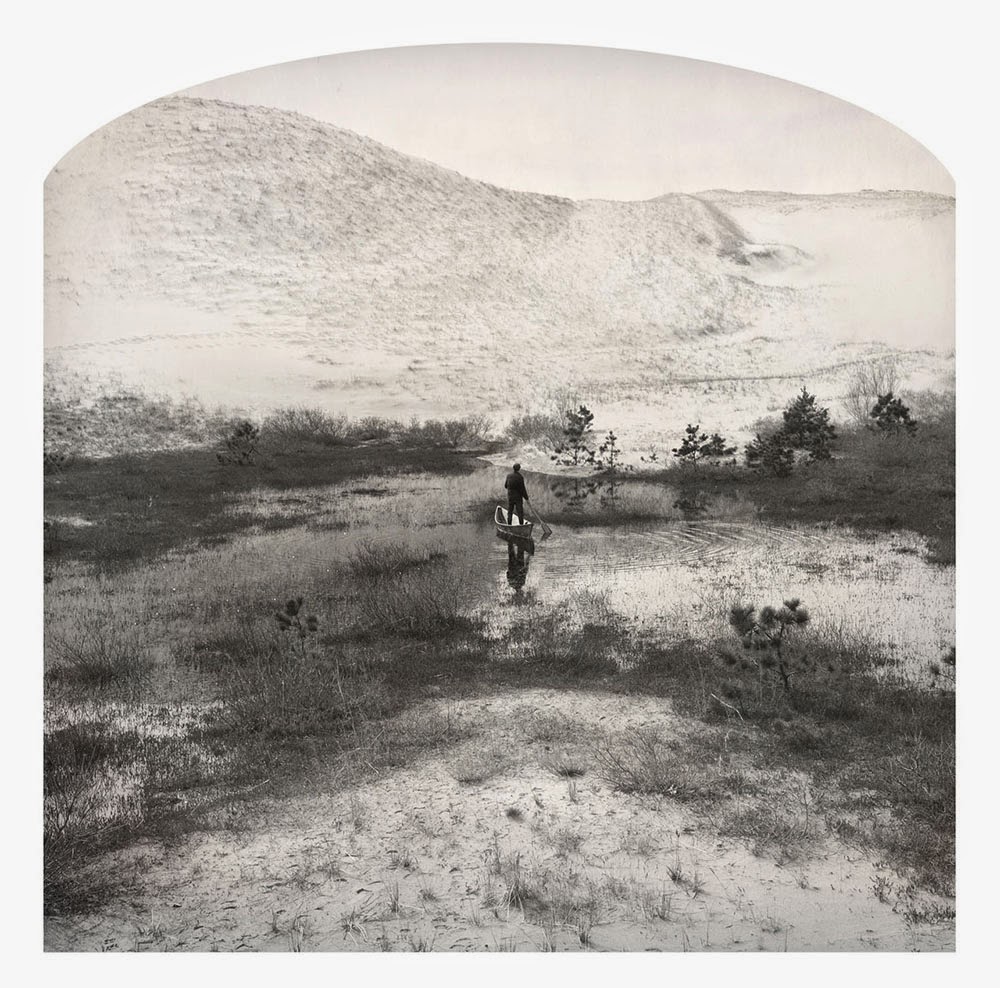
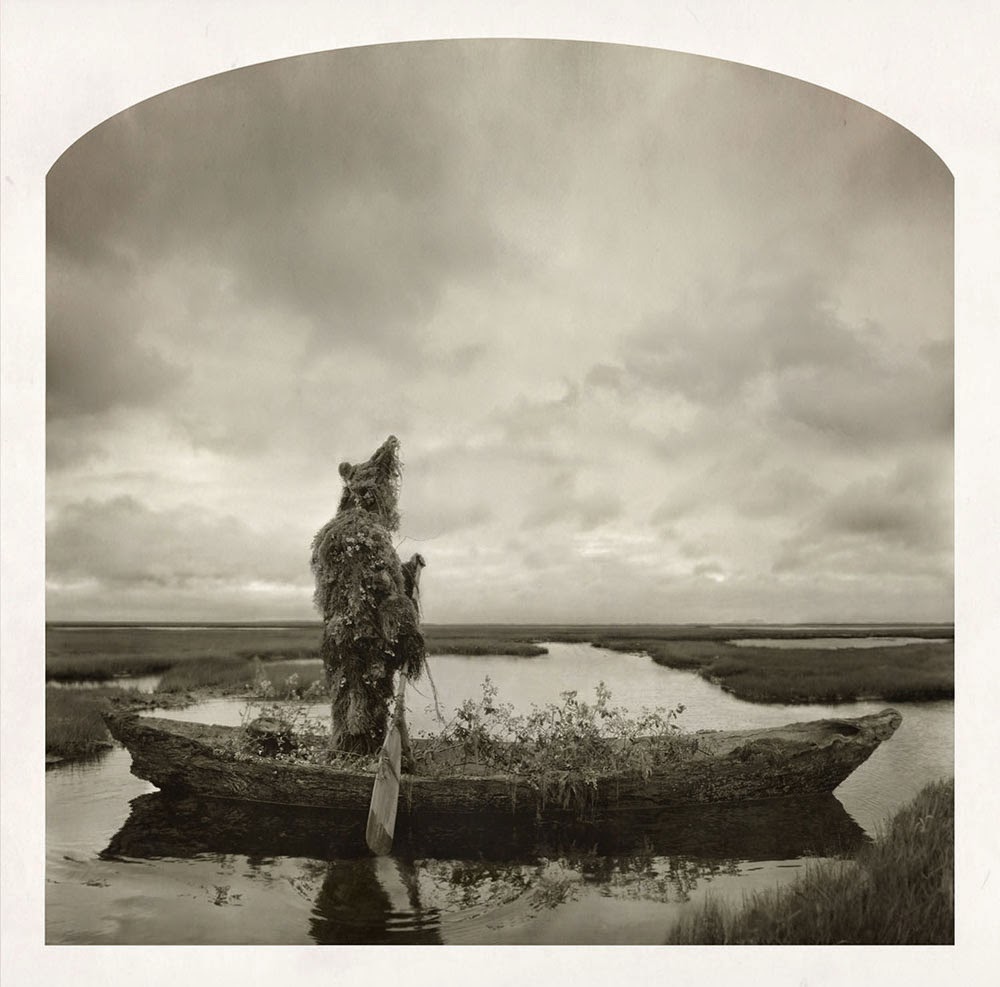
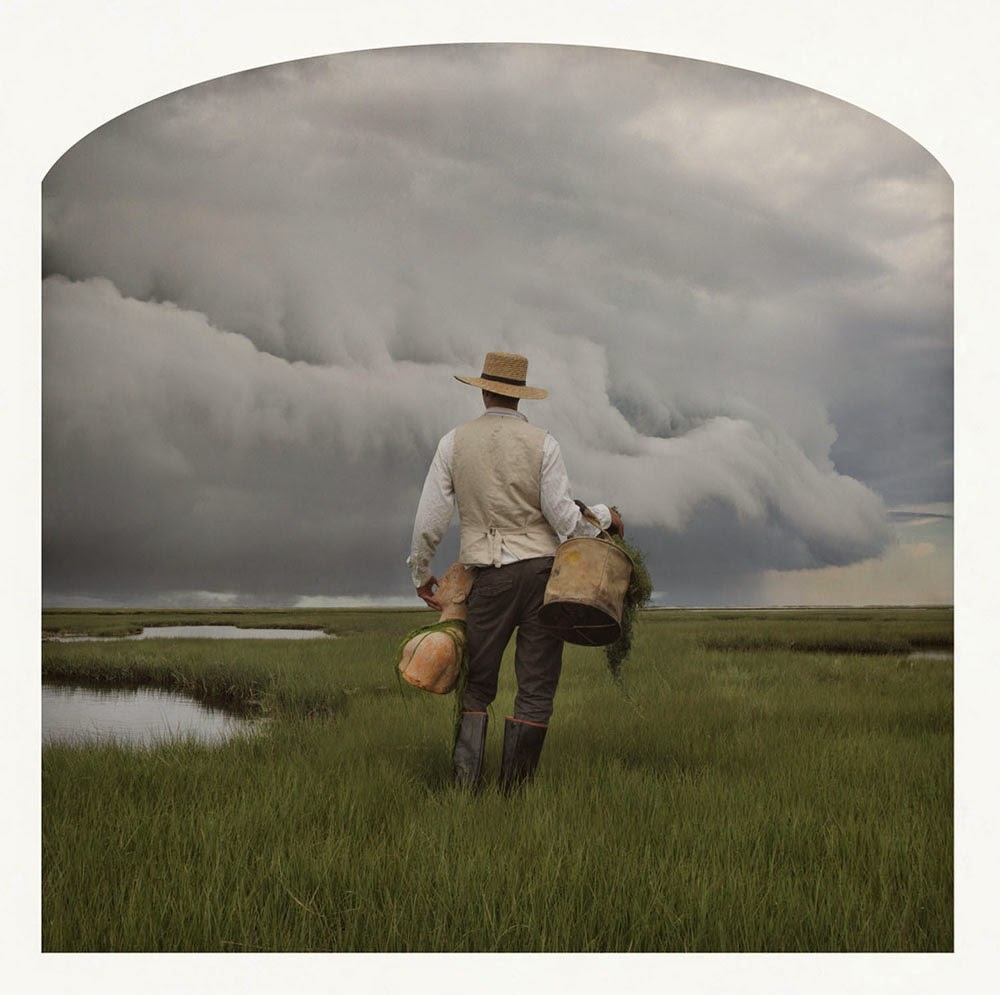
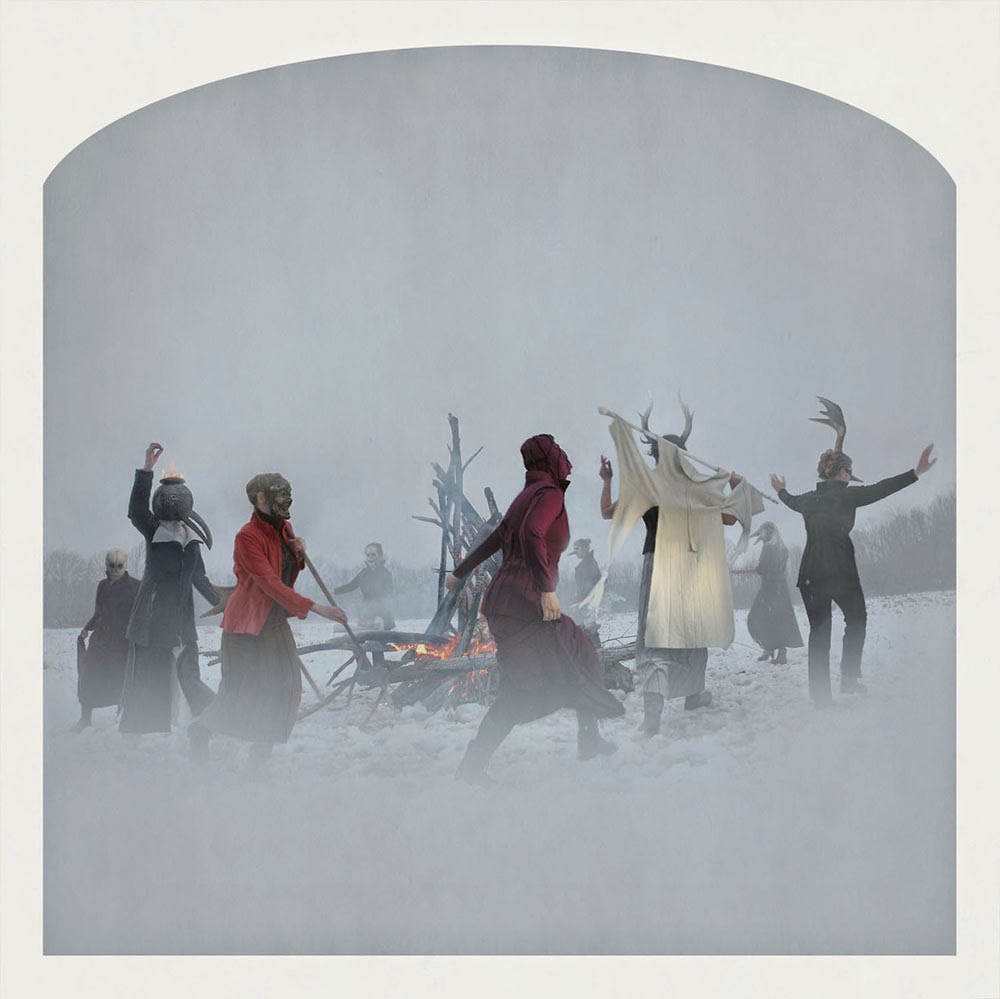
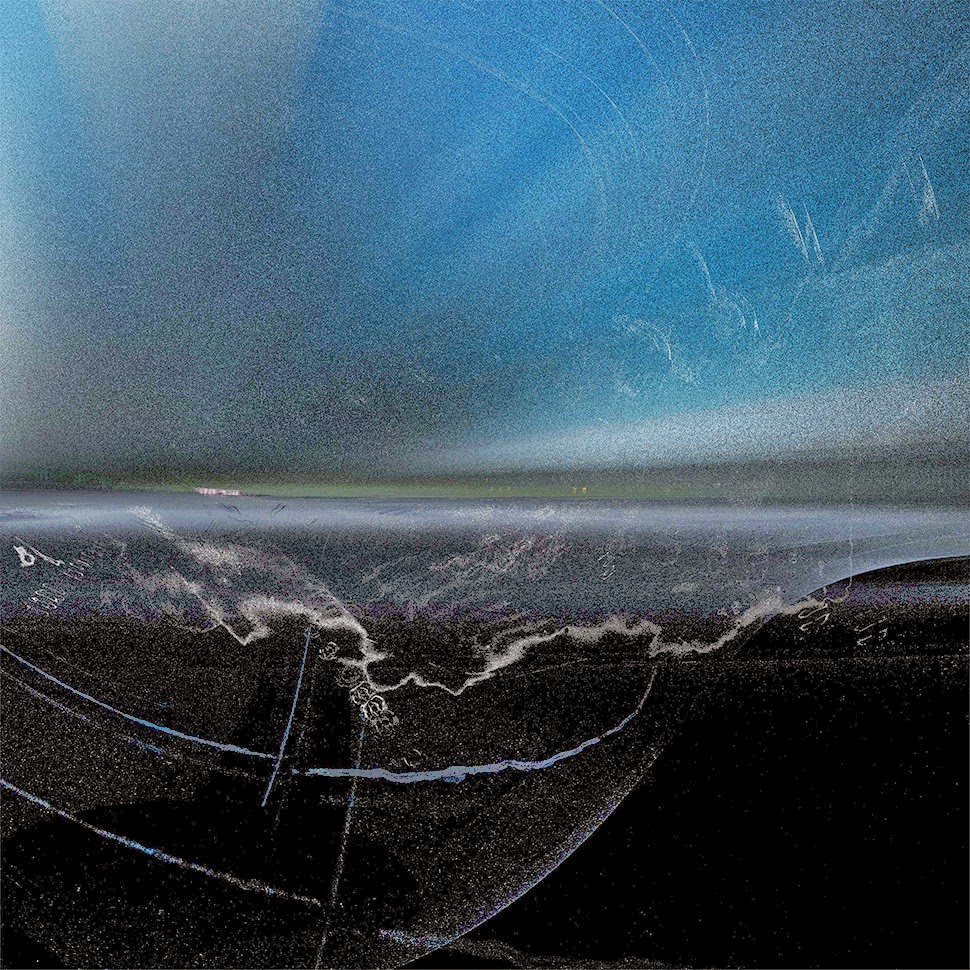
I’ve mentioned the work of artists Kahn & Selesnick before; their surreal narratives are illustrated with elaborately propped photos that fall somewhere between avant-garde theater and landscape fiction, with mountain glaciers, salt mines, alien planets, utopian cityscapes, and, as seen here, the slowly flooding marshes of an unidentified hinterland.

[Image: Kahn & Selesnick, courtesy Yancey Richardson].

These images are from a new project, called Truppe Fledermaus & The Carnival at the End of the World, that opened at New York’s Yancey Richardson gallery last week. “Utilizing photography, drawing, printmaking, sculpture and performance,” the gallery writes, “the artists create robust mythic realities for each project, building imaginary, character-driven fictions from kernels of obscure historical truth.”

Kahn & Selesnick’s latest project follows a fictitious cabaret troupe—Truppe Fledermaus (Bat Troupe)—who travel the countryside staging absurd and inscrutable performances in abandoned landscapes for an audience of no one. The playful but dire message presented by the troupe is of impending ecological disaster, caused by rising waters and a warming planet, the immediate consequences of which include the extinction of the Bat, in this mythology a shamanistic figure representing both nature and humanity. In one sense, the entire cabaret troupe can be seen as a direct reflection of the artists themselves, both entities employing farce and black humor to engage utterly serious concerns.

The particular scenes shown here, all on display until July 3, 2014, are from a sub-series within the project called “100 Views of a Drowning World.”

[Image: Kahn & Selesnick, courtesy Yancey Richardson].

Eccentric residents of a drowning landscape live lives indistinguishable from absurdist stagecraft, as they wander through seemingly wild landscapes that are actually ruins and that will eventually all disappear beneath the deceptively placid tidal flats flowing around them.

[Image: Kahn & Selesnick, courtesy Yancey Richardson].

These anonymous coastal dwellers simulate a nature that is already artificial—a kind of maritime grotesque of overgrown animal forms and humans buried beneath ropes and seaweed—and they set off on doomed expeditions through terrains whose original inhabitants have long been forgotten.

[Image: Kahn & Selesnick, courtesy Yancey Richardson].

Lone figures in boats look out into what will soon be sea, attempting to navigate land as if it is already an ocean.

[Images: Kahn & Selesnick, courtesy Yancey Richardson].

And others attempt to escape into some new strain of Romanticism, witnesses of large-scale terrestrial change who know that this moment on the Earth is rare—though not unique—for the extraordinary transitions that lie over the horizon.

[Image: Kahn & Selesnick, courtesy Yancey Richardson].

In the end, then, the idea is not that these characters’ actions somehow represent or propose a new humanist response to climate change, or that the artists are offering us any sort of practical or ethical insight into what futures might face us in a drowned world, but that these absurd rituals and dreamlike antics instead simply illustrate “a world that is sinking into a marsh.”

It is, as the show’s title suggests, just a carnival at the end of the world.

[Image: Kahn & Selesnick, courtesy Yancey Richardson].

The Yancey Richardson gallery is on W. 22nd Street, over near the High Line; be sure to stop by before July 3. Here is a map and here are more images.

The City and its Periphery

If you’re in the Bay Area at the end of month, consider attending an event called Macro City, organized and hosted by the Infrastructure Observatory. Its purpose is “to explore the vast, often overlooked networks of infrastructure that surround us,” and, in the process, “to celebrate the numerous people whose countless efforts shape the built landscape every day.”

Probably the most interesting part of the whole event is the ambitious program of local field trips, all of which take place on May 30th. They include guided tours of everything from the Zanker landfill & recovery facility down in San Jose to one of San Francisco’s wastewater treatment plants, and from a construction aggregate terminal and a kayak trip to an activist walking tour of the city’s many surveillance cameras.

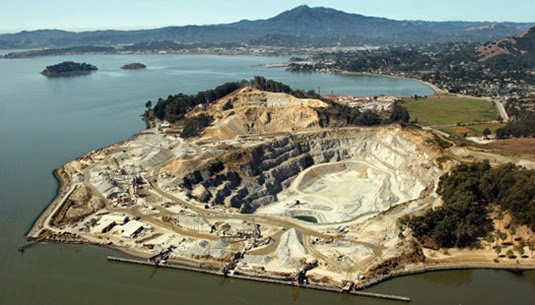
[Image: The Dutra Group‘s extraordinary San Rafael rock quarry, a Macro City field trip site and striking reversal of the figure-ground relationship; photo courtesy of baycrossings/Macro City].

Tickets are available at various levels of price and access—and I should point out that I am also speaking at the event, alongside Nicola Twilley, so my opinion betrays some bias—but the conference has a great and important interpretive mission, and seems well worth attending: “We rarely see in full the cities that we live in,” the organizers write. “Focused on our daily lives, urban dwellers are often only dimly aware of the numerous, enmeshed layers of critical infrastructure that quietly hum in the background to make modern life possible.”

Come tour and talk about those hidden systems on May 30 and 31, at SPUR and the Brava Theater in San Francisco. See the Macro City site for more details.

Demolition Ground


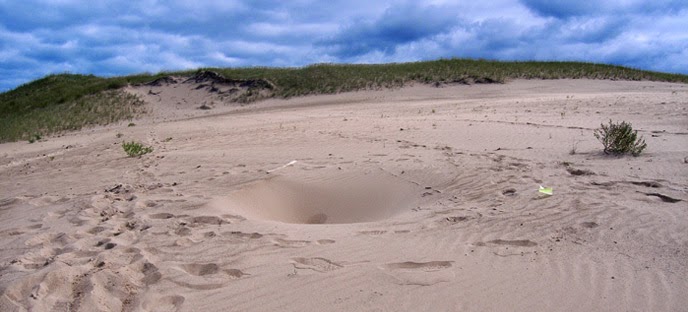
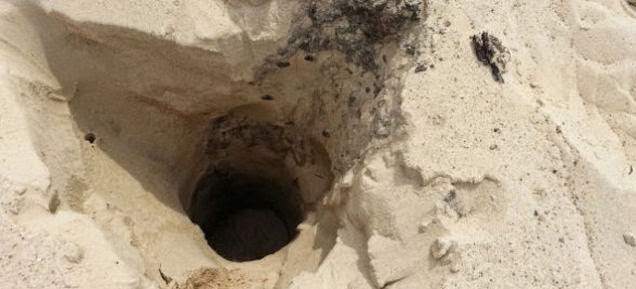
I love this story of the mysterious disappearing sinkholes of Indiana’s Mount Baldy, where deep pits in the sand dunes are opening and closing for reasons as yet to be determined. These “strange holes” have “appeared since last year, only to collapse and be filled in with sand a day later. Some of the holes were so deep they could not be measured with the researchers’ measuring tapes,” Livescience reports.

The area has thus been closed to the public while EPA scientists scan the site with ground-penetrating radar; this will help them to develop an “understanding of the overall internal architecture of the dune, using multispectral GPR and coring.”


After all, one of the leading theories is actually that buried structures, consumed by the dune’s migration over the past century, might have collapsed deep below the sand, creating these temporary sinkholes.

Imagine small buildings imploding under the weight of the landscape, like little cubic tombs held in place all this time by a dry glacier of sand and gravel, finally bursting inward as the strain becomes too much for them to carry—as if, beneath us in weird labyrinths of negative space, the invisible, slow-motion demolition of old buildings proceeds apace, detectable only as momentary pores and sinkholes breathing open and closed in the earth’s mobile surface.

(Images courtesy National Park Service).

Wire-Tapping the Ruins of Pompeii

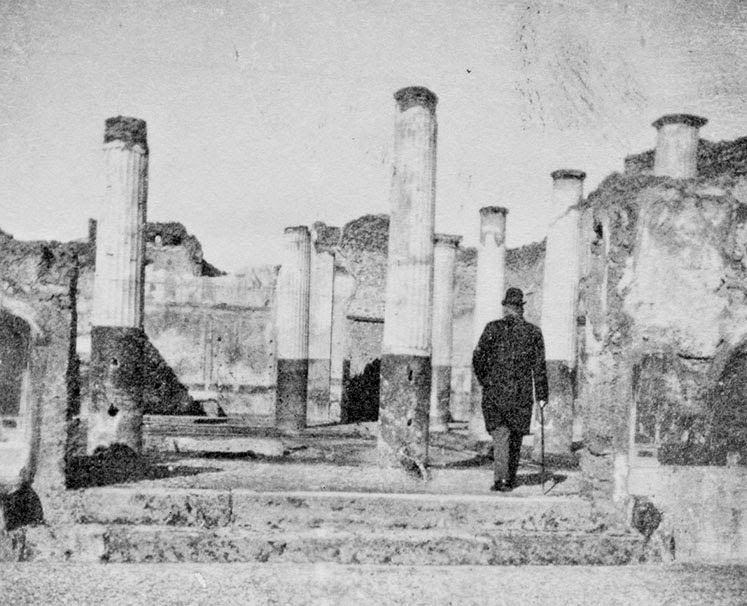
[Image: Alexander Graham Bell, inventor of the telephone, steps forth into the ruins of the “extinct city” of Pompeii; courtesy U.S. Library of Congress].

The ruins of Pompeii are being wired-up by a company otherwise known for its work as a manufacturer of military drones and “electronic warfare equipment,” Phys.org reports. Finmeccanica, the “Italian aerospace and defense giant,” has been contracted to install a high-tech sensor network amongst the barely stabilized walls and streets of this city once buried by a volcanic eruption nearly 2,000 years ago, in the hopes of monitoring unstable ground conditions on the sites.

Slippage and instability threaten to bring some of the buildings down, not just putting the site’s UNESCO-designated mansions at risk but potentially injuring (or worse) its annual hordes of international visitors.

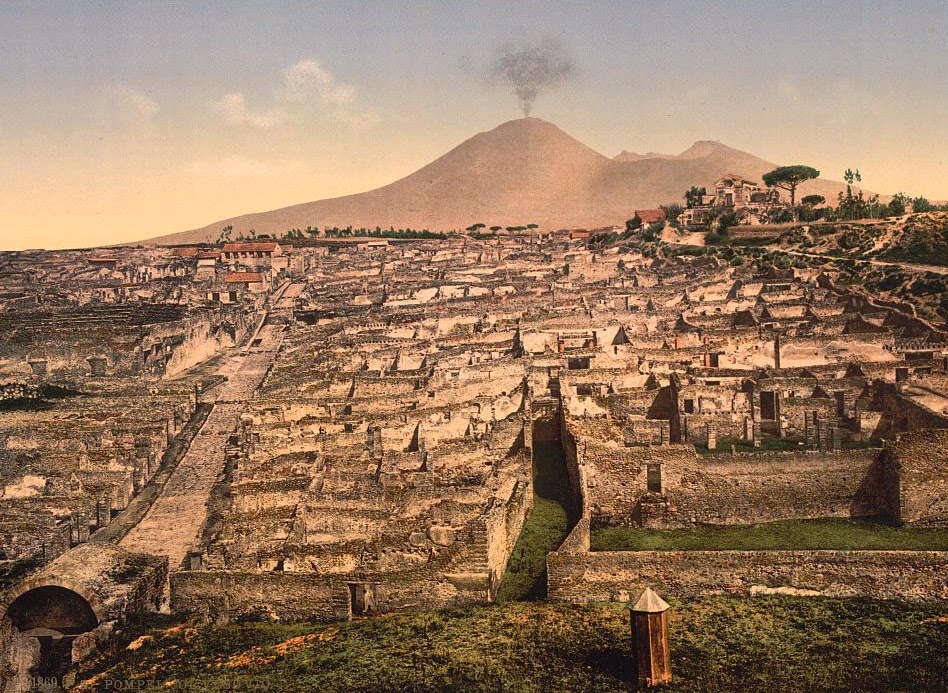
[Image: General view of Pompeii and Mt. Vesuvius; courtesy U.S. Library of Congress].

In Phys.org’s words, the sensors are being installed “to assess ‘risks of hydrogeological instability’ at the sprawling site, boost security and test the solidity of structures, as well as set up an early warning system to flag up possible collapses.”

The results are a bit like electronic eavesdropping—a kind of NSA of the ruins—only, instead of wire-tapping a single phone line, the entire city of Pompeii will be listened to from within, hooked up from one side to the other with equipment so sensitive it is normally used in waging “electronic warfare.”

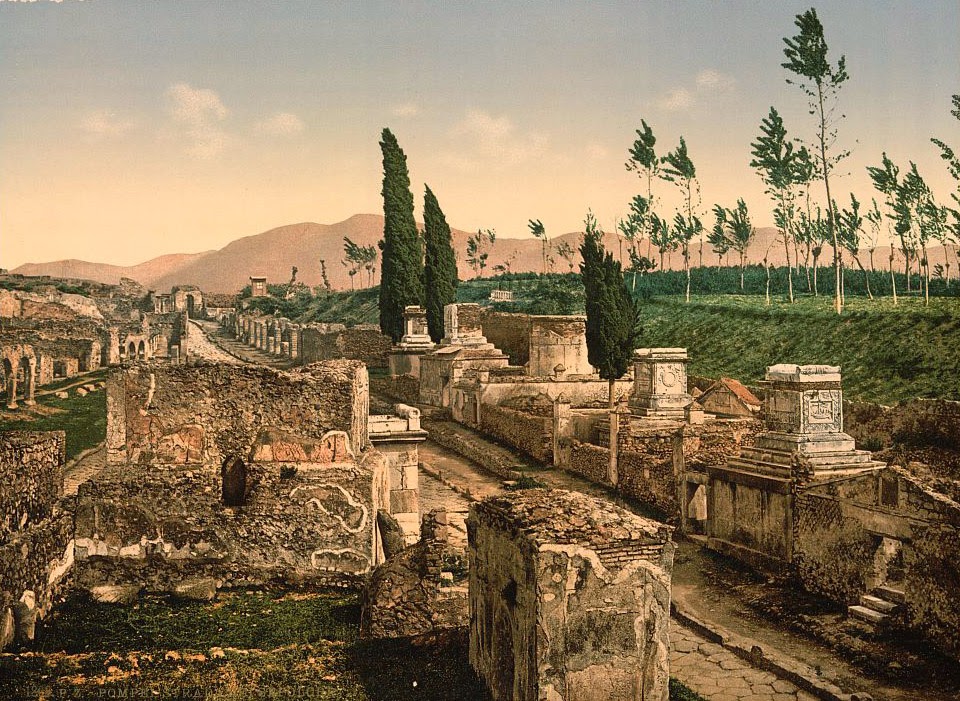
[Image: The Street of Tombs, Pompeii; courtesy U.S. Library of Congress].

The data will eventually be made available online for all to analyze, but it is interesting to read of a more immediate use of the sensors’ findings: Pompeii’s “security guards will be supplied with special radio equipment as well as smartphone apps to improve communication that can pinpoint their position and the type of intervention required.”

In other words, guards will receive electronic updates from the city itself while out on their daily rounds, including automated pings and alerts of impending structural failure or deformations of the ground, like some weird, semi-militarized version of ambient music, as if listening to the real-time groans of a settling city by radio.

Wire-tapping the ruins of a dead city, this mesh of electronic equipment—normally used in military surveillance operations—will thus help to preserve the archaeological site for future generations.

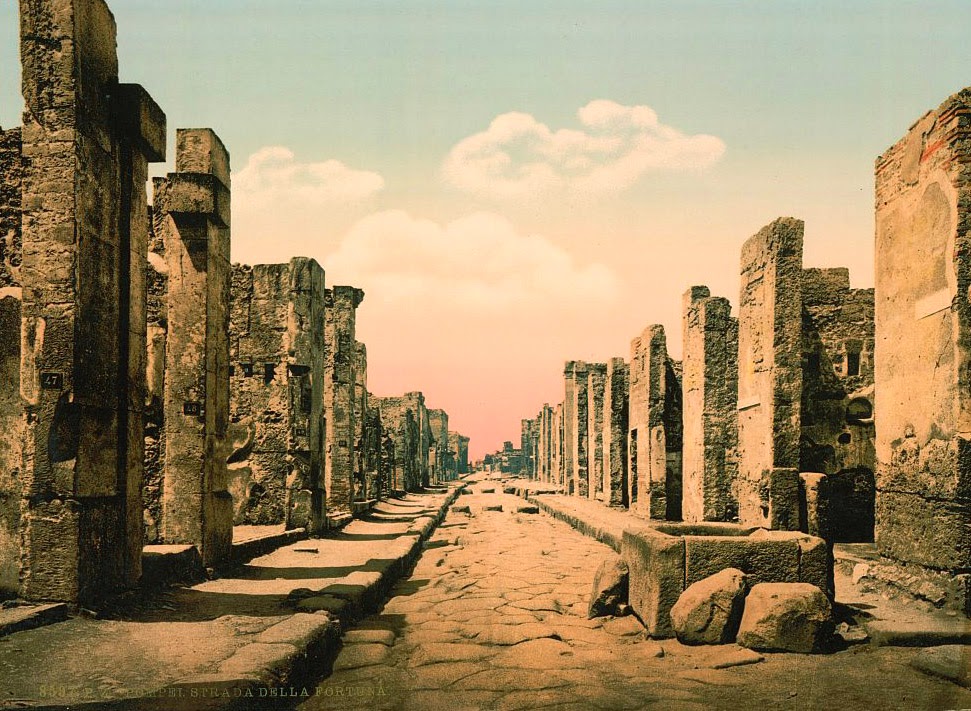
[Image: Fortuna Street, Pompeii; courtesy U.S. Library of Congress].

Like something out of Douglas Kahn’s recent book about the history of terrestrial electromagnetism and audio art, the old crumbling columns and shattered walls of Pompeii will soon find a new voice through repurposed military equipment, a weaponized seance performed on the empty streets of a place that’s more tomb than city.

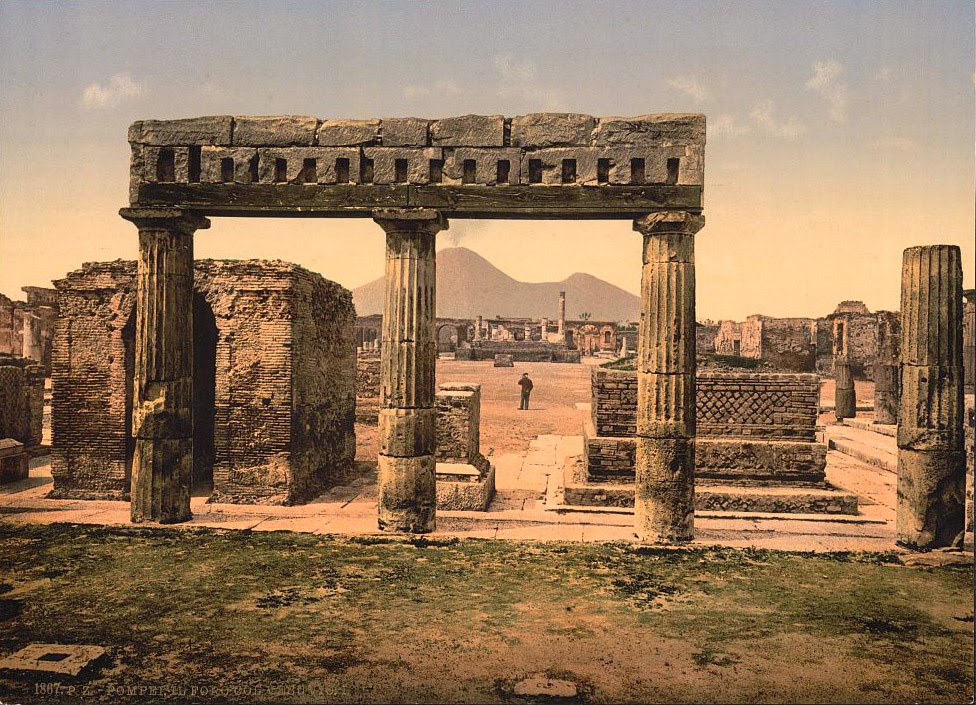
[Image: The Forum, Pompeii; courtesy U.S. Library of Congress].

The possibilities for interactive apps and other touristic experiences are also mind-boggling here: imagine, at the very least, being able to walk into the center of Pompeii totally alone, with nothing but your phone and some earbuds, tuning into real-time broadcasts of the shuddering masonry all around you, a wireless archaeological orchestra of bleached monuments in the sun, listening from within to the sounds of the ancient city.

Distant HAM radio enthusiasts, tuning in from attics in Indiana, spin the dial every Saturday night hoping to find Pompeii, a destroyed city on the other side of the world with its own location in the ether, whistling and purring as its architecture falls apart, room by room, a catacomb of sound and destruction.

(An earlier, different version of this post first appeared on Gizmodo).

Romanticism of the Scanning Error

[Image: ScanLAB Projects].

(A different version of this post previously appeared on Gizmodo).

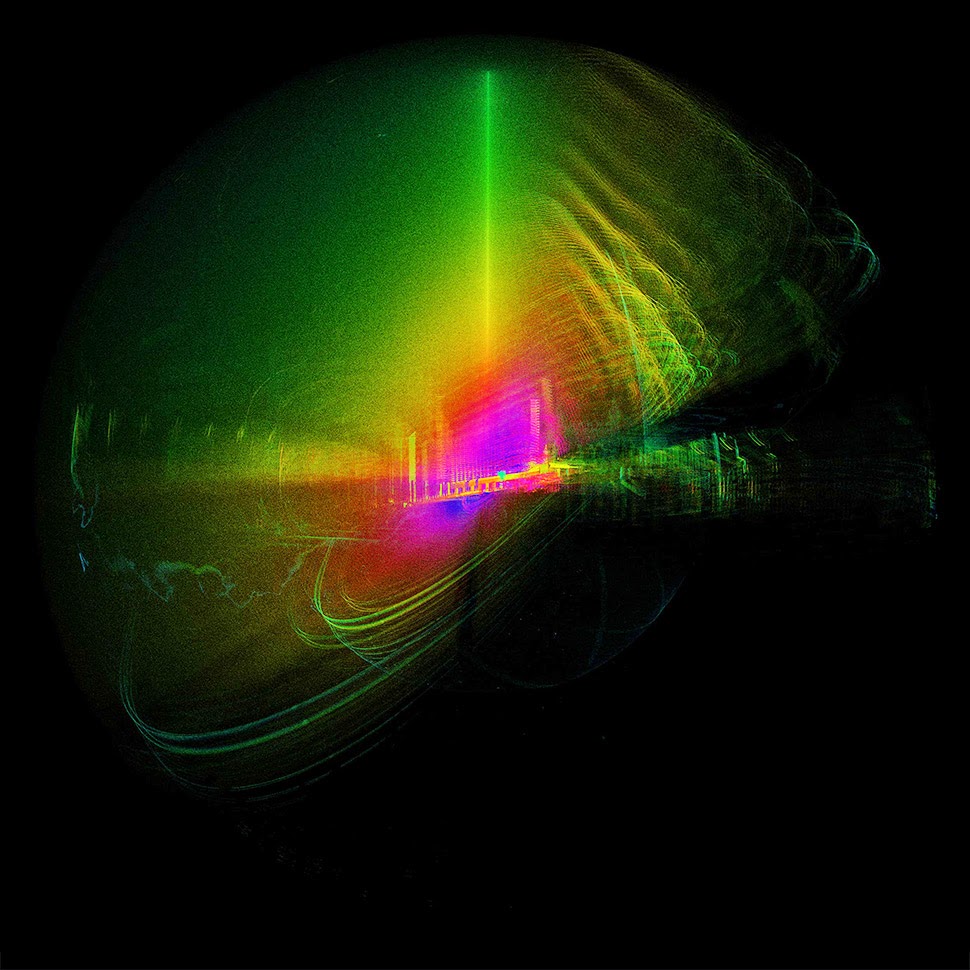
Matthew Shaw and William Trossell, the London-based duo known as ScanLAB Projects, continue to push the envelope of laser-scanning technology, producing visually stunning and conceptually intricate work that falls somewhere between art and practical surveying.

Their work also bears an unexpected yet increasingly pronounced political dimension, as they have scanned concentration camp sites, designed insurgent objects for thwarting police laser scanners, and even point-mapped melting ice floes in the Arctic as part of a larger study of climate change. The results are astonishingly, almost hypnotically detailed, as in this cinematic fly-through of an outdoor festival, where we pass through tent walls and very nearly see recognizable expressions on participants’ faces. It’s as if the future of the motion picture might really be narrative holograms.

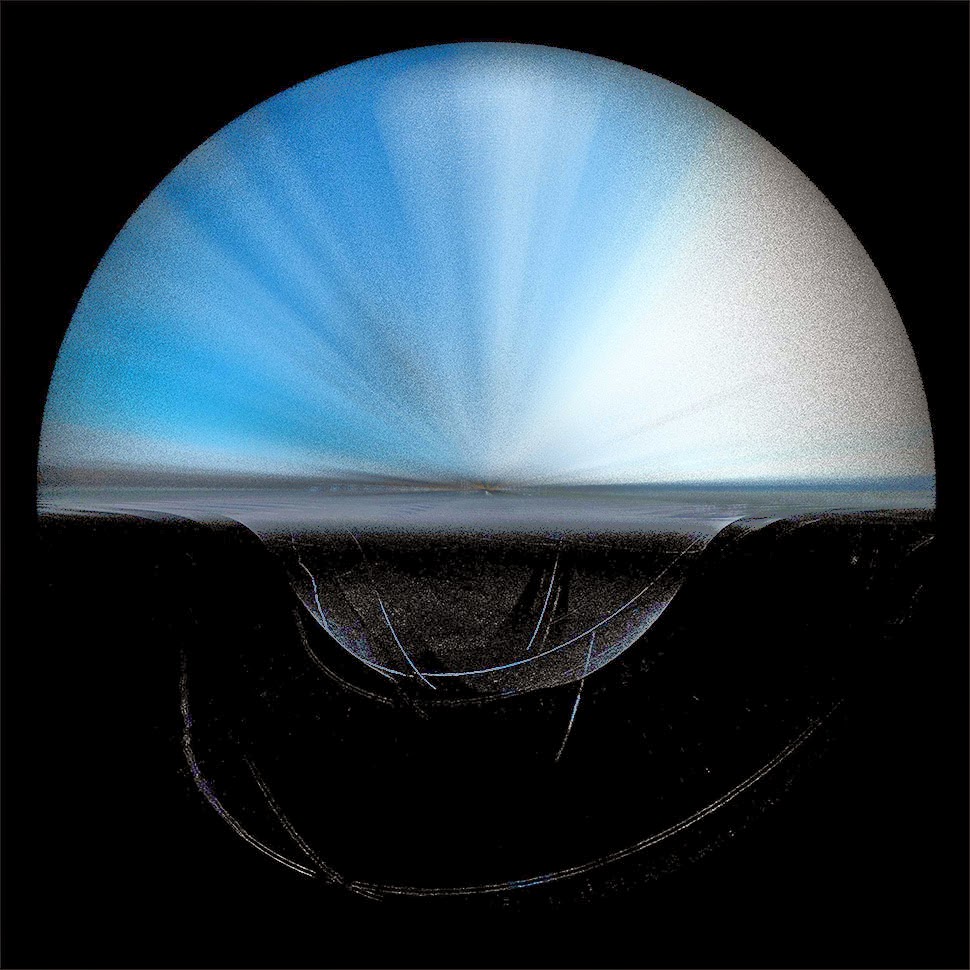
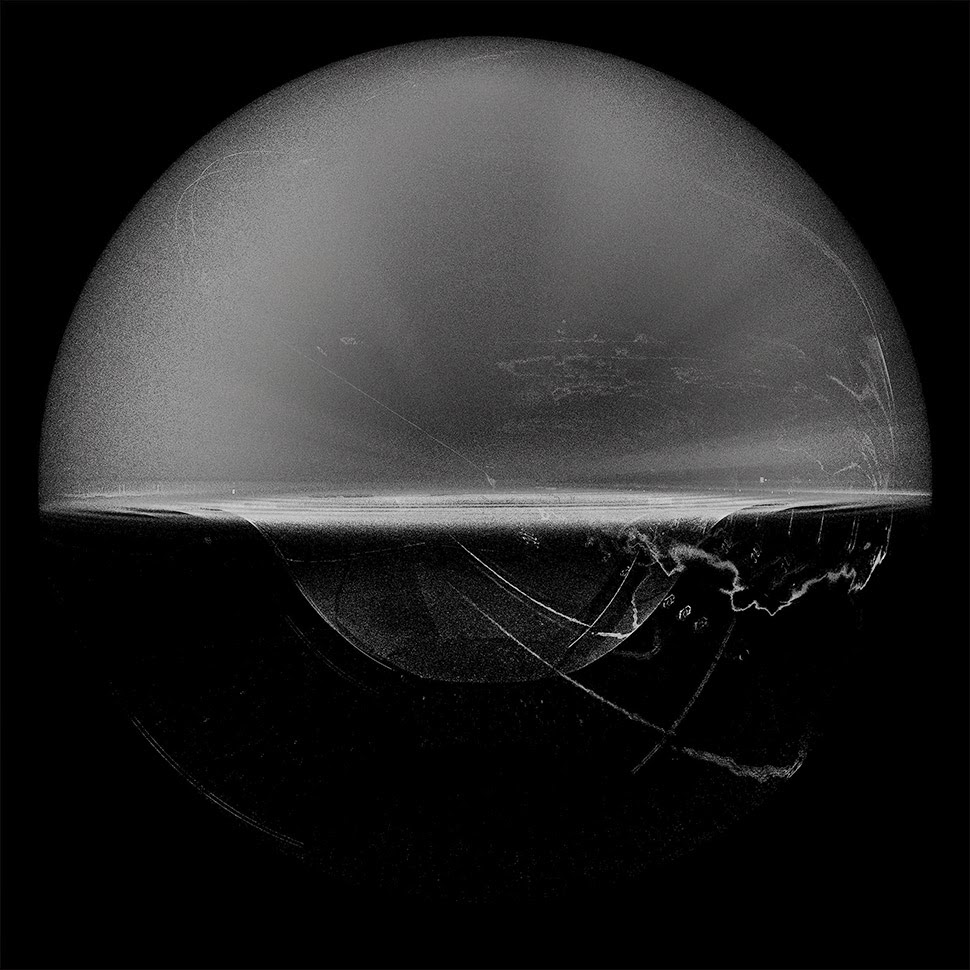
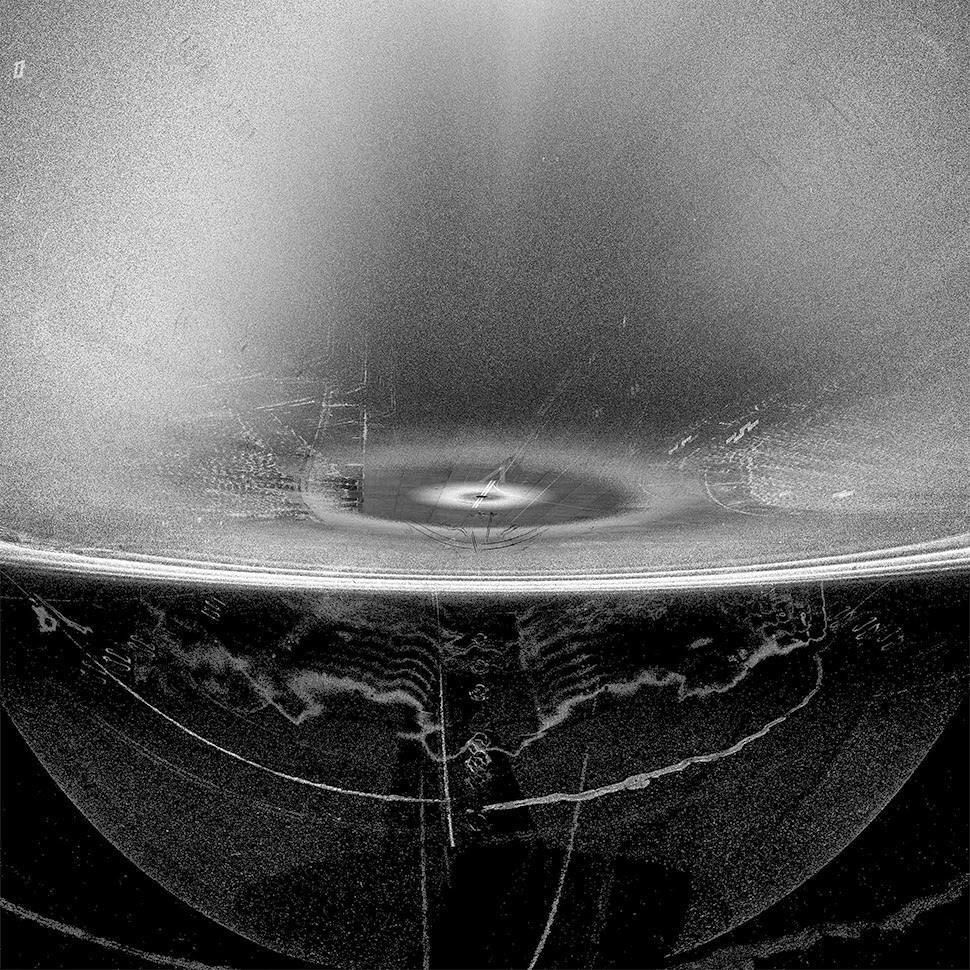
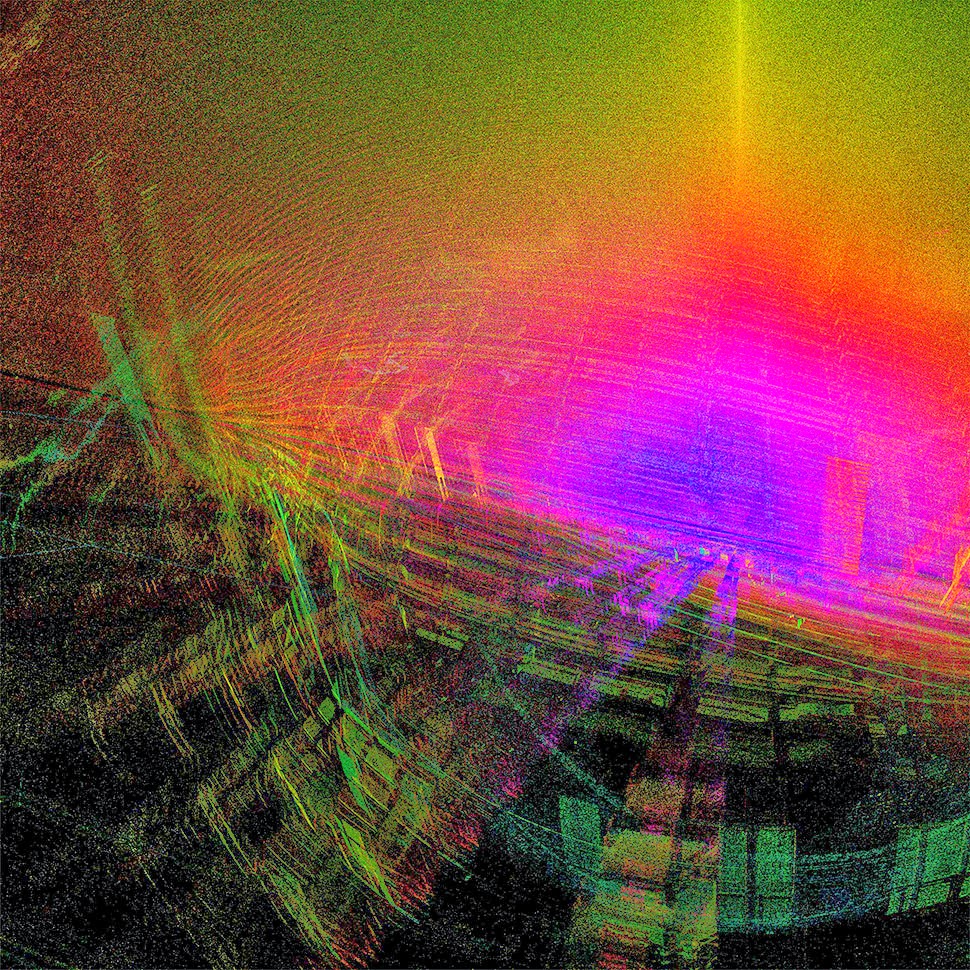
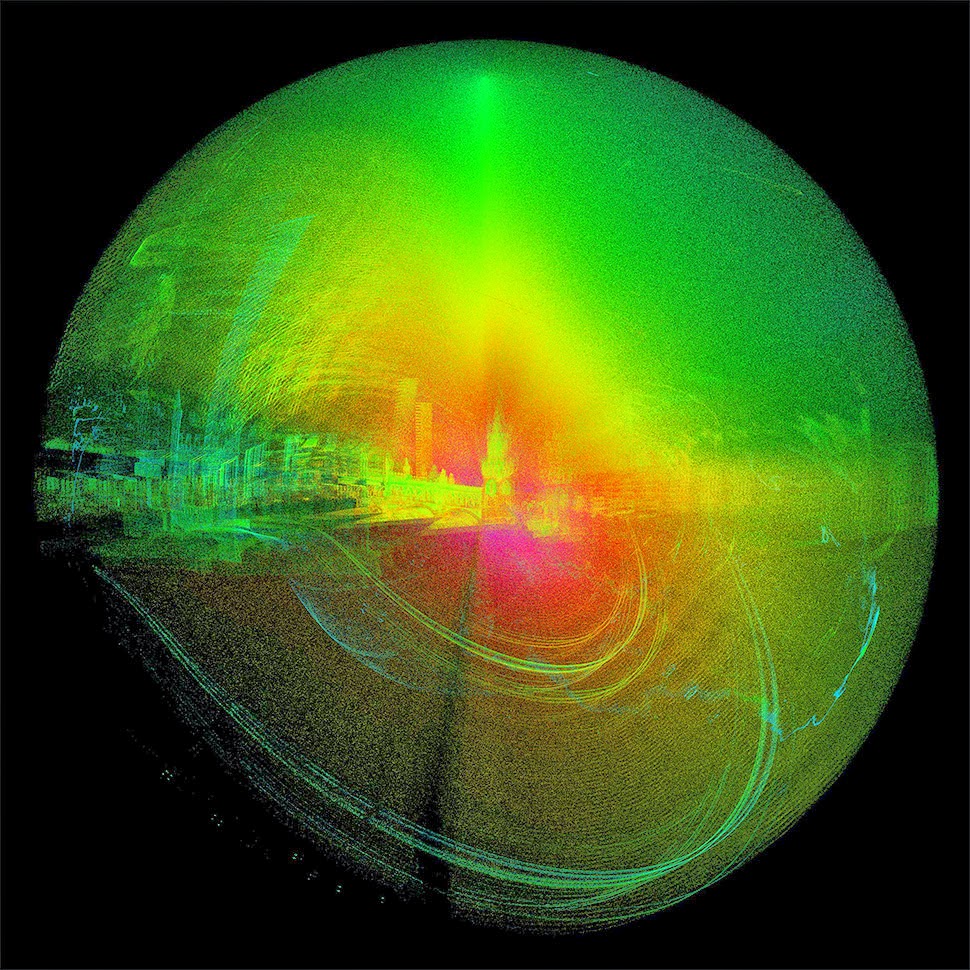
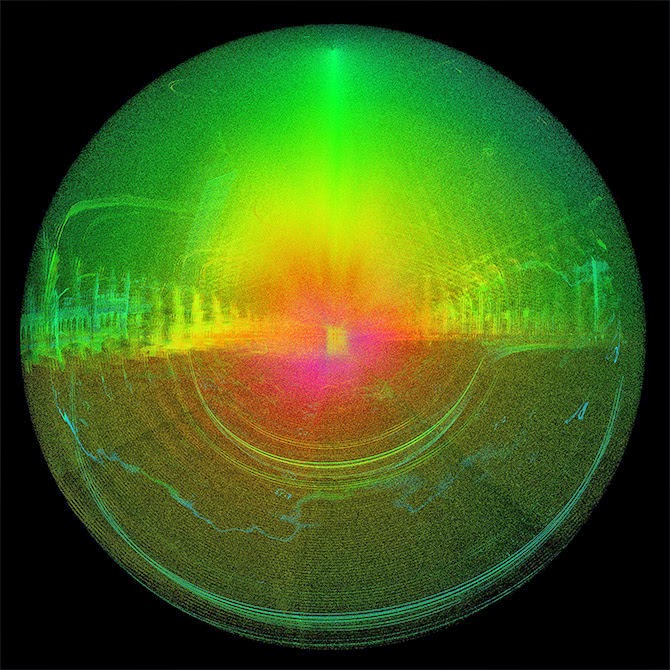
Last week, Shaw and Trossell premiered a new project at London’s Surface Gallery, exploring where laser scanners glitch, skip, artifact, and scatter. Called Noise: Error in the Void, the show utilizes scanning data taken from two locations in Berlin, but—as the show’s title implies—it actually foregrounds all the errors, where the equipment went wrong: a world of “mistaken measurements, confused surfaces and misplaced three-dimensional reflections.”

The tics and hiccups of a scanner gone off the mark thus result in these oddly beautiful, almost Romantic depictions of the world, like some lunatic, lo-fi cosmology filtered through machines.

Frozen datascapes appear like digital mist settling down over empty fields—or perhaps they’re parking lots—a virtual Antarctica appearing in the middle of the city.

[Image: ScanLAB Projects].

Huge domes of white light burn like spherical flames above a central point that remains both mysterious and unidentified, resembling the halos of nuclear explosions or the birth of stars.

[Image: ScanLAB Projects].

Spectacular bursts of color then suggest the presence of some new stratosphere, where black airplanes roam the edge of space and clouds are nothing but processing errors in a blurred celestial rendering. Perhaps we could call it expressionist scanning.

[Image: ScanLAB Projects].

In Shaw’s and Trossell’s own words, “Using terrestrial LIDAR technology it is now possible to capture the world in three dimensions. This technology can create near perfect digital 3D replicas of buildings, landscapes, objects and events. But these digital replicas are always an illusion of perfection. Noise: Error in the Void explores the inherent mistakes made by modern technologies of vision. Here we see the unedited view of the world as seen through the eyes of the LIDAR machine. Reality is shrouded in a cloud of mistaken measurements, confused surfaces and misplaced three-dimensional reflections.”

A short film—more like a dark ambient music video—shows some of the images in action.

In all honesty, many of the images are colored in a way that looks a bit more like a Pink Floyd laser show than the almost melancholy landscapes I like so much above, and I even made a few of these greyscale to see if, stripped of color, they could still repeat the lonely, wanderer-above-a-sea-of-fog feeling that the other images have, the benthic void of miscalculated data that nonetheless results in new worlds. But then I figured I shouldn’t mess with ScanLAB’s work and I left them as is.

[Images: ScanLAB Projects].

But, even here, blinded by the colors of a rave, throbbing architectural shapes rotate and spin, as if parts of London are stuttering in and out of sync with themselves, a whole city rumbling through a shockwave of digital reverb, blinking gyroscopically out of control.

[Images: ScanLAB Projects].

If you’re lucky enough to be in London in the next few weeks, check out their exhibition at Surface Gallery—and, even better, if you’re an architecture student, you can actually take a class with these guys. Check out their teaching work here.

(Read an earlier version of this post at Gizmodo).

When Hills Hide Arches


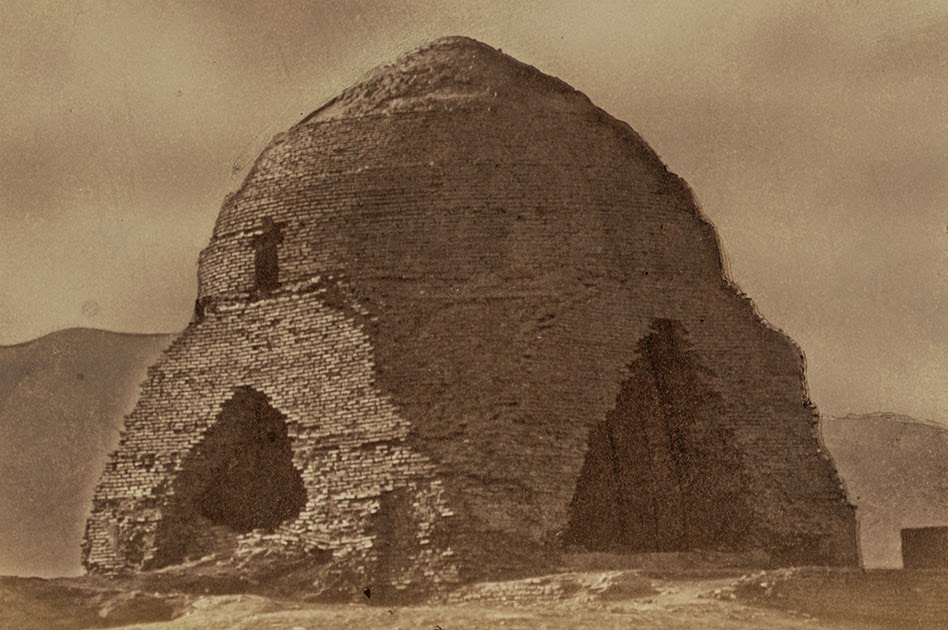
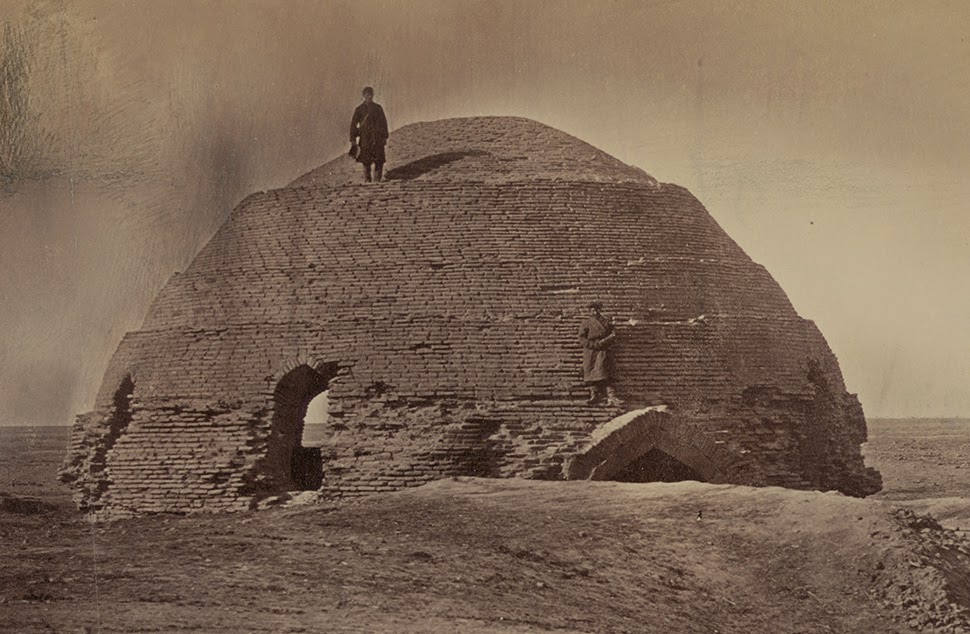
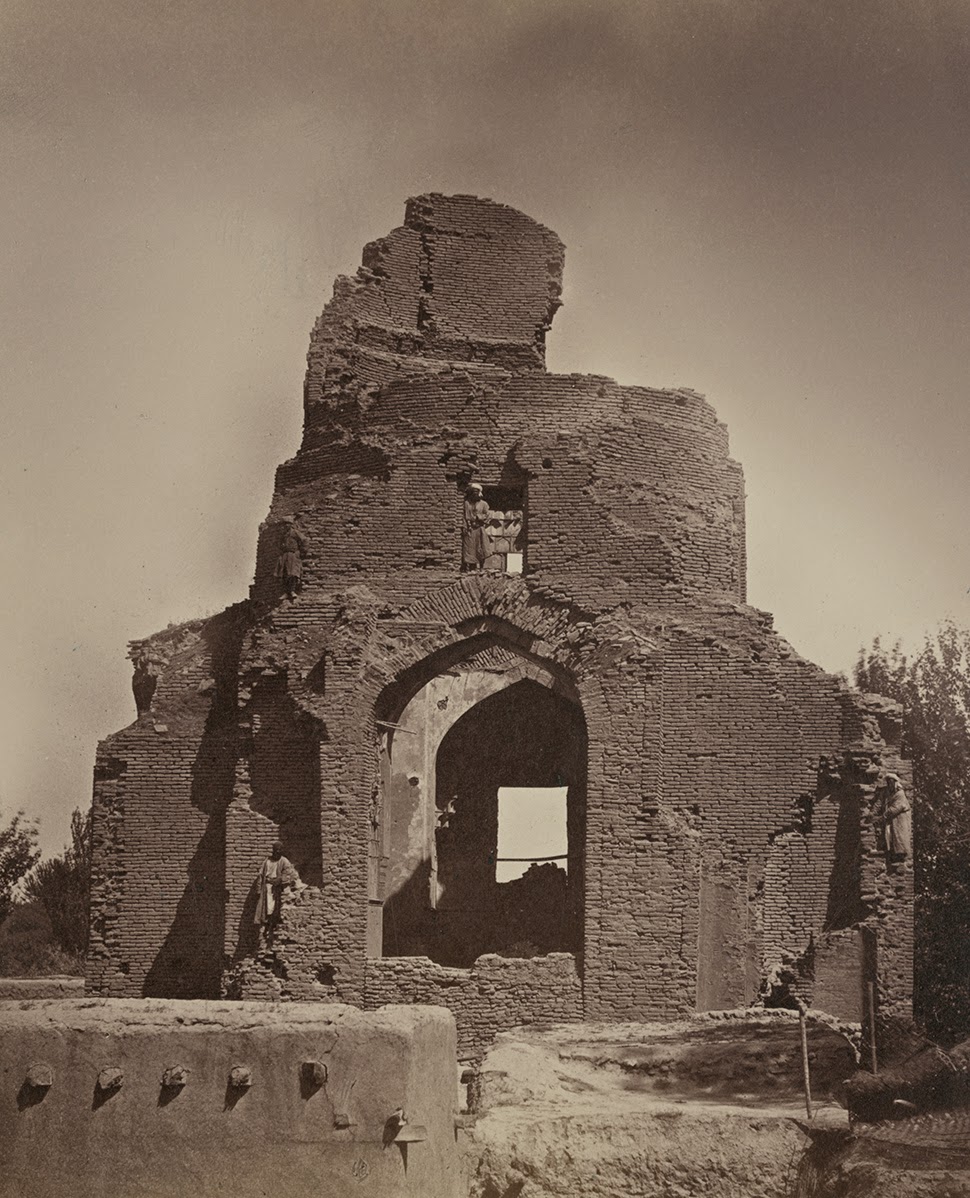
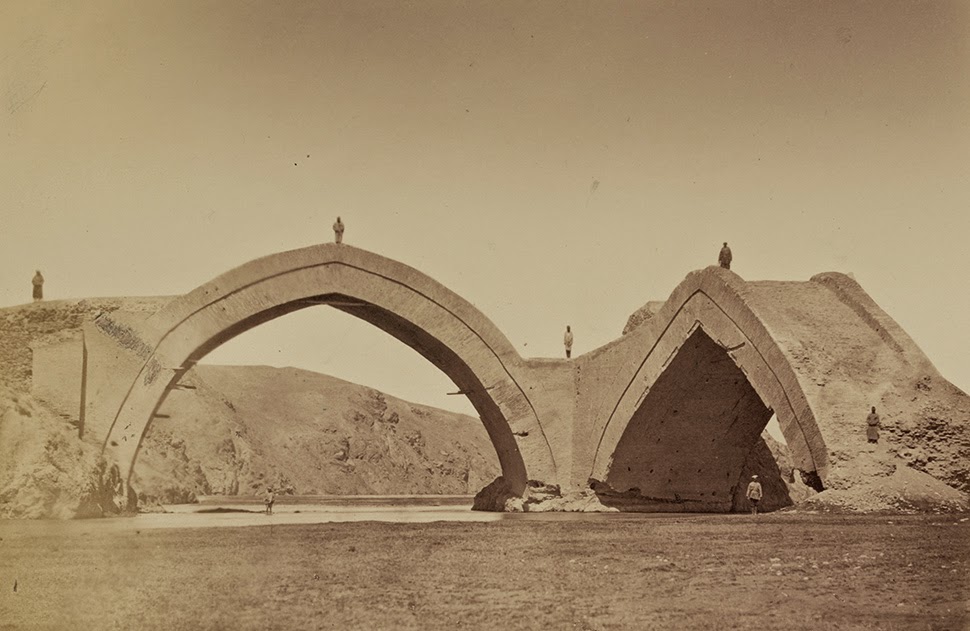
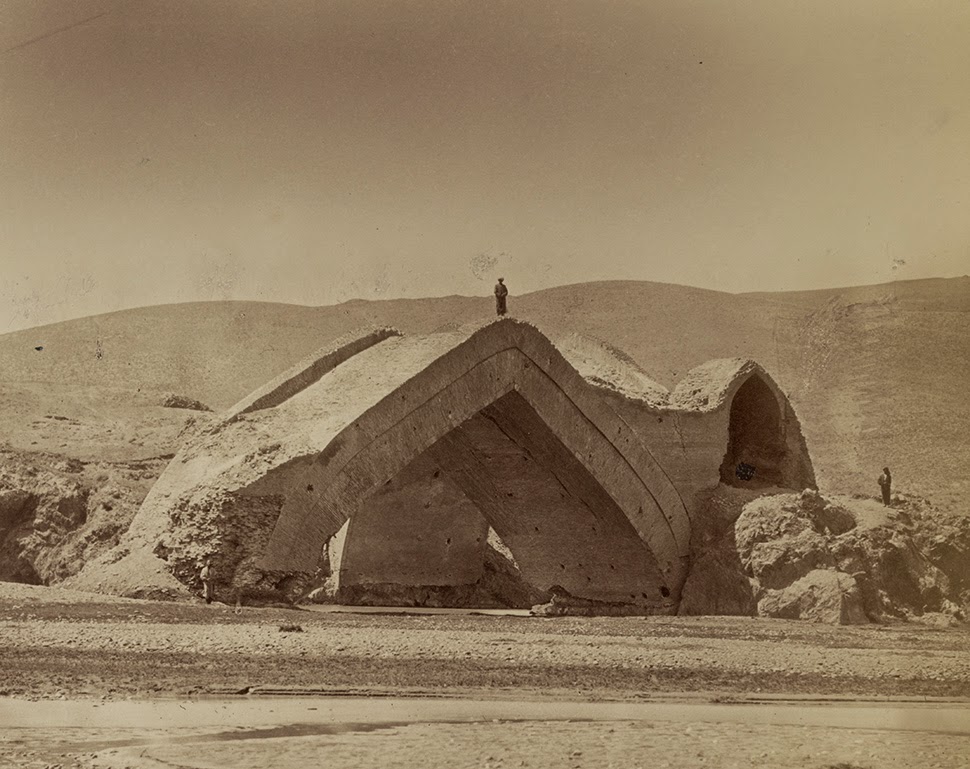
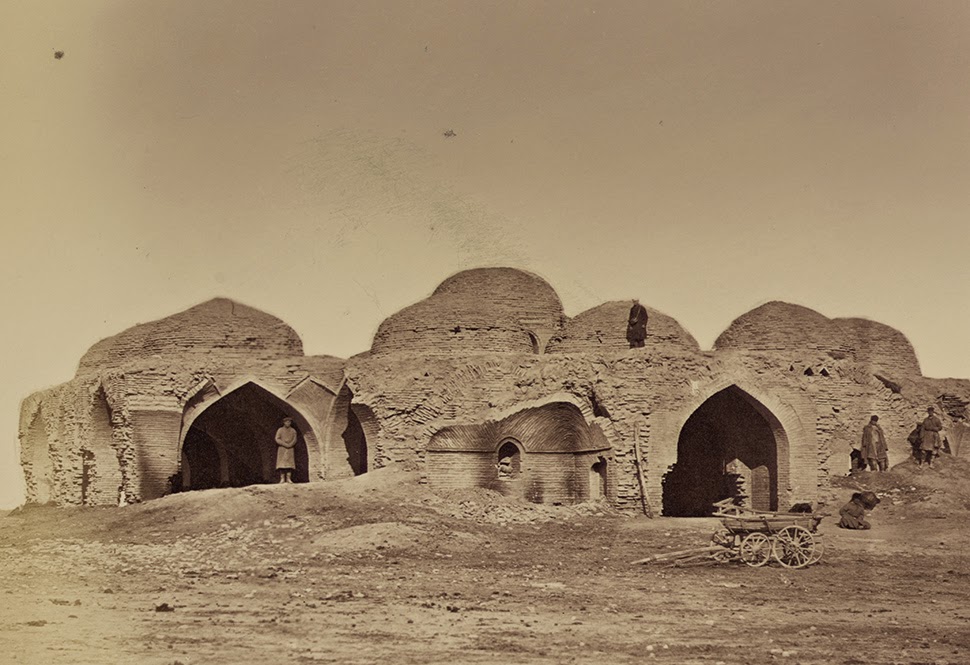
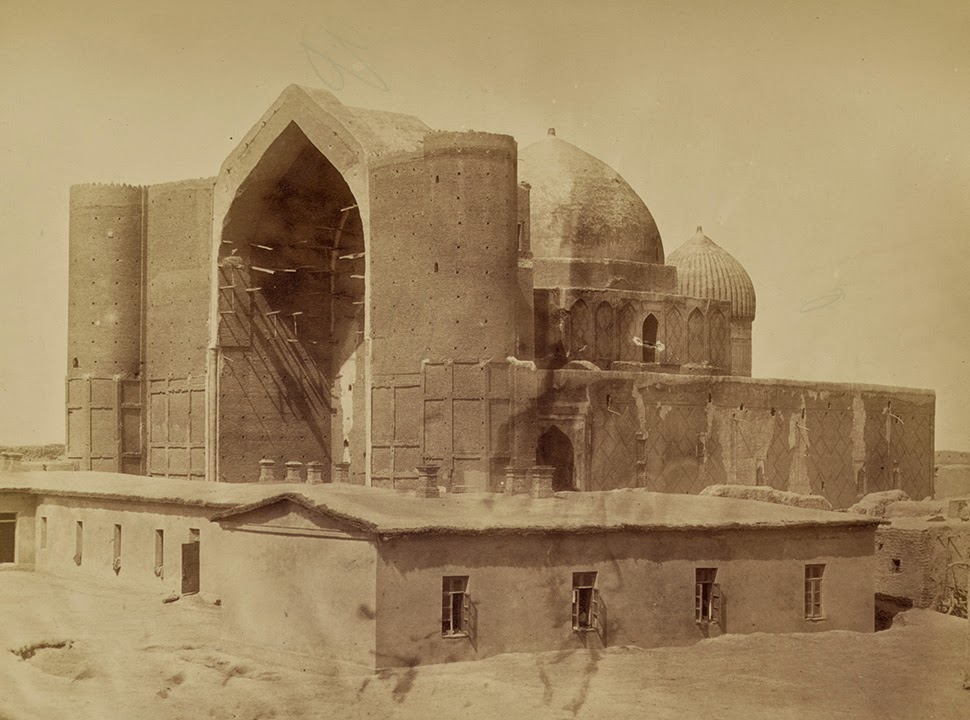
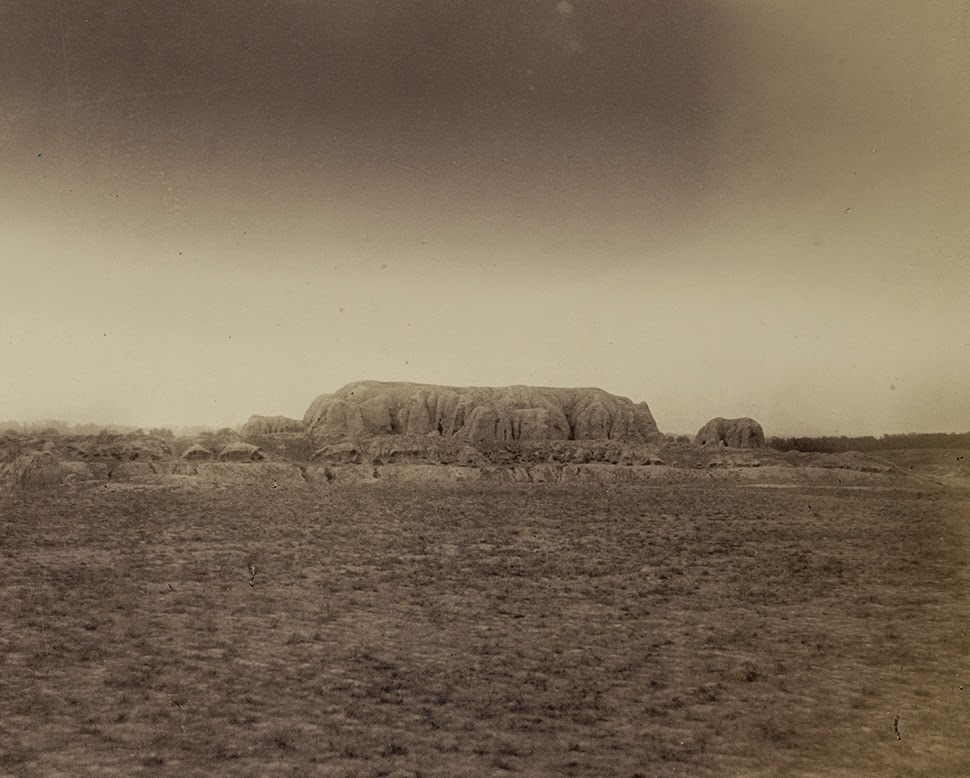
Landforms masquerading as architecture and vice versa seem to dominate a few sets of older images hosted at the Library of Congress.

Photos taken between 1865 and 1872, these are—photographically speaking—almost impossibly ancient, approaching a point of chemical age as comparatively old to us today as the structures they depict were to the military expeditions that documented them in the first place.


The first shot—depicting the “ruins of the Mulushki Mirza Rabat near Khodzhend,” as the Library of Congress explains it—establishes something of a theme here: works of architecture built from modules of fired clay, their wind-pocked brickwork extracted from the hills around them and transformed by kilns into something artificial, “manmade,” now more artifact than natural object.

Ironically, though, it is exactly their resemblance to the earth that sets the stage for these structures’ later decay, falling apart into mere dust and minerals, little pebbles and grains of sand, literally forming dunes, blending imperceptibly with the landscape. Once they’re gone, it’s as if they were never there.


Domes and extraordinary arches stand in the middle of nowhere, as if left behind by the receding tide of some alien civilization that once slid through, depositing works of architecture in its wake. Like the slime of a snail, these are just residue, empty proof that something much bigger once passed by.

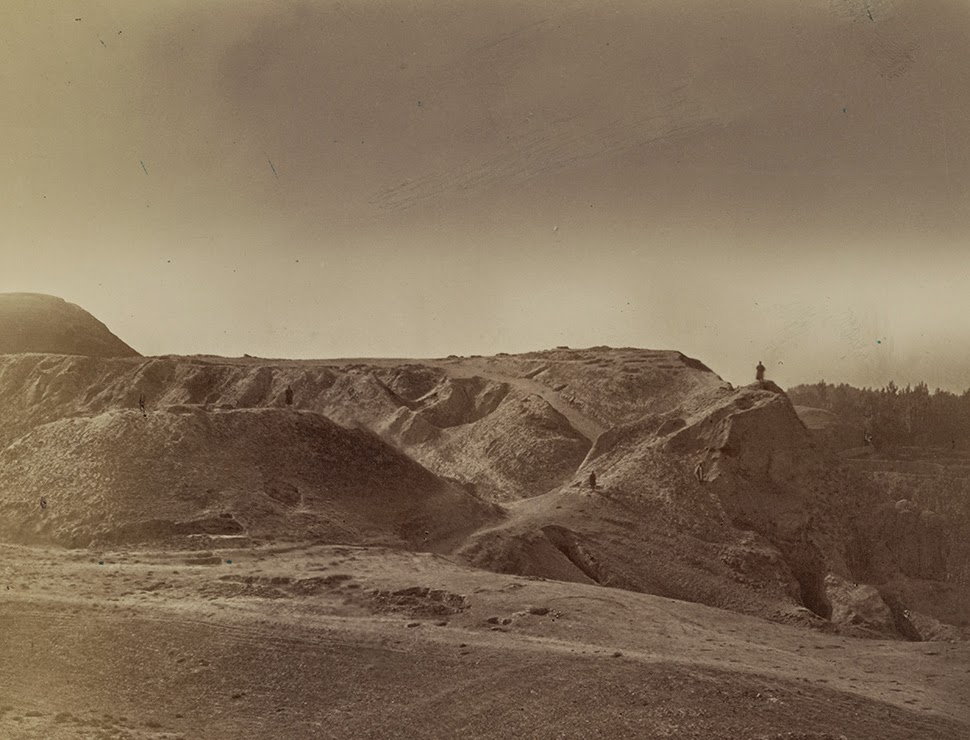
What’s so amazing about these pictures, I’d suggest, is that, among other things, they come with the surreal implication that, beneath or somehow within all the rolling hills and dunes of the surrounding landscape, these sprawling bridges and spinal forms are actually hidden, just waiting there for hooded, 19th-century backpackers to rediscover.

These tiny figures are probably laughing in awe at the anti-gravitational urge that pushes these structures up above the sand line, into the photographs of these seemingly nameless expeditionary teams intent on cataloging every spatially exotic detail they find.


Here, in the ruins of Murza Rabat, seen below, natural hills are actually catacombs of architecture, buildings fooling us for their resemblance to caves, structurally camouflaged as the surface of the earth.

But it’s not the planet—it’s not geology—it’s just architecture: a shaped thing, an artifact, something plastic and formed by human hands. Not hills but abandoned buildings.


In the end, photographs of sand dunes might actually depict scenes of collapsed architecture; that landscape there in front of you might really be a city seen one thousand years after the fact, every wall cracked open and broken into pointless little mounds you’d probably stomp through without even thinking, the desert all around you giving no indication that this all used to be structure.

It used to be arches, bridges, vaults, and domes, huge mosques and cathedrals of human form before crumbling into mindless anthills of mud and clay.


It’s almost like these photographs exist to remind you that everything you now think of as a room—as space, as volume, as creation—will soon just be a suffocation of sand grains packed together in dense, amnesia-ridden hills, landscapes almost laughably quick to forget they once were architecture.

All photos courtesy of the Library of Congress.

Roentgen Objects, or: Devices Larger than the Rooms that Contain Them

[Image: Photo courtesy of the Rijksmuseum Amsterdam and the Metropolitan Museum of Art].

A gorgeous exhibition last year at the Metropolitan Museum of Art featured mechanical furniture designed by the father and son team, Abraham and David Roentgen: elaborate 18th-century technical devices disguised as desks and tables.

First, a quick bit of historical framing, courtesy of the Museum itself: “The meteoric rise of the workshop of Abraham Roentgen (1711–1793) and his son David (1743–1807) blazed across eighteenth-century continental Europe. From about 1742 to its closing in the early 1800s, the Roentgens’ innovative designs were combined with intriguing mechanical devices to revolutionize traditional French and English furniture types.”

Each piece, the Museum adds, was as much “an ingenious technical invention” as it was “a magnificent work of art,” an “elaborate mechanism” or series of “complicated mechanical devices” that sat waiting inside palaces and parlors for someone to come along and activate them.

If you can get past the visual styling of the furniture—after all, the dainty little details and inlays perhaps might not appeal to many BLDGBLOG readers—and concentrate instead only on the mechanical aspect of these designs, then there is something really incredible to be seen here.

[Image: Photo courtesy of the Rijksmuseum Amsterdam and the Metropolitan Museum of Art].

Hidden amidst drawers and sliding panels are keyholes, the proper turning of which results in other unseen drawers and deeper cabinets popping open, swinging out to reveal previously undetectable interiors.

But it doesn’t stop there. Further surfaces split in half to reveal yet more trays, files, and shelves that unlatch, swivel, and slide aside to expose entire other cantilevered parts of the furniture, materializing as if from nowhere on little rails and hinges.

Whole cubic feet of interior space are revealed in a flash of clacking wood flung forth on tracks and pulleys.

As the Museum phrases it, Abraham Roentgen’s “mechanical ingenuity” was “exemplified by the workings of the lower section” of one of the desks on display in the show: “when the key of the lower drawer is turned to the right, the side drawers spring open; if a button is pressed on the underside of these drawers, each swings aside to reveal three other drawers.”

And thus the sequence continues in bursts of self-expansion more reminiscent of a garden than a work of carpentry, a room full of wooden roses blooming in slow motion.

[Images: Photos courtesy of the Rijksmuseum Amsterdam and the Metropolitan Museum of Art].

The furniture is a process—an event—a seemingly endless sequence of new spatial conditions and states expanding outward into the room around it.

Each piece is a controlled explosion of carpentry with no real purpose other than to test the limits of volumetric self-demonstration, offering little in the way of useful storage space and simply showing off, performing, a spatial Olympics of shelves within shelves and spaces hiding spaces.

Sufficiently voluminous furniture becomes indistinguishable from a dream.

[Image: Photo courtesy of the Rijksmuseum Amsterdam and the Metropolitan Museum of Art].

What was so fascinating about the exhibition—and this can be seen, for example, in some of the short accompanying videos (a few of which are archived on the Metropolitan Museum of Art’s website)—is that you always seemed to have reached the final state, the fullest possible unfolding of the furniture, only for some other little keyhole to appear or some latch to be depressed in just the right way, and the thing just keeps on going, promising infinite possible expansions, as if a single piece of furniture could pop open into endless sub-spaces that are eventually larger than the room it is stored within.

The idea of furniture larger than the space that houses it is an extraordinary topological paradox, a spatial limit-case like black holes or event horizons, a state to which all furniture makers could—and should—aspire, devising a Roentgen object of infinite volumetric density.

A single desk that, when unfolded, is larger than the building around it, hiding its own internal rooms and corridors.

Suggesting that they, too, were thrilled by the other-worldly possibilities of their furniture, the Roentgens—and I love this so much!—also decorated their pieces with perspectival illusions.

[Image: Photo courtesy of the Rijksmuseum Amsterdam and the Metropolitan Museum of Art].

The top of a table might include, for example, the accurately rendered, gridded space of a drawing room, as if you were peering cinematically into a building located elsewhere; meanwhile, pop-up panels might include a checkerboard reference to other possible spaces that thus seemed to exist somewhere within or behind the furniture, lending each piece the feel of a portal or visual gateway into vast and multidimensional mansions tucked away inside.

The giddiness of it all—at least for me—was the implication that you could decorate a house with pieces of furniture; however, when unfolded to their maximum possible extent, these same objects might volumetrically increase the internal surface area of that house several times over, doubling, tripling, quadrupling its available volume. But it’s not magic or the supernatural—it’s not quadraturin—it’s just advanced carpentry, using millimeter-precise joinery and a constellation of unseen hinges.

[Images: Photos courtesy of the Rijksmuseum Amsterdam and the Metropolitan Museum of Art].

You could imagine, for example, a new type of house; it’s got a central service core lined with small elevators. Wooden boxes, perhaps four feet cubed, pass up and down inside the walls of the house, riding this network of dumbwaiters from floor to floor, where they occasionally stop, when a resident demands it. That resident then pops open the elevator door and begins to unfold the box inside, unlatching and expanding it outward into the room, this Roentgen object full of doors, drawers, and shelves, cantilevered panels, tabletops, and dividers.

And thus the elevators grow, simultaneously inside and outside, a liminal cabinetry both tumescent and architectural that fills up the space with spaces of its own, fractal super-furniture stretching through more than one room at a time and containing its own further rooms deep within it.

But then you reverse the process and go back through in the other direction, painstakingly shutting panels, locking drawers, pushing small boxes inside of larger boxes, and tucking it all up again, compressing it like a JPG back into the original, ultra-dense cube it all came from. You’re like some homebound god of superstrings tying up and hiding part of the universe so that others might someday rediscover it.

To have been around to drink coffee with the Roentgens and to discuss the delirious outer limits of furniture design would have been like talking to a family of cosmologists, diving deep into the quantum joinery of spatially impossible objects, something so far outside of mere cabinetry and woodwork that it almost forms a new class of industrial design. Alas, their workshop closed, their surviving objects today are limited in number, and the exhibition at the Metropolitan Museum of Art is now closed.

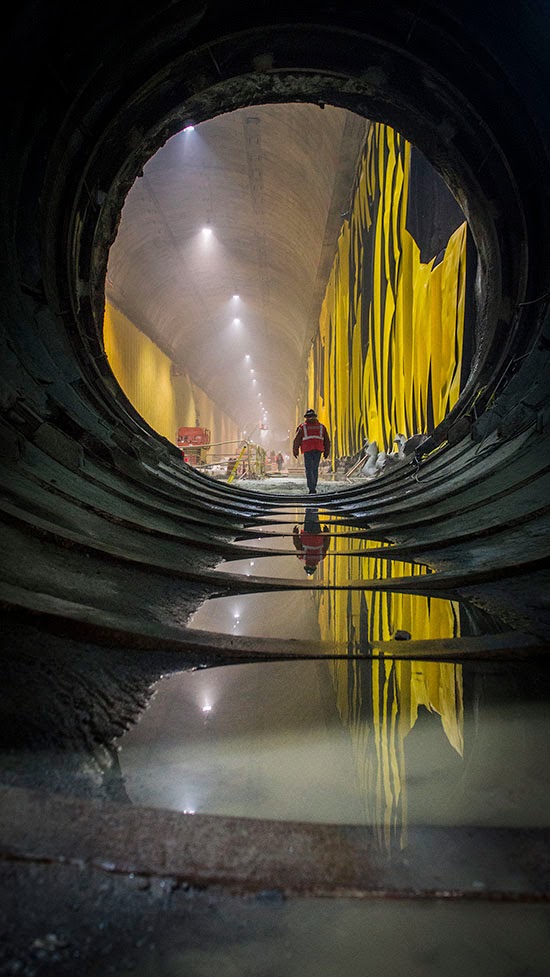
Forward into the colossal yellow room taking shape beneath Manhattan

[Image: A Metropolitan Transportation Authority worker steps forward into the colossal yellow room taking shape beneath Manhattan, an astonishing and cavernous new part of the city’s East Side Access Project that will expand rail service for the Long Island Rail Road. Don’t miss the original shot and its related images, all taken by Rehema Trimiew for the MTA].

Where The Alps Are A 3D-Printed Landscape Made From Artificial Snow

[Image: Photo by Danny Lane].

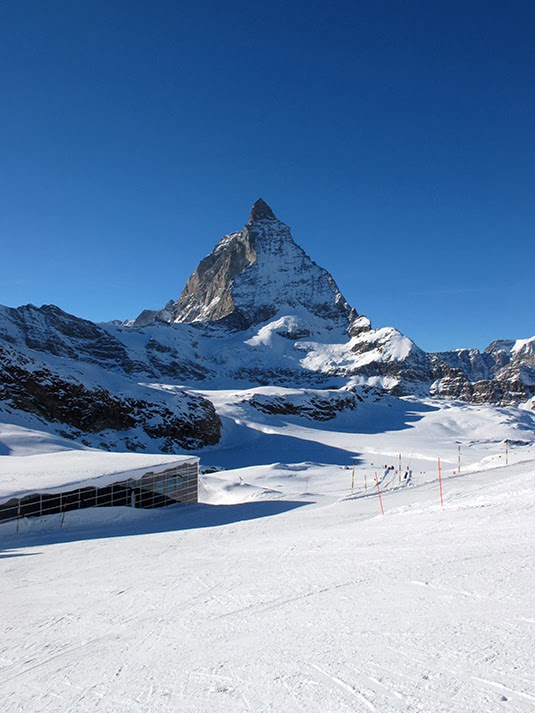
Earlier this winter, I missed an opportunity to travel over to Switzerland with architects Smout Allen and Kyle Buchanan who, at the time, were leading their students around the mountain landscapes of the Alps in order to learn about infrastructures of defense and national snow-production, among other things. It sounded like an amazing trip.

[Image: Photo by Kyle Buchanan].

However, I did get to see some photos sent back of the various and random things they visited in the resort city of Zermatt.

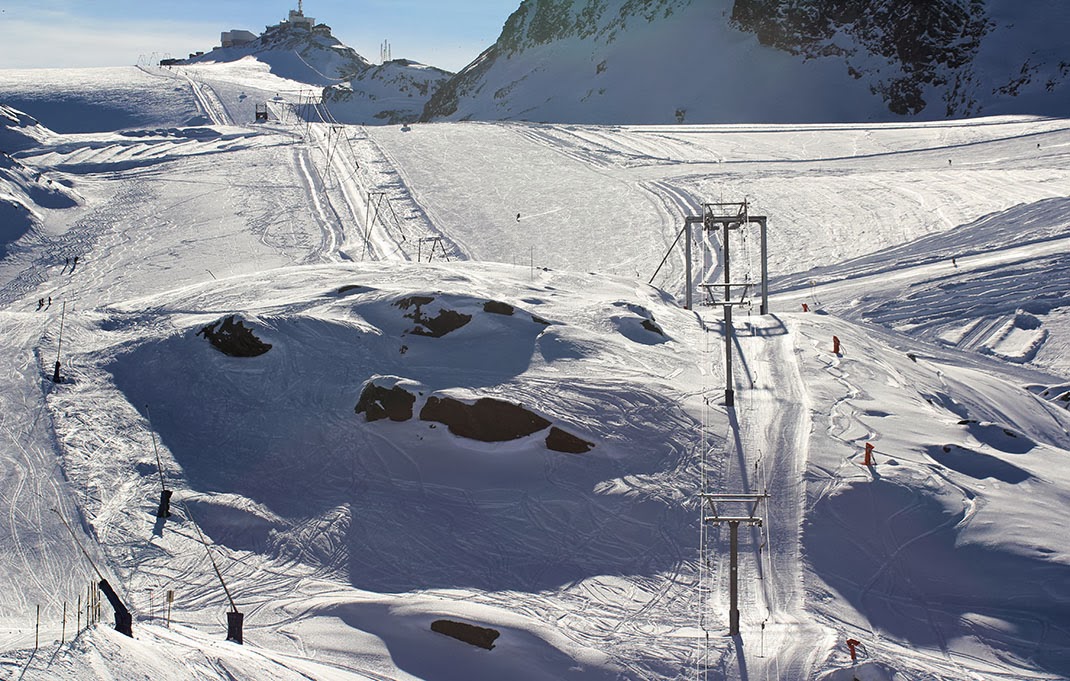
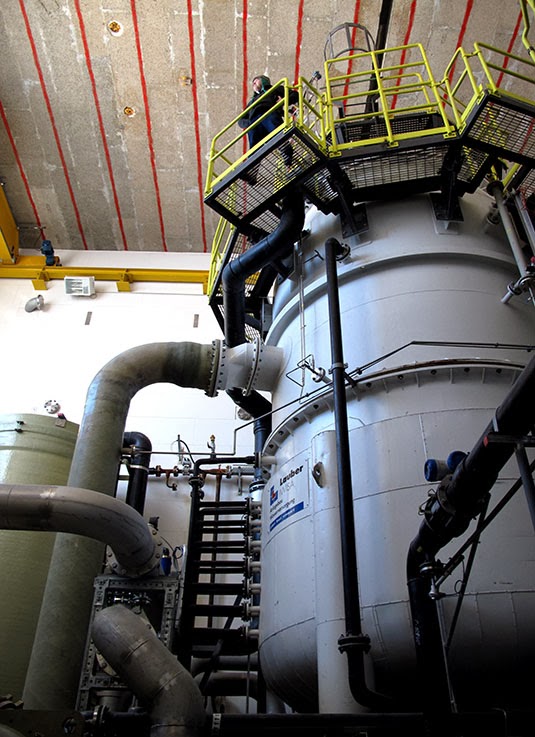
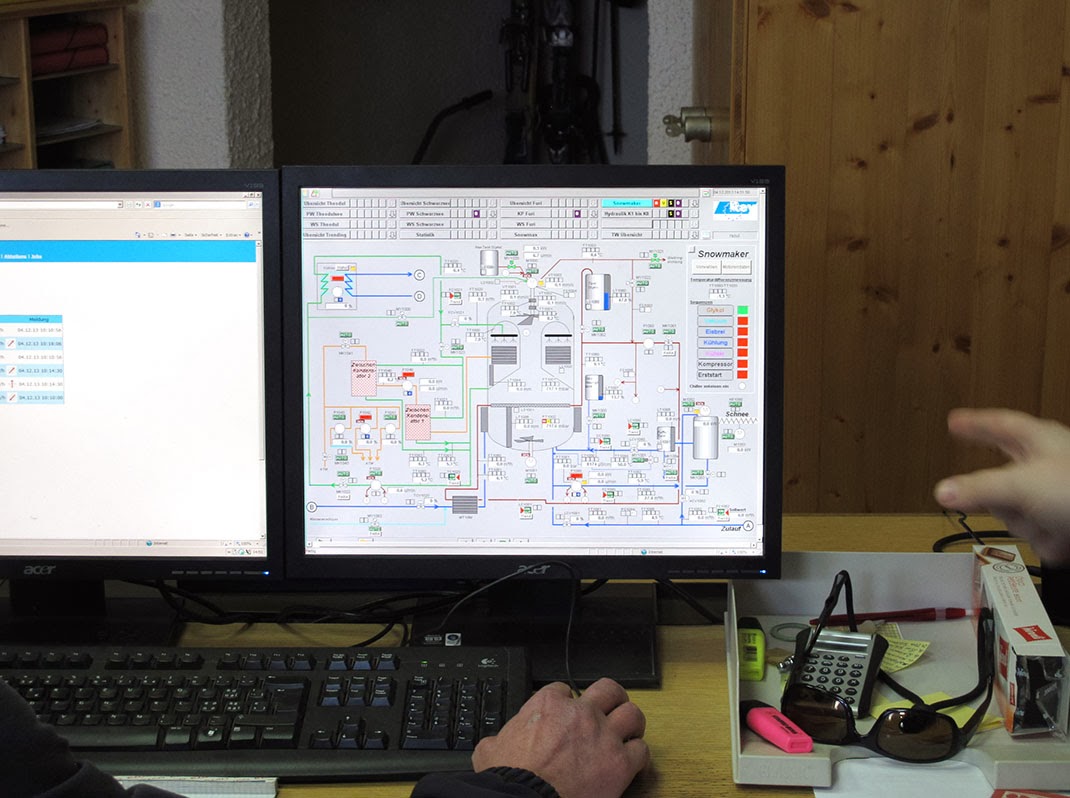
This included a huge machine known as The Snowmaker. Apparently originating in Israel, it was formerly used to cool South African diamond mines but since repurposed for spraying artificial snow onto ski slopes in the Alps.

[Images: Photos by Kyle Buchanan].

The carefully choreographed operation requires a fan-like array of buried water pipes, pipes that spread throughout the resort like capillaries.

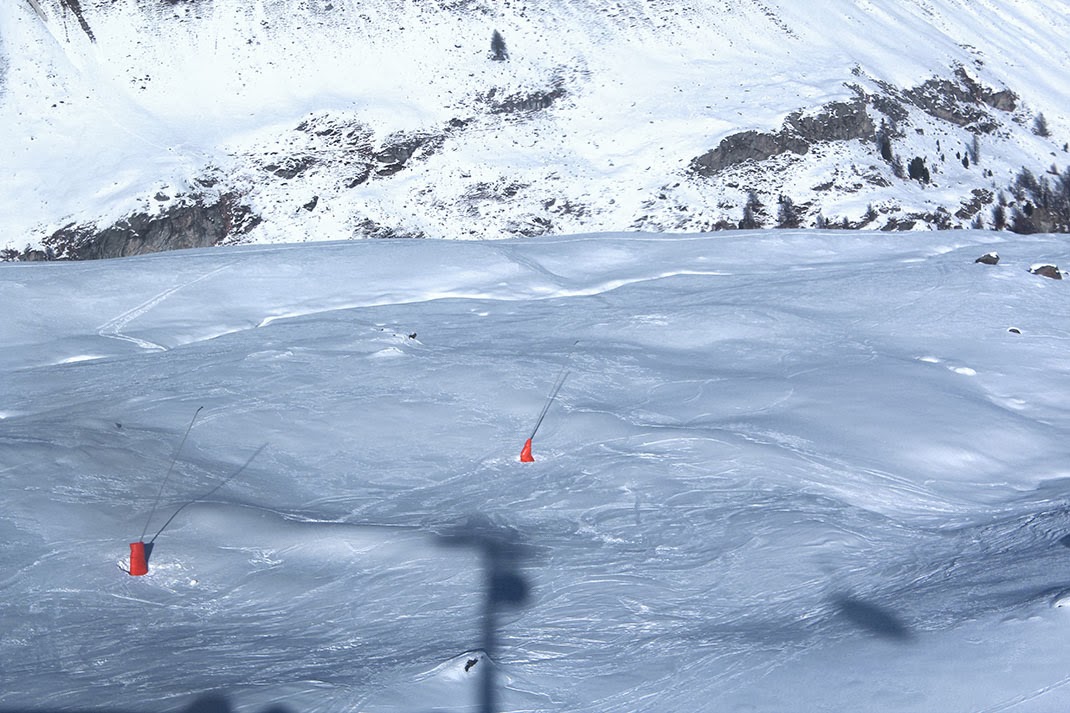
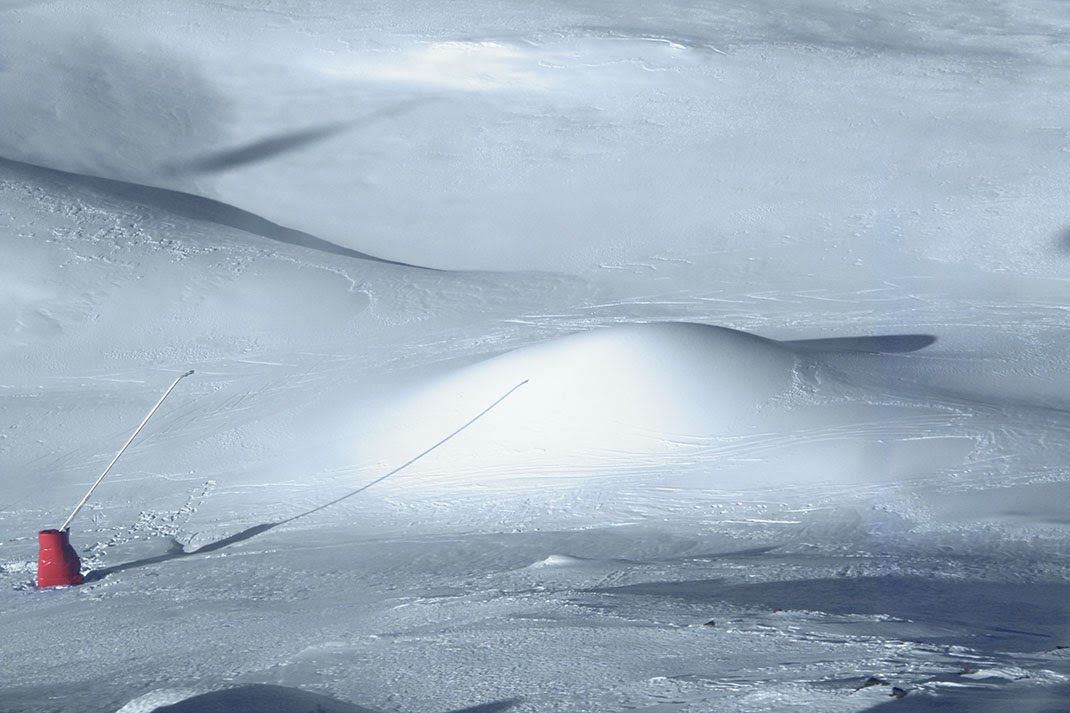
Snow—or what passes for it—then sprays out of thin, reed-like valves called “lances”—

[Image: Photo by Kyle Buchanan].

—resulting in other-worldly piles of fresh white powder, perfectly sculpted domes that later require selective placement elsewhere.

[Images: Photos by Danny Lane].

The shaping of the mountain landscape—so easily mistaken for nature—exhibits obvious features of artificiality, including careful lines and striated grooves resulting from deposition, sculpting, and maintenance.

[Image: Photo by Danny Lane].

The machine is literally an oversized air-conditioning unit, waiting to be put to use by landscape-printing crews whose work is mistaken for winter. It so efficiently—though inadvertently—produced ice while cooling diamond mines in Africa that it has since been put to use 3D-printing popular tourist landscapes into existence, like something out of Dr. Seuss.

To at least some extent, The Snowmaker—and newer technology like it—has replaced older, fan-based snow machines. These thus now sit in a maintenance shed, like antique airplane engines, both derelict and obsolete.

[Image: Photo by Danny Lane].

This is all just part of the dramaturgical stagecraft of Switzerland: winter becomes a precisely choreographed thermal event that just happens to take on spatial characteristics amenable to downhill skiing.

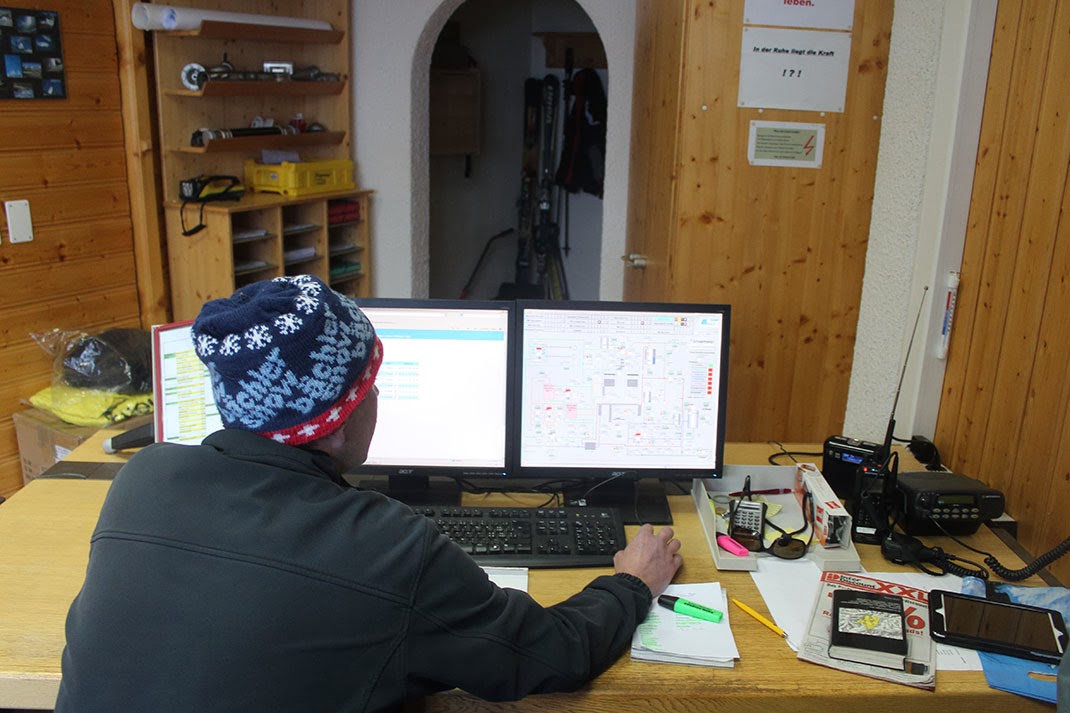
In any case, there are nearly 1,000 individual snow-production machines in Zermatt, only one of which is The Snowmaker. The whole system is controlled from a central computer, apparently operated by one wizard-like figure who is really just a stoned twentysomething in a wool hat, turning different parameters on and off and spraying whole new European landscapes into existence outside.

[Images: (top) Photo by Danny Lane; (bottom) photo by Kyle Buchanan].

It’s like the Sorcerer’s Apprentice at the top of the world, 3D-printing recreational mountainscapes. The landscape is a computer he alone knows how to use.

Imagine if Thomas Mann’s Magic Mountain had taken place amidst a massive, artificially maintained and 3D-printed winter, and you might begin to grasp the unearthly strangeness here, the surreal mechanical goings-on at great altitude.

What appears, at first glance, to be a simple ski holiday actually turns out, upon later inspection, to be a landscape-scale encounter with artificiality and snow-based 3D-printing.

(Thanks to Mara Kanthak for her help with translation in Switzerland).

Kiln

[Image: Via Tunnel Business Magazine].

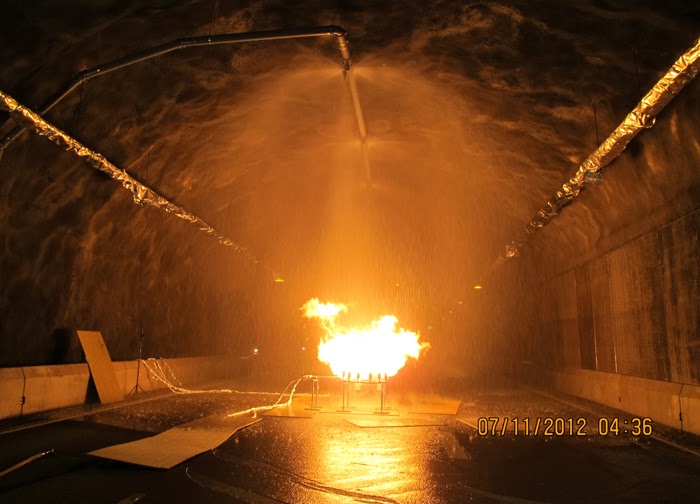
The abandoned Runehamar road tunnel on the southwest coast of Norway has been redesigned and given new life as a site for the experimental burning of trucks, cargo, and other vehicular structures in order to learn how subterranean road fires can best be extinguished.

It’s a kind of Nordic funeral pyre built not for the bodies of kings but for the products of the automotive industry, an underground bonfire of simulated car wrecks that seems more like something you’d see in the fiction of J.G. Ballard.

The overall structure has been modified to serve as a closely-controlled thermal environment—more a furnace than a piece of transportation infrastructure—complete with an array of instruments and sensors, and a system of sprinklers and ventilation fans that let observers try out novel methods of fire suppression.

In a sense, this is what might happen if someone like architect Philippe Rahm was given a limited budget and hired to design experimental subterranean road infrastructure, with his work’s focus on the thermal behavior of spaces and other non-visual dimensions of the built environment.

The Norwegian Public Roads Association explains why all this is necessary:

There is a need for more detailed knowledge on how and why various semi-trailer cargos burn so strongly and why they spread so quickly. The high heat exposure from the semi-trailers to the tunnel linings also needs more focus. The only reasonable way of finding an answer to these questions is to carry out systematic large scale experiments that can provide a better basis for the design of technical systems in road tunnels.

There’s more to write about the tunnel, I’m sure, and there is a bit more detail in the original post on Gizmodo—including, for those of you curious, this PDF that comes complete with structural and thermal diagrams of the burning apparatus.

But I suppose I’m more interested in the sheer strangeness of an old road tunnel being transformed into a venue for controlled thermal events. It is ritualistic, repetitive, and pyromaniacal, as if vitamin-D-deprived engineers in lab coats have been endlessly sacrificing sacred cargo for some infernal mountain, an altar for automotive transubstantiation, where unknown driving objects are reduced to ash and studied, again and again, filmed and re-watched—until the next fire, when the sprinklers fill up again and the vents, like a buried engine, begin to roar.

(Via Gizmodo).

Conic Sections: An Interview with Sol Yurick

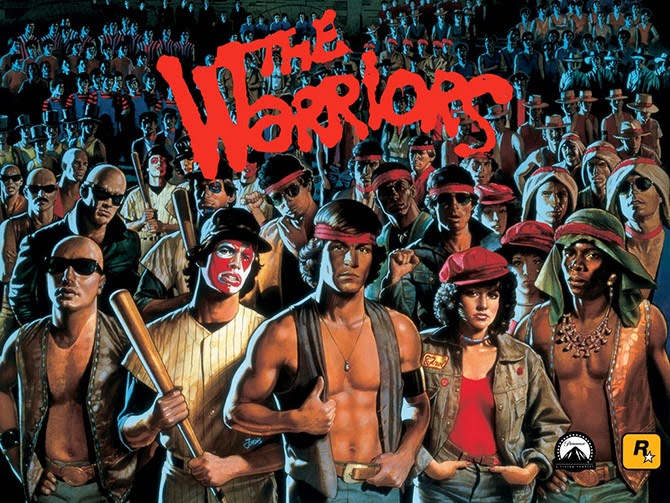
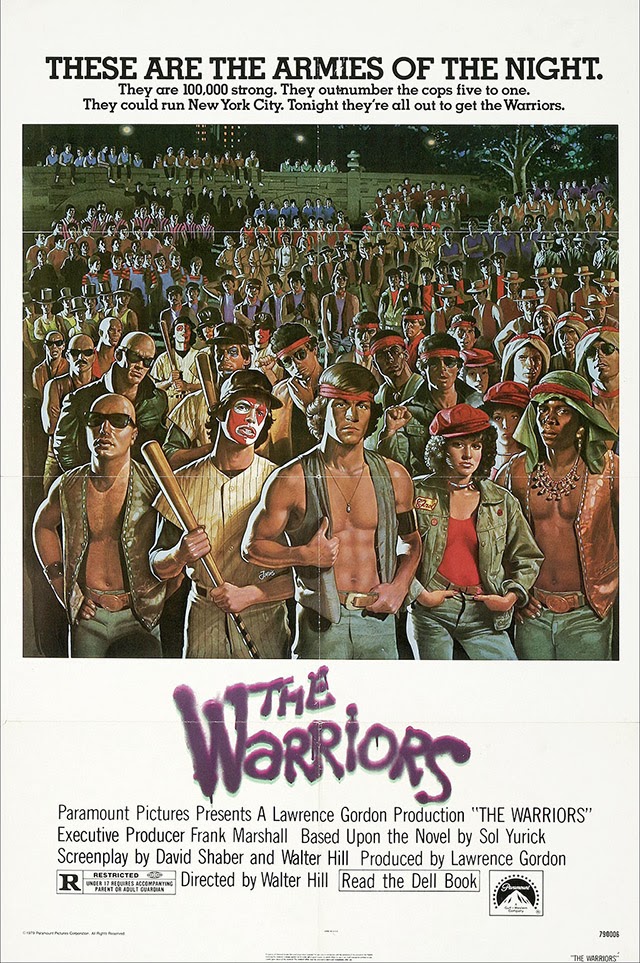
I interviewed novelist Sol Yurick back in March 2009. Rather than publish the interview on BLDGBLOG as I should have, however, I thought I’d try to find a place for it elsewhere, and began pitching it to a few design magazines. Yurick, after all, was the author of The Warriors—later turned into the cult classic film of the same name, in which New York City is transformed into a ruined staging ground for elaborately costumed gangs—and he was a familiar enough figure amidst a particular crowd of underground readers and independent press aficionados, those of us who might gravitate more toward Autonomedia pamphlets, for example, where you’d find Yurick’s strange and prescient Metatron: The Recording Angel, than anything on the bestseller list.

Looked at one way, The Warriors tells the story of a city gone out of control, become feral, taken over by criminal gangs and faceless police organizations, its infrastructure half-abandoned or, at the very least, fallen into a state of Piranesian decay. The everyday lives of its residents whirl on, while these cartoon-like groups of armed militants spiral toward violence and disaster. Yurick was thus an urban author, I thought, suitable for urban and architectural publications, his insights on cities far more useful than your average TED Talk and about one ten-thousandth as exposed.

In the interview, published for the first time below, Yurick freely discussed the back-story for The Warriors, which was the question that had motivated me to contact him in the first place. But he also drifted into his interests in the global financial system, which, at that point in time, was melting down through a domino game of bad mortgages and Ponzi schemes, and he went on to offer an even more dizzying perspective on Dante’s The Divine Comedy. Dante, in Yurick’s unexpected retelling, had actually written a series of concentric financial allegories, tales of monetary wizardry starring lost, beautiful souls searching for one another amongst the impenetrable mathematics of paradise.

Along the way, we touched on Mexican drug cartels, the Trojan War, the United Nations, and a handful of forthcoming books that Yurick was still, he claimed, energetically working on at the time. 
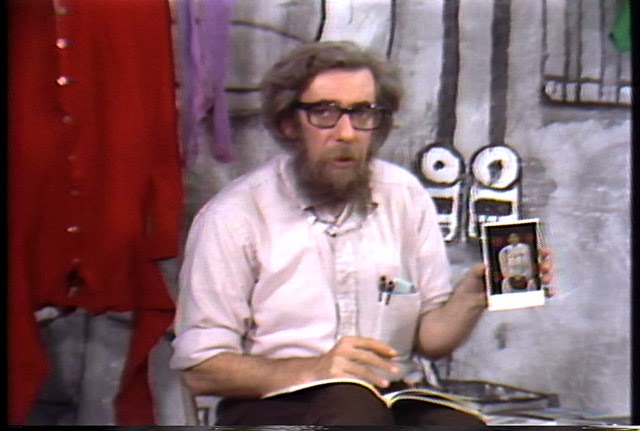
Image from Paper Tiger, via Sheepshead Bites

Alas, I pitched the wrong magazines and, soon thereafter, hit the road for a long period of travel and work; the interview simply disappeared into my hard drive and years went by. Then, worst of all, Yurick passed away in January of this year

The New York Times described him as “a writer whose best-known work, the 1965 novel The Warriors, recast an ancient Greek battle as a tale of warring New York street gangs and earned a cult following in print, on film and eventually in a video game.” Writing for The Nation, Samuel Fromartz specifically referred to several “out-of-the-blue interview requests” that had popped up in Yurick’s latter years, asking him about, yes, The Warriors. As Fromartz writes, “despite the delight he got in its cult status, it did not mean a lot more to him” than his other books, The Warriors being simply one project among many. 

And so this interview sat, unpublished, till I came across it again in my files recently and I thought I’d give it a second life online. It’s a fascinating discussion with an aging writer who unhesitatingly looked back at a long career of writing both fiction and political analysis, a life of deep reading and even a few eye-poppingly abstract interpretations of Dante.

What follows is the final edit of our conversation. Yurick was an engaged and pointed conversationalist, and, while I was obviously just another out-of-the-blue interviewer curious about the broken city of The Warriors, I hope this text does justice to his creative and sharp vision of the world. 

So this is for Sol Yurick, 1925-2013.

* * *

BLDGBLOG: I’d love to start with the most basic question of all, which is to ask about the back-story behind The Warriors. What motivated you to write it when you did?

Sol Yurick: Well, initially it started off when I was talking about some ideas with a friend in college. I’d just finished reading Xenophon and the concept popped into my head. This was the early 1940s.

Then, later, maybe in the 1950s, I read Outlaws of the Marsh, and the combination of ritual and violence in Outlaws of the Marsh just took my breath away. Those things mixed—Xenophon, ritual violence, Outlaws of the Marsh—and, on top of all that, I had already been working on a novel of my own. I was trying to get it published and it kept getting rejected—maybe 37 times?

BLDGBLOG: Wow.

Yurick: To move on to the next step, I wrote The Warriors. I did it in about three weeks. By this time, a lot of these ideas had matured. I’d been thinking about the whole question of gangs. First of all, the youth gangs at that point in time, running into the 1950s and ’60s, had no economic basis whatsoever. They mostly came from poverty-stricken families. You remember the film Rebel Without a Cause, right? That kind of stuff. It was viewed as kind of a national problem.

However, there were also gangs that came out of the suburbs—gangs nobody had ever heard about. No sociologist had wrote about this. In fact, I was big on sociology at the time, especially the works of Émile Durkheim and Max Weber, the founders of modern sociology. I wanted to write about stuff that approached reality—that was based in social reality—and that was not bound by a lot of the clichés or conventions of fiction as I knew it. I wanted to deal with a different stratum of society, something that wasn’t getting the attention it deserved in fiction at the time.

By the time I was actually writing the book, though, the whole 1960s had already started, and I eventually had a different take on it. In the book, it’s really about making a revolution, not just a criminal gang taking over the city. After all, it takes place on July 4th! But, in the book, that holiday is like a slap in the face for my characters—at least that’s the vision of the gang leader, looking at all the things that keep these people down. It’s Independence Day—but independence for whom? Independence from what?

Since that time, I’ve thought an awful lot about gangs and I began to see them in a very different way, as almost a biological formation. People make gangs—men and women, what have you. Cliques, clans, whatever you want to call it. There seems to be a big impulse there, something deeply social and political, but also maybe something biological.

I’d been thinking and meditating on this whole thing—this whole problem of the gang and what makes it. The interesting thing about gangs, as I wrote about them at that point in time, and as I mentioned, is that they had no economic basis. That all began to change during the period of the late 1950s and early 1960s, especially in relation to Vietnam, when more and more heroin began to be imported into the United States—a chunk of that coming through the good offices of the CIA. So, especially looking at the drug cartels in Mexico today, but also looking at this phenomenon of organized crime all over the world, the more you see that gangs are essentially capitalists. Within that system, they organize themselves: they have hierarchical principles and their leadership gets the best of everything. The lower strata are just the soldiers who risk their lives and don’t make out too well.

Look at the other gangs and mafia in ‘Ndrangheta, Calabria, the Camorra, the Japanese gangs, the Chinese triads, the Bulgarian gangs, the Russian gangs, all of that. It’s a business. Essentially, there are connections between these phenomena and corporate capitalism and politics, one way or another. On some level, there are always connections to something else—some other group, level, or economic phenomenon. In fact, no phenomenon, whether we’re talking physics or chemistry or what have you is totally isolated. Total isolation, or the making of discrete sets, is really an intellectual concept. No social formation is isolated in and of itself. It just isn’t.

What’s interesting is that, wherever you go, the gangs develop their own cultures. What makes them alike is generally their structures—their hierarchical structures—and the necessity for their leadership, whether it’s male or female, to exhibit charisma, machismo or machisma. And I don’t care whether you see this in corporations, which are supposedly rational entities but that, really, are not—because, otherwise, why would people talk about the “culture” of a corporation as something that can drive it into bankruptcy or make it successful? And how is that culture different from another corporation? So, in gangs and corporations both, we’re seeing a kind of driven necessity—maybe biological—to make and sustain a culture. But each culture is different.

Structurally, things look the same, but, culturally, things look different. That fascinates me.

Also, I grew up in a Communist household. Starting in the 1960s, I went back to reading Marx. In the back of my mind, though, there were aspects of Marx that seemed inadequate as a theory. It was very Western-centered; the number of classical and historical references in all of Marx’s work was just overwhelming to me. For all of his references, it felt limited. Then, as well, I began to think more in terms of neo-Darwinism. I don’t mean social Darwinism. Leftists and liberals deny the question of human nature, but what if it’s true? So that also became a consideration in my thinking—mixing the two: Marx and Darwin. 

All of that was part of the back-story for The Warriors.

BLDGBLOG: Before we move on to other topics, I think it’s interesting how much the built landscape of New York has changed since you wrote The Warriors. I’m curious, if you were to update the story of Xenophon again and rewrite The Warriors today, if there is a different location you might choose, whether that’s a different city or a different part of New York.

Yurick: Well, I would make it global, for one thing. And I would try to bring into it questions of finance—things like that. I’m not sure, though; I haven’t thought of that. Yes, there was a political and economic connection to Xenophon, and to Xenophon’s story—essentially, these gang members were mercenaries, and they were also a surplus population pushed to the edge of society. They were, after all, kids. And they were revolutionaries, not just street criminals. But I don’t know exactly how I’d handle it today.

Again, the whole question of making a revolution in the old way—it’s a tricky one. From my way of thinking, what happened in the Russian Revolution is: you had an uprising. People were discontented and what have you. Then a moment of opportunity came along, when it was a complete breakdown, and, at that point, Lenin stepped in. It was purely opportunistic. There was nothing decent in his move. There it was. It happened. Boom. He took advantage.
BLDGBLOG: In your book-length essay Metatron: The Recording Angel, you combine so many of these interests—everything from finance to electronic writing, looking ahead to what we now call the internet, and so on. I’m curious if we could talk a little bit about how Metatron came about, what you were seeking to do with that book, and where you might take its research today?

Yurick: When I wrote that, it was still early on. Computers were not universally around. I had a friend who was a computer expert—he had become an expert in the 1950s—so I was introduced to computers and the idea long before there were PCs or anything like that. I knew, when I saw stuff that would later become the internet—exchanges between scientists who had access to this kind of stuff—I knew I was looking at a different world. I began to see signs that this was going to become a big phenomenon, one of information and the effects of information. And again, this was before anybody had home computers.

Then computers began to come in, bit by bit. We’re talking maybe 1979. What happened then was that I got tied up with an organization trying to promote the use of satellites for global education. By this time, though, having been through the 1960s and 70s, I was telling them that this was just not going to happen. You’re not going to get money for this kind of thing; they’re going to use satellites for any other purpose for the most part, maybe military purposes, maybe propagandistic purposes, certainly for telecommunications.

But I went down to Washington with these people a couple of times, and we sat in on the committee hearings. Then I wrote a piece—an essay—to sort of introduce our organization. I forget when it was—maybe 1979 or 1978—but Jimmy Carter was coming to the UN and, because of the connections of several people in this organization, somebody got my essay to Jimmy Carter’s people. He almost incorporated a piece of it into his speech at the UN!

That didn’t happen, of course, so I decided I would submit it to this little publishing house, and they asked me to expand on it. I did that, and that was Metatron.

So my mind was ranging over all these things. I was trying to think of what the effect was going to be of computers and networks and satellites, trying to anticipate a lot of side effects. There was a lot I didn’t foresee, but there were some things I saw beginning to happen—that then, in fact, did happen maybe ten years later. Things like running factory farm machines by satellite and, now, running drones over Afghanistan from a place in Nevada. Things like that.

Anyway, having been getting more and more involved in many areas, while at the same time trying to find a basis for writing my fiction from new perspectives, became very destabilizing. Because most writers—most people—just stop growing at a certain point. They stop taking in more stuff because it gets in the way of their writing. But the opposite was happening. For instance, with The Warriors, I was able to make an outline chart of how the themes would develop. I could coordinate everything: what happened to the clothing, what happened at a certain time of day, and so forth and so on. Interestingly, the form of the chart I borrowed from a business model called program evaluation. It was a review technique. So I could do this thing and it came easy.

But when I tried to do it with The Bag, it didn’t work. I had such a hard time doing The Bag. The chart began to expand and expand till it was about ten feet long; I had different colors on it; it just didn’t work right. But I was learning so much.

Anyway, at certain points you’ve got to say enough. I forget which writer said this: “You don’t finish the work you abandon.”

BLDGBLOG: The financial aspects of your work are very interesting here, as well.

Yurick: Do you mean the economic?

BLDGBLOG: Well, I mean “financial” more specifically to refer to the system of writings, agreements, valuations, and so forth that constitute the world of international finance—which, if you take a very basic, material view of things, is just people writing. It’s numbers and spreadsheets, stock prices, contracts, and slips of paper, licenses and patents—its own sort of literature. You imply as much, in Metatron, with its titular reference to the archangel of writing.

Yurick: OK, yes. You know, I’ve been saying for years to people that this is coming, this moment [the financial crisis of 2007-2009], and it’s happening now. I read the newspaper and I see it: these people manufacturing money out of their imaginations. Sooner or later the bubble has got to burst, and it’s bursting.

In a certain sense, what’s taken place—what’s taking place now—is a series of mistakes. In other words, you don’t hire the people who caused the problem in the first place to try to rectify it, yet that’s what’s happening. It’s very interesting, I think, to look at this in terms of the criminal elements that we discussed—the gangs—and to see that what they do is done through extortion, prostitution, the selling of illegal things, illegal commodities, and what have you. They accumulate money and they launder it. But this also happens at the very top levels of finance: they imagine money and then they objectify it in terms of mansions and things like that.

When you’re dealing with this kind of stuff, you’re dealing with fiction—and when you’re dealing with fiction, you’re in my realm.

BLDGBLOG: The financial world that’s been created in the last decade or so often just seems like a dream world of overlapping fictions—of Ponzi schemes and collateralized agreements that no one can follow. It’s as is people are just telling each other stories, but the characters are mutual funds, and, rather than words, they’re written in numbers. To paraphrase Arthur C. Clarke, it’s as if sufficiently advanced financial transactions have become indistinguishable from magic.

Yurick: A long time ago, I started to write a book in which I invented a planet, and the planet was ultimately nothing but finance. I called it Malaputa. Do you know Jonathan Swift’s work at all? One of the trips Gulliver takes is to an island called Laputa, which really means, in Latin, the whore or the hole. There he encounters nothing but intellectuals building the most astonishing mental structures and doing the stupidest things imaginable. Now, Malaputa would be the evil whore.

So the planet I began to invent was a world that interpenetrates ours and it works by the rules of our world, but it’s not visible. Ultimately, it resides in the financial system in which, as you get to the center of it, its mass and velocity keep on increasing potentially. It’s the movement, ultimately, of symbols.

I realized, at a certain point, that what I was also talking about was, in a sense, The Divine Comedy. The descent into the Inferno, if you remember, is in the form of a cone—the inside of a cone. The ascent to the top of Mount Purgatory is also a cone, but you climb on the outside. Then, to move on to heaven, you have a series of concentric circles, at the center of which is the ultimate paradise, which is where God resides. The circles are spinning, but they’re spinning in an odd way. If you’re at the center of a spinning circle, you’re barely moving around. If you’re on the outside, you’re moving with great velocity.

In this case, Dante tells us that the center of the circle spins with the greatest velocity, and the further out you get away from it, the slower it moves. What does finance have to do with this? The woman who Dante idolized—Beatrice—was a banker’s daughter. You could say his interest in her was partly financial, pursued through these circles and cones of symbols. Anyway, that’s the architecture of The Divine Comedy that I was getting at.

From this point—as all of this was going into the stuff I’m writing now—I began to meditate on the question of surplus labor value. Which, as Marx said, is the unpaid part of what a worker doesn’t get, the part that the owner—the owner of the means of production—expropriates.

BLDGBLOG: The Malaputa idea was for an entire standalone novel, or it’s something that you’re now including in your current work? 

Yurick: It was originally going to be its own book, but I’m going to change that. I’ll incorporate it; I’ll reinvent it. 

I wrote a piece a long time ago for—I forget the name of the magazine. It was on the question of the information revolution, the dimensions of which were not yet clear at that point. I think it was the mid-1980s. I was talking about, even at that point in time, the speed of the transactions, and the infinitesimally small space in which transactions occur—against the space that you have to traverse either by foot or other means, like to the market village or the shopping mall or the warehouse floor.

In other words, I’m saying that finance has a space—it has an architecture. You might want to transfer billions of dollars from one country to another, but both are accounts in one computer space. What you’re doing might have enormous effects on the real world—the world of humans and geography—but what you’ve done is move it a fraction of an inch, at an enormous speed, with an enormous velocity and mass. And that has real effects thousands of miles away.

BLDGBLOG: I’m curious if you see other future developments of these works, or if there’s something new you’re working on at the moment.

Yurick: Yes—I’m working on two things that may intersect. One is a kind of biography that I call Revenge. What I realized, in a certain way—partly because I grew up in the Depression under bad circumstances, and now I see those same circumstances coming back again—I realized at a certain point that my novels Fertig and The Bag were revenge novels. That was a theme that was not clearly in my mind at the time, but that came into my consciousness relatively recently. 

Revenge begins with trying to pick a starting point—to impose a starting point—because wherever you begin, there is no ultimate beginning. Someone did something to someone else, in reaction to something that came before that, and so on and so forth. You start in the middle of things, and choose a starting point. It’s like a lot of the things we say about The Iliad, for instance. They start in the middle of things, in medias res.

There was an essay I wrote for The Nation on Truman Capote’s In Cold Blood, in which I panned the novel. But what I realized, even at the time I was writing it, was that, in a certain way, the story in that book—the true story it was based on—wasn’t just a random killing. It was a revenge killing. It was about two people who are, in a sense, dispossessed. But the person who got killed—not the family so much, but the farmer himself, Clutter—was no ordinary guy. He was no ordinary farmer, but a well-to-do guy with 3,000 acres and some cattle and maybe an oil-pumping system. He was important. He’d worked in government and he’d worked as a county agent. I won’t go into the history of the county agents and their ultimate role in making agribusiness as we know it today. But he was important enough in 1954 to have been interviewed about a kind of global crisis in agriculture in the magazine section of the New York Times.

This wasn’t the story Truman Capote told. Capote was given an assignment by the New Yorker and he went and he did it. He didn’t know or understand any of this background. He didn’t talk about the role of this guy. Not that this guy was the ultimate villain—this Clutter person—but, the fact is, he had a very key role. If he was important enough to be interviewed in a section on changes in agricultural policy in the New York Times Magazine, that means he’s not just nobody. The fact that he conjoined the outlaws, the killers—the fact that they conjoin, in a sense, with the Clutters—I think is a piece of, you can almost say, Dickensian chance. It’s like how some novelists will start out with two or three random incidents that are not connected at all and then mold them together.

I don’t know if you’ve read The Bridge of San Luis Rey? It’s about six or seven people who are on a bridge that collapses; it falls and they’re killed. What it is is an exercise in what brought these people together: what did they have, or not have, in common? Why this moment and not another moment? That’s what I wanted to develop with this, to go a little into the background of how I came to this line of thinking.

Now, one of the killers: his mother was an Indian [sic] and his father was a cowboy. The other one’s parents were poor farmers. So, here, we have three social groups expressed in these people. In the long struggle between corporate agriculture and the individual farmer, this is what develops: they get pushed off the land, these social groups. In fact, this also connects back to the old story of Joseph, in Egypt. With Joseph in Egypt, yes, he predicts the coming famine—the good times and the coming famine. But, when the famine does come, first he takes the farmer’s money, then he takes their land, and he moves them all into the cities. What you’ve got there is kind of an algorithm for the way agriculture develops: we’re talking Russia, the Soviet Union, China. We’re talking the United States. It looks different in different places, but the structure remains the same. You urbanize the people and you consolidate the land.

Then, of course, with the book I go into my own reactions to all kinds of literature, and I stop to try to rewrite that literature. For instance, suppose we think of The Iliad as one big trade war. Troy, as you know, sat on the route into the Black Sea, which means it commanded the whole hinterland where people like the Greeks and the Trojans did trading. The Trojan War was a trade war.

BLDGBLOG: The mergers and acquisitions of the ancient world.

Yurick: So that’s the kind of stuff I’m working on.

In the end, of course, the smaller farmer fought agribusiness tooth and nail, and they lost. We see what agribusiness has done to food itself, creating all kinds of mutational changes in seeds and so forth. Again, I think of the collectivization period in the Soviet Union in which, in order to win, you had to starve the peasants. That’s what the intellectuals of the time wanted, without understanding the practicality of life on the ground, so to speak. It was a catastrophe.

On the other hand, one of the images I had when I was a kid, during the Depression, was: you’d go see a newsreel and you’d see farmers spilling milk and grain on the ground because they couldn’t get their price. People didn’t have enough food, but they were just dumping their milk in the mud. These were smaller farmers—agribusiness hadn’t happened yet. So you’ve got two greed systems going on here.

Anyway, I use all that as the novel’s jumping-off point. In a sense, I’m saying Clutter had it coming to him—or his class had it coming to him.

But I’m in the very early stages. It becomes like a little race between living and doing it, and ultimately dying. I’m not rushing myself, but I’m having fun.

* * *

This interview was recorded in March 2009. Thank you to Sol Yurick for the conversation.