Urban Ecology

An interesting symposium at Columbia University later this month looks at “the ecology of New York City“:

This symposium will explore a range of ecological research happening in and around New York City. The program is focused on three themes—organisms, environment, and history—with speakers from a range of disciplines including community ecology, evolutionary biology, ecophysiology, paleoecology, archaeology, and conservation. The research presented here spans multiple taxa including plants, microbes, birds, and mammals.

The event is free and kicks off—as a lot of academic events unfortunately do—at 9am on a Saturday morning, but if you’re up and at ’em and want to stop by, the program looks pretty compelling. Expect the marginal ecologies of vacant lots, green roofs, urban waterways, regional bird migration, marshlands, and even a look back at “Early Foods and Medicines of 17th Century New Amsterdam: Cross-cultural Plant Population Exchange and Environmental Change in the Lower Hudson Valley,” when the plans growing along the river could perhaps be thought of as a kind of cultivated pharmacy garden. Finally, the symposium wraps up with a speculative look ahead to the ecology of greater New York in the year 2409 AD, with Eric Sanderson of Mannahatta fame leading the conversation.

You must register to attend, after which you’ll find everyone in room 501 of Schermerhorn Hall at Columbia University’s Morningside Campus on Saturday, April 20.

(Thanks to Nicola Twilley for the tip!)

Model Landscape

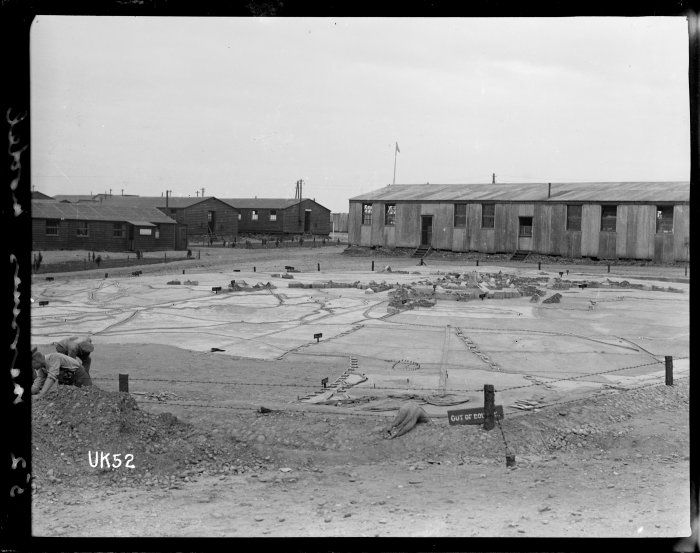
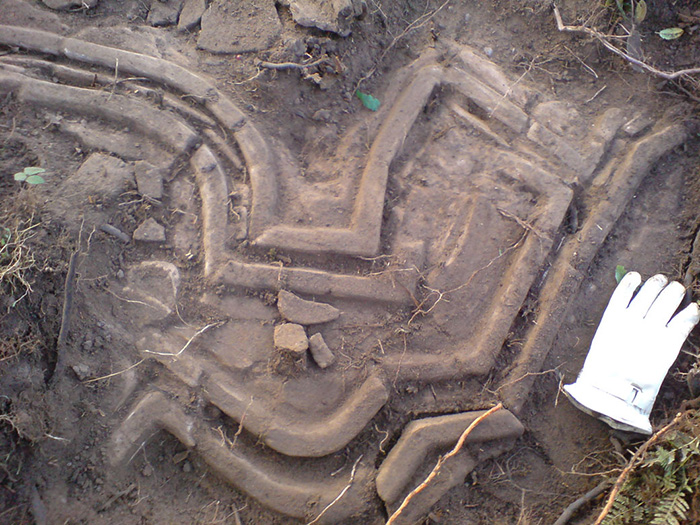
[Image: The WWI terrain model of Messines, Belgium, in Cannock Chase, England; photo, “taken probably 1918 by Thomas Frederick Scales,” courtesy of the National Library of New Zealand].

Past Horizons reported the other week that “a large concrete terrain model on Cannock Chase, representing a section of the Great War battle of Messines Ridge, is to be excavated” by archaeologists later this year.

The preserved but damaged model “represents the section of the front captured by New Zealand troops,” and, indeed, the model itself was used most extensively by troops from New Zealand who had been stationed in England during the war.

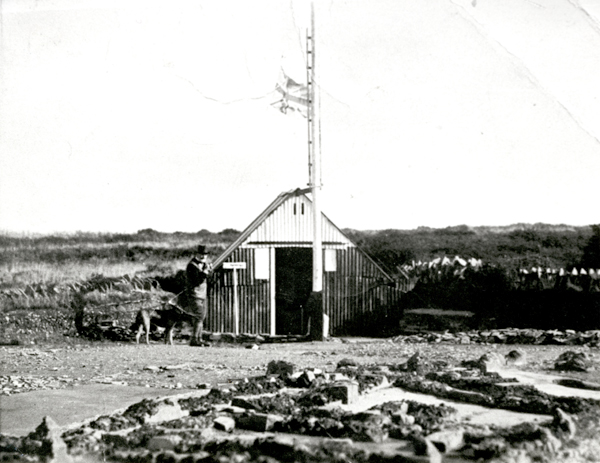
[Image: The concrete model at Cannock Chase, including a viewing hut; photo via The First World War Camps of Cannock Chase].

The construction of the model is itself pretty fascinating, as it was accomplished with the forced help of German POWs:

The Messines model had been constructed at Brocton in 1918 by men from the New Zealand Rifle Brigade, using German labour from the nearby prisoner of war camp. The use of trench maps and aerial photographs ensured the model, constructed in concrete, had a high degree of accuracy; trenches, strong points, railways, roads and buildings all being represented. The model was used to train soldiers in topography and to show how an impeccably planned battle could be won with minimal casualties. One feature, believed to be a “viewing platform” around three sides of the model still exists.

The “full excavation” to occur later this year—hopefully more photographs of the model will emerge online—will include the “recording and reburial” of the simulated landscape.

[Image: A viewing hut for studying the model landscape; photo via The First World War Camps of Cannock Chase].

An interpretive center—complete with an interactive 3D digital model of the nearby 3D concrete model of the actual 3D battlefield in Belgium—will also be constructed, to guide visitors through the site and to “explain how these models were used to prepare troops for battle.”

Near the model, however, lie the rest of the training camps at Cannock Chase, the subject of at least one historical website about these wartime facilities, where we read about the preserved earthworks used to train soldiers for trench warfare:

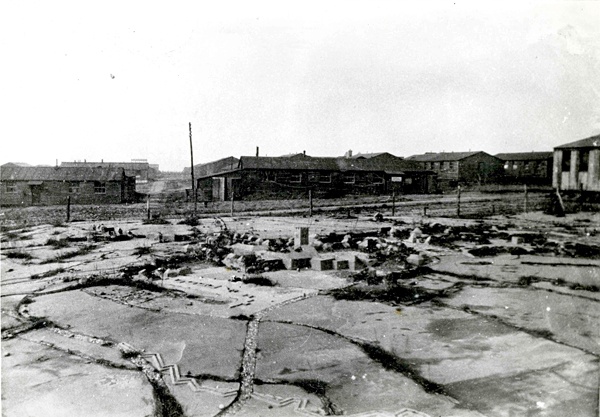
Front line trenches were typically constructed in a pattern which in plan resembled battlements (also known as the Greek Key pattern) with the intention that attackers were fired upon from three sides. Conversely communication trenches connecting the front line with reserve trenches were built in a zig-zag pattern. This ensured that if the front line trenches fell the enemy would not have a clear line of sight down the length of the “communication” trench and could therefore not enfilade (fire straight at) approaching reinforcements.

They were topographic baffles, we might say.

[Image: The scale of the model becomes more clear in this photo, also via Past Horizons].

Briefly, I’m reminded of an aside by natural historian Tim Flannery in his long but extraordinarily interesting book The Future Eaters: An Ecological History of the Australasian Lands and People, where he comments on the Maori origins of European trench warfare tactics.

The Maori—pre-European but remarkably recent inhabitants of the islands of New Zealand—had been brutalized, in Flannery’s telling, by their own environmental mismanagement of their adopted island home, all but exterminating the indigenous wild bird population and reducing themselves, through egregiously unsustainable hunting practices, to an almost stereotypically Hobbesian state of nature.

They had thus long been at war amongst themselves, fighting over the archipelago’s steadily dwindling sources of protein—which is when the British came along, unknowingly stumbling into the midst of what Flannery describes as a chaotic and very nearly continuous state of ecologically-necessitated human conflict.

The British, Flannery explains, thus learned firsthand that the Maori had already gone to ground, so to speak, digging themselves into defensive trenches and other complex earthworks as their battles became both more extreme and more sophisticated. “Indeed,” Flannery writes, “during the Maori defense of the pa [or fortress] Puapekapeka, the British learned their first lessons in trench warfare and underground bunkers from the Maori. They were to turn these tactics to their advantage in the First World War.”

Of course, as we’ve explored elsewhere on BLDGBLOG, Flannery’s claim is an overstatement—”siege mines” and other forms of militarized earthworks had already long existed in the European war tradition, well before English seafarers reached New Zealand—but it’s an interesting claim, nonetheless, and it resonates strangely with this vision of New Zealand troops studying trench geometries on a large-scale 3D concrete model in the middle of WWI England, preparing to dig themselves into “Greek key” and zig-zag patterns over on the European mainland.

Benchmark B

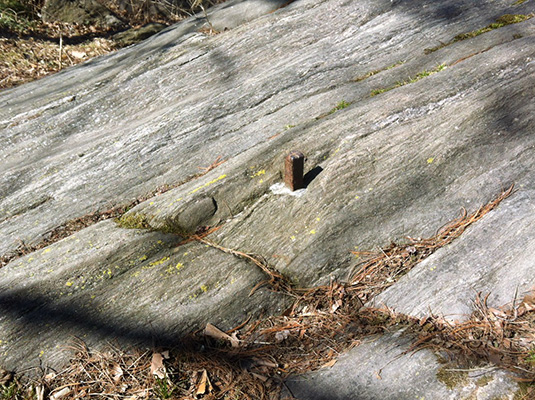
[Image: The Central Park bolt, photographed by The Bowery Boys].

One of many memorable images from Marguerite Holloway’s recommended new book The Measure of Manhattan is the Central Park bolt, a 19th-century survey marker affixed in place by John Randel Jr., original surveyor of Manhattan’s street grid.

The bolt is, in Holloway’s words, “the relic of an invisible intersection, one city leaders had planned to build in 1811 but that had never been constructed.” In fact, she adds, these “planned but never realized intersections” are rare but not, in fact, unique, low in number but peppered around the island like acupuncture points that somehow materialized before the body they were meant to intensify. The city lives alongside and strangely amidst other, historically unrealized versions of itself.

This particular “grid bolt,” as Holloway goes on to describes it, is now “long-forgotten,” but has recently become “part of the National Spatial Reference System database.” This means, as she phrases it, that a “bolt on a rock in a park on an island is connected to the satellites that travel above us in great arcs,” incorporated into the great digital systems of earth-measurement—or geodesy—used today.

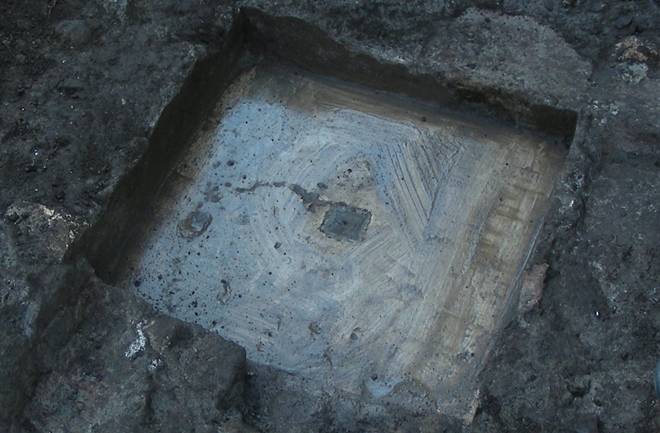
[Image: A photo of Benchmark B taken by Tullio Aebischer, courtesy of Discovery News].

I thought of this when reading earlier this winter about a “Roman marker used to measure the Earth” that had been found “near the town of Frattocchie along one of the earliest Roman roads which links the Eternal City to the southern city of Brindisi.”

To refer to it as “Roman,” however, is a bit misleading, as it was actually laid in the mid-1800s by Father Angelo Secchi—not in the days of ancient Rome—as part of an attempt to establish a comprehensively measured geographic baseline; this baseline could be used to support much larger calculations that would ultimately verify (or not) the mathematically projected shape of the Earth. It thus acted as a verification point for abstract speculation.

A geographer named Tullio Aebischer explained how it worked to Discovery News back in January:

“We found it after a long archival research and a georadar survey. The discovery will allow us to precisely verify the ancient measurements with modern GPS technologies,” Aebischer said.

“The measurements along the Appian Way were part of surveys which began in the middle of the 18th century and spread all over Italy, in Europe, especially in France and Lapland, and in South America. The aim was to measure the shape of the Earth,” Aebischer said.

Today, the marker is referred to as Benchmark B—with Benchmark A located back in Rome proper, near the tomb of Cecilia Metellaan architectural feature familiar to any fans of Piranesi. More specifically, it is “hidden under a manhole in the middle of the road at the Cecilia Metella mausoleum”—as such, surely a worthy target for urban explorers intent on bringing to light the forgotten objects and spaces of geographic history.

Buried benchmarks, competing meridians, rejected state lines, shifting global poles, mistaken horizons: one can easily imagine a kind of amateur archaeology dedicated to exploring nothing but obsolete regimes of territorial management, whole planet-spanning systems of measurement whose function depends on these almost impossibly mundane, mud-covered artifacts.

If Borges, say, is their poet laureate, then we might say that these—lost bolts, grids, and baselines—are the sites and relics of other Earths that nearly were, derelict props from a Borgesian folklore now geodetically coextensive with the planet.

In any case, both of the examples referred to here are all but forgotten 19th-century objects—a plaque and a bolt—that nonetheless now participate in much larger-scale projects of measurement, one planetary, the other civic: two physical monuments to older ways of modeling, measuring, and definitively interpreting something as unassuming as the ground.

Parallax View


Spatially speaking, the game Parallax looks pretty amazing, especially now that, in the words of Rock, Paper, Shotgun, the developers—two students at Queen’s University, calling themselves Toasty Games—have “decided to turn off all the gravity.”

The resulting “gravitational surface test,” seen in the first video embedded above, lets you twist, meander, level-hop, and corkscrew around inside the game’s “overlapping spatial dimensions,” passing through portals on windowed ribbons of black and white space.

The game has not been released yet, but, if it looks like something you might want to play someday, consider voting for Parallax over on Steam Greenlight.

Cool Dam

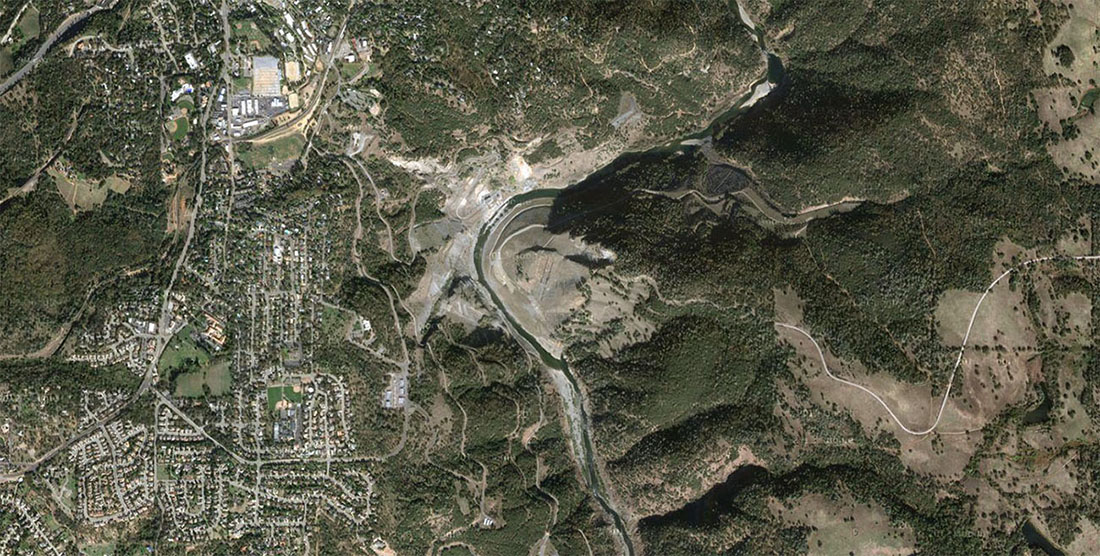
[Image: The Auburn Dam site, via Google Maps].

While re-reading John McPhee’s excellent book Assembling California last month for the San Andreas Fault National Park studio, I was struck once again by a short description of a Californian landscape partially redesigned in preparation for a reservoir that never arrived.

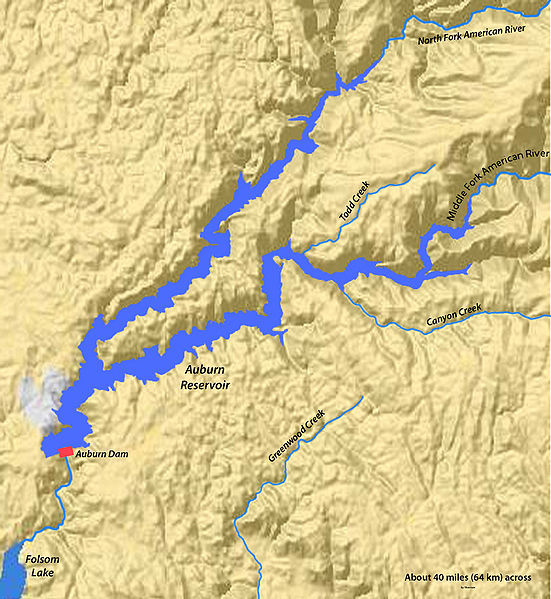
McPhee is referring to the Auburn Dam, in the city of Auburn, northeast of Sacramento (and near a small town called, of all things, Cool, California). The $1 billion Auburn Dam would have been “the largest concrete arched dam in the world,” according to Geoengineer.org, but construction was abandoned over fears that seismic activity might cause the dam to collapse, inundating Sacramento.

Construction was begun, however, and its cessation produced some rather unassuming ruins—basically large piles of exposed gravel and rock now eroding in springtime floods.

Nonetheless, these mounds were not cheap, including “$327 million concrete abutments [that] stand in stark contrast to the rest of the oak-filled canyon,” as the Auburn-Cool Trail site (or ACT) explains. “The washout of the 250-foot coffer dam in 1986 left huge scars that continue to erode, with large broken pipes sticking out in a precarious manner. Hasty roadbuilding for the project has contributed to landslides that have caused sedimentation and increased turbidity in the river downstream and in Folsom Lake. The cost of seasonal repairs on the service roads alone has run into the millions of dollars, and many roads remain cracked and unsafe.”

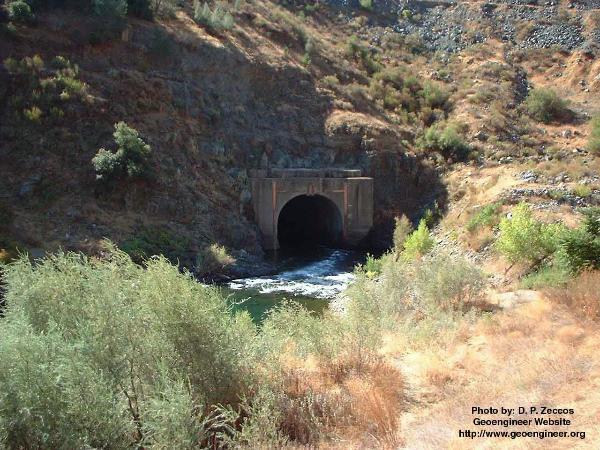
[Image: A bypass tunnel built in anticipation of the never-completed Auburn Dam; photo by D.P. Zeccos of Geoengineer.org].

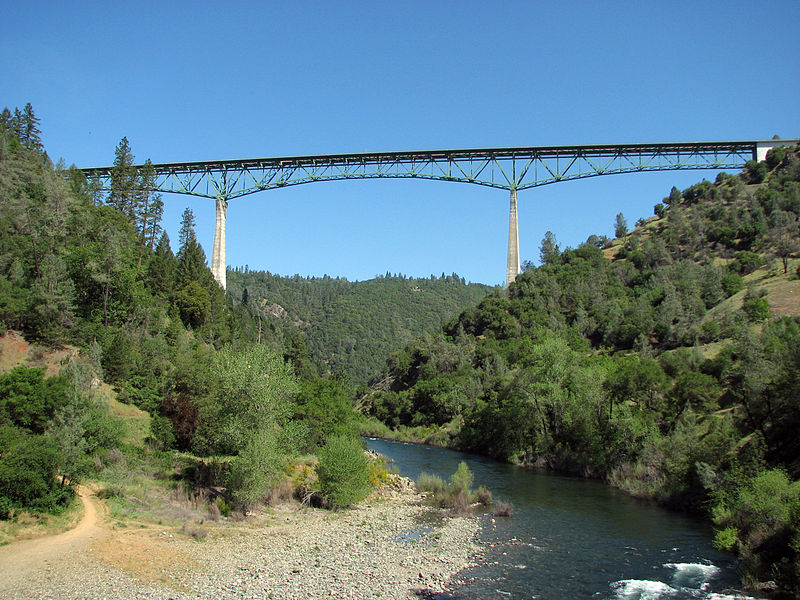
Amazingly, though, and this is where we come to John McPhee, regional infrastructure was constructed with an eye on what the landscape would look like in the future, given the presence of the Auburn Dam, leading to surreal sights like the Foresthill Bridge.

The bridge, which you can still drive on today, is a towering structure remarkably out of proportion with the landscape, its unnecessary height all but incomprehensible until you imagine the cold waters of the American River rising up behind the Auburn Dam, forming a recreational lake and reservoir, the lights of the bridge reflected at night in the waters below. “Not particularly long,” McPhee quips, “the bridge was built so high in order to clear the lake that wasn’t there.”

[Image: The Foresthill Bridge, via Wikipedia].

Weirdest of all, McPhee writes, there were boat docks built high up on the surrounding hillsides, waiting for their lake.

One gravel boat ramp, he explains, “several hundred yards long, descends a steep slope and ends high and nowhere, a dangling cul-de-sac. The skeletons [a skeleton crew of federal workers stationed at the former dam site] call it ‘the largest and highest unused boat ramp in California.’ Houses that cling to the canyon sides look into the empty pit. They were built around the future lakeshore under the promise of rising water. You can almost see their boat docks projecting into the air. Thirty-three hundred quarter-acre lots were platted in a subdivision called Auburn Lake Trails.”

[Image: The expected waters of a lake that never arrived; via Wikipedia].

While I will confess that, while using the omniscient eye of Google Maps, I can’t find these gravel boat ramps leading down to the rim of a lake that doesn’t exist—looking in vain for a maze of quasi-lakeside home lots perched uselessly in the hills—I assume that it’s either because the ramps have long since revegetated, given the two decades that have passed since the publication of McPhee’s book, or perhaps because there was a certain amount of willful projection on McPhee’s part in the first place.

After all, the idea of a line of homes built far up in the hills somewhere, overlooking an empty space in which a lake should be, is so beautiful, and so perfectly odd, that it would be tempting to conjure it into being, imagining bored kids in a town called Cool riding their bikes down to lost docks in the woods each summer near sunset, climbing over maritime ruins slowly crumbling in the mountains, throwing rocks at rotting lifejackets, building small forts inside the discarded hulls of someone else’s midlife crisis, perhaps still waiting, even hoping, for a flood to come.

Rockets to Reefs

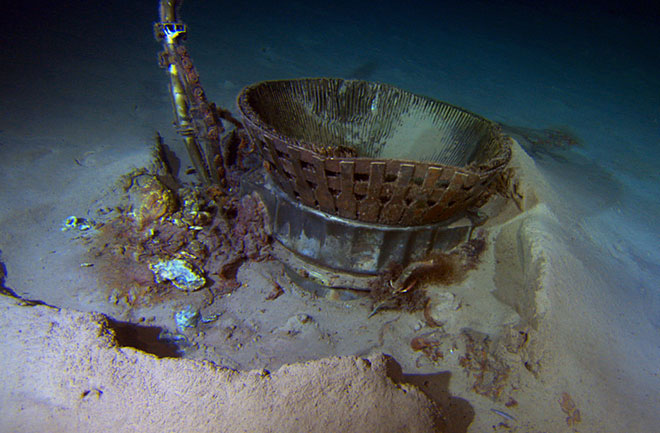
[Image: Fallen rockets at the bottom of the sea; photo by Bezos Expeditions, via Discovery News].

News this week that the discarded engines of the Apollo rockets from the moon missions of the 1960s have been found at the bottom of the ocean by Amazon.com billionaire Jeff Bezos is perhaps further indication that the robber barons of the 21st-century will be spending at least some of their fortunes on complex, engineering-oriented, and slightly Nemo-like adventures, whether that means mining asteroids, flying civilians into space, building 10,000-year clocks in the mountains of west Texas, traveling down into the deepest trenches on Earth, or, yes, performing gonzo acts of space archaeology 400 miles off the east coast of Florida.

Bezos’s description of the rocket-age ruins now on their way back to dry land—and, eventually, into a museum—puts a fairly Ballardian spin on the discovery: “We’ve seen an underwater wonderland,” he quipped, “an incredible sculpture garden of twisted F-1 engines,” a garden of fallen offworld technologies appearing to grow coral at the bottom of the sea.

I’m reminded of a line from Robert Charles Wilson’s novel Axis, where Wilson writes that “the sky filled with the luminous debris of ancient, incomprehensible machines,” fragmentary gears and circuits drifting through the air like mechanical snow, only, here, it’s the equipment of our own recent history having washed down through the ocean, taking on the ringed appearance of coral.

Maintaining his Ballardian tone, Bezos suggested that the seafloor from which the rockets were pulled was not unlike the surface of the moon: “We on the team were often struck by poetic echoes of the lunar missions. The buoyancy of the ROVs looks every bit like microgravity. The blackness of the horizon. The gray and colourless ocean floor. Only the occasional deep sea fish broke the illusion.”

Explaining his interest in restoring the behemoth pieces of equipment being re-absorbed into the planetary ecosystem, Bezos adds that his team “photographed many beautiful objects in situ and have now recovered many prime pieces. Each piece we bring on deck conjures for me the thousands of engineers who worked together back then to do what for all time had been thought surely impossible.” Now, he says, “We want the hardware to tell its true story, including its 5,000 mph re-entry and subsequent impact with the ocean surface.” Sadly, doing this required interrupting what might someday have been a reef, possibly one of the most interesting points to take away from all of this—that even something as unearthly as rockets, given enough time and isolation, could become overgrown, a kind of Angkor Wat of the sea, indistinguishable from life in the oceans.

Build a Bridge

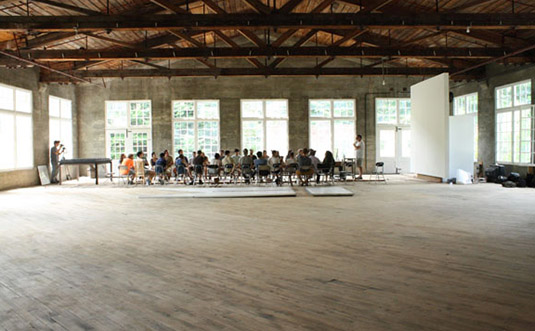
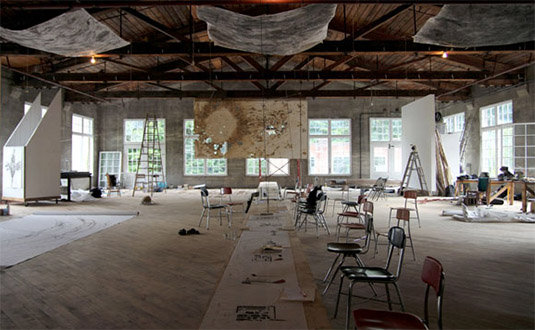
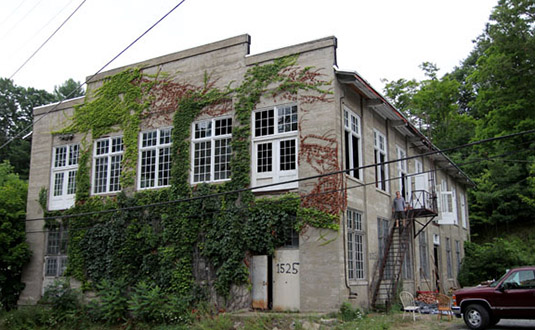
Last year, I posted about a summer workshop held in upstate New York run by architect David Gersten of the Cooper Union. Well, it’s back and this summer’s 8-week program is even more ambitious. However, note that the deadline for applications fast approaches (due March 25).

[Images: Photos from Arts Letters & Numbers; applications for the summer 2013 workshop are due March 25].

As Gersten himself describes it, this summer’s workshop will be “structured through six disciplines: construction, drawing, film/photography, writing, theater and music/sound,” forming a kind of “disciplinary exquisite corpse.” Participants in each of these fields “will work in parallel and in close proximity, directly interacting though a framework of shared questions and actions.”

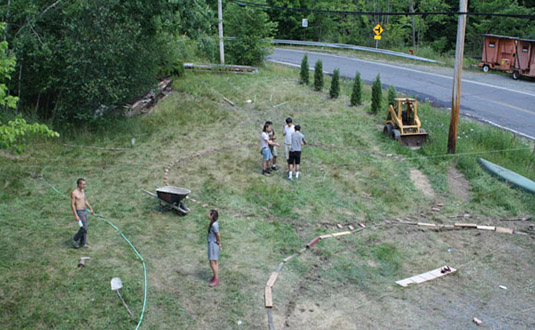
During the eight-week intensive workshop, together, we will build a bridge; a bridge that is a stage, a drawing board, a film screen, a story, a place to act—a bridge between many disciplines. This bridge will be co-constructed, as each step in its construction will be developed as a series of shared questions across all of the disciplines. As we excavate the site, we will ask: What is excavation in drawing? in film, in writing, in theater, in music. As we pour the foundations we will ask what are foundations in drawing, in film, in writing, in theater, in music. As we raise the structure, we will ask what is structure in drawing, in film, in writing, in theater, in music. As raise a new horizon, we will ask; what is horizon in drawing, in film, in writing, in theater, in music? Week by week as we move thought the shared questions we will co-construct a work, an emergent space between all of the disciplines.

The grand finale of the eight weeks will be “a live performance built between all of the works,” an interdisciplinary opera of construction, poetry, drawing, light, and words.

[Image: Photo from Arts Letters & Numbers].

As is probably obvious, this is a much more embodied and physically engaged form of architectural exploration, in many ways at the opposite end of the world from sitting inside, designing little triangle-shaped tiles in Rhino all day, and, as such, it offers a great way to experience the humid and heavy vegetation of a New York forest outside the nighttime lights of the city for a few weeks, exploring the rigors of other disciplines (and possibly even driving heavy excavation equipment).

[Image: Photo from Arts Letters & Numbers].

Application information and a short film about the summer program are available on the project website.

Meshworm

The last few years have seen the rise of “soft robots,” squirming, biomorphic, and highly flexible little machines that can be used to slip through cracks, infiltrate tight spaces, even explore architectural ruins in the wake of earthquakes and warfare.

But soft robots are also getting closer to becoming what are, in effect, mechanically agile medical devices that can “monitor your insides,” in the words of Sangbae Kim, assistant professor of mechanical engineering at MIT, as reprinted by Popular Science, sneaking around inside your body like an earthworm.

The so-called “meshworm” is exactly that: a robotic “worm” made from layered wire mesh that uses “nickel-titanium alloy for muscles.” The application of a high temperature “shortens the wire, tightens the spring’s coil, and squeezes that body segment.” Thus, “when a segment contracts, the one behind it stretches out, and the robot inches forward. The tendon also has muscles attached so the robot can turn left or right.”

The result is the oddly grotesque and somewhat phallic creeping machine you see in the short video, above. The idea is that this could be used for medical diagnosis or vascular surgery.

However, the architectural or broadly spatial uses of this technology are also worth considering, including the potential for monumentally scaled-up versions of the meshworm, capable of assisting human or material transport through the built environment—a kind of peristaltic package-delivery tube that could replace the much-discussed pneumatic tubes of an earlier urban era. Like something out of a David Cronenberg film, the city would have a kind of giant bowel-infrastructure distributing waste material from point to point.

More interestingly, though, this new class of soft robots and meshworms could quickly assume their roles as architectural explorers in their own right, burrowing through collapsed buildings, passing beneath or around doors, even being taken up by the more ambitious burglars and tactical operations teams of the world.

Or, for example, earlier this month in the cave state of Kentucky, the annual “Cave City Hamfest” explored how to bring radio transmission deep underground. This was “accomplished by placing handheld (relay capable) walkie-talkies or relay boxes along a cave passage.” “After the inital debugging phase, we demonstrated the ability to simply walk the cave, until data was lost and then backing up a few feet for a solid link. Then placing a radio on a convenient rock and continuing.” Taking this as our cue, we could simply wire-up a team of meshworms with radio repeaters and send a small, crawling team of spelunking robots far ahead of us into caves where no human body can fit; they would crawl until they lose a signal, move back a few feet to re-establish a secure feed, and then the next one squirms dutifully forward.

You’ve thus built a mobile, semi-autonomous, deep-earth radio network made from repurposed medical devices—equal parts cave-mapping expedition and subterranean pirate radio station—opening up whole new realms of underground exploration (and tactical media).

Landscape Futures

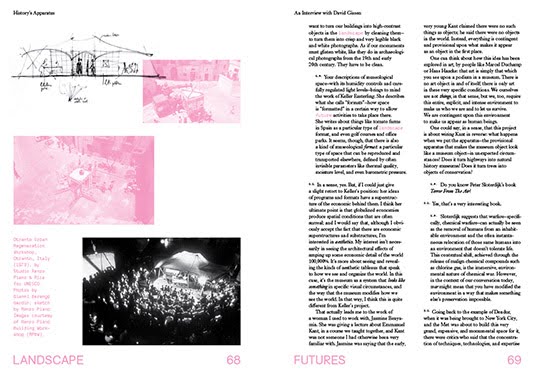
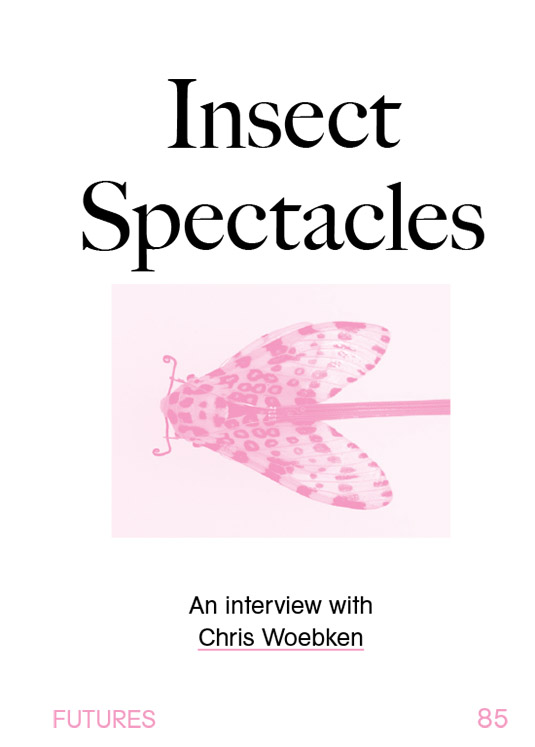
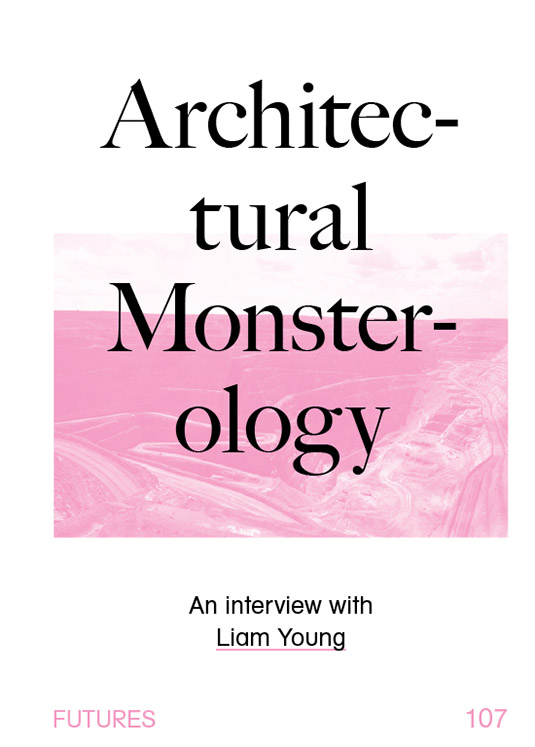
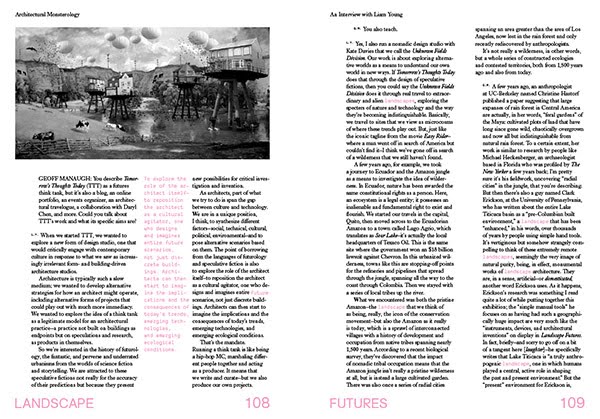
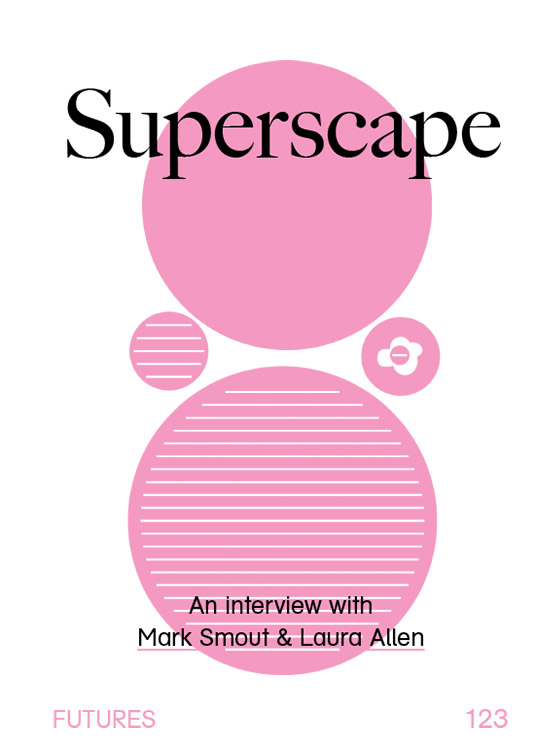
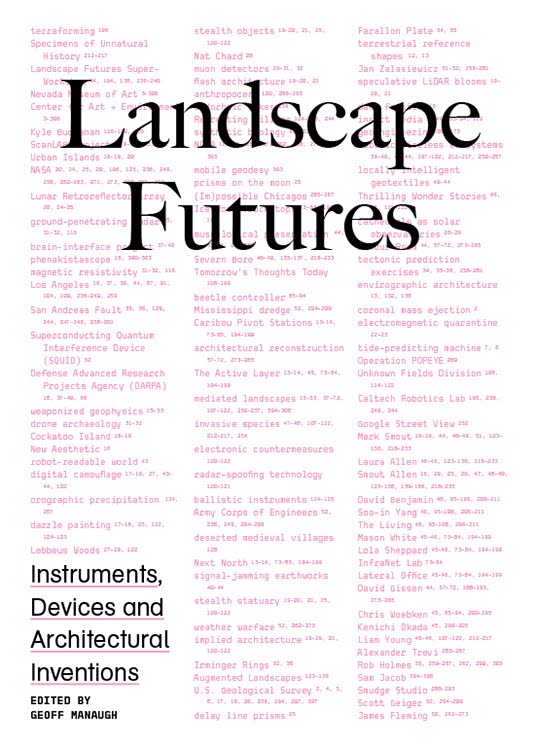
[Images: The cover of Landscape Futures; book design by Brooklyn’s Everything-Type-Company].

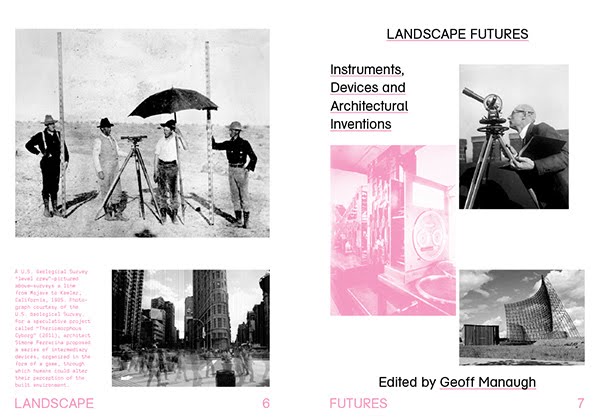
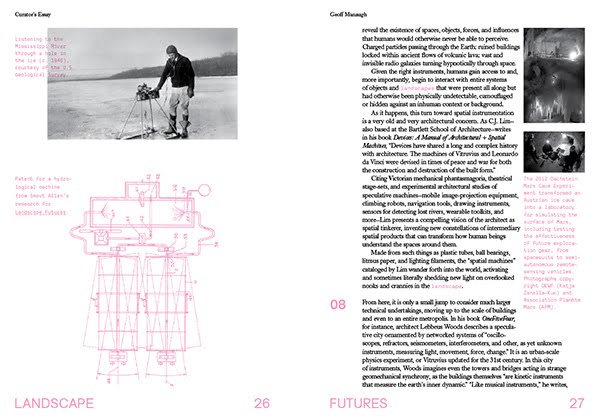
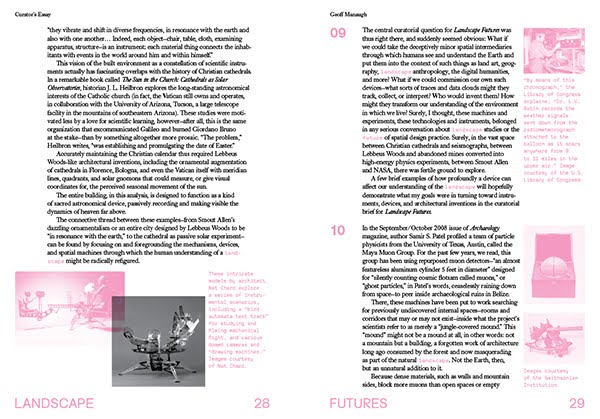
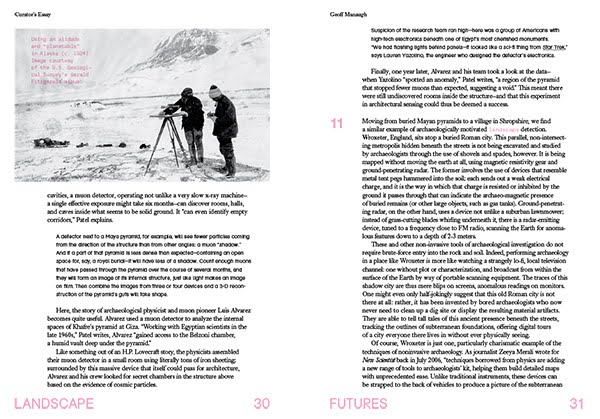
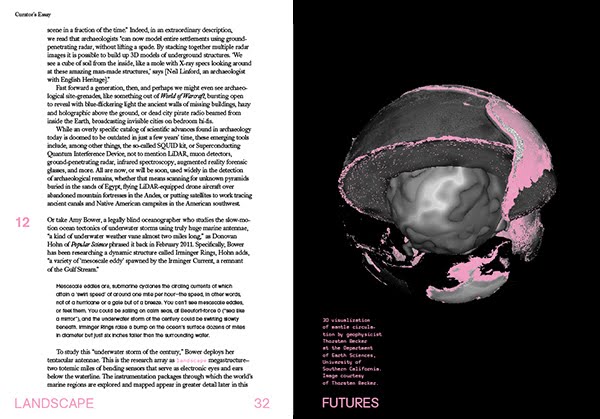
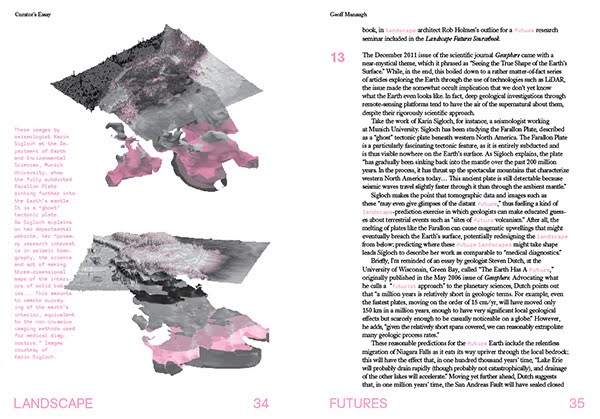
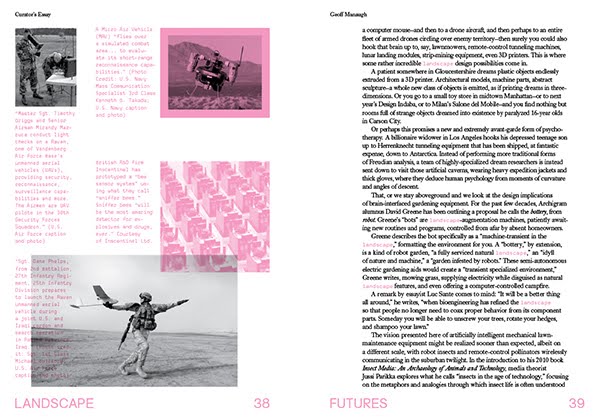
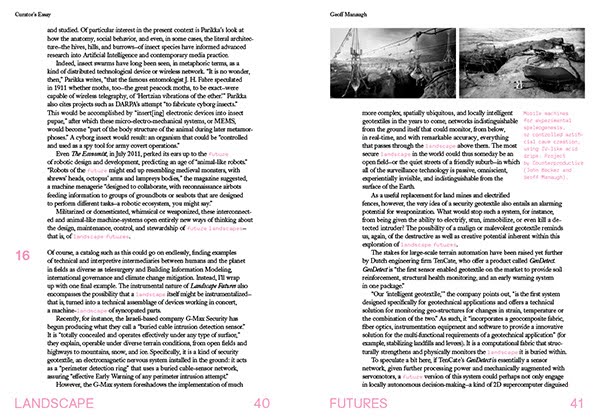
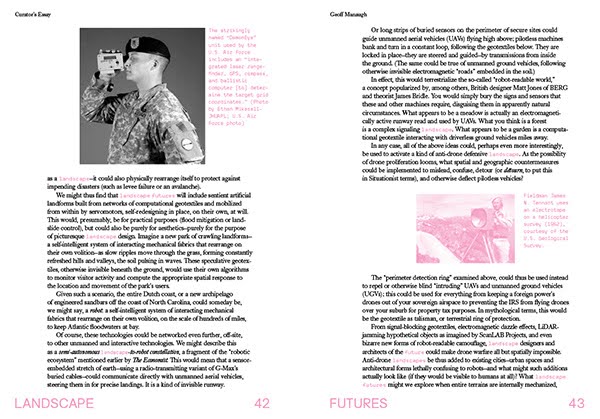
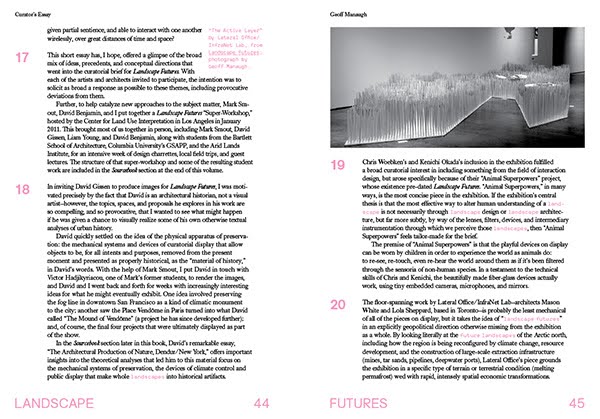
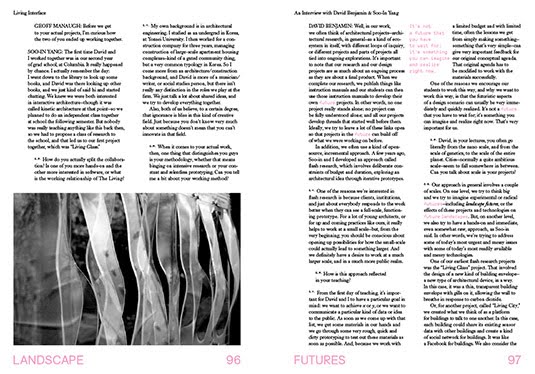
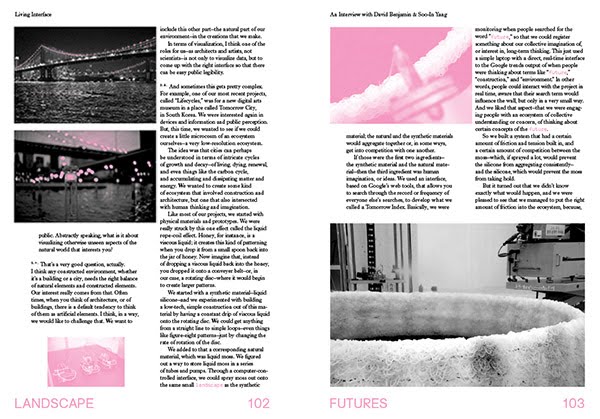
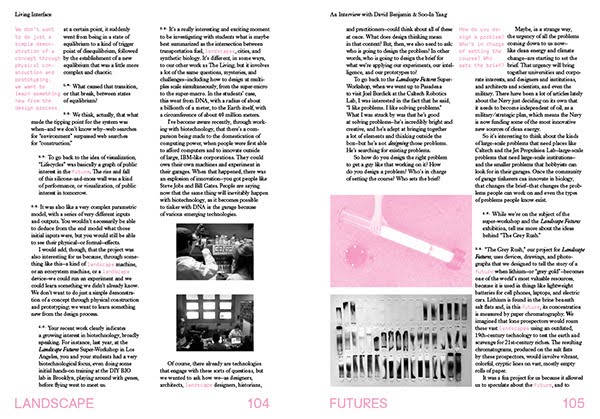
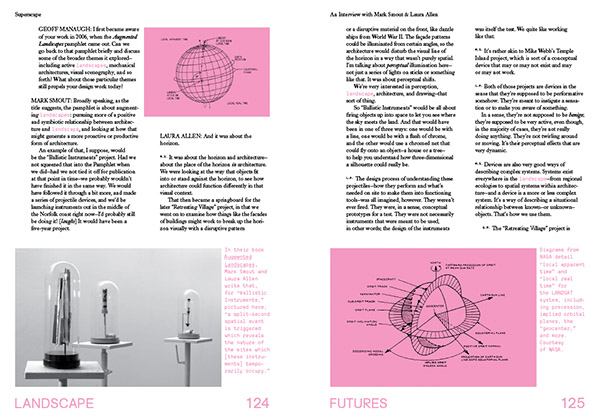
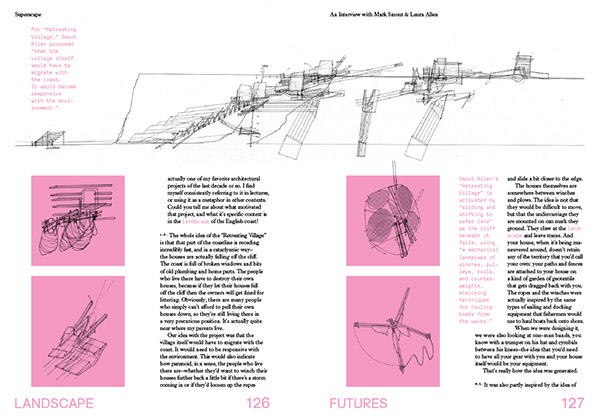
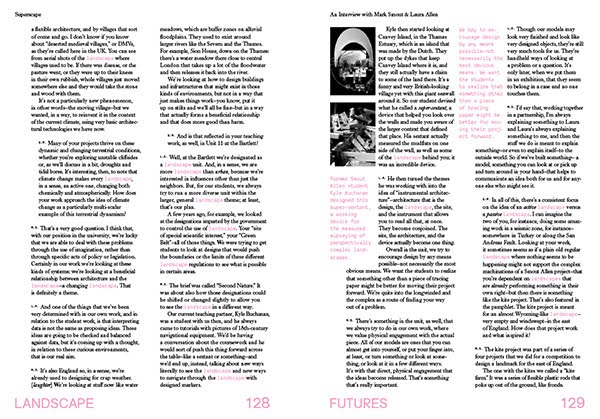
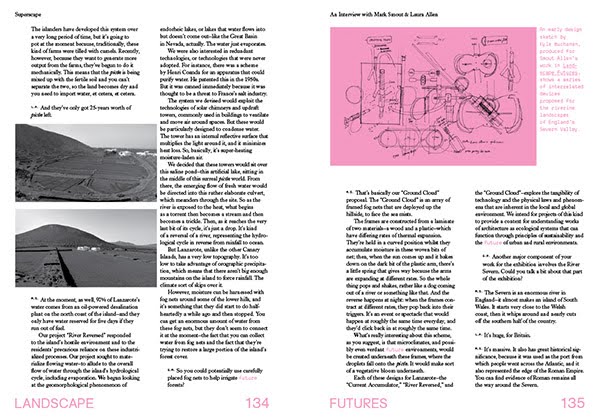
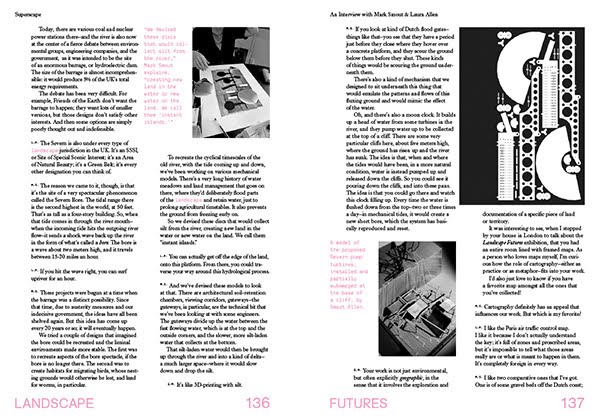
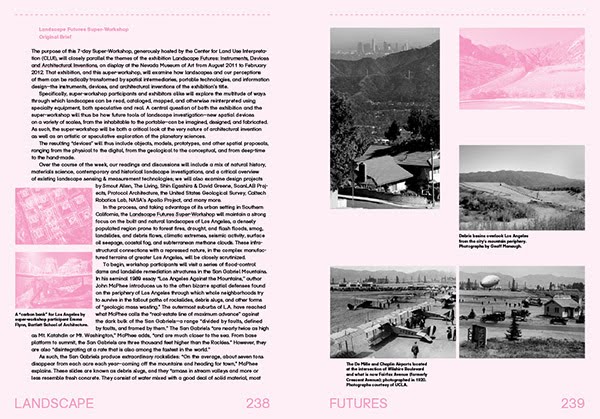
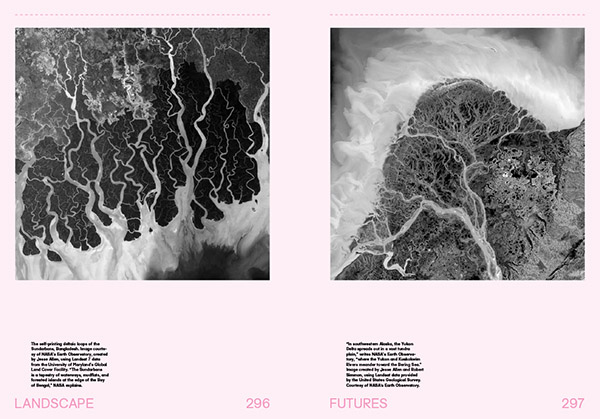
I’m enormously pleased to say that a book project long in the making will finally see the light of day later this month, a collaboration between ACTAR and the Nevada Museum of Art called Landscape Futures: Instruments, Devices and Architectural Inventions.

On a related note, I’m also happy to say simply, despite the painfully slow pace of posts here on the blog, going back at least the last six months or so, that many projects ticking away in the background are, at long last, coming to fruition, including Venue, and, now, the publication of Landscape Futures.
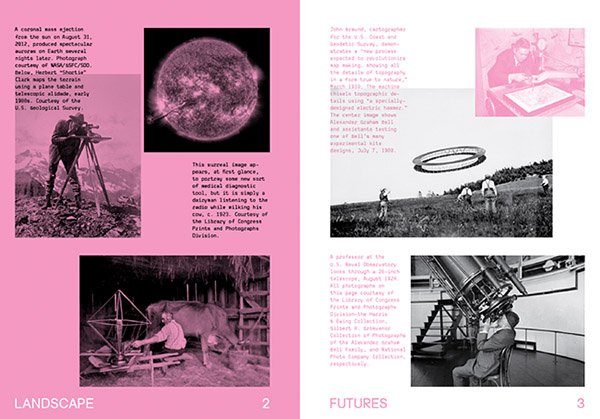
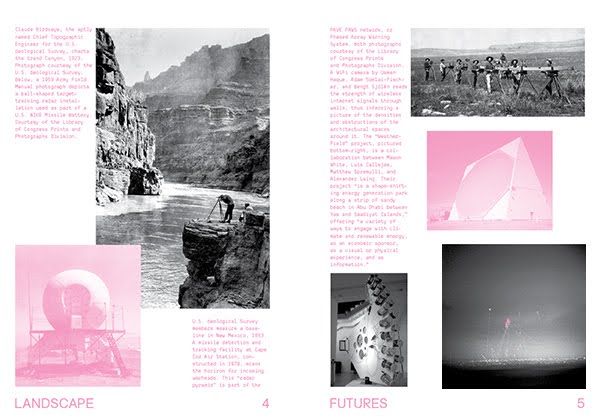
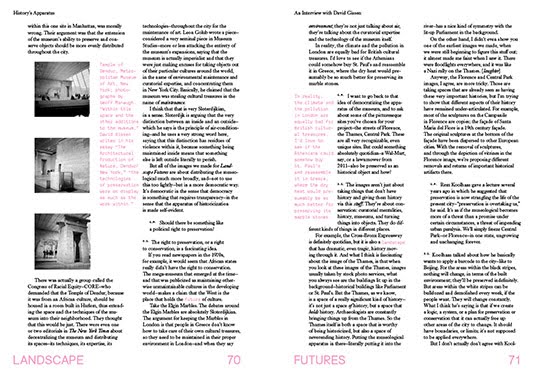
[Images: The opening spreads of Landscape Futures; book design by Everything-Type-Company].

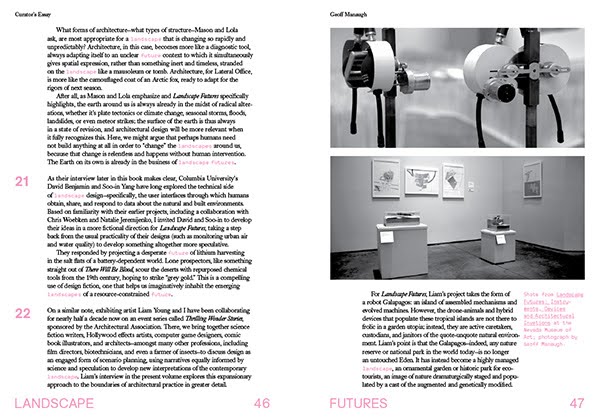
Landscape Futures both documents and continues an exhibition of the same name that ran for a bit more than six months at the Nevada Museum of Art in Reno, from August 2011 to February 2012. The exhibition was my first solo commission as a curator and by far the largest project I had worked on to that point. It was an incredible opportunity, and I remain hugely excited by the physical quality and conceptual breadth of the work produced by the show’s participating artists and architects.

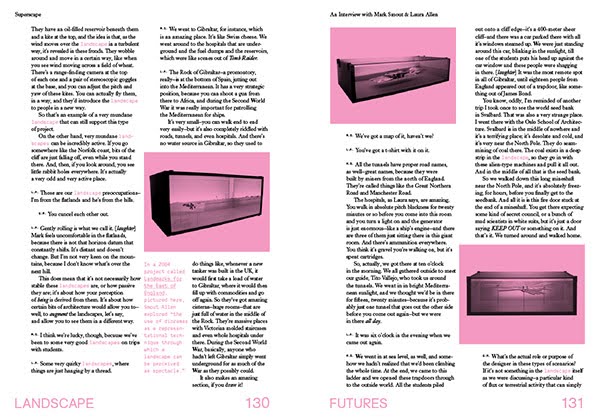
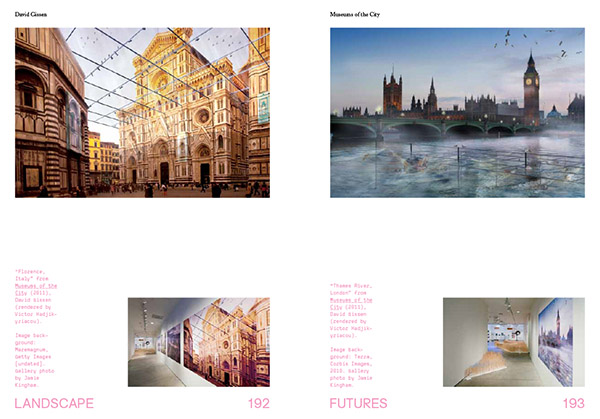
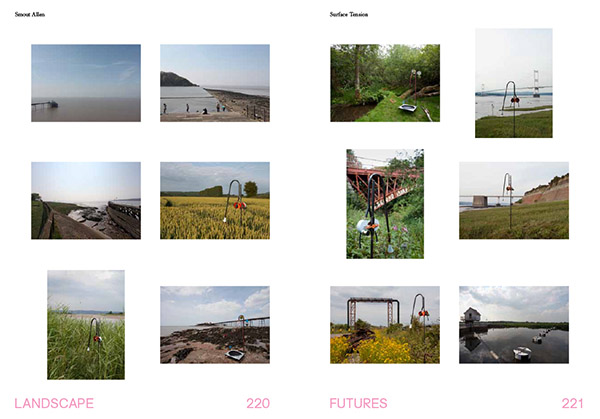
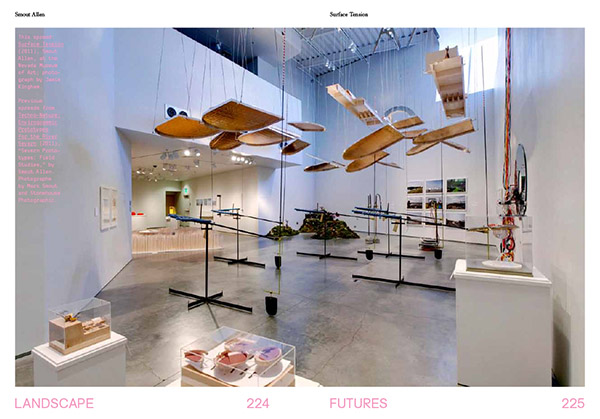
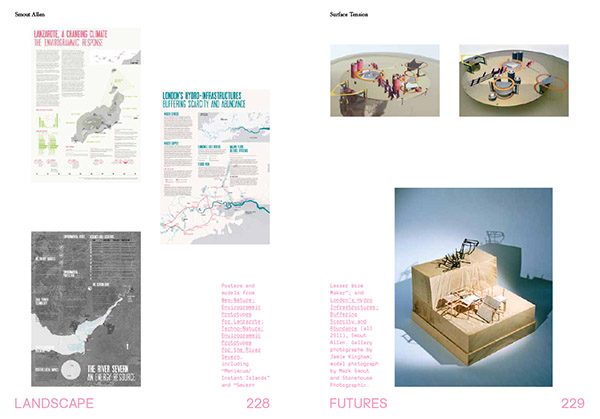
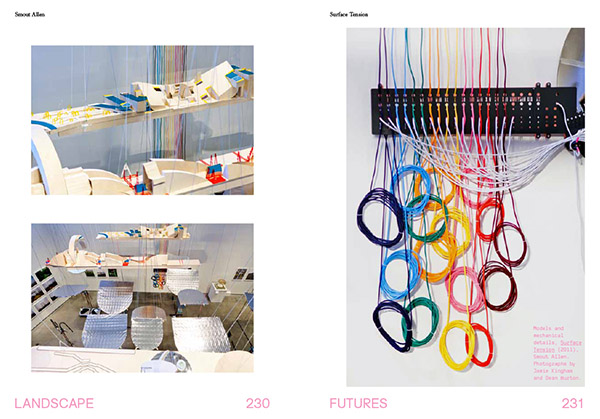
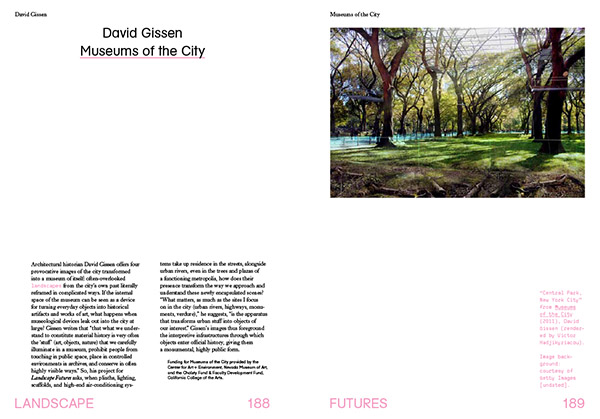
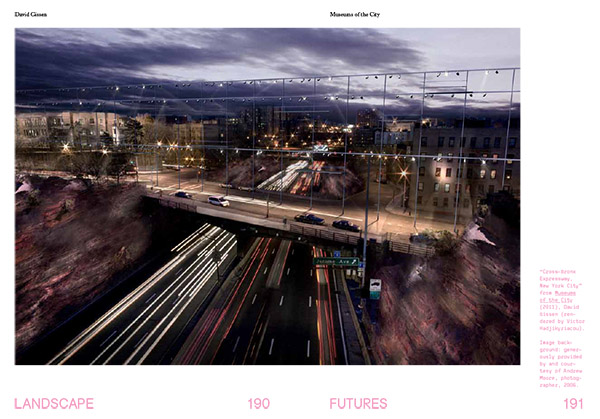
Best of all, I was able to commission brand new work from many of the contributors, including giving historian David Gissen a new opportunity to explore his ideas—on preservation, technology, and the environmental regulation of everyday urban space—in a series of wall-sized prints; finding a new genre—a fictional travelogue from a future lithium boom—with The Living; and setting aside nearly an entire room, the centerpiece of the 2,500-square-foot exhibition, for an immensely complicated piece of functioning machinery (plus documentary photographs, posters, study-models, an entire bound book of research, and much else besides) by London-based architects Smout Allen.

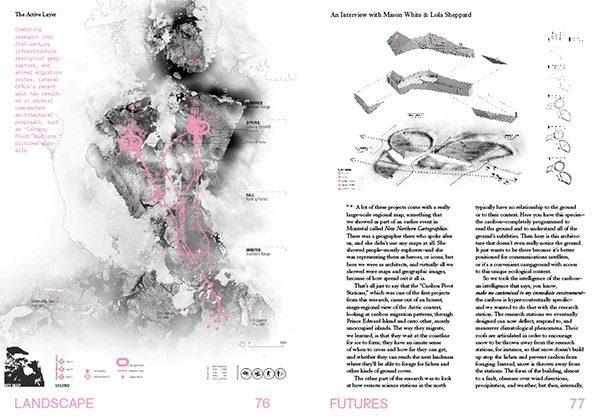
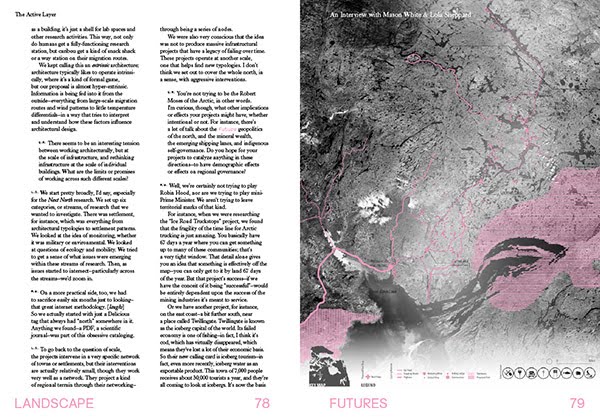
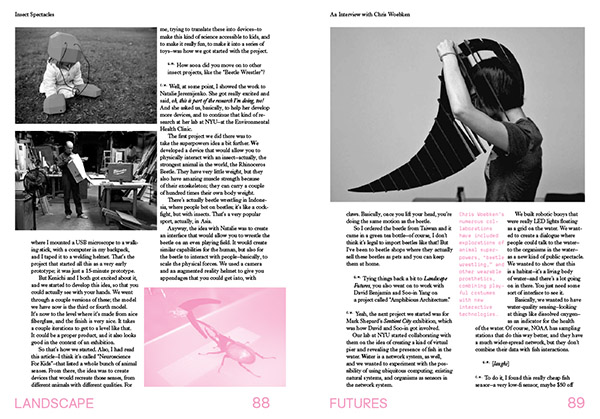
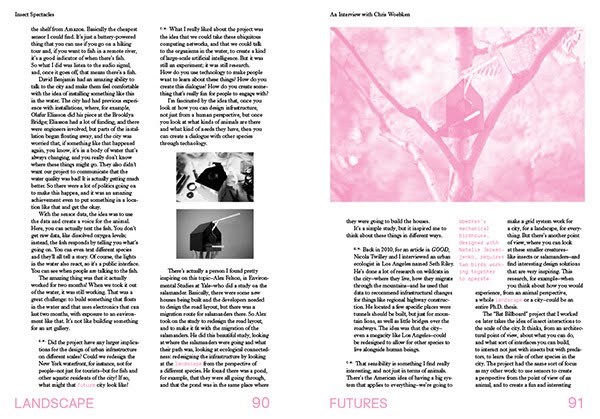
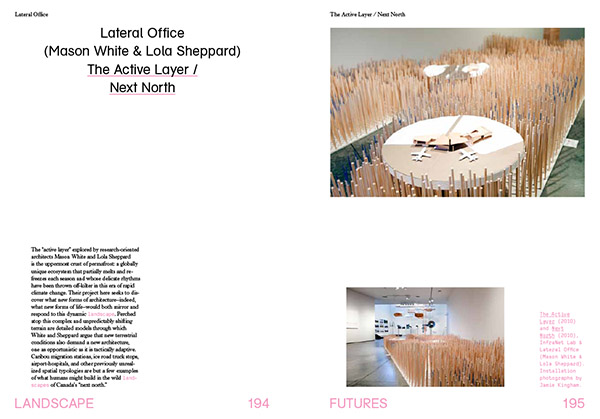
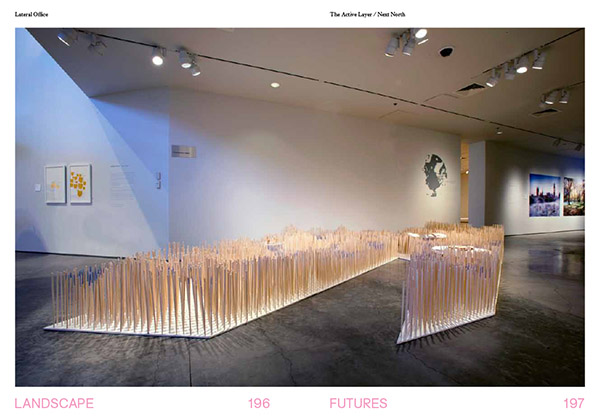
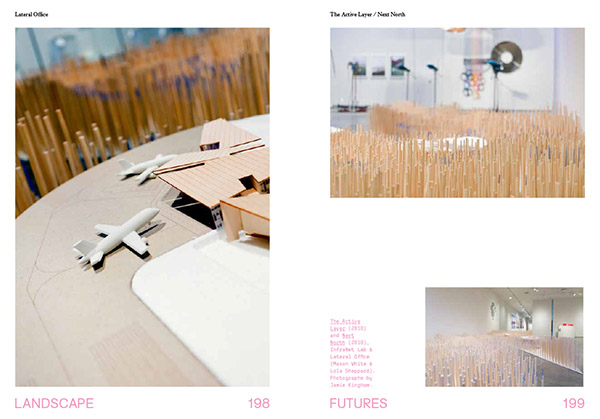
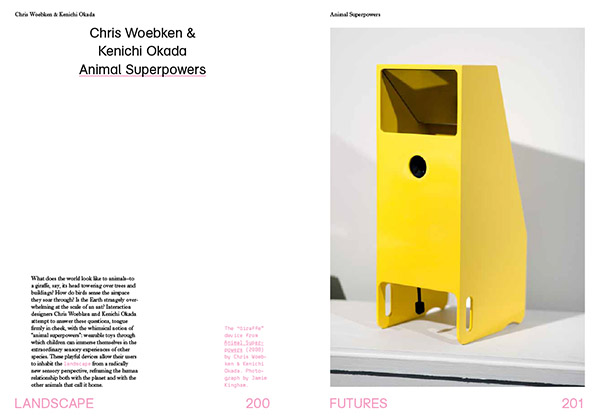
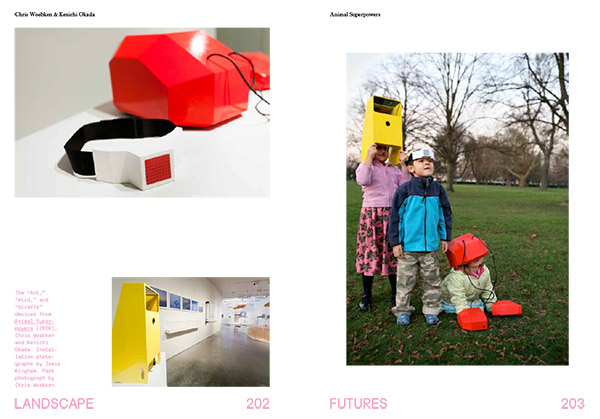
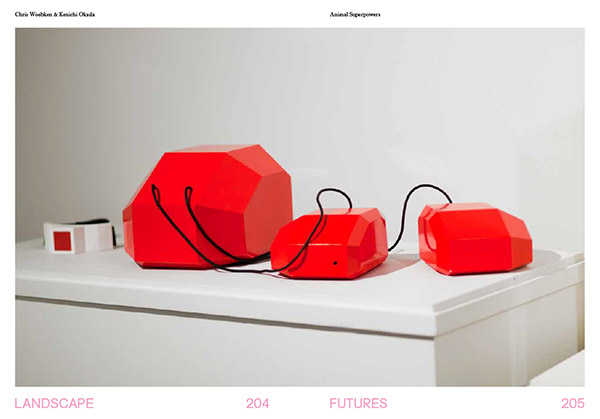
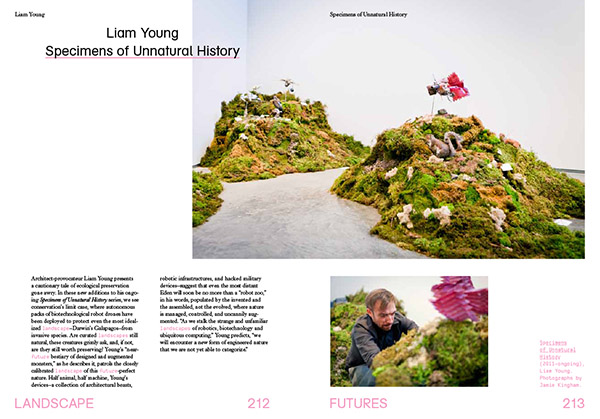
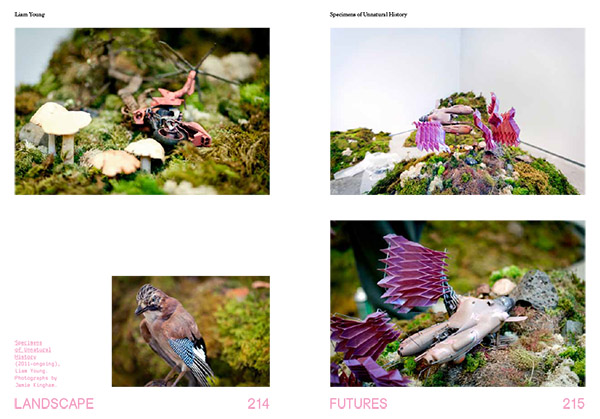
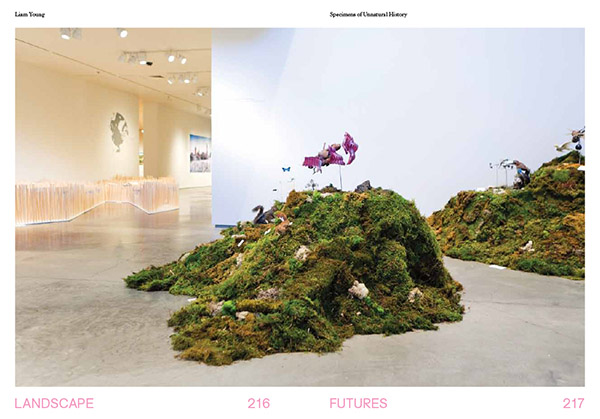
Those works joined pre-existing projects by Mason White & Lola Sheppard of Lateral Office and InfraNet Lab, whose project “Next North/The Active Layer” explored the emerging architectural conditions presented by climate-changed terrains in the far north; Chris Woebken & Kenichi Okada, whose widely exhibited “Animal Superpowers” added a colorful note to the exhibition’s second room; and architect-adventurer Liam Young, who brought his “Specimens of Unnatural History” successfully through international customs to model the warped future ecosystem of a genetically-enhanced Galapagos.
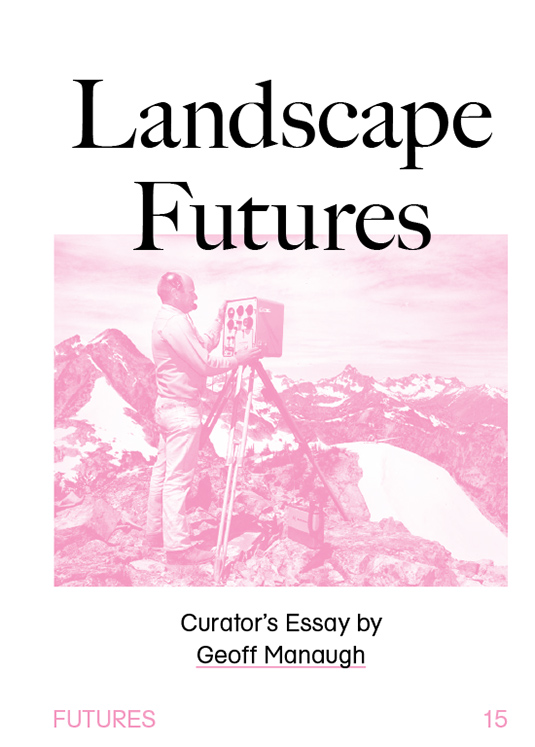
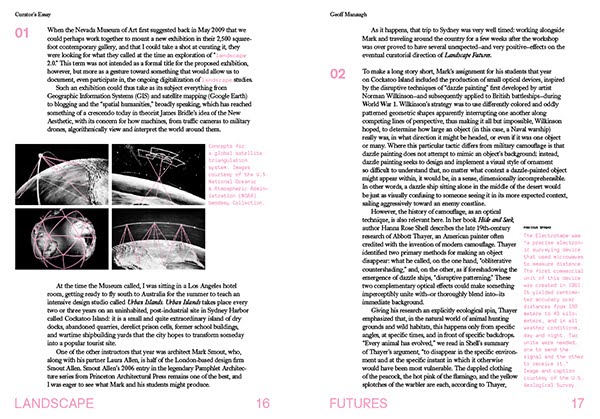
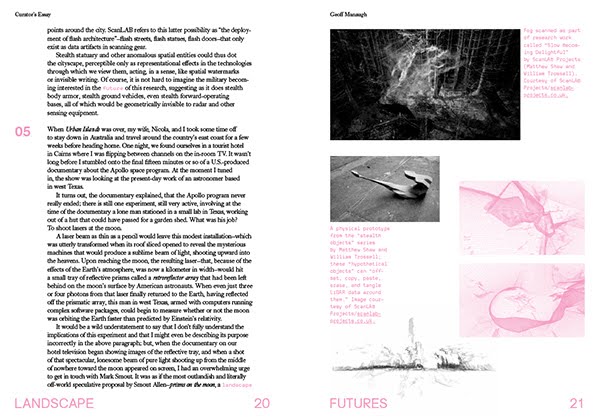
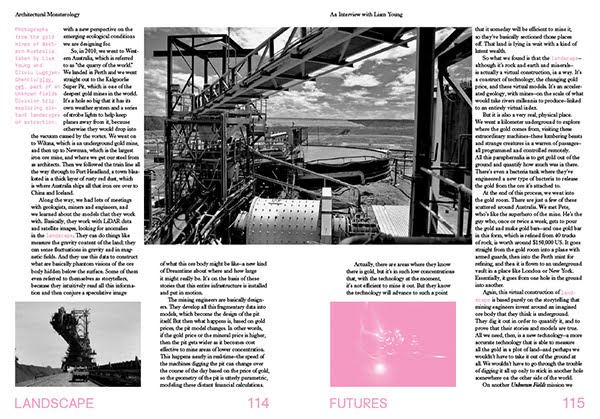
[Images: More spreads from Landscape Futures; book design by Everything-Type-Company].

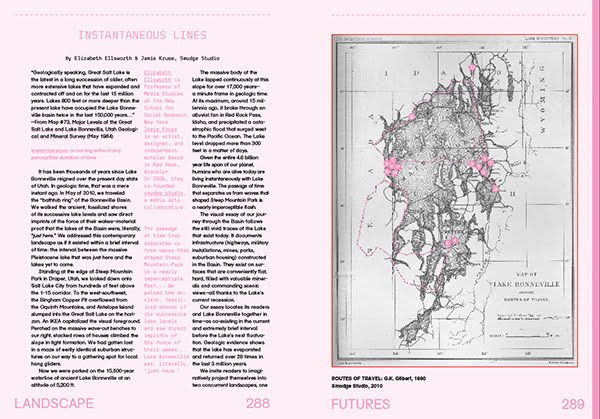
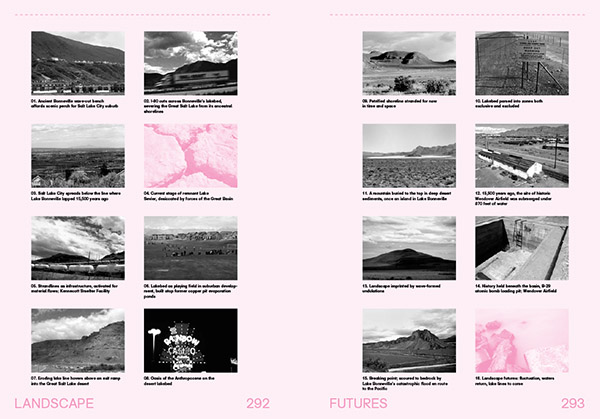
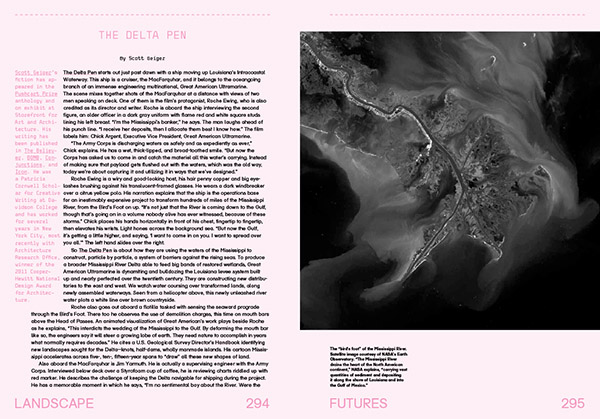
But the book also expands on that core of both new and pre-existing work to include work by Rob Holmes, Alex Trevi (edited from their original appearance on Pruned), a travelogue through the lost lakes of the American West by Smudge Studio, a walking tour through the electromagnetic landscapes of Los Angeles by the Center for Land Use Interpretation, and a new short story by Pushcart Prize-winning author Scott Geiger.

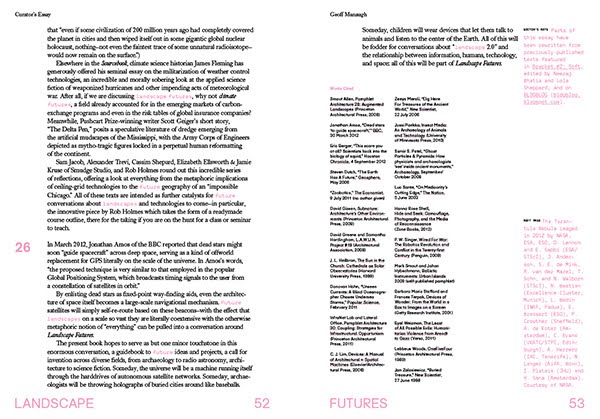
These, in turn, join reprints of texts highly influential for the overall Landscape Futures project, including a short history of climate control technologies and weather warfare by historian James Fleming, David Gissen‘s excellent overview of the atmospheric preservation of artifacts in museums in New York City (specifically, the Temple of Dendur at the Metropolitan Museum of Art), and a classic article—from BLDGBLOG’s perspective, at least—originally published in New Scientist back in 1998, where geologist Jan Zalasiewicz suggests a number of possibilities for the large-scale fossilization of entire urban landscapes in the Earth’s far future.

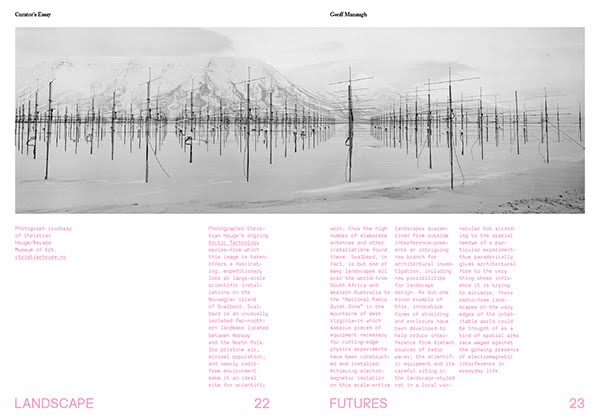
Even that’s not the end of the book, however, which is then further augmented by a long look, in the curator’s essay, at the various technical and metaphoric implications of the instruments, devices, and architectural inventions of the book’s subtitle, from robot-readable geotextiles and military surveillance technologies to the future of remote-sensing in archaeology, and moving between scales as divergent as plate-tectonic tomography, radio astronomical installations in the the polar north, and speculative laser-jamming objects designed by ScanLAB Projects.

To wrap it all up and connect the conceptual dots set loose across the book, detailed interviews with all of the exhibition’s participating artists, writers, and architects fill out the book’s long middle—and, in all cases, I can’t wait to get these out there, as they are all conversations that deserve continuation in other formats. The responses from David Gissen alone could fuel an entire graduate seminar.

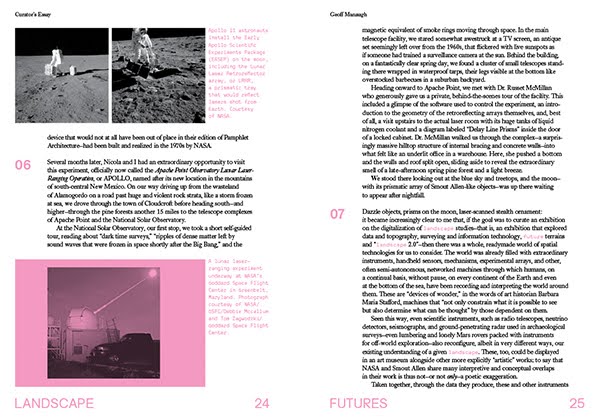
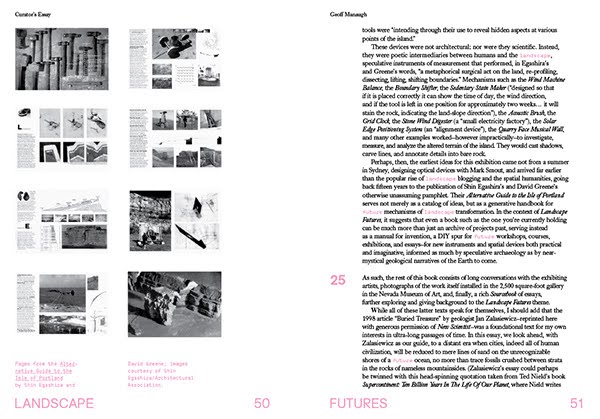
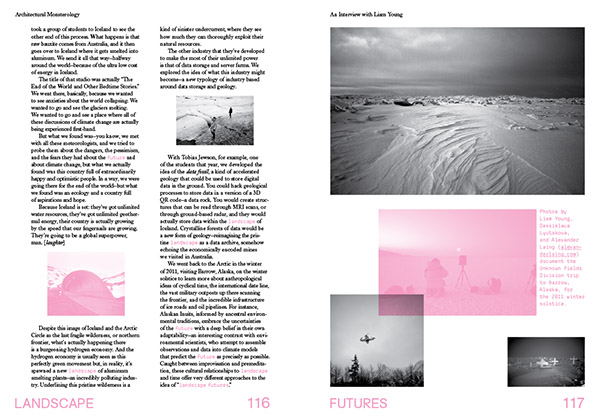
The spreads and images you see here all come directly from the book.
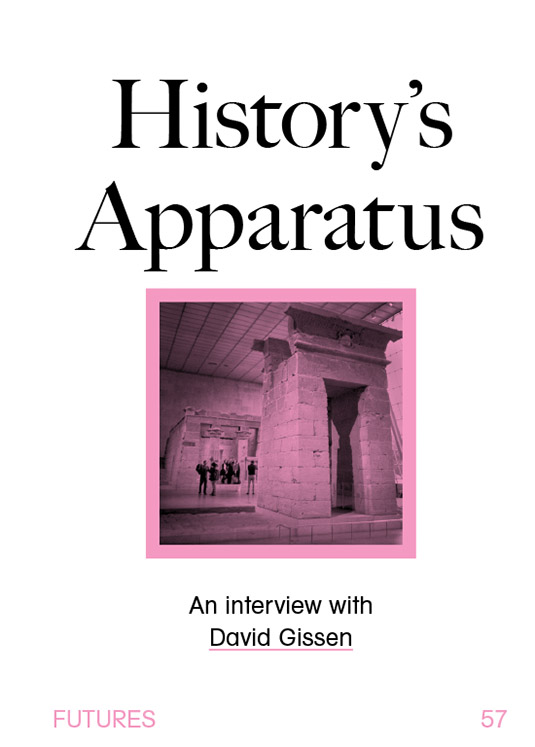
[Images: Spreads from Landscape Futures; book design by Everything-Type-Company].

Of course, the work itself also takes up a large section in the final third or so of the book; consisting mostly of photographs by Jamie Kingham and Dean Burton, these document the exhibition contents in their full, spatial context, including the double-height, naturally lit room in which the ceiling-mounted machinery of Smout Allen whirred away for six months. This is also where full-color spreads enter the book, offering a nice pop after all the pink that came before.
[Images: Installation shots from the Nevada Museum of Art, by Jamie Kingham and Dean Burton, including other views, from posters to renderings, from Landscape Futures; book design by Everything-Type-Company].

Which brings us, finally, to the Landscape Futures Sourcebook, the final thirty or forty pages of the book, filled with the guest essays, travelogues, walking tours, photographs, a speculative future course brief by Rob Holmes of Mammoth, and the aforementioned short story by Scott Geiger.
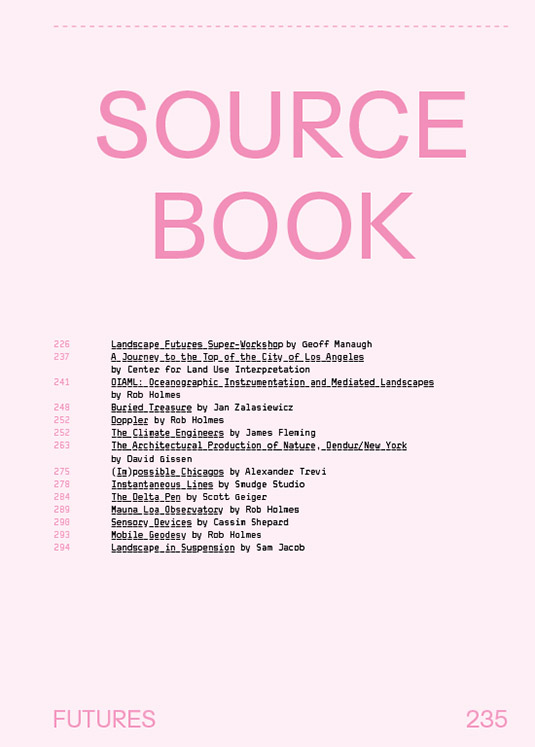
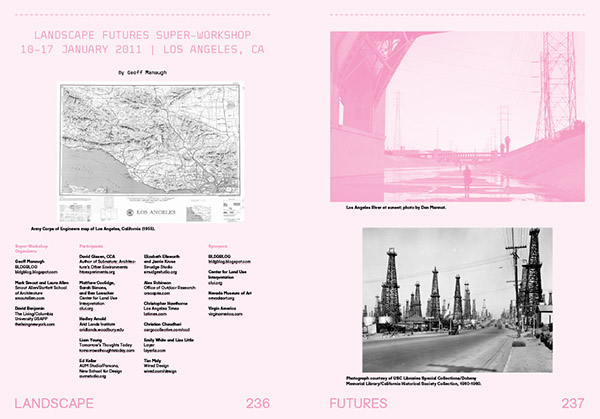
[Images: A few spreads from the Landscape Futures Sourcebook featured in Landscape Futures; book design by Everything-Type-Company].

Needless to say, I am absolutely thrilled with the incredible design work done by Everything-Type-Company—a new and rapidly rising design firm based in Brooklyn, founded by Kyle Blue and Geoff Halber—and I am also over the moon to think that this material will finally be out there for discussion elsewhere. It’s been a long, long time in the making.

In any case, shipping should begin later this month. Hopefully the above glimpses, and the huge list of people whose graphic, textual, or conceptual work is represented in the book, will entice you to support their effort with an order.

Enjoy!

(Thank you to all the people and organizations who made Landscape Futures possible, including the Nevada Museum of Art and ACTAR, supported generously by the Graham Foundation for Advanced Study in the Fine Arts, the National Endowment for the Arts, and the Andy Warhol Foundation for the Visual Arts).

Cross-Species Infrastructure

[Image: From “Assimilation” by Dillon Marsh].

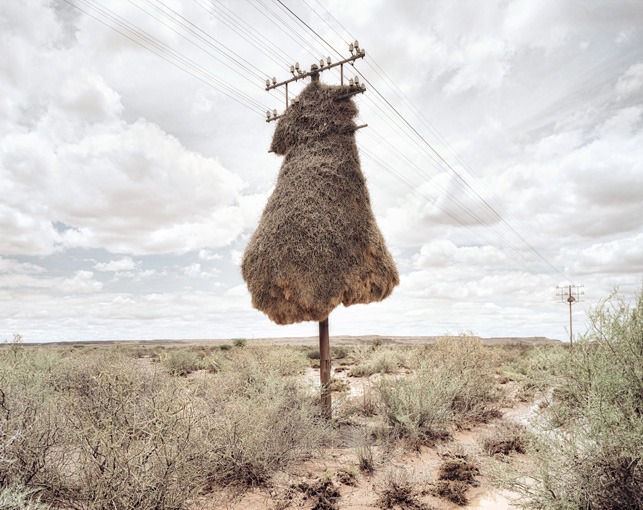
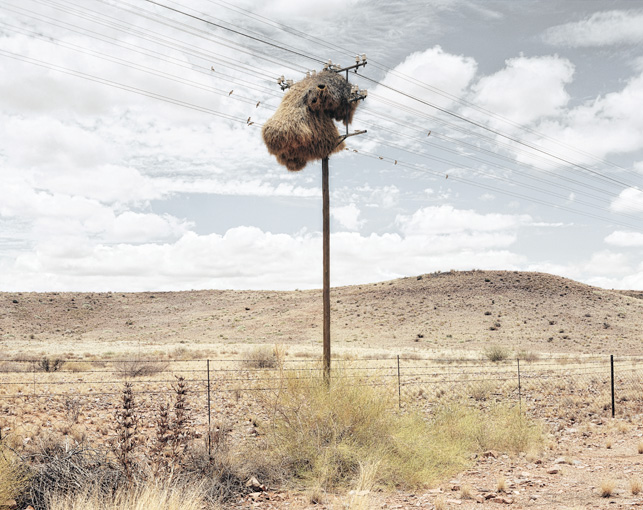
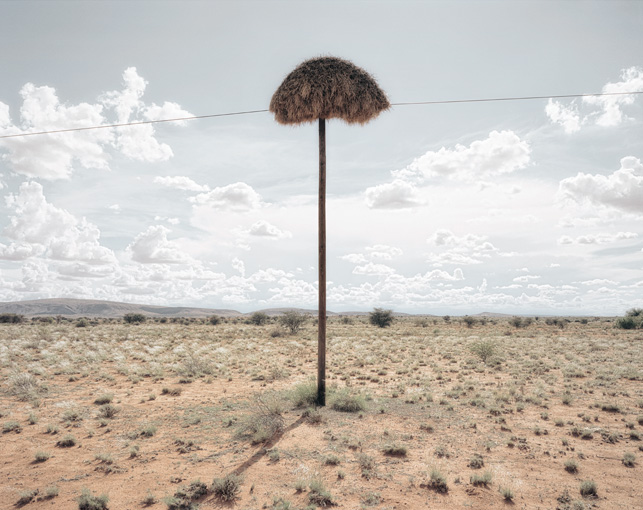
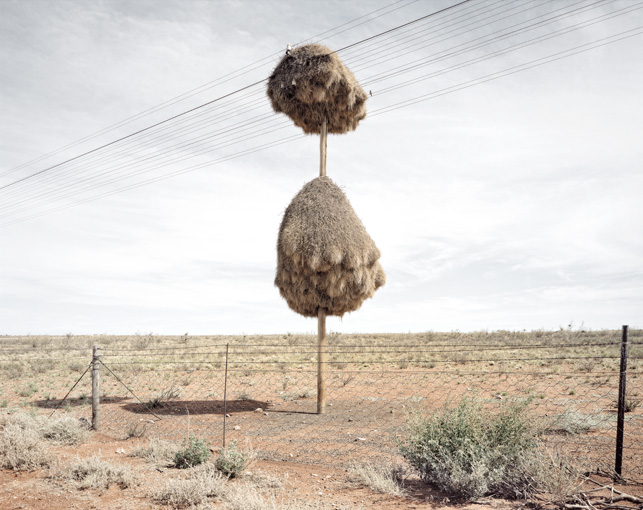
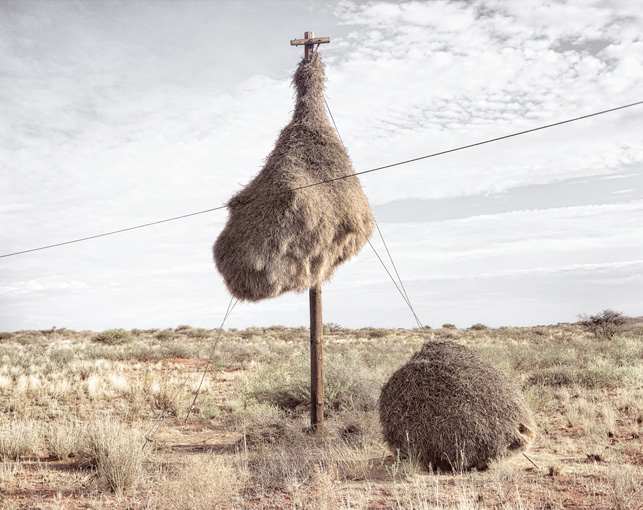
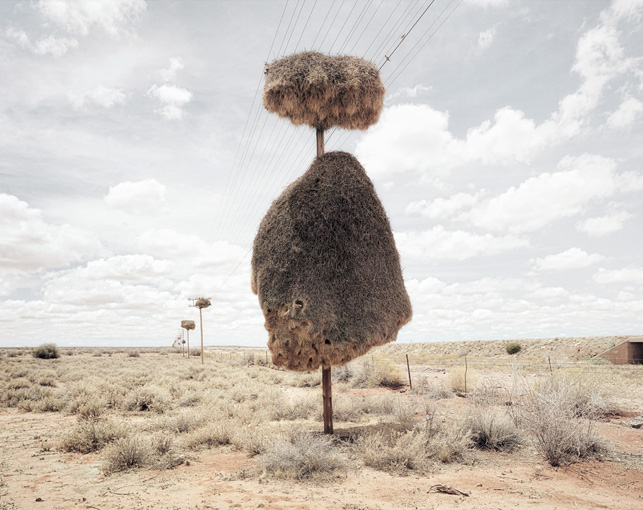
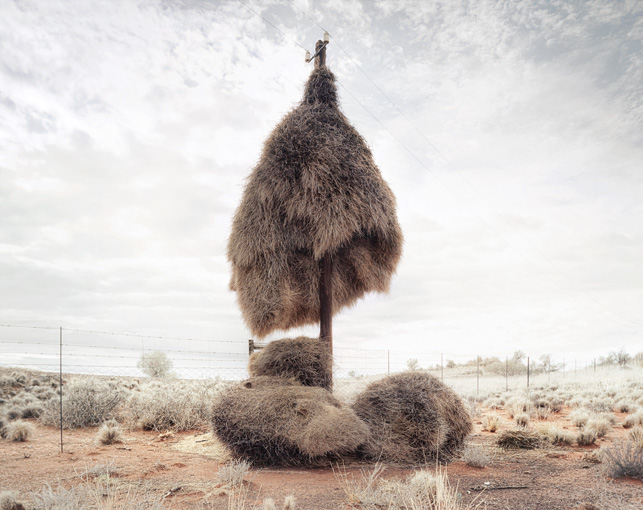
I mentioned in the previous post the work of South African photographer Dillon Marsh, whose “Landscape Series” seeks “to find things that are out of the ordinary, picking them out of the landscape where they might otherwise blend in. I choose objects that can be found in multitude within their environment so that I can depict a family of objects in a series of photographs. By displaying each project as such, I feel I am able to show both the character of the individual members, and the characteristics that make these objects a family.”

[Image: From “Assimilation” by Dillon Marsh].

Marsh’s photos seen here were seemingly everywhere on the internet a few weeks ago, but I thought I’d post them nonetheless, as they’re not only interesting images in and of themselves, but they depict one of my favorite topics: human infrastructure claimed—or assimilated, in Marsh’s words—by nonhuman species, other builders and users of artificial environments, who construct their own homes on those underlying skeletons.

[Images: From “Assimilation” by Dillon Marsh].

It is an architecture of infestation, of creative reuse across species lines.

[Images: From “Assimilation” by Dillon Marsh].

So what is all this, more specifically? As Marsh explains, “In the vast barren landscapes of the southern Kalahari, Sociable Weaver Birds assume ownership of the telephone poles that cut across their habitat. Their burgeoning nests are at once inertly statuesque and teeming with life. The twigs and grass collected to build these nests combine to give strangely recognisable personalities to the otherwise inanimate poles.”

[Images: From “Assimilation” by Dillon Marsh].

Seen one way, these photos depict an entire form of architecture reduced to ornament, mere biological decoration; seen another, they just as powerfully reveal how the smallest and seemingly most inconsequential additions to the built environment—incremental 3D fabrics of twigs, grass, and weeds—serve to augment that built environment through inhuman architectural means.

Branch

[Image: From “Means to an End” by Dillon Marsh].

There are a few projects by the young South African photographer Dillon Marsh that seem worth a look.

[Image: From “Means to an End” by Dillon Marsh].

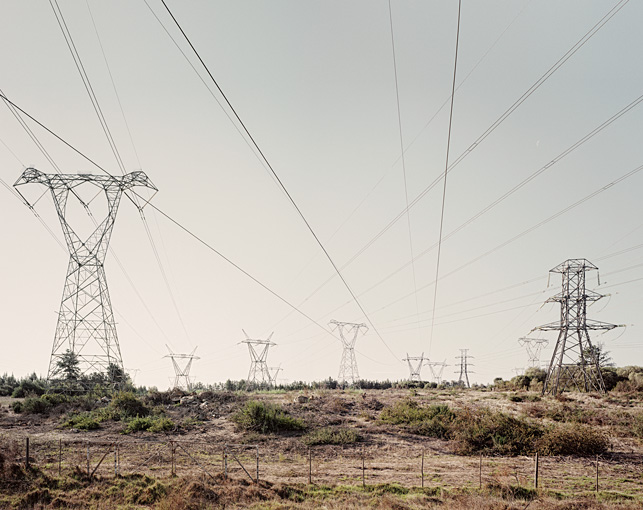
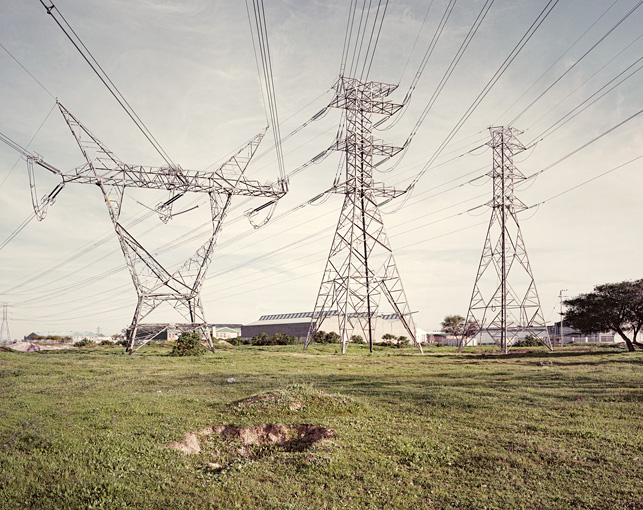
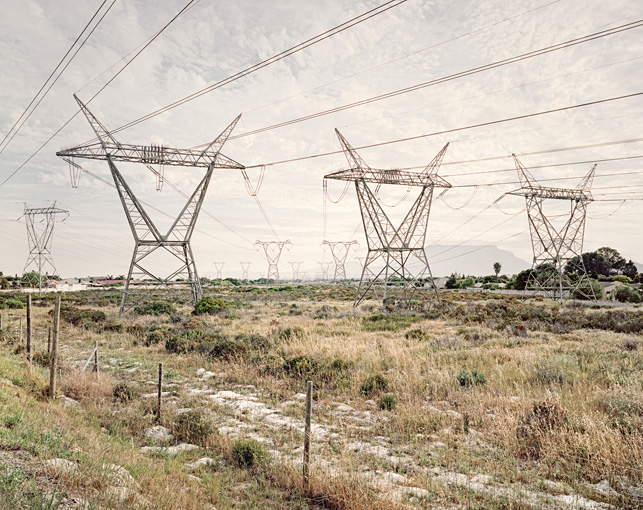
The first are his photos of “electricity pylons… criss-crossing the landscape around the city of Cape Town,” called “Means to an End.”

[Image: From “Means to an End” by Dillon Marsh].

Marsh is by no means the first photographer, artist, writer, architect, etc., to look at electricity pylons, but the resulting images are pretty stunning.

Meanwhile, Marsh has a variety of other series available for view on his website, but another one I want to feature briefly here is called “Limbo.”

[Image: From “Limbo” by Dillon Marsh].

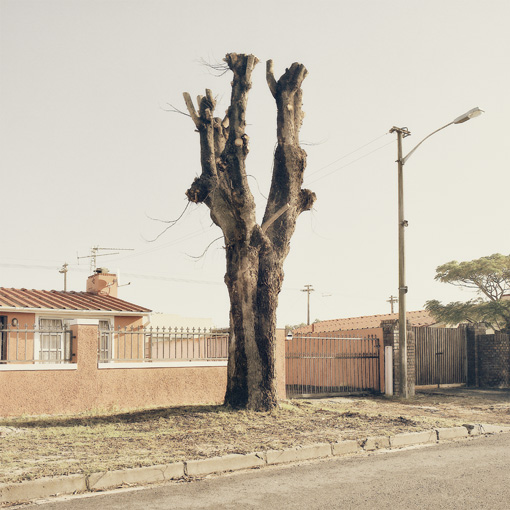
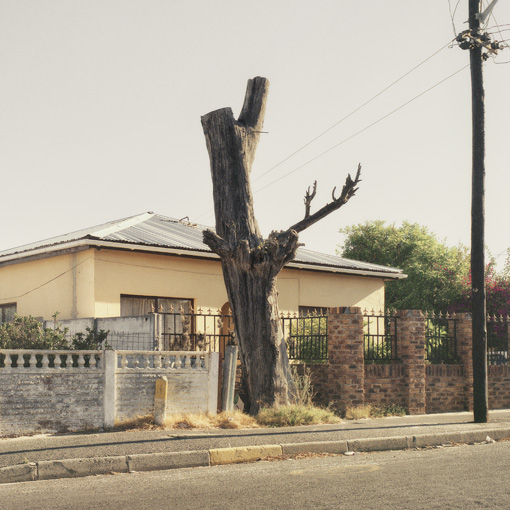
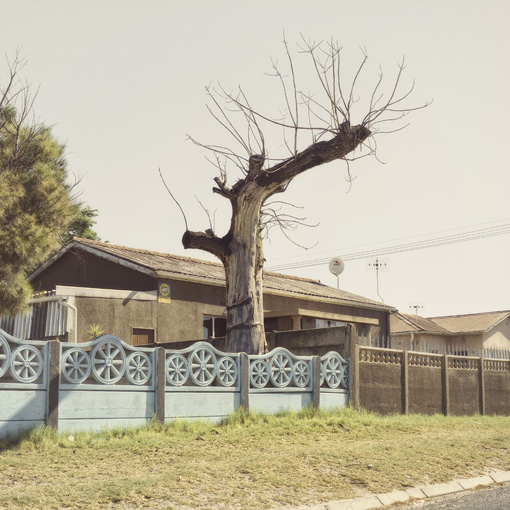
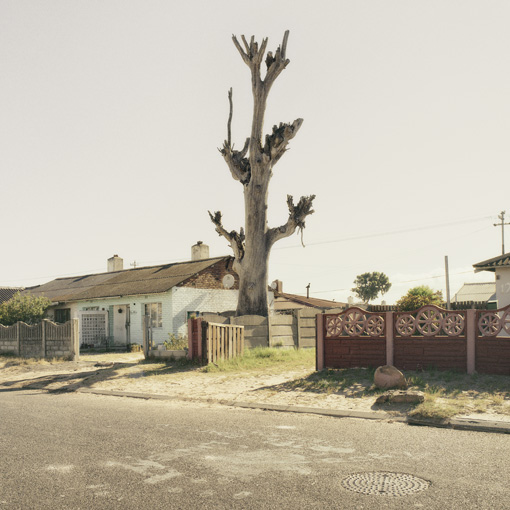
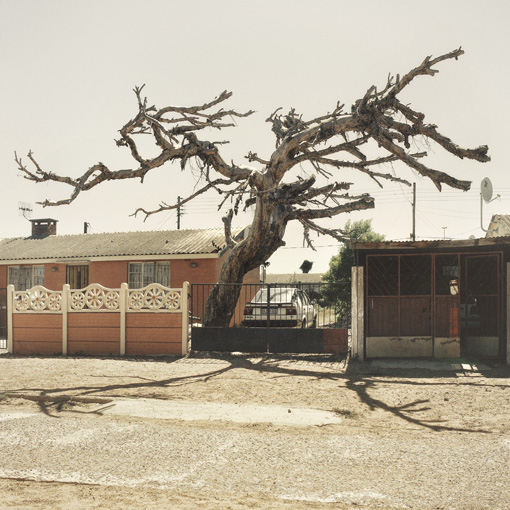
In Marsh’s own words, “‘Limbo‘ is a series of photographs showing trees that have died, but not yet fallen. All these trees were photographed in various suburbs of the Cape Flats area of Cape Town, including Bridgetown, Bonteheuwel, Ruyterwacht, Windermere, and The Hague.”

The results perhaps recall the “Rise” filter, as well as the square format of Instagram, but, for me, that doesn’t take away from their visual or conceptual interest.

[Images: From “Limbo” by Dillon Marsh].

Oddly, these actually remind me of the trees in Hackney, a borough of London where I briefly lived more than a decade ago; the branches of almost every tree along the streets that I walked each morning to the local bus stop had been cut—or hacked, as it were—by the Council, apparently out of a mathematically impossible fear of liability should the branches someday fall and hit a car, a pedestrian, or a baby in a stroller, lending the neighborhood an even drearier feel of grey-skied Gothic horror than it would have had already on its own.

[Images: From “Limbo” by Dillon Marsh].

Somewhere between portraits and landscape photography, these two projects of Marsh’s go well together, depicting the starkly exposed branching peculiar to these two types of structures.

They are also both in Marsh’s “Landscape Series” of photographs, a series that, in his words, seeks “to find things that are out of the ordinary, picking them out of the landscape where they might otherwise blend in. I choose objects that can be found in multitude within their environment so that I can depict a family of objects in a series of photographs. By displaying each project as such, I feel I am able to show both the character of the individual members, and the characteristics that make these objects a family.”

I’ll do one more quick post about Marsh’s work, showing my favorite series of all.