Awakener

A few examples of landscapes waking up after long periods of time lying dormant have been in the news recently.

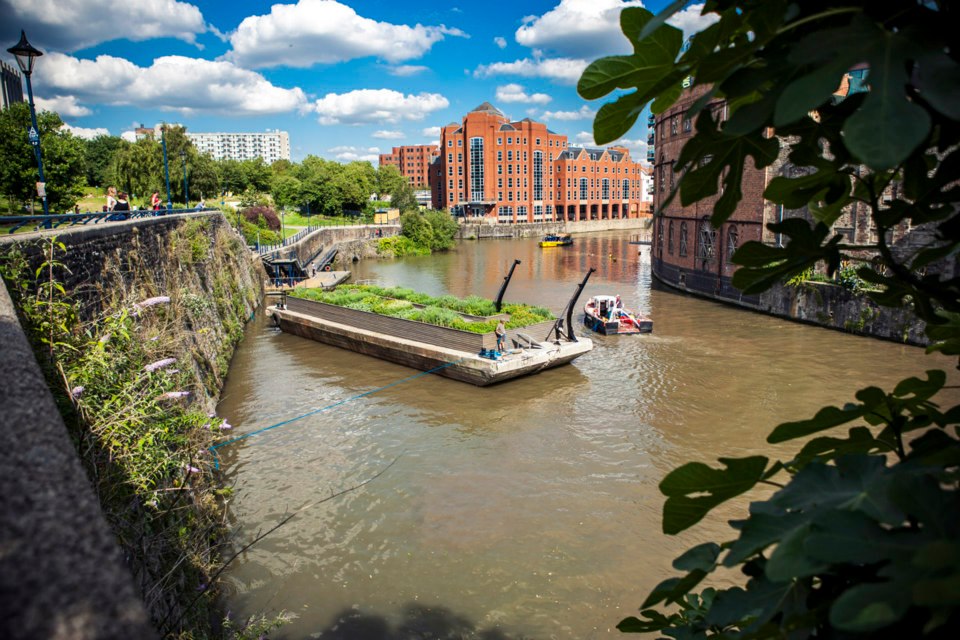
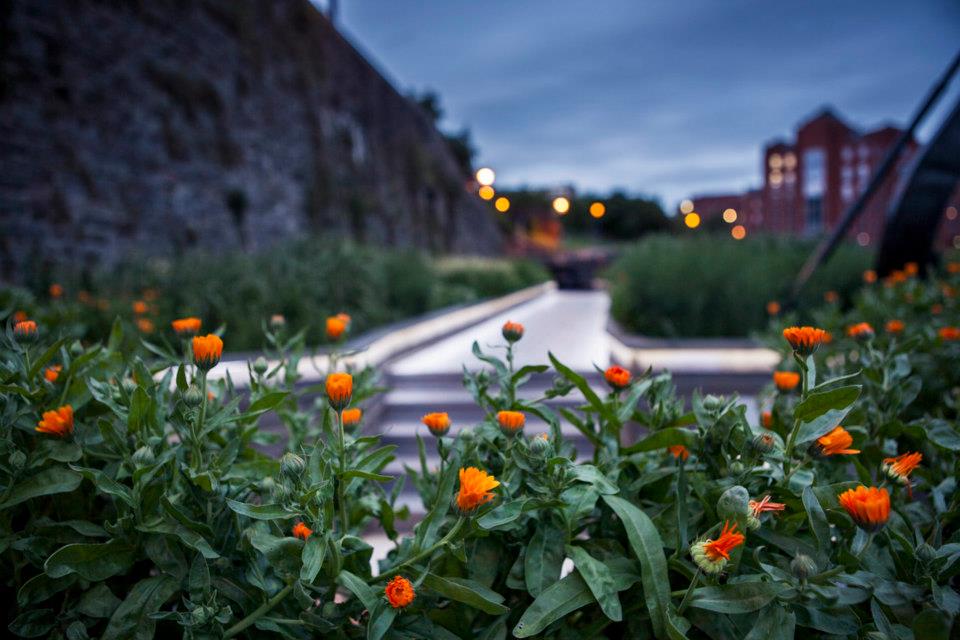
[Image: Maria Thereza Alves’s Seeds of Change garden, via Facebook].

First, there is artist Maria Thereza Alves’s “ballast seed garden” project, called Seeds of Change, which arose from a moment of revelation:

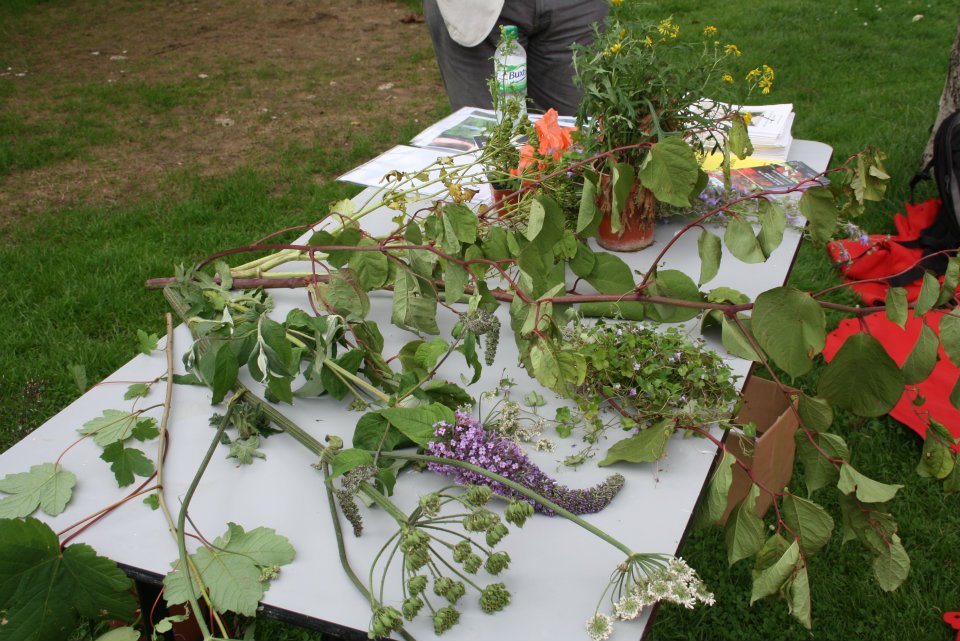
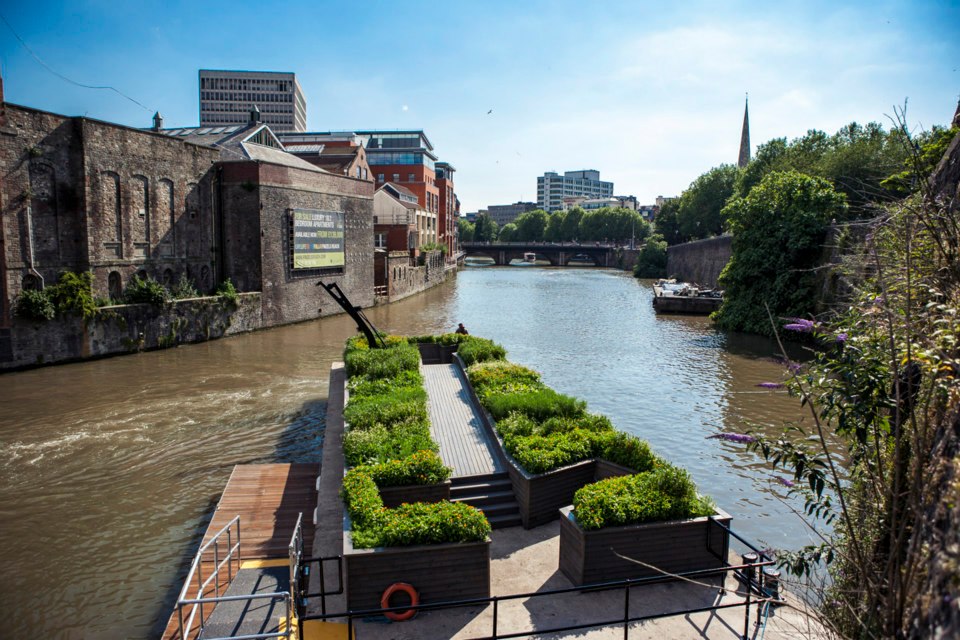
Between 1680 and the early 1900s, ships’ ballast—earth, stones and gravel from trade boats from all over the world used to weigh down the vessel as it docked—was offloaded into the river at Bristol. This ballast contained the seeds of plants from wherever the ship had sailed. Maria Thereza Alves discovered that these ballast seeds can lie dormant for hundreds of years, but that, by excavating the river bed, it is possible to germinate and grow these seeds into flourishing plants.

While Alves seems not to have literally dug down into the old layers of the river in order to harvest her seeds—instead sourcing contemporary examples of species known to have sprouted from mounds of ballast over the last few hundred years—her project nonetheless has the character of a long-lost landscape waking up, popping up like a refugee amidst the rubble in a return to visibility.

[Images: The ballast garden, via Facebook].

This idea of accidental ballast gardens—heavily detoured landscapes-to-come lying patiently in wait before springing back to life several centuries after their initial transportation—is incredible; I might even suggest parallels here with such 21st-century problems as how we might sterilize spacecraft before sending them offworld, to places like Mars, lest we, in a sense, bring along our own bacterial “ballast” and thus unwittingly terraform those distant locations with escaped landscapes from Earth. Might we someday culture “ballast gardens” on other planets from the tiniest of remnant organic compounds found on our own ancient and dismantled ships?

[Image: Maria Thereza Alves’s Seeds of Change garden, via Facebook].

Meanwhile, in a headline that reads like something straight out of Stanislaw Lem or H.P. Lovecraft, we read that “Nunavut’s Mysterious Ancient Life Could Return by 2100 as Arctic Warms.” In other words, forests that thrived in the hostile conditions of “Canada’s extreme north” nearly three million years ago might return to re-colonize the landscape as the region dramatically warms over the next century due to climate change.

This is a relatively mundane resurrection—after all, it is just a forest—but even the suggestion that future climate conditions on Earth might re-awaken ancient ecosystems, dormant environments in which humans might find it less than easy to survive, is an incredible cautionary tale for the future of the planet. That, and this story offers the awesomely mythic image of human explorers wandering across the thawing earth of the far north as strange and ancient things bloom from cracks in the ground around them.

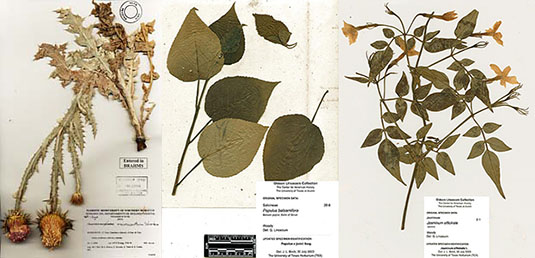
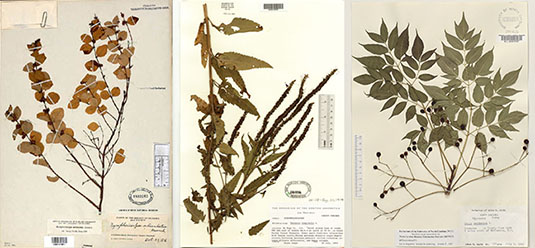
[Images: Various herbaria pages].

In both cases, I’m reminded of an essay published in Lapham’s Quarterly a few years ago, by novelist Daniel Mason. There, Mason writes about “nature’s return,” a scenario in which dormant and waylaid seeds thrive on the rubble of the present-day landscape. “In the dusty cracks between the concrete, seedlings would germinate, grow,” Mason writes, heralding unpredictable landscapes to come.

[Images: More herbaria pages].

However, referring to these remnant seeds left over from older landscapes, Mason writes that “most would not germinate straight away,” even if given free rein over an empty field or cracked streetscape. “Rather,” he adds, these seeds “would lodge in microscopic nooks and crannies, some to be eaten or crushed, others to be paved over, but most, simply, to wait. A square meter of urban soil can contain tens of thousands of seeds persisting in a state of suspended animation, waiting to be woken from their slumber. After the fire brigades rescued the London Natural History Museum from German incendiaries, Albizia silk-tree seeds bloomed on their herbarium sheets, liberated from two hundred years of dormancy by the precise combination of flame and water.”

A square meter of urban soil can contain tens of thousands of seeds persisting in a state of suspended animation, waiting to be woken from their slumber. In Mason’s words, this return of dormant life “suggests the parallel existence of a hidden world, fully formed, simply awaiting the opportunity for expression.”

Whether dredging up old riverbeds full of ballast from previous centuries, or watching new storms form over the Arctic, bringing back climates unseen for millions of years, what might yet wake up from the ground around us, return from dormancy, resurrect, as it were, and make itself at home again on a planet that thought it had since moved on?

(Ballast garden link spotted via Katie Holten).

Caves of Nottingham

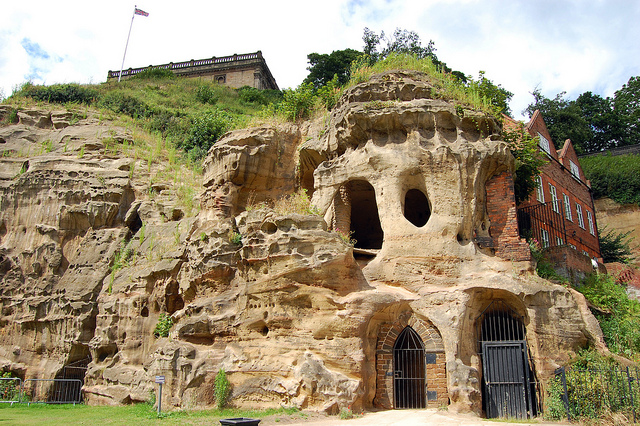
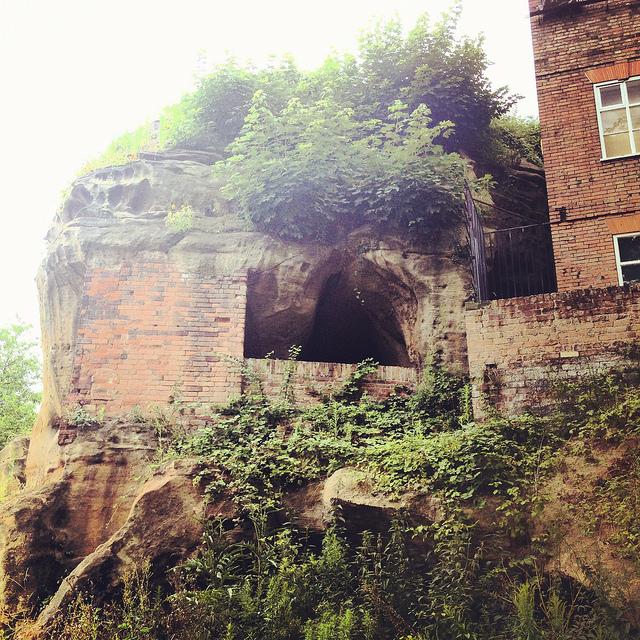
[Image: Cliffs and caves of Nottingham; photo by Nicola Twilley].

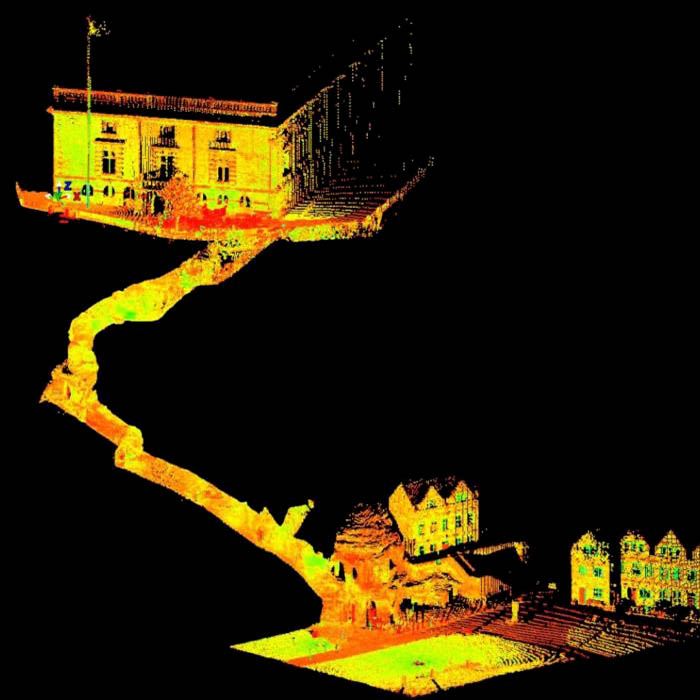
For several years now, I’ve admired from afar the ambitious laser-scanning subterranean archaeological project of the Nottingham Caves Survey.

Incredibly, there are more than 450 artificial caves excavated from the sandstone beneath the streets and buildings of Nottingham, England—including, legendarily, the old dungeon that once held Robin Hood—and not all of them are known even today, let alone mapped or studied. The city sits atop a labyrinth of human-carved spaces—some of them huge—and it will quite simply never be certain if archaeologists and historians have found them all.

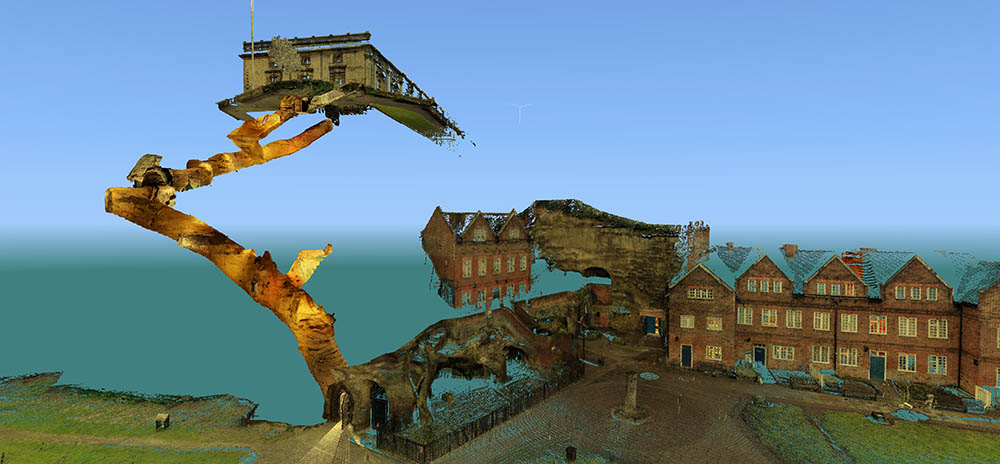
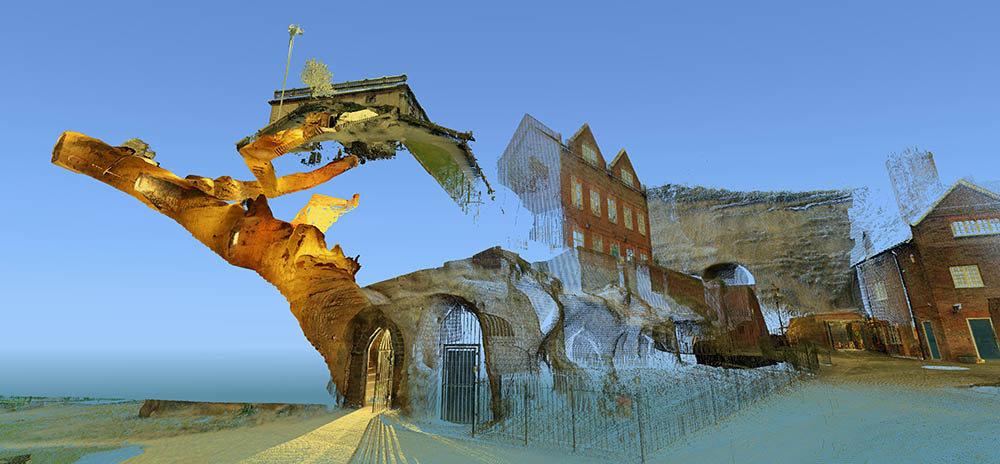
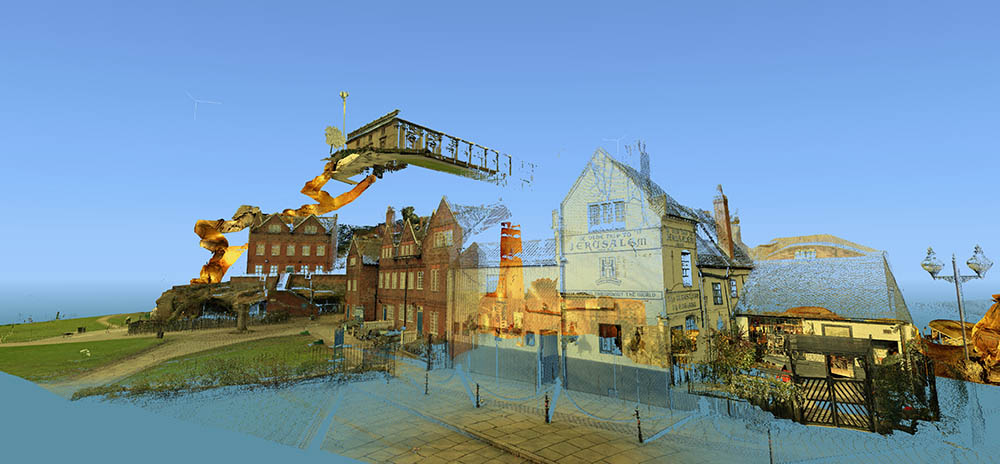
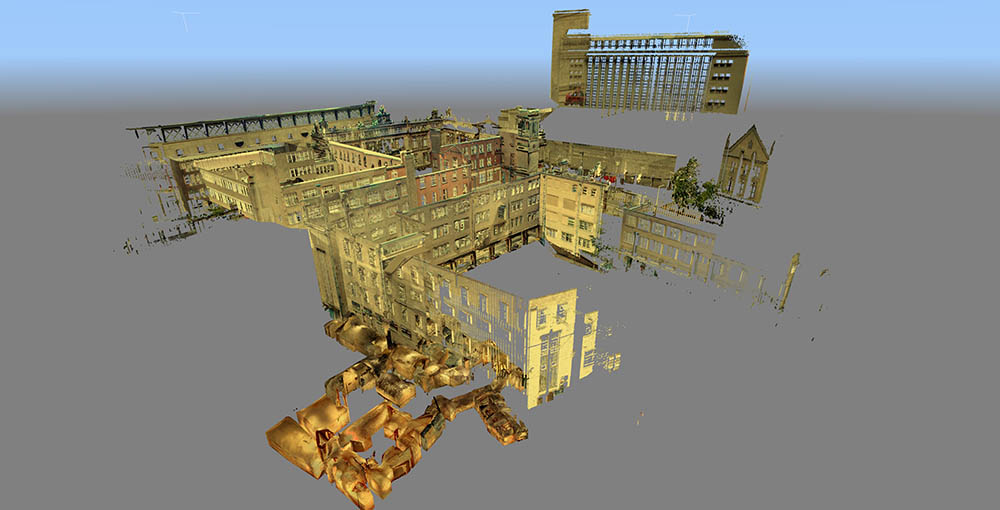
[Images: Laser scans from the Nottingham Caves Survey show Castle Rock and the Mortimer’s Hole tunnel, including, in the bottom image, the Trip to Jerusalem Pub where we met archaeologist David Strange-Walker; images like this imply an exhilarating and almost psychedelic portrait of the city as invisibly connected behind the scenes by an umbilical network of caves and tunnels. Scans courtesy of the Nottingham Caves Survey].

“Even back in Saxon times, Nottingham was known for its caves,” local historian Tony Waltham writes in his helpful guide Sandstone Caves of Nottingham, “though the great majority of those which survive today were cut much more recently.” From malt kilns to pub cellars, “gentlemen’s lounges” to jails, and wells to cisterns, these caves form an almost entirely privately-owned lacework of voids beneath the city.

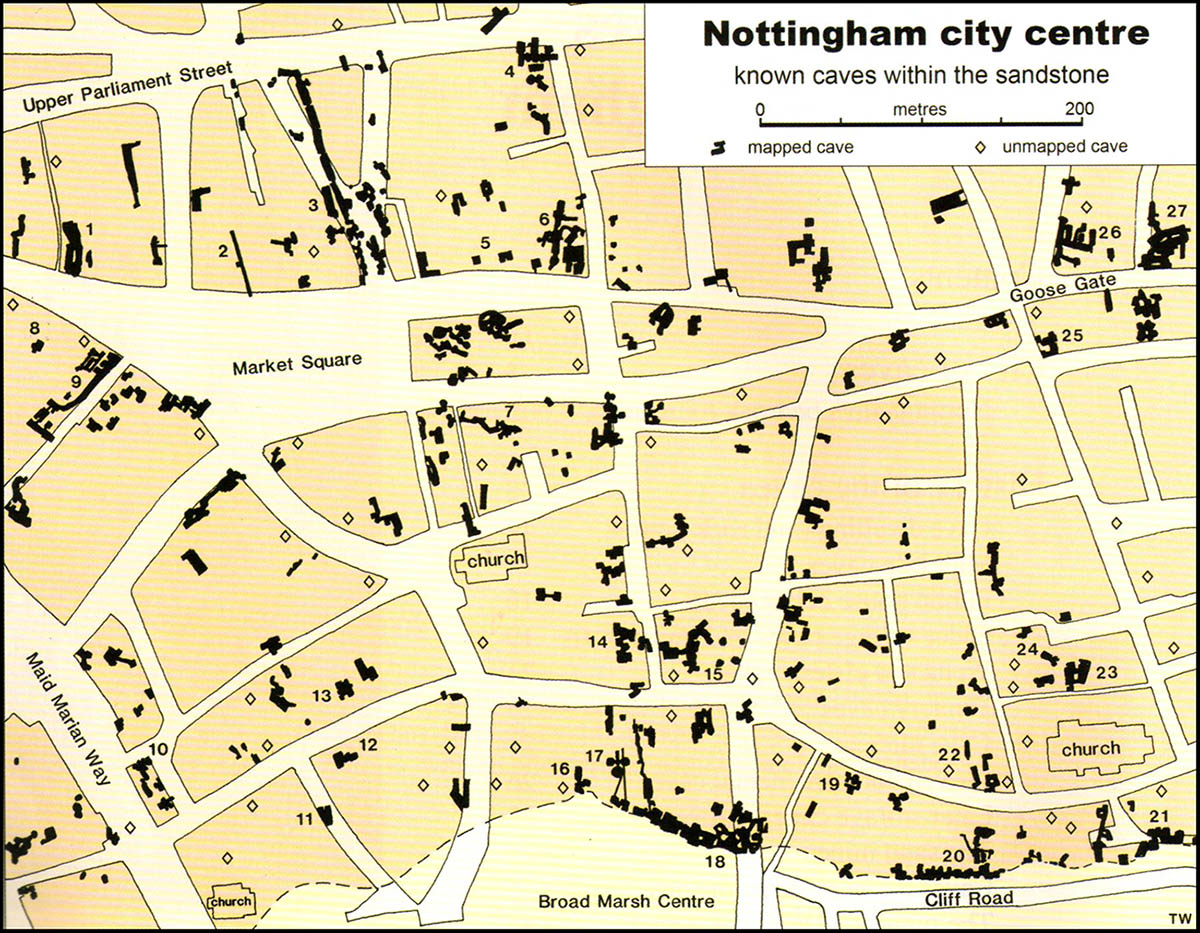
[Image: Map of only the known caves in Nottingham, and only in Nottingham’s city center; map by Tony Waltham, from Sandstone Caves of Nottingham].

As Waltham explains, “Nottingham has so many caves quite simply because the physical properties of the bedrock sandstone are ideal for its excavation.” The sandstone “is easily excavated with only hand tools, yet will safely stand as an unsupported arch of low profile.”

In a sense, Nottingham is the Cappadocia of the British Isles.

[Image: The extraordinary caves at 8 Castle Gate; scan courtesy of the Nottingham Caves Survey].

The purpose of the Nottingham Caves Survey, as their website explains, is “to assess the archaeological importance of Nottingham’s caves. Some are currently scheduled monuments and are of great local and national importance. Some are pub cellars and may seem less vital to the history of the City.”

Others, I was soon to learn, have been bricked off, taken apart, filled in, or forgotten.

“All caves that can be physically accessed will be surveyed with a 3D laser scanner,” the Survey adds, “producing a full measured record of the caves in three dimensions. This ‘point cloud’ of millions of individual survey points can be cut and sliced into plans and sections, ‘flown through’ in short videos, and examined in great detail on the web.”


[Video: One of very many laser-scan animations from the Nottingham Caves Survey].

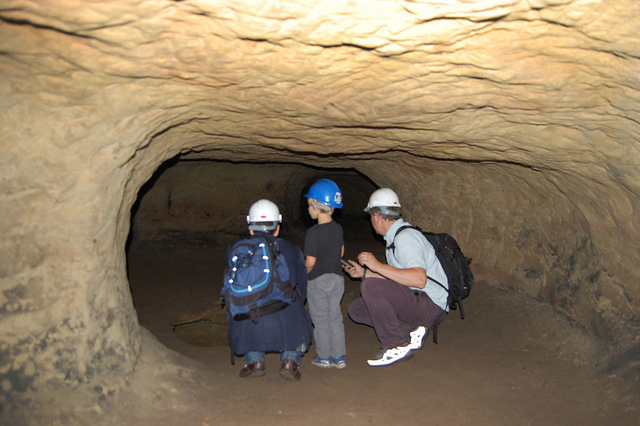
While over in England a few weeks ago, I got in touch with archaeologist David Strange-Walker, the project’s manager, and arranged for a visit up to Nottingham to learn more about the project. Best of all, David very generously organized an entire day’s worth of explorations, going down into many of the city’s underground spaces in person with David himself as our guide. Joining me on the trip north from London was Nicola Twilley of Edible Geography; architect Mark Smout of Smout Allen and co-author of the fantastic Pamphlet Architecture installment, Augmented Landscapes; and Mark’s young son, Ellis.

[Image: Artificially enlarged pores in the sandstone; photo by BLDGBLOG].

We met the very likable and energetic David—who was dressed for a full day of activity, complete with a well-weathered backpack that we’d later learn contained hard hats and floodlights for each of us—outside Nottingham’s Trip to Jerusalem pub.

Rather than kicking off our visit with a pint, however, we simply walked inside to see how the pub had been partially built—that is, expanded through deliberate excavation—into the sandstone cliffside.

The building is thus more like a facade wrapped around and disguising the artificial caves behind it; walking in past the bar, for instance, you soon notice ventilation shafts and strange half-stairways, curved walls and unpredictable acoustics, as the “network of caves” that actually constitutes the pub interior begins to reveal itself.

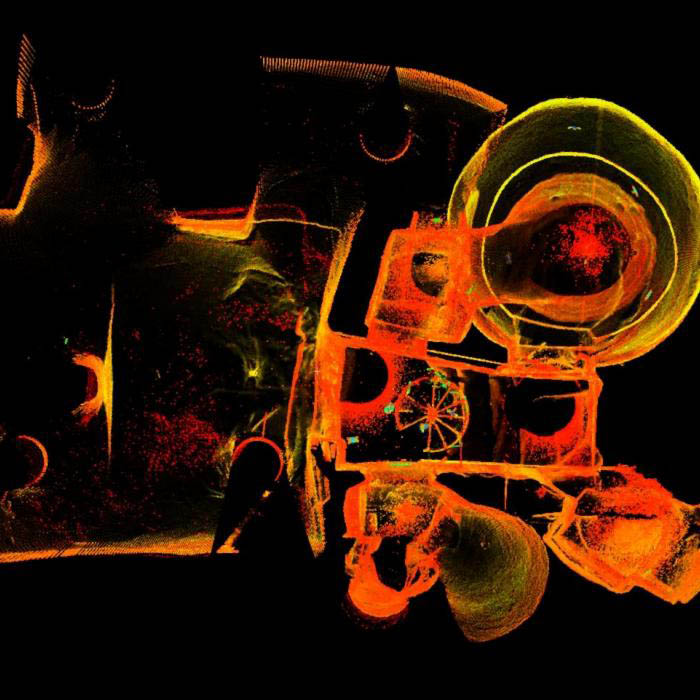
[Image: A laser scan showing the umbilical connection of Mortimer’s Hole, courtesy of the Nottingham Caves Survey].

My mind was already somewhat blown by this, though it was just the barest indication of extraordinary spatial experiences yet to come.

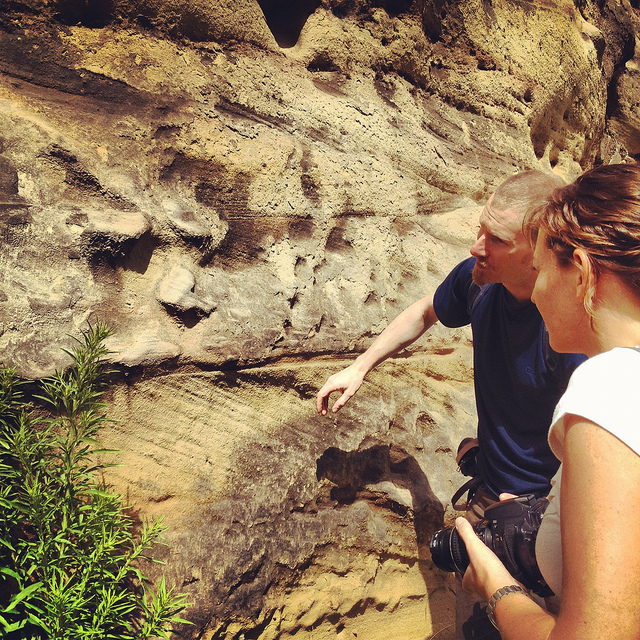
[Image: Examining sandstone with Dr. David Strange-Walker; photo by BLDGBLOG].

Wasting no time, we headed back outside, where afternoon rain showers had begun to blow in, and David introduced us to the sandstone cliff itself, pointing out both natural and artificially enlarged pores pockmarking the outside.

The sandstone formations or “rock units” beneath the city, as Tony Waltham explains, “were formed as flash flood sediments in desert basins during Triassic times, about 240 million years ago, when Britain was part of a hot and dry continental interior close to the equator. Subsequent eons of plate tectonic movements have brought Britain to its present position; and during the same time, the desert sediments have been buried, compressed and cemented to form moderately strong sedimentary rocks.”

The city is thus built atop a kind of frozen Sahara, deep into which we were about to go walking.

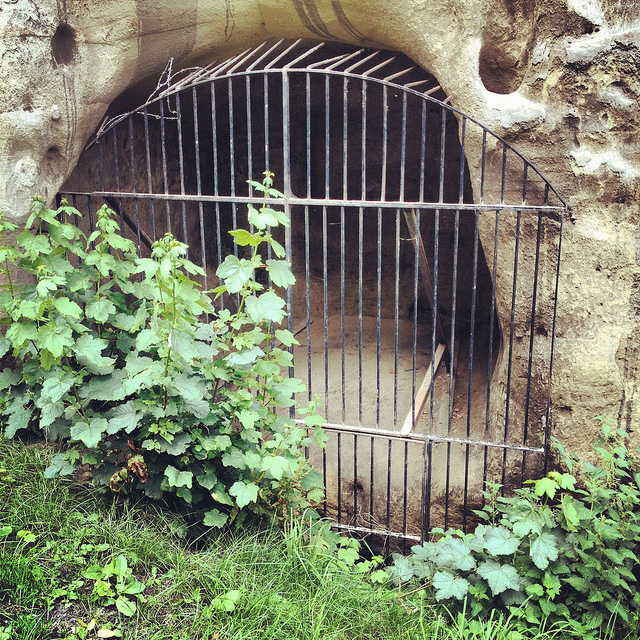
[Image: A gate in the cliff; photo by BLDGBLOG].

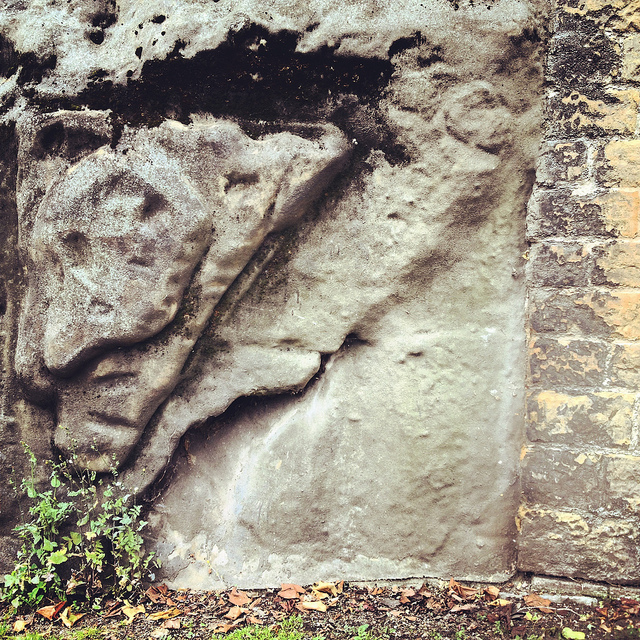
Outside here in the cliff face, small openings led within to medieval tunnels and stairs—including the infamous Mortimer’s Hole—that themselves curled up to the top of the plateau; doors in the rock further up from the Trip to Jerusalem opened onto what were now private shooting ranges, of all things; and, with a laugh, David pointed out shotcrete cosmetic work that had been applied to the outer stone surface.

[Image: Artificial shotcrete geology; photo by BLDGBLOG].

We headed from there—walking a brisk pace uphill into the town center—with David casually narrating the various basements, cellars, tunnels, and other urban perforations that lay under the buildings around us, as if we were traveling through town with a human x-ray machine for whom the city was an archaeologically rich cobweb of underground loops and dead-ends.

We soon ended up at the old jails of the Galleries of Justice. A well-known tourist destination, complete with costumed re-enactors, the building sits atop several levels of artificial caves that are well worth exploring.

[Image: Scan of the Guildhall caves, courtesy of the Nottingham Caves Survey].

We were joined at this point by the site’s director, who generously took time out of his schedule to lead us down into parts of the underground complex that are not normally open to the general public.

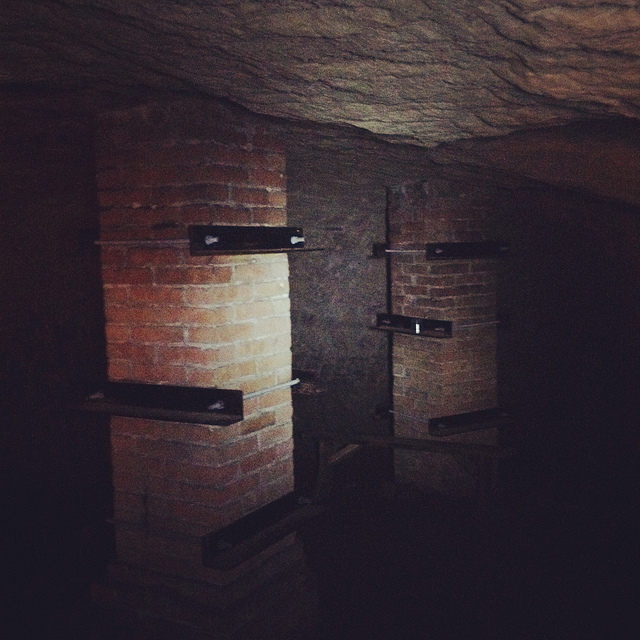
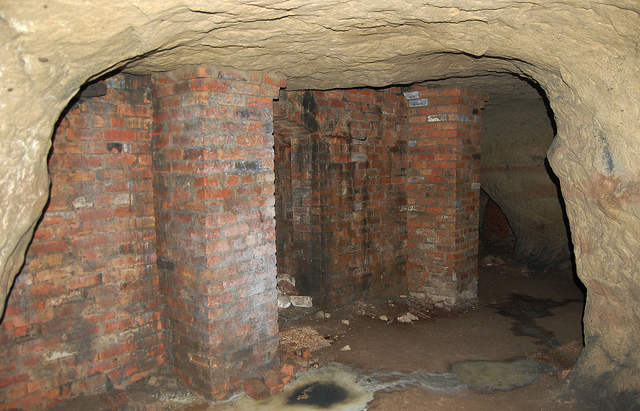
Heading downward—at first by elevator—we eventually unlocked a door, stepped into a tiny room beneath even the jail cells, crouching over so as not to bang our heads on the low ceiling, and we leaned against banded brick pillars that had been added to help support all the architecture groaning above us.

Avoiding each other’s flashlight beams, we listened as our two guides talked about the discovery—and, sadly, the willful reburial—of caves throughout central Nottingham.

[Image: Brick pillars below Nottingham; photo by BLDGBLOG].

We learned, for instance, that, elsewhere in the city, there had once been a vacuum shop with a cave beneath it; if I remember this story correctly, the shop’s owners had the habit of simply discarding broken and unsold vacuum cleaners into the cave, inadvertently creating a kind of museum of obsolete vacuum parts. Discontinued models sat in the darkness—a void full of vacuums—as the shop went out of business.

We heard, as well, about a nearby site where caves had been discovered beneath a bank during a recent process of renovation and expansion—but, fearing discovery of anything that might slow down the bank’s architectural plans, the caves were simply walled up and left unexplored. They’re thus still down there, underneath and behind the bank, their contents unknown, their extent unmapped—a fate, it seems, shared by many of the caves of Nottingham.

Rather than being greeted by the subterranean and historical wonder that such structures deserve—and I would argue that essentially all of subterranean Nottingham should be declared a UNESCO World Heritage Site—the caves are too often treated as little more than annoying construction setbacks or anomalous ground conditions, suitable only for bricking up, filling with concrete, or forgetting. If the public thinks about them at all, in seems, it is only long enough to consider them threats to building safety or negative influences on property value.

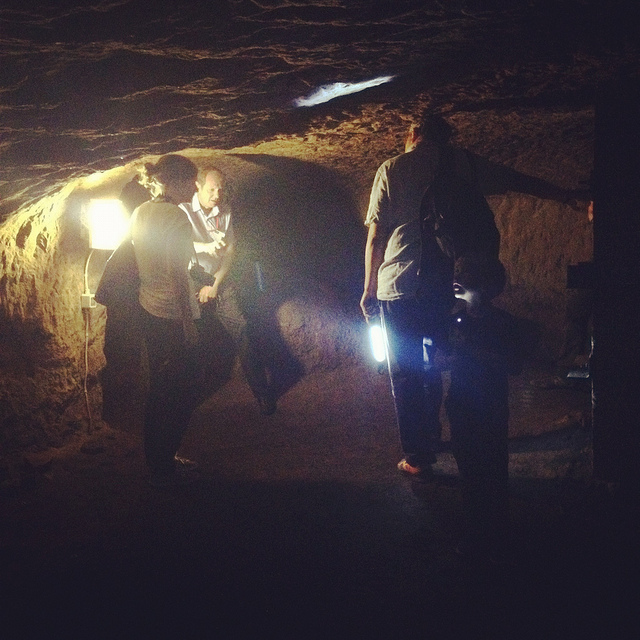
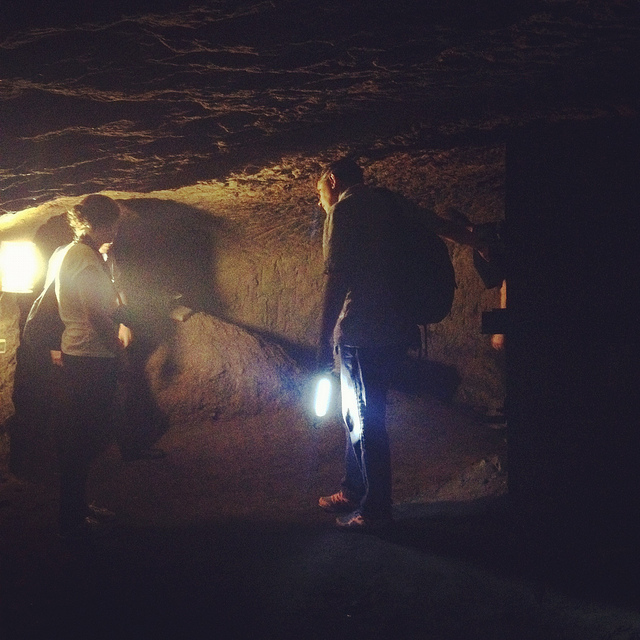
[Images: Learning about caves; photos by BLDGBLOG].

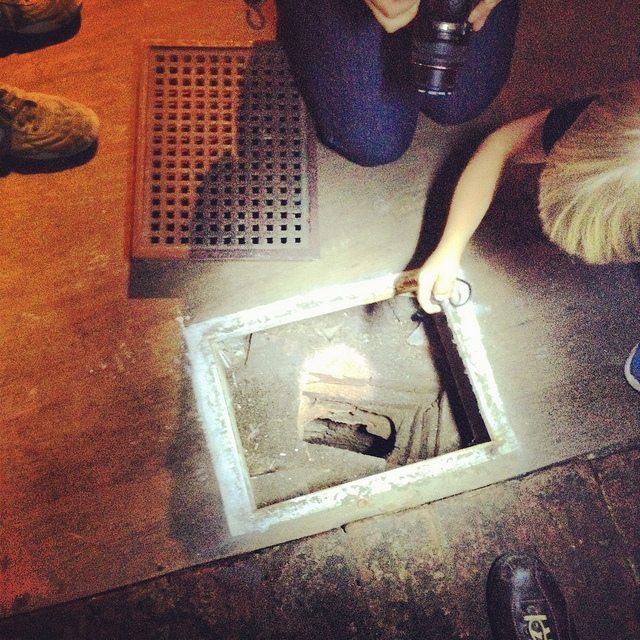
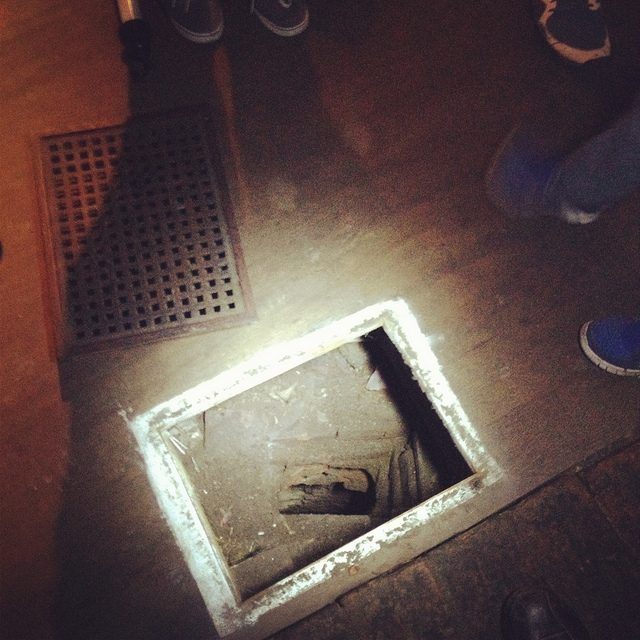
In any case, on our way out of the Galleries of Justice, we lifted up a ventilation grill in the floor and looked down into a small vertical shaft, too narrow and contorted even for Ellis to navigate, and we learned that there are urban legends that this particular shaft leads down to a larger room in which Robin Hood himself was once held… But we had only enough time to shine our flashlights down and wonder.

[Images: Ellis Smout looks for Robin Hood below; photos by BLDGBLOG].

From here, we headed over to our final tourist-y site of the day, which is the awesomely surreal City of Caves exhibition, located in Nottingham’s Broad Marsh shopping mall.

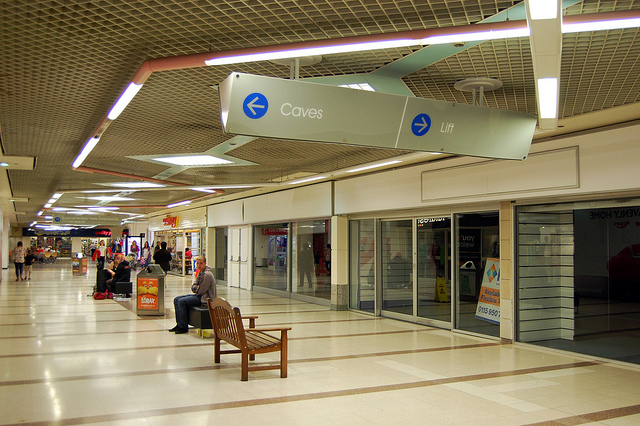
You literally take an escalator down into an indoor mall, where, amidst clothing outlets and food courts, there is an otherwise totally mundane sign pointing simply to “Caves.”

If you didn’t know about Nottingham’s extensive sub-city, this would surely be one of the most inexplicable way-finding messages in mall history.

[Image: Caves; photo by Nicola Twilley].

Here, where we picked our copy of Tony Waltham’s Sandstone Caves of Nottingham pamphlet, from which I’ve been quoting, we learned quite a bit more about how the city has grown, how the caves themselves have often been uncovered (for example, during building expansions and renovations), and what role Nottingham’s underground spaces served during the Nazi bombings of WWII.

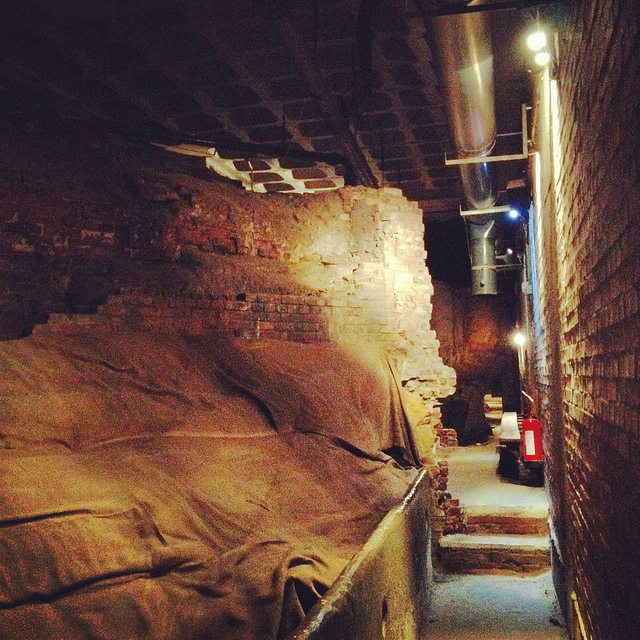
[Image: Beneath Broad Marsh shopping mall; photo by BLDGBLOG].

The specific underground complex beneath the shopping mall offers an interesting mix of old tanning operations and other semi-industrial, pre-modern work rooms, now overlapping with 20th-century living and basement spaces that were sliced open during the construction of the Broad Marsh mall.

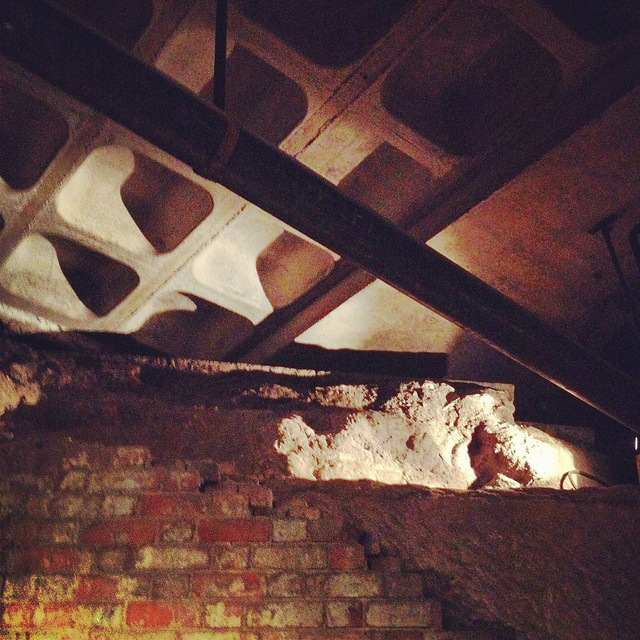
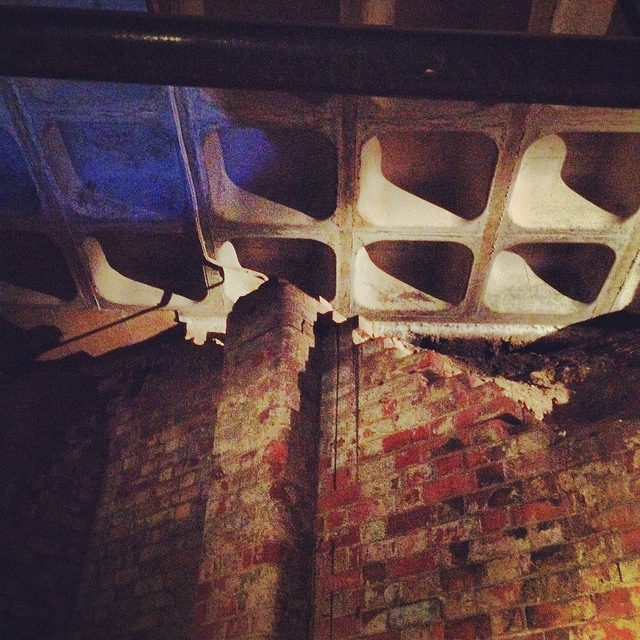
[Images: Cave spaces beneath the Superstudio-like concrete grid of Nottingham’s Broad Marsh shopping Mall].

That these caves were preserved at all is testament to the power of local conservationists, as the historically rich and spatially intricate rooms and corridors would have been gutted and erased entirely during post-War reconstruction without their intervention.

As it now stands, the mall is perched above the caves on concrete pillars, with the effect that curious shoppers can wander down into the caves through an entrance that could just as easily lead to a local branch of Accessorize.

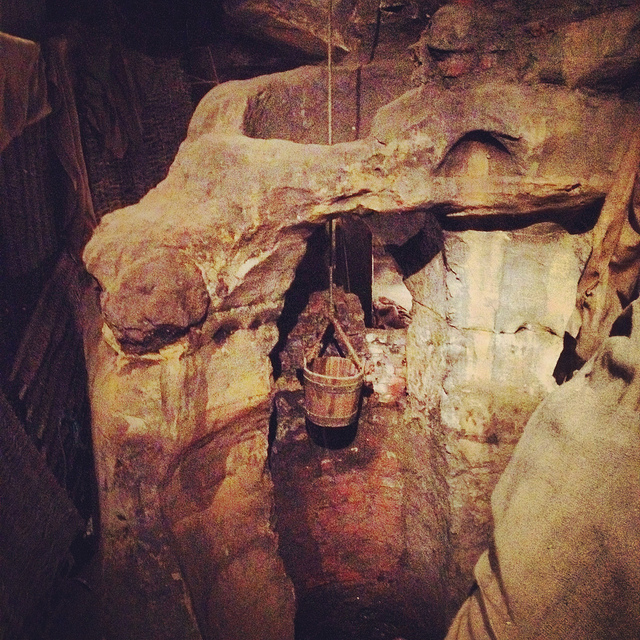
[Image: A well bucket in the caves beneath Broad Marsh; photo by BLDGBLOG].

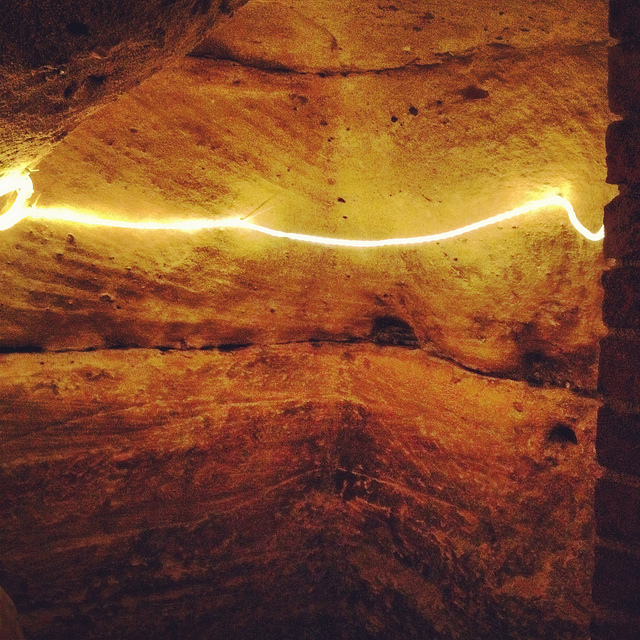
Again, we were fortunate to be taken down into some off-limits areas, stepping over lights and electric wires and peering ahead into larger rooms not on the tourist route.

[Images: Lines of lights we switched on in one of the off-limits rooms below Broad Marsh; photo by BLDGBLOG].

This included stepping outside at one point to wander through an overgrown alleyway behind the mall. Small openings even back here stretched beneath and seemingly into the backs of shops; one doorway, a short scramble up a hill of weed-covered rubble, appeared to contain a half-collapsed spiral staircase installed inside a brick-lined sandstone opening.

[Image: A doorway to voids behind Broad Marsh Centre; photo by BLDGBLOG].

At this point, we began to joke about the ease with which it seemed you could plan a sort of speleological super-heist, breaking into shops from below, as an entire dimension of the city seemed to lie unwatched and unprotected.

Nottingham, it appeared, is a city of nothing but doors and openings, holes, pores, and connections, complexly layered knots of space coiling beneath one building after another, sometimes cutting all the way down to the water table.

Incredibly, the day only continued to build in interest, reaching near-impossible urban sights, from catacombs in the local graveyard to a mind-bending sand mine that whirled and looped around like smoke rings beneath an otherwise quiet residential neighborhood.

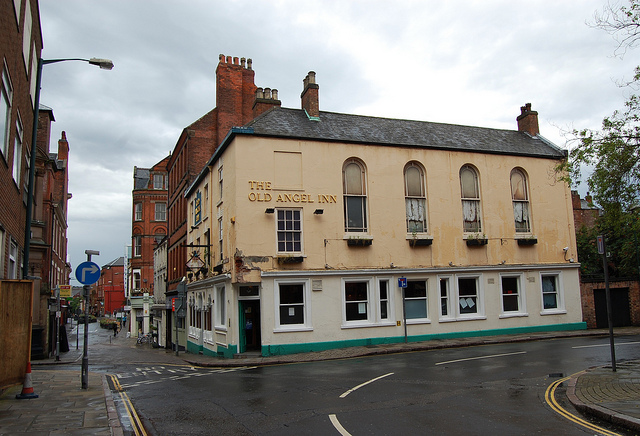
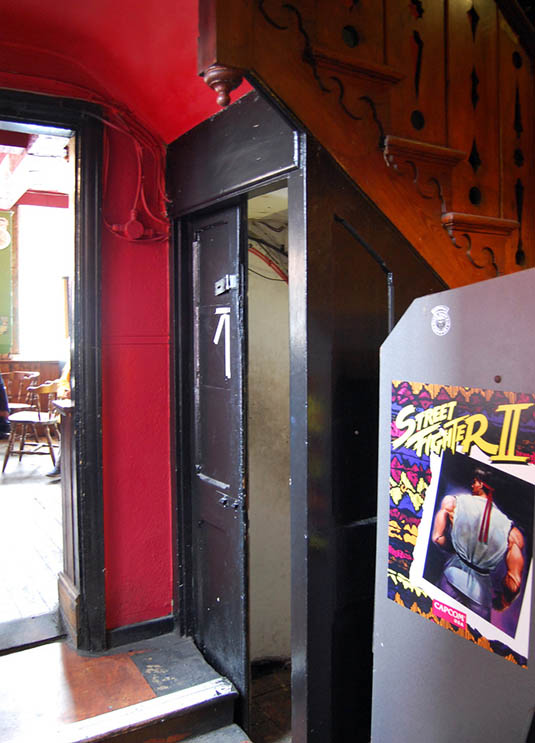
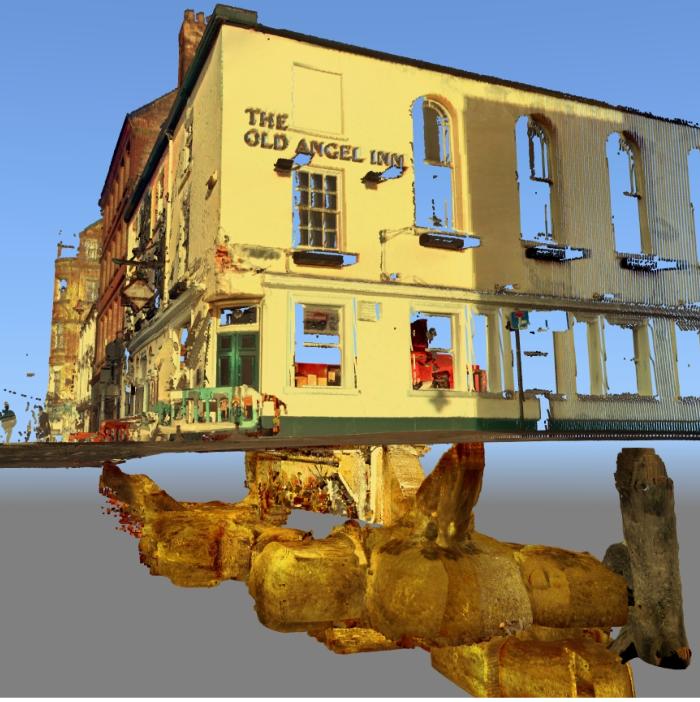
Leaving the mall behind, and maintaining a brisk pace, David took us further into the city, where our next stop was the Old Angel Inn, another pub with an extensive cellar of caves, in this case accessed through a deceptively workaday door next to an arcade game.

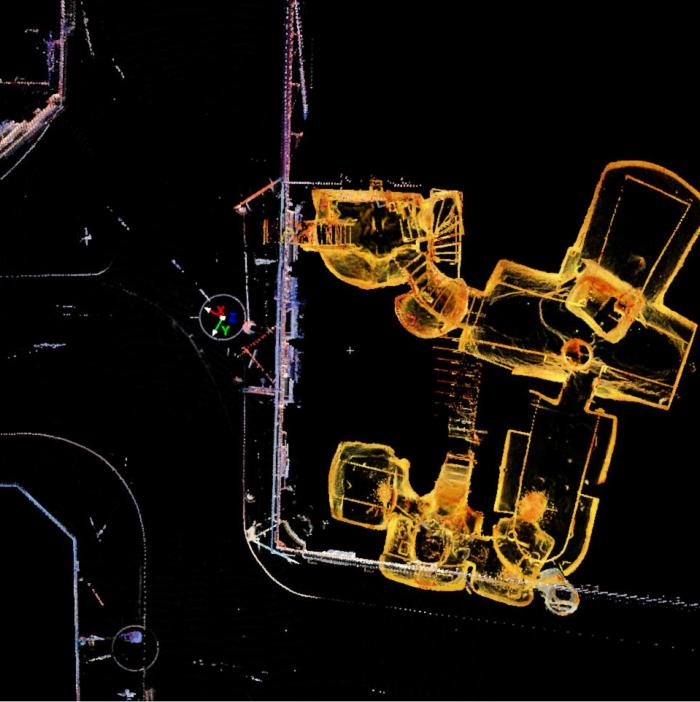
[Images: The Old Angel Inn (top), including the door inside the pub that leads down to the caves below; photos by Nicola Twilley].

Once again, it can hardly be exaggerated how easy it would be to visit or even live in Nottingham and have absolutely no idea that underground spaces such as this can be found almost anywhere. As Tony Waltham points out, “It would be a fair assumption that every building or site within the old city limits either has or had some form of cave beneath it. About 500 caves are now known, and this may be only half the total number that have been excavated under Nottingham.”

[Images: The caves of the Old Angel Inn, courtesy of the Nottingham Caves Survey].

In any case, “Although the Old Angel is a ‘modern’ brick building,” as the Nottingham Caves Survey describes the pub on its website, “an investigation of the caves below reveals stone walls belonging to an earlier incarnation. It is likely that there were buildings on this site as far back as the Anglo-Saxon period. Whether the caves beneath are also this old cannot be demonstrated definitively.”

Typical, as well, for these types of pub caves, we found ventilation and delivery tunnels leading back up to the surface, and the walls themselves are lined with long benches, perfect for sitting below ground and, provided you have candles or a flashlight along with you, enjoying a smoke and a pint of beer. As Tony Waltham explains, pub cellars often include “perimeter thralls,” or “low ledges cut in the rock,” normally used for storing kegs and barrels of beer but quite easily repurposed for a quick sit-down.

But I sense I’m going on way too long about all this, especially because the two most memorable details of the entire day were yet to come.

Jumping forward a bit, we left the Old Angel and followed some twists and turns in the street to find ourselves standing outside a nightclub called Propaganda.

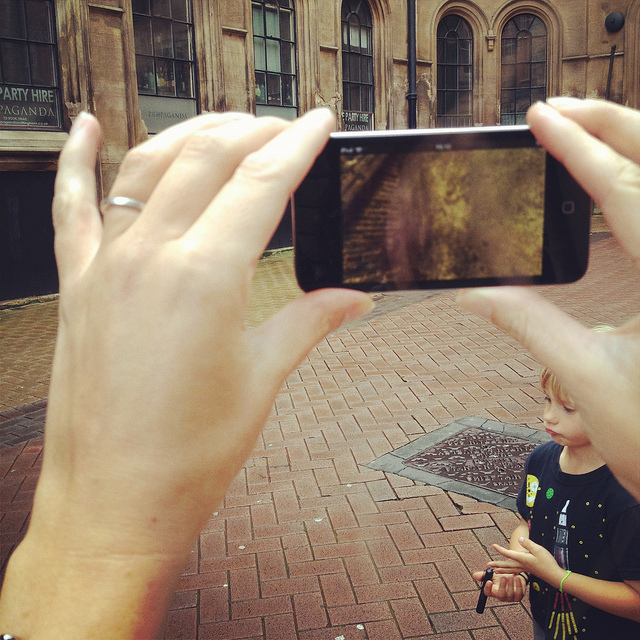
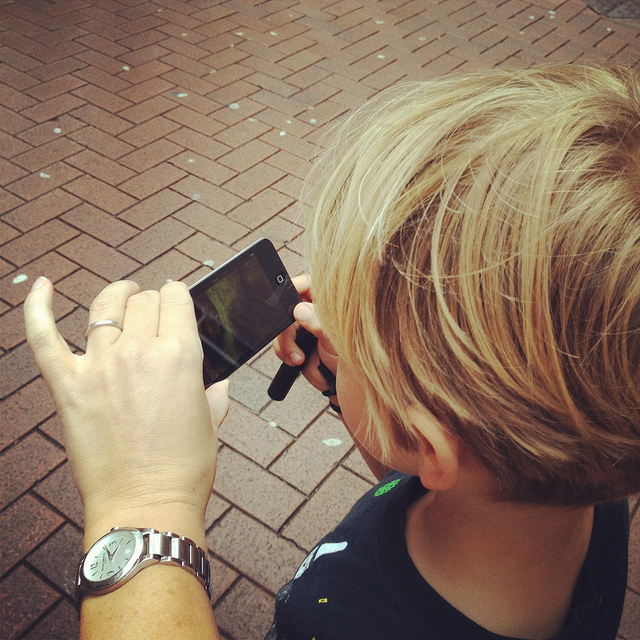
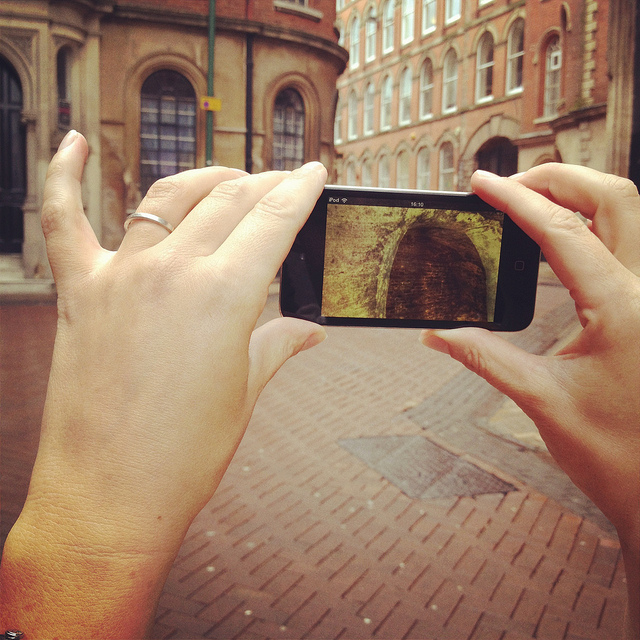
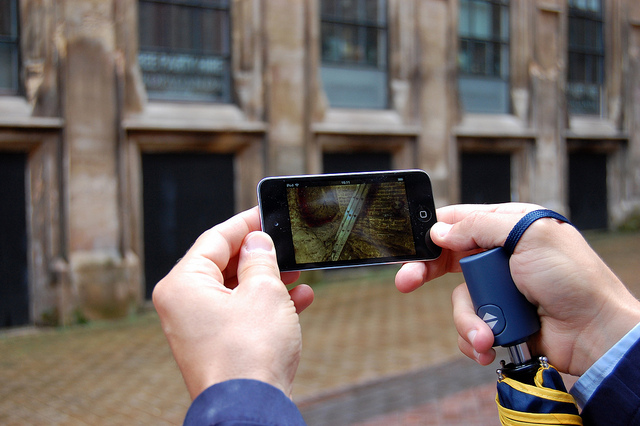
Here, David revealed that he has been working on what, in my opinion, will easily be one of the must-have apps of the year. In a nutshell, David has managed to make the subterranean 3D laser-scans of the Nottingham Caves Survey accessible by location, such that, holding up his iPod Touch, he demonstrated that you could, in effect, scan the courtyard we were standing in to see the caves, tunnels, stairways, cellars, vents, storage rooms, and more that lay hidden in the ground around us.

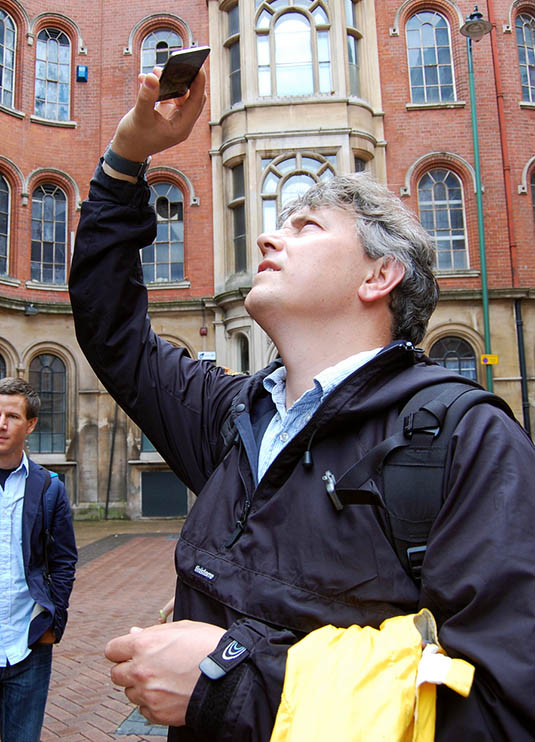
[Images: We test-drive the cave-spotting app; bottom photo by Nicola Twilley].

Ideally, once the Survey’s extensive catalog of 3D visualizations and laser point-clouds has been made available and the app is ready for public download, you will be able to walk through the city of Nottingham, smartphone in hand, revealing in all of their serpentine complexity the underground spaces of the city core.

For anyone who has ever dreamt of putting on x-ray glasses and using them to explore architectural space, this app promises to be a thrilling and vertiginous way to experience exactly that—peering right through the city to see its most ancient foundations.


[Video: A fly-through of the Propaganda Nightclub malting caves].

I, for one, can’t wait to see what David and the Nottingham Caves Survey do with the finished application and I eagerly await its public availability.

[Image: Mark Smout looks for caves in the sky; photo by Nicola Twilley].

I’ll wind up this already quite long post with just a few more highlights.

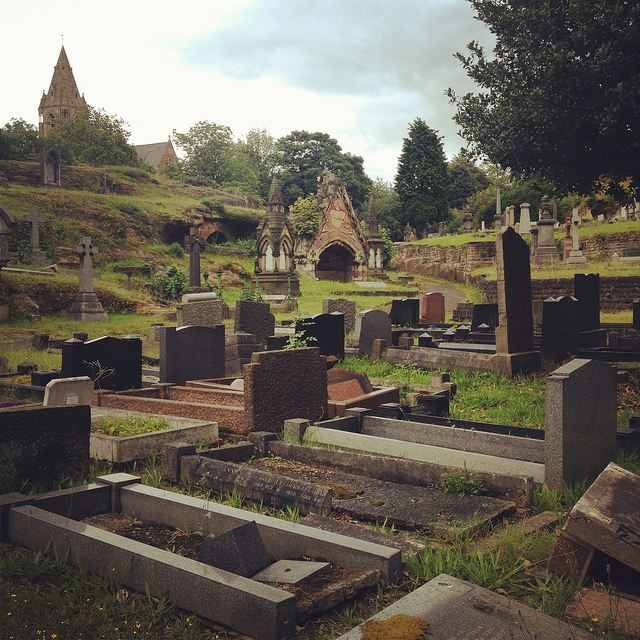
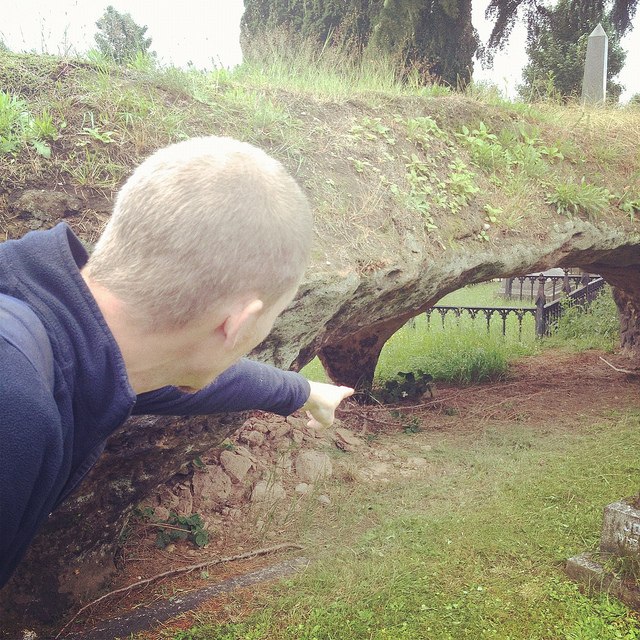
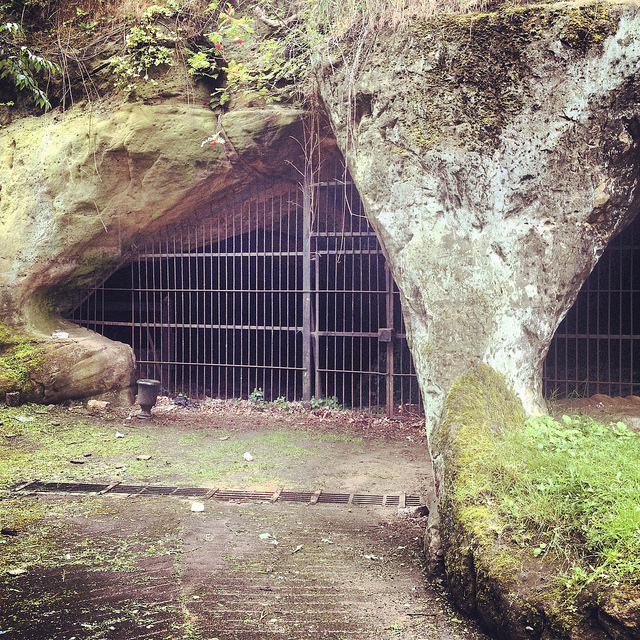
Nottingham’s Rock Cemetery, north from the center of town along the Mansfield Road, contains, among other things, the collapsed remains of a sand mine. Three of the mine’s old entrances are now gated alcoves surrounded by graves, like something out of Dante. They “are the only surviving remnants of the mine,” Waltham writes in his pamphlet.

[Images: Nottingham’s Rock Cemetery, where archaeologist David Strange-Walker explained the history of the local landscape].

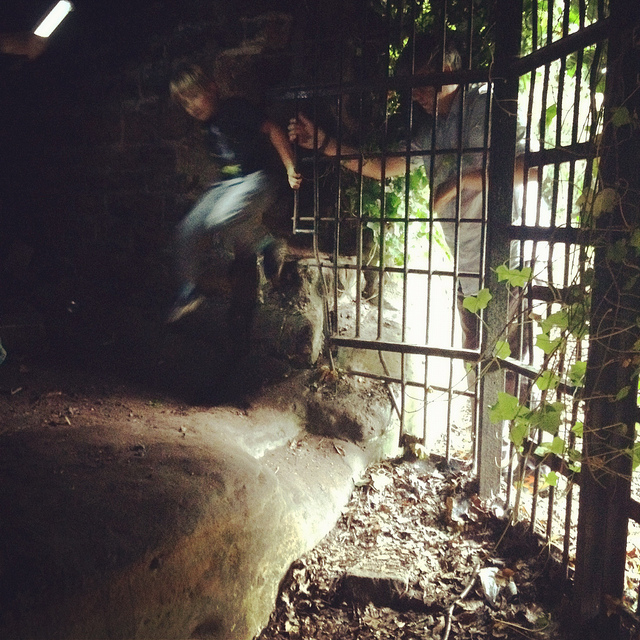
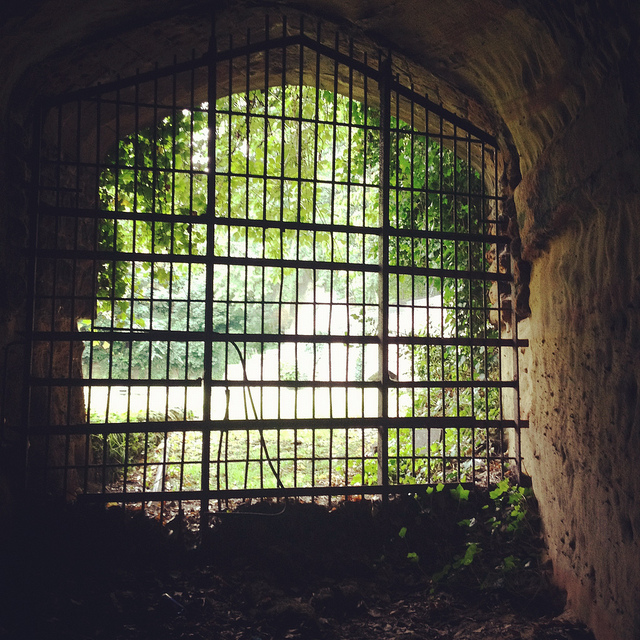
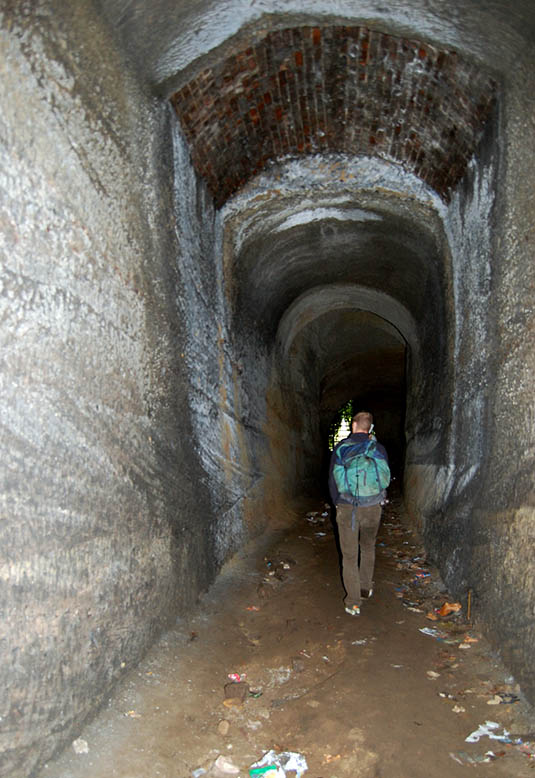
However, an ambitious plan to carve sizable catacombs, inspired by Paris and Rome, through the sandstone beds of the ancient desert here resulted in the never-completed Catacomb Caves, “probably done in 1859-63,” Waltham suggests. These long arched tunnels, accessible through one of the gates described above, eventually lead to a radial terminus from which branch the unused proto-catacombs.

The air there is cloudy with sand—leading me, several days later, to experience a brief attack of hypochondria, worried about developing silicosis—the walls are graffiti’d, and years of trash are piled on the sides of the sandy floor (which has since taken on the characteristics of a dune sea in places, as 150 years of footfall and a collapsing ceiling have led to the appearance of drifts).

[Images: The Rock Cemetery catacomb gates].

What was so extraordinary here, among many other things, was that, for most of this walk through the catacombs, we were actually walking below the graves, meaning that people were buried above us in the earth. At the risk of overdoing it, this felt not unlike becoming aware of an altogether different type of constellation, with bodies and all the stories their lives could tell held above us in a terrestrial sky like legends and heroes, like Orion and Cassiopeia, as we looked up at the vaulted ceiling, flashlights in hand.

[Image: Inside the catacombs; photo by Nicola Twilley].

But the best site of all was next.

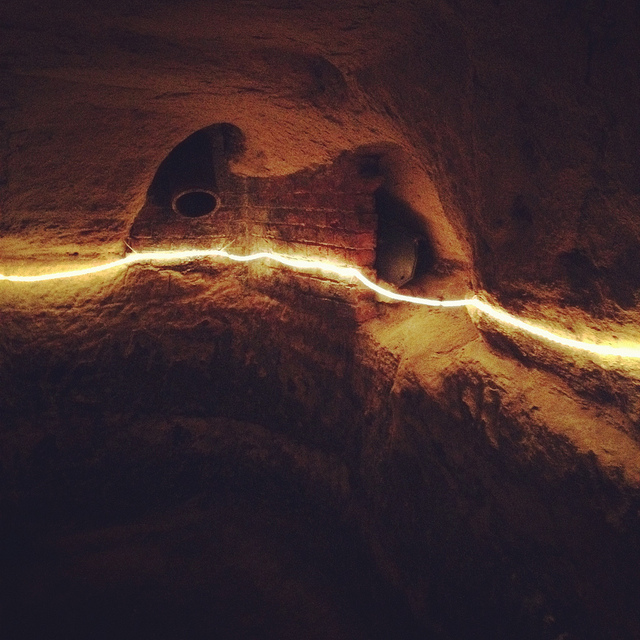
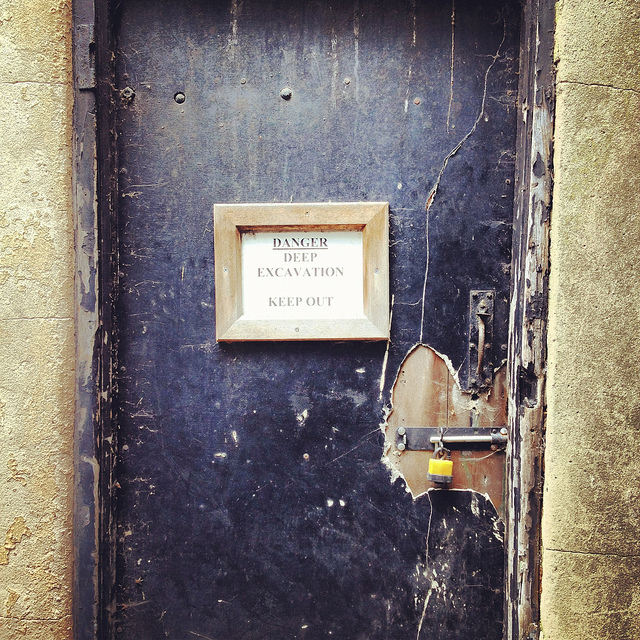
[Image: A door on the street—the black door with bars—leading down into a sand mine; photo by BLDGBLOG].

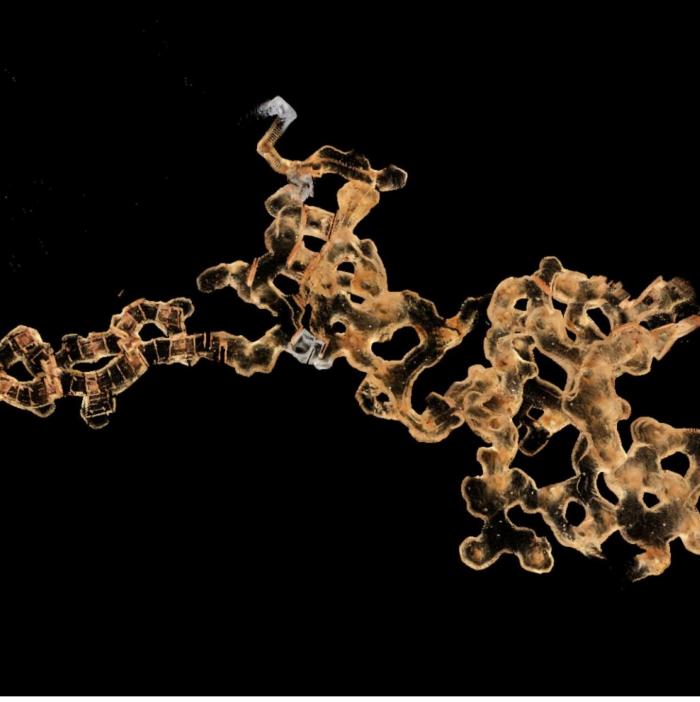
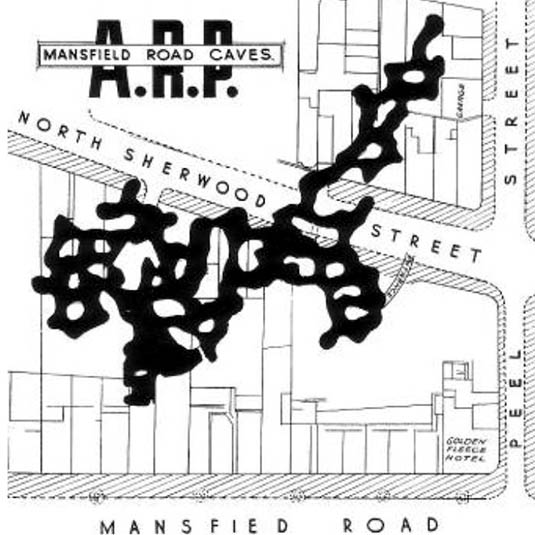
Serving as something of the ultimate proof that Nottingham is a city of overlooked doors that lead into the underworld, there were two locked doors—one of which (the black door, near the sidewalk) appears in the photo, above, another of which, on a street nearby, leads down into the Peel Street Caves—simply sitting there on the sidewalk that, if opened, will take you down into extensive and now defunct sand mines. David’s laser-scans of these for the Nottingham Caves Survey are absolutely gorgeous, as you can see, below.

[Image: The Peel Street Caves sand mine, courtesy of the Nottingham Caves Survey].

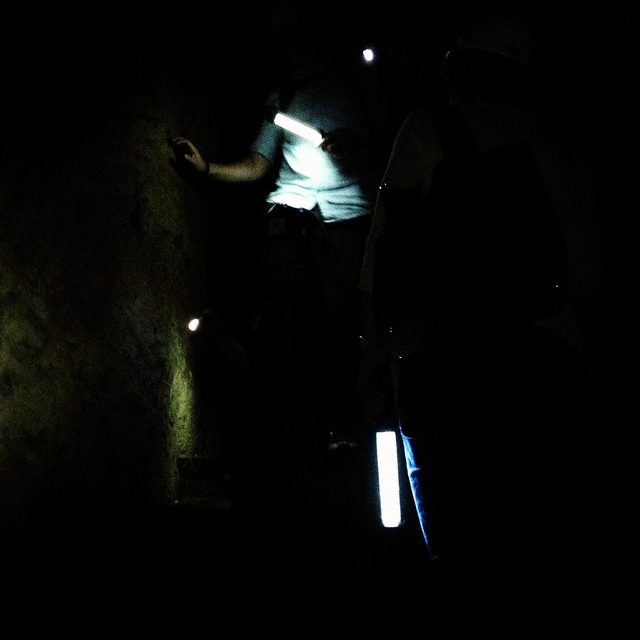
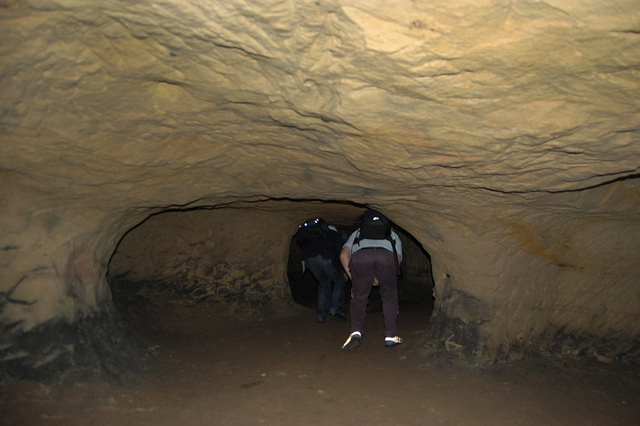
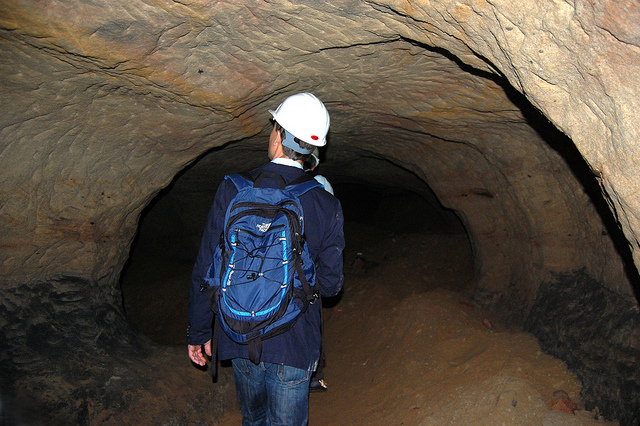
For a variety of reasons, I am going to avoid being too specific about some of the details here, but, aside from that, I can only enthuse about the experience of donning our hard hats and heading down several flights of comparatively new concrete steps into a coiling and vast artificial cavern from the 19th century, one we spent nearly an hour exploring.

[Image: Nicola Twilley and Mark Smout head down into the sand mine; photo by BLDGBLOG].

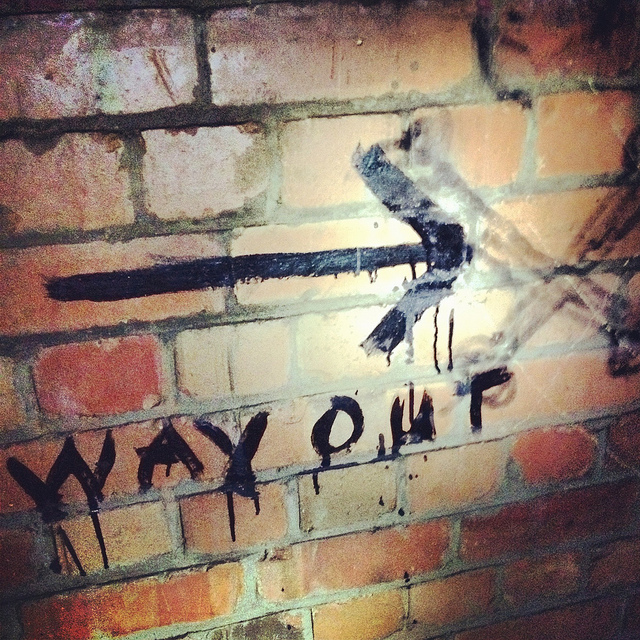
Getting lost down there would be so absurdly easy that it is frightening even to contemplate, and, in case the group of us somehow got split up or our batteries ran out of juice, we joked about—if only we could remember them—the easy techniques for navigating a labyrinth offered in Umberto Eco’s novel The Name of the Rose.

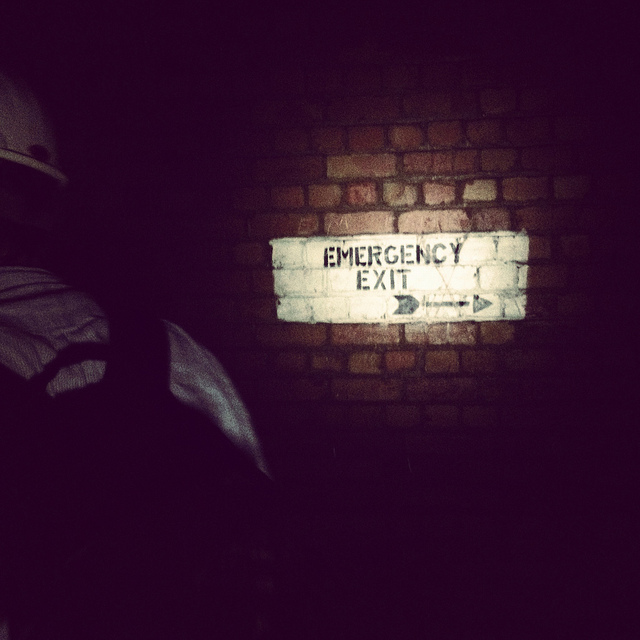
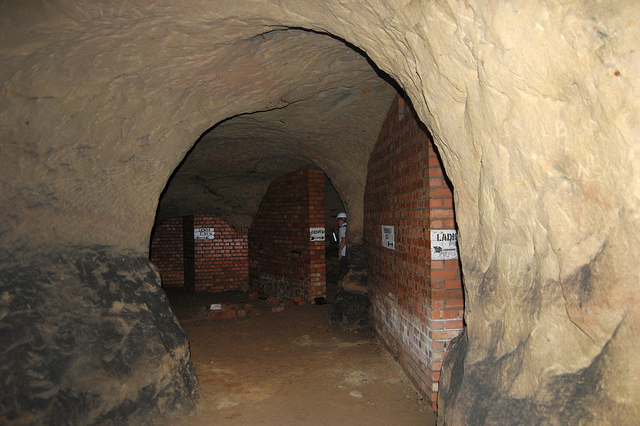
[Image: Many of these way-finding signs are actually incorrect, David explained, and seem to have been painted as a kind of sick joke by someone several years ago; photos by BLDGBLOG].

Avoiding such a fate, however, we found graffiti and men’s and women’s latrines; we popped our heads through holes allowing glimpse of other levels; and we cracked our helmets loudly against the low and rough roof more times than I could count.

[Images: Inside the sand mine; all photos by Nicola Twilley].

And even that doesn’t complete the day. From here, heading back out onto the street through a nondescript steel door, as if we had been doing nothing more than watching football in someone’s basement, we went on to eat pie and chips in a restaurant built partially into a cave; we walked back across town, returning to where we started, talking about the future and seemingly obvious possibility of Nottingham’s caves being declared a UNESCO World Heritage Site and thus saved from their all but inevitable destruction (it’s easy to imagine a future in which a tour like the one David gave us will be impossible for lack of caves to see); and we all said goodbye beneath an evening sky cleared of clouds as a late-day breeze began to cut through town.

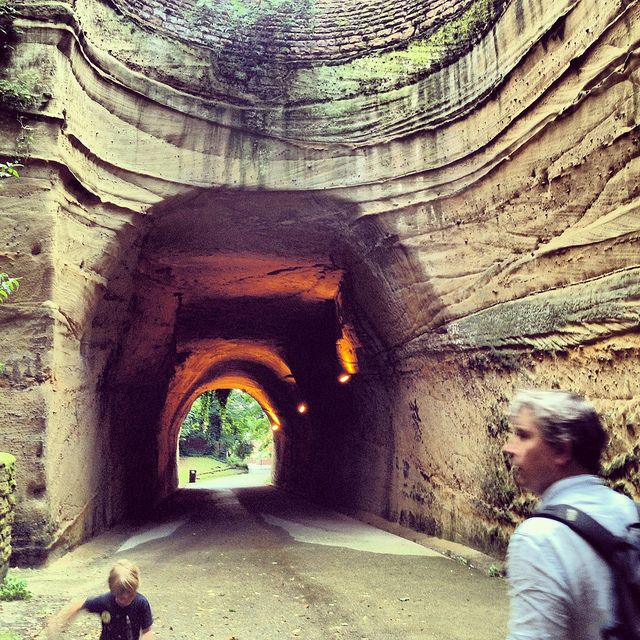
[Image: Mark & Ellis Smout explore our final “underground” space of the day, the magnificent Park Tunnel; the banded strata clearly visible in the walls show how the tunnel was carved through the dunes of an ancient desert. Photo by BLDGBLOG].

David proved to be a heroic guide that day. His energy never flagged throughout the tour, and he never once appeared impatient with or exhausted by any of our often ridiculous questions—not to mention our tourists’ insistence on pausing every three or four steps to take photographs—and he remained always willing to stay underground far longer than he had originally planned, all this despite having never met any of us before in person and only communicating with me briefly via a flurry of emails the week before.

Meeting David left me far more convinced than I already was that the Nottingham Caves Survey fully deserves the financial support of individuals and institutions, so that it can complete its ambitious and historically valuable work of cataloging Nottingham’s underground spaces and making that knowledge freely accessible to the general public.

Weirdly, England has within its very heart a region deserving comparison to Turkish Cappadocia—yet very few people even seem to know that this subterranean world exists. There very well could be more than 1,000 artificial caves beneath the city, many of them fantastically elaborate, complete with fine carvings of lions and ornate stairwells, and it is actually somewhat disconcerting to think that people remain so globally unaware of Nottingham’s underground heritage.

With any luck, the work of David Strange-Walker, Trent & Peak Archaeology, and the Nottingham Caves Survey will help bring this extraordinary region of the earth the attention—and, importantly, the focused conservation—it is due.

(For further reading, don’t miss Nicola Twilley’s write-up of the tour on her own blog, Edible Geography; and Tony Waltham’s Sandstone Caves of Nottingham, cited extensively in this post, is worth a read if you can find a copy).

British Exploratory Land Archive

Speaking of the 2012 Venice Architecture Biennale, I’m thrilled to be an exhibitor this year in the UK pavilion, as part of a collaborative project undertaken with Mark Smout and Laura Allen of Smout Allen.

[Image: The British Exploratory Land Archive’s “capture blanket” in use on Hampstead Heath, London; photo by Mark Smout].

Smout Allen are the authors of Augmented Landscapes, easily one of my favorite installments in the Pamphlet Architecture series, as well as long-time instructors at the Bartlett School of Architecture—in fact, many of their students’ projects have been featured here on the blog over the last half-decade—and working with Mark and Laura on a project such as this has been fantastic.

Specifically, as part of the “Venice Takeaway” project curated by Vicky Richardson and Vanessa Norwood, Smout Allen and I have proposed what we call the British Exploratory Land Archive (or BELA).

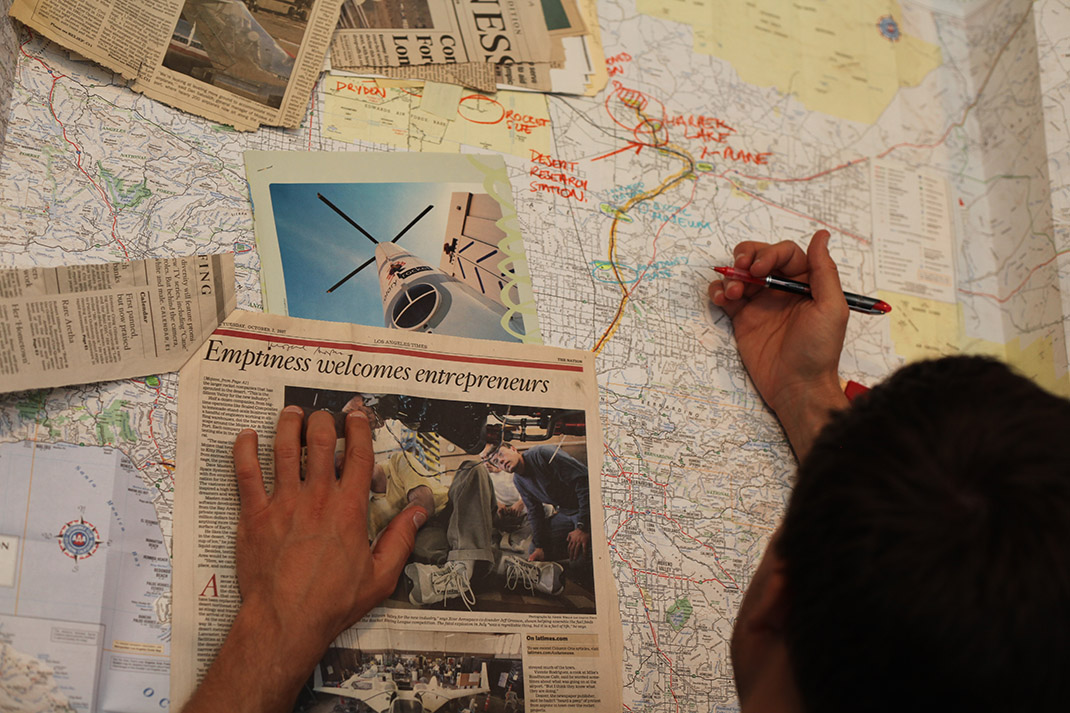
The British Exploratory Land Archive is, in essence, a British version of the Center for Land Use Interpretation, albeit one defined as much by the use of unique instruments designed specifically for BELA as by its focus on sites of human land-use in the United Kingdom as by.

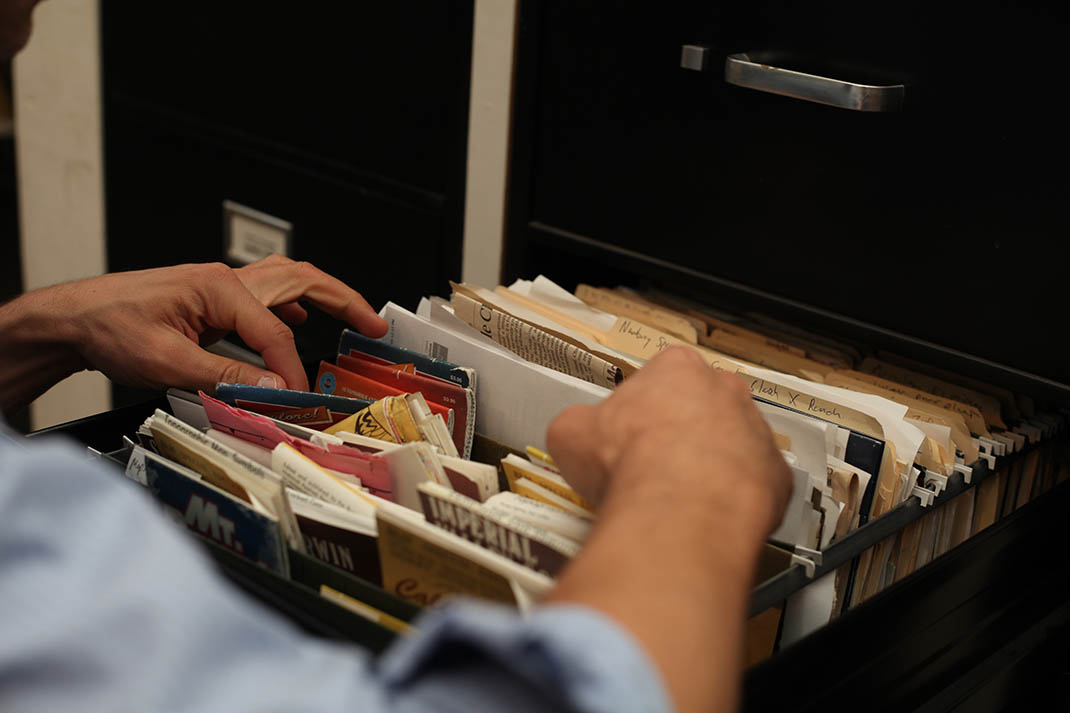
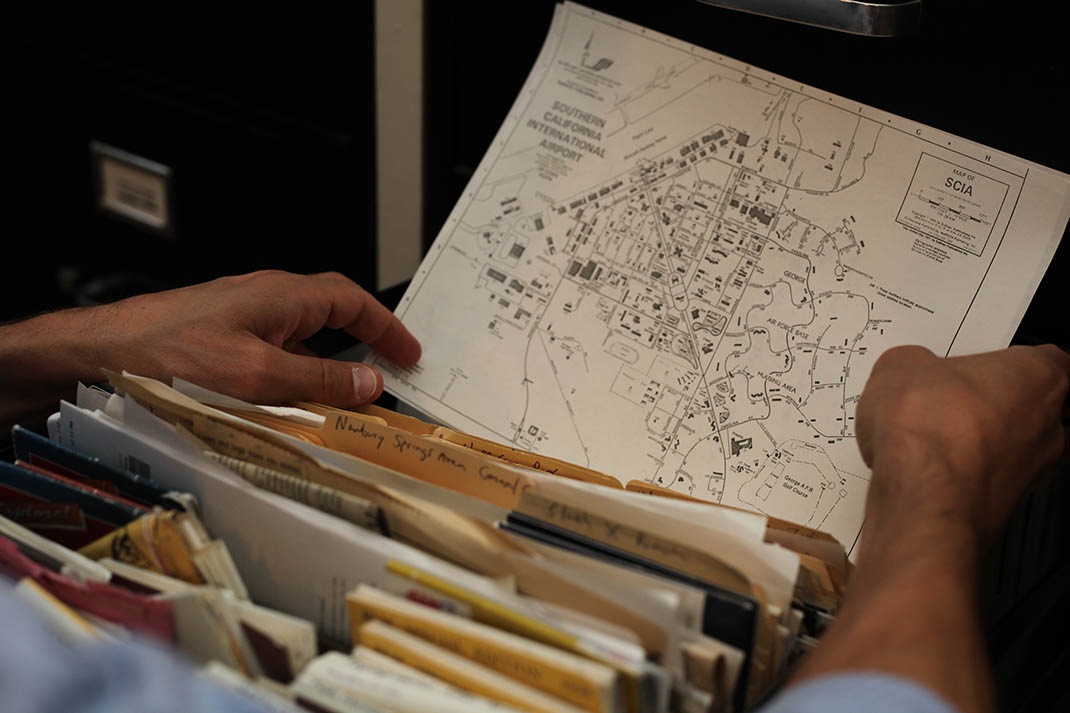
[Images: Going through the archives, maps, and files of the Center for Land Use Interpretation, including one of my favorite headlines of all time: “Emptiness welcomes entrepreneurs”; photos by Mark Smout].

In an essay for the Venice Takeaway book, we describe the inspiration, purpose, and future goals of the—still entirely hypothetical—British Exploratory Land Archive:

BELA is directly inspired by the Los Angeles-based Center for Land Use Interpretation (CLUI). It aims to unite the efforts of several existing bodies—English Heritage, Subterranea Britannica, the Airfields of Britain Conservation Trust and even the Department for Transport, among dozens of others—in a project of national landscape taxonomy that will combine catalogues created by distinct organisations into one omnivorous, searchable archive of human-altered landscapes in Britain… From military bases to abandoned factories, from bonded warehouses to national parks, by way of private gardens, council estates, scientific laboratories and large-scale pieces of urban infrastructure, BELA’s listings are intended to serve as something of an ultimate guide to both familiar and esoteric sites of human land use throughout the United Kingdom.

In the end, a fully functioning BELA would offer architects, designers, historians, academics, enthusiasts, and members of the general public a comprehensive list of UK sites that have been used, built, unbuilt, altered, augmented and otherwise transformed by human beings, aiming to reveal what we might call the spatial footprint of human civilization in the British Isles.

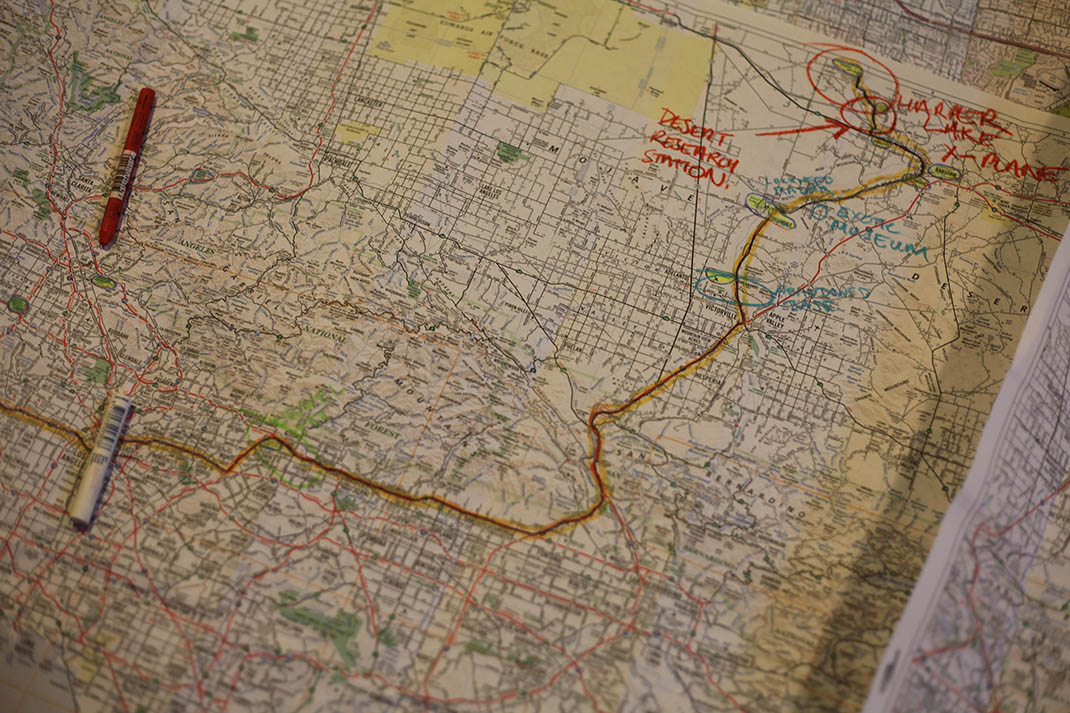
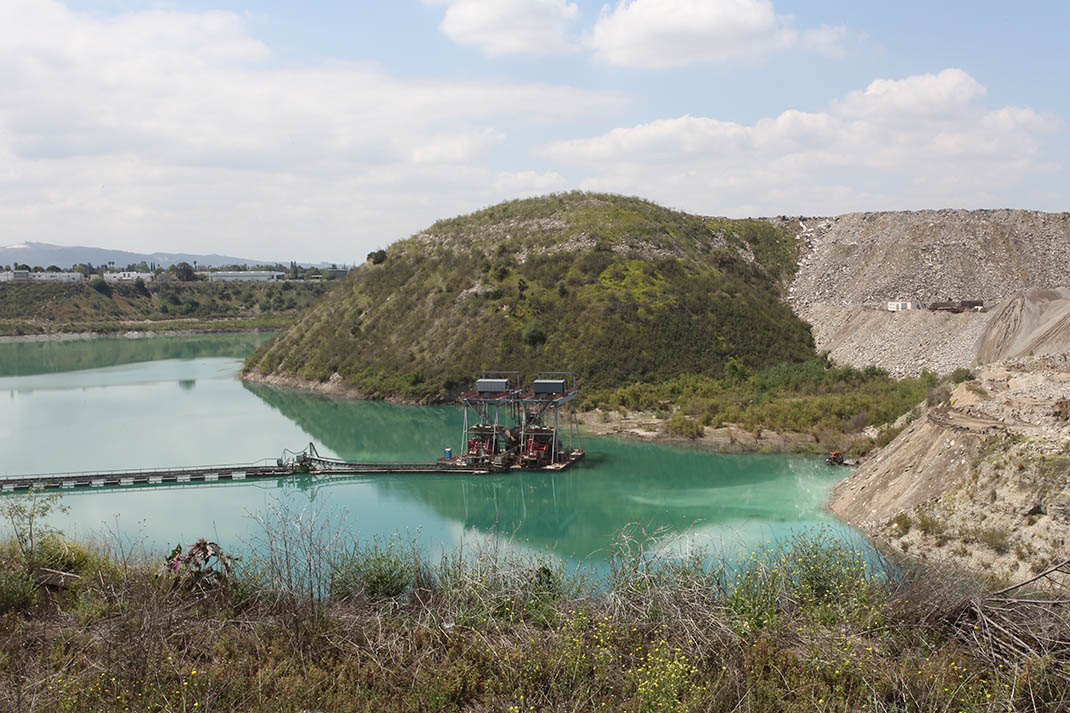
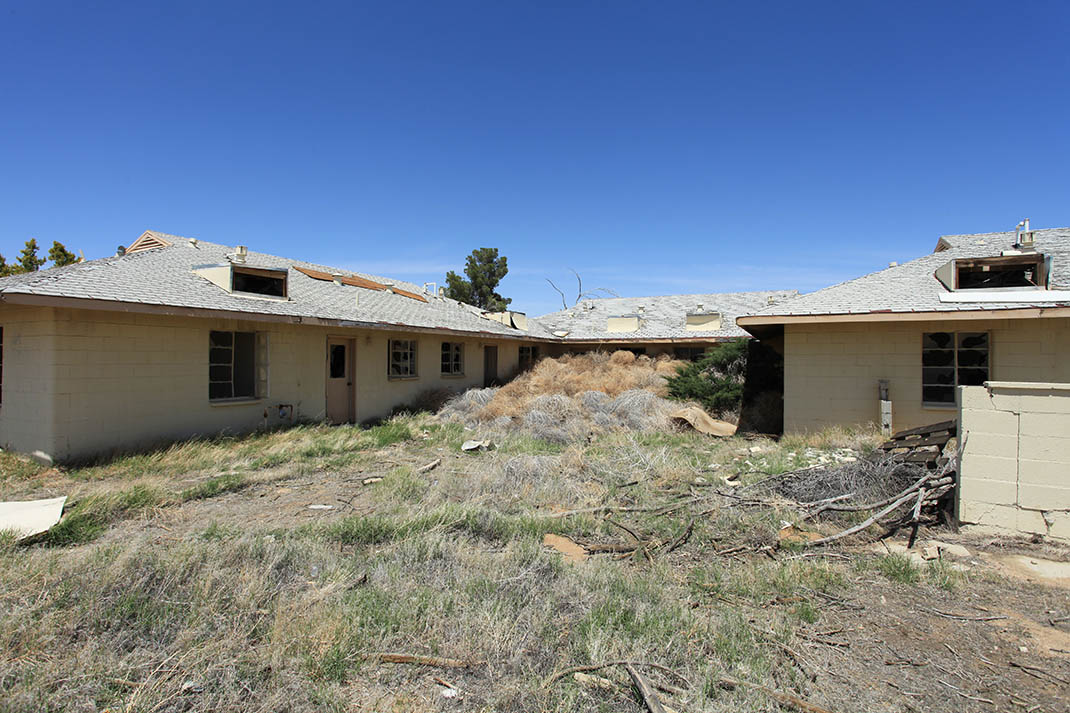
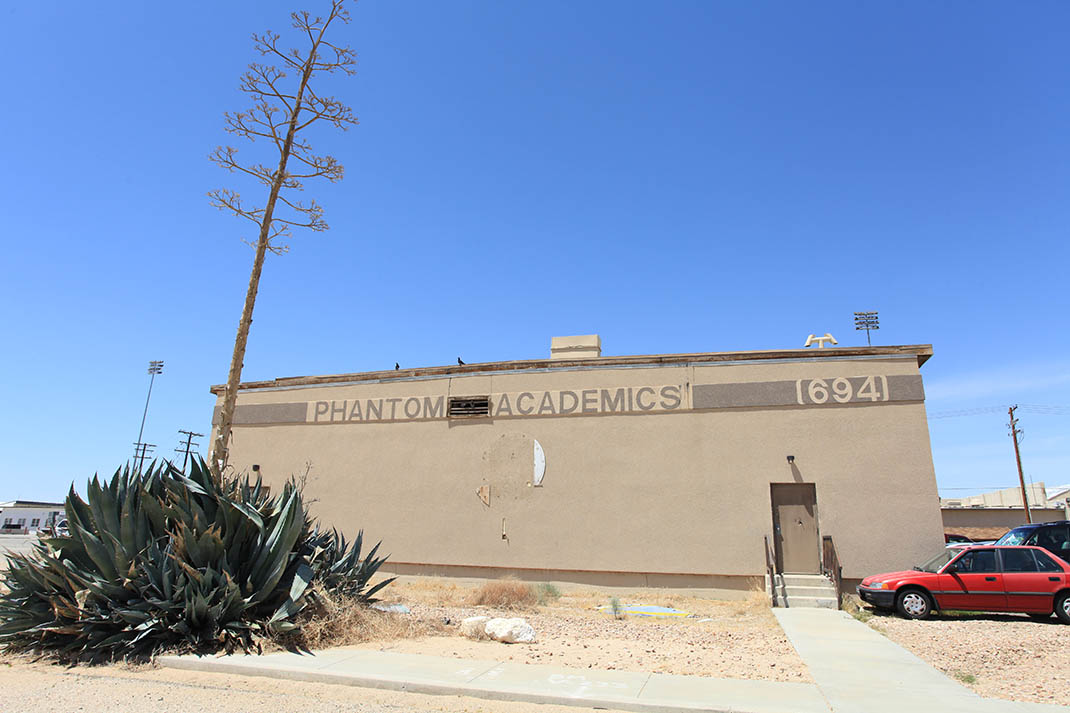
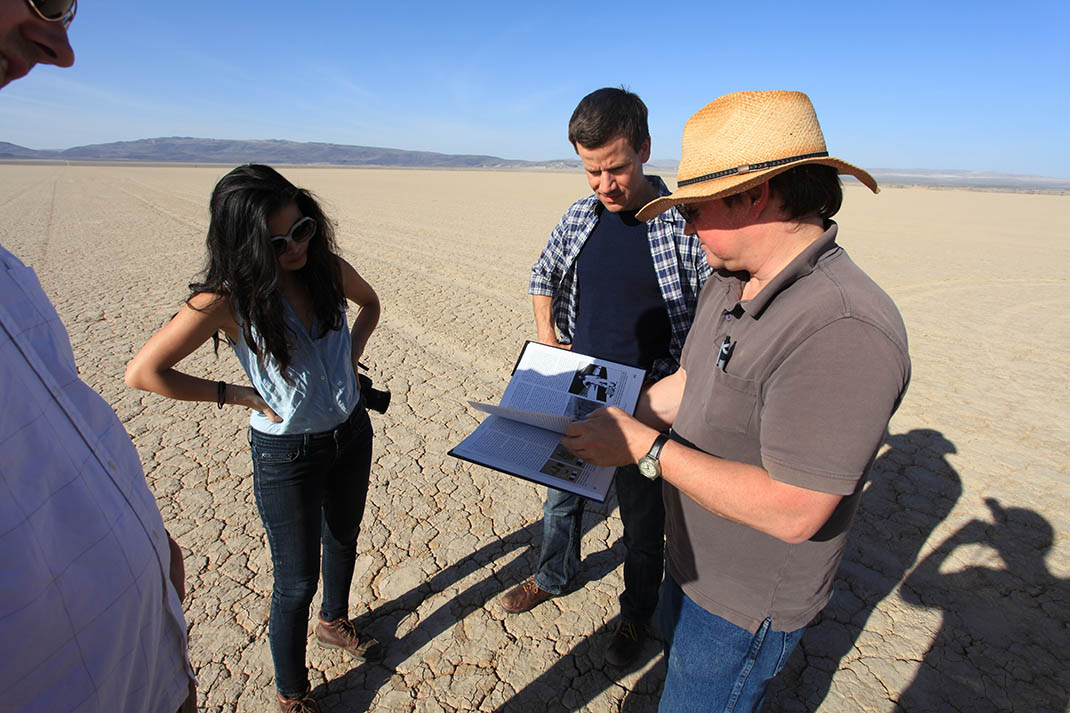
Thanks to the generosity of the Venice Takeaway organizers, with funding from the British Council, Mark Smout and I had the pleasure of traveling to Los Angeles back in April 2012 specifically to meet with Matthew Coolidge, Sarah Simons, Ben Loescher, and Aurora Tang at the Center for Land Use Interpretation. Even better, we were able to take Matt, Ben, and Aurora out on a daylong road-trip through gravel pits, dry lake beds, Cold War radar-testing facilities, airplane crash sites, logistics airfields, rail yards, abandoned military base housing complexes, and much more orbiting the endlessly interesting universe of Greater Los Angeles.

[Images: Exploring Greater Los Angeles with Matthew Coolidge, Ben Loescher, and Aurora Tang; photos by Mark Smout].

That trip was documented in a series of photographs, in a (very) short film, and in the essay mentioned above, all of which will be available for perusal at the UK pavilion for the duration of this year’s Biennale.

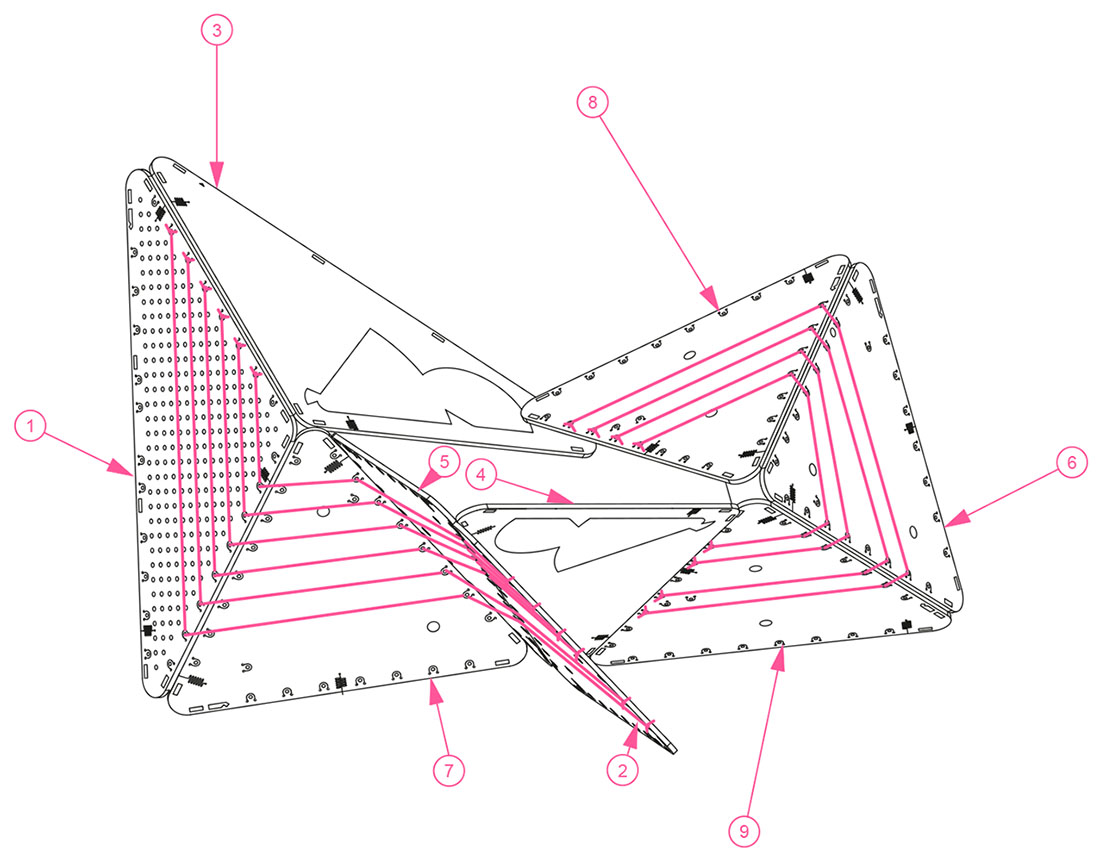
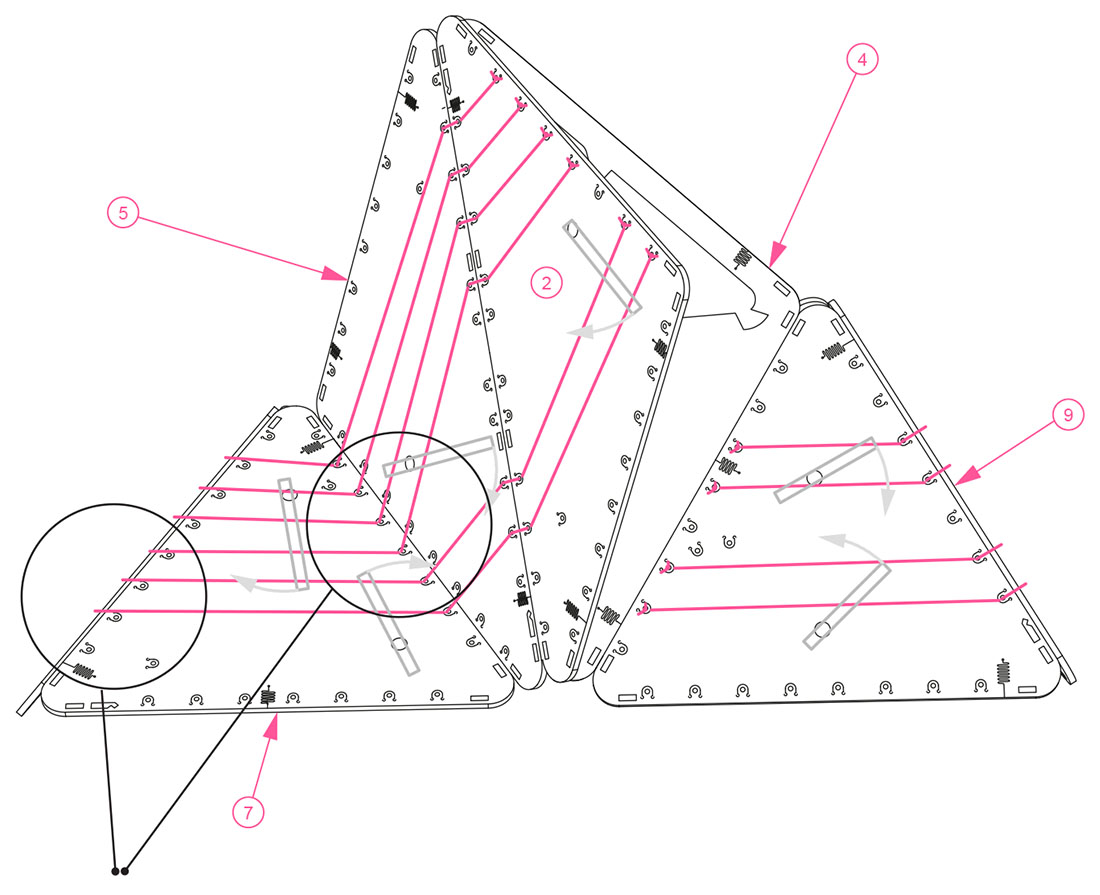
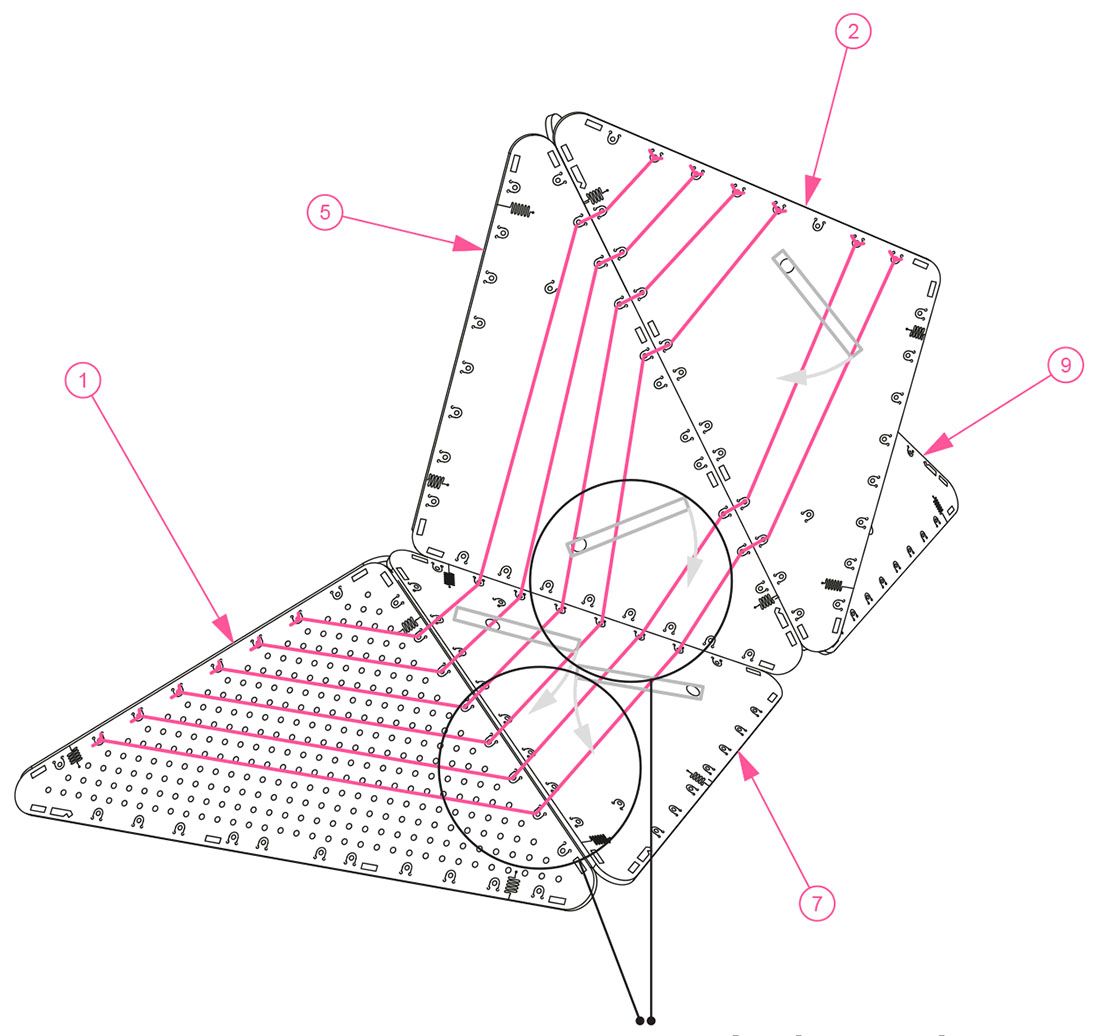
I’ll also include here a few diagrams depicting one the instruments Smout Allen and I devised as part of our land-investigation tools—making BELA a kind of second-cousin to Venue—with the real objects, including a portable explorer’s hut, also on display in Venice.

[Images: Assembly diagrams for the BELA “clinometer,” a speculative device “for the measurement of variable slopes on sites such as scrap yards, landfills, slag heaps and other industrial dumping grounds… functioning as an easily readable survey tool and as a unique design object that calls public attention to the process of measuring artificial landscapes”].

Taken together, these are what we call, in the essay, “prototypical future survey instruments and experimental site-identification beacons.” They are “both semi-scientific and speculative, portable and permanently anchored.”

From telescopes to Geiger counters, from contact microphones to weather satellites, the devices and scales with which we measure and describe the landscapes around us determine, to a large extent, what we are able to see. BELA will thus work to pioneer the design, fabrication and expeditionary deployment of new landscape survey tools—instruments and devices both functional and speculative that will aid in the sensory cataloguing and interpretive analysis of specific locations.

While the British Exploratory Land Archive is, for now, merely a proposition, I think Mark, Laura, and I are all equally keen to see something come of that proposition, perhaps someday even launching BELA as a real, functioning resource through which the various human-altered landscapes of Britain can be catalogued and studied.

For now, those of you able to visit Venice, Italy, before the end of the 2012 Biennale can see our instruments, photos, drawings, and texts as they currently exist, and, in the process, learn more about the possibilities for a British Exploratory Land Archive.

(Thanks to Sandra Youkhana for her invaluable help with the project, and to Matthew Coolidge, Sarah Simons, Ben Loescher, and Aurora Tang at the Center for Land Use Interpretation for hosting us back in April).

War Sand

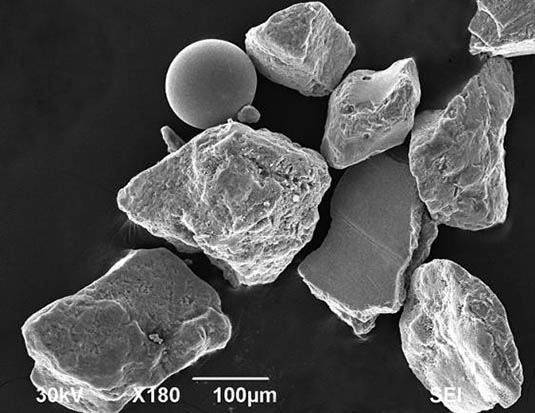
[Image: Geologist Earle McBride’s microscopic images of war sand on the beaches of Normandy].

A short piece in the September/October 2012 issue of Archaeology magazine highlights the presence of spherical magnetic shards—remnants of the D-Day operations of World War II—found hidden amongst natural sand grains on the beaches of Normandy. “Up to 4 percent of the sand is made up of this shrapnel,” the article states; however, “waves, storms, and rust will probably wipe this microscopic archaeology from the coast in another hundred years.”

This is not a new discovery, of course. In Michael Welland’s book Sand, often cited here on BLDGBLOG, we read that, “on Normandy beaches where D-Day landings took place, you will find sand-sized fragments of steel”—an artificial landscape of eroded machines still detectable, albeit with specialty instruments, in the coastal dunes.

I’m reminded of a line from The Earth After Us: What Legacy Will Humans Leave in the Rocks?, a speculative look by geologist Jan Zalasiewicz at the remains of human civilization 100 million years from now. There, we read that “skyscrapers and semi-detached houses alike, roads and railway lines, will be reduced to sand and pebbles, and strewn as glistening and barely recognizable relics along the shoreline of the future.”

The oddly shaped magnetic remains of World War II are thus a good indication of how our cities might appear after humans have long departed.

London Bells / Urban Instruments

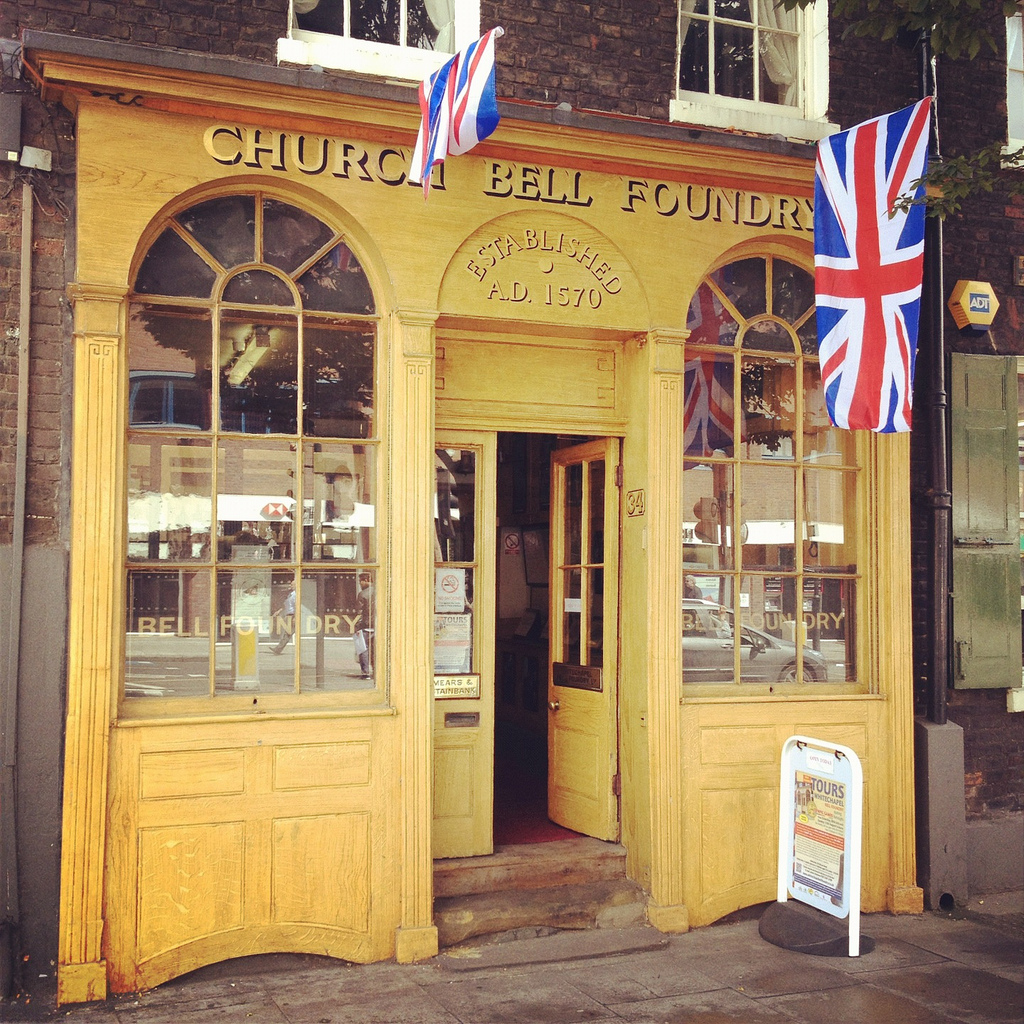
[Image: Outside the Whitechapel Bell Foundry, London; all photos by BLDGBLOG].

Before leaving London last week, I learned that the Whitechapel Bell Foundry was offering walk-in tours for the duration of the Olympics, so Nicola Twilley and I headed out to see—and hear—what was on offer.

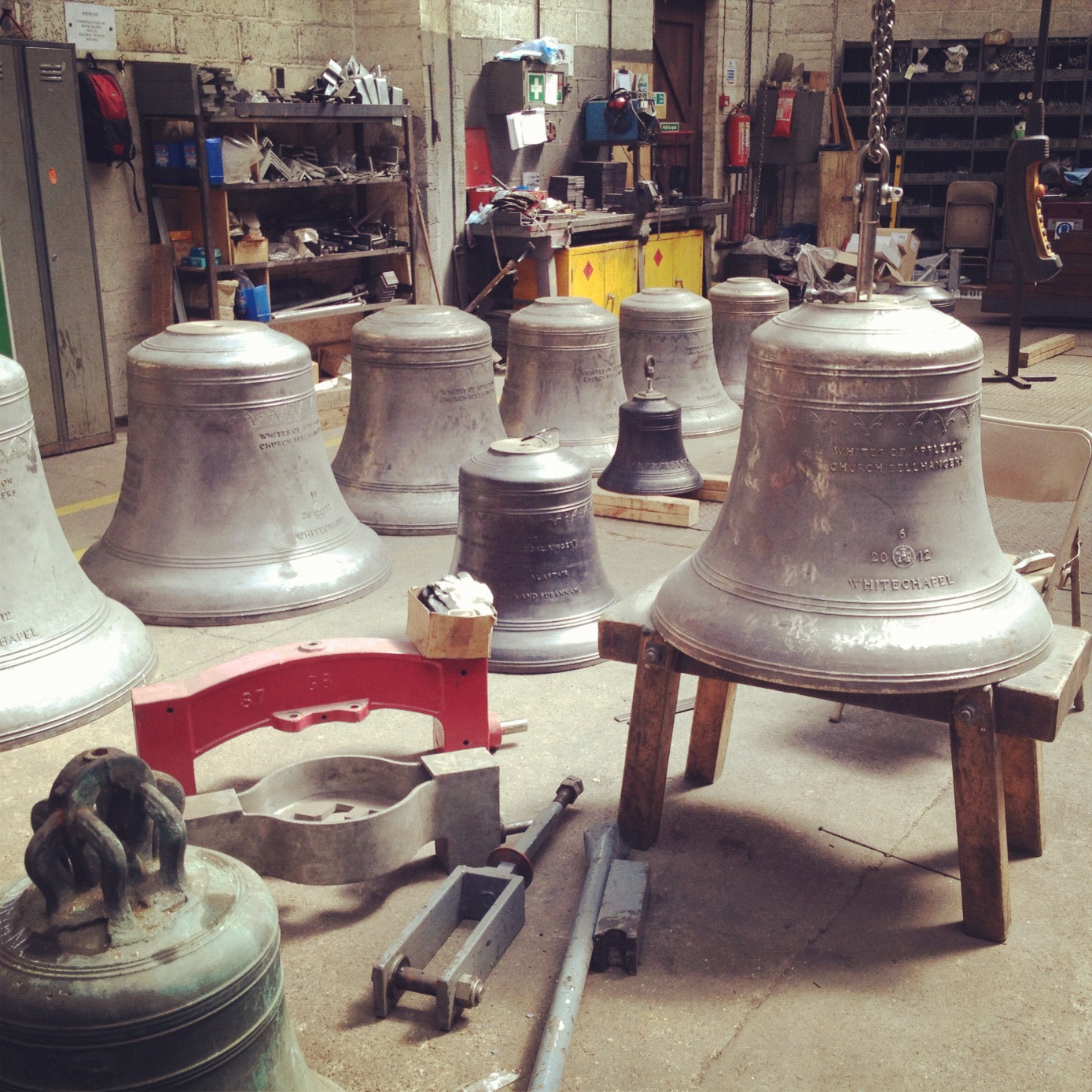
[Image: Inside the Whitechapel Bell Foundry].

I’d say, first off, that the tour is well worth it and that everyone on hand to help us along on the self-guided tour seemed genuinely pleased to have members of the public coming through. Second of all, if you have any interest at all in the relationship between cities and acoustics—say, the influence of bells on neighborhood identity or the subtle differences in city soundscapes based on different profiles moulded into church bells—then it’s a fabulous way to spend the afternoon.

We were there for nearly two hours, but I still felt like we were rushing.

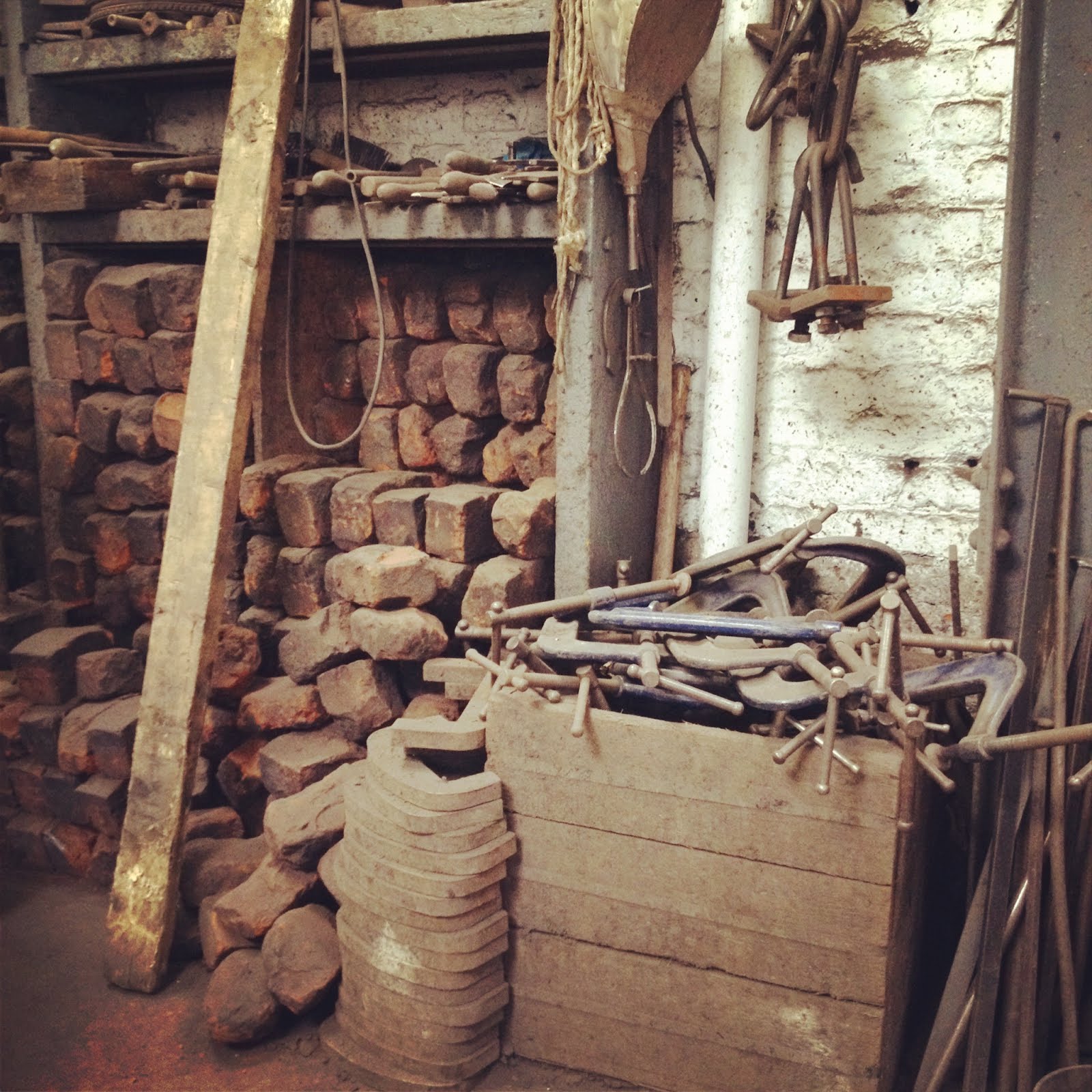
[Image: Bell-making tools at the Whitechapel Bell Foundry].

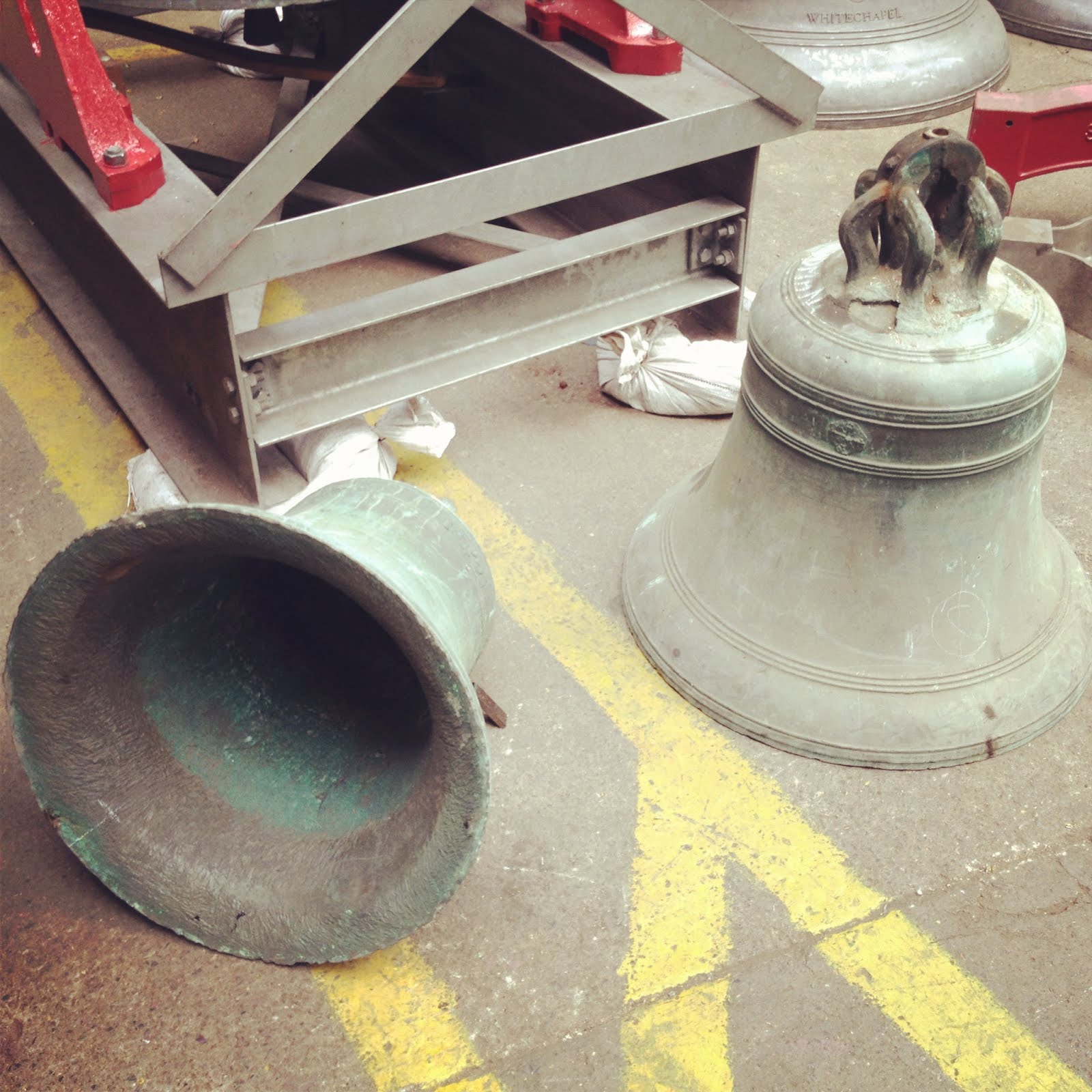
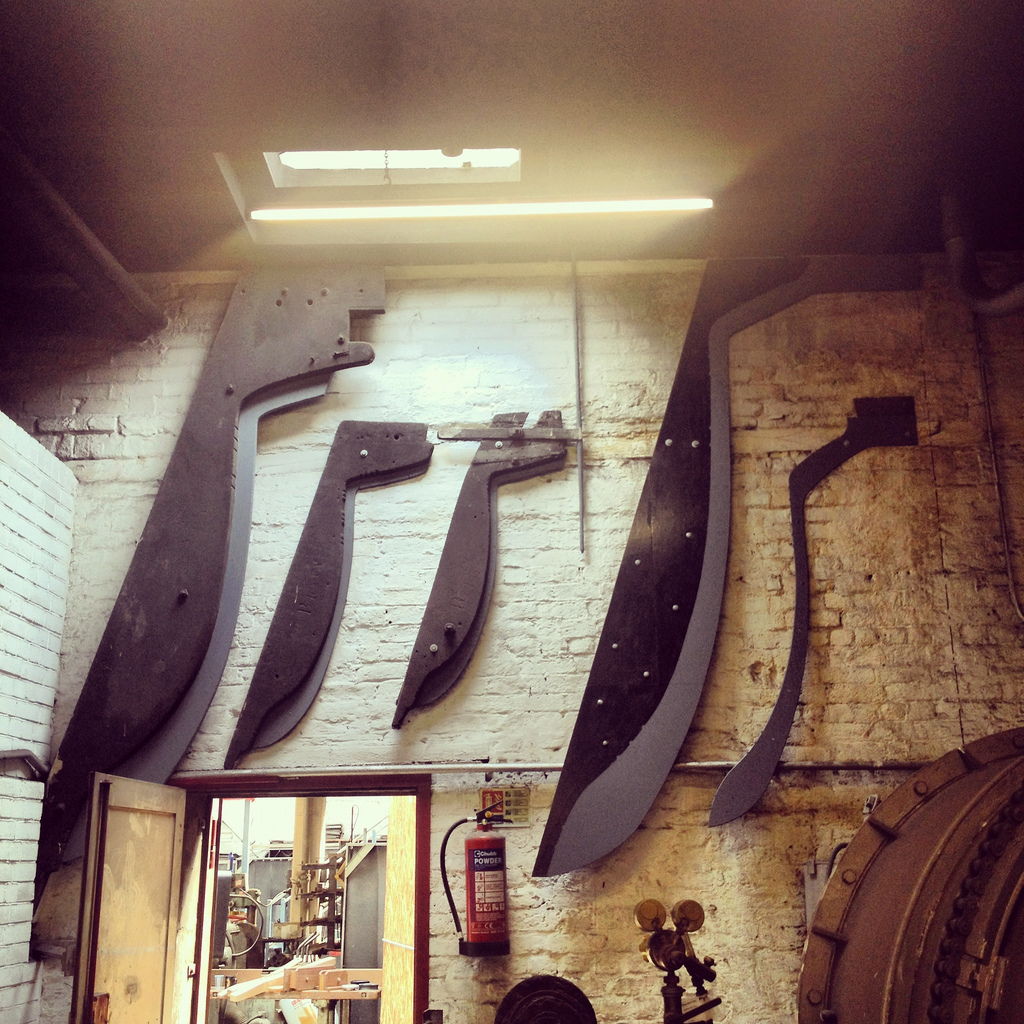
In any case, the Foundry bills itself, and is apparently recognized by the Guinness Book of World Records, as the oldest manufacturing company in Britain. They made Big Ben; they forged the first Liberty Bell; they created, albeit off-site, the absolutely massive 23-ton 2012 Olympic Bell; and, among thousands of other, less well-known projects, they even made the famed Bow bells whose ringing defines London’s Cockney stomping ground.

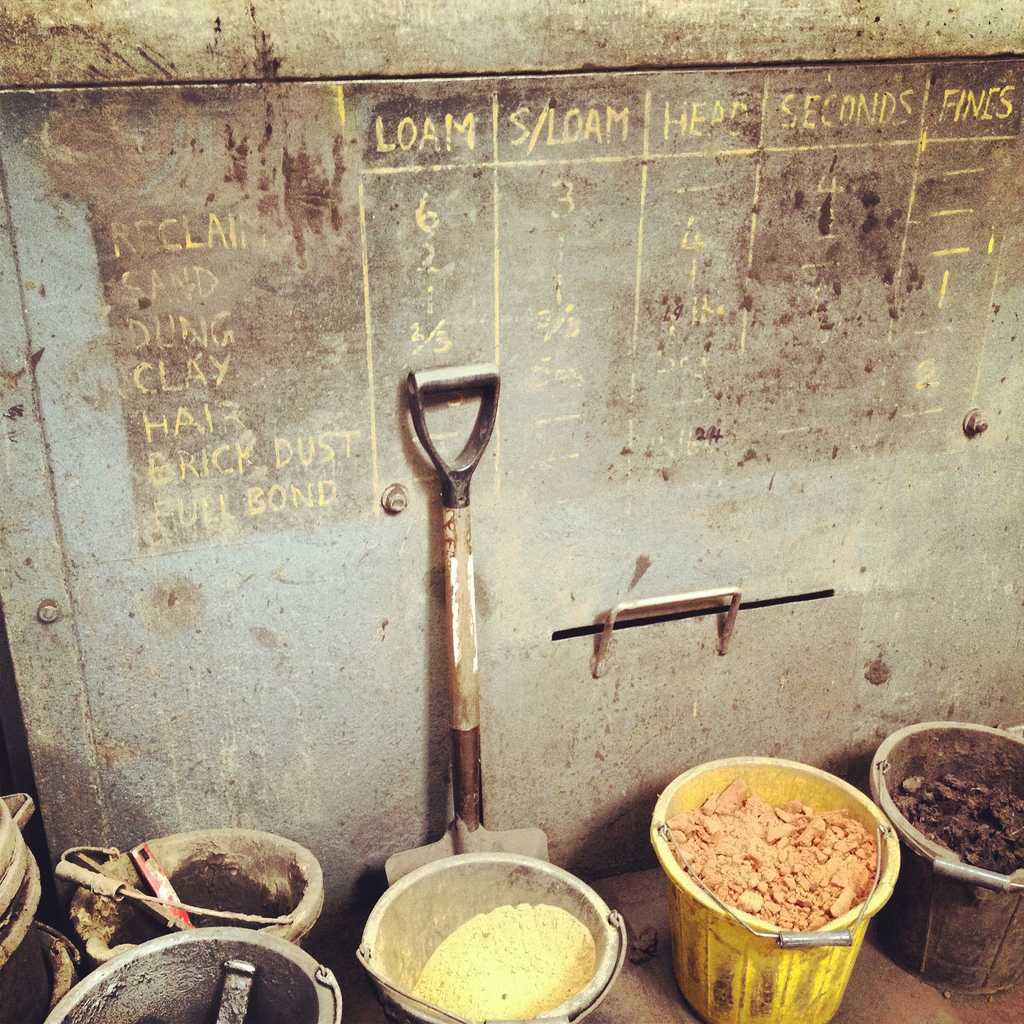
[Image: The ingredients of loam].

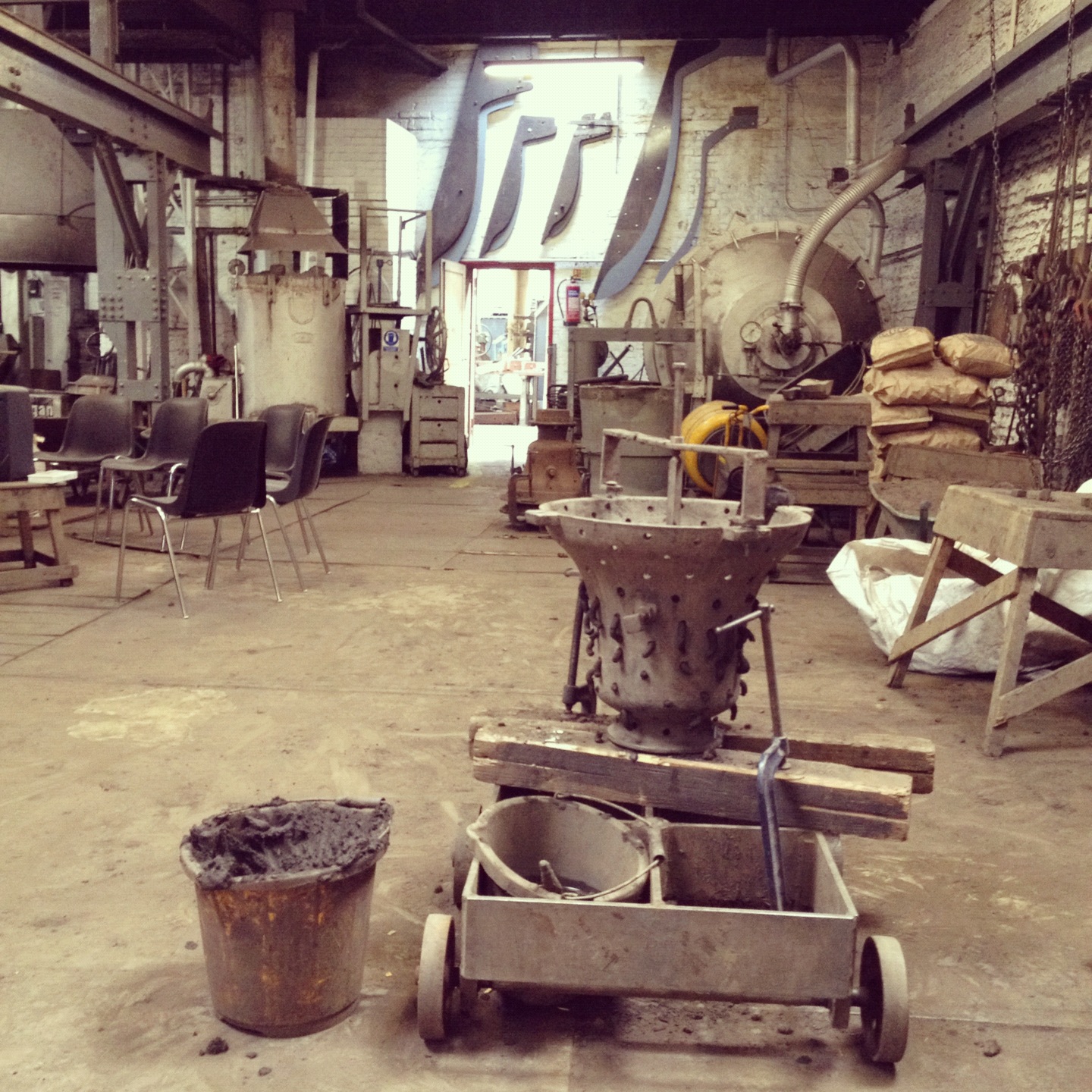
The self-guided tour took us from buckets of loam, used to shape the earthen moulds into which “bell metal” (an alloy of copper and tin) is later poured during casting, all the way to the mind-blowing final sight and sound of the bell-tuning station.

Here are some quick photos, then I’ll come back to the tuning process.

[Images: Interior of the Foundry, plus some of the casting/pouring equipment. In the bottom two images, the frames visible on the back wall were used to cast, from left to right, Big Ben; the original Liberty Bell; the Bow bells; the enormous 2012 Olympic Bell; and another bell, on the far right, that I unfortunately don’t remember].

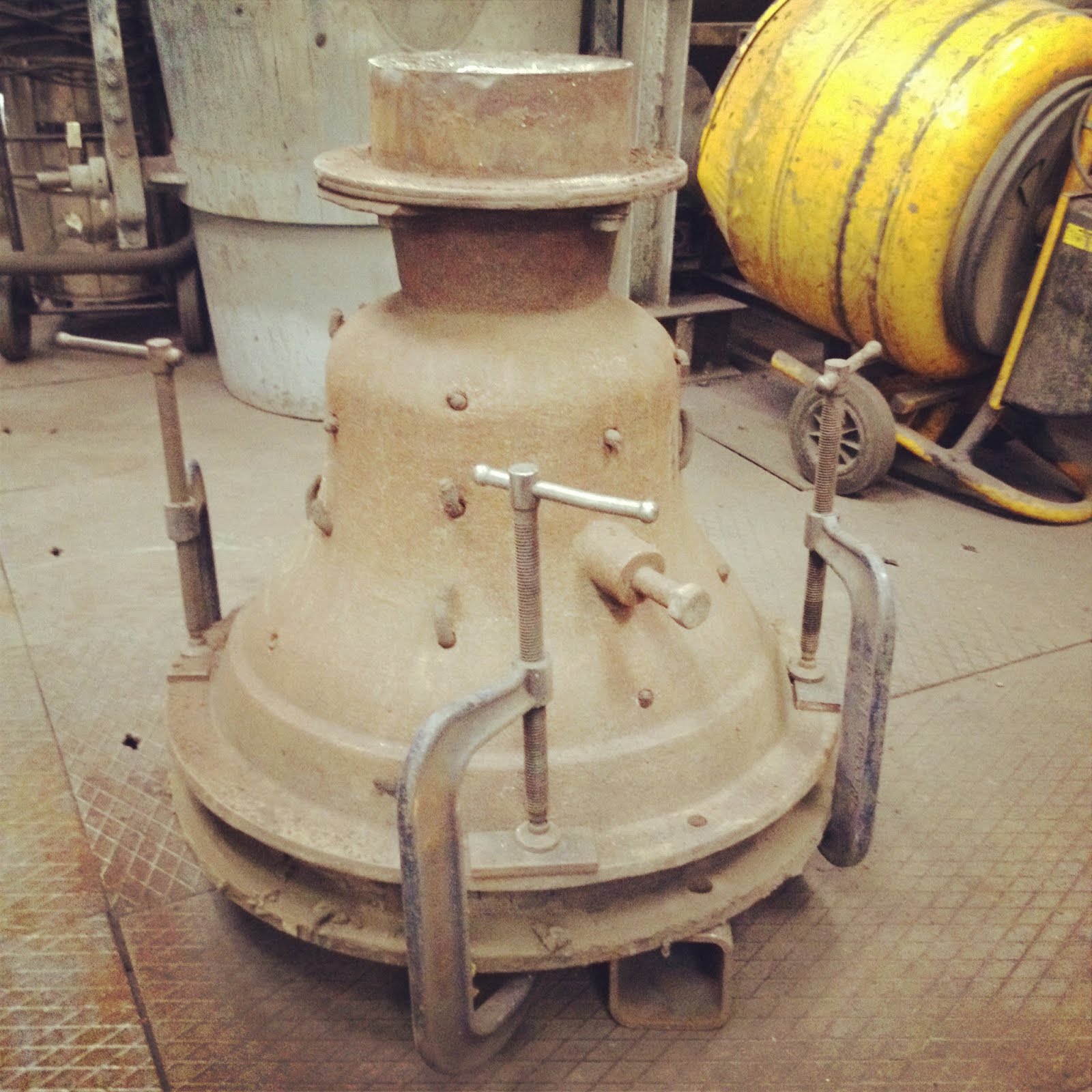
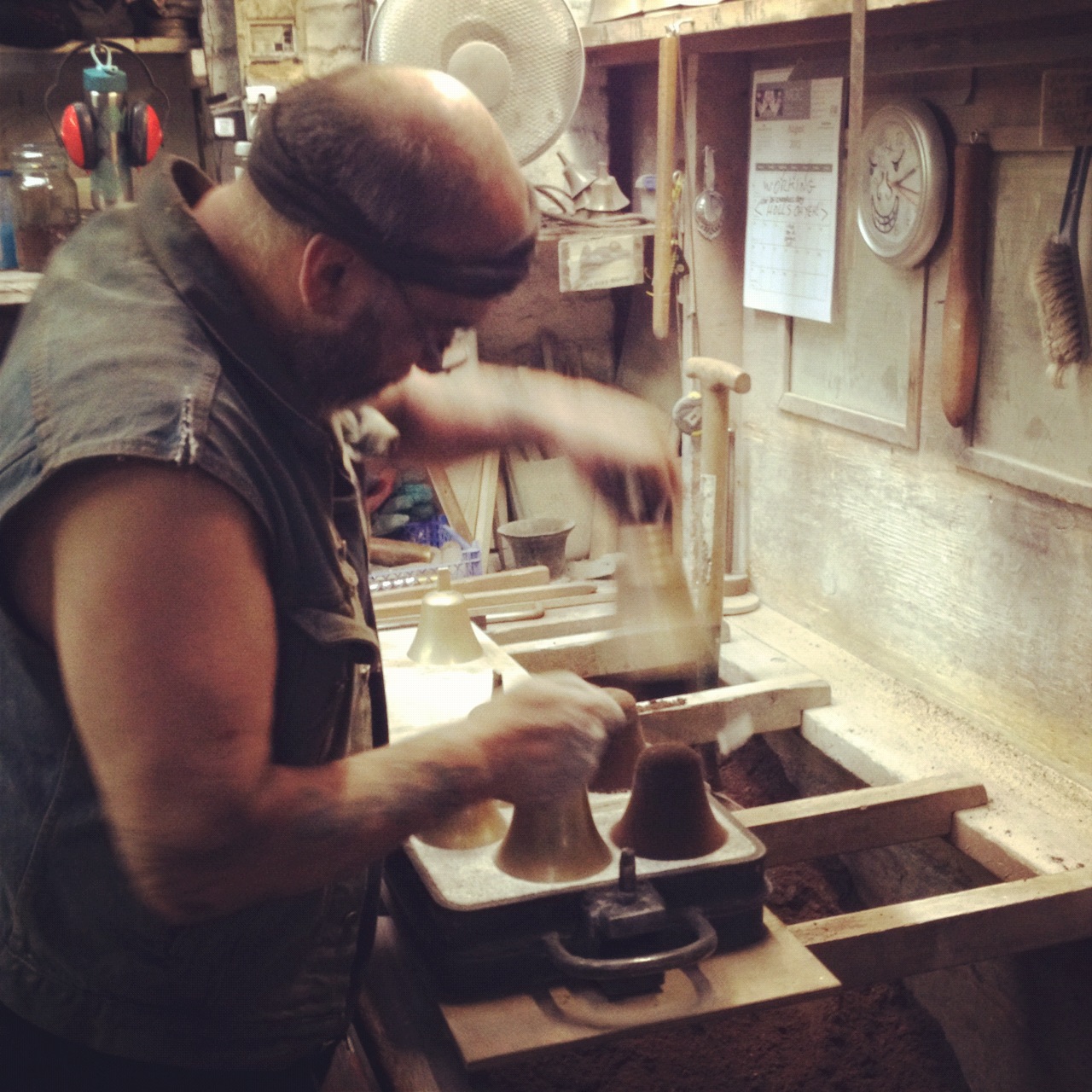
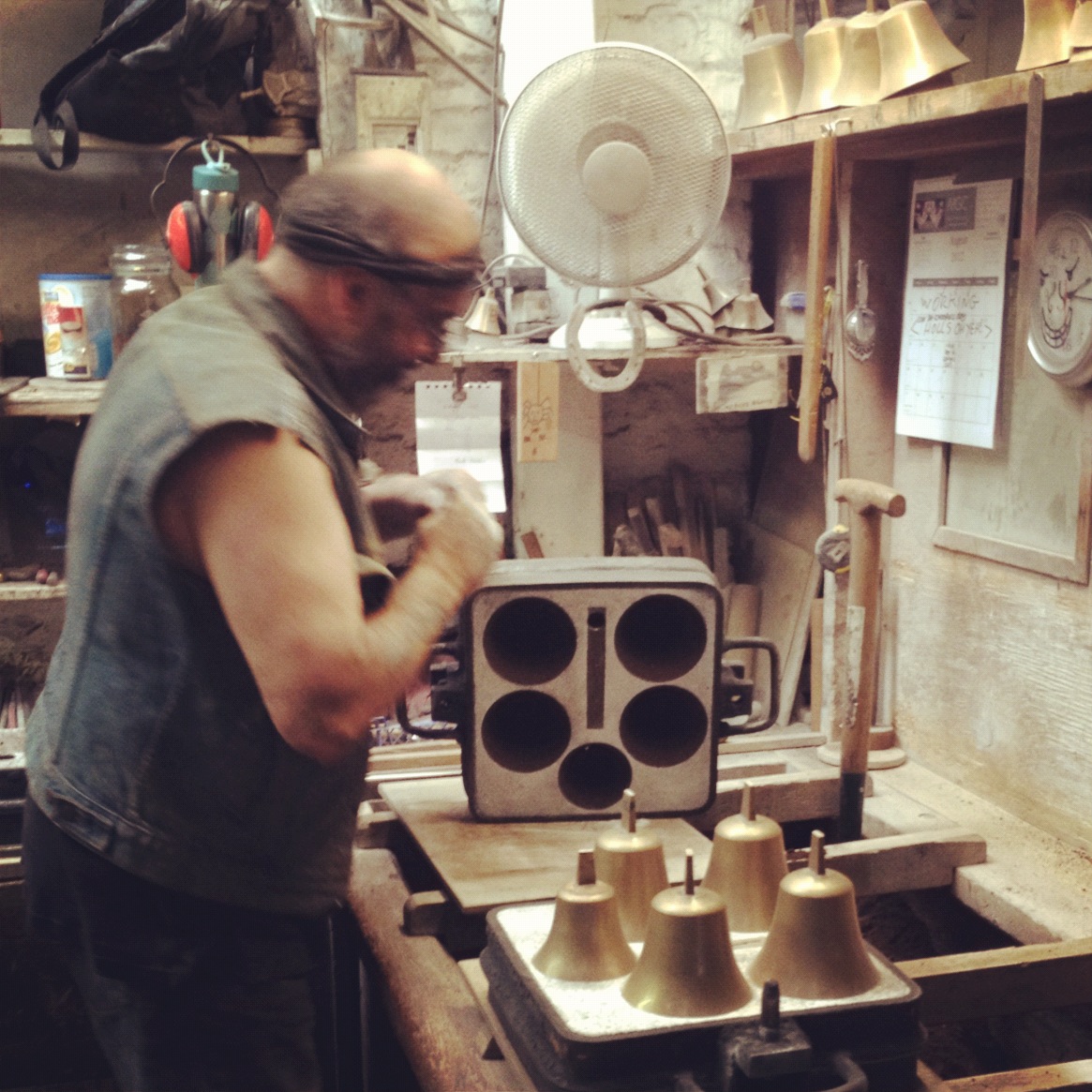
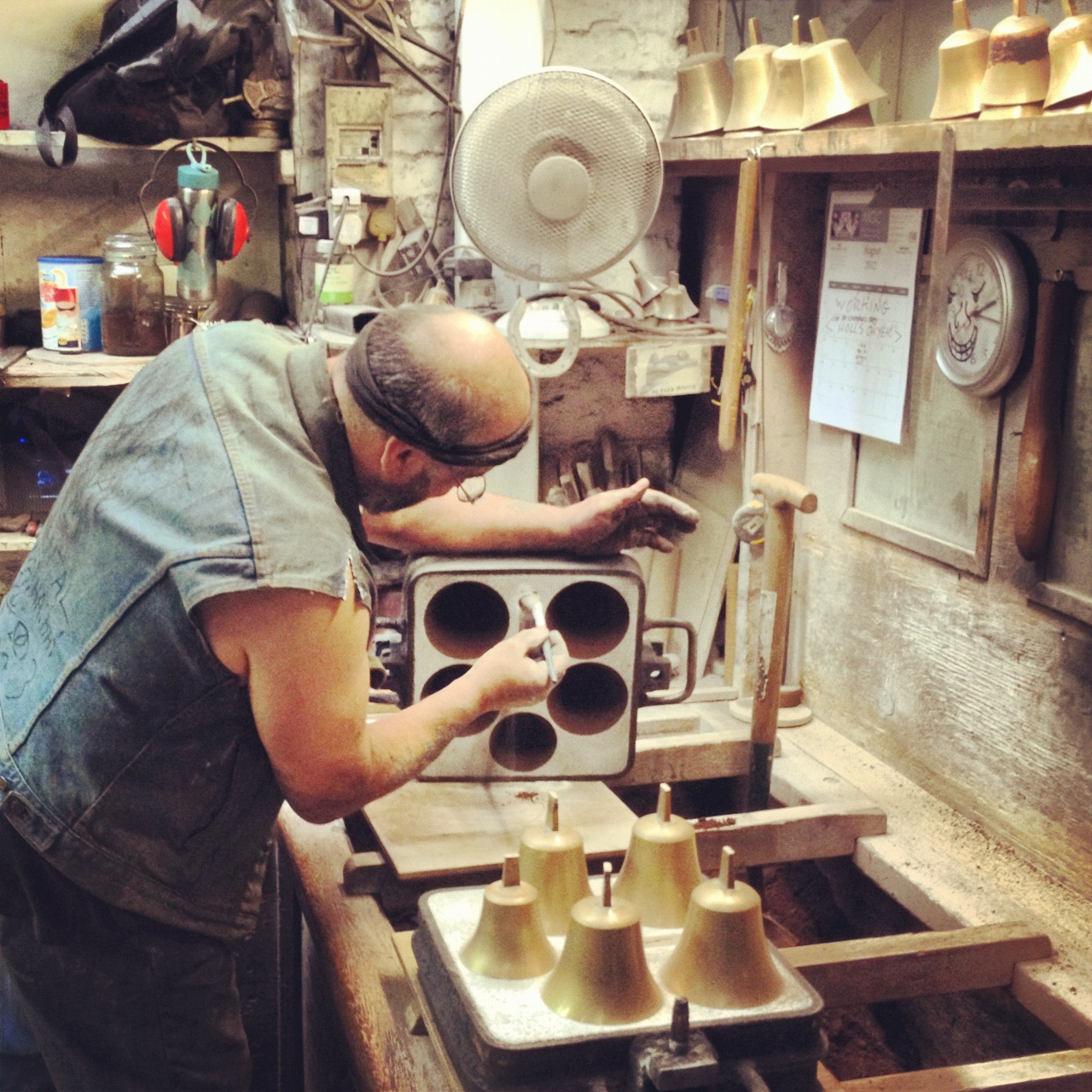
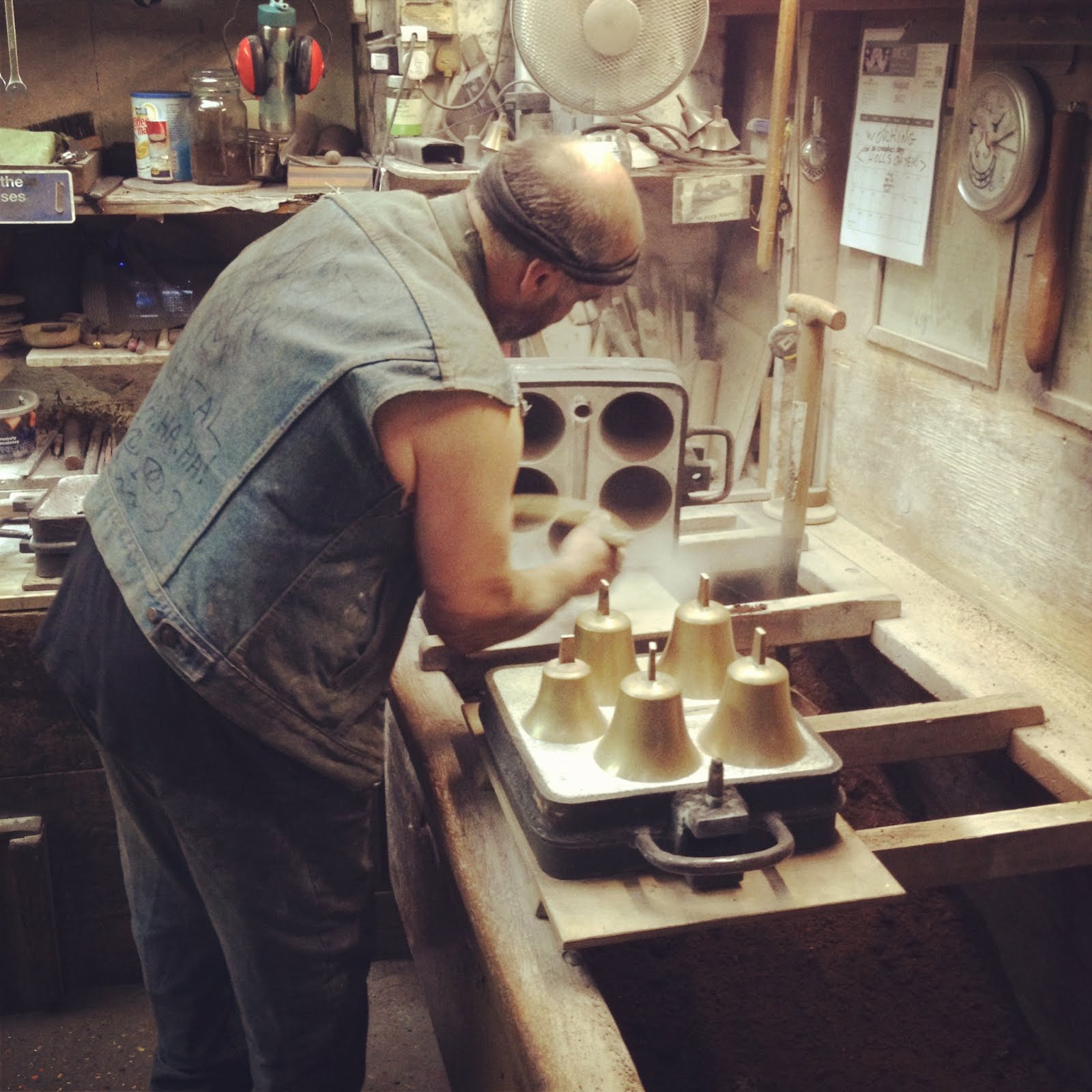
The next sequence shows the casting of hand bells. We were basically in the right place at the right time to see this process, as the gentleman pictured—whose denim vest had written on it in black marker, “I’m not mad, I’m mental, HA! HA! HA!”—pulled apart the suitcase-like casting frame seen in these photos to reveal gorgeously bright golden bells sitting silently inside.

Using powder, almost like something you’d use to sugar a cake, and an air-hose, he removed the bells from their loamy matrix and got the frame ready for another use.

[Image: The bells are revealed and powdered].

The whole thing was a kind of infernal combination of kilns and liquid metal, soundtracked by the sharp metallic ring of bells resonating in the background.

As the origin site for urban instruments—acoustic ornaments worn by the city’s architecture to supply a clockwork soundtrack that bangs and echoes over rooftops—the Foundry had the strange feel of being both an antique crafts workshop of endangered expertise (kept afloat almost entirely by commissions from churches) and a place of stunning, almost futuristic, design foresight.

In other words, the acoustic design of the city—something that isn’t even on the agenda of architecture schools today, considered, I suppose, too hard to model with Rhino—was taking place right there, and had been for centuries, in the form of vast ovens and casting frames out of which emerge the instruments—shining bells—that so resonantly redefine the experience of the modern metropolis.

So that brings us to the final stage of the Foundry tour, which was the tuning station.

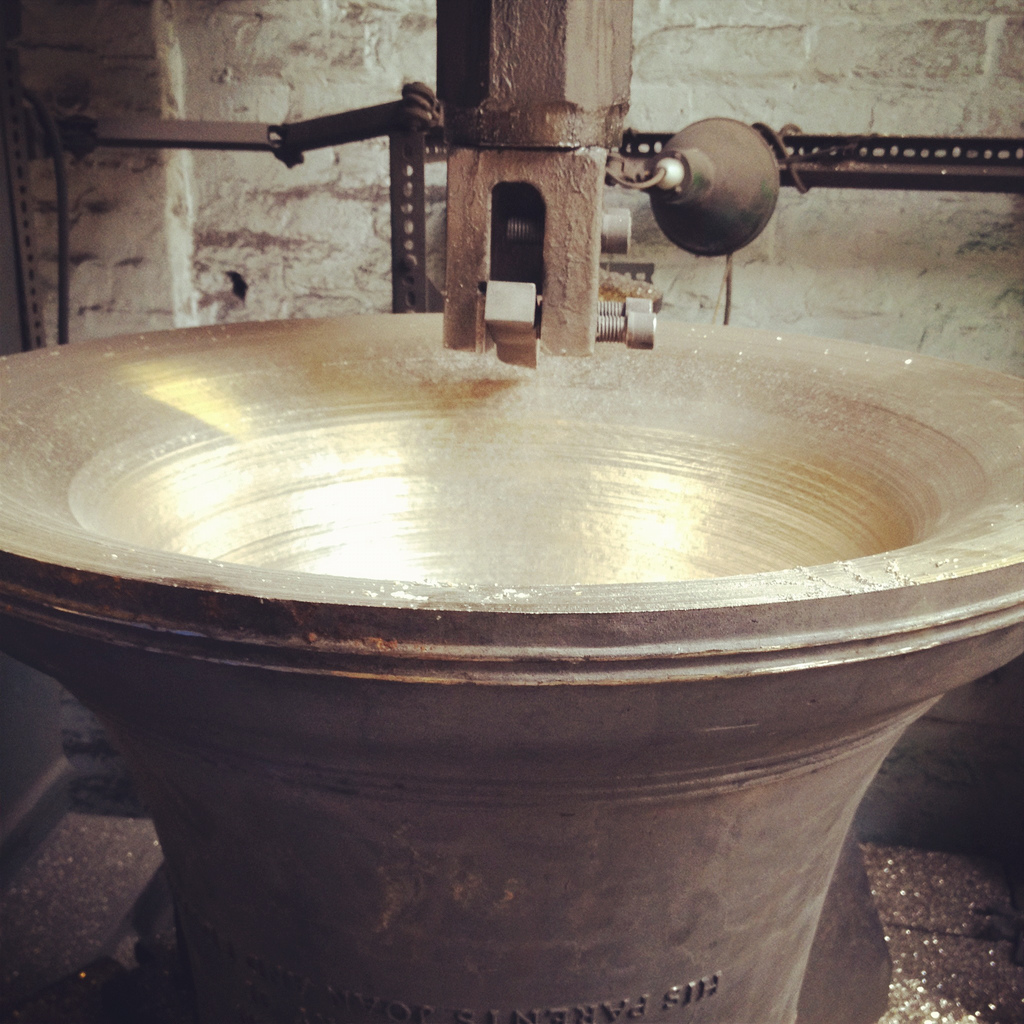
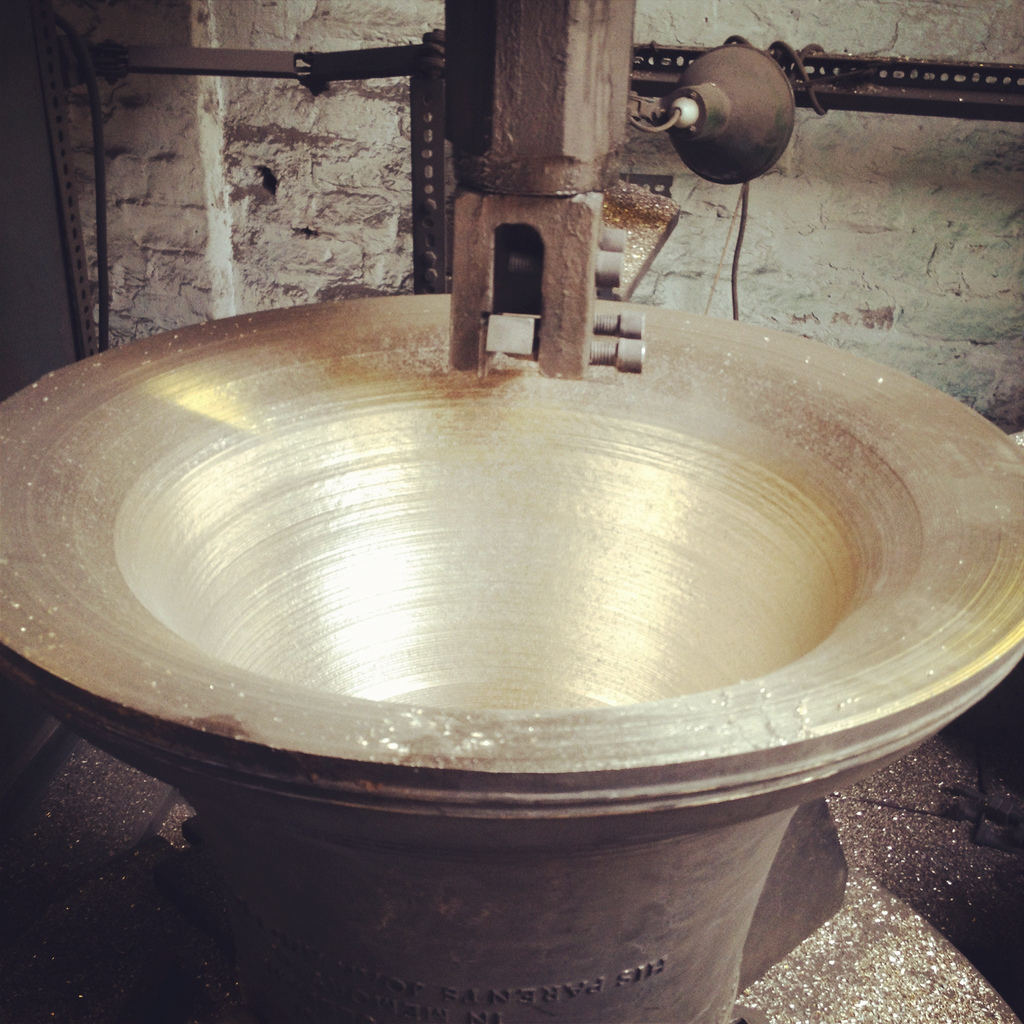
[Images: Tuning a bell; note the shining flecks of metal on the floor, which have been scraped out of the bell in order to tune it. “Tuning” is thus a kind of mass reduction, or reductive sculpting].

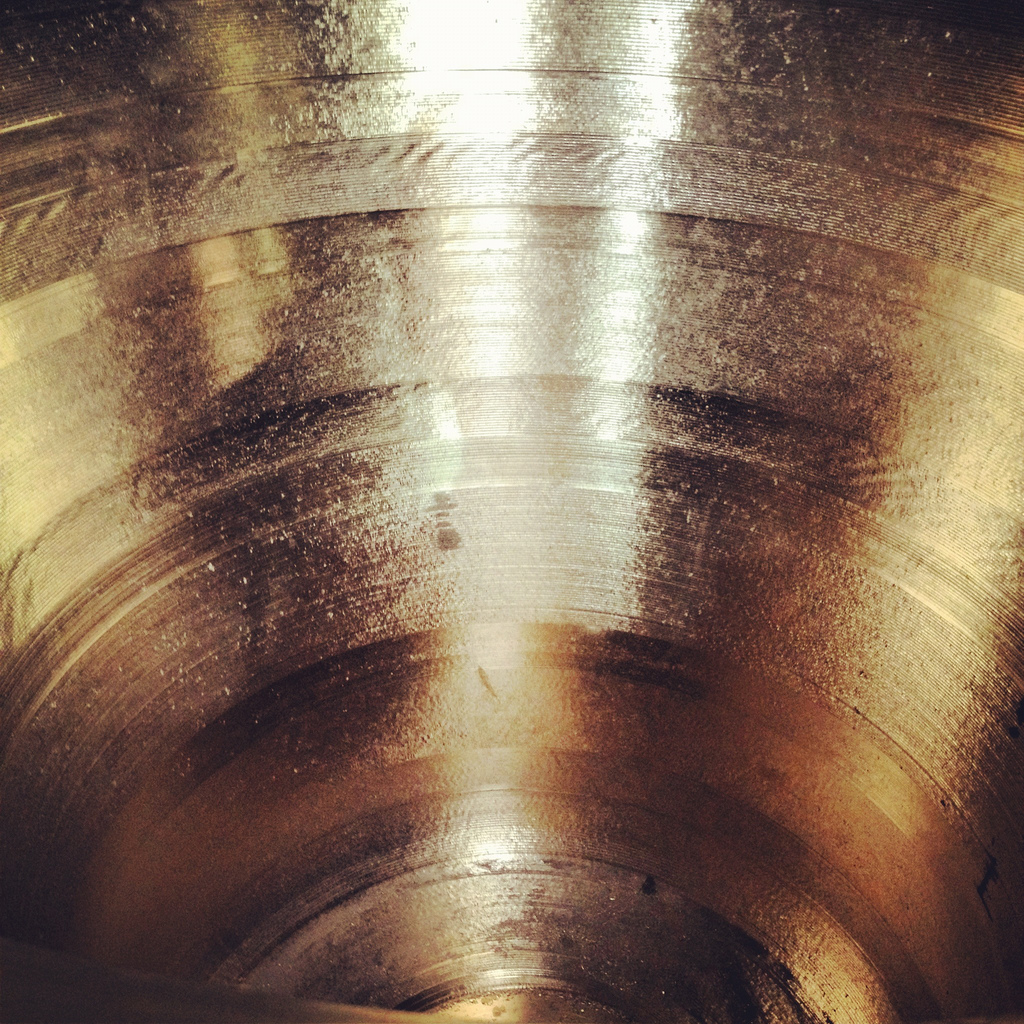
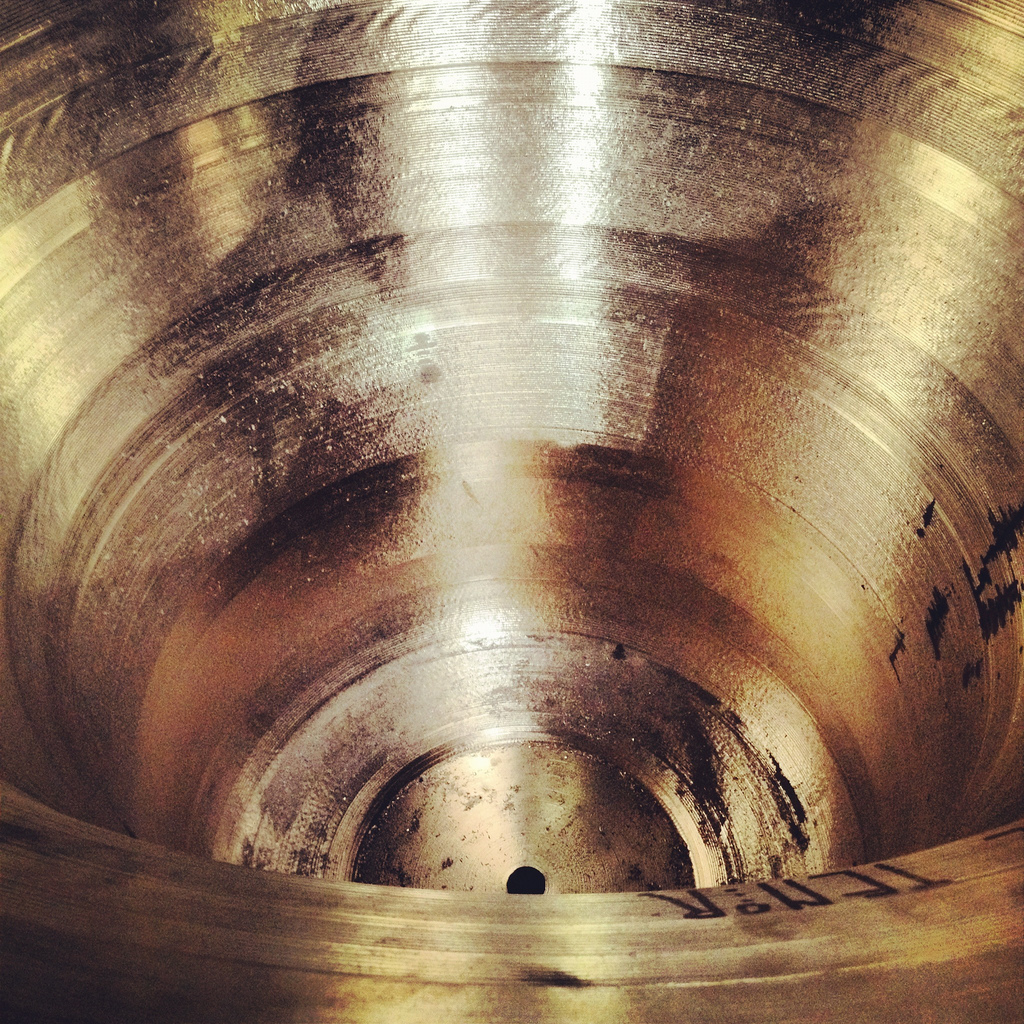
Assuming I remembered this correctly, modern bells are tuned by having tiny bits of metal—mere flecks at a time—scraped or cut away from the inside. This produces an incredible texture of bright, polished grooves incised directly, even violently, into the metal; the visual effect is absolutely magical.

[Image: The grooved interior of a recently tuned bell; in the bottom image, note the word “tenor” written on the bell’s inner rim].

Even better, while these massive bells are rotating anti-clockwise on their turning plates, having their insides scraped away, they are actually ringing!

Deep below the abrasive droning roar of the bell turning you can make out the resonant tone of the bell itself. The effect was like listening to tuned rocks falling endlessly in a tumbler, polished into acoustically more beautiful versions of themselves. This process alone could make a new instrument: a full orchestra of bell-tuning stations, as if mining shaped metals for their sounds.

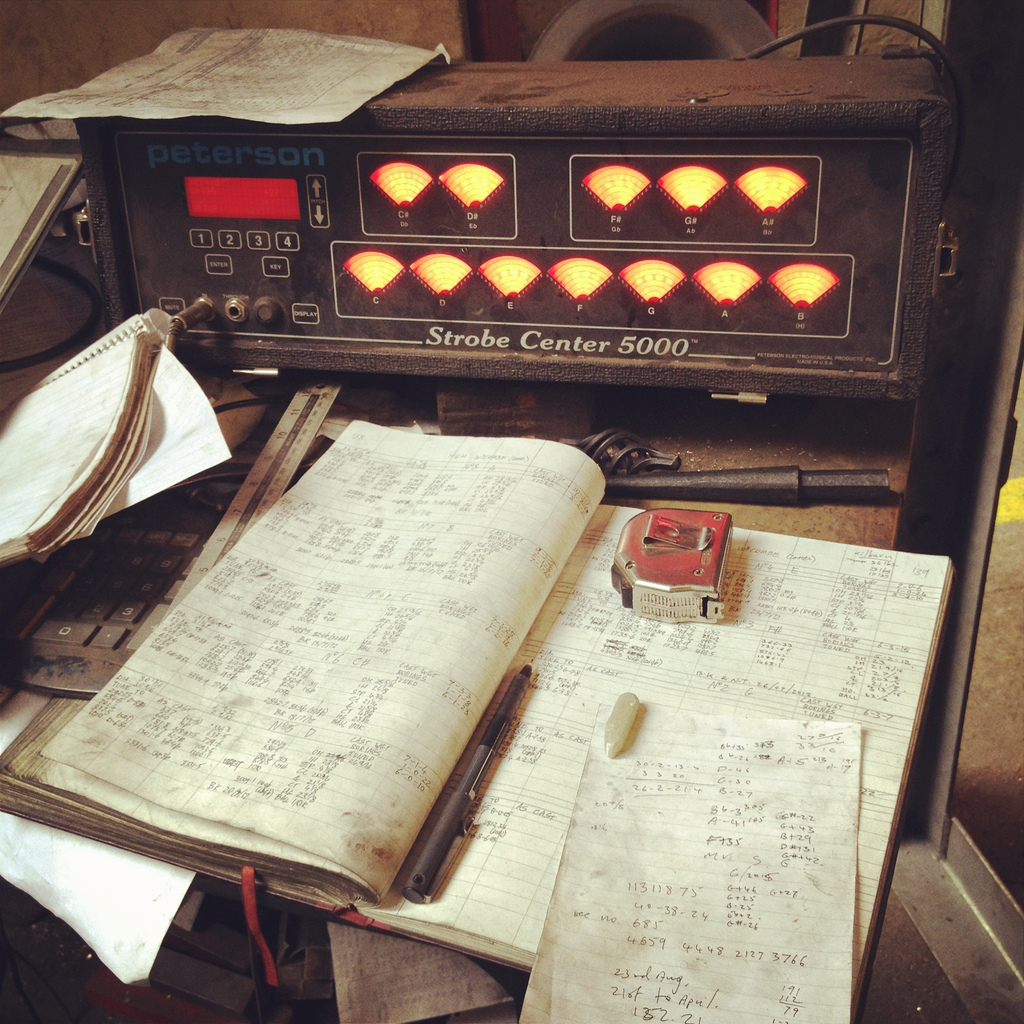
Finally, then, the tuning process is controlled by one of three ways, often used in combination. One uses software; you bang the bell with a mallet and the software tells you if it’s resonating at the right frequencies. The second method uses an oscilloscope, which looks like something straight out of a 1980s submarine-warfare movie.

[Image: As if looking for ghosts inside the bell, the oscilloscope spins and glows].

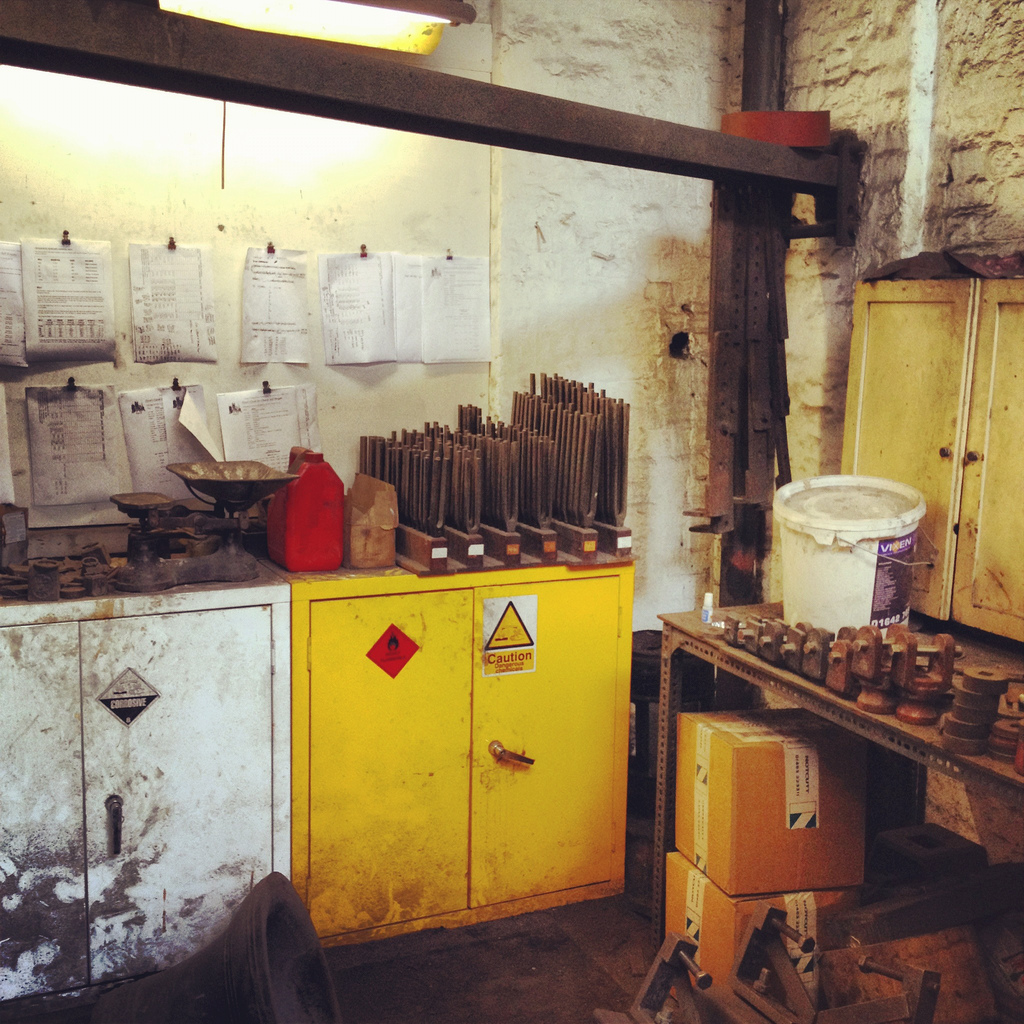
And the third is much more analogue, relying entirely on the tuner’s own sense of pitch and the use of tuning forks.

[Image: Tuning forks at the Whitechapel Bell Foundry].

At the risk of going on too long about this, there really was something almost indescribably beautiful about the tuning process: watching, and listening to, otherwise featureless metal surfaces be sculpted and inscribed from inside by an anti-clockwise machine as the weird circular howl of the bell grew gradually more distinct, more precisely pitched with every scraping away of unpolished metal.

Being, as you’ll know by now, prone to clichés, I can’t help but think of William Blake’s “Satanic Mills” of the Industrial Revolution every time I enter an industrial facility these days, and a vision of some titanic factory somewhere in the pollution of a future era, spinning raw metal into bells, golden and shrieking things droning as if enspirited or possessed, is almost too fantastical to contemplate.

Anyway, the Whitechapel Bell Foundry is open for walk-in tours, for £10 per adult, until the end of the 2012 Olympics, after which the tours go back to advance reservations only (and the ticket price goes up to £12). Enjoy!

Below, buried beneath the very roots of the trees

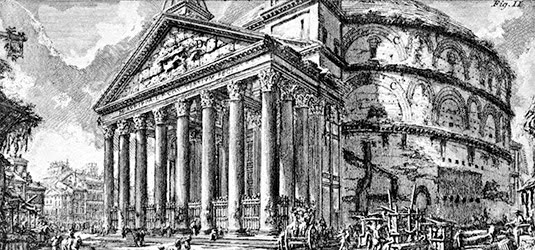
[Image: Piranesi’s Rome].

Peter Ackroyd’s allusion to a landscape comparable to the tropical swamps of Borneo found in the sewers of London reminded me of a brief line in Gilbert Highet’s book Poets in a Landscape.

Describing the origins of Rome, a city built on the Tiber River, Highet writes that the landscape there was once as wild as any to be found on earth—indeed, offering evidence that writers seem consistently to fantasize of finding a new tropics in the very ground of Europe, Rome was founded in “those early idyllic days, when the Tiber was as primitive as the Upper Amazon today.”

Highet goes on to describe the city’s long-term devolution into the “heap of ruins” it became in the Middle Ages, a city “earth-choked, mutilated, silent,” one where weeded streets were lined with “the titanic palaces of later monarchs—arches which now look not so much like relics of human architecture as fragments of mountain-ranges into which dwellings have been built.”

“In those days,” Highet writes, a variant form of “primitive” landscape emerged, one in which forests returned and plants ran riot, when “Rome was a place of grassy ruins and elegant palaces and whispering melancholy churches, little changed from the strange half-visionary city immortalized in the engravings of Piranesi: tall pillars standing among rocks and mounds which prove to be the fallen walls and earthquake-shattered arches of some vast mansion; huge fields in which a few peasants stand gossiping while their goats scramble among carved pilasters, and which are at a great distance revealed as being, not fields, but the overgrown floors of temples and baths; lonely obelisks once designed to perpetuate some Roman glory, and now purposeless, mighty circular tombs converted during the Middle Ages into fortresses; hills which covered buried palaces.” The ruin, here, “earth-choked, mutilated, silent,” could thus be seen as a vertiginous act of misrecognition: architecture mistaken for the surface of the earth.

Even the supersized spatial affectations of someone like Emperor Nero, Highet continues, could not ultimately resist the inhuman pull of insects and vegetation that settled onto Rome: “so many centuries after Nero shocked his contemporaries by insisting on making a private landscape in the midst of a crowded metropolis, the ruins of his palace have gone back to nature. Bees hum through the roofless corridors; flowering weeds flourish among the imperial brickwork; from the sunlight above we hear the voices of children running and laughing on the grassy slopes.”

Highet was writing nearly half a century ago, but it’s still accurate that, as he writes, visitors to the city are able to “feel the ephemeral happiness of summer flowers and summer birds all around, to enjoy the fresh warm air and the genial quietness, and to reflect that below, buried beneath the very roots of the trees, clogged with hundreds of tons of earth and fallen masonry, shrouded in the darkness of many disastrous centuries, there lie some of the foundations of our world”—foundations built and implanted when the region was “Amazonian” in its humid and unsettled wildness.

Urban Target Complex National Monument

[Image: Yodaville, via Google Maps].

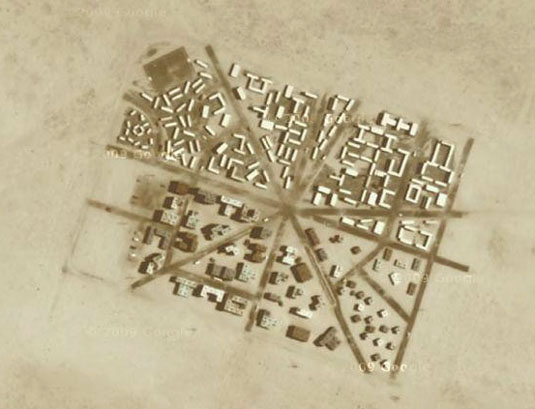
Yodaville is a fake city in the Arizona desert used for bombing runs by the U.S. Air Force. Writing for Air & Space Magazine back in 2009, Ed Darack wrote that, while tagging along on a training mission, he noticed “a small town in the distance—which, as we got closer, proved to have some pretty big buildings, some of them four stories high.”

As towns go, this one is relatively new, having sprung up in 1999. But nobody lives there. And the buildings are all made of stacked shipping containers. Formally known as Urban Target Complex (R-2301-West), the Marines know it as “Yodaville” (named after the call sign of Major Floyd Usry, who first envisioned the complex).

As one instructor tells Darack, “The urban layout is actually very similar to the terrain in many villages in Iraq and Afghanistan.”

The Urban Target Complex, or UTC, was soon “lit up with red tracer rounds and bright yellow and white rocket streaks,” till it “looked like it was barely able to keep standing”:

The artillery and mortars started firing, troops advanced toward the target complex, and aircraft of all types—carefully controlled by students on the mountain top—mounted one attack run after another. At one point so much smoke and dust filled the air above the “enemy” that nothing could be seen of the target—just one of the real-world problems the students had to learn to cope with that day.

In a recent article for the Tate, writer Matthew Flintham explores “the idea of landscape as an extension of the military imagination.” Referring specifically to the UK, he adds that what he perceives as a contemporary “lack of artistic engagement with the activities of the Ministry of Defence (MoD) is perhaps principally due to the relative segregation of defence personnel, land and airspace from the civil domain.”

Flintham points out—again, referring to the UK—that “today’s MoD has its own vast training estate with numerous barracks and an enormous stock of housing, all of which are detached from public scrutiny. The public are prevented from accessing many areas of the defence estate for two reasons: the extreme danger of live weapons and hazardous activities (and related issues of potential litigation), and the restrictions on privileged, strategic or commercial information in the interests of national security.” This has the effect that these sorts of military landscapes not only fall outside critical scrutiny—and also remain, with very few exceptions, all but invisible to architectural critique—but that their only real role in the public imagination is entirely speculative, often based solely on rumor and verging on conspiracy.

While Flintham thus calls for a more active artistic engagement with military landscapes, exploring what he calls the “military-pastoral complex,” I would echo that with a related suggestion that spaces such as Yodaville belong on the architectural itinerary of today’s design writers, critics, and students.

Given the mitigation of the very obvious problems Flintham himself points out—such as site contamination, unexploded ordnance, and national security leaks—it would be thrilling to see a new kind of “fortifications tour,” one that might bring these sorts of facilities into the public experience.

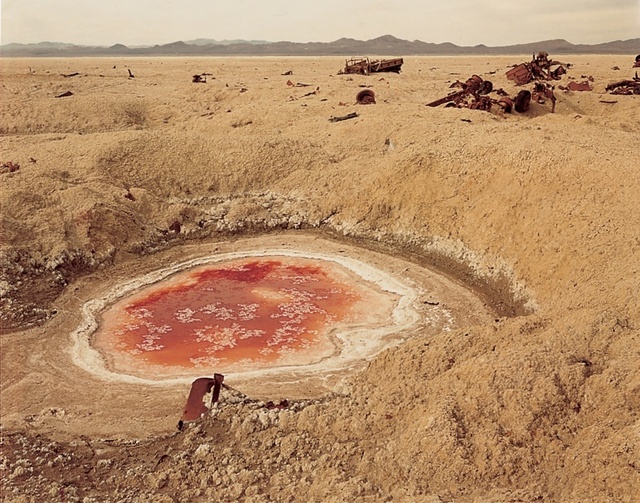
[Image: Photo by Richard Misrach, courtesy of the Whitney Museum of American Art, from Bravo 20].

An interesting possibility for this sort of national refocusing on military landscapes comes from artists Richard and Myriam Misrach. The Misrachs have proposed a “Bravo 20 National Park“—that is, “turning the blasted range into a National Park of bombing,” as the Center for Land Use Interpretation phrases it. “When the Navy’s use of Bravo 20 was up for Congressional review in 1999,” CLUI continues, “Misrach made one more heroic, quixotic, and failed attempt to get his proposal seriously considered. Instead, the Navy has increased its use of Bravo 20, and the four other ranges around Fallon, and has been authorized to expand their terrestrial holdings in the area by over 100,000 acres.”

So what, for instance, might something like a Yodaville National Park, or Urban Target Complex National Monument, look like? How would it be managed, touristed, explored, mapped, and understood? What sorts of trails and interpretive centers might it host? Alternatively, in much the same way that the Unabomber’s cabin is currently on display at the Newseum in Washington D.C., could Yodaville somehow, someday, become part of a distributed collection of sites owned and operated by the Smithsonian, the National Building Museum, or, for that matter, UNESCO, in the latter case with Arizona’s simulated battlegrounds joining Greek temples as world heritage sites?

In any case, bringing spaces of military simulation into the architectural discussion, and reading about Yodaville in, say, Architectural Record instead of—or in addition to—Air & Space Magazine, would help to demystify the many, otherwise off-limits, landscapes produced (and, of course, destroyed) by military activity. Better, this would reveal even the cloudiest of federal lands as spatial projects, nationally important places that—again, given declassification and appropriate environmental remediation—might hold unexpected insights for design practitioners, let alone for critics, the public, and national historians.

(Thanks to Mark Simpkins for the Tate link).

Buncefield Bomb Garden

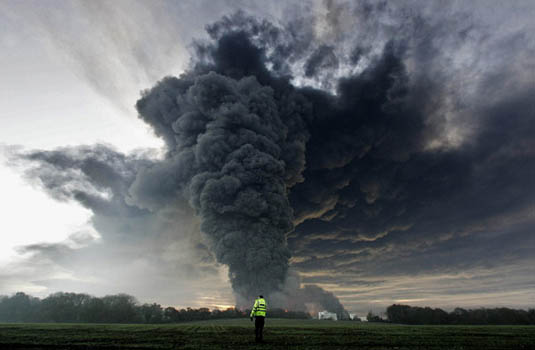
[Image: The Buncefield explosion, via the BBC].

In one of the more interesting landscape design stories I’ve read this year, New Scientist reported back in March that the massive, December 2005 explosion at a fuel-storage depot called Buncefield in England, might have been strongly assisted by the site’s landscaping.

“A few years ago no one would have predicted that a row of trees and shrubs could make the difference between a serious fire and a catastrophic explosion,” the magazine suggests. But now, it’s becoming a reasonably accepted notion that the physical layout of the Buncefield site’s plantlife—from the “shrubs and small trees” down to their individual “twigs and branches”—can work to contain and concentrate, and, worse, add explosive surface area to what would otherwise have simply been a gas leak.

Indeed, the ongoing investigation at Buncefield “might change the way storage depots, refineries and pipelines are designed, and how the sites are landscaped [emphasis added]. Along with conventional safety features like sensors and alarms, site operators may have to rethink the way that trees, hedges and shrubs are positioned.” Investigators have concluded that “even structures on nearby commercial developments could help to accelerate a flame,” meaning that, in the design of any landscape, from industrial parks to corporate lawns, there is a previously unknown capacity for detonation.

What’s incredible about this—if proven true—is that the potentially explosive landscaping of sites such as Buncefield might suggest, according to New Scientist, new geometries or diagrammatic possibilities for the design of jet engines, in particular “a novel aircraft propulsion system called a pulse detonation engine.” The garden as jet engine!

Putting this into the context of other landscape typologies, such as ritual gardens or sacred groves—as if we might someday have orchards that churn and pulse with controlled coils of fire, like the engine of some vast arboreal machine—makes this terrifying topographical phenomenon seem all the more mythic and extraordinary.

(Previously on BLDGBLOG: Star Garden).

Buy an Underground Kingdom

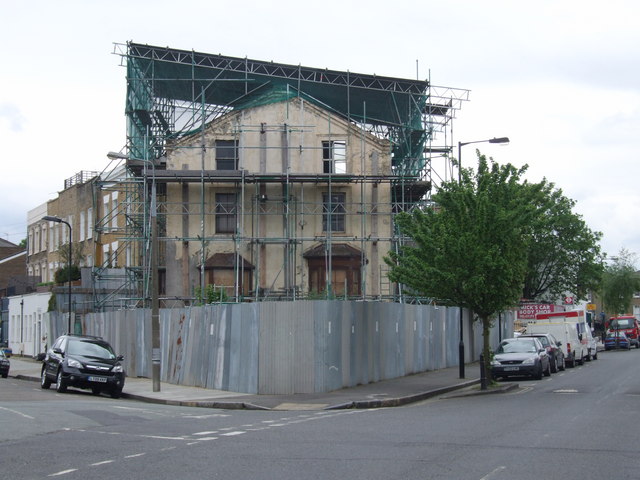
[Image: The Mole Man’s house in Hackney, via Wikipedia].

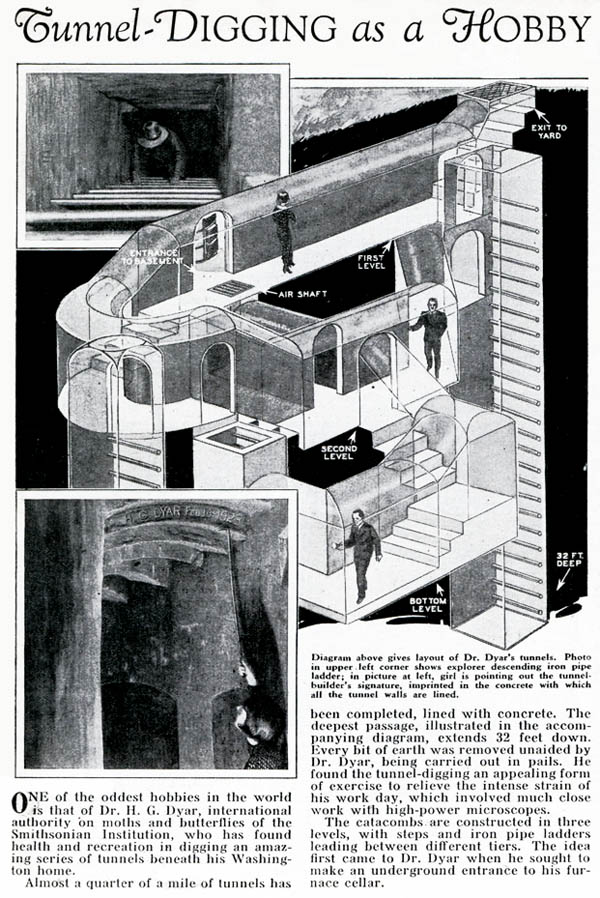
As most anyone who’s seen me give a talk over the past few years will know, I have a tendency to over-enthuse about the DIY subterranean excavations of William Lyttle, aka the Mole Man of Hackney.

Lyttle—who once quipped that “tunneling is something that should be talked about without panicking”—became internationally known for the expansive network of tunnels he dug under his East London house. The tunnels eventually became so numerous that the sidewalk in front of his house collapsed, neighbors began to joke that Lyttle might soon “come tunnelling up through the kitchen floor,” and, as a surveyor ominously relayed to an English court, “there is movement in the ground.”

From the Guardian, originally reported back in 2006:

No one knows how far the the network of burrows underneath 75-year-old William Lyttle’s house stretch. But according to the council, which used ultrasound scanners to ascertain the extent of the problem, almost half a century of nibbling dirt with a shovel and homemade pulley has hollowed out a web of tunnels and caverns, some 8m (26ft) deep, spreading up to 20m in every direction from his house.

What did he store down there? After Lyttle was forced from the house for safety reasons, inspectors discovered “skiploads of junk including the wrecks of four Renault 4 cars, a boat, scrap metal, old baths, fridges and dozens of TV sets stashed in the tunnels.”

But now the late Mole Man’s home is for sale.

[Image: An earlier Mole Man: Tunnel-Digging as a Hobby].

Alas, “most of the tunnels have been filled in” with concrete, and the house itself is all but certain to be torn down by its future owner, but I like to think that maybe, just maybe, some strange museum of subterranea could open up there, in some parallel world, complete with guided tours of the excavations below and how-to evening classes exploring the future of amateur home excavation. Curatorial residencies are offered every summer, and underground tent cities pop-up beneath the surface of the capital city, lit by candles or klieg lights, spreading out a bit more each season.

Briefly, I’m reminded of a scene from Georges Perec’s novel Life: A User’s Manual, in which a character named Emilio Grifalconi discovers “the remains of a table” that he hopes to salvage for use in his own home. “Its oval top, wonderfully inlaid with mother-of-pearl, was exceptionally well preserved,” Perec explains, “but its base, a massive, spindle-shaped column of grained wood, turned out to be completely worm-eaten. The worms had done their work in covert, subterranean fashion, creating innumerable ducts and microscopic channels now filled with pulverized wood. No sign of this insidious labor showed on the surface.”

Grifalconi soon realizes that “the only way of preserving the original base—hollowed out as it was, it could no longer suport the weight of the top—was to reinforce it from within; so once he had completely emptied the canals of the their wood dust by suction, he set about injecting them with an almost liquid mixture of lead, alum and asbestos fiber. The operation was successful; but it quickly became apparent that, even thus strengthened, the base was too weak”—and the table would thus have to be discarded.

At which point, Grifalconi has an idea: he begins “dissolving what was left of the original wood” in the table’s base in order to “disclose the fabulous arborescence within, this exact record of the worms’ life inside the wooden mass: a static, mineral accumulation of all the movements that had constituted their blind existence, their undeviating single-mindedness, their obsinate itineraries; the faithful materialization of all they had eaten and digested as they forced from their dense surroundings the invisible elements needed for their survival, the explicit, visible, immeasurably disturbing image of the endless progressions that had reduced the hardest of woods to an impalpable network of crumbling galleries.”

Somewhere beneath a new building in East London, then, some handful of years from now, the Mole Man’s “fabulous arborescence” will still be down there, a vast and twisting concrete object preserved in all its tentacular sprawl, like some unacknowledged tribute to Rachel Whiteread: a buried and elephantine sculpture that shows up on radar scans of the neighborhood, recording for all posterity “the endless progressions” of Lyttle’s eccentric and mysterious life.

(Via @SubBrit. Earlier adventures in real estate on BLDGBLOG: Buy a Prison, Buy a Tube Station, Buy an Archipelago, Buy a Map, Buy a Torpedo-Testing Facility, Buy a Silk Mill, Buy a Fort, Buy a Church,).

Books Received

[Image: A riverboat library in Bangladesh; image courtesy of the Gates Foundation].

Many, many books have arrived at the home office here, and I’m thus once again woefully behind in tallying up all the titles that have come my way. Accordingly, there are still many more write-ups to come, but it will be next month, after some upcoming travels, before I get to those other books.

Meanwhile, as has always been the case with Books Received posts, I have not read all of the books linked here and not all of them are necessarily new. However, in all cases, these are included for the interest of their approach or subject matter, and the following list should easily give just about anyone at least one good book to read over the coming summer.


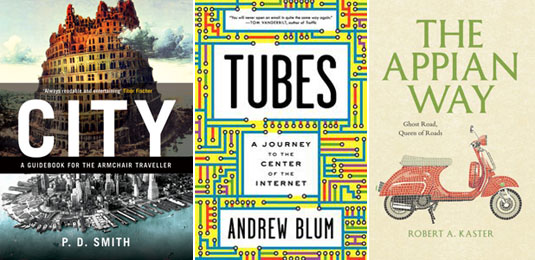
1) City: A Guidebook for the Urban Age by P.D. Smith (Bloomsbury) — P.D. Smith’s voluminous look at the history of urbanism stretches from the Sumerians to the 2012 London Olympics, from Tenochtitlán to Dubai, from the Code of Hammurabi to J.G. Ballard, and from the Italian Renaissance to the urban ruins of nuclear war. Smith has organized his book like a travel guide, albeit not for a particular metropolis but for the city in and of itself. Chapters are thus divided into overarching categories such as “arrival,” “where to stay,” “getting around,” and more, and while the result can sometimes conflate otherwise quite different urban phenomena found in disparate cities around the world, that slight sense that things are starting to blur is evened out by Smith’s eye for detail in the stories and anecdotes he relates, particularly in the book’s many boxed texts and sidebars. Migration, food security, global tourism, natural disasters, economic expansion, and war: these are all perennial influences on urban form—and urban futures—and Smith works hard to show their role in shaping the life of what he calls “the ape that shapes [its] environment, the city builders.” City comes out in the United States in June 2012.

2) Tubes: A Journey to the Center of the Internet by Andrew Blum (Ecco) — I had the pleasure of receiving periodic email updates from author Andrew Blum as he traveled to the unmarked buildings and coastal warehouses—amongst many other sites—that enable, store, and protect what we broadly refer to as the internet. The resulting book, released earlier this week, tells the story of those travels: it is Blum’s field guide to the physical infrastructure of contemporary data, tracking the internet’s actual geography, the sites where the switches are kept and the servers are cooled, where the cables come out of the sea and relay onward, deeper into cities and suburbs, into office and apartments like the one from which I’m posting this. “The Internet couldn’t just be everywhere,” Blum writes, questioning ethereal metaphors like “the cloud” or the abstract “tubes” of the book’s title. “But then where was it? If I followed the wire, where would it lead? What would that place look like? Why were they there? I decided to visit the Internet.” In one particularly memorable description, Blum quips that he “had begun to notice that the Internet had a smell, an odd but distinctive mix of industrial-strength air conditioners and the ozone released by capacitors,” as if even the most amorphous realms of data have their own peculiar body odor. This body—the “tubes” of the internet—leads Blum from underground London to the middle of nowhere in central Oregon, from downtown Milwaukee to locked rooms in Amsterdam, on the trail of the “pulses of light” that give the internet physical and geographic form.

3) The Appian Way: Ghost Road, Queen of Roads by Robert A. Kaster (University of Chicago Press) — As Kaster’s book claims on its opening page, “No road in Europe has been so heavily traveled, by so many different people, with so many different aims, over so many generations.” The Appian Way, which cuts broadly southeast from the old city walls of Rome, gives Kaster—a Classicist at Princeton—a long and meandering geography on which to base this otherwise concise, almost pamphlet-length look at the Italian landscape and how it has evolved over the past two millennia. From marshes and town centers to incongruously 21st-century wind farms where the ancient road all but disappears into gravel-strewn ruins, by way of endless crumbling tombs that will be familiar to any fan of Piranesi, Kaster’s book describes the sites, monuments, churches, cemeteries, and more that give readers an opportunity to explore the historical—usually archaeological—context for this legendary piece of transportation infrastructure. The Appian Way is part of the “Culture Trails” series from the University of Chicago Press.


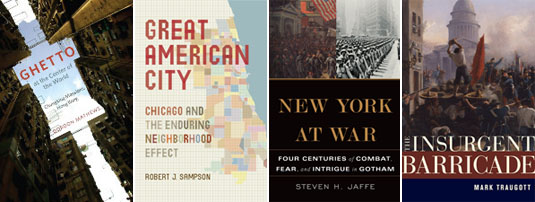
4) Ghetto at the Center of the World: Chungking Mansions, Hong Kong by Gordon Mathews (University of Chicago Press) — Mathews offers a kind of anthropological critique of globalization in the guise of architectural reportage, telling the story of Chungking Mansions, “a dilapidated seventeen-story commercial and residential structure in the heart of Hong Kong’s tourist district,” and using close descriptions of everyday life in the complex to build a cross-section of the global economy. “A remarkably motley group of people call the building home,” we read in the book’s own description: “Pakistani phone stall operators, Chinese guesthouse workers, Nepalese heroin addicts, Indonesian sex workers, and traders and asylum seekers from all over Asia and Africa live and work there—even backpacking tourists rent rooms. In short, it is possibly the most globalized spot on the planet.”

5) Great American City: Chicago and the Enduring Neighborhood Effect by Robert J. Sampson (University of Chicago Press) — Sampson’s very academic book—less narrative than statistical and analytic, and keenly based in empirical research—weighs the importance of community in defining, empowering, and uniting the city of Chicago, neighborhood by neighborhood.

6) New York at War: Four Centuries of Combat, Fear, and Intrigue in Gotham by Steven H. Jaffe (Basic Books) — Jaffe has written an incredibly interesting military history of New York City, beginning well before it was either New York or a city. Jaffe’s detailed accounts of early colonial battles and Revolutionary battlegrounds reveal the, to me, surprising number and topographic diversity of combat sites that dot the greater New York landscape. In the process, he offers little-known historical anecdotes—for instance, not only that Wall Street is so named after the defensive wall once constructed there, from one side of the island to the other, but that the wall was the first example of debt-financed urban infrastructure in what were then Dutch colonies. Jaffe’s look at a military urbanism peculiar to New York, from the 1600s to WWII to the security bollards of post-9/11 NYC, has proven hard to put down.

7) The Insurgent Barricade by Mark Traugott (University of California Press) — Traugott’s history of the barricade as a uniquely successful “technique of insurrection” is, first and foremost, a look at the spatial politics of the built environment. These politics operate in at least two primary, and clearly oppositional, ways, Traugott suggests. The first is the deliberate mis-use or counter-use of the city, transforming it into something that, through improvisatory re-design, can be express the political demands of an otherwise overlooked constituency. This is the production of barricades, which interfere with and strategically realign the internal movements of the city. The other side of this story, however, is the purposeful and systematic alteration of a city’s fabric precisely so that its everyday spaces cannot be used as outlets for political expression. In the latter example, streets can be widened or public spaces closely surveilled; in the former, makeshift tools and ad hoc materials, from cobblestones to wheelbarrows, can be transformed at a moment’s notice into walls that clog the city’s arteries and bring its streets to a halt. Traugott shows how all this has played out over more than four centuries of European urban history, also looking at what future spatial possibilities exist, on both sides of the barricade, for the political life of the metropolis.


8) Horseshoe Crabs and Velvet Worms: The Story of the Animals and Plants That Time Has Left Behind by Richard Fortey (Alfred A. Knopf) — Fortey is easily one of my favorite natural history writers, and his Earth: An Intimate History remains high on my list of recommended books. With this new book, Fortey takes on the question of survival—or super-survival—in creatures whose wildly successful evolutionary paths mean they have had a disproportionately deep effect on whole ecosystems still thriving today. This is “life’s history told not through the fossil record but through the stories of organisms that have survived, almost unchanged, throughout time,” in the book’s own words. The horseshoe crabs and velvet worms of the title are only two of the most-cited creatures in Fortey’s unsurprisingly enjoyable book.

9) The Prehistory of Home by Jerry D. Moore (University of California Press) — Moore starts things off with the unfortunate claim that “various animals build shelters, but only humans build homes,” an unprovable statement that belongs on the sadly endless pile of false comparisons made about humans and animals. Indeed, only four pages later, Moore himself writes that “we [humans] have been building homes longer than we have been Homo sapiens,” which can literally only be true if animals—that is, non-humans or non-Homo sapiens—can, after all, build homes, not just shelters, and have been doing so all along. In any case, this minor but by no means inconsequential quibble shouldn’t hold you back from enjoying Moore’s engaging history of the home—that is, the symbolically rich personal shelter—which he takes on a wide and exciting run from hand-woven walls and mud floors on the coast of Peru all the way to maximum security prisons, from Mesopotamian walled cities to gated suburbs, and from bachelor pads to underground “dwellings” built for the recently deceased in globally diverse burial practices. Part archaeological survey dating back, as Moore explains, to before humans were Human, and part speculative treatise as to why humans have an emotional need for homes at all, Moore’s book spans hundreds of thousands of years and nearly every continent.

10) The Last Imaginary Place: A Human History of the Arctic World by Robert McGhee (Oxford University Press) — McGhee, an archaeologist at the Canadian Museum of Civilization, “paints a vivid portrait of Viking farmers, entrepreneurial Inuit, and Western explorers” in their encounter with, and long-term settling of, the Arctic. Though the book has been out for several years, it just crossed my desk and I look forward to jumping in over the summer.

11) Rough-Hewn Land: A Geologic Journey from California to the Rocky Mountains by Keith Heyer Meldahl (University of California Press) — Meldahl’s book is, in its own words, “a 1000-mile-long field trip back through more than 100 million years of deep time to explore America’s most spectacular and scientifically intriguing landscapes.” Those landscapes are the western plateaus, mountains, and deserts of the southwestern United States, a region whose terrain now verges on the over-exposed—hardly a season goes by without a new book on the subject—but, as Meldahl suggests, “geology is stranger than fiction,” and the book he’s built around that statement is a worthwhile read.


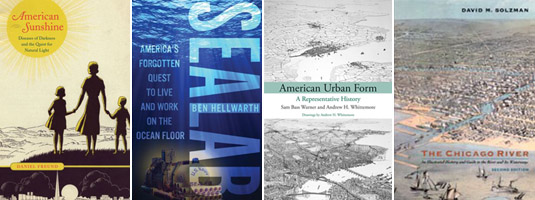
12) American Sunshine: Diseases of Darkness and the Quest for Natural Light by Daniel Freund (University of Chicago Press) — Freund’s book is a delightfully idiosyncratic look at the “quest for natural light” in American culture, from the earliest use of tanning beds as a kind of surrogate sun to the mainstream acceptance of “light therapy” as a cure for Seasonal-Affective Disorder, and from the marketing of climate tourism to the development of specialty lighting rigs for use in industrial food preparation. Freund explains in his introduction that the book was motivated by three otherwise unrelated historical figures—Akhenatan, Vitruvius, and Linnaeus—all of whom represent for Freund “the universality of sunlight as a subject for consideration.” The results are this unique look at the confluence of personal health, urban design, and near-religious popular beliefs about the purifying power of sunlight over roughly 150 years of American culture.

13) Sealab: America’s Forgotten Quest to Live and Work on the Ocean Floor by Ben Hellwarth (Simon & Schuster) — Hellwarth relates the surprisingly overlooked story of U.S. Navy “saturation divers” and the international oceanographers whose research helped to pioneer the construction of deepsea equipment and large-scale architectural environments that almost made living on the ocean floor an everyday reality. Equal parts tropical retro-futurism, complete with scenes of Jacques Cousteau assembling his Conshelf habitats in the Mediterranean Sea, and high-tech adventure story populated by military super-athletes and entrepreneurial gear manufacturers few of us even knew existed—including surreal high-pressure diving experiments involving presumably quite bewildered farm animals—Hellwarth’s book tells the true history of what have been (and what might still be) for human inhabitation of the oceans. Best of all, it’s almost entirely set in a quasi-utopian underwater world, like Archigram crossed with The Abyss.

14) American Urban Form: A Representative History by Sam Bass Warner and Andrew H. Whittemore (MIT Press) — Warner and Whittemore have produced an illustrated historical survey of U.S. urbanism, with short chapters ranging from “the city’s seventeenth-century beginnings” on the Atlantic coast to “the federally supported city” of the 1950s, ending with a somewhat obligatory overview of the “global city” and its suburban fringe. The book is a great introduction to the processes that have influenced and restrained urban development in the United States for more than three centuries, but it focuses more on presenting a coherent narrative—often reading more like a special issue of The Economist—as opposed to developing an original or otherwise surprising new interpretation of American urban form.

15) The Chicago River: An Illustrated History and Guide to the River and Its Waterways by David M. Solzman (University of Chicago Press) — Re-released in its current, second edition back in 2006, Solzman’s book will no doubt already be familiar to many readers of BLDGBLOG, but his history of the Chicago River, its ecological context and industrial re-engineering, complete with a hands-on guide for anyone who might want to explore it, was new to me.


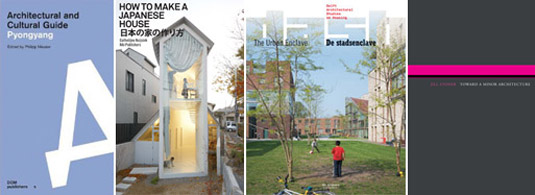
16) Pyongyang: Architectural and Cultural Guide edited by Philipp Meuser (DOM Publishers) — In print for less than three months, Meuser’s guide is already something of a cult classic in architectural circles, offering as it does a photographic and textual survey of the gonzo dictatorial postmodernism of Pyongyang, North Korea. A genuinely fascinating look at the political symbology of a capital city—Stefano Boeri’s memorable description of Pyongyang as a “rogue city” comes to mind—this slipcased, two-volume set offers “photographs and descriptions” in one book, including brief lessons on Pyongyang’s overall urban organization, and, in the other, what Meuser calls “background and comments.” These latter categories include—incredibly—excerpts from an architectural pamphlet written by the late Kim Jong-Il, who explains to his readers that, among other things, “architects are creative workers and operations officers,” spatially gifted functionaries of the State. Many of the photographs found in each volume can unfortunately resemble washed-out tourist postcards, and the buildings themselves are often striking for their super-ornamental, propagandistic absurdity—in a city whose natural setting makes it look oddly like Memphis, Tennessee—but to mock the city so easily and dismissively would be to miss the guide’s more interesting insight, which is that Pyongyang is, in fact, a remarkably assembled collection of processional spaces and monumental object-buildings, aesthetically arranged in a kind of 3-dimensional essay extolling the wonders of uncontested state power.

17) How to Make a Japanese House by Catherine Nuijsink (NAi Publishers) — Although architecture blogs have perfected the art of Japanese house fatigue over the past few years—in which it seems like a central server somewhere has been auto-feeding photos of small Japanese houses to the same design blogs over and over again every week—Nuijsink’s book is, refreshingly, a more substantive exploration of 21st-century domestic space in Japan, complete with one-on-one architectural interviews and occasional floor plans. Many of the projects you will already have seen online, but, given the breadth of context here, some great photographs, and three framing “monologues” written by architects Yoshiharu Tsukamoto, Taro Igarashi, and Jun Aoki, it more than justifies its publication.

18) Dash 5: The Urban Enclave edited and produced by Delft Architectural Studies on Housing (NAi Publishers) — Dash—not quite a magazine, more of a subscription book series—continued last autumn with this look at the “urban enclave,” which the editors have framed as an often progressively intended urban mega-project. These developments, both privately and publicly funded, can create what one of the book’s essays calls “a city-within-the-city” or a city “made up of miniature utopias”: social developments and architectural forms that appear, at first glance, to be entirely disconnected from one another but that, the authors argue, actually invigorate the city through these clear and obvious contrasts. The enclave offers—in fact, it does not let you avoid—”the proximity and the accessibility of ‘the other.'” Agree or disagree, it’s another well-produced issue in the ongoing Dash series, including an interesting look at Oswald Mathias Ungers’s notion of Grossform by historian Lara Schrijver, author of Radical Games.

19) Toward A Minor Architecture by Jill Stoner (MIT Press) — Stoner’s book looks to “dissect and dismantle prevalent architectural mythologies,” and to do so through a turn toward fiction—but the result is an often somewhat timid and unnecessarily academic entry in what should be a very rich conversation. Stoner relies too much on citations from the usual suspects found in your, mine, and everyone else’s thesis papers from the 1990s (Deleuze & Guattari, Walter Benjamin, Leibniz, Sigmund Freud, Italo Calvino, and even the now sadly over-exposed J.G. Ballard). But, having said that, it’s hard not to find pleasure in a book that takes, well, J.G. Ballard, Walter Benjamin, Sigmund Freud, Franz Kafka, James Joyce, and more—even the Berlin Wall—as fuel for a descriptive expansion of architecture into various other genres and media.


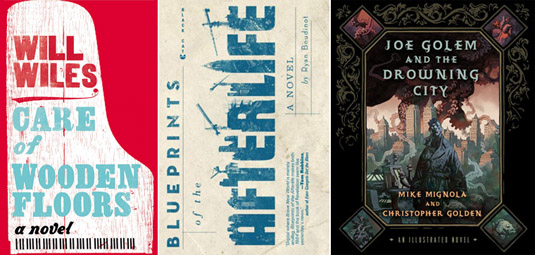
20) Care of Wooden Floors by Will Wiles (Amazon) — Many of you will recognize Will Wiles from his work as deputy editor of ICON magazine or his excellent though infrequent blog Spillway, but here he turns to fiction in a debut novel that tells the story of a man slowly going mad whilst house-sitting for a friend in Eastern Europe. From the book’s own description: “A British copywriter house-sits at his composer friend Oskar’s ultra-modern apartment in a glum Eastern European city. The instructions are simple: Feed the cats, don’t touch the piano, and make sure nothing damages the priceless wooden floors. Content for the first time in ages, he accidentally spills some wine. The apartment and the narrator’s sanity gradually fall apart in this unusual and satisfying novel.” The book has already been released in the UK, where it’s been receiving good reviews as a dark-humored “disaster novel,” but it’s not due out in the States until later this year, when it will become part of the first crop of books published directly and exclusively by Amazon.com.

21) Blueprints of the Afterlife by Ryan Boudinet (Grove Press) — Boudinet’s “bracingly weird new novel” has been receiving high praise and enviable comparisons for the author’s style, including to such writers as Philip K. Dick, William Burroughs, and Neal Stephenson, as Blueprints of the Afterlife picks up considerable buzz in the scifi/speculative fiction world. Fans of odd settings and spatial details will presumably appreciate the book’s “sentient glacier” or its “full-scale replica of Manhattan under construction in Puget Sound.” I’m looking forward to reading this while traveling over the next few weeks.

22) Joe Golem and the Drowning City by Mike Mignola and Christopher Golden (St. Martin’s Press) — It’s no secret that I’m a huge fan of Mike Mignola’s work, and his novelistic collaborations with Christopher Golden have so far been great, if not quite as gripping as Mignola’s own early Hellboy tales. Joe Golem tells the story of a flooded Manhattan, or, in the book’s own words: “In 1925, earthquakes and a rising sea level left Lower Manhattan submerged under more than thirty feet of water, so that its residents began to call it the Drowning City. Those unwilling to abandon their homes created a new life on streets turned to canals and in buildings whose first three stories were underwater.” The results, set 50 years after the flooding, are somewhere between H.P. Lovecraft and Central European urban folklore, featuring occasional black and white drawings by Mignola.

* * *

All Books Received: August 2015, September 2013, December 2012, June 2012, December 2010 (“Climate Futures List”), May 2010, May 2009, and March 2009.

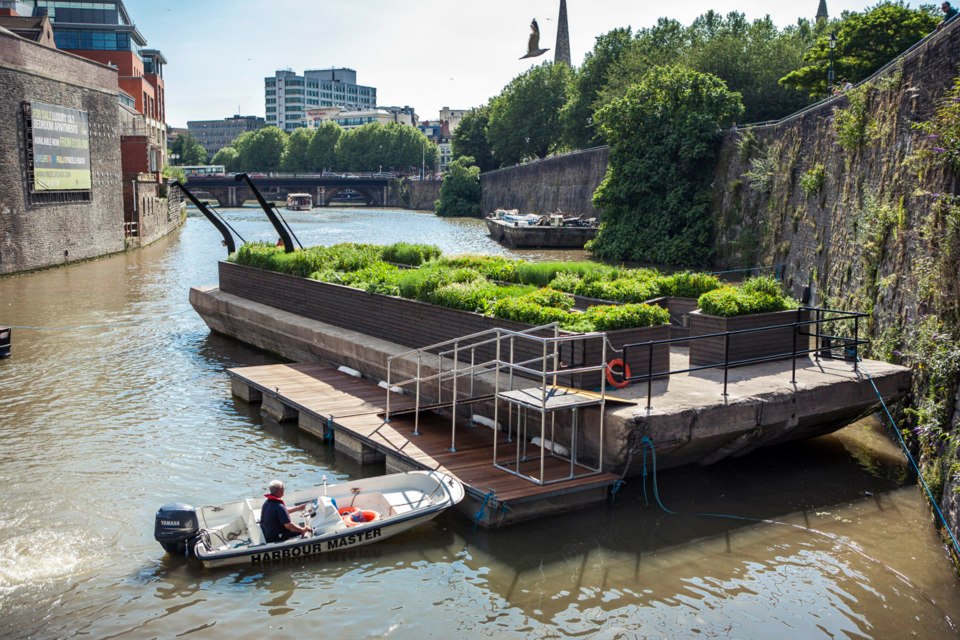
Forensic Flowers

Two quick botanical stories in the news:

1) A short piece in The Scientist profiles artist Macoto Murayama, who “began applying the computer graphics programs and techniques he had learned while studying architecture at Miyagi University of Education in Sendai to illustrate, in meticulous detail, the anatomy of flowers.”

[Image: A flower by Macoto Murayama, via The Scientist].

Murayama physically dissects flowers in his studio, uncovering what he calls their “hidden mechanical and inorganic elements”; he then “sketches what he sees, photographs it, and models it on the computer using 3dsMAX software, a program typically used by architects and animators. Finally, he creates a composition of the different parts in Photoshop, and uses Illustrator to add measurements and other labels.” See more at The Scientist.

2) Archaeologists in Israel have used pollen trapped in plaster to reconstruct a “luxurious garden created by the Persians.” Their method reads like a rejected pitch for Jurassic Park 4: “Using a specialised technique for separating fossilized pollen trapped in the layers of plaster found in the garden’s waterways, researchers from Tel Aviv University’s Sonia and Marco Nadler Institute of Archaeology have now been able to identify exactly what grew in the ancient royal gardens of Ramat Rahel. By examining the archaeological evidence and the likely settings of specific plants they have also been able to reconstruct the lay-out of the garden.”

The hydrologically complex landscape, as reimagined by the archaeologists, was able to support a huge variety of species, including “ornamentals such as myrtle and water lilies, native fruit trees including the grape vine, the common fig, and the olive and imported citron, Persian walnut, cedar of Lebanon and birch trees. Researchers theorize that these exotics were imported by the ruling Persian authorities from remote parts of the empire to flaunt the power of their imperial administration.”

It would be interesting to reconstruct Central Park based solely on pollen grains trapped inside the painted walls and debris-filled lobbies of ruined hotels of a semi-submerged New York City 2,000 years from now. A Nobel Prize in Landscape Forensics.

(See also: Detection Landscapes).