The Unified Lunar Control Network

[Image: Lunar topography, courtesy of the USGS].

The Unified Lunar Control Network is “a set of points on the lunar surface whose three dimensional selenodetic coordinates (latitude, longitude, and radial position) have been determined by careful measurement. Typically the points consist of very small craters.” This network forms a series of cardinal points that can then be used to orient, fix, and control our topographic understanding of the moon—in a sense, lunar variants on terrestrial coordinate systems such as the trig stations of New Zealand, “a network of control marks that serve as physical reference points.”

As it happens, there is quite a long history of temporary “lunar control networks,” most of which have simply faded into cartographic obsolescence. For instance, you can read this brief “Chronology of Lunar Control Networks.” It includes such phrases as the Apollo Zone Triangulation, the Manchester Selenodetic Control System, the Kazan Series, and the Clementine Control Network—a taxonomic graveyard of discarded geographies, these lost trigonometries of the moon.

(Thanks to Jon Rennie for pointing out trig stations to me a few weeks ago).

The Road Printer

A few hours ago, we looked at the exoatmospheric potential of 3D printers in space, but what about road-printers here on our own home planet, printing brick & cobblestone streets through rural villages?

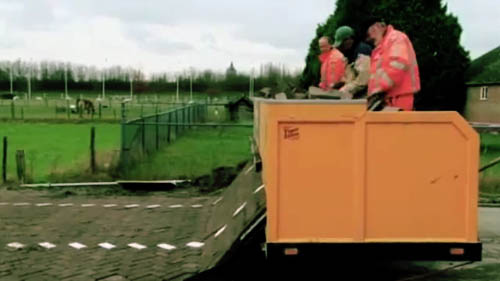
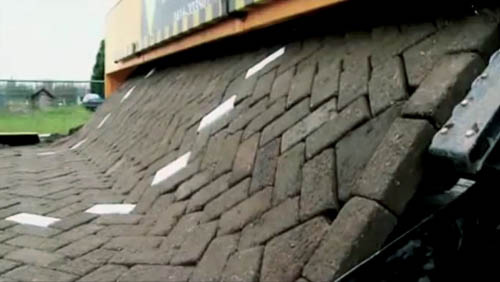
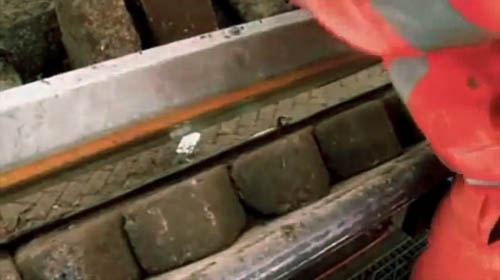
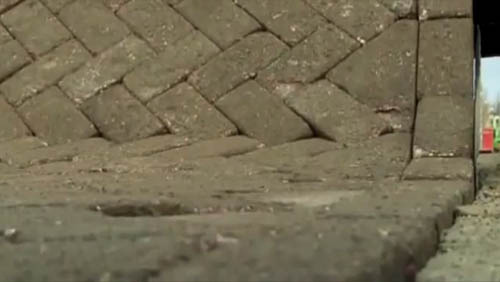
[Image: From the video, which appears below, showing the laying of so-called Tiger Stone].

As it happens, a new street-printing device—unfurling a geological substrate known as Tiger Stone, as orderly and as easy “as laying laminate flooring”—can neatly place brick roads where there weren’t roads before.

Here’s a video of the “printer” in action:

After you’ve watched this footage, of course, it becomes immediately clear that it is inaccurate to refer to this technology as a literal or genuine act of “printing,” but it’s nonetheless provocative to imagine a world where roads can be created, as if from an inkjet printer, directly from the vehicles that travel on them.

In China Miéville’s book Iron Council, readers follow the path of a vehicle called the “Perpetual Train.” It operates by laying its own tracks as it moves forward, hauling in the road it travels upon only to unfurl it again seconds later, tank-like, pushing deeper into landscapes that would once have been impenetrable. It is a route that drives itself, moving, as Miéville writes, on “downlaid and uptaken rails,” whereby “the roadbed is extended, the tracks laid through, taken up again,” always cycling, again and again forward, on “rails, newly renewed,” their own context, “meandering.”

The road-printing vehicle featured in the video above clearly presents no such utopia, but it does offer at least a domesticated variant on Miéville’s mobile perpetuity, bringing roads to distant towns in a single afternoon. What is the geographical status of the road that, itself, can travel?

(Thanks to Jon Bucholtz for the tip!)

Gold is the Metal

[Image: Gold nanoparticles, courtesy of Georgia Tech].

It was reported earlier this month that “gold nanoparticles can induce luminescence in leaves.” That’s right: glowing trees. The scientists who discovered it call it bio-LED.

According to ElectroIQ, “by implanting the gold nanoparticles into Bacopa caroliniana plants, Dr. Yen-Hsun Su [of the Research Center for Applied Science in Taiwan] was able to induce the chlorophyll in the leaves to produce a red emission. Under high wavelength of ultraviolet, the gold nanoparticles can produce a blue-violet fluorescence to trigger a red emission of the surrounding chlorophyll.”

This has the exquisitely surreal effect of being able “to make roadside trees luminescent at night”—with the important caveat “that the technologies and bioluminescence efficiency need to be improved for the trees to replace street lights in the future.” In other words, we’re not quite there—but a deciduous splendor might illuminate streets near you, soon.

[Image: Gold nanoparticles, courtesy of Georgia Tech].

Last spring, I should point out, I had the pleasure of teaching a research seminar at the Pratt Institute in Brooklyn, looking at blackouts: that is, landscapes—both urban and otherwise—encountered in a state of unexpected darkness.

We looked at a huge variety of technologies for non-electrical illumination—sources of light for situations in which electricity has failed—from tools as basic as pocket lighters to openly whimsical investigations into bioluminescent fish, plants, algae, and bacteria, scaled up to intimations of an entire bioluminescent metropolis.

But the idea that trees impregnated with gold might someday line city streets, turning night into day, is like a vision of Gustav Klimt unexpectedly crossed with Con Edison: a botanical alchemy through which base wood becomes light at the speed of photosynthesis.

(Via Popular Science; earlier: Three Trees).

Printheads in Space

[Image: The International Space Station, courtesy of NASA, via PopSci].

Space offers a quick look at the possibility that we might someday print space stations into existence in orbit.

A seemingly website-less company called Made in Space “wants to launch 3-D printers into orbit and use them to make parts for spacecraft and space stations, which would be assembled in zero gravity.” They would do this using “thin layers of ‘feedstock,’ which can be metal, plastic or a variety of other materials.” Even better, when parts break down, they’d simply be recycled back into future printed components: “Rather than shuttling a replacement part from Earth to a space station, 3-D printers aboard the station could simply crank out whatever’s needed. And the broken part could be recycled into feedstock.”

Of course, this is not entirely different from earlier visions of using radically exported 3-D printers to construct bases in situ on the moon’s dusty surface (using “lunar concrete“)—albeit, here, there is even less gravity to work with and a much more urgent need to plan for the availability of future construction material.

As it happens, a few years ago I was speaking with a concept artist who had worked on some of the earliest (and eventually unused) design proposals for Avatar; these included, he explained, plans for elaborate 3-D printers that would be used by the military in order to establish a rapid forward-operating base architecture on that alien world.

In a way, though, this is simply the microgravitational realization of BLDGBLOG’s earlier proposal for permanently installing 3-D printers inside perpetually incomplete works of architecture so that they can self-expand and internally reorganize over time.

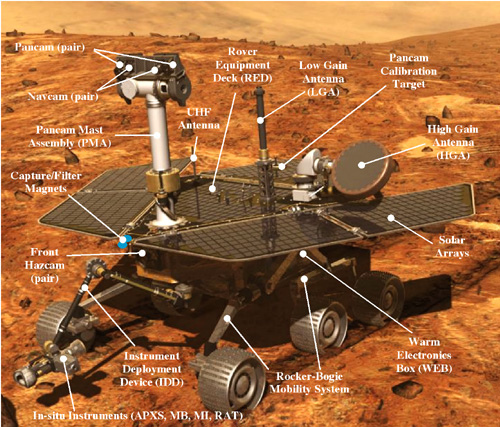
[Image: Mars rover and its gadgets, courtesy of NASA].

This would seem to lead to the question of why 3-D printers, even absolutely tiny ones, aren’t already being included on Mars rover missions in order to test the validity of these architectural ideas; why pack only cameras and chemical sensors and their like on these offworld robots when you could add some kind of robust printhead assemblage? If you could put enough printheads on Mars, say, scattered around like totem poles, some of them could even be rented out as design studio equipment for experimental classes at Georgia Tech or the AA. What, then, would be the implications for the future of Mars archaeology, when the impulse toward heritage management will include artificial constructions on other worlds?

Having said all this, of course, architect Mark Hogan pointed out on Twitter this morning that “3d printing sounds so promising but the printed objects often still look like real-world low-res 3d bitmaps”—sobering, to be sure, but the idea of lo-fi, dot-matrix-quality space stations orbiting the planet, passing over continents and tropical island chains and glinting with distant starlight at 2 in the morning as insomniacs gaze up at the sky, actually seems even more endearing. And, I’ll admit, I have something of a mystical attachment to the possibilities of 3-D printing.

Fast, cheap, and out of control—and coming soon to a sky or offworld near you—these 3-D printers, like tubes of semi-sentient toothpaste, will extrude their low-res geometries, where 8-bit objects meet outsider art, as platforms for the future of human exoplanetary civilization.

(Via Popular Science).

Critical Condition

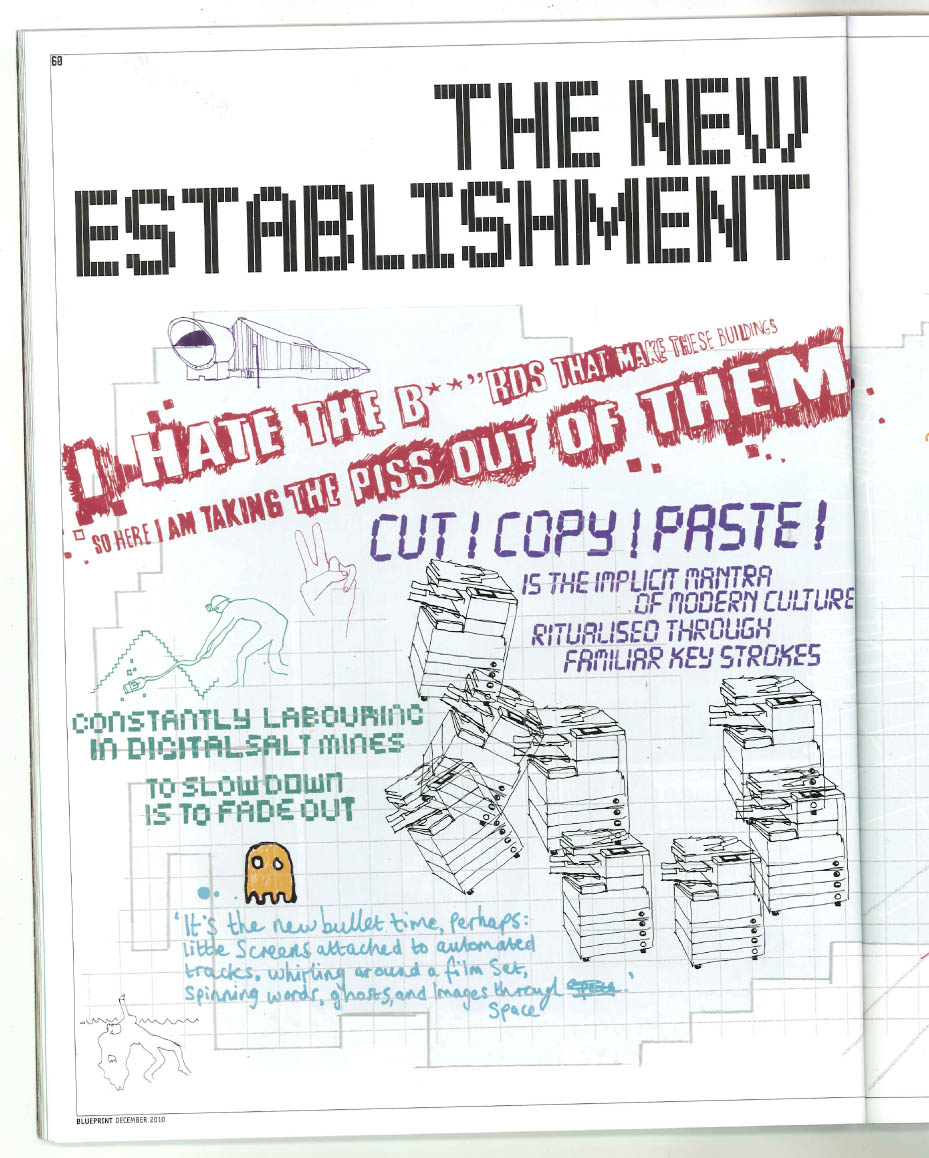
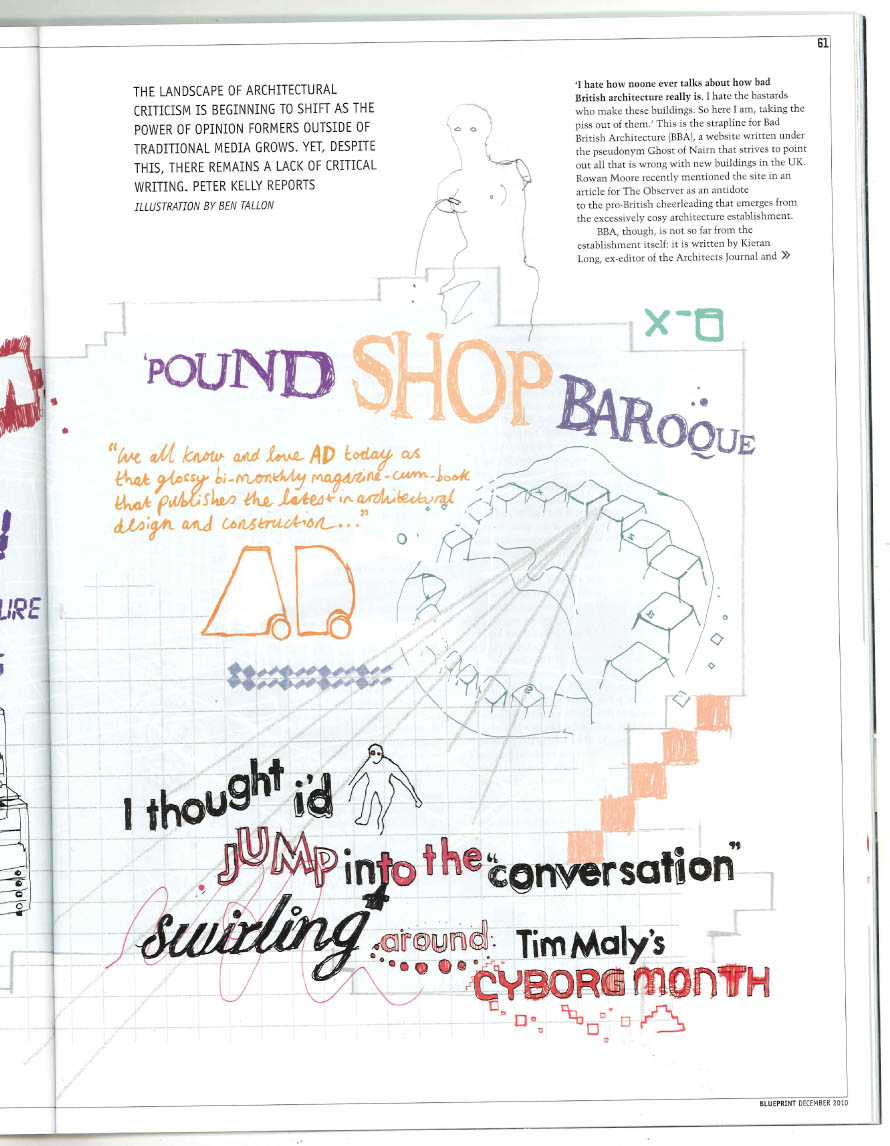
[Image: “The New Establishment” by Peter Kelly, courtesy of Blueprint].

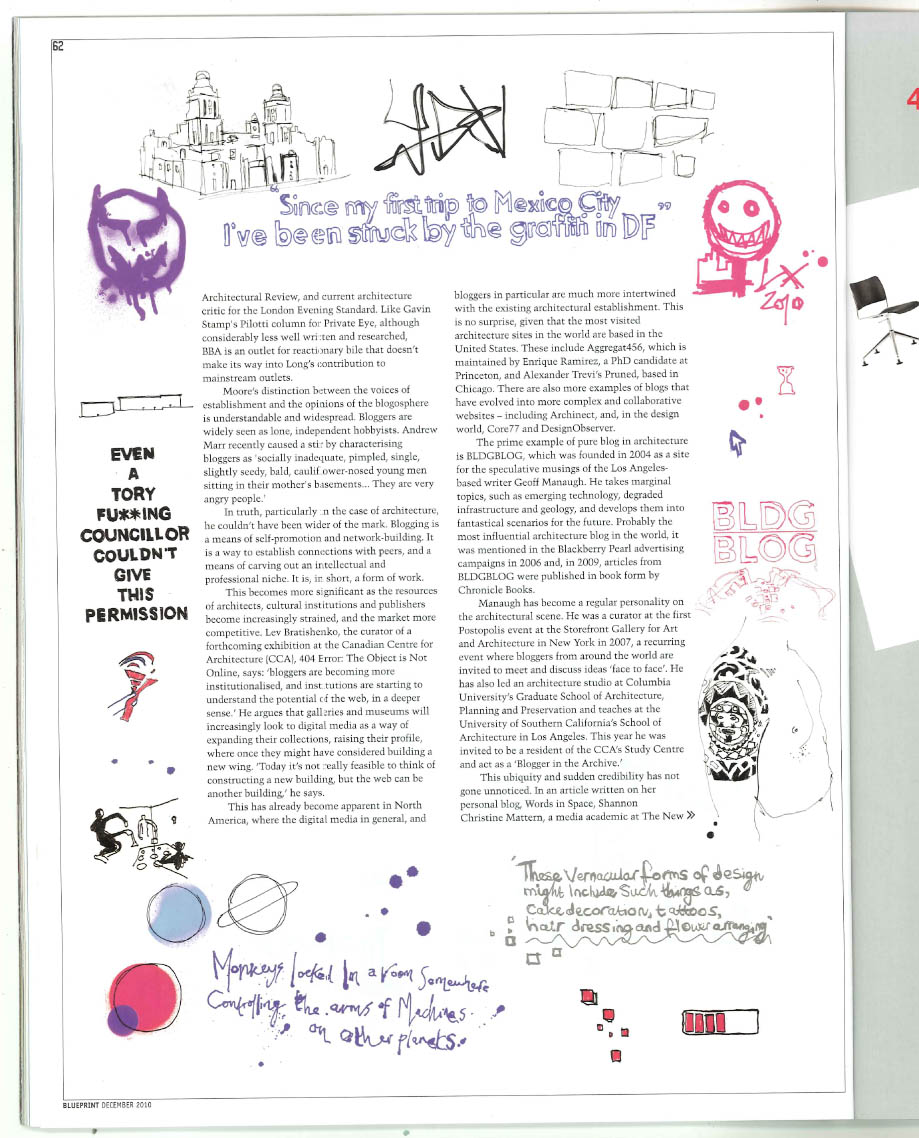
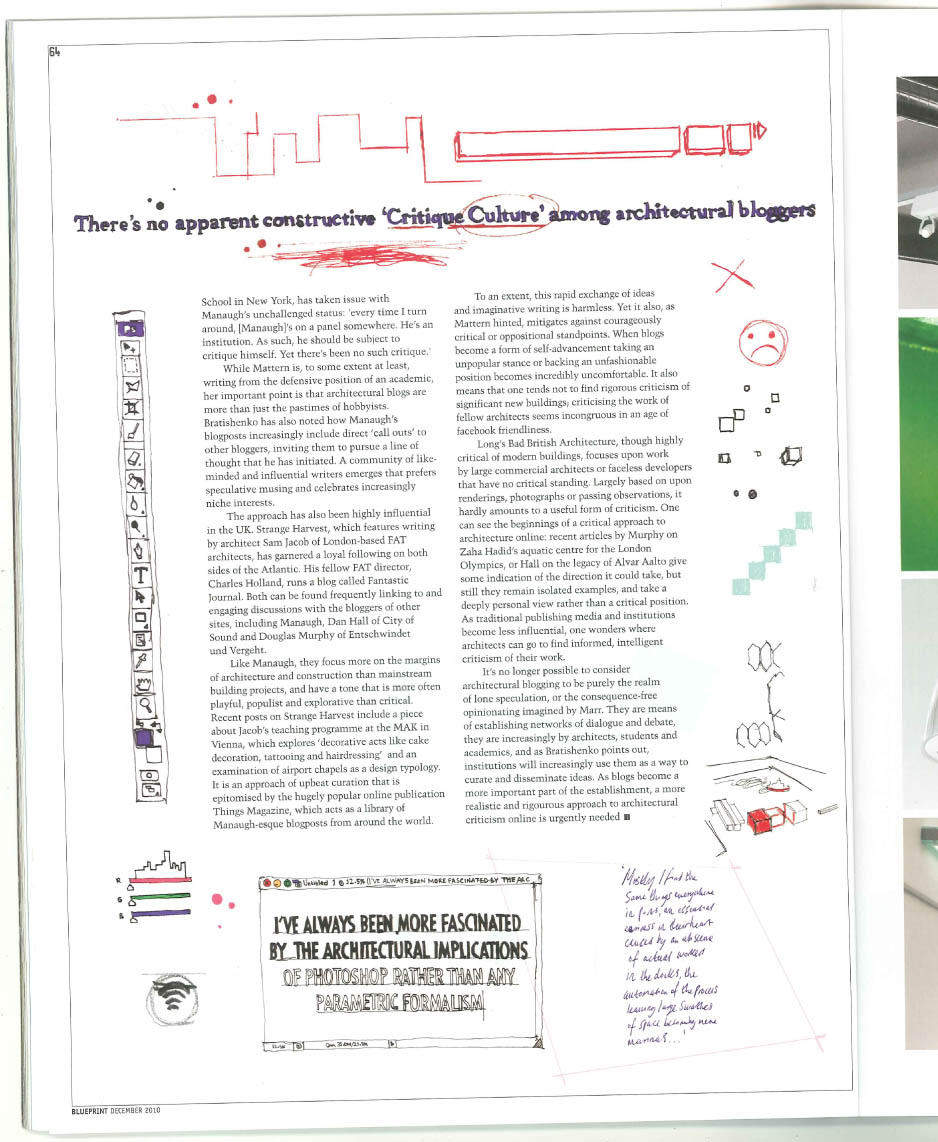
There’s an interesting and provocative article in the most recent issue of Blueprint called “The New Establishment,” by Peter Kelly. In it, Kelly takes issue with the lack of formal criticism in architecture blogging today, writing that “one tends not to find rigorous criticism of significant new buildings” on sites such as Strange Harvest, things magazine, and BLDGBLOG.

Instead, he suggests, a “like-minded” community of writers has arisen, one “that prefers speculative musing and celebrates increasingly niche interests.” He adds, with not a small shade of foreboding, that, “as blogs become a more important part of the establishment, a more realistic and rigorous approach to architectural criticism online is urgently needed.” After all, “As traditional publishing media and institutions become less influential, one wonders where architects can go to find informed, intelligent criticism of their work.”

These are absolutely valid points. I agree wholeheartedly that a more vigorous critique of the built environment is needed, as it will always be; I’ve said this before, in fact, and I have not changed my mind since then. Infrastructure, the growth of police power in urban space, pedestrianization and mass transit schemes, improved access to cultural institutions, the politics of military landscapes, healthy housing projects, aging and the city—all of these topics need more coverage and broader public discussion. Kelly is right to suggest as much.
[Image: “The New Establishment” by Peter Kelly, courtesy of Blueprint].

But what I find deeply confusing about Kelly’s article is that, rather than read websites or blogs which do, in fact, offer “criticism of significant new buildings,” as he puts it, Kelly specifically and only focuses on websites that claim to do nothing of the sort (with perhaps one exception: Kieran Long’s Bad British Architecture).

As such, Kelly’s article feels a bit like listening to someone who’s just spent two weeks looking around the classical music section only to come out complaining that he couldn’t find any death metal. Well, no shit: you were in the wrong section, and it’s your mistake not ours.

In fact, it is illogical to assume that, because this site in particular is more likely to post about topics like weaponized climate modification, Greek mythology, strange infestations, narrative film, haunted house novels, paleontology, and so on, rather than about a new suite of renderings released by Rem Koolhaas, or a new museum in outer Rome, that I am therefore uninterested in seeing buildings and their architects held accountable to rigorous standards of design. As it happens, I am very interested in that; I just don’t tend to write those pieces myself.

To draw an analogy, Kelly seems to be assuming that, because someone plays guitar, they must be willfully obstructing the careers of people who instead play saxophone. Kelly, in this context, plays saxophone; he wants a bigger audience for people who play saxophone; so he writes an article not critiquing other people who play saxophone but deliberately selecting a group of guitar players so that he can make the obvious point that they don’t play sax—and this is what passes for serious architectural criticism? No wonder its audience has evaporated.

What amazes me about these sorts of critiques of blogging—and they are becoming more and more common and predictable today, now that interest in academic architectural discourse has faded (if there was ever interest in it) in favor of other, more energetic, unapologetically interdisciplinary writing styles—is that these critics are actually complaining about the lack of something they themselves purport to do.

Put another way, writers like Kelly are complaining about the unacknowledged side-effects of their own inadequacy as architecture critics. If they had actually known what they were doing in the first place, then people would never have lost interest in “rigorous criticism of significant new buildings.”

That is, speaking directly to Peter Kelly, if you want to see a more vigorous critique of real buildings, then, by all means, go ahead and show us how it’s done. Make it popular again. Find an audience for that type of writing and cultivate it. Convincingly demonstrate the power of the genre you so openly wish to celebrate.

But for Kelly to complain that BLDGBLOG doesn’t tour Alice Tully Hall, for instance, and offer constructive feedback for the architects is like complaining that Point Break doesn’t have anything to say about the design of the High Line, or that The Hobbit lacks exegetical interludes about the theories of Walter Benjamin—but neither of those things are about that, and they’re not without value because of it. They are, we might say, valued otherwise: performing an altogether different cultural function than the one whose absence Kelly mourns.

In fact, it’s a serious methodological flaw for critics like Kelly to read only the blogs that aren’t about building criticism—he cites BLDGBLOG, Pruned, Tim Maly’s Quiet Babylon, and so on—in order to make the point that today’s blogosphere is lacking in building criticism. Talk about shooting your own skeet. It’s not only lazy, it’s tautological and it betrays a total lack of commitment to original research.

To use another musical analogy, it’s like listening to smooth jazz for six years and then complaining that not one of those songs had vocals by Dave Mustaine—well, you were listening to the wrong kind of music.
[Image: “The New Establishment” by Peter Kelly, courtesy of Blueprint].

Pointing out that BLDGBLOG doesn’t offer traditionally recognizable formal criticism of the built environment misses the fact that the modus operandi of this blog is all but precisely not to do that. Indeed, this blog is and always has been very consciously about architecture and landscape in a representationally broad sense: exploring how spatial environments appear in film, literature, mythology, games, dreams, and comics, and to write about the otherwise radically under-reported side-effects of buildings and cities, from freak local weather systems and invasive species to psychiatric disorders and rodents. In fact, I would say that BLDGBLOG has never claimed to be a place “where architects can go to find informed, intelligent criticism of their work.” I don’t want to do that; that is not my goal as an architecture writer. But that doesn’t mean—nor does it in any way imply—that I don’t want to see other writers successfully demonstrate how that sort of criticism is done.

Again, to address writers and critics such as Kelly: you all have had so long to prove your point about the value of serious architectural research. You claim absolute, if not unique, critical priority for a style of architecture writing that you yourselves fail to produce in any convincing manner, and you’ve failed to find any real audience for the very thing you are hoping to promote. Even now, you have blogs, zines, pamphlets, international magazines, Ph.D. funding, radio shows, whole university departments, conferences, and teaching opportunities at your disposal. You can make documentaries for the BBC. Your words and ideas should speak for themselves.

With that in mind, how exactly is your failure to find an audience—indeed, even to find more writers like yourselves willing to write this stuff, surely a damning absence if there ever was one—the fault of a loose group of bloggers who prefer “speculative musing” and “increasingly niche interests”? What exactly are you saying here—that we are Katy Perry to your Shostakovich? Is that a universally negative thing?

To use a wildly overblown historical metaphor, it’s a bit like seeing a lost group of battle-shocked British troops suffering from amnesia as they wander down the streets of Philadelphia in the summer of 1778, asking, in all seriousness, why there isn’t more British influence on display. But one of the reasons we came here in the first place was to get away from people like you.
[Image: “The New Establishment” by Peter Kelly, courtesy of Blueprint].

In any case, having said all that, I want to reiterate that I actually agree with the underlying premise of Peter Kelly’s article: that we need more direct and engaged criticism of the built environment. This is true, and Kelly is right. We need more Christopher Hawthornes and fewer Nicolai Ouroussoffs. We need more Matthew Coolidges and fewer Philip Jodidios. We need the next J.G. Ballard.

But until architecture critics can find a way to make formal building criticism interesting, entertaining, emotional, funny, adventurous, sexy, or thrilling, it—and its popular appeal—will languish. If people like Kelly can’t bring it upon themselves to reinvigorate their chosen discipline, then it’s not the fault of Sam Jacob or Alex Trevi if they fail. We’re back to the saxophone/guitar thing: what you need to do, Peter Kelly, is learn to play your saxophone so well that everyone else stops liking guitar; you can’t just complain about successful guitar players. Or, in market-speak: put us guitar players out of business by offering the world better music. If you can do something amazing, then I want to hear it, too.

Consider this an open appeal, then, to all architecture critics unnecessarily scared of blogs: produce the texts you want us to read & study. Find writers working in the genre you’re actually talking about and constructively team up with them to promote good and rigorous criticism. Use multiple media. Cast your net wide. Don’t assume that to entertain is to lose critical insight. Remember that sometimes the most “significant new buildings” in public life today are not museums and concert halls, but film sets and game environments.

Indeed, Alex McDowell is a more influential architect than David Chipperfield, which means covering McDowell’s work is not just fringe speculation. Grand Theft Auto generates more conversations about crime and the city than the writings of Adolf Loos, which means discussing GTA is not just self-indulgent musing.

After all, there is absolutely no reason in the world why we can’t have blogs that “celebrate increasingly niche interests” alongside blogs that offer “rigorous criticism of significant new buildings”—in fact, there is no reason in the world why a single blog couldn’t simultaneously perform both functions. It would be a dream to read.

Imagine a world, then, where critics like Peter Kelly actually step up and demonstrate how to do the things they so enjoy pointing out as lacking in others. If they could succeed at this—and find an audience, and push an agenda, and gather influence, and raise the stakes of what it means to be an architecture blogger—then we would all, as writers and readers and builders, be stronger because of it.

And, if they don’t succeed—if they can’t pull it off—then they should do better than to pin the blame on others.

Vent Stack

[Image: The Holland Tunnel Land Ventilation Building, courtesy of Wikipedia].

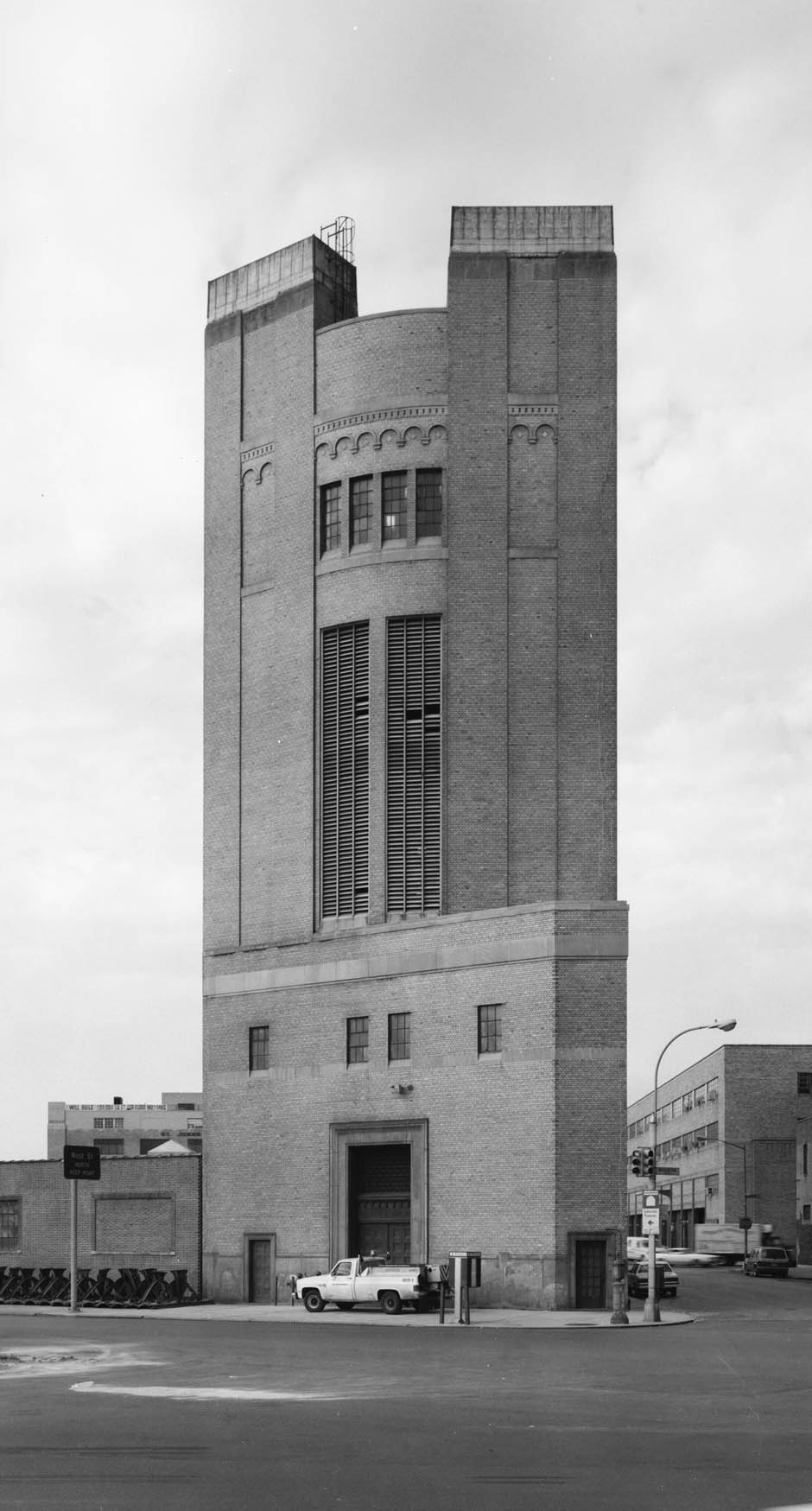
As described in this PDF, Holland Tunnel has four ventilation structures:

The four ventilation buildings (two in New Jersey and two in New York) house a total of 84 fans, of which 42 are blower units, and 42 are exhaust units. They are capable, at full speed, of completely changing the tunnel air every 90 seconds.

David Gissen briefly explores the architecture of NYC tunnel vents in his book Subnature, opening a window onto the architecture of subterranean weather generation, where unseen machines suck whole atmospheres from the depths of the city. Perhaps we’ll even read someday that New York’s ongoing rash of tornadoes includes a few rogue climate systems belched forth from these vent stacks on the autumnal banks of the Hudson (or perhaps not).

Bridge & Tunnel

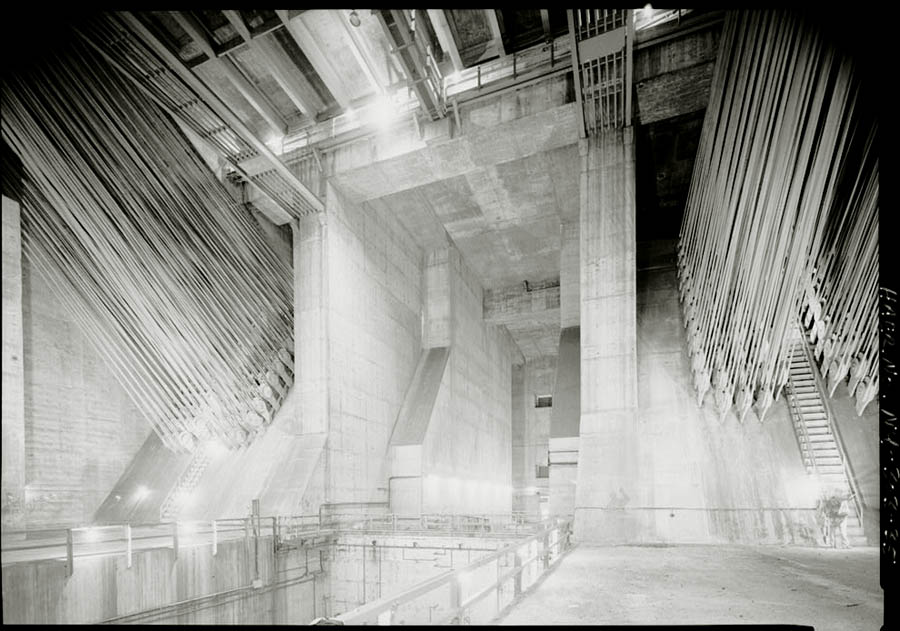
[Image: The harp-like cabled insides of a New York bridge footing interior, courtesy of the Library of Congress].

Back in 2004, Cryptome offered a carto-photographic look at the bridges and tunnels of New York City, relying on some gorgeous photos taken from the Historic American Buildings Survey (HABS) and the Historic American Engineering Record (HAER) of the U.S. Library of Congress.

That link is particularly worth seeing, however, in the context of this recent interview with Stanley Greenberg, published last week on Urban Omnibus. As Greenberg says, “I think the city is a huge organism, only some of it visible, and we inhabit it, change it, get changed by it. But there is so much of it that I don’t know”—so much of it still undiscovered, including infrastructure often invisible for the fact that it stands proudly in plain view.

An Invisible Empire of Sidewalks and Gutterspace

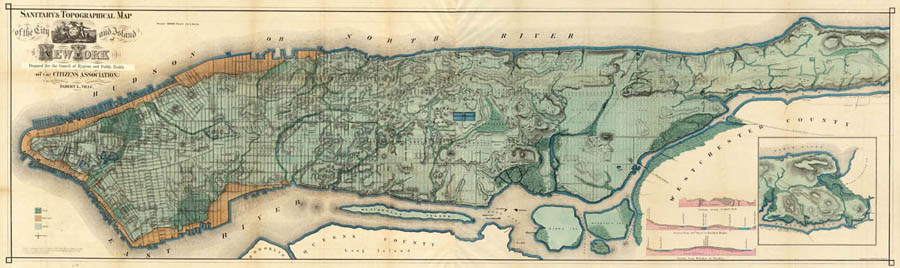
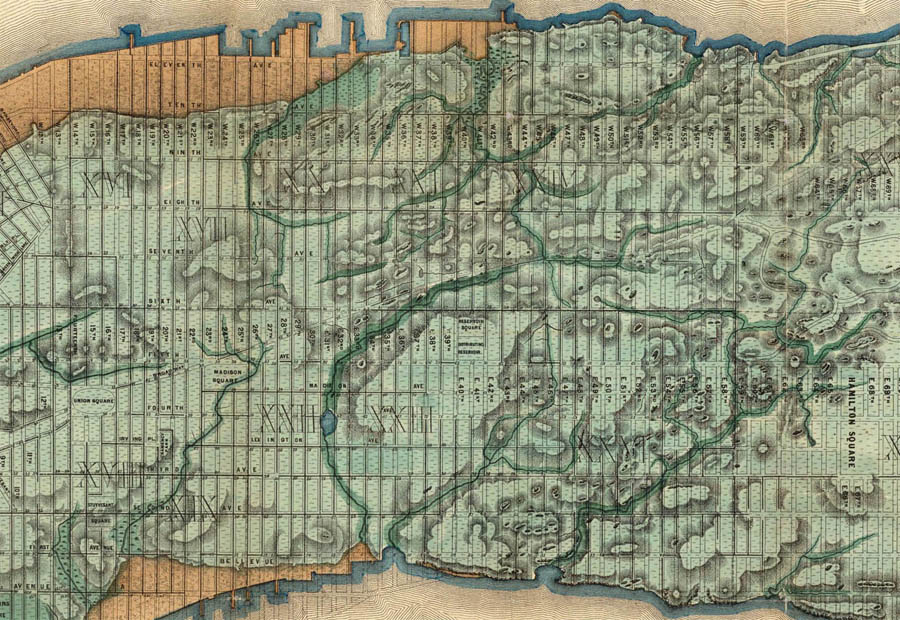
[Image: The Viele Map].

Because of a talk I’ll be giving tonight at the USC School of Architecture with Nicola Twilley of Edible Geography, I found myself re-reading an old post here about fishing in the basements of Manhattan.

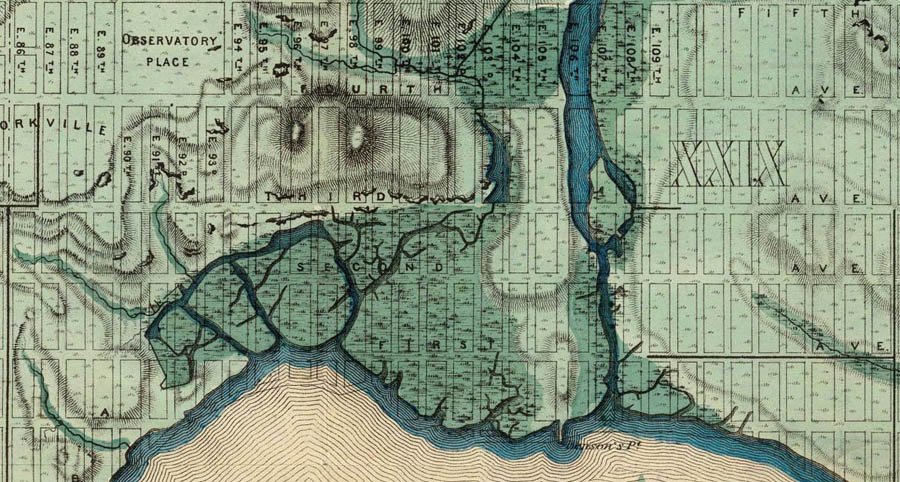
[Image: The Viele Map].

Manhattan being an island once thoroughly criss-crossed by ponds and streams, almost all of which have been sealed in concrete and turned into sewers, this somewhat hallucinatory theory goes that some of those streams might still be accessible: just smash down through your building’s basement floor, uncover the island’s lost hydrology of well-braided rivers and streams, and an angling paradise will be accessible at your feet.

[Image: The Viele Map via Kottke.org].

But what really caught my eye, and what I’m actually posting about here, is a “gutterspace” reclamation project inaugurated by a man named Jack Gasnick, something I rediscovered today after following a link at the end of that post, which leads to the long-defunct blog Urbablurb by Giles Anthony.

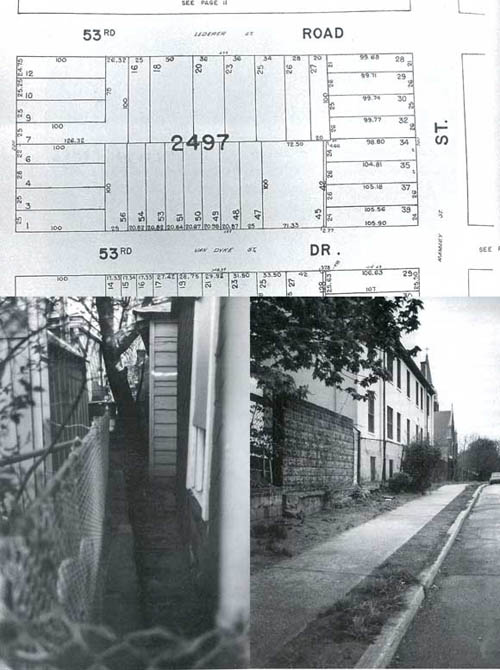
[Image: From Gordon Matta-Clark’s Fake Estates, via Free Association Design].

This is how Anthony describes Gasnick’s project:

In the early 1970s—unbelievably, given how influential Gordon Matta-Clark has become in the last few years—Gasnick began buying and collecting “gutterspace,” or small slivers of land left over from zoning or surveying errors. He said that after a little while he couldn’t stop: “It’s like collecting stamps; once you’ve got the fever, you’ve got the fever.”

Accordingly, Gasnick “bought a slice in Corona just behind Louis Armstrong’s house,” Urbablurb continues, “a piece near Jamaica Bay where he once filled a pail with sea-horses, and yet another adjacent to the Fresh Kills landfill where he claims an abandoned sea Captain’s house still stood.” Gasnick then cultivated small patches of parkland and wilderness within those areas—a micro-wilding of the metropolis, one site at a time: “On the weekends, he would sometimes drive out to the tiny parcels and help the milkweed and laurel grow, tend to the turtles, and sit down for a picnic. ‘This jump of mine from flower pot to apple tree bears witness to the fact that it doesn’t cost much for an apartment-living guy to get a share of the good environment,’ he wrote in 1974. To be exact, it cost between $50 and $250. But the taxes he had to pay were enough of a hassle that he gave away (or otherwise lost track of) all the pieces by 1977.”

He “lost track” of them—the mind reels at the possibility that there is still a distributed Jack Gasnick estate somewhere, peppering the streets and gutters of New York City.

As Anthony suggests, this all has an uncanny parallel in Gordon Matta-Clark’s Fake Estates project. From Cabinet magazine:

In the early 1970s, Matta-Clark discovered that the City of New York periodically auctioned off “gutterspace”—unusably small slivers of land sliced from the city grid through anomalies in surveying, zoning, and public-works expansion. He purchased fifteen of these lots, fourteen in Queens and one in Staten Island. Over the next years, he collected the maps, deeds, and other bureaucratic documentation attached to the slivers; photographed, spoke, and wrote about them; and considered using them as sites for his unique brand of “anarchitectural” intervention into urban space.

So who is Jack Gasnick, that minor New Yorker who once “bought strange-shaped lots in every borough,” as the New York Times reported back in 1994, when Gasnick was still alive and 74 years old, and who once claimed to fish in the basements of Manhattan? Who knows.

(The BLDGBLOG/Edible Geography presentation tonight at USC is at 6pm in Harris Hall; it’s free and open to the public. We’ll be talking about buried rivers, artificial glaciers, and quarantine, among other shared topics of interest).

Honeycomb Home

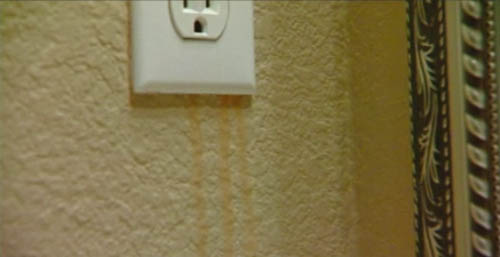
[Image: Honey drips from the electrical sockets of a home in California; courtesy of KSBW].
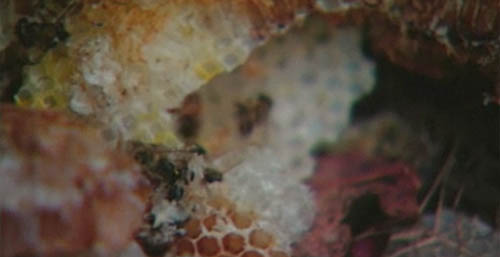
A single-family home in California has been “invaded” by bees—so much so that honey is now leaking from the electrical outlets, coming “from a giant beehive behind the walls.”

When the owner reached into one of the house’s vents to investigate this growing apian problem, he pulled out “honeycomb after honeycomb after honeycomb,” according to news channel KSBW.

[Image: A close-up of the honeycombs now tormenting a family in California; courtesy of KSBW].

The vents are droning; honey is flooding the interior of the house; and the owners are exactly one month past the cancellation of their builders’ warranty, meaning that the problem is not only quite expensive, it is entirely up to them to solve.

The same owner is now justifiably worried that the house will become infested with honey-hungry ants.

It is infestation after infestation after infestation, we might say—though I suppose ants are a better fate than being infested with bears.

Ages ago, though, we saw that foreclosed homes have become an alternative ecological niche for mountain lions, and even now that unused—and undrained—suburban swimming pools are breeding grounds for West Nile-infected mosquitoes; the possibility that still-inhabited architecture could become the target of these and other strange infestations puts a uniquely worrying spin on the subject.

Liquid Radio

Could temporary jets of seawater be used as functioning radio antennas? Apparently so: as PopSci reports, “communications are vital” for vessels at sea, but deck space for “all the large antennas necessary for long-range (and often encrypted) communications” can be hard to come by. “So U.S. Navy R&D lab SPAWAR Systems Center Pacific (SSC Pacific) engineered a clever scheme to turn the ocean’s most abundant resource into communications equipment, making antennas out of geysers of seawater.”

Using arcing vaultworks of oceanwater, like domesticated waves, to beam and receive encrypted telecommunications not only reduces the metal-load of ships—thus also reducing the radar profile of military vessels—it also offers a way to construct “a quick, temporary antenna that could just as easily be dismantled.”

What they [SPAWAR] came up with is little more than an electromagnetic ring and a water pump. The ring, called a current probe, creates a magnetic field through which the pump shoots a steam of seawater (the salt is a key ingredient, as the tech relies on the magnetic induction properties of sodium chloride). By controlling the height and width of the [stream], the operator can manipulate the frequency at which the antenna transmits and receives. An 80-foot-high stream can transmit and receive anywhere from 2 to 400 mHz, though much smaller streams can be used for varying other frequencies, ranging from HF through VHF to UHF.

Turning seawater into a temporary broadcast architecture is absolutely fascinating to me and has some extraordinary design implications for the future. Pirate radio stations made entirely from spiraling pinwheels of saltwater; cell-phone masts disguised as everyday displays spurting seasonally in public parks, from Moscow to Manhattan; TV towers replaced with Busby Berkeley-like aquatic extravaganzas, camouflaging the electromagnetic infrastructure of the city as a gigantic water garden.

[Image: A mountainous display of women closely choreographed with water by Busby Berkeley, via Alexander Trevi’s Pruned].

Given some salt, for instance, the Trevi Fountain could begin retransmitting mobile phone calls throughout the heat-rippling summer landscape of greater Rome. Ultra-refined specialty saltwaters offer dependable signal clarity in audio HD. La Machine de Marly becomes a buried industrial art project, beaming death metal salt hydrologies to garden visitors: a continuous fountain of thundering music on FM, headbanging to seawater hifi. Espionage conspiracies involving elaborate, deep-cover radio links hidden inside public fountains.

So how could this be further explored in the contexts of tidal river waters—Thames Radio!—rogue waves, and even tsunamis? The artistic, architectural, musical, and infrastructural misuse of this technology is something I very much look forward to hearing in the future.

Holocubic Animations in 3D Narrative Space

[Image: From “Don’t Trip” by Calvin Waterman].

For his final thesis project at the Rhode Island School of Design, recent graduate Calvin Waterman produced a project called “Don’t Trip.”

[Image: From “Don’t Trip” by Calvin Waterman].

The project “explores the relationship between written prose and illustrated scenarios,” Waterman explains, as it zooms into specific spatial episodes in the lives of five characters.

There are thus five specific buttons a viewer can push, each of which corresponds to one of these characters: “When one of the five character buttons is pressed a version of that character’s scenario is chosen from a database of possible outcomes.” It is a choose-your-own-adventure cube of light, a projection whose contents are partially decided by viewer interest.

[Images: From “Don’t Trip” by Calvin Waterman].

Waterman achieves the installation’s disorientingly holographic visual effect, as you can see in these photographs, using a white cube inside of another half-cubic projection area in the lower corner of a room; the smaller cube supports a sort of projection inside the projection, amplifying the resulting image’s apparent 3D.

That smaller cube is a burning stove in one character’s life, an ambulance in another, an ominous train tunnel in another, and so on.

[Image: From “Don’t Trip” by Calvin Waterman].

A larger version of this, perhaps installed atop a billboard cantilevered next to the roadway, would be interesting to see, offering pseudo-holographic variations on future signage. Or flip it upside-down and you’ve got surfaces for virtual ornament on the corners of existing buildings.

The materials used, Waterman says, include MAX/MSP/JITTER, Arduino, a five-button circuit, projector, computer, foam board, 15 thirty-second animations, inkjet prints, and fluorescent light.

Check out a short film of the installation over on Vimeo.

[Vaguely, but not really, related: Urban Greenscreen].