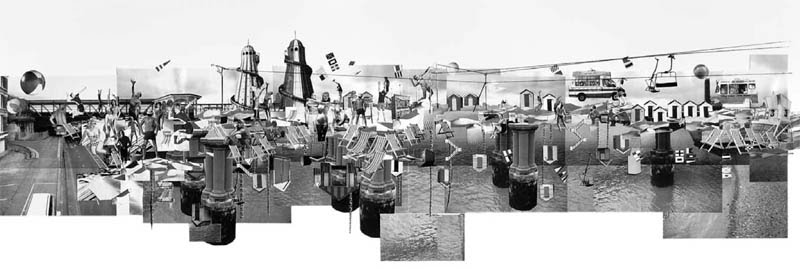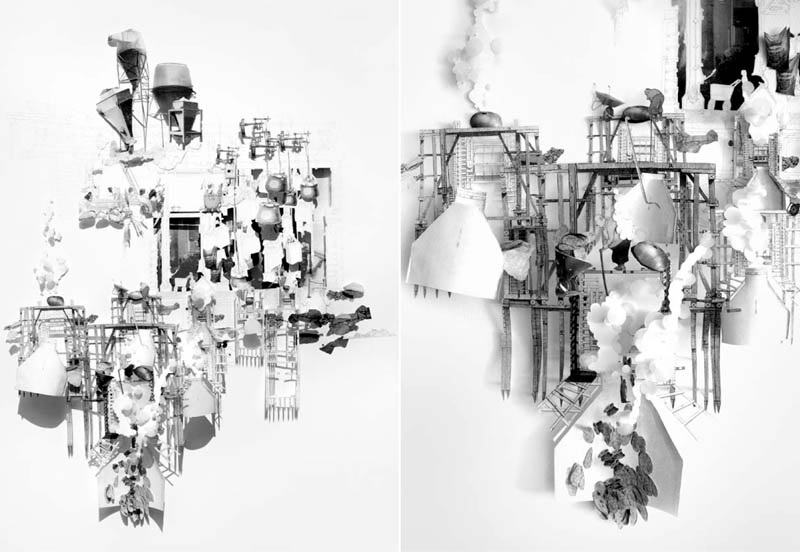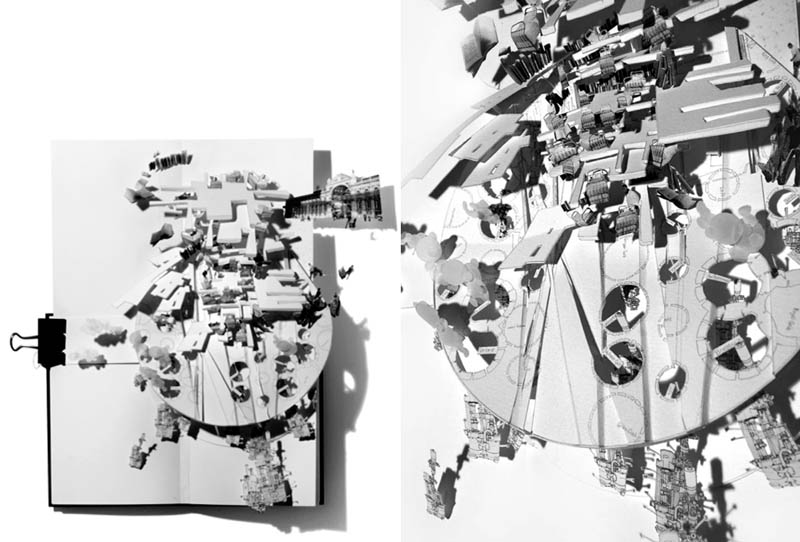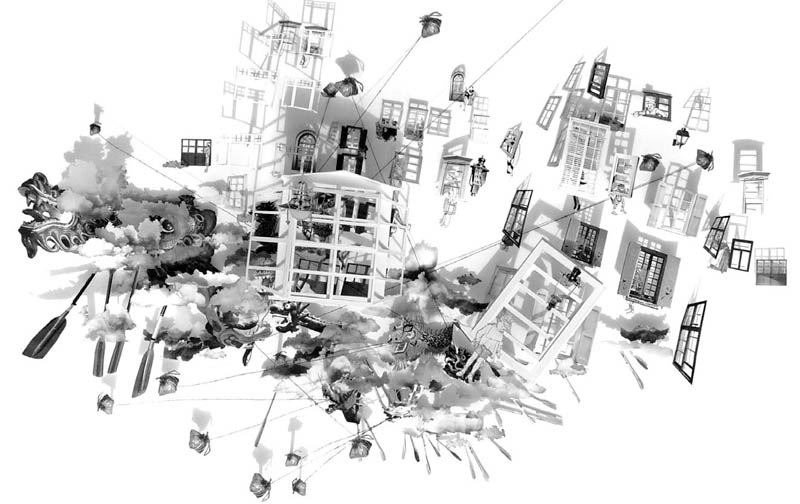
Canal Street Cross-Section

[Image: From Canal Street Cross-Section by Alan Wolfson].

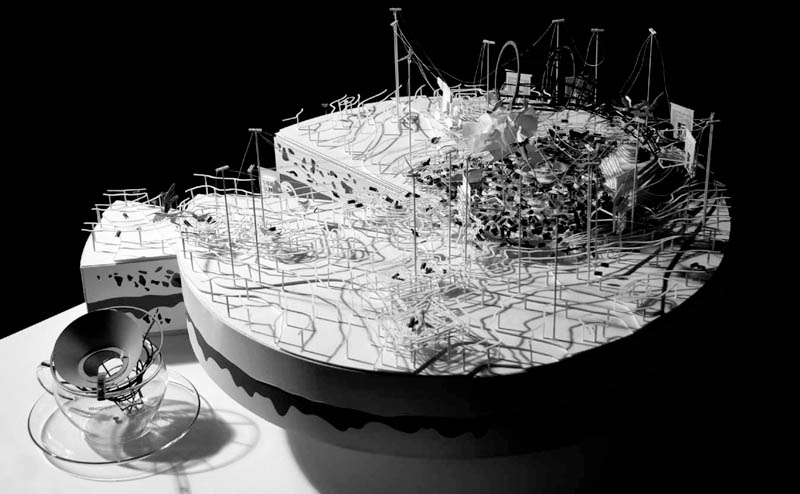
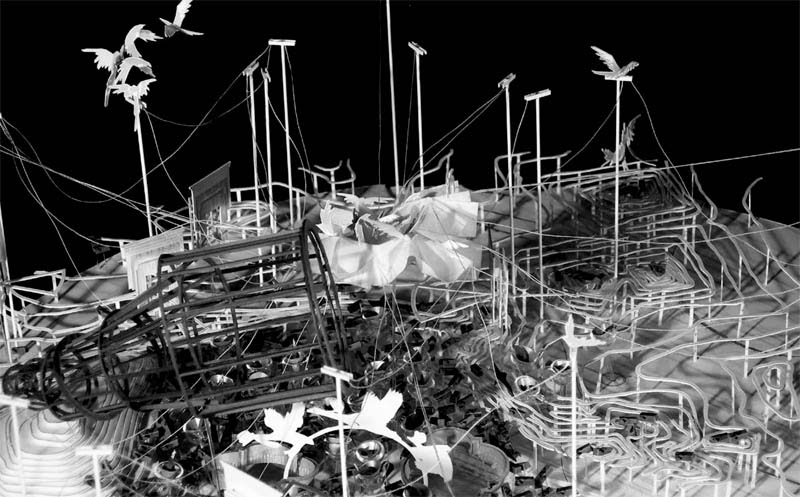
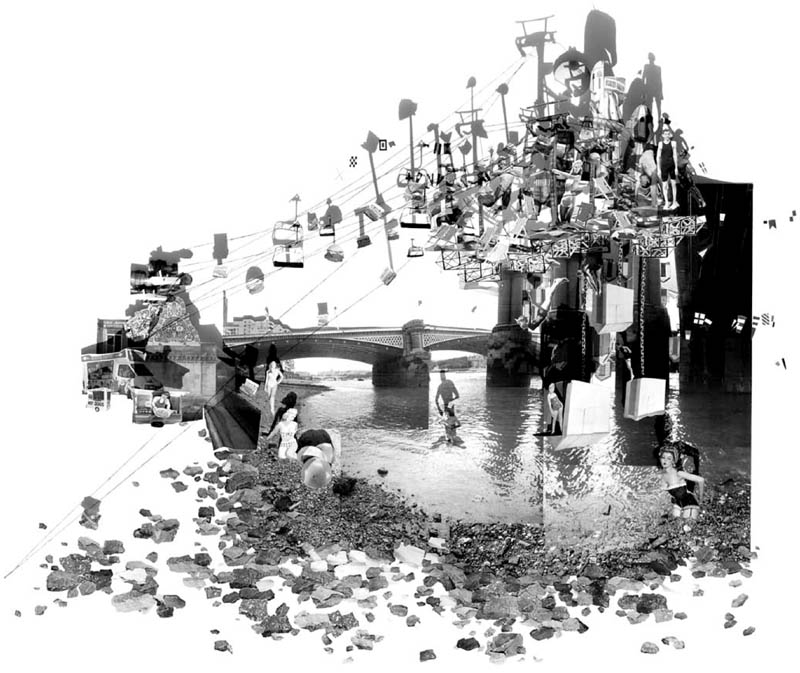
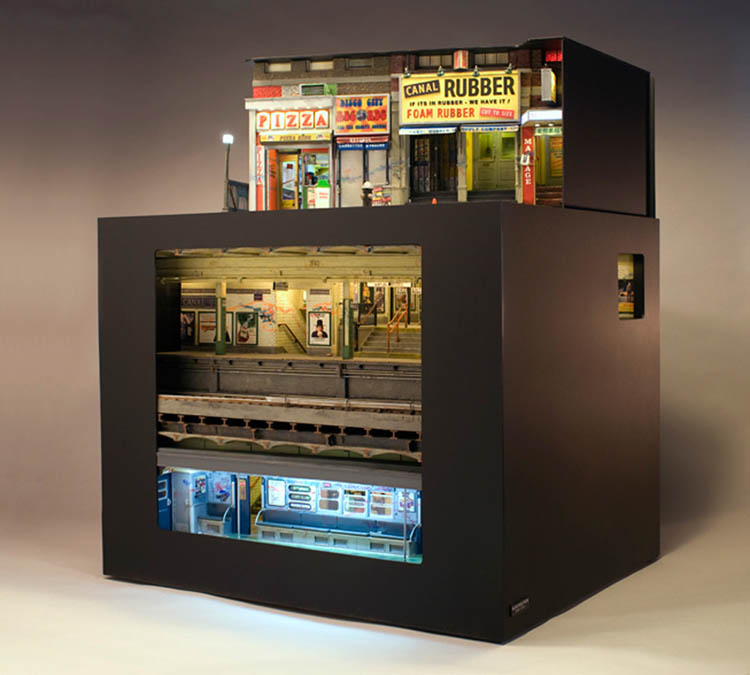
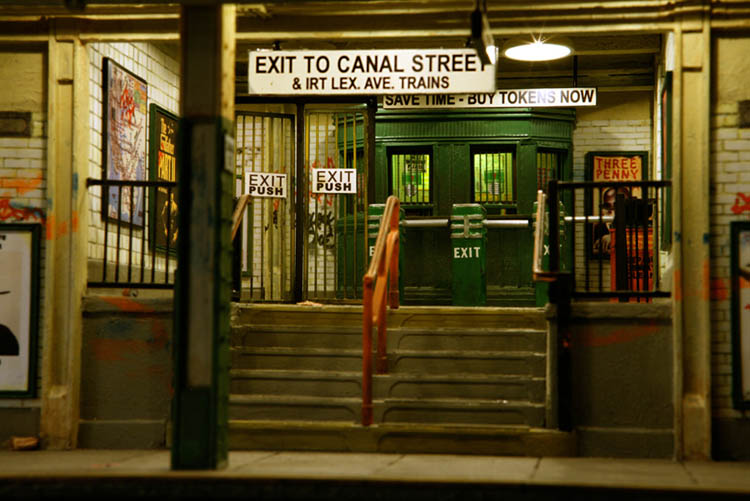
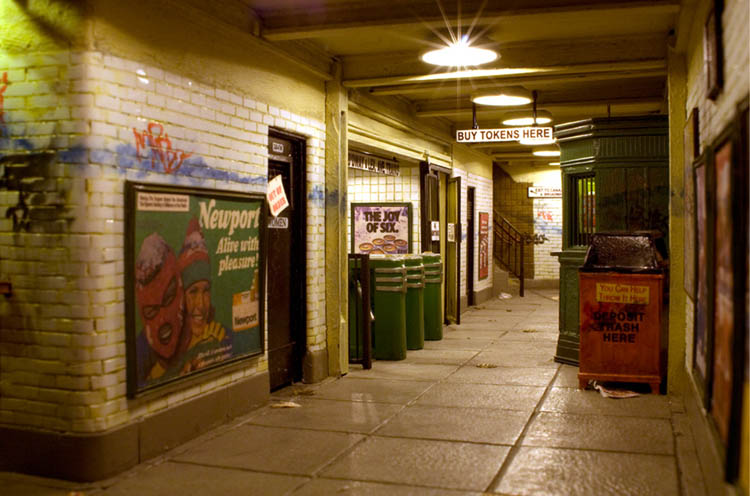
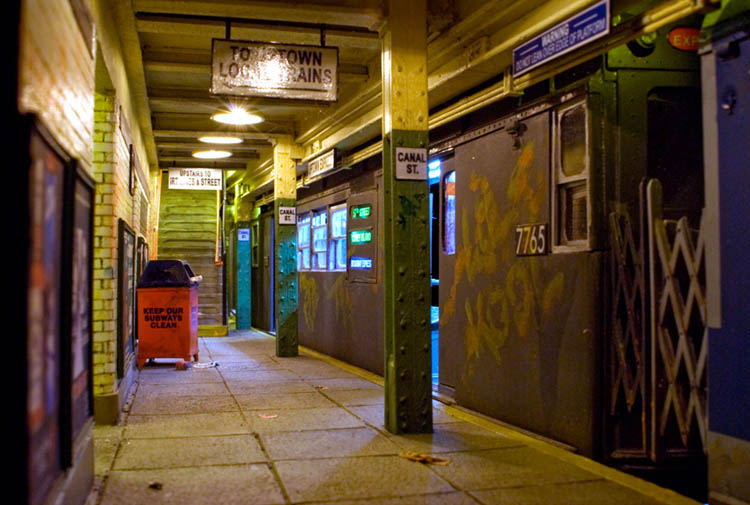
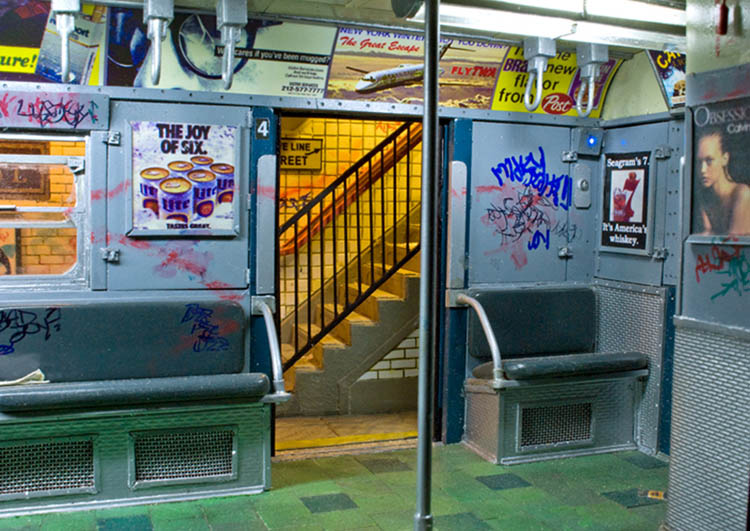
Alan Wolfson’s Canal Street Cross-Section, a miniature depiction of the New York street and subway station, will be on display this summer as part of the forthcoming group exhibition, Otherworldly: Optical Delusions and Small Realities, at the Museum of Arts & Design in New York, starting 7 June.

[Images: From Canal Street Cross-Section by Alan Wolfson].

Wolfson explains that he “wanted to build a piece that resembled a core sample of a city street. As though you took a street, dug it up, and lifted it straight off the earth.”

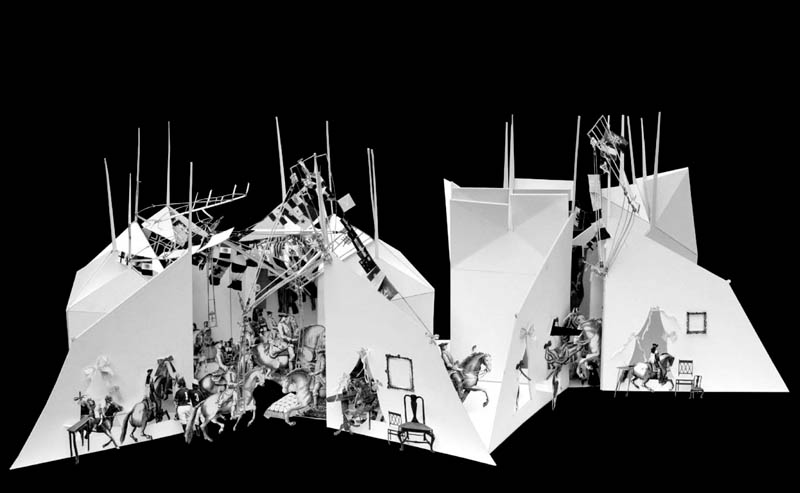
The resulting urban core sample has the look of a toy oven or vending machine—as if, in the latter case, we could someday just a few quarters into a streetside machine and walk away holding complete miniature rooms, intact down to their ads and posters, extruded from some kind of self-replicating master-model.

[Image: From Canal Street Cross-Section by Alan Wolfson].

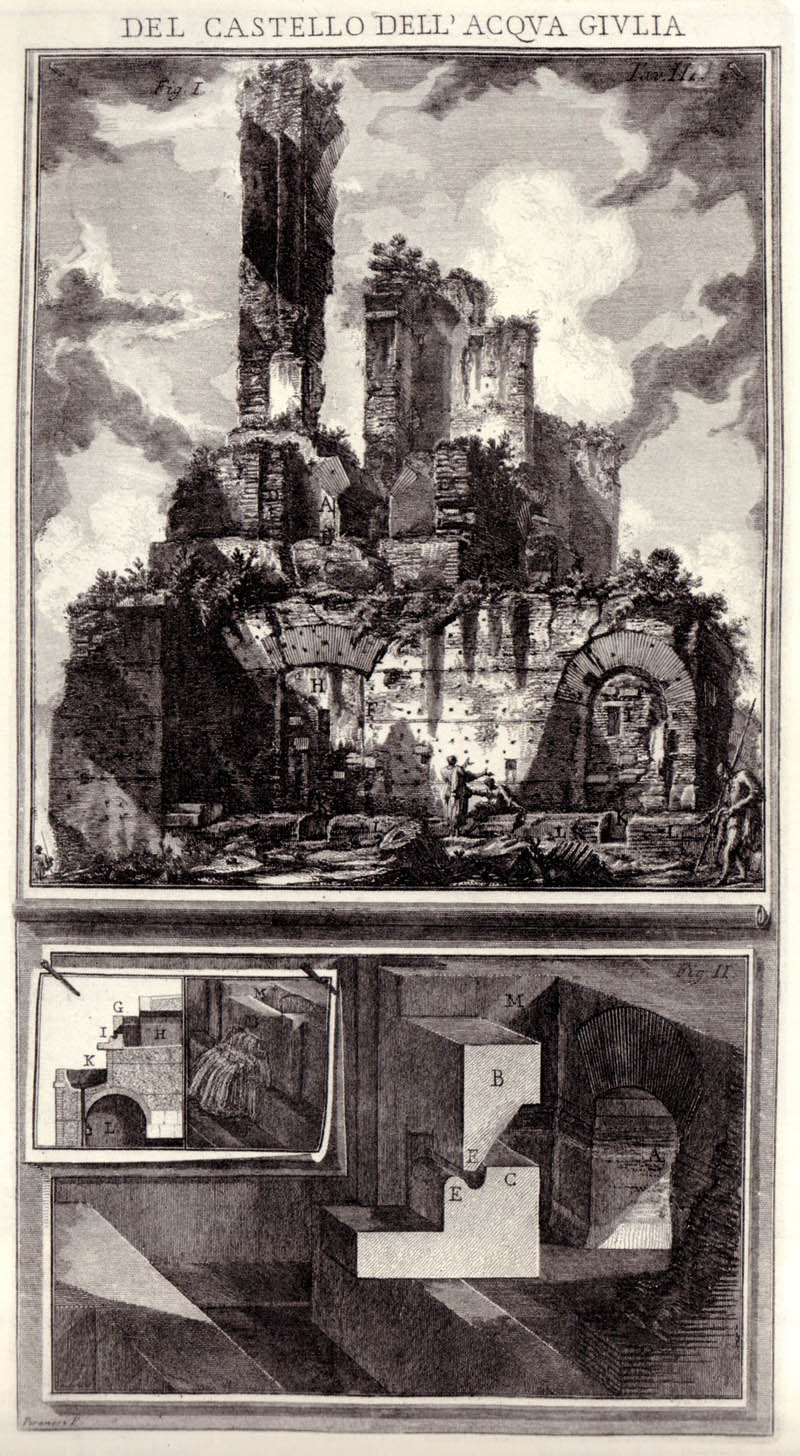
“The problem,” as he explains it, “was to make all that architecture work together and make sense visually. I was able to do that by having windows on the sides of the piece to accommodate the cross views. I gave the subway platform a sense of depth by using a carefully placed mirror at the far end. As with almost all of my projects, the sight lines were critical.” The piece, we might say, required a kind of Piranesian optical correction so that all its cross-angles and counterviews could be spatially comprehensible.

You can see many, many more photographs of Canal Street Cross-Section over on Wolfson’s website, as well as dozens of other, often quite incredible “miniature urban sculptures,” as the artist describes them.

(Spotted via Thomas Pollman and Joe Alterio; earlier on BLDGBLOG: Romecore).

Time, Photography, and Spatial Devices

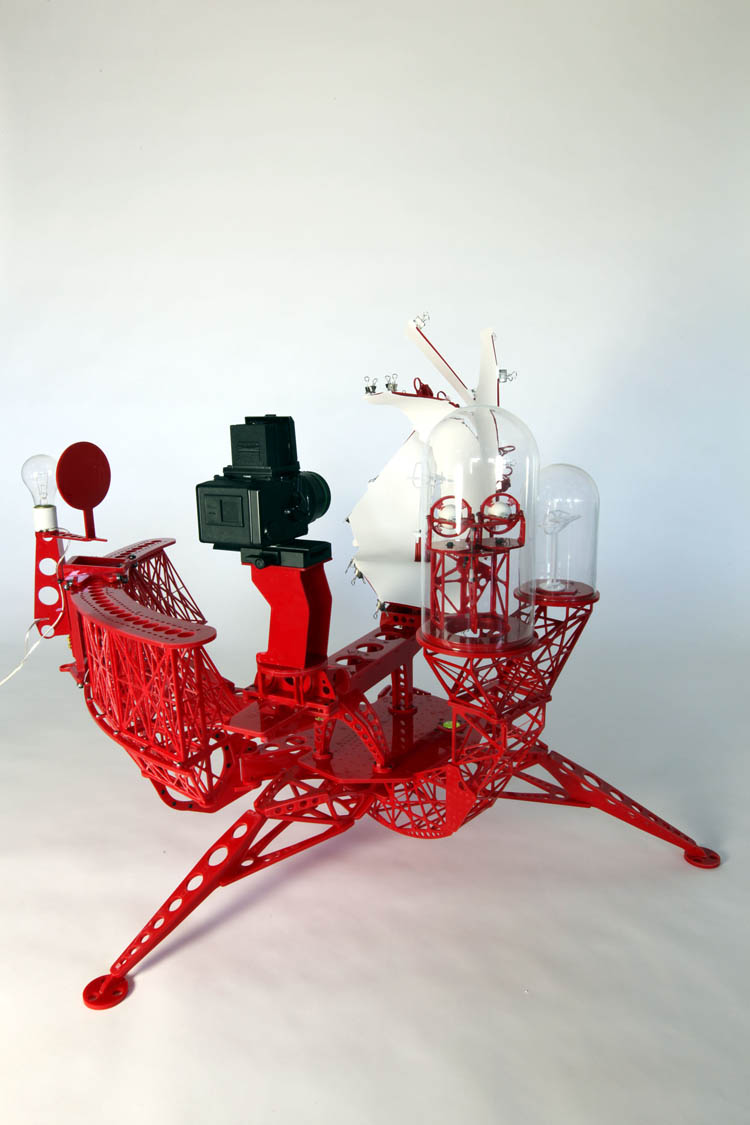
[Image: From the “Bird Automata Research Test Track” by Nat Chard].

Fabricate is underway over in London, wrapping up in only a few hours (read a bit more about it here).

One of the conference’s many speakers is Nat Chard, from the University of Manitoba, who recently got in touch with some fantastic project images, showing mechanisms and devices of various functions and scales.
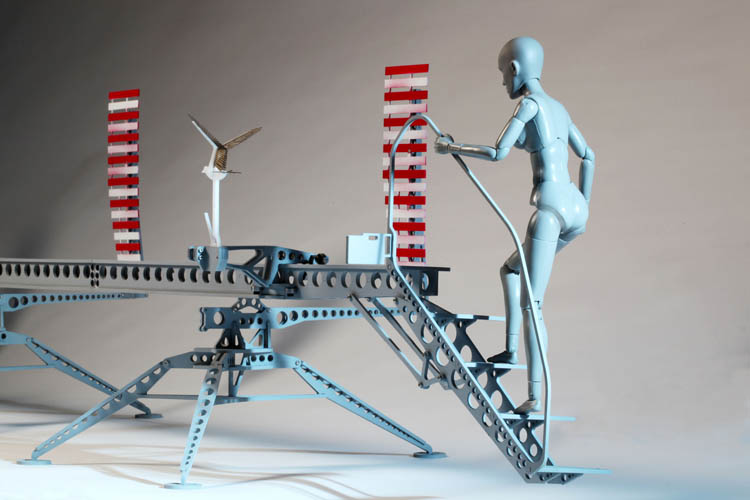
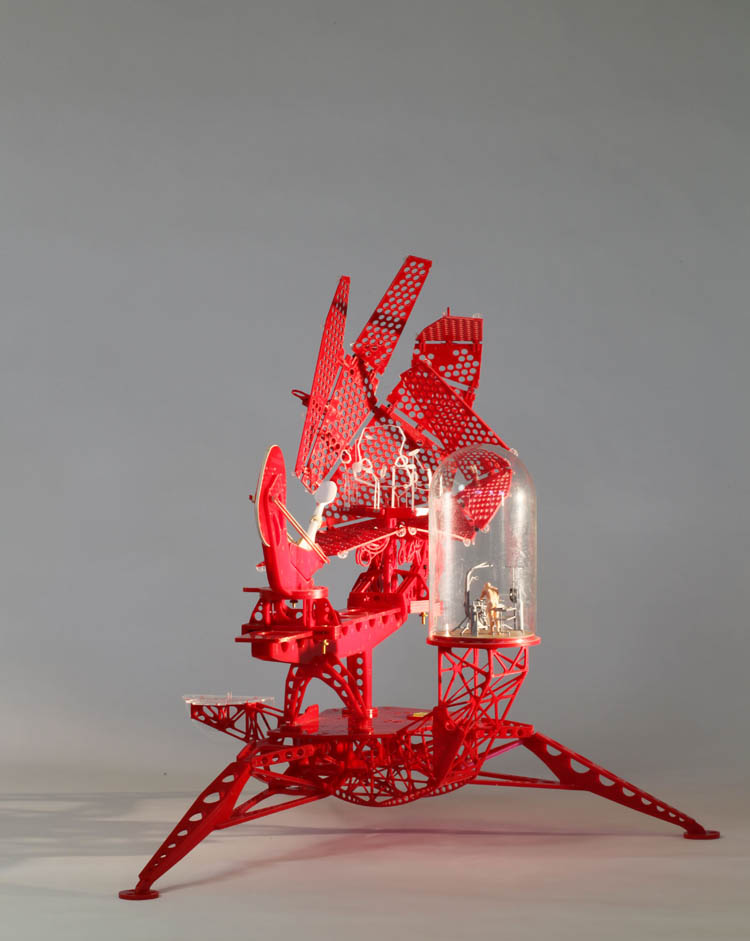
[Images: From the “Bird Automata Research Test Track” by Nat Chard].

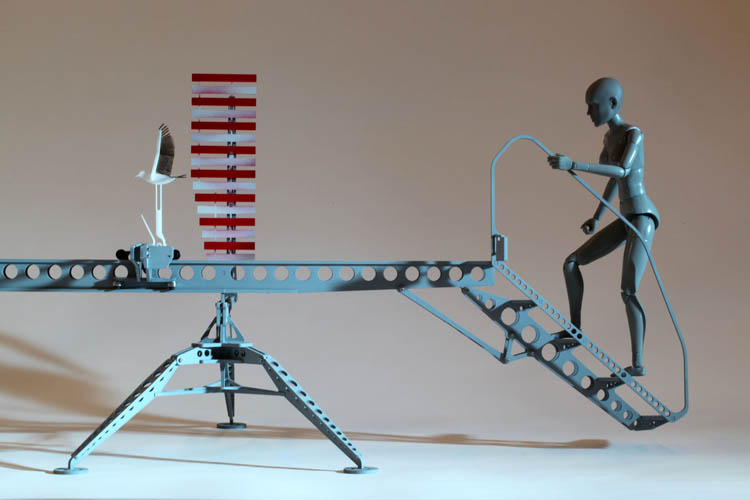
The first project seen here is the “Bird Automata Research Test Track.” It’s a spatial condensation and narrative reenactment of early attempts to photograph the anatomical movements associated with bird flight.

The set-up is a reference to the work of early artist-scientists such as Étienne-Jules Marey and Eadweard Muybridge, who sought to develop a technical means for analyzing physiological activity as a series of discrete, individual moments—or bodily freeze frames, if you will—using chronophotography.
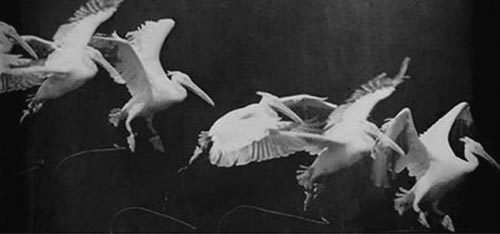
[Image: A chronophotograph by Étienne-Jules Marey].

As Jussi Parikka describes this in his recent book Insect Media, for late 19th-century and early 20th-century scientists, animal life represented “a microcosmos of new movements, actions, and perceptions”—it was seen as “something akin to a foreign planet of perceptions waiting to be excavated and reproduced.”

Whole new branches of technology were therefore developed in order to record and study how these unfamiliar anatomies interacted with the surrounding environment.
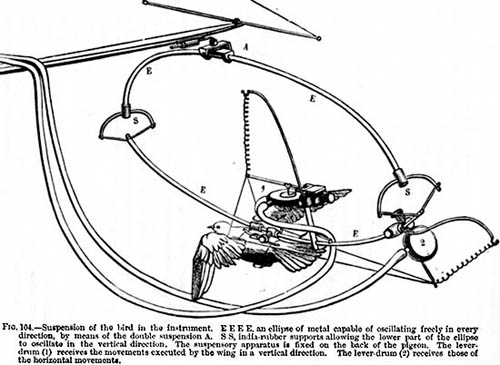
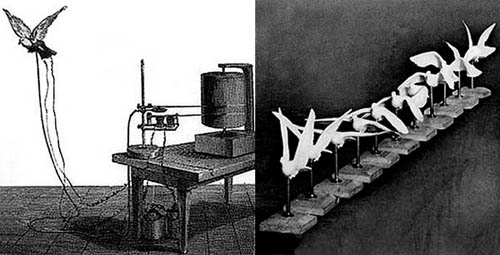
[Image: The spatial apparatus behind bird chronophotography].

Chard’s bird track is thus an exploration of “representational stop animation… witnessed by researchers from two camera positions.” But the birds are not natural, living creatures; they are automata, machines: “A researcher tracks one of the birds in elevation, the other camera is sited at the end of the track watching the approaching birds. There is a stair cantilevered off the start of the track to allow access to set up the automata for a flight.”
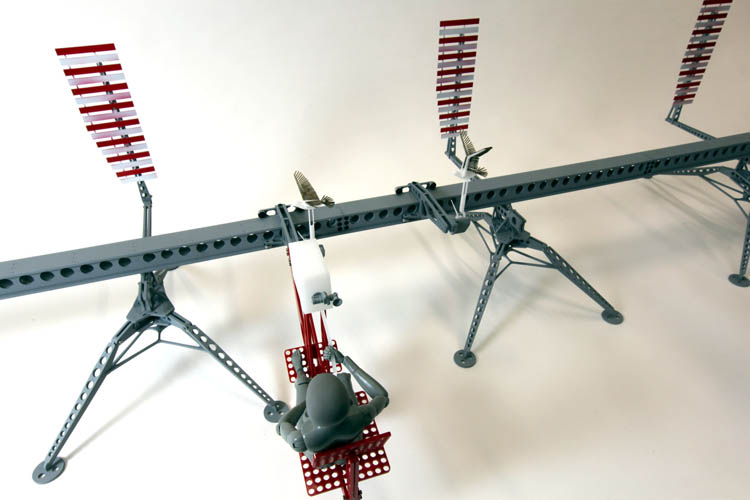
[Images: From the “Bird Automata Research Test Track” by Nat Chard].

The spatial implications of chronophotography—which visually shatters the passage of time into a series of discrete moments extracted from an event-sequence of otherwise unfixed length and duration—leads to a reference, in a text on Chard’s website, to the fact that criminologists, physicists, and even paranormal investigators all also began to use “the emerging potential of photography to further their research.” In the process, those researchers “developed new sorts of architecture particular to the demands and opportunities of the medium and the way they were using [them]. There are many research institutions that display the emergence of a new architecture with very little typological precedent.”

I might refer to this instead not as architecture, though, but as spatial equipment for the measurable demarcation of fixed events. Or, if it is architecture, it is architecture as a piece of gear—a device, an instrument—that lets you measure the very thing it simultaneously helps set into motion.
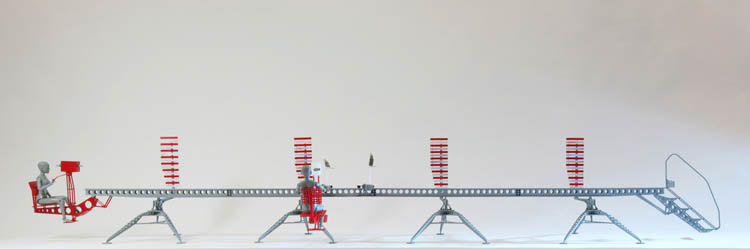
[Image: From the “Bird Automata Research Test Track” by Nat Chard].

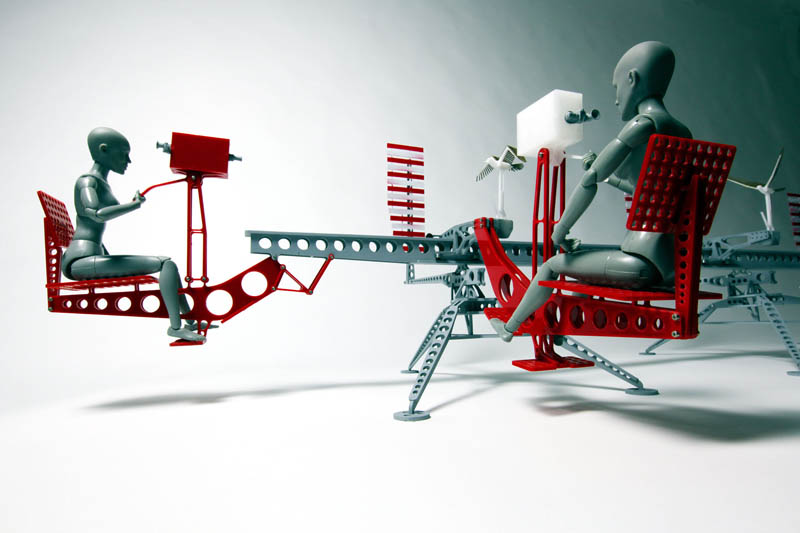
In any case, these ideas also animate Chard’s other, ongoing work: designing “variable picture plane drawing instruments” that graphically record spatial events.
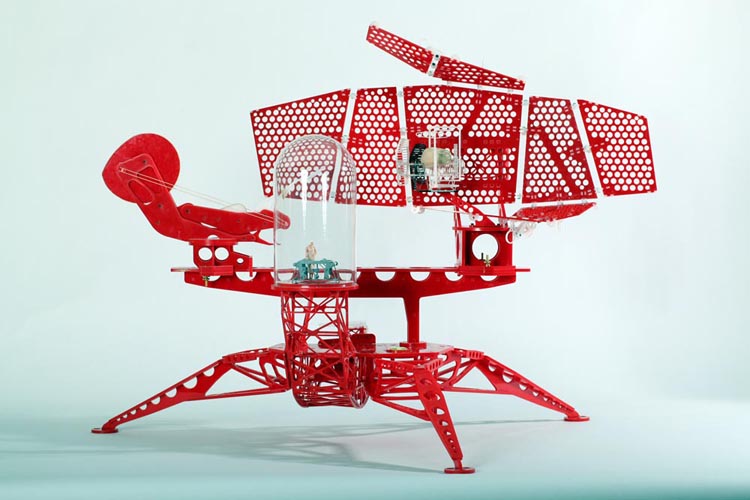
[Image: From a series of spatial drawing instruments by Nat Chard].

They are optical devices that seem to flicker in and out of phase with themselves—little stage-sets that whir, self-camouflage, and take photos of their own future repositions and alterations.

Here, where we see that the equipment is actually photographing itself, I’m reminded of Edward Gordon Craig, a stage-set designer (and the son of an architect), whose “architectonic scenery,” as M. Christine Boyer describes it in The City of Collective Memory, turned the architectural backdrops themselves into the only action an audience was meant to watch, even proposing the elimination of actors altogether.

Craig “proposed that a stage in which walls and shapes rose up and opened out, unfolded or retreated in endless motion could become a performance without any actors,” Boyer writes. “The stage thus became a device to receive the play of light rhythmically, creating an endless variety of mobile cubic shapes and varying spaces. Deep wells, stairs, open spaces, platforms, or partitions created a stage of complete mobility, which Craig believed appealed to the imagination.”

The fascinating thing here is the idea of “a performance without any actors”—it would be pure space, pure architecture, pure equipment, pure device.

You’d simply sit in the dark and watch mechanized stage sets endlessly self-transforming.
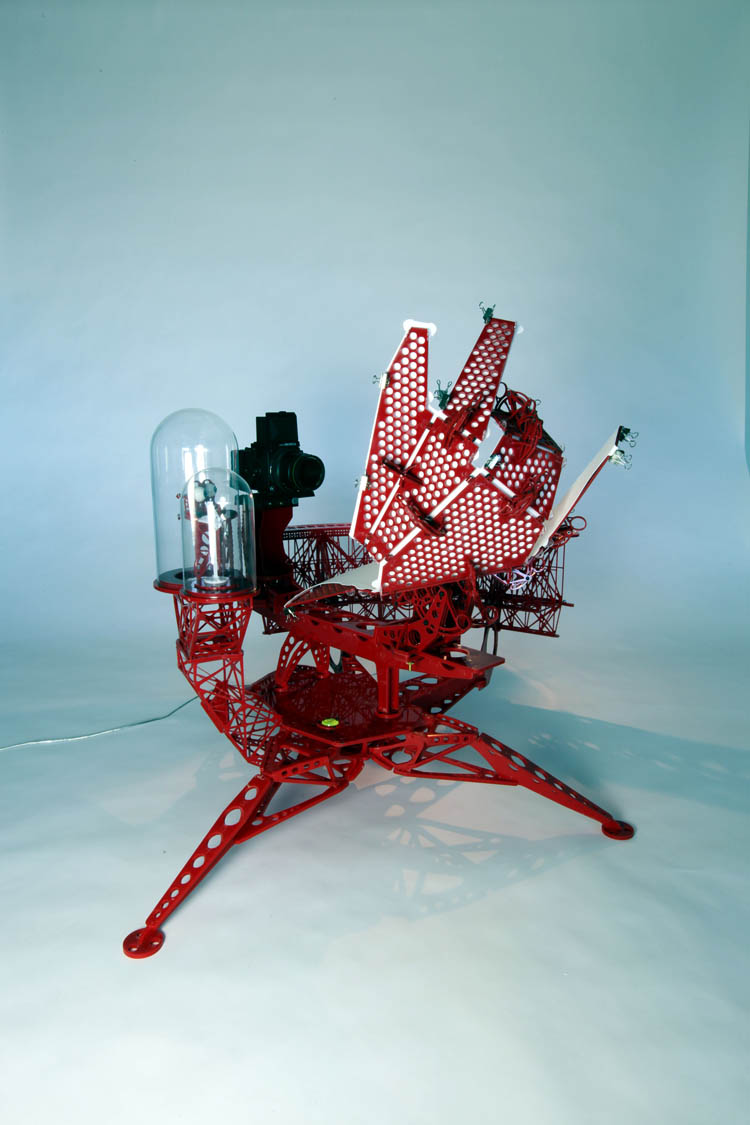
[Images: From a series of spatial drawing instruments by Nat Chard].

Chard sent along parts of a still in-process essay that will soon be published in an issue of AD, edited by architect Bob Sheil, of sixteen*(makers), whose “probe field” project was featured on BLDGBLOG back in December.
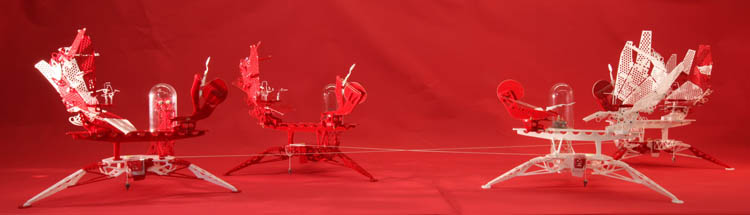
[Image: From a series of spatial drawing instruments by Nat Chard].

Chard’s essay throws a variety of ideas into the mix, including the mystical (and unfortunately nonexistent) technology of “thoughtography,” i.e. the direct translation of thoughts into photographic images; the myth of the “genius sketch,” an image produced by someone (or, as his work intriguingly suggests, something) uniquely qualified and technically skilled enough to pull off instantaneously perfect acts of visual representation; and the geometric difficulties of representing 3D urban space on 2D surfaces, specifically looking at back at the history of drawing and surveying equipment, with references to the trigonometry of modern aerial bombers and Renaissance artillerymen, both of whom relied upon precise spatial calculations in order to map the targets that they would then set about trying to destroy.

At the heart of all these examples is the trick—the magic, one might say—of spatial representation: how to distill, translate, carry across, or otherwise re-enliven something from one field or context into another.

Chard’s devices are spatial equipment that document the very places they also frame and help define.
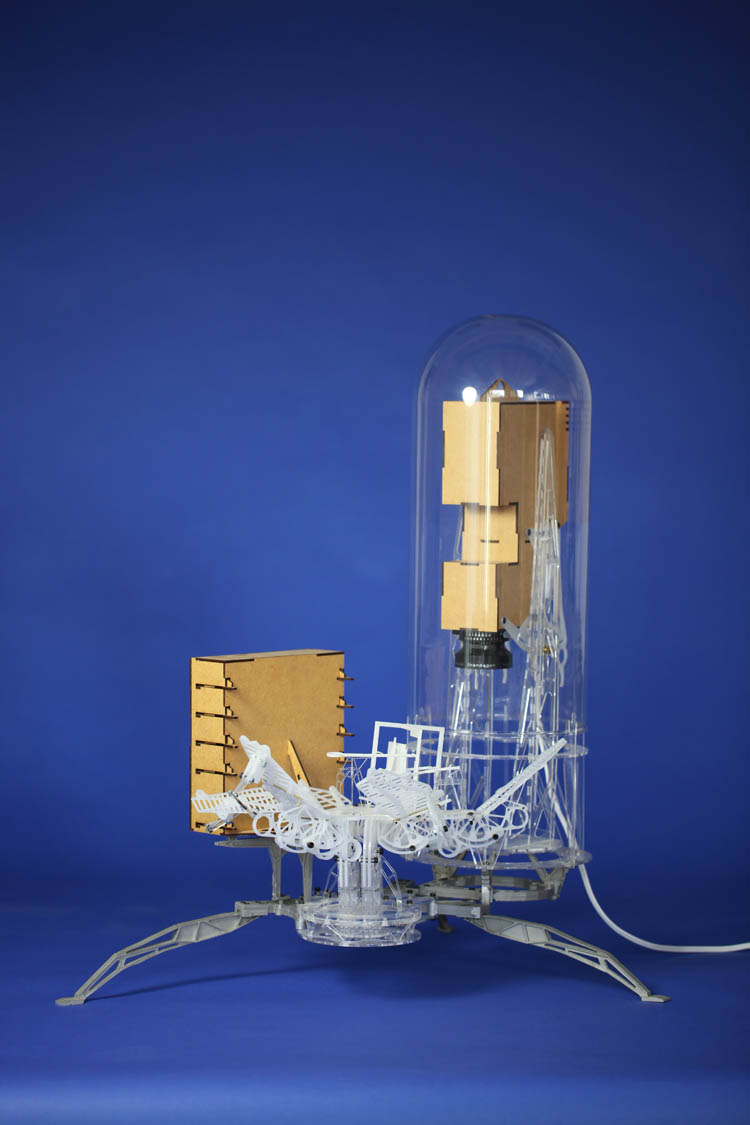
[Image: From a series of spatial drawing instruments by Nat Chard].

Chard’s machines are surprisingly playful—indeed, almost toylike—inhabited by small human figures and seemingly ready for mass-assembly (which would be amazing: imagine a generation of children raised not on Lincoln Logs but on Chard Devices, rewiring kids’ brains through the toys they play with).
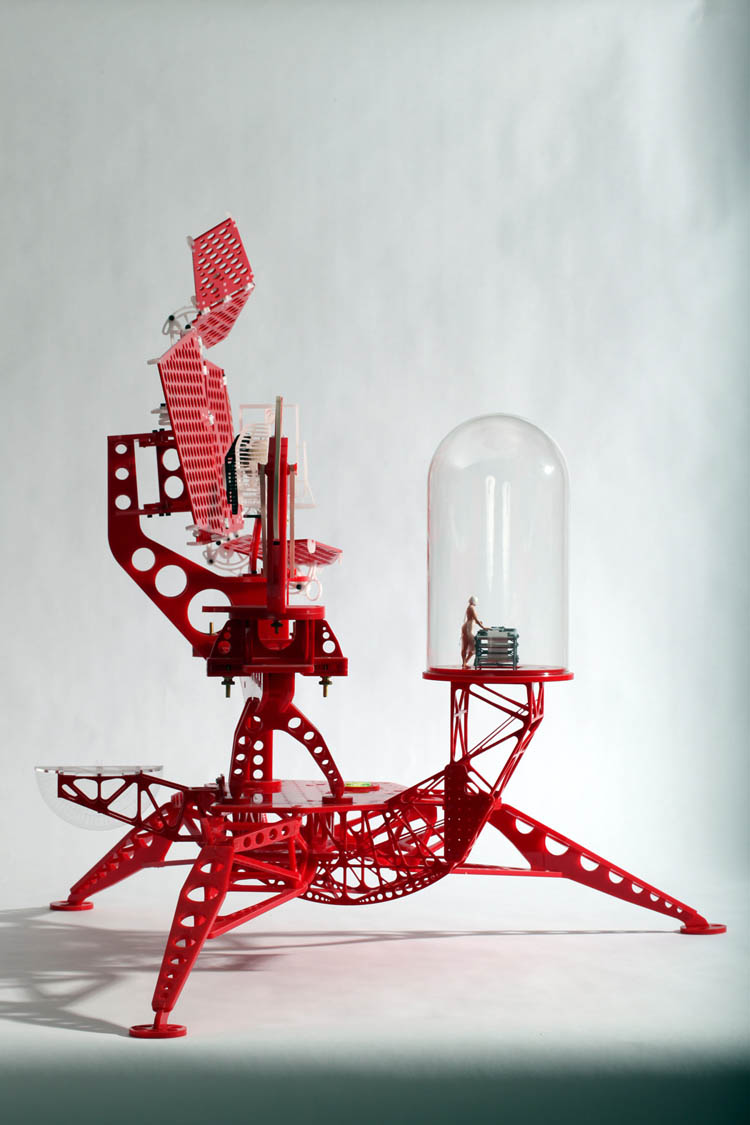

[Images: From a series of spatial drawing instruments by Nat Chard].

The issue of AD edited by Bob Sheil, featuring Chard’s essay, should be out at some point in the near future, so keep your eyes peeled for that. In the meantime, I’ve posted some images of Chard’s work to give you a sense of the project’s ongoing directions and research possibilities.
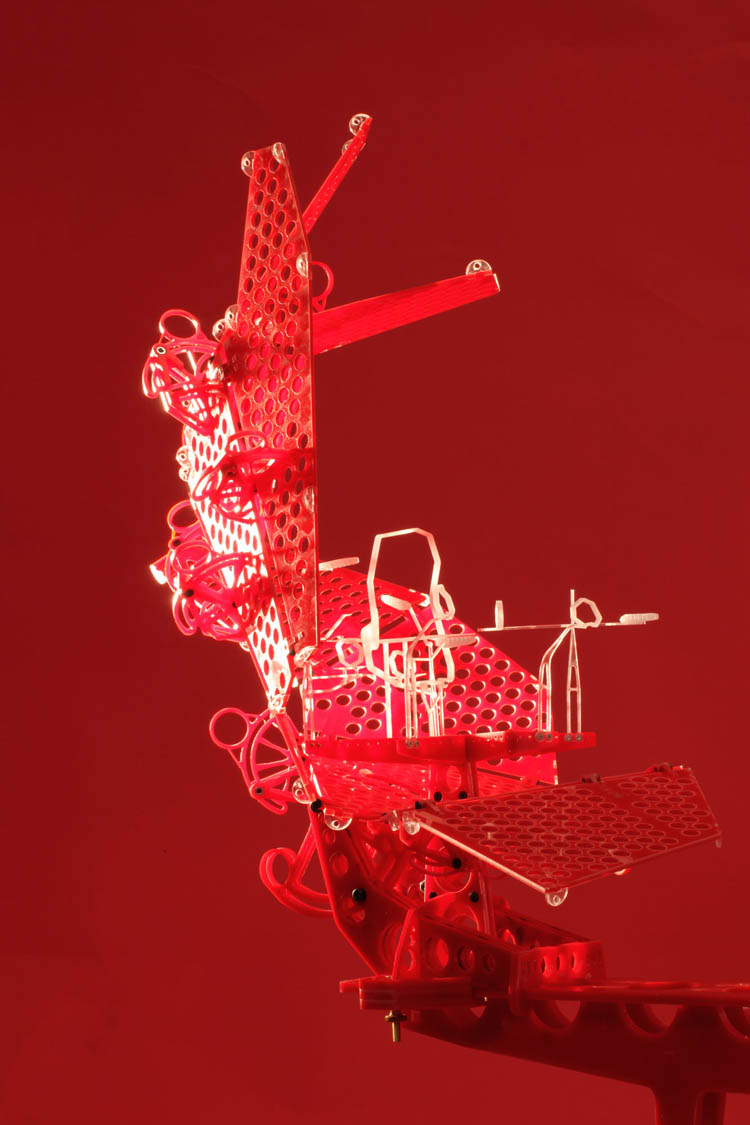
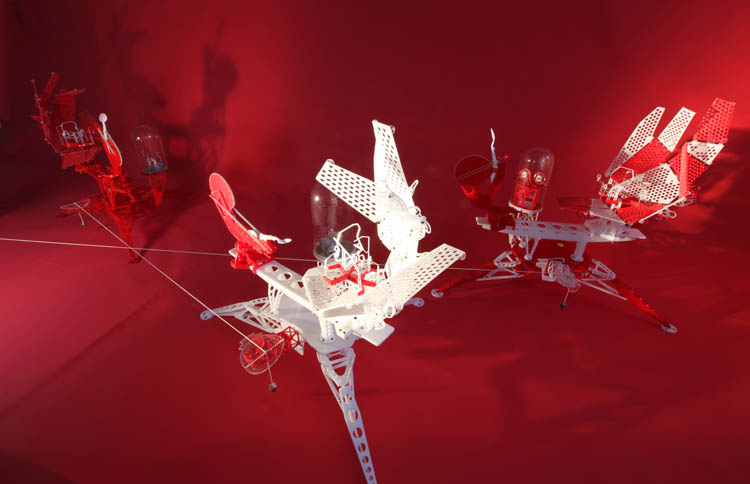
[Images: From a series of spatial drawing instruments by Nat Chard].

Until then, check out Nat Chard’s website for a bit more info, or check out his book Drawing Indeterminate Architecture, Indeterminate Drawings of Architecture (though I should note that I have not yet seen a copy myself).

Water Towers of Ireland

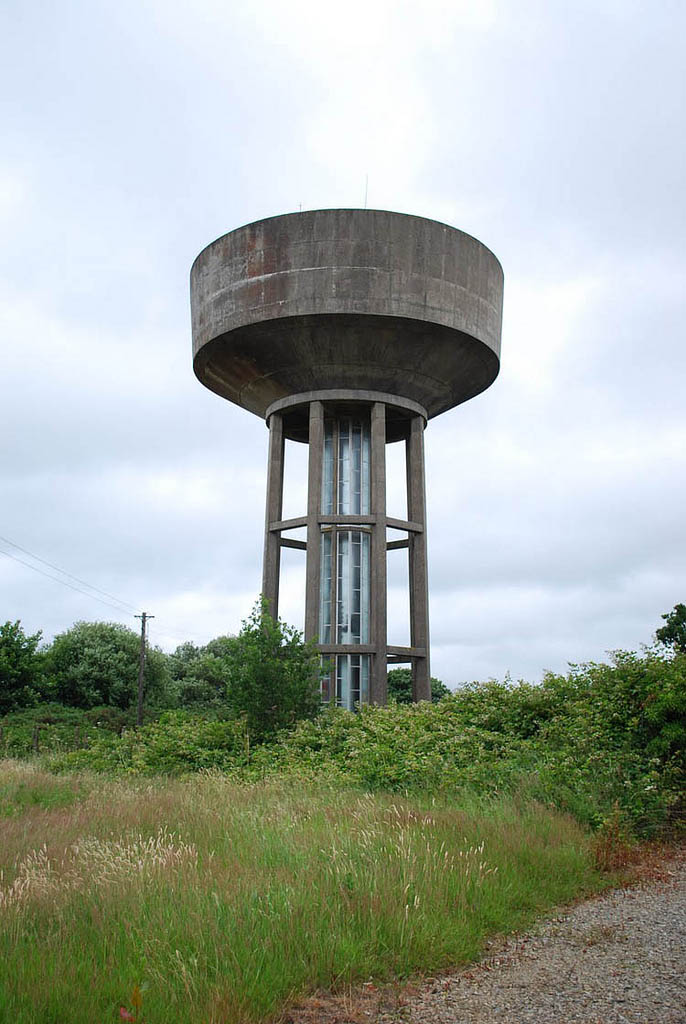
[Image: From Water Towers of Ireland; photograph by James Young].

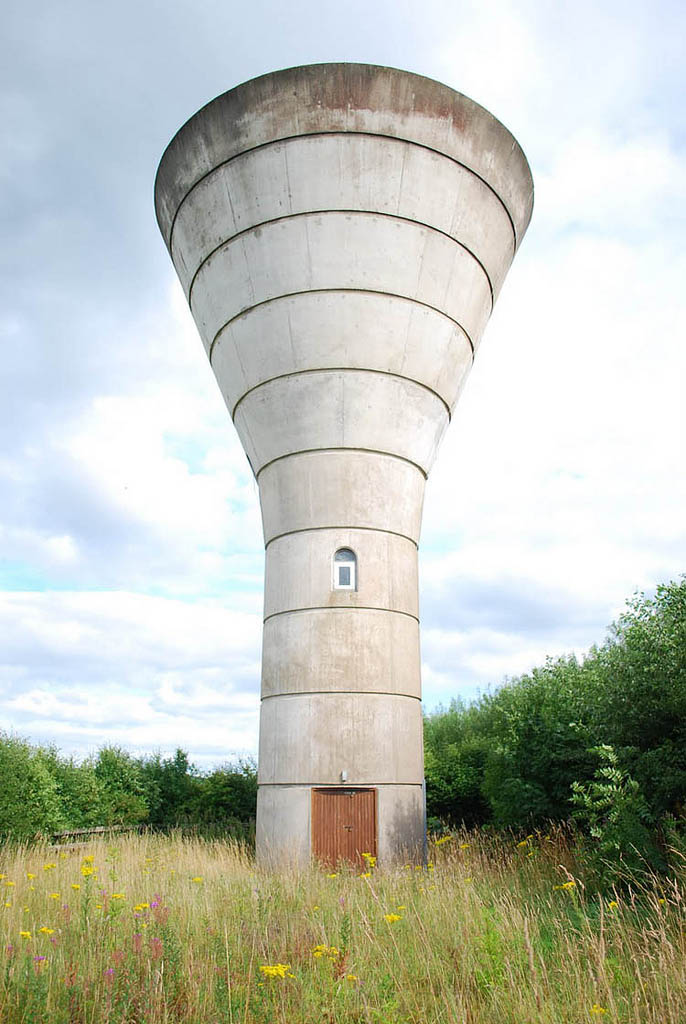
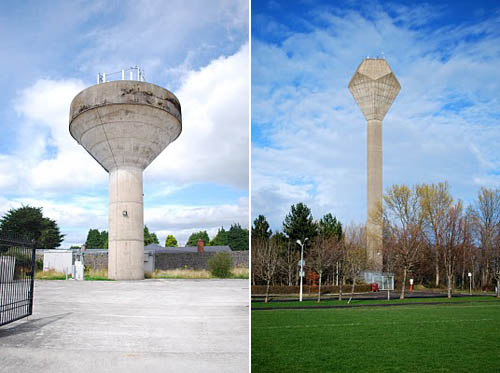
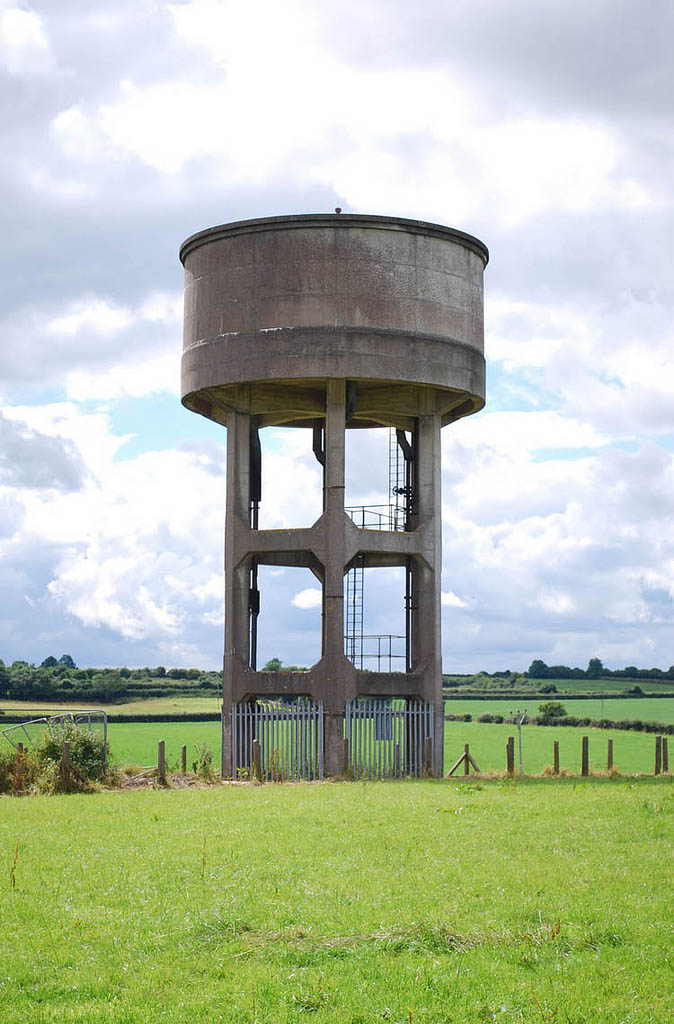
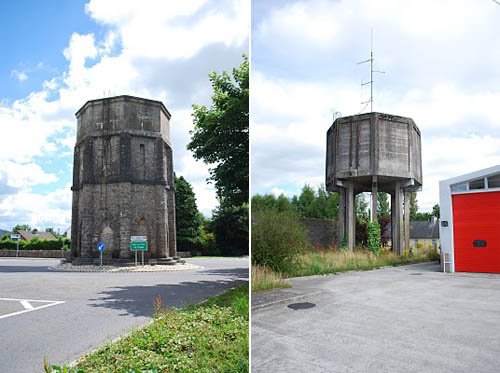
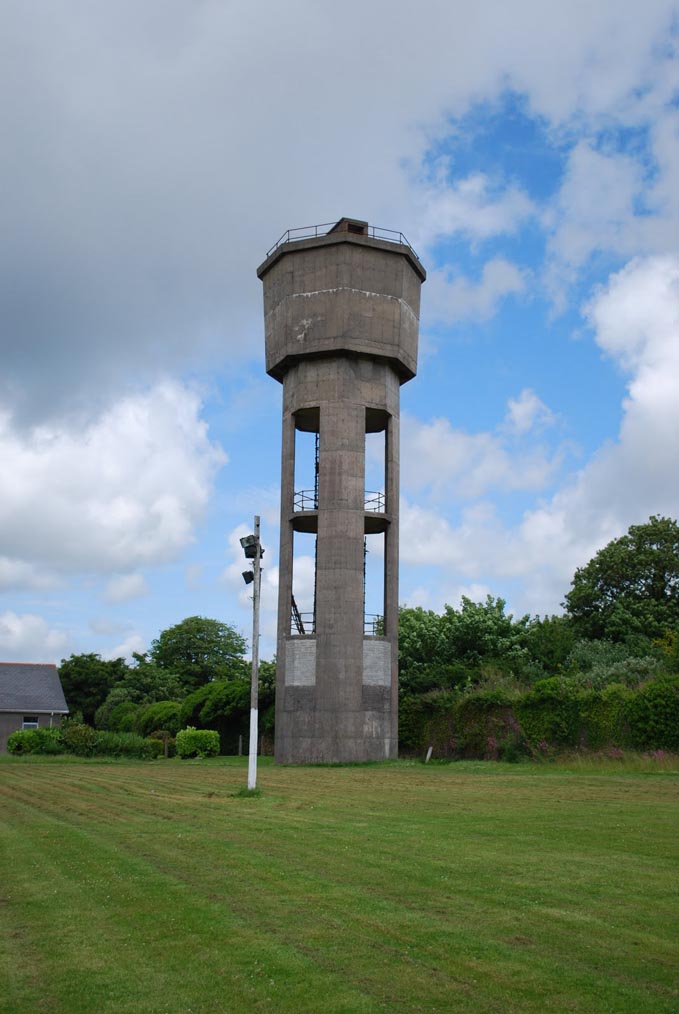
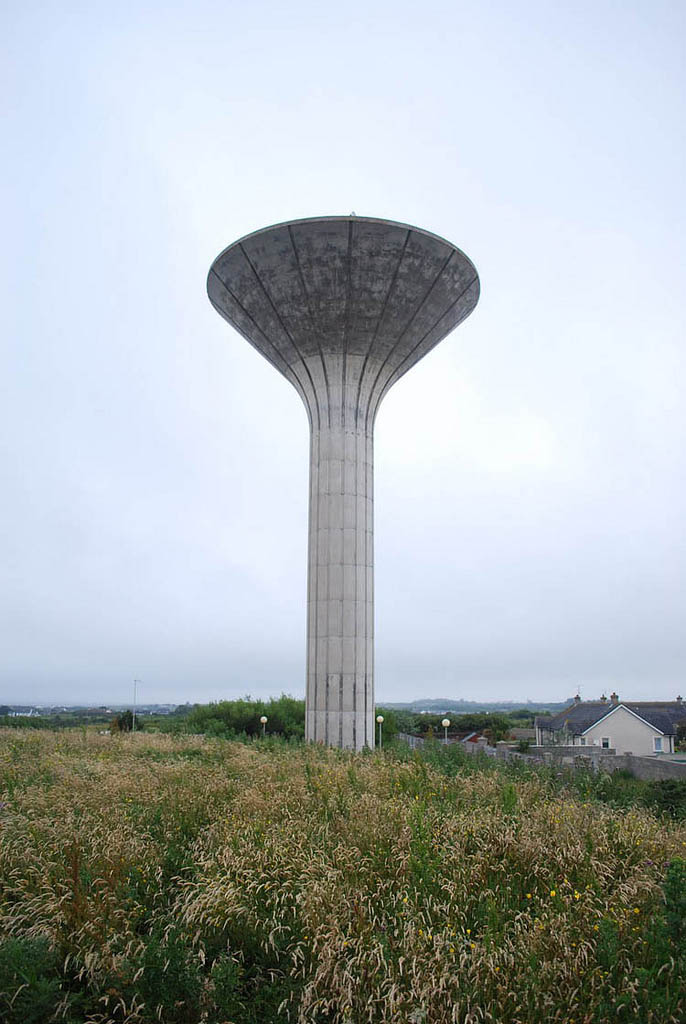
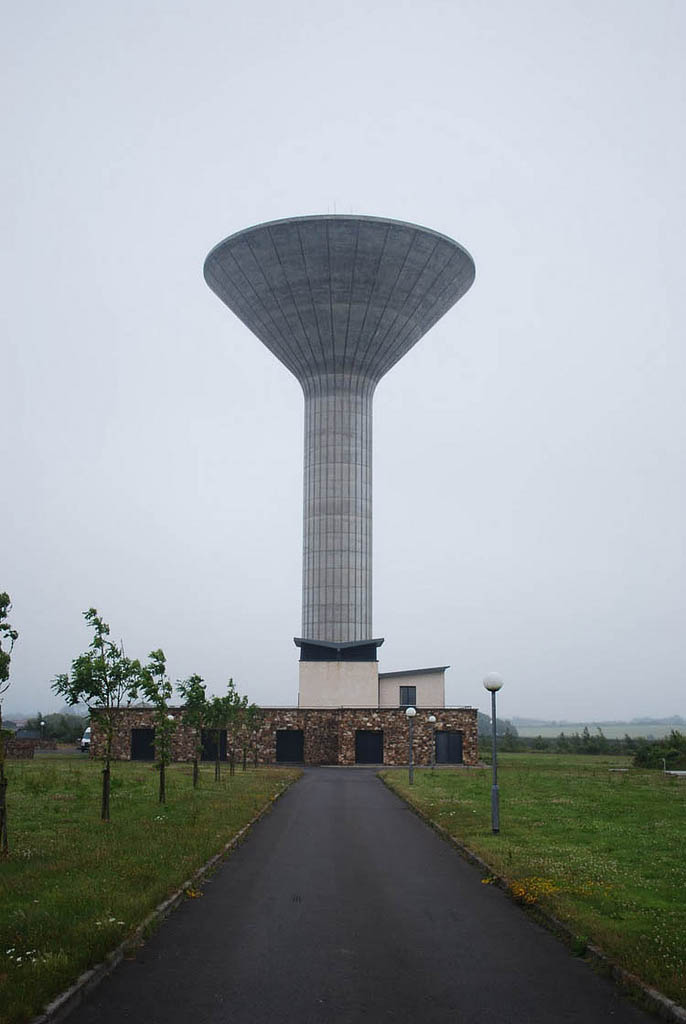
An exhibition up—possibly for just one more day—over at University College, Dublin, features photos by James Young. For the last 10 months, Young has been assembling a typological study of water towers in Ireland. Young describes it as “part inventory, part photographic essay and part history.”

Of course, Young’s work has presumably been greeted with very many comparisons to the work of Bernd & Hilla Becher.

[Images: From Water Towers of Ireland; photographs by James Young].

Many of the structures are militaristic and even explicitly fortress-like. They are prisons for water.

[Image: From Water Towers of Ireland by James Young].

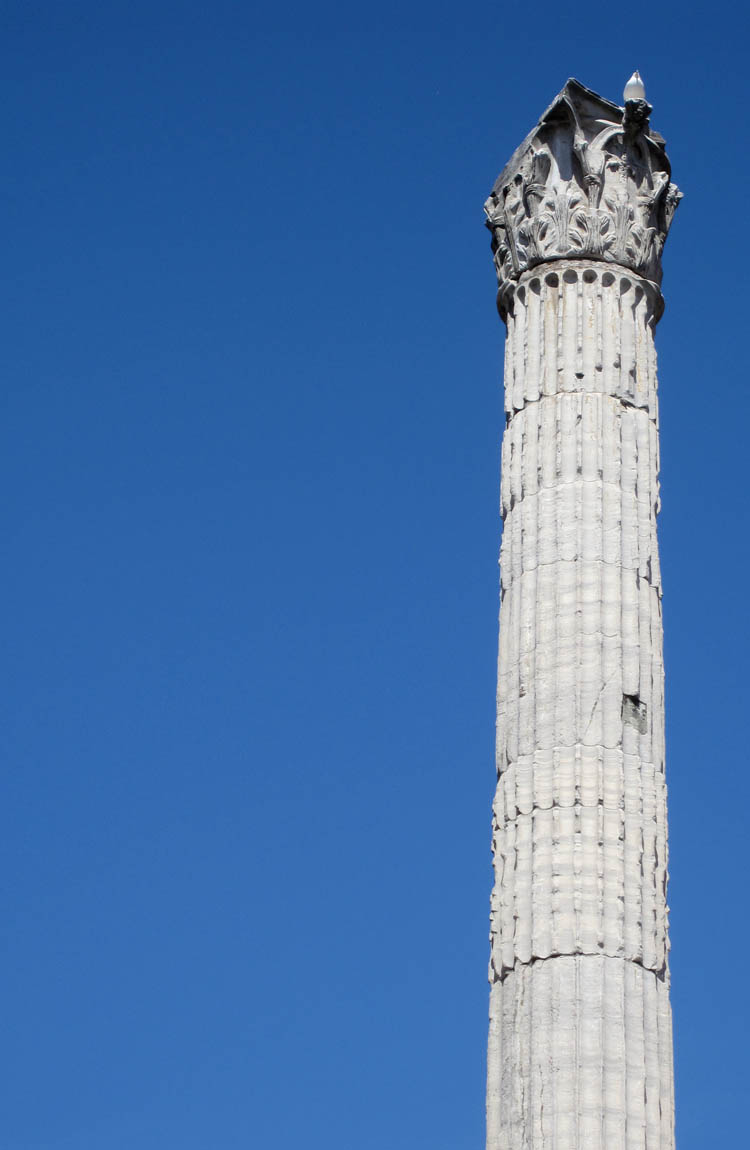
Others could be mistaken for ornamental menhirs, functionless and inexplicable totems standing patiently in the fog and rain.

[Image: From Water Towers of Ireland by James Young].

I just wanted to post a few of my favorite images here, but then urge you to look through the many other examples over at the Water Towers of Ireland website.

[Images: From Water Towers of Ireland; photos by James Young].

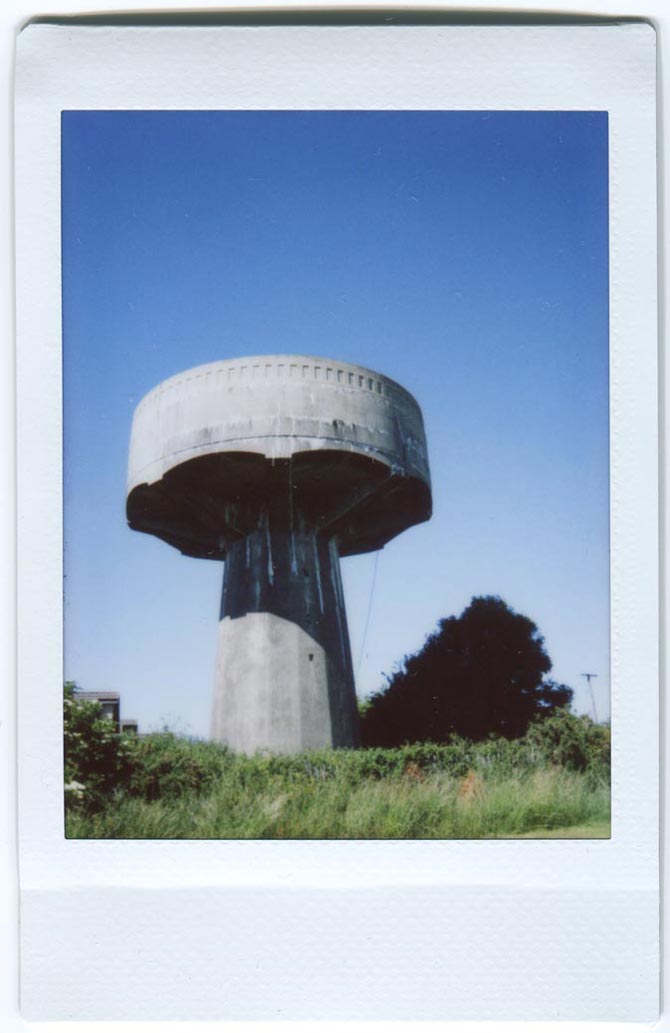
You’ll see, among other things, that many of the more forensic portraits, as seen above, have been twinned with casual, souvenir-like Polaroid shots—such as this one, in Castlemoyle, the very first tower posted on Young’s site.

[Image: From Water Towers of Ireland; photo by James Young].

Perhaps this last one heralds the aborted start of a new branch in architectural history, that of mycological brutalism.

Ground Conditioning

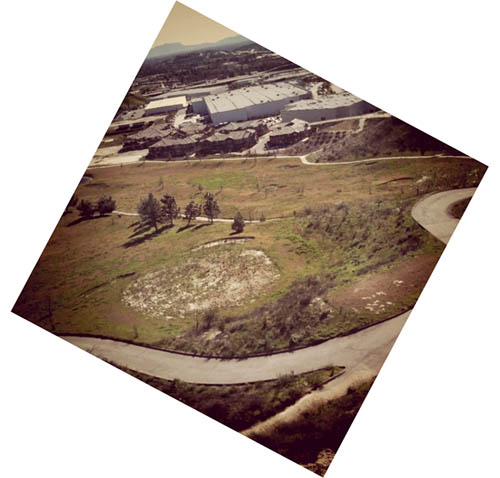
[Image: An abandoned golf course leaves traces in the landscape in northern Los Angeles].
Golf runs in my family, although I don’t seem to have inherited that gene; I was nonetheless interested to read about an air-conditioning network embedded in the ground itself at this year’s Masters Tournament, dehumidifying the course from below.

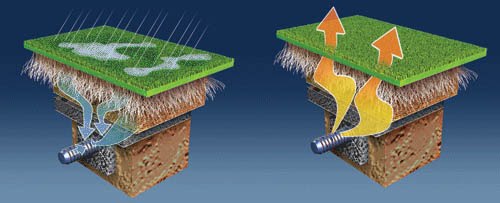
In an article called the “Weather Underground,” published in the May 2011 issue of Golf Digest, author David Owen describes something called the SubAir system. SubAir was invented in the 1990s by Marsh Benson, Owen explains, a senior grounds manager at August National. The first model consisted of “a stove-size machine,” as Owen describes it, that was “attached to the existing network of drainage pipes beneath the putting surface [where it] was acting like a giant Shop-Vac, hoovering moisture from below.”

A project director at SubAir explains to Owen that “the concept is to supply fresh air into the root zone and help provide a more optimal growing environment for the greens.” Indeed, as SubAir’s website explains:

The SubAir aeration and moisture removal system promotes healthier and stronger playing surfaces through moisture content management, subsurface aeration, and root zone temperature control. As a result, SubAir provides optimum aerobic subsurface growing conditions. SubAir is integrated underground with no impact on the golf course design options.

Further, “Since the SubAir system can be installed on a progressive basis, adding pieces incrementally makes putting together the SubAir puzzle easy and affordable.” This latter turn of phrase explains the company’s tagline: SubAir: Adding Pieces to the Puzzle.

Indeed, I have to assume, considering the system’s incremental expandability, that we will someday see a suburb somewhere—presumably on a golf course—where the SubAir system has been preemptively installed on every private lot, like any other utility, providing an electrically intensive drainage and lawn-management system for the entire neighborhood. Wired with terrestrial HVAC.

[Image: The system goes from suck to blow; images courtesy of SubAir].
At least two things immediately come to mind:

1) The “refrigerated beach” in Dubai that “will have a network of pipes beneath the sand containing a coolant that will absorb heat from the surface.” This self-parodically indulgent mechanism built on the scale of a landscape will ensure, as the Times explains, that “hotel guests can walk comfortably across the sand on scorching days.”

The management of terrain from below by subterranean machine-strata embedded in the earth itself is surely an extravagance whose accepted price of operation does not include its long-term environmental cost; but the vertiginous implications of being managed from below by unseen machinery even compels Owen, writing in Golf Digest, to joke that the world of golf is actually “a Matrix-like simulation created by green-jacketed aliens.” We could call it an encounter with the geological uncanny: an artificial stratigraphy that makes the earth itself into a manufactured object.

On the other hand, this verticalization of grounds-management strategies is no different, I would argue, from the massively horizontal sprawl of flood-control measures in the Netherlands, as but one example, with its Herculean gates, dikes, levees, and depolderized sacrifice zones, a protective network of unseen machines that makes that nation terrestrially possible.

Neither the Dutch water defense line nor SubAir is entirely sound, environmentally speaking; but my larger point is that if we would find ourselves outraged by one (SubAir) for its apparent extravagance, then we should not overlook the invisible systems on which our everyday landscapes already rely—the pumps that keep New York’s subways from flooding, the dams, canals, and levees that make New Orleans and Sacramento inhabitable, the aqueducts that feed Phoenix and Los Angeles, the South-North Water Transfer project, the Great Man-Made River of Libya—when we look for something to critique.

SubAir, in this context, is but one minor symptom of a larger, civilization-wide dependence on what we might call terrestrial life-support systems: machines actively and constantly re-formatting the surface of the planet for often fleeting human needs and desires.

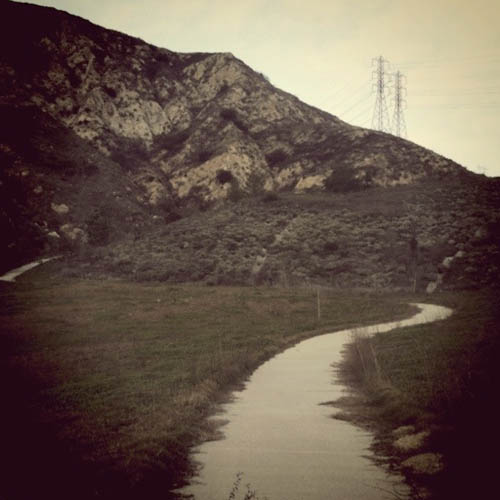
[Image: A path originally meant to follow a now-abandoned golf course in northern Los Angeles].
2) Having said all that, I’m curious if SubAir could actually play a much more ambitious ecological role somewhere, whether that’s in forestry, gardening, brownfield remediation, wetlands management, or even in a partial automation of urban parks.

After all, if SubAir’s “aeration and moisture removal system promotes healthier and stronger [land surfaces] through moisture content management, subsurface aeration, and root zone temperature control,” and if, “as a result, SubAir provides optimum aerobic subsurface growing conditions,” then why not see what this might do for, say, indoor farms, recovering forests, or experimental gardens of a more botanically radical kind?

Imagine, for a minute, a SubAir system powered entirely by renewable energy, aerating, pressurizing, and vacuuming the soil from below in some highly engineered series of fields or enclosed growth chambers, producing the “optimum aerobic subsurface growing conditions” out of which specialty foods, medicines, or biofuels will emerge; what would the moral objection to such a system be, and how would this not simply be but one more device of environmental-conditioning grafted onto an already highly complex bundle of other such networks?

At the very least, I suppose, discovering that an otherwise pristine forest is actually being air-conditioned from below by a geographically extensive, underground air-plumbing network would induce a sense of terrestrial vertigo, as described above; ideally, it would also be working to encourage ecological health and self-repair.

(Thanks to Nick Sowers for pointing me to the Golf Digest article!)

Urban Hypotheticals

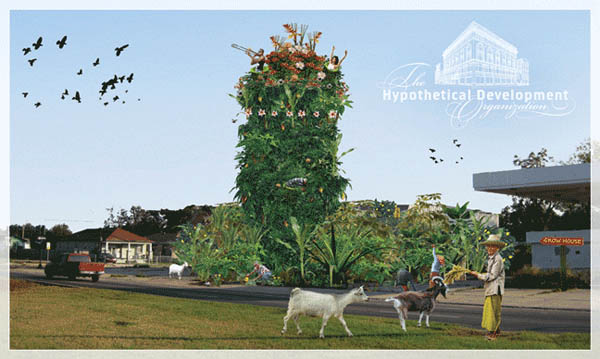
[Image: The “Grow House” by Carey Clouse, with the Hypothetical Development Organization].

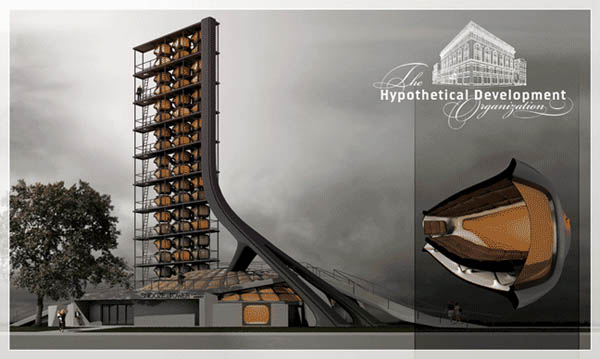
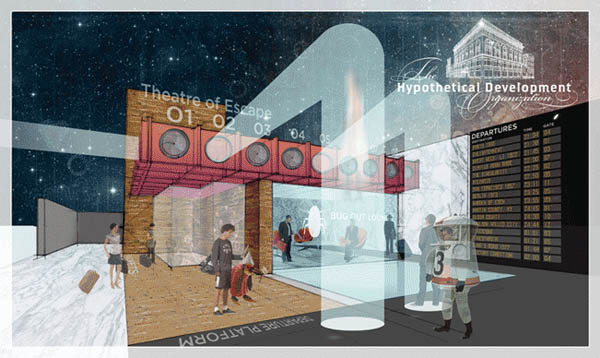
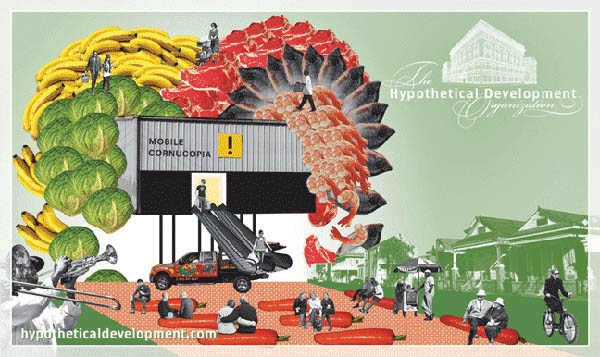
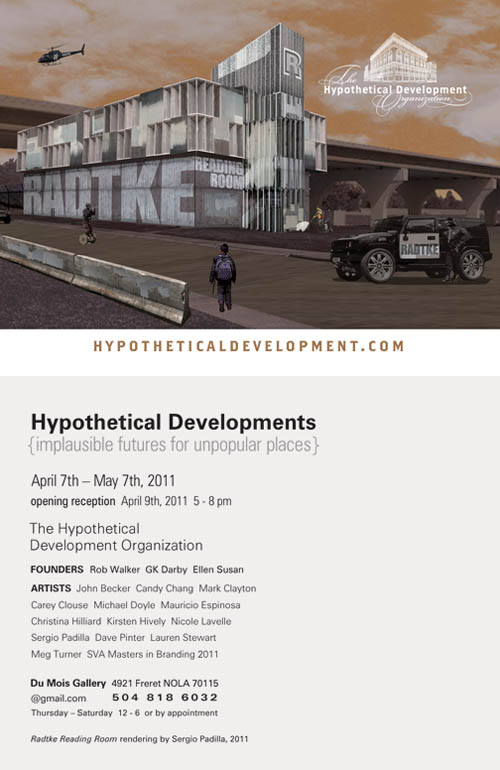
Tonight in New Orleans, the Hypothetical Development Organization, spearheaded by G.K. Darby, Ellen Susan, and Rob Walker, will celebrate a public launch at the Du Mois Gallery on Freret Street.

Their strategy is to propose and render a series of speculative architectural detours and additions to the city, “dedicated to the recognition and extension of a new form of urban storytelling.” Each project, they explain, is merely a “hypothetical addition to the built environment,” an “absurdly impractical solution”—some of them based on “nonexistent technologies”—to the many problems facing New Orleans today.

[Image: The “Snooze Tower” by John Becker, with the Hypothetical Development Organization].

As the organizers describe it:

Members of this organization begin the narrative process by examining city neighborhoods and commercial districts for compelling structures that appear to have fallen into disuse—“hidden gems” of the built environment. In varying states of repair, these buildings suggest only stories about the past, not the future.

That’s where the Hypothetical Development Corporation comes in:

As a public service, H.D.O. invents a hypothetical future for each selected structure. Unlike a traditional, reality-based developer, however, our organization is not bound by rules relating to commercial potential, practical materials, or physics. In our view, plausibility is a creative dead end. That is to say: We are not trying to fool anybody.

The resulting projects are then printed as posters and displayed in public, at the sites their creators have chosen.

[Image: The “Theater of Escape” by Michael Doyle, with the Hypothetical Development Organization].

It goes without saying that many people will object to the notion of dreaming up deliberately impossible solutions to very real socio-economic problems; indeed, this argument would go, if you’re going to spend so much time coming up with ideas, raising money to print glossy posters, investing in the effort to hang those images up around the city, and then go on to advertise the project online, why not simply create, say, a food bank or a homeless shelter or even a nomadic school? Why not buy a bookmobile and bring mobile libraries to the city’s most under-served parish?

These are valid questions, and any speculative project needs to consider the implications of how it uses its time.

[Image: The “Mobile Cornucopia” by Candy Chang, with the Hypothetical Development Organization].

However, speaking only for myself, I have never believed that speculative work or writing—fiction, broadly speaking, whether it’s architecture fiction or literary fiction—exists in an either/or relationship with social and political activism. We don’t need either speculative writing about architecture, for instance, or politically engaged critical writing about real buildings; we need both. Some people are better at the former than they are at the latter; some are better at the latter than they are at the former. It should never be assumed that someone impassioned by the speculative potential of new ideas is somehow against the existence of soup kitchens or grass roots community groups—or that someone working at or relying upon a soup kitchen, shelter, hostel, or church would not be inspired by whimsical utopias and bizarre ideas.

My point is that urban speculation is not some politically dangerous variant on “the opium of the people,” cruelly hypnotizing people with intellectual spectacle so that they no longer seek to transform their everyday spatial circumstances; speculation, in fact, is often the very reason they seek out—and physically embark upon—urban change in the first place.

In any case, the fact that these projects deliberately amplify the impossible doesn’t bother me. Starting from the miraculous, the marvelous, the utopian, the crazed and working backward from there to fashion a new world is a worthwhile design strategy and it needs to be pursued more often, not less.

Nonetheless, when I first heard about this project, I was afraid that the resulting posters for hypothetical developments might come off not as aspirational signs of the urban fantastic, but more as a kind of taunting—as if a bunch of architects had come along with their posters to show you all the things that your city is not, all the things we wish you could be good enough to be, that we wish you could pull yourself together long enough to become—like a deranged husband taunting his wife with the Sports Illustrated swimsuit issue—but, well, just look at you: you’re all weeds, empty lots, and abandoned buildings, and, even worse, you’re poor. We architects don’t appreciate the ramshackle street you live on or the old five-and-dime where you shop everyday; you’re not science fiction enough for our tastes.

In a sense, this is the aggressive undertone of all real estate development ads. The world you live in right now is not up to scratch, those ads say, and this development only proves your current inadequacy.

But there are many ways in which the Hypothetical Development Organization works to avoid—or at least lessen—this fate, in large part through its selection of sites—genuinely abandoned or destroyed lots around the city—but also through the project’s tone. It is still whimsical, to be sure; but that’s both its strategy and its point.

If an architectural proposal can catalyze local efforts toward remaking the neighborhood—which doesn’t mean clearing empty lots so that Walmart can move in or someone can build million-dollar condos—or if that proposal can simply push residents to re-conceive how they physically engage with their surroundings, then it has successfully revealed, at least in part, the transformative potential of spatial ideas and other urban hypotheticals.

In any case, if you’re in New Orleans tonight, stop by the Du Mois Gallery to learn more; if you’re unable to go, check out the Hypothetical Development Organization‘s website.

Animal Architecture

Animal Architecture, founded in 2009 by Jonathan LaRocca and Ned Dodington, is currently on the hunt for “exciting projects that engage the lives, minds and behaviors of our alternate, sometimes familiar companion species—insects, birds, mammals, fish and microorganisms—each one with unique ways of world-making.”

[Images: The “Bee Station” by Jamie Hutchison].

Animal Architecture thus “invites your critical and unpublished essays and projects to address how architecture can mediate and encourage multiple new ways of species learning and benefiting from each other—or as we say it here: to illustrate cospecies coshaping.”

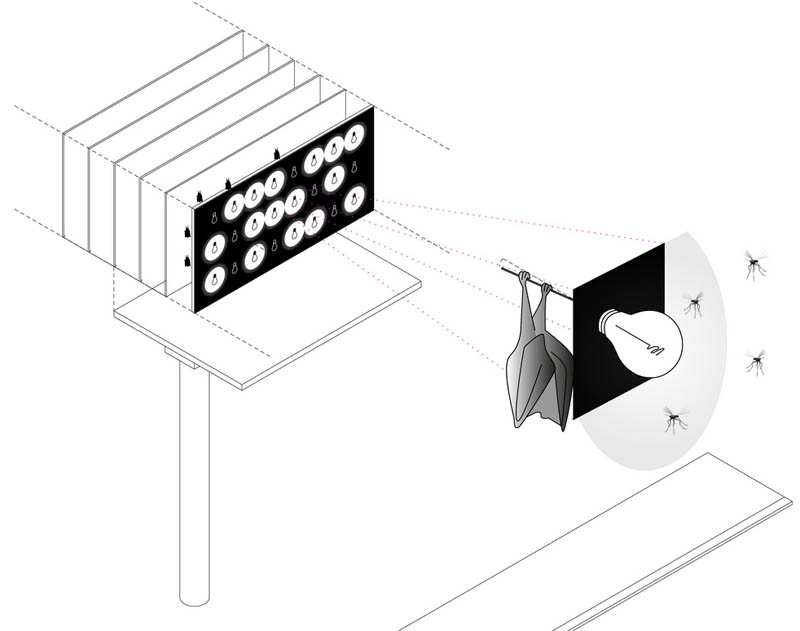
[Images: The “Bat Billboard” by Chris Woebken and Natalie Jeremijenko].

Designing either with or for nonhuman species can offer, LaRocca and Dodington suggest, “a greater understanding of biotic and ecological relationships [that] can influence design, reshape our cities, and restructure our homes—benefiting the human and non-human animals that interact with and around them.” For instance, “what making friends with a duck can teach us about urban design.”

Such projects can occur across multiple spatial and temporal scales, whether at the level of landscape infrastructure, through such things as wildlife corridors, national parks, and even zoos (for instance, the forthcoming project by TN Plus, described later on in this post), or through much more intimate interventions, such as Jamie Hutchison’s “Bee Station” or the “Animal Estates” project by Fritz Haeg.

[Images: From “Animal Estates” by Fritz Haeg].

On the other hand, of course, there is another, equally fascinating strategy of spatial inhabitation—available to humans and nonhumans alike—and that is is infestation.

From suburban homes taken over by honeybees and wildcats, to the labyrinthine stratigraphies of rats that colonize our cities from below, nonhuman species have their own ways of using—sometimes wildly repurposing—architecture.

Seen in this light, the spatial strategies of the pest-control industry are as much a question of “animal architecture” as the design of underground ant cities or termite mounds.

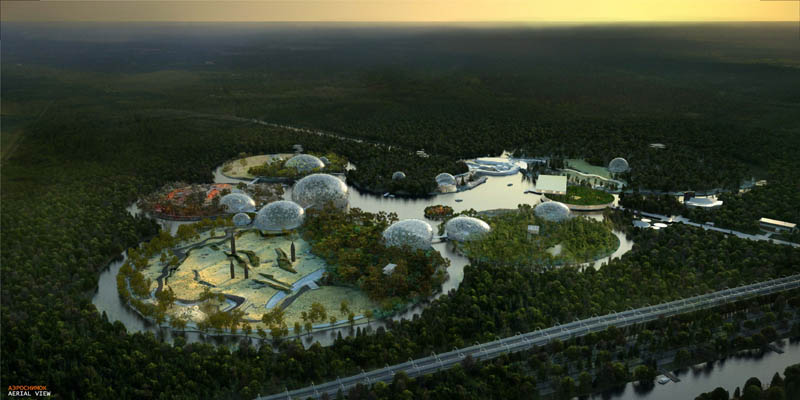
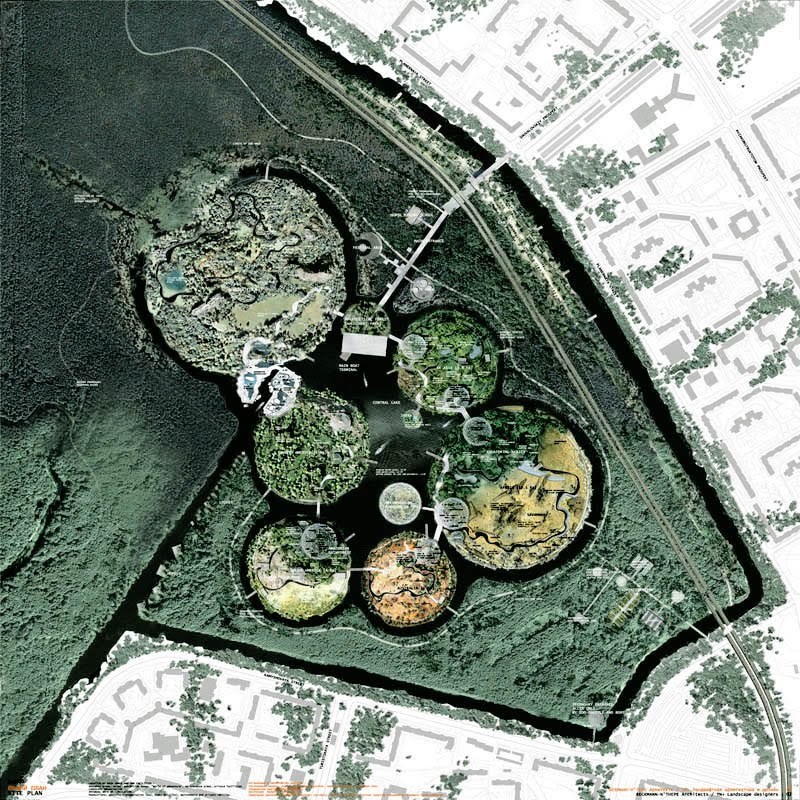
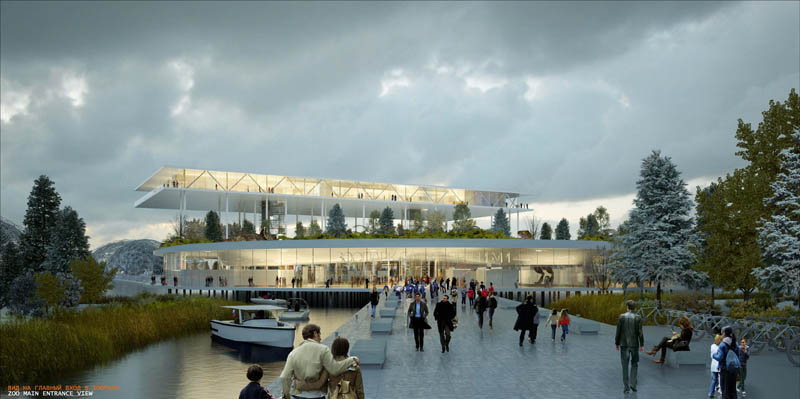
This final project, below, is, at first glance, a more traditional type of “animal architecture.” This is a recent design by Paris-based landscape architects TN Plus for a zoo in St. Petersburg, Russia.

“Our fabricated urban development,” the designers write, “will evoke Pangaea, the supercontinent described by German meteorologist and astronomer Alfred Wegener.”

[Images: From a design for a zoo in St. Petersburg, Russia, by TN Plus].
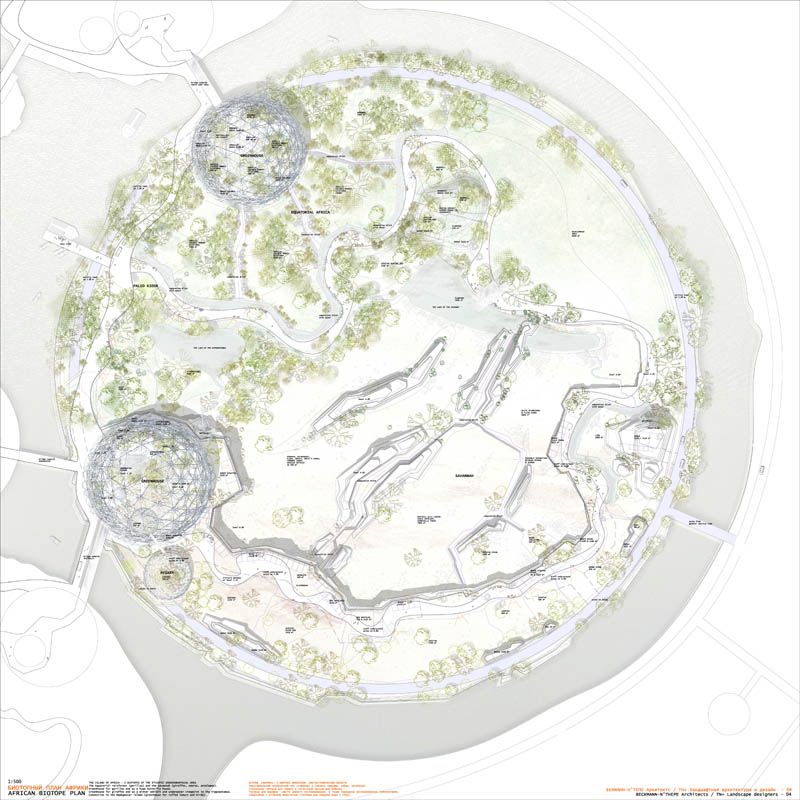
Accordingly, the project is a kind of virtual reconstruction of that now-absent supercontinent:

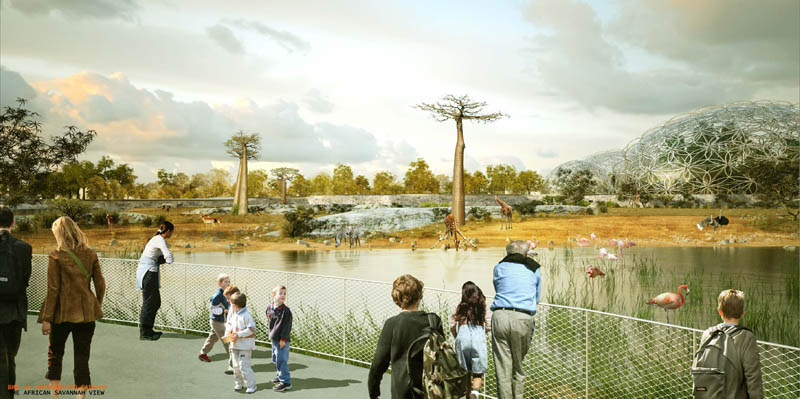
The main idea of the project for the new Saint Petersburg zoo is to reunite in one place pieces of lands which are separated today, but which were once in connection. The project takes symbolic core samples all over the world from various biotopes to assemble them in the Saint Petersburg zoo in the form of an archipelago. Every island of the project must be considered as a sample of a particular zone of a continent.

TN Plus thus hope for the resulting archipelagic complex—which will include its own microclimates and “biozones”—to be “an intriguing, mysterious, attractive, off-kilter strategy at the service of the animals and their well-being, to become the icon of new cultural and scientific life in Saint Petersburg.”

[Image: An archipelagic zoological park in St. Petersburg by TN Plus].
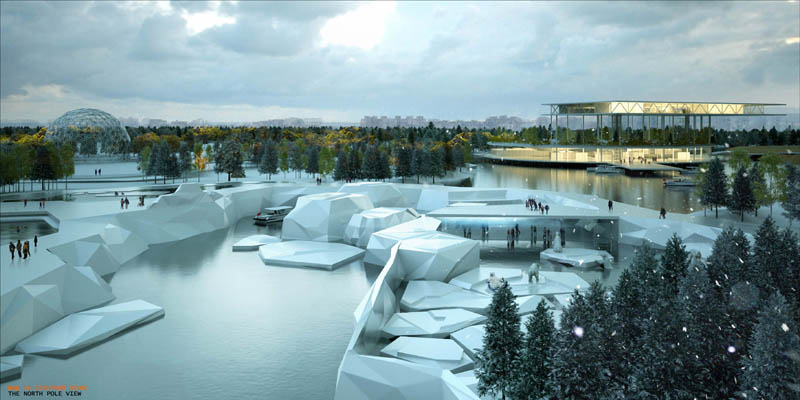
What fascinates me here is the prospect that cross-species interaction can take on a particular spatial form—or series of spatial forms—turning landscape architecture into a kind of biological speech act.

In other words, the ideal zoo could be seen as a kind of landscape cryptography: an immersive, trans-species conversation in which the terrestrial forms, plantlife, and climatological special effects are actually signs, intended for a nonhuman audience, simulating—i.e. actively referring to—otherwise locally absent environments.

The “zoo” thus presents a kind of spatial conversation “between man and animal,” as the designers describe it.

The question, then, is how we can appropriately evaluate the success of such a project. What can be realistically achieved during the resulting encounters “between man and animal,” how can these moments of inter-species communication be most effectively fostered by spatial design, and, again, how do we then measure a particular landscape’s tactical success?

[Images: A future zoo in St. Petersburg by TN Plus].

As I wrote here several years ago, also in reference to a zoological park by TN Plus, it would seem that zoos can be thought of as a kind of spatial hieroglyphics: an elaborate system of reenactments and signs through which humans attempt to communicate with other species.

It’s as if there is a spatial grammar of zoological communication, and it takes shape, here, as landscape architecture.

Zoos, in this way of thinking, can be at least partially subject to rhetorical analysis: do they express what they are intended to communicate, how has this meaning been produced, and how do we measure the success of its reception? Further, what are the risks of miscommunication?

In any case, there are so many directions to go with this discussion of “animal architecture”—theoretical, practical, speculative, critical, and otherwise—that I can’t wait to see what sort of things are submitted to the Animal Architecture project. Register by 15 May 2011 to submit your own essays and designs.
Further information—including the names of the editorial jury, which features Sanford Kwinter, Joyce Hwang, Neeraj Bhatia from InfraNet Lab, myself, and many others—can be found on the Animal Architecture website.

Two Water Tables

1) A neighborhood in Brooklyn known as “The Hole” is thirty feet below sea level. It is so close to the water table, in fact, that local homes are not connected to the city’s sewer system, relying instead on cesspools; the streets—with names like Ruby, Emerald, and Sapphire—are often flooded, on the verge of permanently returning to marshland. The Hole is a short documentary by Courtney Sell and Billy Feldman about this neighborhood; cowboys on horseback wander through water-logged streets while abandoned housing developments soak up rain like giant sponges.

2) Montréal’s St. Pierre River “was pushed underground long ago,” we read in the Montréal Gazette; before it was funneled through storm drains and sewers, however, the river “would occasionally flood the surrounding farmlands.” This tendency to flood never went away: it just went into people’s basements. As one local homeowner explains, “The land is low, apparently very low. Before I bought the building, the inspector I hired told me the pit of standing water in one corner of the basement was no cause for concern. ‘Oh that,’ he said. ‘That’s quite normal here. The water table is very high.’ Yes, it is.”

The notion that a city could be so misaligned with its own water table that puddles—in basements and roadways alike—are actually the return of an underground river quietly streaming through your cellar, and your neighbor’s cellar, and their neighbor’s cellar, and a thousand other cellars all invisible to maps, or the self-reassertion of an ancestral marsh surfacing like a dream in the streets is fascinating, bringing to mind the possibly apocryphal tale of old men fishing in the basements of Manhattan, casting their lines down into still existing rivers and streams that were simply paved over and forgotten, or the tempting prospect of resurrecting London rivers based on obscure royal decrees.

(Via @wateryone and @under_the_city).

Forest Sound Track


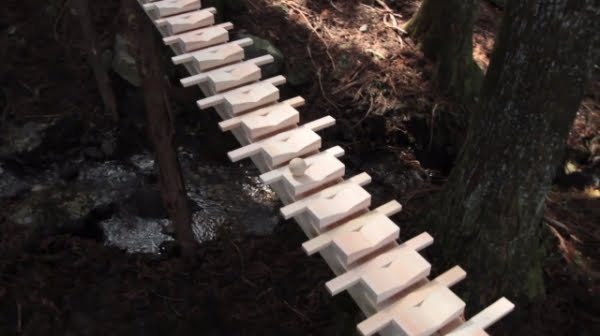
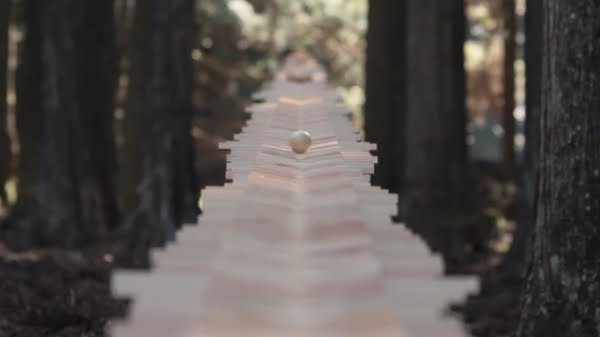
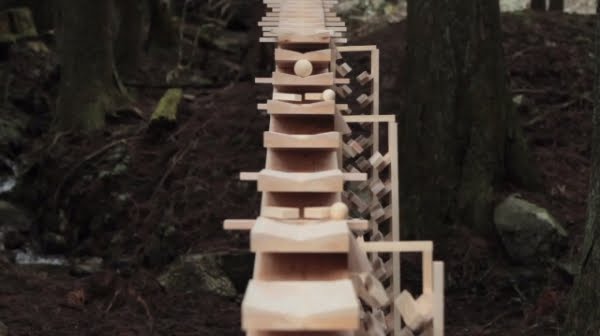
This short film is actually an advertisement for Japanese mobile phone company Docomo, but it’s nonetheless hard to resist: a linear musical instrument designed by Drill Inc. is played by the descent of a wooden ball as it slowly rolls down track, sending xylophonic plinks and plonks out into the forest.

[Images: A linear wooden forest instrument playing Bach, by Drill Inc. for Docomo].

Landscape-scale musical instruments are an unfortunately under-explored typology. We need more wave organs and forest xylophones, more Aeolian harps and conspiratorially whistling infrastructures.

(Via @pruned and Colossal).

Seismic Decentralization

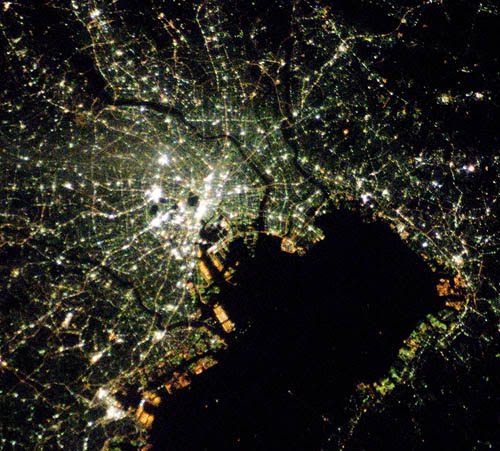
[Image: Tokyo at night, courtesy of NASA’s Earth Observatory].

At the height of the Cold War, the sprawling, decentralized suburban landscape of the United States was seen by many military planners as a form of spatial self-defense. As historian David Krugler explains in This Is Only a Test: How Washington D.C. Prepared for Nuclear War, “urban dispersal” was viewed as a defensive military tactic, one that would greatly increase the nation’s chance of survival in the event of nuclear attack.

Specially formatted residential landscapes such as “cluster cities” were thus proposed, “each with a maximum population of 50,000.” These smaller satellite cities would not only reshape the civilian landscape of the United States, they would make its citizens, its industrial base, and its infrastructure much harder to target.

“This might seem the stuff of Cold War science fiction,” Krugler writes, “but after World War II, many urban and civil defense planners believed cluster cities, also called dispersal, should be the future of the American metropolis.”

These planners, like the U.S. Strategic Bombing Survey, imagined atomic firestorms engulfing American cities and advocated preventive measures such as dispersal. Just one or two atomic bombs could level a concentrated metropolitan area, but cluster cities would suffer far less devastation: enemy bombers could strike some, but not all, key targets, allowing the unharmed cities to aid in recovery.

Krugler points out that this suburban dispersal was not always advised in the name of military strategy: “Many urban planners believed dispersal could spur slum clearance, diminish industrial pollution, and produce parks. Not only would dispersal shield America’s cities, it would save them from problems of their own making.”

However, the idea that urban dispersal might be useful only as a protective tactic against the horrors of aerial bombardment overlooks other threats, including earthquakes and tsunamis.

Earlier this week, Japanese prime minister Naoto Kan was advised “to decentralize Japan” out of fear of “Tokyo annihilation danger.” Indeed, we read, the recent 9.0 earthquake, tsunami, and partial nuclear meltdown at Fukushima together suggest that “the nation must reduce the role of its capital city to avert an even greater catastrophe.”

Takayoshi Igarashi, a professor at Hosei University, explains: “I told the prime minister that nationwide dispersal is the first thing we need to do as we rebuild. We have no idea when the big one’s going to hit Tokyo, but when it does, it’s going to annihilate the entire country because everything is here.” His conclusion: “The lesson we need to take away from this disaster is that we have to restructure Japan as an entire nation”—a seismic decentralization that relies as much on horizontal geography as on vertical building code. This could thus be “the nation’s biggest investment in urban planning in decades.”

The idea that urban design might find a reinvigorated sense of national purpose in response to a threat in the ground itself is fascinating, of course, perhaps especially for someone who also lives in an earthquake zone. But the prospect of large-scale urban dispersal remaking the urban landscape of Japan—that Tokyo itself might actually be broken up into smaller subcities, and that future urban planning permission might be adjusted to enforce nationwide sprawl as a form of tectonic self-defense, from megacity to exurban lace—presents an explicit spatialization of Japanese earthquake policy that will be very interesting to track over the years to come.

(Spotted via @urbanphoto_blog).

Islands at the Speed of Light

A recent paper published in the Physical Review has some astonishing suggestions for the geographic future of financial markets. Its authors, Alexander Wissner-Gross and Cameron Freer, discuss the spatial implications of speed-of-light trading.

Trades now occur so rapidly, they explain, and in such fantastic quantity, that the speed of light itself presents limits to the efficiency of global computerized trading networks.

These limits are described as “light propagation delays.”

[Image: Global map of “optimal intermediate locations between trading centers,” based on the earth’s geometry and the speed of light, by Alexander Wissner-Gross and Cameron Freer].

It is thus in traders’ direct financial interest, they suggest, to install themselves at specific points on the Earth’s surface—a kind of light-speed financial acupuncture—to take advantage both of the planet’s geometry and of the networks along which trades are ordered and filled. They conclude that “the construction of relativistic statistical arbitrage trading nodes across the Earth’s surface” is thus economically justified, if not required.

Amazingly, their analysis—seen in the map, above—suggests that many of these financially strategic points are actually out in the middle of nowhere: hundreds of miles offshore in the Indian Ocean, for instance, on the shores of Antarctica, and scattered throughout the South Pacific (though, of course, most of Europe, Japan, and the U.S. Bos-Wash corridor also make the cut).

These nodes exist in what the authors refer to as “the past light cones” of distant trading centers—thus the paper’s multiple references to relativity. Astonishingly, this thus seems to elide financial trading networks with the laws of physics, implying the eventual emergence of what we might call quantum financial products. Quantum derivatives! (This also seems to push us ever closer to the artificially intelligent financial instruments described in Charles Stross’s novel Accelerando). Erwin Schrödinger meets the Dow.

It’s financial science fiction: when the dollar value of a given product depends on its position in a planet’s light-cone.

[Image: Diagrammatic explanation of a “light cone,” courtesy of Wikipedia].

These points scattered along the earth’s surface are described as “optimal intermediate locations between trading centers,” each site “maximiz[ing] profit potential in a locally auditable manner.”

Wissner-Gross and Freer then suggest that trading centers themselves could be moved to these nodal points: “we show that if such intermediate coordination nodes are themselves promoted to trading centers that can utilize local information, a novel econophysical effect arises wherein the propagation of security pricing information through a chain of such nodes is effectively slowed or stopped.” An econophysical effect.

In the end, then, they more or less explicitly argue for the economic viability of building artificial islands and inhabitable seasteads—i.e. the “construction of relativistic statistical arbitrage trading nodes”—out in the middle of the ocean somewhere as a way to profit from speed-of-light trades. Imagine, for a moment, the New York Stock Exchange moving out into the mid-Atlantic, somewhere near the Azores, onto a series of New Babylon-like platforms, run not by human traders but by Watson-esque artificially intelligent supercomputers housed in waterproof tombs, all calculating money at the speed of light.

[Image: An otherwise unrelated image from NOAA featuring a geodetic satellite triangulation network].

“In summary,” the authors write, “we have demonstrated that light propagation delays present new opportunities for statistical arbitrage at the planetary scale, and have calculated a representative map of locations from which to coordinate such relativistic statistical arbitrage among the world’s major securities exchanges. We furthermore have shown that for chains of trading centers along geodesics, the propagation of tradable information is effectively slowed or stopped by such arbitrage.”

Historically, technologies for transportation and communication have resulted in the consolidation of financial markets. For example, in the nineteenth century, more than 200 stock exchanges were formed in the United States, but most were eliminated as the telegraph spread. The growth of electronic markets has led to further consolidation in recent years. Although there are advantages to centralization for many types of transactions, we have described a type of arbitrage that is just beginning to become relevant, and for which the trend is, surprisingly, in the direction of decentralization. In fact, our calculations suggest that this type of arbitrage may already be technologically feasible for the most distant pairs of exchanges, and may soon be feasible at the fastest relevant time scales for closer pairs.

Our results are both scientifically relevant because they identify an econo-physical mechanism by which the propagation of tradable information can be slowed or stopped, and technologically significant, because they motivate the construction of relativistic statistical arbitrage trading nodes across the Earth’s surface.

For more, read the original paper: PDF.

(Thanks to Nicola Twilley for the tip!)

Color Code

[Image: Arc en Ciel by Bernard Buhler Architects].

Here’s some eye-candy for a Tuesday evening: Arc en Ciel, a new building in Bordeaux, France—part residential, part office—by Bernard Buhler Architects, spotted via Architizer.

[Images: Arc en Ciel by Bernard Buhler Architects].

With a building as eye-catching as this one, it’s quite difficult to imagine a rationale behind adding graphics to the exterior glass windows—like children’s drawings, or some vague gesture toward “street art”—which looks both kitschy and unnecessary.

[Images: Arc en Ciel by Bernard Buhler Architects].

After all, the graphics-free windows look fantastic—but c’est la vie.

[Image: Arc en Ciel by Bernard Buhler Architects].

Successfully, to my mind—based entirely on a scan of some photographs on the internet—the colored exterior glass works not only to vivify the building’s urban site but to bring a constantly changing series of hues, like a colored bar code, onto the interior walkways. I would love to see this place lit from within at night, a sight the available photographs don’t offer.

[Images: Arc en Ciel by Bernard Buhler Architects].

Anyway, the building looks cool; that’s about all I have to say. I will add, however, that I’m struck by how extraordinarily better the actual, constructed building is, compared to its rendering, seen below.

[Image: Arc en Ciel by Bernard Buhler Architects].

All the more evidence that rejecting (or embracing) a building’s outward formal characteristics on the basis of renderings is not necessarily a good idea.

See many more images over at Architizer.