The Hollow Hills

In a quick read through the consistently – and often amazingly – interesting links supplied by Archaeology Magazine, I came across an example of what is easily one of my favorite nonfiction plot twists: someone discovers that what they thought was a natural hill somewhere on their family property is actually an extremely ancient building.
It has an interior, perhaps even underground corridors linking to other, nearby hills.
It is not the surface of the earth, in other words, but a piece of architecture. Your backyard, to this way of thinking, might actually be a roof; you simply have to discover a way inside the building deep below.

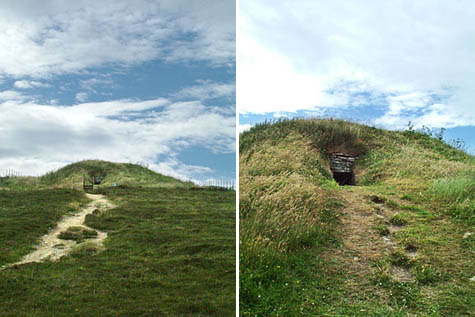
[Image: The artificial hill at Cuween, an Orkney burial cairn, perhaps anticipating by thousands of years the architecture of Vicente Guallart; photos by Sigurd Towrie of Orkney Jar].

In this case, we read, a farmer in the Orkney Islands of northwest Scotland, while plowing a relatively untouched field on his family land, uncovered a Neolithic chambered tomb just sitting there beneath the soil.
It was a room – and suddenly he had access to it.
“The structure itself is neat drystone construction,” a local archaeologist explains, and “the wall curves round tightly and is beehived in by corbelling at the top. On the opposite side to the wall is a space topped by lintels, and indeed it was breaking one lintel that caused the site to be found. It’s early days yet, but it may be a Neolithic chambered cairn, some five or six thousand years old.”
Of course, readers of The BLDGBLOG Book, finally published this week in the United States, will recognize this same idea from the beginning of that book’s “Underground” chapter (where the discovery of a tomb now known as Crantit Cairn is described in slightly fictionalized form). The bare bones of that story, however, are worth repeating here: one day, back in 1998, we read, a farmer “decided to plough [his] field in a different direction to normal – a seemingly insignificant decision that led to the discovery of what was hailed as one of ‘the greatest archaeological finds of recent years.'”
Specifically, “While ploughing, the tractor disturbed the roof of the tomb, dislodging a roofing slab. The slab fell to reveal a hole and daylight streamed into the underground chamber for the first time in millennia.”
With today’s penchant for green roofs and other forms of “vegitecture,” one wonders if similar such experiences might become exponentially more common in the distant future; two kids, playing around in the garden, pull a stone up from the flowerbed only to discover that they are standing atop the main gallery of a science museum constructed back in 2009 A.D.
Zork Begins.
In fact, as I mentioned in my lecture at the School of Visual Arts in New York back in April, a similar sort of idea made a cameo appearance in The Day After Tomorrow. There, we watch as Dennis Quaid and his two colleagues are hiking across a rapidly forming glacier – only for one of them to crash through a skylight into the snow-buried mall below.
It was not a glacier at all, in other words, but an unrecognized architectural form.
In any case, perhaps the great human adventure of the year 45,000 A.D. will not be in outer space at all, but a terrifying Dantean super-tour through the deeply buried cities of our present age. People stumble through this seemingly endless underground labyrinth, spanning nearly the whole surface of the globe, utterly unaware of who created these buildings and why.
In this context, old Celtic/Britannic myths of the Hollow Hills take on an especially interesting architectural resonance. I’m yet further reminded of many bunkers in the hills around San Francisco; seen from one side, these buildings appear to be mere mounds covered with gravel and weedy vegetation, like a gently rolling, even bucolic American landscape – but, from the other side, you find that they have heavily rusted metal doors…
The implication here, that you could open a door and walk inside a manmade earth, where the hills around you are actually the roofs of old buildings, will never cease to amaze me.

Chinese Islam and the Case of the Disappearing Prison

What do you do when you’re trying to shut down a high-profile prison for unofficially accused international terrorists? Ship the prisoners off to a nation of disappearing islands.
The U.S. might shortly begin sending Chinese Muslim prisoners from its facility at Guantanamo Bay – itself an extra-judicial territory, or semi-sovereign administrative enclave, that both is and is not part of the United States – to a terrestrially complicated new situation in the Pacific island nation of Palau.
Palau, of course, is disappearing.
From one black hole to another, then.

(Via @pruned).

Watershed Down

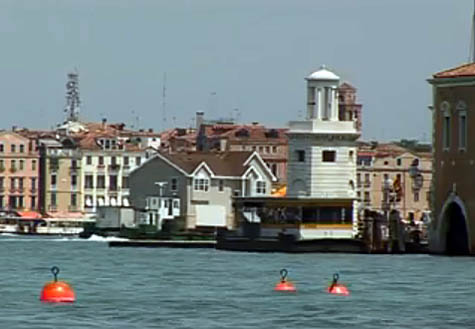
[Image: Mike Bouchet’s Watershed being towed through Venice towards the Arsenale basin, against a backdrop of Italian palazzi].

Note: This is a guest post by Nicola Twilley.

The 2009 Venice Biennale opened this week with an unexpected and quite beautiful piece of performance art. Artist Mike Bouchet had built a one-to-one scale replica of a typical American surburban home that he planned to install on floating pontoons in the Venice Arsenale basin. He called the project Watershed.

David Birnbaum, the Biennale’s curator, told camera crews filming the installation that he thought the project “sounded a bit megalomaniac,” but the sight of the oversized house, clad in beige vinyl, flimsily bobbing up and down against a backdrop of palazzi and piazzi as it was towed through Venice’s canals, was breathtaking. It was an architectural icon of the American Dream revealed in all its formulaic absurdity.

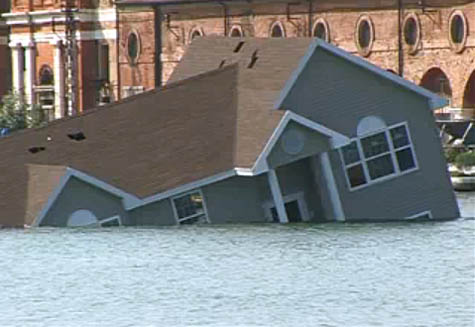
Amazingly, then, one of the pontoons capsized, and the entire house sank to the bottom of the canal—an unintentional yet utterly perfect coda to the house’s own built-in commentary. Now, a fake generic American suburban home will add its ruins to the underwater archaeology of Venice.

[Image: Mike Bouchet’s Watershed goes down].

A two-minute video of the house’s journey, and eventual fate, can be seen in full on YouTube.

(Originally spotted on Flavorwire).

Mobile Street Furniture

Note: This is a guest post by Nicola Twilley.

Over the past two weeks, in two separate cities, multiple sightings of IDEO-like user-generated adaptations have reframed the motorbike as an intriguing addition to the emerging category of street furniture.

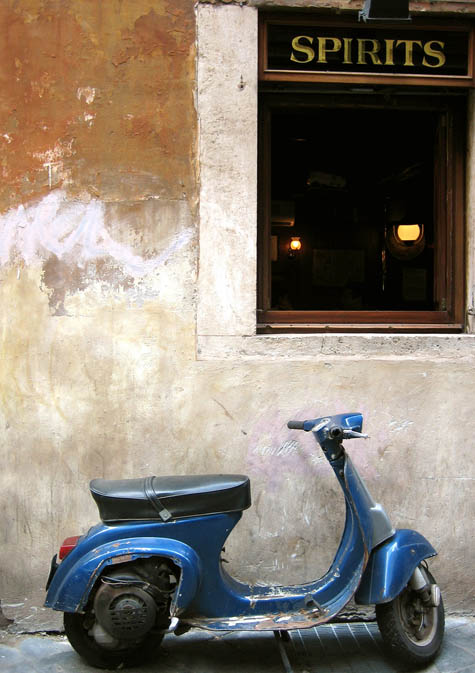
[Image: Photo by Lucy Crosbie, used under a Creative Commons license].

The first example was spotted outside Richard Rogers’s Channel 4 building in London, where a cluster of bike couriers had put their feet up onto their bikes’ handlebars, tipping their helmets down over their faces, and allowing the seats to form a gently curved cradle for their spines. They thereby squeezed in a quick nap between jobs.

Then, last week, as the streets of Trastevere overflowed with Romans celebrating the Festa della Repubblica, an unlucky Vespa parked next to a bustling enoteca was claimed as a bar stool and drink stand by several different groups over the course of the evening.

In both cases, the bikes suddenly appeared remarkably well-designed for their off-menu functionality: the hammock-like seat cushion and broad, flat rear looked purpose-built for backs and beer, respectively. In fact, with just a few adaptations and some thoughtful urban planning, their potential as mobile street furniture could be taken to the next level.

Simple additions—such as a gently vibrating seat cushion to work out muscle knots while couriers are snoozing, or flip-out cup holders behind the seat of the Vespa—combined with reserved parking spots for motorbikes outside bars and popular brunch spots, would surely enhance city life.

Ambitious entrepreneurs could carve out a seasonal niche by deploying a fleet of specially customized motorbikes as on-demand mobile seating. Perhaps tourists visiting Rome for the day could even rent motorbikes in a shady side-street so as not to miss out on their expected siestas. And, particularly in London, where dedicated outdoor beer gardens—a losing proposition for at least three hundred days of the year, but the most desirable real-estate in the city on those few hot, sunny days—smart publicans would eagerly pay to rent a dozen Vespa bar stools for their clientele to enjoy.

In each case, the motorbikes would be gone by the time pedestrian and vehicle traffic started up again—their mobility ensuring that streets and sidewalks remain uncluttered at peak flow.

It would only be a matter of time before low-platform flat-bed trucks had rentable sofas installed in the back and were then parked at scenic overlooks, while empty lorries were re-purposed as hammock dormitories, circling airport terminals to snap up jet-lagged travelers intent on maximizing layover time. The first international Mobile Street Furniture Conference in Milan would be swiftly followed by the creation of an industry-sponsored urban planning lobbying arm, high-profile design contests, and premium membership schemes, allowing unlimited worldwide street furniture rental…

[Other guest posts by Nicola Twilley include Watershed Down, The Water Menu, Atmospheric Intoxication, Park Stories, and Zones of Exclusion].

Pardon the Disruption

Just a quick note that I’m off to Turin tomorrow to participate in a conference called I Realize: The Art of Disruption, if any readers out there are in that city of long shadows and automobiles.

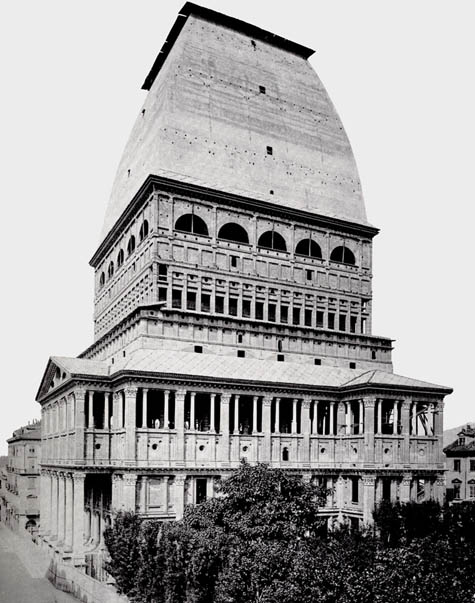
[Image: The massive Mole Antonelliana, Turin (1875); view larger].

The point of the conference is to look at “breaking radically with the past, moving the horizon and embracing ambitious challenges.”
Even better, it takes place inside a “Virtual Reality & Multimedia Park” (here’s a map) – and the other speakers include the one and only Bruce Sterling, legendary designer Peter Saville, architect Andrea Branzi, Nicolas Nova, Jennifer Higgie, Gianluigi Ricuperati, Nicola Perullo (director of Slow Food Italia), and many, many others.
If you’re around, be sure to introduce yourself (although my Italian, unfortunately, è inesistente).

Urban X-Ray / Ancient Orchard

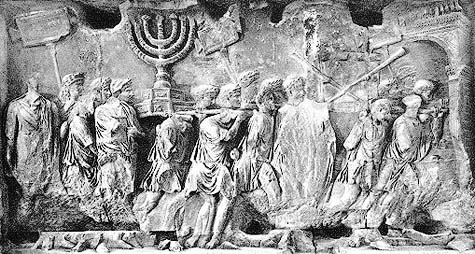
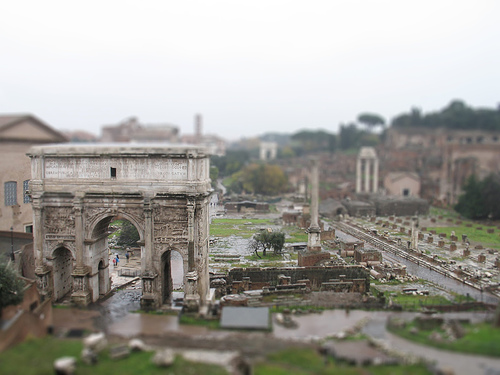
[Image: A Roman Triumph following the sack of Jerusalem].

Amongst the many books I’m reading here in Rome this month – including Tobias Jones’s surprisingly good Dark Heart of Italy, the incredible Anatomy of Fascism by Robert Paxton (J.G. Ballard wrote that he “found Paxton’s post-mortem deeply unsettling, with its strong hint that the corpse [of fascism] might sit up at any moment and seize us by the throat” – Exhibit A here might be Andrew Brons‘s election this week to the European Parliament), and Roger Deakin’s Waterlog – I’m making my way through two books by Mary Beard.
Beard, of course, was the subject of a long, two-part interview with BLDGBLOG back in 2007.
What I want to mention here comes from her book The Roman Triumph; it’s only a brief quotation, but I like it.
At one point Beard refers to the “theaters and porticoes” built in ancient Rome using wealth taken during Pompey‘s “eastern campaigns” in Armenia and elsewhere. However, she writes:

The term “theaters and porticoes” hardly does justice to this vast building complex, which stretched from the present day Piazza Campo del Fiori to the Largo Argentina, covering an area of some 45,000 square meters. A daring – and, for Rome, unprecedented – combination of temple, pleasure park, theater, and museum, it wrote Pompey’s name permanently into the Roman cityscape. Even now, though no trace remains visible on the ground, its buried foundations (and particularly the distinct curve of the theater) determine the street plan and housing patterns of the city above; it remains a ghostly template which accounts for the surprising twists and turns of today’s back-streets, alleyways, and mansions.

The not entirely surprising realization that the present-day street grid of Rome is actually an articulation of other, previously buried cities – cities not lost to history, then, but accessible in outline through the indirect archaeology of contemporary urban planning – reminds me of something that came up back at Postopolis! LA.

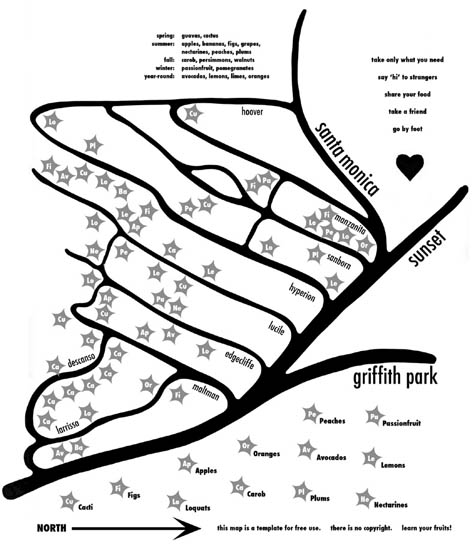
[Image: Fallen Fruit‘s map of the lost orchards of Silver Lake].

During their presentation, the ingenious duo Fallen Fruit mentioned that, when they were mapping fruit trees in today’s Los Angeles, they stumbled upon the borders of much older, abandoned fruit orchards.
In other words, what appeared simply to be a random fig tree growing in someone’s front yard was, when seen on a map together with other such trees, actually the remnant presence of a now-forgotten farm.
Those trees, to use Beard’s term, are the “ghostly template” from an earlier phase of land use.
There is a different grid inside the grid, you might say – where each tree becomes something like a legal document, marking the outer boundaries of a lost landholding.
Of course, both of these examples together bring to mind the lost airports of Los Angeles, those geographies of aerial experience that now sit buried and all but forgotten beneath millions of tons of pavement throughout the greater L.A. region.
Other such examples are easy to come by – but their interest, for me, never dissipates. Whether it’s the lost rivers of London still giving shape to the street plan above (or lost streams of Manhattan turning into underground fishing ponds), there are remnant geographies and ghostly templates everywhere.
In fact, as I recently wrote in an introduction to photographer Shaun O’Boyle’s forthcoming book Modern Ruins: Architectural Monuments of the Mid-Atlantic – definitely check it out upon publication in 2010 – this even includes our own bodies: forgotten anatomies still make themselves known through the structure and layout of our nerves and bones.
But Rome, Los Angeles, London – these urban examples simply give our ghostly ancestors architectural shape.

Shells, Tube Structures, and Minimal Surfaces

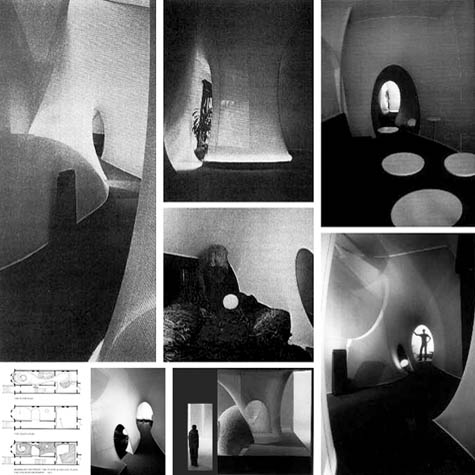
Reader Louis Schultz has pointed out the work of Lithuanian-born artist Aleksandra Kasuba, who used curved surfaces of fabric stretched and attached between space frames in order to create inhabitable rooms and corridors.

[Images: The Live-in-Environment (1971) by Aleksandra Kasuba; the project “was built on a parlor floor of a brownstone house in New York City,” we read. “The intent was to abolish the 90-degree angle and create an environment that would capture changes in daylight, provide variations in terrain, and introduce the unexpectedness of views found in nature without simulating nature”].

These ephemeral installations were intended, spatially, as a way to “abolish the 90-degree angle and create an environment that would capture changes in daylight, provide variations in terrain, and introduce the unexpectedness of views found in nature without simulating nature.” I love that latter caveat: to retain the experiential impact of unexpected natural vistas without simply copying, or simulating, the spatial details and material palette of the natural world.
Instead, a somewhat stark world of undecorated surfaces curves around us – call it biomorphic minimalism – thus eliding the differences between architecture and large-scale tailoring.
In any case, her Live-in-Environment, from 1971, seen in the images above, is a great example of this – but don’t miss the Roof Deck Study from 1974; the Barbarella-meets-IBM world of torqued geometry from her Office Renovation Study (1975); the aerial tunnels of Art-in-Science I (1977), which look like some megafaunic form of undersea life, stretched through the canopies of a North American thicket (“With the assistance of three students during an eight week stay,” Kasuba writes, “we explored the topology of 78 fabric structures, hardened 32 with resins, and erected 4 weather structures”); and the simplicity of Blue Shade (1978).
Better yet, Kasuba supplies a section called How It Was Done – where you can learn how to create finishes, arches, and doors, for instance – and this includes Kasuba’s extraordinary, lo-fi guide to shells, tube structures, and minimal surfaces.
It’s what The North Face might have become had their tent division been bought by Kenneth Snelson.

Rome Thunderdome

[Image: Little Rome Ruins by Bernat Gallemí].

An early burst of thunder woke me up this morning, before a brief wash of rain blew through – but what was extraordinary was that the sound of the thunder didn’t pass all at once: it kept opening and echoing, as if moving outward through the city to trace the shapes of piazzas, streets, river banks, and alleyways.
There was a kind of Dopplered geometry to it – an acoustic version of Rome exactly opposite the city’s angles and walls. Live here long enough, and perhaps you could even tell when a storm has reached the Campo del Fiori – echolocating yourself amidst urban geography – because the thunder has opened out again, getting louder, or more resonant, only then to dampen itself back in a tight squeeze through surrounding alleyways. The sound moves through the city like a spider.
You might say that thunder could be used here as a kind of horizontal space-detection device. It’s urban radar: an acoustic sensing of the city that moves through that city, seeking out cracks and passageways. Only to fill those empty spaces with sound.
A guild of blind mapmakers uses thunderstorms to pursue prehistoric radar cartography.
It occurred to me, though, that every city – or, at least, every city with a different street grid – must react to thunder differently. Urban design becomes a direct sonic engagement with the atmosphere through storms, using the unique form of your city as a precise acoustic frame for the sky.
Could there even be building types that funnel the sound of thunder? Like Athanasius Kircher‘s talking statues, they would be talking buildings: acoustically activated by thunder for the purpose of public spectacle.
You could actually test people with this: put them blindfolded in different locations during foreign thunderstorms and ask them to deduce where they are from the widening concussions of sound around them.
Moscow, Cairo, Rome, Fez. London, Barcelona, New York. All with their own sonic signatures: you pinpoint an aerial detonation and acoustically trace its spatial after-effects.

The Water Menu

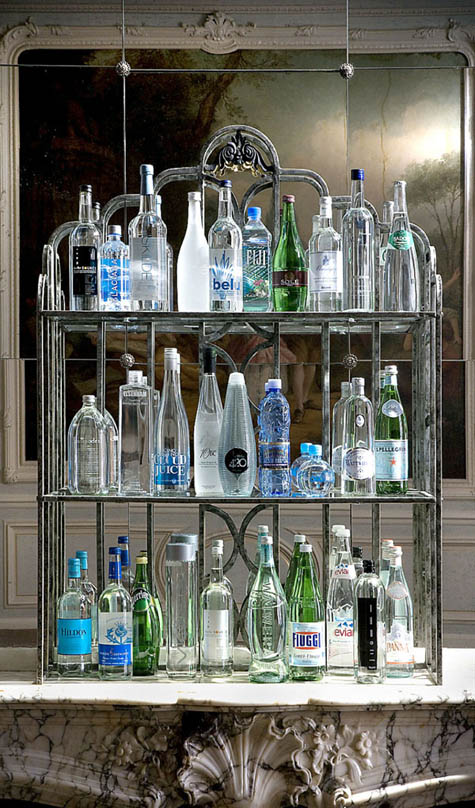
[Image: The water selection at Claridge’s, curated by Renaud Grégoire, food and beverage director].

Note: This is a guest post by Nicola Twilley.

The concept of terroir has its origins in French winemaking, as a means to describe the effect of geographic origin on taste. As a shorthand marker for both provenance and flavor, and as a sign of its burgeoning conceptual popularity, it has spread to encompass Kobe beef, San Marzano tomatoes, and even single-plantation chocolate.

But can water have terroir? What about the influence of the earth on water?

In late 2007, Claridge’s (a luxury hotel in Mayfair, London) caused a minor stir by introducing a “Water Menu.” The list features more than thirty mineral waters from around the world, described in terms of their origin and suggested flavor pairings.

Leaving aside a few obvious issues (such as the environmental impact of bottled water and the sheer economic wastefulness of sending multiple varieties of it to one hotel in England), it is hard not to appreciate the poetry of three-line exotic water biographies.

Take Mahalo Deep Sea Water, at £20 for 71cl, which comes from “a freshwater iceberg that melted thousands of years ago and, being of different temperature and salinity to the sea water around it, sank to become a lake at the bottom of the ocean floor. The water has been collected through a 3000ft pipeline off the shores of Hawaii.” According to the Daily Mail, Mahalo has a “very rounded quality on the palate” and it “would be good with shellfish.”

[Image: The Daily Mail‘s taste test results].

Meanwhile, Danish Iskilde‘s “flinty, crisp style” apparently derives from the Jutland aquifer’s complicated geology, consisting of interlaced deposits of quartz sand, clay, gravel, and soil. The most expensive (and possibly the most exciting) water on the menu is 420 Volcanic from New Zealand. Sourced from the Tai Tapu spring, which bubbles up through more then 650 feet of rock at the bottom of an extinct volcano, it is apparently “extremely spritzy on the palate with a tangy mineral finish.”

Claridge’s has since been joined by the Four Seasons in Sydney, and, according to The Guardian, “a handful of five-star Los Angeles hotels now employ water sommeliers to advise on the best water accompaniment to spiced braised belly pork or fillet of brill with parmentier of truffled leek.”

This same Guardian article goes on to recount the origins of Elsenham Water, which is described as “absolutely pure” and “very earthy—almost muddy,” depending on who you ask. Elsenham was discovered almost accidentally by Michael Johnstone, a former jam manufacturer; it is filtered over a 10-year period, in a confined chalk aquifer, half a mile below his abandoned jam factory and a neighboring industrial-sealant plant. Now, staff in white coats and hair nets fill up to 1,000 bottles daily “from an acrylic tank connected to pipes running into a hole in the ground.” Each bottle, priced at £12 for 75cl, is then polished by hand before it leaves the building.

According to Michael Mascha, former wine critic and author of Fine Waters: A Connoisseur’s Guide to the World’s Most Distinctive Bottled Waters, “water is in a transition from being considered a commodity to being considered a product.”

There is an undeniable Wild West gold-rush type of excitement to the idea of drilling for water in geologically auspicious locations. However, Mascha’s comment also implies that we might even begin to see the engineering of gourmet water products.

Loop tap water in a closed pressurized system for twenty years, through thick beds of pure northern Italian dolomite, and enjoy the lightly acidic result with chicken and fish. Better yet, blend it with water forced through a mixture of Forez and Porphyroid granite chips sourced from southwest France, stacked in a warehouse outside London to mimic in situ geological formations, to add a citrusy top note reminscent of Badoit.

A final spritz of oxygen ensures a silky mouthfeel—combined with the right designer packaging—and the burgeoning ranks of water connoisseurs will be lining up at your industrial plant for a taste.

[Previous posts by Nicola Twilley include Atmospheric Intoxication, Park Stories, and Zones of Exclusion].

Urban Haunting

I’m in Rome now for the month of June, living across from a prison near the banks of the Tiber, listening to seagulls, on a fairly awful and inexplicably expensive wireless internet connection, fearing that I might only be able to post every few days.

In fact, my early morning attempts to find domestic hotspots – putting my computer near the windows, or moving books and papers just a few more feet away – reminds me of stories I’ve read about high-end audio equipment aficionados, people who purchase arcane bits of scientifically dismissible, wildly overpriced stereo attachments in the hopes that they can affect, clarify, or otherwise improve their home-listening experience.
Pieces of piezoelectric crystal, or unsustainably harvested rain forest wood milled into odd shapes – combined with bizarre new alloys imported from metallurgical research labs in southern Germany – all wired up and placed around your home stereo, like a deviant altar. Where consumer goods meet Arthur C. Clarke’s 3rd law.
But is there an equivalent for wireless internet connections?
You put a small piece of copper near your USB port, hoping for magical cross-interference, or, in a fit of antihistamine-influenced mania, you rewire your whole house, splicing electrically unnecessary strands of tellurium through the switchboards inside the walls.
Or why not take the Ghostbusters route and construct a whole building as an urban antenna, an architectural attractor for that strange wireless haunting that allows you to Google things in foreign cities from a desktop that isn’t yours.
In other words, are there micro-practices of wireless superstition that people engage in so that they can achieve, or believe they achieve, stronger wireless internet signals?
You implant rods inside all of Rome’s statuary, and inside the ruined walls of the city’s periphery, in order to boost your home internet access. A conspiratorial geometry of antennas that no one else recognizes, pulsing with airborne data.
Rome, reconceived as a counter-Vatican of wireless downloads. Catholicism of the megabyte.
It’s what might happen if Telecom Italia opened an urban design wing after reading too much Aleister Crowley.
In any case, while the internet is still functioning here, I also wanted to thank everybody who came out to see Thrilling Wonder Stories last week at the Architectural Association. My own talk was something of a jumble, to be honest – sorry about that, especially for those of you who were meeting me for the first time – but the rest of the day really impressed.
For those of you who missed it, participant Jim Rossignol has a great write-up of the event on his blog; Rossignol’s account of Francois Roche is well worth a read. Here’s an excerpt:

Then the most extraordinary storm of science-madness came from Francois Roche (of architects R&Sie) whose thick accent masked incredible phrases: “strategies of sickness,” “protocolising the witch in the forest,” “the necrosis of the building,” “the penis of the wall”… He talked about feeding death and traditional fairy tales into design, and about creating a machine that would build an un-navigable glass maze in the courtyard between buildings, into which people would wander, and then die, unable to escape without GPS. “They die to become part of the building,” he said, grinning, and propping expensive sunglasses on his styled bonce. He talked about a building which would be constructed from vast, moulded versions of bullet holes on wet clay, covered in rotting vegetation collected from the Korean de-militarized zone by a purpose-built “witch” robot, referencing Tarkovsky’s Stalker on the way.

With any luck, the whole of Thrilling Wonder Stories will soon be made into an AA publication by the end of this summer.
So expect more posts soon – and if anyone has tips for obscure archaeological sites in Rome that need to be visited, let me know.

Saddam’s Palaces: An Interview with Richard Mosse

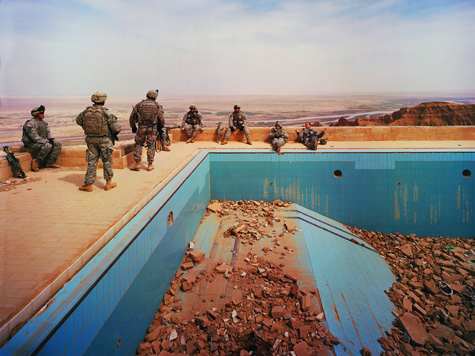
[Image: Ruined swimming pool at Uday’s Palace, Jebel Makhoul, Iraq (2009); photo by Richard Mosse].

Photographer Richard Mosse first appeared on BLDGBLOG last year with his unforgettable visual tour through the air disaster simulations of the international transportation industry.

He and I have since kept in touch—so, when Mosse returned from a trip to Iraq this spring, he emailed again with an unexpectedly intense new body of work. These extraordinary images—published here for the first time—show the imperial palaces of Saddam Hussein converted into temporary housing for the U.S military.

Vast, self-indulgent halls of columned marble and extravagant chandeliers, surrounded by pools, walls, moats, and, beyond that, empty desert, suddenly look more like college dormitories. Weight sets, flags, partition walls, sofas, basketball hoops, and even posters of bikini’d women have been imported to fill Saddam’s spatial residuum. The effect is oddly decorative, as if someone has simply moved in for a long weekend, unpacking an assortment of mundane possessions.

The effect is like an ironic form of camouflage, making the perilously foreign seem all the more familiar and habitable—a kind of military twist on postmodern interior design.

Of course, then you notice, in the corner of the image, a stray pair of combat boots or an abandoned barbecue or a machine gun leaned up against a marble wall partially shattered by recent bomb damage—amidst the dust of collapsed ceilings and ruined tiles—and this architecture, and the people who now go to sleep there every night, suddenly takes on a whole new, tragic narrative.

Fascinated by the dozens and dozens of incredible photos Mosse emailed—only a fraction of which appear here—I asked him to describe the experience of being a photographer in Iraq.
The ensuing dialogue appears below.


• • •

BLDGBLOG: What was the basic story behind your visit to Iraq? Was it self-funded or sponsored by a gallery?

Richard Mosse: The trip was backed by a Leonore Annenberg Fellowship in the Performing and Visual Arts, which I received after graduating from Yale last summer with an MFA in photography. The Fellowship provides enough to fund two full years of traveling to make new photographs, and I applied to shoot in a range of places, including Iraq. My proposal was to make work around the idea of the accidental monument. I’m interested in the idea that history is something in a constant state of being written and rewritten—and the way that we write history is often plain to see in how we affect the world around us, in the inscriptions we make on our landscape, and in what stays and what goes.
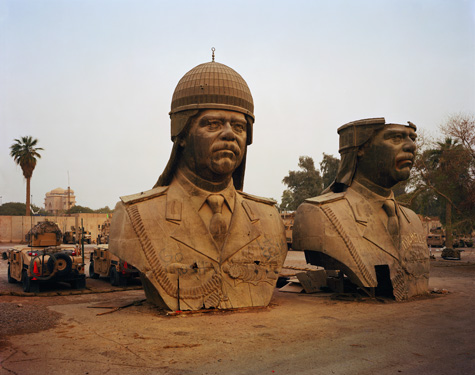
[Image: Saddam’s heads, taken from the roof of the Republican Guard Palace, now located at Al-Salam Palace, Forward Operating Base Prosperity, Baghdad, Iraq (2009); photo by Richard Mosse].

I suppose it’s an idea that captured me while traveling through Kosovo in 2004. I saw a building by the side of the road there that lay mined and shattered in a field of flowers. It was almost entirely collapsed—except for a church cupola which lay at a pendulous angle, though otherwise perfectly intact on a pile of rubble. It was a marvelously pictorial vision of the Kosovo Albanian desire to rewrite the history books. In other words, what I saw before me was not an act of mere vandalism, but a decisive act by the Kosovo Albanian community to disavow the fact of Serb Orthodox church heritage in the region. The removal of religious architecture is a terrible crime, and it constitutes an act of ethnic cleansing (remember Kristallnacht); yet I couldn’t help but interpret this as an attempt to create a brave new Kosovo Albanian world.

I began to see architecture as something that can reveal the ways in which we alter the past in order to construct a new future, as a site in which past, present, and future come together to be reformed. And it’s not the only one: language—our words and the way we use them—are another fine barometer of these things.

But architecture is something I felt I could research and portray using the dumb eye of my camera.
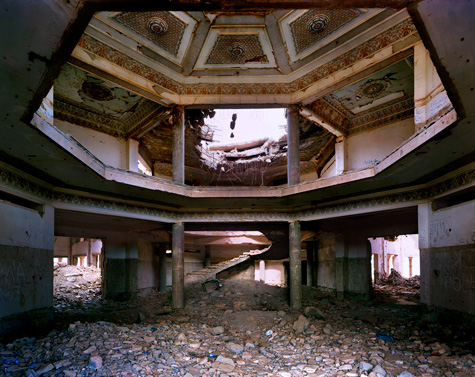
[Image: JDAM bomb damage within Saddam’s Palace interior, Jebel Makhoul, Iraq (2009); photo by Richard Mosse].

BLDGBLOG: Beyond the most obvious reasons—for instance, there’s a war going on—why did you go to Iraq? Was there something in particular that you were hoping to see? 

Mosse: I had heard plenty about Saddam’s palaces. They were the focus of the International Atomic Energy Association’s tedious investigations in the years preceding the invasion, and the news was always full of delegations being turned away from this or that palace. Why were we so keen to get inside Saddam’s palaces? Because he built so many—81 in total. Surely, we thought, he must be hiding something in those palace complexes. Surely he must be building subterranean particle accelerators. And, in the end, our curiosity got the better of us.
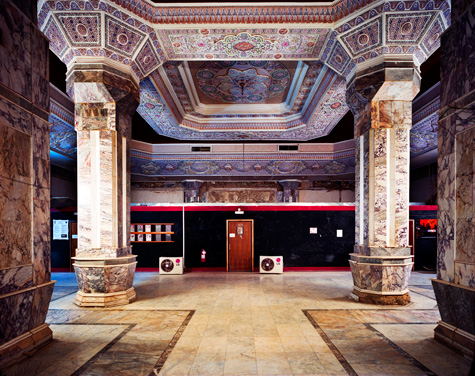
[Image: U.S.-built partition and air-conditioning units within Al-Salam Palace, Forward Operating Base Prosperity, Baghdad, Iraq (2009); photo by Richard Mosse].

In fact, Saddam was building palaces in every city as an expression of his authority. Palace architecture in Iraq served as a constant reminder of Saddam’s immanence. A palace in your city simply fed the sense that Saddam was not just nearby—he was everywhere. Saddam was omnipresent.

I once heard a Westerner tell me that, prior to the invasion, Iraqis driving near one of Saddam’s palaces would actually avert their eyes—they would refuse to look toward the palace. It was almost as if they were prisoners in a great outdoor version of Jeremy Bentham’s Panopticon. Curiously, the sentry towers along the perimeter walls of Al-Salam Palace in Baghdad face only outward; they’re screened from looking inward at the palace itself. People say it’s so the guards could not witness Saddam’s eldest son Uday’s relations with underage girls, but I rather like to think that it created a sense of the unseen authoritarian staring blankly outwards. It was like those ominous black turrets that the British army constructed over the hills of Belfast, packed with listening devices and telescopic cameras.
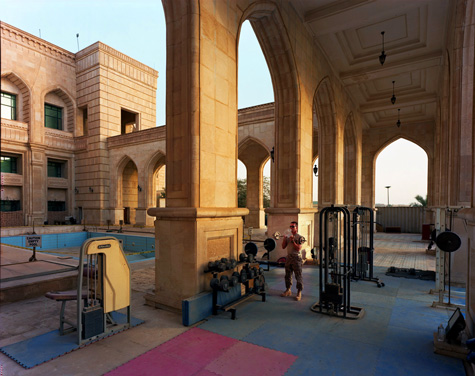
[Image: Outdoor gym, Al-Faw Palace, Camp Victory, Baghdad, Iraq (2009); photo by Richard Mosse].

But the idea of Iraqis averting their eyes from Saddam’s palace architecture also reminds me of something from W.G. Sebald’s book On the Natural History of Destruction.

BLDGBLOG: That’s an incredible book – I still can’t forget his descriptions of tornadoes of fire whirling through bombed cities and melting asphalt.

Mosse: Sebald recounts how the German population, after the end of WWII, would ride the trains, staring into their laps or at the ceiling—anywhere but out the window at the terrible wreckage of their cities. It was as if they were somehow disavowing the war by willing it away, by refusing to perceive it.

It’s interesting, then, that, in both instances—in both Iraq and in post-war Germany—it’s the tourist, or the outsider, who observes this blindness. I suppose that’s why I like to make photographs in foreign places: only the tourist notices the really dumb things that everyone else takes for granted.
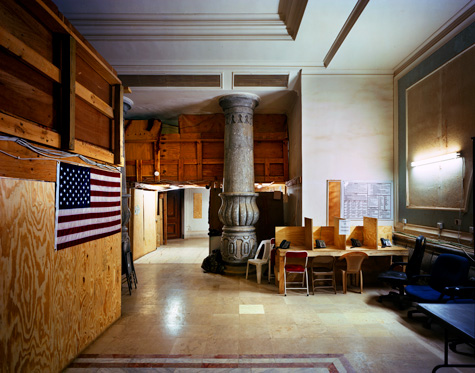
[Image: U.S. military telephone kiosks built within Birthday Palace interior, Tikrit, Iraq (2009); photo by Richard Mosse].

BLDGBLOG: The way these structures have been colonized is often amusing and sometimes shocking—the telephones, desks, and instant dormitories that turn an imperial palace into what looks like a suburban office or hospital waiting room. Can you describe some of the spatial details of these soldiers’ lives that most struck you? 

Mosse: It was extraordinary how some of the palace interiors had been transformed to accommodate the soldiers. Troops scurried beneath vaulted ceilings and glittering faux-crystal chandeliers. Lofty marble columns towered over rat runs between hastily constructed chipboard cubicles. Obama’s face beamed out of televisions overlooking the freezers and microwaves of provisional canteen spaces.

Many of the palaces have already been handed back to the Iraqis—but where Americans troops do remain, they live in very cramped conditions, pissing into a hole in the ground and waiting days just to shower. Life is hard on the front line, and it seems more than a little surreal to be ticking off the days in a dictator’s pleasure dome.
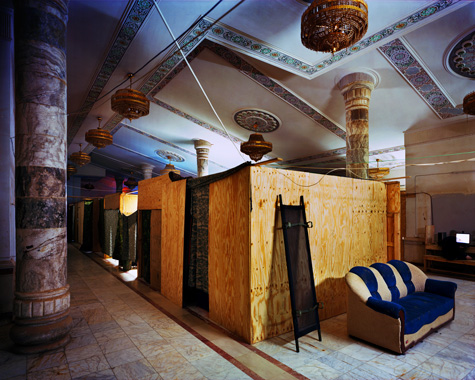
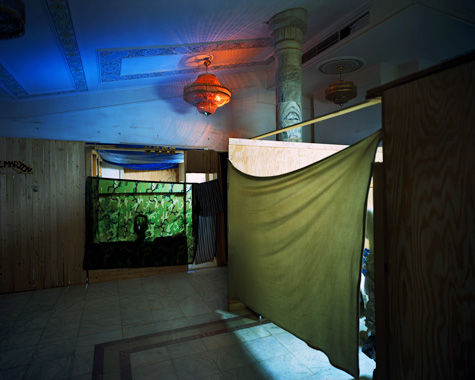
[Images: American dormitories built within Saddam’s Birthday Palace, Tikrit, Iraq (2009); photos by Richard Mosse].

The most interesting thing about the whole endeavor for me was the very fact that the U.S. had chosen to occupy Saddam’s palaces in the first place. If you’re trying to convince a population that you have liberated them from a terrible dictator, why would you then sit in his throne? A savvier place to station the garrison would have been a place free from associations with Saddam, and the terror and injustices that the occupying forces were convinced they’d done away with. Instead, they made the mistake of repeating history.

This is why I’ve titled this body of work Breach. “Breach” is a military maneuver in which the walls of a fortification (or palace) are broken through. But breach also carries the sense of replacement—as in, stepping into the breach. The U.S. stepped into the breach that it had created, replacing the very thing that it sought to destroy.

There are other kinds of breach—such as a breach of faith, a breach of confidence, or the breach of a whale rising above water for air. All of these senses were important to me while working on these photographs.
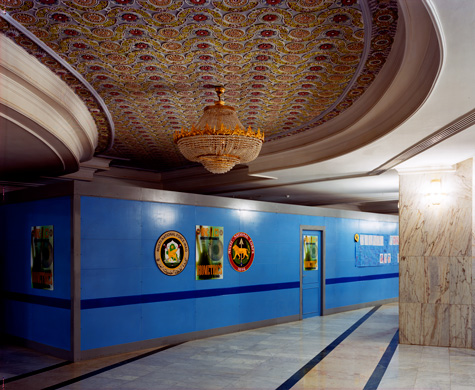
[Image: Provisional office wall partitions within Al-Faw Palace, Camp Victory, Baghdad, Iraq (2009); photo by Richard Mosse].

BLDGBLOG: In several of these photos, the soldiers are literally lifting tiles up from the floor as if the buildings had been left unfinished, or they’re peering through cracks in the palace walls. From what you could see, were Saddam’s palaces badly constructed or were they just heavily damaged during the war?

Mosse: Tiles simply fell from Al-Faw Palace because the cement used there had been poorly salinated. If that can happen to tiles, think what’s happening when the entire palace has been built on similarly salinated foundations! It’s just a matter of time before Al-Faw collapses in on itself.

You can already see arches cracking and walls beginning to sag.
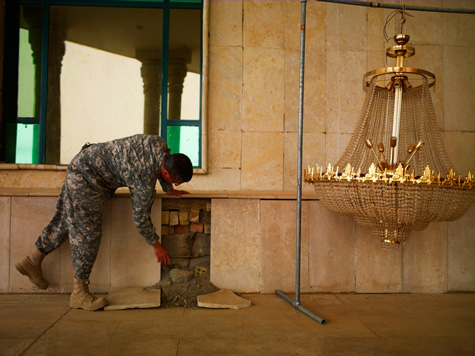
[Image: Fallen tiles and chandeliers, Al Faw Palace, Camp Victory, Baghdad, Iraq (2009); photo by Richard Mosse].

But I’m reluctant to include images of U.S. soldiers pointing out problems with Saddam’s architecture, because it’s fairly evident that those could be a form of propaganda—and it’s easy to forget that many of these palaces were built during times of terrible sanctions imposed by the West. It might not seem very clear why Saddam was busy building palaces in a time of sanctions, but remember how the WPA was set-up during the Great Depression? I don’t want to risk being called an apologist for Saddam, but there are many ways to read a story.
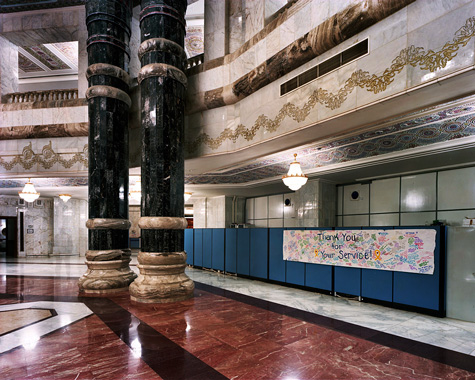
[Image: “Thank you for your service” banner, Al-Faw Palace interior, Camp Victory, Iraq (2009); photo by Richard Mosse].

That said, the palace is a fabulous monument to rushed construction, poor materials, and gaudy pomp. Saddam had apparently insisted that the palace be finished within two years, so many shortcuts were taken during construction. For example, the stairway banisters were made of crystallized gypsum—rather than carved marble—and where pieces didn’t quite fit together, they were just sanded down rather than replaced. Marble that was used in the palace (such as in the great spacious bathrooms) was imported from Italy, in spite of the trade embargo. And the plaster cast frescoes in the ceilings were imported from Morocco.
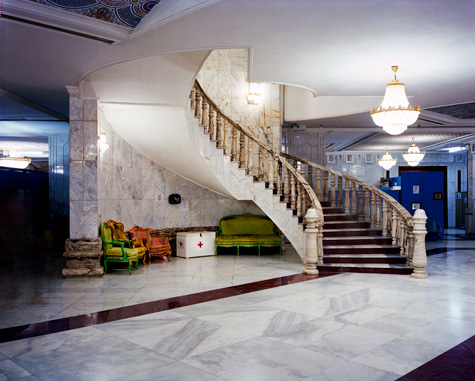
[Image: Stairway, Al-Faw Palace, Camp Victory, Baghdad, Iraq (2009); photo by Richard Mosse].

Al-Faw Palace later became the U.S, Army’s Command HQ, located at the heart of Camp Victory, near Baghdad International Airport. The palace is now teeming with generals, including General Odierno, the commander of coalition forces in Iraq. It’s a great, tiered wedding-cake structure, built around an inner hall with possibly the biggest and ugliest chandelier ever made. In fact, the chandelier is not made of crystal, but from a lattice of glass and plastic.
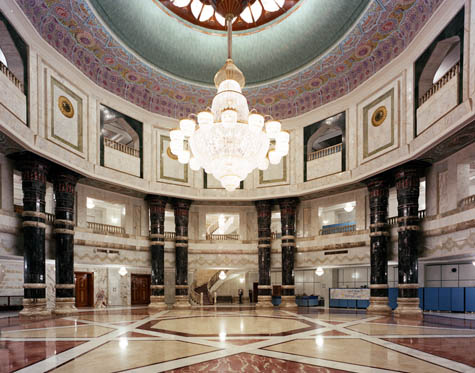
[Image: Chandelier, Al-Faw Palace, Camp Victory, Baghdad, Iraq (2009); photo by Richard Mosse].

The palace itself is then surrounded by a lake, which seems a bit like a moat—and it would be tempting to take a swim there, but the moat has been turned into a standing pool for Camp Victory’s sewage. In the summer, the place must be rather unpleasant: rank in all senses of the word, both military and sanitary. These artificial lakes surrounding the palace are also populated by the infamous “Saddam Bass.” It’s said that Saddam would feed the bodies of his political opponents to these monsters. In fact, they’re not bass at all, but a breed of asp fish. U.S. troops stationed at Camp Victory love to fish on these lakes, and a 105-pound specimen was recently caught.

[Image: Tigris Salmon caught at Camp Victory Base, measuring 5 feet 10.5 inches and weighing 105 lbs. Image courtesy of the U.S. Army].

BLDGBLOG: How was your own presence received by those soldiers? Did you present yourself as a photojournalist or as an art photographer?

Mosse: The difference between art and journalism is, for me, of paramount importance—but twenty minutes in Iraq, and the dialectic recedes. I got a vague sense that Americans working there feel a little forgotten—unappreciated by people at home—so they’re very grateful for a camera, any camera, coming through. Even a big 8″x10″ bellows camera with an Irishman in a cape. There were a lot of rather obvious photographs that I chose not to make, and occasionally someone got offended by this.
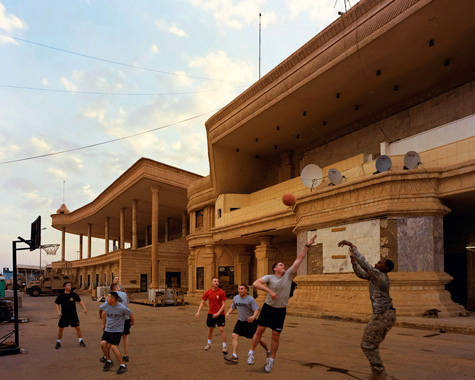
[Image: A game of basketball, Birthday Palace, Tikrit, Iraq (2009); photo by Richard Mosse].

BLDGBLOG: What was the soldiers’ opinion of these buildings? Did they ever just wander around and explore them, for instance, or was that a safety violation?

Mosse: I got the feeling that soldiers who occupied one of Saddam’s palaces were pretty interested in its original function. They seemed a lot more together, and happier with their job, compared with the troops I met on the massive, sprawling, purpose-built military bases in the Iraqi desert. Constant reminders of hierarchy and protocol were everywhere on the bigger bases—but on the more cramped and less comfortable palace bases, soldiers of different ranks seemed much closer and more capable of shooting the shit with each other, to borrow an American turn of phrase.

Though a far tougher environment, there seemed to be real job satisfaction—a sense that they were taking part in a piece of history.
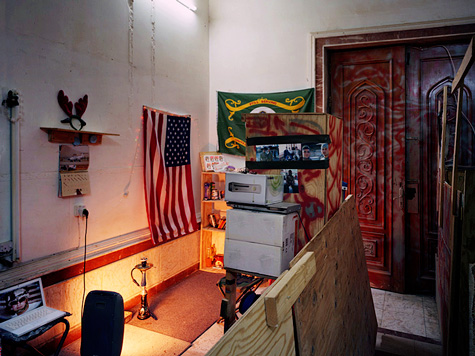
[Image: Detail of U.S. soldier’s living quarters, Birthday Palace interior, Tikrit, Iraq (2009); photo by Richard Mosse].

BLDGBLOG: Architect Jeffrey Inaba once joked, in an interview with BLDGBLOG, that Saddam’s palaces look a bit like McMansions in the suburbs of New Jersey. He quipped that “the architecture of state power and the architecture of first world residences don’t seem that far apart. Saddam’s palaces, while they’re really supposed to be about state power, look not so different from houses in New Jersey.” They’re not intimidating, in other words; they’re just tacky. They’re kitsch. Now that you’ve actually been inside these palaces, though, what do you think of that comparison? 

Mosse: Well, I’ve never been inside a New Jersey McMansion, so I can’t pass judgment. However, “McMansion” is a term borrowed by us in Ireland, where I’m from. Ireland was hard-hit by English penal laws, from the 17th century onward. One of those laws was the Window Tax. This cruel levy was imposed as a kind of luxury tax, to take money from anyone who had it; the result was that Irish vernacular architecture became windowless. The Irish made good mileage on the half-door, for instance, a kind of door that can be closed halfway down to keep the cattle out but still let the light in.

Aside from this innovation, and from subtleties in the method of thatching, Irish architecture never fully recovered—to the point that, even today, almost everyone in my country chooses their house from a book called Plan-a-Home, which you can buy for 15 euros. And if you have extra cash to throw in, you can flick to the back of the book and choose one of the more spectacular McMansions. Those are truly Saddam-esque.
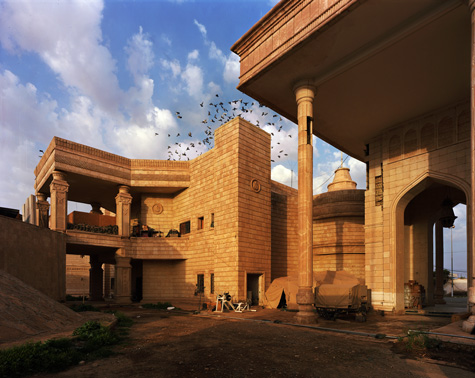
[Image: Birthday Palace, Tikrit, Iraq (2009); photo by Richard Mosse].

BLDGBLOG: Finally, the “Green Zone,” as well as many of these palaces, are notoriously insular, cut-off behind security walls from the rest of Iraq. Did you actually feel like you were in Iraq at all—or in some strange architectural world, of walls and dormitories, surrounded by homesick Americans? 

Mosse: Not all of Saddam’s palaces are as isolated from reality as those situated in the green zone (or international zone, as it’s now called). One I visited near Tikrit—Saddam’s Birthday Palace—was even right at the heart of the city. Saddam was said to visit the palace each year on his birthday.

Wherever you go on the base, you’re eminently shootable—a fantastic sniper target—and can hear the coming and going of Iraqis in the surrounding neighborhoods. It’s a remarkable experience to go up to the roof with the pigeons at dusk and watch the changing light. You get a palpable impression of the great tragedy of the Iraq war, and you can see for yourself the fencing between neighborhoods, the rubbish strewn everywhere, the emptiness of the place, and you can hear the packs of dogs baying about. But you can also hear occasional shots fired in the distance, and you get the distinct feeling that you’re being watched.

I spent a very slow month in Iraq trying to reach as many of these palaces as possible. I only managed to visit six out of eighty-one palaces. It is impossibly slow going over there, working within the war machine. These palaces are currently being handed back to the Iraqis, and many of them will be repurposed, sold to private developers or demolished. If I could get the interest of a publisher, for instance, I would return to Iraq to complete the project before Saddam’s heritage, and the traces of U.S. occupation, are entirely removed.


• • •

Thanks again to Richard Mosse for the incredible opportunity to talk to him about this trip, and for allowing BLDGBLOG to publish these images for the first time.

Be sure to see the rest of Mosse’s work on his website. Hopefully the entirety of Breach will be coming soon to a book or gallery near you.