Incident Report

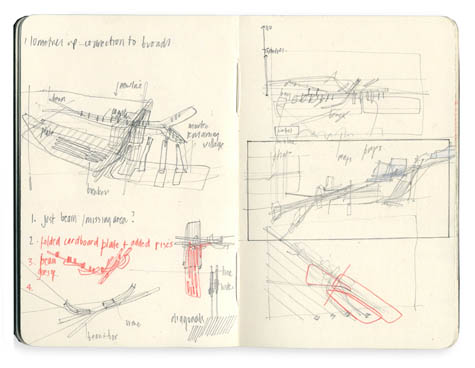
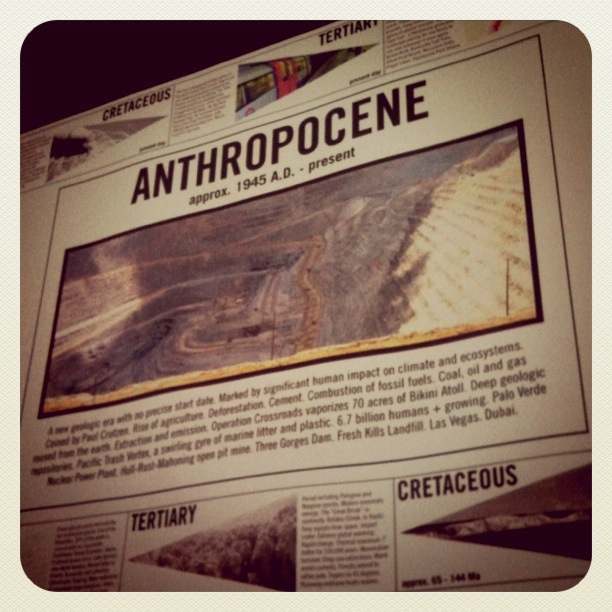
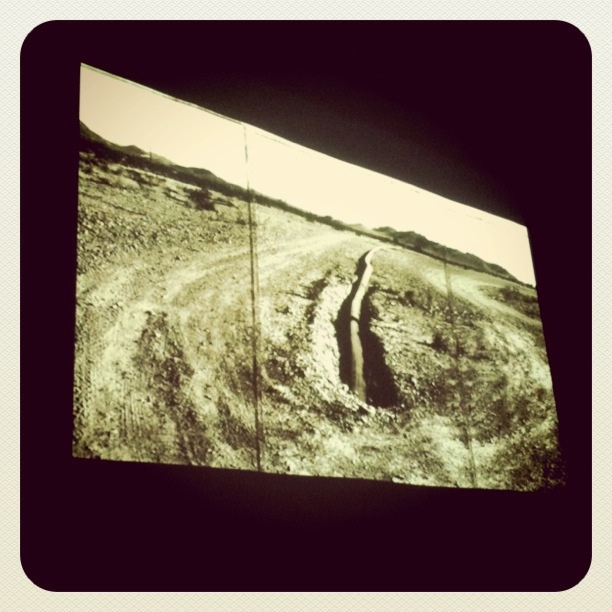
[Image: From a presentation by Smudge Studio (Elizabeth Ellsworth & Jamie Kruse) at the Center for Land Use Interpretation, 15 January 2011].

Yesterday’s event at the Center for Land Use Interpretation was recorded via multiple audio feeds, and each presentation will reappear later this year in some form as an edited transcript; for now, if you want to risk the pointillist abstraction and occasional typos associated with live Twitter commentary, you can read back through the bulk of notes taken yesterday via @bldgbloglive. Thanks again to everyone who came out, meanwhile, in particular to our host and participants.

Landscape Futures Super-Dialogue

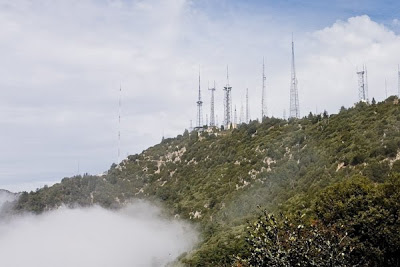
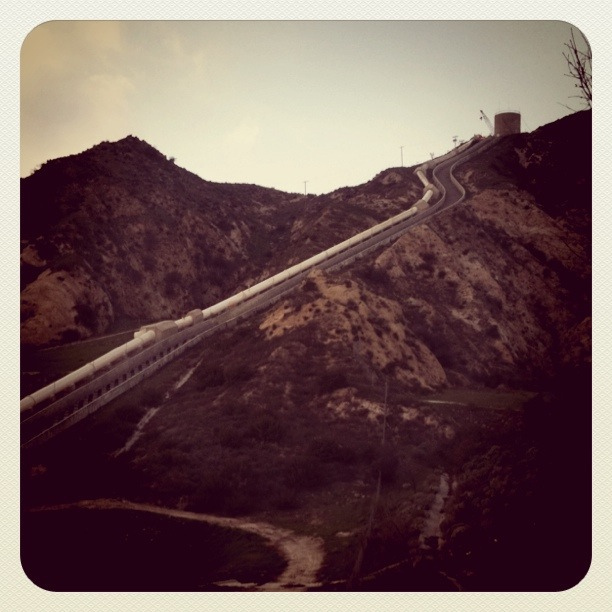
[Image: The electromagnetic infrastructure of Los Angeles; photo by the Center for Land Use Interpretation].

I’ve deliberately waited to the last minute to mention this event, simply because there will only be room for five or six people to join us, but the Landscape Futures Super-Workshop pops out in public today for a live event beginning at 1pm at the Center for Land Use Interpretation in Culver City.

It features, in order of appearance:

Matthew Coolidge, Center for Land Use Interpretation
David Gissen, Subnature / HTC Experiments / California College of the Arts
David Benjamin, The Living
Liam Young, Tomorrow’s Thoughts Today / Architectural Association
Mark Smout and Laura Allen, Smout Allen / Barlett School of Architecture
Elizabeth Ellsworth and Jamie Kruse, Smudge Studio / Friends of the Pleistocene

Students from the Arid Lands Institute will also have a casebook of research drawings on display, and the day will conclude with a panel discussion, kicking off at 4pm, featuring all of the above speakers in addition to Arid Lands Institute faculty and Los Angeles Times architecture critic Christopher Hawthorne.

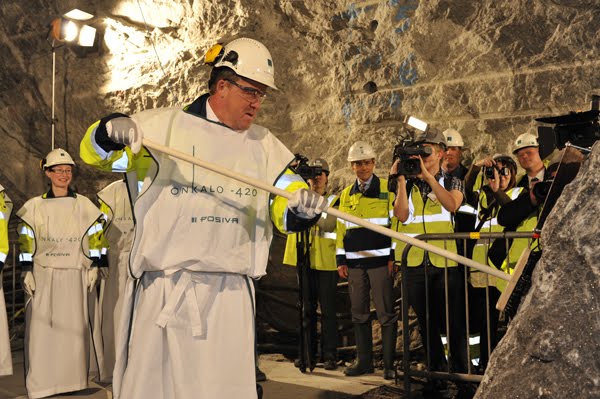
[Image: “Topping-out ceremony” at the Onkalo nuclear-waste sequestration site, Finland; photo by Posiva/Jari Hakala, via Friends of the Pleistocene].

In addition to the work of each practitioner listed above, we’ll be discussing everything from the coastal-expansion infrastructures of Los Angeles, urban aridity, future climates and their spatial implications, and the architecture of dynamic landscapes to the cognitive difficulties associated with geologic time, the Super-Workshop‘s own recent experience of L.A., L.A. itself as a site for interventions both speculative and real, and the layered ecologies of the city.

Things kick off at 1pm at the Center for Land Use Interpretation. Due to the size of our own group, however, I should point out again that there will be limited space, and I’d thus suggest arriving early.

Super-Workshop Update

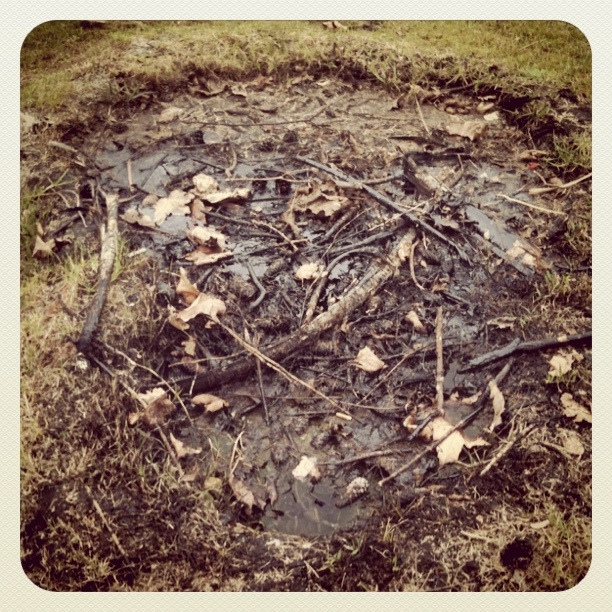
[Image: A bubbling tar seep near Wilshire Boulevard].

We’re in the final few days of the Landscape Futures Super-Workshop now, heading out soon for another field trip this afternoon, after half a week of presentations, lectures, site visits, crits, walks, and much else besides.

By way of a rapid and by no means thorough update, I figured I’d give a rundown of some of the many, many things we’ve done so far, having hit the ground running on Tuesday morning with a tour through old oil sites to see the surface indications of L.A.’s subterranean petrology. We visited pumping stations, tar pits, and camouflaged drilling rigs, discussing explosive clouds of methane gas and the machines that monitor those invisible but toxic accumulations, and trying to understand the financial industries that have arisen to package and sell fossil fuels from windowless offices in Los Angeles, all during a series of drives led by architect and local oil-history expert Ben Loescher.

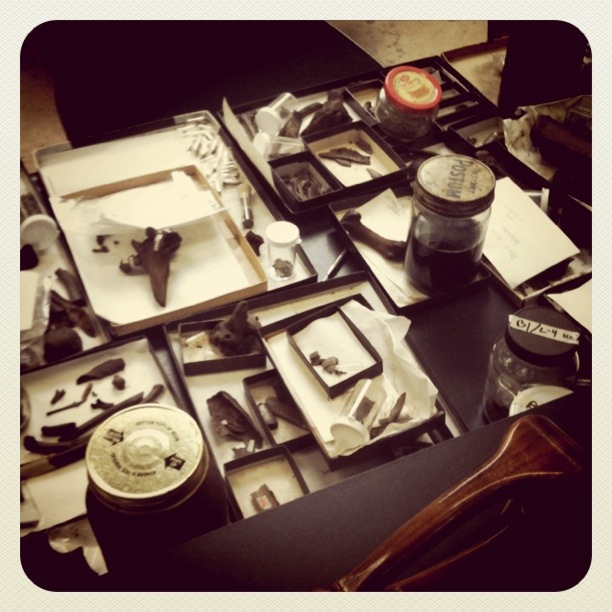
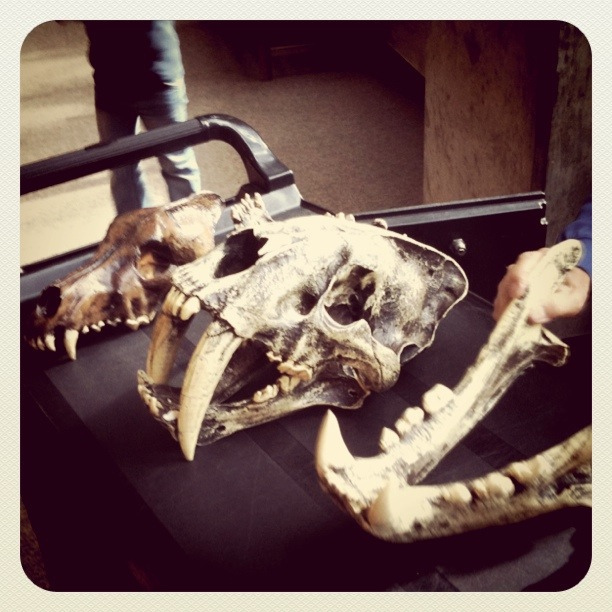
[Images: Skulls and bones at the La Brea Tar Pits].

We heard from students from the Bartlett, Columbia, and the Arid Lands Institute, seeing proposals for urban-scale fortresses made from freshwater injection wells, artificial troglodyte homesteads in Long Beach constructed with from rocks harvested from San Gabriel debris basins, crawling bagpipe-machines (actually built!) that walked around London powered by bike pumps and bleating like sheep, pollution-harvesting devices in the skies of southern California that will collect dust and carbon through electromagnetic attractors, future climate-prediction mechanisms and the networked sensorscapes that make them possible, synthetic orchards, mobile well heads, resistance-powered lamps in the chaparral monitoring seasonal windspeeds, “kit architectures” for unstable landscapes, “cloud dispensers” and other augmented climatologies, machine-cowboys overseeing herds of hydrotropic robots on the dry bed of Owens Lake, groundwater filtration interfaces for sites where the hills hit urban flatlands, open-source bio-fuel experimentation labs run by amateur genetic engineers, urban oxygen gardens, experimental greenhouses running test-climates for a future earth, and a dozen other projects, all of which will continue to be developed, tweaked, or abandoned as the workshop moves on.

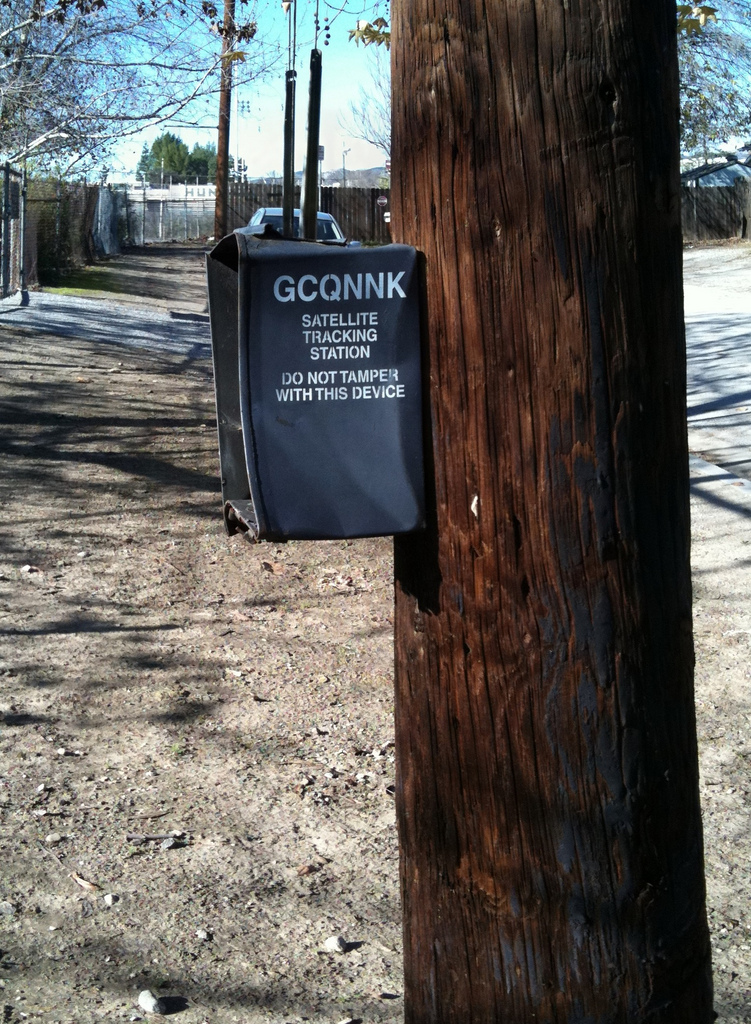
[Image: A “satellite tracking station” near the headwaters of the L.A. River].

We’ve discussed cinema, time, repetition, noise, and landscape through the interpretive lens of Ed Keller, who introduced us to “the multiple, the nonlinear, [and] the demonic” as represented through non-narrative jumpcuts and other strange edits of logic and sense. We traced infrastructural maps of L.A.’s water supply with the Arid Lands Institute.

[Image: Learning about water infrastructure courtesy of the Arid Lands Institute].

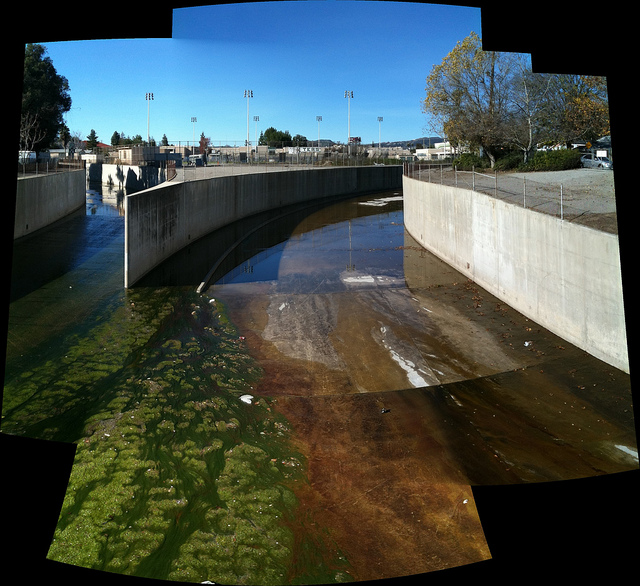
And then we headed out on a cloudless Wednesday morning, in a five-car caravan from our hotel in Venice, to visit the headwaters of the L.A. River, photographing wake-engineering fins made of concrete and looking down at trembling pools of green algae.

[Image: The headwaters of the L.A. River].

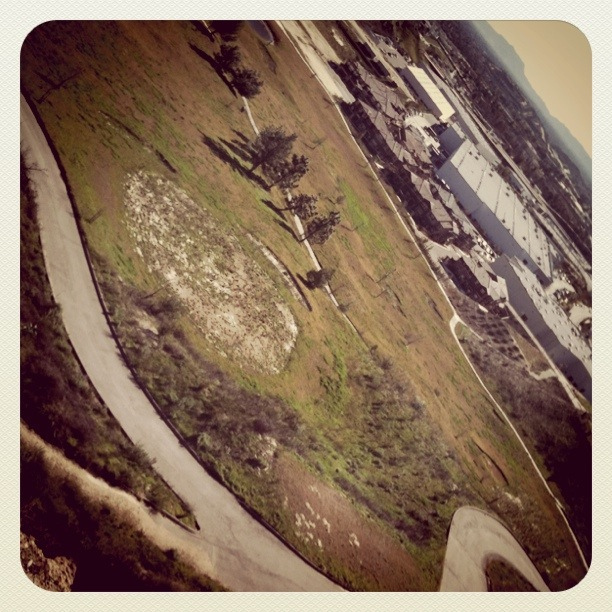
We drove north to a suburb at the foot of the Cascades, its New Urbanist streets named after golfing legend Jack Nicklaus, its neighbors a surreal complex of municipal water-filtration ponds, DC-to-AC electrical conversion facilities, aqueducts, and warehouses, and we realized only after hiking far up above those mis-placed houses onto a hillside road and looking back down that the surrounding landscape was an abandoned golf course, with dead trees, clogged drains, and overgrown depressions that were once sand-traps, greens, and bunkers.

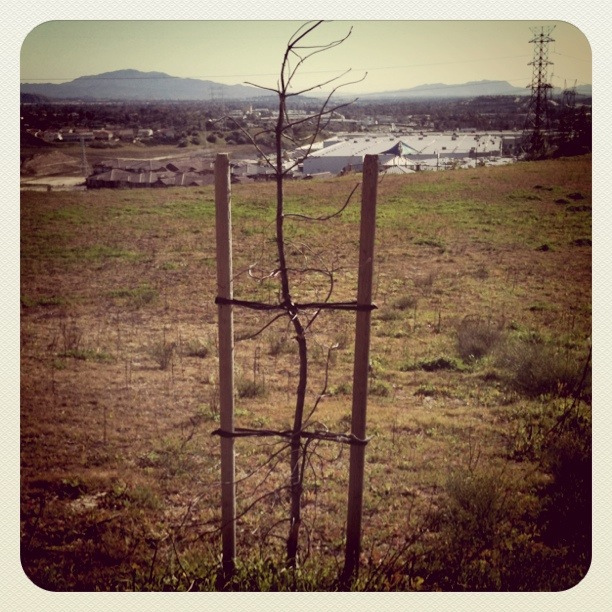
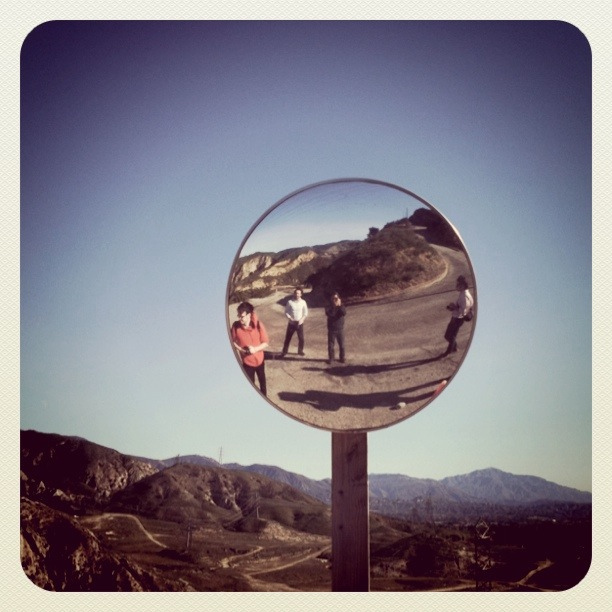
[Images: The Cascades, a dead tree, an abandoned golf course, a mirror].

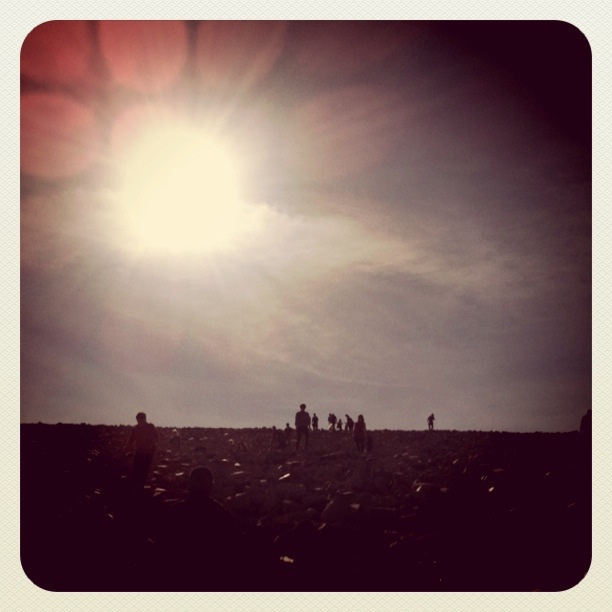
We walked the rim of the Hansen Dam, hiking down the side of that mind-boggling field of piled rubble.

[Image: Super-workshoppers descend the Hansen Dam].

Driving in a caravan through the obliterated landscapes of industrial San Fernando, we visited spreading fields for rubble and saw gravel conveyers at work, and then we headed further northeast into the debris basins of the San Gabriels. We got an introduction to the functional geometry of these mud-filled reservoirs with a site manager for the Army Corps of Engineers, who told us about a “geologic problem” up in the hills that he worries will fill all of L.A.’s basins any storm now, eyeing the mountaintops warily. We saw artificial hills of flattened dirt growing into a new state park with panoramic views of nearly the entire L.A. region, and we drove through whole neighborhoods lined with modular concrete deflection walls to protect the houses from future rockslides.

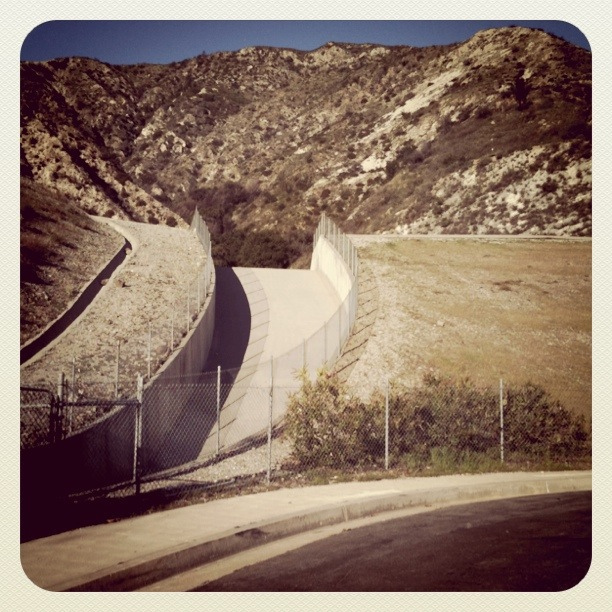
[Image: Debris basin at the top of Pine Cone Road].

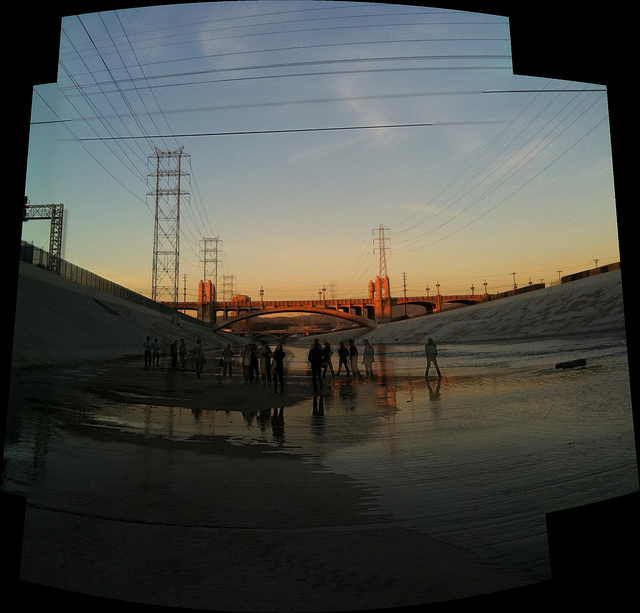
And then we headed back down into the city to walk along the L.A. River at sunset, underneath the 6th Street Bridge, unexpectedly overlapping with a crew filming CSI: NY, complete with fake NYPD cars driving by, as trains roared past the river and the concrete landscape turned orange, then purple, then black as evening arrived and we drove off for a final trip to see an oil-pumping site downtown, one where, decades ago, engineers over-pressurized the oil field causing black ooze to flow up and out through storm drains and collect inside neighborhood basements, as if Los Angeles had woken up some black, formless, Lovecraftian presence beneath the city.

[Images: The L.A. River at sunset].

And now, after more talks yesterday—about Owens Lake, regional water-supply systems, synthetic landscapes, and so on, after students had branched off to see local works by Frank Gehry, an active oil field in Culver City, and a church inside a converted bank (that used to be a film set)—we’re off to learn about robots in Pasadena. I’ll have more updates (and fewer pictures taken with Instagram) soon.

Landscape Futures Super-Workshop

[Image: “Retreating Village” by Smout Allen, a mobile settlement for a collapsing landscape].

For the past few months, I have been working behind the scenes here on something that I am finally able to announce: starting tonight, and lasting for the next seven days, I will be helping to lead a Los Angeles-based design “super-workshop” with a spectacular line-up of participants.

Mark Smout and Laura Allen of Smout Allen & the Bartlett School of Architecture, along with 14 students; David Benjamin of The Living, along with 6 of his students; and the Arid Lands Institute in Burbank, California, along with 12 students will be here in Los Angeles, participating in a solid week of intensive workshops, discussions, site visits, design challenges, hikes, symposia, dinners, presentations, and crits.
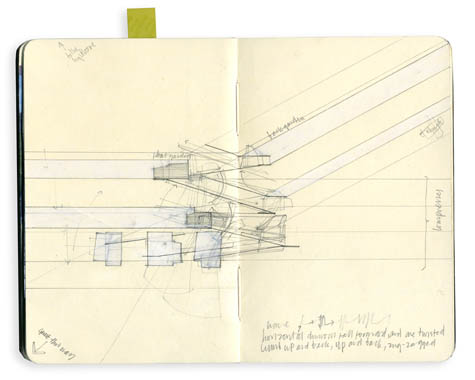
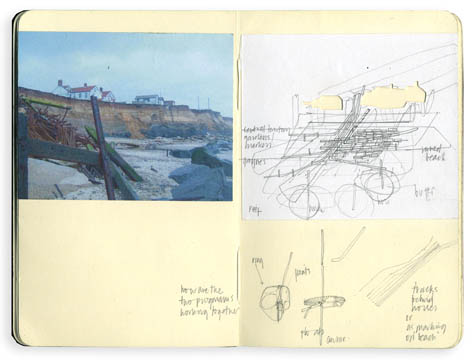
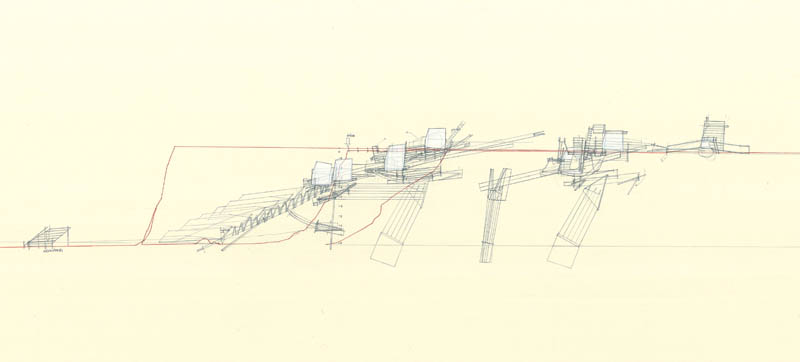
[Images: Sketches by Smout Allen].

But that’s just the tip of the iceberg. Smout Allen, David Benjamin, and the Arid Lands Institute will be joined in this collaborative, multi-institutional undertaking by:

—David Gissen, California College of the Arts/Author of Subnature: Architecture’s Other Environments (htcexperiments.org)
—Matthew Coolidge and Sarah Simons, Center for Land Use Interpretation (clui.org)
—Christopher Hawthorne, Architecture Critic, Los Angeles Times (latimes.com)
—Elizabeth Ellsworth and Jamie Kruse, Smudge Studio/Friends of the Pleistocene (smudgestudio.org/fopnews.wordpress.com)
—Ed Keller, AUM Studio/Parsons, New School for Design (aumstudio.org)
—Liam Young, Architectural Association/Tomorrow’s Thoughts Today (tomorrowsthoughtstoday.com)
—Alex Robinson, Office of Outdoor Research (orscapes.com)
—Emily White and Lisa Little, Layer (layerla.com)
—Nicola Twilley, Edible Geography/GOOD (ediblegeography.com/good.is)
—Christian Chaudhari (cargocollective.com/ccd)
—Tim Maly, Quiet Babylon (quietbabylon.com)

Getting this many people to Los Angeles has also been made possible in part with the generous support of Virgin America.
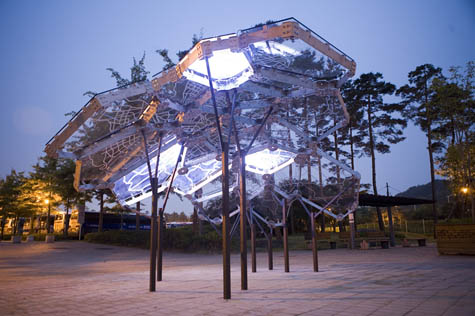
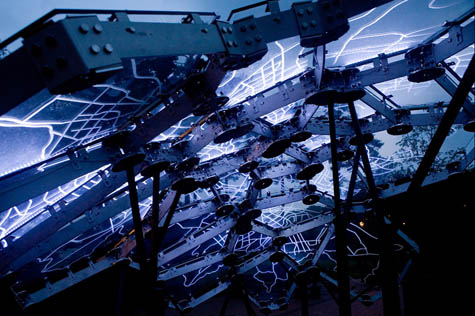
[Images: From Living Light by The Living].

The super-workshop will be run in close parallel to the themes of a forthcoming exhibition that I am in the process of curating for the Nevada Museum of Art in Reno, called Landscape Futures: Instruments, Devices, and Architectural Inventions. That exhibition—on display from August 2011 to Spring 2012—has received grants from the Graham Foundation and the National Endowment for the Arts. Needless to say, I am unbelievably excited about the exhibition and will be posting more about it as the year develops.

In brief, both the exhibition and this week’s super-workshop will examine how landscapes and our perceptions of them can be radically transformed by architecture, technology, and design. Specifically, participants and exhibitors alike will explore the multitude of ways through which landscapes can be read, cataloged, interpreted, mapped, and understood using specialty equipment, both speculative and real.

A central question of both the exhibition and the super-workshop will be how future tools of landscape investigation—new spatial devices on a variety of scales, from the inhabitable to the portable—can be imagined, designed, and fabricated. These include objects, models, prototypes, graphics, and speculative proposals, ranging from the physical to the digital, from the geological to the conceptual, from the felt to the heard, and from deep-time to the hand-made.

Workshop readings and discussions will include a mix of natural history, materials science, contemporary and historical landscape investigations, and an overview of existing landscape sensing & measurement technologies; we will also examine design projects by Smout Allen, The Living, Shin Egashira, Protocol Architecture, the United States Geological Survey, Caltech Robotics Lab, NASA’s Apollo Project, and more.
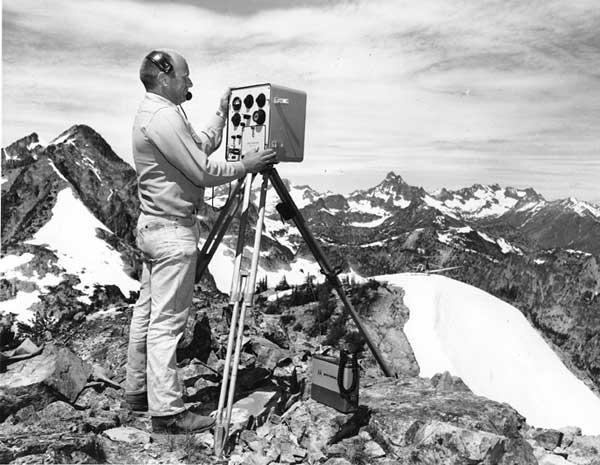
[Image: ”A crewman operates an Electrotape, circa late 1960s… a precise electronic surveying device that used microwaves to measure distance… It yielded centimeter accuracy over distances from 100 meters to 40 kilometers, and in all weather conditions, day and night. Two units were needed, one to send the signal and the other to receive it. A brass triangulation station marker is visible directly below the Electrotape.” Courtesy of the USGS].

In the process, the workshop will maintain a strong focus on the built and natural landscapes of Los Angeles, a region prone to forest fires, drought, and flash floods, smog, landslides, and debris flows, climatic extremes, seismic activity, surface oil seepage, and methane clouds. These tacit connections with nature, even in the apparently manufactured terrains of greater Los Angeles, will be scrutinized.

To begin, workshop participants will visit a series of flood-control dams and landslide remediation structures in the San Gabriel Mountains; we will move from there to explore remnant urban oil fields, camouflaged drilling rigs, the La Brea Tar Pits, and other spatial side-effects of the region’s fossil fuel industry; we will study Southern California’s seismological sensing infrastructure; we will visit designers and engineers at the Caltech Robotics Lab; we will walk the streets of a once-thriving neighborhood that collapsed into the sea long ago due to relentless coastal erosion; and we will discuss the city’s troubled history with water diversion schemes—including dry lakes and dust storms—through a sustained look at the role of water in California’s landscapes of agri-business.

Recommended readings and references include but are not limited to:
—Smout Allen, Pamphlet Architecture 28: Augmented Landscapes (Princeton Architectural Press)
—Paul Thomas Anderson (dir.), There Will Be Blood
—Mike Davis, Ecology of Fear: Los Angeles and the Imagination of Disaster (Vintage)
—Keller Easterling, Enduring Innocence: Global Architecture and its Political Masquerades — Chapter 3 (MIT Press)
—Shin Egashira and David Greene, Alternative Guide to the Isle of Portland (Architectural Association)
—William L. Fox, Making Time: Essays on the Nature of Los Angeles (Shoemaker & Hoard)
—David Gissen, Subnature: Architecture’s Other Environments (Princeton Architectural Press)
—InfraNet Lab/Lateral Office, Pamphlet Architecture 30: Coupling: Strategies for Infrastructural Opportunism (Princeton Architectural Press)
—cj Lim, Devices: A Manual of Architectural + Spatial Machines (Architectural Press)
—John McPhee, Assembling California (Farrar, Straus and Giroux)
—John McPhee, “Los Angeles Against the Mountains” in The Control of Nature (Farrar, Straus and Giroux)
—Michael Novacek, Time Traveler: In Search of Dinosaurs and Ancient Mammals from Montana to Mongolia (Farrar, Straus and Giroux) — Chapters 1 and 10
—Fred Pearce, When the Rivers Run Dry: Water, The Defining Crisis of the Twenty-First Century (Beacon) — Chapters 1, 3, 6, 24, 27, 28, 30
—Roman Polanski (dir.), Chinatown
—Marc Reisner, Cadillac Desert: The American West and its Disappearing Water (Penguin)
—Kim Stringfellow, Greetings from the Salton Sea: Folly and Intervention in the Southern California Landscape, 1905–2005 (Center for American Places)
—Chris Taylor and Bill Gilbert, Land Arts of the American West (University of Texas Press)
—David Ulin, The Myth of Solid Ground: Earthquakes, Prediction, and the Fault Line Between Reason and Faith (Penguin)

Needless to say, I suspect some fantastic student work, conversations, and more will come out of the next seven days, and I will do my best to keep track of it all here on the blog. But if things fall quiet for a few days here, now you’ll know why.

Finally, stay tuned for information about a public event here in Los Angeles this coming weekend, bringing many of these participants together.
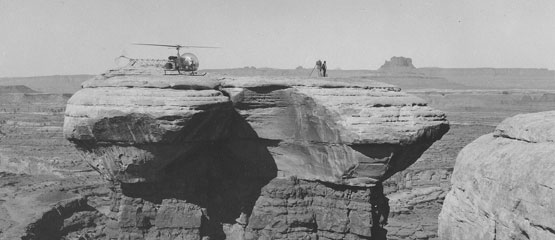
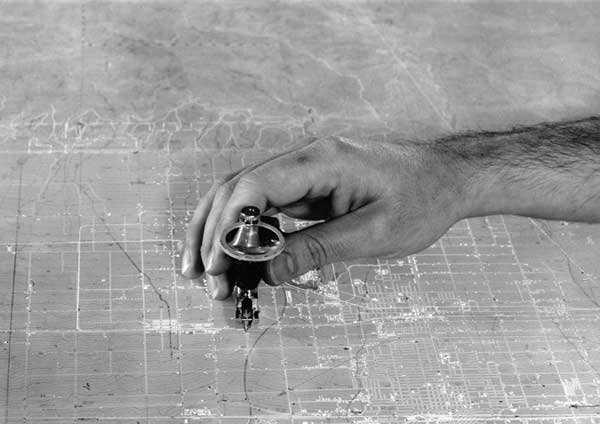
[Images: (top) “A helicopter makes access easy in southern Utah, circa early 1960s.” (bottom) “Scribing roads on a topographic map.” Courtesy of the USGS].

So thanks again to Virgin America for their generous support, and, of course, to all our participants. More information coming soon.

Ground TV

[Image: An otherwise unrelated temple complex in Indonesia].

“Hardened lava from Indonesia’s Mount Merapi covers ancient temples in the historic city of Yogyakarta,” Archaeology News reports. As if fishing in the ground for lost architecture, “Scientists are using remote sensing equipment to locate them.”

The Jakarta Post elaborates, pointing out that “objects recently found underneath cold lava,” thus “requiring archeologists to use remote sensing equipment to find them,” remain physically ambiguous when they cannot be directly excavated. Indeed, “the equipment cannot determine precisely whether rock is part of a temple construction or not.” In some cases, then, it’s a question of forensic interpretation.

Nonetheless, five entire temples have been discovered so far, locked down there in old lava: the Morangan, Gampingan, Kadisoko, Sambisari and Kimpulan temples, “buried between 2 and 9 meters deep.” That’s nearly thirty feet of rock—a once-liquid landscape covering blurred remnants of an otherwise overwritten past, architectural history by way of subterranean remote-sensing.

I should point out, meanwhile, that Archaeology News also links to a quick story taking place out here in greater Los Angeles: a parking lot in Ventura, at the intersection of Palm and Main streets, is under archaeological investigation. “Researchers this week are crisscrossing the parking lot using ground-penetrating radar,” the Ventura County Star explains, “in search of anomalies below the asphalt that could be artifacts or building foundations from years past. Archaeologists will return to excavate by hand those areas believed to contain artifacts.”

I love the idea that the surface of a parking lot could become something like a new screen technology—a depth-cinema of lost evidence from earlier phases of human history, shining from within with archaeological remains as researchers walk back and forth above.

Imagine the archaeological cinema of the future—some massive open parking lot in Istanbul, say, where crowds arrive, milling about, tickets in hand, and then, like the giant LED screen from the Beijing Olympics, the city’s archaeological past is revealed in 3D: hologram-like structures shivering there inside the surface of the earth, below everyone’s feet in real-time, the planet become an immersive TV screen on which we can view the debris of history.

Peel Street Caves

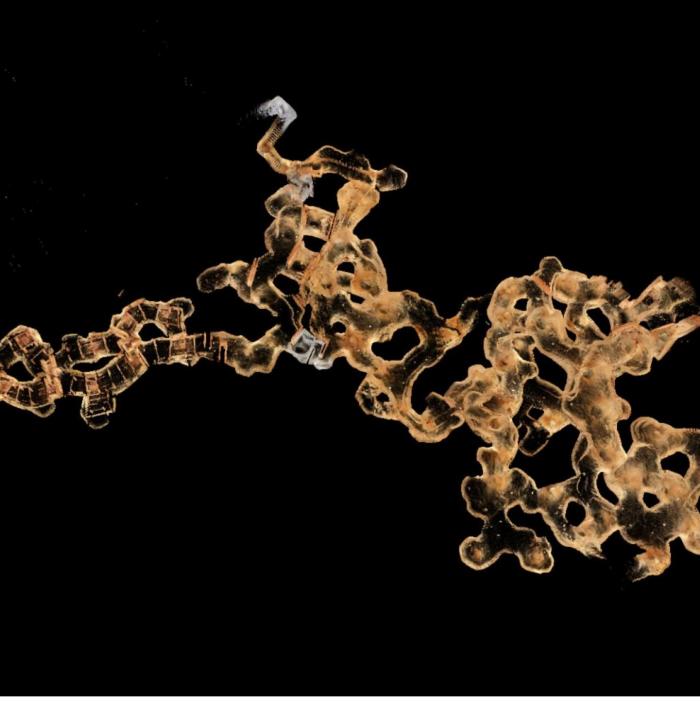
[Image: A 3D laser scan of the Peel Street Caves—actually a former sand mine beneath the city—courtesy of the Nottingham Caves Survey].

It’s hard to resist a note that says a “new cave” has been “uploaded,” but the Nottingham Caves Survey—previously mentioned here—has announced just that, putting 3D laser scans of the incredible Peel Street Caves on their website.

Like smoke rings breaking apart and slowly looping inside the planet, their near-endless recursivity makes it almost impossible to see where they begin.

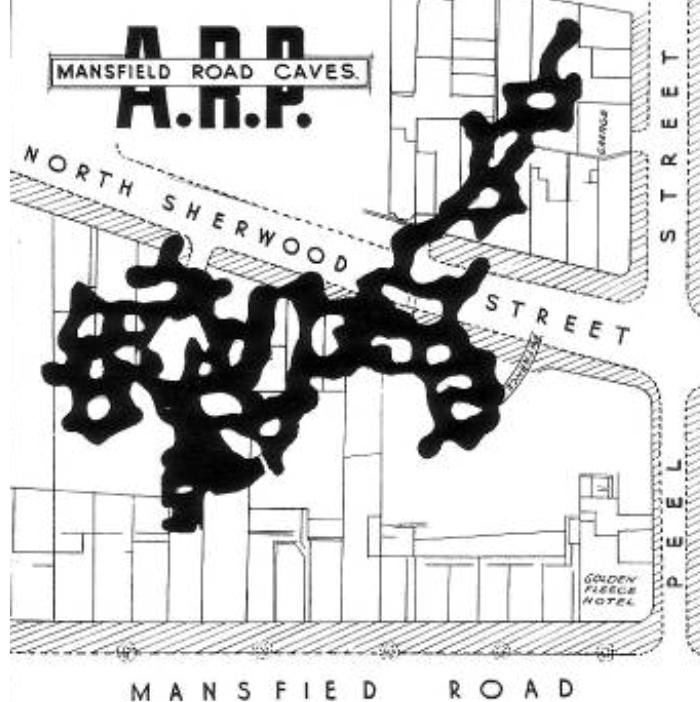
[Image: Plan of the Peel Street Caves, courtesy of the Nottingham Caves Survey].

The “caves,” however, are really a former sand mine:

It is thought that the mine was in use from around 1780 to 1810. However it is possible that the mine was worked from an even earlier date, acting as a direct source of sand for a nearby glass works which was in operation until 1760. The mine was forgotten until about 1892 when the caves became a tourist attraction, “Robin Hood’s Mammoth Cave.” A map of 1844 shows a number of properties on Mansfield Road. Some of these have basements cut into the sandstone which open out into the sand mine.

The caves were transformed into bomb shelters during WWII. How spectacular to own one of those basements, though, that “open out into the sand mine”—and how doubly spectacular to discover such a connection only accidentally, tapping on a hollow wall downstairs or finally forcing open a door that had been rusted shut, finding, there both beneath and behind your house, this strange labyrinth of voids uncoiling through the city.

Read more at the Nottingham Caves Survey (or previously on BLDGBLOG).

An assertion of edge and boundary

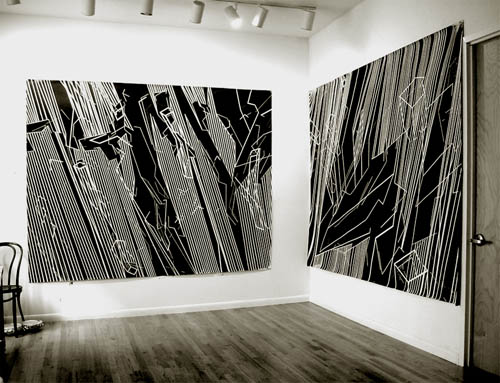
[Image: One of the corners of Lebbeus Woods’s drawing room, courtesy of Lebbeus Woods].

Lebbeus Woods kicks off 2011 with an in situ glimpse of several wall-sized drawings including an explanation of the work that went into producing them.

“The impulse,” he explains, “to make these large drawings—they are, with one exception, 74 inches high by 120 inches wide (188 by 305 centimeters)—came first from my desire to make drawings at the scale of a room, that is, at an architectural scale. The reason for this is rather simple: to see if one could physically and not only mentally inhabit the space of a drawing. The second driving force was to see if drawing at that scale would produce something different than I’d imagined or drawn before.”

The drawings themselves are spectacular—and there are many more in the original post—but it’s particularly compelling to read the technical details of their realization.

(Earlier: Without Walls: An Interview with Lebbeus Woods, an expanded version of which appears in The BLDGBLOG Book).

Microplot

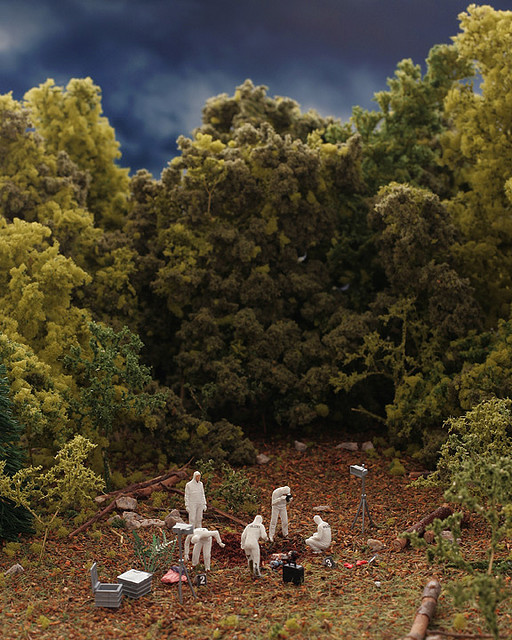
[Image: “CSI” by Florian Tremp, from Tremp’s series No Country for Small Men].

I think I’m the last person to see Florian Tremp’s amazing series No Country for Small Men—a collection of 48 narrative dioramas constructed and photographed by the artist, loosely inspired by the Coen Brothers’ film—but I’ll point it out nonetheless. Most of the images are just fantastic (the second page best of all).

Cryptoforests and Spatial Folklore

[Image: Photo by Gary Warner, from the cryptoforestry Flickr pool].

In his ongoing exploration of “the forest in the city,” Wilfried Hou Je Bek has produced a voluminous quantity of writings worth exploring in more detail, and so it is somewhat arbitrary to lead with this link; but the title of a recent post, “If the forest is empty so is the mind,” compelled me to point your attention to his blog Cryptoforestry (previously mentioned here).

Cryptoforesty, as Wilfried describes it in that post, emphasizes “the psychological effects of a forest” rather than the forest’s pure ecological function; indeed, he writes, “The point is not that wolfs and bears are needed to fulfill ecological functions that are now null and void, the point is that a forest with such animals fuels the imagination and adds zest to life, even to those who would never visit such a ‘full’ forest.” And, thus, he quips, “If the forest is empty,” devoid of its animal sentience, “so is the mind.”

Further, his point that European forests are now actually “being replenished from the east” with wild creatures is both politically symbolic and environmentally interesting.

[Image: Photo by Gary Warner, from the cryptoforestry Flickr pool].

The “What is a Cryptoforest?” essay is a virile and spirited defense of landscape ferality. Quoting at length and hoping to give a rhetorical sense of the writer’s interests, which range from the poetry of Gary Snyder to pre-Columbian rock art:

Cryptoforests are those parts of the city in which nature, in “secret,” has been given the space and the time to create its own millennia-millennia-old, everyday-everyday-new order by using the materials (seeds, roots, nutrients, soil conditions, waste, architectural debris) at hand. Cryptoforests are sideways glances at post-crash landscapes, diagrammatic enclaves through which future forest cities reveal their first shadows, laboratories for dada-do-nothingness, wild-type vegetable free states, enigma machines of uncivilized imagination, psychogeographical camera obscuras of primal fear and wanton desire, relay stations of lost ecological and psychological states. Cryptoforests are wild weed-systems, but wildness is equated not with chaos but with productiveness at a non-human level of organization. What starts with weed ends with a cryptoforest, and in between there is survivalism, with plants eking out a living against all odds, slowly but determinedly creating the conditions for the emergence of a network of biological relationships that is both flexible and stubborn, unique and redundant, fragile and resilient. Cryptoforests are honey pots for creatures that have no other place to go. Animals live there, the poor forage there, nomads camp there and the cryptoforester who has renounced the central planning commission re-creates there (free after Henri Thoreau). In the future, young people will no longer want to play in bands and they will become guerrilla gardeners and cryptoforesters instead.

“What starts with [a] weed ends with a cryptoforest”—the cryptoforest is a nearly all-encompassing botanical category for vegetation untamed. “The cardinal rule of cryptoforestry is that you can’t search for a cryptoforest,” we read. “You stumble upon them, they are already right in front of you.” Further, becoming sites of spatial folklore, cryptoforests are “always larger on the inside than they appear from the outside.”

[Image: Photo by Gary Warner, from the cryptoforestry Flickr pool].

Cryptoforestry offers fives diagnostic categories for this marginal terrain:

1) Feral forests (Planted tree zones, for instance along motorways, that have been allowed to become wild to the point that their wildness is outgrowing their manmadeness.) 2) In limbo forests (Tree-covered plots that feel like forests but technically probably aren’t; states of vegetation for which lay-language has no name.) 3) Incognito Forests (Forests that have gone cryptic and are almost invisible, forests in camouflage, forests with a talent for being ignored.) 4) Precognitive forests (Lands that are on the brink of becoming forested, a future forest fata morgana.) 5) Unappreciated forests (Forests regarded as zones of waste and weed, forests shaming planners, developers, and the neighbourhood. NIMBY forestry.)

These are less climax ecosystems than purgatorial ones, we might say—false gardens beyond cultivation, in which a different sort of nature is discovered growing “already right in front of you.”

The whole blog is worth bookmarking for later return.

(Consider joining the cryptoforestry Flickr pool).

Swimscape

[Image: Courtesy of ifonlyhecouldswim].

ifonlyhecouldswim (IOHCS) is currently working on a project called Oxygen is Overrated, “a photography-based publication on swimming pool culture” coming out this summer/fall, with open submissions accepted until 15 March 2011. “There are no thematic guidelines,” the editors write, “as long as the swimming pool subject is clearly defined.”

IOHCS describes itself as “a research agency investigating the relationships among hydrology, spatiality, and culture.” Citing J.G. Ballard, they refer to the swimming pool as “a natural world redesigned as inhabited, imagined and inhaled environment,” a next nature achieved by means of closely regulated hydrology. “Let us visualize this existing man-made landscape.”

Visual and textual explorations of the pool’s sociological mise-en-scène and its attendant microclimate are welcome; check out the publication’s website and Flickr page for more info.

As a random aside, I worked as a poolboy in North Carolina one summer when I was 16.

Drift Deck

[Image: From the Drift Deck by Julian Bleecker and Dawn Lozzi].

The Drift Deck, produced in 2008 by Julian Bleecker and Dawn Lozzi, is “an algorithmic puzzle game used to navigate city streets,” offering “instructions that guide you as you drift about the city.”

Each card contains an object or situation, followed by a simple action. For example, a situation might be—you see a fire hydrant, or you come across a pigeon lady. The action is meant to be performed when the object is seen, or when you come across the described situation. For example—take a photograph, or make the next right turn.

The deck has a tendency to sound a bit like a human behavior manual for urban residents suffering from Asperger Syndrome—”Uh Oh…” one card reads, “An awkward moment. Pause and take a photograph,” as if talking to Rain Man, or “Ugliness,” another card says, “Avoid it noticeably, gesturing and registering disgust,” as if the city would be more interesting if only we could be as flamboyant as RuPaul—rather than serving as a genuinely diagonal guide to the city.

But I love the Drift Deck‘s premise, combining as it does the Oblique Strategies of Brian Eno with the chance operations of John Cage, by way of Situationism and perhaps even the “let the dice decide” tactics of Luke Rhinehart.

[Image: From the Drift Deck by Julian Bleecker and Dawn Lozzi].

A non-sentimental Drift Deck, intended not as a way to emotionally enrich the urban experience but simply to densify the number of personal actions taken during a given span of time, would be an interesting thing to develop and explore. Basic, analog instructions (turn left, enter that shop, buy something, slow down) would, in the end, I’d suggest, generate at least as many random encounters.

This could also quite easily be turned into a mobile app: tap the screen at every intersection (or every hour on the hour) and random navigational options are generated. Combine this with Foursquare (“the mayor of turning-left at 44th Street”), Twitter, etc., and you could leave automatically generated traces of unique drifted paths for others to see. Repeatable experiments of random acts through the city.

There’s still the key question, though, of how to realize this without falling back onto a kind of Instabuddhism™, exhorting participants to appreciate their everyday lives with greater intensity. After all, the results could just as easily be disorienting and sharply alien—deliberately so—not instilled with a New Age sense of rejuvenated authenticity. Perhaps petty crimes could even be thrown in for good measure…