Pushkin Park

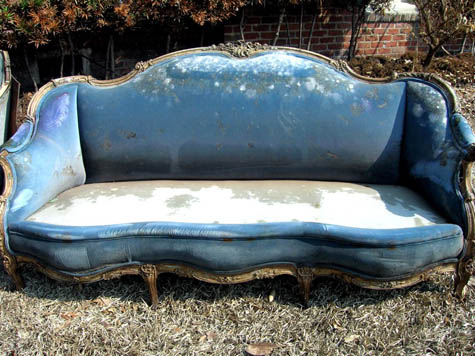
[Image: A moldy sofa, otherwise unrelated to this post, photographed by Flickr user melinnis].

Russian scientists have begun testing blood stains on the sofa where novelist Alexander Pushkin is rumored to have died, in order to determine if those stains might have come from Pushkin himself.
At least two things interest me here:

1) It’s the forensic sciences applied to antique furniture in order to find the otherwise undetectable remains of a dead Russian novelist. One might even say residue here, not remains at all; it is the barest of traces. Suddenly, though, it’s as if those old stuffed sofas, fading carpets, and tables of hand-worn wood in obsolete interiors around the world have been transformed into a kind of archaeological site, in which the chemical traces of literary history might yet be discovered. The sofa is Pushkin’s Calvary, if you will – a chemical reliquary. Furniture becomes a kind of hematological Stargate into literature’s mortal past. Who else might they find in there? You go around the world performing genetic tests on antique furniture to see which novelists ever used it – traces of Sebald, Hemingway, Tolstoy.

2) Two words: Pushkin Park. We clone Pushkin and start a theme park. Like a thousand Mini-Me‘s well-versed in storycraft, Pushkin – one man distributed through a thousand bodies – wanders the artificial landscape, and like some strange Greek myth wed with Antiques Roadshow, he tells the crowds, “I sprung forth, fully formed, from a sofa…” And there begins a tale for stunned tourists.

(Via the Guardian).

Worship the Glitch

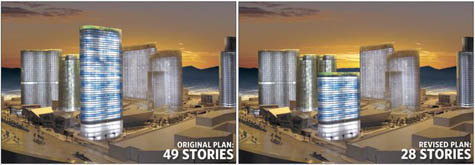
[Image: The revised tower, via the Las Vegas Sun].

A new boutique hotel in Las Vegas designed by architect Norman Foster – who is soon to lose his seat in the House of Lords after becoming a Swiss citizen to avoid paying taxes – is being cut almost in half due to a construction error: “15 floors of wrongly installed rebar.”
The hotel, called the Harmon, was meant to stand at 49 stories; it will now reach a mere 28.
“It’s still unclear how the Harmon will be capped,” the Las Vegas Sun reports, “and what reengineering will be required for such infrastructure elements as elevators and vents. If the Harmon’s exterior isn’t significantly redesigned, it risks looking unmistakably out of proportion. Think 28 oz. of tomatoes squished into a 16 oz. can.”
Midway through becoming what you were meant to be, an unanticipated internal flaw forces you to become something else entirely – for good or for bad, that remains to be seen.

(Via Archinect).

Agricultural Sabotage

A Welsh farmer has become an “agricultural saboteur” by “secretly planting and harvesting genetically modified varieties of maize and feeding them to local sheep and cattle.” This undercuts Wales’s ability to claim that it is a GM-free nation.

An unrepentant Harrington [the farmer in question] said he had resorted to the secret planting after the Welsh assembly, which voted unanimously for GM-free status in 2000, refused to have any meaningful discussions over its policy. He said: “Out of frustration I went and bought some varieties of maize bred to be resistant to a pest called the European corn borer and which are grown widely in Spain, France, Germany and the Czech Republic.”
The varieties he chose were on the EU common variety list, and as such it is legal to grow them anywhere in Europe.

The ease with which this sort of thing could happen makes it obvious that the genetic purity of a nation’s agricultural supply cannot be rigorously policed.

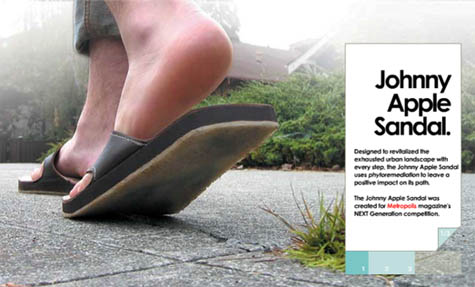
[Image: “Johnny Apple Sandal” by Lift].

Briefly, I’m reminded of a design project from nearly half a decade ago called “Johnny Apple Sandal,” where the soles of a pair of sandals had different varieties of wildflower seeds embedded in their plastic; as your soles wore down, the seeds were released – theoretically going on to form new landscapes. A kind of pedestrian agronomy.
But what a perfect tool for agricultural smuggling! You load up your sandals with genetically modified seeds, fly to Wales, and go for a long hikes in the Brecon Beacons. Soon enough, you’ve contaminated the hills with illegal plants, or forms of life subject to government regulation.
In any case, I also can’t imagine that this is the only example of such a thing; this farmer just seems like the only one who was caught. It’s not hard to speculate that there are what might be called – with no small amount of irony – protest gardens full of genetically modified plants sprouting in secret across the world.
What strange cultivations might we yet stumble upon in some unofficial garden in the woods?

(Thanks, Alex, for the Welsh farmer article!)

The Boom is Over

[Image: By David Gray for Reuters, via The New York Times].

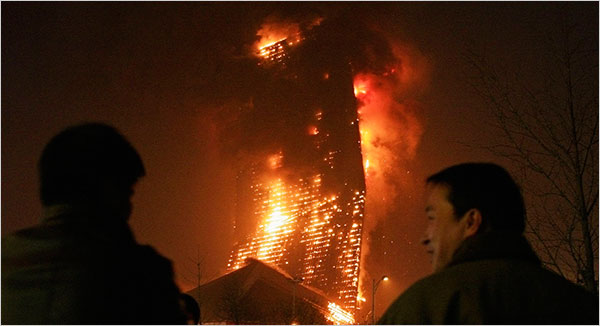
Amongst many, many signs that the building boom has come to an end, from gridlocks of cars abandoned at the Dubai airport by fleeing workers to massive holes in the urban surface of Chicago, to entire architectural firms going out of business, to delayed towers and theme parks on pause, none seem quite as explicitly apocalyptic as the sight of OMA’s CCTV complex – that is, the part of it known as TVCC, containing a luxury hotel – roaring with flames.

[Image: By Andy Wong for the Associated Press, via The New York Times].

The boom ended long ago, but its icon are now on fire.

(Note some updates on this story in the comments thread, below).

Park’s Parks

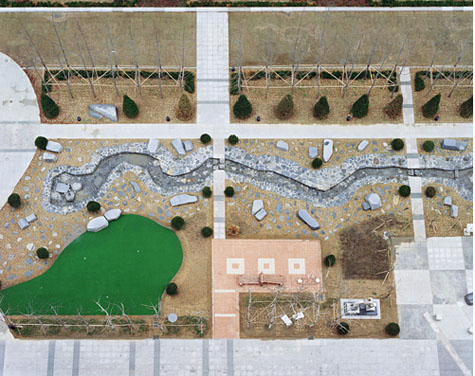
[Image: “Daechi Dong,” a photo by Hosang Park, from his series A Square].

Note: This is a guest post by Nicola Twilley.

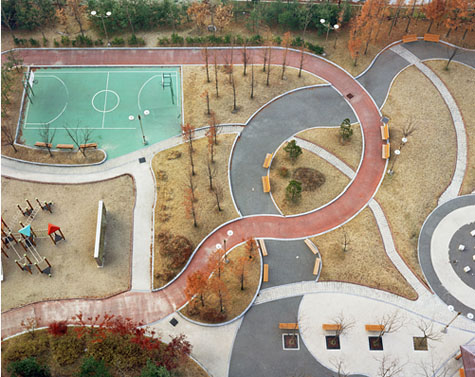
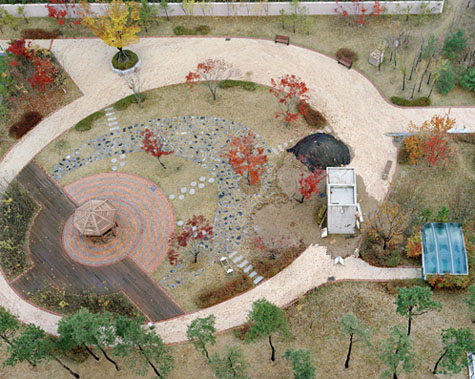
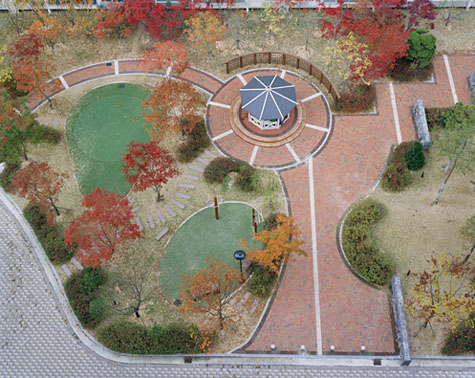
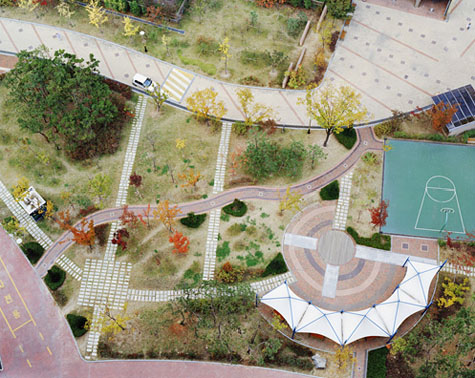
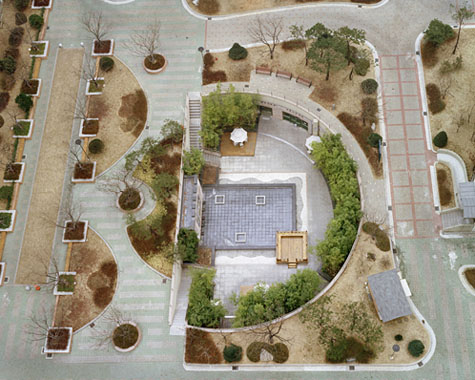
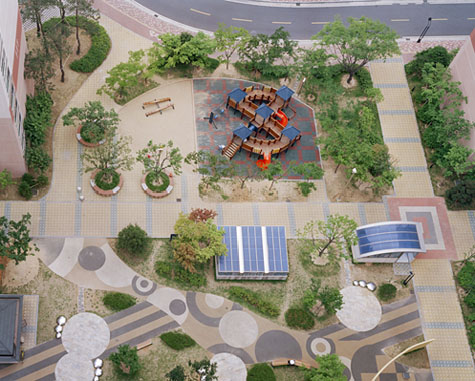
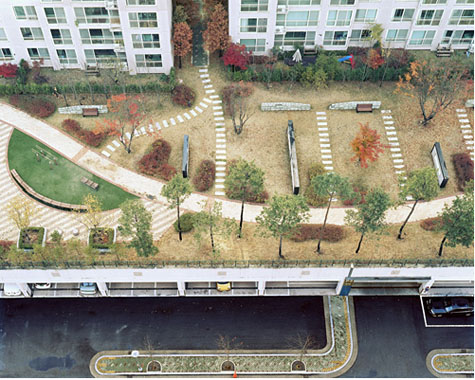
Korean photographer Hosang Park‘s series A Square consists of bird’s-eye views of the small, over-landscaped parks that seem to accompany modern apartment towers all over the world. As Park explains, these “parks” are too small to serve their ostensible purpose: as open space for recreation and places “to make discussions or take a rest.” In the UK and US, they are included in new construction projects to fulfill the letter of planning regulations (if not the spirit) – a token band-aid of “nature” applied to high-density development. As Park points out, their presence in Korea is both a reassurance and an investment: the trees, paths, and water features, no matter how artificial, push up property prices by providing an implicit guarantee of “the environmental benefits of a place where they belong.”

[Images: “Howon Dong” and “Sinbong Dong 2,” photos by Hosang Park, from his series A Square].

Park’s parks are photographed from above – which seems, in fact, to be the view for which they were designed. As two-dimensional compositions of curved paths, colored paving, and rhythmically spaced rocks or trees, they resemble pleasing, if sterile, designs for wrapping paper or Ikea rugs. Tellingly, they are also completely empty. Park explains that he took these photos while he was living on the 13th floor of Jugong Apartment in Chang-dong, Seoul. He and his hundreds of neighbors experienced their park as a a patch of eye candy – visual respite from the concrete and tarmac of their surroundings. Its cornucopia of amenities – climbing frames, fountains, seesaws and swing sets, pagodas, grass, ornamental rocks, meandering paths, trees and flower beds, benches, ponds, basketball courts… even public art – are crammed together as visual shorthand for endless leisure. They are landscape as signage, a placeholder for the possibilities of a park.

[Images: “Samsung Dong” and “Uman Dong,” photos by Hosang Park, from his series A Square].

But could we then imagine that Korea’s urban landscape subcontractors have been applying the lessons of graphic design to their creations, as if to a poster or magazine spread? The spaces between ornamental planters are carefully kerned, the edges of flower beds masterfully shaped through ragging to create an “organic” appearance – each element ordered and constrained by a Tschicholdian grid. Or perhaps these parks are the work of one visionary landscape designer, a passionate disciple of Edward Tufte. His goal is the ultimate park infographic, and he diligently recombines ponds, benches, and pagodas to achieve ever greater data density that allow for ever more sophisticated landscape analyses. The published results will become the canonical park design text for a generation, changing public policy as effectively as John Snow’s landmark cholera outbreak map of London once did.

[Image: “Sindorim Dong” by Hosang Park, from his series A Square].

Finally, I’m reminded of the Royal Horticultural Society’s model gardens at Wisley. Wisley, an otherwise unremarkable village in Surrey, is home to an educational garden, meant to fulfill the Society’s remit “to show to the public the best kinds of plants to grow.” Behind the scenes at Wisley, fields are devoted to trialling difficult, delicate, or entirely new kinds of flowers, vegetables, and fruit for “garden or ornamental use.” Teams of horticulturists partner with botanists, entomologists, and pathologists to determine the correct details, cultivation, and advice for each group of plants, with high performing plants winning an Award of Garden Merit (AGM) – the gardening equivalent of a Good Housekeeping Seal.

[Images: “Jangan Dong” and “Sinbong Dong,” photos by Hosang Park, from his series A Square].

AGM-winning plants are then arranged in model gardens at Wisley, to which the public is invited to learn the ideal varietals, patterns, and conditions for a garden on chalky soil, say, or a poorly drained lot. These model gardens are not actually intended to be the private back yards they resemble; instead they are part-instruction manual, part-shop window, part prototype of future, unrealized landscapes elsewhere. Like Park’s parks, they are primarily designed to be read, rather than sensed or experienced; and they are deliberately exhaustive in their approach, with each rather small plot landscaped to show all appropriate elements of, for instance, a sub-alpine rock garden. Which leads me to wonder if Park’s photos have inadvertently documented an experimental array of urban test gardens, new spatial formats for high-density leisure in their beta phase.

(Hosang Park’s work discovered via Flavorwire. Earlier posts by Nicola Twilley include Dark Sky Park and Zones of Exclusion).

Get Set

[Image: Photo by soupandtea].

Catching up on some news, emails, and links sent in over the past few weeks, I was amused to see that financially hard-hit homeowners in the Los Angeles area have begun temporarily renting out their houses as filming locations for TV commercials and pornos.
One man in Burbank, unable to sell his house for its asking price and having to compensate for a loss of rental income, “posted an Internet notice that the property, which has an eight-person hot tub, was available to the adult-film industry, which he had heard pays as much as $5,000 a day. A few months ago, ‘I probably would’ve said, “You want to do what in here?”‘ he said. ‘That’s reserved for me and the missus.'”
Apparently, “Income from residential filming for fewer than 15 days a year isn’t subject to federal taxes,” so there might yet be something of a boom in short-term film sites around the city, a distributed micro-Hollywood of economically depressed domestic space.

(Thanks, Javier!)

Watermarks

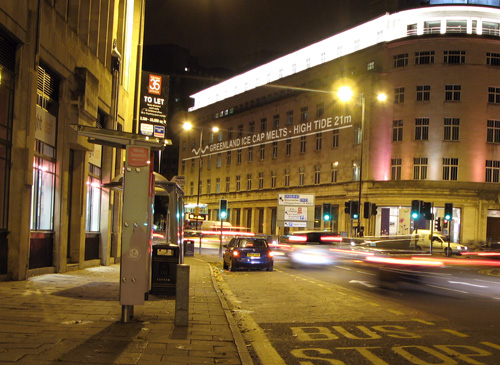
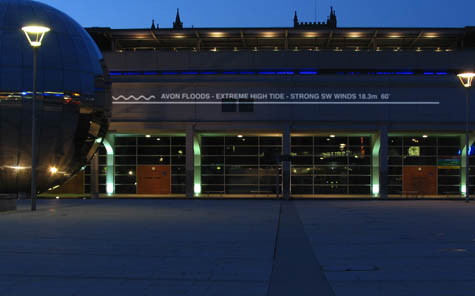
Last night in Bristol, England, marked the start of Chris Bodle’s Watermarks Project. For the next week, Bodle will be projecting onto the facades of buildings throughout Bristol estimated future high-tide marks should the entire Greenland ice cap melt.

[Image: From Chris Bodle’s Watermarks Project].

The idea is brilliant; I love the idea of mapping the future earth onto the earth of the present, of overlaying onto our present geography the virtual presence of a geography yet to come.

In many ways, I’d even say that this project can be divorced from its immediate context of climate change science and applied to any number of terrestrial processes, from the projected future and the hypothesized past. Whether mapping lost lakes of a different era or tracing the edges of disappeared lagoons that still haunt the streets of San Francisco – or reminding urbanites of the sport-fishing possibilities beneath Manhattan – we are alive within laminations we will never fully map or comprehend.

And these geographic superimpositions needn’t all by hydrological: the constant erasures and revisions of the earth through plate tectonics represent an unlimited supply of counter-landscapes we might explore.

I’m reminded of John McPhee’s fantastic book Assembling California – part of his equally great collection Annals of the Former World. There, McPhee describes how entire “Newfoundlands, Madagascars, New Zealands, Sumatras, [and] Japans” have all come together, rammed into place, one into the other over millions of years, to form what we now call California. Walking around Los Angeles, or through the coastal hills of Bug Sur, you’re not walking on unified ground at all, then, but across “the metamorphosed remains of what had once been an island arc.”

The ground here is all wandering, nomadic wreckage, only it’s been temporarily “consolidated as California,” McPhee writes.

So could all those old islands be flagged, their mutated and compressed remains – sheer gravel, lone hillsides, folded slopes, and whole mountain ranges – marked out with surveyors’ tape? The Archipelago Project. You cross and recross lost geographies made visible through an artist’s intervention – or follow a new state hiking path that meanders around the edges of minor fault lines yet to open.

[Image: From Chris Bodle’s Watermarks Project].

In any case, projecting the earth’s future oceans onto a contemporary cityscape is an almost unbelievably stimulating idea.

These are the data points of a world yet to come, you might say, made visible here on the fronts of a hundred buildings – a future or alternative version of the earth coming into focus all around us.

(Via the RSA’s Arts & Ecology site, thanks to Nicky!)

Postopolis! LA

It still feels like Postopolis! only just happened, though it’s been nearly two years. We’ve all moved on to new cities or we’ve had kids; books have been written; jobs have changed; the United States has a new president; the landscape of architecture and design websites continues to mutate, and… we’ve thus decided that it’s time to do another one.
And we’re doing it in Los Angeles.

[Image: Logo by Joe Alterio].

From Tuesday, March 31, to Saturday, April 4, 2009, from 5-11pm each day, in a location to be confirmed very soon, we’re bringing art, architecture, music, film, design, planning, politics, sci-fi, special effects, geology, history, lost rivers, futurism, and archaeology to Los Angeles, that city of tar pits and movie stars, of beaches, landslides, and mountain lion attacks, of universities and parking lots, of real estate speculation and individualized automotive fractality, city of black magic, mass murder, and abandoned swimming pools, military simulation labs, Die Hard and plate tectonics. City of the Center for Land Use Interpretation, of ecologies, gravel pits, and infrastructure.
So who’s involved?

—David Basulto from Plataforma Arquitectura and ArchDaily (Santiago, Chile)
—Jace Clayton from Mudd Up! (New York City, USA)
—Régine Debatty from we make money not art (Europe)
—Bryan Finoki from Subtopia (San Francisco, USA)
—Dan Hill from City of Sound (Sydney, Australia)
—Geoff Manaugh from BLDGBLOG (San Francisco, USA)

The first Postopolis! was hosted in the uniquely awesome perforated space of the Storefront for Art and Architecture; it was a collaboration between Inhabitat, Subtopia, City of Sound, and BLDGBLOG; and it was an exhilarating and exhausting five days’ worth of back-to-back interviews, presentations, lectures, panel discussions, slideshows, short film screenings, roundtable discussions, slightly surreal international phone calls, and so on.
This time it will be all that plus more art, film, and music, a larger international scope, hopefully several Spanish-language events and lectures, hopefully at least one minor earthquake, and just a short drive west to views of the Pacific Ocean.
We’ll be announcing the actual speakers and all other subsidiary events soon; for now, check out the Postopolis! LA page over at the Storefront for Art and Architecture, bookmark the other blogs involved in planning all this, and watch out for more info coming soon!
And each night will be free and open to the public, and all indications are that this thing will be as centrally located as something can be in Los Angeles. So come by at any point: from 5pm to 11pm each night.
Postopolis! LA is sponsored by the Storefront for Art and Architecture and ForYourArt, and it will be part of Los Angeles Art Weekend.

Cardiopulmonary Spatialization

[Image: From “Change of Heart: Rethinking the Prescriptive Medical Environment” by Marina Nicollier].

The idea that architecture might have medical effects on the people who experience it was the premise of a project by Marina Nicollier produced this year at Rice University.
In the project’s accompanying documentation, Nicollier writes that we must learn “to create spaces that provide, through their experience and material substance, enough variability in environmental effects that individual differences in reception and response can be studied and used as a part of curative regimes.”
In other words, the sensorial experience of architecture could play a role in healing – or, as Nicollier explains, “spaces themselves should act as experiential platforms that provide a broader spectrum of environmental qualities, so that we may better understand their effects on our psychology – and ultimately, on our physiology.”
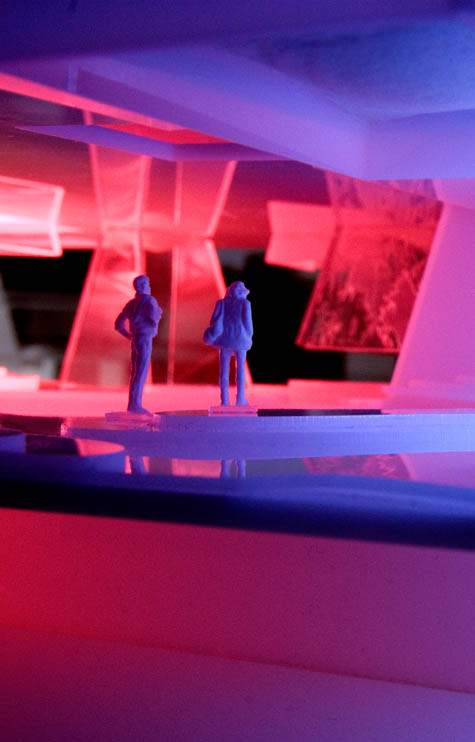
[Image: From “Change of Heart” by Marina Nicollier].

From the project description:

The human body responds to its spatial and environmental surroundings in very subtle ways. Our most basic reactions to our environment can be read, essentially, in our vital signs; yet as many of these phenomena are subtle enough to be easily overlooked without some sort of monitoring device, they have been too often dismissed as fleeting emotional and sensorial effects that have little impact on our physiological system as a whole. These qualities can do much more. They can act as an architectural base for a very important body of research, expanding beyond the limited range of possibilities imposed on them by existing models of medical environments.

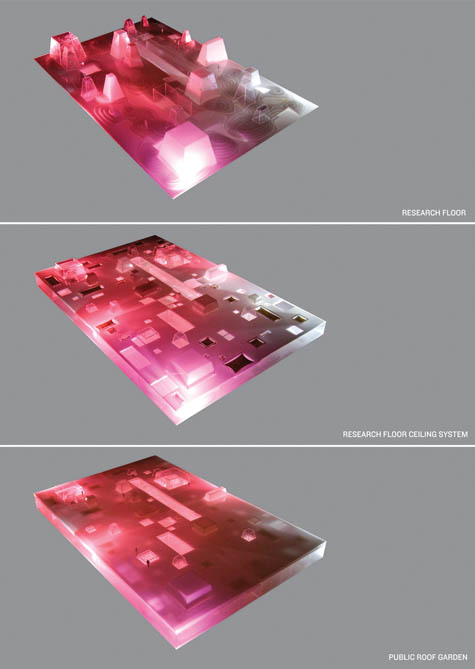
To perform a test-run for these propositions, Nicollier has designed a “cardiology research facility adjacent to two major medical institutions in Mexico City.”
You would wander through the building, hooked up to electrocardiographs, every flutter of heart valve and sweat gland monitored by doctors from afar.
[Image: From “Change of Heart” by Marina Nicollier].

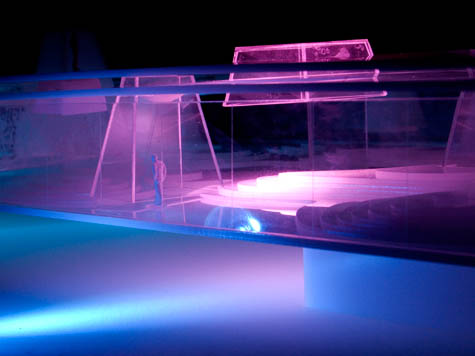
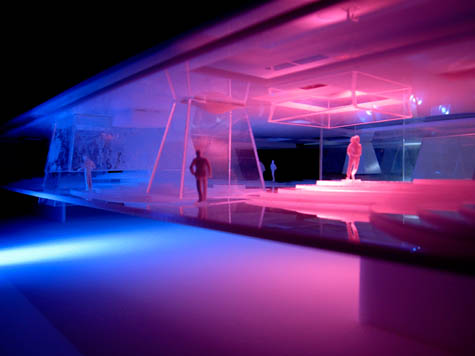
I was on Nicollier’s final thesis review the other week, where I joked that the project was like a visual combination of Barbarella and Constant’s New Babylon, by way of A Clockwork Orange – an immensely positive combination, I might add.
But that same impression strikes me today: that this is the kind of project Constant might have designed had he been more interested in the avant-garde spatial application of cardiac self-analysis.
It is the megastructure as medical cocoon, architecture designed to stimulate the human nervous system.
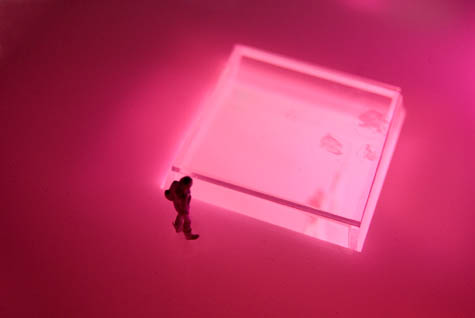
[Image: From “Change of Heart” by Marina Nicollier; think of it as a Foucauldian application of Winston Churchill’s famous phrase, that “We shape our buildings, and afterwards our buildings shape us.” Only here, those buildings cause heart palpitations].

Nicollier’s cardiology research lab “relies on an experience-based design generated on a series of gradient intensities,” she writes.
She then contrasts this brilliantly with the design of modernist sanitariums, highlighting what might be called the medical origin of modern architecture:

Popular ideas about what constitutes a healthy environment gave rise to many of the components that became the formal trademarks of modernism – the flat roof was devised as a means to provide additional sunning surfaces for tubercular patients; while the deep verandas, wide private balconies, and covered corridors served as organizational tools to isolate contagious patients from the general staff.

Indeed:

Visits to these establishments were prescribed, as were the conditions and durations of the exposures themselves. Today, of course, there is ongoing research to determine how and to what extent environmental factors such as temperature, natural and artificial light, and sound affect our health, and despite there having been some interesting conclusions, it is still an area of research that requires more investigation and exploratory trials.

Then, however, in the 1950s it was discovered that tuberculosis was only treatable through the use of antibiotics, and so architectural modernism – with its wide verandahs and flat roofs – lost its medical justification, so to speak. It became just another style to be mined for a new pastiche of superficial quirks and regional variations.
[Images: From “Change of Heart” by Marina Nicollier].

Even the siting of the project, in Mexico City, plays on this development. Early modern sanitariums and “health resorts,” Nicollier writes, were designed with “specific needs regarding their site.”

Their regime of exposure to light, temperature, and clean air limited called for very particular climatic conditions falling within acceptable ranges. This is why the vast majority of these facilities were built in remote, rather idyllic locations near the coast or tucked away in alpine forests, away from any urban centers, which were considered to be too dense and dirty to be of any use for a treatment regime.

To wit, Thomas Mann’s Magic Mountain.
Locating a facility like this, then, in Mexico City, a notoriously polluted megalopolis, is to suggest that architecture can counteract – that is, influentially avoid negation by – even the most invasive and unnatural of contexts. The building “supplements the environmental qualities of the city, incorporating them into its intensity gradients,” in Nicollier’s words.
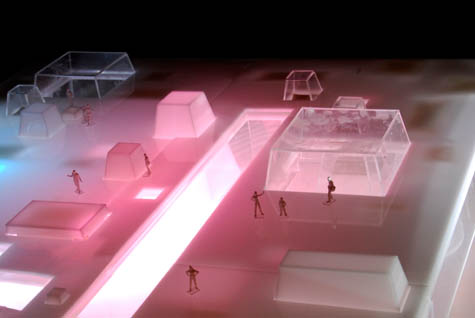
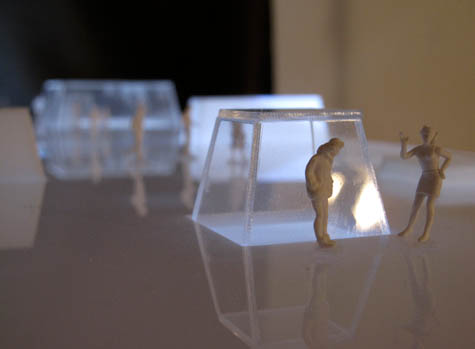
[Images: From “Change of Heart” by Marina Nicollier].

But I find it almost overwhelmingly interesting to think that controlled exposure to a certain piece of architecture could actually be prescribed as a medical treatment. Viewed this way, the immersive experience of a well-designed space could actually stimulate one toward otherwise unknown medical highs and lows.
A building becomes almost pharmaceutical – or narcotic – in its level of influence over those who use it.
Could a building even become addictive?, one might ask. Could you experience something like withdrawal after going too long without experiencing it?
Could you someday receive a prescription from a doctor telling you to visit a certain building for twenty minutes everyday, because the phenomenological impact of its vaulted galleries might cure you of whatever – kidney stones, anemia, or even manic-depression? Male pattern baldness. Sexual frigidity.
Space is the treatment for the things that harm you.
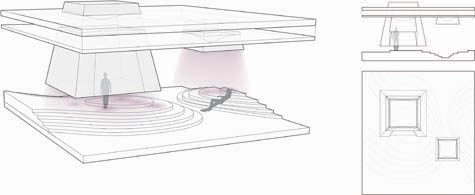
[Image: From “Change of Heart” by Marina Nicollier].

During the project review, we discussed whether it might be possible for the building to act as a template or prototype for other such projects elsewhere. That is, could you produce a kind of spatial franchise in which certain combinations of color, materiality, texture, sequence, and even scent would be put to use for medical purposes? The light, sound, and temperature of the building would thus act as a general format, available to other designers in utterly dissimilar circumstances.
Perhaps it’d even be subject to regulation by the FDA and reproduced as a generic in Canada.
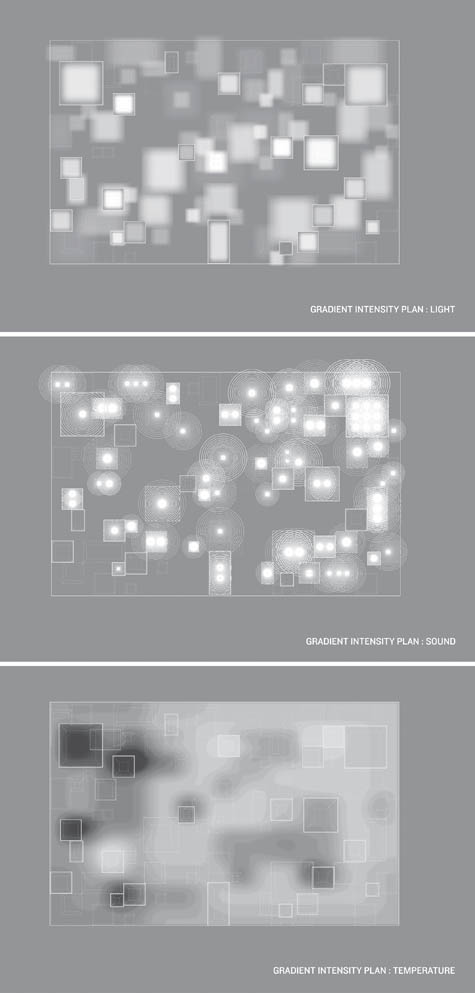
[Image: From “Change of Heart” by Marina Nicollier].

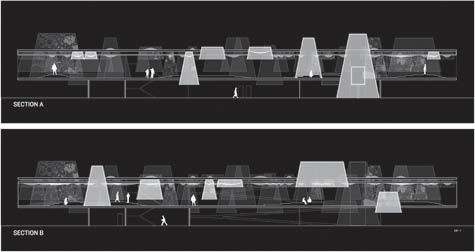
The sections, meanwhile, are beautiful in their own way –
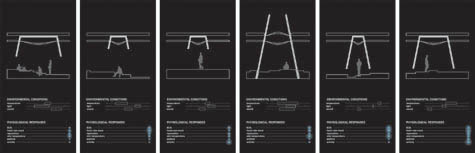
[Images: From “Change of Heart” by Marina Nicollier].

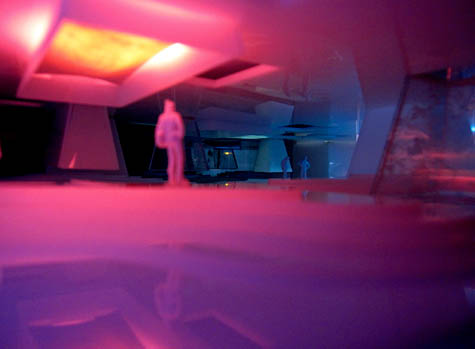
– though I’m unashamedly a fan of the semi-psychedelic mood lighting of the actual models.
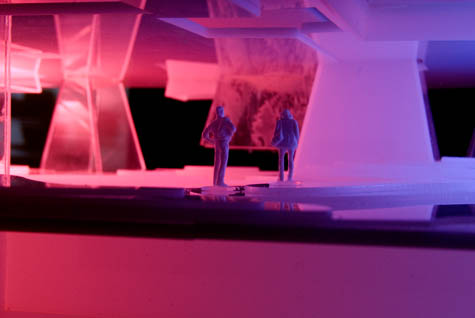
[Image: From “Change of Heart” by Marina Nicollier].

To read a complete description of the project and see larger images, check out this Flickr set of the project.

(“Change of Heart” was produced at Rice University under the supervision of Dawn Finley, Eva Franch Gilabert, Farès el-Dahdah, and Albert Pope).
Hydro-Pharmacology

Medical researchers have found that some of the streams, rivers, and groundwater in Patancheru, India, are really “a soup of 21 different active pharmaceutical ingredients, used in generics for treatment of hypertension, heart disease, chronic liver ailments, depression, gonorrhea, ulcers and other ailments. Half of the drugs measured at the highest levels of pharmaceuticals ever detected in the environment.”

[Image: The Iska Vagu stream near Hyderabad, India. “Indian factories that make lifesaving drugs swallowed by millions worldwide are creating the worst pharmaceutical pollution ever measured,” we read, “spewing enough of one antibiotic into a stream each day to treat everyone living in Sweden for a work week.” Photo by AP Photo/Mahesh Kumar A].

“If you just swallow a few gasps of water,” a German doctor said to MSNBC, “you’re treated for everything. The question is for how long?”

Indeed, all of this has the unsurprising effect that “some of India’s poor are unwittingly consuming an array of chemicals that may be harmful, and could lead to the proliferation of drug-resistant bacteria.” For instance, amongst this mix are high levels of Ciproflaxin:

The more bacteria is exposed to a drug, the more likely that bacteria will mutate in a way that renders the drug ineffective. Such resistant bacteria can then possibly infect others who spread the bugs as they travel. Ciprofloxacin was once considered a powerful antibiotic of last resort, used to treat especially tenacious infections. But in recent years many bacteria have developed resistance to the drug, leaving it significantly less effective.

With sources of freshwater all over the world now showing at least trace signs of pharmaceutical pollution, is some kind of global superbug brewing?

Aside from the very real health implications of this story, though, I’m fascinated by these drugs’ effect on the landscape; in other words, millions of pounds’ worth of loose pharmaceuticals will surely someday form a detectable layer in the soil, given time.

Pharmaco-geological formations take shape in the sand, compacted into strange new types of stone. The locals dissolve slices of it in their tea, as it’s used to treat illnesses.
Thousands of years pass; then millions. The rocks you’re looking at in the wall of that canyon are made of lithified Prozac. Tylenol Gorge State Park.

A deltaic geography of sedimentary Tamiflu is eventually mined as a building material; temples of this unusually smooth rock are built; visits to them are believed to help prevent infection.

And how will this affect plants? If river grasses and trees begin to accumulate this novel class of mineral, taking pharmaceutical-rich waters up into their roots, will it change the way they grow? Day of the Triffids.

“We don’t have any other source, so we’re drinking it,” a local woman named R. Durgamma explains to MSNBC. In a chilling detail that reveals how those in power clearly know what is happening there, she adds: “When the local leaders come, we offer them water and they won’t take it.”

(Thanks, dad, for the link!)

State of Incorporation

I recently came across something I first read back in January 2004 about what might be called the private nationalization of Italy under Prime Minister Silvio Berlusconi – when your country becomes a labyrinth of overlapping properties owned by one man – and it seemed interesting enough that I thought I’d re-post it here. So:

Hi there,

I’m an Italian citizen living in Milan, in a building that was built by Immobiliare EdilNord, which is owned by the Prime Minister. I work part-time for the Pagine Utili, owned by the Prime Minister, but I might soon be contracted by Blockbuster, the famous chain owned by the Prime Minister. I’ve always been a fan of Milan, the soccer club of the Prime Minister. I go to work in a car which I first saw in an ad in Panorama, a weekly magazine owned by the Prime Minister, and which I bought secondhand from an employee of the Banca Mediolanum, a bank amongst whose biggest shareholders we find the Prime Minister. The insurance for the car is also owned by the Prime Minister, and when I’m driving I often listen to some radio stations… owned by the Prime Minister. When I leave my house I first accompany my neighbor, who works at the Finbanc Inversiones (owned by the Prime Minister) before I pick up some newspapers and magazines (also owned by the Prime Minister). Sometimes there’s traffic on the way to work, and so to tell my colleagues I’ll be late I use a cellphone of the Compagnia Telefonica Mobile, which sees the Prime Minister as one of its shareholders.

Some afternoons I go shopping in the supermarkets built by one of the Prime Minister’s construction and development companies, where I buy products produced, published, and sponsored by the Prime Minister. In the evening I nearly always watch the television, nowadays completely in the hands of the Prime Minister, on which the movies (often produced by the Prime Minister) are continuously interrupted by commercials made by the Prime Minister’s own publicity agency. Thus, through satellite, I try to get out of Italy to see if anything good is being transmitted elsewhere, but then it happens that I find TV networks functioning under Mediaset – which is owned by the Prime Minister. Distrustful and tired, I do some surfing on the internet via the Jumpy Provider, of NewMedia Investment, another property of the Prime Minister, and there I find lots of declarations of the Prime Minister, nearly all against his political opponents. Sundays I like to stay at home and just read books – which come from publishing companies owned by the Prime Minister.

Panta rei, everything proceeds – but for a while now I’ve heard a lot of whispering about the conflicts of interest in relation to our Prime Minister, so I ask myself: why? Is there something anomalous? This isn’t how it’s supposed to be?

My sincere greetings,
An Italian Citizen

Originally published on Indymedia Italia.