Shells, Tube Structures, and Minimal Surfaces

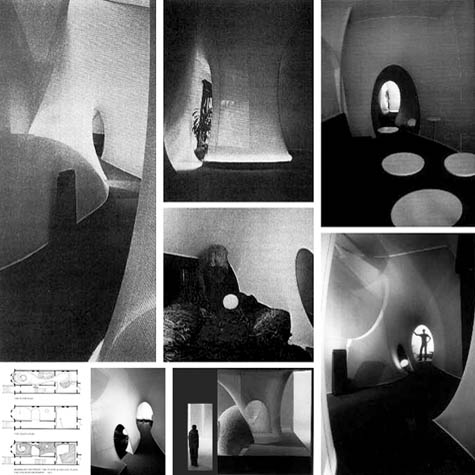
Reader Louis Schultz has pointed out the work of Lithuanian-born artist Aleksandra Kasuba, who used curved surfaces of fabric stretched and attached between space frames in order to create inhabitable rooms and corridors.

[Images: The Live-in-Environment (1971) by Aleksandra Kasuba; the project “was built on a parlor floor of a brownstone house in New York City,” we read. “The intent was to abolish the 90-degree angle and create an environment that would capture changes in daylight, provide variations in terrain, and introduce the unexpectedness of views found in nature without simulating nature”].

These ephemeral installations were intended, spatially, as a way to “abolish the 90-degree angle and create an environment that would capture changes in daylight, provide variations in terrain, and introduce the unexpectedness of views found in nature without simulating nature.” I love that latter caveat: to retain the experiential impact of unexpected natural vistas without simply copying, or simulating, the spatial details and material palette of the natural world.
Instead, a somewhat stark world of undecorated surfaces curves around us – call it biomorphic minimalism – thus eliding the differences between architecture and large-scale tailoring.
In any case, her Live-in-Environment, from 1971, seen in the images above, is a great example of this – but don’t miss the Roof Deck Study from 1974; the Barbarella-meets-IBM world of torqued geometry from her Office Renovation Study (1975); the aerial tunnels of Art-in-Science I (1977), which look like some megafaunic form of undersea life, stretched through the canopies of a North American thicket (“With the assistance of three students during an eight week stay,” Kasuba writes, “we explored the topology of 78 fabric structures, hardened 32 with resins, and erected 4 weather structures”); and the simplicity of Blue Shade (1978).
Better yet, Kasuba supplies a section called How It Was Done – where you can learn how to create finishes, arches, and doors, for instance – and this includes Kasuba’s extraordinary, lo-fi guide to shells, tube structures, and minimal surfaces.
It’s what The North Face might have become had their tent division been bought by Kenneth Snelson.

Rome Thunderdome

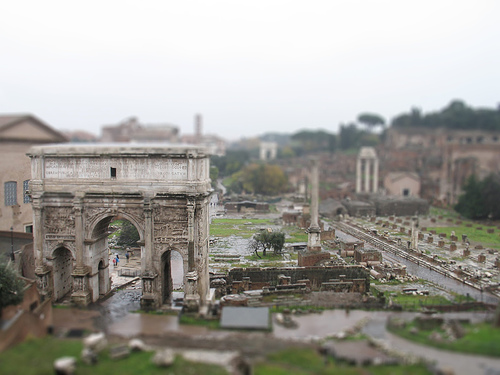
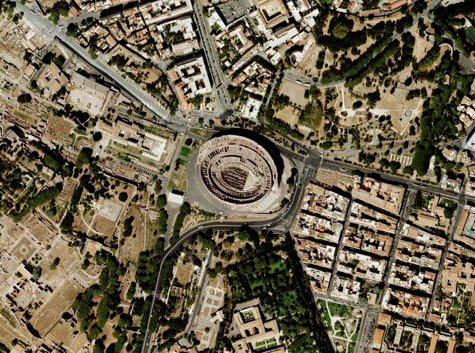
[Image: Little Rome Ruins by Bernat Gallemí].

An early burst of thunder woke me up this morning, before a brief wash of rain blew through – but what was extraordinary was that the sound of the thunder didn’t pass all at once: it kept opening and echoing, as if moving outward through the city to trace the shapes of piazzas, streets, river banks, and alleyways.
There was a kind of Dopplered geometry to it – an acoustic version of Rome exactly opposite the city’s angles and walls. Live here long enough, and perhaps you could even tell when a storm has reached the Campo del Fiori – echolocating yourself amidst urban geography – because the thunder has opened out again, getting louder, or more resonant, only then to dampen itself back in a tight squeeze through surrounding alleyways. The sound moves through the city like a spider.
You might say that thunder could be used here as a kind of horizontal space-detection device. It’s urban radar: an acoustic sensing of the city that moves through that city, seeking out cracks and passageways. Only to fill those empty spaces with sound.
A guild of blind mapmakers uses thunderstorms to pursue prehistoric radar cartography.
It occurred to me, though, that every city – or, at least, every city with a different street grid – must react to thunder differently. Urban design becomes a direct sonic engagement with the atmosphere through storms, using the unique form of your city as a precise acoustic frame for the sky.
Could there even be building types that funnel the sound of thunder? Like Athanasius Kircher‘s talking statues, they would be talking buildings: acoustically activated by thunder for the purpose of public spectacle.
You could actually test people with this: put them blindfolded in different locations during foreign thunderstorms and ask them to deduce where they are from the widening concussions of sound around them.
Moscow, Cairo, Rome, Fez. London, Barcelona, New York. All with their own sonic signatures: you pinpoint an aerial detonation and acoustically trace its spatial after-effects.

The Water Menu

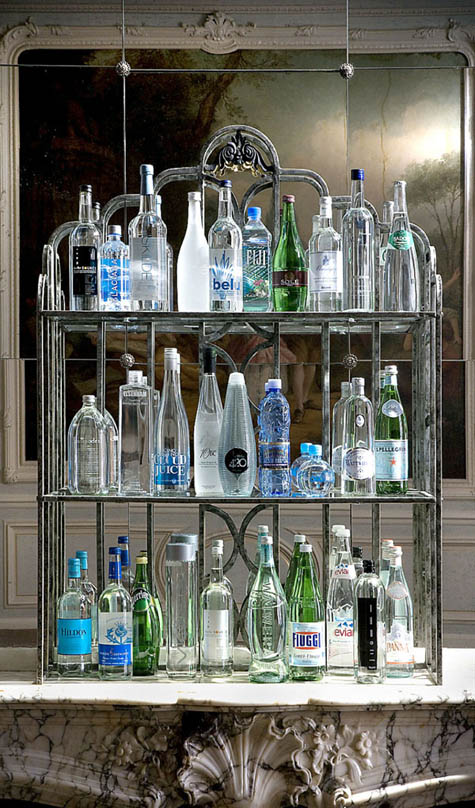
[Image: The water selection at Claridge’s, curated by Renaud Grégoire, food and beverage director].

Note: This is a guest post by Nicola Twilley.

The concept of terroir has its origins in French winemaking, as a means to describe the effect of geographic origin on taste. As a shorthand marker for both provenance and flavor, and as a sign of its burgeoning conceptual popularity, it has spread to encompass Kobe beef, San Marzano tomatoes, and even single-plantation chocolate.

But can water have terroir? What about the influence of the earth on water?

In late 2007, Claridge’s (a luxury hotel in Mayfair, London) caused a minor stir by introducing a “Water Menu.” The list features more than thirty mineral waters from around the world, described in terms of their origin and suggested flavor pairings.

Leaving aside a few obvious issues (such as the environmental impact of bottled water and the sheer economic wastefulness of sending multiple varieties of it to one hotel in England), it is hard not to appreciate the poetry of three-line exotic water biographies.

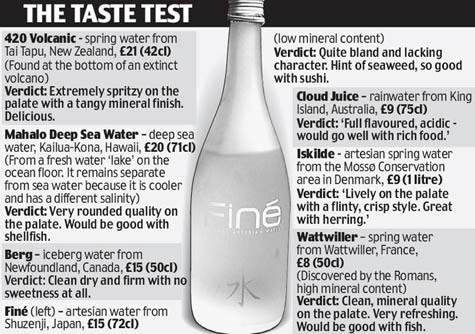
Take Mahalo Deep Sea Water, at £20 for 71cl, which comes from “a freshwater iceberg that melted thousands of years ago and, being of different temperature and salinity to the sea water around it, sank to become a lake at the bottom of the ocean floor. The water has been collected through a 3000ft pipeline off the shores of Hawaii.” According to the Daily Mail, Mahalo has a “very rounded quality on the palate” and it “would be good with shellfish.”

[Image: The Daily Mail‘s taste test results].

Meanwhile, Danish Iskilde‘s “flinty, crisp style” apparently derives from the Jutland aquifer’s complicated geology, consisting of interlaced deposits of quartz sand, clay, gravel, and soil. The most expensive (and possibly the most exciting) water on the menu is 420 Volcanic from New Zealand. Sourced from the Tai Tapu spring, which bubbles up through more then 650 feet of rock at the bottom of an extinct volcano, it is apparently “extremely spritzy on the palate with a tangy mineral finish.”

Claridge’s has since been joined by the Four Seasons in Sydney, and, according to The Guardian, “a handful of five-star Los Angeles hotels now employ water sommeliers to advise on the best water accompaniment to spiced braised belly pork or fillet of brill with parmentier of truffled leek.”

This same Guardian article goes on to recount the origins of Elsenham Water, which is described as “absolutely pure” and “very earthy—almost muddy,” depending on who you ask. Elsenham was discovered almost accidentally by Michael Johnstone, a former jam manufacturer; it is filtered over a 10-year period, in a confined chalk aquifer, half a mile below his abandoned jam factory and a neighboring industrial-sealant plant. Now, staff in white coats and hair nets fill up to 1,000 bottles daily “from an acrylic tank connected to pipes running into a hole in the ground.” Each bottle, priced at £12 for 75cl, is then polished by hand before it leaves the building.

According to Michael Mascha, former wine critic and author of Fine Waters: A Connoisseur’s Guide to the World’s Most Distinctive Bottled Waters, “water is in a transition from being considered a commodity to being considered a product.”

There is an undeniable Wild West gold-rush type of excitement to the idea of drilling for water in geologically auspicious locations. However, Mascha’s comment also implies that we might even begin to see the engineering of gourmet water products.

Loop tap water in a closed pressurized system for twenty years, through thick beds of pure northern Italian dolomite, and enjoy the lightly acidic result with chicken and fish. Better yet, blend it with water forced through a mixture of Forez and Porphyroid granite chips sourced from southwest France, stacked in a warehouse outside London to mimic in situ geological formations, to add a citrusy top note reminscent of Badoit.

A final spritz of oxygen ensures a silky mouthfeel—combined with the right designer packaging—and the burgeoning ranks of water connoisseurs will be lining up at your industrial plant for a taste.

[Previous posts by Nicola Twilley include Atmospheric Intoxication, Park Stories, and Zones of Exclusion].

Urban Haunting

I’m in Rome now for the month of June, living across from a prison near the banks of the Tiber, listening to seagulls, on a fairly awful and inexplicably expensive wireless internet connection, fearing that I might only be able to post every few days.

In fact, my early morning attempts to find domestic hotspots – putting my computer near the windows, or moving books and papers just a few more feet away – reminds me of stories I’ve read about high-end audio equipment aficionados, people who purchase arcane bits of scientifically dismissible, wildly overpriced stereo attachments in the hopes that they can affect, clarify, or otherwise improve their home-listening experience.
Pieces of piezoelectric crystal, or unsustainably harvested rain forest wood milled into odd shapes – combined with bizarre new alloys imported from metallurgical research labs in southern Germany – all wired up and placed around your home stereo, like a deviant altar. Where consumer goods meet Arthur C. Clarke’s 3rd law.
But is there an equivalent for wireless internet connections?
You put a small piece of copper near your USB port, hoping for magical cross-interference, or, in a fit of antihistamine-influenced mania, you rewire your whole house, splicing electrically unnecessary strands of tellurium through the switchboards inside the walls.
Or why not take the Ghostbusters route and construct a whole building as an urban antenna, an architectural attractor for that strange wireless haunting that allows you to Google things in foreign cities from a desktop that isn’t yours.
In other words, are there micro-practices of wireless superstition that people engage in so that they can achieve, or believe they achieve, stronger wireless internet signals?
You implant rods inside all of Rome’s statuary, and inside the ruined walls of the city’s periphery, in order to boost your home internet access. A conspiratorial geometry of antennas that no one else recognizes, pulsing with airborne data.
Rome, reconceived as a counter-Vatican of wireless downloads. Catholicism of the megabyte.
It’s what might happen if Telecom Italia opened an urban design wing after reading too much Aleister Crowley.
In any case, while the internet is still functioning here, I also wanted to thank everybody who came out to see Thrilling Wonder Stories last week at the Architectural Association. My own talk was something of a jumble, to be honest – sorry about that, especially for those of you who were meeting me for the first time – but the rest of the day really impressed.
For those of you who missed it, participant Jim Rossignol has a great write-up of the event on his blog; Rossignol’s account of Francois Roche is well worth a read. Here’s an excerpt:

Then the most extraordinary storm of science-madness came from Francois Roche (of architects R&Sie) whose thick accent masked incredible phrases: “strategies of sickness,” “protocolising the witch in the forest,” “the necrosis of the building,” “the penis of the wall”… He talked about feeding death and traditional fairy tales into design, and about creating a machine that would build an un-navigable glass maze in the courtyard between buildings, into which people would wander, and then die, unable to escape without GPS. “They die to become part of the building,” he said, grinning, and propping expensive sunglasses on his styled bonce. He talked about a building which would be constructed from vast, moulded versions of bullet holes on wet clay, covered in rotting vegetation collected from the Korean de-militarized zone by a purpose-built “witch” robot, referencing Tarkovsky’s Stalker on the way.

With any luck, the whole of Thrilling Wonder Stories will soon be made into an AA publication by the end of this summer.
So expect more posts soon – and if anyone has tips for obscure archaeological sites in Rome that need to be visited, let me know.

Saddam’s Palaces: An Interview with Richard Mosse

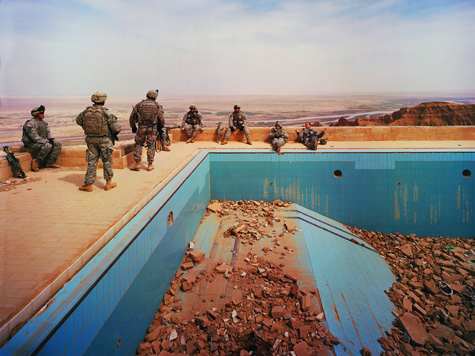
[Image: Ruined swimming pool at Uday’s Palace, Jebel Makhoul, Iraq (2009); photo by Richard Mosse].

Photographer Richard Mosse first appeared on BLDGBLOG last year with his unforgettable visual tour through the air disaster simulations of the international transportation industry.

He and I have since kept in touch—so, when Mosse returned from a trip to Iraq this spring, he emailed again with an unexpectedly intense new body of work. These extraordinary images—published here for the first time—show the imperial palaces of Saddam Hussein converted into temporary housing for the U.S military.

Vast, self-indulgent halls of columned marble and extravagant chandeliers, surrounded by pools, walls, moats, and, beyond that, empty desert, suddenly look more like college dormitories. Weight sets, flags, partition walls, sofas, basketball hoops, and even posters of bikini’d women have been imported to fill Saddam’s spatial residuum. The effect is oddly decorative, as if someone has simply moved in for a long weekend, unpacking an assortment of mundane possessions.

The effect is like an ironic form of camouflage, making the perilously foreign seem all the more familiar and habitable—a kind of military twist on postmodern interior design.

Of course, then you notice, in the corner of the image, a stray pair of combat boots or an abandoned barbecue or a machine gun leaned up against a marble wall partially shattered by recent bomb damage—amidst the dust of collapsed ceilings and ruined tiles—and this architecture, and the people who now go to sleep there every night, suddenly takes on a whole new, tragic narrative.

Fascinated by the dozens and dozens of incredible photos Mosse emailed—only a fraction of which appear here—I asked him to describe the experience of being a photographer in Iraq.
The ensuing dialogue appears below.


• • •

BLDGBLOG: What was the basic story behind your visit to Iraq? Was it self-funded or sponsored by a gallery?

Richard Mosse: The trip was backed by a Leonore Annenberg Fellowship in the Performing and Visual Arts, which I received after graduating from Yale last summer with an MFA in photography. The Fellowship provides enough to fund two full years of traveling to make new photographs, and I applied to shoot in a range of places, including Iraq. My proposal was to make work around the idea of the accidental monument. I’m interested in the idea that history is something in a constant state of being written and rewritten—and the way that we write history is often plain to see in how we affect the world around us, in the inscriptions we make on our landscape, and in what stays and what goes.
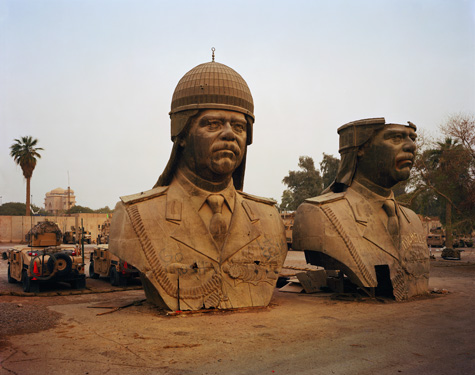
[Image: Saddam’s heads, taken from the roof of the Republican Guard Palace, now located at Al-Salam Palace, Forward Operating Base Prosperity, Baghdad, Iraq (2009); photo by Richard Mosse].

I suppose it’s an idea that captured me while traveling through Kosovo in 2004. I saw a building by the side of the road there that lay mined and shattered in a field of flowers. It was almost entirely collapsed—except for a church cupola which lay at a pendulous angle, though otherwise perfectly intact on a pile of rubble. It was a marvelously pictorial vision of the Kosovo Albanian desire to rewrite the history books. In other words, what I saw before me was not an act of mere vandalism, but a decisive act by the Kosovo Albanian community to disavow the fact of Serb Orthodox church heritage in the region. The removal of religious architecture is a terrible crime, and it constitutes an act of ethnic cleansing (remember Kristallnacht); yet I couldn’t help but interpret this as an attempt to create a brave new Kosovo Albanian world.

I began to see architecture as something that can reveal the ways in which we alter the past in order to construct a new future, as a site in which past, present, and future come together to be reformed. And it’s not the only one: language—our words and the way we use them—are another fine barometer of these things.

But architecture is something I felt I could research and portray using the dumb eye of my camera.
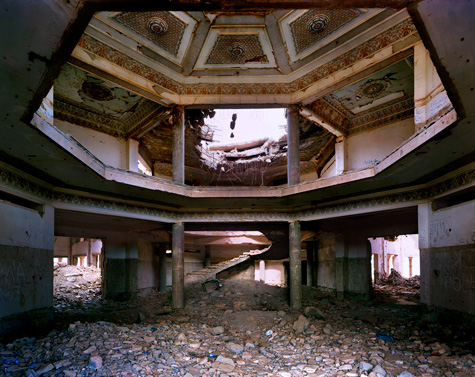
[Image: JDAM bomb damage within Saddam’s Palace interior, Jebel Makhoul, Iraq (2009); photo by Richard Mosse].

BLDGBLOG: Beyond the most obvious reasons—for instance, there’s a war going on—why did you go to Iraq? Was there something in particular that you were hoping to see? 

Mosse: I had heard plenty about Saddam’s palaces. They were the focus of the International Atomic Energy Association’s tedious investigations in the years preceding the invasion, and the news was always full of delegations being turned away from this or that palace. Why were we so keen to get inside Saddam’s palaces? Because he built so many—81 in total. Surely, we thought, he must be hiding something in those palace complexes. Surely he must be building subterranean particle accelerators. And, in the end, our curiosity got the better of us.
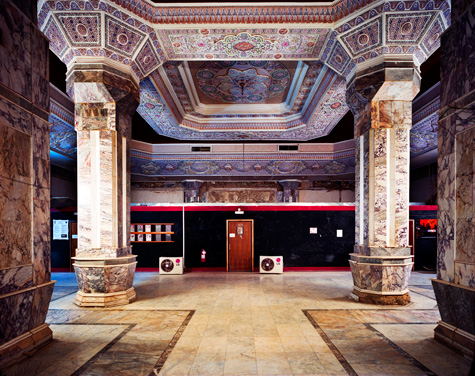
[Image: U.S.-built partition and air-conditioning units within Al-Salam Palace, Forward Operating Base Prosperity, Baghdad, Iraq (2009); photo by Richard Mosse].

In fact, Saddam was building palaces in every city as an expression of his authority. Palace architecture in Iraq served as a constant reminder of Saddam’s immanence. A palace in your city simply fed the sense that Saddam was not just nearby—he was everywhere. Saddam was omnipresent.

I once heard a Westerner tell me that, prior to the invasion, Iraqis driving near one of Saddam’s palaces would actually avert their eyes—they would refuse to look toward the palace. It was almost as if they were prisoners in a great outdoor version of Jeremy Bentham’s Panopticon. Curiously, the sentry towers along the perimeter walls of Al-Salam Palace in Baghdad face only outward; they’re screened from looking inward at the palace itself. People say it’s so the guards could not witness Saddam’s eldest son Uday’s relations with underage girls, but I rather like to think that it created a sense of the unseen authoritarian staring blankly outwards. It was like those ominous black turrets that the British army constructed over the hills of Belfast, packed with listening devices and telescopic cameras.
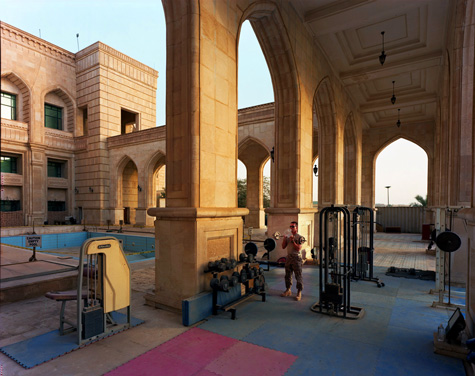
[Image: Outdoor gym, Al-Faw Palace, Camp Victory, Baghdad, Iraq (2009); photo by Richard Mosse].

But the idea of Iraqis averting their eyes from Saddam’s palace architecture also reminds me of something from W.G. Sebald’s book On the Natural History of Destruction.

BLDGBLOG: That’s an incredible book – I still can’t forget his descriptions of tornadoes of fire whirling through bombed cities and melting asphalt.

Mosse: Sebald recounts how the German population, after the end of WWII, would ride the trains, staring into their laps or at the ceiling—anywhere but out the window at the terrible wreckage of their cities. It was as if they were somehow disavowing the war by willing it away, by refusing to perceive it.

It’s interesting, then, that, in both instances—in both Iraq and in post-war Germany—it’s the tourist, or the outsider, who observes this blindness. I suppose that’s why I like to make photographs in foreign places: only the tourist notices the really dumb things that everyone else takes for granted.
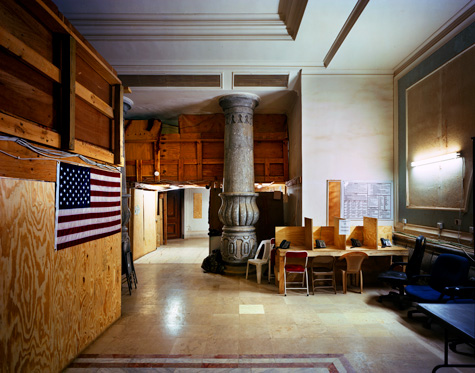
[Image: U.S. military telephone kiosks built within Birthday Palace interior, Tikrit, Iraq (2009); photo by Richard Mosse].

BLDGBLOG: The way these structures have been colonized is often amusing and sometimes shocking—the telephones, desks, and instant dormitories that turn an imperial palace into what looks like a suburban office or hospital waiting room. Can you describe some of the spatial details of these soldiers’ lives that most struck you? 

Mosse: It was extraordinary how some of the palace interiors had been transformed to accommodate the soldiers. Troops scurried beneath vaulted ceilings and glittering faux-crystal chandeliers. Lofty marble columns towered over rat runs between hastily constructed chipboard cubicles. Obama’s face beamed out of televisions overlooking the freezers and microwaves of provisional canteen spaces.

Many of the palaces have already been handed back to the Iraqis—but where Americans troops do remain, they live in very cramped conditions, pissing into a hole in the ground and waiting days just to shower. Life is hard on the front line, and it seems more than a little surreal to be ticking off the days in a dictator’s pleasure dome.
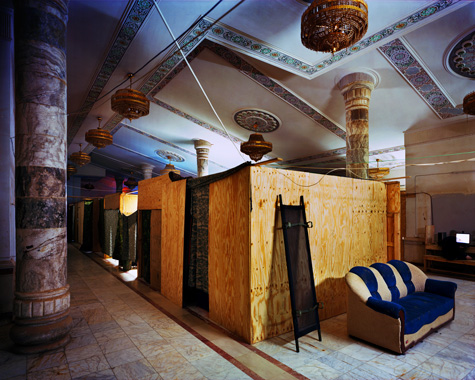
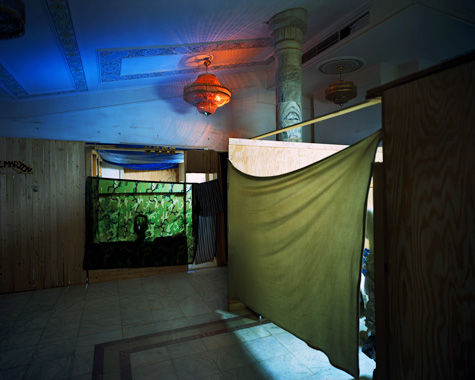
[Images: American dormitories built within Saddam’s Birthday Palace, Tikrit, Iraq (2009); photos by Richard Mosse].

The most interesting thing about the whole endeavor for me was the very fact that the U.S. had chosen to occupy Saddam’s palaces in the first place. If you’re trying to convince a population that you have liberated them from a terrible dictator, why would you then sit in his throne? A savvier place to station the garrison would have been a place free from associations with Saddam, and the terror and injustices that the occupying forces were convinced they’d done away with. Instead, they made the mistake of repeating history.

This is why I’ve titled this body of work Breach. “Breach” is a military maneuver in which the walls of a fortification (or palace) are broken through. But breach also carries the sense of replacement—as in, stepping into the breach. The U.S. stepped into the breach that it had created, replacing the very thing that it sought to destroy.

There are other kinds of breach—such as a breach of faith, a breach of confidence, or the breach of a whale rising above water for air. All of these senses were important to me while working on these photographs.
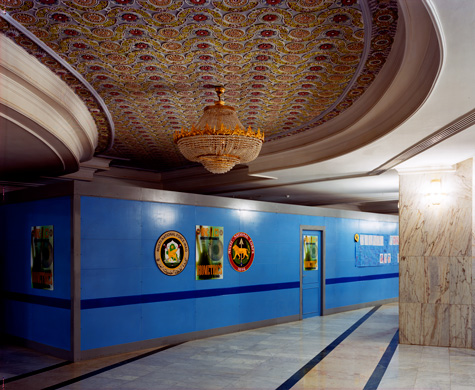
[Image: Provisional office wall partitions within Al-Faw Palace, Camp Victory, Baghdad, Iraq (2009); photo by Richard Mosse].

BLDGBLOG: In several of these photos, the soldiers are literally lifting tiles up from the floor as if the buildings had been left unfinished, or they’re peering through cracks in the palace walls. From what you could see, were Saddam’s palaces badly constructed or were they just heavily damaged during the war?

Mosse: Tiles simply fell from Al-Faw Palace because the cement used there had been poorly salinated. If that can happen to tiles, think what’s happening when the entire palace has been built on similarly salinated foundations! It’s just a matter of time before Al-Faw collapses in on itself.

You can already see arches cracking and walls beginning to sag.
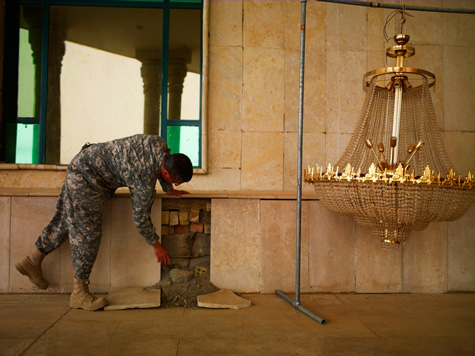
[Image: Fallen tiles and chandeliers, Al Faw Palace, Camp Victory, Baghdad, Iraq (2009); photo by Richard Mosse].

But I’m reluctant to include images of U.S. soldiers pointing out problems with Saddam’s architecture, because it’s fairly evident that those could be a form of propaganda—and it’s easy to forget that many of these palaces were built during times of terrible sanctions imposed by the West. It might not seem very clear why Saddam was busy building palaces in a time of sanctions, but remember how the WPA was set-up during the Great Depression? I don’t want to risk being called an apologist for Saddam, but there are many ways to read a story.
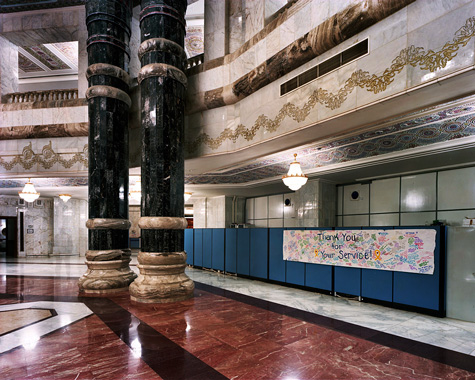
[Image: “Thank you for your service” banner, Al-Faw Palace interior, Camp Victory, Iraq (2009); photo by Richard Mosse].

That said, the palace is a fabulous monument to rushed construction, poor materials, and gaudy pomp. Saddam had apparently insisted that the palace be finished within two years, so many shortcuts were taken during construction. For example, the stairway banisters were made of crystallized gypsum—rather than carved marble—and where pieces didn’t quite fit together, they were just sanded down rather than replaced. Marble that was used in the palace (such as in the great spacious bathrooms) was imported from Italy, in spite of the trade embargo. And the plaster cast frescoes in the ceilings were imported from Morocco.
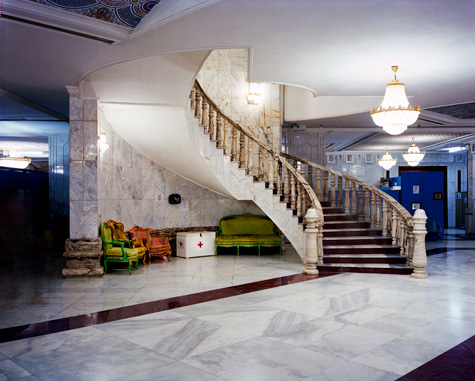
[Image: Stairway, Al-Faw Palace, Camp Victory, Baghdad, Iraq (2009); photo by Richard Mosse].

Al-Faw Palace later became the U.S, Army’s Command HQ, located at the heart of Camp Victory, near Baghdad International Airport. The palace is now teeming with generals, including General Odierno, the commander of coalition forces in Iraq. It’s a great, tiered wedding-cake structure, built around an inner hall with possibly the biggest and ugliest chandelier ever made. In fact, the chandelier is not made of crystal, but from a lattice of glass and plastic.
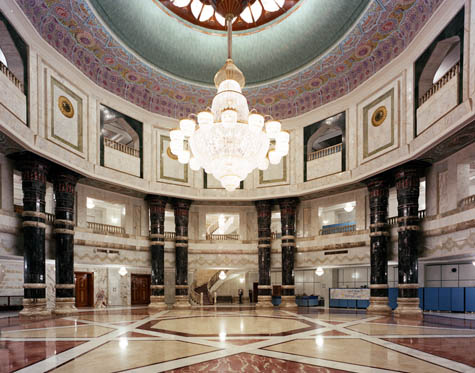
[Image: Chandelier, Al-Faw Palace, Camp Victory, Baghdad, Iraq (2009); photo by Richard Mosse].

The palace itself is then surrounded by a lake, which seems a bit like a moat—and it would be tempting to take a swim there, but the moat has been turned into a standing pool for Camp Victory’s sewage. In the summer, the place must be rather unpleasant: rank in all senses of the word, both military and sanitary. These artificial lakes surrounding the palace are also populated by the infamous “Saddam Bass.” It’s said that Saddam would feed the bodies of his political opponents to these monsters. In fact, they’re not bass at all, but a breed of asp fish. U.S. troops stationed at Camp Victory love to fish on these lakes, and a 105-pound specimen was recently caught.
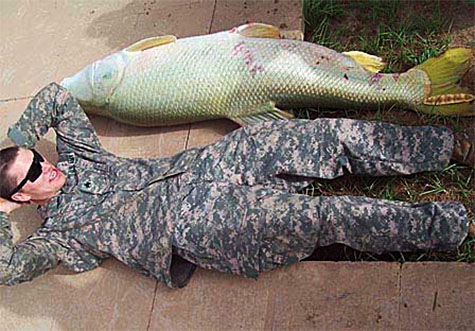
[Image: Tigris Salmon caught at Camp Victory Base, measuring 5 feet 10.5 inches and weighing 105 lbs. Image courtesy of the U.S. Army].

BLDGBLOG: How was your own presence received by those soldiers? Did you present yourself as a photojournalist or as an art photographer?

Mosse: The difference between art and journalism is, for me, of paramount importance—but twenty minutes in Iraq, and the dialectic recedes. I got a vague sense that Americans working there feel a little forgotten—unappreciated by people at home—so they’re very grateful for a camera, any camera, coming through. Even a big 8″x10″ bellows camera with an Irishman in a cape. There were a lot of rather obvious photographs that I chose not to make, and occasionally someone got offended by this.
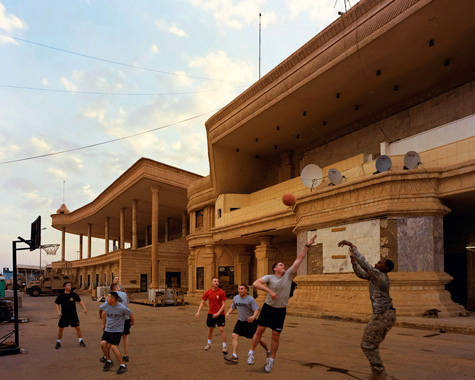
[Image: A game of basketball, Birthday Palace, Tikrit, Iraq (2009); photo by Richard Mosse].

BLDGBLOG: What was the soldiers’ opinion of these buildings? Did they ever just wander around and explore them, for instance, or was that a safety violation?

Mosse: I got the feeling that soldiers who occupied one of Saddam’s palaces were pretty interested in its original function. They seemed a lot more together, and happier with their job, compared with the troops I met on the massive, sprawling, purpose-built military bases in the Iraqi desert. Constant reminders of hierarchy and protocol were everywhere on the bigger bases—but on the more cramped and less comfortable palace bases, soldiers of different ranks seemed much closer and more capable of shooting the shit with each other, to borrow an American turn of phrase.

Though a far tougher environment, there seemed to be real job satisfaction—a sense that they were taking part in a piece of history.
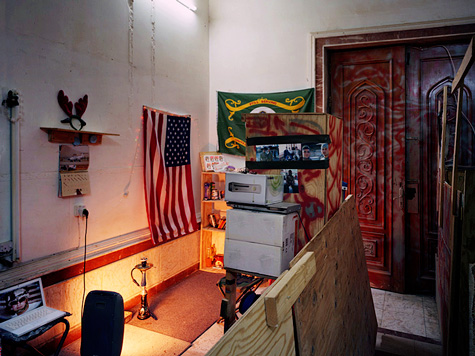
[Image: Detail of U.S. soldier’s living quarters, Birthday Palace interior, Tikrit, Iraq (2009); photo by Richard Mosse].

BLDGBLOG: Architect Jeffrey Inaba once joked, in an interview with BLDGBLOG, that Saddam’s palaces look a bit like McMansions in the suburbs of New Jersey. He quipped that “the architecture of state power and the architecture of first world residences don’t seem that far apart. Saddam’s palaces, while they’re really supposed to be about state power, look not so different from houses in New Jersey.” They’re not intimidating, in other words; they’re just tacky. They’re kitsch. Now that you’ve actually been inside these palaces, though, what do you think of that comparison? 

Mosse: Well, I’ve never been inside a New Jersey McMansion, so I can’t pass judgment. However, “McMansion” is a term borrowed by us in Ireland, where I’m from. Ireland was hard-hit by English penal laws, from the 17th century onward. One of those laws was the Window Tax. This cruel levy was imposed as a kind of luxury tax, to take money from anyone who had it; the result was that Irish vernacular architecture became windowless. The Irish made good mileage on the half-door, for instance, a kind of door that can be closed halfway down to keep the cattle out but still let the light in.

Aside from this innovation, and from subtleties in the method of thatching, Irish architecture never fully recovered—to the point that, even today, almost everyone in my country chooses their house from a book called Plan-a-Home, which you can buy for 15 euros. And if you have extra cash to throw in, you can flick to the back of the book and choose one of the more spectacular McMansions. Those are truly Saddam-esque.
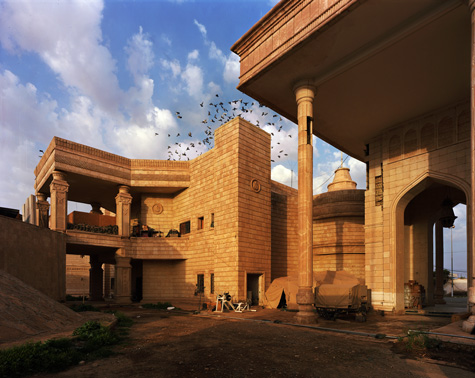
[Image: Birthday Palace, Tikrit, Iraq (2009); photo by Richard Mosse].

BLDGBLOG: Finally, the “Green Zone,” as well as many of these palaces, are notoriously insular, cut-off behind security walls from the rest of Iraq. Did you actually feel like you were in Iraq at all—or in some strange architectural world, of walls and dormitories, surrounded by homesick Americans? 

Mosse: Not all of Saddam’s palaces are as isolated from reality as those situated in the green zone (or international zone, as it’s now called). One I visited near Tikrit—Saddam’s Birthday Palace—was even right at the heart of the city. Saddam was said to visit the palace each year on his birthday.

Wherever you go on the base, you’re eminently shootable—a fantastic sniper target—and can hear the coming and going of Iraqis in the surrounding neighborhoods. It’s a remarkable experience to go up to the roof with the pigeons at dusk and watch the changing light. You get a palpable impression of the great tragedy of the Iraq war, and you can see for yourself the fencing between neighborhoods, the rubbish strewn everywhere, the emptiness of the place, and you can hear the packs of dogs baying about. But you can also hear occasional shots fired in the distance, and you get the distinct feeling that you’re being watched.

I spent a very slow month in Iraq trying to reach as many of these palaces as possible. I only managed to visit six out of eighty-one palaces. It is impossibly slow going over there, working within the war machine. These palaces are currently being handed back to the Iraqis, and many of them will be repurposed, sold to private developers or demolished. If I could get the interest of a publisher, for instance, I would return to Iraq to complete the project before Saddam’s heritage, and the traces of U.S. occupation, are entirely removed.


• • •

Thanks again to Richard Mosse for the incredible opportunity to talk to him about this trip, and for allowing BLDGBLOG to publish these images for the first time.

Be sure to see the rest of Mosse’s work on his website. Hopefully the entirety of Breach will be coming soon to a book or gallery near you.
Thrilling Wonder Stories

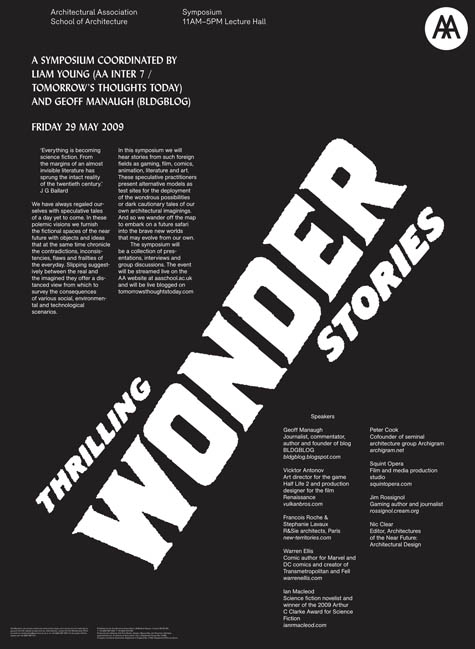
This Friday at the Architectural Association here in London, Liam Young and I will be hosting Thrilling Wonder Stories: Speculative Futures for an Alternate Present: a 6-hour event with an unbelievable line-up, discussing the thematic, imaginative, technical, and even structural connections between science fiction and architectural design.

[Image: Thrilling Wonder Stories: Speculative Futures for an Alternate Present at the Architectural Association. Poster design by Wayne Daly, with art direction by Zak Kyes; view larger for more info].

I’ve repeatedly asked here on the blog what architects might learn from science fiction – whether this latter term is understood to mean Star Trek, Dune, ancient myth, or The Book of Revelation – but, of course, this also works the other way around. What can producers and fans of sci-fi take away from the offshore utopias, Walking Cities, artificial reefs, vertical farms, genetically-modified living megastructures, intelligent machinery, and reengineered urban rivers of contemporary architectural design?
This symposium, hosted from 11am to 5pm in the Lecture Hall of the Architectural Association (here’s a map), will be an incredible way to explore these questions in depth.
From the event description:

We have always regaled ourselves with speculative tales of a day yet to come. In these polemic visions we furnish the fictional spaces of the near future with objects and ideas that, at the same time, chronicle the contradictions, inconsistencies, flaws and frailties of the everyday. Slipping suggestively between the real and the imagined, they offer a distanced view from which to survey the consequences of various social, environmental and technological scenarios.

In this symposium we will hear stories from such foreign fields as gaming, film, comics, animation, literature and art. These speculative practitioners present alternative models as test sites for the deployment of the wondrous possibilities, or dark cautionary tales, of our own architectural imaginings. And so we wander off the map to embark on a future safari into the brave new worlds that may evolve from our own.

Following an introduction from Brett Steel, Director of the Architectural Association, and short welcomes from both myself and Liam Young, you’ll hear a genuinely fantastic line-up:

—Sir Peter Cook, cofounder of Archigram and CRABstudio, and designer (with HOK) of the 2012 London Olympic Stadium

Warren Ellis, comic book author and graphic novelist – with a portfolio ranging from X-Men, Wolverine, and Iron Man to Ellis’s legendary Transmetropolitan, FreakAngels, and Fell – and author of Crooked Little Vein

—Architects Francois Roche and Stephanie Lavaux of R&Sie, designers of, among other things, the awesome Spidernethewood house

—Novelist Ian MacLeod, winner of the 2009 Arthur C. Clarke Award and author of The Light Ages and The House of Storms

—Journalist and games critic Jim Rossignol, author of This Gaming Life: Travels in Three Cities and subject of a long interview here on BLDGBLOG last week

Viktor Antonov, art director for Half-Life 2 and production designer for Christian Volckman’s film Renaissance

Squint/Opera, independent media studio and producers of last year’s widely publicized Flooded London

—Nic Clear, interviewed last year by Ballardian, editor of “Architectures of the Near Future,” a forthcoming issue of Architectural Design, and director of Unit 15 at the Bartlett School of Architecture

The event is free, open to the public, takes place at 36 Bedford Square, and will last all day, from 11am to 5pm; definitely feel free to stop in and check it out. The AA will also be opening up their Wifi network for event attendees, so you’ll be able to live-blog the proceedings, if you wish – and, even better, the whole thing will be livestreamed, which means that, even if you’re not in London, you can still tune-in.
So expect some amazing presentations, live interviews, and open discussions – as well as an ongoing flurry of mind-bending ideas, visuals, and architectural designs. It’s not often that Archigram, Half-Life 2, and Transmetropolitan get together in the same room.
Hope to see you there!

Zone for Cloud

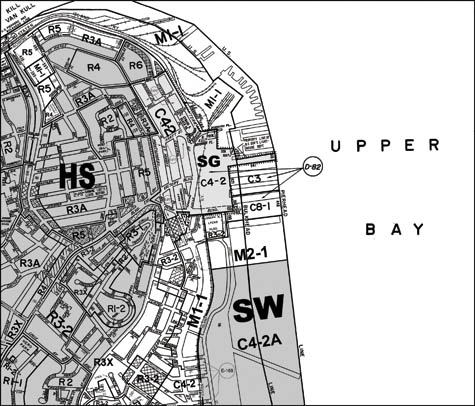
[Image: Detail of a zoning map for New York City].

Earlier this month, mammoth – just two months old, but already one of the more interesting architecture blogs out there – cited climatological research that certain land use patterns can dramatically affect the formation of clouds above.

In other words, pastures, forests, suburbs, cities, farms, and so on, all affect the skies in very particular spatial ways. Deforestation, for instance, has “substantially altered cloud patterns” in the Amazon; specifically, we read that “patches of trees behave as ‘green oceans’ while cleared pastures act like ‘continents’,” generating a new marbling of the local atmosphere.

The same thing can be found to happen above cities, of course. Instead of “being zoned ‘R-3 Residential Low Density’,” mammoth continued, “a block might be zoned ‘Cumulus H-2’.” Or Mammatus H-3. In this tongue-in-cheek vision of sky-centric urban development, all new buildings would have to be cleared with a Meteorological Bureau to ensure that they produce the right types of cloud. Atmospheric retrofitting comes to mean attaching bizarre cantilevers, ramps, and platforms to the roofs and walls of existing houses till the clouds above look just right.

Sky vandals are people who deliberately misengineer the weather through the use of inappropriate roof ornamentation.

Over generations, you and your friends and the descendants of your friends sculpt vast, urban-scale volumes of air, guiding seasonal rain events toward certain building types – where, as mammoth‘s own earlier paper about fog farming suggests, “fog nets” might capture a new water source for the city.

(Incidentally, there is a short vignette in The BLDGBLOG Book about bespoke, privatized, and extremely local weather control).

The Immersive Future of the Architectural Monograph

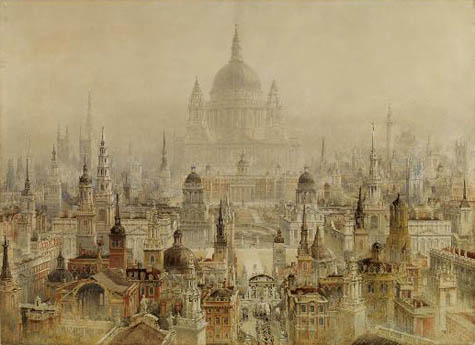
[Image: A Tribute to Sir Christopher Wren (1838) by Charles Robert Cockerell].
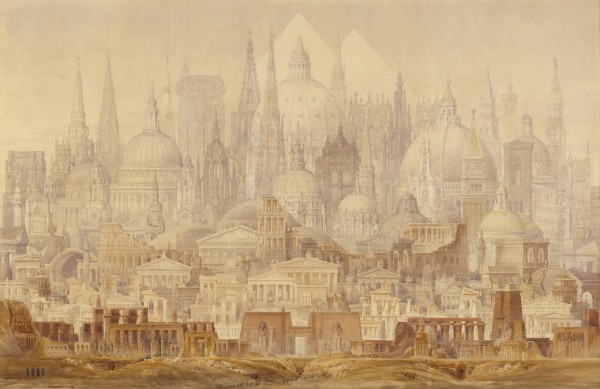
Yesterday in the architecture galleries of the V&A, I found myself looking at a painting by Charles Robert Cockerell called A Tribute to Christopher Wren, from 1838.
The image is a spatially overwhelming lamination of various buildings all designed by the legendary English architect; in a way, it’s an early predecessor of today’s total city renderings by firms like Foster & Partners and OMA: a complete metropolis designed in one fell swoop by a master architect.
What first came to mind, though, when seeing Cockerell’s image, was something that I’ve mentioned on the blog before – as recently as in the interview with Jim Rossignol – which is that the era of the architectural monograph is over: perhaps we will soon enter the age of the architectural videogame.
In other words, what if Charles Robert Cockerell had not been a painter at all, but a senior games designer at Electronic Arts? His “tribute to Christopher Wren” would thus have looked quite different.
The architect’s buildings would still be visually represented, all standing in the same place, but thanks to the effects of immersive digital media and not the intensely beautiful but nonetheless materially obsolete techniques of a different phase of art history.
Might we yet see, for instance, A Tribute to Sir John Soane, complete with scenes of zombie warfare beneath the arches of ruined bank halls, released by Joseph Gandy Designs Corporation™?
When it comes time to release a major monograph, MVRDV instead releases a videogame.
Bjarke Ingels has already released a comic book – the game, as another narrative medium, as simply another option for architectural publishing, can’t be far off.
Learning about the buildings of Erich Mendelsohn… by hurling virtual grenades at them.

[Image: The Professor’s Dream (1848) by Charles Robert Cockerell, courtesy of the Royal Academy of Arts].
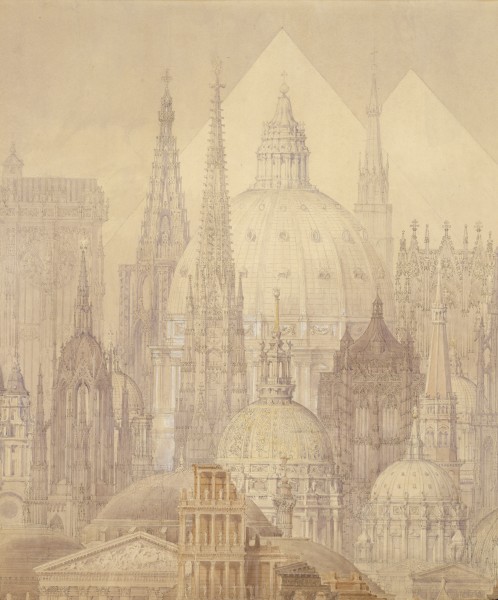
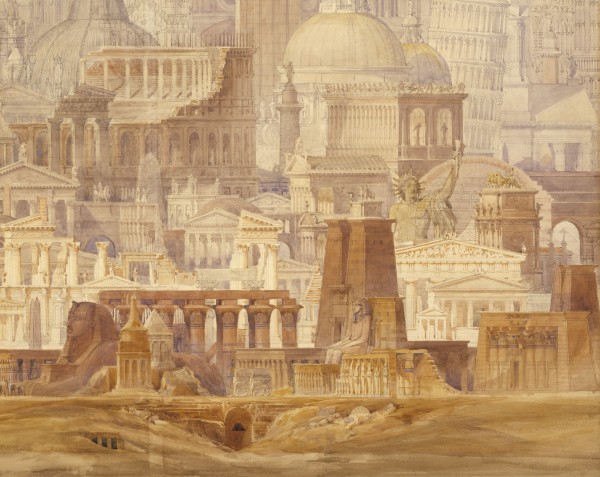
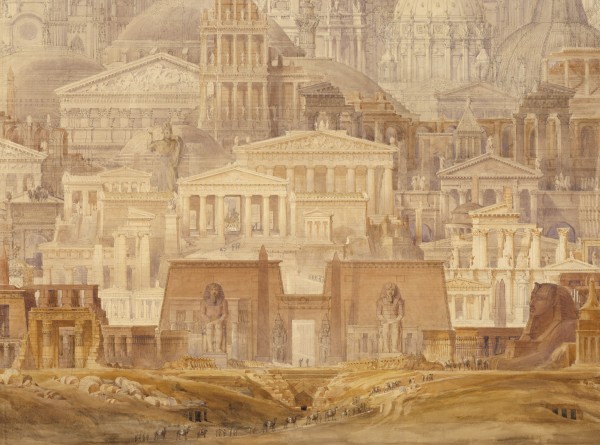
Until then, here are some more or less unrelated close-up views of another of Cockerell’s works, the otherworldly pyramids, domes, and steeples from The Professor’s Dream (1848), courtesy of the Royal Academy of Arts.

[Images: The Professor’s Dream (1848), and several details thereof, by Charles Robert Cockerell, courtesy of the Royal Academy of Arts; say what you like about pastiche, but a part of me wishes that all cities looked like this].
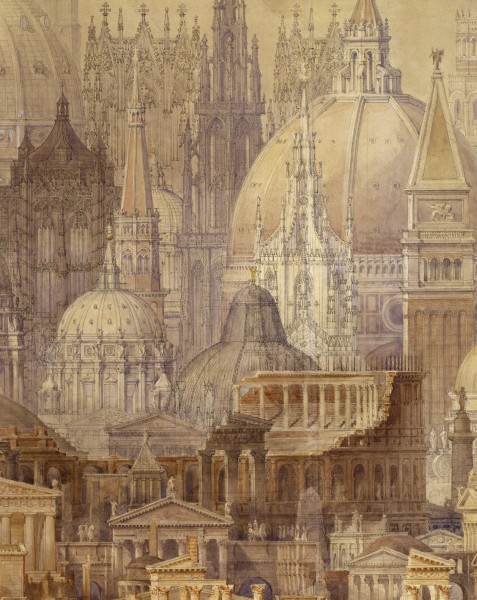
Gaming our way through the future of architectural history.

London Yields: Urban Agriculture

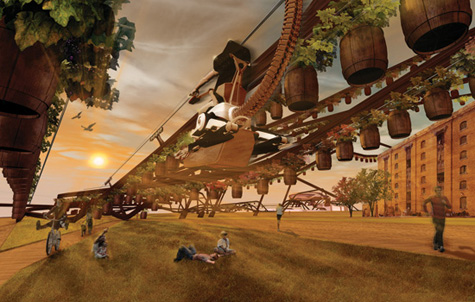
[Image: The King’s Vineyard, London, by Soonil Kim, one of many projects featured in London Yields: Urban Agriculture].

One of the many benefits of being in London this week is that I get to stop by the Building Centre, one of my favorite urban galleries and architectural exhibition spaces, to check out their new show London Yields: Urban Agriculture.
While imagining what it might be like to eat extremely local food, grown right there in your city – a line of 96th Street Honey, for instance, or, in light of Times Square’s recent (but unfortunately temporary) pedestrianization, perhaps a Times Square Tomato (why not agriculturalize parts of Times Square?) – we also need to ask how we might make such a vision come true.
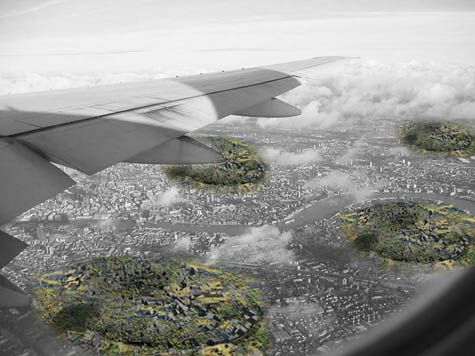
How can a city like London be at least partially turned over to food production – so that London Fields might produce southeast England’s newest yields of meat, fruit, and vegetables?
I have to admit that urban agri-utopianism is easily one of the most seductive visions of the 21st century city that I’ve yet seen – from farming new medicinal plants on the rooftops of schools to hybridizing sci-fi flowers on vast and heavily perfumed highway-farms stretching across one borough to another – and it’s hard not to get excited when thinking about such things.

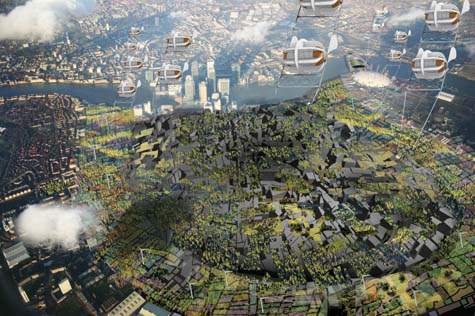
[Images: From Ian Douglas-Jones’s awesome Towards New Capital project, also featured in London Yields. Douglas-Jones asks us to project ahead to London in 2070 A.D.: “Food imports dried up 20 years ago when oil peaked at $1000 a barrel. Our new self-reliance has necessitated the development of dense enclaves of self-subsistence, and self sustenance; each enclave provides the optimum population density with the exact amount of energy and food,” he writes].

Even better, tomorrow morning the Building Centre will be hosting a related event called London Yields: Getting Urban Agriculture off the Ground. Featuring Mark Brearley (Design for London), Jamie Dean (East London Green Grid), architect Carolyn Steel (author of Hungry City: How Food Shapes Our Lives), architects Bohn & Andre Viljoen, Mikey Tomkins and Ruth Coulson (Croydon Council), and a representative from Sustain (“the alliance for better food and farming”), the whole thing will be hosted by none other than David Barrie.
Coincidentally, my wife and I picked up a copy of Steel’s book yesterday; it looks fantastic. From the food supply infrastructure of ancient Rome to today’s exurban British megamarkets, by way of a brief feminist history of cooking (the TV dinner as misguided step toward female liberation) and the carefully engineered landscapes of London waste processing (including a short tour through the city’s eastern marshes), it seems to have no shortage of general interest.
So the event tomorrow costs £35, unfortunately, but if you’re up for it, stop by; if not, consider checking out the exhibition before it comes down on May 30!

(Note: Check out the other work on Ian Douglas-Jones’s site, including his Aeronautica Sovereign State).

Sound-Sensitive Maze Labs of a Sewer-Spelunking Blog

While standing in the check-out line of a grocery store the other day, I remembered that the new issue of Wired might feature a review of The BLDGBLOG Book.

And, lo! In a moment of brief mania, I saw that The BLDGBLOG Book is right there on on p. 66.
As a very long-term reader of Wired – since at least 1995 – it’s hard to exaggerate how cool it was to see that, especially as it’s still hard to believe that the book has really been published and that it actually will be out on people’s shelves this summer.
So what does Wired think of The BLDGBLOG Book?

Geoff Manaugh’s long-form riff on his building blog skips through Soviet sleep labs, sound-sensitive rice genes, transborder mazes, and the life of a sewer-spelunker. His energy and imagination make him an excellent tour guide: Manaugh sees architecture – past, future, and fantasy – through an arts-and-culture lens. By pondering how humans shape the environment with, say, fiction or film, he turns his enthusiasm into our own.

So exciting to see that!
Meanwhile, if you’ll excuse this obvious commercial interlude, the book is beginning to get good reviews from sources as diverse as Sunset magazine and Joerg Colberg’s widely-read photography blog, Conscientious.
Allison Arieff, Editor-at-Large of Sunset and author of the New York Times blog By Design, writes:

Trapped icebergs, Dollywood, fossil rivers, and the “undiscovered bedrooms of Manhattan.” These are just a few of the million preoccupations writer/blogger Geoff Manaugh explores in The BLDGBLOG Book, just published by Chronicle Books. Driven by unfettered curiosity, Manaugh delves into pet obsessions including but not limited to 19th century paintings of ruins, the architecture of video games, the Garden Museum of London, and storms on demand… Highly recommended reading.

The book itself starts shipping in North America on June 10, I believe, and a bit later – in early July – in the UK and Australia. Amazon has it for sale at a pretty steep discount right now, so definitely take advantage of the price and preorder a copy soon – that, or order the book directly through Chronicle.
Finally, I hope to have information about some public events that will take place around the book release coming up soon. And, of course, expect more info about the book itself.
So thanks again to everyone who’s seen and reviewed the book so far!

London Future Green

Note: This is a guest post by Nicola Twilley.

During a brief Tube journey earlier today, this image stood out against a backdrop of mobile phone advertisements, travel insurance offers, and posters for English-language schools.

[Image: “Above Ground” by Nils Norman, commissioned by Platform for Art for Transport for London; view it as a 2.6MB PDF].

Designed by artist and architect Nils Norman, this fantasy map traces the Piccadilly line’s route through an alternate London whose landmarks consist of utopian eco-fantasies (mushroom farms and geothermal energy platforms) alongside various post-war avant-garde architects’ unrealized projects for the city.

Mike Webb’s Sin Centre and Cedric Price’s Fun Palace sit next to the Westminster Bog and Wetland Chain, while Thomas Affleck Greeves’ Monument to Commemorate the Passing of the Good Old Days of Architecture nestles in the shadow of a dual purpose algae factory and housing tower not far from George Orwell’s Ministries of Love, Peace and Plenty. The result is an interesting juxtaposition of hypothetical projects designed as critique or provocation, and equally imaginary proposals rooted in a utopian impulse toward sustainability: Superstudio’s Continuous Monument is set alongside the North London Turbine Fields and the South Kensington Vegetable Oil Refinery.

It turns out that the map dates from summer 2007, and was part of a year-long celebration of the Piccadilly line’s centenary. Transport for London commissioned multiple public art projects to mark the occasion, under the curatorial title “Thin Cities”—a reference to Italo Calvino’s invisible city of Armilla, in which a “forest of pipes… rise[s] vertically where the houses should be and spread[s] out horizontally where the floors should be.” This striking description highlights the Tube’s structural centrality to London—even if Calvino’s “underground veins” carry water, not commuters or tourists.

Other projects from the series include the first ever whole-Tube wrap, as well as the calls of fifty-two different migratory species (one per week) broadcast every twenty minutes over the Knightsbridge station tannoy. Taken from the British Library’s sound archive, these included the clicks of a bottle-nosed dolphin and the honks of a Whooper swan—and they were each introduced by the official voice of the Tube, Emma Clarke.

All the Thin Cities projects are now archived online; they’re presented alongside photos and anecdotes from each station on the Piccadilly line, such as the best place to watch planes take off and land at Heathrow (hint: it’s a small footbridge outside Hatton Cross) and the fate of Alfie the cat (he was adopted by a Station Supervisor after 10 years’ independent living at Cockfosters).

[Check out Archinect‘s interview with Nils Norman for more. Also vaguely related: Just Add Water. Previous posts by Nicola Twilley include Atmospheric Intoxication, Park Stories, and Zones of Exclusion].