Perpetual Architecture

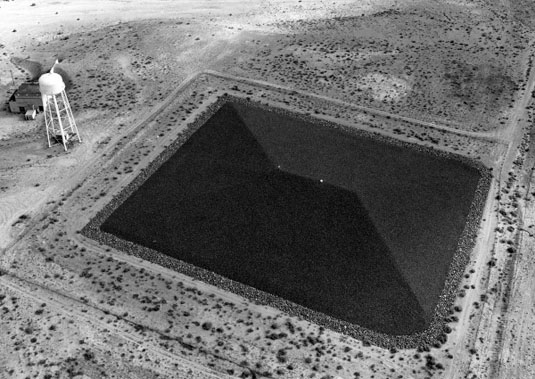
[Image: A “disposal cell,” also visible on Google Maps, courtesy of CLUI].

It’s always welcome news around here when a new exhibition opens up at the Center for Land Use Interpretation—even though, in this case, it displaces the excellent historical look at U.S. federal surveying with the Initial Points: Anchors of America’s Grid show.

On display now is Perpetual Architecture, which explores “uranium disposal cells in the southwest,” constructed “primarily to contain radioactive contamination from decommissioned uranium mills and processing sites. They are time capsules, of sorts, designed to take their toxic contents, undisturbed, as far into the future as possible.” More info, including visiting hours and location, is available at the CLUI website.

Meanwhile, those of you interested in this sort of thing might enjoy BLDGBLOG’s earlier interview with Abraham van Luik, a geoscientist with the U.S. Department of Energy who described in great detail the process by which sites are chosen for the task of isolating nuclear waste over geological timescales.

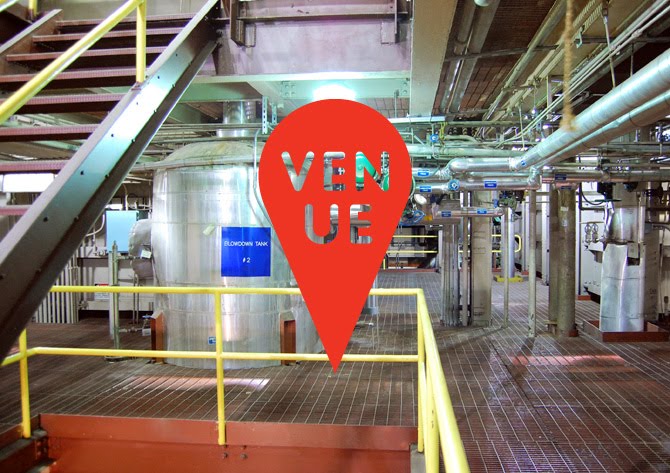
Venue


I’m excited to be launching a new project called Venue, a 16-month collaboration with the Nevada Museum of Art‘s Center for Art + Environment and Future Plural, the small publishing and curatorial group I’m a part of with Nicola Twilley.

We kick things off this Friday, June 8, with a launch event at the Nevada Museum of Art in downtown Reno, from 6-8pm; if you’re near Reno, consider stopping by!

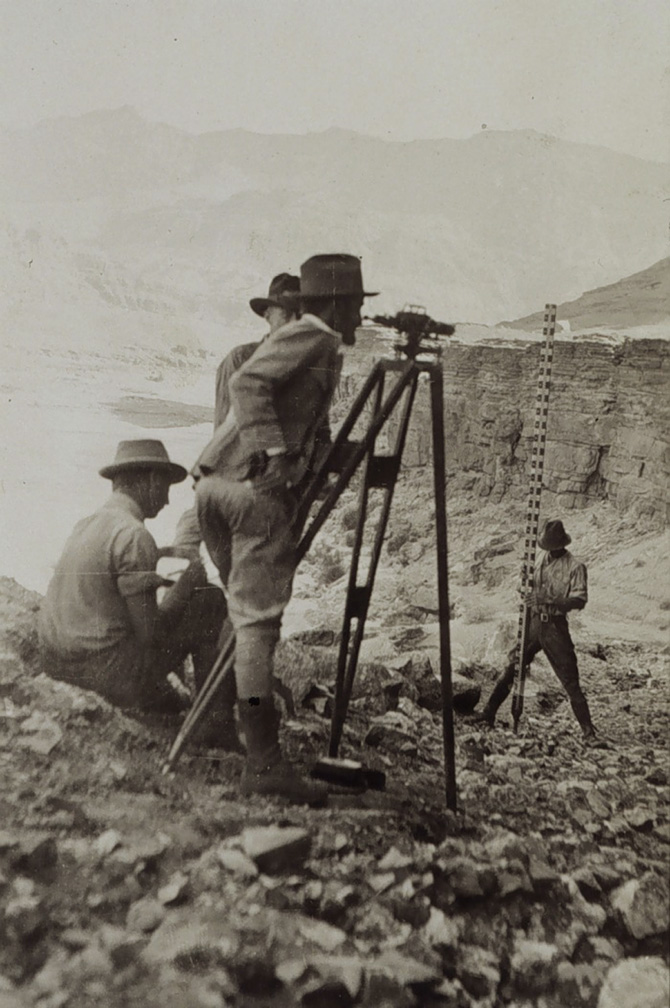
[Image: The tools and props of surveying; courtesy of the USGS].

In brief, Venue is equal parts surveying expedition and forward-operating landscape research base, a DIY interview booth and media rig that will pop up at sites across North America through September 2013.

Nicola Twilley and I will be traveling on and off, in a series of discontinuous trips, over the next 16 months, visiting a variety of sites including infrastructural landmarks, science labs, factories, film sets, archaeological excavations, art installations, university departments, design firms, National Parks, urban farms, corporate offices, studios, town halls, and other locations across North America, where we’ll both record and broadcast original interviews, tours, and site visits. From architects to scientists and novelists to mayors, from police officers to civil engineers and athletes to artists, Venue’s interview archive will form a cumulative, participatory, and media-rich core sample of the greater North American landscape.

[Image: Understanding landscapes by way of strange devices; courtesy of the USGS].

While there will no doubt be regular updates here on BLDGBLOG, you can follow along, both online and off, by reading our latest dispatches, suggesting sites and people we should visit, and keeping an eye on our schedule (or signing up for our mailing list) to find out when we will be bringing Venue to a neighborhood near you. In addition, our best content will be syndicated on a dedicated channel online by The Atlantic, so keep your eye out for our first interviews or site visits—photos, short films, MP3s—as our travels get underway.

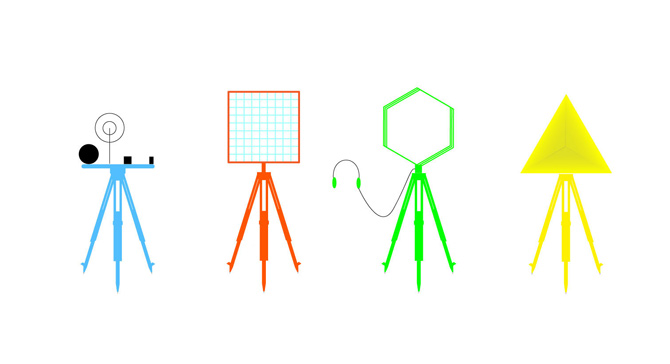
[Image: The Venue tripods, universal mounts for interchangeable devices; designed by Chris Woebken].

There’s a lot more information available about the project at the Venue website—including some early images depicting the incredible array of devices designed for us by Chris Woebken, a gorgeous hand-made interview box custom-fabricated for Venue by Semigood, and the “Descriptive Camera” that we’ll have on the first leg of our trip—so by all means stop by and see the ideas behind the project, from conceptual inspiration taken from historical survey expeditions to Ant Farm’s Media Van.

[Image: The Venue box takes shape, custom-designed by Semigood].

And hopefully somewhere down the line, we can meet many of you in person.

Buncefield Bomb Garden

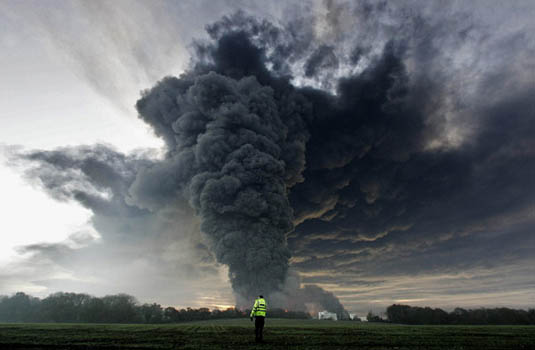
[Image: The Buncefield explosion, via the BBC].

In one of the more interesting landscape design stories I’ve read this year, New Scientist reported back in March that the massive, December 2005 explosion at a fuel-storage depot called Buncefield in England, might have been strongly assisted by the site’s landscaping.

“A few years ago no one would have predicted that a row of trees and shrubs could make the difference between a serious fire and a catastrophic explosion,” the magazine suggests. But now, it’s becoming a reasonably accepted notion that the physical layout of the Buncefield site’s plantlife—from the “shrubs and small trees” down to their individual “twigs and branches”—can work to contain and concentrate, and, worse, add explosive surface area to what would otherwise have simply been a gas leak.

Indeed, the ongoing investigation at Buncefield “might change the way storage depots, refineries and pipelines are designed, and how the sites are landscaped [emphasis added]. Along with conventional safety features like sensors and alarms, site operators may have to rethink the way that trees, hedges and shrubs are positioned.” Investigators have concluded that “even structures on nearby commercial developments could help to accelerate a flame,” meaning that, in the design of any landscape, from industrial parks to corporate lawns, there is a previously unknown capacity for detonation.

What’s incredible about this—if proven true—is that the potentially explosive landscaping of sites such as Buncefield might suggest, according to New Scientist, new geometries or diagrammatic possibilities for the design of jet engines, in particular “a novel aircraft propulsion system called a pulse detonation engine.” The garden as jet engine!

Putting this into the context of other landscape typologies, such as ritual gardens or sacred groves—as if we might someday have orchards that churn and pulse with controlled coils of fire, like the engine of some vast arboreal machine—makes this terrifying topographical phenomenon seem all the more mythic and extraordinary.

(Previously on BLDGBLOG: Star Garden).

Buy an Underground Kingdom

[Image: The Mole Man’s house in Hackney, via Wikipedia].

As most anyone who’s seen me give a talk over the past few years will know, I have a tendency to over-enthuse about the DIY subterranean excavations of William Lyttle, aka the Mole Man of Hackney.

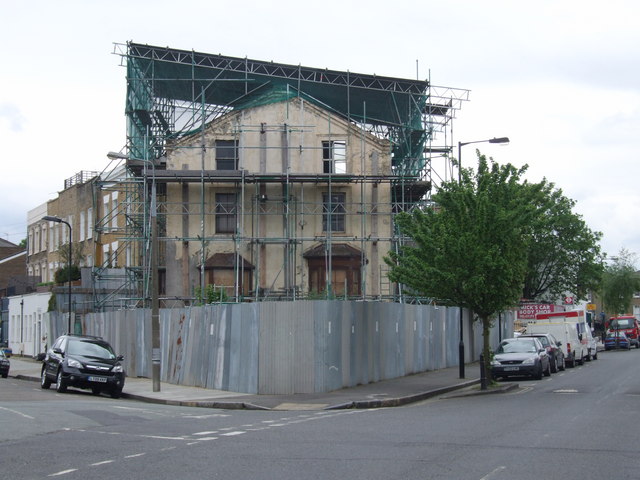
Lyttle—who once quipped that “tunneling is something that should be talked about without panicking”—became internationally known for the expansive network of tunnels he dug under his East London house. The tunnels eventually became so numerous that the sidewalk in front of his house collapsed, neighbors began to joke that Lyttle might soon “come tunnelling up through the kitchen floor,” and, as a surveyor ominously relayed to an English court, “there is movement in the ground.”

From the Guardian, originally reported back in 2006:

No one knows how far the the network of burrows underneath 75-year-old William Lyttle’s house stretch. But according to the council, which used ultrasound scanners to ascertain the extent of the problem, almost half a century of nibbling dirt with a shovel and homemade pulley has hollowed out a web of tunnels and caverns, some 8m (26ft) deep, spreading up to 20m in every direction from his house.

What did he store down there? After Lyttle was forced from the house for safety reasons, inspectors discovered “skiploads of junk including the wrecks of four Renault 4 cars, a boat, scrap metal, old baths, fridges and dozens of TV sets stashed in the tunnels.”

But now the late Mole Man’s home is for sale.
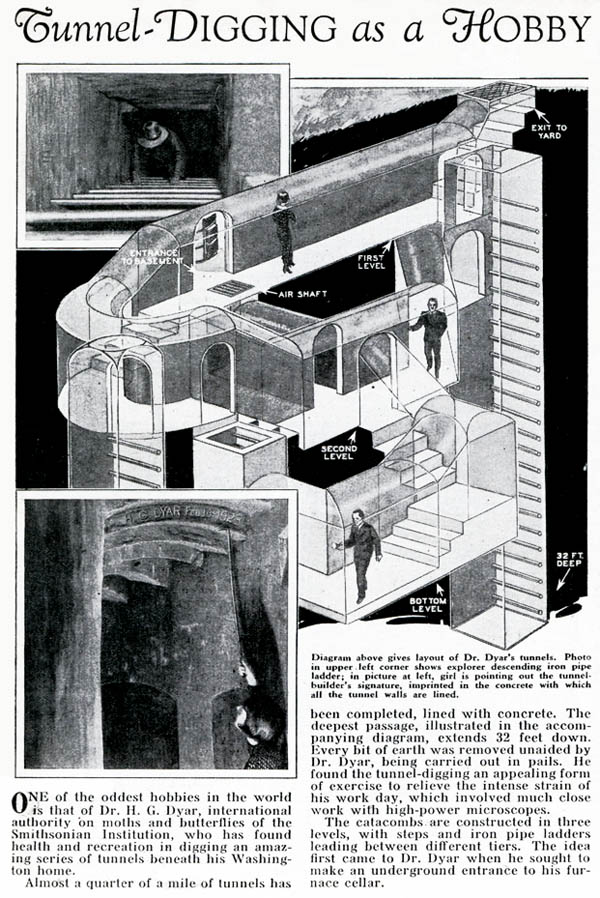
[Image: An earlier Mole Man: Tunnel-Digging as a Hobby].

Alas, “most of the tunnels have been filled in” with concrete, and the house itself is all but certain to be torn down by its future owner, but I like to think that maybe, just maybe, some strange museum of subterranea could open up there, in some parallel world, complete with guided tours of the excavations below and how-to evening classes exploring the future of amateur home excavation. Curatorial residencies are offered every summer, and underground tent cities pop-up beneath the surface of the capital city, lit by candles or klieg lights, spreading out a bit more each season.

Briefly, I’m reminded of a scene from Georges Perec’s novel Life: A User’s Manual, in which a character named Emilio Grifalconi discovers “the remains of a table” that he hopes to salvage for use in his own home. “Its oval top, wonderfully inlaid with mother-of-pearl, was exceptionally well preserved,” Perec explains, “but its base, a massive, spindle-shaped column of grained wood, turned out to be completely worm-eaten. The worms had done their work in covert, subterranean fashion, creating innumerable ducts and microscopic channels now filled with pulverized wood. No sign of this insidious labor showed on the surface.”

Grifalconi soon realizes that “the only way of preserving the original base—hollowed out as it was, it could no longer suport the weight of the top—was to reinforce it from within; so once he had completely emptied the canals of the their wood dust by suction, he set about injecting them with an almost liquid mixture of lead, alum and asbestos fiber. The operation was successful; but it quickly became apparent that, even thus strengthened, the base was too weak”—and the table would thus have to be discarded.

At which point, Grifalconi has an idea: he begins “dissolving what was left of the original wood” in the table’s base in order to “disclose the fabulous arborescence within, this exact record of the worms’ life inside the wooden mass: a static, mineral accumulation of all the movements that had constituted their blind existence, their undeviating single-mindedness, their obsinate itineraries; the faithful materialization of all they had eaten and digested as they forced from their dense surroundings the invisible elements needed for their survival, the explicit, visible, immeasurably disturbing image of the endless progressions that had reduced the hardest of woods to an impalpable network of crumbling galleries.”

Somewhere beneath a new building in East London, then, some handful of years from now, the Mole Man’s “fabulous arborescence” will still be down there, a vast and twisting concrete object preserved in all its tentacular sprawl, like some unacknowledged tribute to Rachel Whiteread: a buried and elephantine sculpture that shows up on radar scans of the neighborhood, recording for all posterity “the endless progressions” of Lyttle’s eccentric and mysterious life.

(Via @SubBrit. Earlier adventures in real estate on BLDGBLOG: Buy a Prison, Buy a Tube Station, Buy an Archipelago, Buy a Map, Buy a Torpedo-Testing Facility, Buy a Silk Mill, Buy a Fort, Buy a Church,).

O.P. Tree

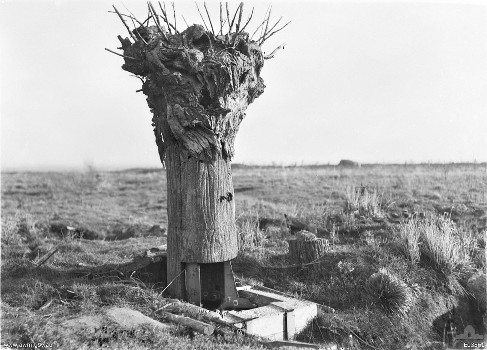
[Image: An exemplary “Observation Post Tree” via the Australian War Memorial].

The “O.P. Tree” was an Observation Post Tree deployed during World War I. Its “goal,” as author Hanna Rose Shell explains in Hide and Seek, her newly published history of the relationship between camouflage and photography, “was to craft a mimetic representation of a tree—and not just any tree, but a particular tree at a specific site” on the European battlefield.

The design, fabrication, and, perhaps most interestingly, installation of this artificial plant form had a fascinating and somewhat Truman Show-esque quality:

To develop the O.P. Tree, Royal Engineers representatives selected, measured, and photographed the original tree, in situ, extensively. The ideal tree was dead; often it was bomb blasted. The photographs and sketches were brought back to the workshop, where artists constructed an artificial tree of hollow steel cylinders, but containing an internal scaffolding for reinforcement, to allow a sniper or observer to ascend within the structure. Then, under the cover of night, the team cut down the authentic tree and dug a hole in the place of its roots, in which they placed the O.P. Tree. When the sun rose over the field, what looked like a tree was a tree no longer; rather, it was an exquisitely crafted hunting blind, maximizing personal concealment and observational capacity simultaneously.

You can see photographs, read about the construction of replicant bark, and even learn that some of the trees were internally upholstered—like wartime superfurniture—as snipers sometimes relied on cushions to assist with long periods of sitting, over at the Australian War Memorial.

[Image: O.P. Trees].

But there’s something almost comedically paranoid about the idea that, upon waking up tomorrow morning, a tree—or rock or, for that matter, a whole hillside—has been surreptitiously replaced by an artificial surrogate, an exactly designed stand-in or double, in a ruse about which you otherwise remain unaware. It happens again—and again, perhaps for an entire season—before one day you finally stumble upon incontrovertible evidence that the entire forest through which you hike every weekend has been filled with incredibly precise, hollow representations of trees through which someone appears to be spying on you.

(For those of you interested in where the state of fake trees and other artificial landforms is today, consider watching this video of George Dante, founder of Wildlife Preservations, present his firm’s work at Studio-X NYC).

Buy a Prison

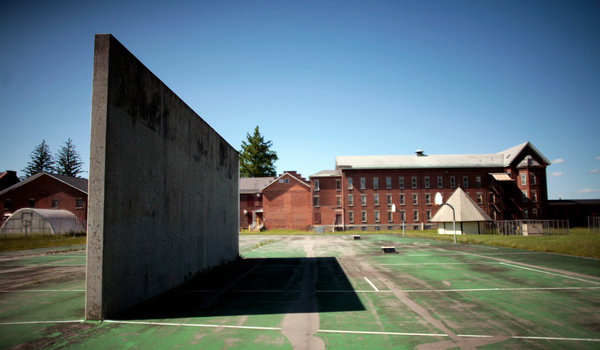
[Image: Prisons for sale; photo by Nathaniel Brooks for The New York Times].

The State of New York is hoping to sell its old prisons.

“One property, in the Hudson Valley, includes a 16-car garage, a piggery and hundreds of yards of lake frontage,” the New York Times explains. “Another offers 69 acres of waterfront land on the west shore of Staten Island, complete with a two-story gymnasium, a baseball diamond and an open-air pavilion.” Some of the sites actually sound amazing:

Among the facilities the team is considering selling are 23 state-owned residences set aside for prison superintendents. Some are quite lavish: one in Auburn, to be auctioned this summer, is an 8,850-square-foot brick mansion with eight bedrooms, six bathrooms, an attached gazebo and a barn-size garage.

The article somewhat ironically suggests that “the ideal buyer” of one the prisons would be “someone who craves space to spread out.”

Despite the piece’s pessimistic tone—”You couldn’t make it into a hotel. You couldn’t make it into an apartment complex. You’re talking millions of dollars to renovate. Who’s going to do it?”—I can’t help but wonder if someone couldn’t buy one of these places anyway, admit that most of the complex will simply be left to ruin, consumed by weeds and filled with pigeons, but then transform some core part of it into a kind of architectural research center, its very setting the most intense spatial lesson of your time spent writing and studying there.

(Earlier on BLDGBLOG: Buy a Tube Station, Buy an Archipelago, Buy a Map, Buy a Torpedo-Testing Facility, Buy a Fort, Buy a Church, Buy a Silk Mill).

Hotels in Zero-G

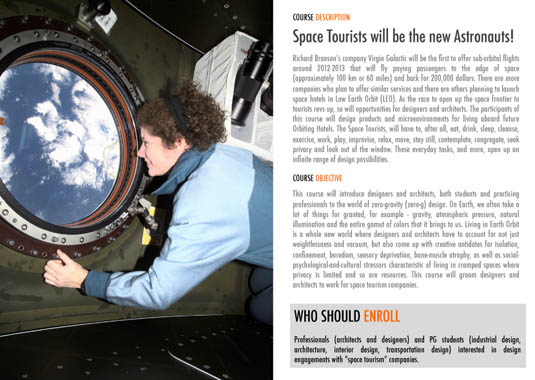
[Image: “Zero-Gravity Design” at the Domus Academy in Milan].

Given all the justifiable excitement in the past few days about the successful launch of SpaceX, Milan’s Domus Academy is hosting a rather well-timed two-week design intensive this summer called “Zero-Gravity Design: Products & Microenvironments for Orbiting Hotels.”

It runs from July 2-13, 2012, and will be taught by “aerospace entrepreneur” Susmita Mohanty.

From the studio brief:

As the race to open up the space frontier to tourists revs up, so will opportunities for designers and architects. The participants of this course will design products and microenvironments for living aboard future Orbiting Hotels. The Space Tourists, will have to, after all, eat, drink, sleep, cleanse, exercise, work, play, improvise, relax, move, stay still, contemplate, congregate, seek privacy and look out of the window. These everyday tasks, and more, open up an infinite range of design possibilities.

Participants will be challenged to “come up with creative antidotes for isolation, confinement, boredom, sensory deprivation, bone-muscle atrophy, as well as social-psychological-and-cultural stressors characteristic of living in cramped spaces where privacy is limited and so are resources.”

Perhaps, best of all, “this course will groom designers and architects to work for space tourism companies.”

[Image: “Zero-Gravity Design” at the Domus Academy in Milan].

More information is available at the Domus Academy website.

(Thanks to Rajeev Thakker for the tip!)

There’s No One There / Man-Made Lands

[Image: Art by Joe Alterio].

New Yorkers, stop by Studio-X NYC tonight, Wednesday, May 23rd, at 7pm for free drinks and the launch of Man-Made Lands, “a collection of seven stories and five real architectural and landscape proposals for cities around the world,” the first chapbook from Ninth Letter.

The chapbook, guest-edited by Scott Geiger and including work by Bjarke Ingels Group, James Corner Field Operations, Steven Holl, Will Wiles, and many others, explores, in Geiger’s words, “marbled boundaries: between cities and nature; between the infinity of the digital and the analog of every day life; between the past and our present, our present and many possible futures; between fictions we envision and the facts that we construct to transform lives.”

Geiger will also be interviewing contributors Seth Fried, Dong-Ping Wong, Archie Lee Coates, and Joe Alterio in a live conversation about the book, about the influence of fiction on architectural design (and vice versa), and on some speculative future possibilities for urban design here in New York.

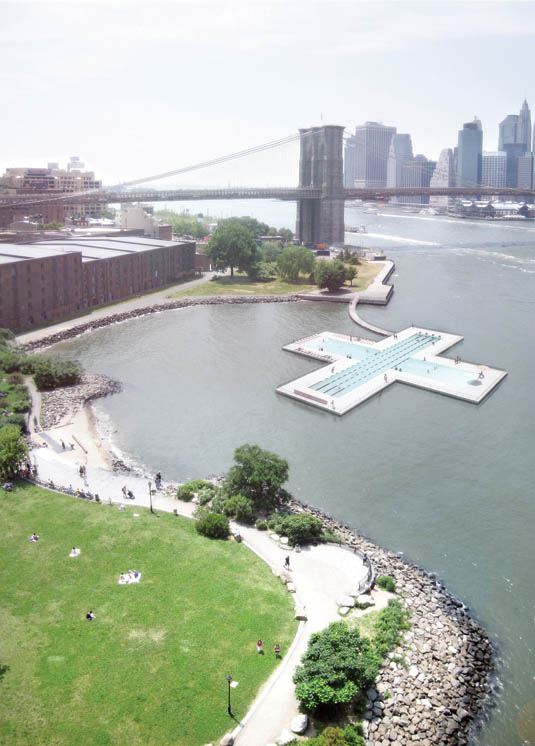
[Image: The +Pool, featured in Man-Made Lands].

Even better, we’ll also be kicking off a small exhibition of new work by Joe Alterio, who some of you might recognize from, among other things, his work in The BLDGBLOG Book, where he and I collaborated on two graphic storyboards featured in the book’s inside covers. Tonight, Joe will be premiering several gorgeously screen-printed new posters, called “There’s No One There,” originally commissioned for Ninth Letter, as they go on display at Studio-X NYC.

Meet Joe, say hey to Scott, pick up a copy of Man-Made Lands, and enjoy our Manhattan views from the 16th floor at 180 Varick Street, Suite 1610; here’s a map. Hope to see you at 7pm!

Mobile Surroundsound

Two design competitions that might catch your eyes and ears:

1) Legendary L.A. radio station KCRW is looking for a mobile sound booth: a “space where conversation can happen amidst the urban chaos. A comfortable space that isolates sound for good recording, but also gives the listener a sense of place.”

KCRW is hoping to go on the road, “taking this booth all over the city—to churches, food fairs and schools. To rock, jazz and cumbia concerts. We will be at the park, at the coffee shop and hanging at the tamale hot spots. We’ll be setting up and closing shop alongside food trucks and observing public transportation from bus stops and corner shops.”

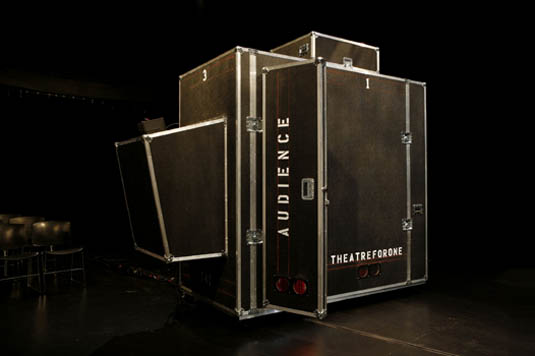
[Image: Theatre for One].

Remember LOT-EK’s Theatre for One? Do something even better, and watch—or listen to—your interview booth as it moves around Los Angeles. More specific info is available at KCRW.

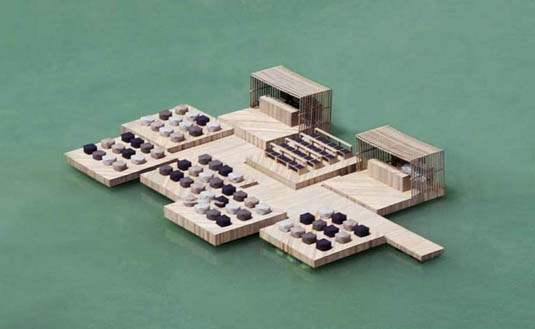
2) Alternatively, design a floating cinema.

[Image: Ole Scheeren’s “archipelago cinema” in Thailand].

Britain’s Architecture Foundation, in collaboration with UP Projects, have announced a fairly straight-forward brief: for those of you who never thought you’d never be on a boat, “this vessel will need to accommodate intimate on-board film screenings, larger outdoor film events as well as provide a base for film related talks and activities. The Floating Cinema will navigate the waterways that connect the boroughs of Tower Hamlets, Newham, Waltham Forest and Hackney with the new Olympic Park, hosting events, activities and also tours into the Olympic Park.”

A bit more information is available via the Architecture Foundation.

Vitamin C and Aloe

Hidden in an article about New York City’s first million-dollar parking space is the somewhat incredible fact that, up in the apartment building this parking space will be attached to, “the shower water will be pumped full of vitamin C and aloe” for the building’s economically distinguished residents.

Like the home vodka tap we joked about years ago, this enhanced water supply seems to be further evidence that literally every aspect of the human environment can not only be redesigned, it can be aggressively capitalized upon in its ensuing augmented state.

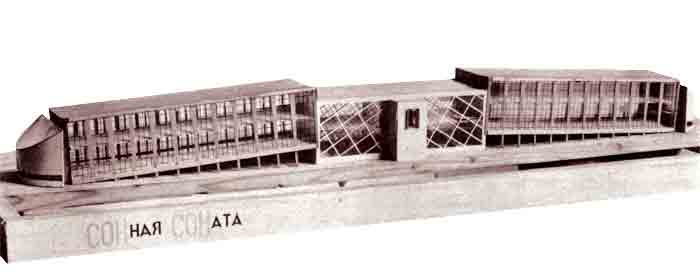
The article also mentions, for instance, that even the building’s “lighting patterns and air quality” have been re-designed so as to maximize the quality of residents’ sleep, bringing to mind Stalin’s “sleep labs,” in which aromatherapy and ambient music would have been used to lull stalwart workers of the CCCP back into bed each evening:

At either end of the long buildings were to be situated control booths, where technicians would command instruments to regulate the temperature, humidity, and air pressure, as well as to waft salubrious scents and “rarefied condensed air” through the halls. Nor would sound be left unorganized. Specialists working “according to scientific facts” would transmit from the control center a range of sounds gauged to intensify the process of slumber. The rustle of leaves, the cooing of nightingales, or the soft murmur of waves would instantly relax the most overwrought veteran of the metropolis. Should these fail, the mechanized beds would then begin gently to rock until consciousness was lost.

It doesn’t seem far-fetched that New York City buildings will add, to their already existing stock of doormen and cleaning crews, lifestyle technicians working behind the scenes like conductors of a sensory orchestra, recalibrating sounds, scents, and lighting intensity, even dialing up barometric pressure at certain key times of day, for the strangely mummified people living inside.

[Image: Konstantin Melnikov’s “Sonata of Sleep“].

Specialty mixtures of air—perhaps even air subscriptions—could be piped in through luxury ducts as atmospheric brewmasters toggle dials in the basement, frantically trying to zero-in on domestic perfection for expectant customers breathing calmly above.

Under Angeles

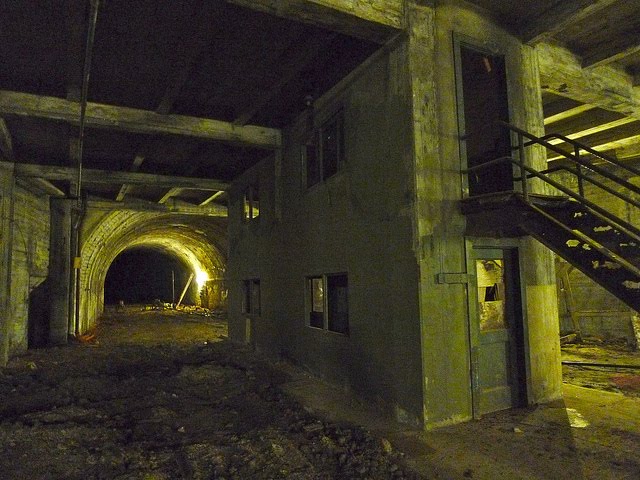
Design writer Alissa Walker recently took a tour of L.A.’s original subway system, one whose tunnels are no longer in operation, though they remain down there—

[Image: L.A.’s original subway, now walled-off beneath downtown; photo by Alissa Walker].
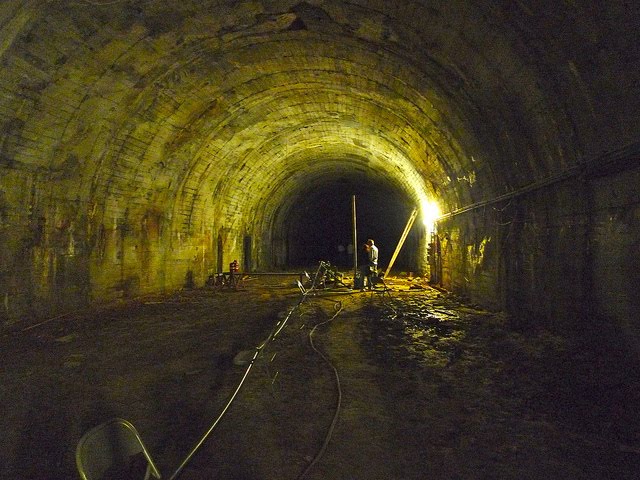
—bricked off and all but forgotten beneath buildings downtown.

[Image:Photo by Alissa Walker].

Cue horror movie soundtrack here, with hapless apartment dwellers in a newly renovated downtown loft complex finding strange things coming up from the facility’s voluminous basement floors; the power flickers on and off; pets disappear; strange sounds skitter and thump down the corridors at night, leaving muddy trails; then somehow, someone, as in the following photograph—

[Image: A walled-up sign announces, “TRAINS”; photo by Alissa Walker].
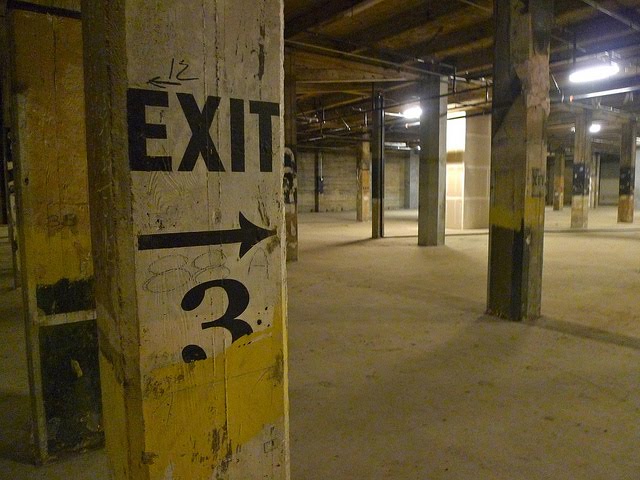
—knocks a hole in the wall, perhaps accidentally losing their grip on a piece of furniture as they move their new table or couch into the building, revealing the eery, abandoned subway tunnels below. And, soon, they go down to find the answers to what’s gone wrong in their otherwise perfectly photogenic multimillion dollar building, only to open the door to something altogether much worse.

[Image: Photo by Alissa Walker].

In any case, absent of these clichéd public-transit-is-a-source-of-horror motifs, Alissa’s write-up of the tunnel visit is worth reading in full—and, even better, they will be leading another such visit again some time soon. You’ll see sights like this.

Sign-up on the Design East of La Brea website for this and other such events, and don’t miss any future announcements.