Seer

A few weeks ago, The Economist looked at the growing problem of “ubiquitous technical surveillance” in the field of espionage. It describes the difficulty of maintaining a rigorous or believable cover story, for example, when genealogy websites might be consulted by adversarial border agents to verify that a potential spy is who she says she is, where internet cookies and undeleted search histories might reveal a hidden identity, or, of course, when fitness trackers, smartphones, and other networked devices specifically exist for the purpose of recording our current locations and recent activities. We now pay to be tracked, then seek self-awareness in the data.

I’ll admit, however, that I was expecting the Economist article to go into a bit more detail about the ubiquitous tech part of its headline. That is, we are living through the rise of an immersive, real-time, omnipresent environment of always-on sensors that are now coextensive both with urban space and with modern transportation infrastructure, from airports to ride-sharing apps. The article does refer to techniques such as “retroactive surveillance,” whereby an intelligence agency, investigative team, or police authority can spool backward in time, so to speak, following every move you made prior to arriving at a particular moment or destination; but, again, I think there’s more to be said about the fact that the built environment itself is, for all intents and purposes, becoming a gigantic archive, at all scales, forensically recording every event that occurs within it, with few or no options for opting out.

The recent story of the Coldplay concert kiss-cam is only one superficial example of how commercial experiences are now all but premised on the possibility of being archived, from the cameras in strangers’ pockets to all-seeing eyes like the one that caught a cheating couple mid-embrace. Indeed, being caught on camera is often presented now as one of the main highlights of attending a concert or sports event in the first place: looking up through a haze of light and anonymity to see your own face on a gigantic screen, then raising your arms and cheering, because the lottery of public surveillance has found you, momentarily pulling you out of the crowd and giving your life a taste of communal validation. For three seconds, you are the star. This is ubiquitous technical surveillance as both promise and thrill.

Again, though, cameras and such like are only the most superficial recording technologies at work. Recall that underground fiber-optic cable networks can also be tapped as seismic sensors, recording vehicle traffic and pedestrian footfall (and, in some cases, private conversations) or that smartphone accelerometers, networked microphones, and even self-driving vehicles are now recording not just our facial expressions but our vibrations and bodily movements.

To this can be added much longer-term recording processes, something I’m exploring in a new book project, whereby our everyday activities also often, if unintentionally, leave behind archaeologically legible electromagnetic traces. The ubiquitous technical surveillance The Economist discusses becomes intergenerational. A single campfire in a field somewhere can leave a magnetic trace in the soil that lasts centuries, even millennia.

It is often presented as a reason for nihilism or melancholy, that our lives are ultimately fleeting, insubstantial, and almost certainly destined for oblivion, leaving behind nothing to remember or memorialize us; but I think there’s a much stranger fate taking shape at the moment, which is that, no matter what we do, it is as if we cannot disappear. We can always be found. We, in a sense, cannot be left behind; we will always be remembered and carried along with everyone else—a statement that perhaps once inspired reassurance and comfort, even cultural cohesion, but increasingly feels like an authoritarian threat.

Fractalize Me

The genes that cause Romanesco, a kind of cauliflower, to grow in a fractal pattern have been identified. Researchers were subsequently able to manipulate one of those genes and get it to function inside another plant—thale cress—producing fractal blooms.

The language used to describe this is interesting in its own right—a vocabulary of memory, transience, perturbation, and abandoned flowering.

In the words of the researchers’ abstract, “we found that curd self-similarity arises because the meristems fail to form flowers but keep the ‘memory’ of their transient passage in a floral state. Additional mutations affecting meristem growth can induce the production of conical structures reminiscent of the conspicuous fractal Romanesco shape. This study reveals how fractal-like forms may emerge from the combination of key, defined perturbations of floral developmental programs and growth dynamics.”

It’s the fact that this gene appears to function in other plants, though, that is blowing my mind. Give this technique another ten or twenty years, and the resulting experiments—and the subsequent landscapes—seem endless, from gardens of infinitely self-similar roses and orchids to forests populated by bubbling forms of fractal pines, roiling oaks, and ivies.

Until, of course, the gene inevitably escapes, going mobile, infecting insects and animals, producing confused anatomies in fractal landscapes, like minor creatures in a Jeff VanderMeer novel, before breaching the human genome, and oracular multicephalous children are born, their bodies transitioning through monstrosities of self-reminiscence and new limbs, mythological, infinitely incomplete, cursed with endless becoming.

In any case, read more over at ScienceNews, and check out the actual paper at Science.

Sounds in Transit

I’ve been delinquent in mentioning Jace Clayton’s new book, Uproot: Travels in 21st-Century Music and Digital Culture. Longtime readers of this blog might recognize Clayton—aka DJ /rupture—from an interview published many years back in The BLDGBLOG Book, on the topic of music, sound, and cities.

Uproot is Clayton’s guide to various sonic undertows shaping contemporary music around the world, from Autotuned vocals spilling out of North African villages to raves in ruined buildings on the divided island of Cyprus, or from Jimi Hendrix’s literally sinister left-handed amplification of the “Star-Spangled Banner” to five thousand years of continuous habitation—and urban music—in Beirut.

Clayton has long defined himself as a kind of human forward-operating base, picking up the signals of incoming future music, writing dispatches for Fader, giving interviews to The Wire, and chronicling much of this on his own blog, Mudd Up!

The book itself proceeds through a series of longer chapters punctuated by aphoristic statements (“Dancing is a form of listening”; “Music that doesn’t change is free to do other things”; “To be local is to have few options”; “What we care for we repeat”). These summations both highlight and launch each chapter’s short, linked essays that back up Clayton’s claims.

Its very first sentence simultaneously warns against and advocates digital amnesia: “The early twenty-first century will be remembered as a time of great forgetting,” he writes. He is referring to the complex effects of an ongoing format change, as musical culture transfers “from analog to digital.” Later in the book, Clayton develops this into what he calls the “distributional aesthetics” of 21st-century music, with both approval and slight political hesitation. He has in mind not just DIY punk CDs sold for cash after road shows but Lebanese cab drivers streaming new, anonymous tracks to jet-lagged passengers over Bluetooth.

How the sounds are delivered—through whom they are distributed and how they are saved—becomes as much a part of their effect as their rhythm or their BPM.

Uproot is at its best and most resonant when Clayton is out in the field, tracking down the physical origin of today’s music, whether that means visiting a town in Monterey, Mexico, to interview a 17-year-old bedroom producer of tribal ranch techno or browsing the stalls of Moroccan public markets.

In the latter case, Clayton gives an unexpected material signature to otherwise ephemeral MP3 culture. “The inorganic tang of injection-molded plastics off-gassing complex, probably carcinogenic polymer molecules mingles with sweat and diesel exhaust,” he writes. “Find the sellers of cheap plastic and you’ll have found the sellers of music, because for most of the world music is only worth as much as the plastic it comes delivered on.”

[Images: Jace Clayton at work; photos by Erez Avissar, via NPR].

Questions of preservation, economic control, and cultural power interlace throughout the book, but Clayton manages to ground these in examples of samples—Sting profiting from P. Diddy, say—and software, such as the now-ubiquitous Autotune mentioned earlier, originally developed as a seismic tool for oil exploration.

Clayton remains both attention-addled and unusually focused, zooming in to track, with forensic detail, the unlikely paths a specific remix followed from a Berlin apartment to becoming an online dancing meme, before he abruptly changes station and moves on to new ground. Later, for example, Clayton shifts from the impossible task of preserving an ever-growing ocean of MP3s washing around online to thoughts about why sending golden phonographs to space with the Voyager mission—intergalactic file-sharing—wasn’t such a bad idea after all.

In any case, what’s particularly great about the book is that it wasn’t simply written from the comfort of Clayton’s home, an introvert’s report from too many hours spent downloading vast catalogs of exotic sounds; instead, Uproot is a road book, part field guide, part treasure map, a demonstration project to show that all music is made somewhere and that Clayton is unusually good at locating it.

Village Design as Magnetic Storage Media

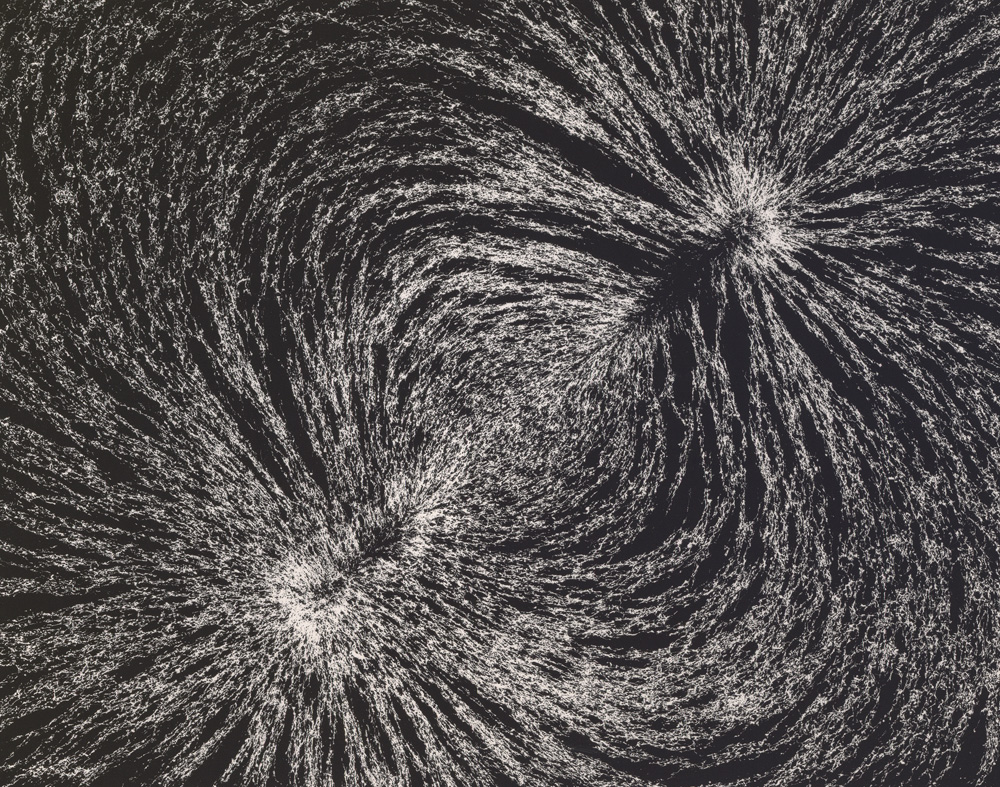
[Image: “Magnetic Field” by Berenice Abbott, from The Science Pictures (1958-1961)].

An interesting new paper suggests that the ritual practice of burning parts of villages to the ground in southern Africa had an unanticipated side-effect: resetting the ground’s magnetic data storage potential.

As a University of Rochester press release explains, the “villages were cleansed by burning down huts and grain bins. The burning clay floors reached a temperature in excess of 1000ºC, hot enough to erase the magnetic information stored in the magnetite and create a new record of the magnetic field strength and direction at the time of the burning.”

What this meant was that scientists could then study how the Earth’s magnetic field had changed over centuries by comparing more recent, post-fire alignments of magnetite in the ground beneath these charred building sites with older, pre-fire clay surrounding the villages.

The ground, then, is actually an archive of the Earth’s magnetic field.

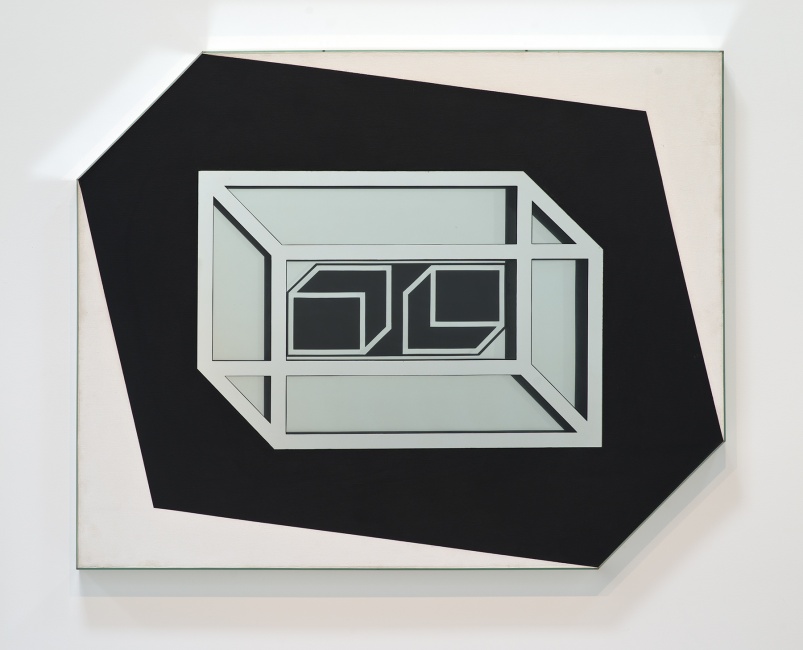
If you picture this from above—perhaps illustrated as a map or floor plan—you can imagine seeing the footprint of the village itself, with little huts, buildings, and grain bins appearing simply as the outlines of open shapes.

However, within these shapes, like little windows in the surface of the planet, new magnetic alignments would begin to appear over decades as minerals in the ground slowly re-orient themselves with longterm shifts in the Earth’s magnetic field, like differently tiled geometries contrasting with the ground around them.

[Image: “Untitled” by Larry Bell (1962), via the L.A. Times].
What really blows me away here, though, is the much more abstract idea that the ground itself is a kind of reformattable magnetic data storage system. It can be reformatted and overwritten, its data wiped like a terrestrial harddrive.

While this obviously brings to mind the notion of the planetary harddrive we explored a few years ago—for what it’s worth, one of my favorite posts here—it also suggests something quite strange, which is that landscape architecture (that is, the tactical and aesthetic redesign of terrain) and strategies of data management (archiving, cryptography, inscription) might someday go hand in hand.

(Via Archaeology).

Planet Harddrive

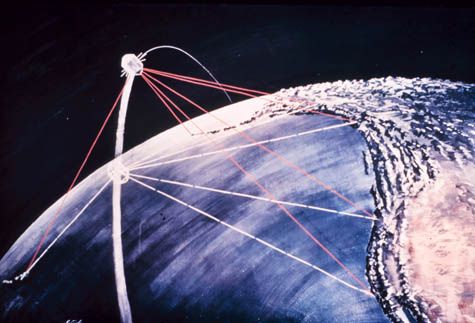
[Image: “Conceptual diagram of satellite triangulation,” courtesy of the Office of NOAA Corps Operations (ONCO)].

I’ve long been fascinated by what I might call the geological nature of harddrives – how certain mineral arrangements of metal and ferromagnetism result in our technological ability to store memories, save information, and leave previous versions of the present behind.

A harddrive would thus be a geological object as much as it is a technical one: a content-rich, heavily processed re-configuration of the earth’s surface.

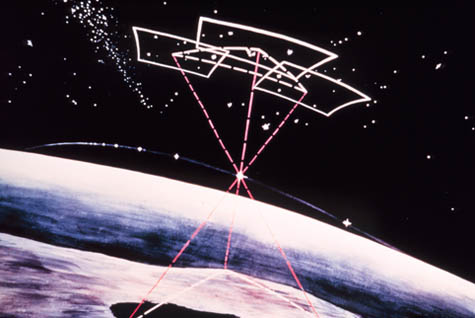
[Image: Geometry in the sky. “Diagram showing conceptual photographs of how satellite versus star background would appear from three different locations on the surface of the earth,” courtesy of the Office of NOAA Corps Operations (ONCO)].

Perhaps someday we won’t need harddrives at all: we’ll simply use geology itself. In other words, what if we could manipulate the earth’s own magnetic field and thus program data into the natural energy curtains of the planet?

The earth would become a kind of spherical harddrive, with information stored in those moving webs of magnetic energy that both surround and penetrate its surface.

This extends yet further into an idea that perhaps whole planets out there, turning in space, are actually the harddrives of an intelligent species we otherwise have yet to encounter – like mnemonic Death Stars, they are spherical data-storage facilities made of content-rich bedrock – or, perhaps more interestingly, we might even yet discover, in some weird version of the future directed by James Cameron from a screenplay by Jules Verne, that the earth itself is already encoded with someone else’s data, and that, down there in crustal formations of rock, crystalline archives shimmer.

I’m reminded of a line from William S. Burroughs’s novel The Ticket That Exploded, in which we read that beneath all of this, hidden in the surface of the earth, is “a vast mineral consciousness near absolute zero thinking in slow formations of crystal.”

[Image: “An IBM HDD head resting on a disk platter,” courtesy of Wikipedia].

In any case, this all came to mind again last night when I saw an article in New Scientist about how 3D holograms might revolutionize data storage. One hologram-encoded DVD, for instance, could hold an incredible 1000GB of information.

So how would these 3D holograms be formed?

“A pair of laser beams is used to write data into discs of light-sensitive plastic, with both aiming at the same spot,” the article explains. “One beam shines continuously, while the other pulses on and off to encode patches that represent digital 0s and 1s.”

The question, then, would be whether or not you could build a geotechnical version of this, some vast and slow-moving machine – manufactured by Komatsu – that moves over exposed faces of bedrock and “encodes” that geological formation with data. You would use it to inscribe information into the planet.

To use a cheap pun, you could store terrabytes of information.

But it’d be like some new form of plowing in which the furrows you produce are not for seeds but for data. An entirely new landscape design process results: a fragment of the earth formatted to store encrypted files.

Data gardens.

They can even be read by satellite.

[Image: The “worldwide satellite triangulation camera station network,” courtesy of NOAA’s Geodesy Collection].

Like something out of H.P. Lovecraft – or the most unhinged imaginations of early European explorers – future humans will look down uneasily at the earth they walk upon, knowing that vast holograms span that rocky darkness, spun like inexplicable cobwebs through the planet.

Beneath a massive stretch of rock in the remotest state-owned corner of Nevada, top secret government holograms await their future decryption.

The planet thus becomes an archive.

(Earlier on BLDGBLOG: Geomagnetic Harddrive).