Migratory Anagram

[Image: From “HLYWD” by Jeffrey Inaba and Darien Williams].

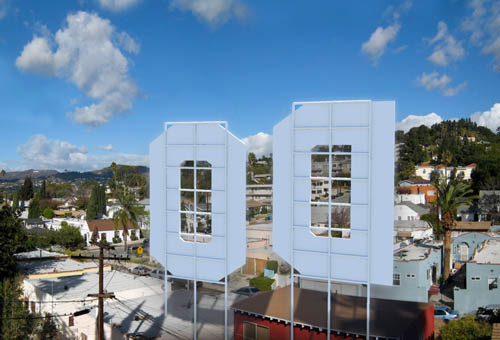
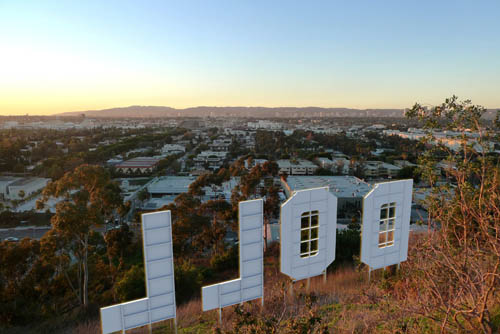
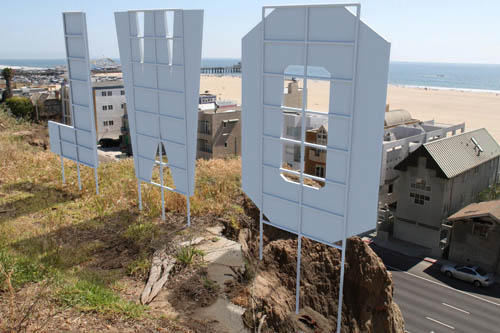
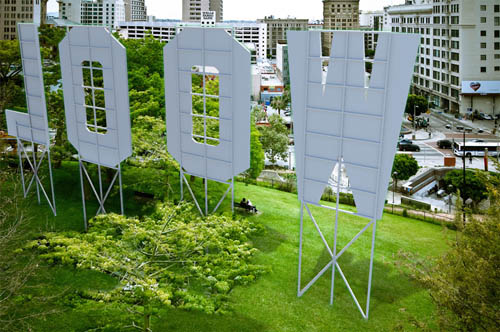
As part of the forthcoming UNPLANNED exhibition here in Los Angeles, opening March 25, Jeffrey Inaba and Darien Williams have produced “HLYWD,” a series of images in which the individual letters of the Hollywood sign break off, rearrange themselves, and appear here and there around the city.

It is, the creators write, a “proposal for the migratory distribution of the Hollywood sign across Los Angeles”—like mobile anagrams in a game of trans-neighborhood Scrabble.

[Images: From “HLYWD” by Jeffrey Inaba and Darien Williams].

After all, “why limit [the Hollywood sign] to a fixed location?”

Proposal: Let it roam? The sign’s simple structure and generic materiality lend it well to temporary erection on any number of sites throughout the city. Neighborhoods ‘borrow’ the sign or any subgroup of its letters for a determined period of time. Migration affords the sign a temporal dimension, which ensures its continued vitality as an unplanned landmark.

With one letter lent out at a time, it’d bear an urban-scale resemblance to Shelley Jackson’s Skin project, blown up and imposed on the roofs and hilltops of the city.

[Image: From “HLYWD” by Jeffrey Inaba and Darien Williams].

Or, like a new form of megastructural language poetry—perhaps an unexpected hybrid of Aram Saroyan and Ed Ruscha—the resulting project is a random species of unplanned words on the loose.

Expedition to the Geoglyphs of Nowhere


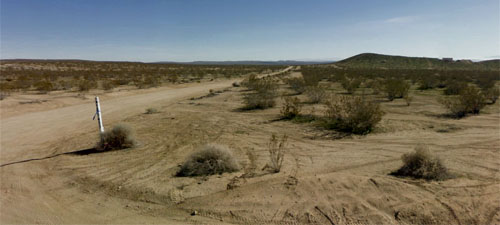
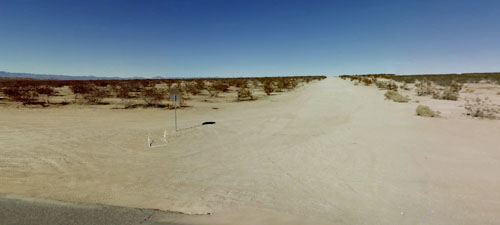
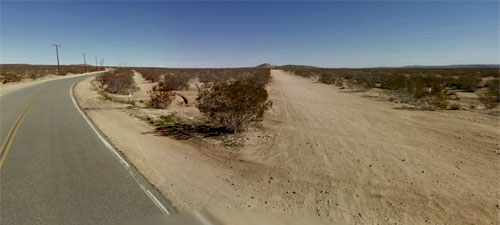
BLDGBLOG and Atlas Obscura have teamed up to lead an outing into the deserts of southern California on Saturday, March 20: an afternoon-long photographic expedition through the dusty grids of unpaved streets on the northeastern fringe of California City.


To quote from an earlier post here on BLDGBLOG:

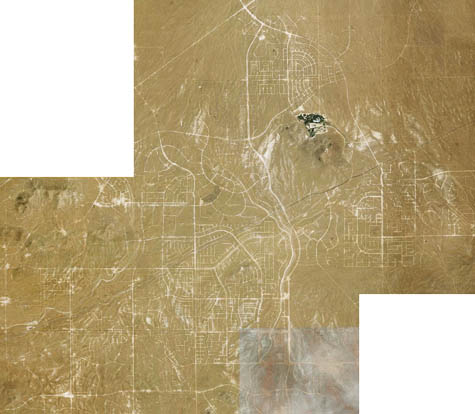
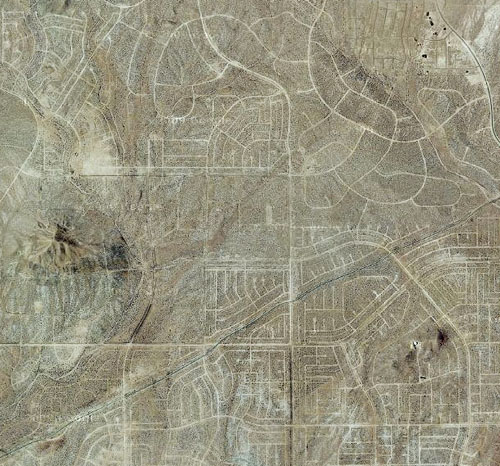
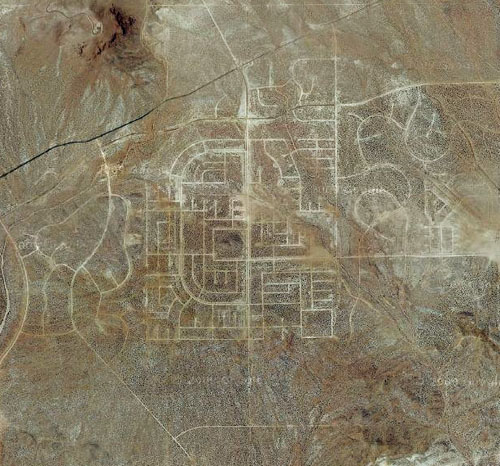
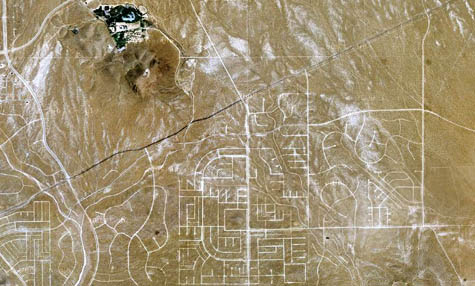
In the desert 100 miles northeast of Los Angeles is a suburb abandoned in advance of itself—the unfinished extension of a place called California City. Visible from above now are a series of badly paved streets carved into the dust and gravel, like some peculiarly American response to the Nazca Lines (or even the labyrinth at Chartres cathedral). Bill & Ted meet Cerne Abbas Man.

The uninhabited street plan has become an abstract geoglyph—unintentional land art visible from airplanes—not a thriving community at all.


Take a look.

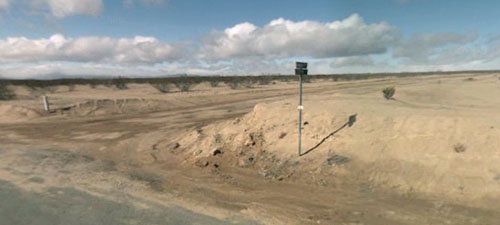
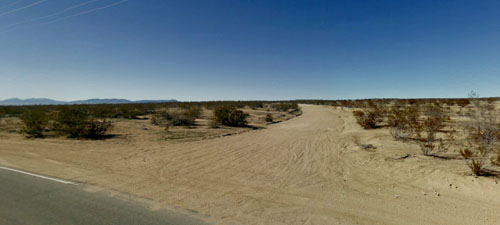
On Google Street View, distant structures like McMansions can be made out here and there amidst the ghost-grid, mirages of suburbia in the middle of nowhere. Meaningless STOP signs stand guard over dead intersections.


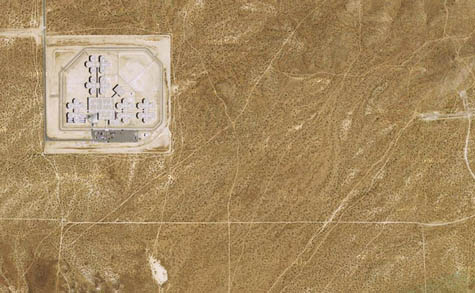
And it’s a weird geography: two of the most prominent nearby landmarks include a prison and an automobile test-driving facility run by Honda. There is also a visually spectacular boron mine to the southeast—it’s the largest open-pit mine in California, according to the Center for Land Use Interpretation—and an Air Force base.


To make things more surreal, in an attempt to boost its economic fortunes, California City hired actor Erik Estrada, of CHiPs fame, to act as the town’s media spokesperson.

The history of the town itself is of a failed Californian utopia—in fact, incredibly, if completed, it was intended to rival Los Angeles. From the city’s Wikipedia entry:

California City had its origins in 1958 when real estate developer and sociology professor Nat Mendelsohn purchased 80,000 acres (320 km2) of Mojave Desert land with the aim of master-planning California’s next great city. He designed his model city, which he hoped would one day rival Los Angeles in size, around a Central Park with a 26-acre (11 ha) artificial lake. Growth did not happen anywhere close to what he expected. To this day a vast grid of crumbling paved roads, scarring vast stretches of the Mojave desert, intended to lay out residential blocks, extends well beyond the developed area of the city. A single look at satellite photos shows the extent of the scarred desert and how it stakes its claim to being California’s 3rd largest geographic city, 34th largest in the US. California City was incorporated in 1965.

California City is now the site of a proposed mega-farm for solar energy harvesting, as well as for a bizarre plan to build the so-called Cannabis City of the Future.

Sign up to join us over at the Obscura Day site.


Note, however, that this is not a guided tour; it is simply an organized simultaneity of people all going out to investigate these streets en masse. Armed with cameras, microphones, sketchbooks, GPS devices, quickly scrawled notes for future blog posts, and more, we’ll be exploring the site at our own pace, perhaps even miles apart at various times. This is not a guided tour with an expert on the area.

As such, all questions of transportation (including tires suitable for travel over unsealed dirt roads); adequate food, fuel, and water; personal safety (including protection from sprained ankles and snakes); and navigation are up to individual participants.

We will meet at 1pm on Saturday, March 20, 2010, in the parking lot of Rite Aid in California City: 9482 California City Boulevard, California City, CA 93505. There will be a very brief group introduction there—and you can run inside to buy Cokes or whatever—before we set off to document the uninhabited streets outside town. Let’s photograph, film, blog, Lomo, Twitter, and audio-record the crap out of this place! I’ve started a Flickr group, which will be opened up soon. If you arrive late, simply head out Randsburg Mojave Road, onto 20 Mule Team Parkway, and look for the cars; our eventual cluster of destinations is approximately 15 minutes’ drive northeast of town.

And, in the unlikely event of torrential rains, I will post travel updates here on BLDGBLOG.


Meanwhile, the incomparable Atlas Obscura has a whole slew of amazing trips planned for March 20, all over the world, all part of their first annual “Obscura Day.” Definitely check out that list for sites closer to you, if you’re not in southern California.

(California City was originally pointed out to me by David Donald, and it was written up by The Vigorous North last year. The “cannabis city” and solar farm links come courtesy of Alexis Madrigal. All images in this post via Google Maps and Google Street View).

Three Trees

1) And then there was computational wood.

For his master’s thesis, produced last year under the direction of Timo Arnall, Matt Jones, Jack Schulze, Lennart Andersson, and Mikael Wiberg, designer Matt Cottam directed this short video about a technique for growing electrical circuitry inside the trunks of living trees. Just inject the right trace metals, Cottam’s mad scientist narrator explains, do some more techno-magic, and simply let the wood grow…

If only it were true. But the day will come, my t-shirt will read, when all the trees around us are computers.

2) While researching blackouts for a seminar I am teaching this winter at Pratt, I stumbled on a strange anecdote from The New York Times, published back in 1986, about a plant physiologist at the Brooklyn Botanic Garden who was seeking a way to end the risk of “trees crashing down on power lines” (a major source of power interruptions).


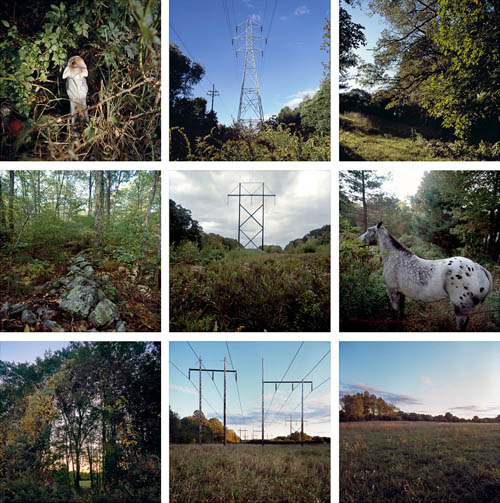
[Images: All photos by Adam Ryder, from On the Grid].

“One of the things we’re looking at,” the scientist explained, “is something that will directly retard the growth of trees”—that is, chemicals “that interfere with the basic growth hormones.” He was trying to develop, he adds, “a mild chemical” that would deliberately slow tree growth, “and instead of spraying we’re injecting [it] directly into the tree.”

Who knows where that research has now led them, twenty-four years later, but I’d suggest someone might want to mail them a copy of The Death of Grass. ASAP.


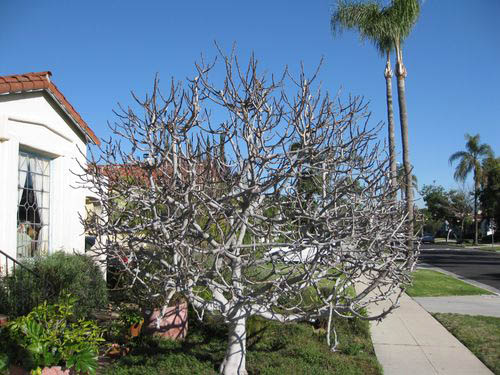
[Image: A fig tree grows in Los Angeles; photo by Pieter Severynen].

3) While going back through old bookmarks this morning, I rediscovered Tree of the Week, a series of articles run by the Los Angeles Times. The overall project could be described as a botanical cartography of the city: a catalog of Angeleno trees.

This week’s tree is the “highly productive fig“; last week’s was the Blackwood Acacia. With regard to the latter tree, Pieter Severynen, the series author, writes: “Given its negative properties it should be clear that a description of this tree, or for that matter any tree of the week, does not imply an endorsement to plant. Instead it is offered as a means to learn more about the existing trees that make up the fascinating urban forest surrounding us in the Southland.”

The “fascinating urban forest surrounding us in the Southland” includes the Weltwitschia, the “picturesque Aleppo pine,” and, of course, among many others, the apple, a tree genetically sculpted over the millennia through “hundreds of accidental and deliberate cross-hybridizations” around the world, Severynen writes.

Anyone interested in exploring the urban forests of Los Angeles would do well to check out the fruit maps of Fallen Fruit, who have discovered in the seemingly random dispersal of fruit trees around Silver Lake the remnant outlines of long-forgotten orchards; but if your curiosity goes further afield than L.A., the absolutely fantastic book Wildwood, by the late Roger Deakin, has truly unforgettable descriptions of walnut harvesting in Kazakhstan, old-growth Eastern European forests filled with war ruins and shrapnel, and Deakin’s own backyard in England. It is often astonishingly beautiful—and it also Deakin’s last major work.

Book Tower


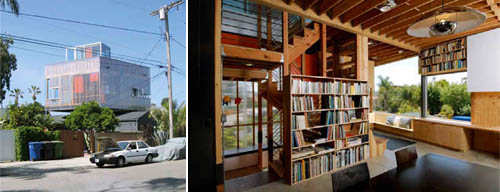
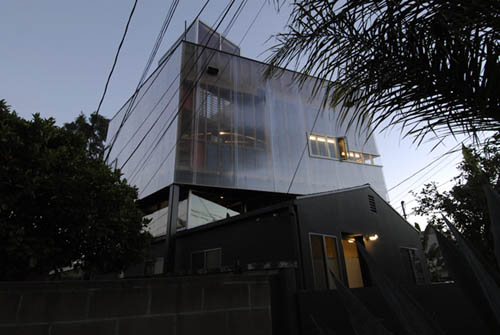
[Images: House in Venice, California, by Bureau AA; photos by Larry Underhill].

This small and breezy house in Venice, California, designed by Robert Choeff and Krystyan Keck of the Bureau of Architectural Affairs, was completed in April 2009.


[Image: House in Venice, California; photo courtesy of Bureau AA].

The house’s transparent polycarbonate cladding, used to “expose the interactions” of the building elements, makes the house function like “a structural X-ray,” we read in a recent issue of Mark Magazine.

Tight quarters, a tight budget and further restrictions—including a height limit and required setbacks—navigated the architects toward their design solution: a 54-square-meter trapezoid perched above the existing structure on steel stilts, topped by a roof deck with views in all directions.

I’m reminded here of Francois Perrin’s Guest House for an Anthropologist, itself also very biblio-intensive: both are houses of exposed wood and polycarbonate, with lots of things to read.


[Image: House in Venice, California, by Bureau AA; photo by Larry Underhill].

The interior of the house seems solidly locked in place: “the upper story has no doors,” we read, “and its only piece of freestanding furniture is the dining table. Lean work desks and kitchen counters hug the perimeter, and built-in storage spaces double, discreetly, as screens.” This includes the bookshelves.

“Where there isn’t cabinetry and Sheetrock,” Mark Magazine adds, “there’s a window.”


[Images: Courtesy of the Bureau of Architectural Affairs].

I would feel compelled to add curtains, I’m afraid, and I would probably be a bit nervous with all those books over my head during an earthquake, but with a few minor adjustments I might put in an order for one, too, please…

California City

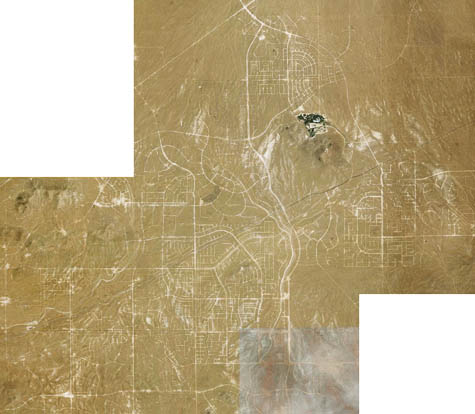
[Image: Geoglyphs of nowhere].

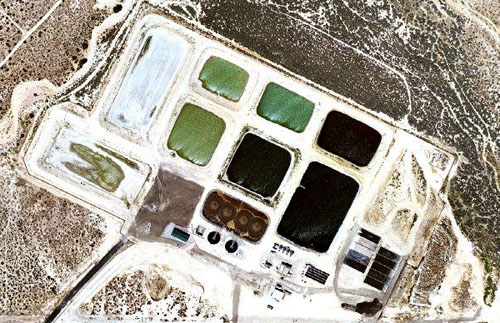
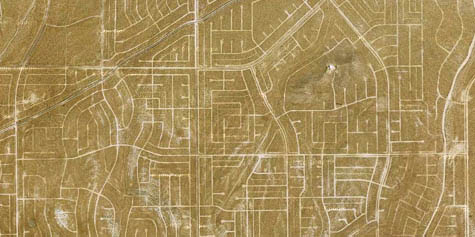
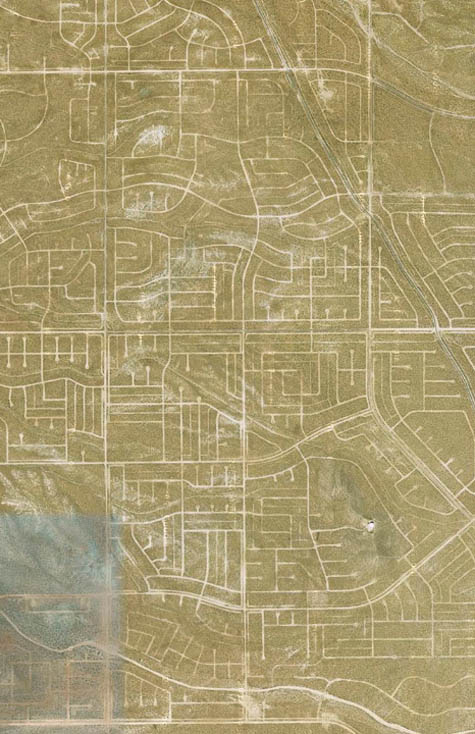
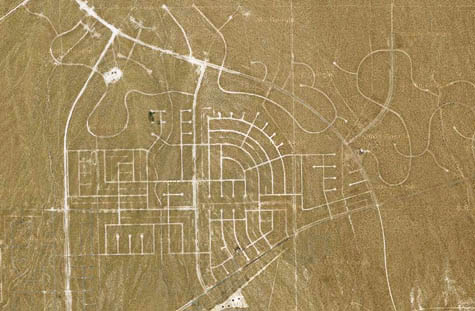
In the desert 100 miles northeast of Los Angeles is a suburb abandoned in advance of itself—the unfinished extension of a place called California City. Visible from above now are a series of badly paved streets carved into the dust and gravel, like some peculiarly American response to the Nazca Lines (or even the labyrinth at Chartres cathedral). The uninhabited street plan has become an abstract geoglyph—unintentional land art visible from airplanes—not a thriving community at all.

Take a look.

[Image: Empty streets from above, rotated 90º (north is to the right)].

On Google Street View, distant structures like McMansions can be made out here and there amidst the ghost-grid, mirages of suburbia in the middle of nowhere.

And it’s a weird geography: two of the most prominent nearby landmarks include a prison—

[Image: The geometry of incarceration].

—and an automobile test-driving facility run by Honda. There is also a visually spectacular boron mine to the southeast—it’s the largest open-pit mine in California, according to the Center for Land Use Interpretation—and an Air Force base.

To make things slightly more surreal, in an attempt to boost its economic fortunes, California City hired actor Erik Estrada, of CHiPs fame, to act as the town’s media spokesperson.

[Image: Spatial fossils of the 20th century].

The history of the town itself is of a failed Californian utopia—in fact, incredibly, if completed, it was intended to rival Los Angeles. From the city’s Wikipedia entry:

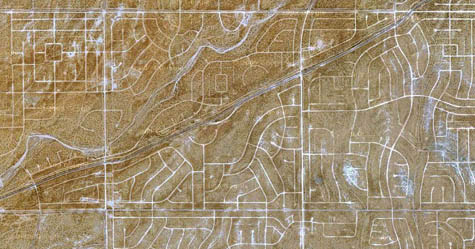
California City had its origins in 1958 when real estate developer and sociology professor Nat Mendelsohn purchased 80,000 acres (320 km2) of Mojave Desert land with the aim of master-planning California’s next great city. He designed his model city, which he hoped would one day rival Los Angeles in size, around a Central Park with a 26-acre (11 ha) artificial lake. Growth did not happen anywhere close to what he expected. To this day a vast grid of crumbling paved roads, scarring vast stretches of the Mojave desert, intended to lay out residential blocks, extends well beyond the developed area of the city. A single look at satellite photos shows the extent of the scarred desert and how it stakes its claim to being California’s 3rd largest geographic city, 34th largest in the US. California City was incorporated in 1965.

I can see an amazing article being written about this place for GOOD magazine —”California and its Utopias,” say—or The New Yorker, or, for that matter, Atlas Obscura. The large-scale spatial remnants of an economic downturn, decades in advance of today’s recession.

[Images: Zooming in on the derelict grid].

Either way, and with any luck, a road trip out through the deserted inscriptions of this forgotten masterplan will hopefully beckon once BLDGBLOG moves back to Los Angeles.

(California City was pointed out to me a very long time ago by a BLDGBLOG reader—whose original email I can no longer find. If it was you who pointed this out to me, I owe you a huge thanks! David Donald—who also pointed out that California City was written up by The Vigorous North last year).

City Laid Out Like Lizard

[Image: View larger].

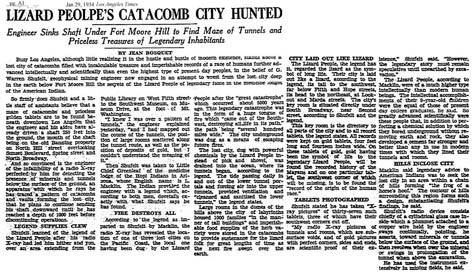
Last week, Josh Williams, formerly of Curbed LA, emailed with an amazing link to an article, reportedly published back in 1934 by the L.A. Times, about a race of “lizard people” who once lived beneath the city.

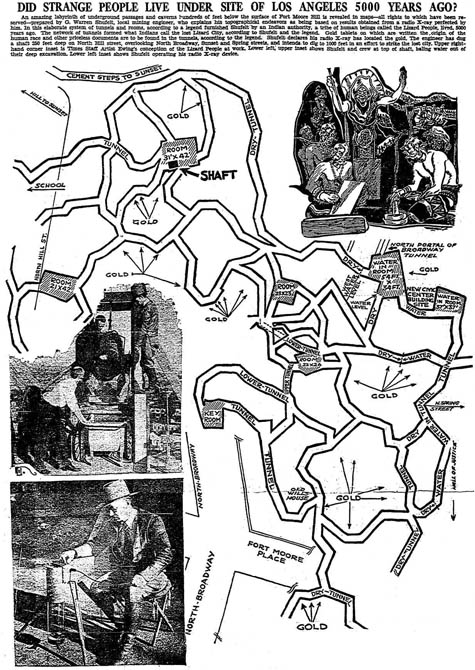
“Did strange people live under site of Los Angeles 5000 years ago?” the article asks, supplying a bizarre treasure map through the city’s undersides in the process.

[Image: View larger].

Although you can read the article in full through these links, I wanted to give you a taste of the story’s strange mix of gonzo archaeology, Poltergeist-like pre-Columbian cultural anxiety, and start-up geophysical investigation squad:

So firmly does [a “geophysical mining engineer” named G. Warren Shufelt] believe that a maze of catacombs and priceless golden tablets are to be found beneath downtown Los Angeles that the engineer and his aides have already driven a shaft 250 feet into the ground, the mouth of the shaft behind on the the old Banning property on North Hill Street overlooking Sunset Boulevard, Spring Street and North Broadway.
And so convinced is the engineer of the infallibility of a radio X-ray perfected by him for detecting the presence of minerals and tunnels below the surface of the ground, an apparatus with which he says he has traced a pattern of catacombs and vaults forming the lost city, that he plans to continue sending his shaft downward until he has reached a depth of 1000 feet before discontinuing operations.

The article goes on to suggest that this ancient subterranean city was “laid out like [a] lizard”; we visit a Hopi “medicine lodge,” wherein geophysical secrets are told; there are lost gold hoards; and, all along, the engineer’s “radio X-ray” apparatus continues to detect inhabitable voids beneath the metropolis.

“I knew I was over a pattern of tunnels,” Shufelt is quoted, “and I had mapped out the course of the tunnels, the position of large rooms scattered along the tunnel route, as well as the position of the deposits of gold, but I couldn’t understand the meaning of it.”

Perhaps this is what we’d get if Steven Spielberg hired Mike Mignola to write the next installment of Indiana Jones.

(Thanks to Josh Williams, and to vokoban, who originally uploaded the scan. Vaguely related: The Hollow Hills and Mysterious Chinese Tunnels).

The exact acoustic shape of
the skies above Los Angeles

[Image: Photo by John Gay: an F/A-18 creates a condensation cone as it breaks the speed of sound].

An email was sent out last week from the Regional Public & Private Infrastructure Collaboration Systems (RPPICS) – an organization with no apparent web presence – warning many businesses in and around Los Angeles that city residents “could hear up to a dozen sonic booms this morning [June 11] as some NASA F/A-18 aircraft fly at supersonic speeds around Edwards Air Force Base.”

While the “loudness of the booms will vary,” we read, these are only “preliminary calibration flights for an upcoming NASA study” that will research how “to reduce the intensity of sonic booms.” Part of this will be studying “local atmospheric conditions,” including air pressure, wind speed, and humidity, as these all entail acoustic side-effects.

It’s a sonic cartography of the lower atmosphere: an echo-location exercise. The geometry of noise.

Sound-bombing L.A. from above in order to know the exact acoustic shape and structure of the sky.

Nocturnal Projections

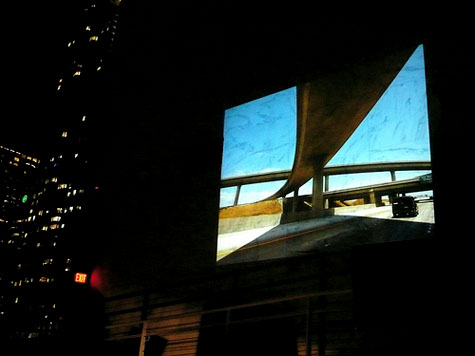
[Image: A dream of freeways above the city, at Postopolis! LA; I believe this was from Ted Kane‘s presentation. Photo by Dan Hill].

One Postopolis!, a minor car accident, and 500 miles later, I’m back in the rain of San Francisco. I owe a huge thanks to everyone who came out for the event last week, from my fellow bloggers (Bryan, Jace, David A./David B., Régine, and Dan) to Joseph Grima and the crew of Storefront for Art and Architecture, by way of ForYourArt, who found us the venue, organized several daytrips, and brought the whole thing into real time.
Thanks not only for coming along to see it unfold, but for sticking with us through microphone feedback, near-freezing rooftop temperatures, and the odd delay. If you get a chance, definitely visit the websites of the people who presented to learn more about their work; you can find links here.

The Lost Airfields of Greater Los Angeles

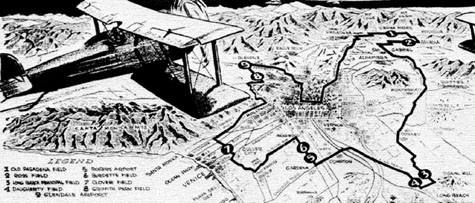
[Image: An airplane flies above Los Angeles, a landscape of now-forgotten airports].

Buried beneath the streets of Los Angeles are lost airfields, airports whose runways have long since disappeared, sealed beneath roads and residential housing blocks, landscaped into non-existence and forgotten. Under the building you’re now sitting in, somewhere in greater L.A., airplanes might once have taken flight.

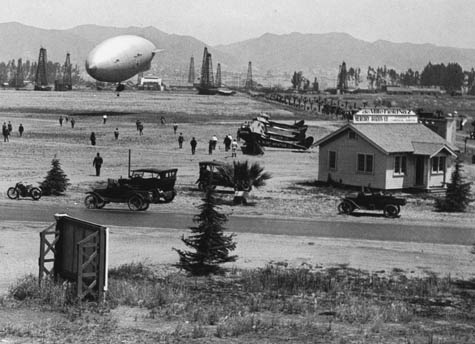
[Image: The now-lost runways of L.A.’s Cecil B. De Mille Airfield; photo courtesy of UCLA’s Re-Mapping Hollywood archive].

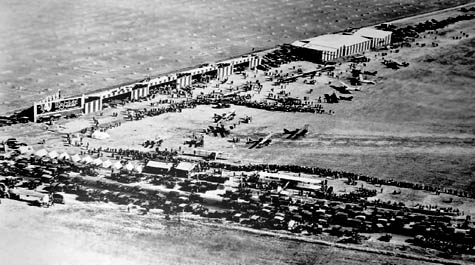
The Cecil B. De Mille Airfield, for instance, described by the Re-Mapping Hollywood archive at UCLA as having once stood “on the northwest corner of Wilshire Boulevard and Crescent Avenue (now Fairfax),” would, today, be opposite The Grove; on the southwest corner of the same intersection was Charlie Chaplin Airfield. As their names would indicate, these private (and, by modern standards, extremely small) airports were used by movie studios both for transportation and filming sky scenes. They were aerial back-lots.

Other examples include Burdett Airport, located at the intersection of 94th Street and Western Avenue in what is now Inglewood; the fascinating history of Hughes Airport in Culver City; the evocatively named, and now erased, Puente Hills “Skyranch“; and at least a dozen others, all documented by Paul Freeman’s aero-archaeology site, Abandoned & Little-Known Airfields (four pages alone are dedicated to lost L.A. airfields).

[Image: Charlie Chaplin Airfield in 1920s Los Angeles; photo courtesy of UCLA’s Re-Mapping Hollywood archive].

In a way, though, these airports are like the Nazca Lines of Los Angeles – or perhaps they are even more like Ley lines beneath the city. Laminated beneath 20th century city growth, their forgotten geometries once diagrammed an anthropological experience of the sky, spatial evidence of human contact with the middle atmosphere. Perhaps we should build aerial cathedralry there, to mark these places where human beings once ascended. A winged Calvary.

The cast of minor characters who once crossed paths with those airfields is, itself, fascinating. A minor history of L.A. aviators would include men like Moye W. Stephens. Stephens’s charismatic globe-trotting adventures, flying over Mt. Everest in the early 1930s, visiting Timbuktu by air, and buzzing above the Taj Mahal, would not be out of place in a novel by Roberto Bolaño or an unpublished memoir by Antoine de Saint-Exupéry. And that’s before we really discuss Howard Hughes.

[Image: The Cecil B. De Mille Airfield, renamed Rogers Airport (or, possibly, Rogers Airport, which later became the Cecil B. De Mille Airfield); image via Paul Freeman’s Abandoned & Little-Known Airfields].

Of course, many of these aeroglyphs are now gone, but perhaps their remnants are still detectable – in obscure property law documents at City Hall, otherwise inexplicable detours taken by underground utility cables, or even in jurisdictional disputes at the L.A. fire department.

And they could even yet be excavated.

A new archaeology of airfields could be inaugurated at the corner of Wilshire and Fairfax, where a group of students from UCLA will brush aside modern concrete and gravel to find fading marks of airplanes that touched down 90 years ago, over-loaded with film equipment, in what was then a rural desert.

With trowels and Leica site-scanning equipment in hand, they look for the earthbound traces of aerial events, a kingdom of the sky that once existed here, anchored down at these and other points throughout the L.A. basin, cutting down into the earth to deduce what once might have happened high above.

Greater Los Angeles

I got back from Los Angeles last night and my head is still spinning. I’d move there again in a heartbeat.
There are three great cities in the United States: there’s Los Angeles, Chicago, and New York – in that order.
I love Boston; I even love Denver; I like Miami; I think Washington DC is habitable; but Los Angeles is Los Angeles. You can’t compare it to Paris, or to London, or to Rome, or to Shanghai. You can interestingly contrast it to those cities, sure, and Los Angeles even comes out lacking; but Los Angeles is still Los Angeles.

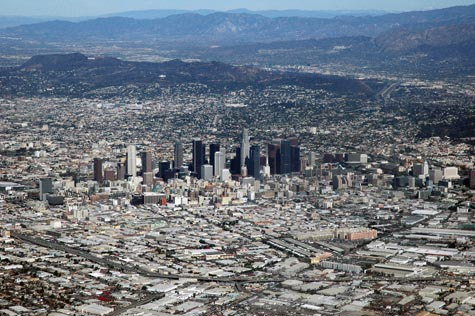
[Image: L.A., as photographed by Marshall Astor].

No matter what you do in L.A., your behavior is appropriate for the city. Los Angeles has no assumed correct mode of use. You can have fake breasts and drive a Ford Mustang – or you can grow a beard, weigh 300 pounds, and read Christian science fiction novels. Either way, you’re fine: that’s just how it works. You can watch Cops all day or you can be a porn star or you can be a Caltech physicist. You can listen to Carcass – or you can listen to Pat Robertson. Or both.
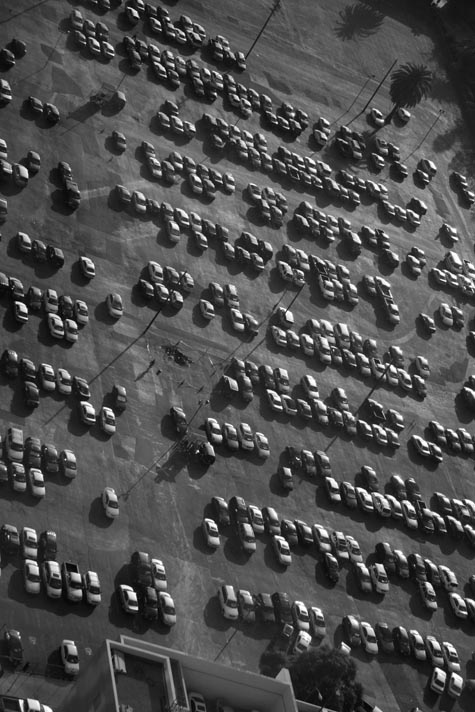
L.A. is the apocalypse: it’s you and a bunch of parking lots. No one’s going to save you; no one’s looking out for you. It’s the only city I know where that’s the explicit premise of living there – that’s the deal you make when you move to L.A. The city, ironically, is emotionally authentic.
It says: no one loves you; you’re the least important person in the room; get over it.
What matters is what you do there.

[Image: An extraordinary photograph, called 4.366 Braille, by jenlund70].

And maybe that means renting Hot Fuzz and eating too many pretzels; or maybe that means driving a Prius out to Malibu and surfing with Daryl Hannah as a means of protesting something; or maybe that means buying everything Fredric Jameson has ever written and even underlining significant passages as you visit the Westin Bonaventure. Maybe that just means getting into skateboarding, or into E!, or into Zen, Kabbalah, and Christian mysticism; or maybe you’ll plunge yourself into gin-fueled all night Frank Sinatra marathons – or you’ll lift weights and check email every two minutes on your Blackberry and watch Bruce Willis films.
Who cares?
Literally no one cares, is the answer. No one cares. You’re alone in the world. L.A. is explicit about that.
If you can’t handle a huge landscape made entirely from concrete, interspersed with 24-hour drugstores stocked with medications you don’t need, then don’t move there.
It’s you and a bunch of parking lots.
You’ll see Al Pacino in a traffic jam, wearing a stocking cap; you’ll see Cameron Diaz in the check-out line at Whole Foods, giggling through a mask of reptilian skin; you’ll see Harry Shearer buying bulk shrimp.
The whole thing is ridiculous. It’s the most ridiculous city in the world – but everyone who lives there knows that. No one thinks that L.A. “works,” or that it’s well-designed, or that it’s perfectly functional, or even that it makes sense to have put it there in the first place; they just think it’s interesting. And they have fun there.
And the huge irony is that Southern California is where you can actually do what you want to do; you can just relax and be ridiculous. In L.A. you don’t have to be embarrassed by yourself. You’re not driven into a state of endless, vaguely militarized self-justification by your xenophobic neighbors.
You’ve got a surgically pinched, thin Michael Jackson nose? You’ve got a goatee and a trucker hat? You’ve got a million-dollar job and a Bentley? You’ve got to be at work at the local doughnut shop before 6am? Or maybe you’ve got 16 kids and an addiction to Yoo-Hoo – who cares?
It doesn’t matter.
Los Angeles is where you confront the objective fact that you mean nothing; the desert, the ocean, the tectonic plates, the clear skies, the sun itself, the Hollywood Walk of Fame – even the parking lots: everything there somehow precedes you, even new construction sites, and it’s bigger than you and more abstract than you and indifferent to you. You don’t matter. You’re free.

[Image: Two beautiful photos by Andrew Johnson; here’s the left, here’s the right].

In Los Angeles you can be standing next to another human being but you may as well be standing next to a geological formation. Whatever that thing is, it doesn’t care about you. And you don’t care about it. Get over it. You’re alone in the world. Do something interesting.
Do what you actually want to do – even if that means reading P.D. James or getting your nails done or re-oiling car parts in your backyard.
Because no one cares.
In L.A. you can grow Fabio hair and go to the Arclight and not be embarrassed by yourself. Every mode of living is appropriate for L.A. You can do what you want.
And I don’t just mean that Los Angeles is some friendly bastion of cultural diversity and so we should celebrate it on that level and be done with it; I mean that Los Angeles is the confrontation with the void. It is the void. It’s the confrontation with astronomy through near-constant sunlight and the inhuman radiative cancers that result. It’s the confrontation with geology through plate tectonics and buried oil, methane, gravel, tar, and whatever other weird deposits of unknown ancient remains are sitting around down there in the dry and fractured subsurface. It’s a confrontation with the oceanic; with anonymity; with desert time; with endless parking lots.
And it doesn’t need humanizing. Who cares if you can’t identify with Los Angeles? It doesn’t need to be made human. It’s better than that.

The Cloud

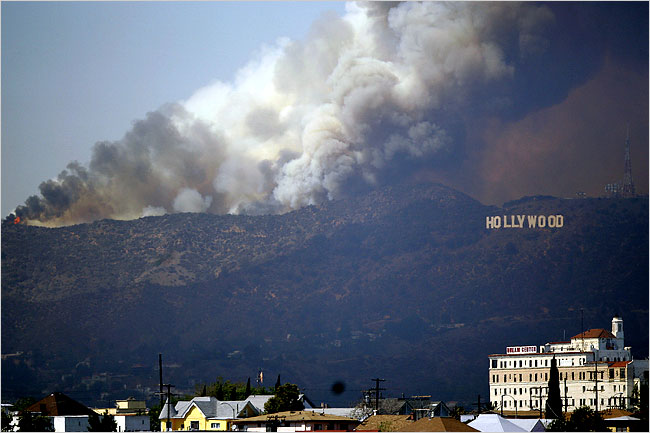
[Image: Photo by Kim Johnson Flodin/Associated Press, via the New York Times].

Not being a local news follower, I found myself sitting outside yesterday afternoon in Los Angeles, beneath a huge brown cloud that seemed to hover there, more or less stationary, above the parking lot beside me. The cloud was totally alone, surrounded on all sides by perfectly blue sky, as if a thunderstorm had rolled in only to change its mind and drift off, leaving part of itself behind, atmospherically orphaned in the sunlight. After all, there was no rain.

The cloud didn’t appear to be moving.

I began expecting an earthquake.

“Is there a fire or something?” I asked a guy wearing sunglasses as he walked past me on the sidewalk – but it occurred to me, absurdly, even as I heard myself asking him the question, that perhaps the cloud would be impossible to see through his sunglasses: its color would be visually filtered out by the glass’s tint and so he wouldn’t even know what I was talking about.

Instead, he just nodded and said, “Uh huh,” walking off past Radio Shack.

Still detached from the local news cycle at that point, and beginning to notice that not a single other person was looking up into the sky at what seemed, at least to me, to be a very obvious and possibly threatening brown cloud, I decided that people here really must be so over-trustful of the world that even a menacing, oily blur hovering above their heads could simply be perceptually filed away as some weird but harmless fluke: it’ll go away – it won’t be here tomorrow – and you can therefore just forget it ever happened…

Don’t think about it and it won’t harm you.

Which is when I remembered something called the “airborne toxic event” from Don DeLillo’s novel White Noise.

About a third of the way through that book, there is a train derailment somewhere outside a small American college town. The accident releases a toxic cloud into the sky: “the smoke was plainly visible,” we read, “a heavy black mass hanging in the air beyond the river, more or less shapeless.”

One of the characters says it resembles “a shapeless growing thing. A dark black breathing thing of smoke.”

Families close to the accident are soon asked to evacuate – “Abandon all domiciles,” an amplified voice calls out, broadcast from a truck that drives through the cul-de-sacs – while “medical problems” that might develop upon “personal contact with the airborne toxic event” are discussed on the radio.

One of these problems is apparently déjà vu.

The source of the cloud, meanwhile, is being buried by snow machines, in the weird hope that this will thermo-chemically contain its spread; and so an artificial winter begins to erupt as rogue flakes blow on contaminated winds through the suburbs. Etc. etc. It’s all very ironic and surreal.

At one point, though, the drifting cloud becomes an all-out military spectacle:

A few minutes later, back on the road, we saw a remarkable and startling sight. It appeared in the sky ahead of us and to the left, prompting us to lower ourselves in our seats, bend our heads for a clearer view, exclaim to each other in half finished phrases. It was the black billowing cloud, the airborne toxic event, lighted by the clear beams of seven army helicopters. They were tracking its windborne movement, keeping it in view. In every car, heads shifted, drivers blew their horns to alert others, faces appeared in side windows, expressions set in tones of outlandish wonderment.
The enormous dark mass moved like some death ship in a Norse legend, escorted across the night by armored creatures with spiral wings. We weren’t sure how to react.

To find out what happens next, both to the cloud and to the people watching it, you’ll just have to read the book; but, returning to a bench in Los Angeles yesterday on top of which I sat, looking up at an oily blur that seemed oddly rooted in place there above a parking lot, with no one else visibly concerned, no one else appearing to wonder what on earth it was that had come to visit us that day, there in the atmosphere, shadowing us, I was sad to learn that the whole thing was just the downwind result of a fire in the Hollywood Hills – an event I had otherwise managed to miss seeing entirely.
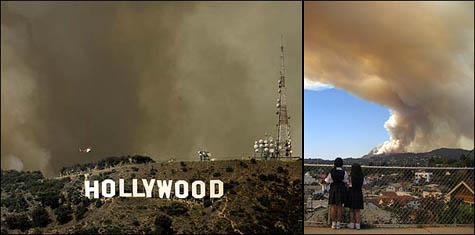
[Images: Via the BBC].

So much for the sublime or the inexplicable or the mysterious. I went back to reading, and the cloud blew away.