Glacier / Island / Storm Online

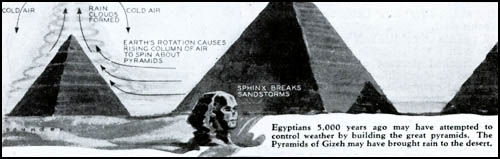
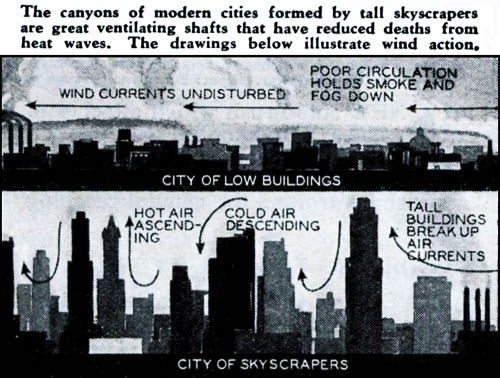
[Image: From Modern Mechanix, thanks to a tip from Nicole Seekely].

For the next five days, if everything goes as planned, BLDGBLOG and eight other architecture, design, and technology blogs will be engaged in a series of linked posts and ongoing conversations about themes relevant to the “Glacier/Island/Storm” studio at Columbia University this Spring.

In the broadest terms, we will be exploring the architecture of large-scale natural processes; more specifically, this means studying artificial glaciers; organically-grown archipelagos and other artificial reef technologies; and the unintended climatic side-effects of architecture, including the possibility of “owning the weather.”

[Image: From Modern Mechanix].

The participating blogs are a456 (Enrique Ramirez), Edible Geography (Nicola Twilley), HTC Experiments (David Gissen), InfraNet Lab (Mason White, Maya Przybylski, Neeraj Bhatia, and Lola Sheppard), mammoth (Rob Holmes and Stephen Becker), Serial Consign (Greg J. Smith), Soundscrapers/UC-Berkeley Archinect School Blog Project (Nick Sowers), and Quiet Babylon (Tim Maly).

For my own part, I’ll be posting on a wide range of themes directly related to the studio, including summaries of visiting expert lectures and class field trips to local scientific institutions; but I will also be offering my own speculative thoughts on the matter. Also, in addition to each blogger commenting on one another’s posts when possible, or simply following up with their own response-posts, I will be maintaining a list of relevant links to keep the whole thing flowing.

So my students and I are off on a field trip for the rest of the day, but I will begin putting up posts this evening. Feel free to join in, leave comments, suggest further readings, and more. Thanks!

Expedition to the Geoglyphs of Nowhere


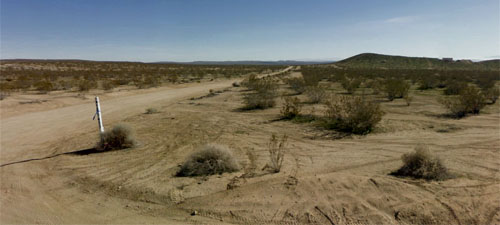
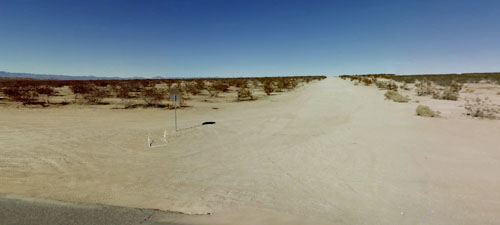
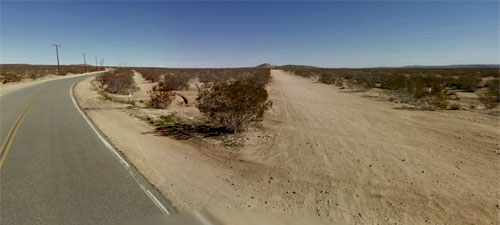
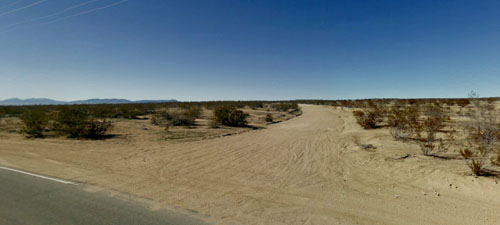
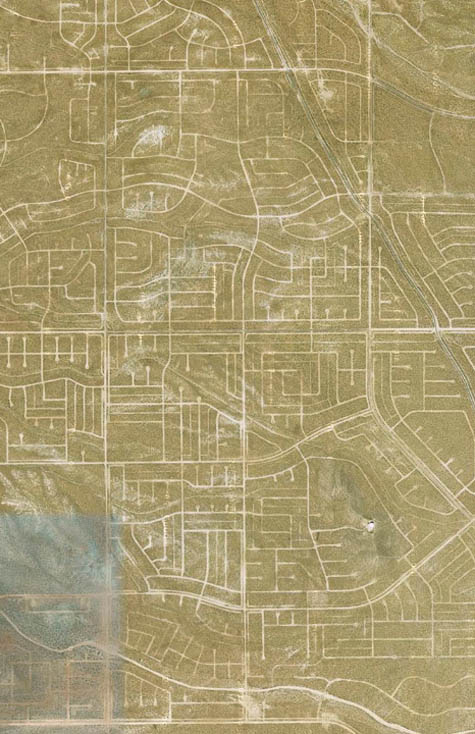
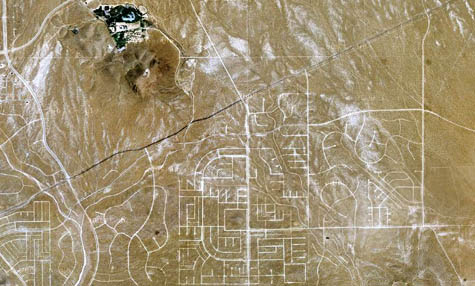
BLDGBLOG and Atlas Obscura have teamed up to lead an outing into the deserts of southern California on Saturday, March 20: an afternoon-long photographic expedition through the dusty grids of unpaved streets on the northeastern fringe of California City.


To quote from an earlier post here on BLDGBLOG:

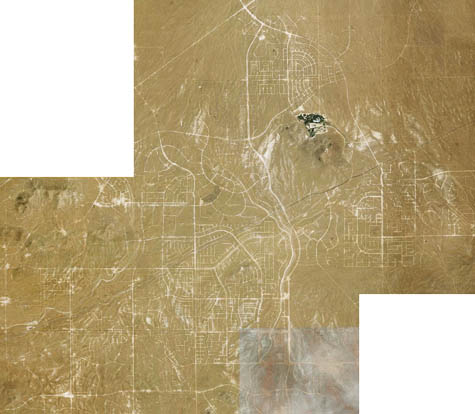
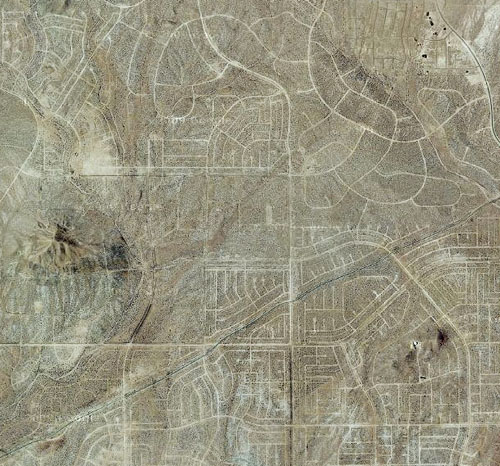
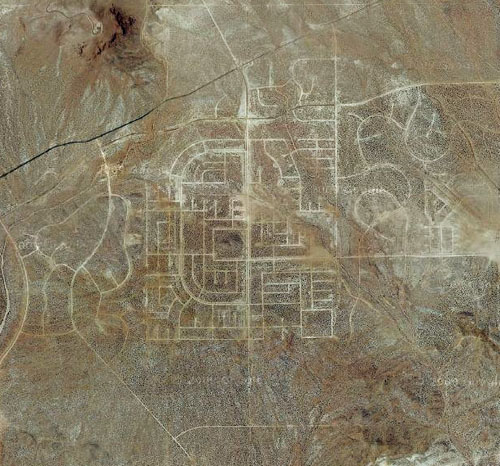
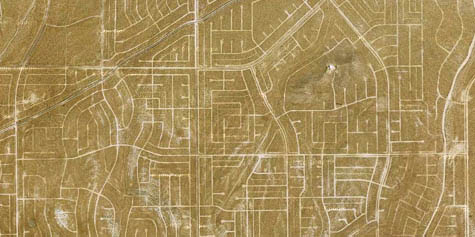
In the desert 100 miles northeast of Los Angeles is a suburb abandoned in advance of itself—the unfinished extension of a place called California City. Visible from above now are a series of badly paved streets carved into the dust and gravel, like some peculiarly American response to the Nazca Lines (or even the labyrinth at Chartres cathedral). Bill & Ted meet Cerne Abbas Man.

The uninhabited street plan has become an abstract geoglyph—unintentional land art visible from airplanes—not a thriving community at all.


Take a look.

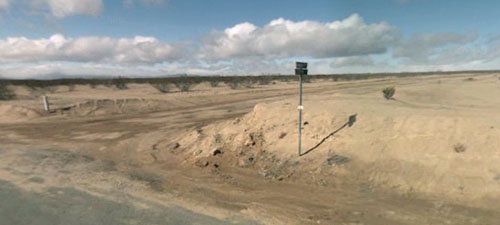
On Google Street View, distant structures like McMansions can be made out here and there amidst the ghost-grid, mirages of suburbia in the middle of nowhere. Meaningless STOP signs stand guard over dead intersections.


And it’s a weird geography: two of the most prominent nearby landmarks include a prison and an automobile test-driving facility run by Honda. There is also a visually spectacular boron mine to the southeast—it’s the largest open-pit mine in California, according to the Center for Land Use Interpretation—and an Air Force base.


To make things more surreal, in an attempt to boost its economic fortunes, California City hired actor Erik Estrada, of CHiPs fame, to act as the town’s media spokesperson.

The history of the town itself is of a failed Californian utopia—in fact, incredibly, if completed, it was intended to rival Los Angeles. From the city’s Wikipedia entry:

California City had its origins in 1958 when real estate developer and sociology professor Nat Mendelsohn purchased 80,000 acres (320 km2) of Mojave Desert land with the aim of master-planning California’s next great city. He designed his model city, which he hoped would one day rival Los Angeles in size, around a Central Park with a 26-acre (11 ha) artificial lake. Growth did not happen anywhere close to what he expected. To this day a vast grid of crumbling paved roads, scarring vast stretches of the Mojave desert, intended to lay out residential blocks, extends well beyond the developed area of the city. A single look at satellite photos shows the extent of the scarred desert and how it stakes its claim to being California’s 3rd largest geographic city, 34th largest in the US. California City was incorporated in 1965.

California City is now the site of a proposed mega-farm for solar energy harvesting, as well as for a bizarre plan to build the so-called Cannabis City of the Future.

Sign up to join us over at the Obscura Day site.


Note, however, that this is not a guided tour; it is simply an organized simultaneity of people all going out to investigate these streets en masse. Armed with cameras, microphones, sketchbooks, GPS devices, quickly scrawled notes for future blog posts, and more, we’ll be exploring the site at our own pace, perhaps even miles apart at various times. This is not a guided tour with an expert on the area.

As such, all questions of transportation (including tires suitable for travel over unsealed dirt roads); adequate food, fuel, and water; personal safety (including protection from sprained ankles and snakes); and navigation are up to individual participants.

We will meet at 1pm on Saturday, March 20, 2010, in the parking lot of Rite Aid in California City: 9482 California City Boulevard, California City, CA 93505. There will be a very brief group introduction there—and you can run inside to buy Cokes or whatever—before we set off to document the uninhabited streets outside town. Let’s photograph, film, blog, Lomo, Twitter, and audio-record the crap out of this place! I’ve started a Flickr group, which will be opened up soon. If you arrive late, simply head out Randsburg Mojave Road, onto 20 Mule Team Parkway, and look for the cars; our eventual cluster of destinations is approximately 15 minutes’ drive northeast of town.

And, in the unlikely event of torrential rains, I will post travel updates here on BLDGBLOG.


Meanwhile, the incomparable Atlas Obscura has a whole slew of amazing trips planned for March 20, all over the world, all part of their first annual “Obscura Day.” Definitely check out that list for sites closer to you, if you’re not in southern California.

(California City was originally pointed out to me by David Donald, and it was written up by The Vigorous North last year. The “cannabis city” and solar farm links come courtesy of Alexis Madrigal. All images in this post via Google Maps and Google Street View).

Sonic Warfare

The opening scene of The Forever War by Dexter Filkins presents us with the sight of U.S. soldiers preparing for their invasion of Falluja. Filkins is there to witness the attack; amidst the growl of tanks and Humvees, and “by the light of airstrikes and rockets,” he writes, there is suddenly something sonically unexpected.


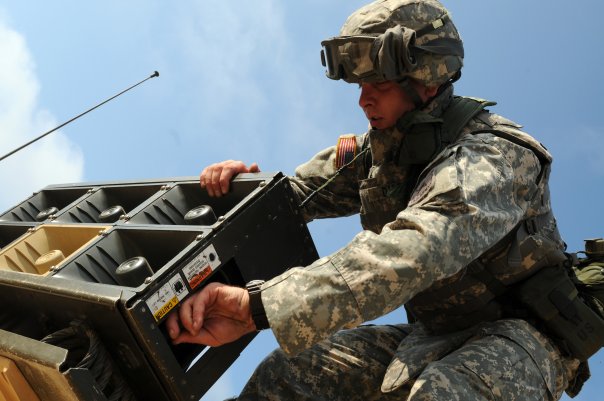
[Image: “An Advanced Individual Training Soldier in the Psychological Operations Specialist Course attaches a loud speaker on top of a High Mobility Multi-Wheeled Vehicle, or HUMVEE, at Forward Operating Base Freedom, Camp MacKall, N.C.” Courtesy of the John F. Kennedy Special Warfare Center and School].

“And then, as if from the depths,” Filkins writes, “came a new sound: violent, menacing and dire.”

I looked back over my shoulder to where we had come from, into the vacant field at Falluja’s northern edge. A group of marines were standing at the foot of a gigantic loudspeaker, the kind used at rock concerts.

It was AC/DC, the Australian heavy metal band, pouring out its unbridled sounds. I recognized the song immediately: “Hells Bells,” the band’s celebration of satanic power, had come to us on the battlefield.

While by no means advocating the use of sonic warfare as a tool in U.S. military adventures or police operations, I nonetheless instantly thought of this scene—of armed soldiers holding aloft rock-blaring boom boxes, like some John Milius-directed remake of Say Anything—when I read, in a very different context, that bark beetles can be driven out of the pine forests they currently infest if you play digitally-altered sounds of their own chewing back at them through loud speakers. The high-volume sound of themselves drives them away.

A research assistant suggested using sounds to aggravate the beetles, much as police sometimes blare music in hostage situations. The researchers tried Queen and Guns N’ Roses and played snippets of radio talker Rush Limbaugh backward. None produced the desired results.

Then, the beetles were exposed to digitally altered recordings of their own calls, the sounds they make to attract or repel other beetles. The response was immediate. The beetles stopped mating or burrowing. Some fled, helter-skelter. Some violently attacked each other.

Most important, they stopped chewing away at the pine tree, suggesting that the scientists may have discovered a sort of sonic bullet that could help slow the beetles’ destructive march.

Again, I do not mean to imply that infestation metaphors are the most appropriate to use when discussing Operation Phantom Fury, or that military action in that city was analogous to clearing a forest of bark beetles; but the audio possibilities here, and the specifics of the set-up, seem amazing.


[Image: A ponderosa pine forest; within those trunks might be beetles].

More about the actual experiment, run at Northern Arizona University’s Forestry Lab:

They collected tree trunks infested with bark beetles… Working in the lab, [research assistant Reagan McGuire] piped in the music through tiny speakers, the sort you might find in a singing greeting card. He watched the reaction of the beetles using a microscope. The rock music didn’t seem to annoy the bugs, nor did Rush in reverse.

McGuire and [Northern Arizona University forest entomologist Richard Hofstetter] decided to try something different. They recorded the sounds of the beetles and played them back, manipulating them to test the response.

Suddenly, every little thing they did seemed to provoke the beetles.

“We could use a particular aggression call that would make the beetles move away from the sound as if they were avoiding another beetle,” Hofstetter said.

When they made the beetle sounds louder and stronger than a typical male mating call, he said, the female beetle rejected the male and moved toward the electronic sound.

These audio simulations, in other words, had demonstrable physical effects on another species; their own warped sonic portrait drove them crazy.

So could you reprogram your Marsona 1288A (“create a personalized sound environment“) with the digitally-altered ambient sounds of termites and thus clear your house of insectile pests? The USDA, after all, has published a paper—download the PDF—explaining how a “portable, low-frequency acoustic system was used to detect termite infestations in urban trees.” Indeed, “termite sounds could be detected easily underneath infested trees, despite the presence of high urban background noise.” So why not reverse this—drive them out of the city using weird MP3s specially produced for boom cars?

Perhaps we should petition Clear Channel or Sirius XM to premiere a new, insect-only broadcast hour, killing ants and roaches in every city where it’s played (or perhaps just driving them all out, streaming from the floorboards, in a moment of utter horror).

I’m reminded here of the famous example of Sgt. Pepper’s Lonely Hearts Club Band by The Beatles, with its “dog whistle—which humans can’t hear—buried on the album’s second side.” Only, in our case, it would be a different kind of beetle-whistle, and one with anti-infestational effects.

(Bark beetle story found via @treestrategist).

Architecture of a Decade Past


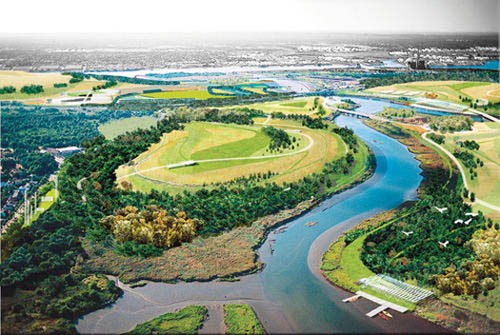
[Image: Fresh Kills landscape masterplan by Field Operations, via Mammoth; “With 2,200 acres filled with 150 million tons of trash to contend with,” Metropolis writes, “the challenge is making Fresh Kills public and safe, which means covering the garbage mounds with some four feet of fresh soil. The park would grow itself with cost-effective soil farms that aren’t eyesores.” Read more at the Freshkills Park Blog].

Mammoth has posted a great list of the best architecture of the decade. It runs the gamut from groundwater replenishing infrastructure and Chinese high-speed rail to the Svalbard Global Seed Vault and the iPhone, by way of the Large Hadron Collider, Rome’s Pontine marshes, and a library in Medellín (among others).

The purpose of the list, they write, is “to share a handful of the reasons that we’re genuinely excited about the future of architecture, and to hopefully engender a bit of that excitement in a reader or two.” It’s an inspired (and refreshingly non-building-centric) list of innovations (like microfinance) that have affected the built environment—and yet another reason why Mammoth is one of the best architecture blogs being written anywhere in the world today.

As a list, it also fares very favorably against the mind-numbing self-congratulation of other critics’ decade-in-retrospect lists, in which the last ten years appeared to exist only to validate the publishing decisions of people who, long ago, forgot how to engage with anything more than a shaving mirror.

Again, here’s a link.

Glacier / Island / Storm

I thought it might be fun to post the course description and design brief for a course I’ll be teaching this semester at Columbia.

[Image: Photo via the Alfred Wegener Institute].

The idea behind the studio is to look at naturally occurring processes and forms—specifically, glaciers, islands, and storms—and to ask how these might be subject to architectural re-design.

We will begin our investigations by looking at three specific case-studies, including the practical techniques and concerns behind each. This research will then serve as the basis from which studio participants will create original glacier/island/storm design proposals.

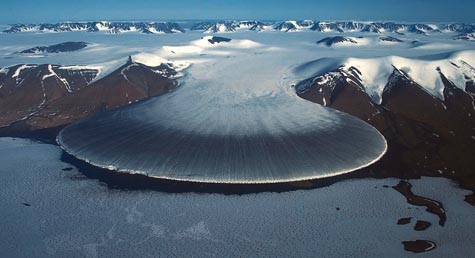
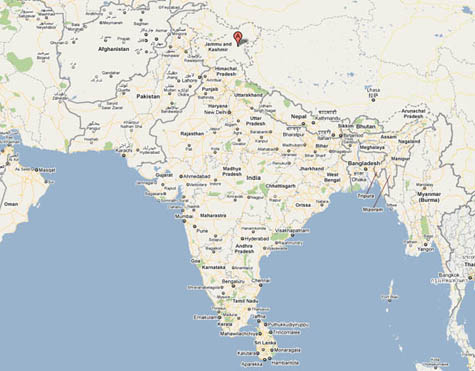
GLACIER: For centuries, a vernacular tradition of constructing artificial glaciers in the Himalayas has been used to create reserves of ice from which freshwater can be reliably obtained during dry years. This is the glacier as non-electrical ice reserve, in other words; some of these structures have even received funding as international relief projects—for instance, by the Aga Khan Rural Support Program in Pakistan. Interestingly, the artificial glacier here becomes a philanthropic pursuit, falling somewhere between Architecture For Humanity and a sustainable water-bank.

Through an examination of glacier-building techniques, water requirements, and the thermal behavior of ice, we will both refine and re-imagine designs for self-sustaining artificial glaciers, for the ultimate purpose of storing fresh water.

But what specific tools and spatial techniques might this require? Further, what purposes beyond drought relief might an artificial glacier serve? There are myths, for instance, of Himalayan villagers building artificial glaciers to protect themselves against invasion, and perhaps we might even speculate that water shortages in Los Angeles could be relieved with a series of artificial glaciers maintained by the city’s Department of Water and Power at the headwaters of the Colorado River…

ISLAND: Building artificial islands using only sand and fill is relatively simple, but how might such structures be organically grown?

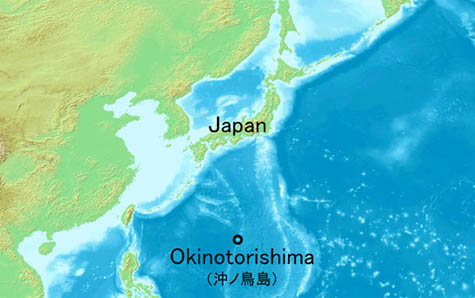
In the ocean south of Japan is a complex of reefs just slightly below the surface of the water; Japan claims that these reefs are, in fact, islands. This is no minor distinction: if the international community supports this claim, Japan would not only massively extend its Exclusive Economic Zone (EEZ), complete with seabed-mining and fishing rights, but it would also block China from accessing those same resources. This would, however, also limit the ability of Chinese warships to patrol the region—and so the U.S. has publicly backed Japan’s territorial claim (China does not).

Okinawan scientists have thus been developing genetically-modified species of coral with the express idea of using these species to “grow” the reefs into a small but internationally recognized archipelago: the Okinotori Islands. Think of it as bio-technology put to use in the context of international sovereignty and the U.N. Law of the Sea.

The stakes are high—but, our studio will ask, by way of studying multiple forms of reef-building as well as materials such as Biorock, where might other such island-growing operations be politically and environmentally useful? Further, how might the resulting landforms be most interestingly designed? Assisted by a class visit from marine biologist Thomas Goreau, one-time collaborator of architect Wolf Hilbertz, we will look at the construction techniques and materials necessary for building wholly new artificial landforms.

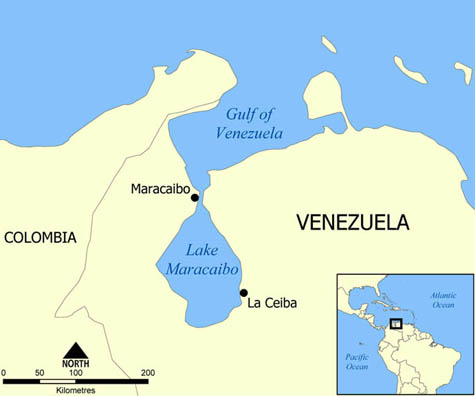
STORM: For hundreds of years, a lightning storm called the Relampago del Catatumbo has flashed in the sky above Venezuela’s coastal Lake Maracaibo. The perfect mix of riverine topography, lake-borne humidity, and rain forest air currents has produced what can be described, with only slight exaggeration, as a permanent storm.

This already fascinating anecdote takes on interesting spatial design implications when we read, for instance, that Shanghai city officials have expressed alarm at the inadvertent amplification of wind speeds through their city as more and more skyscrapers are erected there—demonstrating that architecture sometimes has violent climatological effects. Further, Beijing and Moscow both have recently declared urban weather control an explicit aim of their respective municipal governments—but who will be in charge of designing this new weather, and what role might architects and landscape architects play in its creation?

We will be putting these—and many other—examples of weather control together with urban, architectural, and landscape design studies in an attempt to produce atmospheric events. For instance, could we redesign Manhattan’s skyline to create a permanent storm over the city—or could we rid the five boroughs of storms altogether? And under what circumstances—drought-relief in the American southwest or Gulf Coast hurricane-deflection—might our efforts be most practically useful?

• • •

The studio will be divided into three groups—one designing “glaciers,” one designing “islands,” one designing “storms.” Each group will mix vernacular building technologies with what sounds like science fiction to explore the fine line between architectural design and the amplified cultivation of natural processes. Importantly, this will be done not simply for the sake of doing so (although there will be a bit of that…), but to address much larger questions of international sovereignty, regional drought, global climate change, and more.

Golden Scans

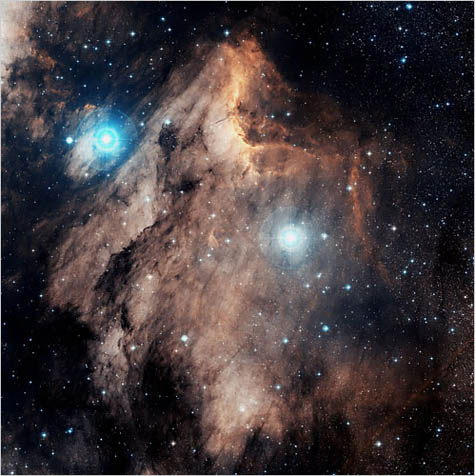
[Image: The Pelican Nebula, photographed by Charles Shahar at the Palomar Observatory].

A new book of photographs curated, cropped, and digitally reprocessed by Michael Benson (previously mentioned on BLDGBLOG here) has been reviewed by the New York Times as something you could flip through “for hours and never be bored by the shapes, colors and textures into which cosmic creation can arrange itself.” The book shows us “stars packed like golden sand, gas combed in delicate blue threads, piled into burgundy thunderheads and carved into sinuous rilles and ribbons, and galaxies clotted with star clusters dancing like spiders on the ceiling.”

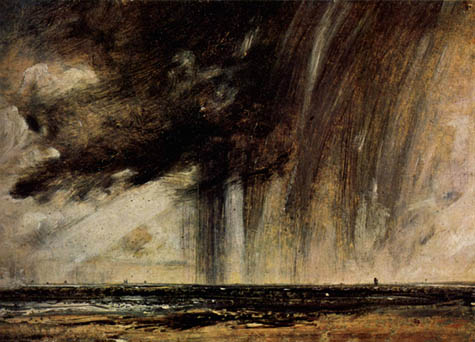
The above image of the Pelican Nebula, photographed by Charles Shahar at Caltech’s Palomar Observatory, brings to mind the later sky studies and weather paintings of John Constable, in particular Constable’s Seascape Study with Rain Cloud (1827). As if there are nebulas here on earth with us, moving through the sky (and through art history).

Stars, here, would be chemical weather that emits light.

[Image: John Constable, Seascape Study with Rain Cloud (1827); originally spotted at Pruned].

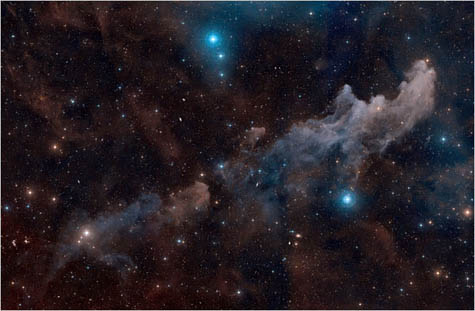
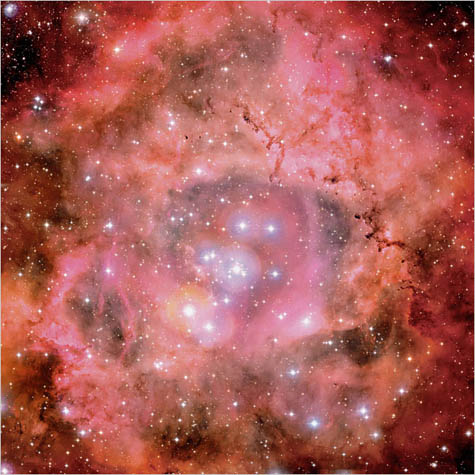
But such landscape comparisons only go so far; here are a few more photographs from the book, which you can buy at Amazon.

[Images: (top) The bewilderingly beautiful Cat’s Paw Nebula, photographed by T.A. Rector at the University of Alaska, Anchorage; (middle) The Witch Head Nebula, photographed by Davide De Martin at the Palomar Observatory; (bottom) The Rosette Nebula, photographed by J.C. Cuillandre (Canada France Hawaii Telescope) and Giovanni Anselmi (Coelum Astronomia)].

That final image shows us “3000 cubic light years of gas… heated to a temperature of over 10 million degrees Fahrenheit.” To my discredit, I have never thought of volumes of space in terms of “cubic light years” before—it’s an extraordinary unit of measurement. Perhaps someday it could even be applied to data: teraflops be damned, our future harddrives will be filled with cubic light years of information.

Leviathan: An Interview with Richard Mosse

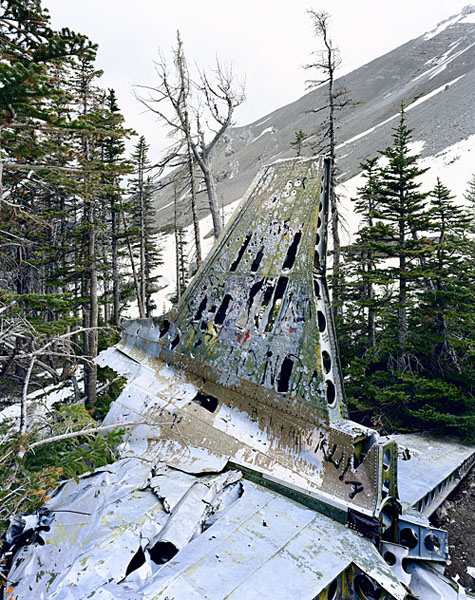
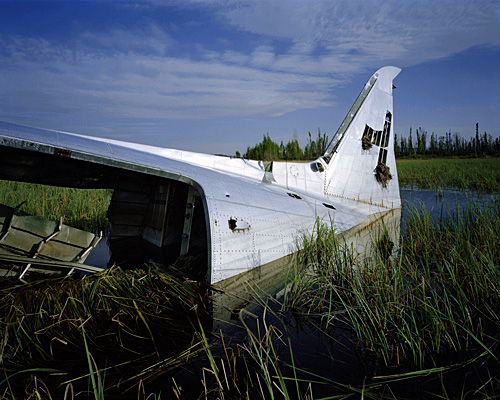
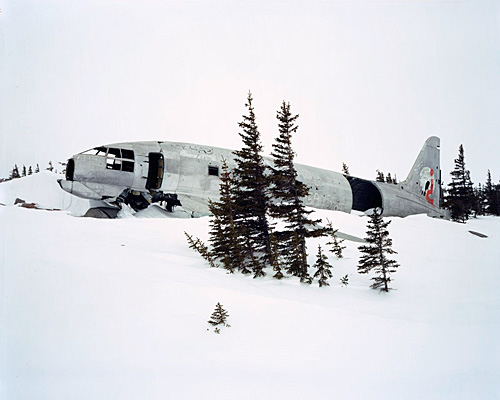
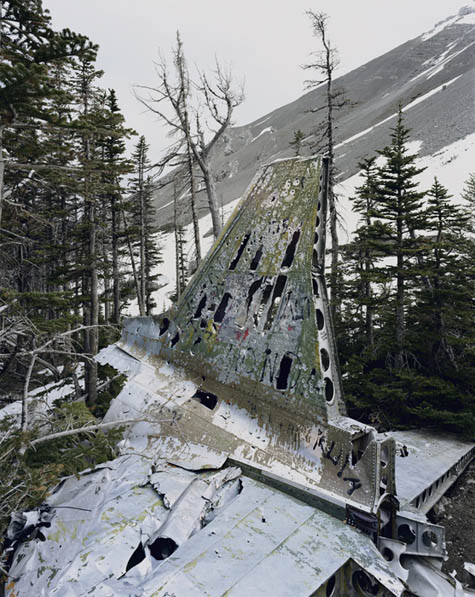
[Image: “C-47 Alberta” by Richard Mosse].

Photographer Richard Mosse, originally from Ireland, is a graduate of the Yale MFA program in photography, as well as a recipient of a Leonore Annenberg Fellowship in the Performing and Visual Arts. This Fellowship has funded Mosse’s ongoing and extraordinary series of travels around the world.

Readers of BLDGBLOG will recognize his work from its previous appearances here—whether that’s the air disaster simulations of a year or two back or the full interview with Mosse about his, until then, unpublished photographs of Saddam Hussein’s palaces.

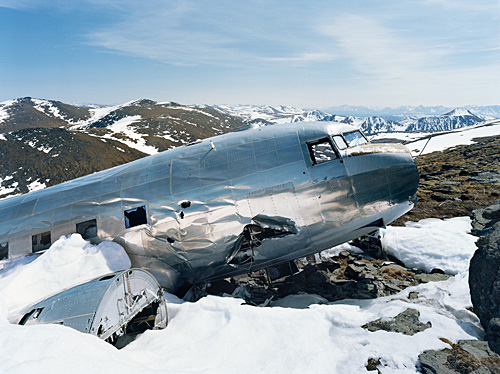
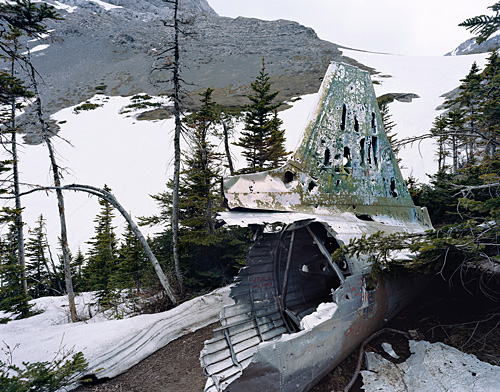
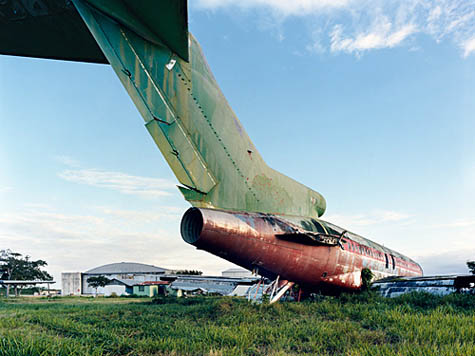
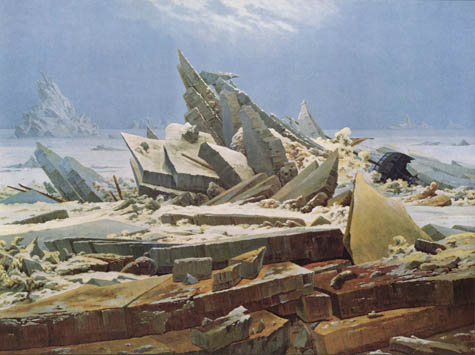
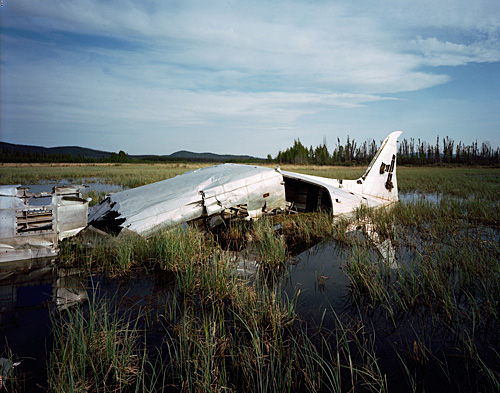
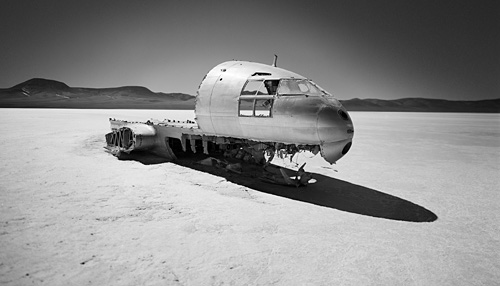
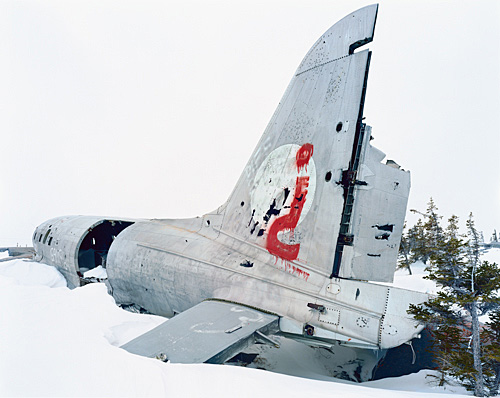
Having worked together all Autumn as part of the quarantine studio here in New York, Mosse and I coordinated another interview, via email, about his most recent solo exhibition. That show, called The Fall, features photographs of extremely remote airplane crash sites, with often partially dismantled or disintegrated wrecks disappearing into an uninhabited landscape; Mosse compares these structures to the Arctic shipwrecks and ruined forest abbeys of painter Caspar David Friedrich. The images will be on display for only two more days—closing Wednesday, 23 December 2009—at New York’s Jack Shainman Gallery.

[Image: “C-47 Yukon” by Richard Mosse].

In the following interview, Richard Mosse discusses the visual representation of catastrophe; conceptual links between terrorism, advertising, and photography; the 2006 disappearance of pilot Steve Fossett; surveillance subcultures along the U.S./Mexico border; the short fiction of J.G. Ballard; and Werner Herzog’s film Fata Morgana.

• • •

BLDGBLOG: I’d like to start off with a fairly practical question: how do you actually locate these plane wrecks, many of which received no media coverage at all?

Mosse: These photos are the result of months of online research, skimming forums, YouTube videos, Google Earth, Flickr, emailing wreck chasers, and cold-calling bush pilots. I’d even surf the web for jpegs of plane wrecks, then bring this information into Google Earth in the hopes of finding tiny silhouettes of downed planes. I was searching for accidents so disintegrated and remote to civilization that they only really exist in the virtual imagination of transient and anonymous online communities. Others had become landmarks, a destination for the intrepid to come and leave their trace.

Like 19th-century survey photography, it became a process of charting the unknown—but it’s also a kind of picaresque quest narrative. I think the work has echoes of the poète maudit, the immoral artist figure who will go to any extreme, transgressing any boundaries in pursuit of the ultimate aesthetic experience.

[Image: “C-47 Crows Nest Pass” by Richard Mosse].

BLDGBLOG: Abstractly speaking, was it that idea of trespassing and transgression—photographing something that terrifies so many people and that so few people actually witness or see—that drew you to this project?

Richard Mosse: I’m fascinated by contemporary art’s ability to point to the limits of experience, making visible what can’t otherwise be represented. Photography, meanwhile, is supposed to be rooted in the world of things, as it carries an actual physical memory of the world at a specific time and place. Between these poles, I think photography has a unique potential to represent human suffering—which is, after all, something that cannot be represented. I cannot literally feel your pain; you cannot adequately express that pain. Pain is an essentially private affair, yet it is something experienced by all of us. Starting from these basic ideas, I’m hoping to find a better way to describe the catastrophe. By this I mean a totalizing concept of warfare, disaster, the battlefield—the things that define our era but which have become increasingly abstract, impersonalized, invisible, simulated and global.

So how is the catastrophe popularly represented? Through terrorism. Terrorism is a gesture of advertising; it’s a literary act, a form of representation, before all else. Its aim is not primarily to kill, but to capture the popular imagination through killing. It’s for this reason that I’m drawn to the air disaster: there is no finer, more succinct, more international, and more culturally loaded expression of the catastrophe than a plane crash. An airliner in vertical descent is a spectacle of modernity’s complete failure. It is horrifying, but also aesthetically powerful—and it’s for these reasons that terrorists covet the air disaster. I feel that photographers, who work in close proximity to advertising, can enter the terrorist’s symbolic order and violate the same taboos.

Like the catastrophe, the air disaster is virtually impossible to represent. After the Continental crash near Buffalo last year, I traveled immediately to the site. It was totally inaccessible. In only a few hours, various authorities had come together to form a kind of firewall around the event; it had become opaque with layers of jurisdiction.

[Image: “727 Santa Domingo” by Richard Mosse].

BLDGBLOG: How did you manage to get near the wreckage?

Mosse: The plane had crashed into a suburban neighborhood, and state troopers were waving down the traffic about a mile or so from the site. I parked up in the woods nearby, slung my camera and tripod in a shoulder bag, and trespassed through people’s backyards in the hope of being taken for a resident. I was able to walk almost to the crash site itself, about 100 yards from the wreckage, where I stood and watched the disaster bureaucracy arrange and rearrange itself while body bags were carried out.

Unable to get any closer than that, and with no clear line of sight, I looked for some trace of the disaster violating this residential idyll and found police tape slung around trees whose branches had been broken by the crash. I set up the tripod and within about twelve seconds the veil had closed in. First came the local officers, and then the Feds. They kept me there for about an hour, ran my name and social security number, and threatened me with arrest.

I began to understand this larger project as a kind of deferral: I started to look sideways at the air disaster through older wrecks, forgotten relics in the middle of nowhere. There are layers of deferral here which attempt to access a crystallization of themes surrounding the air disaster. Control. Remoteness. Archaeology. Time. Environment. Form. Scale. Quest. The hidden. Taboo. In making these images, I’m aiming towards something aligned in spirit with Caspar David Friedrich‘s painting, Das Eismeer: spatial remoteness becomes temporal remoteness, and the forgotten plane wreck is swallowed by the primeval landscape.

[Image: Das Eismeer (1823-24) by Caspar David Friedrich].

BLDGBLOG: Friedrich’s Arctic shipwreck brings to mind a pretty incredible video that you’ve put together, called Leviathan. It features wrecked airplanes emerging from, or being dropped into, the sea. Can you tell me more about that project?

Mosse: I met an extraordinary Dutchman out in Thailand who is known in wreck-chasing circles as the Dakota Hunter. Once an advertising director for a cigarette company, the Dakota Hunter ventures into the world’s remotest places to salvage the wingtips of C-47 Dakotas, which he then ships back to the Netherlands to be sandblasted and turned into luxury tables for boardrooms and executive offices. He very generously tipped me off about a Thai-organized project sinking Dakota aircraft into the waves off Phuket. These aircraft were vintage American military bombers (and Sikorsky attack helicopters) from the Vietnam War that had been donated to the Thai Army upon America’s withdrawal from Saigon. They had been flown by the Thai Air Force until they could fly no longer, and have since lain rusting in the jungle.

But the diving clubs of Phuket, struggling to re-stimulate the dive-tourism industry as well as the coral reef environment that had been virtually wiped out by the recent tsunami, came up with the idea of sinking these decommissioned aircraft onto the ocean floor.

I pulled this footage from Thailand together with a second video showing the 2009 US Airways crash in the Hudson River. In this piece, I became fascinated by themes of tourism, disaster, globalization, the military-industrial complex, and history. But most of all, I’m drawn to the aesthetic power of the air disaster, and the majesty of watching airplanes be submerged and re-emerge from water, like a kind of baptismal rite. The sea has a wide array of psychoanalytic and mythic associations which I feel produce sparks of meaning when they coincide with the airplane’s modern form.

You can watch an unfinished version of the film below. This was shot and edited by Trevor Tweeten, with coloring and post-production by Jerome Thelia, and sound by Martin Clarke. Please note that this piece is not yet finished; it’s just an early draft.


BLDGBLOG: You’re not a pilot yourself, meanwhile, so getting to these sites must have required a tremendous amount of assistance. Can you tell me a bit more about the people who helped you visit—like the Dutchman in Thailand—and the process you had to go through to get to these places?

Mosse: I actually had to abandon one trip to see a wreck in a high mountain pass because of bear-paw prints in the snow! On my return trip, I brought a local fellow with a shotgun. I asked him whether he’d ever had an encounter with a bear, but he wouldn’t tell me, saying that he’d give me an answer after we reached the wreck and were making our way back down the mountain. Once I’d finished making the photograph and we’d started for home, I asked impatiently for an answer. He told a fabulous story of being charged by a five hundred pound grizzly who picked him up in her jaws and flung him like a ragdoll. Lucky for him, he managed to fire a shot at the bear while it was coming at him, saving his life. He showed me the wounds on his shoulder and forearm.

That trip was by all-terrain vehicle—with a few hours of heavy walking through snow—but, on other forays, I’ve hired a helicopter. I had a choice of pilots in a town in the Yukon, and decided to go with the Swiss pilot, thinking he’d be safer. But he totally failed to find the wreck and flew me to the top of a mountain range where we sallied out into the snow to frown at the horizon. I made a second attempt the same day with a different pilot, one who had lived there all his life. He took me straight to the wreck and suggested many others. Always shop local.

Another pilot dropped me into a swamp, way out in the Yukon wilderness. He left me there alone and flew off to refuel. I had to wade up to my armpits in the swampy water for hours, apprehensive that the helicopter would never return. But my fears were forgotten when I discovered that an animal, perhaps an otter or a mink, had built a nest out of reeds in the shelter of the belly of the plane wreck, and birds had propped their nests in holes in the back fin.

[Images: (top) “C-47 Beaver Creek” and (bottom) “C-47 Snag” by Richard Mosse].

BLDGBLOG: What about particularly unexpected or surreal plane wrecks?

Mosse: The tail of an old Nazi Junkers was discovered while dredging a lake in northern Finland. I suppose nobody knew what to do with it, because it was simply dumped in the car park of a supermarket, in the same sort of place that joyriders might abandon a burned out car. I like to imagine the local people driving carefully around the old Nazi tailfin, and it becoming a well-known attraction in the region.

There’s also a crashed Cold War bomber that has been salvaged from the Icelandic wastes and is now used as a garden shed. And, in Sicily, the remains of an Alitalia disaster were propped proudly on the roof of a scrap merchant’s shed. Sadly, this monument no longer survives.

But scrappers are not always the plane wreck’s enemy. At 13,000 feet in the Patagonian Andes, there’s an old Curtiss Commando which has been neatly cannibalized leaving only the cockpit. In the winter, flamingoes migrate to this freezing and inhospitable salt lake in northwest Argentina to mate.

[Image: “Curtiss Commando Patagonia” by Richard Mosse].

BLDGBLOG: When Steve Fossett, the aviator, disappeared over Nevada last year, there was a huge technological effort to find his plane again—people using Google Earth from all over the world, for instance, to spot the wreckage. It became a kind of landscape challenge. Did the enormous response to that air disaster, or even the public’s use of satellite surveillance technology, have any influence on your project?

Mosse: The hunt for Fossett’s wreck on Google Earth reminds me of a group of webcam vigilantes who I discovered while shooting on the Mexican border. These anti-immigration volunteers spend their free time monitoring footage from live border cameras situated in the Sonoran Desert or overlooking the banks of the Rio Grande River. I’ve encountered these surveillance camera rigs in the middle of absolutely nowhere along the US-Mexico border. The project, BlueServo Virtual Borderwatch is a public-private partnership described by Justin Hall as “an innovative real-time surveillance program designed to empower the public to proactively participate in fighting border crime.”

I’m intrigued by the idea of people logging into, and staring at, live webcam views of an unchanging landscape on their home computers. What drives people to do this? I suppose it’s the same lure that draws people to Google Earth. These are both a pursuit of the real within—and through—simulacra, and you are apprehending the world as if it were a computer game. That is enormously empowering, because the tools at your disposal are extremely powerful. You can go virtually anywhere without putting yourself at risk.

But, ultimately, it’s a form of entertainment: you’re consuming a representation of the world—one that’s been produced—and not representing the world for yourself.

[Images: “Miss Piggy Churchill” 1 and 2 by Richard Mosse].

BLDGBLOG: In J.G. Ballard’s fiction, there is often a character who is a wounded aviator—someone who’s been in a minor plane crash or car accident, has a ruined knee, and can never fly again. They are exiled on the earth, so to speak. Ballard sometimes included lost aviators in his fiction: amateur pilots who have taken on the air of Arthurian knights flying pioneer missions into the skies of undiscovered worlds. Does this romance or mythology of the figure of the pilot—not the airplane—have any role in your interest in photographing crash sites? There’s even someone like Amelia Earhart, whose disappearance only amplified her already global fame.

Mosse: Certainly. Since I was a boy, I’ve been haunted by Ballard’s story of a journalist visiting the site of an air disaster in the Mexican mountains. But I’m also thinking along the lines of Robert Smithson or Bas Jan Ader: the artist heading out to his death in the wilderness, like the protagonist at the end of Jim Jarmusch’s Dead Man, whose body disappears into a ghostly fog on a drifting boat.

[Image: From Fata Morgana, directed by Werner Herzog].

BLDGBLOG: Finally, is there a crash site that you really want to get to but either haven’t had the time to visit or the wreck might even just be a rumor, an urban legend?

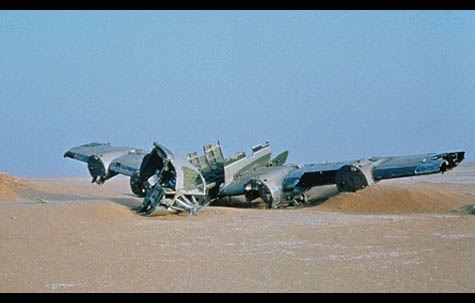
Mosse: That would have to be the plane wreck in Werner Herzog’s Fata Morgana. It was like an epiphany for me when Herzog’s lens comes across this ruin in the Saharan desert; he examines the twisted form as if it were a sculpture in the landscape, like the Sphinx. I immediately pressed rewind and watched the scene again and again, swearing to myself that I would retrace his journey south through Algeria to search for the ruin. But it’s impossible to find.

• • •

Be sure to read BLDGBLOG’s earlier interview with Richard Mosse: Saddam’s Palaces. Mosse’s solo exhibition The Fall closes on 23 December 2009.

Plants Without Borders: An Interview with Sara Redstone

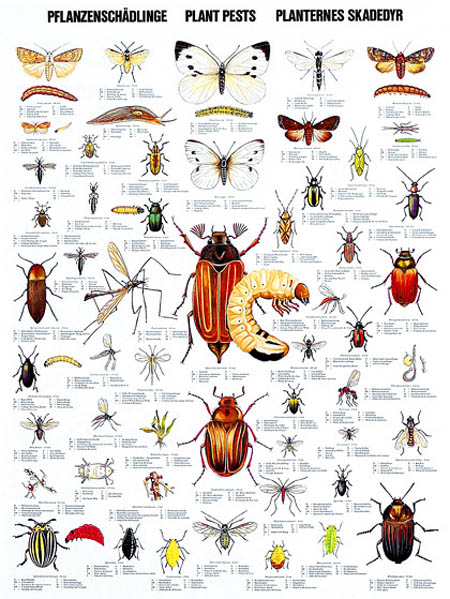
[Image: 55 of Europe’s most common plant pests in a wall poster found via the Scandinavian Fishing Year Book].

Sara Redstone is Plant Health and Quarantine Officer for the Royal Botanic Gardens at Kew, home of the world’s largest collection of living plants. In addition to screening and isolating all incoming or outbound plant material, she is currently overseeing the design and construction of a new quarantine facility for the gardens.

As part of our ongoing series of quarantine-themed interviews, Nicola Twilley of Edible Geography and I visited Redstone at Kew, where we drank tea outside the Orangery café. Over the course of nearly two hours, we talked about the impact of current and potential pest outbreaks, the ecological risks of open E.U. borders and global trade, and the complicated governmental infrastructure of plant protection. In addition, we touched on what plant quarantine at Kew actually looks like, in terms of the functional and technical challenges involved in Wilkinson Eyre Architects‘ design for a new Quarantine House. Along the way, we covered plant smuggling, invasive species, and the potential to create a Sudden Oak Death super-strain.
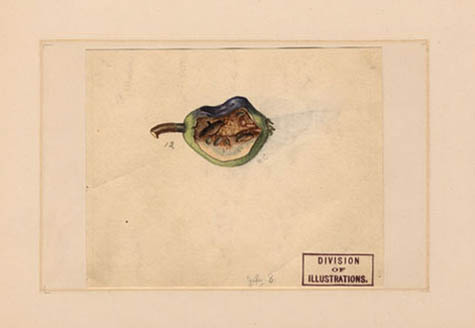
[Image: A diseased pear from the USDA Pomological Watercolor Collection].


• • •

BLDGBLOG: What do plant quarantine measures encompass—invasive species, plant diseases, or even genetically modified organisms? And who is in charge of enforcing plant quarantine in the UK?

Sara Redstone: Plant quarantine at the Royal Botanic Gardens, Kew, is concerned with controlling plant pests and diseases, to protect our living collections and the wider environment. In the UK, a number of different structures govern plant import restrictions, monitor invasives, and issue licenses for quarantine and for genetically-modified organism—GMO—research. The rules for working with GMOs are laid out and policed by the Health and Safety Executive, but issues that relate to plant health, quarantine, and potential pests and diseases of plants are actually monitored and controlled by an organization called FERA (the Food and Environment Research Agency), which is a new agency within DEFRA (the Department for Environment, Food and Rural Affairs).

It can get quite complicated! Different organizations deal with plant health issues depending on where the plants grow and what they are. Unfortunately, the type of information you can get online relating to plant health and quarantine is not always very user-friendly. For example, inquiries about plant health, imports, and restrictions in Scotland go to the Scottish Office, but in England they either go to FERA or the Forestry Commission, depending on the type of organism. Licenses to operate quarantine facilities depend on what type of material you are quarantining (plant or animal), the purpose of raising such material (to grow the plant itself or to grow potential pests or diseases), and various other factors. Meanwhile, GMOs fall under the Health and Safety Executive, as I said—but inquiries about GMO regulations go to DEFRA.

Ordinary members of the public quite understandably find this very confusing.

Edible Geography: What are some of the most worrying issues facing you in terms of plant pest control?

Redstone: One particularly nasty tree pest, which is also a potential human health hazard, is the Oak Processionary Moth. Kew is just one of many locations in southwest London that has experienced this pest. Like the Browntail and other moths, during various stages of their life-cycle the caterpillars are covered in really brittle hairs that have a toxin in them. It can give you a nasty rash and may cause breathing difficulties or affect your eyes on contact.

The moth came into the UK as eggs on imported trees from Holland—and the challenge we face is that we don’t typically quarantine trees from northern Europe. There is no legal requirement to quarantine material from within the EU, but the pest is widespread in the Benelux countries and in Germany, and it is increasing its range on the mainland.
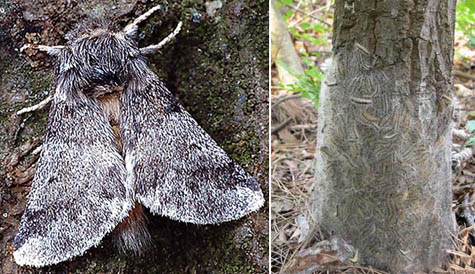
[Images: (left) The Oak Processionary Moth, pictured in a 2007 Daily Mail article titled: “Gardeners are mercilessly hunting down moths with hairspray and flame-throwers.” (right) Tree infested with Oak Processionary Moth caterpillars. Photo taken by Ferenc Lakatos, University of West-Hungary; found via the Centre for Invasive Species and Ecosystem Health’s Bugwood Network].

What happens is that many Dutch, Belgian, and German nurseries raise trees and shrubs in southern Europe, in areas such as Italy, where the Oak Processionary Moth is already established. The climate and local conditions promote better growth than can be achieved in northern areas, so you get bigger plants faster. They then move the plants back north to grow them on the nursery for a period of time, to get the right shape, etc. This kind of movement of plants has resulted in a lot of pests increasing their range and moving northwards.

Once a pest is established in a those northern mainland European states, there’s no way to prevent it from spreading to the others—because there are no real boundaries. There are no geographic features that are going to prevent them from moving, and there are no trade barriers that are going to stop them, either.

Although Britain is an island, everything is very much geared toward free trade; unfortunately, quarantine is usually secondary to trade. Most people involved in pest & disease control and quarantine will tell you that we like to employ what we call “the precautionary principle”—but, for political and economic reasons, governments don’t always choose to operate that way.

One of my concerns is that we know about these tree movements on the European mainland, and we know that the Citrus Long-horned Beetle, for instance, is now fairly well established in the Lombardy district in Italy—which is not that far from some of the major tree-growing areas in Tuscany. But what’s going to prevent those Long-horneds from spreading to northern Europe, given the movement of plants, and then coming over to the UK?

We’ve already had an instance where infested Acers were grown in China, shipped over to mainland Europe, and then sold in the UK. The beetle has a long larval phase—two to three years when it is undetectable by normal means, though I understand stethoscopes are now being used by some plant inspectors in an effort to detect larvae feeding. Usually the only way to detect them is finding the emergence hole in the tree base—or finding the adult beetle, after the fact. Were all the infested trees found? Were all the beetles present in the consignment destroyed? We don’t even know where all those plants have gone. It’s really bad news.

[Image: Sample “Plant Passport” from DEFRA’s Plant Health Guide to Plant Passporting].

BLDGBLOG: What sort of measures are in place to deal with these threats?

Redstone: Material that comes in from the European Union is generally uncontrolled. There are “Plant Passport” regulations that apply to certain types of plant, but there’s no record of exactly what plant material is moving and where it’s from.

For instance, even if it says it is from, say, Holland, it doesn’t mean that that material originated in Holland. It may have arrived via Holland in a container ship from China.

Different countries have different standards for quarantine and plant health. You can understand that, in some countries where it’s really a struggle to make a living, different rules apply. There is an organization called the International Plant Protection Committee (IPPC), which makes recommendations—but there is a real lack of shared standards for plant quarantine.

One thing that would be really useful now would be a series of suggested blueprints for quarantine buildings. For example, quarantine houses in places like the tropics can be relatively simple: mesh-screen, poly-tunnel-type structures with restricted access are fine. You don’t always have to use chemicals to sterilize things—in the tropics, you can use heat. Even in the UK, we can quite often use solar gain in our glasshouses to sterilize an area, provided we know what we’re trying to kill. The same methods have been used for years in agriculture; farmers will put polythene over an area of land, and then rely on the sun to sterilize the soil.
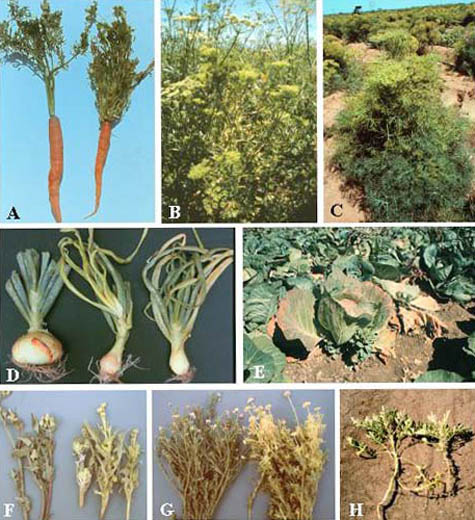
[Image: Healthy and diseased plants in a side-by-side comparison, via the USDA Agricultural Research Service].

Edible Geography: Here at Kew, what is it that you are quarantining? Why does Kew need a quarantine house?

Redstone: We use plant quarantine—isolating, screening, and treating plants—for incoming and outgoing plants where we’ve determined they may be a risk associated with their movement. For example, if we want to repatriate material to a country as part of a conservation project, the last thing we would want to do is inadvertently introduce a new pest or disease; so we isolate and treat plants before moving them, to reduce that risk to an absolute minimum.

At present we’re in the process of planning a new quarantine facility. Our intention with the new building is that all plant material that is sent to Kew and to our sister-garden, Wakehurst Place in Sussex, will come to this one point—our new “plant reception”—regardless of its origin. This means we can improve our data capture; we can make sure that all incoming material is compliant with the necessary legislation; we can do an initial inspection; and, if we think there’s a risk, we can also do the isolation and screening.

England is not like the United States, where the USDA maintains the plant quarantine service. If, say, the New York Botanical Garden requests plant material from us, they will send us an import permit and shipping labels, and the labels will direct those materials to the USDA quarantine service, who then send the material on. But we operate quite a different system in the UK and European Union.

What happens here at Kew is that we have a licensed quarantine facility, which is approved by FERA and licensed by DEFRA. This gives us the ability to quarantine plant imports that come to the gardens from outside the European Union.
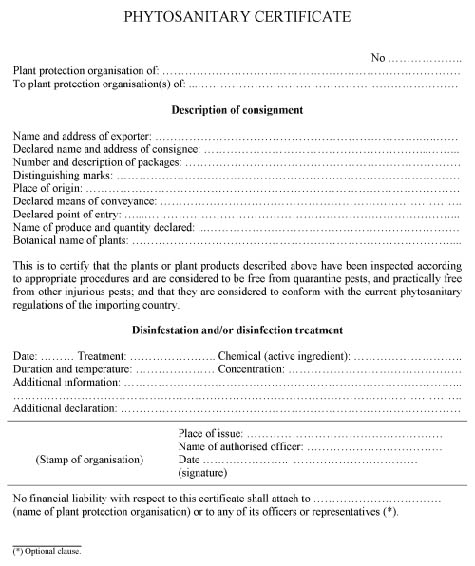
[Image: UK Phytosanitary Certificate, via the Plant Health (England) Order (2005)].

These usually fall into two main types. One is the type of material that comes in with a phytosanitary certificate.

If, for example, somebody went to Costa Rica and they wanted to bring back material from a botanic garden there, they would arrange for all the necessary permissions, but they would also arrange for an inspection by a representative of the national plant protection organization there. If the plant material was free of pests and diseases, it would be issued with a phytosanitary certificate. Normally, that’s only valid for two weeks—so there’s quite a short window of time in which the plant can travel. Once material reaches Kew, it then has to have another inspection—because, at the time it was inspected in Costa Rica, there may have been no visible signs of pests or diseases, but, in the time it takes to reach the UK, something might have developed. So that’s one kind of material that is received into quarantine.

The other type of material we receive into quarantine is what we call “natural source,” or “wild-collected,” material. We operate under a Letter of Authority to import wild-collected material whose movement would normally be prohibited or controlled. An example of that kind of material would be vines from Kyrgyzstan. Their movement is strictly controlled because, in the European Union, vines are a really important crop. You’ll find the same thing in most countries: a lot of cereal crops are controlled, for example, because they can have such a dramatic impact on the horticulture and agriculture of a country.
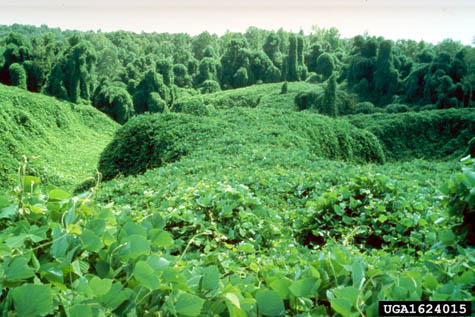
[Image: Kudzu-infested forest; photo courtesy John D. Byrd, Mississippi State University].

BLDGBLOG: Do you ever quarantine controlled or banned plants, such as kudzu or marijuana, to prevent them from entering the country?

Redstone: We wouldn’t normally consider that quarantine. It’s more a case of restricting access of non-authorized people to those plants, or restricting the release of non-native species into the environment. When we quarantine plants, it’s not to do with excluding a particular plant type so much as excluding the diseases or pests that those plants might be harboring.

Invasive plants like kudzu (Pueraria montana) aren’t banned, although we have a few species like Japanese Knotweed (Fallopia japonica) and Giant Hogweed (Heracleum mantegazzianum) which are illegal to intentionally allow to spread to natural areas.

I’m not sure whether UK authorities would prevent specific plants being imported. Marijuana (Cannabis sativa), whether in THC-containing forms or hemp, requires a Home Office license to produce and process.

We do also provide a service for UK customs authorities. If they make a CITES (the Convention on International Trade in Endangered Species) seizure, we have a department here that will go out to help identify the plant and tell them whether it’s been wild-collected and if it’s of conservation value.

Edible Geography: Can you give any examples of outbreaks that have happened while you’ve been here?

Redstone: We haven’t had any outbreaks here due to failure of quarantine. The impact of an outbreak on our collection could be very serious, particularly if it involves a known quarantine organism where the only sensible treatment is to destroy the plant material. That could cost tens or even hundreds of thousands of pounds to eradicate. It could also threaten rare species, restrict people’s access to the collections, and prevent us from supplying material for research to our own labs and to other botanic gardens.

We have had a couple of recent pest outbreaks in the UK. I’ve already referred to our ongoing Oak Processionary Moth problem. The interesting thing is that when that outbreak happened, the moth wasn’t even recognized as a quarantine organism and it wasn’t clear which government department was going to manage it.

The problem with all of these things is that it’s so much easier to prevent an outbreak than it is to deal with one that’s already in progress. Unlike in the U.S., where you seem to be more geared up to a rapid response once something has been identified, it takes us a long time in the UK and we need more resources in place to do the monitoring and undertake control.

One issue, for example, is making sure we have the right chemicals in place. It’s not enough to do a risk assessment; we also need a list of specific, recommended control measures. And if the recommendation is, for example, “Use this particular chemical,” then we need to make sure that somebody in the UK is able to supply it.
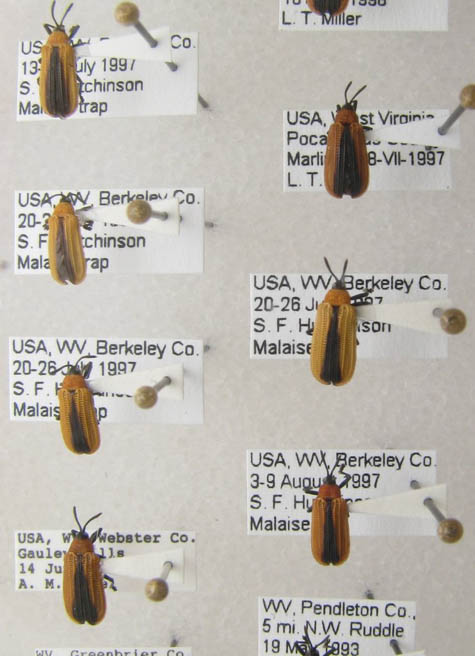
[Image: West Virginia Department of Agriculture’s pest collection, via the Massachusetts Introduced Pests Outreach blog].

BLDGBLOG: What’s involved in thinking through the design of a new quarantine facility?

Redstone: One of the design challenges is to make sure that we not only meet current legislation, but that we also anticipate some of the changes that might need to happen. Global trade and climate change are having an impact already.

Even trying to decide the scale of our building is a challenge: we want to build-in flexibility, and we don’t want to hamstring the organization in the future. At the same time, we have to be able to afford to run the facility!

What we know from the experience of others is that there have been lots of examples of institutions where they’ve spent vast sums of money—tens of millions of pounds—on creating fabulous infrastructure, but it has then been so expensive to run that they haven’t been able to operate it. We can’t afford that. That’s not what we’re about at Kew.

On the other hand, to contain pests and diseases, we need to assess the risks associated with every single plant movement. As a result, over the past few years we’ve routinely quarantined material that there’s no legal need to quarantine. However, we’ve felt that there was a practical need and a moral obligation to quarantine seed material that comes from, for example, California, or from other states where we know there’s a really severe problem with Sudden Oak Death. Particularly with the understory material, we’ve germinated it all in quarantine and grown it on so that we can screen it. The last thing we want to do is introduce Sudden Oak Death—particularly the American form, because there’s an American and a European strain, and the concern is that the two will meet and produce a super-strain.

The other factor is the human resource. It’s not enough just to have a building: you need to have people who are trained and who understand how to operate it.
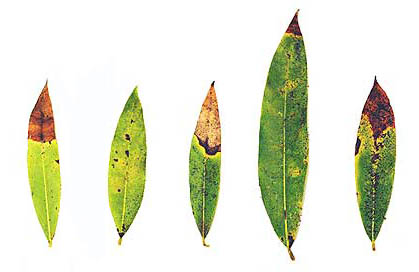
[Image: Bay leaves showing symptoms of infection by Phytophthora ramorum, the “causal agent” of Sudden Oak Death. Photo courtesy D. Schmidt, Garbelotto Forest Pathology Lab, UC Berkeley, via the U.S. Department of Energy’s Joint Genome Institute].

Edible Geography: Quarantine is always a question of time. How do you decide how long to grow these understory plants, for example, before you can determine whether they are healthy or sick?

Redstone: That’s all part of the risk assessment process. I work with our local inspector and an excellent scientific support team at FERA to make those kinds of decisions. For example, the inspector might look at a batch of seedlings and say: “That group hasn’t grown very well—but this group is fine, and they’ve reached three months and we can see that they’re still healthy.” What he might then say is, “The healthy ones can move on”—and he’ll do me a release certificate—“but those other ones ought to stay for a little bit longer.” Or he might say: “I don’t like the look of that first group: destroy them.”

This is always decided on a case-by-case basis—which is very different from genetically-modified organisms, where there are fixed containment levels. What we’ve done with our new building is use the containment levels for GMOs as a guideline when talking to potential suppliers. For example, in terms of treating our water waste, we’re saying to them that we need an equivalent for containment level 3. That means we’re looking at steam-sterilizing all our liquid waste. We’ll take off the solid fraction, and that will be dried and incinerated—or it will be sent through the autoclave—but the liquid will all be steam-sterilized.

The other thing is that all the technology we use needs to be proven and validated. For example, I know of some places where they use an ultraviolet system for treating water, but there are potential problems with that, because if you have high levels of organic matter in the water, things can, in fact, survive. We just can’t take that risk, because it might result in us not getting a license. And if you put an awful lot of effort—and millions of pounds—into doing something, then it would be an awful shame to fail just for the sake of wanting to try something new and cool.
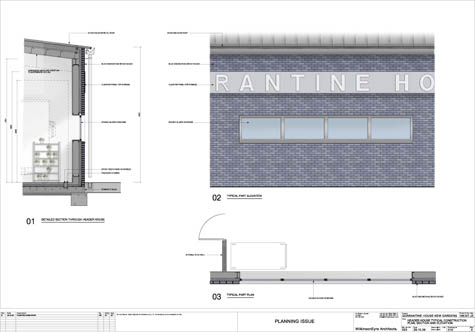
[Image: Proposed façade for the new Quarantine House at Kew, courtesy of Wilkinson Eyre architects].

Edible Geography: Where does the innovation and experimentation in quarantine design take place, if not in designing a new facility?

Redstone: That’s the problem—it doesn’t. It’s the kind of thing that somebody somewhere should do so that we can test new systems. The trouble is that resources are usually limited in this area and facilities tend to be expensive both to build and operate well. Usually you can’t afford to experiment.

We do test our systems once they’re in place, of course. With the steam-sterilization system that we’re planning to install, we’ll be regularly inoculating it with particular organisms and then testing the processed material to make sure it works. It’s simple, but it’s effective.

I’ll show you the plans as they stand now. [unfolds plans] In the scheme as it stands, we have a reception area which will receive all plant material that comes into Kew: seeds, bulbs, shrubs, trees, everything—whether it’s from the EU or not.
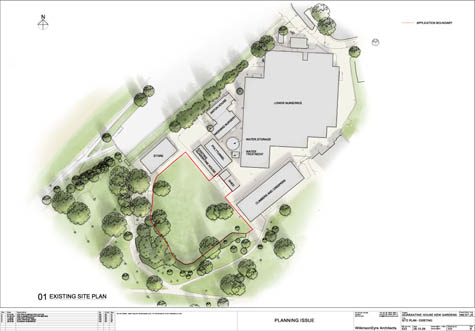
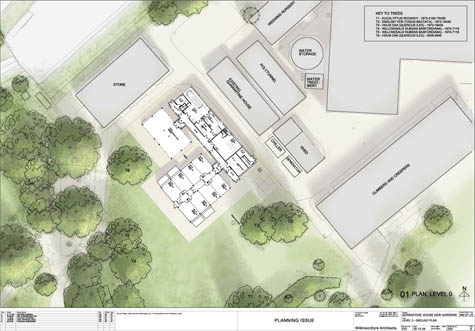
[Images: Site plan for the new Quarantine House at Kew, showing the proposed site (marked with red, top) and the proposed floor plan of the new structure (bottom). Courtesy of Wilkinson Eyre].

Edible Geography: What sort of volume is that?

Redstone: Kew receives, on average, between three to five and half thousand accessions a year, and an accession can be quite a large group of plants—it needn’t necessarily be a single plant, if they’re all genetically identical.

The material will then be processed via the inspection area and then either go into the licensed facility (medium and high containment pods) or into the unlicensed large specimen store. The large specimen store’s primary function is to enable us to hold, monitor and, if necessary, treat or destroy trees, shrubs and other plants originating from within the UK and EU.

The large specimen store is basically what we call a high hat. It has a solid roof, which can be shaded, and insect-proof sides. The insect-proofing is aphid proof, so it’s not particularly small—it’s around the 1mm² mark.

Adjoining the store will be the licensed quarantine facility, which will be split in two: high containment and medium containment. Both spaces will be governed by the licence issued by DEFRA. Both units have air cooling—though they each use a different cooling method—and they’re going to be kept at negative air pressure.

We also have to build in systems to allow for a failure in the power supply. As we’re on the edge of a flood risk zone, the building itself will sit on top of a concrete raft and the plants will be on benches. That will give us quite a lot of leeway as far as any risk from flooding goes. As added protection we also intend to have slots at the doorways; we can then put in barriers and reinforce them with sandbags, in the case of a serious flood. I also want to have an operating procedure that says, if we get advanced warning that there’s going to be a really catastrophic flood event, we’ll load everything in the incinerator and destroy it. Frankly, if that happens, most of London is going to be completely stuffed—so there’ll be bigger problems to deal with!

At the entrance to the licenced area, we’re putting in a cold lobby. It will be kept at 0ºC and it will have a freezer for lab coats. People will put on lab coats before they go into the medium and high containment areas and put them back in the freezer when they come out, where the coats will be sterilized. There will also be an air-circulation fan so that, if anything like seeds or pollen has got stuck to people, it will be blown off into the cold.
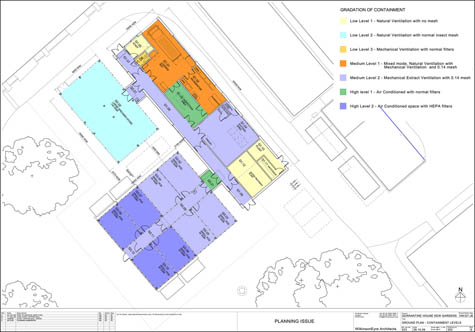
[Image: “Gradations of Containment” in the proposed floor plan for the new Quarantine House at Kew, courtesy of Wilkinson Eyre].

Edible Geography: Will there be chemical showers as well?

Redstone: No, that would be considered excessive, to be honest. It’s all about assessing and managing risk proportionately. We’re not a research facility raising pests or diseases for experimentation, so the risks are somewhat less. We have an emergency shower in case somebody’s been contaminated, during pesticide spraying, for example, but our working procedures and precautions like the cold lobby and freezing of lab coats should provide the appropriate level of bio-security.

At every stage, we’re assessing and trying to minimise risk. If we received particularly precious seeds that I thought might harbour a problem, what I would look to do is send them to the seed bank so that they can X-ray them and we can weed out the bad guys straight away, to be destroyed. We also use external treatments – for example, peroxide or other chemicals. Apart from anything else, peroxide is great because it can help trigger germination and is biodegradable.

With everything, you have to give it a bit of thought first. Which is why we say to staff, for goodness sake, please don’t turn up on the doorstep with plant material. We need advance notice so we can risk assess the material.

Other parts of the facility include the loading bay, where there’ll be some storage, the incinerator area, and the inspection bay.
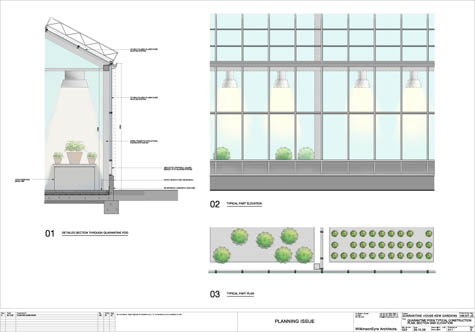
[Image: Wall detail and section of the new Quarantine House at Kew, courtesy of Wilkinson Eyre].

BLDGBLOG: What do you do with the output from the incinerator?

Redstone: The ashes are usually incorporated into the soil heap. It doesn’t go into the compost because it blows around; instead, we usually dig it into the soil piles, so it doesn’t go to waste and it is recycled.

The facility also includes a potting area, which contains a small chemical store and a water-treatment area. And there are going to be insectocutors everywhere!

One important design feature is that the plant room is entirely separate, so that the only way people can enter is through that external door. This means that anyone coming to do maintenance on the electrics or whatever doesn’t have to go through any of the quarantine procedures, because they don’t have access to any other part of the building. It’s human nature to prop open the door if you’re feeling warm—but that sort of thing just can’t be allowed to happen inside the licenced areas.

Edible Geography: How will the temperature-control system work?

Redstone: For the individual zones within the greenhouse, each “pod” will have its own small unit climate control panel on the outside of the house, which will control air circulation, fans, and fogging. We’re going to use fogging not just to control relative humidity, but also, in part, to control temperature gain. It’s quite an effective way of modifying the temperature without huge energy input. And we’re going to use external shading—rollers in tracks—because that’s more efficient than internal shading. Although this is the UK, you may be shocked to hear that heat is the biggest problem we have in maintaining the right kind of environment for our glasshouses.

There’s going to be limited lighting because we’ll be either propagating material or maintaining material—we’re not trying to promote lush growth. There will also be a central computer that controls all the zones, and my intention with the new one is to have direct access from my mobile phone and home computer.

One of the intentions with the new building is to minimize energy costs as much as possible. The building also needs to be capable of being operated by only a few staff—it mustn’t be labor or energy intensive!

For plants that have really critical temperature requirements at the lower end of the spectrum—for example, we had some orchids in from Patagonia—it’s hard to provide those kind of environmental requirements reliably through a glasshouse system. So what we’re going to use is a couple of growth cabinets with lighting, because we feel that’s the most cost-effective solution to that particular headache. We’re also hoping to use rainwater harvesting for part of our irrigation system, and we’re trying to use the most energy-efficient materials.

One of the vendors we’re considering makes quarantine houses using curved polycarbonate sheets. You get a lot of lengthways expansion with polycarbonate sheets, and the curve helps accommodate the expansion and contraction, while maintaining a really good seal. The other thing I like is that we can pump air through a cold water spray and then actually circulate it up and over the curve of the structure, which can give a much more even temperature regime across the bays.
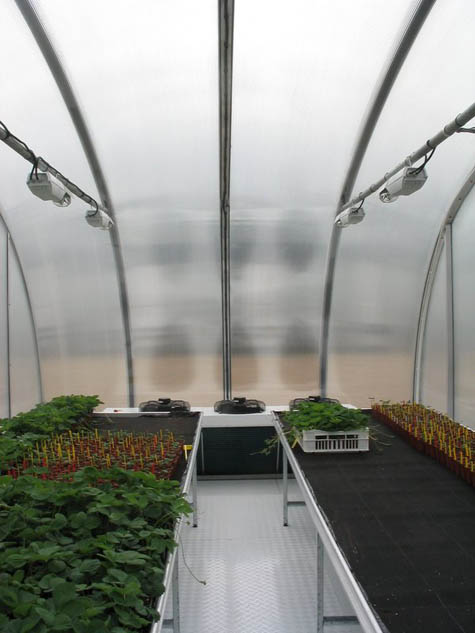
[Image: Curved polycarbonate sheets for glasshouse construction, courtesy Unigro].

BLDGBLOG: I see the facility has been designed by Wilkinson Eyre. How is working with them going?

Redstone: Well, the design isn’t finished yet. The final version will be designed and built within the restrictions we’ve incorporated—we are really getting into this now, I think. It’s quite different from anything else they’ve done and the combination of very specific needs, with a lack of specific technical guidelines, makes it a challenging and interesting exercise. We want the building to look attractive, but containment and functionality are its key priorities.

The other interesting design feature is that there’s a five-meter exclusion zone around the building—a completely solid surface with no plant material. We arrived at that measurement through discussion with the Plant Health and Safety Inspectorate, and it’s important to have a clearly marked exclusion zone. Although the old quarantine building began its life being relatively isolated, pressure to use every available square metre of behind-the-scenes space for support activities at Kew means this is no longer the case. We’ve located the new building so we can make use of some of the existing roadway as exclusion. That way we’re not wasting space, and we’re closer to some of the services.

This particular layout also enables us to add on another block, if we need to in the future.
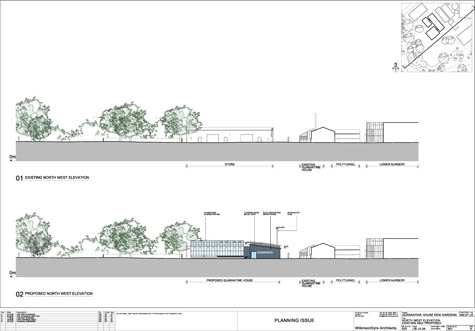
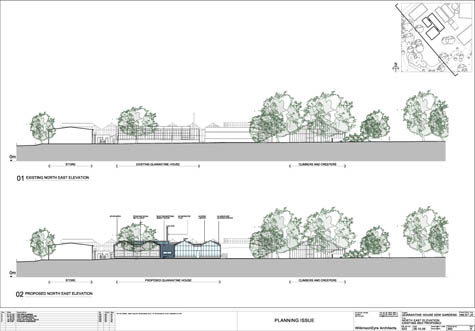
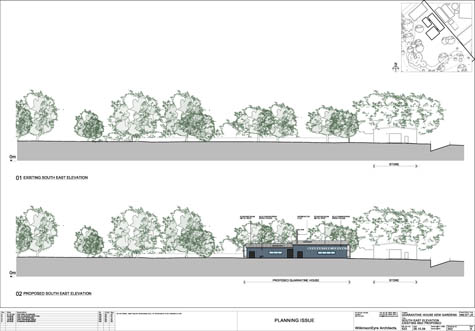
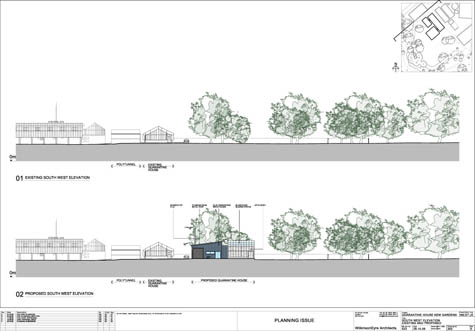
[Images: Proposed elevations—from the NW, NE, SE, and SW—of the new Quarantine House at Kew, courtesy of Wilkinson Eyre].

Edible Geography: How many plant pest & disease quarantine facilities are there in the UK?

Redstone: A lot of universities have small quarantine facilities, often used for GMO work or raising pests & diseases rather than specifically quarantining plants. Rothamsted have a really excellent facility for experimental work. Central Science Labs at the FERA headquarters in York also have quarantine facilities.

Edible Geography: Does the Royal Horticultural Society have one?

Redstone: No, not that I’m aware of. The National Trust doesn’t have specific quarantine facilities either—although, having said that, they have been working very hard on biosecurity issues, triggered, as they will tell you, by outbreaks of Sudden Oak Death in their collections in the West Country. They have taken stock of the situation and realized that they, like many organizations across the UK, needed to improve current practices. I think it says a lot for the organization that they have been so open and self-critical.

The head of this program for the National Trust is Ian Wright, a head gardener from a Trust property in Cornwall. He realized that through lack of resources, budget challenges, and other difficulties, we’ve moved away from basic good practices: cleaning your materials, cleaning your boots, sterilizing your blades, all those kind of things. For example, if you bring in new plants, you should keep them isolated for a period of time, just to make sure they’re clean—but we seem to have lost a lot of those good habits.

So Ian has worked with David Slawson from FERA to produce a lot of information, as well as posters like this. [unfolds poster] These would go up inside potting sheds, to remind people that quarantine doesn’t have to be fancy. It can be something as simple as a poly-tunnel, or an area behind a shed, where you keep things separate. Containment can be as simple as remembering to wash your boots and wash your hands—basic good hygiene.

In fact, one of the things that we’ve been encouraged to think about by DEFRA is providing a limited commercial service, because there are so few plant quarantine facilities in the UK. This new quarantine facility at RBG Kew will be quite a major one, relative to what’s available in the UK. The thing I’m really excited about is the fact that we’ll have the capacity to control more tightly the stuff that comes in from the European Union and around the UK. That’s increasingly important.
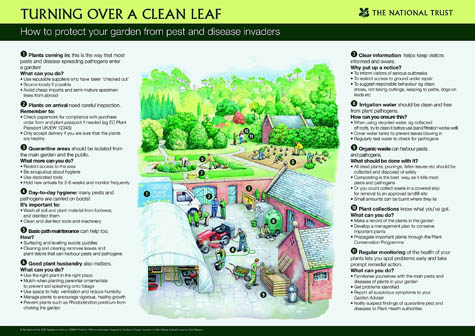
[Image: The National Trust’s “Clean Leaf” plant quarantine poster].

Edible Geography: Did you have any qualms about the decision to locate such a major quarantine facility in the middle of one of the world’s greatest collections of rare and valuable plants?

Redstone: We are in a vulnerable location, in a number of ways. We’ve done a major environmental impact assessment, and even looked at the option of having it off-site, but that in itself created major problems. One of the real issues is that it’s not enough just to have the building; you have to have the human resource.

It also makes sense to have a quarantine facility where the movement occurs. We’re not just accessioning new plant material—we’re also doing quite a bit of repatriation. I think it’s really important that we should be able to return safe material to its country of origin, especially if it’s seriously endangered or on the verge of extinction. We have to be able to hold our hand on our heart and say, “It’s clean, there are no problems, and your only challenge will be making sure it grows and that something doesn’t eat it or squash it.”

It’s not just for stuff coming in—it’s for stuff we’re sending out that quarantine is crucial, too.

BLDGBLOG: How do you interact with the Millennium Seed Bank? Do you quarantine seeds for them?

Redstone: No, they have a quarantine area in their own lab for seed material. However, if they want to grow any controlled or prohibited seeds—for verification by herbarium staff, for example—then that has to be done within our facility. So they can examine seeds, but if they want to germinate them and grow them on, then they have to come here.
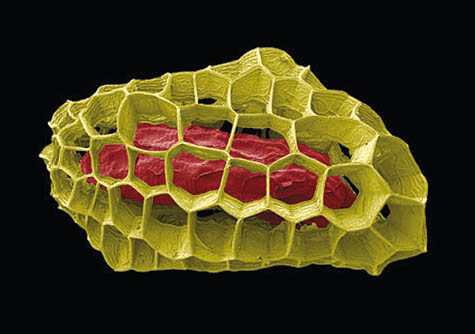

[Image: Electron micrograph images of seeds. (top) Lamourouxia viscosa; (bottom) Franklin’s sandwort, conserved at Kew’s Millennium Seed Bank. Photographs by Rob Kesseler and Madeline Harley, via the The Guardian].

Edible Geography: You mentioned that, in the UK, there isn’t a system where the government gives you the approved quarantine facility plans and you follow them to the letter. How can you be sure your design will qualify for the appropriate license?

Redstone: Well, that’s the case for plant quarantine—the system for GMOs is very different, and I don’t know how animal quarantine operates. In our case, I have constant contact with my colleagues in FERA who will be involved in evaluating the new build plans. If they have an issue with a particular system, they’ll let me know.

For example, I had an inspector on site yesterday who asked, “Have you thought about the door seals? I know that these are really good doors but, to get a good seal, what you want is a little up-stand at the bottom of the door for the seal to butt up against.” It’s all sorts of small details like that.

The difficulty with the project from my point of view has been to make sure it gets enough time and attention now—because I know that if I’m still here when it gets built, my ongoing sanity is going to rely on having made the right choices so that we can physically manage the building. I think that, for projects that are very specialized, like this one, the people who are going to use the buildings often don’t get enough time to actually sit and evaluate what the building needs to do.

Edible Geography: Just writing the brief for it must have been quite a challenge!

Redstone: To say the least. Version 10 got issued about three weeks ago. My biggest worry is that I’ve missed something. There’s just no wriggle room.

Edible Geography: Did you take any of your ideas for your plan from other facilities that you’ve seen?

Redstone Yes. I actually persuaded them to employ a colleague from Rothamsted, Julian Franklin, as a consultant. He is a major quarantine nerd—not only is he really knowledgeable about the plant side of things, but he’s obsessed by technology, so he can tell you that so-and-so needs to be at this many atmospheres, or amps, or whatever. He’s been a real find.

In fact, one of the risks of a project like this is that there are very few experts around—and, especially in the current climate, there are lots of companies who are desperate for work who may claim expertise they don’t really have.

BLDGBLOG: You said you need to avoid innovation at all costs, but is there any aspect of the facility that will be genuinely new or unprecedented?

Redstone:: Nobody’s built a screening house quite like ours, I don’t think, but it’s really just an adaptation of things that we’ve seen done elsewhere. Ultimately, it will all be technology that’s been used elsewhere, but perhaps not in quite the same way. Other facilities have air showers, for example, but most of those haven’t also had a cold lobby. We are combining things—but we’re also trying to play safe.
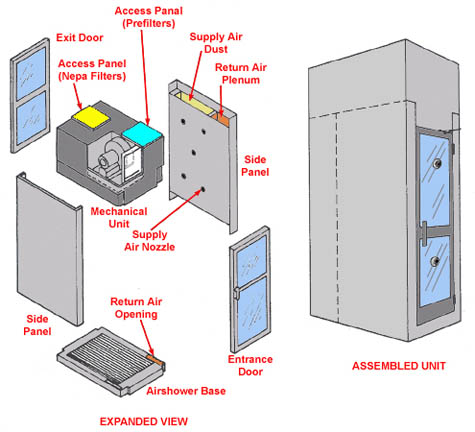
[Image: Air Shower diagram, via the U.S. Occupational Health and Safety Administration (OSHA)].

Edible Geography: What is the old quarantine facility like—and what will happen to it once the new building is completed?

Sara Redstone: It’s a modified commercial glasshouse, about twenty-five years old. It wasn’t specifically designed as a quarantine house: it has no automatic shading, and controlling the internal climates reliably can be a challenge. The water here is very hard, as well, so the building has had a lot of issues with equipment.

The new facility should be operational by late autumn 2010. This time next year, we’ll be thinking about doing the smoke tests and the pressure tests and so on. And once stuff has been screened in the new facility, it will go into the old house and be held there for short periods of time until it goes onward to the display houses.
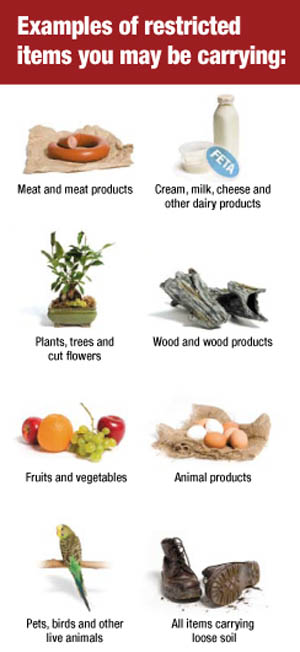
[Image: A fairly standard list of materials that must be declared at the border and potentially quarantined to prevent the import of pests and diseases; this particular brochure is Canadian].

BLDGBLOG: I’m also curious about what happens off-site—for instance, if there is an outbreak somewhere in the Midlands or up in Yorkshire, do you have a field quarantine unit of some sort who can rush out and seal the place off in situ?

Redstone: Not yet, that I know of. You’d need to talk to DEFRA and the Non-Native Species Secretariat who monitor and deal with invasive alien species, or IAS. There is a working group working on developing a protocol for a rapid response against non-native species—NNS—but I’m not sure if they have agreed the way forward.

If the outbreak relates to plants then you’d have to notify—depending on what the host and pest or disease is—either FERA or the Forestry Commission. If the organism isn’t quarantine-listed, then a pest risk analysis (PRA) and other detailed work may be required, and this can take some time to do thoroughly. Depending on where the outbreak is and what it is, there’s then also the need to identify who will attempt to eradicate it and how—and where the resources will come from.

What we really need to do is make everybody aware of the dangers of moving plants. It doesn’t matter if you’re a business or an individual.

I had a person tell me recently that they deliberately altered their suitcase so that they could bring back cuttings from their holidays overseas without being detected. People get very confessional—when they hear what my job is, they have this urge to tell me about all of the plant material they’ve brought through customs without declaring, or all of the farms they visited overseas and didn’t mention on their immigration forms. It’s my worst nightmare.

There have been outbreaks of quite serious pest problems in botanic gardens and plant collections. These have probably, according to the experts at FERA, been the result of things like exotic flower arrangements or of bringing in fruits from around the world to explain to children about plants. Those routes need to be cut off, as well.

Individuals can sometimes be ignorant of the impact they could have by smuggling—in fact, sometimes they don’t even realize that they are smuggling—plant material into and out of the country. We’ve got a bit of money as part of the project to actually do some interpretation on site. I’m hoping that we can do quite a lot to explain to people the risks of moving plant material, and the impact of plant pests and diseases, by having signage in the display houses and in public areas on site.

For example, did you realize that there’s a risk, when you’re moving plants that have soil around the roots, of introducing a pest called the small hive beetle, which can eradicate honeybees? Bees are getting a lot of press at the moment—for very good reason—and so one of the things I’m hoping we can do is use that sort of example to show that the consequences when you smuggle that plant back from your holiday, or when you bring back a jar of local honey, or wax candles, or a wooden sculpture, may be more far reaching than you realize.

If you put things in context, most people are responsible enough not to flout the rules—I hope. We’re all in this together—we all share the same planet.

• • •

This autumn in New York City, Edible Geography and BLDGBLOG have teamed up to lead an 8-week design studio focusing on the spatial implications of quarantine; you can read more about it here. For our studio participants, we have been assembling a coursepack full of original content and interviews—but we decided that we should make this material available to everyone so that even those people who are not in New York City, and not enrolled in the quarantine studio, can follow along, offer commentary, and even be inspired to pursue projects of their own.

For other interviews in our quarantine series, check out Until Proven Safe: An Interview with Krista Maglen, One Million Years of Isolation: An interview with Abraham Van Luik, Isolation or Quarantine: An Interview with Dr. Georges Benjamin, Extraordinary Engineering Controls: An Interview with Jonathan Richmond, On the Other Side of Arrival: An Interview with David Barnes, The Last Town on Earth: An Interview with Thomas Mullen, and Biology at the Border: An Interview with Alison Bashford.

More interviews are forthcoming.
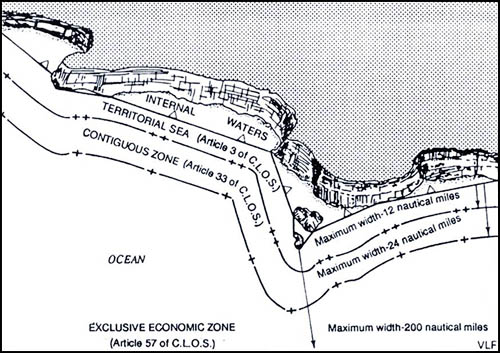
California City

[Image: Geoglyphs of nowhere].

In the desert 100 miles northeast of Los Angeles is a suburb abandoned in advance of itself—the unfinished extension of a place called California City. Visible from above now are a series of badly paved streets carved into the dust and gravel, like some peculiarly American response to the Nazca Lines (or even the labyrinth at Chartres cathedral). The uninhabited street plan has become an abstract geoglyph—unintentional land art visible from airplanes—not a thriving community at all.

Take a look.

[Image: Empty streets from above, rotated 90º (north is to the right)].
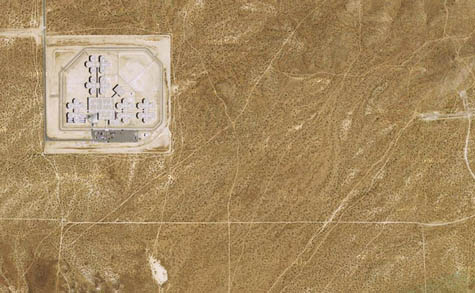
On Google Street View, distant structures like McMansions can be made out here and there amidst the ghost-grid, mirages of suburbia in the middle of nowhere.

And it’s a weird geography: two of the most prominent nearby landmarks include a prison—

[Image: The geometry of incarceration].
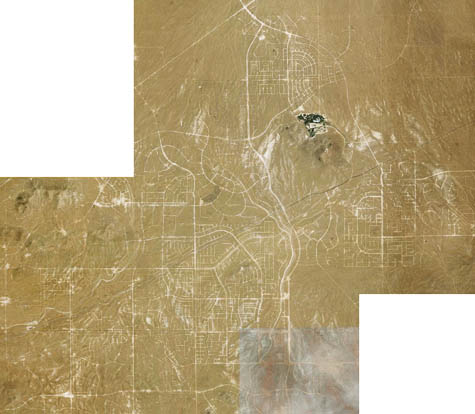
—and an automobile test-driving facility run by Honda. There is also a visually spectacular boron mine to the southeast—it’s the largest open-pit mine in California, according to the Center for Land Use Interpretation—and an Air Force base.

To make things slightly more surreal, in an attempt to boost its economic fortunes, California City hired actor Erik Estrada, of CHiPs fame, to act as the town’s media spokesperson.

[Image: Spatial fossils of the 20th century].
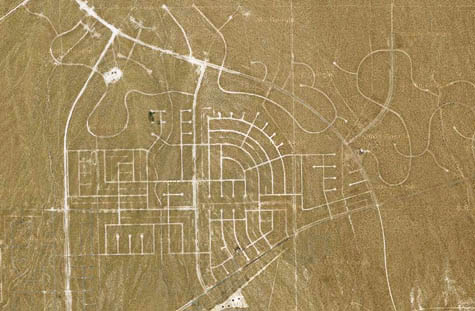
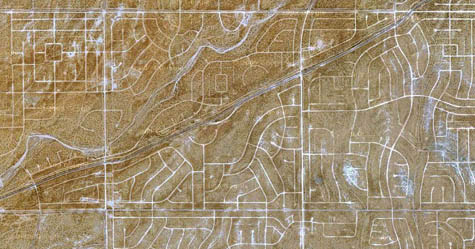
The history of the town itself is of a failed Californian utopia—in fact, incredibly, if completed, it was intended to rival Los Angeles. From the city’s Wikipedia entry:

California City had its origins in 1958 when real estate developer and sociology professor Nat Mendelsohn purchased 80,000 acres (320 km2) of Mojave Desert land with the aim of master-planning California’s next great city. He designed his model city, which he hoped would one day rival Los Angeles in size, around a Central Park with a 26-acre (11 ha) artificial lake. Growth did not happen anywhere close to what he expected. To this day a vast grid of crumbling paved roads, scarring vast stretches of the Mojave desert, intended to lay out residential blocks, extends well beyond the developed area of the city. A single look at satellite photos shows the extent of the scarred desert and how it stakes its claim to being California’s 3rd largest geographic city, 34th largest in the US. California City was incorporated in 1965.

I can see an amazing article being written about this place for GOOD magazine —”California and its Utopias,” say—or The New Yorker, or, for that matter, Atlas Obscura. The large-scale spatial remnants of an economic downturn, decades in advance of today’s recession.

[Images: Zooming in on the derelict grid].
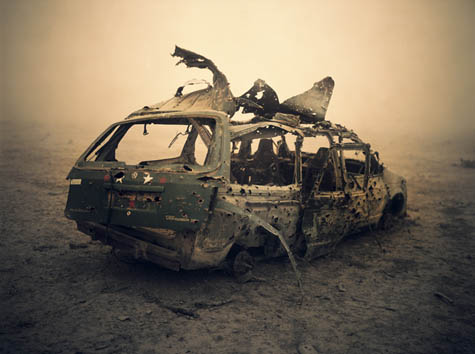
Either way, and with any luck, a road trip out through the deserted inscriptions of this forgotten masterplan will hopefully beckon once BLDGBLOG moves back to Los Angeles.

(California City was pointed out to me a very long time ago by a BLDGBLOG reader—whose original email I can no longer find. If it was you who pointed this out to me, I owe you a huge thanks! David Donald—who also pointed out that California City was written up by The Vigorous North last year).

The Fall

Photographer Richard Mosse, interviewed here on BLDGBLOG earlier this year, has a show opening up tonight in New York City: The Fall.

[Image: Richard Mosse, “Grand Voyager Sunni Triangle” (2009), courtesy of the Jack Shainman Gallery].

For the past year, Mosse has been traveling the world on a Leonore Annenberg Fellowship, documenting distant sites of aviation wreckage, war ruins, and more. From Iraqi battlefields and ruined palaces to bullet-riddled trucks and disaster-preparation test-landscapes, his new exhibition, The Fall, “is a photographic survey of our historic unconscious,” the gallery explains.

Mosse travelled to intensely remote locations, from the Patagonian Andes to the Yukon Territories, and worked as an embed with the US military to produce work for this exhibition. The Fall is a rescue mission to try to locate our blasted sense of landscape and archeology, and reclaim the primeval waste for our imagination. Produced to an epic scale, each of the photographs in The Fall is a history painting for our times.

The exhibition will be up until December 23, 2009, at the Jack Shainman Gallery, and is highly recommended; here’s a map of how to get there.

[Image: Richard Mosse, “C-47 Alberta” (2009), courtesy of the Jack Shainman Gallery].

One Million Years of Isolation: An Interview with Abraham Van Luik

[Image: Yucca Mountain, Nevada; courtesy of the U.S. Department of Energy].

Abraham Van Luik is a geoscientist with the U.S. Department of Energy; he is currently based at the nuclear waste-entombment site proposed for Yucca Mountain, Nevada. Yucca Mountain, a massive landform created by an extinct supervolcano inside what is now Nellis Air Force Base’s Nevada Test and Training Range, 90 miles northwest of Las Vegas, is the controversial site chosen by Congress for the storage of nuclear waste. Its political fate remains uncertain. Although the Obama Administration has stated that Yucca Mountain is “no longer… an option for storing nuclear waste,” Congress has since voted to continue funding the project—albeit only with enough funds to allow the licensing process to continue.

[Image: Resembling some new breed of Stargate emerging from the Earth, the tunnel-boring machine at Yucca Mountain reaches daylight; view larger! Courtesy of the Department of Energy].

As part of our ongoing series of quarantine-themed interviews, Nicola Twilley of Edible Geography and I spoke to Van Luik about the technical nature of nuclear waste storage and what it means, on the level of geological engineering, to quarantine a hazardous material for more than one million years.

• • •

BLDGBLOG: How did you start designing a project like Yucca Mountain, when you’re dealing with such enormous timescales and geological complexity?

Abraham Van Luik: You start with a question: how do you perceive the need to isolate a material from the environment?

I think most people would begin to answer that by looking at the nature of the material. Wherever that material is currently, we make sure that there is either a thick wall or a deep layer of water to protect the people working around it. That’s what’s being done at a reactor: when spent fuel comes out of a reactor, it’s taken out remotely with no one present, and put into a water basin that’s deep enough that there is no radioactive shine from the spent fuel escaping out of that water. If the pool is getting full, after five years or so of cooling, then the utility company will take the material out of the pool—remotely manipulated from behind leaded-glass windows—and put it into dry storage. Dry storage uses very thick steel and concrete. And there it will sit until someone disposes of it, or until it’s reprocessed.

Now, in most countries, what they have done next is asked: What geology would be very good for isolating this material from the environment? And what geologies are available in our country? The Swedes have gone to their granites, because their whole country is basically underlain by granites. The French looked at granites, salts, and clay, and decided to go with clay. The Belgians and Dutch are looking at clay and salts; and the Germans are looking at salts right now, but also at granites and clay. The Swiss are looking at clay, mostly, although they did look at crystalline rock—meaning rock with large crystals, like granite, gabbros, and that kind of thing. But they decided that, in their particular instance—since the Alps are still growing and slopes are not all that stable over hundreds of thousands of years—to look instead at their deep basins of clays close to the Rhine River as a repository location. We’re all looking to isolate this material for about a million years.

In the U.S. we did a sweep of the country, looked at all the available geologies, and we decided that we had many possible sites. We investigated some, which basically involved looking at what we knew from geological surveys of the states, and then we made a recommendation to go look at three of the possibilities in greater detail. There was then a decision process: it went from nine sites, to five, to three.

At that point, Congress stepped in. They started looking at the huge bills associated with site-specific studies—excavation is not cheap—and they said: let’s just do one site and see if it’s suitable. If it is not, then we’ll go back and see what else we can do.

So that’s how Yucca Mountain, basically, was selected. It was a cost-saving measure over the other two that were in the running for a repository. Those were a bedded salt site in Texas and a basalt site—a deep volcanic rock site—in Washington State.

But all three were looked at, and all three were judged to be equally safe for the first 10,000 years—which, at that time, was the regulation. Since the selection of Yucca Mountain, the regulation has been bumped up to a million years, which is pretty much where the rest of the world is looking: a million years of isolation.

[Images: Views inside the tunnels of Yucca Mountain; top photo by Rick Gunn for the Associated Press].

Now, the reason that you want to isolate this material for a million years is that the spent fuel—meaning fuel that no longer supports the chain reaction that keeps reactors making electricity—contains actinides. These are metal elements, from 90 to 103 on the Periodic Table, most of which are heavier than uranium (which is 92). Actinides are generally very slow to radioactively decay into smaller atoms—which then decay more rapidly—and some of the actinides actually do remain hazardous for a million years and beyond. The trick is to isolate them for that length of time.

At Yucca Mountain we took the attitude that, since we basically have a dry mountain in a dry area with very little rainfall, we would use a material that can stand up to oxygen being present. The material we selected was a metal alloy called Alloy 22. Our design involves basically wrapping the stainless steel packages, in which we would receive the spent fuel, in Alloy 22 and sticking them inside this mountain with a layer of air over the top. What we know is that when water moves through rock or fractured materials, it tends to stay in the rock rather than fall—unless that rock is saturated. Yucca Mountain is unsaturated, so water ought not be a major issue for us at Yucca Mountain—yet it is.

We have to worry about future climates, because, right now in Nevada, we are in a nine year drought—and, basically since the last Ice Age, we have been in a 10,000-year drought. 80% of the time, if we look a million years into the past, we have, on average, twice the precipitation we have now. Most of the past is—and the future will be—wetter and cooler. Which is nice for Nevada! [laughs]

In any case, we tried to take advantage of the natural setting, as well as take advantage of a metal that stands up very well to oxidizing conditions. That is how, in our safety analyses, we showed that we are basically safe for well beyond a million years—if we do exactly what we said we would do in that analysis.

[Image: An engineer stands inside one of the tunnels in Yucca Mountain; courtesy of the Department of Energy].

Other countries have decided not to go in a similar direction to us. The only other country that’s contemplating a similar repository to ours is Mexico. All the other countries in the world are looking at constructing something that is very deep—and under the water table. If you go under the water table deep enough, there is no oxygen in the water, and if there is no oxygen than the solubility of a sizable number of the radionuclides is a non-problem. Many are just not soluble unless there is oxygen in the water.

Going that deep then allows those countries to use a different set of materials, ones that last a long time when there is no oxygen present. For example, the Swedes are using granite—so are the Finns, by the way, and the Canadians, though the Canadians might decide to go for clays. With the granites, the older they are, the more fractured they are, and they can’t predict a million years into the future where the fracture zones are going to be. So they have chosen a copper container for their spent fuel; copper is thermodynamically stable in granite. In fact, copper deposits naturally occur in granite. They then wrap a very thick layer of bentonite clay around the container, which they put in dry. When that clay gets wet, as it will do eventually, it expands. When there is a fracture zone that is created by nature, the clay will basically decompress itself a little bit, fill the fracture zone, and you will still have a lot of protection from that clay layer. It’s a similar set up with salt or clay repositories, they eventually close up against the waste packages. Nothing moves through clay or salt very rapidly.

Those are basically the three rock types that the whole world is looking at in terms of repositories.

So you can rely more on the engineered system or more on the natural system. Either way, it’s the combination of the two systems that allows you to predict, with relative security, that you’re going to isolate a material for well over a million years. By that time, the natural decay of the material that you’ve hidden away has pretty much taken care of most of the risk. In fact, by about half a million years, most of the spent fuel is less radioactive than the ore from which it was created. That’s a wonderful argument—but the spent fuel still isn’t safe at that point. You still need to continue to isolate it, just as you don’t want to live on top of uranium ore, either. It’s a dangerous material.

In a nutshell, that’s our philosophy of containment.

[Image: Yucca Mountain diagrammed; courtesy of the Department of Energy].

BLDGBLOG: I’m interested in how you go about testing these sorts of designs. Do you actually build scale models, like the U.S. Army Corps of Engineers’ hydrological models, or do you rely on lab tests and computer simulations, given the timescale and complexity?

Van Luik: What we do is safety assessments that project safety out to a million years. What I used to say to my troops, when I was a manager of this activity, was: “Safety assessment without any underlying science is like a confession in church without a sin: without the one, you have nothing to say in the other.”

To collect the science needed to make credible projections of system safety, we have dug several miles of tunnels under this mountain; we’ve done lots of testing of how water can move through this mountain, if there was more water; and we’ve done testing of coupons of the materials that we want to use. These tests were performed using solutions, temperature ranges, and oxygen concentrations that we think are representative over the whole range of what can be reasonably expected at Yucca Mountain. Those kinds of physical tests we have done.

We have also utilized information from people who have taken spent fuel apart in some of our national laboratories and subjected it to leaching tests to see how it dissolves, how fast it dissolves, and what dissolves out of it. We have done all of that kind of testing, and that’s what forms the basis for our computer modeling.

One thing we have not done, and can’t do, is a mock-up of Yucca Mountain. It just doesn’t work that way. It’s too complicated, too large, and too long a time-scale.

[Image: Yucca Mountain, courtesy of Wikipedia].

In compensation for that spatial- and time-scale difficulty, what we have done is looked for similar localities with uranium deposits in them, like Peña Blanca, Mexico, just north of Chihuahua City. There, we have rock very similar to Yucca Mountain’s rock, and we have probably a 30-million year old uranium deposit—quite a rich one—that was going to be mined until the price of uranium dropped considerably. We’ve studied that piece of real estate—it has roughly similar rock, sitting under similar conditions except for more summer rainfall—and we’ve looked at the movement of radioactivity from that ore body. From that we’ve gained confidence that our computer modeling can pretty much mimic what was seen at that uranium site.

We’ve looked for natural analogues of other possible conditions—for example, the climate at Yucca Mountain during an ice age. We’ve studied six or seven sites that mimic what we would see during a climate change here.

And, in terms of materials, there are some naturally occurring materials that have a passive coating on them. We’ve studied metals found in nature that are similar in the way they act to the metals that we are using for our waste packages.

So we have gone basically all through nature looking for analogous processes—but none are exact matches for Yucca Mountain. It’s going to need something more unique than that. I think the same is true for every other repository being contemplated.

We have worked in cooperation with fourteen other countries through the European Commission’s Research Directorate in Brussels, and the Nuclear Energy Agency in Paris, to compare notes on natural analogues and discuss what is useful and what is not for which concept. All these countries are doing the same kind of thing: looking at natural occurrences that are hundreds of thousands, if not hundreds of millions, of years old.

In some cases, the natural analogues we’ve studied are billions of years old. We’ve looked at the Oklo mining district in Gabon, Africa. We studied several occurrences in that mining district where, for the last few million years, ore bodies have been subjected to oxidizing conditions, because uplift of the land brought them above the water table. We’ve looked at these natural reactor zones, which were active two billion years ago when the earth was much more radioactive than it is now, to see what we could learn about the movement of radioactivity in an oxidizing zone. We can use that data for corroborating the modeling of Yucca Mountain.

On top of all that, we have the problem of unlikely volcanic events, as well as strong earth motions from equally unlikely seismic events, at Yucca Mountain. These are problems you won’t have at most of the other repository sites being considered in the world. To study that, we brought in expert groups with their own insights and models to evaluate what the chances are, from a risk perspective, of a volcanic event actually interrupting or disrupting the repository. They also looked at the possibility of a very large ground motion adding stress and causing eventual failure of one or more of the waste packages. Although volcanic events are highly unlikely—as are very large ground-motion events—they must be factored into our analyses, based on the likelihood of their occurring over a one-million year time span.

We have basically done all safety-evaluation analyses from the perspective of the things that could happen, given the nature of this geologic setting. Looking at analogues for processes in nature has given us confidence that what we expect to see at Yucca Mountain is what we have seen nature produce elsewhere. These are indirect lines of evidence that support us—but we have also made a lot of direct measurements and observations, as well as testing in laboratories of materials and processes, to make sure that we’re on the right track.

The National Academy of Sciences has reviewed our research and our situation, and they’ve agreed that we have predictability for about a million years. That judgment influenced the EPA, who then gave us a standard for a million years.

[Image: “Coupons” of metal tested for their long-term weathering and resilience; courtesy of the Department of Energy].

BLDGBLOG: Could you discuss the material selection process in more detail? I’d like to hear how you found Alloy 22, for example. Also, when my wife and I visited Yucca Mountain a few years ago, we were given a black glass bead at the information center—what role does that glass play in the containment design? Finally, are the materials you’ve chosen specifically engineered for the nuclear industry, or are these simply pre-existing materials that happen to have the requisite properties for nuclear containment?

Van Luik: No, the materials are not specifically engineered for the purpose of nuclear containment.

Let’s look at Alloy 22 first. We looked at the whole range of what is commercially available, in terms of pure metals and metal alloys. We also looked at things like ceramic coatings. There are some very, very hard ceramic coatings that, for example, are used on bearings for locomotives. There are also ceramics that the military uses on projectiles to penetrate buildings. There are some very good ceramic materials out there, but we had a problem with the predictability of very, very long-term behavior in ceramics. That’s why we decided to go with a metal; a metal will fail by several different corrosion mechanisms, but not by the breakage that is typical of ceramics.

One of the things that the metals industry has been doing—for the paper-pulp industry, for example, which creates the worst possible chemical environment you can imagine—is that they have been developing more and more corrosion-resistant materials. One of the top of the line of these corrosion-resistant materials was Alloy 22. We tested it alongside about six other candidates in experiments where we dripped water on them, we soaked them in water, and we had them half in and out of water, with varying solutions that we tailored for what we would expect in the mountain over time. The one that stood out—the most reliable in all of these tests—was Alloy 22.

The black glass that you saw is not something that the waste is wrapped in. This material will be made at Hanford and maybe at Idaho, too—and at Savannah River they are making that black material right now. It’s an imitation volcanic glass—a borosilicate glass—in which radioactive materials are dispersed. Material would be released from that if the waste package breaks, and if the material is touched by water or even water vapor. It would then start to alter, and as it alters it would start to release the radioactivity inside. So what you and your wife were looking at was basically a glass waste-form. We don’t make it here—that’s how radioactive waste will be delivered to us from the Defense Department and Department of Energy. We will receive it in huge containers, not as beads.

We also have little pellets of imitation spent fuel, similar to pencil lead in color, to show visitors what the fuel rods look like inside of a reactor. The fuel rods are ceramic, coated on the outside with an alloy.

[Image: Nuclear fuel rods].

Edible Geography: Could you walk us through the planned process of loading the waste into the mountain, all the way up to the day you close the outer door?

Van Luik: Sure. The process, depending on whether Yucca Mountain ever goes through, politically speaking, will be as follows.

From the cooling pools or dry storage at the reactor, we’ve asked the nuclear utility companies to put their spent fuel—or waste—into containers that we have designed and that we will supply to them. The waste will be remotely taken out of whatever container it is in now, put into our containers, which are certified for shipping as well as disposal, and then we would slide those containers onto trains. We want to use mostly trains—we try to avoid truck use.

Rail shipping containers currently in use are massive—some approaching two-hundred tons fully loaded. The trains would bring the containers to us and then we would up-end them remotely and take the material out in a large open bay—all done remotely, again. If it comes in the shipping cask that we have provided, we will be able to put it directly into the Alloy 22 and stainless steel waste package and weld it shut. Then, with a transporter vehicle that’s also remotely operated, we would take it underground and place it end-on-end, lying down in our repository drifts. That’s what we call the tunnels; tunnels without an opening are called drifts. We would basically fill the drifts until we get to the entrance, put a door on, and then move on to the next one. That’s the basic scheme of how this would be done. Everything is shielded, of course, so that people are not exposed to radiation; workers are protected, as well as the public.

[Image: The “drifts” inside Yucca Mountain; view larger. Courtesy of the Department of Energy].

Edible Geography: How many containers could you fit inside a single drift, and how many drifts do you actually have in the mountain?

Van Luik: The drifts are each about 600 to 800 meters long. They vary a little bit, depending on where they are in the mountain. We will have 91 emplacement drifts—with an average of about 120 waste packages, set end-to-end, in each drift—to take care of the 70,000 metric tons that we are authorized to have. If we receive authorization to have more than 70,000 metric tonnes, then we’re prepared to go up to 125,000 metric tonnes of heavy metal. That metric tonnage figure doesn’t represent the total weight that goes into the mountain, by the way—it means that the containers have the equivalent of that many tonnes of uranium in them. In other words, 70,000 metric tons is about 11,000 containers that weigh about ten metric tons each, so it’s a huge amount of weight. Each container contributes a significant amount of weight in itself: the steel and the Alloy 22 are very heavy.

In terms of what the repository would look like, if built, it would be a series of open tunnels, one after the other, with a bridging tunnel that allows the freight to be brought in on rail. Everything is done remotely. The 40km of tunnels would all be filled up at some point, and then we would seal up the larger openings to the exterior, but leave everything else inside the mountain unsealed.

This is very different, by the way, from every other repository in the world, which would tightly compact material around the waste packages. We want to leave air around the waste packages, because of our situation. We have unsaturated water flow, rather than saturated flow, and as I’ve mentioned, water does not like to fall into air out of rock—it would rather stay in the rock, unless it’s saturated and under some degree of pressure (such as from the weight of water above it). So if we put something like bentonite clay around our packages, that would actually wick the water from the rock toward the waste packages—which is a silly thing to do if you’re trying to take advantage of an unsaturated condition.

[Image: An engineer uses ultraviolet light to analyze water-movement through rocks; courtesy of the Department of Energy].

Edible Geography: What process have you designed for sealing the exterior door? Does that also require a uniquely secure set of material and formal choices?

Van Luik: Sealing the repository wouldn’t happen for at least 100 years, so what we have done at this point is basically left that decision for the future. We have done a preliminary design, which uses a heavy concrete mixture—as well as rock rubble for a certain portion—to seal the exits from the main tunnel that goes around and feeds all the smaller tunnels.

The idea is that these openings have nothing to do with how the mountain itself functions, because the mountain is a vertical-flow system. Coming in from the sides, as we are, has nothing to do with how the water behaves in the repository, or with the containment system we’ve designed. So we just want to block the side exits and make it very difficult for someone to reenter the mountain—to the point where they would basically be much better off reentering it by drilling a whole new entryway beside one of the old ones that’s filled in.

Then there are going to be about seven vertical shafts for ventilation that will be sealed at the time of final closure. Those will be filled to mimic the hydrological properties of the rock around them; we don’t want them to become preferred pathways of water, because those will point directly into the repository.

So there are two different closure schemes for the two different types of openings: three large entryways that will be completely sealed off to prevent reentry, and seven ventilation shafts that will be filled with materials that have been engineered to mimic the hydrological properties of the rock around it.

[Image: A diagram of hypothetical water-movement around the waste packages at Yucca Mountain; courtesy of the Department of Energy].

Edible Geography: And the ventilation shafts are required because the material is so hot?

Van Luik: Yes. Once we put the waste in, we want to blow air over it by drawing in air from the bottom and blowing it out the top to take heat away until we shut off the vents for final closure. The idea is to take enough heat out of the system so that, when we close it, it doesn’t exceed our tolerances for temperature.

Edible Geography: Is there any chance that having such a large amount of heavy material at Yucca Mountain could actually pose a seismic risk for the region?

Van Luik: When we selected this particular location, we looked very carefully at faults. But you’re right: if you get beyond a certain amount of weight, as under a growing mountain range, you do start shifting things in the ground. If you build something right on a fault line you can probably change the frequency of vibration at that location, and maybe aggravate the earthquake that’s eventually going to happen.

However, even if we fill this repository to 125,000 metric tons, that is only something like .01% of the weight of the mountain itself. Plus, we are surrounded by two major faults, on both sides of the mountain, and even though there’s movement occasionally on those faults, the block in the middle—where Yucca Mountain sits—is like a boat, riding very steadily. It’s been like that for the past twelve million years, so we don’t see that it’s going to change in the future.

That said, we are in an area that’s moving all the time. The entire area now is moving slowly to the northwest, and the basin and range here is still growing—the distance between Salt Lake and Sacramento is already twice what it was twelve million years ago, and they will continue to be pulled apart. We’re well aware of the consequences of basin and range growth, and the possibility that the faults Yucca Mountain is sitting next to could be active again in the future. We factored that in. In fact, it’s those earthquakes that might actually lead to failures in the system that would allow something to come out before a million years—otherwise nothing would come out until beyond a million years.

But you can’t put enough weight in that mountain to change the tectonic regime in the area.

[Image: Future warning signs scattered across the Yucca Mountain site, part of “the monumental task of warning future generations“; courtesy of the Department of Energy].

BLDGBLOG: Of course, once you have sealed the site, you face the challenge of keeping it away from future human contact. How does one mark this location as a place precisely not to come to, for very distant future generations?

Van Luik: We have looked very closely at what WIPP is doing—the Waste Isolation Pilot Plant in New Mexico. They did a study with futurists and other people—sociologists and language specialists. They decided to come up with markers in seven languages, basically like a Rosetta Stone, with the idea that there will always be someone in the world who studies ancient languages, even 10,000 years from now, someone who will be able to resurrect what the meanings of these stelae are. They will basically say, “This is not a place of honor, don’t dig here, this is not good material,” etc.

What we have done is adapt that scheme to Yucca Mountain—but we have a different configuration. WIPP is on a flat surface, and their repository is very deep underground; we’re basically inside a mountain with no resources that anybody would want to go after. We will build large marker monuments, and also engrave these same types of warnings onto smaller pieces of rock and metal, and spread them around the area. When people pick them up, they will think, “Oh—let’s not go underground here.”

Now if people see these things and decide to go underground anyway, that becomes advertent, not inadvertent, intrusion—and we can’t protect against that, because there’s no way to control the future. All we’re worried about is warning people so that, if they do take some action that’s not in their best interest, they do so in the full knowledge of what they’re getting into. The markers that we’re trying to make will be massive, and they will be made of materials that will last a long time—but they’re just at the preliminary stage right now.

What I have been lobbying for with the international agencies, like the International Atomic Energy Agency and the Nuclear Energy Agency is that before anybody builds a repository, let’s have world agreement on the basics of a marker system for everybody. Whoever runs the future, tens of thousands of years from now, shouldn’t have to dig up one repository and see a completely different marker system somewhere else and then dig that up, too. They should be able to learn from one not to go to the others.

Of course, there’s also a little bit of fun involved here: what is the dominant species going to be in 10,000 years? And can you really mark something for a million years?

What we have looked at, basically, is marking things for at least 10,000 years—and hopefully it will last even longer. And if this information is important to whatever societies are around at that time, if they have any intelligence at all, they will renew these monuments.

[Image: Aerial view of Yucca Mountain; courtesy of the Department of Energy].

BLDGBLOG: What kinds of projects might you work on after Yucca Mountain? In other words, could you apply your skills and a similar design process to different containment projects, such as carbon sequestration?

Van Luik: I think so—if we ever get serious about carbon sequestration. I don’t know if you know this, but we laid off a lot of people here because there were budget cuts, and many of those people, because of the experience they had with modeling underground processes, are now working on carbon sequestration schemes for the energy sector and the Department of Energy.

No matter what happens to Yucca Mountain—whether it goes through or not—dealing with spent fuel and other nuclear waste will still be a problem, and that’s the charter that was given to our office. What I’m hoping is that, as soon as Yucca Mountain gets completely killed or gets the go-ahead, I can go back to what I loved doing in the past, which was to look at selecting sites for future repositories.

One repository won’t be enough for all time; it will be enough for maybe a hundred years, at the very most. You have to plan ahead. As long as you create the nuclear waste, you need to have a place to put it. Even if you reprocess it—even if you build fast reactors and basically burn the actinides into fission products so that they only have to be isolated for 500 years rather than a million—you still have to have a place to put that material. Even if we can build repositories less and less frequently, we will still be creating waste that needs to be isolated from the environment.

BLDGBLOG: You mentioned that your favorite pastime was looking for repository sites. If you had the pick of the earth, is there a location that you genuinely think is perfect for these types of repositories, and where might that location be?

Van Luik: My ideal repository location has changed over time. When I worked on crystalline rock, like granites, I thought crystalline rock was the cat’s meow. When I worked for a short time in salt, I thought salt was the perfect medium. Now that I have worked with the European countries and Japan for the past twenty-five years, learning of their studies of various repository locations, I’m beginning to think that claystone is probably the ideal medium.

In the U.S., I would go either to North or South Dakota and look for the Pierre Shale, where it grades into clay: there, you get the best of both worlds. I have been quoted by MSNBC, much to the chagrin of my bosses, saying that, if I were to get the pick of where we go next, that’s where I would go. They really didn’t like that—I was supposed to praise the Yucca Mountain site. But let’s get real: Yucca Mountain was chosen by Congress. We have shown that it’s safe, if we do what we say in terms of the engineered system. But it was not chosen to be the most optimal of all optimal sites, the site-comparison approach was taken off the table by Congress. As long as a chosen site and its system are safe, however, that is good enough.

Our predicted performance for Yucca Mountain, lined up to what the French are projecting for their repository in clay, and next to what the Swedes are projecting for their repository in granite, shows about the same outcome, over a million years, in terms of potential doses to a hypothetical individual. We’re safe as anybody can be—which is what our charter requires. We told Congress in 2002 that, yes, it can it be done safely here—but it’s going to cost you, and that cost is in Alloy 22 and stainless steel. Congress said OK and it became public law.

[Image: Map of repository sites across the United States; courtesy of the Department of Energy].

Edible Geography: Are any countries actually using their repositories yet?

Van Luik: They’re getting very close to licensing in Finland and Sweden. Those are going to be the first two. We have a firm site selection in France, which means that they’ll be going into licensing soon. Licensing takes several years in every country. In fact, we’re in licensing now, except we had a change of administration and they’ve decided that they really don’t want to do Yucca Mountain anymore. They want to do something else. They have every right to make those kind of policy decisions—so here we are.

No one is actually loading high-level waste or spent nuclear fuel into a repository yet. We have our own repository working with transuranic waste from the Defense program, in New Mexico, and both the Swedes and the Finns have medium-level waste sites, which are basically geological disposal sites, that have been active for over a decade.

The Swedes and Finns have a lot of experience building repositories underground, and their situation is interesting. The Swedes are building a repository under the Baltic Sea, but in granites that they can get to from dry land. When there is a future climate change, however, there’s going to be a period when the repository area will be farmable; it will be former ocean-bottom that is now on the surface. Their scenario is that, at the end of the next ice age, you might actually get a farmer who drills a water-well right above the repository.

The Finns actually have a very pragmatic attitude to this. They have regulations that basically cover the entire future span, out to a very long time period—but they also say that, once the ice has built up again and covered Finland, it won’t be Finland. No one will live there. But it doesn’t matter whether anyone lives there or not: you still have to provide a system that’s safe for whoever’s going to be there when the ice retreats.

We—as in the whole world—need to take these future scenarios quite seriously. And these are very interesting things to think about—things that, in normal industrial practice, you never even consider.

The repository program in England, meanwhile, went belly-up—because of regulatory issues, mostly—but it’s coming back, and it’s probably going to come back to exactly the same place as it was before. That’s a sedimentary-metamorphosed hard-rock rock site at Sellafield, right by the production facility. No transportation will be involved, to speak of. That’s not a bad idea, but they had to prove that the rock was good. The planning authority rejected their proposal the first time, so they dissolved the whole waste management company and now the government is going to take over the project; it’s not going to be private anymore. In the end, the government takes over this kind of stuff in most places because the long-term implications go way beyond the lifetime of one corporation.

If there’s any country that’s setting a good example for waste disposal, it’s Germany. They’re the only country I know of who have the same kind of regulations for hazardous waste and chemical waste as they do for nuclear waste. There are two or three working geological repositories for chemical waste in Germany, and they have been working for a very long time. They’re the only ones in the world. The chemical industry in the U.S. has basically said, no, no, don’t go there! [laughs]

[Images: Like a scene from Poe’s “Cask of Amontillado“—as rewritten by the international chemical industry—hazardous materials undergo geological entombment].

But I think Germany is right: if one thing needs to be isolated because it’s dangerous, then the other thing—that never decays and is also dangerous—needs to be treated in the same way. The EPA does have a standard for deep-well injection of hazardous waste—they have a 10,000-year requirement for no return to the surface. That was comparable to what we had here, until the standard for Yucca Mountain got bumped up to a million years by Congress. But with some chemicals, regulations only require a few hundred years of isolation—that’s all. Those things don’t decay, so that doesn’t make sense to me.

Anyway, I applaud Germany for their gumption—and they’re very dependent on their chemical industry for income. It’s not like they’re trying to torpedo their industry. They’re just saying: you have to do this right.

• • •

This autumn in New York City, Edible Geography and BLDGBLOG have teamed up to lead an 8-week design studio focusing on the spatial implications of quarantine; you can read more about it here. For our studio participants, we have been assembling a coursepack full of original content and interviews—but we decided that we should make this material available to everyone so that even those people who are not in New York City, and not enrolled in the quarantine studio, can follow along, offer commentary, and even be inspired to pursue projects of their own.

For other interviews in our quarantine series, check out Isolation or Quarantine: An Interview with Dr. Georges Benjamin, Extraordinary Engineering Controls: An Interview with Jonathan Richmond, On the Other Side of Arrival: An Interview with David Barnes, The Last Town on Earth: An Interview with Thomas Mullen, and Biology at the Border: An Interview with Alison Bashford.

More interviews are forthcoming.