Super NAFTA Land

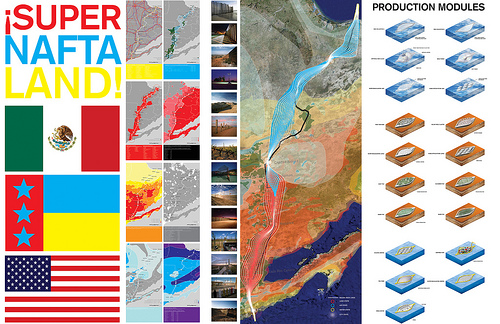
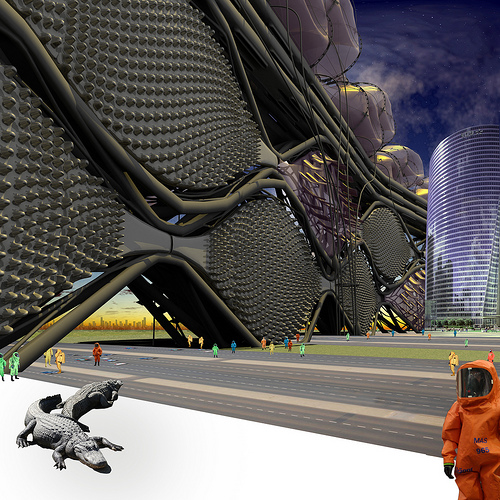
[Image: From ¡Super NAFTA Land! by Richie Gelles].

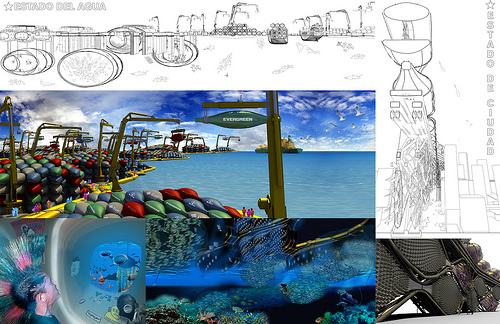
Another project from the Rice University final thesis reviews that I helped to jury back in January is Richie Gelles’s project ¡SUPER NAFTA LAND!.
That project imagines a kind of Mad Max salvage economy, made up of equal parts post-industrial subculture and bioengineered agri-futurism, set along the US/Mexico border.
Think of it as the sci-fi-inflected spatio-cultural wake of the North American Free Trade Agreement (or NAFTA) – falling somewhere between a new, continent-spanning red light district and a super-ranch run by Al Jourgensen.


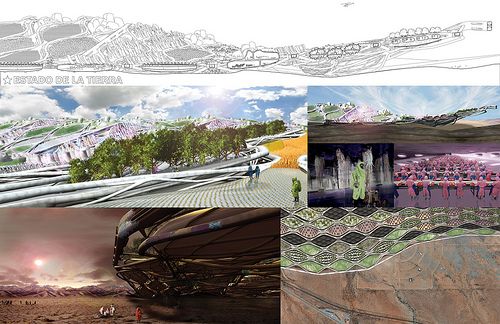
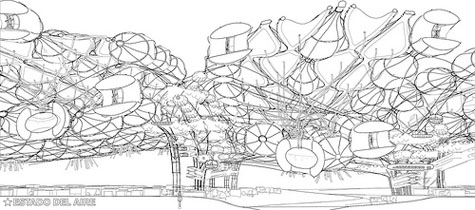
[Images: From ¡Super NAFTA Land! by Richie Gelles; be sure to view the sections much larger: Estado de la Tierra and Estado del Aire].

This border region is “a dynamic, hybridized, and rapidly growing regional zone,” Gelles writes, “known as ‘Amexica’ or the ‘third space.'”
He continues, outlining the broader political intentions of the project:

The emergence and potential of this “third space” as an economic engine and potential immigration buffer has been jeopardized by US policies towards Mexico such as the Secure Fence Act of 2006, which insists on understanding the border as a line, rather than its reality as a blurred zone of transition. This project proposes building a thickened, connective infrastructural corridor landscape to unite the sister cities (in place of the divisive 700 miles of fence currently under construction by the US government) and generate the resources and conditions for an independent, neutral border nation to emerge.

The result is ¡SUPER NAFTA LAND!, “a giant self-sufficient artificial landscape growing out of the border,” its infrastructure consisting of “a modular system of production pods to generate enough food, water, and energy for the entire border population.”
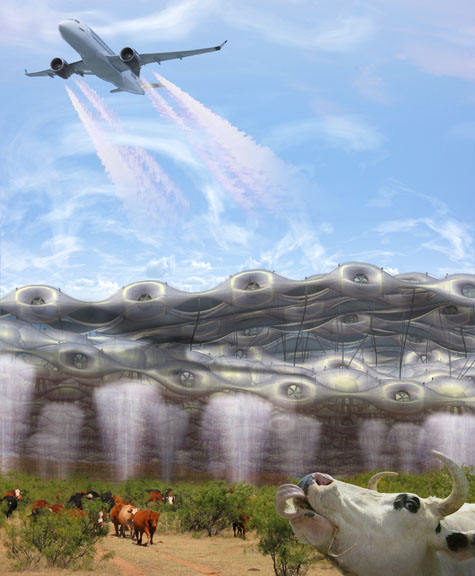
Awesomely, Gelles’s vision of an Estado de la Tierra and an Estado del Aire includes linked megastructures assembled for the purpose of aeroponic gardening.

[Image: From ¡Super NAFTA Land! by Richie Gelles].

It’s the borderzone as micronation.
Read a bit more about the project through Gelles’s Flickr set – or, even better, stop by his Tumblr site for further updates. For what it’s worth, ¡SUPER NAFTA LAND! could easily become a much larger, long term research project, similar to Fernando Romero’s Hyperborder; I’ll be interested to see where Gelles might take this.

(¡SUPER NAFTA LAND! was produced at Rice University under the direction of Carlos Jimenez. Thesis advisors were Eva Franch Gilabert and Fares El Dahdah; thesis readers were John Casbarian, Albert Pope, and Fiamma Montezemolo).

Photography, Rights, Media

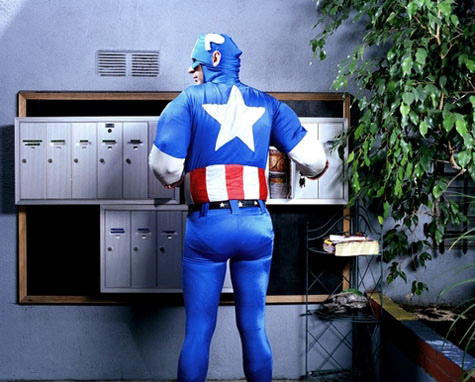
[Image: From the amazing Superheroes series by photographer Gregg Segal].

As many readers will no doubt know, the New York Times last week sent a “cease and desist” letter to Apartment Therapy, demanding that AT stop posting New York Times proprietary material on their website.
Though the story has since undergone a few less confrontational developments – i.e. Apartment Therapy “reached both the NYTimes legal and marketing [departments] on Friday and they called off their take down notice pending our initial conversation” – the issue is still a very valid one, and it cuts to the heart of many financial problems now facing both print and online media.
As but one example, it has always struck me as somewhat economically lopsided that in order for Dwell to run a photograph in the magazine, we have to pay the photographer a not inconsiderable use fee; but that I, as BLDGBLOG, can simply post that photograph – or Dezeen can post it, or materialicious, or Apartment Therapy – and, at least for now, no one has to pay a cent. (See further thoughts on this sentence in the comment thread, below).
In this business model, magazines like Dwell and Wallpaper – or the New York Times – become a kind of unacknowledged production budget for architecture blogs (this site included). Metropolis pays for a photographer to fly to, say, Chicago or Melbourne or Eagle Rock… and an architecture blog then gets free photographs to post on their website, from which they can earn a constant stream of advertising revenue.
From the perspective of an architecture and design blogger, it can’t help but feel a bit like the easy money days of the derivatives market: you wait till someone else pays for a photographer to document something, and then you jump in and skim ad revenue off of that transaction.
The value of your website is derived value; if the magazine photography economy were to collapse, so would your third-party ability to extract revenue from it.
While I was Senior Editor at Dwell, this hit some particularly surreal notes, such as when an architecture blogger – whose entire visual content has been bought and paid for by other people – emailed me to accuse Dwell of stealing from architecture blogs because we had run images (at no small expense to us) of houses that once appeared on that person’s website.
In any case, my point here is not to argue, regressively, from the standpoint of magazines (after all, BLDGBLOG has been around for 5 years, hosting other people’s photographs) or to advance a kind of 1990s-era model of intellectual property, but to point out that this conversation is far from resolved – and that I’m thus particularly excited to announce that Postopolis! LA will include an entire panel about this very subject.
Catherine Ledner, Dave Lauridsen, Gregg Segal, Misha Gravenor, and Tom Fowlks, professional photographers who have worked for the likes of National Geographic, Wired, Newsweek, Dwell, Popular Science, Esquire, the New York Times Magazine, and countless others, will be joining us on Saturday, April 4, to talk about the financial and/or reputational pros and cons of blogs, magazines, online portfolios, Flickr accounts, and so on.
It’s interesting, for instance, in this context, that even mundane technical questions – such as whether to host your work online via a Flash website (which prevents bloggers from downloading your work) – are actually legally motivated decisions made to protect the financial integrity of your portfolio, not aesthetic or stylistic choices at all.
So what do these photographers think of Flash as a form of self-protection? Or of seeing their work on architecture blogs – or, for that matter, of never seeing their work on architecture blogs? Does this result in more (or fewer) paid commissions? What is the ideal balance here between exposure and financial compensation?
The questions are innumerable, and come as part and parcel of the ongoing implosion of the publishing industry, with newspapers and magazines folding (or laying off staff) left and right, and with no realistic new business model yet taking shape.
Watch for this panel coming up on the evening on Saturday, April 4. It will take place in the context of an entire day themed about the future of media, with editors-in-chief, bloggers, journalists, and many more on hand to discuss the changing industrial landscape.
By the way, the complete Postopolis! LA schedule will be announced shortly – so stay tuned!

Books Received

[Image: Bookstore for Shibuya Publishing, Japan, designed by Hiroshi Nakamura].

Through a combination of publisher review copies and the slow-to-end fire sale at my favorite local bookstore, Stacey’s – they’ve gone out of business and are selling everything at 50% off, including now even the furniture – BLDGBLOG’s home office is awash in books. Since there literally is not enough time left in a person’s life to read all of these, I decided that I would instead start a new, regular series of posts on the blog called “Books Received” – these will be short descriptions of, and links to, interesting books that have crossed my desk.
Note that these lists will include books I have not read in full – but they will never include books that don’t deserve the attention.
Note, as well, that if you yourself have a book you’d like to see on BLDGBLOG, get in touch – send us a copy, and, if it fits the site, we’ll mention your title in a future Books Received.
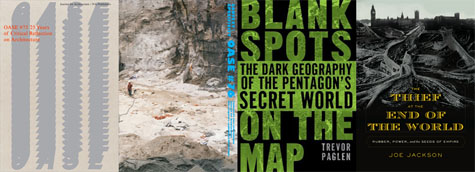
1) Oase #75 and #76Oase is an excellent architecture and urban studies journal published by the Netherlands Architecture Institute and designed by Karel Martens of Werkplaats Typografie. Oase #75 is the 25th anniversary issue, and includes essays from Jurjen Zeinstra (“Houses of the Future”), René Boomkens (“Modernism, Catastrophe and the Public Realm”), and Frans Sturkenboom (“Come una ola de fuerza y luz: On Borromini’s Naturalism”), among many, many others. To be honest, there is so much interesting material in this issue that it’s hard to know where to start; look for this in specialty architecture bookstores and definitely consider picking up a copy. Meanwhile, Oase #76 arrived just in time for me to quote part of its interview with photographer Bas Princen in The BLDGBLOG Book – but the entire issue, bilingually printed in both English and Dutch and themed around what the editors call “ContextSpecificity,” is worth reading. There’s a whole section on “In-Between Buildings,” itself coming between long looks at context, tradition, and the generation of architectural form. #76 also includes virtuoso displays of how to push the typographic grid. A new favorite.

2) Blank Spots on the Map: The Dark Geography of the Pentagon’s Secret World by Trevor Paglen (Dutton) — Trevor Paglen is an “experimental geographer” at UC-Berkeley, well-known – perhaps infamous – for his successful efforts in tracking unmarked CIA rendition flights around the world. Using optical equipment normally associated with astronomy, Paglen has managed to photograph the goings-on of deep desert military bases and has even been able to follow US spy satellites through what he calls “the other night sky.” This book serves more or less as an introduction to Paglen’s work, from Afghanistan to Los Alamos.

3) The Thief at the End of the World: Rubber, Power, and the Seeds of Empire by Joe Jackson (Penguin) — Jackon’s book, new in paperback, explores the industrial implications of monopoly plantlife, telling the story of Henry Wickham, who “smuggled 70,000 rubber tree seeds out of the rainforests of Brazil and delivered them to Victorian England’s most prestigious scientists at Kew Gardens.” This led directly to the “great rubber boom of the early twentieth century,” we read – which itself resulted in such surreal sites as Henry Ford’s failed utopian-industrial instant city in the rain forest, Fordlandia. Here, Jackson describes that city, now in ruins and like something from a novel by Patrick McGrath:

The American Villa still stands on the hill. The green and white cottages line the shady lane, but the only residents now are fruit bats and trap-door tarantulas. The state-of-the-art hospital shipped from Michigan is deserted. Broken bottles and patient records litter the floor. A towering machine shop houses a 1940s-era ambulance, now on blocks. A riverside warehouse built to hold huge sheets of processed rubber holds six empty coffins arranged in a circle around the ashes of a small campfire.

Check out Jackson’s website for a bit more.
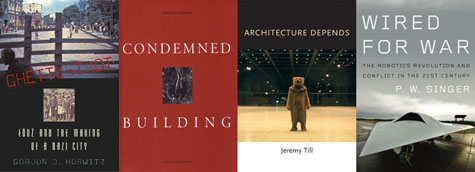
4) Ghettostadt: Łódź and the Making of a Nazi City by Gordon J. Horwitz (Harvard University Press) — By choosing the historical experience of Łódź, Poland, during its political assimilation and ethnic ghettoization by the Nazis, Gordon Horwitz shows how a long series of seemingly minor bureaucratic decisions can radically alter the normal urban order of things, paving the way for something as nightmarish as the Final Solution. This latter fact Horwitz memorably describes as “a phenomenon so unexpected and outrageous in design and execution as to exceed the then-understood limits of organized human cruelty.” About Łódź itself, he writes: “Secured by German arms, reshaped by German planning and technical expertise, the city was to be remade inside and out.” Horwitz shows how property confiscation, spatial rezoning, and literal new walls transformed Łódź into a Ghettostadt.

5) Condemned Building by Douglas Darden (Princeton Architectural Press) — The late Douglas Darden’s work seems both underknown and underexposed (perhaps because so little of it can be found online). This book, published in 1993, collects ten speculative projects, including the Museum of Impostors, the Clinic for Sleep Disorders, and the Oxygen House, complete with plans, models, elevations, and historical engravings. Darden’s work is an interesting hybrid of narrative fiction, visual storytelling, and architectural design – and so naturally of great interest to BLDGBLOG. For instance, his “Temple Forgetful” project weds amnesia, flooding, and the mythic origins of Rome. Good stuff.

6) Architecture Depends by Jeremy Till (MIT Press) — Architectural theory written with the rhetorical pitch of a blog, Architecture Depends is a kind of from-the-hip philosophy of “rogue objects,” construction waste, massive landfills, “lo-fi architecture,” and the fate of buildings over long periods of time. As Till states in the book’s preface, “Mess is the law.”

7) Wired for War: The Robotics Revolution and Conflict in the Twenty-first Century by P.W. Singer (Penguin) — An extremely provocative look at the future of war in an age of robot swarms and autonomous weaponry, Singer’s book is nonetheless a bit too casual for its own good (reading that Singer wrote the book because robots are “frakin’ cool” doesn’t help me trust the author’s sense of self-editing). Having said that, there is so much here to discuss and explore further that it’s impossible not to recommend the book – eyepopping micro-histories of individual war machines come together with Singer’s on-the-scene anthropological visits to robotics labs and military testing grounds, by way of Artificially Intelligent snipers, drone “motherships” forming militarized constellations in the sky, and even “mud batteries” and automated undersea warfare. Like Singer’s earlier Corporate Warriors – another book I would quite strongly recommend – the often terrifying implications of Wired for War nag at you long after you’ve stopped reading. For what it’s worth, by the way, this book seems almost perfectly timed for the release of Terminator Salvation.
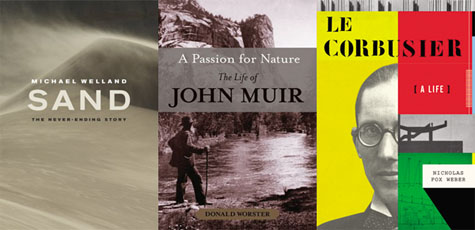
8) Sand: The Never-Ending Story by Michael Welland (University of California Press) — This book is awesome, and I hope to draw a much longer post out of it soon. Only slightly marred by an unfortunate subtitle, Welland’s book is disproportionately fascinating, considering its subject matter. On the other hand, “it has been estimated,” he writes, “that on the order of a billion sand grains are born around the world every second” (emphasis his) – so the sheer ubiquity of his referent makes the book worth reading. From the early history of sand studies to the aerial physics of dunes – by way of the United States’ little-known WWII-era Military Geology Unit – the interesting details of this book are inexhaustible.

9) A Passion for Nature: The Life of John Muir by Donald Worster (Oxford University Press) — Donald Worster has written a long biography of John Muir, the naturalist and writer who once famously climbed as high as he could into the canopy of a Californian forest during a lightning storm so that he could see what it was like to experience nature firsthand. At its most basic, Worster’s book explores the natural landscape of the American West as “a source of liberation.”

Going into wild country freed one from the repressive hand of authority. Social deferences faded in wild places. Economic rank ceased to matter so much. Bags of money were not needed for survival – only one’s wits and knowledge. Nature offered a home to the political maverick, the rebellious child, the outlaw or runaway slave, the soldier who refused to fight, and, by the late nineteenth century, the woman who climbed mountains to show her strength and independence.

Worster himself is an environmental historian at the University of Kansas.

10) Le Corbusier: A Life by Nicholas Fox Weber (Alfred A. Knopf) — I’m strangely excited to read this, actually – and I say “strangely” because I am not otherwise known for my interest in reading about Le Corbusier. But Nicholas Fox Weber’s approximately 765 pages of biographical reflection on Corbu’s life look both narratively satisfying, as a glimpse into the man’s daily ins and outs over eight decades, but also architecturally minded, contextualizing Le Corbusier’s spatial work within his other political (and libidinal) interests. I hope to dive into this one over the summer.

* * *

All Books Received: August 2015, September 2013, December 2012, June 2012, December 2010 (“Climate Futures List”), May 2010, May 2009, and March 2009.
Postopolis! LA Update

Postopolis! LA has been gathering pace over the past few weeks, despite the silence, so it seemed like high time for an update. Although we’re still finalizing both the schedule and the list of speakers, it’s looking amazing so far.

[Image: Logo by Joe Alterio].

The whole thing kicks off in less than two weeks, running from Tuesday, March 31, to Saturday, April 4, and from 5pm-11pm everyday.
The venue has finally been announced, as well: we’ll be up in the sky, watching the sun set every evening from the rooftop pool, deck, and bar of the Standard Hotel in downtown Los Angeles. The event is free and open to everyone, with a cash bar and free wifi, so come on down for some landscape and architecture, bring your favorite wireless device, and wear your Speedo or bikini if you want to use the pool (it’s more like a wading pool, FYI). And, of course, we’ll be keeping our fingers crossed for no rain.
The list of speakers, as it now stands, includes unbelievably interesting people. Here’s a glimpse:

—Ari Kletzky (Founder, Islands of LA)
—Austin Kelly (Principal, XTEN Architecture)
Ava Bromberg (Artist, In the Field)
—Ben Cerveny (Strategic and Conceptual Advisor, Stamen Design)
Benjamin Bratton (Architect and Theorist)
—Bryan Boyer (Organizer, Helsinki Design Lab 2010)
—Christina Ulke (Artist, Co-Founder, C-Level, and Editor, Journal of Aesthetics and Protest)
—Christopher Hawthorne (Architecture Critic, Los Angeles Times)
—David Burns, Matias Viegener, and Austin Young (Founders, fallen fruit)
David Gissen (Theorist and Historian, CCA)
—Dwayne Oyler (Architect and Principal, Oyler Wu Collaborative)
—Eric Rodenbeck (Founder, Stamen Design)
—Freya Bardell and Brian Howe (Principals, Greenmeme)
Fritz Haeg (Artist and Writer)
Gary Dauphin (Writer and Critic)
—Jeffrey Inaba (Architect and Principal, Inaba Projects)
Ken Ehrlich (Artist and Writer)
—Mary-Ann Ray (Architect, Writer, and Principal, Studio Works Architects)
—Matthew Coolidge (Director, Center for Land Use Interpretation)
—Michael Dear (Professor of Geography, USC)
—Michael Downing (Deputy Chief of Counter Terrorism, Los Angeles Police Department)
Mike the Poet (Poet and Writer)
—Orhan Ayyüce (Architect, Blogger, and Senior Editor, Archinect)
—Patrick Keller (Architect and Principal, Fabric)
—Paul Petrunia (Founder, Archinect)
—Robert Miles Kemp (Designer and Principal, Variate Labs)
—Sam Grawe (Editor-in-Chief, Dwell)
—Sharon Johnston and Mark Lee (Architects and Principals, Johnston MarkLee)
—Stephanie Smith (Founder, Ecoshack)
Steve Roden (Musician and Artist)
—Ted Kane (Architect and Author, Polar Inertia)
—Whitney Sander (Architect and Principal, Sander Architects)
—Yo-Ichiro Hakomori (Architect and Principal, wHY Architecture)
—Zach Frechette (Editor-in-Chief, GOOD)

That’s nowhere near the final list, though, as we’ve also got a handful of media panels planned for Saturday, April 4; these will include Matt Chaban from the Architect’s Newspaper, Dakota Smith from Curbed LA, Greg J. Smith of Serial Consign & Vague Terrain, journalist Alissa Walker, a variety of Archinect school bloggers, and many, many more.
So stay tuned for more updates.
And, don’t forget, Postopolis! LA will be hosted by BLDGBLOG, City of Sound, mudd up!, Plataforma Arquitectura/Arch Daily, Subtopia, and we make money not art, under the organization of the Storefront for Art and Architecture and the sponsorship of ForYourArt.
Hope to see you there!

So good you can’t see it

[Image: So good you can’t see it: a hunter wearing a Ghillie suit].

For some reason I found myself looking at Ghillie Suits last week, and I couldn’t resist writing a post about them.
Manufactured under the tagline “It’s what they don’t see that’s important!” Ghillie suits are made for paintball – but they are an amazing example of fashion design and landscape simulation together in one. Less a style of dress, they use garments to represent – and thus blend into – the earth’s surface.

[Images: Two more examples of Ghillie suits – the visual effect of the suits are somewhat undercut by the model’s posture].

You might say that these suits are mobile, replicant earths – minor terrains on the move – a statement seemingly backed up by the incredible “HUMUS® Cover Scent,” marketed by the same firm. HUMUS® is an “oil based product that gives off the smell of decaying leaves and allows you to smell like a part of the forest.”
I’m embarrassed to admit this, because it now seems obvious, but I had never actually thought of hunting as a local repertoire of earth-replication techniques, techniques through which you can become as much like the surface of the earth as possible. This then distracts and fools other organisms – and allows you to step in for the kill.
Looked at this way, hunting becomes a kind of planetary pas de deux – which is just a pretentious way of saying that if you act like the planet, you can kill that which lives upon it most efficiently.
Or, to put it one other way, well-camouflaged hunters are masterful practitioners of the landscape arts – but their contributions to any potential conversation about landscape design have been overlooked for ideological reasons (i.e. they’re hunters, not academics, and never the twain shall meet).

[Image: This suit apparently only weights 2.25 lbs. Photo courtesy of Ghillie Suits].
Whatever you might think of wildlife slaughter, though, how unbelievably interesting would it be to get Ghillie suit designers, deep wilderness hunters, and some landscape theorists together for a long afternoon of spatialized discussions. Throw in some anthropologists studying hunter-gatherer tribes and maybe some military camouflage field testers – and, at the very least, you’ve got yourself an interesting book proposal.
After all, what Deleuze has to say about landscape is meant to be interesting; but what about the guys who run Ghillie Suits? Or the editors of King’s Outdoor World or Predator Xtreme? Invite them to your next landscape architecture conference.
In any case, the instructions for how to build your own Ghillie suit are an amazing, if unintentional, act of sartorial landscape criticism, turning clothing into hyper-accurate representations of the local plantlife.
Finally, for a few more images don’t miss the Ghillie suit product slideshow.

(Related: Urban Camouflage).

Death, dust, decay

[Image: From Library of Dust by David Maisel].

In an earlier post, I mentioned that there will be at least one more big event coming up in New York City that I’ll be a part of; the information for that is now available (at least on Facebook!).
On Monday, April 13, from 7-9pm, the New York Institute for the Humanities will be hosting a celebration of David Maisel’s recent, beautiful, and widely praised book Library of Dust.
This will take place at the Angel Orensanz Foundation, housed in an extraordinary, blue-ceilinged synagogue at 172 Norfolk Street, and it will be led by the indefatigable Lawrence Weschler.
Here’s a map.
The list of participants looks absolutely amazing, and I’m thrilled to be a part of this group. In addition to Maisel and Weschler, there will be writer, professor, and historian of photography Ulrich Baer; author Rachel Cohen; writer and historian Jennifer Michael Hecht; art historian Karen Lang; novelist Jonathan Lethem; photographer Joel Meyerowitz; novelist Ted Mooney; filmmaker Bill Morrison; Magnum photojournalist Gilles Peress; president of Wesleyan University and historian Michael Roth; author and critic Luc Sante; and poet Vijay Seshadri.
It sounds like an unbelievably interesting evening – and I hope to bring something to the table myself, as author of one the essays in Maisel’s Library of Dust.
So if you’re in New York that night, please come check it out – and more information about the event, including ticket pricing and availability, should hopefully be up on the Orensanz Foundation’s site soon, or on the website of the New York Institute for Humanities.
Also, on a tangent, should you be in Philadelphia, Lawrence Weschler will be speaking tomorrow night at the Penn Humanities Forum. If you don’t know Weschler’s book Mr. Wilson’s Cabinet of Wonder, then you need to pick up a copy ASAP.

(Earlier on BLDGBLOG: Library of Dust. On Archinect: Interview with David Maisel).

Circle and District

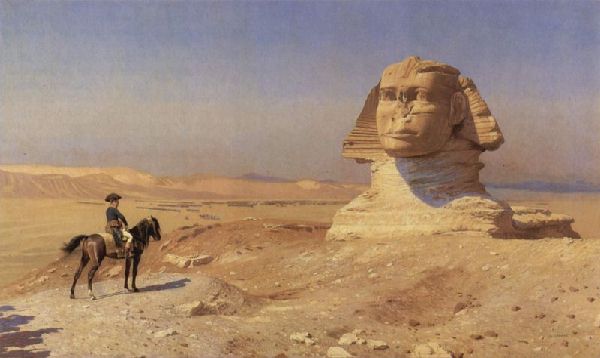
[Image: Napoleon in Egypt].

I started reading Nina Burleigh’s recent book Mirage on the flight over to New York this afternoon. Burleigh’s book is a review of Napoleon’s 1798 invasion of Egypt, during which “more than 150 French engineers, artists, doctors, and scientists – even a poet and a musicologist – traveled to the Nile Valley under the command of Napoleon Bonaparte and his invading army.”
Burleigh’s descriptions of 18th century Cairo stand out. She writes that the city was “a labyrinthine metropolis that frustrated and confused the invaders.” It was “a city of doors, mostly closed.”

Massive gates opened into the city, and the winding streets themselves often ended abruptly at smaller doors that defined neighborhood and community boundaries… Whole neighborhoods might be walled off, accessible only by a single door in a narrow street.

She writes that “The city frustrated Europeans. To their eyes, there was no logic to its street plan, and less order. Claustrophobic alleys ended at walls, or dwindled into walkways and disappeared.”
When an imperial cartographic project is kicked off a few months into the occupation, it “was deemed so daunting that at first the engineers hoped the order [to map Cairo] would be rescinded” – but, of course, “it was not.”
Edme-François Jomard, the cartographer in charge of the project, wrote: “The city is almost entirely composed of very short streets and twisting alleys, with innumerable dead-ends. Each of these sections is closed by a gate, which the inhabitants open when they wish; as a result the interior of Cairo is very difficult to know.” Jomard, Burleigh writes, would spend his time “knocking on gates that hid whole neighborhoods.”
How interesting to think of the Manhattanized equivalent of this – where, for instance, a small door at 1st and 13th Street might seal off an entire subdistrict of the island, a kind of undiscovered private archipelago of walled neighborhoods that maze outward in small streets barely wide enough to walk through.
You knock two or three times – and then crawl through a small circular door in the middle of a brick wall that could just as easily have been the entrance to a building. And then you’re gone, hiking through a part of the city you’d never even heard of before.
Of course, the Napoleonic approach to Cairo was, in the end, a military one; Burleigh adds that “These doors inconvenienced the French, and eventually Napoleon committed one of his most offensive acts – in the eyes of the Arabs – when he ordered them removed.” And so those old neighborhoods, previously sealed apart as if by airlocks, were made open for soldiers to pass through, the city remade for its military occupiers.

Kind of Blue


It’s nice to see a friend (and coworker) get an opportunity to discuss his work: Dwell‘s Design Director, Kyle Blue, talks to Arkitip about why we make Dwell the way we do, in this short video shot just the other day in the office. Congrats, Kyle!
Also visible in the background of the video are Brendan Callahan, illustrator of The BLDGBLOG Book, Michele Posner, Ryan Nelson, and Dakota Keck – as well as some spreads from our forthcoming May 2009 issue, my second third-to-last as Senior Editor.

Guardians of Architecture

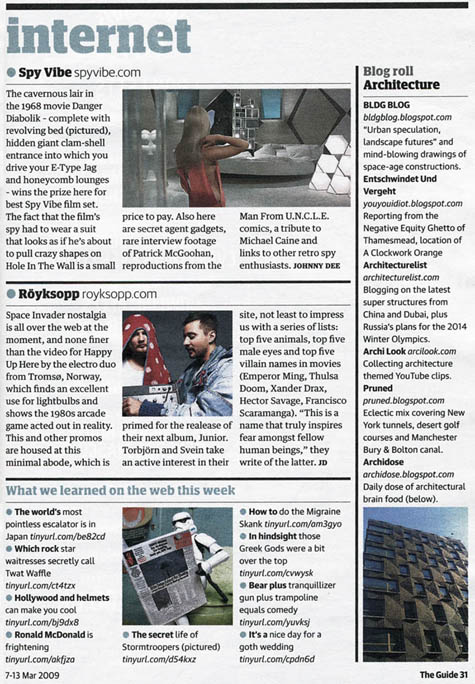
[Image: The Guardian‘s architecture blog roll, cropped down from a scan by John Coulthart; view larger].

I was excited to see that BLDGBLOG made it onto the Guardian‘s list of recommended architecture blogs this weekend, along with Pruned, Archidose, entschwindet und vergeht, Architecture List, and Arcilook. It seems notable that four of those, if you count BLDGBLOG, are written using Blogger.
Also, I’m hugely pleased that were able to include a brief mention of Pruned in the new (April 2009) issue of Dwell magazine – so take a look on p. 120 if you stumble on a copy. “Alexander Trevi’s Pruned offers readers a wild adventure into landscapes both real and imagined,” Dwell says. “At once practical and visionary.”
While we’re on the topic, don’t miss Dwell‘s new website, launched last week.

(Thanks to John Coulthart for pointing out the Guardian list!)

Surgeon of Space

[Image: Grapes, 2008, by Ai Weiwei; courtesy of Phillips de Pury & Company].

The new exhibition Ai Weiwei: Four Movements opened today in London at Phillips de Pury & Company, and it will remain on display until March 28. I’m proud to have contributed an essay to the show’s catalog, alongside a text by Arthur I. Miller.
My essay, “Ai Weiwei: Surgeon of Space” can be read in full online – and I have to admit that I like it! I don’t often write about furniture design here on BLDGBLOG, so it was particularly fun to be able to do so.
I suggest that “furniture for Ai Weiwei exists in a very interesting space, so to speak, and it comes with compelling conceptual possibilities.”

Furniture doesn’t just ornament a given space; it remakes and redefines the internal boundaries of the space itself. If furniture is something that breaks up space, offering punctuated moments of rest and stoppage and giving rhythm to a room, then it can also be deliberately misused. It can be contrapuntal and off-kilter, designed against the grain of the space it appears within. Furniture can interrupt, challenge, and deform.

The rest of the text veers from David Cronenberg to geology, by way of Gerrit Rietveld and German tunneling machines, Stone Age tools and psychoanalysis. From the essay:

Ai’s “Furniture”, subject to such interpretations, become not unlike allegories: small storylines in wood. They are narratives. “Tables at Right Angles”, 1998, is really just one table that has misunderstood itself, reeling back from its own projected double. Mistaking its own eccentric solidity for the architecture that surrounds it, this table will never realize that the world it thinks it touches is just another part of itself.

Of course, it would be a cliché to say that these works, thus described, are like poems – so let us instead suggest that they are screenplays: symbolically rich and heavy with implication, they have character, destiny, and tension all at once. They have drama. They can be argued about and reenacted. They have plots. Perhaps someday we might even see a film directed by David Cronenberg – based on a table by Ai Weiwei.

Check it out if you get a chance – and stop by the exhibition itself if you’re in London.
Meanwhile, if you’re looking for more of an introduction to Ai Weiwei’s work, nearly three years ago Archinect published a feature-length interview with him called “Fragments, Voids, Sections and Rings,” also well worth a read.

Seastead Design Competition

[Image: The basic platform; design your seastead atop this and win $1000].

The Seasteading Institute is sponsoring a design competition to see who can most interestingly visualize a permanent, microsovereign architectural state at sea.
“A seastead,” they write in the competition brief, “is a floating platform that allows people to permanently settle the ocean as they do land. Professional naval engineers have already designed a bare platform – a structure about 400×400 feet, roughly the size of a city block. What you build on the platform is up to you. It may be a hospital, a casino, a residential community, a cricket stadium, or something entirely different.”

[Image: The sample design].

There are some basic engineering constraints that participants will have to heed, as explained both in the call-for-entries and in this forum, and a sample design has been supplied (see images above and below).
But if architects were asked to rethink the spatial design of offshore libertarian self-rule, what sorts of structures might we see?

[Image: An illustrated variation of the sample design, from Wired magazine].

For a little more background, Wired‘s Chris Baker covered the Seasteading Institute last month. Baker wrote that the Institute “doesn’t just want to create huge floating platforms that people can live on,” they are “also hoping to create a platform in the sense that Linux is a platform: a base upon which people can build their own innovative forms of governance. The ultimate goal is to create standards and blueprints that can be easily adapted, allowing small communities to rapidly incubate and test new models of self-rule with the same ease that a programmer in his garage can whip up a Facebook app.”
Here, architectural design would actually help to catalyze new forms of political sovereignty.
The cultural possibilities for these offshore spaces are effectively without limit – and they would be self-policed, falling outside the bounds of international law. This opens up a number of legal (not to mention moral) quandaries.
Baker reports that Patri Friedman, the Institute’s co-founder and executive director, speaking at a Bay Area conference held last fall, “notes that some enterprises – like euthanasia clinics – would incense local authorities, but almost all the ideas attendees [at that conference] come up with would capitalize on activities that skirt existing laws and regulations: Fish farming and aquaculture. Prisons. Med schools. Gold warehouses. Brothels. Cryonics intakes. Gene therapy, cloning, augmentation, and organ sales. Baby farms. Deafeningly loud concerts. Rehab/detox clinics. Zen retreats. Abortion clinics. Ultimate ultimate fighting tournaments.”
So what might these platforms look like? Submissions are due by May 1.