Memorial to a Buried Village

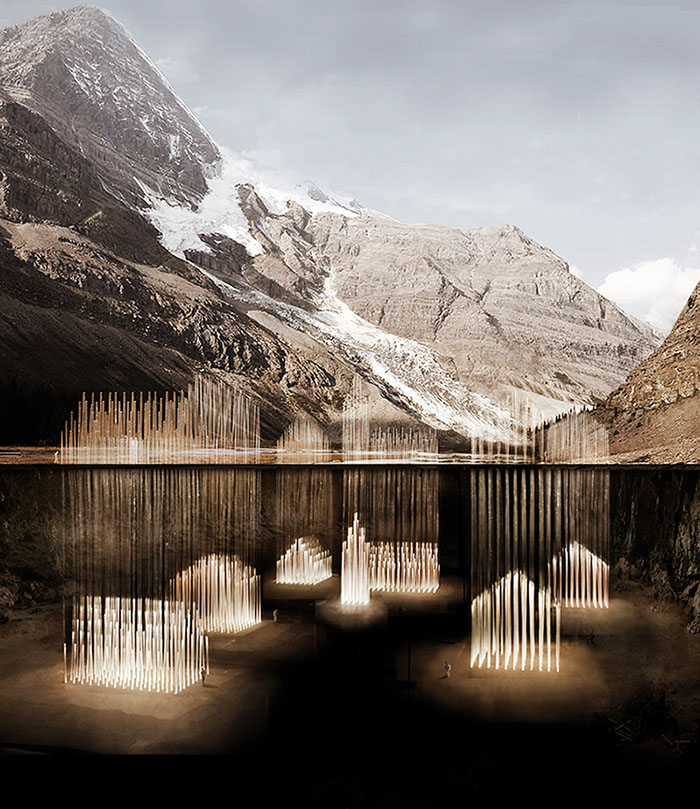
[Image: From the project “Resonance, memory” by Bo Li and Ge Men, students at ETH Zürich].

An interesting new project by Bo Li and Ge Men, students of architecture at ETH Zürich, proposes a kind of buried chandelier to memorialize lost villages in Switzerland—architecture destroyed by landslides, replaced by light.
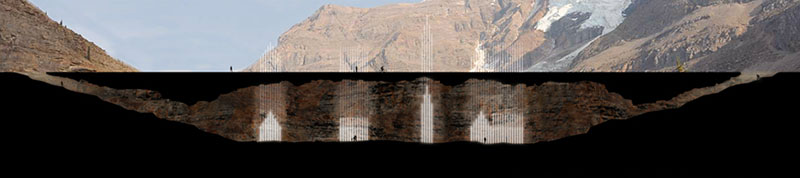
[Image: A “long section” from “Resonance, memory” by Bo Li and Ge Men].

From the 2012 International VELUX Award, where this project won first place:

Inspired by the many hiking trips that the two students from China have enjoyed during their studies at ETHZ, the entry is based on the idea of a hypothetical mudflow in the Swiss Alps burying a village. The project works with columns of transparent thermoplastic planted into the earth as a metaphorical representation of the former village. Sunlight is being transmitted through the columns into the subterranean space, where they illuminate a poetic memory of the former rooms in the buried houses.

Visitors can thus walk around beneath the surface of the Earth, exploring buried rooms of light.
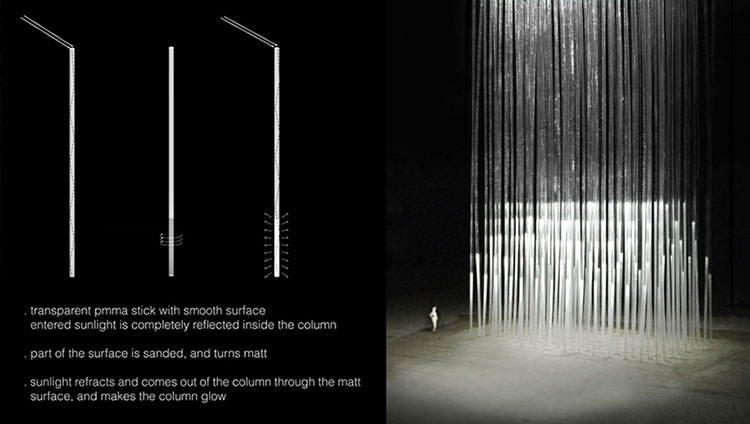
[Image: From “Resonance, memory” by Bo Li and Ge Men].

To a certain extent, the project brings to mind the odd memorial known as the Cretto di Burri, by artist Alberto Burri, in which an Italian village called Gibellina, destroyed by an earthquake in 1968, was replaced—or, rather, memorialized—by a field of poured concrete: “Burri covered the streets of Old Gibellina with concrete, preserving the layout of the blocks. Walking around his monument is unsettling. You’re not just standing on the gravestone of a city, but actually tracing the lines of its corpse.”

In Bo Li and Ge Men’s case, however, you not only can walk the plan of the old village, street by street and corner by corner, following the forest of “transparent thermoplastic” sticks that break the surface of the landslide to mark the positions of destroyed buildings; you can also do so from below, where glowing houses illuminate an artificial cavern carved into the landslide.
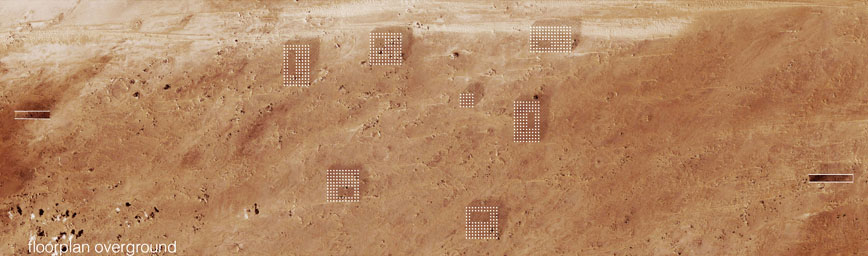
[Image: The plan of the old village, seen from above, from “Resonance, memory” by Bo Li and Ge Men].

I will admit, meanwhile, that when I first saw the image that opens this post, I actually thought it was a proposal to mark the remains of villages submerged by the construction of dams—deliberately flooded towns still known to reappear when droughts pull water levels to seasonal lows. You could thus dive down into murky lakes and reservoirs and see the shining cages of houses sacrificed by an earlier generation, a radiant architecture beneath the waves.

For a bit more information about the project, stop by the International VELUX Award showcase.

(Thanks to Luka Piskorec, the students’ teacher, for the tip!)

Landscapes by Remote Control

One of many interesting things I’ve been reading this month is the new book by William J. Clancey, Working on Mars: Voyages of Scientific Discovery with the Mars Exploration Rovers.

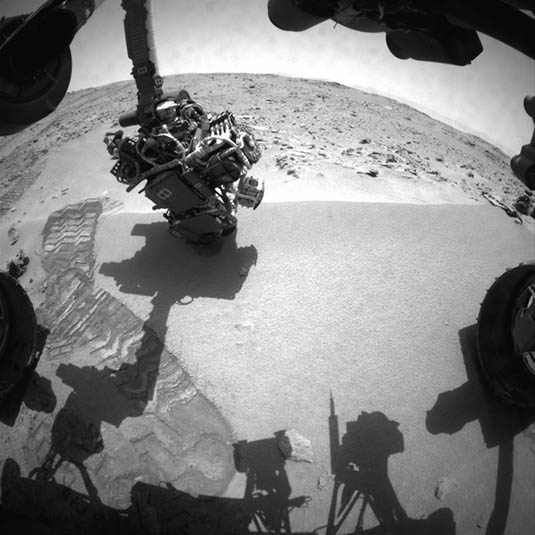
[Image: Curiosity pokes its heavily instrumented “head” around the Red Planet; photo courtesy of NASA and U.S. taxpayers].
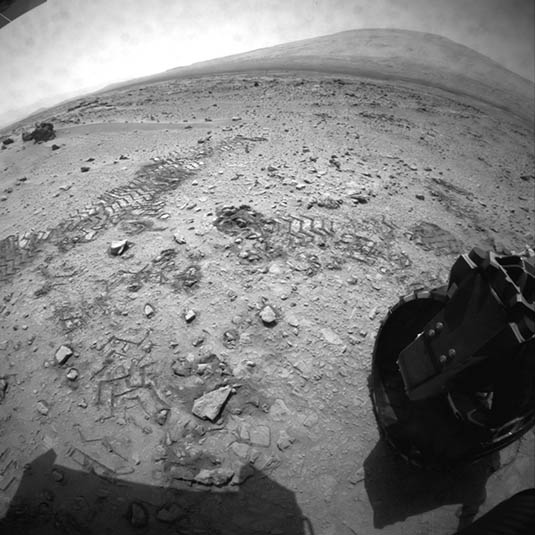
Clancey’s look at the “robotic geologists” humans have sent to Mars over the past decade explores the strange phenomenon of science-at-a-distance, pursued, measured, recorded, and analyzed by human controllers located on another planet.

This is, in Clancey’s words, “a unique human-robotic enterprise,” by way of “teleoperated robots” or “telerobotic tools.”

[Image: Curiosity looks back at the “Morse road” it has created; photo courtesy of NASA].

The book is very much academic—i.e. it is not a New Yorker-style profile of mission scientists in their lab at Pasadena—but it nonetheless reveals the bizarre methodological requirements of working on another planet through remotely controlled machine-surrogates. From altered sleep-patterns (to keep pace with the longer days on Mars) to darkened window shades (to enact on Earth the darkness of the Martian nightfall for rovers), the actual practices of the scientists come to the foreground of Clancey’s study.

It is through these practices that the humans can engage with and control—or at least efficiently keep track of—these radically off-site prosthetic extensions, the rover now understood as “a mechanism that can be ‘acted through,’ an extended embodiment of the human eyes and hands of the people who control its actions from Earth.”

It is a remotely operated surrogate sensory apparatus—organs without a body.

[Images: Curiosity on Mars; photos courtesy of NASA].
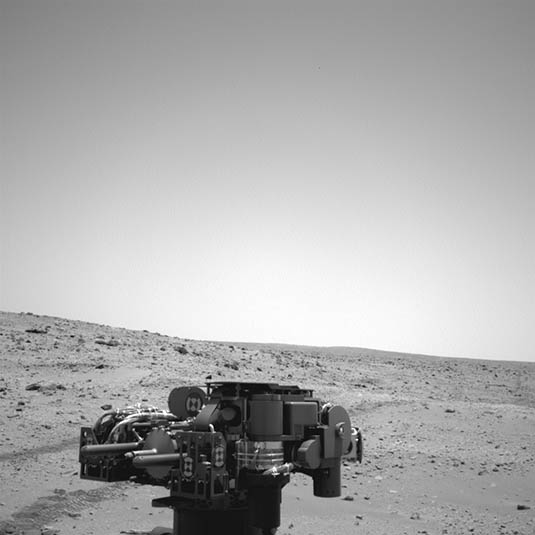
Yet, even as these deliberately chosen images show—images taken by me from NASA‘s website, not from Clancey’s book—it is hard to resist what Clancey himself takes critical issue with, which is the personification of these “robot geologists” as they trundle around the Martian environment, peering at things, laser-zapping rocks, craning their heads—”heads”—around like ostriches and setting off across the landscape afresh, solar-recharged, every morning.

[Image: Curiosity on Mars; photo courtesy of NASA].
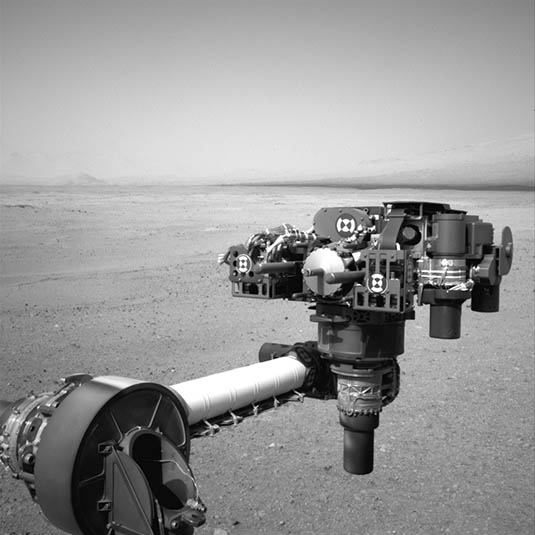
Emotionally identifying with the Mars rovers not only leads to the use of anatomical metaphors, such as those present in the previous sentence; it also, Clancey argues, clouds the notion of what it means to do science at all. “These inspirational descriptions have a place,” he writes in the book’s introduction, “but we must understand this new technology and articulate how it has worked so well if we are to know how to use and improve it.” Overarching questions about how humans and robots might exchange their roles in this undertaking—whether it’s the phrase “robot geologists” or a reversal of this situation with computer-guided “human tools” more like the astronauts in 2001—are, he writes, “technically and philosophically confused.”

The obvious benefit of non-scientific attachment between humans and their charismatic machines is that it is exactly these identifications that catalyze public enthusiasm for extraordinarily expensive scientific expeditions. But debunking myths of robot charisma is only part of Clancey’s purpose, as his book begins, instead, with a more or less anthropological study of the Earth-bound laboratory and the constantly changing teams of human beings within it, as they deploy and operate long-distance geologic tools, naming the terrain, mapping the landmarks, coordinating survey information, and chemically sensing the Martian landscape through surrogate “bodies” of complex instrumentation.

In other words, we might be busy anthropomorphizing machines, but the humans actually engaged with these off-world robotic tools are themselves realizing how they must adapt to the needs of the devices, to the tools’ own scientific and sensory limits, and to what these instruments can and cannot do in as distant a location as Mars.

[Image: Curiosity on Mars; photo courtesy of NASA].

In any case, Clancey’s book is worth checking out if this sort of thing interests you. However, it seems worth noting here briefly that this could also be put into the context of, say, art historian Barbara Maria Stafford’s 2001 essay on “devices of wonder,” or the interpretive machines and intermediary technical instruments that “not only constrain what it is possible to see but also determine what can be thought” by those who use them; as well as the idea, mentioned previously, of the “prosthetic imaginary,” or “a more metaphorical notion of the ‘prosthetic’ as an extended tool that becomes a proxy, or a substitute for experience.”

Founding Landscapes

Over the past few years, I’ve posted enthusiastic overviews of various books by Robert Sullivan, including The Meadowlands and Rats.

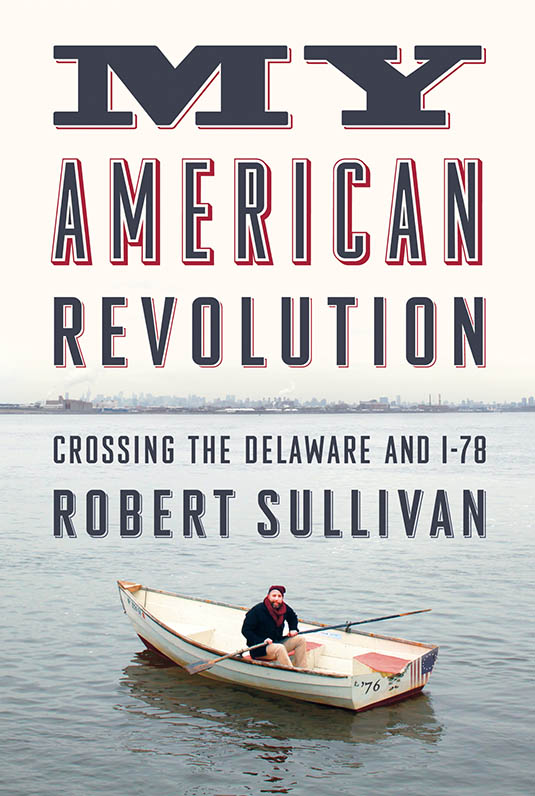
[Image: Robert Sullivan’s My American Revolution: Crossing the Delaware and I-78 from FSG].

Rats, in particular, reveals a perspective on the city so often overlooked and perhaps so revolting—the city as seen through the eyes of professional pest specialists and rat catchers—that it is unfortunately quite easy to miss the fascinating insights into New York’s history that such a viewpoint entails. From archaeology—discovering that now long-buried earthworks from the Revolutionary War are still breeding grounds for rats—to rat-resistant material science, where steel wool is mixed into concrete to slow the animals’ ability to chew through walls, Sullivan’s book is memorable, worthwhile, and hard to stop thinking about once you’re through.

I’m thus very much looking forward not only to meeting Robert Sullivan in person next week, but doing so as part of a public event at Studio-X NYC. That will be a live interview—free and open to the public—hosted in recognition of Sullivan’s newest book, My American Revolution: Crossing the Delaware and I-78.

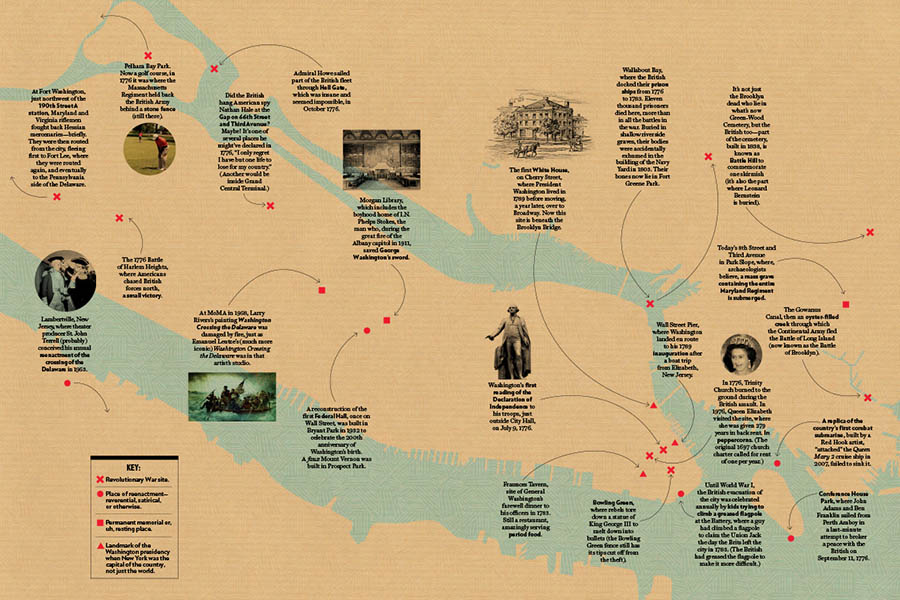
This new book is premised on two main themes: the terrain and weather of New York City, and how these both worked to shape the Revolutionary War against English troops in the 18th century. These “founding landscapes,” in Sullivan’s words, literally guided and formed those events—a fairly obvious claim, of course, but one that takes on the air of an archaeological expedition or a landscape detective story as Sullivan sets off by car, boat, and, most importantly, foot to track down the old routes, campgrounds, overlooks, signaling hills, and other waypoints used to such liberating effect nearly 250 years ago.

As Sullivan phrases it, “I began to work like a scout, going out on reconnaissance missions into a landscape that might not appear ancient, camouflaged as it is by cities and strip malls, by toxic waste sites, and high-end commercial properties.” Or, in the words of the New York Times, for Sullivan, “history is not so much a collection of dates and facts but actual places you can revisit—layers of geography that can be excavated one by one.”

After all, as anyone interested in military history will already know, winning a battle—let alone an entire war—comes down in many ways simply to a more strategically informed use of the landscape, beyond even the quality or impact of the weapons at hand; and Sullivan uses the book to suggest that the topography and the climate of the New York region opened certain opportunities while foreclosing others for the colonial insurgents. This is done in typical Sullivan fashion, mind you; the Washington Post, for instance, calls the book “almost entirely eccentric” and “about as far from a conventional account of that conflict as one could get,” yet both of these are meant in a positive sense. It is a book of asides, footnotes, detours, and second thoughts.

[Image: A map of selected Revolutionary War sites and landscapes in greater New York, courtesy of Robert Sullivan].
In any case, we’ll be talking to Sullivan about his new book—as well as about rats and the Meadowlands and much more—at 6:30pm on Tuesday, October 16th. We’ll also get a sneak peek at some of the behind-the-scenes techniques Sullivan uses to write his books, including his fascinating personal books about his books: part collage, part notebook, part bound filing system, these books-of-the-books detail Sullivan’s own process of writing and assembling the eventual published artifact.

As an aside, My American Revolution makes an interesting pair with Steven Jaffe’s New York at War: Four Centuries of Combat, Fear, and Intrigue in Gotham, which I’ve mentioned a few times here previously.

Jaffe’s own tour through the overlooked—and ongoing—militarization of the New York landscape, from Wall Street (named after the literal defensive wall that once stood on the site) to the coastal fortifications that still stand in places along the NYC shoreline, is a compelling and unforgettable read. Getting Jaffe and Sullivan to speak together at Studio-X NYC, perhaps, about their work would be a fascinating possibility.

Keys to the City

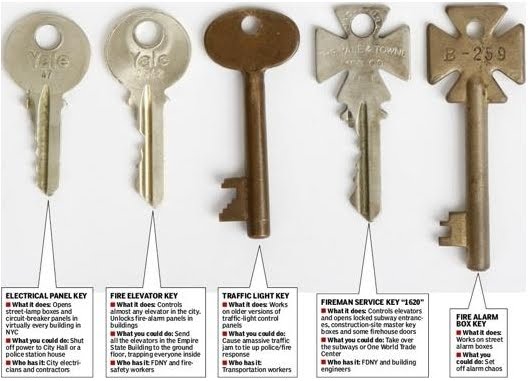
[Image: The “keys to the city,” via the New York Post. One key description reads: “What you could do: Take over the subways”].
A set of “master keys” to the infrastructure of New York City popped up on eBay last month, leaving many public commentators and city officials alike concerned for the safety of the metropolis.

It’s “what a terrorist might call a dream come true,” the New York Post suggests:

The set consists of five keys that would allow control of virtually any elevator in the city, could knock out power to municipal buildings and skyscrapers, darken city streets, open subway gates and some firehouse doors and provide full access to 1 World Trade Center and other construction sites.

After the keys were sold to a buyer who was actually “an undercover Post reporter,” an investigation found that “most of the keys did, in fact, work.” And they can do quite a lot:

The keys include the all-purpose “1620,” a master firefighter key that with one turn could trap thousands of people in a skyscraper by sending all the elevators to the lobby and out of service, according to two FDNY sources. And it works for buildings across the city.
That key also allows one to open locked subway entrances, gain entry to many firehouses and get into boxes at construction jobs that house additional keys to all areas of the site.
The ring sold to The Post has two keys used by official city electricians that would allow access to street lamps, along with the basement circuit-breaker boxes of just about any large building.

One thing I mentioned last month during the “Applied Topology” lecture at UC-Berkeley was the potential to produce 3D replicas of keys based simply upon visual documentation of the target key set.

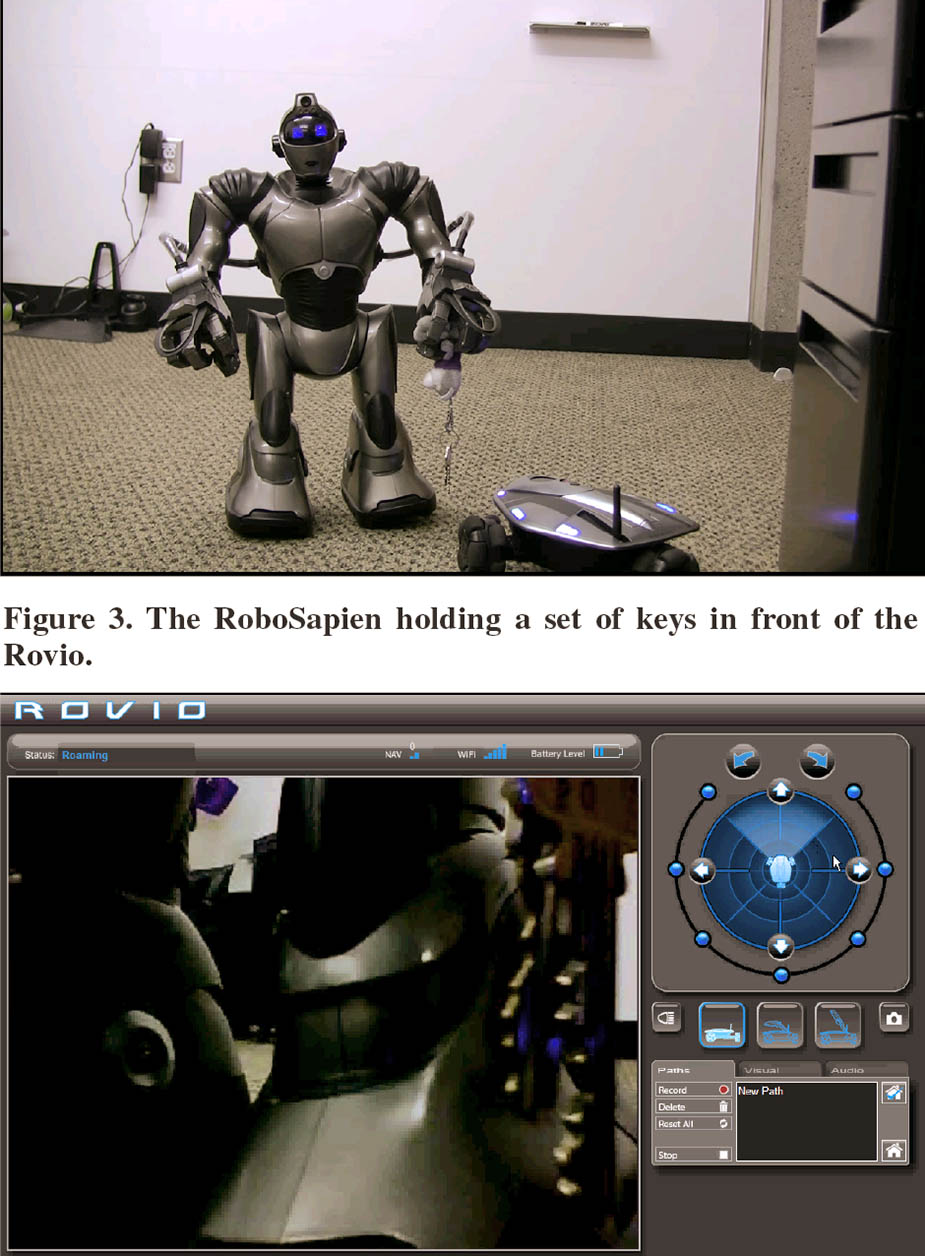
For instance, research by Tamara Denning, Cynthia Matuszek, Karl Koscher, Joshua R. Smith, and Tadayoshi Kohno at the University of Washington—see this PDF—has suggested that “household robots,” in their words, could be used someday to commit home burglary.

In a situation as notable for its comedic potential as for its criminal ingenuity, belligerent hackers could thus wirelessly take control of your “household robots”—Denning’s group chose the Robosapien, Rovio, and Spykee for testing—and surreptitiously gain access to information about your house. Room layout, location of motion sensors, whether or not a certain door has been locked at night, if anyone is even home, or, more directly, where certain things, like jewels, cash, pharmaceuticals, or a handgun, might be kept.

The most plausible scenario the team came up with involved something like a robot still-life, an American Gothic with keys: the Robosapien would simply grab ahold of your house keys and the Rovio would then sit there filming it.

[Images: From research by Tamara Denning, Cynthia Matuszek, Karl Koscher, Joshua R. Smith, and Tadayoshi Kohno at the University of Washington].
This cinematographic duo would thus pose there looking at each other, under the control of hackers huddling in a van somewhere wearing Stadium Pals, long enough that they could 3D-map the keys from the ensuing image feed and then have accurate copies produced. Thus would your house be robbed by robot.

All of which is a long-winded way of saying: surely someone could now produce, given enough dedication and perhaps a metal-based 3D printer, hypothetical copies of these “keys to the city” and shortly find him- or herself clicking open locked subway doors, turning off streetlights, stalling elevators, even redirecting construction site equipment to produce off-kilter towers in midtown? Using nothing more than a few glimpses of the keys found online and some late-night field-testing, the keys are cloned and begin to proliferate.

After all, this is now the era of 3D-printed crime: 3D-printed machine guns, 3D-printed bomb triggers, 3D-printed burglar’s tools.

3D-printed lock-picking kits, with near-universal access to the city, from elevators to subway cars to private apartments, can only be, worryingly, a few years away.

(Thanks to Nicola Twilley for the link!)

Garage Warfare

Going back through dozens and dozens of links saved over the past few months, I rediscovered two quick news items I thought I’d post together, both of which involve automatic garage doors.

1) The U.S. Navy has been using a radio signal that seems to interfere with garage door openers in suburban Connecticut:

U.S. Navy officials have acknowledged on Monday that a radio signal being transmitted out of the Groton Submarine Base is likely the cause behind the residents’ garage-door woes. The signal is part of the Enterprise Land Mobile Radio (ELMR) system, which is used by the military to coordinate responses with civil emergency workers, said Chris Zendan, a spokesman for the submarine base in Groton.

In short, it seems that frequencies used by remote-control garage door openers overlap with signals put back into service after 9/11 for communicating during civil emergencies.

However, putting this into the context of several recent articles about the accelerating pace of “cyber-attacks” on U.S. infrastructure—that is, “the pace at which America’s electricity grids, water supplies, computer and cellphone networks and other infrastructure are coming under attack,” in the words of the New York Times—as well as news that New York City’s elevators and boilers are now seen as potential targets for cyberwarfare (hackers “could increase the speed of how elevators go up or down,” perhaps crashing them to the bottom of the shaft), the idea of garage doors being hacked by radio signals emanating from the ocean by belligerent foreign powers takes on the air of, say, Red Dawn as remade by Bob Vila. Or it could be the plot of a bizarre future heist film: a sleepy coastal town in Oregon, its every house and building, robbed by submarine.

Just two weeks ago, meanwhile, over-heated headlines proclaimed that “Chinese hackers have control of U.S. power grid,” but perhaps we can imagine, instead, a far less threatening scenario, in which Chinese hackers manage to take control of every garage door in a small town in southern Georgia. Indescribably ignorant politicians proclaim it the work of Satan—but it’s just distant teenage poltergeists, high-fiving each other over cans of Diet Coke and trapping families in their 4-car garages.

2) Former professional wrestler Hulk Hogan had back surgery a while back—and the resulting spinal implant has given him the power to open garage doors from afar. In an otherwise idiotic article that explains how “Hulk Hogan Has Battery Powered Back,” one of the wrestler’s friends jokes that, “When he’s walking down a small neighborhood [sic] he opens every garage door on the street!” Talk about the prosthetic imaginary.

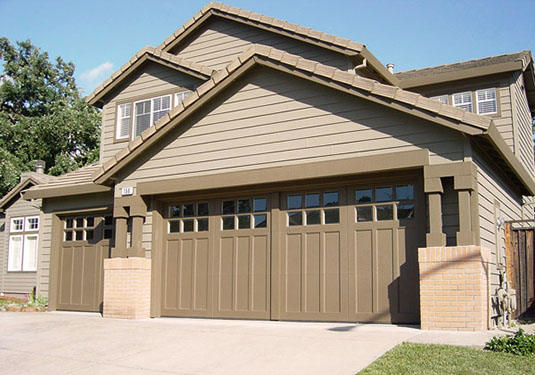
[Image: If Hulk Hogan pushes real hard, his garage door opens].
Next year’s headline: Chinese hackers in control of Hulk Hogan’s back open every garage door in Connecticut.

Version Control

As a brief follow-up to the Lost Rivers trailer—and the full film debuts in less than one week’s time, on Wednesday, October 10th, at Toronto’s “Planet In Focus” Environmental Film Festival—it’s worth taking a look at a recent post on the excellent blog L.A. As Subject.

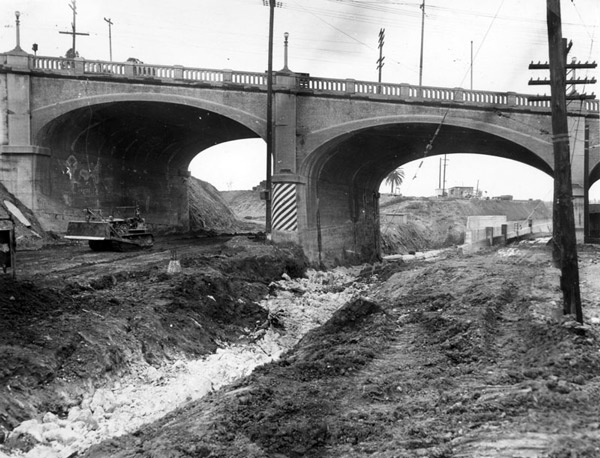
[Image: Older versions of Los Angeles: “1943 view of the Macy Street viaduct over the Arroyo de las Pasas’ former route. Today, the bridge carries Cesar Chavez Avenue over the Interstate 10 freeway.” Photo and caption via L.A. As Subject].
There, we read that the older, wilder geography of Southern California still breaks through the surface of the city—including lost rivers. Tracking down these older versions of Los Angeles takes research: “Archives have played a key role in rediscovering another forgotten feature of L.A.’s wild geography: the extensive system of creeks, arroyos, and other watercourses that once flowed through present-day Los Angeles.”

Fed by springs issuing from vast underground aquifers, storm runoff, or some combination of the two, these streams once crisscrossed the entire city. Today, many of them have suffered a similar fate as the Los Angeles River: paved over, buried and converted into storm drains, or eliminated altogether. Most Angelenos walk or drive over them every day without realizing it.

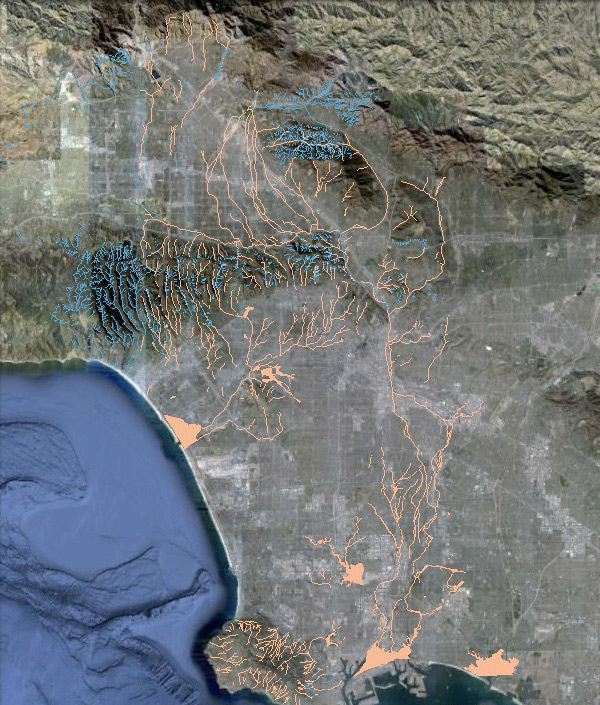
The post’s author, Nathan Masters, points us toward L.A. Creek Freak, a blog by Jessica Hall. “By studying the maps, photographs, and other documents preserved in the region’s archives,” Masters writes, “Hall has reconstructed a surprisingly wet L.A. landscape, braided with dozens of streams that now lie buried beneath streets and parking lots.”

[Image: A satellite view “overlaid with L.A.’s historical streams and wetlands. Courtesy of Jessica Hall, L.A. Creek Freak,” via L.A. As Subject].
Masters also links to a great old profile of Hall’s work on L.A. Weekly, first pointed out to me by Nicola Twilley a few years ago, during a conversation about the Tyburn Angling Society, that contains this awesome image:

“Do you know why there’s sometimes fog at the intersection of Beverly and Rossmore?” Hall asks. “It’s because there’s a perennial creek that runs through the country club there,” she says. “It goes underground beneath Beverly, and comes up again on the other side.”

Urban fog banks as tracking markers for underground streams!

As usual, L.A. As Subject includes some great archival photographs with their post, so it is worth clicking through—and scrolling down—to see them.

While you’re there, however, don’t miss their look at “why L.A. has clashing street grids,” the history of Chavez Ravine, or—one of my personal favorites—an incredible look at the “lost hills of Los Angeles” (previously mentioned on BLDGBLOG here). The center of the city is a history of terrain deformation, advanced topology in built form, as tunnels turn to streets because the hills they were cut through no longer exist.

(You can follow L.A. As Subject on Twitter).

Gossamer Systems

[Image: Via A456].

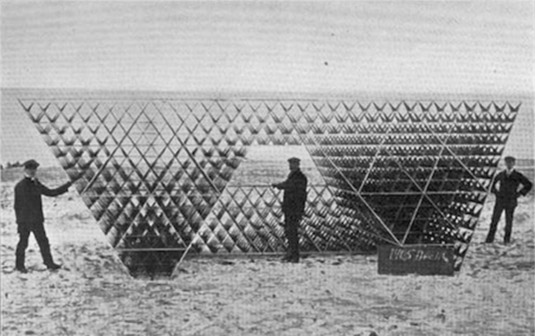
I’m intrigued by the architectural possibilities of “gossamer systems,” a term referring to the design of ultra-lightweight—or perhaps ultra-thin is more accurate—systems for spacecraft design.

According to a recent online course description from the American Institute of Aeronautics and Astronautics, “an evolving trend in spacecraft is to exploit very small (micro- and nano-sats) or very large (solar sails, antenna, etc.) configurations. In either case, success will depend greatly on [the use] of ultra-lightweight technology, i.e., ‘gossamer systems technology.’ Areal densities of less than 1 kg/m2 (perhaps even down to 1 g/m2!) will need to be achieved.”

[Image: Via A456].

That exclamation point, present in the original text, is well-justified: structures that weigh one gram per square-meter! While obvious comparisons can be made here with super-light spaceframes and other widely familiar engineering achievements of the past few decades, pushing terrestrial structures toward this seemingly impossible vanishing point—buildings so thin and ethereal, they are, in a sense, no longer even physically present—would be a fascinating challenge for a structures class somewhere.

In fact, let’s just make it an actual design challenge, architecture’s equivalent of the X Prize: combining origami, aerodynamism, spacecraft physics, materials science, athletic equipment, and more, design and fabricate a building the size of Manhattan that weighs less than one pound. Go!

(Gossamer Systems link spotted by Alice Gorman).

Lost Rivers

The trailer for Lost Rivers has been released, a film I’ve been looking forward to seeing since meeting Katarina Soukup, the film’s producer, way back in the summer of 2010.

“Once upon a time, in almost every city,” the film states, “many rivers flowed. Why did they disappear? How? And could we see them again? This documentary tries to find answers by meeting visionary urban thinkers, activists and artists from around the world.”

I’m not sure what the schedule is for forthcoming screenings of the final feature, but you can follow the film on Twitter to stay updated.

(From the archives: Drains of Canada: An Interview with Michael Cook).

The city and its citadels

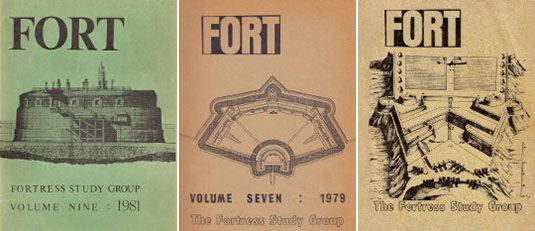
[Images: Covers from old copies of Fort, the Fortress Study Group member publication].

While writing the previous post and looking for a link to FSG, Robin Sloan’s publisher, a fortuitous auto-fill in my browser bar led me to the Fortress Study Group, the “international society of artillery fortification and military architecture.” Their site includes a helpful series of PDFs on the architectural history of fortification, or “the development of fortifications designed to resist artillery,” including this long look back at the group’s most recent “study tour” (similar in many ways to the Fortifications Tour we explored on BLDGBLOG long ago).

Of particular note: through their site, we learn that a symposium called Fortifications at Risk 2 will be held in March 2013 at the National Army Museum in London, discussing “how derelict fortifications may be preserved and re-used” for future purposes. You can register here.

Briefly, I’m reminded of historian Steven Jaffe’s fascinating book, New York at War: Four Centuries of Combat, Fear, and Intrigue in Gotham, in which Jaffe details the construction of coastal forts and artillery batteries throughout New York City, from colonial times to the Civil War (and beyond).

In particular, Jaffe cites the work of inaugural West Point superintendent Jonathan Williams, “mastermind of New York’s harbor fortifications,” in Jaffe’s words, who designed and proposed “a network of new fortifications placed strategically” at the marine entrances to the city during the War of 1812. His designs included “stone and mortar citadels” peppering the shores and “a line of massive stone blocks” that would be dropped into the harbor waters, forming a kind of submerged gate topped with barrier chains and artillery, further closed in places by the hulls of deliberately scuttled ships, seemingly an architecture equal parts wreckage and military geometry.

The majority of Williams’s defensive plan was never built; however, Castle Williams on Governors Island, which we boated past last week as part of Dredgefest 2012, is still there in its circular ruin, not far from the massive unmarked ventilation structure for the Brooklyn-Battery Tunnel which roars beneath the harbor waters.

An unbuilt fortifications tour of New York City is thus quite an interesting prospect.

24-hour bookstore people

The release of Robin Sloan’s first novel, Mr. Penumbra’s 24-Hour Bookstore, with its glow-in-the-dark book jacket, kicks off with a 24-hour launch party tonight at New York’s Center for Fiction, featuring a long series of interviews, conversations, and guests.

Nicola Twilley and I will be some of the many people participating; we’ll be talking to Robin about, in his words, “vast storage spaces” for everything from books and national gold reserves to strategic food stockpiles and nuclear waste, riffing off of the coded book-spine library patterns and semi-autonomous warehouse memory systems found in Robin’s book. That particular conversation takes place tonight at midnight.

But tune in to the whole 24-hour interview marathon, as it will be livestreamed, or stop by in person to meet Robin and check it all out. Other speakers include Steven Johnson, Jace Clayton, Hilary Mason, Alexis Madrigal, Jenna Wortham, Jason Kottke, and many more. See the Center for Fiction‘s website for more details.

Awakener

A few examples of landscapes waking up after long periods of time lying dormant have been in the news recently.

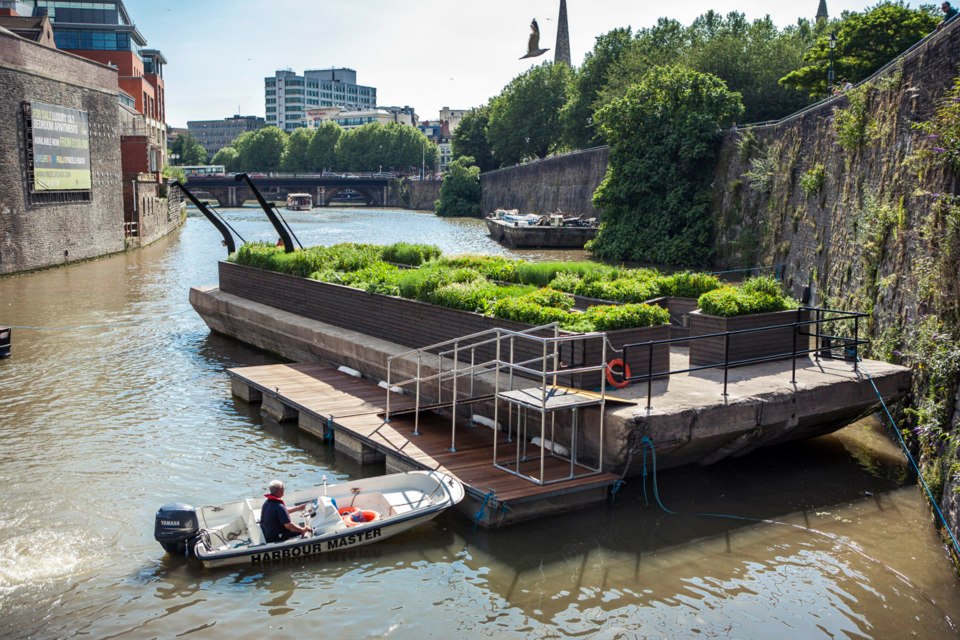
[Image: Maria Thereza Alves’s Seeds of Change garden, via Facebook].
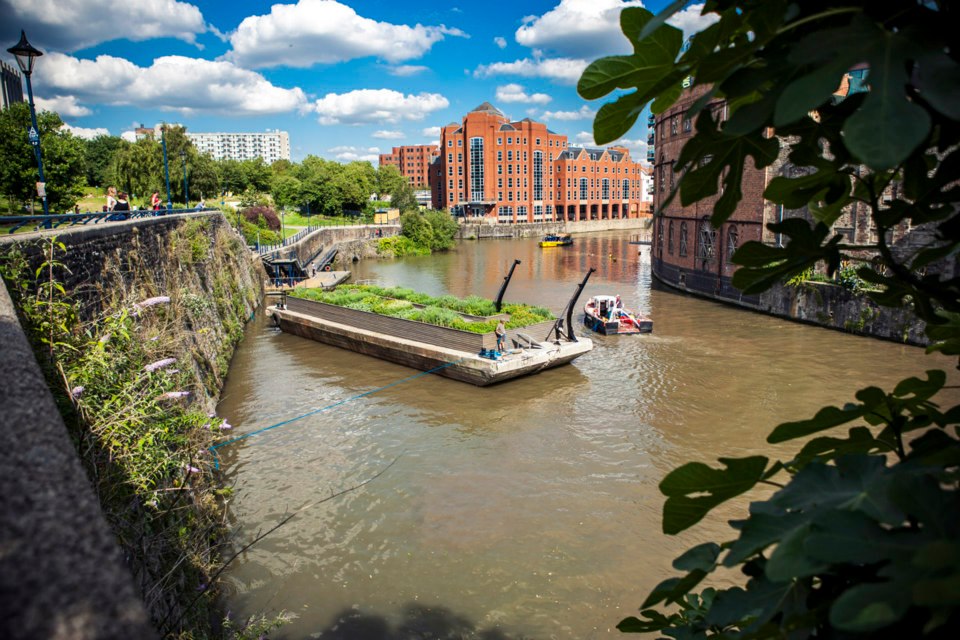
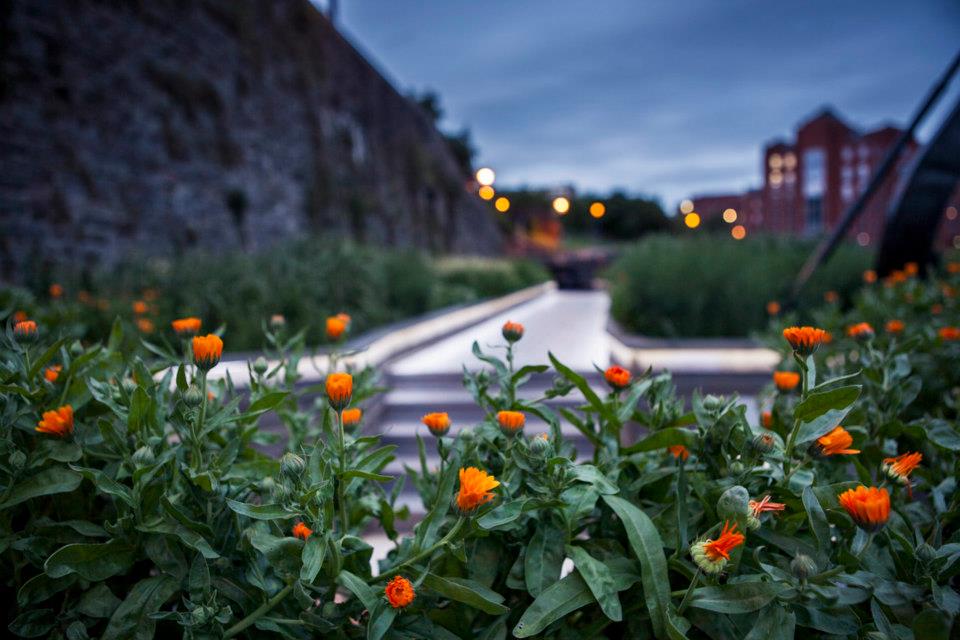
First, there is artist Maria Thereza Alves’s “ballast seed garden” project, called Seeds of Change, which arose from a moment of revelation:

Between 1680 and the early 1900s, ships’ ballast—earth, stones and gravel from trade boats from all over the world used to weigh down the vessel as it docked—was offloaded into the river at Bristol. This ballast contained the seeds of plants from wherever the ship had sailed. Maria Thereza Alves discovered that these ballast seeds can lie dormant for hundreds of years, but that, by excavating the river bed, it is possible to germinate and grow these seeds into flourishing plants.

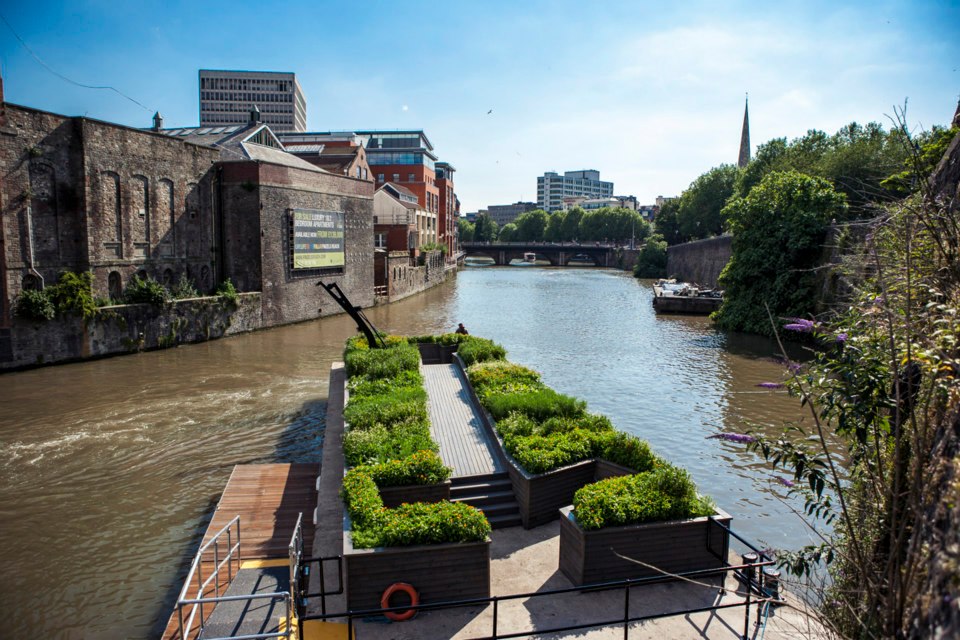
While Alves seems not to have literally dug down into the old layers of the river in order to harvest her seeds—instead sourcing contemporary examples of species known to have sprouted from mounds of ballast over the last few hundred years—her project nonetheless has the character of a long-lost landscape waking up, popping up like a refugee amidst the rubble in a return to visibility.

[Images: The ballast garden, via Facebook].

This idea of accidental ballast gardens—heavily detoured landscapes-to-come lying patiently in wait before springing back to life several centuries after their initial transportation—is incredible; I might even suggest parallels here with such 21st-century problems as how we might sterilize spacecraft before sending them offworld, to places like Mars, lest we, in a sense, bring along our own bacterial “ballast” and thus unwittingly terraform those distant locations with escaped landscapes from Earth. Might we someday culture “ballast gardens” on other planets from the tiniest of remnant organic compounds found on our own ancient and dismantled ships?

[Image: Maria Thereza Alves’s Seeds of Change garden, via Facebook].
Meanwhile, in a headline that reads like something straight out of Stanislaw Lem or H.P. Lovecraft, we read that “Nunavut’s Mysterious Ancient Life Could Return by 2100 as Arctic Warms.” In other words, forests that thrived in the hostile conditions of “Canada’s extreme north” nearly three million years ago might return to re-colonize the landscape as the region dramatically warms over the next century due to climate change.

This is a relatively mundane resurrection—after all, it is just a forest—but even the suggestion that future climate conditions on Earth might re-awaken ancient ecosystems, dormant environments in which humans might find it less than easy to survive, is an incredible cautionary tale for the future of the planet. That, and this story offers the awesomely mythic image of human explorers wandering across the thawing earth of the far north as strange and ancient things bloom from cracks in the ground around them.

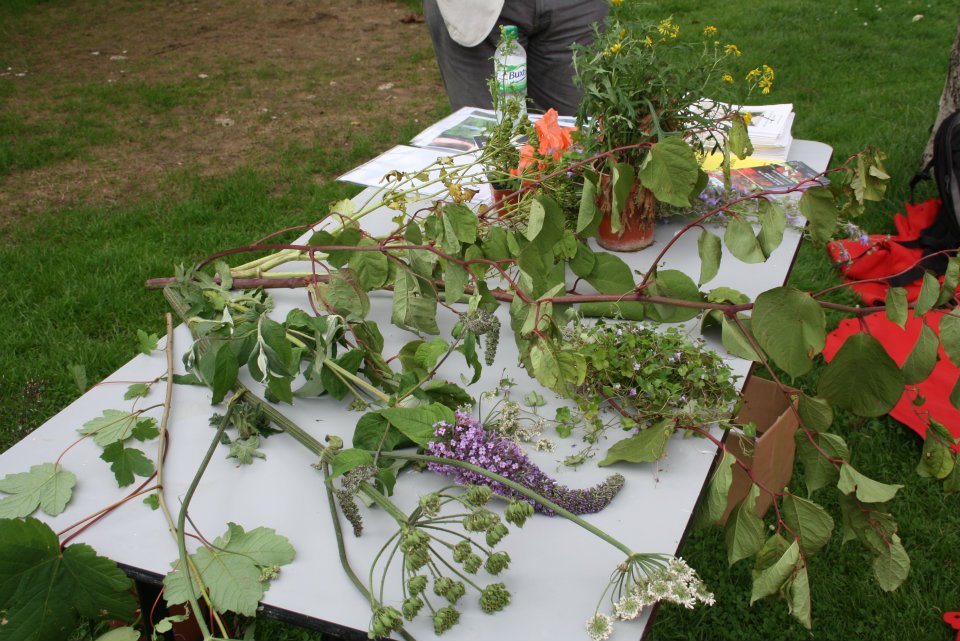
[Images: Various herbaria pages].

In both cases, I’m reminded of an essay published in Lapham’s Quarterly a few years ago, by novelist Daniel Mason. There, Mason writes about “nature’s return,” a scenario in which dormant and waylaid seeds thrive on the rubble of the present-day landscape. “In the dusty cracks between the concrete, seedlings would germinate, grow,” Mason writes, heralding unpredictable landscapes to come.

[Images: More herbaria pages].

However, referring to these remnant seeds left over from older landscapes, Mason writes that “most would not germinate straight away,” even if given free rein over an empty field or cracked streetscape. “Rather,” he adds, these seeds “would lodge in microscopic nooks and crannies, some to be eaten or crushed, others to be paved over, but most, simply, to wait. A square meter of urban soil can contain tens of thousands of seeds persisting in a state of suspended animation, waiting to be woken from their slumber. After the fire brigades rescued the London Natural History Museum from German incendiaries, Albizia silk-tree seeds bloomed on their herbarium sheets, liberated from two hundred years of dormancy by the precise combination of flame and water.”

A square meter of urban soil can contain tens of thousands of seeds persisting in a state of suspended animation, waiting to be woken from their slumber. In Mason’s words, this return of dormant life “suggests the parallel existence of a hidden world, fully formed, simply awaiting the opportunity for expression.”

Whether dredging up old riverbeds full of ballast from previous centuries, or watching new storms form over the Arctic, bringing back climates unseen for millions of years, what might yet wake up from the ground around us, return from dormancy, resurrect, as it were, and make itself at home again on a planet that thought it had since moved on?

(Ballast garden link spotted via Katie Holten).