Lost Roads of Monticello

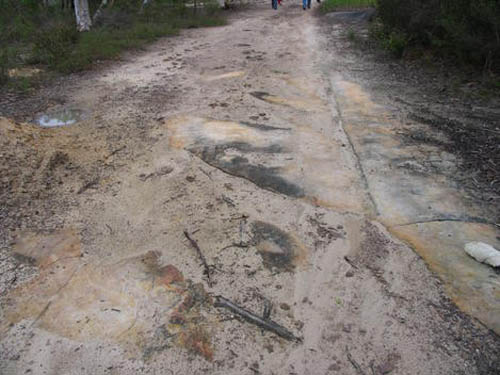
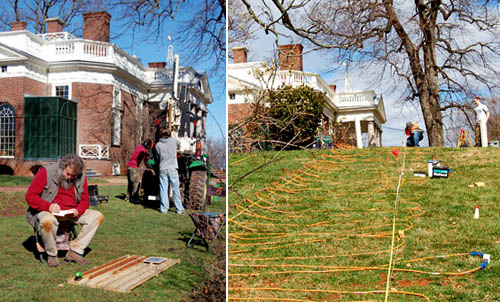
[Images: (left) An archaeologist examines soil cores. (right) Researchers plot lost roads across the grounds of Monticello. Courtesy of the Glenn A. Black Laboratory of Archaeology at IU Bloomington].

It’s hard to resist a caption referring to a “team of researchers” who have used their “electrical resistivity profiler to discover long-buried roads around the historic Virginia home” of 18th century U.S. president Thomas Jefferson. But that’s exactly what you’ll see courtesy of a recent press release from Indiana University.

Specifically, we read, a team of Indiana University archaeologists have “conducted a landscape study to find evidence of two lost roads: a ‘kitchen road’ that serviced the Monticello kitchen, and a formal carriageway that circled along the Ellipse Fence marking the edge of the East Lawn and the formal landscape in front of Monticello.”

A combination of soil cores and direct electrical data helped that team outline this otherwise lost geography at the heart of U.S. presidential history and across the original lawns of American Palladianism. Jefferson, as you might know, was an architect, one heavily influenced by the texts and buildings of Andrea Palladio. American architecture, from day one, was, in a sense, a facsimile: created, with far-reaching variations and personal stylistic quirks, based on reproduced manuscripts from Europe.

In any case, stepping back: beneath Jefferson’s lawn are lost roads.

I’m reminded here of an amazing story published two years ago in the New York Times about “ancient roads,” dating from colonial times, in the U.S. state of Vermont.

[Image: Walking an “ancient road” in Vermont; photo by Joseph Sywenkyj for The New York Times].

As the The New York Times explained back then, a 2006 state law gave Vermont residents a strong incentive to uncover the buried throughways in, around, and through their often quite rural towns. Indeed, “citizen volunteers are poring over record books with a common, increasingly urgent purpose: finding evidence of every road ever legally created in their towns, including many that are now impassable and all but unobservable.”

These “elusive roads”—many of them “now all but unrecognizable as byways”—are lost routes, connecting equally erased destinations. In almost all particular cases, they have barely even left a trace on the ground; their presence is almost entirely textual.

They are not just lost roads; they are road that have been deterrestrialized.

If these ancient routes can be re-discovered, however, then Vermont state law dictates that they can also be added to official town lands (and thus be eligible for some kind of federal something-or-other). Accordingly:

Some towns, content to abandon the overgrown roads that crisscross their valleys and hills, are forgoing the project. But many more have recruited teams to comb through old documents, make lists of whatever roads they find evidence of, plot them on maps and set out to locate them.

And, in what is surely one of the most interesting geographical subplots in recent newspaper publishing, we read: “Even for history buffs, the challenge is steep: evidence of ancient roads may be scattered through antique record books, incomplete or hard to make sense of.”

Like something out of the poetry of Paul Metcalf, or even William Carlos Williams, the descriptions found in these old documents are narrative, impressionistic, and vague. They “might be, ‘Starting at Abel Turner’s front door and going to so-and-so’s sawmill,’ said Aaron Worthley, a member of the ancient roads committee in Huntington, southeast of Burlington. ‘But the house might have burned down 100 years ago. And even if not, is the front door still where it was in 1815? These are the kinds of questions we’re dealing with.'”
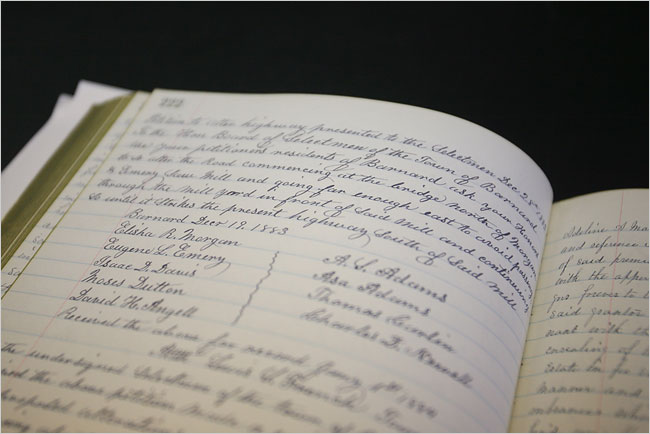
[Image: A hand-written inventory of Vermont’s ancient routes; photo by Joseph Sywenkyj for The New York Times].

While making sense of cryptic references to lost byways is fascinating in and of itself, these acts of perambulatory interpretation are part of a much larger, fairly mundane attempt to end “fights between towns and landowners whose property abuts or even intersects ancient roads.”

In the most infamous legal battle, the town of Chittenden blocked a couple from adding on to their house, saying the addition would encroach on an ancient road laid out in 1793. Town officials forced a showdown when they arrived on the property with chain saws one day in 2004, intending to cut down trees and bushes on the road until the police intervened.

The article here goes on to refer to one local, a lawyer, who explains that “he loved getting out and looking for hints of ancient roads: parallel stone walls or rows of old-growth trees about 50 feet apart. Old culverts are clues, too, as are cellar holes that suggest people lived there; if so, a road probably passed nearby.”

Think of it as landscape hermeneutics: hunting down traces of a disappeared landscape.

What would happen, then, if you discovered that an ancient road actually passes through your house? Your living room is a former throughway, and old paths knot and twirl off to every side; one even leads right through the guest bedroom. And then another road pops up, and another—and you realize that you live on the intersecting scars of a lost built environment, some old village that disappeared or was destroyed in an H.P. Lovecraft-like enigmatic disaster.
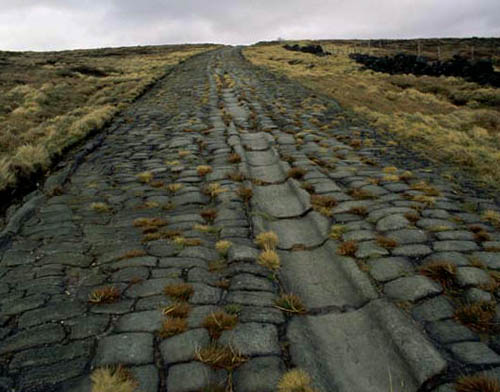
[Image: An old Roman road in Britain; photo via Historic UK].

I’d also be curious, meanwhile, to see what might happen if such a law was passed in a city like London. In an old but interesting review of the book London: City of Disappearances, edited by Iain Sinclair, we’re told that London “is a city of the forgotten.” It is where anyone “can still disappear without trace.” Indeed, London is a city “built upon lost things”; it “towers above forgotten underground rivers and discarded tunnels. It is built upon old graveyards and burial pits.”

Best of all, entire London streets have disappeared: “Catherine Street, Jewin Street, Golden Place are just three of the vanished thoroughfares named in a litany of sorrowful mysteries,” our reviewer points out. “Other streets have been curtailed. Swallow Street has been swallowed by burgeoning London. Grub Street has been renamed Milton Street.”

So what would happen if someone—who liked “getting out and looking for hints of ancient roads”—were to set about such a task elsewhere, in a city made from unstable geographies flashing in and out of county land registers?

I’m reminded here of China Miéville’s short story “Reports of Certain Events in London,” in which “unstable” streets appear and disappear throughout the city. One night they’re there, the next night they’re not.

Or take Chris Carlsson’s explorations of San Francisco’s ghost streets. “Intrepid explorers of San Francisco regularly stumble upon the many ghost streets that still hide all over town, rewarding the patient pedestrian for their diligence,” Carlsson wrote last autumn. “Mostly they are on hillsides where steep grades impeded road building at earlier moments in history, but they’re still presented as if they were through-streets on the maps.”
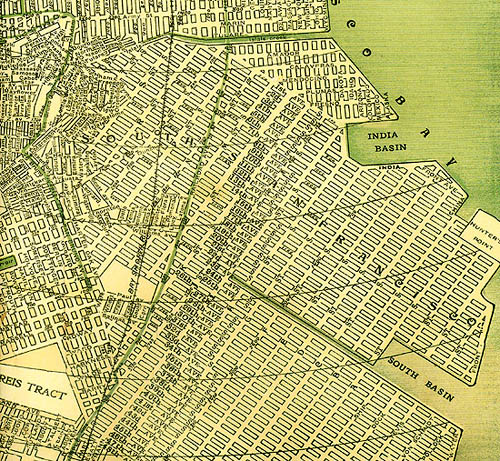
[Image: A map of San Francisco, including many “ghost streets,” courtesy of Streetsblog SF].

Carlsson’s post—something every San Franciscan should read—seemingly paved the way for a later exploration of “San Francisco’s unaccepted streets,” throughways too ephemeral for any real act of archaeology.

This unaccepted geographical unconscious of the city was recently mapped by Nicholas de Monchaux in an awesomely ambitious project called Local Code. It’s hard to exaggerate how interesting this project is; the following embedded video barely does it justice:

Here we are, then, surrounded by lost roads, forgotten throughways, and unaccepted streets. We turn on ground-penetrating radar and we find lost highways. What new cartographies could possibly account for these layers? With avenues leading nowhere and medieval freeways whose stratigraphic routes remain unpaved?

Finally—though by no means answering these questions—roughly two years ago, historian Kitty Hauser published a book called Bloody Old Britain. That book told the story of pilot, and accidental archaeologist, O.G.S. Crawford. Crawford pioneered the use of aerial photography in both discovering and analyzing ancient sites. Learning to read the landscape from the air, on the look-out for German ditches and bunkers, Crawford “would later apply this kind of skill honed in war, the trained interpretation of visual evidence, to the peacetime work of archaeology,” Hauser writes.

In the process, he realized almost instantly that you could detect, from high above, the traces of ancient landscape features that would otherwise have gone unseen. For instance, “at certain times of day, when the sun is low in the sky, the outlines of ancient fields become visible over Salisbury Plain, as shadows throw their ridges and dimples into sharp relief; these are known as ‘shadow sites.’” Much of this comes down to the specific species of plant growing over these landscapes:

Field archaeologists know that vegetation grows differently on soil that has been disturbed, even if that disturbance happened centuries ago. They know that crops grow more luxuriantly over silted-up ditches, and more stunted where there are buried remains. The site of a Roman villa might go unnoticed until a field of wheat grows and ripens, to reveal most strangely the outlines of buried masonry, only to disappear again at harvest. Slight contours or indentations on the land marking out the site of a lost settlement might be invisible to the eye until a low sun throws them into sharp but momentary relief.

Further:

Barley is a more sensitive ‘developer,’ for example, than oats, wheat, or grass, but only in certain soils. Dry spells can bring about remarkably sharp crop sites, like the outline of the medieval tithe barn, complete with buttresses, that appeared in the grass at Dorchester in June of 1938.

Hauser continues, pushing the awe factor:

One of the most remarkable things about aerial archaeology is that very few human processes will completely remove a site from view for ever. It might be decades—centuries even—before the right combination of crop growth, rain, sun, and aerial observer results in a site manifesting itself and being photographed. But unless deep excavations or quarrying are carried out, removing all traces of the site, the possibility remains that one day, under new conditions, it will reveal itself.

And, thus, “Photographs of unimpressive-looking mounds and lumps, the sort of thing one might not notice as one went past in a car or a train, turn out to be burial mounds, still for all we know containing crouching skeletons or buried treasure. You just needed to know where to look.” And Crawford knew where to look: there were ancient archaeological features everywhere, from buried roads to wooden menhirs rotting back into the soil. Britain was very old, Crawford himself could see; it was Bloody Old Britain.
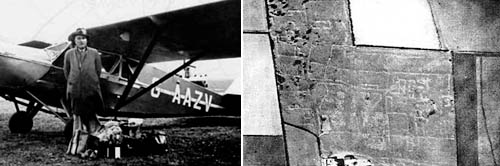
[Image: O.G.S. Crawford and his archaeological airplane; via Kitty Hauser’s Bloody Old Britain].

What, then, if we could combine all this? Dead streets buried beneath the sprawling lawn of a U.S. president—himself now erased from the historical memory of U.S. Conservatives—crossed with lost streets from San Francisco, wed with linear archaeological sites known only from the air of 1910s England, meeting ancient roads through the hills of rural Vermont, informing short story sci-fi by China Miéville: how does our understanding of the built environment accordingly change?

What ancient routes exist all around us—like the dead streets of California City?
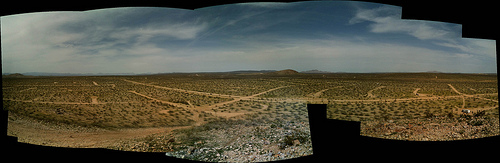
[Image: California City, CA; view much larger!].

When I first mentioned the story of Vermont’s ancient roads two years ago on BLDGBLOG, commenters pointed out things like the Icknield Way, a.k.a. the “oldest road in Britain,” as well as lost railway lines in North Dakota:

I’ve done a lot of ‘landscape hermeneutics’ with former rail lines. I’m working on photographing every town in North Dakota, and most of these towns were built on a rail line. Many of those lines are now long-gone, so there’s often a ridge running through the town where the railroad used to be. Some of the tiniest spots (like Petrel) that still manage to get on the map can only be identified by a swath of cleared land where a railroad siding and depot might have been.

Or, from Ian Milliss, perhaps the best commenter in BLDGBLOG history (punctuation added):

For the last two years I’ve been on a National Trust committee working on heritage listing for Coxs Road, the first road across the Blue Mountains west of Sydney that opened up Australia to European settlement. Its bicentenary is in 2015.
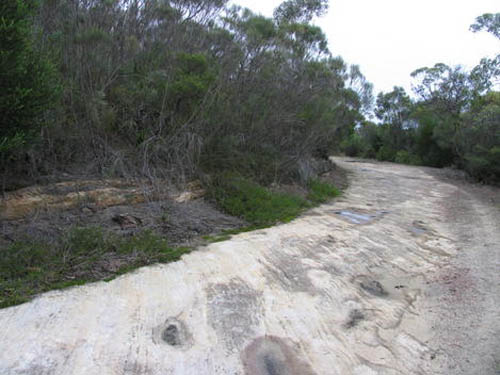
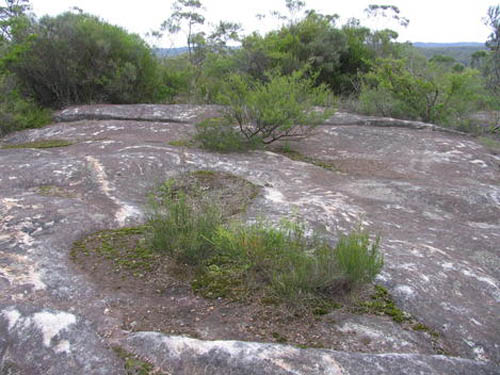
[Image: Three views of Australia’s lost Coxs Road, taken in the Woodford area].

Numerous pieces of it survive intact, and it does, indeed, sometimes disappear under houses. I’ve also been working on an overlay of it for Google Earth and even some virtual sections done using SketchUp… Its entire construction is detailed in the diaries and reports of its builders so that it can still be tracked through farmland where there is no visible trace of it.

It also relates to Australian indigenous mapping via ancestor stories and songlines, to produce virtual highways that can easily be followed but have very little obvious physical evidence of their existence.

Geography is a dream. Like an absorbed twin, we are surrounded by forgotten roads. That there are lost routes even at the spatial core of the U.S. presidency is just one of many surprising acts of poetry that this world seems always capable of.

(Monticello story spotted via Jessica Saraceni’s great newsfeed over at Archaeology Magazine. Of interest, meanwhile, earlier on BLDGBLOG: Ancient Roads, from which part of this post actually comes, Ancient Lights, and Z).
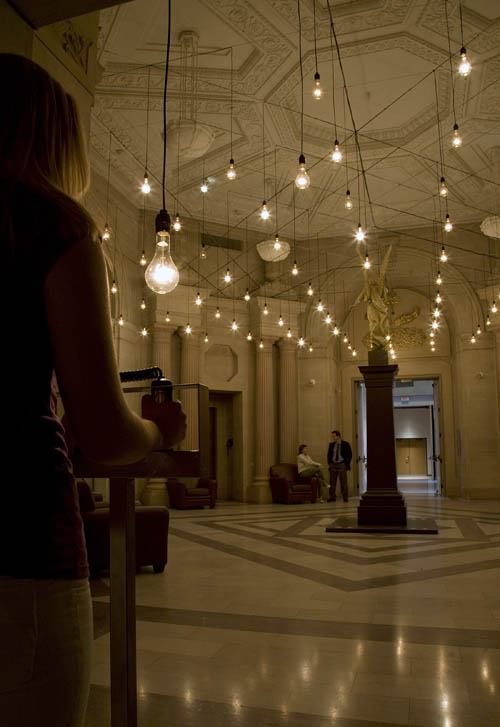
Pulse Room

A project I’ve been meaning to write about ever since seeing it in Vague Terrain #16 is “Pulse Room” by Rafael Lozano-Hemmer.

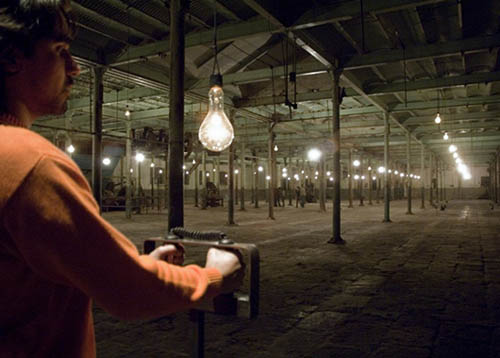
[Image: From “Pulse Room” by Rafael Lozano-Hemmer].

“Pulse Room,” originally produced back in 2006, was an “interactive installation featuring one to three hundred clear incandescent light bulbs,” the brightness of which was controlled by an interface and sensor that could detect “the heart rate of participants.”

When someone holds the interface, a computer detects his or her pulse and immediately sets off the closest bulb to flash at the exact rhythm of his or her heart. The moment the interface is released all the lights turn off briefly and the flashing sequence advances by one position down the queue, to the next bulb in the grid. Each time someone touches the interface a heart pattern is recorded and this is sent to the first bulb in the grid, pushing ahead all the existing recordings. At any given time the installation shows the recordings from the most recent participants.

The room thus becomes a counterpunctual archive of heart rates in space, throbbing like a chandelier in front of you.

[Image: From “Pulse Room” by Rafael Lozano-Hemmer].

Lozano-Hemmer later expanded this idea in scale quite significantly for his “Pulse Park” project, in which New York’s Madison Square Park was temporarily illuminated by a moving, heart-rate-controlled “matrix of light beams.”

But I would like to see something like “Pulse Subway,” say, where long tunnels flicker off around underground curves as heartbeat-like rhythms of light beat below ground, scaling the whole thing up yet further to form a piece of urban infrastructure (or is that simply a nightclub?); or even “Pulse Cinema,” in which the film itself fades in and flickers out according to the pulmonary ups and downs of the audience. Scenes of high-stress are seamlessly projected, but boring moments make the whole theater drain down toward black. One particularly caffeinated individual keeps the whole place bright as day.

[Image: From “Pulse Room” by Rafael Lozano-Hemmer].

It’s less the lighting effects that interest me here, though, than the idea of an archive of heart rates, a place where old rhythms could be stored. You could thus try out someone’s pulse—Usain Bolt’s record-shattering runs, or someone who’s survived a car accident—turning the facility (call it the CardiArchive) into a kind of Brainstorm for heart rates. Adventures in tachycardia. Heart-rate sharing.

Upload new pulses into the light-cloud and experience someone else’s panic as your own.

(“Pulse Room” originally spotted via Vague Terrain #16).

Ice Manifested As Sound

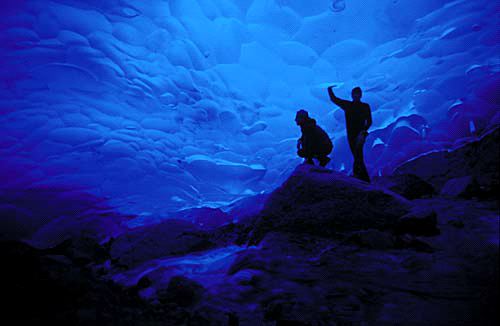
[Image: Photo by Kevin Sellers, courtesy of the Juneau Empire].
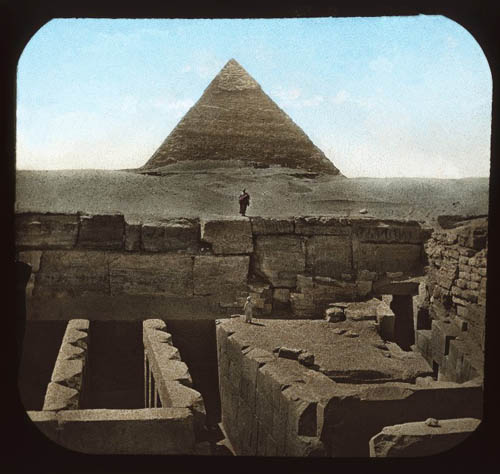
This weekend, April 16-17, over at The Lab (2948 16th Street) in San Francisco, sponsored by Swissnex San Francisco, an event called Activating the Medium will explore the sonic properties of ice—that is, “the physical, geographic, metaphoric, and mythological attributes of ice as manifested through sound.”

Specifically, you will hear “the sound of frozen lakes and ice caves,” as well as “various hydrophone recordings” taken in frozen circumstances around the world, and “a composition for real and imagined ice” will be played. As something like the main event of the evening, Cheryl E. Leonard’s work Antarctica will also be performed, samples from which can be heard on her blog Music from the Ice.

That being the case, I thought I’d post a by now very widely disseminated audio clip, recorded by Andreas Bick, of alien sounds racing through strained ice sheets on a lake in Berlin. The noises are incredible:


And this video, below, that Bick later linked to, offers a bit for anyone curious to hear more from these amazing phenomena that sound like laser warfare being conducted inside a glacier.


In any case, the event kicks off at 8:30pm both nights; tickets range from $8-$15. Enjoy!

(Andreas Bick material originally spotted via Kottke; related older posts include When landscapes sing: or, London Instrument, Phoning glaciers at 3am, and many more).

Brutalism at Giza and the Iron Room Beneath the Pyramids

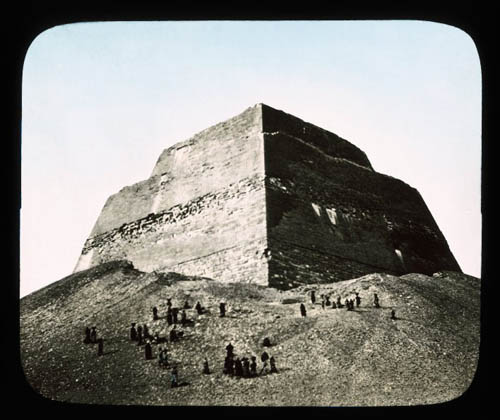
[Image: A pyramid at Giza, the earth archaeo-surgically opened at its base; courtesy of the Brooklyn Museum; for what it’s worth, this photo just knocks me out].
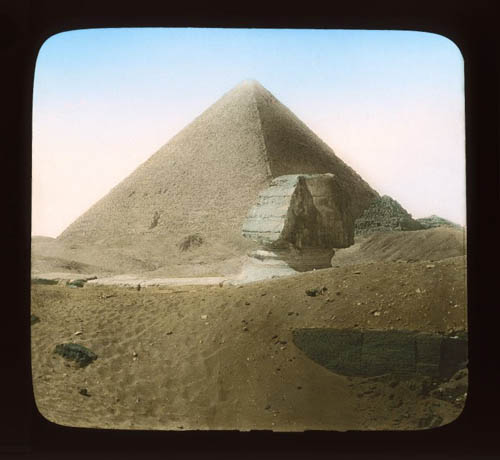
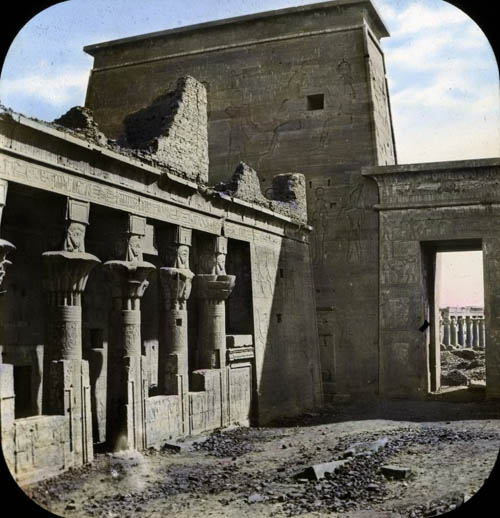
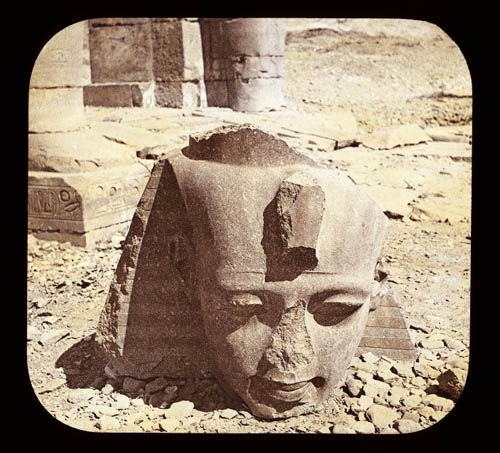
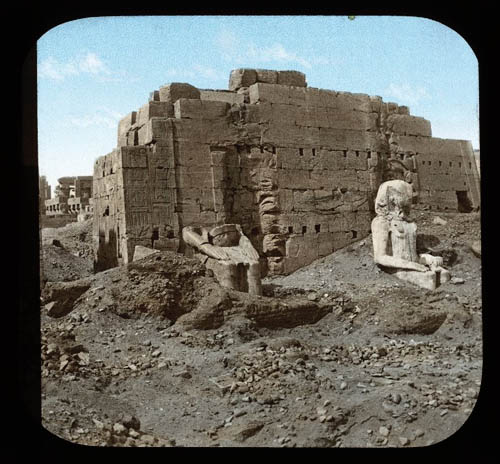
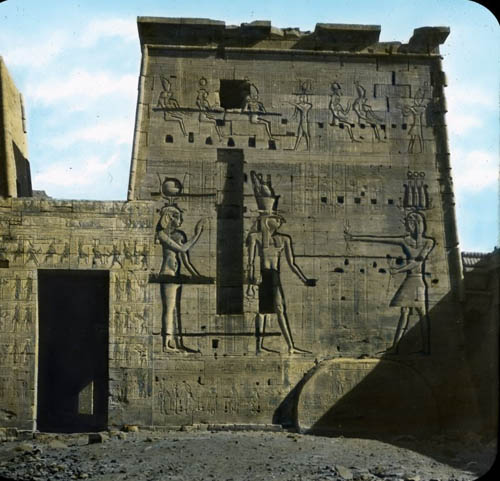
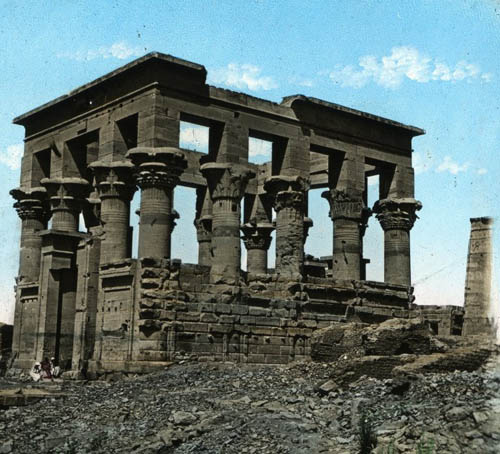
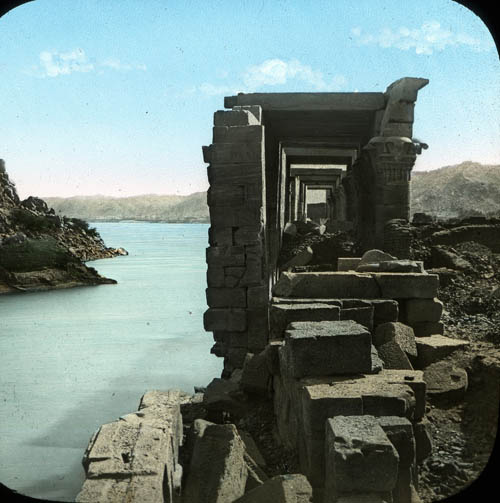
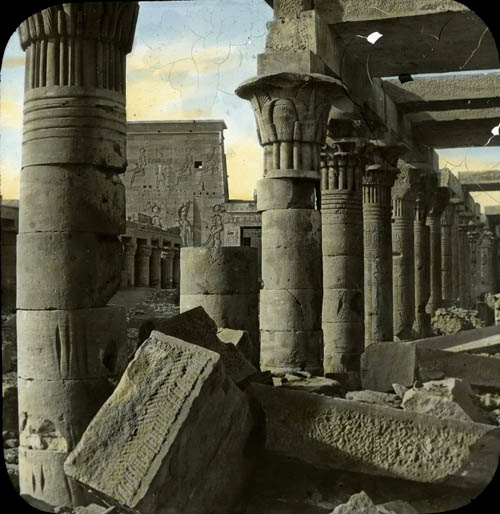
The Brooklyn Museum has an amazing collection of old lantern slides from Egypt, documenting that country’s archaeological history and monumental remains.

The shots above and immediately below, in which we see the pyramids at Giza, exude a stage-set quality: the diffuse and hand-colored light, the foreshortened perspective, and the cut-away glimpse into a world of subterranean vaults lending an air of surreality to the whole collection.

[Image: Giza, courtesy of the Brooklyn Museum; for what it’s worth, this photo just knocks me out].

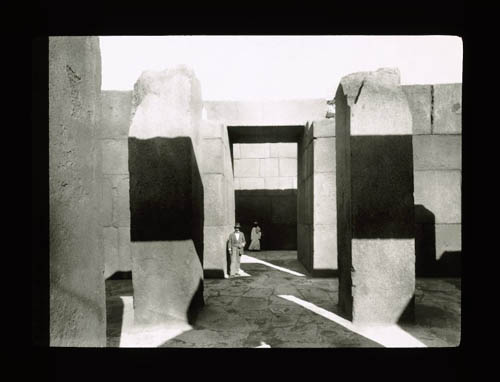
Overall, the architecture captured in these images is a mixture of deeply shaded, geometric minimalism—

Egypt, GizehEgypt, Gizeh[Images: Brutalism at Giza, circa 2,500 B.C.; courtesy of the Brooklyn Museum].
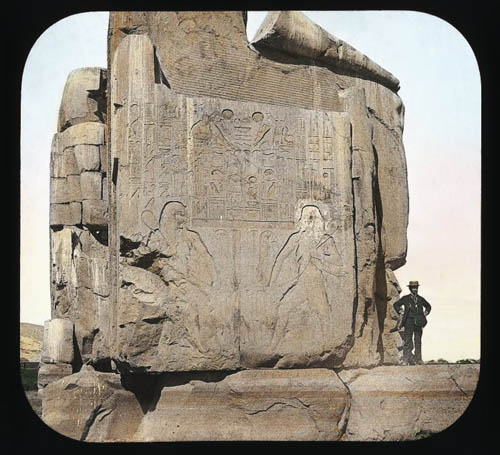
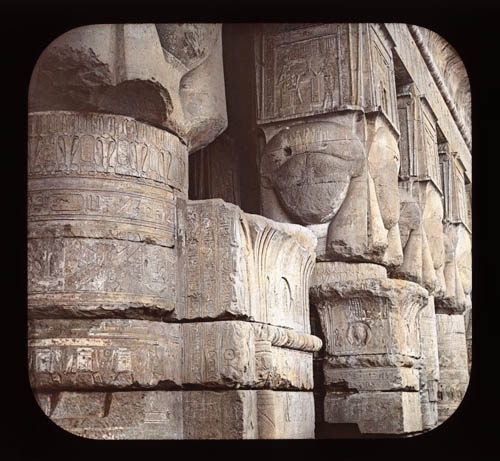
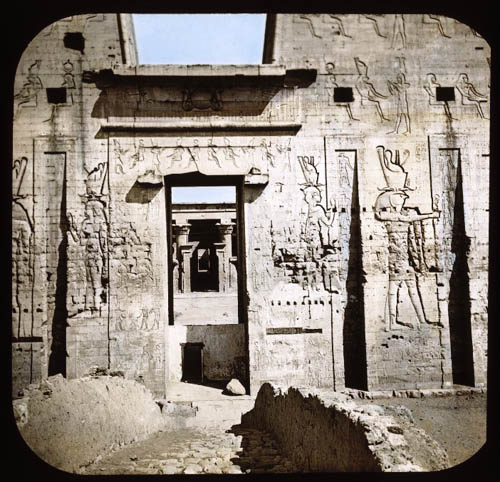
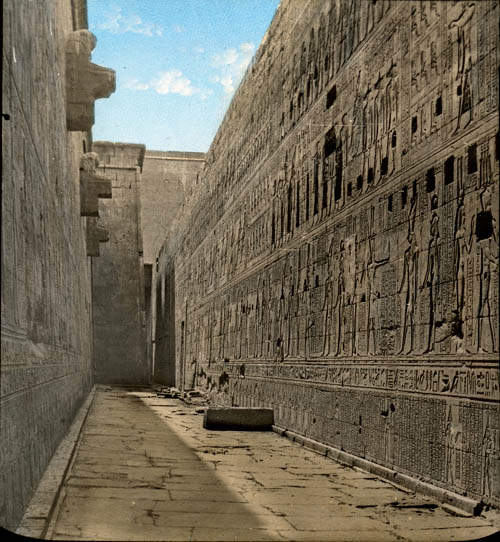
—wed with moments of ornamental grandeur, as hieroglyphic bas-reliefs, revealed by passing angles of sunlight, offer whole worlds of spatial detail. Stone inscriptions become less like something you might read, in other words, and more of a spatial experience in their own right.

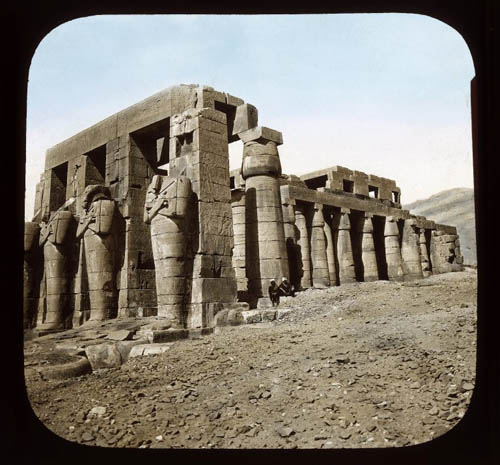
Egypt, ThebesEgypt, DenderahEgypt, EdfuEgypt, ThebesEgypt, PhilaeEgypt, ThebesEgypt, KarnakEgypt, Edfu[Image: Ruins in light, courtesy of the Brooklyn Museum].
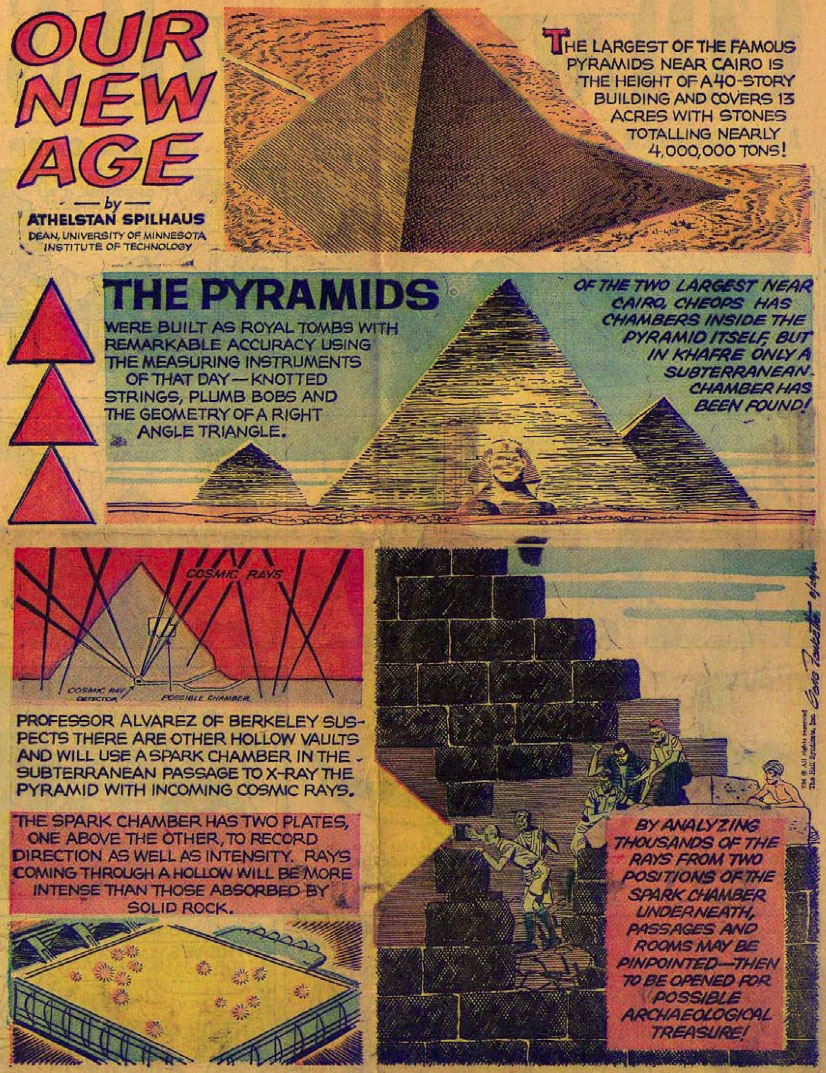
I’m reminded here of one of my favorite stories of all time, which is that of physicist Luis Alvarez. In the September/October 2008 issue of Archaeology magazine, author Samir Patel explained how Alvarez used a device called a muon detector “to scan the inside of an ancient structure,” which, in this case, was Khafre’s pyramid at Giza.

“Working with Egyptian scientists in the late 1960s,” Patel explains, Alvarez “gained access to the Belzoni chamber, a humid vault deep under the pyramid.” There, “Alvarez’s team set up a muon detector called a spark chamber, which included 30 tons of iron sheeting, in the underground room.” This image—of foreign physicists building iron rooms beneath the pyramids in a search for secret chambers based on cosmic particles raining down from above—is one of the coolest things I have ever read in my life.

[Image: An illustrated depiction of the physicists’ sub-pyramidal adventures; view larger].

As it happens, Alvarez’s work was not without local controversy:

Suspicion of the research team ran high—here was a group of Americans with high-tech electronics beneath one of Egypt’s most cherished monuments. “We had flashing lights behind panels—it looked like a sci-fi thing from Star Trek,” says Lauren Yazolino, the engineer who designed the detector’s electronics.

Alvarez’s humid iron room beneath the pyramid—like a collaborative project by Lebbeus Woods and Mike Mignola—took one full year to perform its work. At that point, when the team finally took a long look through its gathered data, Yazolino “spotted an anomaly, a region of the pyramid that stopped fewer muons than expected, suggesting a void.”

There were still undiscovered rooms inside the structure.

Egypt, AbuSimbel[Image: Tombs at Abu Simbel, Egypt, courtesy of the Brooklyn Museum].
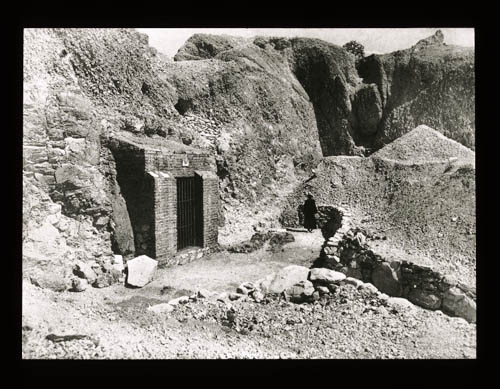
In any case, you can find these and many more on the Brooklyn Museum’s website; just go to the Lantern Slide Collection (including this write-up of the Lantern Slide Collection’s history) or to this Flickr set. The specific images seen here come from subsidiary collections: Giza, Thebes, Karnak, Philae, Abu Simbel, Edfu, Denderah, and so on.

This final image, below, featuring a doorway embedded in the hills—perhaps leading down into iron rooms, and further into spark chambers, and beyond even those into unmapped humid vaults—is particularly fantastic.

Egypt, Middle Kingdom[Image: The hollow hills of Egypt’s Middle Kingdom, courtesy of the Brooklyn Museum].

(Via @stevesilberman).

It’s the Trees

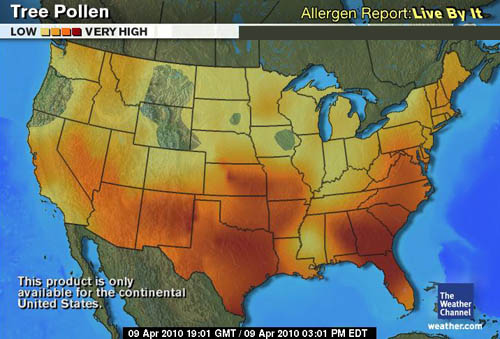
[Image: Tree pollen map, brought to you by the Weather Channel].

One of the most memorable posts on Pruned, I think, was written way back in September 2005, when Alex took a look at what he called “litter-free landscapes and the politics of pollen.” He quoted horticulturalist Thomas Leo Ogren at length:

In our urban landscapes we now have the most manipulated kind of city forest ever seen. In the past twenty years landscapers have grown inordinately fond of using male trees. In dioecious species (separate-sexed) there are separate male trees and separate female ones. Female trees and shrubs do not produce any pollen, ever, but they do produce messy seeds, fruits, old flowers, and seedpods. Landscapers and city arborists consider this female byproduct to be “litter”, and they don’t like to see it lying on our sidewalks.

In other words, urban landscapers over-utilize pollen-intensive plantlife—which, in turn, wildly amplifies seasonal allergies. What if you didn’t need more boxes of Claritin, then—you need a more informed city parks department?

I was thus thrilled when Alex pointed out that Ogren had written an op-ed piece for the New York Times, revisiting these very ideas. “As certain trees burst into bloom in spring,” Ogren writes, “their pollen wafts through the air in a wanton attempt to reach receptive blossoms.”

Millions of people with allergies pay the price, in sneezing, wheezing, coughing, drowsiness and itchy, watery eyes. They needn’t suffer so much. Cities could reduce the misery by planting street trees that produce very little pollen or none at all.

Approaching public health from the perspective of landscape design—streetscape botany—together with the unexpected history of our growth in urban allergies, is absolutely fascinating. “Street trees weren’t always as allergenic as they are today,” for instance, Ogren writes.

Back in the 1950s, the most popular species planted in the United States was the native American elm, which sheds little pollen. Millions of these tall, stately trees lined the streets of towns and cities from coast to coast. Sadly, in the 1960s and ’70s, Dutch elm disease killed most of the elms, and many of them were replaced with species that are highly allergenic.

Whether you suffer from allergies or not, the op-ed is worth reading in its entirety.

(Via Pruned).

Sydney Beaches, Future Towers, and How to Park Cars on the Moon

Linda Bennett of Archi-Ninja has posted an interview with Sydneysider architect and fellow blogger Marcus Trimble.

[Image: Proposal for a new UTS Tower by Super Colossal].

By way of some historical context, Marcus was writing one of the few architecture blogs out there, during an earlier phase in the field (say, 2004-2005), when Archinect, City of Sound, Archidose, Strange Harvest, we make money not art, Life Without Buildings, things magazine, and not a lot of others (though some deserving sites have been left out of that truncated and subjective list) were the only blogs offering consistent architectural coverage. Inhabitat didn’t exist till mid-2005; same with Pruned; Subtopia had yet to be launched; and the bigger sites today, like Dezeen, which sidestep architectural journalism altogether to focus simply on image reproduction and/or social networking, were still years away.

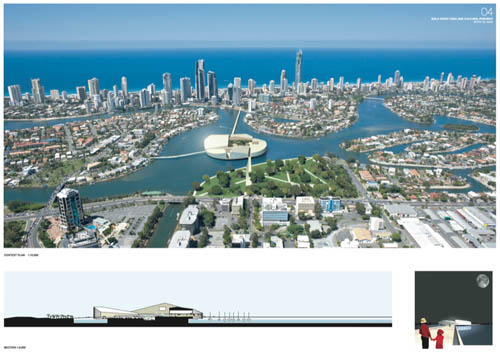
But there was Marcus, writing his first blog gravestmor—which lasted from May 18th, 2004, to July 12, 2007—a site that morphed into a blog for his own architectural practice, Super Colossal. That firm has since gone on to win first place in the Gold Coast Performing Arts Centre design competition (proposing a sort of inhabitable bridge -slash- artificial harbor island), as well as the high-profile Australian Peacekeeping Memorial (and their overlooked design for a new UTS Tower, which can be seen in the image above). Of course, those are in addition to several finished projects, including a private house, apartment, bathroom renovation, and the internet-famous cardboard cubby house.

[Image: Super Colossal’s competition-winning design for Gold Coast Performing Arts Centre].
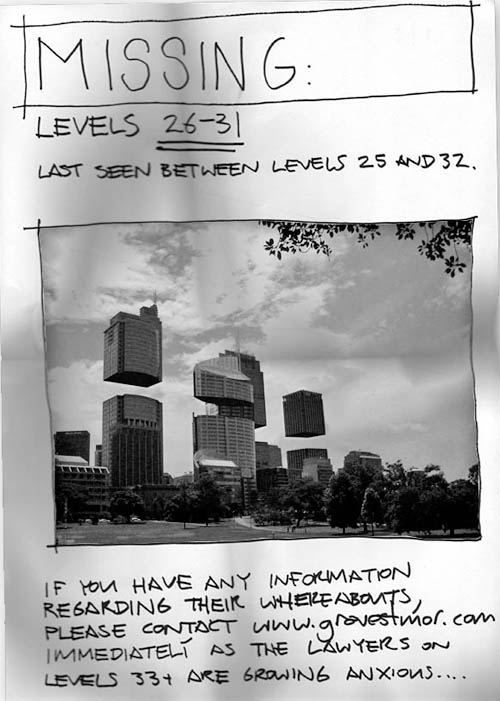
But it’s Marcus’s roving and very widespread field of interests that made gravestmor so appealing, and that Super Colossal extends today—whether it’s his ongoing explorations of comic book architecture, steampunk spaces, the racial politics of Sydney beaches, how to park cars on the moon, urban space as depicted in the work of J.G. Ballard, his suggestion that China might really be a USB external harddrive for the French, and much more. This was actually the first post I ever remember seeing over there—and I was pretty much hooked from then on.

[Image: “Lost and Found” by Marcus Trimble].

In any case, the interview over at Archi-Ninja is a bit on the short side, and I would love to hear more from Marcus about his active organizational role down there in Sydney, promoting that city’s architects and their work both to one another and to the rest of the world. But it’s still worth a read, covering space elevators, the films of Stanley Kubrick and Michael Mann, the future of the architect, running in the city, and more.

Chocolate City

[Image: Via Edible Geography].

In a long new post, Edible Geography takes a look at the planned cities of chocolate barons, suburban sites where the capitalist ideal of a company town overlapped with philanthropic inclinations toward utopia. Quoting at length:

The towns that chocolate built are a curious blend of idealistic vision and pragmatic company town—the convergence of paternalistic benevolence and capitalist expedience. The Cadbury and Rowntree brothers were devout Quakers, whose humanitarian beliefs undoubtedly impelled them to improve the living conditions of their workers. Hershey’s benevolence seems not to have been motivated by religious belief, despite the fact that he was raised by a strict Mennonite mother. However, he was undoubtedly a grand philanthropist, anonymously giving away his entire personal fortune (an estimated value of $60 million in 1918) at the age of sixty-one to endow a school for poor and orphan boys.

Nonetheless, as Tim Richardson is quick to point out [in his recent book Sweets], “philanthropy was always accompanied by efficiency in these developments.” Hershey chose his rural location, for example, less from a desire to ensure his factory workers had access to healthy, rural air, than for strategic gain—deep in dairy-farming land to ensure a cheap supply of milk, but close enough to major cities (Philadelphia and New York) to allow cost-efficient distribution.

The design, planning, economic administration, and cultural history of these chocolate cities would be a fascinating subject for a longer book (or Ph.D.).

Until then, see a related—and similarly titled—story over at Lapham’s Quarterly, then check out the Edible Geography post in full.

Speculative subways for landscapes with no need for them

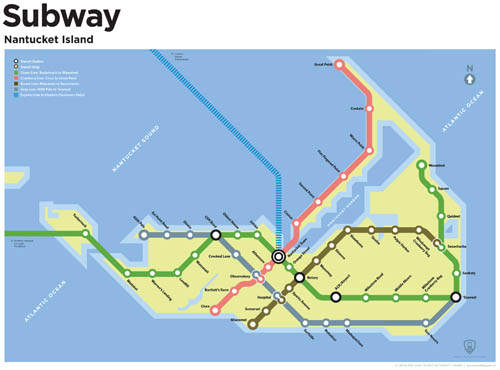
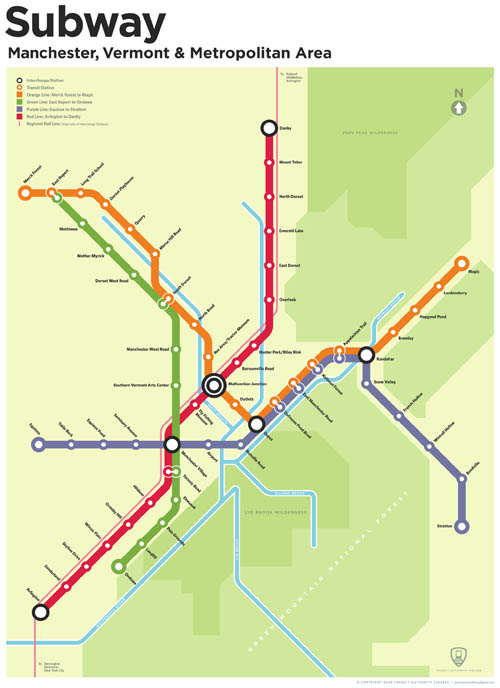
I’m a big fan of these speculative subway maps in which underground transportation systems have been projected for landscapes in which their actual construction would be absurd.

[Image: A speculative future subway map by Transit Authority Figures].
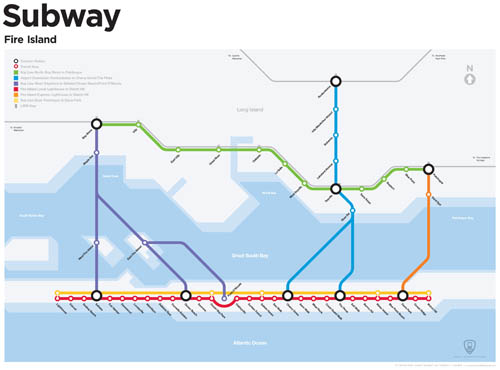
Indeed, in many cases, constructing a subway in these sites—Acadia National Park, for instance, seen above, or Martha’s Vineyard—would not only be technically ridiculous, or simply surreal, it would be a disaster.

[Images: Maps by Transit Authority Figures].

Designed by Transit Authority Figures, there are currently nine posters to view (and purchase).

[Image: By Transit Authority Figures].

Hopefully more maps are forthcoming—and it would be great to see more sites outside of New England. A subway for Rocky Mountain National Park, say, or the Galapagos. How about the Greek island of Patmos, where St. John so famously experienced his revelation? Or mechanized travel beneath the Antarctic base at McMurdo. Marrakech. The Florida Keys.

Keep your eye on the Transit Authority Figures’ poster page to see what might come next.

(Via @stevesilberman).

Ice Cream Climatology

[Image: The Cloud Project van by Zoe Papadopoulou and Cathrine Kramer].

Like a whimsical hybrid of molecular gastronomy and Glacier/Island/Storm, the Cloud Project by Zoe Papadopoulou and Cathrine Kramer, design-interaction students at London’s Royal College of Art, would use “artillery dispersed ice cream ingredients,” fired from roof-mounted cannons, “to make clouds snow ice cream.”

[Images: From the Cloud Project by Zoe Papadopoulou and Cathrine Kramer].

The van’s projectile clouds of aerosolized nanotechnology would kick-start snowflake formation high above—seemingly inspired by the cloud-producing exhalations of open-ocean algae—but they would also then scent the resulting snowfall with the aroma of fresh strawberries.

The result? Ice cream, delivered soft, cold, and delicious, falling straight from the afternoon sky. Perhaps we’ll soon all need ice cream gloves.

[Image: A how-to guide for precipitating strawberry ice cream by Zoe Papadopoulou and Cathrine Kramer].

Oddly, BLDGBLOG proposed a variant on this—scented snow—a few years back, so it should come as no surprise that I think it’s at least worth a shot. After all, what could possibly go wrong?

But it’s worth asking what other foodstuffs might also be made to precipitate directly from the summer sky—when agriculture gives up the ghost, say, or once our planetary soils have been entirely depleted, could we someday farm the sky? Aerocultural precipitation: nutrition fresh and direct from the planet’s atmosphere.

And what a strange planet it would be if this somehow sparked runaway ice cream climate change: unstoppable drifts of Chunky Monkey filling the streets of Montreal, vast glaciers of the stuff carving valleys through Antarctic plains.

(Thanks to Liam Young for the tip! Speaking of food, meanwhile, don’t miss the previous post about this coming weekend’s quarantine banquet).

The Quarantine Banquet

New Yorkers with a taste for great—and jaw-droppingly creative—food should take note that, next weekend, two quarantine-themed banquets will be held inside Storefront for Art and Architecture, adding a culinary dimension to the ongoing exhibition Landscapes of Quarantine.

[Image: From a previous a razor, a shiny knife meal; photo by Jennifer May for the New York Times. See more photos here].

As Nicola Twilley describes these nights over on Edible Geography, “on Saturday, April 10, and Sunday, April 11, the Brooklyn-based a razor, a shiny knife team will explore the culinary implications of quarantine, preparing and serving a quarantine-themed dinner inside the exhibition itself. Tickets are not cheap but then this will not be just dinner,” she adds; it will “explore the outside limits of the science of cooking, as well as the theatrical, social, and experiential possibilities of a meal.”

Michael Cirino himself explains that “these events are not only for professional chefs or foodies; they are for anyone who loves food, regardless of culinary knowledge or experience. We produce these evenings to effect a communal environment of social interaction, education and fun.” As such, the quarantine dinners will also include live demonstrations of Cirino’s techniques—including a lesson in “interesting applications for an iSi whipper.”

[Image: From a previous a razor, a shiny knife meal; see more photos here].

I would highly recommend reading the detailed rundowns of the quarantine menu both at Edible Geography and at the event listing itself (where you can also buy tickets). Edible Geography points out, for instance, that “if the dinner guests are passengers on a journey through quarantine, then the first course plays with the idea of exposure to disease, and the second course mimics the first step taken on arrival at the lazaretto—disinfection.”

In our initial conversations, I had told Michael that during outbreaks of the Black Death in fifteenth-century Europe, port officials would “disinfect” suspect cargo and mail by dousing it in vinegar and/or subjecting it to cedar or sandalwood smoke: from that seed of an idea, combined with culinary technology, a new edible experience emerged.

There will be “vacuum-sealed plastic bags,” riffing off the idea of separation and containment, and an “encapsulated” dessert course, all prepared by Cirino using the best ingredients on offer (such as dry-aged steak from the finest purveyors in New York City, white truffles, steelhead trout roe, and specially paired wines from Cabrini).

[Images: Photos from previous a razor, a shiny knife meals; see many more photographs here].

The very idea of a quarantine menu is, I have to say, extraordinarily inspired, as it recontextualizes the spatial tactics of quarantine as unexpected new techniques for cooking, and it takes materials and foods that have themselves, at various points in history, been subject to quarantine and treats them as ingredients for a gourmet meal. Further, an elaborate dinner served and plated after-hours inside Storefront for Art and Architecture will be quite a thrill (for photos of what such a meal might look like, check out the dinner for the Storefront re-opening gala a few years back).

[Image: From a previous a razor, a shiny knife meal; see more photos here].

In any case, all proceeds go to a razor, a shiny knife, and the events sound brilliant; definitely consider supporting Cirino’s culinary experiments, as you’ll get a night of cooking demonstrations and a delicious, once-in-a-lifetime meal in the process.

Digital Analog

[Image: O.T. (2006) by Esther Stocker, photographed by Rainer Iglar].

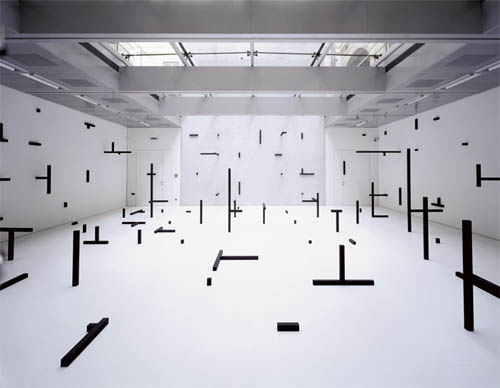
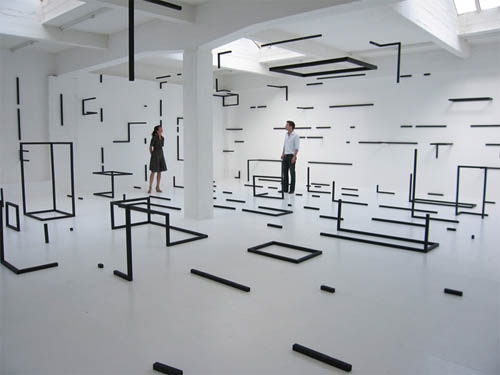
Here are two projects by artist Esther Stocker. They both use the black, abstract outlines of fragmented spaces to suggest much larger architectural shapes. There is the implication in each that, if only you could stand in the right place, at the right angle, all of these detached typographies of edges and corners might merge, Felice Varini-like, overlapping backward through the stages of a slow explosion, to form a building.

[Image: Abstract thought is a warm puppy (2008) by Esther Stocker; photo by Sacha Georg].

But each of these also has the optical side-effect of generating what looks like an immersive matrix of information hovering somewhere in the room in front of you, the stark contrast between black and white, and the geometric clarity of the pieces, taking on a disconcertingly digital air.

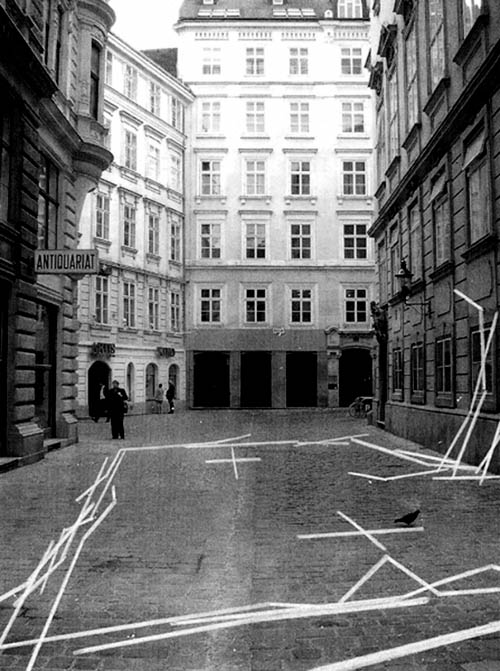
Tangentially, I’m reminded of the System Wien/”Architecture of Energy” project by Lebbeus Woods and Christoph Kumpusch, which translates a series of seemingly directionless sketches of white lines in black space—

[Image: From System Wien/”Architecture of Energy” by Lebbeus Woods and Christoph Kumpusch].

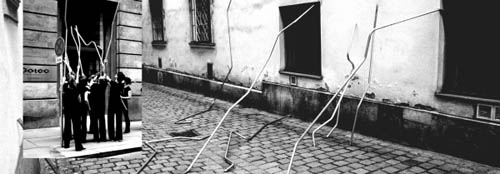
—into reflective implications of perimeters, the outermost envelopes of buildings that don’t exist, when “drawn” onto city streets with metal pipes.

[Images: System Wien by Lebbeus Woods and Christoph Kumpusch installed on the streets of its urban namesake].

This up-scaled materialization of the 2D sketch—from flat line on paper to angular filling of space, built with what Woods calls “vector rods”—for me also has the optical effect of gesturing toward something that doesn’t really seem to be there. In other words, these pipes, so reflective as to appear white, seem more like retinal tears (or even scratches in the negative), not objects that you can actually see or touch somewhere out there in the city. They are pieces of an invisible building—like fingernail clippings of space.

(Esther Stocker spotted via but does it float).