Star Forts, Mines, and Other Maastricht Subterranea

I was in Maastricht, Netherlands, for a couple nights last week, mostly as a way to break-up my trip across the Atlantic and thus help get over jet-lag before attending an archaeology conference (where I currently type this).

I went specifically to Maastricht, however, because it’s home to an astonishing number of subterranean sites, from 800-year-old limestone mines and 17th-century star fortifications to NATO defense bunkers. I basically checked into my hotel then disappeared underground for the rest of the visit.

Here are some pics.

My morning started here, at the entrance to the Casemates Waldeck, a labyrinth of defensive earthworks complete with tunnels, counter-mine tunnels, barracks, and firing positions. Large parts of the system were then later repurposed as civilian air-raid shelters during WWII.

The geometric logic of the forts was—among other things—to lure enemy attackers in over cliff-like artificial drops and ridges, thinking they were on their way to the heart of the city. However, this simply trapped them between huge brick walls, directly in front of disguised gun emplacements, many of which were deliberately aimed at stomach-height to maximize suffering.

If you go through the door seen in the above photographs, meanwhile, you end up inside a bewildering system of multi-level tunnels weaving around for kilometers beneath the outer edge of the city.

Because the city has expanded and grown over the centuries, whole neighborhoods now sit atop these structures; if you live in Maastricht, you might very well have disused military fortification tunnels running under your basement.

What’s more, not all of the tunnels are mapped—which means that some are neither maintained nor stabilized. Apparently, seasonal floods have led to sinkholes above, as streets partially collapse into the system.

And that’s just one of many, many underground sites you can tour.

The next place I headed was called the Zonneberg Caves—which are not natural caves, but a colossal limestone mine—and I honestly can say I would spend entire weeks down there.

I’m just randomly typing facts from memory, because I’m on a break from a conference and want to get these photos up, which means I will almost certainly get a few details wrong, but I believe they said that “only” 80 or so kilometers of these ancient limestone mines remain from more than 200, and that the first shafts were cut in the 13th century.

The mines extend all the way over the international border into Belgium. The Belgian tunnels are apparently closed to the public, yet people sneak into them all the time.

There are 20th-century artworks painted on the walls, much older graffiti etched directly into rock, and massive corridors extending off on all sides into darkness.

If you’re into the underground and ever have an opportunity to spend more time than a tour down there, I would recommend it without any hesitation—and I will be deeply, deeply jealous.

The site is even complete with a little church altar.

Bear in mind, this is all still the same day.

The next site I went to was accessed through a locked metal door in the rock (pictured above). This system, known as the North Caves, is actually physically connected to the Zonneberg Caves, although it would take an hour or more to get between them underground. Like I say, I would go back there and wander around in a heartbeat.

The added interest of this latter system is that parts of it were used during WWII to house paintings by the Old Masters, protecting them from Nazi plunder and stray Allied bombs alike.

At the end, you go into a place called “the Vault” to see where Rembrandts and other paintings were hung while war waged above.

Finally, after many hours underground, I walked outside—and the first thing I saw was this rainbow. A cheesily enjoyable end to a fantastic day.

If you’re tempted to see any of these places yourself, and you hope to do so legally, check out Maastricht Underground for potential tours.

[All photos by Geoff Manaugh/BLDGBLOG.]

Uncontrolled Remains

I find landfill chemistry weirdly fascinating, particularly the idea that untold millions of tons of garbage being stored in giant, artificial landforms—or simply buried underground like false geological deposits—might be inadvertently catalyzing chemical processes we neither understand nor know how to stop. I was thus excited to see a long investigation of this topic in Bloomberg last week, led by journalists Laura Bliss and Rachael Dottle.

At the Chiquita Canyon Landfill here in greater Los Angeles, a disquieting smell—not to mention strange medical issues—has been tormenting local neighbors for years. But there is “no simple solution,” we read, “because what’s driving it is something buried beneath the waste: a complex and dangerous chemical reaction whose very nature is in dispute.”

The side-effects of that complex chemical reaction include elevated, sometimes “scorching,” underground temperatures and the production of Dantean landscape scenes above: “In early 2022 a closed section in the landfill’s northwest corner began overheating, eventually reaching temperatures above 200F (93C). That’s nearly 40% hotter than the federal EPA’s standard for landfill operations. As the waste slowly cooked, it belched out toxic gases, elevating nearby levels of hydrogen sulfide, carbon monoxide and benzene, which can damage DNA and cause leukemia after enough exposure. Large amounts of leachate (basically, trash juice) built up and bubbled, boiled and even shot into the air like geysers.” The belch as landscape phenomenon.

The article is worth reading in full, and goes into much further depth about all of this. One important point is the potential role played by new types of material waste, including lithium-ion batteries, vape pens, electric toothbrushes, and other electronic goods whose presence might be at least partially to blame for rising subterranean temperatures in landfills across the United States.

But what continues to interest me about this overall problem, and why I’m posting about landfills again, is something more abstract than just waste-management practices or oxygen-content regulations in the disposal industry: we continue to create things we don’t know how to get rid of, objects whose attempted destruction only empowers them and materials whose burial makes them harder to control.

Institute for Controlled Speleogenesis

Recently, I’ve been looking back at a collaborative project with John Becker of WROT Studio.

The “Institute for Controlled Speleogenesis” (2014) was a fictional design project we originally set in the vast limestone province of Australia’s Nullarbor Plain.

[Image: A rock-acid drip-irrigation hub for the “Institute for Controlled Speleogenesis,” a collaboration between BLDGBLOG and WROT Studio; all images in this post are by John Becker of WROT Studio.]

The Nullarbor Plain is a nearly treeless region, roughly the size of Nebraska. It is also the world’s largest karst landscape, and thus home to hundreds of natural caves.

“There is a great variety of cave types under the Nullarbor,” as Australian Geographic explains, “but the plain’s most interesting features are long, deep systems (such the Old Homestead Cave), which are found only here, in the U.S. state of Florida, and on Mexico’s Yucatan Peninsula, all of which all have similar karst limestone layers.”

The Institute for Controlled Speleogenesis was imagined as a remote, thinly staffed site for applied geological research, where huge artificial caves could be generated below the Earth’s surface using a special acid mix—as safe as vinegar, but, importantly for our project, capable of dissolving limestone on a greatly accelerated timescale.

Subterranean spaces of every conceivable size, from tiny hollows and capillaries to vast megastructures, could thus be acid-etched into even the deepest karst formations, both rapidly and over decadal expanses of time.

The resulting rooms, tunnels, and interconnected cave systems could be used for a wide range of purposes: generating speleo-pharmaceuticals, for example, as well as testing recreational caving equipment, experimenting with underground agricultural systems, or developing new technologies for subterranean navigation, communication, inhabitation, and mapping.

As John writes on his own website—where you can also see larger, more-detailed versions of these images—our “aberrant caverns,” in John’s phrase, would be monitored in real-time by autonomous systems operating 24 hours a day.

The ever-growing caves could thus be left on their own, unsupervised, while the acid-drip system gradually etches down, drop by drop, reaching increasingly remote underground realms that the acid itself creates.

As a preliminary step, different blends of rock-acid mix would first be tested on large pillars aboveground, to choose or highlight specific spatial effects.

Controlled showers of rock-acid would result in totem-like sculptures, like industrial-scale menhirs—Stone Age ritual artifacts by way of 21st-century geochemistry.

Once the desired effects have been achieved, fields of bladders, nozzles, and injection arrays can be programmed and choreographed to enlarge an artificial cave mouth.

The irrigation system can then be continued underground. Necklaces of acid-drip arrays can easily be extended underground in order to expand the cave itself, but also to lengthen certain tunnels or to experiment with architecturally stable cave formations.

As John explains, the images seen here depict an “injection array using a pressurized system to move large quantities of solution to underlying areas of the cave network. These injection sites are outwardly the tell for a hidden world below. Much like oil derricks extracting resources from the earth, their density and scale across the landscape give you a glimpse into areas afforded the most resources for injection.”

Our initial siting of this in the Nullarbor Plain was motivated entirely by geology, but other large limestone provinces—from Kentucky or northern Arizona to southern France, and from California’s Lucerne Valley to Egypt—would also be good hosts.

While we looked into standard mining acids, currently used for stripping tailings piles of valuable minerals, it quickly became apparent that specific kinds of acetic acid—again, no more toxic than vinegar—offered a more viable approach for creating a maximally spacious site with minimally polluting environmental implications. (Of course, should someone without such qualms want to explore this set-up with no concern for its ecological impact, then much stronger acids capable of dissolving much stronger rocks could also be explored.)

In 2022, I was excited to see that John returned to this project, generating a new series of images using AI image-generation software trained on our earlier project documentation. Given their provenance, the resulting images are unsurprisingly cinematic—equal parts cyberpunk dereliction and underworldly luminescence.

Over the years, John has become a wizard at producing Modernist geological imagery, publishing images on his Instagram account—rock sculpted as smooth as paper and as diaphanous as a veil or curtain.

Check out his own website for more images of the Institute for Controlled Speleogenesis and other recent projects. And, if you like this, don’t miss “Architecture-by-Bee and Other Animal Printheads,” an earlier project of ours that I’m proud to say was published in Paul Dobraszczyk’s excellent recent book, Animal Architecture: Beasts, Buildings and Us.

(All images in this post are by John Becker of WROT Studio. This post contains a Bookshop.org affiliate link, meaning that I might receive a small percentage of any resulting sales.)

The Reaction Area

Enigmatic chemical reactions” have broken out underground inside two Los Angeles-area landfills, according to the L.A. Times. These “highly unusual reactions at Los Angeles County’s two largest landfills have raised serious questions about the region’s long-standing approach to waste disposal and its aging dumps.”

If landfills are the extreme endpoint of a cultural practice of burial—we bury to memorialize, to forget, to protect, to hide, store, and retrieve—then the idea that what we’ve made subterranean might take on a life or chemical activity of its own has a strange irony. Landfills seem to fully embody the idea that we don’t understand the extent of we’ve placed into the ground, nor what it does once we leave it there. Perhaps we also bury to reinvigorate and transform.

I’m reminded of a story from the British nuclear facility at Sellafield, whose new owners realized they had incomplete documentation of the site and thus had no idea where radioactive waste had been buried there. They actually put an ad in the local newspaper saying, “We need your help. Did you work at Sellafield in the 1960s, 1970s or 1980s? Were you by chance in the job of disposing of radioactive material? If so, the owners of Britain’s nuclear waste dump would very much like to hear from you: they want you to tell them what you dumped—and where you put it.”

It feels oddly on-brand with modern living that we might not fully understand long-term landfill chemistry, that random solvents, dyes, acids, fuels, and detergents sloshing around together in huge, sealed landscapes for decades might break out in unexplained reactions, like inadvertent batteries—that we isolated our waste, thinking it would make us safe, but it is only gaining in chemical power.

As of November 2023, the “reaction area” in one of the L.A. dumps “had grown by 30 to 35 acres, according to the agency [CalRecycle]. Already, the heat has melted or deformed the landfill’s gas collection system, which consists mostly of polyvinyl chloride well casings. The damage has hindered the facility’s efforts to collect toxic pollutants.” This seems to imply it will get worse, and nearby residents have begun reporting chemical smells.

“The bad news,” L.A. County Supervisor Kathryn Barger told the paper, “is we’ve never seen anything like this, and if we don’t understand what triggered it, it could happen at other landfills that are dormant. So it’s important for us to get a handle on it.” The earth, riddled with dormant landfills, attaining enigmatic chemical vigor in the darkness.

(Related: Class Action, Land of Fires, and The Landscape Architecture of Crisis.)

Potsdamer Sea

[Image: From Kiessling’s Grosser Verkehrs-Plan von Berlin (1920).]

It’s funny to be back in Berlin, a city where I once thought I’d spend the rest of my life, first arriving here as a backpacker in 1998 and temporarily moving in with a woman 14 years older than me, who practiced Kabbalah and had twin dogs and who, when seeing that I had bought myself a portable typewriter because I was going through a William Burroughs phase, blessed it one night in her apartment near the synagogue in a ceremony with some sort of bronze sword. It’s almost literally unbelievable how long ago that was. More years have passed since I spent time in Berlin—supposedly to study German for grad school, but in reality organized entirely around going to Tresor—than I had been alive at the time.

Because I’m here again on a reporting trip, I was speaking yesterday evening with a former geophysicist who, when the Berlin Wall came down, found work doing site-remediation studies and heritage-mapping projects on land beneath the old path of the Wall. He was tasked with looking for environmental damage and unexploded ordnance, but also for older foundations and lost buildings, earlier versions of Berlin that might pose a structural threat to the city’s future or that needed to be recorded for cultural posterity.

Ironically, in a phase of my life I rarely think about, I wrote my graduate thesis on almost exactly this topic, focused specifically on Potsdamer Platz—once divided by the Wall—and the role of architectural drawings in communicating historical context. When I was first here, in 1998 into early 1999, Potsdamer Platz was still a titanic hole in the ground, an abyss flooded with groundwater, melted snow, and rain, a kind of maelström you could walk over on pedestrian bridges, where engineering firms were busy stabilizing the earth for what would become today’s corporate office parks.

As I told the former geophysicist last night, I remember hearing at the time that there were people down there, SCUBA diving in the floodwaters, performing geotechnical studies or welding rebar or looking for WWII bombs, I had no idea, but, whatever it was, their very existence took on an outsized imaginative role in my experience of the city. Berlin, destroyed by war, divided by architecture, where people SCUBA dive through an artificial sea at its broken center. It felt like a mandala, a cosmic diagram, with this inverted Mt. Meru at its heart, not an infinite mountain but a bottomless pit.

What was so interesting to me about Berlin at the time was that it felt like a triple-exposure photograph, the city’s future overlaid atop everything else in a Piranesian haze of unbuilt architecture, whole neighborhoods yet to be constructed, everything still possible, out of focus somehow. It was incoherent in an exhilaratingly literal sense. In Potsdamer Platz, what you thought was the surface of the Earth was actually a bridge; you were not standing on the Earth at all, or at least not on earth. It was the Anthropocene in miniature, a kind of masquerade, architecture pretending to be geology.

The more that was built, however, the more Berlin seemed to lose this inchoate appeal. The only people with the power to control the rebuilding process seemed to be automobile consortiums and international hotel groups, office-strategy consultants not wizards and ghosts or backpacking writers. Perhaps the city still feels like that to other people now—unfinished, splintered, jagged in a temporal sense, excitingly so, a city with its future still taking shape in the waves of an underground sea—but it seems to me that Berlin’s blur has been misfocused.

In any case, with the caveat that I am in Berlin this week for a very specific research project, so many people I’ve met have pointed to the fall of the Wall as an explosive moment for geophysical surveys in the East. Engineers were hired by the dozen to map, scan, and survey damaged ground left behind by a collapsed imperialist Empire, and the residues of history, its chemical spills and lost foundations, its military bunkers and archaeological remains, needed to be recorded. The ground itself was a subject of study, an historical medium. On top of that, new freeways were being built and expanded, heading east into Poland—and this, too, required geophysical surveys. The future of the region was, briefly, accessible only after looking down. The gateway to the future was terrestrial, a question of gravel and sand, forgotten basements and fallen walls.

The SCUBA divers of the Potsdamer Sea now feel like mascots of that time, dream figures submerged in the waves of a future their work enabled, swimming through historical murk with limited visibility and, air tanks draining, limited time. Their pit was soon filled, the hole annihilated, and the surface of the Earth—which was actually architecture—returned with amnesia.

Underground Cathedrals of Radiation and Zones of Irreversible Strain

[Image: Nevada test site, Google Maps, filtered through Instagram.]

There’s a great line in Tom Zoellner’s book Uranium: War, Energy, and the Rock That Shaped the World where he describes the after-effects of underground nuclear tests. Zoellner writes that, during these tests, “a nuclear bomb buried in a deep shaft underneath a mountain would vaporize the surrounding rock and make a huge cathedral-like space inside the earth, ablaze with radioactivity.”

I thought of Zoellner’s vision of a “huge cathedral-like space inside the earth” recently while reading a paper by Colin N. Waters et al., called “Recognising anthropogenic modification of the subsurface in the geological record.” Among other things, the authors describe the long-term “structural effects of subsurface weapon detonations.”

[Image: Nevada test site, Google Maps, filtered through Instagram.]

They suggest that these detonations produce spaces—such as collapse cones and debris fields—that have “no direct natural analogue,” although they do helpfully contrast weapon-test craters with meteor-impact sites. (The authors also break underground nuclear test sites down into “zones,” which include a “zone of irreversible strain,” which is an amazing phrase.)

The larger purpose of their paper, though, is to look at long-term “signatures” that humans might leave behind in our underground activity, from nuclear tests to mineralogical carbon-capture to deep boreholes to coal mines. Will these signatures still be legible or detectible for humans of the far future? On the whole, their conclusion is not optimistic, suggesting instead that even vast subterranean mines and sites of underground nuclear weapons tests will fade from the terrestrial archive.

“Many of the physical and chemical products of human subsurface intrusion either do not extend far from the source of intrusion, lack long-term persistence as a signal or are not sufficiently distinctive from the products of natural processes to make them uniquely recognisable as of anthropogenic origin,” they write. “But the scope and complexity of the signals have increased greatly over recent decades, both in areal extent and with increasing depths, and seem set to be a fundamental component of our technological expansion. There will be some clues to the geologist of the far-future, when historical knowledge records may not be preserved, that will help resolve the origin.”

[Image: Nevada test site craters, courtesy of the National Nuclear Security Administration Nevada Site Office Photo Library.]

Nevertheless, it is totally fascinating to imagine what future archaeologists might make of Zoellner’s “huge cathedral-like space[s] inside the earth, ablaze with radioactivity,” long after they’ve collapsed, and where sand has been fused into unnatural glass and anomalous traces of radiation can still be found with no reasonable explanation for how they got there.

Could future archaeologists deduce the existence of nuclear weapons from such a landscape? And, if so, would such a suggestion—ancient weapons modeled on the physics of stars—sound rational or vaguely insane?

(Vaguely related: “fossil reactors” underground in Gabon.)

Fungal Lightning

[Image: The mushroom tunnel of Mittagong, photo by Nicola Twilley, via BLDGBLOG.]

“Japanese researchers are closing in on understanding why electrical storms have a positive influence on the growth of some fungi,” Physics World reported last month, with some interesting implications for agriculture.

These electrical storms do not have to be nearby, and they do not even need to be natural: “In a series of experiments, Koichi Takaki at Iwate University and colleagues showed that artificial lightning strikes do not have to directly strike shiitake mushroom cultivation beds to promote growth.” Instead, it seems one can coax mushrooms into fruiting using even just the indirect presence of electrical fields.

As the article explains, “atmospheric electricity has long been known to boost the growth of living things, including plants, insects and rats,” but mushrooms appear to respond even to regional electrical phenomena—for example, when a distant lightning storm rolls by. “In Takaki’s previous studies, yield increases were achieved by running a direct current through a shiitake mushroom log. But Takaki still wondered—why do natural electric storms indirectly influenced [sic] the growth of mushrooms located miles away from the lightning strikes?”

Whether or not power lines or electricity-generation facilities, such as power plants, might also affect—or even catalyze—mushroom growth is not clear.

For now, Takaki is hoping to develop some kind of electrical-stimulation technique for mushroom growth, with an eye on the global food market.

[Image: Nikola Tesla, perhaps daydreaming of mushrooms; courtesy Wellcome Library.]

It is quite astonishing to imagine that, someday, those mushrooms you’re eating in a gourmet pasta dish were grown inside some sort of wild, Nikola Tesla-like electrical cage, half X-Men, half food-technology of the near-future—underground shining domes of fungal power.

[Image: The mushroom tunnel of Mittagong, photo by Nicola Twilley, via BLDGBLOG.]

The opening image of this post, meanwhile, is from a surreal field trip I took back in 2009 with Nicola Twilley to visit the “mushroom tunnel of Mittagong,” a disused rail tunnel in southeast Australia that is—or, as of 2009, was—used as a subterranean mushroom-growth facility. Imagine this tunnel quietly pulsing with electricity in the darkness, humid, strobing, its wet logs fruiting with directed fungi.

Electrical mushroom-control techniques, or where the future of food production merges imperceptibly with the world of H.P. Lovecraft.

[Image: The mushroom tunnel of Mittagong, photo by Nicola Twilley, via BLDGBLOG.]

Read a bit more over at Physics World.

The Deep

[Image: Binnewater Kilns, photo by BLDGBLOG.]

While I was over in New York State last fall, reporting both the “witch houses” piece for The New Yorker and the Middletown High School piece for The Guardian, I stopped off in the town of Rosendale, enticed there by several things I noticed on Google Maps.

[Image: The Rosendale Trestle, photo by BLDGBLOG.]

First was what turned out to be a satirical reference to something called the Geo Refrigeration Crevice, which, even on its own, sounded worth a side-trip. But, in the exact same area, there were also photos of an incredible-looking railway bridge converted to a hiking path that I wanted to walk across; there were these gorgeous, ruined kilns built into the hillside; and there were supposedly huge caves.

How on Earth could I drive past all that without stopping?

[Image: Caves everywhere! Photos by BLDGBLOG.]

Being—perhaps to my Instagram followers’ frustration—an avid hiker, I spent far more time there than I should have, mostly looking down into jagged crevasses that extended past the roots of trees, carpeted in fallen leaves, often hidden beneath great, shipwrecked jumbles of boulders slick with the waters of temporary streams.

I crossed the bridge and was ready to hit the road again, when I saw another site of interest on the map. I decided to walk all the way down and around to something called the Widow Jane Mine.

Having visited many mines in my life, I was expecting something like a small arched hole in the side of a hill, probably guarded with a locked gate. Instead, hiking into the woods past some sort of private home/closed mining museum, the ground still damp from rain, I found myself stunned by the unexpected appearance of these huge, moaning, jaw-like holes blasted into the Earth.

[Image: An entrance to the Widow Jane Mine; photo by BLDGBLOG.]
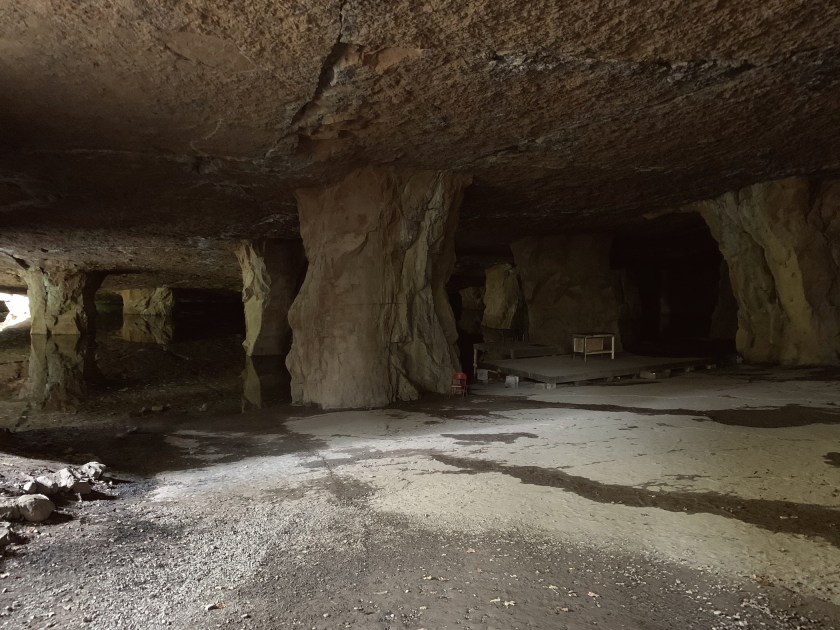
I walked inside and immediately saw the space was huge: a massive artificial cavern extending far back into the hillside. Excuse my terribly lit iPhone photos here, but these images should give you at least a cursory sense of the mine’s scale.

[Image: Inside the Widow Jane Mine; photos by BLDGBLOG.]

Several things gradually became clear as my eyes adjusted to the darkness.

One, I was totally alone in there and had no artificial illumination beyond my phone, whose light was useless. Two, a great deal of the mine was flooded, meaning that the true extent of its subterranean workings was impossible to gauge; I began fantasizing about returning someday with a canoe and seeing how far back it all really goes.

[Image: Flooding inside the Widow Jane Mine; photo by BLDGBLOG.]

Three, there were plastic lawn chairs everywhere. And they were facing the water.

While the actual explanation for this would later turn out to be both entirely sensible and somewhat anticlimactic—the mine, it turns out, is occasionally used as a performance venue for unusual concerts and events—it was impossible not to fall into a more Lovecraftian fantasy, of people coming here to sit together in the darkness, waiting patiently for something to emerge from the smooth black waters of a flooded mine, perhaps something they themselves have invited to the surface…

[Image: Lawn chairs facing the black waters of a flooded mine; photo by BLDGBLOG.]

In any case, at that point I couldn’t be stopped. While trying to figure out where in the world I had left my rental car, I noticed something else in Google’s satellite view of the area—some sort of abandoned factory complex in the woods—so I headed out to find it.

On the way there, still totally alone and not hiking past a single other person, there was some sort of Blair Witch house set back in the trees, collapsing under vegetation and water damage, with black yawning windows and graffiti everywhere. I believe it is this structure in the satellite pic.

[Image: A creepy, ruined house in the woods, photo by BLDGBLOG.]

Onward I continued, walking till I made it, finally, to this sprawling cement plant facility of some sort just standing there in a clearing.

[Image: Cement world; photos by BLDGBLOG.]

I wandered into the silos, looking at other people’s graffiti…

[Image: “Born to Die”—it’s hard to argue with that, although when I texted this photo to a friend he thought it said “Born to Pie,” which I suppose is even better. Photo by BLDGBLOG.]

…before continuing on again to find my car.

Then, though, one more crazy thing popped up, sort of hidden behind those kilns in the opening photo of this post.

There was a door in the middle of the forest! With a surveillance camera!

[Image: Photos by BLDGBLOG.]

It turns out this door leads down into the massive document-storage caverns of Iron Mountain located nearby, a company whose subterranean archive fever was documented in The New Yorker several years ago (albeit referring to a slightly different location of the firm). I would guess that this is the approximate location of that door.

This was confirmed for me by a man sitting alone in a public works truck back at the Binnewater Kilns parking lot, near my rental car. He was smoking a cigar and listening to the radio with his window rolled down when I walked up to the side of his truck and said, “Hey, man, what’s that door in the woods?”

Void Shaft Electricity

[Image: An engraving of mining, from Diderot’s Encyclopedia.]

A Scottish firm called Gravitricity wants to turn abandoned mine shafts into gravity-driven, underground electrical batteries. Power could be generated and stored, the Guardian reported back in late 2019, “by hoisting and dropping 12,000-ton weights—half the weight of the Statue of Liberty—down disused mine shafts.”

By timing these drops with regional energy demand, Gravitricity’s repurposed mines could act as “breakthrough underground energy-storage systems,” a company spokesperson explains in a video hosted on their site.

“Gravitricity said its system effectively stores energy by using electric winches to hoist the weights to the top of the shaft when there is plenty of renewable energy available, then dropping the weights hundreds of meters down vertical shafts to generate electricity when needed,” the Guardian continues.

[Image: From the Gravitricity website.]

In Subterranea: The Magazine for Subterranea Britannica, where I initially read about this plan, some of the proposal’s inherent design limitations are made clear. “What would be required for the Gravitricity scheme,” SubBrit suggests, “would be very deep, wide, and perhaps brick-lined shafts clear of ladderways, air ducts, cables and the like. On what sort of surface the weights might land, time and time again, is another consideration.”

Of course, this suggests that such shafts could also be deliberately designed and excavated as purpose-built battery-voids stretching down hundreds—thousands—of meters into the Earth, a not-impossible architectural undertaking. Repurposed domestic wells, using smaller weights, could also potentially work for single-home electrical generation, etc. etc.

So here’s to a new generation of proposals for how to perfect such a scheme, proposals that should be awarded bonus points if the resulting gigantic underground cylinders might also function as seismic invisibility cloaks (or “huge arrays of precisely drilled holes and trenches in the ground”).

Dark Matter Mineralogy and Future Computers of Induced Crystal Flaws

[Image: Mexico’s “Cave of the Crystals,” via Wikipedia].

I guess I’ve got minerals on the brain.

Anyway, there was an amazing story last week suggesting that, deep inside the planet, minerals might exhibit flaws associated with “collisions with dark matter.” In a sense, this would make the entire interior of the earth a de facto dark matter detector—or, according to researchers at the University of Michigan, “minerals such as halite (sodium chloride) and zabuyelite (lithium carbonate), can act as ready-made detectors.”

Proving this hypothesis sounds like the opening scene of a blockbuster science fiction film: “An experiment could extract the minerals—which can be around 500 million years old—from kilometres-deep boreholes that already exist for geological research and oil prospecting. Physicists would need to crack open the extracted minerals and scan the exposed surfaces under an electron or atomic force microscope for the tracks made by recoiling nuclei. They could also use X-ray or ultraviolet 3D scanners to study bigger chunks of minerals faster, but with lower resolution.”

Either way, it’s incredible to imagine that slightly altered mineral structures deep inside the planet might reveal the presence of dark matter washing through the cosmos. After all, the Earth is allegedly “constantly crashing through huge walls of dark matter,” so the idea that some rocks might be glitched and scratched by these impacts isn’t that hard to believe. In fact, this brings to mind another hypothesis, that the GPS satellite network is, in fact, a huge, accidental dark matter detector.

Read more at Nature.

Meanwhile, ScienceDaily reported earlier this month that flaws deliberately introduced into the crystal forms of diamonds could be structured such that they improve those diamonds’ capacity for quantum computation. Apparently, a team at Princeton has designed new kinds of diamonds “that contain defects capable of storing and transmitting quantum information for use in a future ‘quantum internet.’”

There is obviously no connection between these two stories, but that won’t stop me from imagining some vast new quantum computer network, coextensive with the Earth’s interior, performing prime-number calculations along dark matter-induced crystal flaws, crooked mineral veins flashing in the darkness with data, like some buried circuitboard throbbing beneath the continents and seas.

Read more at ScienceDaily.

(Related: Planet Harddrive.)

Secret British Caving Teams and the Mineralogy of Nuclear War

[Image: An otherwise unrelated photo of a cave in China, taken by @PhailMachine, via wallhere].

An interesting story that re-emerged during recent coverage of the Thai cave rescue is that a team of British cavers trapped underground in central Mexico for “more than a week” back in 2004 had been accused of having an ulterior motive.

Of the six men, five were British soldiers, and the crew was rescued not by local emergency crews but by a team flown in from Britain. Nothing about either alleged fact is even remotely suspicious, of course, but, according to local press at the time, “the men had been looking for materials that could be used to make nuclear weapons.”

This was apparently more than just a bar-room rumor: Mexico’s energy minister “waded into the row by saying he would send members of the country’s nuclear research institute into the caves because of rumours the British potholers were looking for uranium deposits.” Things “descended into farce,” according to the Guardian, “amid claims the MoD-sponsored expedition was a secret uranium prospecting exercise and that precise details of the trip were not forwarded to the relevant authorities.”

The conspiracy seems to have begun when someone noticed a particular piece of equipment in a photo of the caving team: “someone spotted radon dosimeters being used. This wasn’t a military training exercise; it was a bunch of guys on holiday, some of whom happened to be in the armed services.”

What the British team would even have done with such materials, if they had found them, including how they would have safely transported uranium out of the underworld in their caving gear—not to mention how they would have exploited this knowledge later, perhaps by developing a vast, illegal, underground mine in the middle of central Mexico?—is difficult to imagine, but, wow, would I like to read that novella.

Six British soldiers descend into the Earth beneath Mexico looking for the infernal materials of war, part of a much larger, secret global mission for subterranean weapons-prospecting, slipping into caves in Central America, the U.S. Southwest, the Namibian desert, and beyond, combining raw international espionage, classified satellite reports, weaponized mineralogy, advanced underground mapping techniques, and every gear-head’s camping equipment fantasy turned up to 11.