Star Forts, Mines, and Other Maastricht Subterranea

I was in Maastricht, Netherlands, for a couple nights last week, mostly as a way to break-up my trip across the Atlantic and thus help get over jet-lag before attending an archaeology conference (where I currently type this).

I went specifically to Maastricht, however, because it’s home to an astonishing number of subterranean sites, from 800-year-old limestone mines and 17th-century star fortifications to NATO defense bunkers. I basically checked into my hotel then disappeared underground for the rest of the visit.

Here are some pics.

My morning started here, at the entrance to the Casemates Waldeck, a labyrinth of defensive earthworks complete with tunnels, counter-mine tunnels, barracks, and firing positions. Large parts of the system were then later repurposed as civilian air-raid shelters during WWII.

The geometric logic of the forts was—among other things—to lure enemy attackers in over cliff-like artificial drops and ridges, thinking they were on their way to the heart of the city. However, this simply trapped them between huge brick walls, directly in front of disguised gun emplacements, many of which were deliberately aimed at stomach-height to maximize suffering.

If you go through the door seen in the above photographs, meanwhile, you end up inside a bewildering system of multi-level tunnels weaving around for kilometers beneath the outer edge of the city.

Because the city has expanded and grown over the centuries, whole neighborhoods now sit atop these structures; if you live in Maastricht, you might very well have disused military fortification tunnels running under your basement.

What’s more, not all of the tunnels are mapped—which means that some are neither maintained nor stabilized. Apparently, seasonal floods have led to sinkholes above, as streets partially collapse into the system.

And that’s just one of many, many underground sites you can tour.

The next place I headed was called the Zonneberg Caves—which are not natural caves, but a colossal limestone mine—and I honestly can say I would spend entire weeks down there.

I’m just randomly typing facts from memory, because I’m on a break from a conference and want to get these photos up, which means I will almost certainly get a few details wrong, but I believe they said that “only” 80 or so kilometers of these ancient limestone mines remain from more than 200, and that the first shafts were cut in the 13th century.

The mines extend all the way over the international border into Belgium. The Belgian tunnels are apparently closed to the public, yet people sneak into them all the time.

There are 20th-century artworks painted on the walls, much older graffiti etched directly into rock, and massive corridors extending off on all sides into darkness.

If you’re into the underground and ever have an opportunity to spend more time than a tour down there, I would recommend it without any hesitation—and I will be deeply, deeply jealous.

The site is even complete with a little church altar.

Bear in mind, this is all still the same day.

The next site I went to was accessed through a locked metal door in the rock (pictured above). This system, known as the North Caves, is actually physically connected to the Zonneberg Caves, although it would take an hour or more to get between them underground. Like I say, I would go back there and wander around in a heartbeat.

The added interest of this latter system is that parts of it were used during WWII to house paintings by the Old Masters, protecting them from Nazi plunder and stray Allied bombs alike.

At the end, you go into a place called “the Vault” to see where Rembrandts and other paintings were hung while war waged above.

Finally, after many hours underground, I walked outside—and the first thing I saw was this rainbow. A cheesily enjoyable end to a fantastic day.

If you’re tempted to see any of these places yourself, and you hope to do so legally, check out Maastricht Underground for potential tours.

[All photos by Geoff Manaugh/BLDGBLOG.]

Conversion Moment

[Image: Proposal for a converted residential water tower in Utrecht, by Zecc Architects; rendering by 3D Studio Prins, based on a photo by Stijnstijl Fotografie].

While we’re looking at work by Zecc Architects, it’s worth checking out their proposed renovation of a water tower in Utrecht.

A circular room with panoramic views of the city, and a modern fireplace in the center? Yes, please.

[Image: Proposal for a converted residential water tower in Utrecht, by Zecc Architects; rendering by 3D Studio Prins].

I even love where the tower’s original brick core is revealed, despite appearing in something as mundane as a restaurant.

[Image: Proposal for a converted residential water tower in Utrecht, by Zecc Architects; rendering by 3D Studio Prins].

As a very brief aside, meanwhile, one of many things that remains amazing to me about the architectural world today is that these sorts of buildings—grandiose brick megastructures, from water towers to old tobacco warehouses to classic New York brownstones—are immensely popular as domestic renovations or large-scale residential conversions, but they otherwise seem to be completely beyond the pale for architects to consider designing from scratch in the present day. Even when contemporary architects do take on such commissions, they seem to leave their creativity at the door.

As a former New Yorker, it always blew me away that incredible building stock existed in neighborhoods such as DUMBO—that is, huge warehouses featuring recessed arched windows, ornamented brick, and, at times, gorgeous exterior buttressing—or that even the most random online image search for historical warehouse districts pop up such incredible and evocative buildings. Yet there seems to be no appetite, either amongst developers or architects, to explore what architects could do with these same styles and languages today.

Even just imagining a 21st-century brick super-warehouse (or circular tower) built from scratch in New York City—or Boston, or Bermondsey, or Hamburg—featuring modern interiors and finishes, and designed to avoid the headaches of older building stock, makes my head swoon, and there is no doubt in my mind that elaborate, architecturally complex brick megastructures could be realized today without falling into kitsch or postmodern quotation. And there is also, in fact, no inherent reason why creating brickwork residential super-projects should lead to an emerging financial ecosystem for absent investors in the process.

But, hey: I’m not a real estate developer and I have no way to change the game.

Shuttered

[Image: Cabin by Zecc Architects and Roel van Norel; photo by Laura Mallonee, courtesy Dwell].

Here’s another cabin, this time by Zecc Architects and Roel van Norel for a client in the Netherlands.

[Image: Cabin by Zecc Architects and Roel van Norel; photo by Laura Mallonee, courtesy Dwell].

“Building atop the foundation of a previous greenhouse was a cost-cutting measure,” according to Dwell; this “allowed the project to be considered a renovation and thereby qualify for a temporary tax reduction. Its traditional, gabled form also pays homage to the original structure.”

[Images: Cabin by Zecc Architects and Roel van Norel; photos by Laura Mallonee, courtesy Dwell].

The shutters are awesome, I think, and the effect at night is otherworldly, like an inhabited lantern.

[Image: Cabin by Zecc Architects and Roel van Norel; photo by Laura Mallonee, courtesy Dwell].

For more photos of the project, check out Dwell or ArchDaily.

(I am under the impression that these photos were taken by Laura Mallonee, but the attribution at Dwell leaves this somewhat ambiguous; apologies if I have misattributed someone else’s work).

Baarle-Hertog

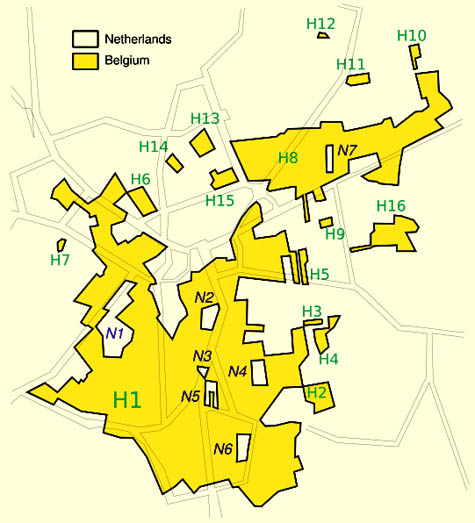
In response to the previous post, a reader kindly pointed me to the fascinating town of Baarle-Hertog, Belgium.
Baarle-Hertog borders the Netherlands – but, because of its unique history of political division, the town is sort of marbled with competing national loyalties. In other words, pockets of the town are Dutch; most of the town is Belgian. You can thus wander from country to country on an afternoon stroll, as if island-hopping between sovereignties.
Check out the town map.

[Image: The strange, island-like spaces of micro-sovereignty within the town of Baarle-Hertog; a few more maps can be seen here, and you can read more in this two-page article].

Being in a bit of a rush at the moment, I’ll simply have to quote Wikipedia:

Baarle-Hertog is noted for its complicated borders with Baarle-Nassau in the Netherlands. In total it consists of 24 separate pieces of land. Apart from the main piece (called Zondereigen) located north of the Belgian town of Merksplas, there are twenty Belgian exclaves in the Netherlands and three other pieces on the Dutch-Belgian border. There are also seven Dutch exclaves within the Belgian exclaves. Six of them are located in the largest one and a seventh in the second-largest one. An eighth Dutch exclave lies in Zondereigen.

The border is so complicated that there are some houses that are divided between the two countries. There was a time when according to Dutch laws restaurants had to close earlier. For some restaurants on the border it meant that the clients simply had to change their tables to the Belgian side.

Sarah Laitner, at the Financial Times, adds that “women are able to choose the nationality of their child depending on the location of the room in which they give birth.”
Another website, apparently drawing from the Michelin Guide to the Netherlands, explains the origins of Baarle-Hertog’s bizarre geography: it can all be traced back to the 12th century, it seems, when the town was first divided. The northern half of the town became part of the Barony of Breda (later home to the Nassau family), and the southern half went to the Duke of Brabant (Hertog means Duke in Dutch).
But that same website also mentions this:

The municipality limits are very complicated. Nowadays, each municipality has its city hall, church, police, school and post office. The houses of the two nationalities are totally mixed. They are identified by the shield bearing their number: the national flag is included on it.

I hate to refer to Thomas Pynchon twice, in back-to-back blog posts, but there something’s remarkably Pynchon-esque about this final detail.
In any case, also check out this site for more historical information.
While we’re on the subject of micro-sovereignties, though, be sure to check out Neutral Moresnet, a tiny, politically independent non-state formed around a zinc mining operation in eastern Belgium. There’s also Cospaia, “a small former republic in Italy” which “unexpectedly gained independence in 1440” after Pope Eugene IV sold the land it stood on. “By error,” we read, “a small strip of land went unmentioned in the sale treaty, and its inhabitants promptly declared themselves independent.”
The Free State Bottleneck, Åland Islands, and the Sovereign Military Order of Malta are all also worth checking out.
Finally, of course, I’d be remiss if I didn’t point out BLDGBLOG’s earlier interview with Simon Sellars, co-author of The Lonely Planet Guide to Micronations.

(With huge thanks to Scott Gosnell, Christopher, Claus Moser, and Blinde Schildpad for the tips!)