Surface/Structure/Fold

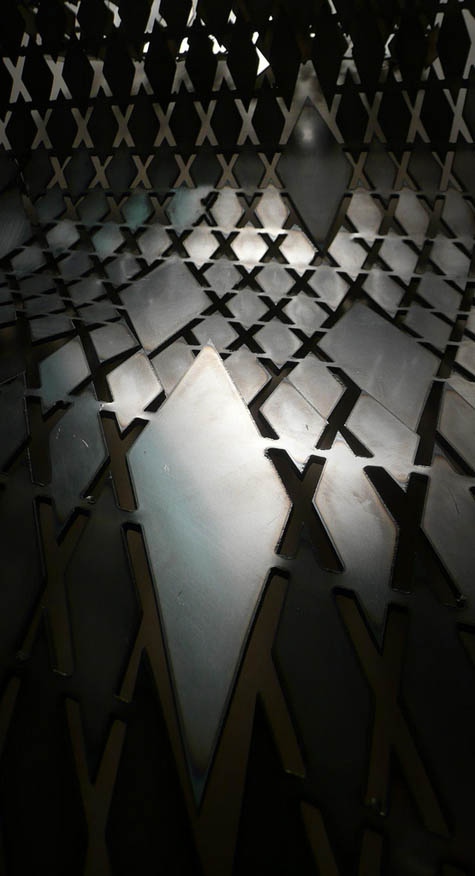
[Image: An absurdly beautiful photo of laser-cut steel by Elijah Porter, a student at the Yale School of Architecture].
Elijah Porter, a student at the Yale School of Architecture, has a great Flickr set up called Material Formation in Design. It features several awesome examples of how strategic cutting can transform a solid surface into a porous structure.
In the specific case of the image featured above, you’re looking at what might be called subtractive origami, wherein diamond-shaped cuts have introduced foldability and mesh into a solid sheet of steel.
How interesting to think that, with just the right geometry of cuts and slices, you could activate the otherwise overlooked – or even unknown – baroque possibilities of a given material. You could even hold annual slice-design competitions, where students and mathematicians from around the world get together to display their secrets of cutting; one at a time, they program precise geometries into a laser-cutting machine, and whoever thereby achieves the most complex form, or the largest volume of folded space, wins.
Huge, 8′ x 8′ sheets of steel are turned into spheres and waveforms, in a kind of arabesque of wounding through which metal becomes lace.
One year, a student from Amsterdam blows everyone away by introducing just one, incredibly complex cut… and the whole sheet rolls up to the size of a one-inch ball.
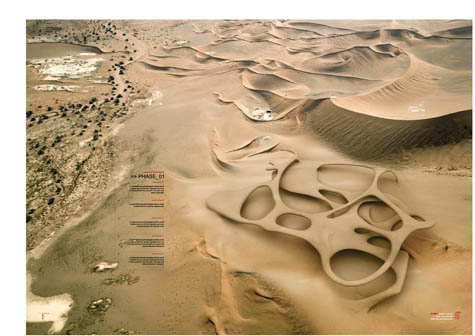
Or you obtain a truck-mounted laser and a grant from the Graham Foundation, and you proceed to cut a new, gridded faultwork into the bedrock of the continent – perforation on the scale of whole landscapes – so that the geography you’re standing on simply folds up and disappears.
Check out the rest of Porter’s Flickr set here.

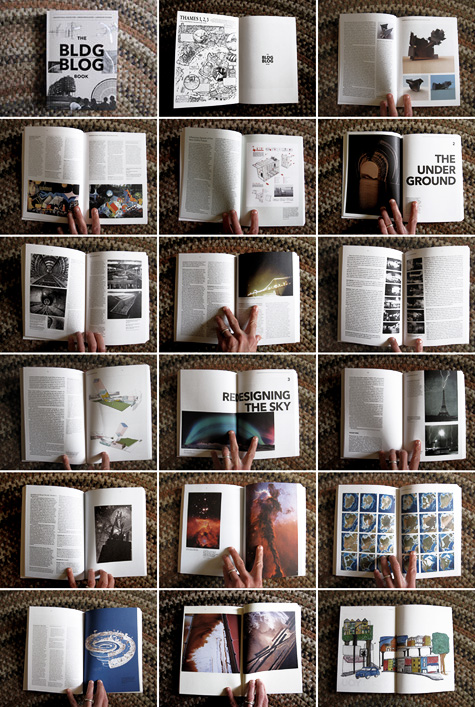
The BLDGBLOG Book

I was on pins and needles all morning knowing that my doorbell would ring, that there would be a bicycle courier standing there waiting for me – and that he or she would then hand me my very first copy of The BLDGBLOG Book.
And it arrived! It’s real, it’s in my hands – and it looks fantastic.

[Image: The BLDGBLOG Book, published by Chronicle Books, designed by MacFadden & Thorpe, and illustrated by Brendan Callahan. Visible here are images by Joe Alterio, Alex Dragulescu, Sir Peter Cook/Archigram, Lateral Architecture, Michael Cook, Stanley Greenberg, Alexis Tjian, myself, Joel Sanders, Örvar Atli Þorgeirsson, NOAA et al., Lebbeus Woods, NASA et al., Ron Blakey, the USGS, David Maisel, and Brendan Callahan].

So amazing to see this thing in real life!
From a series of Microsoft Word documents, to an ever-changing suite of PDFs, to a year and a half of long, long nights editing more than 125,000 words’ worth of content, it’s now bound, inked, and sitting here looking around at the world it tried to describe.
And there’s so much to say about it, I don’t even really know where to begin.
It’s got five major chapters and a huge bibliography; it’s got interviews, full-color photo spreads (by Simon Norfolk! David Maisel! Edward Burtynsky! Ilkka Halso! Bas Princen! and more!), as well as original illustrations by my colleague at Dwell, Brendan Callahan; it’s got maps and plans and architectural sections; it’s got renderings; it’s got 19th-century British ruin paintings, W.G. Sebald, and J.G. Ballard; it’s got FAT, geology, and rogue tunneling machines; it’s got urban farming, icebergs, archaeology, and Archigram; it’s got a saddle-stitched paperback binding that can open up flat, as well as multi-colored paper and an awesome use of a changing page grid; it’s got two original comic strips by BLDGBLOG (my first!), drawn by Joe Alterio and printed on the inside covers; it’s got runaway climate change, undersea cathedrals, artificial reefs, lost cities, oceangoing utopias, and the Chinese Olympics; it’s got injected landforms, spray-foam monuments to the nuclear power industry, Gustave Doré’s black and white visions of the underworld, and the architecture of Gothic horror; it’s got blimps, retractable villages on the British coast, the San Andreas Fault, underground warfare in the mountains of Afghanistan, and a short interview with Alex Trevi (among so many other interviews! dozens! from Sir Peter Cook, Sam Jacob, and DJ /rupture to Lebbeus Woods and Mary Beard); it’s got exploding stars, simulated mountain ranges on Venus, Mars habitats, and a quantum tomb for Albert Einstein; it’s got Minsuk Cho, China Miéville, Christopher Wren, Frederick the Great, and Paradise Lost.
Man, I’m so excited and so genuinely pleased to see this thing in person after such an incredibly long time putting it together.
Check out some spreads here – and feel free to order the living crap out of this thing on Amazon.com, Amazon.ca, and Amazon.co.uk, or simply go straight to the source and pick up a copy through Chronicle Books themselves. Also, how incredibly interesting is it for me to see, on Amazon.com, which books customers “also bought,” from Eyal Weizman to 306090 and Neal Stephenson. It’s good company to be in!
So expect more information about the book over the next two months, including voluminous and genuine thank yous for all the people who helped put it together – from my editor, Alan Rapp, and my designers, MacFadden & Thorpe, to everyone who contributed the book’s eye-popping range of 300+ images – as the actual publication date approaches.
But, for now, I just couldn’t let today go without mentioning how happy I am to see this thing. Hello, book.

Subject

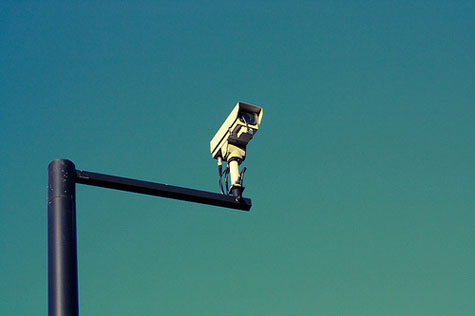
[Image: CCTV by (or perhaps via?) Charbel Akhras; check out Akhras’s blog for more].

You go home to visit your parents in a gated community built 15 years ago in the midst of what used to be virgin pine forest. As a teenager you ran there at night, before the other houses were constructed, when the only visible lights were the stars above and your parents’ house, self-reflecting in the waters of an artificial lake.

Amidst hills and rocks – most of which have been tastefully arranged – there are now cul-de-sacs and a members-only health club, 18 holes of golf and a 4-star restaurant that specializes in Gulf shrimp.

But, standing above all of it now, interspersed throughout the development on tall steel poles painted green to blend in with the well-trimmed forests around them, are surveillance cameras.

They watch parking lots, intersections, driveways, and golf paths; they look down along diagonals at the lobby of the clubhouse restaurant, at the tables inside, and at the various corridors leading to the indoor pool and weight room.

Alarmed by their sheer quantity and concerned that a wave of petty crime has perhaps broken out, you are instead reassured that these cameras are not here because of crime – not at all – but because a new private development outside Dubai wants to study how Americans live.

These camera feeds are reality TV for them; whole parties get together on Tuesday nights to watch an American suburb: BMWs parking in flower-lined driveways, teenagers mowing lawns, groups of two or three women jogging together in the morning as the sun comes up.

This is a research project by overseas developers, your dad explains, cresting a hill in his car beneath an especially well-populated mast of cameras, as formerly rural hills roll away for miles in the distance, and everyone in the neighborhood receives $1,500 a year for participating.

Narrative Planetarium

Before his talk last week at Postopolis! LA, Matthew Coolidge, director of the Center for Land Use Interpretation, joked that someday he should bring a laser pointer up there to the roof deck and give a new lecture, pointing out specific offices visible around us in the nighttime sky.
That afterhours galaxy of Xerox machines and elevator shafts, paper-covered desks and meeting halls, would all be explained, room by room, from the artificially grassed crown of the Standard Hotel.
And though both of us laughed, I think it’s an amazing idea.

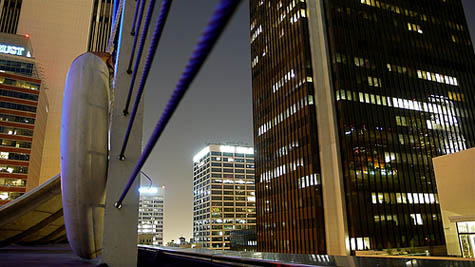
[Image: The view from Postopolis! LA; photo by Dan Hill].

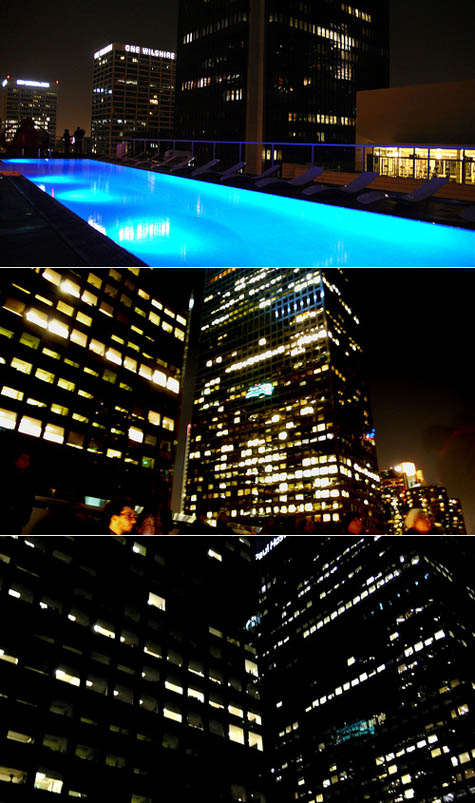
Standing up there in the darkness, looking at bank towers and real estate investment firms, individual offices lit from within (and even whole hallways, stretching horizontally into the sky before disappearing into themselves through a trick of perspective), the 16th, 17th, and much-higher stories of the city all visible to us like an architectural section, you could narrate a kind of local micro-history of nighttime spaces in LA.
It wouldn’t be giving a lecture so much as becoming a planetarium.
“In that building over there,” Coolidge might say, pointing his laser at a window four blocks distant, “the man who invented Technicolor once worked; and in that office over there” – pointing yet further, to One Wilshire, visible from the pool side of the building – “the internet traffic through which you’re able to write this post passes everyday.”
And so on.
The woman who first dreamt up and mapped the flight paths of intercontinental passenger airplanes over LAX once ran a property law services firm in that office, just barely visible with a laser pointer down there.

[Images: The artificial astronomy of downtown Los Angeles, as seen during Postopolis! LA; photographed by Dan Hill].
Or perhaps it could be a new form of immersive storytelling: local novelists stop by every third Friday of the summer months and, in the darkness, using laser pointers, they invent family dramas, murder mysteries, political thrillers, and end-of-the-world catastrophes, all the while pointing to specific rooms and halls within which the action takes place – even the specific computer monitor, visible in someone’s unblinded window, where plot-defining government secrets are thought to be stored…
Alternative fictions of the city.
In a way, I’m reminded of the brilliant Access Restricted program, curated by the Lower Manhattan Cultural Council (the final edition of which is April 28). Access Restricted is a “free nomadic lecture series that opens rarely visited and often prohibited spaces in Lower Manhattan to the general public” – meaning that certain offices, lobbies, meeting rooms, and even whole buildings directly relevant to the lecture taking place inside them are temporarily opened up for public visitation.
But imagine a rooftop version to this, a kind of Rooftops Restricted: you take a roof somewhere in midtown Manhattan and you give it to Paul Auster for the night, with a microphone in one hand and a laser pointer in the other, with 10 or 15 people camped out in sweaters all around him.
Next week, it’s Jonathan Lethem; the week after that, Joseph O’Neill.
You generate a new ad hoc literature for the city, a narrative planetarium that radiates stories outward from the rooftops into the city.

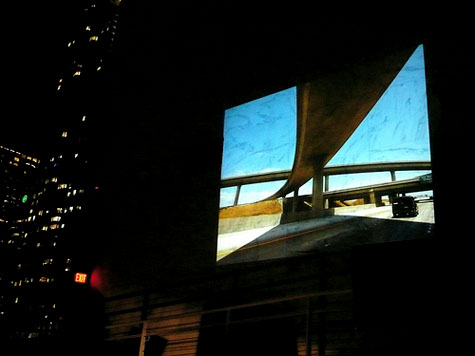
Nocturnal Projections

[Image: A dream of freeways above the city, at Postopolis! LA; I believe this was from Ted Kane‘s presentation. Photo by Dan Hill].
One Postopolis!, a minor car accident, and 500 miles later, I’m back in the rain of San Francisco. I owe a huge thanks to everyone who came out for the event last week, from my fellow bloggers (Bryan, Jace, David A./David B., Régine, and Dan) to Joseph Grima and the crew of Storefront for Art and Architecture, by way of ForYourArt, who found us the venue, organized several daytrips, and brought the whole thing into real time.
Thanks not only for coming along to see it unfold, but for sticking with us through microphone feedback, near-freezing rooftop temperatures, and the odd delay. If you get a chance, definitely visit the websites of the people who presented to learn more about their work; you can find links here.

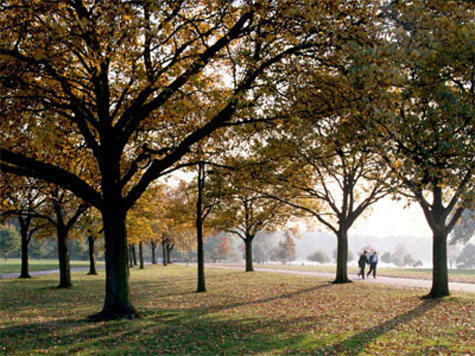
Park Stories

[Image: Hyde Park, London. Image courtesy of The Royal Parks].
Note: This is a guest post by Nicola Twilley.

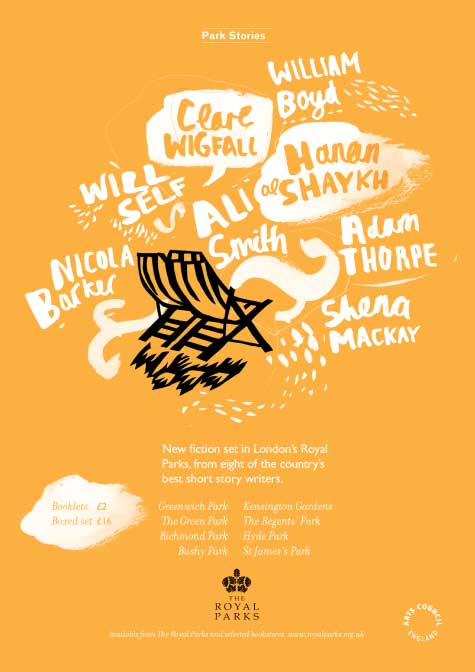
The Royal Parks of London already boast a long list of worthy, if specialized, publications, from the Kensington Gardens Shared Use Assessments to an executive summary of the Cycle Review at The Regent’s Park. But Thursday, May 7, 2009, will open a new chapter in The Royal Parks’ publishing career, as the organization unveils Park Stories, a set of eight specially-commissioned short stories, each story set in one of London’s public parks.

[Image: A poster for the Park Stories project, produced by The Royal Parks under the direction of Rowan Routh].
According to the series’ editor, Rowan Routh, the seeds of her idea were sown during a recent collaboration with London’s Natural History Museum. The Curator for Contemporary Arts at the NHM, Bergit Arends, worked with Routh to commission literary responses—some poems and a short story—to the life and scientific theories of Charles Darwin, for their current exhibition. The creative challenges of incorporating a substantial reading experience into the limited space of a crowded museum, as well as the quality of the writing that emerged from the commission, left Routh “thinking about fiction in terms of other places to experience it,” she explained in a telephone interview with BLDGBLOG.

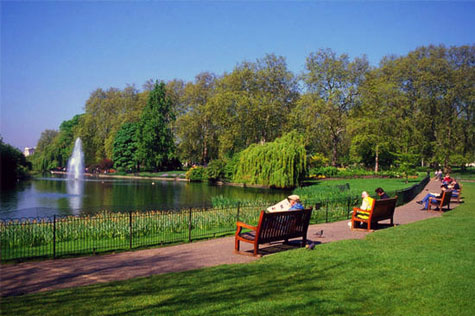
Routh is also a champion of the short story form—which she feels has been neglected in the UK—and a Londoner who enjoys the city’s parks, so she was thrilled to find a way to bring all three enthusiasms together: “It just suddenly occurred to me: Hang on a minute, a park is a wonderful place to read! It’s a perfect marriage, really, of a location and an activity. Once the idea formed, it became more and more of a no-brainer, to the point where I was wondering why people haven’t done this before. People spend their lunch breaks in the park. It’s an amount of time in which the golden nugget of the short story can be consumed. And even more to the point, London’s Royal Parks have an incredibly rich literary history anyway, so it’s something that is sort of already there.”

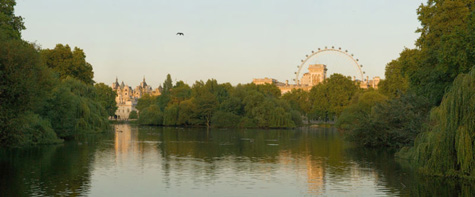
[Image: St. James’s Park, London. Image courtesy of The Royal Parks].
The project is exciting on a number of different levels. For starters, Routh has assembled a stellar list of writers: she has a background as a literary agent, and for her, “It was very important that this was about the short story as well as about parks. It was important that it was about good writing. Commissioning stories for The Royal Parks, when they already have a history of Virginia Woolf, Charles Dickens, and Henry James writing about them, it seemed right to keep to the gold standard.”

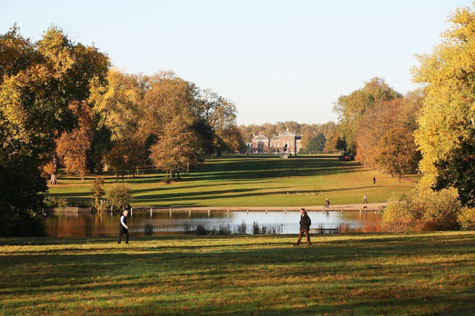
She started out by asking writers who had a connection to a particular part of London: for example, Nicola Barker, whose most recent novel is the Booker-prize short-listed Darkmans and who lives in Greenwich, has contributed By Force of Will Alone, set in Greenwich Park. The selection process evolved as word spread—and the final list now looks like this: William Boyd (The Dreams of Bethany Mellmoth, Green Park), Will Self (A Report to the Minister, Bushy Park), Ali Smith (The Definite Article, Regent’s Park), Adam Thorpe (Direct Hit, Hyde Park), Shena Mackay (The Return of the Deer, Richmond Park), Hana al-Shaykh (A Beauty Parlour for Swans, Kensington Gardens), and Clare Wigfall (Along Birdcage Walk, St James’s Park).

[Image: Kensington Gardens, London. Image courtesy of The Royal Parks].
Routh hopes that the Royal Parks commission will become an annual event, and the potential for this series to evolve in future years is energizing. Her hope is that the project’s core remains “eight very high quality short stories set in the parks,” but she speculates that it could expand to include responses to the parks in different genres or even stories by the general public (through a park-based storybooth or wiki page). Crime writers could make use of fog, weed-choked ponds, and overgrown outhouses to do away with early morning joggers, and sci-fi novelists could set stories in the drowned parks of London’s watery future; it’s even possible to imagine an erotic fiction series (complete with a foreword by George Michael). Meanwhile, the authors of historical romances could bring to life Hyde Park’s Rotten Row, once the gathering place for fashionable London, while horror writers would be drawn instead to the park’s off-limits pet cemetery (which George Orwell apparently considered “perhaps the most horrible spectacle in Britain.”)

Equally pleasing is the formal connection between parks and short stories: both offer a limited space of encounter, but a heightened, or concentrated, experience for all that. In a park, various elements—trees, follies, flowerbeds, and water features—are carefully, even narratively, arranged to mimic, distill, and often improve on the unplanned, “natural” landscape they replace; similarly, Routh contends that short stories “don’t give any less of an emotional or stylistic punch than a novel, and it’s actually heightened and changed by being so carefully contained and arranged in a smaller space.” This idea that a particular landscape can be married to its equivalent literary form is inspiring: perhaps suburbia is best expressed through the sprawling novel; wilderness requires poetry; and a city like Tokyo all but demands a text-message thriller.

[Image: Another view of St. James’s Park, London. Image courtesy of The Royal Parks].
Finally, the real joy in this project lies in the idea that the owners of a particular landscape or building might commission original literature to celebrate and promote it. If literary commissions become a form of property investment, for instance, could we perhaps see bespoke short stories replacing new kitchen cabinets as the surest way to add value to your home? Or will Los Angeles’ real estate developers forego glossy brochures in favor of paying T.C. Boyle to set his next novel in the city’s struggling loft district, while the local Convention & Visitors Bureau cancels its regular press junkets and instead develops a package of incentives for writers prepared to use L.A. as the backdrop for their work?

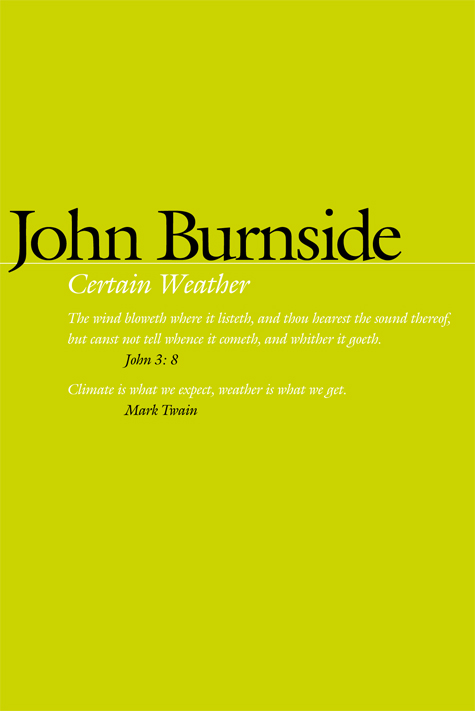
Some critics have caviled, finding “precious few examples of good literature being written to order,” but I rather agree with former Poet Laureate Andrew Motion, who felt that his poems, “like all commissioned pieces, work best when they coincide with an existing personal interest.” Within this fruitful framework of shared interests, for example, we already have Lloyd’s of London commissioning poems from John Burnside on the subject of climate change (which is the insurance industry’s greatest threat to profitability as well as a passionate concern for the Scots nature poet). But what about Sigalert.com drumming up customers for its personalized traffic reports through hourly freeway-themed haiku delivered to your smartphone, or NASA campaigning for a manned Mars program by commissioning dozens of screenplays on the subject?

[Image: From John Burnside’s collection Trees in the City; check out the PDF].
Of course, this type of content-specific literary commission is indistinguishable from product placement—and here I feel compelled to mention the example set by Fay Weldon’s 2001 novel The Bulgari Connection. Weldon’s book was commissioned by the eponymous jewelers, who paid an “undisclosed, but ‘not huge’ amount of money,” according to Weldon’s agent, Giles Gordon, for a dozen mentions of their company in the book. Bulgari were, in fact, rewarded with at least three times as many—not to mention the title. With pitch-perfect po-mo sensibility, critics sniped in the New York Times, “It is like the billboarding of the novel. [Note: How about novelizing the billboard?] I feel as if it erodes reader confidence in the authenticity of the narrative. Does this character really drive a Ford or did Ford pay for this?”

In any case, if The Royal Parks are creative and brave enough to commission a set of short stories, I would hope that perhaps the fictionally fertile landscapes built and managed by KB Home (who, in fact, have already partnered with Disney), the Parking Company of America, or the incorporated gated communities of Southern California cannot be far behind?

The Park Stories series will be available from May in eight individual booklets (priced at £2 each) and as a boxed-set (priced at £16) from selected bookstores and The Royal Parks website: (www.royalparks.org.uk). The authors will be conducting readings in the parks this summer.

[Earlier posts by Nicola Twilley include Park’s Parks, Dark Sky Park and Zones of Exclusion; we’ve started joking that she’s our Parks Correspondent).

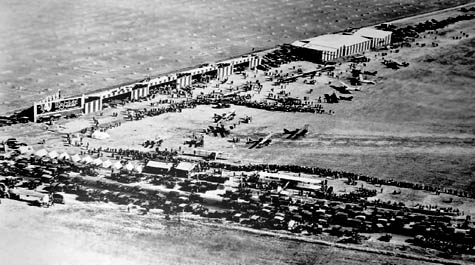
The Lost Airfields of Greater Los Angeles

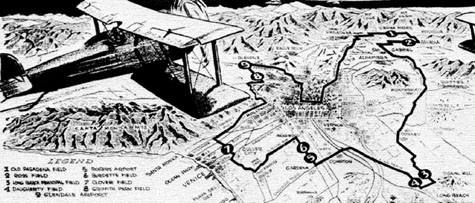
[Image: An airplane flies above Los Angeles, a landscape of now-forgotten airports].
Buried beneath the streets of Los Angeles are lost airfields, airports whose runways have long since disappeared, sealed beneath roads and residential housing blocks, landscaped into non-existence and forgotten. Under the building you’re now sitting in, somewhere in greater L.A., airplanes might once have taken flight.

[Image: The now-lost runways of L.A.’s Cecil B. De Mille Airfield; photo courtesy of UCLA’s Re-Mapping Hollywood archive].

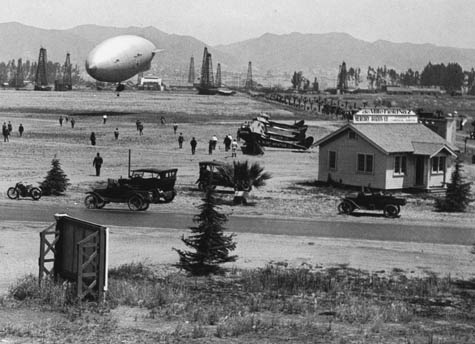
The Cecil B. De Mille Airfield, for instance, described by the Re-Mapping Hollywood archive at UCLA as having once stood “on the northwest corner of Wilshire Boulevard and Crescent Avenue (now Fairfax),” would, today, be opposite The Grove; on the southwest corner of the same intersection was Charlie Chaplin Airfield. As their names would indicate, these private (and, by modern standards, extremely small) airports were used by movie studios both for transportation and filming sky scenes. They were aerial back-lots.

Other examples include Burdett Airport, located at the intersection of 94th Street and Western Avenue in what is now Inglewood; the fascinating history of Hughes Airport in Culver City; the evocatively named, and now erased, Puente Hills “Skyranch“; and at least a dozen others, all documented by Paul Freeman’s aero-archaeology site, Abandoned & Little-Known Airfields (four pages alone are dedicated to lost L.A. airfields).

[Image: Charlie Chaplin Airfield in 1920s Los Angeles; photo courtesy of UCLA’s Re-Mapping Hollywood archive].

In a way, though, these airports are like the Nazca Lines of Los Angeles – or perhaps they are even more like Ley lines beneath the city. Laminated beneath 20th century city growth, their forgotten geometries once diagrammed an anthropological experience of the sky, spatial evidence of human contact with the middle atmosphere. Perhaps we should build aerial cathedralry there, to mark these places where human beings once ascended. A winged Calvary.

The cast of minor characters who once crossed paths with those airfields is, itself, fascinating. A minor history of L.A. aviators would include men like Moye W. Stephens. Stephens’s charismatic globe-trotting adventures, flying over Mt. Everest in the early 1930s, visiting Timbuktu by air, and buzzing above the Taj Mahal, would not be out of place in a novel by Roberto Bolaño or an unpublished memoir by Antoine de Saint-Exupéry. And that’s before we really discuss Howard Hughes.

[Image: The Cecil B. De Mille Airfield, renamed Rogers Airport (or, possibly, Rogers Airport, which later became the Cecil B. De Mille Airfield); image via Paul Freeman’s Abandoned & Little-Known Airfields].
Of course, many of these aeroglyphs are now gone, but perhaps their remnants are still detectable – in obscure property law documents at City Hall, otherwise inexplicable detours taken by underground utility cables, or even in jurisdictional disputes at the L.A. fire department.

And they could even yet be excavated.

A new archaeology of airfields could be inaugurated at the corner of Wilshire and Fairfax, where a group of students from UCLA will brush aside modern concrete and gravel to find fading marks of airplanes that touched down 90 years ago, over-loaded with film equipment, in what was then a rural desert.

With trowels and Leica site-scanning equipment in hand, they look for the earthbound traces of aerial events, a kingdom of the sky that once existed here, anchored down at these and other points throughout the L.A. basin, cutting down into the earth to deduce what once might have happened high above.

The Immersive Edge

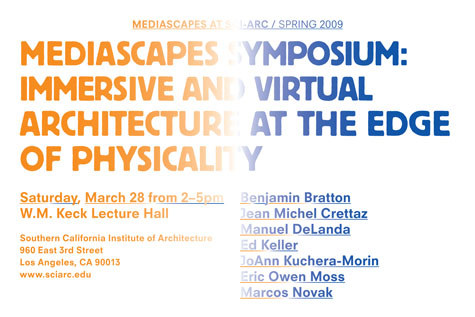
Starting just a few hours from now down at SCI-Arc, on a cloudless 73º day, “seven distinguished architects and theorists” whose designs straddle “the intersection of physical and virtual worlds” will be presenting their work at the Mediascapes Symposium, led by Ed Keller.

The bulk of the afternoon’s discussion will encompass “the practice of immersive and virtual architecture, which spans animation and 3D technologies, digital environments, and questions of materiality… asking how these classifications will define our understanding of the relationships between tangible and intangible worlds.”
One of today’s speakers, Benjamin Bratton, who will also be presenting next week at Postopolis! LA, describes his talk: “Pervasive computing will make inanimate objects see, hear, and comment on our interactions with them. This experience will, in many cases, be indistinguishable from a psychotic break, or from the rituals of classical Animism.” That, or it will feel like The Sorcerer’s Apprentice.
If you’re in LA, be sure to stop by.

Media Facades and Newscocoons

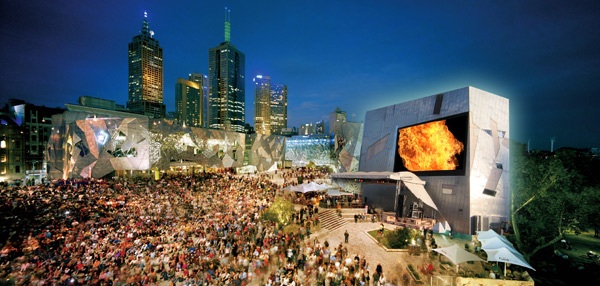
[Image: A rendering of a “media facade” in action, in Melbourne’s Federation Square; image via Swissnex].

Tonight at 6:30pm here in San Francisco, the fantastic local gallery Swissnex is hosting an event called Media Facades and Newscocoons, “featuring three guests from Switzerland and a Bay Area counterpart.”
The participants are:

—Barbara Kummler, a Swiss media specialist with ag4, a “mediatecture company” based in Köln, Germany
—media artist Muriel Waldvogel
—Jeffrey Huang, Director of the Media and Design Laboratory at EPFL in Lausanne, Switzerland
—Patrick Keller of fabric | ch (and speaker at next week’s Postopolis! LA)
—Scott Minneman, interdisciplinary designer and co-founder of Onomy Labs

At the same time, Swissnex will be kicking off an exhibition of Newscocoons designed by Waldvogel and Huang. The Newscocoons are “room-compatible media art pieces of inflatable ‘media furniture’ that mirror the topics discussed in a subtle but powerful manner.” Waldvogel and Huang have also developed the amazing Sentient Ecologies project, “an algorithmically generated housing structure that follows phototropic behaviors of plants and produces instead of consumes energy.”
After their presentations, BLDGBLOG will be on hand to moderate a 40-minute roundtable discussion about the implications and future applications of their work.
Here is a map. You are meant to email before attending; if you want to stop by – and please do, as I think it will be quite interesting (and it’s free) – please send a note to “media-facades” at “swissnexsanfrancisco” dot org.

Southern Exposure

[Image: Elias Redstone stands inside the facade of Casa Poli, designed by Pezo von Ellrichshausen Architects; read more about his visit to the house here. Photo by Jaffer Kolb].

Regrettably, I have not until now pointed readers’ attention to the soon-to-finish travels of Elias Redstone, curator of London’s Architecture Foundation, as he visits the work of emerging Latin American architects, from Mexico to Colombia, Chile to Argentina and Brazil, documenting the whole thing on his blog.
This massive three-and-a-half month tour, funded by a Winston Churchill Fellowship, comes to a close on April 1, when Elias returns to London. His huge roster of site visits – heavy with modern residential design – is worth a scroll, as are his visits to the architects’ offices. He even drops in on our Postopolitan friends, Arch Daily.
Check out the blog for more.
Let me randomly add, by the way, that I would absolutely and genuinely love to do the Australian equivalent of this trip…

Talks, Tours, and the Cities of Tomorrow

[Image: Photo by Satya Pemmaraju, courtesy of the Architectural League].

Here are some upcoming events, courses, and lectures that I would attend if I could:

—Tonight, March 26, author William L. Fox speaks in Reno at the Nevada Museum of Art about his new exhibition, co-curated with Matthew Coolidge of the Center for Land Use Interpretation, about the Trans-Alaska Pipeline. Hopefully Fox will also discuss his newest book, Aereality: The World From Above; Fox’s books are an ongoing exploration of “extreme environments” and their impact on human cognition, from Antarctica and the gridless deserts of Nevada to the Australian Outback and even Mars.

—Also today, March 26, kicking off in Los Angeles (and then again four days from now, on March 30, in Chicago) is an Urban Escape and Evasion course run by the group OnPoint Tactical. The premise of this is hilarious but fascinating: “While on an international business trip, you are kidnapped and held for ransom. A terrorist attack closes the business district and you find yourself in a fix. How do you stay alive? How do you get to safety on your own?”

This class provides leading-edge skills to civilians who live and work in challenging urban environments or in urban centers that may destabilize during a crisis. Topics covered include covert movement (day vs. night), the judicious use of caches, understanding urban baseline movement and urban awareness training, the use of urban disguises and false papers/identification, lock picking, escaping from unlawful custody, obtaining and driving local transportation, the use of “specialized” urban gear, and instruction on how to develop urban escape and evasion go-bags, etc.

If you already know how to do all that, of course, there are also advanced courses. For that, somewhere in the Philadelphia/Camden, NJ, area, beginning April 30, trainees will “spend time in the city in an extensive (extended) escape and evasion simulation. Students will be required to obtain food, water, and shelter. They will need to avoid capture, and they will be required to complete several tests or scenarios that will require advanced students to truly apply their scout and urban survival skills.” I love OnPoint’s final line: “Warning: Massive waiver required for this course!” These “urban survival” courses are run in Los Angeles, Philadelphia, Chicago, Dallas, Salt Lake City, and Conway, Arkansas. If only I had known about OnPoint earlier, I would have invited them to speak at Postopolis! LA. Check out their lock-picking gear. (Spotted via kottke.org).

[Image: Think you’ll survive a corporate kidnapping (or the coming apocalypse)? OnPoint Tactical disagrees; sign up for their courses to learn more].

—March 27-29: The City From Below hits Baltimore, Maryland, exploring, among other things, how “unanticipated futures are being imagined and built” in the contemporary metropolis. My problem with the event write-up, however, is that participating in “social justice struggles” appears to mean adopting a new, niche vocabulary full of analytically useless words like “herstories” – i.e. feminism’s own “Freedom Fries” moment – excluding from your audience many of the very people who would benefit most from such discussions. Emerging forms of grassroots urban self-governance don’t require bizarre, over-academized newspeak about “metropolitan rearticulation” and “horizontal framework[s] of participation.” We don’t need to know that you’ve read Judith Butler in order to organize a better youth basketball league, plant a roof garden, or campaign for affordable day care. I also have a growing problem with the fetishization of “resistance” in today’s leftwing political writing, as if “resisting” something is, in and of itself, a technique that only the left is capable of performing. But the Bush Administration “resisted” the Geneva Conventions and Alberto Gonzales “resisted” civil liberties laws, even as the Mormon Church “resisted” gay marriage in California. Resistance has no political affiliation, and it is tactically meaningless to promote resistance as a goal in and of itself. One need look no further than the conservative Counter-Reformation; as its very name indicates, this was a massive act of cultural and intellectual resistance. Indeed, to pretend that “resistance” is worthy of commendation at all only makes sense if you’ve built your entire movement around a shifting sequence of enemies who, by your own admission, are always one step ahead of you. The alternative – articulating, out of the blue and in the middle of nowhere, unsolicited enthusiasm for a more equitable future for everyone – would seem both substantially more effective and unifying. It seems little wonder, then, that many otherwise intensely interesting urban social justice movements remain rhetorically self-ghettoized, when their own communication strategies seem to exclude the very people they most urgently need to convince.

—On Monday, March 30, London’s Complex Terrain Laboratory will begin a four-day symposium about P. W. Singer’s important new book Wired for War (previously mentioned on BLDGBLOG here). As the event unfolds, regular updates will be posted online.

[Image: Ecological Urbanism at the Harvard GSD].

—If it wasn’t for Postopolis! LA, I would be in Boston, attending Harvard’s Ecological Urbanism conference, running April 3-5. “While climate change, sustainable architecture, and green technologies have become increasingly topical,” we read, “issues surrounding the sustainability of the city are much less developed.”

The conference is organized around the premise that an ecological approach is urgently needed both as a remedial device for the contemporary city and an organizing principle for new cities. An ecological urbanism represents a more holistic approach than is generally the case with urbanism today, demanding alternative ways of thinking and designing.

Speakers include – and the list looks great – Rem Koolhaas, Andrea Branzi, Stefano Boeri, Anuradha Mathur, and super-dean Mohsen Mostafavi, among many, many others.

—Saturday, April 4, in Montreal, the excellent Canadian Centre for Architecture will sponsor Mapping Rural Montréal: “Artist Amy Franceschini leads an exploration of rural sites and activities in Montréal, questioning the dichotomy of country and city (in English). $10 per person. Free for children under 12. Reservations required: (514) 939-7026.”

—On April 25, Esotouric will be hosting a bus tour of Raymond Chandler’s Los Angeles: “Bungalows. Crime. Hollywood. Blondes. Vets. Smog. Death. This was Raymond Chandler’s Los Angeles, which resonated from deft and melancholy fits of his writer’s bow.” Esotouric’s Reyner Banham Loves Los Angeles tour also looks well worth a spin.

—Finally, for now – as there are dozens and dozens of other amazing events I could mention – the Architectural League in New York is hosting what sounds like an exciting two-day conference called New Architectures of India, from April 30-May 1. It will “address the architectural and urban forms that are emerging as a turbulent ‘second modernity’ rearranges a vast part of the landscape of India.”

All of these are barely the tip of the iceberg, however; I’ll hope to keep track of other lectures, events, gallery openings, conferences, courses, and such like as the year trundles on.