Goldberg Robotics

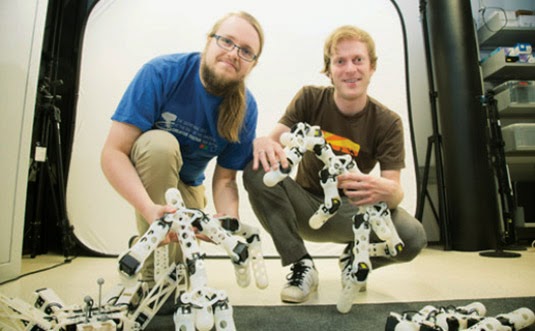
[Image: From Science Daily/University of Oslo].

Robots emitting robots emitting robots: this is one way that machines will learn to navigate extreme spatial environments.

“In the future,” we read in a press release courtesy of Science Daily, “robots must be able to solve tasks in deep mines on distant planets, in radioactive disaster areas, in hazardous landslip areas and on the sea bed beneath the Antarctic”—as well as in the cracks of otherwise inaccessible archaeological sites.

Researchers at the University of Oslo think we need to send machines capable of not exactly of replication, but something more like budding or fruiting, using 3D printers.

Kyrre Glette, one of the researchers behind the press release, imagines a robot being sent into “the wreckage of a nuclear power plant,” for example, where it encounters a stairway it had not been anticipating needing to climb. For the moment, it’s stuck. So what does it do? “The robot takes a picture. The picture is analysed. The arms of one of the robots is fitted with a printer. This produces a new robot, or a new part for the existing robot, which enables it to negotiate the stairs.”

The original robot—which was thus not single but a crowd waiting to happen—moves forward through the landscape by sending detached variations of itself further ahead. You could think of it as Goldberg robotics: advancing through variation.

This is obviously not a new vision—the idea of 3D printers printing 3D printers that can 3D-print further 3D-printer-printing 3D printers, for example, is a long-running staple of stoner sci-fi. Nonetheless, it’s interesting to see this specifically discussed in terms of navigating spatial environments, be they mines, caves, or architecture, explored and mapped by an instant machine-ancestry self-produced specifically for the task at hand.

Amongst the Machines: A Visit to the Tesla Factory

[Image: Outside the Tesla factory; Instagram by BLDGBLOG].

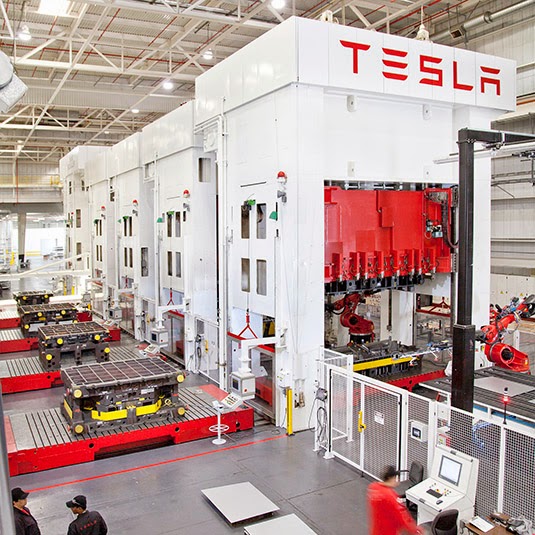
The coolest thing about a tour of the Tesla factory out in Fremont, California, is the huge metal-stamping machine—a behemoth piece of equipment that applies more than five thousand tons of pressure in order to mold metal parts in an instant. In fact, it was not even the company’s largest stamping machine, which was offline the afternoon I went through.

You hear this thing long before you see it: a thundering and resonant split-second blast that sounds more like a minor-key chord being sledgehammered out into the cavernous factory. Then the machine cycle repeats itself: parts are removed, dragged, and rattled into place, followed by the preliminary crash of a new metal sheet being lowered into the bay. Then bam, that weird sound again, equal parts dark ambient soundscape and sci-fi howl.

Strangely, though, there is an air of melancholy to the sound—a kind of unexpected pathos—as if the machine had accidentally been tuned to some minor and wistful harmonic. The instantaneous hydraulic detonation of what sounds like an organ chord thus rings out, augmented by the foot-shuddering bass of the stamp itself, which sends small earthquakes rolling through the floor. (In fact, this reminded me that the factory is more or less directly above the Hayward Fault and I began to wonder what seismic effects such a colossal machine might actually be having.)

The machine only got louder and louder as we wound our way through a complicated back-turning maze of welding walls and robot arms. Finally visible, it seemed to be made entirely of gates: a giant red portal through which shaped metal could pass.

[Image: The red gates of metal-stamping machine; photo courtesy of Tesla].
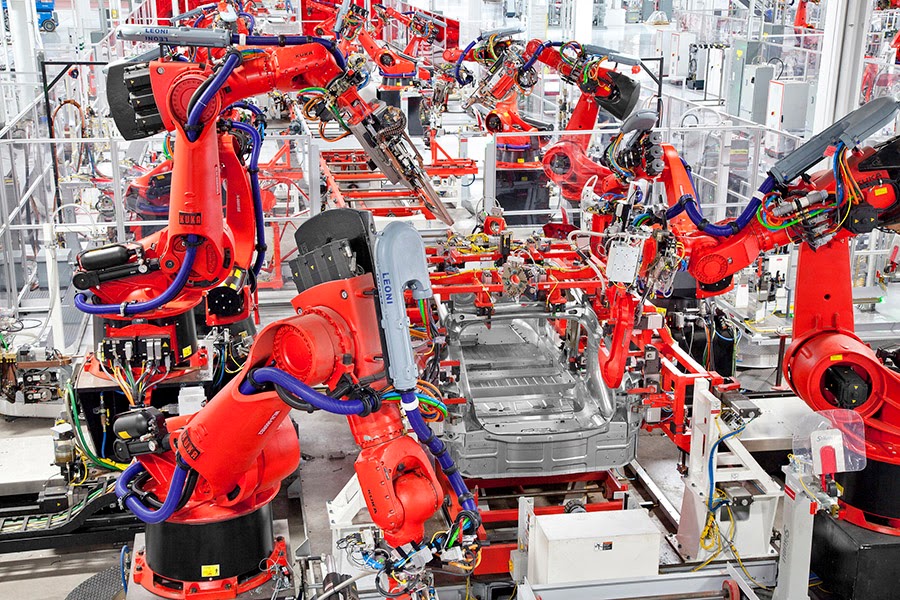
As we stopped to watch, the slow rhythm of its sounds matched up with processional movements now visible deep inside the cathedral-sized device, and the overall process began to make more sense.

Two men in full ear protection stood there, silhouetted against the mouth of the machine, presumably hypnotized by its otherworldly, repetitive soundtrack—or maybe that was just me, perhaps overly willing to hear, in the looped noise of this exotic machine, music that wasn’t really there.

In any case, I was on the tour as part of a workshop run last week at the UC Berkeley College of Environmental Design, with students from Nicholas de Monchaux‘s course at Berkeley and a small group visiting from Smout Allen‘s & Kyle Buchanan‘s Unit 11 over at the Bartlett School of Architecture in London.

[Image: Photo courtesy of Tesla].

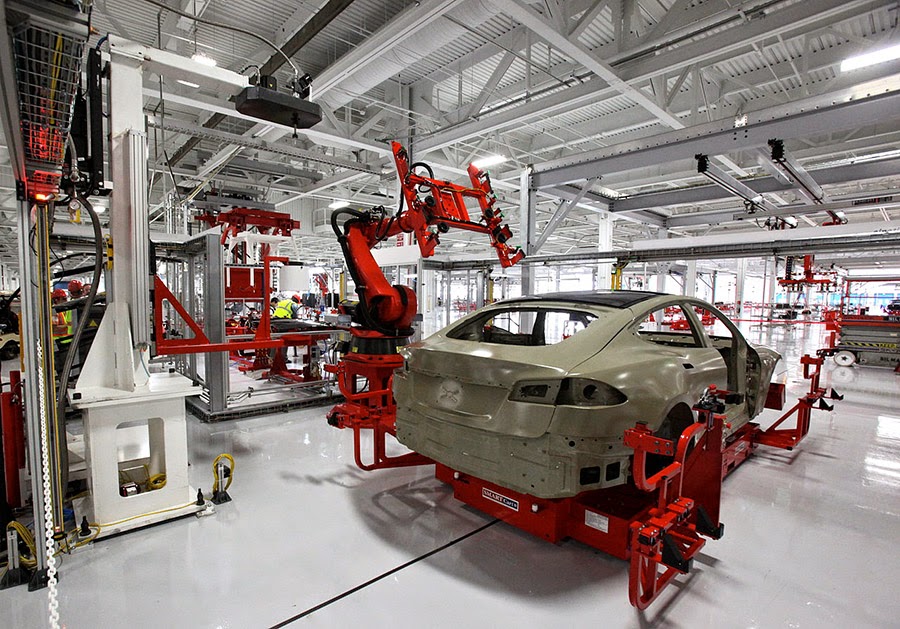
The idea behind the tour was not only to see robots at work but to experience the spatial logic of a factory, its interior the size of 80 football fields broken down into sequential functions and clusters, with color-coded circulation diagrams painted directly onto the concrete floor.

At least those were the paths meant for humans. For self-driving robots, long curving whirls of magnetic tape had been applied to the floor, forming cursive, counter-directional arabesques that only made sense when you considered the aggressive turning radii of those bulky machines.

It was the robot-readable world firsthand, or an indoor landscape architecture for machines.

There is a strict no-photo policy in place, unfortunately, and you are obliged to sign a non-disclosure agreement prior to entering the facility, so the only interior photos I have to show are from Wikipedia and Tesla’s own press page.

[Image: Photo by Steve Jurvetson, via Wikipedia].

The actual tour is very much in the vein of a corporate sales pitch, and it is delivered with true American gusto (and at very high volume), but it’s worth taking. Technically, by entering the factory you step into a foreign free-trade zone, which, for anyone else reading Keller Easterling’s new book, is an interesting thing to do in person, like entering a corporate eruv.

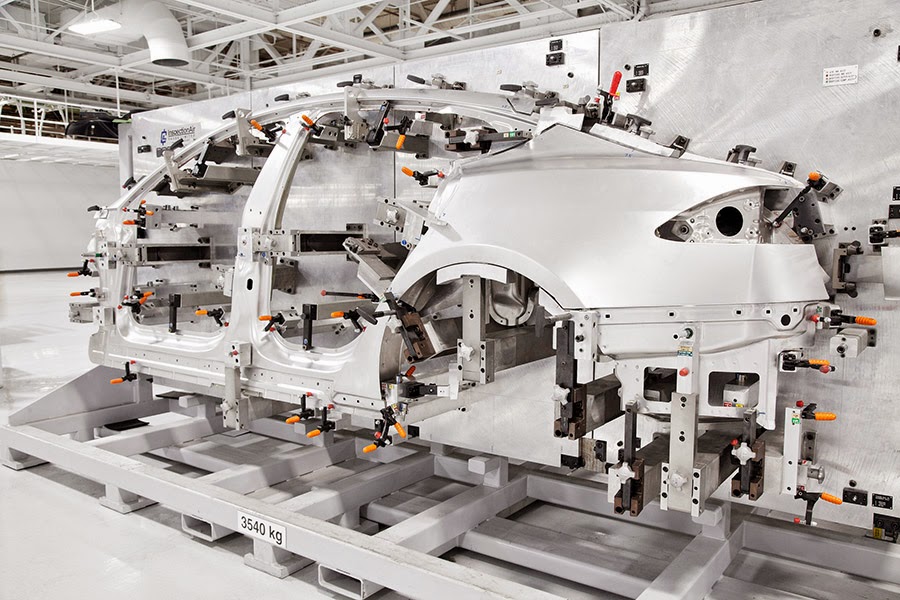
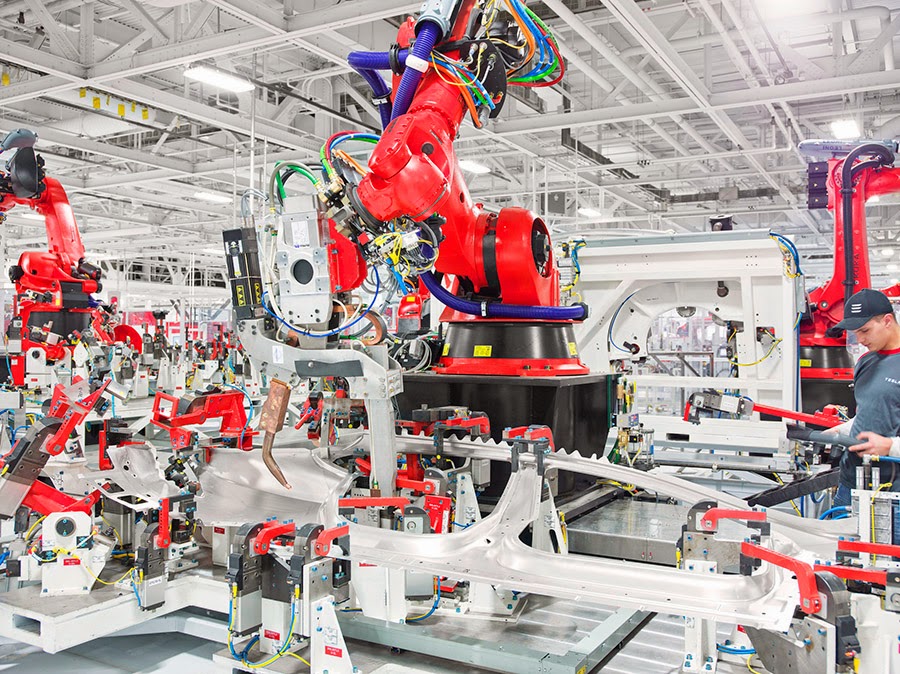
Once inside, you see things like aluminum rapid-injection molds, laser-cutting stations, and emergency “light curtains” dividing humans from the machines they steward. You see “laser-calibration trees,” or knobby poles branching with small geometric ornaments; they are used by laser-scanners for re-booting themselves after measuring the frames of new cars.

At the very end of the process, you see massive, Japanese-made robots lifting entire finished Teslas overhead as if they’re feathers. Each machine has been named by Elon Musk after X-Men characters: there is Thunderbird and Cyclops, Storm and Colossus, Xavier, Changeling, Ice Man, Wolverine, and Angel.

[Image: Photo courtesy of Tesla].

And, perhaps best of all, you might be lucky enough to see engineers training new robots for eventual roles in the assembly process.

Our tram slowed down for just a few seconds so we could watch a woman, less than two-thirds the size of the mechanical arm lurching back and forth in front of her, patiently coding new movements into the gyroscopes and actuators inside the machine.

Uncertain of what we were seeing, we tried to make sense of the drunken movements on display, which looked more like a snake hypnotized by its master, swaying side to side like a cobra being woken up from a dream.

At one point, our tour guide gestured out at literally dozens—perhaps hundreds—of new robots still under plastic wrap, all awaiting training and installation. The factory is expanding dramatically as Tesla gears up for the release of their new SUV.

We have “an army of robots under plastic,” the guide said enthusiastically, and he laughed. If there’s ever a robot uprising, he joked, this is probably not the best place to be.

[Image: Photo courtesy of Tesla].

It seems that our group’s educational affiliation made getting a tour much easier, but you can try your own luck using Tesla’s Contact page.

The Future is Accessible by Automobile

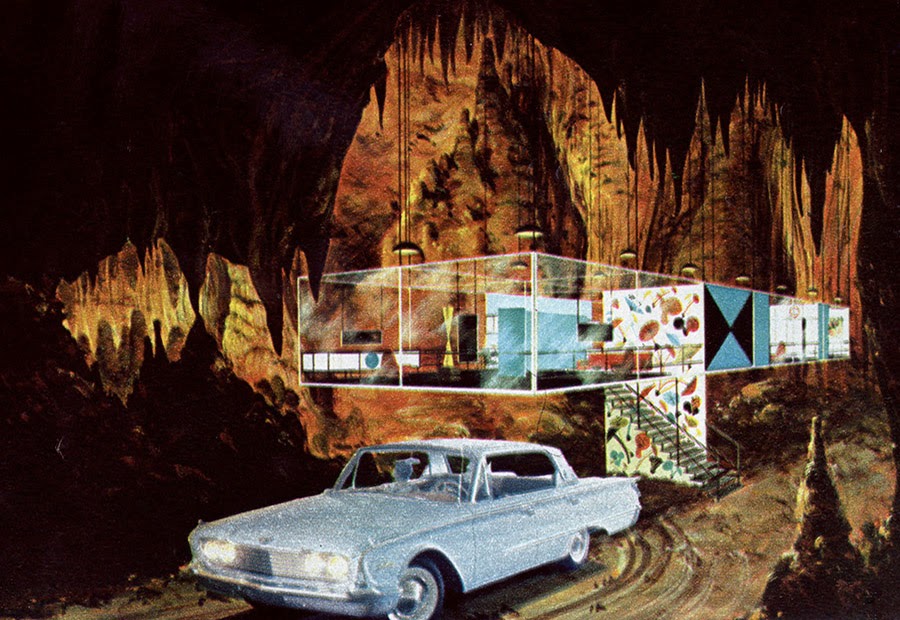
[Image: “Fantasy House 10” by Charley Harper].

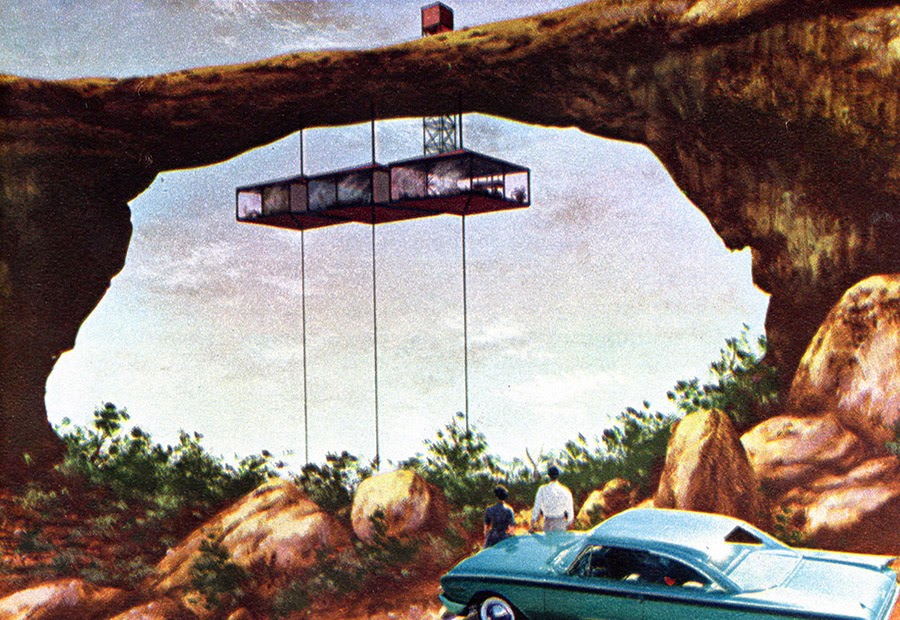
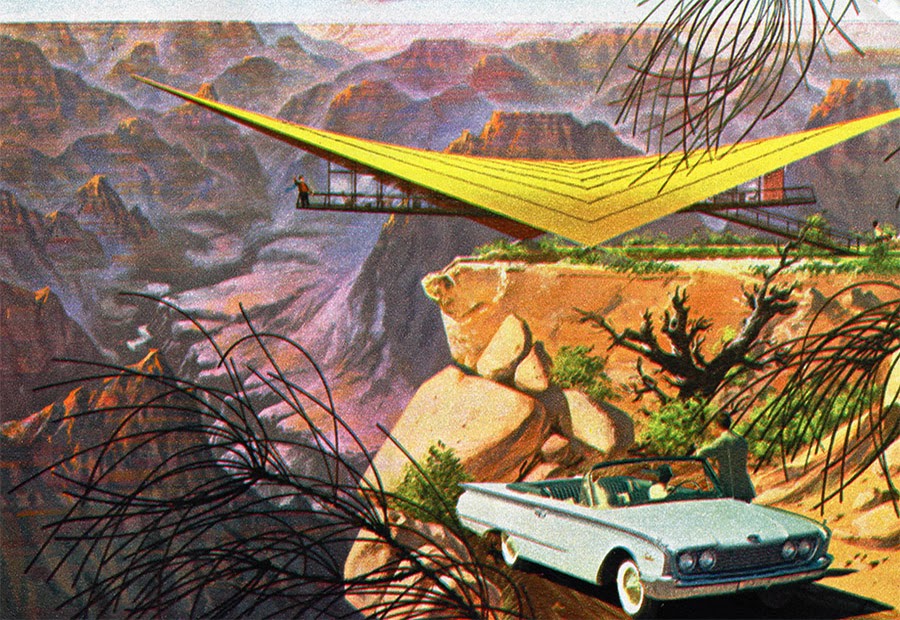
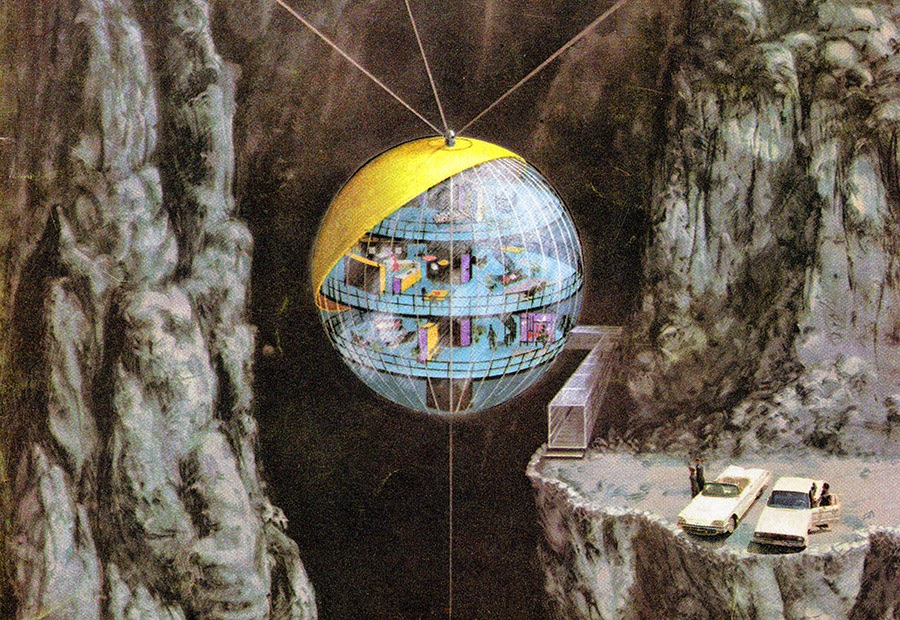
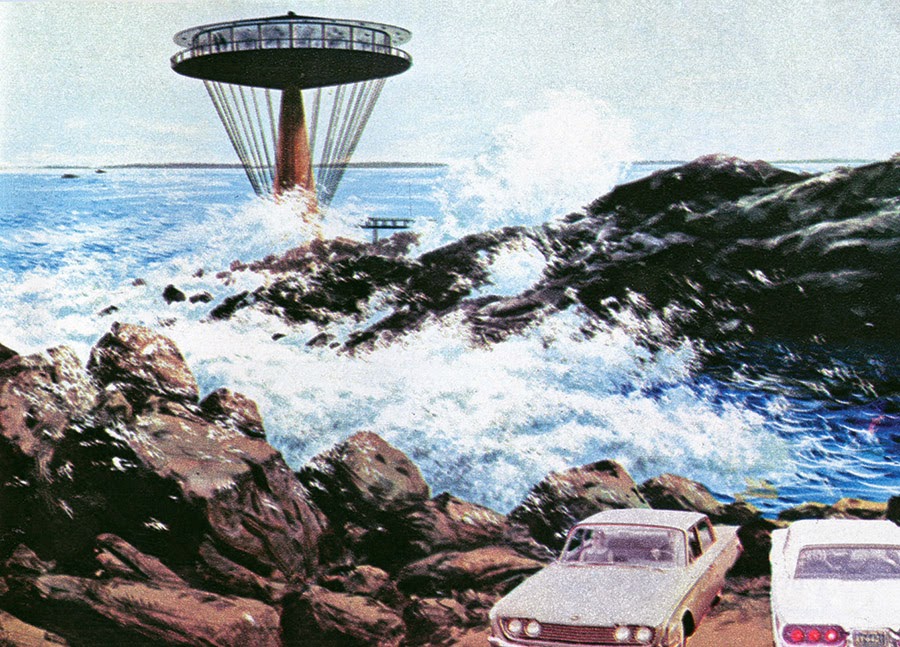
These aren’t the best-quality scans in the world, but I just rediscovered these on my computer and thought I’d post them. These are so-called “fantasy houses” by artist Charley Harper, originally published in, as far as I can tell, the November 1959 issue of Ford Times, exactly 55 years ago.

To use an ungainly compound analogy, these look like what might have happened if Syd Mead had studied with Frank Lloyd Wright, or as if we’re glimpsing a kind of prairie modernism timidly trying on the garb of science fiction.

[Image: “Fantasy House 2” by Charley Harper].

Minimalist cubes are suspended on cables from vast geological forms and glass houses pop up unexpectedly in the deepest recesses of American show caves.

[Image: “Fantasy House 3” by Charley Harper].

Elsewhere, extraordinary cantilevers stretch like the prows of exotic ships over postcard-ready landmarks, and the whole series has the feel of a rather wholesome advertising campaign for the National Park service—complete with conspicuously well-placed Ford automobiles reminding you that the future is only one or two rest stops away.

[Image: “Fantasy House 10” by Charley Harper].

I don’t have much further information about these images, to be honest—other than to point out that they fulfilled the role of a kind of pop-speculative domestic architecture from the near-future for an earlier generation of media consumers—but click through to the Charley Harper website to see more of his work, or consider picking up a copy of the Charley Harper coffee table book for the holidays.

[Image: “Fantasy House 7” by Charley Harper].

Harper—who sadly passed away back in 2007—remains more widely known for his stylized animals and landscape scenes, but these uncharacteristic stabs at architectural futurism are worth a passing glance in any survey of 20th-century speculative work.

In The Dust Of This Planet

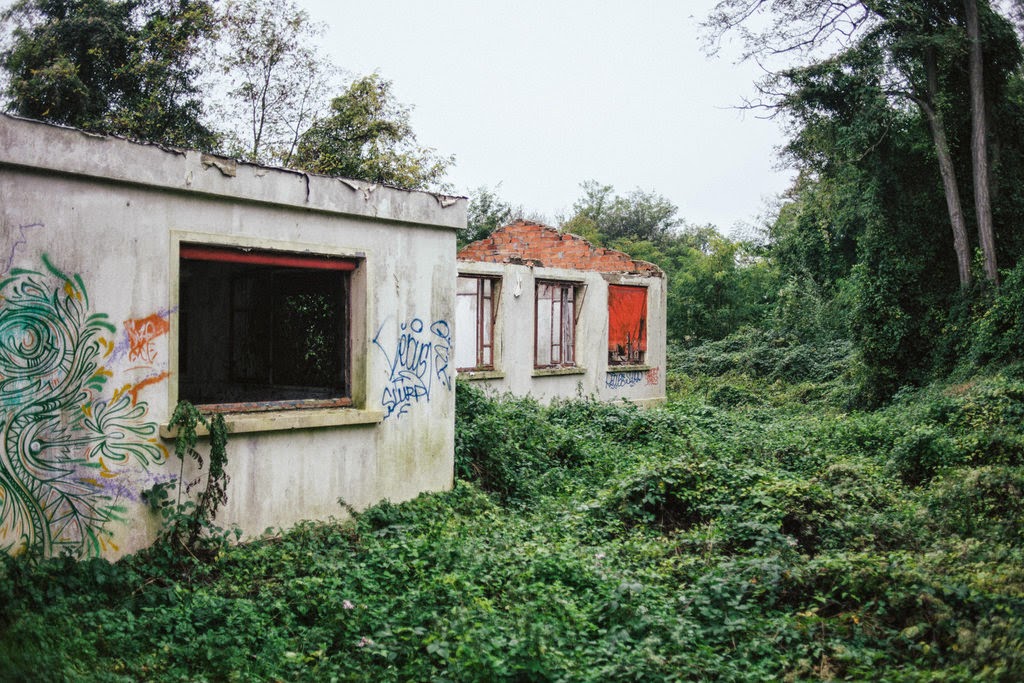
[Image: Photo by Dmitry Kostyukov, courtesy of The New York Times].

The New York Times has the strange story of an abandoned and overgrown military base near Paris where “scientists blew up more than half a ton of uranium in 2,000 explosions… often outdoors, just 14 miles from the Eiffel Tower.”

The site is now being considered for demolition, the ground beneath it to be excavated as part of a new gypsum mine—however, all that construction work risks stirring up clouds of “toxic uranium dust” from an earlier generation’s detonations.

Today, the old fort is part picturesque ruin, part Tarkovsky film:

These days curtains flap from rows of overgrown buildings; radiation symbols and other graffiti cover the security post, which is filled, weirdly, with women’s shoes. The empty housing of a vast supercomputer sits in gloom; vines spill into laboratories. The ruins recall the post-apocalypse landscape of Pripyat, the Ukrainian town evacuated after the 1986 Chernobyl disaster.

For all the controversy and narrative suspense, however, there are surprisingly few sites of detectable radioactivity. “In 2011,” we read, for example, “Christophe Nedelec, a local environmentalist, broke into the fort and, using an amateur Geiger counter, found three spots with elevated levels of radiation.” Three spots—considering that no fewer than an astonishing 150 kilograms—or roughly 330 pounds—of uranium are estimated to have blown around the grounds of the fort, that’s a seemingly reassuring find.

Yet the less optimistic view is that the uranium dust has already been and gone, lost and dissipated over decades into the surroundings neighborhoods, that are only “about nine miles from central Paris,” perhaps even blowing back into the city itself on windy days over a timespan of decades—uranium dust swirling down onto the streets and sidewalks, landing on the shoes, coats, and coffee cups of everyday Parisians who would otherwise have no real reason to worry about what appeared to be ordinary soot.

So, in a sense, the site has already depleted itself. This, certainly, resembles the view of the mining company that now wants to tear down the old fort and rip the landscape into a gypsum mine.

In any case, the site—and the people now guerrilla-gardening there—is worth a quick look over at the New York Times.

(The title of this post is borrowed from a pamphlet by Eugene Thacker, which has surreally and hilariously been in the news this past month after popping up on Glenn Beck’s show as an example of the threat of nihilism in U.S. popular culture; there is otherwise no connection between this post and the book—just toxic uranium dust…).

Touchscreen Landscapes

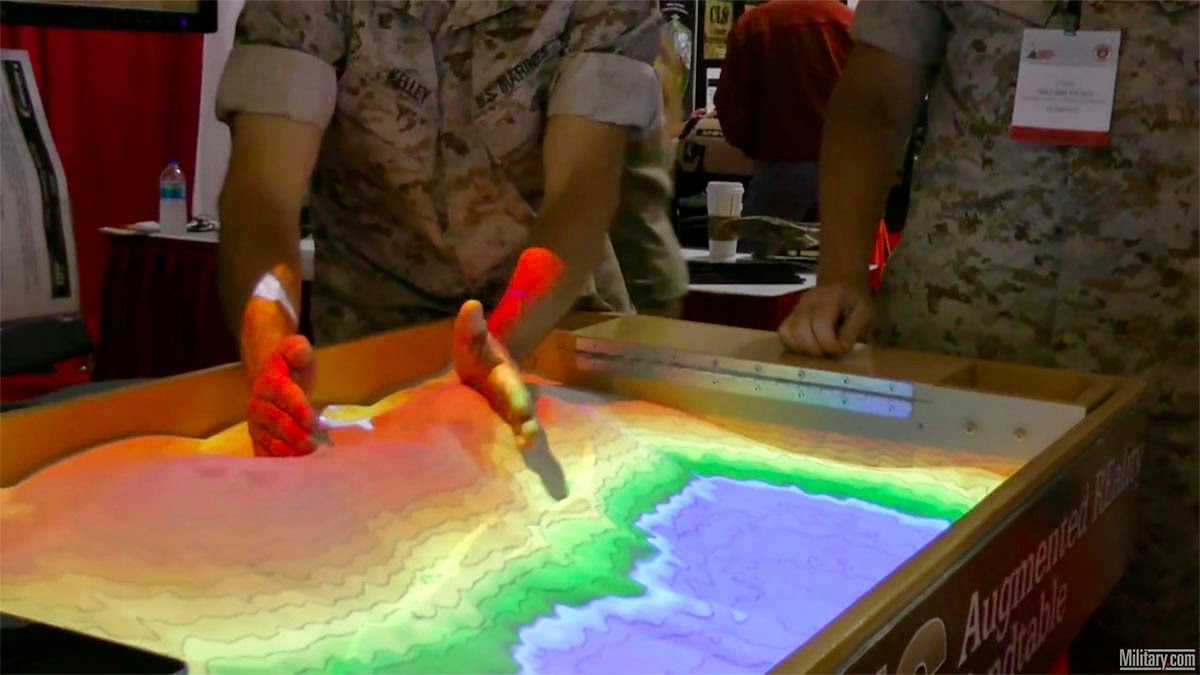
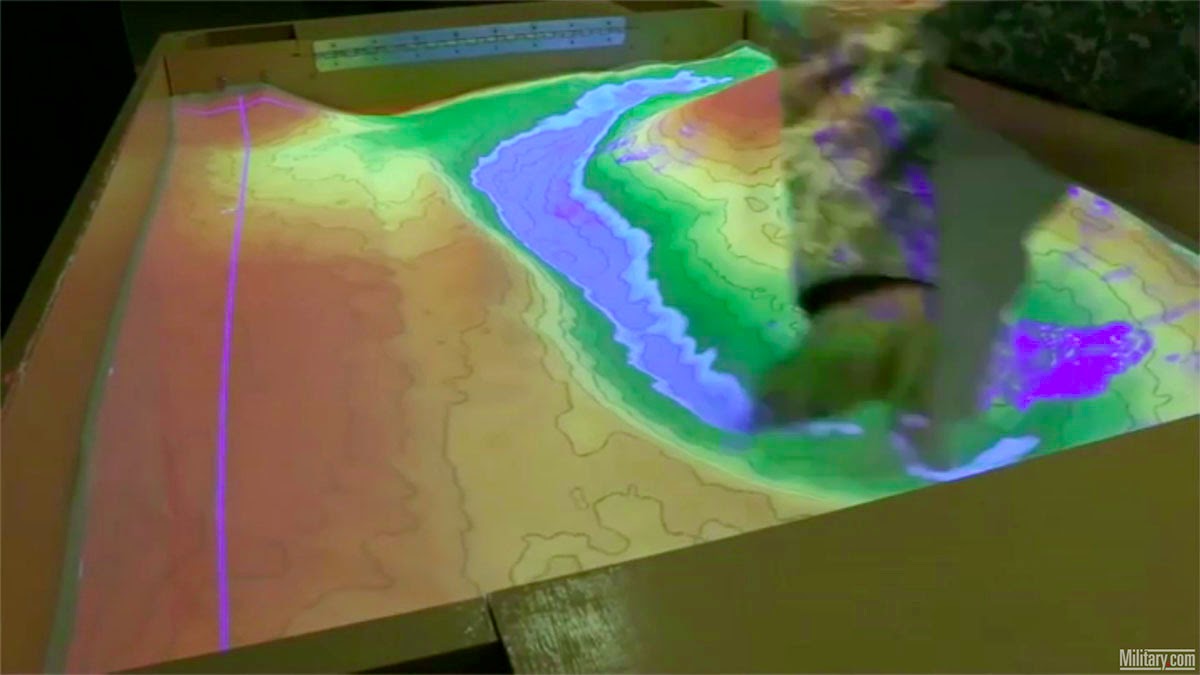
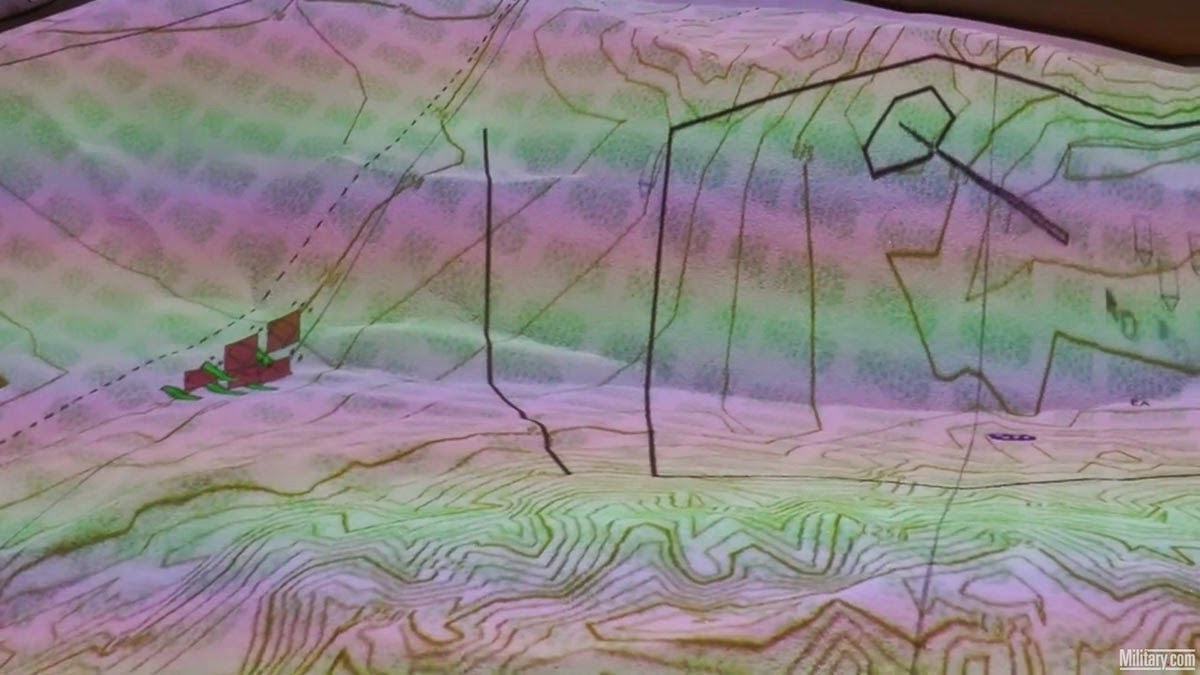
[Image: Screen grab via military.com].

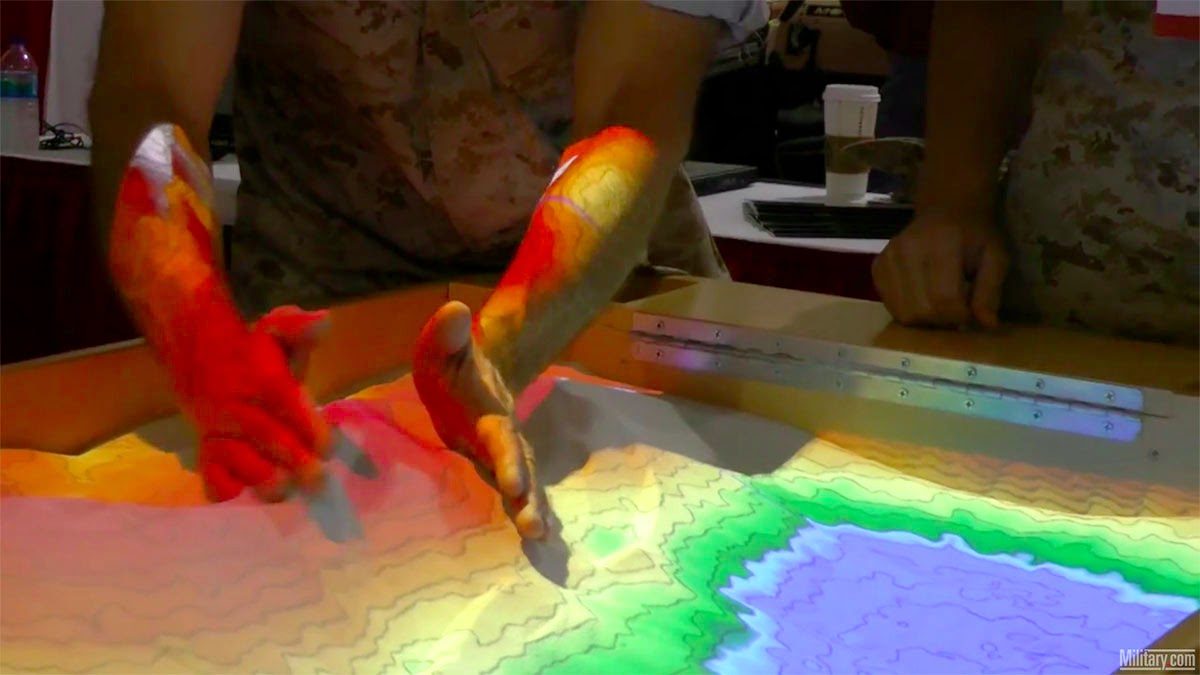
This new, partly digital sand table interface developed for military planning would seem to have some pretty awesome uses in an architecture or landscape design studio.

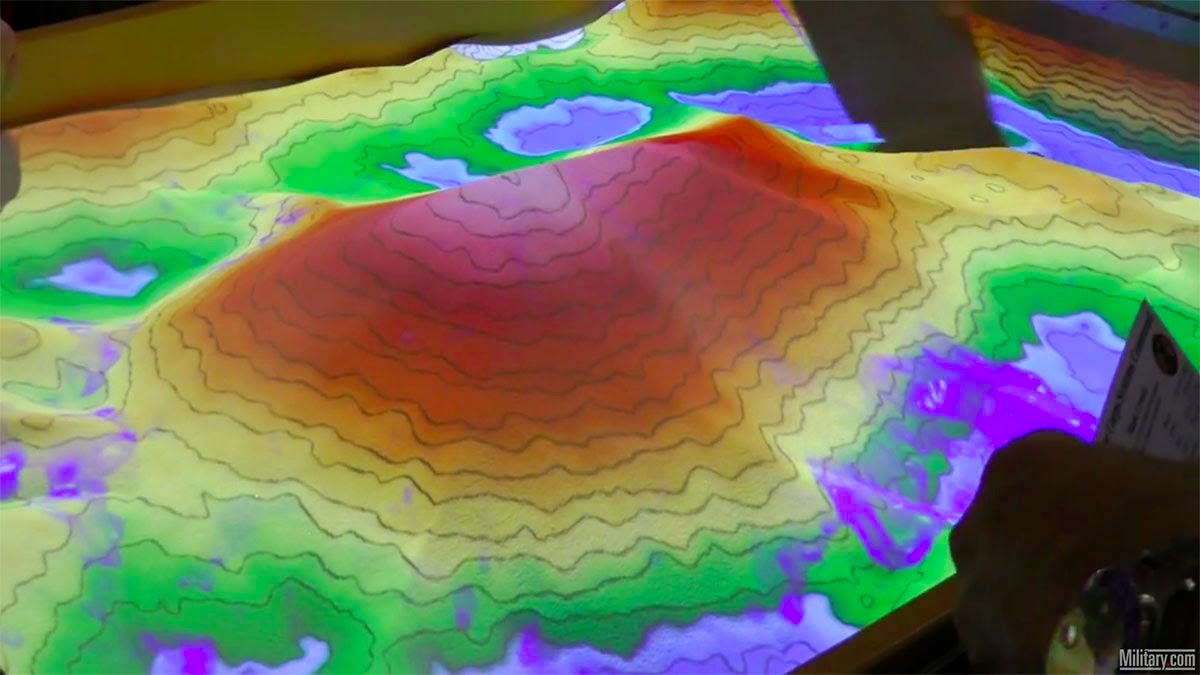
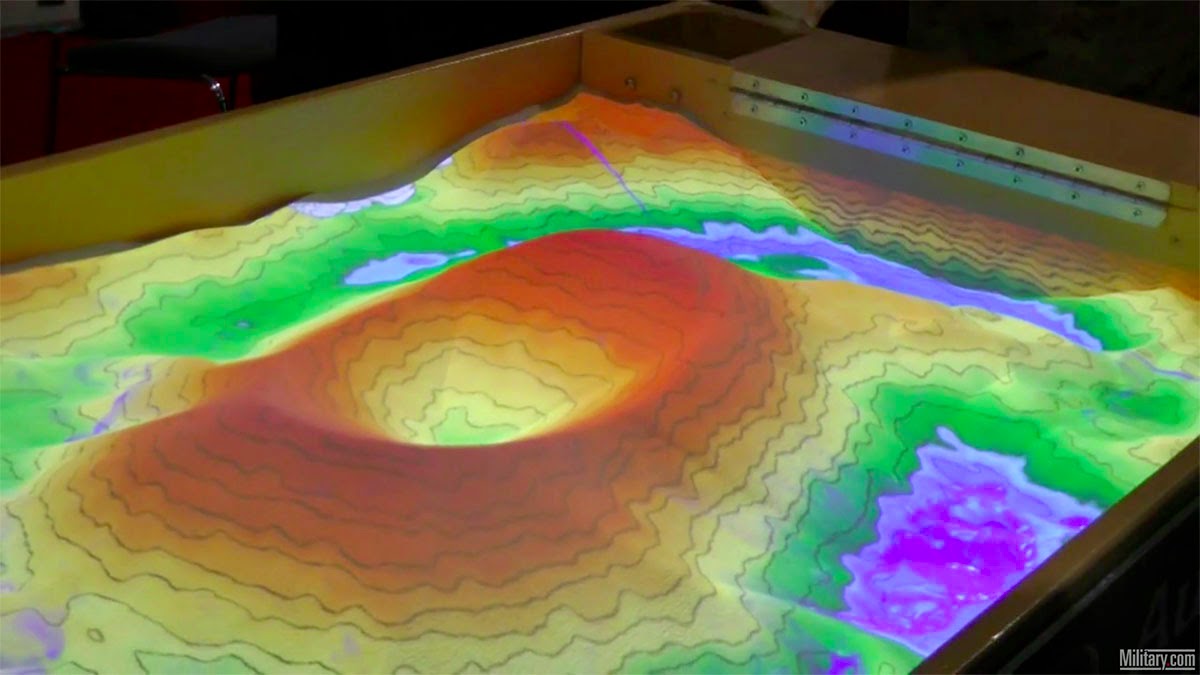
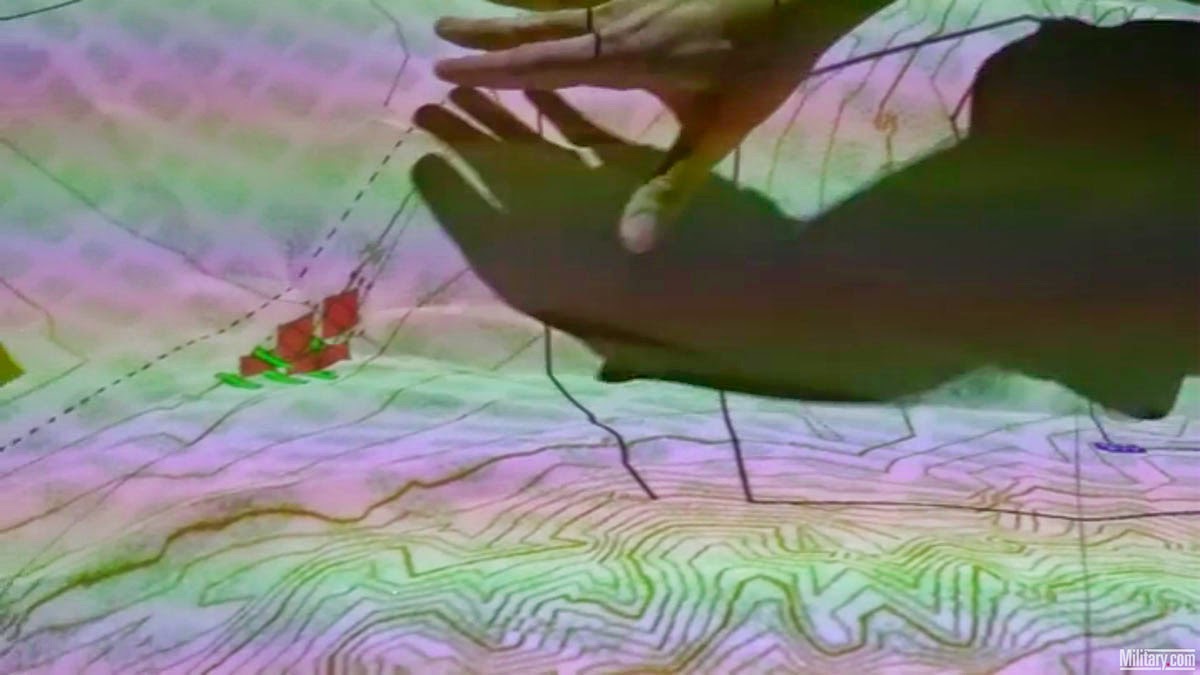
Using 3D terrain data—in the military’s case, gathered in real-time from its planetary network of satellites—and a repurposed Kinect sensor, the system can adapt to hand-sculpted transformations in the sand by projecting new landforms and elevations down onto those newly molded forms.

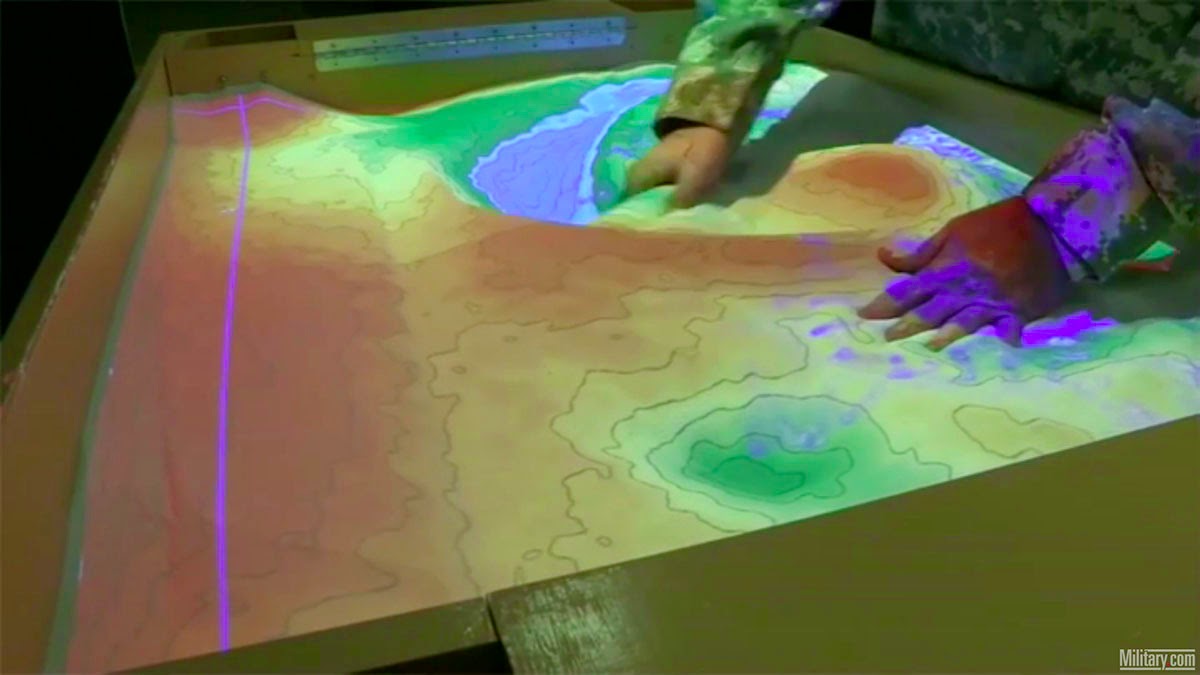
You can thus carve a river in real-time through the center of the sandbox, and watch as projected water flows in—

[Image: Screen grabs via military.com].

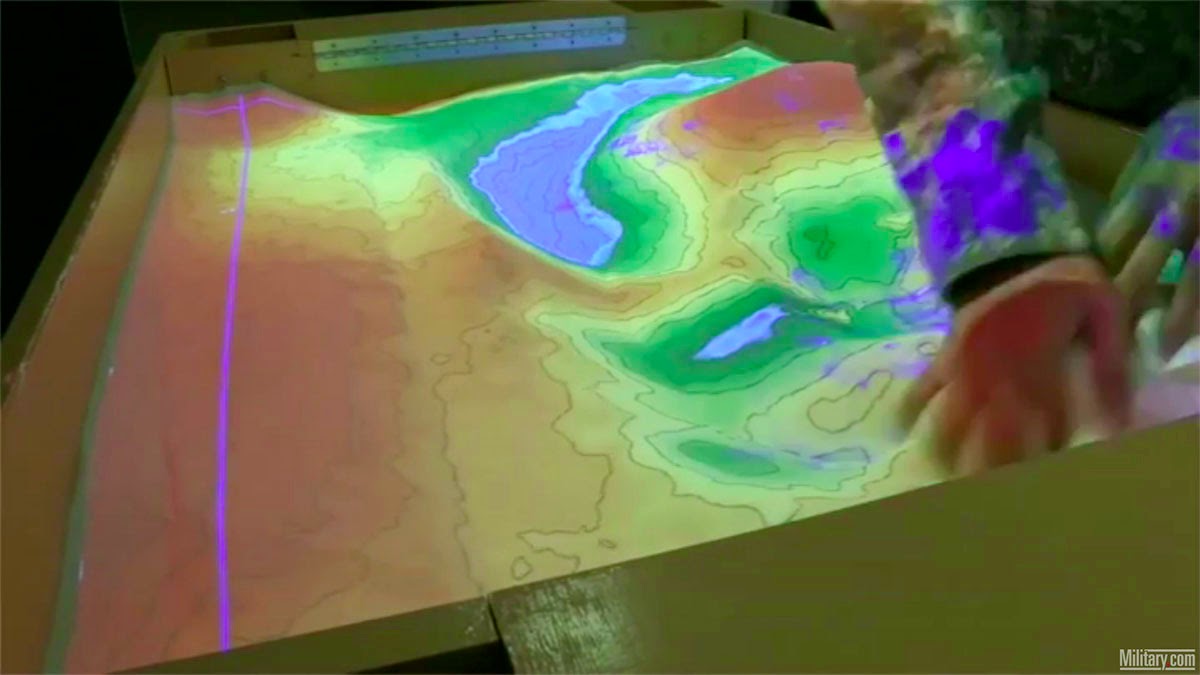
—or you can simply squeeze sand together into new hills, and even make a volcanic crater.

[Image: Screen grabs via military.com].

The idea of projecting adaptive landscape imagery down onto a sandbox is brilliant; being able to interact with both the imagery and the sand itself by way of a Kinect sensor is simply awesome.

Imagine scaling this thing up to the size of a children’s playground, and you’d never see your kids again, lost in a hypnotic topography of Minecraft-like possibilities, or just donate some of these things to a landscape design department and lose several hours (weeks?) of your life, staring ahead in a state of geomorphic Zen at this touchscreen landscape of rolling hills and valleys, with its readymade rivers and a thousand on-demand plateaus.

The military, of course, uses it to track and kill people, filling their sandbox with projections of targeting coordinates and geometric representations of tanks.

[Image: Screen grabs via military.com].

But there’s no reason those coordinates couldn’t instead be the outlines of a chosen site for your proposed architecture project, or why those little clusters of trucks and hidden snipers couldn’t instead be models of new buildings or parks you’re hoping will be constructed.

Watch the original video for more.

The Civic Minimum

[Image: From Gravesend—The Death of Community by Chris Clarke].

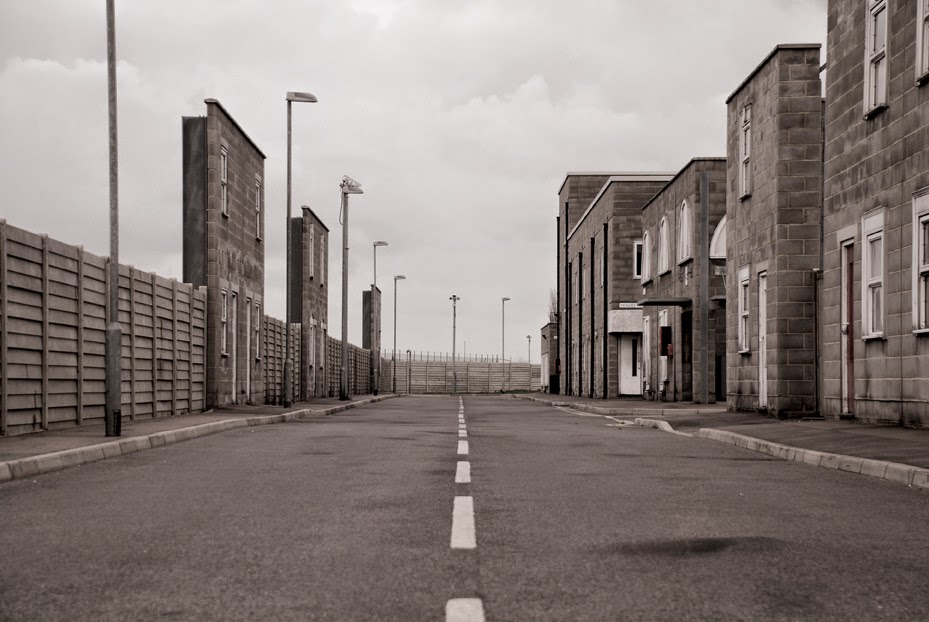
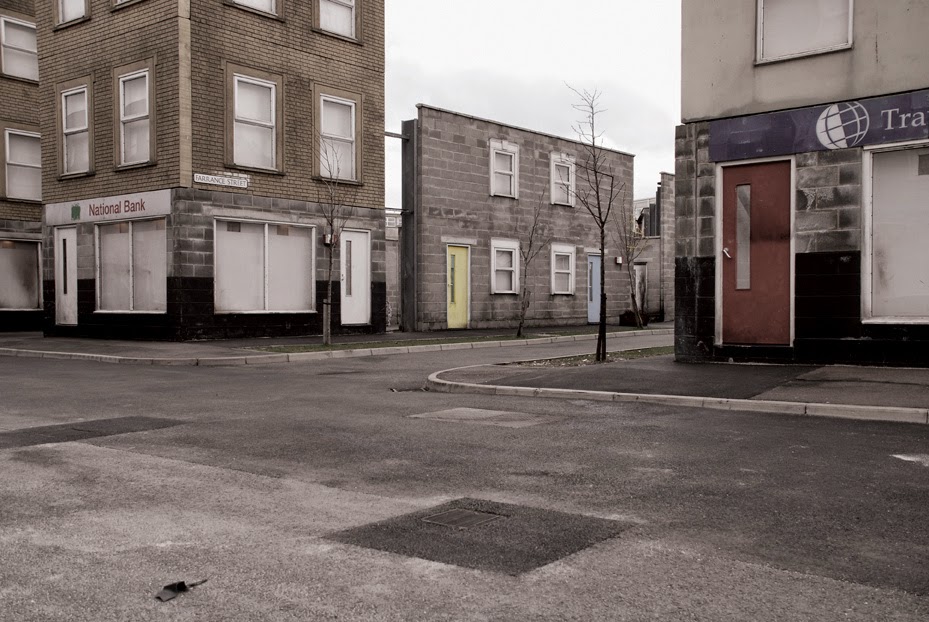
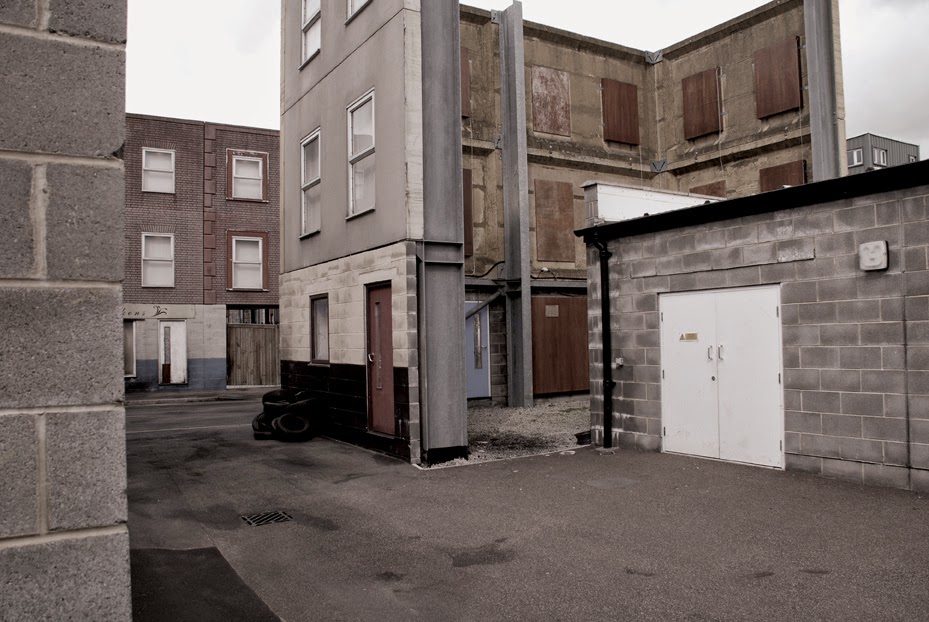
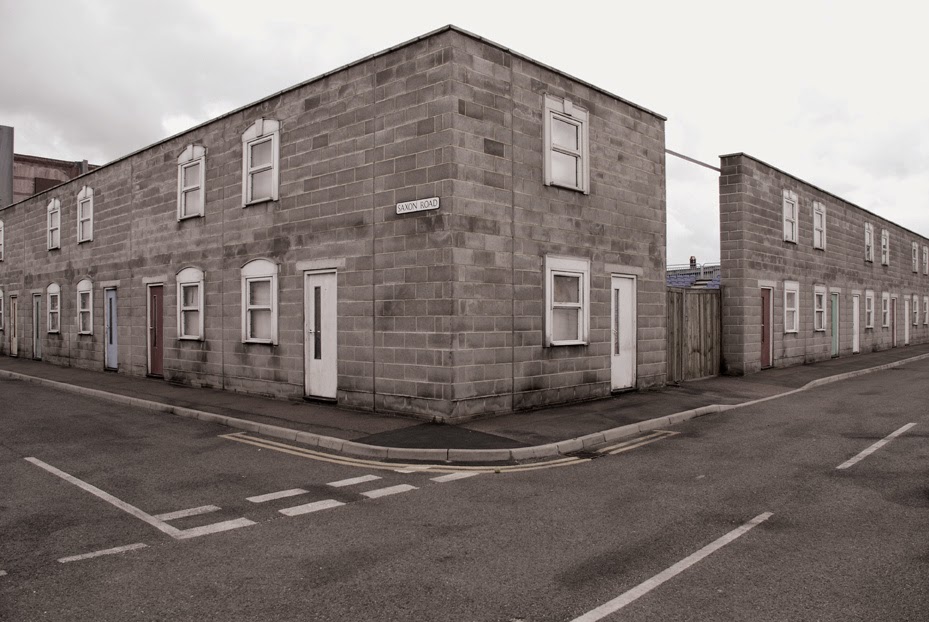
Gravesend is a suburb east of London, hosting on its own eastern edge something of a secondary suburb: a mysterious town on the edge of town that turns out not to be a town at all.

It is a simulated English village built in 2003 by the Metropolitan Police working with Equion Facilities Management and a firm called Advanced Interactive Systems (AIS).

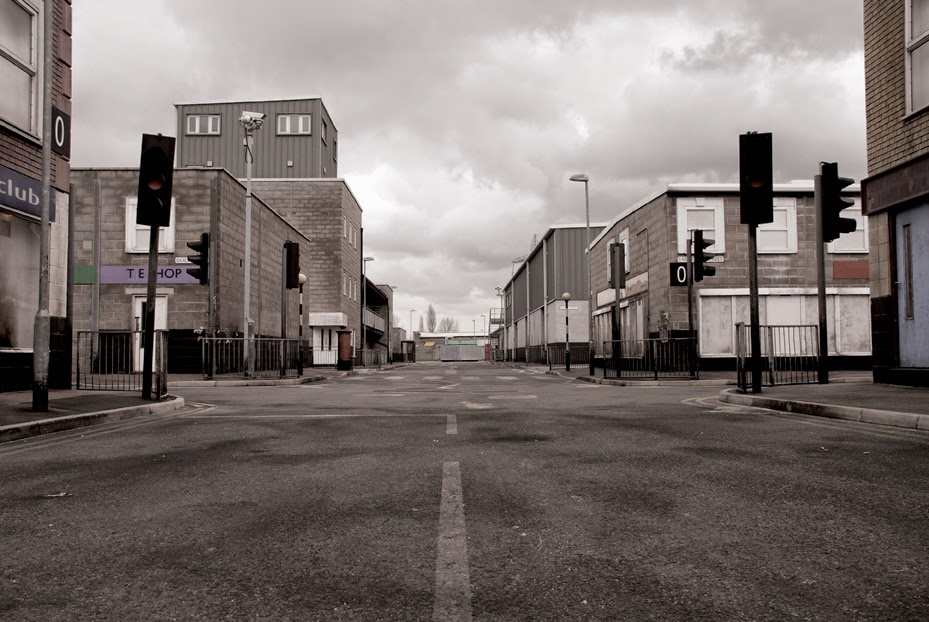
The barren streets and hollow buildings of this militarized non-place were designed for use as an immersive staging ground for police-training exercises, fighting staged riots, burglaries, bank robberies, and other crimes.

[Image: From Gravesend—The Death of Community by Chris Clarke].

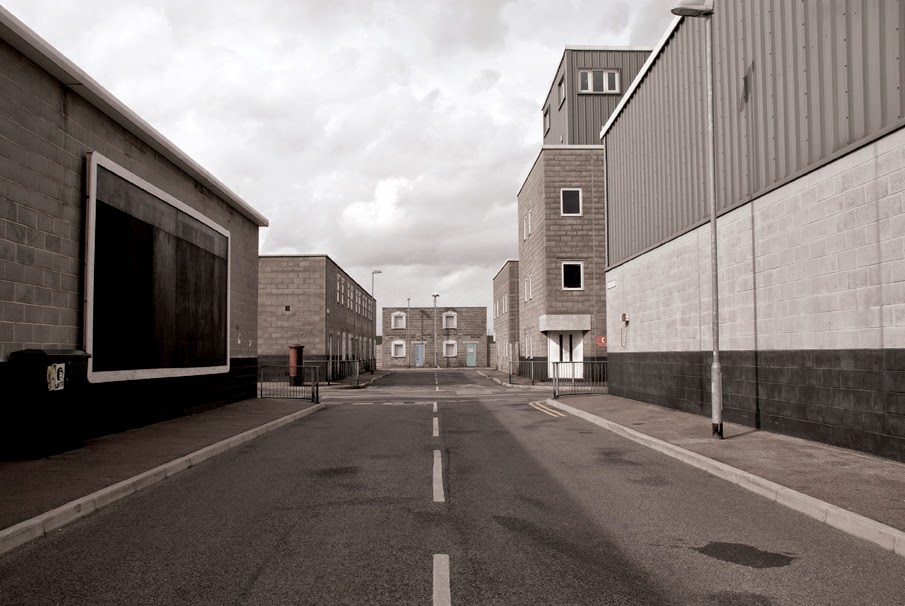
Facades with no buildings behind them line the empty streets; in some cases, it is only through the aerial views afforded by a service like Google Maps that this reality is made clear.

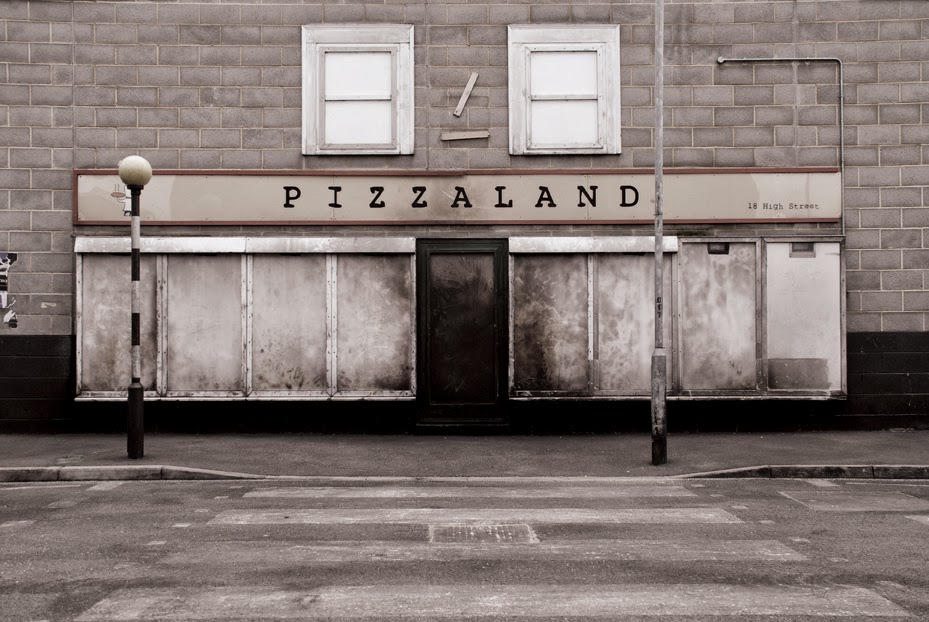
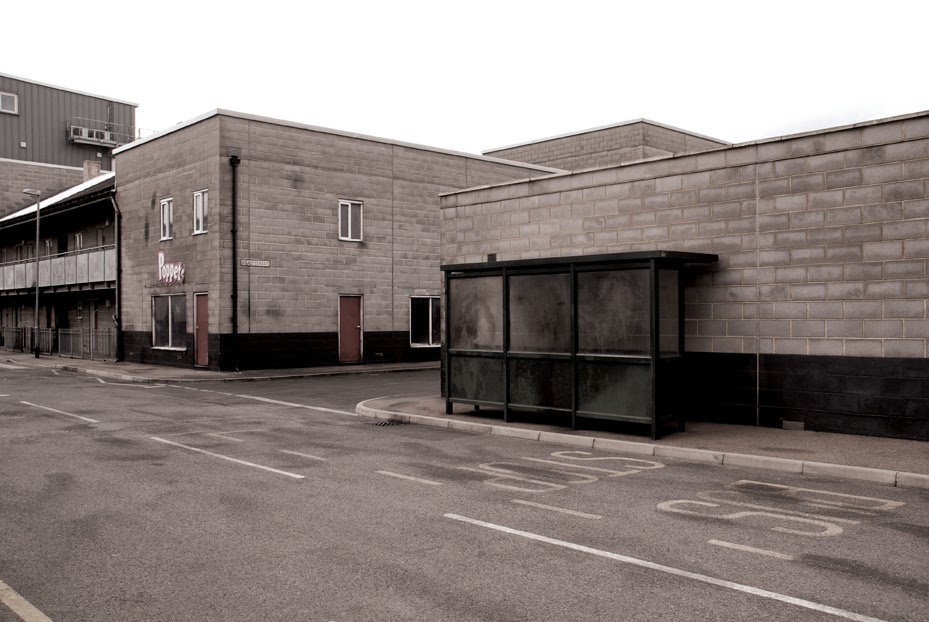
Imitation bus stops, make-believe banks, and an oddly whimsical Pizzaland—like an end-times chain restaurant from Shaun of the Dead—sustain the illusion on the ground.

[Image: From Gravesend—The Death of Community by Chris Clarke].

Somewhat incongruously, an airplane fuselage also now rests beside a chainlink fence near the roadway, giving officers an opportunity to prepare for airplane hijackings.

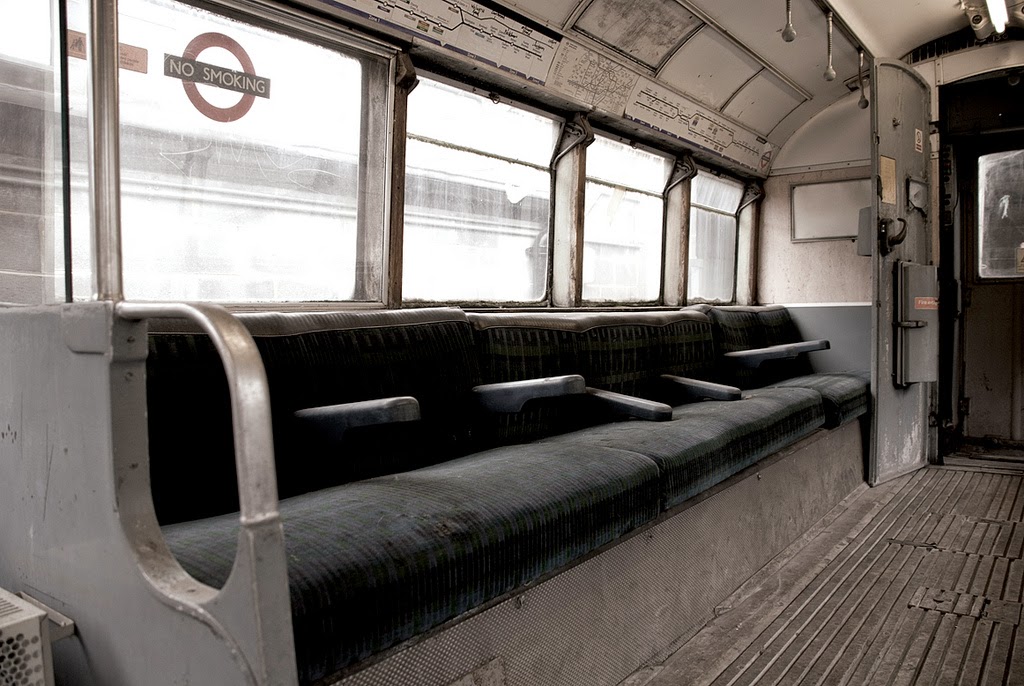
There are even empty Tube carriages parked outside town for improvisatory police raids.

[Image: From Gravesend—The Death of Community by Chris Clarke].

According to AIS, their consultant-designers kitted out the site’s “live-fire ranges with internal ballistic and anti-ricochet finishes, simulation and targetry equipment, and range sound systems,” a complete multimedia package that would soon also include HD video projectors and even “laser-based 3D virtual training environments.”

Architectural simulations embedded with high-tech, upgradeable media technology thus supply the necessary level of detail for repeating crimes, on demand, like strange social rituals.

[Image: From Gravesend—The Death of Community by Chris Clarke].

The photos seen here were all take by designer and photographer Chris Clarke, whose Flickr set of the series, including a dozen or so further images, is worth a look.

[Image: From Gravesend—The Death of Community by Chris Clarke].

For Clarke, the “facsimile” urbanism of this site at the end of Gravesend is actually something of “a warning—a prophecy of society’s potential to alienate itself from itself.” He suggests that these surreal scenes threaten to become indistinguishable from everyday life, our cities and streets stripped down to the civic minimum, used as nothing more than bleak stomping grounds for futuristic security forces armed with military-grade tools.

“We have estates, parks, nightclubs, tube stations,” Clarke writes, “but is the community missing from Gravesend significantly more present in our inhabited cities and towns?” His own answer remains unspoken but obvious.

[Images: From Gravesend—The Death of Community by Chris Clarke].

Writing about this same site back in 2008, Brian Finoki of Subtopia called it a “new theater of the absurd.”

It is, he wrote, “a city standing on the planet for one purpose: to be rioted, hijacked, trashed, held hostage, sacked, and overrun by thousands of chaotic scenarios, only so that it can be reclaimed, retaken, re-propped in circuitous loops of more dazzling proto-militant exercise, stormed by a thousand coordinated boots for eternity, targeted by hundreds of synchronized crosshairs of both lethal and non-lethal weapons.”

[Image: From Gravesend—The Death of Community by Chris Clarke].

Check out more photos at Chris Clarke’s Flickr page.

(Related: In the Box: A Tour Through the Simulated Battlefields of the U.S. National Training Center).

A Geography of Devices

[Image: Tokyo subway map, via re:form].

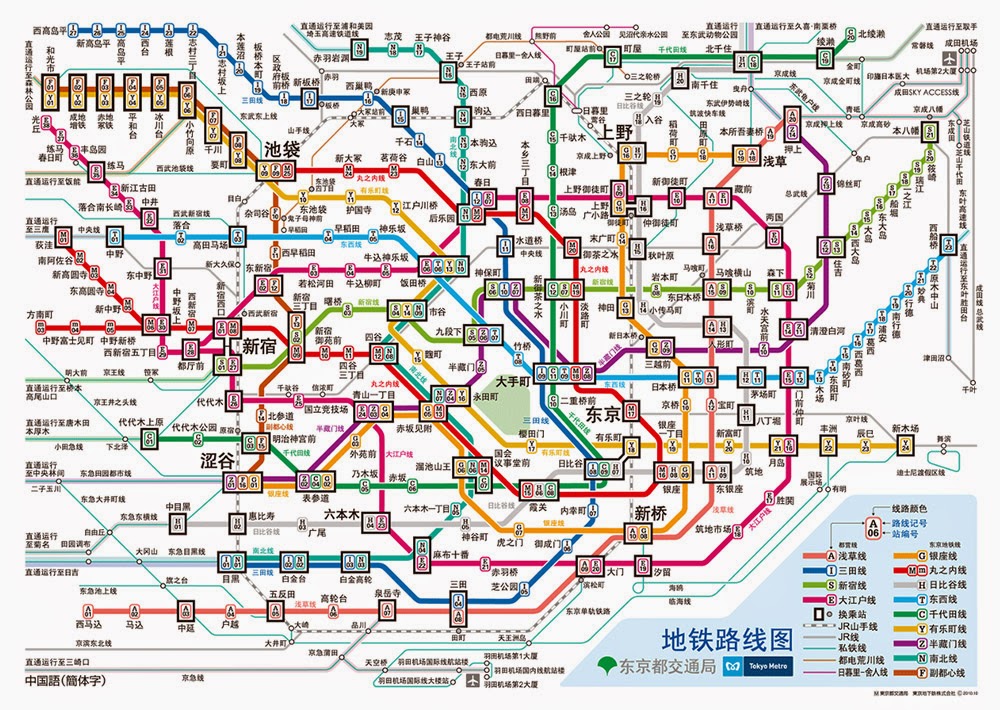
“Just as postal systems remade geographic places into zones determined by politics and history,” Amy Johnson writes for re:form, “social media technologies are remaking them today.”

“Historically,” Johnson writes, “the categories of both who helps in natural disasters and who is helped have largely been organized around place, in this case mapped according to its political and geographic dimensions, by government agencies and relief organizations with parallel structures. Recently, social media has broadened the category of who helps—and in doing so, new technological places have joined political and geographic ones.”

Johnson is describing the various spatial metaphors at work in Japanese disaster response plans following the Tōhoku earthquake in 2011, and the communication of those plans to the public via social media platforms. Evacuation zones defined by “suspiciously round numbers,” so-called geocasting (“when a producer targets publishing to a particular region or location”), and the abandonment of traditional post codes in favor of “device locations” all play a part in her analysis.

After all, Johnson continues, “this is a decidedly different moment of history and politics, and the power balance among people, corporations, and states has shifted. The resultant new zones—and new configurations of zones—will further change this balance.”

The internet of things, we might say, is also an emergency network of things, marking our spatial locations more efficiently than previous methods of territorial administration.

Read the rest over at re:form.

(Thanks to Nicola Twilley for the tip!)

We Can Terraform It For You Wholesale

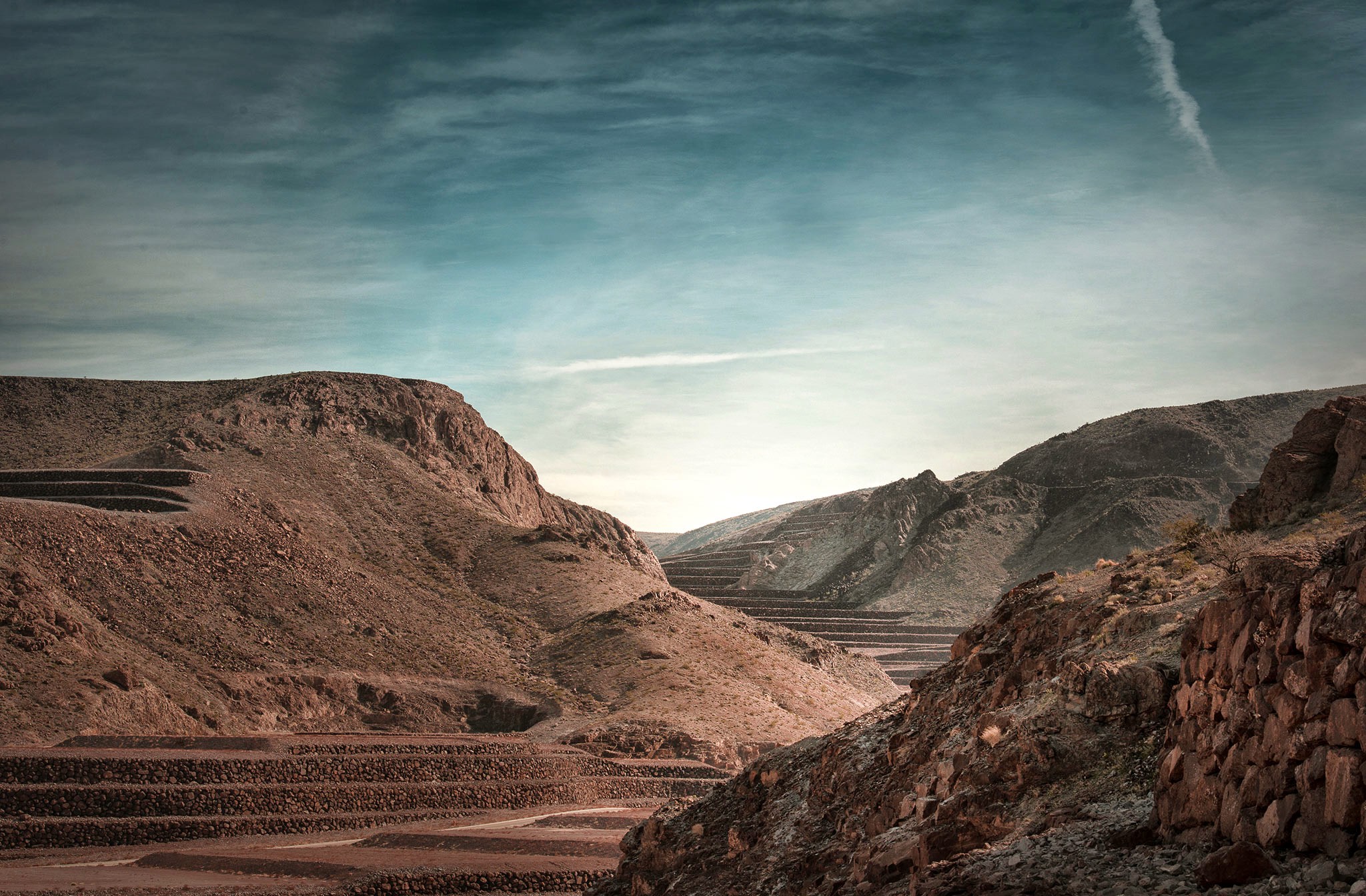
[Image: Real estate development or avant-garde earthwork? The future streets of Ascaya; courtesy of Ascaya].

The website for the stalled Las Vegas development known as Ascaya—which we saw in the previous post through the aerial photographs of Michael Light—is itself quite remarkable and worth a quick visit.

At first glance, the site could actually be mistaken for some kind of strange new media art project, a near-future ad for an interplanetary terraforming corporation dedicated to selling huge geometric shapes directly to consumers.

Slow transitions drift from shot to shot as we peer out over these strangely beautiful, unfinished landforms in the desert, seemingly endless in number as they step back—and back, and back—toward the horizon.

It’s like a planet reconfigured by obsessed geometricians—where, surreally, each individual form is actually for sale.

[Image: Another view of the abstract landforms of Ascaya; courtesy of Ascaya].
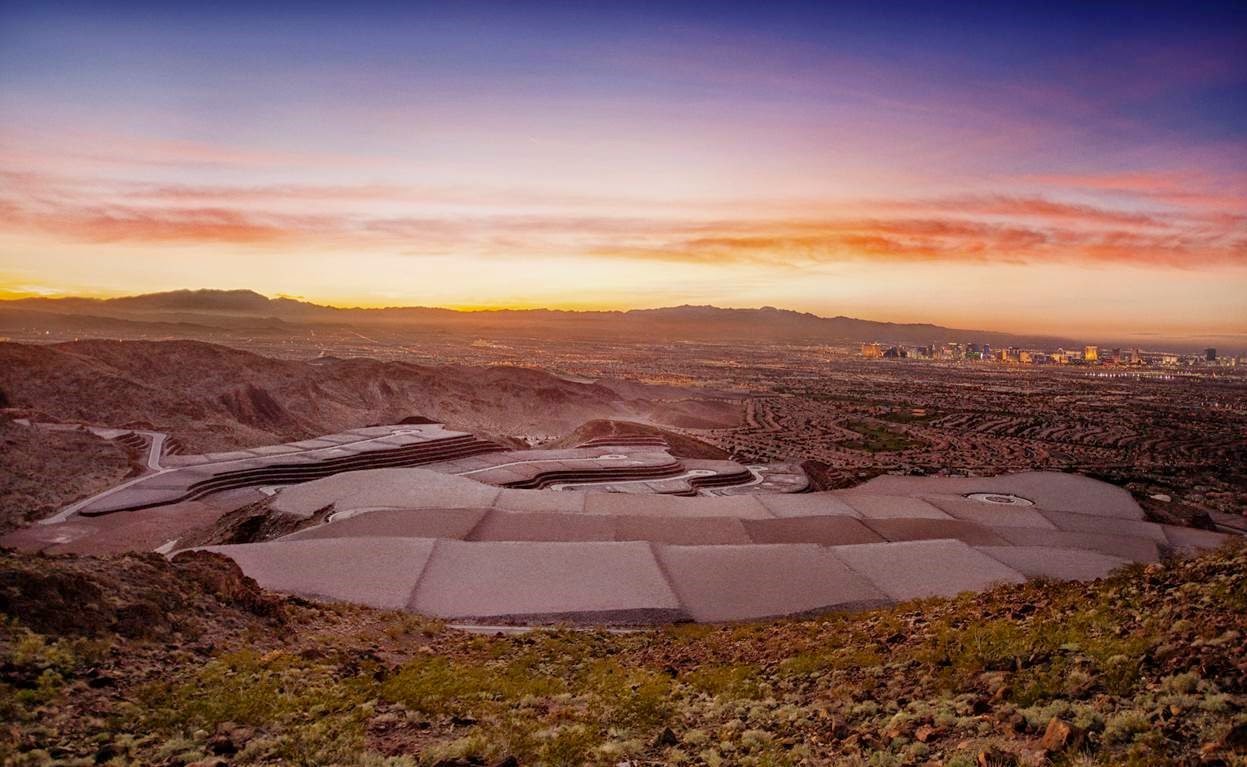
Accordingly, the website presents us with Romantic shots of uninhabited geometry, the gleaming towers of Las Vegas only barely visible in the background, catching the final rays of an arid sunset, as if this is actually the sprawling backdrop for a more interesting remake of Total Recall.

[Image: One more glimpse of Ascaya; courtesy of Ascaya].

In any case, my initial reaction in seeing the Ascaya website was that it could actually pass as a kind of online art auction for the world’s most ambitious land art installation—not a real estate site at all—selling the work of someone far ambitious than, say, Michael Heizer or James Turrell.

After all, surely Ascaya, specifically in its unfinished state, is more seductive—and more interpretively exciting—than the, by comparison, almost absurdly boring “Spiral Jetty“?

Perhaps, next to the work of people like Walter De Maria, we should be studying Ascaya—and a pilgrimage to these weird black steps in the desert should be on the list of any collector of American land art.

Landscape, Redacted

[Image: “Looking east over unbuilt Ascaya lots, Black Mountain beyond, Henderson, Nevada,” 2010; from Black Mountain by Michael Light].
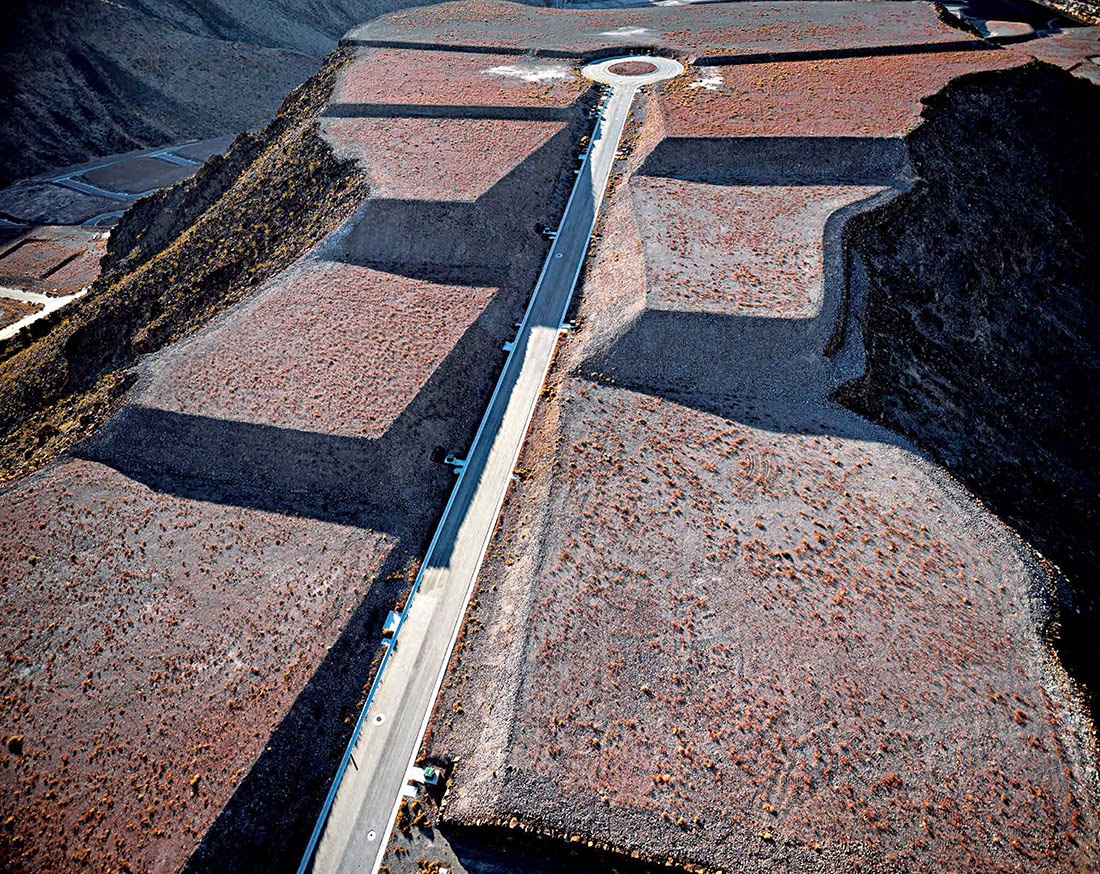
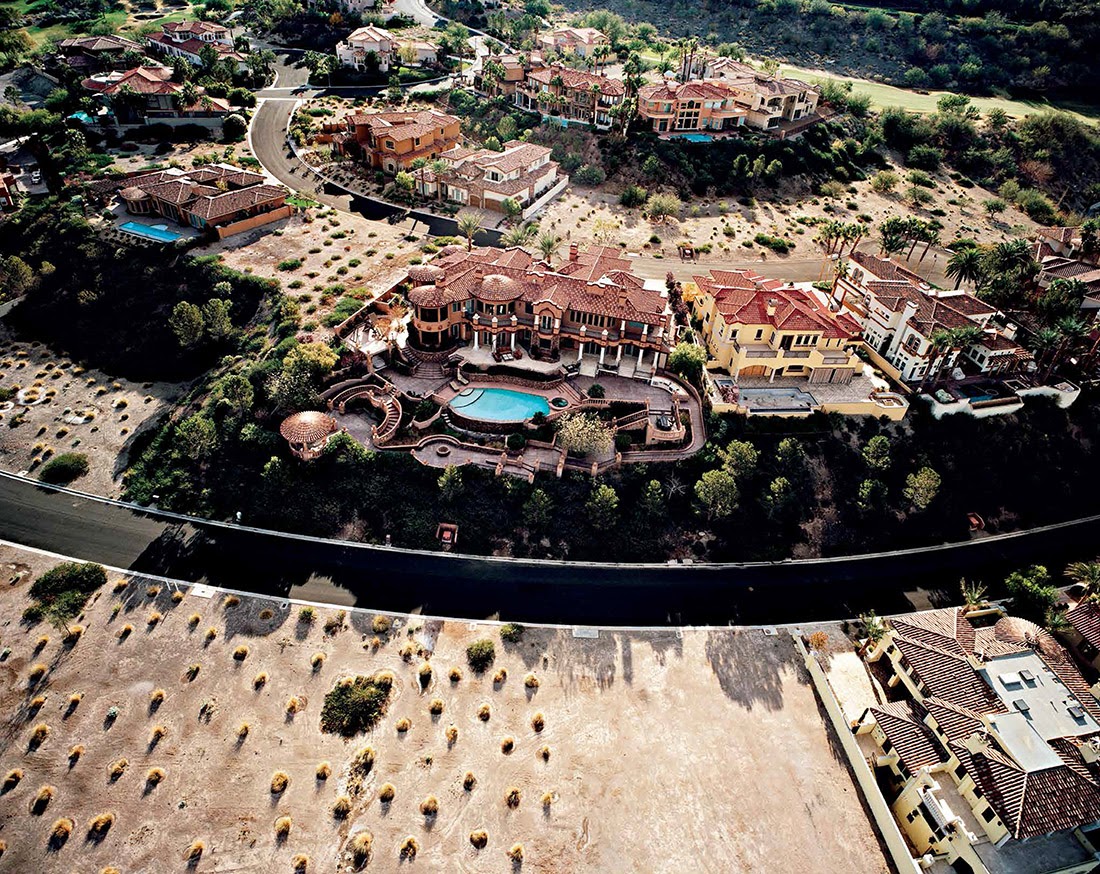
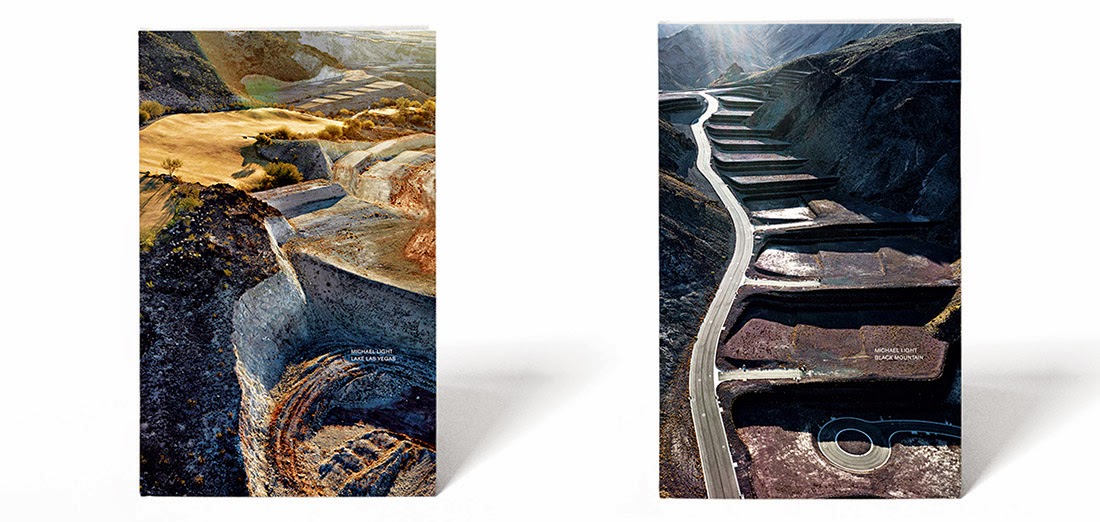
Photographer Michael Light has a new book coming out this fall, published by Radius Books, with work documenting the construction and large-scale terrestrial formatting of two housing developments in the American southwest, one unfinished, one gaudily over the top.

They are known as Ascaya and Lake Las Vegas.

[Image: “Unbuilt Ascaya lots and cul-de-sac looking west, Henderson, Nevada,” 2011; from Black Mountain by Michael Light].
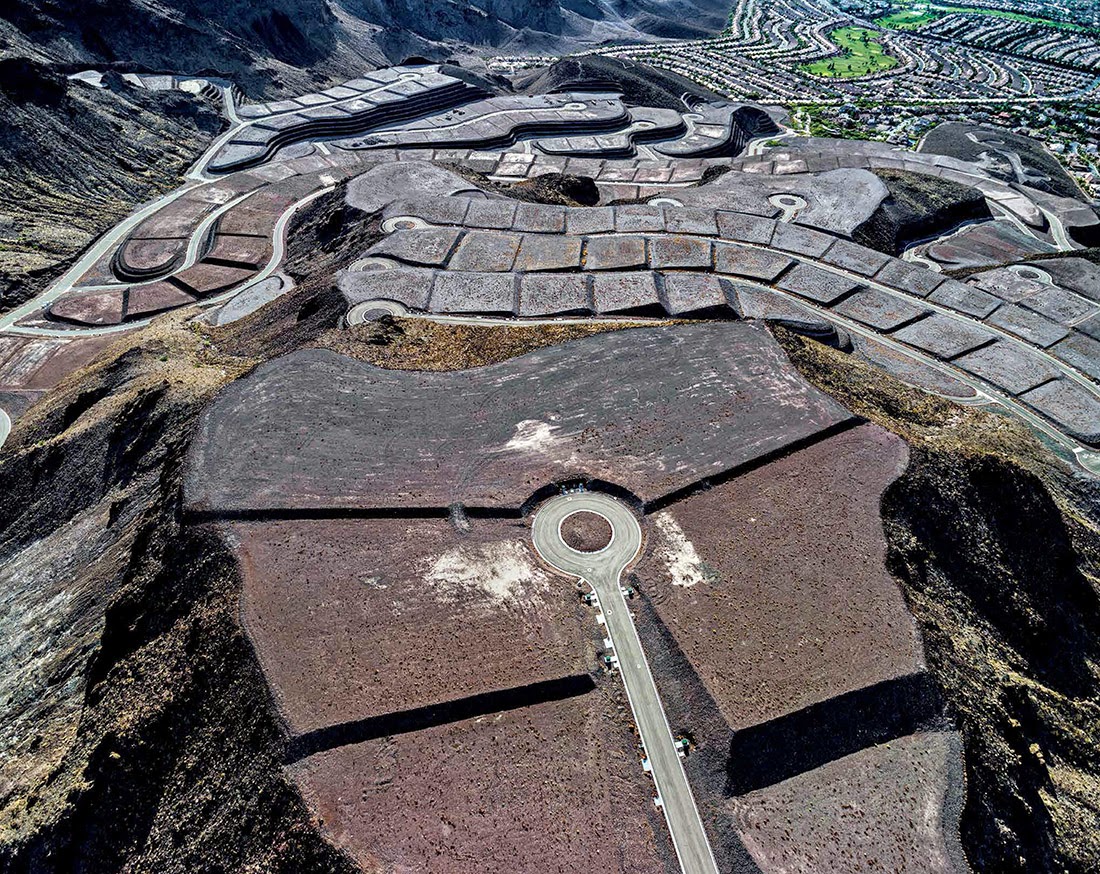
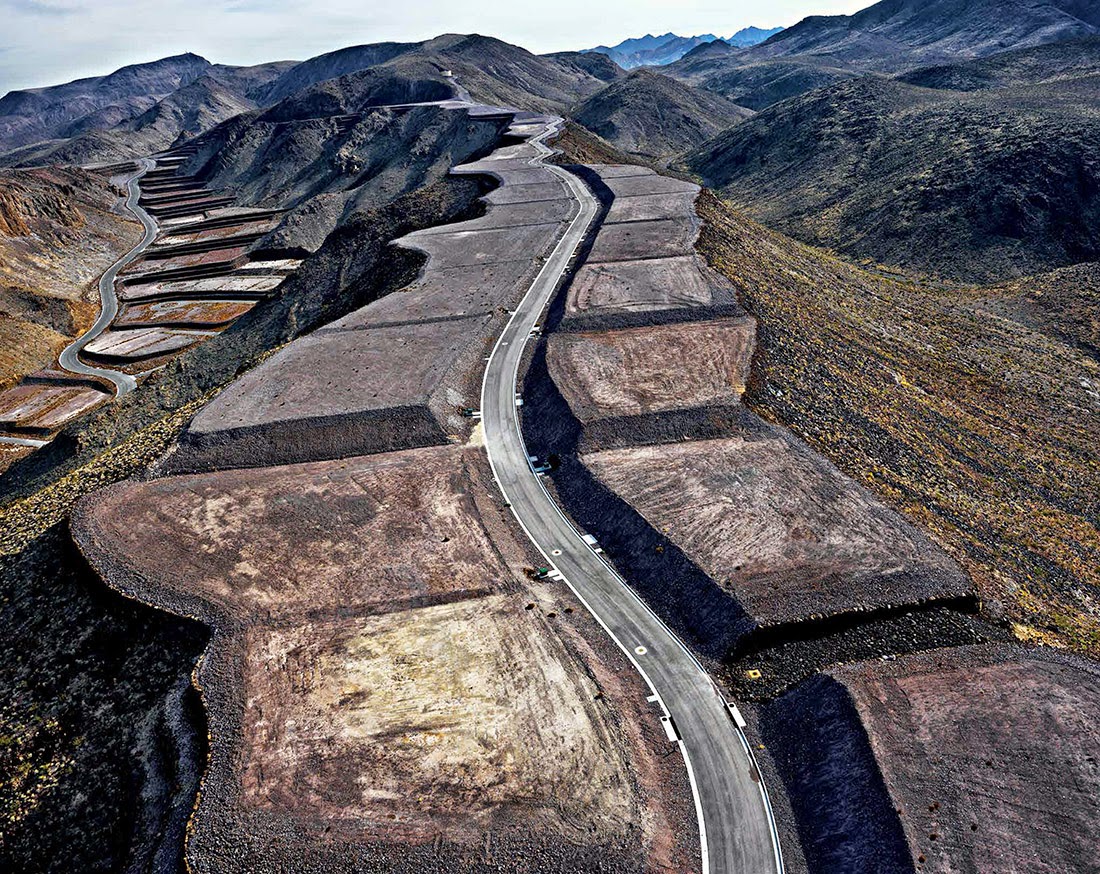
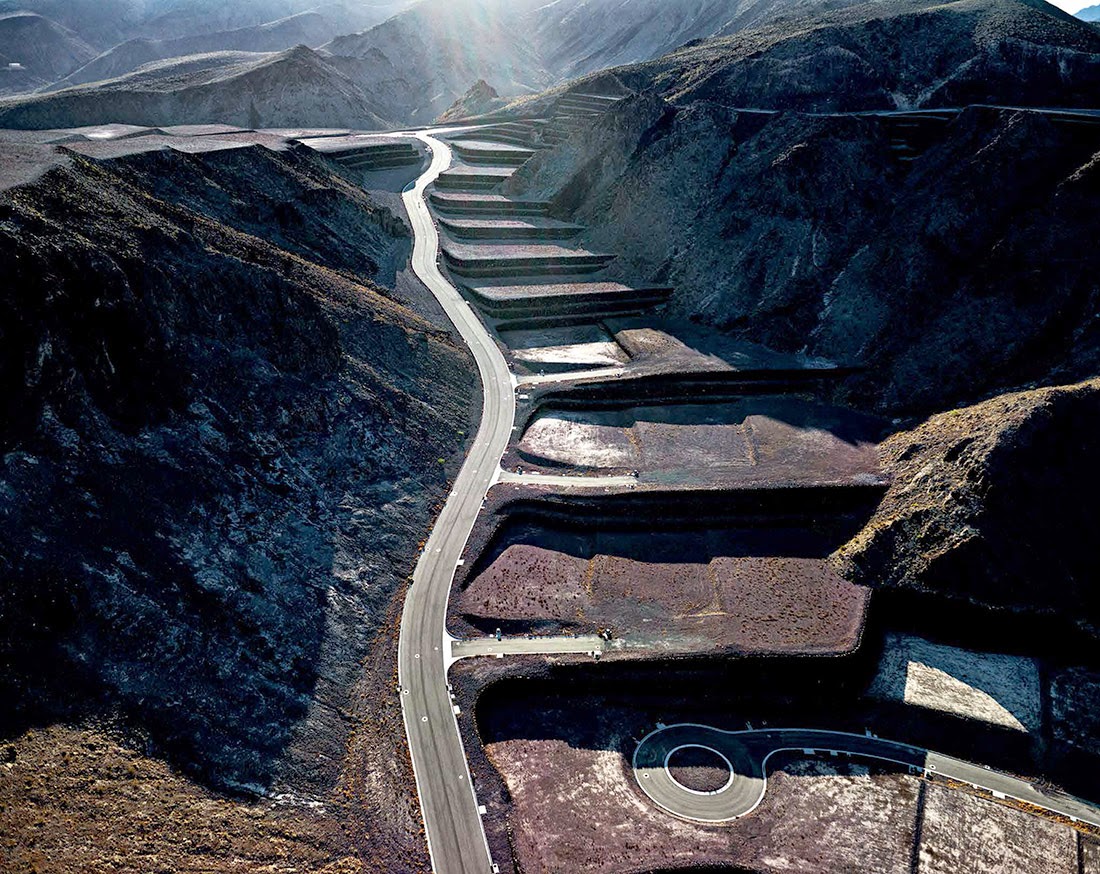
Ascaya was meant to ascend into the desert hills like a vast residential staircase, its plots patiently shaped and awaiting their architecture—but these ambitious plans were radically decelerated into a state of suspended animation by the economic collapse of 2008.

It is now something more like a stalled earthwork, a vast land art installation made all the more amazing when seen from above.

[Image: “Unbuilt Ascaya lots and culdesac looking northwest, Sun City MacDonald Ranch development beyond, Henderson, Nevada,” 2012; from Black Mountain by Michael Light].
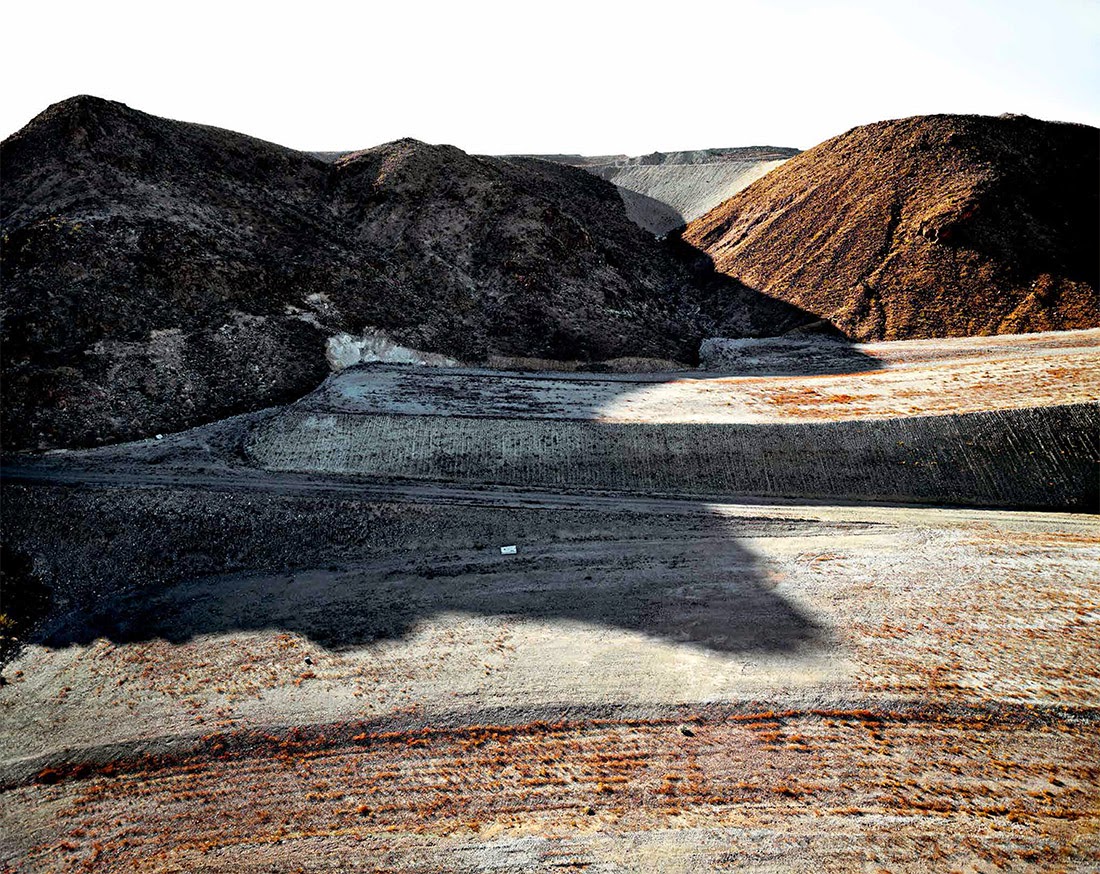
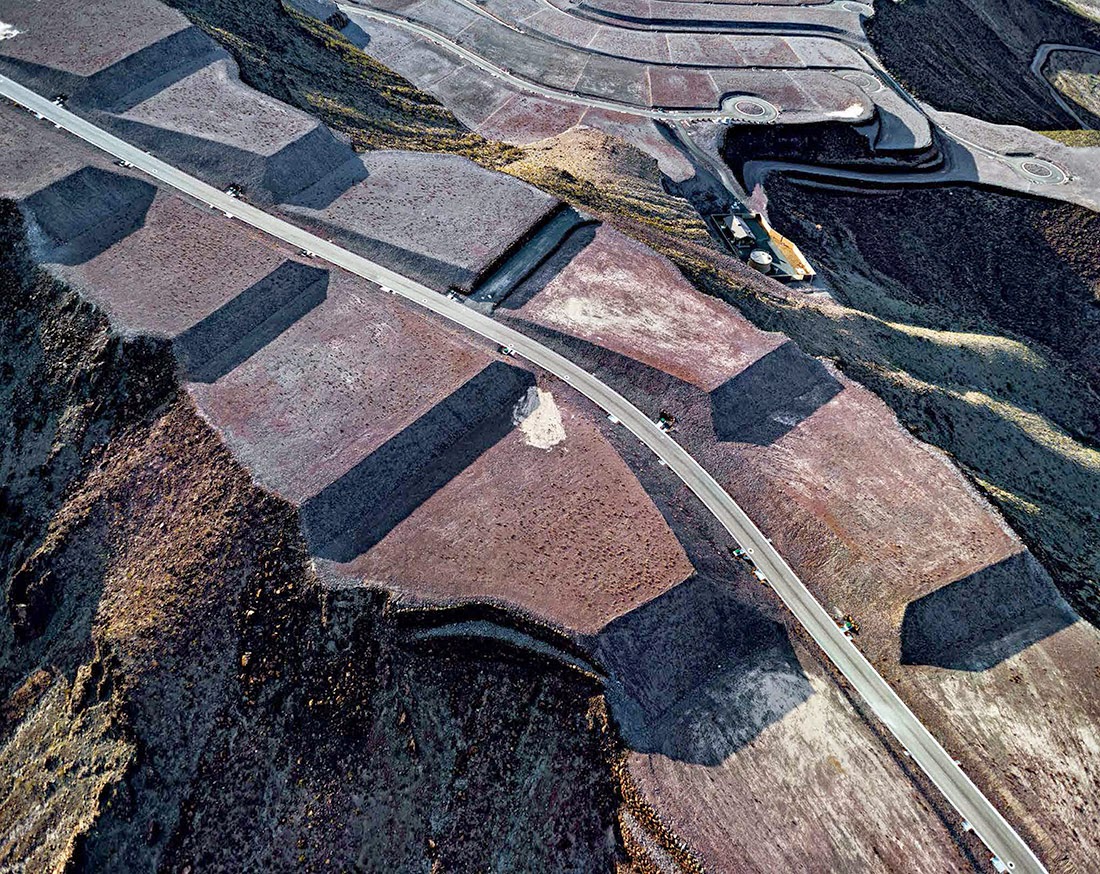
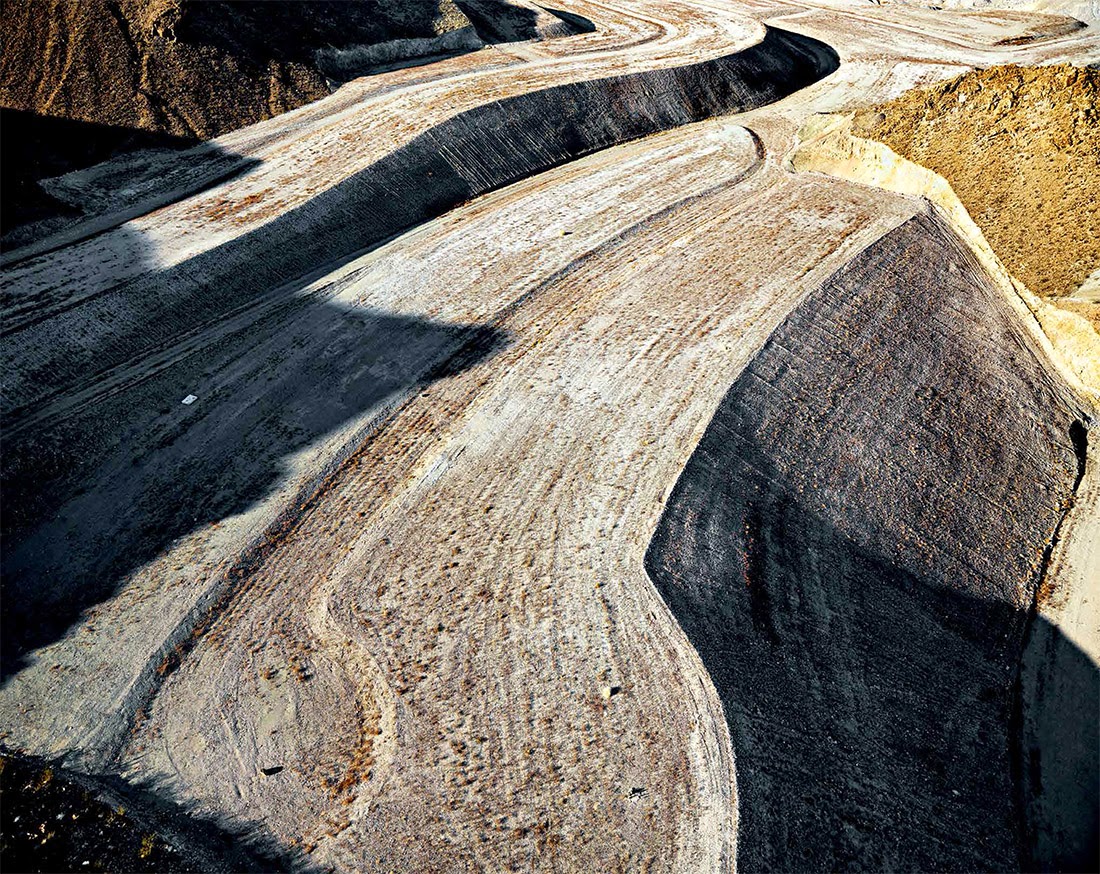
The resulting landforms—huge berms, winding streets, flat-capped foundation piles, and carefully graded podiums of dirt and gravel—look at times like hard drive platters, chocolate bars, or even the tailings piles of a colossal mine.

This latter comparison was made by Light himself in a long interview Nicola Twilley and I recorded with him for Venue.

There, Light told us that “the more work I do in Las Vegas, the more I see parallels between the mining industry—and the extraction history of the west—and the inhabitation industry.”

They do the same sort of things to the land; they grade, flatten, and format the land in similar ways. It can be hard to tell the difference sometimes between a large-scale housing development being prepped for construction and a new strip mine where some multinational firm is prospecting for metals.

“In other words,” he continued, “the extraction industry and the inhabitation industry are two sides of the same coin. The terraforming that takes place to make a massive development on the outskirts of a city has the same order, and follows the same structure, as much of the terraforming done in the process of mining.”

[Images: (top) “The Falls at Lake Las Vegas construction road looking north, Henderson, Nevada,” 2011; (bottom) “Future house lots and abandoned mattress at The Falls at Lake Las Vegas, looking west, Henderson, Nevada,” 2011; both from Lake Las Vegas by Michael Light].

“That was a revelation for me,” Light added. “The mine is a city reversed. It is its own architecture.”

The mine is a city reversed.

[Images: “Unbuilt Ascaya lots looking northwest, Henderson, Nevada,” 2012; both from Black Mountain by Michael Light].

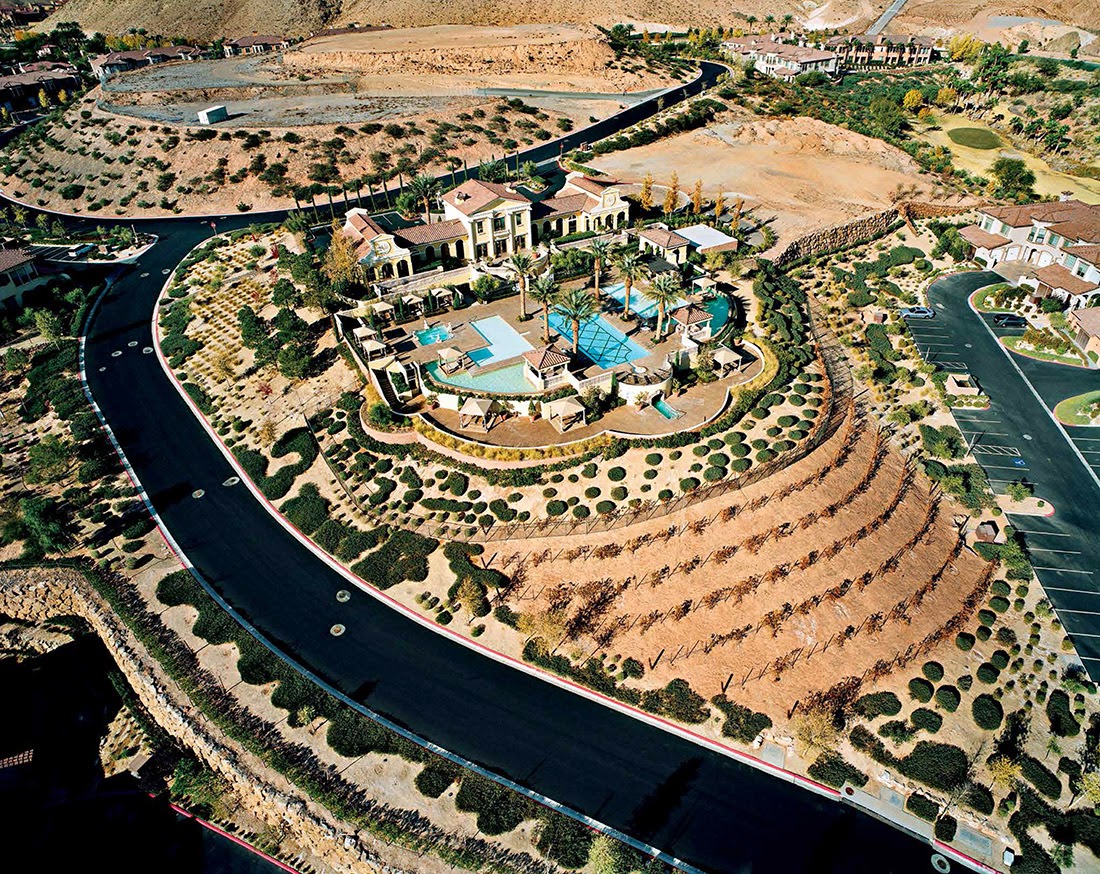
“Until 2008,” the book’s accompanying press release explains, “Nevada was the fastest-growing state in America. But the recession stopped this urbanizing gallop in the Mojave Desert, and Las Vegas froze at exactly the point where its aspirational excesses were most baroque and unfettered.”

They call these homes “castles on the cheap,” and one look at the houses of Lake Las Vegas reveals how apt this comparison can be.

[Image: “V At Lake Las Vegas pool complex, Via Visione at left, Henderson, Nevada,” 2010; from Lake Las Vegas by Michael Light].

In one of the book’s two essays, veteran landscape activist Lucy Lippard writes that the images offer “a disturbing juxtaposition of geologic and current time that the Surrealists could only have imagined.”

[Image: “Monaco Lake Las Vegas home and foreclosed neighbor, on guard-gated Grand Corniche Drive, Henderson, Nevada,” 2010; from Lake Las Vegas by Michael Light].

Honestly, these shots blow me away; it’s as if Light has captured an act of topographical blackout—a whole landscape, redacted—as what should be hills and valleys are erased and obstructed by this imposed crystallography of settlements that never arrived.

[Image: “Ascaya Boulevard looking south up Black Mountain, morning, Henderson, Nevada,” 2012; from Black Mountain by Michael Light].
In any case, the forthcoming book is already generating quite a bit of buzz—for example, being chosen as one of the “Best Fall Photo Books” of 2014 by Time Magazine.

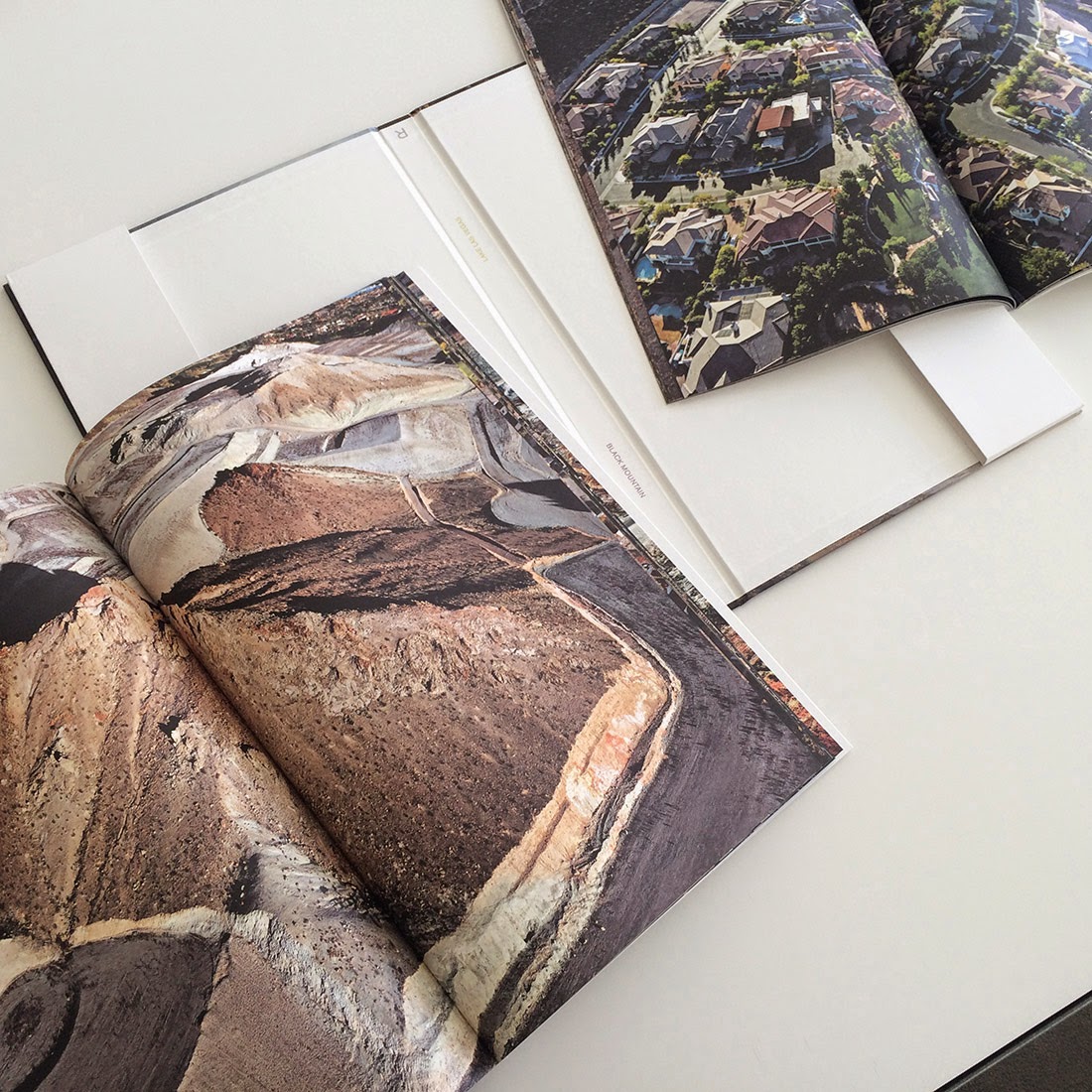
[Images: Some shots of the books, which are actually bound together, back-to-back].

The reproductions look fantastic, as well; consider pre-ordering a copy (and, while you’re at it, consider reading our interview with Michael Light over at Venue).

The book comes out somewhat appropriately on Halloween—a kind of economic horror story of landscapes gone awry.

Atmospheric Crystallography

[Image: From the original research paper (PDF), via Popular Science].

Popular Science reported last week that a “weird crystal”—a “salt made from cobalt”—can “absorb all the oxygen in a room,” and, more crucially, release all that oxygen later, at which point it can safely be breathed.

I will confess that I initially thought this sounded more like some terrifying new air-weapon: after all, if “just a spoonful of the stuff can suck up all the oxygen in a room,” then you’re looking at a very potent, seemingly instantaneous method for causing mass suffocation. Drop a few spoonfuls of these crystals into a building’s ventilation system, and… Well, you get the idea.

But the actual, far more productive implications are incredible (assuming further tests with the material pan out). The University of Southern Denmark-based researchers suggest, for example, that this could revolutionize SCUBA diving, “as the material can absorb oxygen from the water around the diver and supply the diver with it,” meaning that “scuba divers could potentially leave their tanks at home,” gearing up with just a few grains of salt. “

Extrapolate from this for a moment, however, and imagine all of the other confined spatial environments in which oxygen-emitting cobalt salts could upend conventional thinking. Long-term submarine missions; underwater scientific bases or other submerged structures of any kind; mines, collapsed buildings, and other underground spaces; or, perhaps most interestingly, even offworld space missions could all be equipped with radically minimalized oxygen storage systems, reducing costs.

You can thus imagine some strange new everyday reality several decades from now in which deep-sea divers or long-haul astronauts turn to a chewing gum-sized pack of salt crystals which they pop open as needed for emergency oxygen.

Think of this portable atmospheric crystal as the gateway to new spatial possibilities, letting us bring our atmospheres with us in just a few handfuls of salt.

Collapse

I received a review copy of Héctor Tobar’s new book Deep Down Dark the other week and read the entire thing in one sitting. In it, Tobar tells the utterly mind-boggling story of the Chilean mine disaster of 2010, when 33 miners were trapped underground for 69 days after a catastrophic internal collapse of the mountain they’d been working within.

[Images: The escape capsule that brought the miners back to the surface. Photos taken inside the mine by the miners themselves; via the Associated Press].

You might already have read an excerpt from Tobar’s book in The New Yorker, but the complete book is well worth your time; the expanded depth and context of Tobar’s reporting is incredible, and the book’s opening 50-odd pages describing the mine collapse are breathtaking.

The mine itself, Tobar explains, is a labyrinth: a honeycombed “underground city” of ramps and spiraling side-passages, all circling around and leading back again to the central “Pit,” a Dantean void in the center of the mountain from which the miners extract their ore.

[Image: Illustration by Abigail Daker, courtesy of The New Yorker].

The sheer plurality of these underground tunnels, however, is camouflaged by just a smattering of small structures on the surface. Indeed, “the mine is like an iceberg city,” Tobar suggests, “because these surface structures represent only a small fraction of its underground sprawl”:

Below the ground, the mine expands into roads that lead to vast interior spaces carved out by explosives and machinery, pathways to manmade galleries and canyons. The underground city of the San José Mine has a kind of weather, with temperatures that rise and fall, and breezes that shift at different times of day. Its underground byways have traffic signs and traffic rules to keep order, and several generations of surveyors have planned and charted their downward spread. The central road linking all these passageways to the surface is called La Rampa, the Ramp. The San José Mine spirals down nearly as deep as the tallest building on Earth is tall, and the drive along the Ramp from the surface to the deepest part of the mine is about five miles.

Taken together, the book’s opening chapters are an absolute masterpiece of geological horror. Ominous sounds of muffled thunder reverberate up from the very roots of the mountain. Strange moans, like a buried hurricane shaking itself awake in the mine’s abandoned passages, echo up and down the central ramp, causing general unease amongst the men on shift that day.

It is, Tobar writes, “as if they are listening to a distant storm gathering in intensity,” and his prose here is extraordinary:

During their twelve-hour shift these men have noted a kind of wailing rumble in the distance. Many tons of rock are falling in forgotten caverns deep inside the mountain. The sounds and vibrations caused by these avalanches are transmitted through the strong structure of the mountain in the same way the blast waves of lightning strikes travel through the air and ground. The mine is “weeping” a lot, the men say to each other. “La mina está llorando mucho.”

Tobar builds and builds to the actual moment of collapse, like an orchestra tuning itself to some inevitable and apocalyptic note that only gets more terrifying as its implications become clear. There are dust clouds and claps of thunder; changes in air pressure and growing suspicions; then an event unlike anything I’d ever read about before—the complete internal cleaving of a so-called “mega-block” inside the mine.

Here, Tobar explains that a single block of diorite two times heavier than the Empire State Building has suddenly broken free inside the mountain. It immediately free-falls straight downward like a cork plunging into a bottle of wine, breaking through the spiraling ramp on hundreds of underground levels and completely—seemingly fatally—trapping the miners nearly at the very bottom of the entire complex.

[Image: One of Gustave Doré’s engravings from The Inferno].

After hours—days, weeks—of audible strain and the popping of unseen faults, “the essential structure of the mountain must have failed.”

It’s as if the entire mountain is “pancaking” from within, Tobar writes: “the vast and haphazard architecture of the mine, improvised over the course of a century of entrepreneurial ambition is finally giving way.”

For the trapped miners, the inhuman scale of this “mega-block” makes it into an almost totemic object, an otherworldly and supernatural mass. It is impossible for the miners to comprehend, let alone to see, in its entirety, and crawling around or—given their now drastically limited tools and virtually non-existent food supply—digging through.

As Tobar points out, “Only later will the men learn the awesome size of the obstacle before them, to be known in a Chilean government report as a ‘megabloque.’ A huge chunk of the mountain has fallen in a single piece. The miners are like men standing at the bottom of a granite cliff: The rock before them is about 550 feet tall. It weighs 700 million kilograms, or about 770,000 tons, twice the weight of the Empire State Building.”

Sparkling and clean, freshly sheared from the very core of the mountain like a sculpture, it is “an object whose newness and perfection suggest, to some, a divine judgment.”

And, terrifyingly, it is not done falling. “By spray-painting marks on the surface of the gray guillotine of stone blocking the Ramp,” Tobar explains, rescuers trying to climb down from the surface have “detected that the vast, destructive ‘mega-block’ at the heart of the mine is still moving. The broken skyscraper of stone inside the mountain is slipping downward: A new collapse is possible at any moment.”

The real bulk of the book, however, is the miners’ ensuing captivity: their rituals of survival, their petty arguments, their ever-intensifying physical ailments.

We read, for example, about search-and-rescue teams as they mount fruitless expeditions downward to find the miners, “like a Himalayan expedition working in reverse, their goal to ‘assault’ the center of a mountain instead of its peak, with the air getting thicker and hotter instead of colder and thinner.”

We watch as families, emergency drill operators, and even Chilean celebrities set up camp outside on the surface, forming an instant city of tents, klieg lights, and heavy excavation machinery.

And, perhaps most incredibly, we learn that NASA psychologists, whose work normally involves assisting crews of highly-trained astronauts willfully confined in tight spaces on long space flights, are called upon to adapt their advice for men involuntarily sealed deep underground. “They are like men on a mission inside a stone space station,” in Tobar’s words.

That the internal spaces of the Earth have become psychologically indistinguishable from deep space is just one of the many moments of symbolic vertigo that so pressurize the book.

[Image: Still from a video shot underground after rescuers on the surface drilled through to the trapped miners].

In fact, one of the strangest and, for me, most memorable secondary stories is the strange allure of the Pit—the vast, artificially mined cavity at the heart of these coiling and serpentine excavations. Some of the men are seemingly drawn to the Pit, obsessing over it either suicidally—tempted to leap into its depths in order to end their hunger and isolation—or as a means of possible escape. But these are perhaps one and the same thing, when you fear being lost for eternity.

In a scene seemingly straight out of the engravings of Gustave Doré, the hypnotic emptiness of the mine’s “vast interior spaces” compels one of the miners—Florencio Avalos—to attempt an escape.

Wandering off, he squeezes through an opening between some boulders and soon finds himself on the edge a massive, apparently brand new cavern that no one had seen before.

[Image: One of Gustave Doré’s engravings from The Inferno].

Tobar gives us the scene in almost dream-like terms:

Florencio squeezes through, and as he does so he sees a vast, open black space that swallows up the beam from his lamp. He crawls toward this precipice and loosens a rock, which falls into the blackness and lands with a crackling clap about two or three seconds later; his experience as a miner tells him the rock has fallen some 30 or 40 meters, roughly the height of a building that’s ten or twelve stories tall. He realizes he’s near some sort of new, interior rajo, or cavern.

Florencio has just “set eyes upon the new chasm created by the collapse and explosion of the skyscraper-sized chunk of diorite that destroyed the mine on August 5. The crumbling mountain is still spitting rockfalls every few days or hours, and Florencio is fortunate to have seen this chasm, and to have stood inside it, without being seriously injured.”

[Image: Another still of the trapped miners].

I’m deliberately highlighting some of the key moments of spatial interest; the actual core of the book is the—at times, almost overwhelmingly emotional—human story of the miners’ plight. It is not a book about geology or the mining industry, in other words, despite my own foregrounding of those details; it is very much a book about human survival, communities under pressure, and the enormous psychological toll of not knowing when your torment will end.

However, this also leads me to one of my few criticisms of Deep Down Dark: the final few chapters are so relentlessly and obligingly dedicated to describing the eventual, post-rescue fates of each miner that the book begins to feel more like a magazine profile, with some men buying fancy cars, others traveling around the world with football teams, another one drinking too much, another—somewhat astonishingly—actually going back to work in the mining industry.

But, taken out of the mine—out of this space of confinement, with all of its compression and drama—their individual life stories sadly lose a great deal of the incandescence they held in the underworld, precisely by being seen against a backdrop as mundane as everyday life. Perhaps that is one of Tobar’s points; he very clearly shows, for example, how this sudden emergence into the global spotlight nearly destroyed several of the miners, its contrast with their forcibly introverted lives underground almost unbearable.

Nonetheless, I might suggest that the central void of the book—literally, the space of the mine—is, in genre terms, a monster: it is a haunting, even semi-divine force whose own fate, unfortunately, is left undescribed.

While Tobar does, of course, explain that the mine has been closed—it was even declared a sacred space by the Chilean government—Tobar seems to have missed an opportunity to bring us full circle, down again into the surviving galleries of this mine in the middle of the South American desert, its voids the size of skyscrapers gradually filling in with rubble weeping down from above.

After all, down there in the dust and absolute darkness nearly at the mine’s lowest point, the so-called Refuge—a tiny locker room thousands of feet below the Earth’s surface where the miners congregated to await either rescue or death—is, it seems, still intact, a room now sealed off from the surface but peppered with hand-written notes and objects the men deliberately left behind.

There is something weirdly nightmarish about this room—the very fact that it might still exist. Indeed, it’s not hard to imagine the metal doors of those old lockers swinging shut or suddenly popping open now and again, their hinges rusted, trembling as distant caves implode in the mountain all around them—or to hear the sounds of small rocks slowly bouncing down from higher levels along the Ramp, like the awful and halting footsteps of someone lost and alone—as if the miners are all still down there.

Deep Down Dark comes out next week; consider pre-ordering a copy.