
 [Image: Ice in Cranberry Lake, Ontario, photographed by Michael Runtz; via New Scientist].
Hotels in the Afterlife

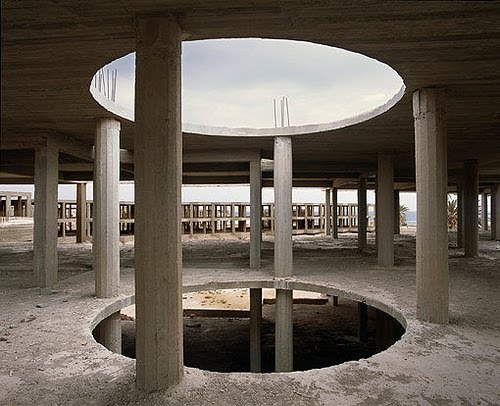
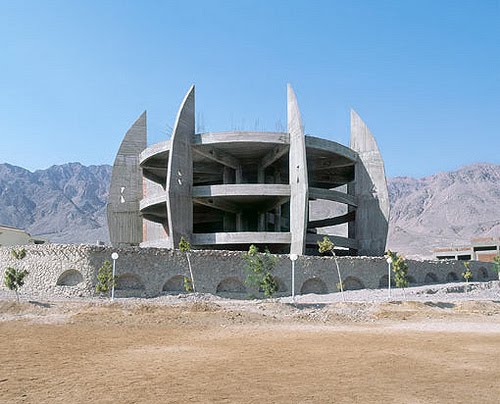 [Image: From Sinai Hotels, by Sabine Haubitz and Stefanie Zoche of Haubitz+Zoche].
Vienna’s Architekturzentrum will be hosting a new photography show, opening this Wednesday, April 24, called Sinai Hotels.
With images by Sabine Haubitz and Stefanie Zoche of Haubitz+Zoche, the show looks at “the concrete skeletons of five-star hotel complexes” abandoned on Egypt’s Sinai Peninsula.
They are resorts that never quite happened, then, with names like Sultan’s Palace and the Magic Life Imperial. This makes them “monuments to failed investment.”
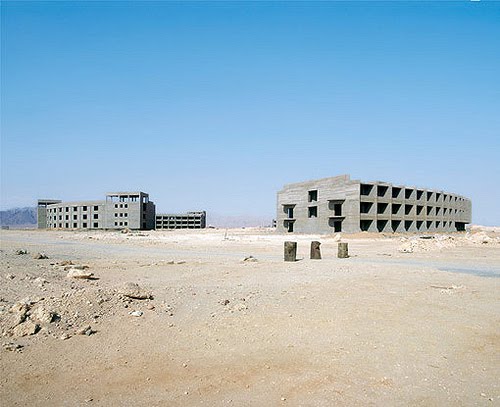
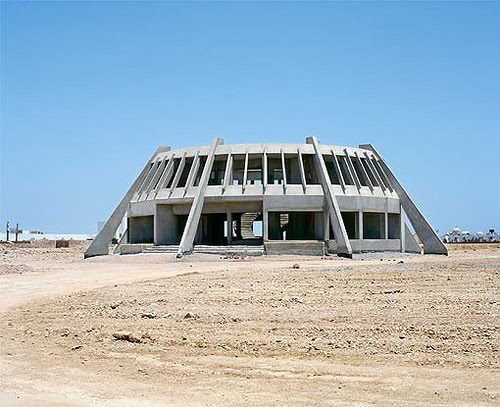 [Images: From Sinai Hotels, by Sabine Haubitz and Stefanie Zoche of Haubitz+Zoche].
The hotels now look more like “architectonic sculptures” in the desert, the photographers claim, or derelict abstractions, as if some aging and half-crazed billionaire had constructed an eccentric sculpture park for himself amongst the dunes.
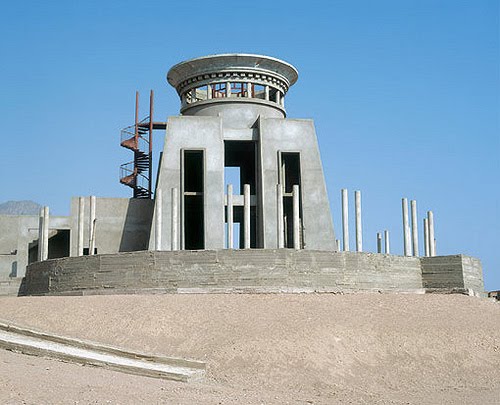
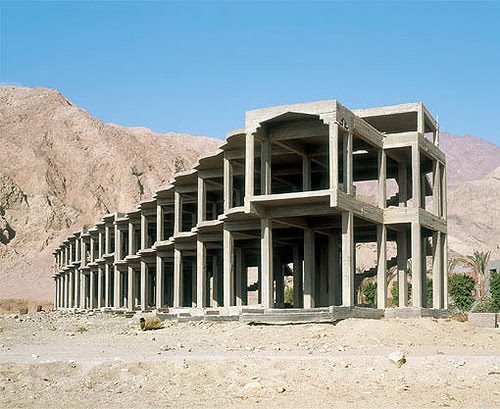 [Images: From Sinai Hotels, by Sabine Haubitz and Stefanie Zoche of Haubitz+Zoche].
The billionaire goes for long walks at night alone amongst the ruins, sweeping dust from recent sandstorms off windowsills and open doorways.
At night, when the stars come out, different constellations are framed by unglazed windows, as if justifying these concrete forms from above with the poetic force of celestial geometry.
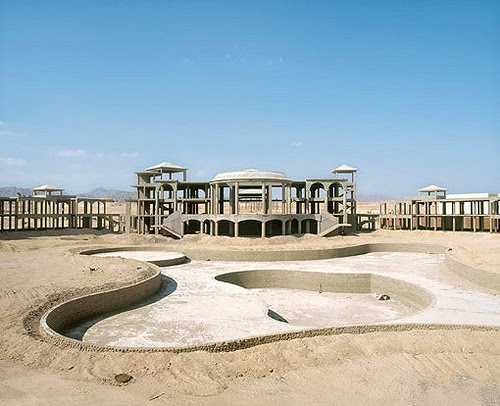
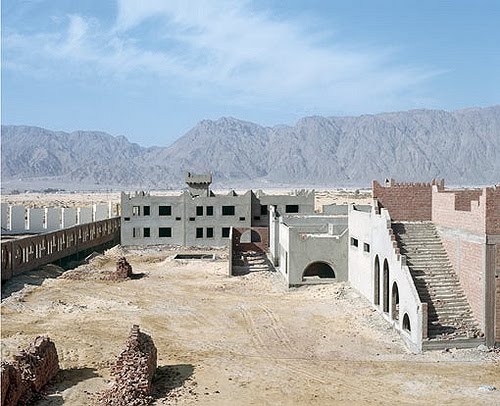 [Image: From Sinai Hotels, by Sabine Haubitz and Stefanie Zoche of Haubitz+Zoche].
Or, for that matter, five years from now these deserted monuments simply disappear – but because they’ve been put to use, finally, enwrapped with drywall and plaster, fitted out with drapes and marble floors, and you can sleep inside them for $300 a night, never even dreaming that these hotels were once ruins, temporarily abandoned to the sand and only recently reclaimed.
The empty swimming pool is now full – and you dive into it, unaware that you’re more like a ghost than a tourist, haunting the afterlife of these sites in bleaching sunlight.
Control Shift
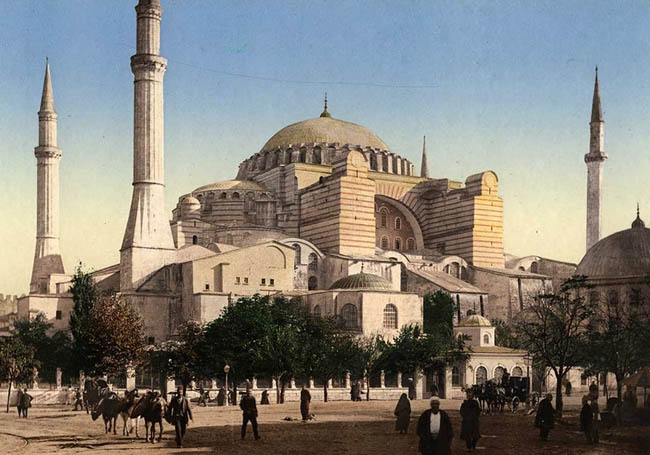 I’ve been going through old magazines to find articles that I hope to read, re-read, or even incorporate into the final edits of the BLDGBLOG Book – and so tonight I came across the January 2007 issue of Metropolis.
There, we read about the ten greatest engineering feats of architectural history – including this short blurb about Hagia Sophia, in Istanbul:
The building was constructed of masonry, which shifted constantly during construction and thereafter. Today we use “switch-on gravity analysis,” where we imagine a structure built on the Moon and then digitally move it over to the Earth in a fraction of a second, and suddenly it’s loaded. But a structure like this changed its characteristics during construction, almost minute by minute. I can’t image [sic] how people could have had the courage to construct it.
It’s fascinating to think that the very thing under construction is in the process of altering itself. The structure has taken on agency, in other words: moving, shifting, becoming something other than what you intended it to be. That which you add to, shifts; that which supports you, changes.
At the end, then, perhaps we’ll all look down at our own foundations, at the walls and arches below us, as if to reassure ourselves, to remember who we were, how we got here, and who we once thought we could be – but our foundations will be defaced or gone.
The past has “changed its characteristics during construction, almost minute by minute” – and so we’re stranded, over a void, our feet firmly planted on nothing.
The only answer, then, will be to keep building up, to go out, to resist the nostalgic pull of foundations, seeking overwhelming extremes of both altitude and complication.
Perhaps we’ll then forget, in a state of self-induced vertigo, that we once needed a past at all – and that the building in which we now stand had a plan, a plan the building itself had always been exceeding.
Mission to Mars
 Tomorrow I’ll be down in San Luis Obispo, helping to judge a competition called Design Village 2008:
In the Design Village Competition, teams from across the United States design and build a theme-based structure that meets several additional requirements: the structure’s parts must be hand carried down a mile trail into the canyon; the structure must be assembled in 12 hours, without the use of plugged electricity; the team members must live in their structure for the entire weekend.
The theme this year is Mission To Mars. Here is a gallery of previous contestants. I think it’s open to the public, as well – so, if you’re in the central coast region, come by, say hello, check out all the structures, and keep your fingers crossed for good weather.
Sky.doc
 [Image: A flying logo, or Flogo].
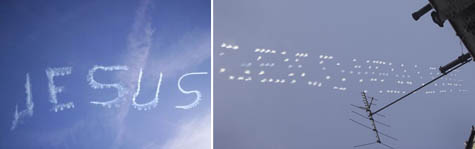
Over on LiveScience we learn that a new company has started using “a mixture of soap-based foams and lighter-than-air gases such as helium” to create “floating ads and messages” in the sky.
Unfortunately dubbed Flogos, these floating logos can be made – or printed, really – every 15 seconds by “re-purposed snow machines,” thus “flooding the air with foamy peace signs or whatever shape a client desires. Renting the machine for a day starts out at a cost of about $2,500.”
I should start blogging with it.
The sky texts aren’t particularly large, however. They’re only “about two feet long and nearly a foot wide” – but they “generally last anywhere from a few minutes to an hour, depending on conditions in the atmosphere.”
“They will fly for miles,” their inventor adds – because they are “durable,” capable of flying as high as 20,000 feet without breaking up. Gaseous typography.
It won’t just be meteorologists watching the skies, in other words, but graphic designers. Adjusting leading, kerning the clouds, ragging atmospheres.
And what about abstract typography – printing random cloud-shapes on a massive scale? Future paranoias appear in the diagnostic handbooks of tomorrow’s most expensive psychiatrists. Patients stumble in, demanding to know if those clouds are really signs… And, if so, who put them there, what they say – and what about that one…
Flying through these atmospheric print-outs, meanwhile, is “like going through a cloud” – and thus, apparently, safe. Just a minor bit of literary turbulence as you pass through a challenging paragraph.
But this ability to print aerial images also hints at what could be called the immersive sky-cinema of tomorrow: you get into the cockpit of a small airplane and you fly through artificial clouds – clouds that have been printed to look like a sequence of animated cells. You proceed to fly through this cloud-by-cloud narrative, perhaps even reading word bubbles and thought balloons – subtitles – or you play a carefully synched soundtrack on your iPod. Soon, you can leave commentary in the air with your own re-purposed snow machine. Metacommentary. Footnotes.
Or perhaps music written in the sky + a local radio station playing that song = SkyKaraoke™.
In any case, I originally saw this bit of news on MetaFilter – where we also find a link to an article published in the New York Times back in 1892. Here it is as a PDF and as a JPG.
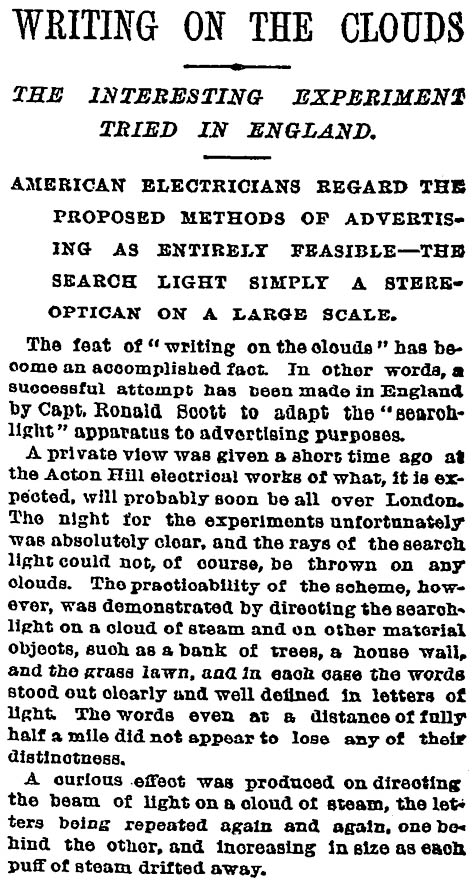 [Image: From an article published in 1892 in the New York Times. Read as PDF or JPG].
Apparently documenting the very birth of skywriting – that “interesting experiment” of typesetting the sky – the article relates what it describes as the “curious effect” of seeing letters and signs mid-air. Clouds of steam become a new textual presence in space.
In any case, there is an obvious (and, frankly, rather uninteresting) reaction to all this – i.e. please save us from yet another form of corporate advertising, we don’t need logos in the sky – but there are also artistic, and even literary, implications here that go beyond mere outrage.
 1) If you put this into the context of weather control as an emerging technique for urban design – for instance, what we’re seeing in Beijing with the Olympics – then these sorts of cloud-printing techniques open up a whole new front in any serious discussion of public space and the city. The question here might be: what are the political and/or municipal implications of being able to typographically format the skies? I’m reminded of Roberto Bolaño’s novel Distant Star, in which a Nazi-sympathizing South American poet turns to skywriting, putting his poems in the clouds after a right-wing coup d’état, scrawling three-dimensional diatribes in the subtropical air.
2) If graphic design suddenly becomes atmospherically relevant, so to speak, will we someday read an issue of PRINT or an essay on Design Observer about well-rounded cloud forms – how, perhaps, the skies above Amsterdam are beautifully sans serif, whilst the skies of Rome are well-paragraphed but poorly spaced…? Then you play an April Fool’s joke: you send a design critic to some city where they don’t print the clouds at all – but you ask him or her to critique their newest font… Six pages of embarrassing sky criticism ensue.
3) If typography also bears information, of course, then perhaps tomorrow’s literature will be skybound, no longer bound in books. Penguin’s UK-based We Tell Stories initiative abandons the internet entirely to print stories in the skies above Bloomsbury or Liverpool or even Hay-on-Wye. Much was made years and years ago about William Gibson’s self-erasing book Agrippa (A Book of the Dead), but why not repeat that performance with a book printed only once, in the air, off a dock on the east coast of England? It disperses across the Channel in a haze of typography – a particularly robust paragraph or two flying as far as Paris, where still intelligible letters float past the bedroom window of a 13 year-old hopeful game designer… who gets an idea.
 4) Perhaps we all really should give up internet-based blogging and switch instead to the sky. I could buy a small shack on a hill somewhere in Los Angeles and grow a beard. Turning my back on representational form, I’ll emit abstractions of well-made foam into the sky on windy days. Air sculptures, like something by Marcel Duchamp, floating over parking lots and across the yards of the rich and famous. Harrison Ford is interviewed by Variety: “I saw very strange clouds last night,” he says, still visibly stunned, his voice shaken. “They were made of foam – and they… they were really quite beautiful.”
5) For the rest of human history, no one trusts the clouds. No one knows for sure if they are natural. Everything appears to be printed. Like those infamous numbers stations – radio broadcasts of uncertain origin which appear to be involved with international espionage – strange cloud forms seen over factories in Berlin are studied for their possible meanings. Cloud cryptography. An aerial Enigma machine. New political departments – combining handwriting analysis, graphic design, linguistics, meteorology, advanced statistics, and spycraft – are formed by governments all over the world. 24-hour surveillance of the skies ensues.
(Via MetaFilter).
Rising Up, Rising Down
 [Image: Untitled (2001) by Maurizio Cattelan, courtesy of the Marian Goodman Gallery, via the New Yorker].
The New Yorker has a fascinating and somewhat unbelievable article up right now – more like a story by Paul Auster – about a man named Nicholas White who once found himself trapped inside a New York City elevator for 41 hours.
That experience apparently so traumatized White that his entire life went into free-fall:
He never learned why the elevator stopped; there was talk of a power dip, but nothing definite. Meanwhile, White no longer had his job, which he’d held for fifteen years, and lost all contact with his former colleagues. He lost his apartment, spent all his money, and searched, mostly in vain, for paying work. He is currently unemployed.
It’s a very long article, but it’s a fantastic read.
Meanwhile, I wonder what sorts of urban myths might exist about lost elevators and the people trapped inside them – perhaps some still moving room deep inside an Upper East Side high-rise where an anonymous woman, long dead, traffics up and down without end, going nowhere. The elevator doors on each floor have been bricked over and the building’s residents assume that the noise is really just the ventilation at work, or the plumbing.
Till they notice a smell…
It’s like Edgar Allan Poe meets The Intuitionist meets Dark Water via BLDGBLOG.
(Article spotted at MeFi).
Cairo Sound City
There was an interesting article in the New York Times yesterday about noise and the city of Cairo.
 [Image: Cairo, photographed by Nick Leonard].
“We’re not just talking typical city noise,” the article says, “but what scientists here say is more like living inside a factory.”
This is not like London or New York, or even Tehran, another car-clogged Middle Eastern capital. It is literally like living day in and day out with a lawn mower running next to your head, according to scientists with the National Research Center. They spent five years studying noise levels across the city and concluded in a report issued this year that the average noise from 7 a.m. to 10 p.m. is 85 decibels, a bit louder than a freight train 15 feet away…
That noise, we’re told, is symptomatic of the fact that Cairo is “an increasingly unmanageable city, crowded far beyond its original capacity” – and the “main culprit is the two million cars, and drivers who jam the city roads every day.” Urban planning and strategic noise control.
The article goes on to talk to people who are shouting – without realizing that they’re shouting – even while they rail against the all-pervasive noise; with people who are screaming – without realizing that they’re screaming – even while denying that the city has become quite loud; and with one man who, oblivious to the cacophonous sounds around him, turns on his radio – and cranks it all the way up in order to hear it.
The overall effect, then, is that the city now sounds more like a stationary airplane engine, an endless and deafening roar on the deltaic northern fringe of the Sahara Desert.
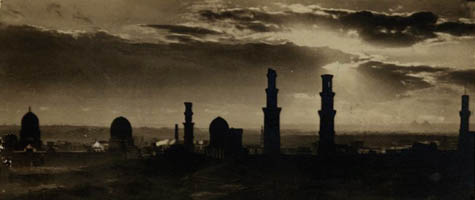 [Image: Cairo, as featured on an old postcard, originally uploaded by Flickr user ptrosss].
But this also reminds me of two things.
Provided I can ever get my act together on this, I’ve got a long and totally fascinating interview with Jace Clayton, aka DJ /rupture, coming up here on the blog, in which we discuss the sonic qualities of cities, focusing on New York and arriving there via Marrakech, Barcelona, and even Rennes, France. (Jace, sorry it’s taken so long!)
Second, I’ve mentioned this before, but I’ve got a short article coming up in Dwell about the future sounds of carless eco-cities – how entire urban soundscapes will change once cars go hybrid/electric, and the internal combustion engine slowly disappears. That’s in the June issue. I really can’t wait to talk more about that, actually – but I’ll have to refrain, again, for now.
But how much of this urban noise, like that described in Cairo, is purely circumstantial? You go to a bar or a party, for instance, and it’s often the case that everyone’s speaking loudly because everyone else is speaking loudly – so someone turns the music up to make sure everyone can hear it, which makes everyone speak louder, and the music goes up, and so on. Now distribute and multiply this process across a whole city – and you get a kind of metropolitan echo chamber, its streets amplifiers, its buildings resonating gourds and reverberatories.
I’m tempted to organize something called World Noise Day. Make your city as loud as possible. Take advantage of car horns, personal stereos, supermarket broadcast systems, and the local radio. Play Merzbow all day, cruising loops in boom cars. Rebuild Luigi Russolo’s intonarumori. Install Japanese war tubas and British sound mirrors throughout the city. Turn on hair dryers. Yodel. Record the sounds of noise in the morning – and play them again that night, much louder.
In any case, perhaps everyone in Cairo now has really bad tinnitus – or ringing in the ears – and so masking their own bodies’ constant silvery scream with massive amounts of background noise is the only way forward.
The over-loud city becomes a kind of acoustic self-remedy: homeopathy through urban noise.
(Thanks, Nicky!)
Ancient Roads
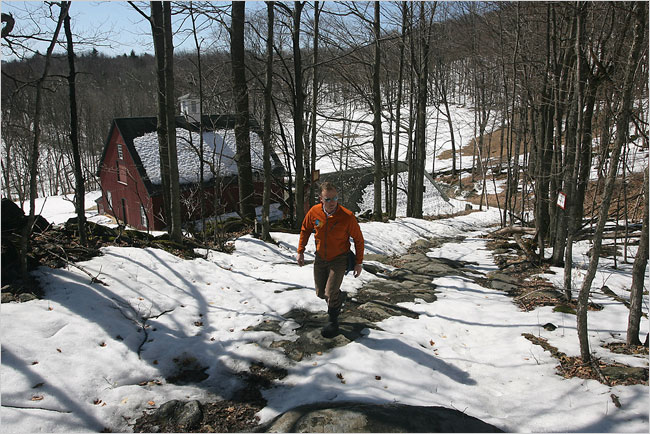 [Image: Walking an “ancient road” in Vermont; photo by Joseph Sywenkyj for The New York Times].
Half-forgotten slashes of land, cutting through, around, and over the hills of Vermont, might actually be “ancient roads,” dating back to colonial times – and a 2006 state law has given the residents of nearby towns a strong incentive for uncovering these buried throughways.
According to The New York Times, “citizen volunteers are poring over record books with a common, increasingly urgent purpose: finding evidence of every road ever legally created in their towns, including many that are now impassable and all but unobservable.” These “elusive roads” – many of them “now all but unrecognizable as byways” – are lost routes, connecting equally erased destinations.
In almost all cases, they’ve barely even left terrestrial traces; in fact, as we’ll see, their presence is almost entirely textual.
If these roads can be re-discovered, however, then they can be added to official town lands. Accordingly:
Some towns, content to abandon the overgrown roads that crisscross their valleys and hills, are forgoing the project. But many more have recruited teams to comb through old documents, make lists of whatever roads they find evidence of, plot them on maps and set out to locate them.
And, in what is surely one of the most interesting geographical subplots in recent newspaper publishing, we read: “Even for history buffs, the challenge is steep: evidence of ancient roads may be scattered through antique record books, incomplete or hard to make sense of.”
Indeed, like something out of the poetry of Paul Metcalf, or even William Carlos Williams, the descriptions found in these old documents are narrative, impressionistic, and vague. They “might be, ‘Starting at Abel Turner’s front door and going to so-and-so’s sawmill,’ said Aaron Worthley, a member of the ancient roads committee in Huntington, southeast of Burlington. ‘But the house might have burned down 100 years ago. And even if not, is the front door still where it was in 1815? These are the kinds of questions we’re dealing with.'”
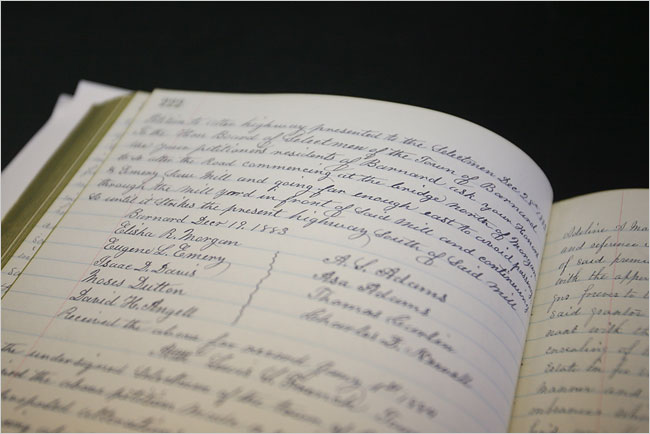 [Image: A hand-written inventory of Vermont’s ancient routes; photo by Joseph Sywenkyj for The New York Times].
While making sense of cryptic references to lost byways is fascinating in and of itself, these acts of perambulatory interpretation are part of a much larger, fairly mundane attempt to end “fights between towns and landowners whose property abuts or even intersects ancient roads.”
In the most infamous legal battle, the town of Chittenden blocked a couple from adding on to their house, saying the addition would encroach on an ancient road laid out in 1793. Town officials forced a showdown when they arrived on the property with chain saws one day in 2004, intending to cut down trees and bushes on the road until the police intervened.
The article refers to one local, a lawyer, who explains that “he loved getting out and looking for hints of ancient roads: parallel stone walls or rows of old-growth trees about 50 feet apart. Old culverts are clues, too, as are cellar holes that suggest people lived there; if so, a road probably passed nearby.”
Think of it as landscape hermeneutics: hunting down traces of a disappeared landscape.
So what would happen, then, if you discovered that an ancient road actually passes through your house – that your living room is a former throughway, and old paths knot and twirl off to every side, one leading right through the guest bedroom? And then another road pops up, and another – and you realize that you live on the intersecting scars of a lost built environment, some old village that disappeared or was destroyed in some H.P. Lovecraft-like enigmatic disaster.
I’m also curious, though, to see what might happen if such a law was passed in a city like London. In an old but interesting review of London: City of Disappearances, a book edited by Iain Sinclair, we’re told that London “is a city of the forgotten.” It is where anyone “can still disappear without trace.” Indeed, London is a city “built upon lost things”; it “towers above forgotten underground rivers and discarded tunnels. It is built upon old graveyards and burial pits.”
More to the point here, entire streets have disappeared: “Catherine Street, Jewin Street, Golden Place are just three of the vanished thoroughfares named in a litany of sorrowful mysteries,” our reviewer points out. “Other streets have been curtailed. Swallow Street has been swallowed by burgeoning London. Grub Street has been renamed Milton Street.”
So what if someone who liked “getting out and looking for hints of ancient roads” were to set about such a task elsewhere? I’m reminded here of China Miéville’s short story “Reports of Certain Events in London” – a perennial reference on BLDGBLOG – in which “unstable” streets appear and disappear throughout the city. One night they’re there, the next night they’re not.
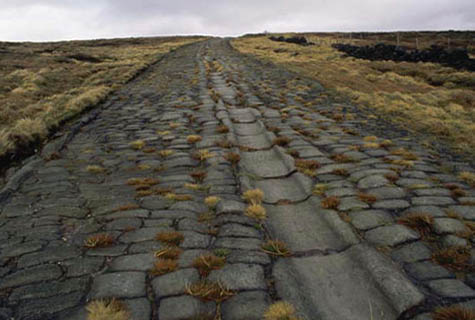 [Image: An old Roman road in Britain; photo via Historic UK].
But what to make of entire unstable geographies that flash in and out of county land registers, with distant echoes appearing in the hand-written captions of family albums and in old, yellowing letters between loved ones? Could you re-trace ancient roads based on such sources? What if the county’s land archivist was Borges?
Perhaps it’d be a bit like reconstructing all of postwar Berlin, or Dresden, or Hiroshima, based only on geographical descriptions found in the journals of former residents.
How piece together a whole city from a position of extreme textual remove?
I suppose the answer to that question might be found in Vermont over the next few months, with people jogging up and down hillsides, and in and out of archives, tracking down the specters of an older terrain – territorial marks of a vanished world on top of which they’ve been living all along.
(Of interest, earlier on BLDGBLOG: Ancient Lights and Z).
Desert Getaway
The Guardian reports this morning that Donna Vassar, “part of the Vassar education dynasty, has launched plans to build a $300m (£150m) private getaway for stressed-out presidents and prime ministers who want to ‘reconnect with their unique purpose in life’.”
And it might look like this.
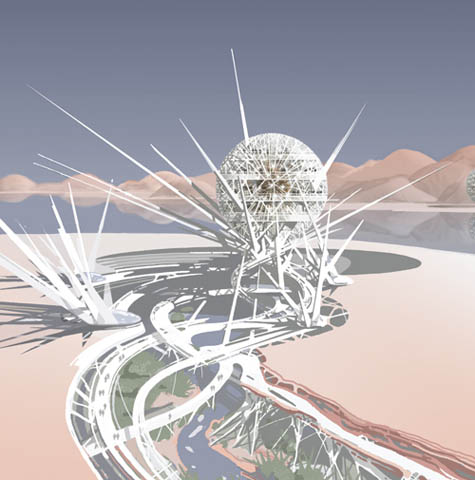 [Image: Design by Chetwoods Architects, via the Architects’ Journal].
Referred to as the Universitas Leadership Sanctuary – or Destination Universitas – Vassar’s desert complex, if built, will be “part monastery and part conference centre,” and it will take the shape “of a four-storey globe on the shores of Lake Las Vegas, a privately-owned lake in the south Nevada desert.”
The site will then be nothing less than the place “where the most powerful men and women on the planet can get away from it all with a combination of reading, contemplation and even a spot of gardening.”
The main globe building will be on four levels. The ground floor will house a library and the first floor a debating chamber, while on the second floor will be technology to help make the building energy efficient. At the top, under a dome of glass, will be the spiritual heart of the development – the contemplation space where leaders will be encouraged to sit in silence.
And sit in silence, I’m sure they will.
The design is by Chetwoods Architects – though they are apparently working with artist and architect Doug Patterson, whose earlier House Mustique supplied Vassar with a spot of inspiration.
More at the Guardian.
Future Super-Cities
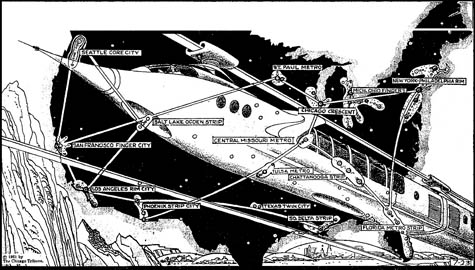 [Image: The Super-Metropolis of 1975, via Paleo-Future; view larger!].
Yesterday, Paleo-Future pointed out a map from 1961, produced by the Chicago Tribune, in which the future urban landscape of the U.S. has been speculatively mapped – as it was projected to exist in the bright and futuristic year of 1975.
Ahead of its time in predicting the urban condition within which most of us now live, the map and its accompanying short article suggest that the “‘regional cities’ of tomorrow will be nearly continuous complexes of homes, business centers, factories, shops and service places. Some will be strip or rim cities; some will be star-shaped or finger-shaped; others will be in concentric arcs or parallels; still others will be ‘satellite towns’ around a nucleus core.”
Unfortunately, it gets the future of U.S. transportation all wrong:
They will be saved from traffic self-suffocation by high-speed transportation – perhaps monorails that provide luxurious nonstop service between the inner centers of the supercities, as well as links between the super-metropolises themselves.
Having ridden Amtrak somewhat extensively up and down the east coast, I would respectfully suggest that a different infrastructural future has come to pass.
Meanwhile, if you look at a bigger version of the map, you’ll see cities like the Chicago Crescent, the Michigan-Ohio Fingers, and Los Angeles Rim City – but it’s the sprawling urban complexes at the core of the country that seem so strangely interesting to me, like the Chattanooga Strip and the Central Missouri Metro, all linked together by arteries of high-speed rail.
What might a futuristic super-city in the hills and valleys of Tennessee really look like? What might a Mississippi mega-city really be?
(Via Paleo-Future, on a tip from James Petty).
By Indirections, Find Directions Out
Last autumn, an article in New Scientist asked: “What routes did our ancestors take as they moved into lands unknown and traversed uncharted seas? When did they move and spread?”
The magazine thus included a two-page map – attempting to answer these larger cultural and evolutionary questions via cartography.
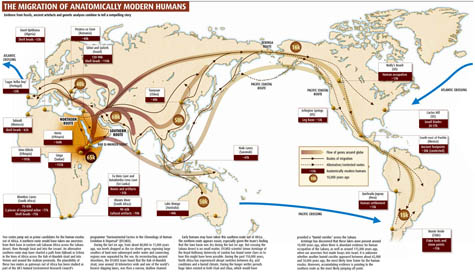 [Image: A map of possible human migration routes out of Africa and the Middle East; via New Scientist].
“Until quite recently,” the article tells us, “H. sapiens was thought to have evolved just 100,000 years ago. Over the past two decades, however, a consensus has grown that anatomically modern humans emerged in Africa at least 160,000, and possibly 200,000, years ago.”
But how did humans spread?
Skeletal remains from Skhul and Qafzeh in Israel dating from 120,000 to 90,000 years ago are the oldest known traces of modern humans outside Africa… However, all evidence of human habitation beyond Africa disappears around 90,000 years ago, only to emerge again much later.
What happened later is the subject of the article – which goes on to encompass “signature” mutations, southern routes and northern routes out of Africa, “the gene associated with language,” the colonization of Australia, bone-bearing caves on the coast of Sri Lanka, and so on.
Little details stand out. For instance: “The earliest evidence of settlement by modern humans in south Asia, comprises stone tools and human remains discovered in the Fa Hien and Batadomba Lena caves in Sri Lanka, dating from up to 35,000 years ago.”
However – and I find this absolutely fascinating: “Although none of these artefacts is more than 35,000 years old, that may simply reflect the fact that sea levels are about 100 metres higher today than they were 50,000 years ago. Any artefacts or bones left by the first coastal migrants are now buried beneath the sea.” (emphasis added)
But it’s the map, I think, that tells the story so clearly. My only major problem with it is that it shows the world as it looks today, with sea levels where they stand in the present.
However, as we only just read, global sea levels were at least 100 meters (or 328 feet) lower back then, because so much water had been frozen into continent-spanning glaciers. Accordingly, the continents would have had very different outlines. Sri Lanka was not an island, for instance, but a peninsula connected to India, and many, many hundreds of smaller islands throughout Indonesia were actually connected into one large landmass.
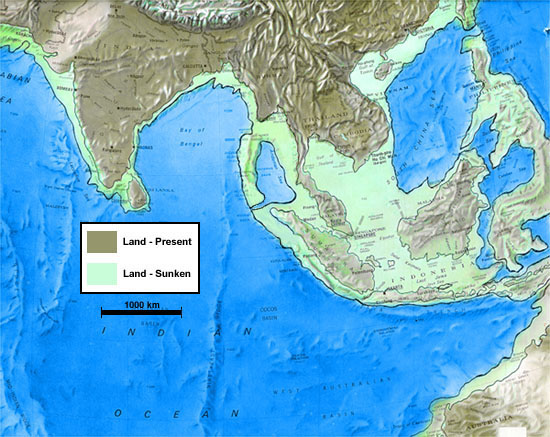 [Image: A map of southeast Asia during the Ice Age; note how much dry land there could have been. This certainly isn’t the greatest map in the world; it’s just all I could find – and it comes from a site claiming that this somehow proves Atlantis was real…].
Looking at a more accurate Ice Age geography, in other words, would make it substantially easier to comprehend how humans spread, for the most part on foot, to places as far away as central Australia. In fact, I’d go as far as to suggest that, until you look at the world as it was back then, with lower sea levels, you will only mis-theorize these migration routes, devising ever more elaborate forms of seafaring and stellar navigation when it might simply have been the case that they walked.
In any case, ancient human migrations just blow me away. What was it like, standing there on the sandy coasts of Iran or Saudi Arabia, 55,000 years ago? Walking around in the growing darkness as evening sets in, looking up at the stars, building fires – perhaps even dreaming of future towers on the very site where Dubai now rises.
[Note: If anyone knows where to find good maps of Ice Age coastlines, let me know!]