Forest Camp San Francisco

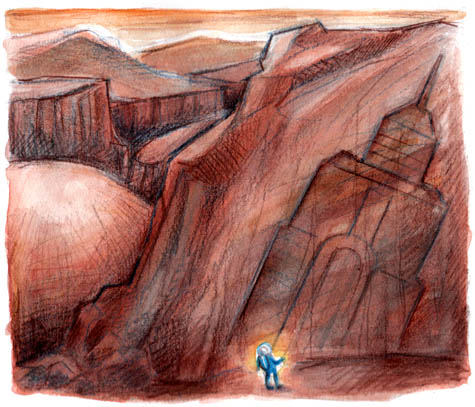
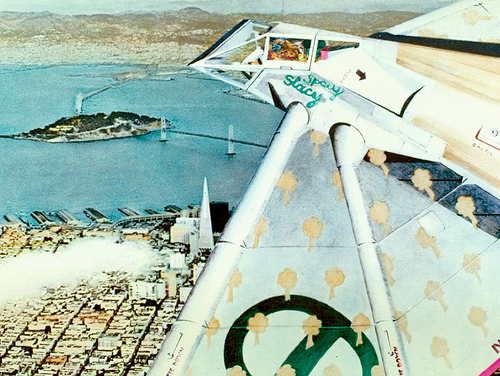
[Image: By Craig Hodgetts, from his prospective drawings for a film adaptation of Ecotopia].

Over on the Architect’s Newspaper Blog, Ken Saylor takes a look at the novel Ecotopia, recently discussed by The New York Times. Amusingly, that novel’s key phrases, according to Amazon.com, include “extruded houses,” “ritual war games,” “forest camp,” and “San Francisco.”
However, what the NYT fails to mention, Saylor adds, is that, in 1978, architect Craig Hodgetts “produced a wondrous set of drawings for a Hollywood movie adaptation of the pulp classic. With plenty of savvy and pop-culture sensibility, the script was translated into awe-inspiring architectonic visuals. The drawings were exhibited and published, but alas, the project never made it to the silver screen.”
The images include solar-powered, high-speed maglev trains that “utilize a ‘lifting body’ profile to reduce gravity forces at speed, allowing lightweight bridges that act in tension rather than compression,” as well as “balloon generators over San Francisco Bay,” complete with their associated “maintenance gondolas.”
Check out the original post for more images – with captions by Hodgetts himself – and more information about the unfortunately undeveloped film adaptation.
However, I have to add, briefly, that architecture is by its very nature a specific form of science fiction: whether we’re using it to design luxury high-rises, modular refugee camps, solar towers, or complete urban ecotopias, architecture gives us the means, on par with literature and mythology, through which we can re-imagine the world.
Architecture, by definition, is speculation about the future.

Nuclear Urbanism

A Google Maps mash-up by Sydney-based design firm CarlosLabs has us looking at what nuclear explosions would do to cities all over the world.

[Image: London nuked, courtesy of CarlosLabs].

“This mapplet,” we read, “shows the thermal damage caused by a nuclear explosion. Search for a place, pick a suitable weapon and press ‘Nuke It!'”
The image you see above is London as decimated by an atomic bomb equivalent to the freakishly terrifying Soviet Tsar Bomba test of 1961. Everything as far as Guildford has been damaged – the entire center of the city simply gone.
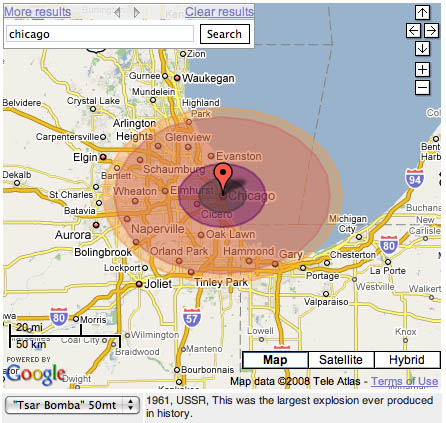
Below, we see Chicago obliterated by the same size of explosion. Looking closely, we see that the difference between a first- and second-degree burn – and this information is explained a bit more, below – passes directly through the distant suburban town in which I was born, Highland Park.

[Image: Courtesy of CarlosLabs].

Waters along the shore of Lake Michigan would be instantly evaporated, forming radioactive rainstorms over northern Indiana, perhaps for days.
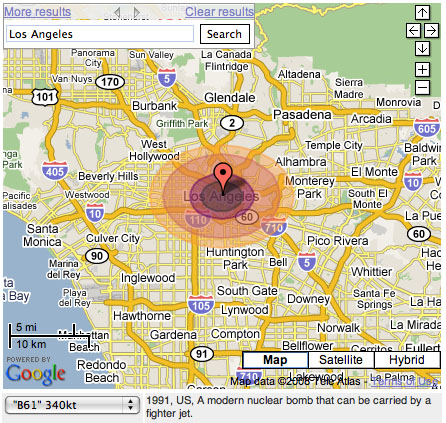
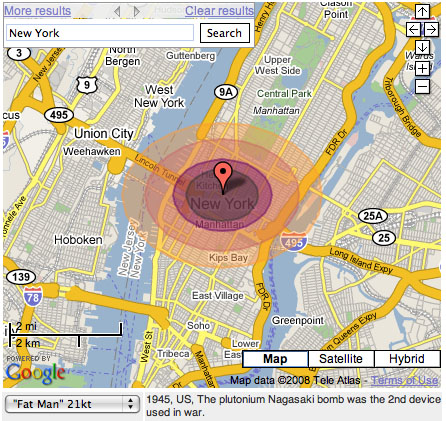
The size of the bomb can be varied, of course; here we see Los Angeles hit by any typical nuclear warhead carried by an American fighter jet, circa 1991; and, below that, we see New York City hit by a bomb equivalent to Fat Man, the device dropped on Nagasaki.

[Images: Courtesy of CarlosLabs].

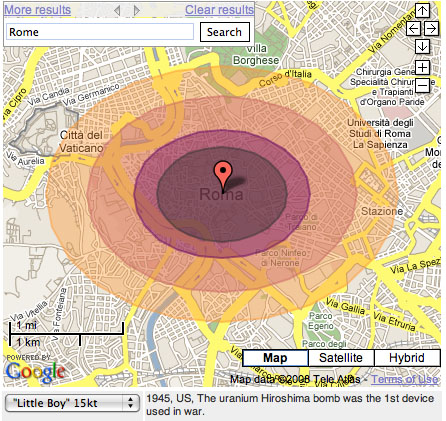
And here, below, is Rome hit by Little Boy, the bomb dropped on Hiroshima – and the first nuclear device ever used as an act of war.
If it’s any consolation to Catholics – or architectural historians – the extreme, northwestern fringes of the Vatican would escape immediate harm.

[Image: Courtesy of CarlosLabs].

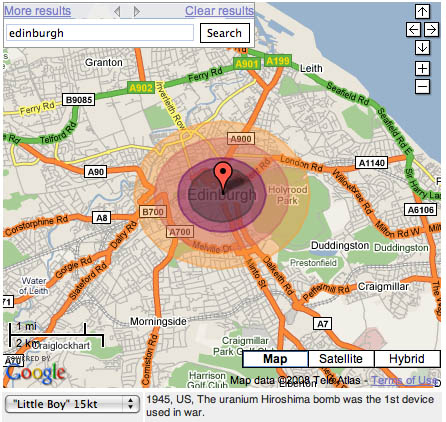
Alternatively, let’s drop Little Boy on Edinburgh.

[Image: Courtesy of CarlosLabs].

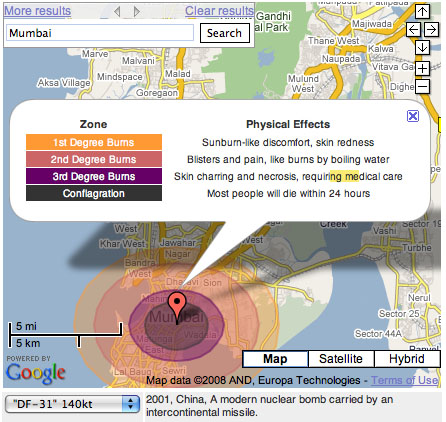
All of this is visually arresting – seeing vast bruises like bull’s eyes consume whole cities – but what does it really mean? What is each colored circle supposed to represent?
In the following image of Mumbai being hit by a nuclear missile equivalent to those used by the Chinese military, we see concentric rings of 1st, 2nd, and 3rd degree burns expanding outward from the detonation – a geometry of necrosis, suffocation, and death. Blisters and cancer would affect tens of thousands of people for miles in every direction (depending on prevailing winds).

[Image: Courtesy of CarlosLabs].

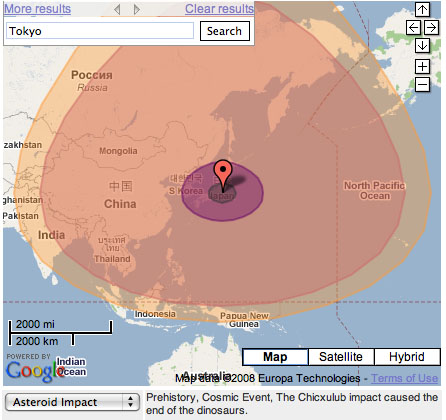
For some unexpected astronomical context, though, CarlosLabs has added a bizarre final option: seeing how asteroid impacts might compare with inter-urban nuclear war.
Tokyo – where the following image is centered – is not merely erased; struck by an asteroid, it’s been placed at the heart of a planetary event, complete with rings of sunburn-equivalent injury spreading out across whole continents.

[Image: Courtesy of CarlosLabs].

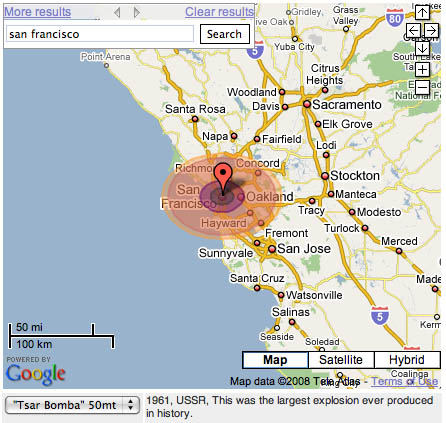
Returning to the realm of historical likelihood, the image that somehow clarifies this the most for me – if, for no other reason, because I live there – is the following glimpse of San Francisco. The entire peninsula has been blasted into absolute, smoking oblivion by an explosion equal to Tsar Bomba.
The fact that you would be more or less screwed as far south as Fremont – and well east of Oakland – seems sobering, indeed.
You could be sitting in the west-facing window of an Oakland high-rise, watching an atomic fireball explode over San Francisco – which quickly expands to melt the glass you’re looking through.

[Image: Courtesy of CarlosLabs].

A few quick points, meanwhile:

1) This will mean very little, and have no effect, but I am 100% behind complete nuclear disarmament. The U.S. taking the lead in this seems like something well worth pursuing.

2) In this context, I have to say that the books of Richard Rhodes cannot be recommended highly enough. His The Making of the Atomic Bomb – which I have to confess to having read only partially – is required reading for anyone interested in what intensive, well-funded efforts of design can – in this case, unfortunately – produce. The bomb as an act of national infrastructure.

3) Michael Light‘s book 100 Suns, a photographic survey of nuclear weapon tests, is as horrifying as it is visually spectacular, especially for anyone with an interest in human history (and its explosive intersection with enriched geology).

4) Gary Snyder has a great poem that I still think of now and again, 17 years after first reading it, called “Bomb Test.” Originally written, I believe, in Kyoto in 1986, the poem presents nuclear weapons as a kind of new terrestrial element, something geologically unprecedented both in and on the surface of the earth – highly processed samples of mineral chemistry (uranium, plutonium) put into military service by rival superpowers.
“The fish float belly-up, for real,” Snyder writes. “Uranium in the whites / of their eyes.

They’ve been swimming
Deep down where it’s black when a
Silvery snow of something queer
glinted in
From cirrus clouds to the seamounts,
Through all the food chains,
Shrimp to tuna, the currents,
Riding the waves.

This “silvery snow,” he suggests, is something outside biological experience altogether. Ironically, though, this is exactly what makes radioactive fallout perhaps the only true, long-term marker of human presence on the earth. It is our greatest fossil, so to speak.
Even now, the globally nomadic residues of nuclear weapons tests form a ghostly stratigraphic marker that can be found literally around the world, an all but permanent part of the earth’s sedimentary record.
So, in the images that illustrate this post, we see what effects this geological discovery – the explosive power of rare elements – could have on the built geography of our species.
Nuclear war thus poetically equates to hurling enriched fragments of the earth’s surface at your rivals. Call it weaponized geology: minerals made altogether unearthly, if not post-terrestrial, through anthropological intervention.

5) Here is a random assortment of nuclear bomb photography. These were all Cold War-era tests – but, someday, perhaps soon, architects and architecture bloggers will be looking at similar images, images that have captured the obliteration of constructed environments from Mumbai or Karachi to New York, London, or Tehran. This will happen, I would say; it might well occur within our lifetimes, or at least within the next century; and any even partially accurate future assessment of global urbanism must still take nuclear weapons into account.
Nuclear weapons present us with a kind of demonic skeleton key, capable of catastrophically unlocking any city in the world, no matter how dense or well-fortified, in mere seconds.

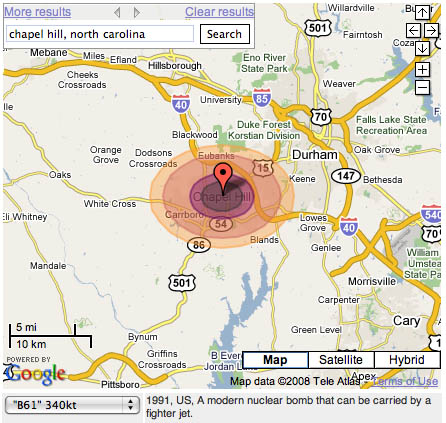
Finally, here is what would happen if a nuclear bomb was dropped on a relatively non-urban environment: in this case, the town of Chapel Hill, North Carolina.

[Image: Courtesy of CarlosLabs].

But this could just as easily have been Ann Arbor, Santa Cruz, Austin, Shrewsbury, Castleton, Aberystwyth, Marburg – it could just as easily have been anywhere on earth.
The overwhelming obliterative power of nuclear weapons turns them into a kind of ubiquitous anti-landscape, something that no geography, built or natural, can successfully resist.
All of which is simply a long-winded way of saying that while we now tend to measure threats against our cities in terms of armed gangs or contextually minor moments of staged terrorist assault, it’s still interesting to remember that, hovering over all of this, is something that could simply annihilate cities altogether.
If we’re going to study cities, in other words, then we should also study that which is radically anti-city.

(Spotted via Alexis Madrigal and Wired Science).

Warmed by Crematorium

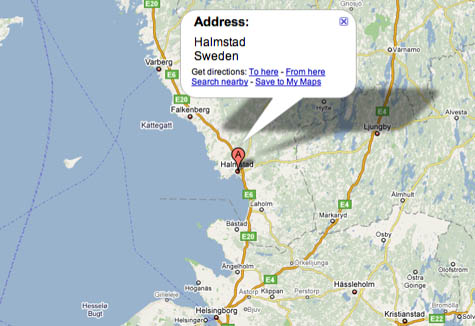
Homes in the Swedish town of Halmstad, the hometown of soccer star and former men’s underwear model Freddie Ljungberg, will soon be using excess heat from the town’s crematorium to stay warm each winter.

“Officials in the western Swedish town came up with the idea,” the Telegraph reports, “after a recent environmental review concluded that the crematorium’s chimneys were pumping far too much smoke into the air. Inspectors said the crematorium would have to buy new ovens in order to meet basic environmental standards.”

“It was when we were discussing all these environmental issues that we started thinking about the energy that is used in the cremations and realised that instead of all that heat just going up into the air, we could make use of it somehow. It was just rising into the skies for nothing,” said Lennart Andersson, the director of the cemetery in the town of Halmstad. “For starters we will heat our own premises. But I hope we can connect to the district heating network in the future.”

A bit more on how it would work:

When a body is cremated, toxic materials are released from the corpse. For example, fillings in the teeth, when heated to high temperatures, release mercury. In order to filter out the toxic materials before they are released into the air, the crematorium must cool the smoke from around 1,000ºC to 150ºC. But, with the heat now directed into the public heating system, the smoke will already be much closer to 150ºC and the crematorium will spend less on materials, including water, to cool it down.

This might be the most obvious – and least interesting – thing I could say right now, but this sounds an awful lot like the premise of a film – starring Paris Hilton, say – in which joy-riding teens stumble upon an idyllic small town in northern Vermont, or perhaps Minnesota, only to realize that all the homes around them, including the nice B&B in which they’ve booked a room, are warmed by an underground labyrinth of pipes and tunnels… that gets all its heat from burning corpses. What sound like distant screams coming in through the bathroom air vent at 2 in the morning leads one of them to explore…
But what constitutes a morally acceptable source of alternative energy? Who decides?

(Thanks to John Devlin for the link!)

Gone Feral

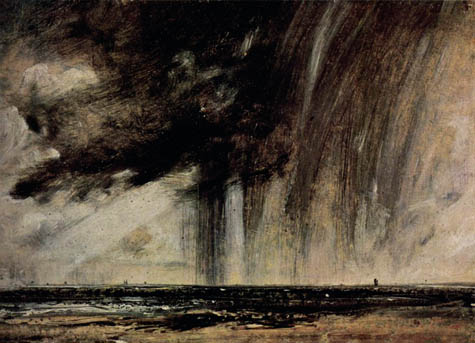
[Image: John Constable, Seascape Study with Rain Cloud, 1824].

Almost exactly a year ago, the Guardian wrote that “huge tracts of Britain’s landscape should be reclaimed from farming and go back to nature to lock up carbon dioxide and counter global warming.”
This would mean, for instance, that “traditional farming would be wound down in marginal areas while some landscapes should be ‘re-wilded’ to absorb more water and reduce flooding downstream. Peat bogs, which can store carbon, must be conserved and restored.”
The change would not come quick, and it would be controversial, a government ecology expert adds; after all, “There’s a deep cultural resistance to the idea of land no longer being farmed,” even if that land does have “other values which are now probably much higher for society.”
Would similar strategies be useful here in the United States? Like some scene from a future, sci-fi-inflected John Steinbeck novel, we’d abandon entire corporate agribusiness complexes to leave those now-lost farms in a state of second nature, re-wilded, gone to seed, subject to a different kind of valuation.

Cities in the Flood Zone

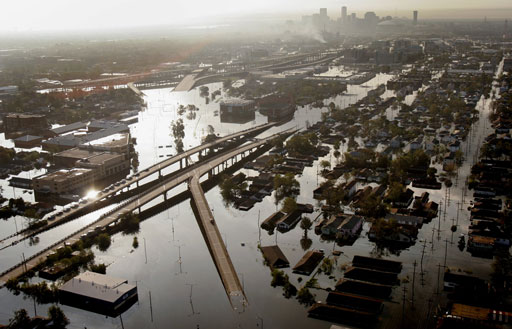
[Image: New Orleans after Hurricane Katrina; photographer unknown].

One of very many interesting points made by Jan Zalasiewicz in his new book The Earth After Us is that rising sea levels in an era of global climate change might actually – ironically – increase humanity’s long-term chances of urban fossilization.
“If we and our children are very unlucky over the next few decades,” he writes, “and the waters rise swiftly, then many of our cities may be as well preserved as Pompeii, as though in aspic.”
After all, he adds, “if the sea rises quickly enough, and there is not time for the waves to do their work, landscapes may be drowned entire. Only a few meters beneath sea level, and what was the land now lies below the destructive surf zone. A hundred meters below sea level, and even the most violent storm waves can scarcely be felt. So, let the sea flood in, with its level jumping by meters over centuries or decades – or perhaps even years – and there simply will not be time for this wave energy to erode the landscape.”

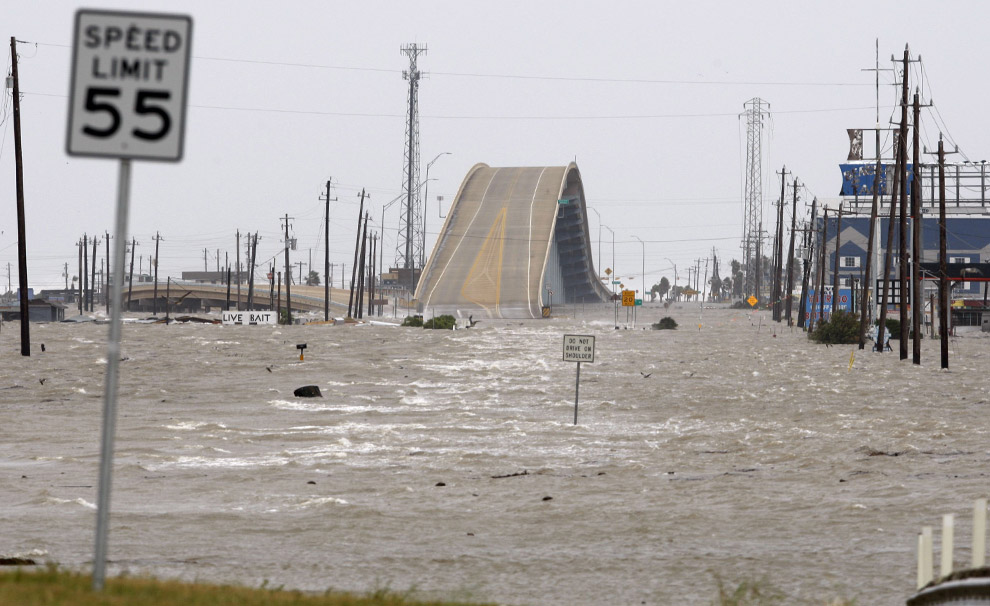
[Image: The aquatic aftermath of Hurricane Ike, photographed by Carlos Barria for Reuters; via The Big Picture].

Then, once everything’s underwater, the silting will begin. The planet’s submerged coastal and river-delta cities will thus be “covered with sand and mud,” entombed within the very landscapes upon which they once rested.

This would immediately put these regions beyond the reach of erosion – except perhaps for a little localized scouring by strong tidal currents – and into the kingdom of sedimentation. Our drowned cities and farms, highways and farms, would begin to be covered with sand, silt, and mud, and take the first steps towards becoming geology. The process of fossilization will begin.

And then, like some gigantic ribcage from a species no one will fully comprehend, bits of New Orleans and Amsterdam and Hanoi will be unearthed amidst the mudstones of a future geography.
So might rapid climate change mean not the complete erasure of humanity’s material traces but, with fantastic irony, civilization’s geologically long-term preservation?

Library of Dust

[Image: From Library of Dust by David Maisel, published by Chronicle Books].

There’s a spectacular new book coming out at the end of this summer called Library of Dust, by photographer David Maisel, published by Chronicle Books. I had the intensely exciting – and flattering – opportunity to write one of the book’s introductory essays; that essay now re-appears below.
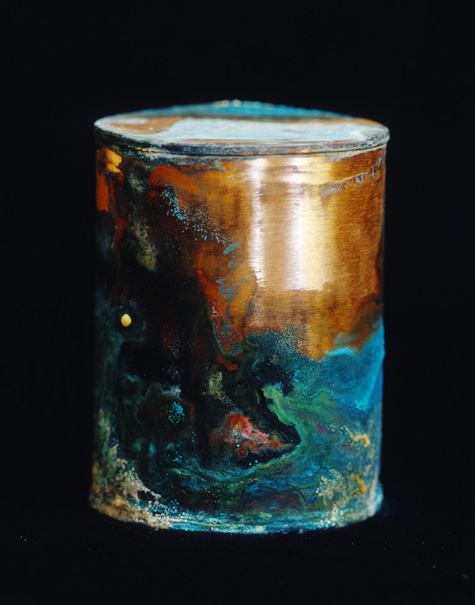
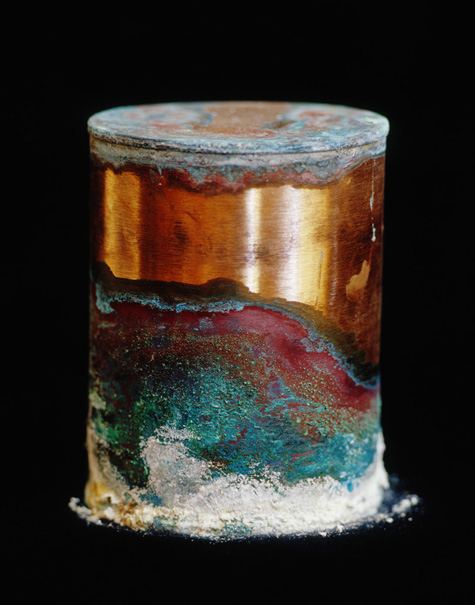
I first learned about Library of Dust when I interviewed Maisel back in 2006 for Archinect. In 1913, Maisel explained, an Oregon state psychiatric institution began to cremate the remains of its unclaimed patients. Their ashes were then stored inside individual copper canisters and moved into a small room, where they were stacked onto pine shelves.
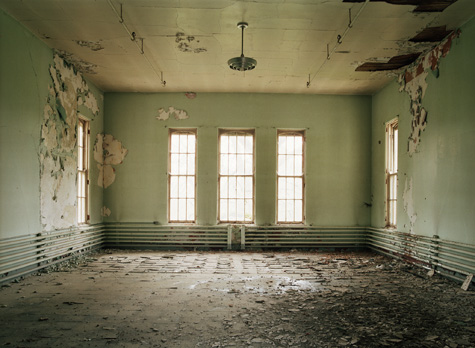
After doing some research into the story, Maisel got in touch with the hospital administrators – the same hospital, it turns out, where they once filmed One Flew Over the Cuckoo’s Nest – and he was granted access to the room in which the canisters were stored.
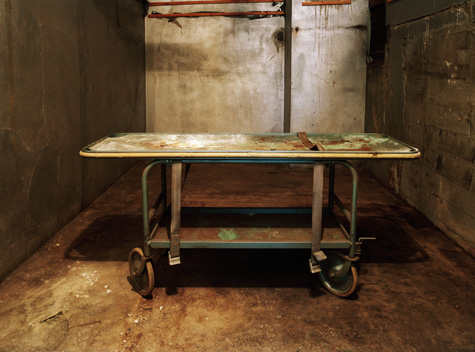
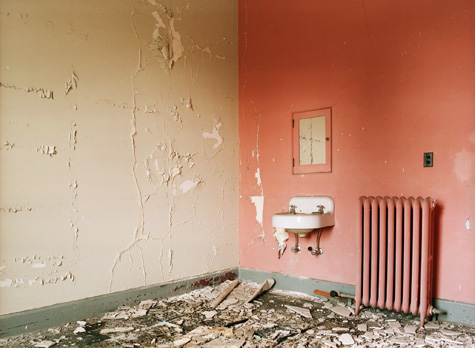
[Image: Abandoned rooms of the hospital. From Library of Dust by David Maisel, published by Chronicle Books].

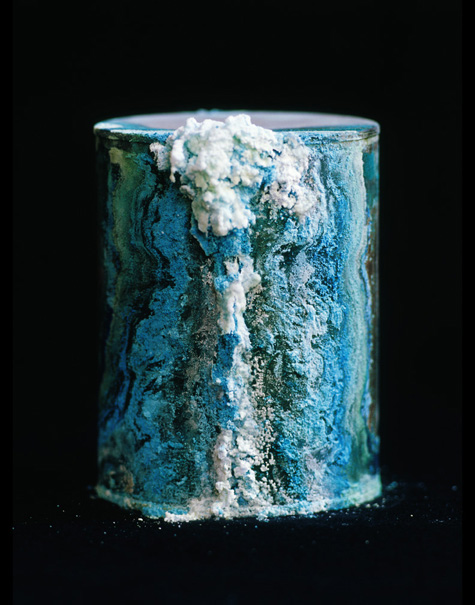
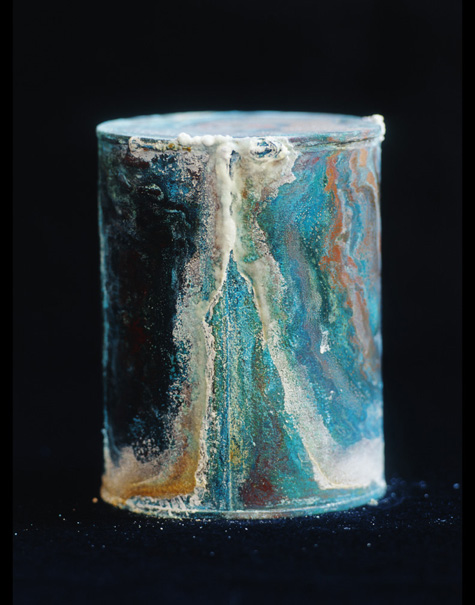
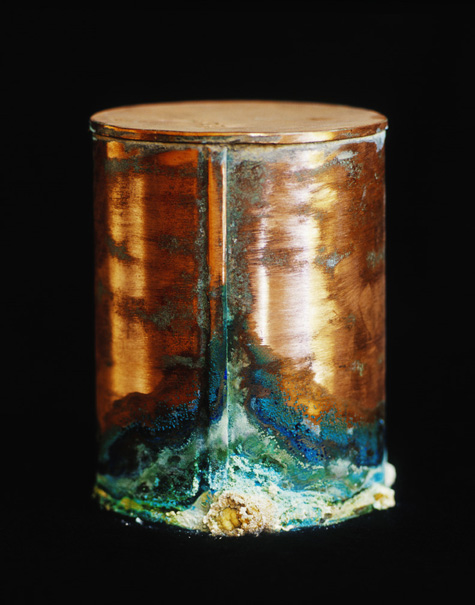
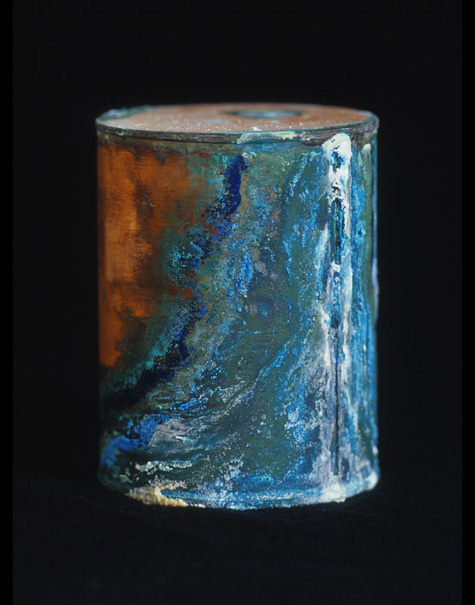
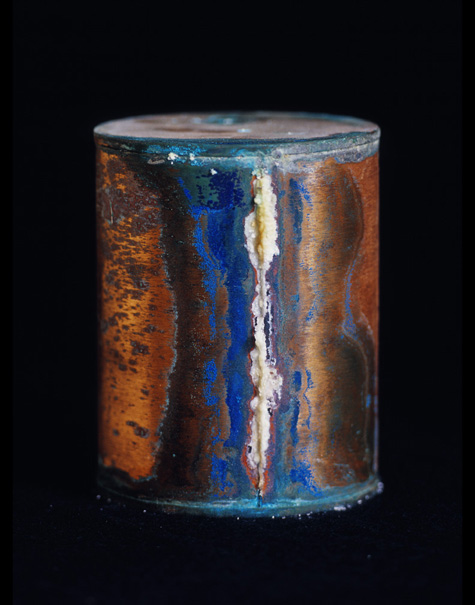
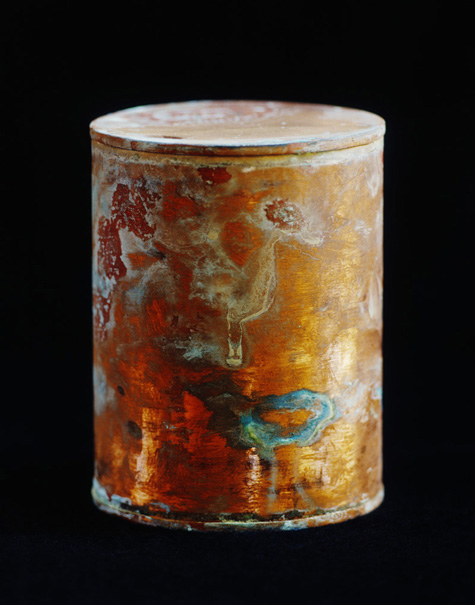
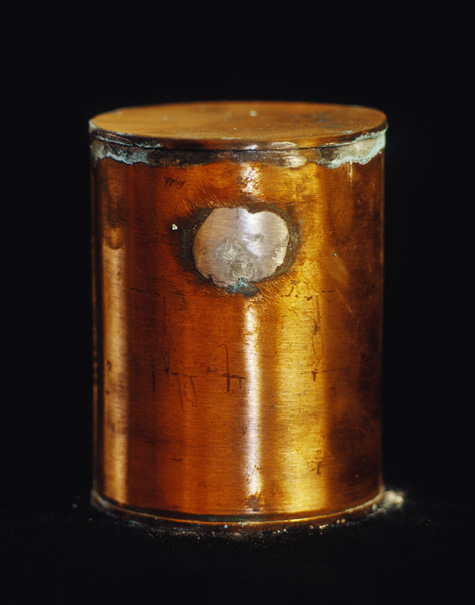
Over time, however, the canisters have begun to react chemically with the human ashes held inside them; this has thus created mold-like mineral outgrowths on the exterior surfaces of these otherwise gleaming cylinders.
There was a certain urgency to the project, then, as “the span of time that these canisters are going to be in this state is really finite,” Maisel explained in the Archinect interview, “and the hospital is concerned that they’re now basically corroding.”

So when I was there just a few weeks ago, photographing for I think the fourth time, there was a proposal being floated that each canister be put into its own individual plastic bag, and then each bag would go into its own individual black box that’s made for containing human ashes. And that would be it.

To me, the arc of the project – if it ends like that, which it seems it probably will – has a certain kind of conceptual logic to it that I appreciate. I appreciate the form and the story of these canisters, that they’re literally breaking down further every day, even between my visits to the hospital. My time of doing it, then, is finite as well.

In order to deal with the fragility of the objects, and to respect their funerary origins, Maisel set up a temporary photography studio inside the hospital itself. There, he began photographing the canisters one by one.
He soon realized that they looked almost earthlike, terrestrial: green and blue coastal forms and island landscapes outlined against a black background. But it was all mineralogy: terrains of rare elements self-reacting in the dark.
Maisel’s photos have now been collected into a gorgeous, and physically gigantic, book. It’s expensive, but well worth checking out.
The following is my own essay for the book; it appears alongside texts by Terry Toedtemeier and Michael Roth.
[Image: From Library of Dust by David Maisel, published by Chronicle Books].

• • •

In Haruki Murakami’s novel Hard-boiled Wonderland and the End of the World, an unnamed man finds himself walking through an unnamed town. Its depopulated spaces are framed most prominently by a Clocktower, a Gate, and an Old Bridge. The nameless man is told almost immediately to visit the town’s central Library – an unspectacular building that “might be a grain warehouse” for all its allure. “What is one meant to feel here?” the man asks himself, crossing a great, empty Plaza. “All is adrift in a vague sense of loss.”

Once inside the Library, the man meets a Librarian. The two of them sit down together, and the man prepares to read dreams. They are not fairy tales written in pen and ink, however, but the psychic residues of long-dead creatures, a gossamer field of electrical energy left behind in the creatures’ bleached skulls. Weathered almost beyond recognition, one such skull is “dry and brittle, as if it had lain in the sun for years.” The skull has been transformed by time into something utterly unlike itself, marked by processes its former inhabitant could not possibly have anticipated.

Each skull is the most minimal of structures, seemingly incapable of bearing the emotions it stores hidden within. One skull in particular “is unnaturally light,” we read, “with almost no material presence. Nor does it offer any image of the species that had breathed within. It is stripped of flesh, warmth, memory.” It is at once organic and mineralogical – living and dead.

The skull is also silent, but this silence “does not reside on the surface, [it] is held like smoke within. It is unfathomable, eternal” – intangible. One might also add invisible. This “smoke” is the imprint of whatever creature once thought and dreamed inside the skull; the skull is an urn, or canister, a portable tomb for the life it once gave shape to.

The Librarian assists our nameless narrator by wiping off a thin layer of dust, and the man’s dream-reading soon begins.
[Images: From Library of Dust by David Maisel, published by Chronicle Books].

Dust is a peculiar substance. Less a material in its own right, with its own characteristics or color, dust is a condition. It is the “result of the divisibility of matter,” Joseph Amato writes in his book Dust: A History of the Small and the Invisible. Dust is a potpourri of ingredients, varied to the point of indefinability. Dust includes “dead insect parts, flakes of human skin, shreds of fabric, and other unpleasing materials,” Amato writes.

Many humans are allergic to dust and spend vast amounts of time and money attempting to rid their homes and possessions of it, yet dust’s everyday conquest of the world’s surfaces never ends. Undefended, a room can quickly be buried in it.

Dust lies, of course, at the very edge of human visibility: it is as small as the unaided eye can see. And dust is not necessarily terrestrial. “Amorphous,” Amato continues, “dust is found within all things, solid, liquid, or vaporous. With the atmosphere, it forms the envelope that mediates the earth’s interaction with the universe.” But dust is found beyond that earthly sphere, in the abiotic vacuum of interstellar space, a freezing void of irradiated particles, where all dust is the ghostly residue of unspooled stars, astronomical structures reduced to mist.

Strangely representational, the chemistry of this stardust can be analyzed for even the vaguest traces of unknown components; these results, in turn, are a gauge for whatever hells of radiation once glowed, when the universe burned with intensities beyond imagining. Those astral pressures left chemical marks, marks which can be found on dust.

Such dust – vague, unspectacular, bleached and weathered by a billion years of drifting – can be read for its astronomical histories.

Dust, in this way, is a library.
[Image: From Library of Dust by David Maisel, published by Chronicle Books].

A geological history of photography remains unwritten. There are, of course, entire libraries full of books about chemistry and its relationship to the photographic process, but what the word chemistry fails to make clear is that these photographic chemicals have a geological origin: they are formed by, in, and because of the earth’s surface.

Resists, stops, acids, metals, fixes – silver-coated copper plates, say, scorched by controlled exposures of light – produce imagery. This is then called photography. Importantly, such deliberate metallurgical burns do not have to represent anything. Photography in its purest, most geological sense is an abstract process, a chemical weathering that potentially never ends. All metal surfaces transformed by the world, in other words, have a literally photographic quality to them. Those transformations may not be controlled, contained, or domesticated, but the result is one and the same.

Photography, in this view, is a base condition of matter.
[Image: From Library of Dust by David Maisel, published by Chronicle Books].

David Maisel’s photographs of nearly 110 funereal copper canisters are a mineralogical delight. Bearded with a frost of subsidiary elements, their surfaces are now layered, phosphorescent, transformed. Unsettled archipelagos of mineral growths bloom like tumors from the sides and bottoms – but is that metal one sees, or some species of fungus? The very nature of these canisters becomes suspect. One is almost reluctantly aware that these colors and stains could be organic – mold, lichen, some yeasty discharge – with all the horror such leaking putrescence would entail. Indeed, the canisters have reacted with the human ashes held within.

Each canister holds the remains of a human being, of course; each canister holds a corpse – reduced to dust, certainly, burnt to handfuls of ash, sharing that cindered condition with much of the star-bleached universe, but still cadaverous, still human. What strange chemistries we see emerging here between man and metal. Because these were people; they had identities and family histories, long before they became nameless patients, encased in metal, catalytic.

In some ways, these canisters serve a double betrayal: a man or woman left alone, in a labyrinth of medication, prey to surveillance and other inhospitable indignities, only then to be wed with metal, robbed of form, fused to a lattice of unliving minerals – anonymous. Do we see in Maisel’s images then – as if staring into unlabeled graves, monolithic and metallized, stacked on shelves in a closet – the tragic howl of reduction to nothingness, people who once loved, and were loved, annihilated?

After all, these ash-filled urns were photographed only because they remain unclaimed; they’ve been excluded from family plots and narratives. A viewer of these images might even be seeing the fate of an unknown relative, eclipsed, denied – treated like so much dust, eventually vanishing into the shells that held them.

It is not a library at all – but a room full of souls no one wanted.
[Image: From Library of Dust by David Maisel, published by Chronicle Books].

Yet perhaps there is something altogether more triumphant at work here, something glorious, even blessed. There is a profoundly emotional aspect of these objects, a physical statement that we, too, will alter, meld with the dust and metal: an efflorescence. This, then, is our family narrative, not one of loss but of reunion.

There is a broader kinship being proclaimed, a more important reclamation occurring: the depths of matter will accept us back. We will be rewelcomed out of living isolation. We are part of these elements, made of the dust that forms structures in space.

Maisel’s photographs therefore capture scenes of fundamental reassurance. The mineralized future of everything now living is our end. Even entombed by metal, foaming in the darkness with uncontrolled growths – there is splendor.
[Image: From Library of Dust by David Maisel, published by Chronicle Books].

To disappear into this metallurgical abyss of reactions – photographic, molecular – isn’t a tragedy, or even cause for alarm. There should be no mourning. Indeed, Maisel’s work reveals an abstract gallery of the worlds we can become. Planetary, framed against the black void of Maisel’s temporary studio, the remnant energies of the long dead have become color, miracles of alteration. There are no graves, the photographs proclaim: only sites of transformation.

That is our final, inhuman release.
[Image: From Library of Dust by David Maisel, published by Chronicle Books].

At the end of winter 2005, David Maisel traveled to a small city in Oregon. There were bridges, plazas, and gates. He was there to locate an old psychiatric hospital – a building now housing violent criminals – because the hospital held something that interested him.

Upon arrival, he met with the head of security, who already knew why Maisel had come. The two of them walked down a nearby corridor, where Maisel was shown what he’d been looking for. It was an isolated room behind a locked door – smaller, less official, than expected.

Within it was the Library of Dust.


• • •

David Maisel’s Library of Dust is available both through Chronicle Books and through Amazon.com – though you can also buy a signed copy through photo-eye.
Don’t miss my earlier interview with David over at Archinect – and, at some point soon, take a long trip through David’s website.

(Thanks to Joseph Antonetti for his help with the images – and to editor Alan Rapp for instigating this book in the first place).
Fossil Cities

[Image: Art by Joe Alterio; view larger].

I’m thrilled to announce that BLDGBLOG and Wired Science have teamed up with Swissnex to host a live interview—free and open to the public—with University of Leicester geologist Jan Zalasiewicz, author of The Earth After Us: What Legacy Will Humans Leave in the Rocks?, from Oxford University Press.

The event will be from 7-9pm on Wednesday, December 17th, at Swissnex, 730 Montgomery Street, in San Francisco; here’s a map.

Zalasiewicz’s book offers a fascinating and sustained look at what will happen to the material artifacts of human civilization 100 million years from now, when cities like Manhattan are mere trace fossils in flooded submarinescapes, Amsterdam is an indecipherably fragmentary presence in the lithified mudflats of a new, future continent, and cities like Los Angeles and Zurich have been eroded away entirely by a hundred million years of rockslides and weather.

To quote an early chapter from Zalasiewicz’s book at length:

The surface of the Earth is no place to preserve deep history. This is in spite of – and in large part because of – the many events that have taken place on it. The surface of the future Earth, one hundred million years now, will not have preserved evidence of contemporary human activity. One can be quite categorical about this. Whatever arrangement of oceans and continents, or whatever state of cool or warmth will exist then, the Earth’s surface will have been wiped clean of human traces.
(…)
Thus, one hundred million years from now, nothing will be left of our contemporary human empire at the Earth’s surface. Our planet is too active, its surface too energetic, too abrasive, too corrosive, to allow even (say) the Egyptian Pyramids to exist for even a hundredth of that time. Leave a building carved out of solid diamond – were it even to be as big as the Ritz – exposed to the elements for that long and it would be worn away quite inexorably.
(…)
So there will be no corroded cities amid the jungle that will, then, cover most of the land surface, no skyscraper remains akin to some future Angkor Wat for future archaeologists to pore over. Structures such as those might survive at the surface for thousands of years, but not for many millions.

The book goes on to explore buried cities, flooded cities, and cities destroyed by erosion; the long-term traces of different materials, from concrete and steel to nuclear waste and industrial plastics; and the future magnetic presence of urban metals that have been compressed into the thinnest bands of underground strata. We’ll be talking about cities like New Orleans, London, Hanoi, and Shanghai; New York, Los Angeles, Cairo, and Geneva. What “signals” of their one-time existence will these cities offer in 100 million years’ time? About Mexico City, Zalasiewicz writes:

Mexico City has a good short-term chance of fossilization, being built on a former lake basin next to active, ash-generating volcanoes; but its long-term chances are poor, as that basin lies on a high plateau, some two kilometers above sea level. The only ultimate traces of the fine buildings of [Mexico City] will be as eroded sand- and mud-sized particles of brick or concrete, washed by rivers into the distant sea.

With visions of cities become not spectacular, vine-covered ruins but but vast deltaic fans of multi-colored sand, the book looks at the future geological destinies of everything from plastic cups to clothes.

Alexis Madrigal, from Wired Science, and I will also have five copies of Zalasiewicz’s book to give away to attendees, and there will be drinks and light food after the event, so it will be well worth coming out.

If you get a chance, please RSVP at the Swissnex site, so that they can keep track of expected visitors.

(With special thanks to Joe Alterio for the artwork!)

The Inhabitable Wind Turbine

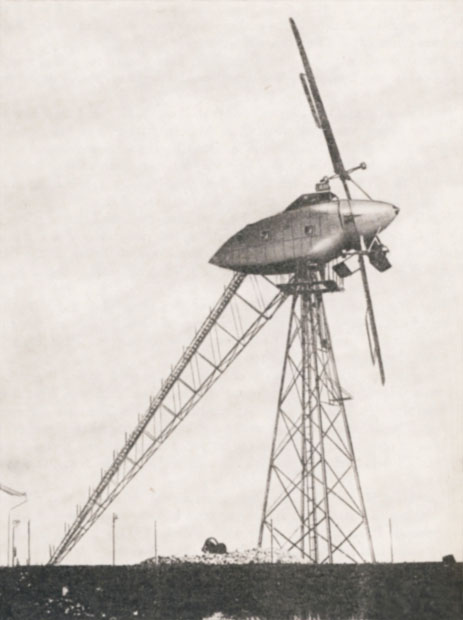
[Image: From Power from the Wind by Palmer Cosslett Putnam].

“In May 1931,” author Palmer Cosslett Putnam wrote in his 1949 book Power from the Wind, and “after two years of wind measurement, a wind-turbine 100 feet in diameter was put in operation on a bluff near Yalta, overlooking the Black Sea, driving a 100-kilowatt, 220-volt induction generator, tied in by a 6300-volt line to the 20,000-kilowatt, peat-burning steam-station at Sevastopol, 20 miles distant.”
As if anticipating BLDGBLOG’s recent look at infrastructural domesticity, Putnam points out that “a streamlined house” containing generators was held aloft behind the turbine – but this “house” also offered a temporary place of rest to the maintenance workers who checked up on the turbine’s workings. Accessible via a long flight of stairs, this airborne space added a small touch of domestic comfort to an otherwise industrial piece of machinery in the sky.

[Sent in by Alexis Madrigal, who also had this image scanned from Putnam’s book].

Backyard Aquaculture

[Image: From a project for fish-farming the Thames by Benedetta Gargiulo, part of a recent design studio at the Architectural Association taught by Nannette Jackowski and Ricardo de Ostos; via Pruned].
A passing comment on the previous post has me thinking that a fantastic, Pruned-inspired summer architectural studio could be organized around the idea of turning backyard swimming pools not into mausoleum-like, subterranean granny flats, but experimental fish farms and hatcheries, alternative-energy algae-breeding ponds and other avant-garde aquacultural installations. Architecture as artificial ecosystem.
Could you reimagine the food production infrastructure of a city through the aquacultural transformation of its backyard swimming pools?

Down Under

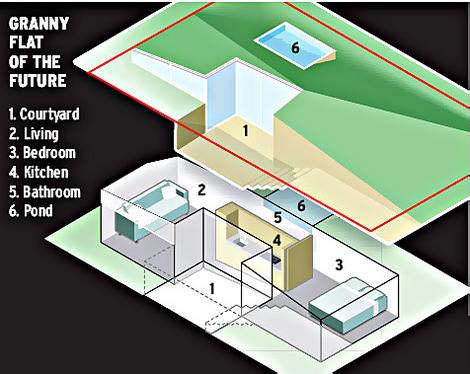
[Image: The subterranean granny flat of the future, via the Sydney Morning Herald].

According to an article published last month in the Sydney Morning Herald, turning backyard swimming pools into subterranean “granny flats” is a spatially innovative, if unexpected, way to assuage Sydney’s growing housing shortage. Indeed, much of Sydney’s projected population growth could simply be “housed within some of [New South Wales’s] 360,000 swimming pools.” These “redeveloped pools” could then be used as detached bedrooms for grandparents, teens, guests, bunker enthusiasts, underground-obsessed schizophrenics, and so on.
The regions 360,000 swimming pools would first be emptied of their water and then transformed, through architectural intervention, into a comfortable domestic space, “complete with a small bedroom, living room, kitchen, bathroom, garden alcove and rooftop windows.”
But where would everyone then swim? In the ocean pools of Sydney, of course.

(Thanks to Simon Sellars for the tip!)

Space Beer

Last week, Sapporo announced that they would soon be serving space beer, “the world’s first beer made with barley descending from plants grown inside the International Space Station.”

The barley used in the new beer is a third-generation offshoot of the original plant stored for five months in a Russian laboratory in the station. The company has made only 100 liters of the new brew, named Sapporo Space Barley, which is not for sale. Sapporo says the beer is safe because it has tested microbes in it and did tests with lab animals and Sapporo employees, too. It also says that the space beer tastes just like regular beer.

For obvious reasons, this brings to mind China’s space seed project, in which “space breeding” puts astronomy to work in the service of contemporary agriculture.

Plant seeds have been blasted into orbit in the hope that “space breeding” holds the key to improving crop yields and disease resistance. Wheat and barley strains developed by the Department of Agriculture and Food in Western Australia (WA) have just landed back on Earth following a 15-day orbital cruise on board China’s Shijian-8 satellite. “Space-breeding refers to the technique of sending seeds into space in a recoverable spacecraft or a high-altitude balloon,” said Agriculture WA barley breeder Chengdao Li. “In the high-vacuum, micro-gravity and strong-radiation space environment, seeds may undergo mutation.”

While this certainly offers landscape architects an unearthly way to boost their horticultural repertoire, it also shows that specialty foods cultivated through genetic interaction with the universe might yet find a comfortable place in the human food chain.
Sipping space beer, ingesting astronomical influence, welcoming literally non-terrestrial nutrition into the planetary web of caloric intake, we’ll find that Sapporo’s newest beer brings a suitably alien tenor to the local amnesia of alcoholic intoxication.

(Earlier on BLDGBLOG: Turning endangered landscapes into beer).