The Labyrinth and the Stairway

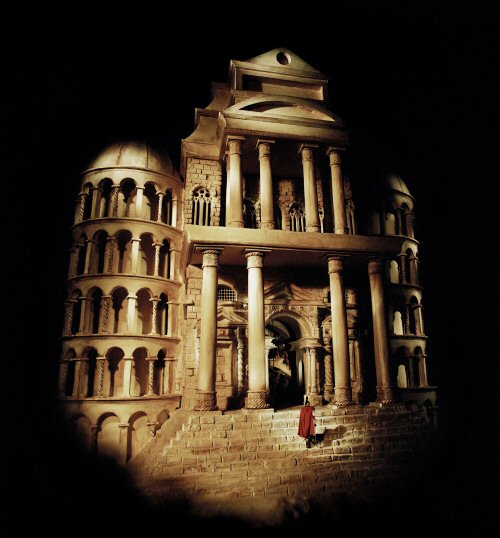
[Image: From “City of the Immortals” by Michelle Lord].

Artist Michelle Lord, whose “Future Ruins” we featured here on BLDGBLOG the other day, has another project on display this year as part of Architecture Week in the UK.
This project, the “City of the Immortals,” inspired by a Jorge Luis Borges short story called “The Immortal,” gives viewers a shadowy glimpse into Lord’s ongoing “fascination with fictional or un-built environments.”
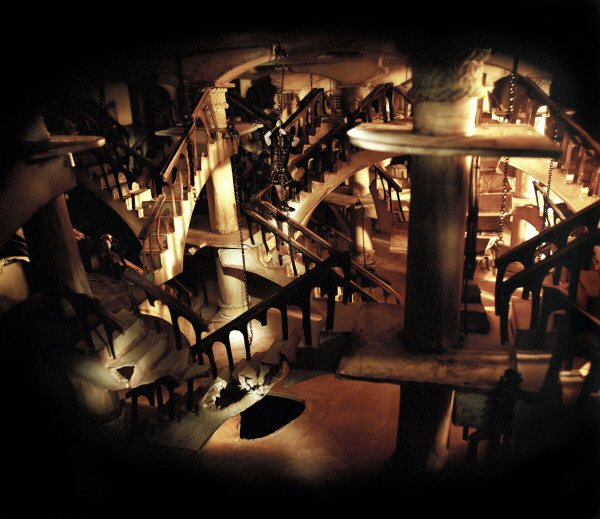
[Image: From “City of the Immortals” by Michelle Lord; also available in a slightly bigger version].

This work in particular represents “a vast fictional topography that exists within the walls of a mythological Roman city.” Within that city, according to the Borges story, “a lone figure traverses its magnificent, eternal architecture in search of immortality.”
At one point Borges describes how this narrator ascends a ladder, pulling himself up toward “a circle of sky” – through which he promptly pokes his head, making a discovery: “I began to glimpse capitals and astragals,” he tells us, “triangular pediments and vaults, confused pageants of granite and marble. Thus I was afforded this ascension from the blind region of dark interwoven labyrinths into the resplendent City.”
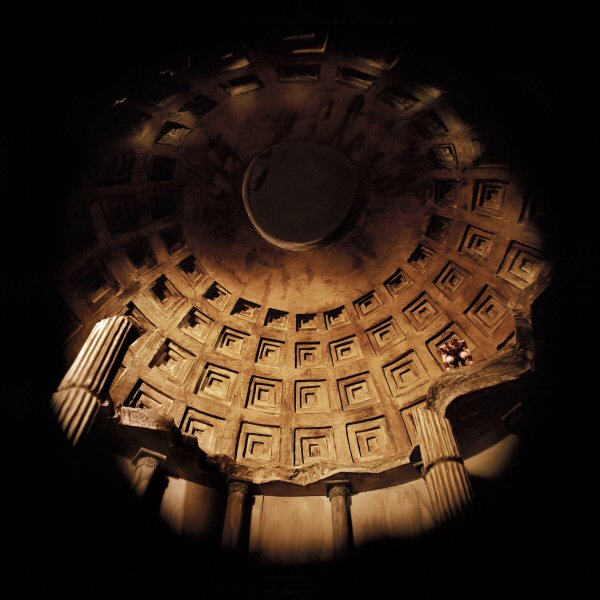
[Image: From “City of the Immortals” by Michelle Lord; see bigger].

The story continues:

A labyrinth is a structure compounded to confuse men; its architecture, rich in symmetries, is subordinated to that end. In the palace I imperfectly explored, the architecture lacked any such finality. It abounded in dead-end corridors, high unattainable windows, portentous doors which led to a cell or pit, incredible inverted stairways whose steps and balustrades hung downwards. Other stairways, clinging airily to the side of a monumental wall, would die without leading anywhere, after making two or three turns in the lofty darkness of the cupolas.

In any case, Lord has physically constructed the architecture described by Borges; her interiors thus “intentionally evoke spatial and geometric confusion, where great pillars extend into infinity and endless staircases appear to intertwine like a three dimensional maze to form a ‘nonsense’ structure or architectural folly.”
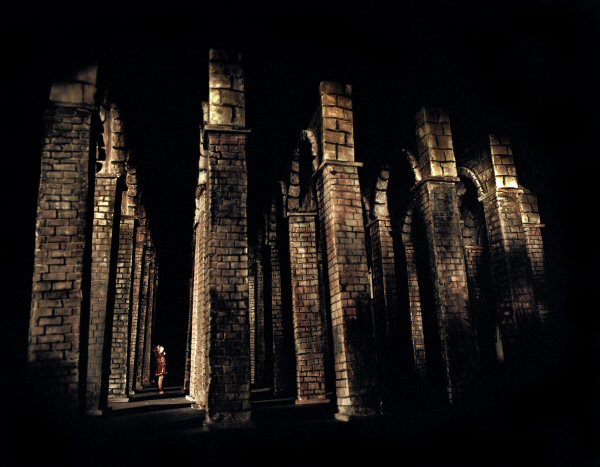
[Image: From “City of the Immortals” by Michelle Lord; also available in a moderately larger version].

Citing Piranesi as an influence, she assembles a “composite of both the real and the invented.” This “demonstrates the power of paper architecture to convincingly simulate reality, where a freshly made model can evoke a lengthy history and its diminutive scale conjure up a life-size space. An intricate hybrid of photography, sculpture and architecture; the artificial eye of the camera subtly transforms these hand crafted models into a large sprawling complex, a new imaginary city.”
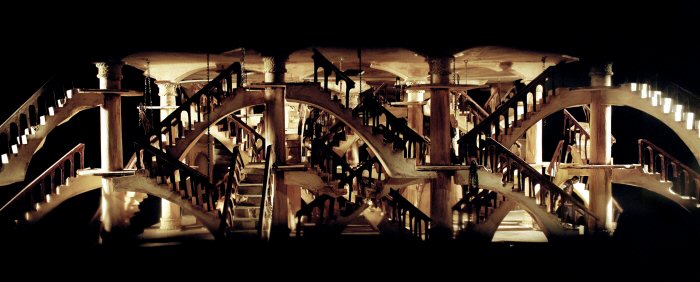
[Image: From “City of the Immortals” by Michelle Lord; also available in a slightly bigger version].

Lord’s “City of the Immortals” is on display till June 24 in Birmingham, England.

(Vaguely related: Edinburgh).
Future Ruins

[Image: From “Future Ruins” by Michelle Lord].

Over on Ballardian we read about a new project by artist Michelle Lord, called “Future Ruins.”
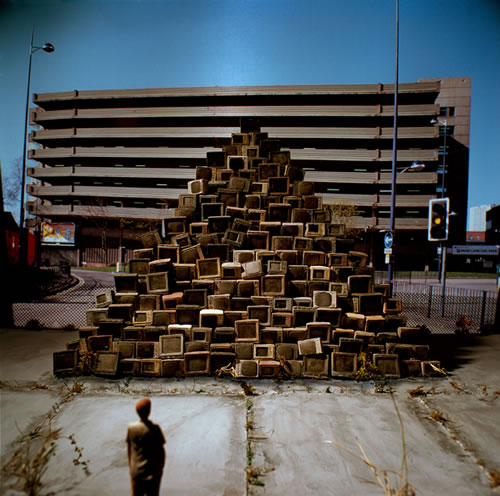
Lord writes: “Inspired by author J.G. Ballard’s literary visions of modernist architectural design and his prophetic views on the technological demise of the urban environment, Future Ruins is a photographic critique of the urban planning of the 1970s and Ballard’s novels of the same period.”

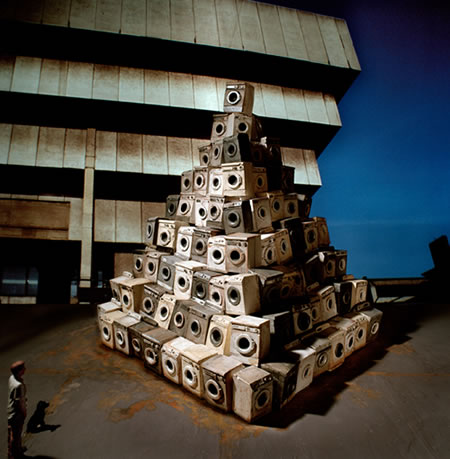
[Image: From “Future Ruins” by Michelle Lord].

“Set against a backdrop of Birmingham’s few remaining concrete structures such as Spaghetti Junction, Central Library and New Street Station signal box,” Lord continues, “Future Ruins aims to highlight the temporality of our landscape, particularly at a time when Birmingham has embarked on a process of regeneration in order to redefine itself.”

Familiar architectural locations around the city take on the appearance of evacuated spaces occupied by strange, carefully arranged structures, built from the technological detritus of abandoned television sets, cars, computers and domestic appliances.

The show is on display until June 23, as part of the UK’s 2007 Architecture Week.
Lord, meanwhile, is also the artist behind “Four Corners,” a photographic exploration of “fictional space.”
According to the 24 Hour Museum: “The images featured in Four Corners tell the tale of a woman who becomes alienated from the room she occupies as it takes on a strange life of its own. Furniture defies gravity and ghostly figures emerge from the shadows in the dreamlike chamber depicted, understandably giving our subject the creeps as her room appears to transform itself.”

(For those of you who like this sort of thing, Ballardian actually interviewed me about architecture, urban design, and the novels of J.G. Ballard, back in November).

The Storm Room

Instead of TV, it seems, you can watch 3D reconstructions of ancient storms – hopefully in surround-sound.
New Scientist reported a few weeks ago that researchers will soon “be able to visually recreate past typhoons, hurricanes and cyclones, then stand in the middle and watch as the weather pattern swirls around them.” It’s the storm room: a “simulator that crunches real storm data and turns it into 3D images that can be viewed with virtual-reality goggles.”
What about the home entertainment version, though? Putting this thing to architectural use. You throw Hurricane Floyd – or Typhoon Tip – up on the walls and read a book while it spins…
Or a new kind of teenage rebellion breaks out in the suburbs of middle America: angry sixteen year-olds program tropical storms into the walls of their bedrooms and make their parents faint with vertigo.
It’s the immersive, weather-reconstructive cinema of the future.

(A tiny bit more information is available at New Scientist).

Aerial Conversationalists

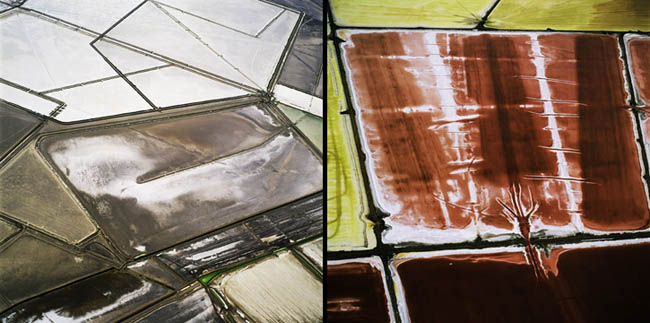
[Image: Two landscapes photographed from above by David Maisel; from Terminal Mirage].

I’m excited to announce that I’ll be participating in a roundtable discussion, on June 28, hosted by the Nevada Museum of Art in Reno.
Some long-term BLDGBLOG readers might remember that I interviewed photographer David Maisel about a year and a half ago for Archinect; well, David will be leading a guided tour of his photographs (at noon on June 28) at the Nevada Museum of Art, followed by a lecture about those images (at 7pm, the same day), by writer William L. Fox – ending, finally, with a roundtable discussion featuring Fox, Maisel, and myself.
The Nevada Museum of Art describes Fox as an author and independent scholar who “has spent three decades studying and writing about the ways in which humans understand where they are in landscapes, often focusing on art, mapping, and cognitive science.” His many, many books include Driving to Mars: In the Arctic with NASA… and Terra Antarctica: Looking into the Emptiest Continent. He’s also got a website.
Fox’s work has come up many times on this blog; see this post, for instance, about high winds in Antarctica, carving musical instruments out of the rocks, or this post, in which huge underground spheres in the south polar glaciers are used as a new kind of cathedral, or even this post, in which settlers on Mars confront seemingly inescapable geo-simulations…
Finally, if you haven’t read it yet, don’t miss the Archinect interview with David Maisel.And I owe a huge thanks to the Nevada Museum of Art for inviting me up to participate in the first place.

Home Again, Home Again

[Image: The future of the private home: a $475 million, custom Airbus A380; illustration by Bryan Christie for Wired].
According to Wired, an “undisclosed billionaire” has paid $475 million for a private Airbus A380 passenger jet.
The plane weighs 361 tons, is eight stories tall, and can hold up to 500 passengers – but this nameless billionaire will simply be using it as “one of the most expensive mobile homes in the world” (complete with $150 million in “custom upgrades”).
For whatever mysterious reasons of his or her own, the plane’s owner has taken to calling the custom airplane “Project Trinity.”
Which is actually interesting, because I was just thinking the other day that there are no flying churches – at least for mainstream congregations – and I don’t think there are any sky mosques.
In other words, the architectural history of the Church doesn’t, to my knowledge, include any airplanes. Gothic cathedrals, sure – but no StratoPulpit™. No CloudChurches (©).
And Islam has no AirMosques®.
In fact, this would make an interesting addition to the Pamphlet Architecture series: speculative religious architecture, creatively re-using vehicles from the private air transport industry.
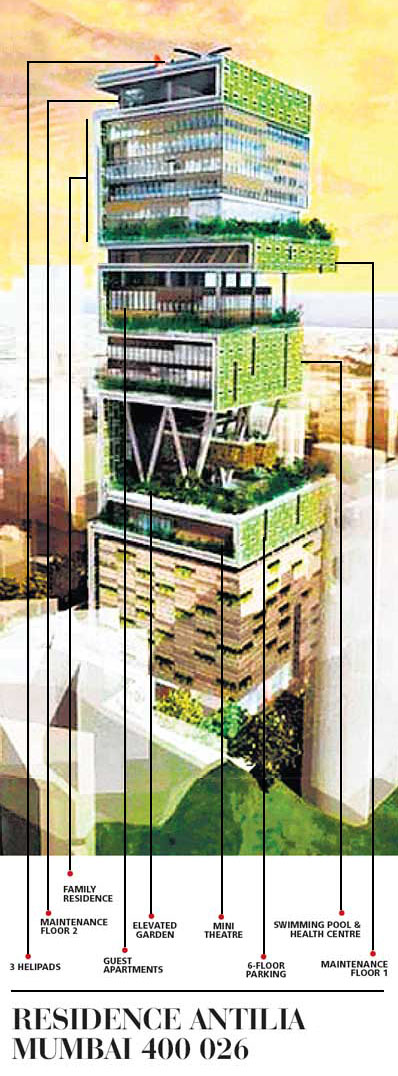
In any case, while we’re on the subject of extravagant private homes, as everyone in the world heard at least once last week, Mukesh Ambani, the richest man in India, is constructing himself a private skyscraper in Mumbai.

[Image: Mukesh Ambani’s 60-story house; via the Mumbai Mirror].

Ambani’s new home will be “over 170m tall,” the BBC reported, and it will require “an army of 600 staff to manage it.”
All said, the tower will cost as much as $1 billion to construct (or 1/20th of Ambani’s reported wealth).
According to the Mumbai Mirror, the house has been named “Residence Antilia.” The Mirror goes on to explain that Antilia is “a phantom island said to lie in the Atlantic Ocean far to the west of Spain. This mythical island had several other names such as Isle of Seven Cities, Ilha das Sete Cidades (Portuguese), Septe Cidades, Sanbrandan (or St Brendan), etc.” Some people say Antilia is actually Manhattan; others say it’s one of the Canary Islands; and yet others say it would make an awesome summer project for architectural design studios: design Antilia, an artificial island – or series of islands – “far to the west of Spain.”
Briefly, then, Residence Antilia will include:

• space for 168 “imported” cars, divided across six floors
• an entire floor for “car maintenance,” with an “in-house service centre”
• an “entertainment floor”
• terraces, balconies, and roof gardens
• a “health” floor, including “the latest gym equipment” and a pool
• three helipads
• two basement levels

Etc. etc.
The expenditure is appalling, and the obvious contrast to the poverty of everyday Mumbai is almost literally unbelievable; and yet I have a soft spot for weird architectural projects built by really rich people – and a private skyscraper would make such a fantastic setting for a novel or film, not to mention a wild place to be left alone for the weekend, that I have to be honest and admit that I find this project pretty interesting.
Is it well-designed (by architects Perkins + Will)? It’s too hard to tell from these images. Is it socially just? Of course not.
But it’s an awesome addition to the growing pantheon of extreme private homes – and the narrative implications that it presents for future Ballardian artworks (novels, films, videogames) are, for me, stunning.
At the very least: a Bollywood Home Alone.

(Vaguely related: $5.4 billion).

Phoning glaciers at 3am

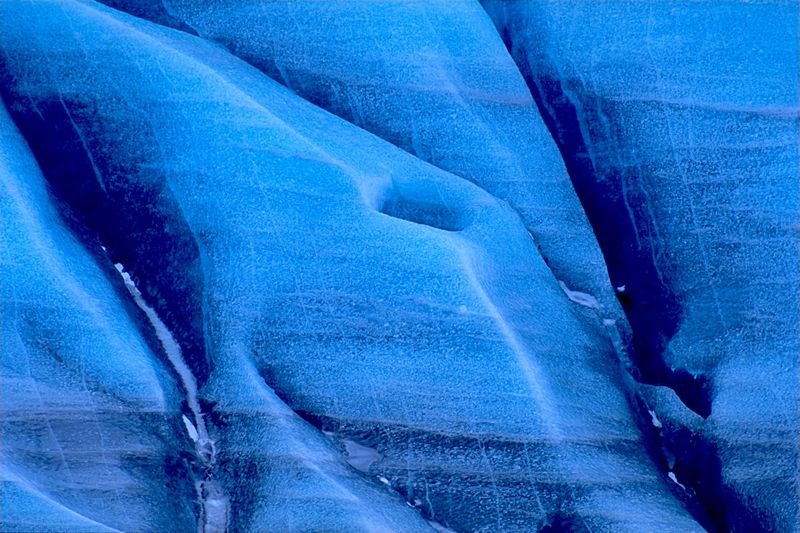
[Image: Iceland’s Vatnajökull glacier].

The Guardian tells us today about a “unique work of art” that “invites viewers to phone a glacier in Iceland – and listen to its death throes, live, through a microphone submerged deep in the bitterly cold lagoon.”
The weatherproof microphone thus “relays the splashes, creaks and groans as great masses of melting ice sheer off and crash into the water.”

[Image: Iceland’s Vatnajökull glacier].

You just have to call the following number: +44 (0) 7758 225698 (a British mobile phone – non-Brits, beware huge long-distance fees!) to “make direct contact with the polar icecap.”
However, the article warns us: “Only one caller at a time can get through: [artist Katie] Paterson recommends the small hours of the morning.”
So, if you’re extremely rich and cursed with insomnia, you can always lull yourself to sleep, sitting up at 3am near the kitchen window with your telephone pressed hard against your ear, listening to the groan of distant glaciers…
I tried to get through a few hours ago, but dialed the wrong number – connecting instead to the subterranean roar of Mt. Hood.
Perhaps there should be a telephone directory for natural phenomena.

(Thanks, Alex! Earlier on BLDGBLOG: To eavesdrop on breaking glaciers from within and When landscapes sing: or, London Instrument).

Rotating Liverpool

[Image: Turning The Place Over by Richard Wilson; image via the Daily Mail].
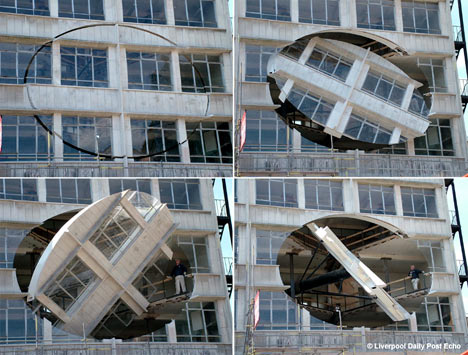
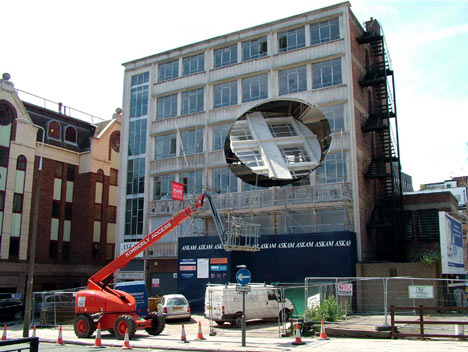
In a project that “will astonish the commuters of Liverpool,” sculptor Richard Wilson has turned part of a building’s facade inside-out.
As if learning from Gordon Matta-Clark, Wilson sliced an “egg-shaped section” out of the building’s facade – “fixing the eight metre diameter piece on a pivot” so it can spin.

[Image: Turning The Place Over by Richard Wilson; image via the Daily Mail].
The “rotating facade” will thus “reveal a glimpse of the interior” – for the low, low price of £450,000.

(Thanks, Nicky!)

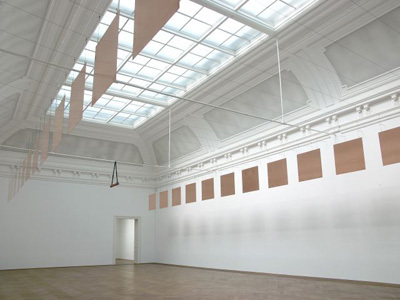
One first senses a disquieting buzzing sound

[Image: A glimpse of Chizhevsky Lessons by Micol Assaël; image courtesy of ArtForum].

Named after a Russian scientist “who explored the correlation between solar activity and historical events,” Chizhevsky Lessons is an art installation in Basel, Switzerland, by Micol Assaël.
The gallery it’s displayed in looks a bit like an empty room. You do see a series of copper plates hanging above you in space, and there’s a triangle, attached to wires, hovering alone in the center, like a Modernist chandelier.
But aside from those somewhat occultish pieces of interior decor, the place looks perfectly normal.
Still, it doesn’t feel right:

Upon entering, one first senses a disquieting buzz sound, followed by a tickling of the skin as one’s body hair stands on end. It’s the loaded atmosphere that precedes a thunderstorm, but re-created artificially with a cascade generator, a transformer, copper plates, and, hung three meters above the floor, a thin wire net that fills the room with negatively charged ions. One cannot help but experience an immediate physical reaction…

Sure, it’s basically just a huge science experiment – but I can’t stop myself wondering what a slightly less powerful, much more well-hidden model could do for you.
If you installed it in, say, a corporate board room: the CEO looks down upon her minions with derision and rage – because they didn’t finish the monthly report. As she speaks they hear a disquieting buzzing sound, followed by a tickling of the skin as one’s body hair stands on end…
It’d be like the Greek myths, reenacted through 21st century technology. The divine encounter: install six of these in St. Peter’s.
Or, for that matter, install one, secretly, in your bedroom – and wait for the sparks to fly.

(Thanks again to Dan Polsby!)

The blob

[Image: The Brooklyn sludge slowly surfaces… Photo by Jeff Riedel for New York Magazine].
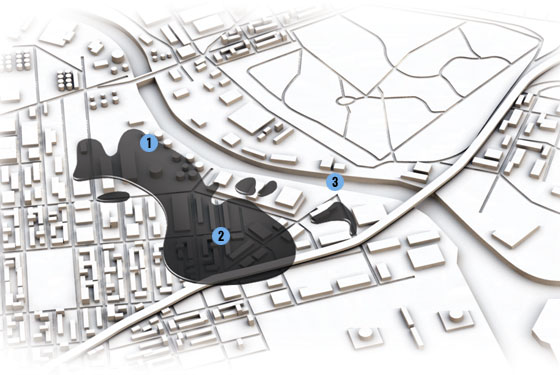
The largest oil spill in American history is apparently: 1) in New York City, 2) nearly a century old, and 3) beginning to re-surface under Greenpoint, Brooklyn.
An article in New York Magazine this week dives head-first into the spill, asking us to “imagine a viscous tar-colored blob stretching amoebalike through the Earth.” This viscous blob is really “ten million gallons of toxic gunk trapped in the Brooklyn aquifer,” made of “gasoline, solvents, and associated poisons bubbling up from the very ground.” These associated poisons include naptha, from which napalm is manufactured.
The subterranean Brooklyn blob represents “more than a century’s worth of spills, leaks, and waste dumped by oil companies” – and it’s “pooled into a vast underground lake, more than 55 acres wide and up to 25 feet thick.”
Not only has it infiltrated the region’s water supply (don’t worry: they pipe water in from the Catskills), but it means you can set the soil on fire.

[Image: A map of the subsurface blob; illustration by Jason Lee, courtesy of New York Magazine].
Worse, thousands of people now live on top of it…
From the article:

No one really knows what the consequences of Greenpoint’s oil spill have been – or will be. It’s like the dust from 9/11, the chemicals dumped at Love Canal, the nuclear meltdown at Three Mile Island, or even global warming. Do we ever really know their costs? Perhaps twenty years from now epidemiological studies will reveal a link between living in Greenpoint and dying of cancer.

Though it seems the cancer rate may already be on the rise.
In any case, I could go on and on – or you could just read the whole article. It’s not a life-changing read – and it’s conclusion is strangely anticlimactic – but the very idea of a black tarry blob drifting beneath the streets of New York is far too awesome to resist.

(Thanks to Dan Polsby for the tip!)

The LightHive: Luminous Architectural Surveillance

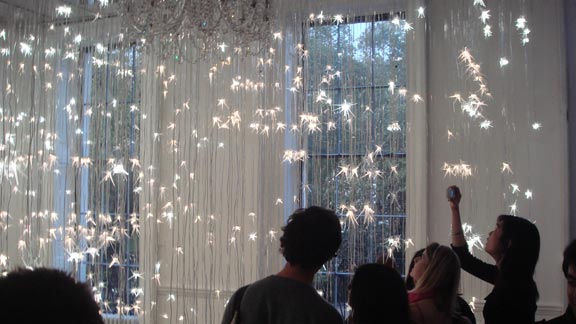
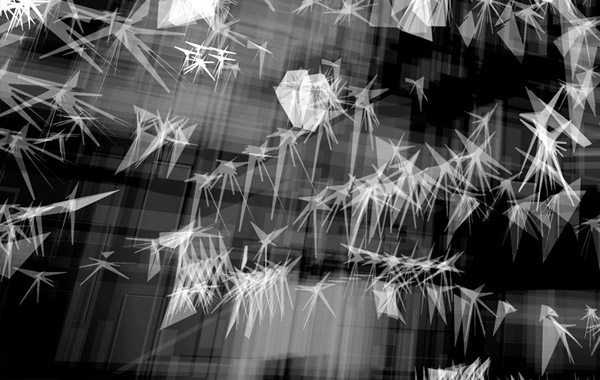
[Image: A glimpse of London’s LightHive, by Alex Haw, on display last week].

An installation called the LightHive closed last week at the Architectural Association in London.
Designed by architect, actor, theorist, and writer Alex Haw, the hive functioned as a new form of “luminous architectural surveillance,” somewhere between sculpture, optical device, and high-end interior decoration – an immersive chandelier, if you will.
According to the UK-based ArtsHub, Haw’s LightHive “pushes CCTV into another dimension.”

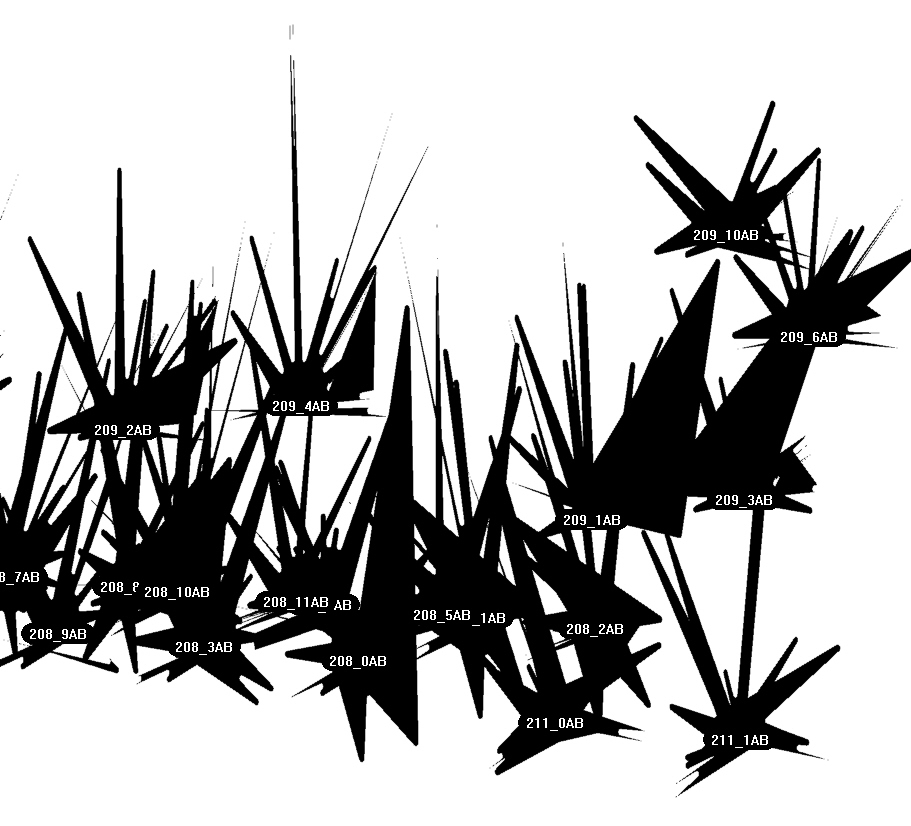
[Image: Preliminary point-cloud study for the LightHive, executed by Marc Fornes].

Specifically, the hive consists of “a surveillance network” – connected to nearly 7.5km of LED wiring – that “records the movement of people through the building” (where “the building” is London’s Architectural Association in Bedford Square).
The LightHive then “transmutes the energy into bursts of light, which create an ‘immersive form of 3d CCTV’.”

[Images: Glimpses of the LightHive, an indoor constellation aware of those who view it. Image one, two, and three – and a lot more here].
From a description of the exhibition:

The space thus operates like a 3D X-ray of the building’s activity, a kind of constantly updating surround-light CCTV, a spatial model of the entire School’s performance fluctuating over the course of hours, days and weeks.

I’ll admit to being a tad unclear about how the ensuing displays of light manage to represent – or not – the presence of human beings; but I love the idea.

[Images: The LightHive as digital model (by Marc Fornes) and material execution].

I love just thinking about the possibility that, say, all the lights in Bloomsbury, from desk lamps and bathroom fixtures to fluorscent bulbs at the nearest Pret a Manger, might someday act as a huge sensory mechanism, responding and dimming in response to the passage of people in the streets. Or parts of Tokyo light up, LightHive-like, illustrating in real-time the level of pedestrian traffic down the King’s Road (or 5th Avenue, or Kastanienallee).
Or install one of these things in the International Space Station, to register human movement through the back rooms of Mission Control, far below…
Anti-gravitational light sculptures in space.

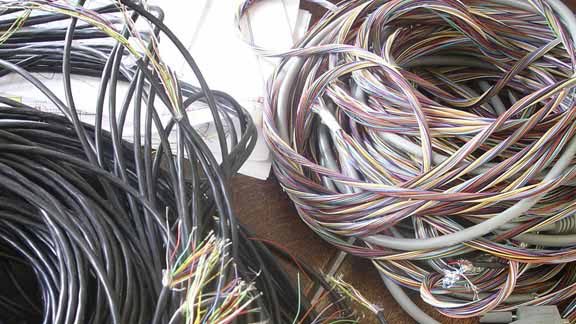
[Images: 7.5km of LED wiring plus “a last view of the lush multicoloured universe of RS232 DMX cables” required for the LightHive].

In any case, this would not be the first time Haw has explored the artistic application of surveillance technology.
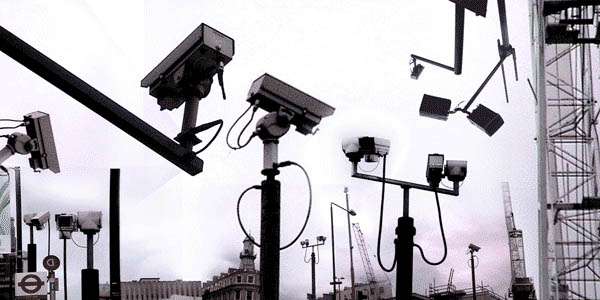
His 2005 film CCLTV, for instance, took a long look at “the astonishing density of CCTV positions along the Euston Road” in London; and Haw wrote an article for AA Files a few years back on the increasingly Panoptic use of surveillance cameras in the greater London area.

[Image: From CCLTV, a film that exposes “the astonishing density of CCTV positions along the Euston Road”; directed by Alex Haw].

Loads of more info – including some technical specifics – about the LightHive can be found over on Marc Fornes‘s site.
And if you managed to see the hive itself in action last week, let me know how it was…

(Thanks to Alex Haw for the tip).

God is Light

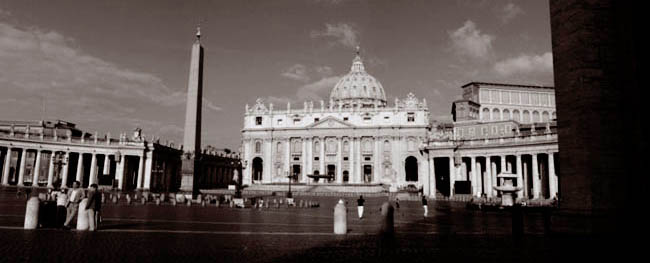
As if tapping into a rival spiritual tradition, Pope Benedict XVI will soon become “the first pontiff to harness solar power to provide energy for the Vatican,” according to the BBC. “The deteriorating cement roof tiles of the Paul VI auditorium will be replaced next year with photovoltaic cells to convert sunlight into electricity.”
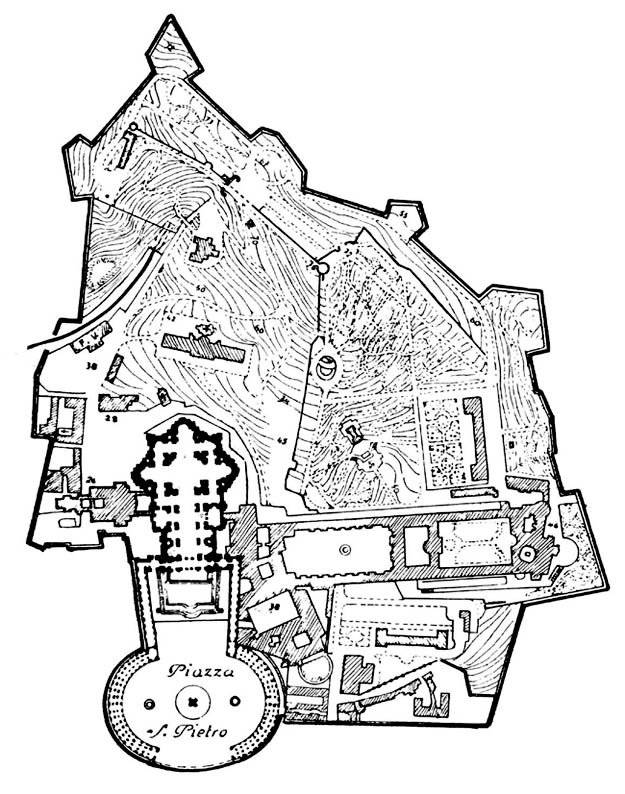
The BBC’s all too short news item goes on to report that the Vatican “is considering placing solar panels on other buildings although St Peter’s Basilica and other historical landmarks will not be touched.”
But why not touch them?
Solar-powered cathedrals lining the bombed-out fields of Europe! How much more spiritually energizing can you get than plugging directly into that ongoing hydro-helium reaction in space? Teaching theology by the contained light of solar flares – astral disasters captured flashing, as power surges down consecrated halls of painted saints. Frescoes gleam.
Christianity meets Mithraism in architectural form.
John 8:12 – I am the Light of the World – taken literally. In fact, the whole book of John is arguably about the solar power industry.

In any case, are solar panels the new stained glass windows?
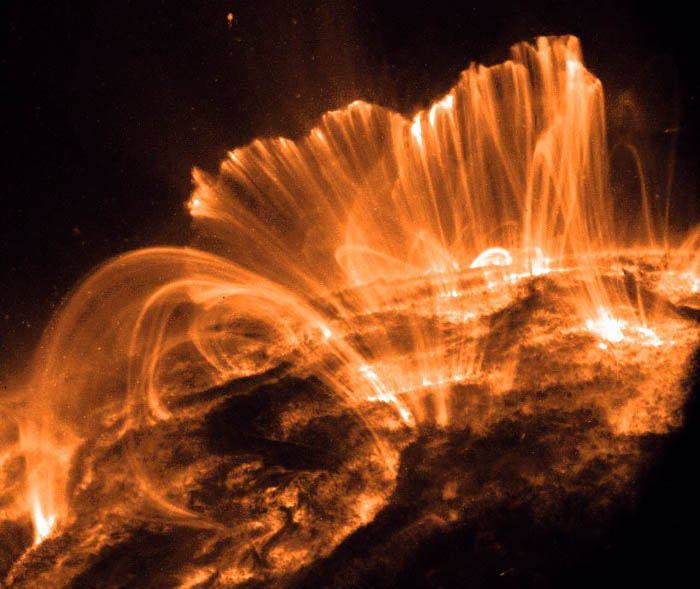
And might Christianity be subtly transformed by this encounter with the celestial realm? Apollonian light burning where there once were candles?
After all, Christianity has been turning its doctrinal face away from the stars for far too long.

Imagine this heaving, propulsive thing lighting up cathedrals and prayer books! Shining in libraries and guiding pilgrims through churches, casting shadows in the courtyards of monks. Christendom should have been solar-powered all along – installing astronomical monstrosity at the very heart of the Catechism.
Seriously, though, do the metaphoric implications of the Vatican going solar outweigh any sort of practical message we might otherwise gain from this bit of news?
Isn’t solar power a major doctrinal shift for contemporary Christianity?
Can everyday technology truly embody religious ideals?

(Earlier on BLDGBLOG: In space, no one can hear you pray and The Heliocentric Pantheon: An Interview with Walter Murch).